
Business
Strategy Inc Stock Rises 5% to $139 on Fresh Bitcoin Purchases and Bitcoin Rally Momentum

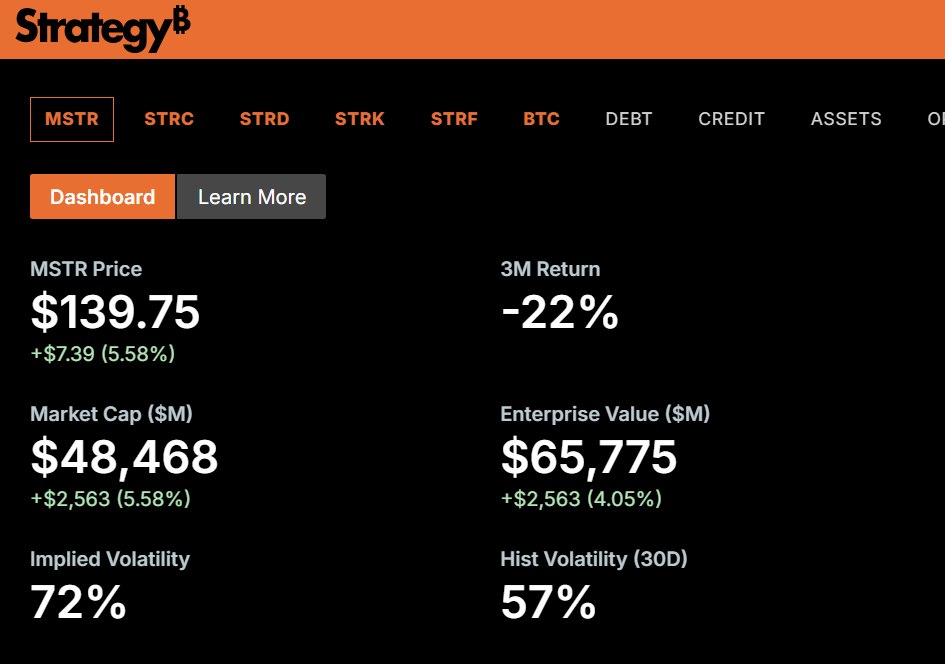
NEW YORK — Shares of Strategy Inc. climbed more than 5% in early trading Tuesday as the company formerly known as MicroStrategy continued its aggressive Bitcoin accumulation strategy, with Bitcoin prices rebounding above $74,000 and investors positioning ahead of the firm’s first-quarter 2026 earnings later next month.

Strategy Inc. (NASDAQ: MSTR), which rebranded to emphasize its role as a Bitcoin treasury powerhouse, saw its Class A shares trade at $139.46, up $7.10 or 5.36%, shortly after the market open on April 14, 2026. The gain came on solid volume and reflected renewed enthusiasm for Bitcoin proxy stocks as the cryptocurrency recovered from recent dips and hovered near $74,900.
The company, led by Executive Chairman Michael Saylor, has transformed into one of the largest corporate holders of Bitcoin, using a combination of equity offerings, convertible debt and operational cash flow to steadily add to its holdings. In recent weeks, Strategy executed multiple large Bitcoin purchases, including a $1 billion acquisition announced in early April that brought its total stash close to 780,000 BTC.
Strategy announced on April 13 that it acquired an additional 13,927 Bitcoin for approximately $1 billion during the previous week, funded partly through sales under its at-the-market equity offering program. The purchase pushed its Bitcoin treasury even closer to the symbolic 800,000 BTC milestone. The company has consistently messaged that its primary corporate strategy is to acquire and hold Bitcoin as a long-term store of value superior to cash reserves.
Bitcoin traded around $74,896 on Tuesday morning, up from levels near $70,000 earlier in the week. The cryptocurrency’s recovery helped lift related stocks, with Strategy often exhibiting amplified moves due to its leveraged exposure through heavy Bitcoin holdings relative to its market capitalization.
Strategy is scheduled to release first-quarter 2026 financial results on May 7, with a live video webinar and earnings conference call set for April 30 at 5 p.m. ET. Analysts expect the report to focus heavily on Bitcoin treasury updates, impairment charges or gains related to digital asset accounting, software business performance and details on ongoing capital raising activities.
The software analytics business, Strategy’s original core operation, continues to generate steady revenue but has become secondary to the Bitcoin strategy in the eyes of many investors. Fourth-quarter 2025 results, released in early February, showed revenue of $122.99 million that beat estimates, though the company reported a significant net loss driven largely by Bitcoin-related accounting.
Strategy maintains a massive Bitcoin balance sheet that has drawn both praise and criticism. Proponents view it as a sophisticated leveraged play on Bitcoin’s long-term appreciation, while skeptics point to volatility, potential dilution from equity issuances and the opportunity cost of tying up capital in a non-yielding asset.
In recent months, the company expanded its at-the-market offerings and issued preferred stock to fund Bitcoin acquisitions without overly diluting common shareholders. It also benefits from periodic convertible note issuances that provide low-cost capital for further purchases.
Wall Street analysts remain divided but largely constructive on the stock’s long-term potential as a Bitcoin play. Consensus price targets vary widely, with some firms maintaining targets above $350 while others have trimmed forecasts amid valuation concerns. The stock has experienced extreme swings in 2026, trading as high as the $450 range earlier and pulling back significantly before recent recovery attempts.
Tuesday’s move helped the shares rebound from levels near $128 seen in recent sessions. Technical traders noted the stock testing key support and resistance zones tied to Bitcoin’s price action.
Michael Saylor, the public face of the strategy, continues to advocate aggressively for Bitcoin adoption through social media and public appearances. He has described Strategy’s approach as a “Bitcoin standard” for corporate treasuries, arguing that holding the asset provides superior inflation protection and capital appreciation compared with traditional reserves.
The company’s rebranding to Strategy Inc. underscores its evolution from a business intelligence software provider to a Bitcoin development and treasury company. While the software segment still contributes revenue, management has signaled that Bitcoin acquisition remains the overriding corporate priority.
Challenges include regulatory scrutiny of digital asset accounting, potential changes in tax treatment of cryptocurrencies and the inherent volatility of Bitcoin, which can lead to large quarterly swings in reported earnings. Strategy accounts for its Bitcoin holdings under fair value rules, resulting in significant non-cash gains or losses that can obscure underlying business performance.
Investors will watch the upcoming earnings closely for any updates on the pace of Bitcoin purchases, average acquisition cost, financing plans and guidance on software revenue trends. Management may also provide color on the broader Bitcoin market outlook and how macroeconomic factors influence its strategy.
Strategy’s market capitalization reflects its unique positioning as the most prominent corporate Bitcoin holder. With holdings approaching 800,000 BTC — a figure that would represent a meaningful percentage of total Bitcoin supply — the company effectively offers investors leveraged, liquid exposure to the cryptocurrency without directly owning it.
Broader market sentiment toward risk assets improved Tuesday as Bitcoin stabilized and equity markets showed resilience. Strategy often moves in sympathy with Bitcoin but with higher beta, amplifying both upside and downside.
The company has faced periodic class action litigation related to disclosures and stock performance, though such suits are common among high-volatility names. Strategy has not commented in detail on ongoing legal matters in recent filings.
As the May 7 earnings date approaches, focus will intensify on execution of the Bitcoin strategy and any signals about future capital raises or acquisition pace. Positive Bitcoin price action combined with continued accumulation could support further upside in the shares.
Strategy Inc. employs a relatively lean team focused on both its legacy software products and Bitcoin treasury management. Its headquarters remain in the Washington, D.C., area, where it originated as a provider of enterprise analytics tools.
For long-term believers in Bitcoin, Strategy serves as a proxy that allows participation through traditional equity markets with the added layer of corporate leverage and professional management. Critics argue the premium valuation leaves little margin of safety if Bitcoin enters a prolonged bear market.
Tuesday’s 5%+ gain underscored ongoing investor appetite for the name despite recent volatility. With Bitcoin trading firmly above $74,000 and Strategy actively adding to its holdings, the stock appeared positioned for continued correlation with crypto sentiment.
As markets digest the latest Bitcoin purchase news, attention turns to whether Strategy can sustain its aggressive accumulation without excessive dilution and how the market prices in the growing scale of its treasury.
Strategy’s journey from software firm to Bitcoin powerhouse illustrates the transformative impact of cryptocurrencies on corporate balance sheet strategies. Whether this approach delivers superior long-term returns will be judged by Bitcoin’s performance over the coming years and the company’s ability to manage associated risks.

Business
Inflation risk more persistent than growth shock, says Tanvee Gupta Jain amid oil price surge

Speaking on ET Now, she underlined that the Middle East conflict represents “a historically large energy shock with an asymmetric macro risk,” adding that high-frequency indicators are already signalling a moderation in momentum.
Growth momentum softens as activity indicators weaken
Gupta Jain pointed to internal indicators tracking economic momentum, noting a divergence between demand and activity trends.She said, “As you rightly pointed out, this Middle East conflict represents a historically large energy shock with an asymmetric macro risk. In fact, we have a lead indicator known as UBS India Composite Economic Indicator, which is basically a compilation of 15 high frequency data points on India. And this is telling me that for the month of March, economic momentum has started to moderate.”

However, she highlighted resilience in consumption demand even as broader activity cools.
“If I look at the auto sales data for the month of March, even for the month of April, the demand indicators are actually holding up. The activity indicators have started to moderate and that is where the problem is because supply disruptions is having a disproportionate impact on selective sectors.”
GDP forecast cut to 6.2%, downside risks remain open
The growth forecast has been revised downward, incorporating both external energy shocks and domestic monsoon uncertainty.
“We are now estimating GDP growth from 6.7% which was our estimate earlier to 6.2%. This is almost 50 basis point below consensus and this is actually taking into account both the external shock on account of the energy and as well as monsoon related uncertainty,” she said.
She added that scenarios remain highly fluid:
“In case the conflict deescalates quickly and from June onwards we start to see oil starting to flow through the Hormuz, there will be upside towards 6.5% to my GDP growth forecast. But in an extended energy shock scenario where say oil is at $150, eventually India’s GDP can even slow down to 5–5.5%.”
Supply-side stress visible; demand impact likely delayed
On transmission of shocks, Gupta Jain noted that supply-side disruptions are already visible in data, while demand tends to respond with a lag.
“I can clearly see fertiliser production contracting by nearly 25% year-on-year. We did realise that now the gas supply to the fertiliser sector was actually adjusted higher in the month of April, so that would have provided some relief,” she said.
She added that demand resilience may not last indefinitely if supply pressures persist.
“Supply disruptions at least in the data is already visible. Demand side data points when you start seeing a slowdown, it should happen with at least a quarter lag.”
Inflation concerns rise; CPI forecast revised upward
While growth risks remain significant, inflation appears to be the more persistent macro challenge.
“Even if there is a quick deescalation, the inflation concerns could linger a bit longer than the growth concerns,” she said.
The CPI inflation forecast has been revised higher.
“We have also revised our CPI inflation forecast from 4.6% which we were estimating earlier to 5.2%. This is reflecting both higher energy prices plus the broader spillover from the Middle East conflict.”
She flagged multiple inflationary triggers already visible:
“Airfare prices have started going up driven by elevated ATF prices, prices because of higher commercial LPG cost, there are supply chain disruptions on the ground. Rupee has underperformed and there are inflation risks coming because of weaker INR.”
Fiscal pressure manageable, but risks of overshoot remain
On the fiscal side, Gupta Jain said policy response has leaned more on fiscal tools in the current global stagflation-like environment.
“We have seen that the policy mix has actually tilted towards fiscal rather than monetary,” she noted.
She added that while the official fiscal target remains largely intact, risks persist if energy disruptions continue.
“The central government targeted a fiscal deficit of 4.3% of GDP. My starting point of fiscal deficit is coming at 4.4% of GDP. As of now, we are seeing that the government might actually stick to the 4.4% GDP fiscal deficit target. There is definitely a risk of temporary overshoot of around 20 to 30 basis points if the energy disruptions persist for longer.”
Outlook: Inflation to outlast growth shock
Even in a scenario of geopolitical de-escalation, Gupta Jain believes inflation pressures may prove stickier than growth disruptions, with food inflation and currency weakness emerging as key watchpoints for policymakers in the coming quarters.

Claire Tyrrell and Ella Loneragan discuss the growth of Perth’s large format retail sector.

HM Revenue & Customs has suffered a major blow in one of the longest-running and most consequential employment status disputes in British tax history, with a tribunal ruling that 60 football referees engaged by the Professional Game Match Officials Limited (PGMOL) were genuinely self-employed, not employees, as the tax authority had insisted for almost a decade.
The decision, handed down at the First-tier Tribunal, means HMRC will be denied £584,000 in employment taxes it had argued were owed. The department retains the right to appeal, but the verdict has already been seized upon by tax specialists as a potentially seismic moment for the millions of contractors, freelancers and businesses operating in the UK’s flexible labour market.
Specialist contractor insurance provider Qdos described the outcome as one of the most significant employment status rulings in history, warning that it lays bare a “fundamental flaw” in HMRC’s own Check Employment Status for Tax (CEST) tool, the digital instrument introduced in 2017 and used millions of times to determine whether a worker should be taxed as employed or self-employed.
The case turned on two principles long regarded as the bedrock of employment case law: mutuality of obligation (MOO), whether a worker is obliged to accept work and the engager obliged to provide it, and control, namely the extent to which a business directs how services are performed. The tribunal ruled that referees were neither mutually obliged to work for PGMOL nor sufficiently controlled in how they performed their duties to be classed as employees.
Seb Maley, chief executive of Qdos, said the ruling directly undermines HMRC’s interpretation of the very rules it polices.
“This landmark verdict directly challenges HMRC’s very understanding of employment status, exposing a fundamental flaw in the tax office’s employment status tool, which is in desperate need of an overhaul,” he said.
“For years, HMRC has insisted that mutuality of obligation exists in every contract, so much so that its CEST tool barely scratches the surface on it. The latest twist in this case highlights the need for a rigorous review of CEST, which has been used millions of times to set the employment status of individuals, in turn determining whether they pay tax as a self-employed worker or employee.”
Maley added that the result should reassure firms that engage contractors. “Make no mistake, this result is good news for businesses that engage contractors and self-employed workers, ultimately because it proves that factors like mutuality of obligation and control really aren’t as narrow as HMRC has been contending.”
He also took aim at the sheer length of the proceedings. “With the first hearing in 2018, we’re nearly a decade into this case, the result of which could yet be appealed. If that doesn’t highlight the desperate need for the simplification of employment status, I don’t know what does. With a government consultation on the matter underway, it’s vital that verdicts like this, which put people through hugely stressful ordeals and cost the taxpayer a staggering amount, are taken into account.”
A decade in the courts
The dispute stretches back to PGMOL’s engagement of referees as self-employed contractors during the 2014/15 and 2015/16 tax years. HMRC opened the first front in 2018, arguing at the First-tier Tribunal that the officials should have been treated as employees because they were mutually obliged to work for PGMOL.
The FTT disagreed, finding insufficient mutuality of obligation. HMRC appealed and lost again at the Upper Tribunal in 2020, which upheld the original ruling that the minimum test for employment had not been met.
A further HMRC appeal took the case to the Court of Appeal in 2022, which reversed the earlier decisions and concluded that mutuality of obligation did exist on each match day, sending the dispute back to the FTT for reconsideration.
PGMOL escalated matters to the Supreme Court in 2024, where its appeal was dismissed, again sending the case back to the FTT. It is at this latest hearing that PGMOL’s position has now finally been vindicated, with the judge ruling that the referees were neither mutually obliged to work nor sufficiently controlled by PGMOL to be employees.
For Britain’s SME community, which leans heavily on freelance and contract labour, the decision is more than a footnote in a niche sporting dispute. It strikes at the heart of how HMRC interprets and enforces the very employment status rules it designed, and adds further pressure on Whitehall to deliver the long-promised simplification of a system that has tied businesses, workers and the courts in knots for years.

Jamie Young
Jamie is Senior Reporter at Business Matters, bringing over a decade of experience in UK SME business reporting.
Jamie holds a degree in Business Administration and regularly participates in industry conferences and workshops.
When not reporting on the latest business developments, Jamie is passionate about mentoring up-and-coming journalists and entrepreneurs to inspire the next generation of business leaders.

Australia’s share market has pared back some early losses after falling to its lowest level in a month, with a Reserve Bank rate hike and the ongoing Persian Gulf conflict gutting investor confidence.

Britain’s over-50s are paying the heaviest price for Labour’s workers’ rights overhaul, with the number of older jobseekers unable to find work climbing by 22 per cent since 2023, according to the latest figures.
Just shy of a million workers aged 50 and above are currently locked out of the labour market, the latest Labour Force Survey data shows, with the age group consistently registering the highest rates of redundancy across the workforce.
Some 917,000 people aged 50 to 66 are unable to find a job, rising to 996,743 once those aged 66 to 70, many of whom remain keen to work despite being eligible for the state pension, are included.
Industry leaders have laid the blame squarely at the door of the Employment Rights Act and the Chancellor’s increase in employer National Insurance contributions (NICs), arguing that the combined cost has made firms markedly more cautious about taking on new hires, particularly more experienced and therefore more expensive ones.
“Older workers, likely on higher salaries than their Gen Z colleagues, have borne the brunt of businesses reassessing their hiring strategies,” said Kevin Fitzgerald, UK managing director at jobs platform Employment Hero.
Alex Hall-Chen of the Institute of Directors echoed the concern, pointing to the Employment Rights Act, the rise in employer NICs and successive increases to the minimum wage as a triple blow that has dampened employer appetite for risk.
Although the Act’s provisions apply to workers of all ages, several measures hit older employees disproportionately hard in practice. The scrapping of the cap on payouts for successful unfair dismissal claims is widely expected to prove costlier in cases involving over-50s, who tend to command higher salaries and whose tribunal awards are typically calculated as multiples of pay.
The Act’s expanded right to request changes to hours or location, particularly where employees are juggling health conditions or caring responsibilities — is also likely to be invoked more frequently by workers in their 50s and 60s, many of whom are supporting elderly parents or managing their own long-term conditions.
Compounding the picture are structural shifts beyond Westminster’s control. The rapid adoption of artificial intelligence across white-collar roles and the lingering hangover from the post-Covid jobs downturn have together hollowed out mid-to-senior positions that older workers have traditionally relied upon.
Lyndsey Simpson, founder of career-coaching platform 55/Redefined, said the fallout from losing a senior or well-remunerated role in one’s 50s can be devastating and long-lasting.
“That’s why people are ‘age-scrubbing’ their CVs. They remove dates, hide early roles and play down seniority because they know age can work against them before they even get an interview,” she said.
Dr Andrea Barry of the Centre for Ageing Better warned that the scale of the crisis among older workers is now comparable to the much-discussed plight of young people not in education, employment or training (Neets), yet receives a fraction of the attention.
“The Government is right to invest in solutions for the current youth employment crisis, but the labour market is in crisis at both ends of the age range and on a similar scale,” she said.
For SME employers already grappling with rising payroll costs, tightening tribunal exposure and the spectre of further regulation, the temptation to play it safe at the recruitment stage is proving difficult to resist, and it is Britain’s most experienced workers who are bearing the cost.

New research has shown a 28% growth in shops selling vape products in Scottish towns and cities.

Allspring is a company committed to thoughtful investing, purposeful planning, and the desire to elevate investing to be worth more. Allspring is reimagining investment management to be worth more—creating an investment, distribution, and operational experience that changes the game for clients. Note: This account is not managed or monitored by Allspring, and any messages sent via Seeking Alpha will not receive a response. For inquiries or communication, please use Allspring’s official channels.

Thungela executives sell shares to cover tax on vested awards

OPINION: It’s time to focus on downsizers, who hold the key to resolving WA’s housing crisis.

I graduated from the University of Western Australia in 1984 with a degree in electronic engineering and from 1984 until 1998 worked in the commercial construction industry as an engineer, a project manager and an operations manager.
I began investing in the stock market 2 months prior to the 1987 stock market crash and thus quickly learned about the downside potential of stocks. Only slightly daunted by the rather inauspicious timing of my entry into the world of financial market investments, my interest in the stock market grew steadily over the years.
In 1993, after studying the history of money, the nature of our present-day fiat monetary system and the role of banks in the creation of money, I developed an interest in gold. Another very important lesson soon followed: gold may be the ideal form of money for those who believe in free markets and a wonderful hedge against the inherent instability of the government-imposed paper currencies, but it is not always a good investment.
By mid-1998 the time and money involved in my financial market research/investments had grown to the point where I was forced to make a decision: scale back on my involvement in the financial world or give up my day job. The decision was actually quite an easy one to make and so, at the beginning of 1999, I began investing/trading on a full-time basis.
My major concern in deciding to pursue a career in which I devoted all of my time to my own investments was that I would miss the personal interaction that had been part and parcel of my business management career. The Speculative Investor (TSI) web site was launched in August of 1999 as a means for me to interact with the world by making my analysis/ideas available on the Internet and inviting feedback from others with similar interests.
During its first 14 months of operation the TSI web site was free of charge, but due to the site’s growing popularity I changed it to a subscription-based service in October of 2000. Its popularity continued to grow, although I remained — and remain to this day — a professional speculator who happens to write a newsletter as opposed to someone whose overriding focus is selling newsletter subscriptions.
My approach is ‘top down’; specifically, I first ascertain overall market trends and then use a combination of fundamental and technical analysis to find individual stocks that stand to benefit from these broad trends. This approach is based on my experience that it’s an order of magnitude easier to pick a winning stock from within a market or market sector that’s immersed in a long-term bullish trend than to do so against the backdrop of a bearish overall market trend. Fortunately, there’s always a bull market somewhere.
I’ve lived in Asia (Hong Kong, China and Malaysia) since 1995 and currently reside in Malaysian Borneo.

7 Greatest Spaghetti Western Heroes, Ranked

Cash stolen and door smashed in post office break-in
Inflation risk more persistent than growth shock, says Tanvee Gupta Jain amid oil price surge

Manchester United reach agreement with Casemiro over contract clause amid transfer speculation

US brings back mandatory military draft registration

Steven Gerrard disagrees with Gary Neville over ‘shock’ Chelsea and Arsenal claim | Football


-

 Business6 days ago
Most Commercial Energy Audits Miss the Real Losses
-

 Fashion6 days ago
Kylie Jenner’s KHY Enters a New Era with ‘Born in LA’
-

 NewsBeat2 days ago
Channel 5 – All Creatures Great and Small series 7 new post
-
 Tech4 days ago
Trump’s 25% EU auto tariff breaches Turnberry Agreement that also covers semiconductors and digital trade
-
 Sports4 days ago
Paul Scholes issues Marcus Rashford reality check as agreement emerges over Man United star
-

 Crypto World7 days ago
CFTC’s AI will review U.S. crypto registration applications, chairman tells CoinDesk
-

 Business6 days ago
Barclay Brothers Avoid Bankruptcy: HSBC Drops High Court Petitions After IVA Deal
-
 Business6 days ago
Tesla Officially Registers Elon Musk’s Stock: What Investors Need to Know
-
 Crypto World7 days ago
Robinhood Phishing Scam Exploits Gmail Dot Feature to Bypass Security
-

 Tech7 days ago
Get Ready for More Brain-Scanning Consumer Gadgets
-

 Tech6 days ago
Texas Instruments made a new flagship graphing calculator: the TI-84 Evo
-

 Business4 days ago
Two Powerball Tickets Split $143 Million Jackpot in Indiana and Kansas
-
 Crypto World4 days ago
CoreWeave (CRWV) Stock Climbs 8% Despite $45M Insider Share Dump
-
Business2 days ago
Winning Numbers Drawn as Jackpot Resets to $20 Million
-
Crypto World5 days ago
Securitize and Computershare Enable Tokenized Equity Issuance for Over 25,000 U.S.-Listed Stocks
-

 Crypto World5 days ago
Gibraltar Proposes Tokenized Funds Regulation to Bolster Compliance
-

 Fashion2 days ago
Mary J. Blige Vegas Residency Looks: Crystal-Embellished Fjolla Haxhismajli, Todd Fisher, and More!
-

 Tech5 days ago
Official SAP npm packages compromised to steal credentials
-

 Tech7 days ago
Acer Swift 16 AI (2026) Review: Where Do Your Hands Go?
-

 Sports6 days ago
Antrim GAA: Hurlers cancel training as row with board deepens
You must be logged in to post a comment Login