
Business
Thailand’s Electronics Investment Surges past $30 Billion as It Powers into Next-Gen Chips and AI


- Thailand’s electronics sector has attracted over $30.5 billion in investment since 2023, with about a third concentrated in printed circuit boards and electronic components across 224 projects. This growth reflects global manufacturers expanding AI hardware and semiconductor packaging operations in Southeast Asia, highlighted at the THECA 2026 summit in Bangkok, which will host over 300 companies and 7,000 delegates.
- Thai policymakers are pursuing structural reforms to escape the middle-income trap and boost competitiveness rankings, with the Board of Investment shifting focus toward high-value sectors, workforce development, and global supply chain integration. Thailand’s selection to host ECWC17 in 2027 and industry emphasis on knowledge transfer and specialized talent further signal its growing role in global electronics manufacturing.
Thailand’s electronics sector has secured over $30.5 billion (1 trillion baht) in investment since 2023. Roughly a third of this capital—exceeding $10.1 billion (331 billion baht) across 224 projects—is concentrated in printed circuit boards (PCBs) and electronic components, driven by global manufacturers scaling their footprint in AI hardware and advanced semiconductor packaging across Southeast Asia.
The investment momentum takes center stage at the Thailand Electronics Circuit Asia (THECA 2026) summit at Bangkok’s BITEC exhibition center, which convenes more than 300 global tech enterprises and 7,000 international delegates across 40 nations. The summit’s program includes more than 60 conference sessions spanning AI infrastructure, the semiconductor ecosystem, photonics, advanced packaging, PCBs, and electronics manufacturing services. The event reinforces the accelerating realignment of critical electronics manufacturing toward Southeast Asia amid ongoing global supply chain diversification.
The technological drive comes as Thai policymakers accelerate structural reforms aimed at overcoming the middle-income trap, lifting the country’s global competitiveness ranking into the world’s top 20, and driving annual gross domestic product growth.
With the electronics sector serving as a primary economic engine, the Thailand Board of Investment (BOI) is shifting its focus from basic capital attraction to maximizing national competitiveness. The agency’s four-pillar framework prioritizes high-value and high-potential sectors, enhances Thailand’s readiness for leading multinationals, deepens local economic benefits by upskilling the workforce and fortifying domestic supply chains, and builds international cooperation to connect Thai firms to global production networks.
“The investments flowing into Thailand’s electronics sector today are fundamentally different from those of three decades ago,” said Mr. Narit Therdsteerasukdi, Secretary General of the Thailand Board of Investment (BOI). “They are driven by frontier technologies, proprietary knowledge, and highly skilled labor. Our objective is not merely keeping pace with global technology, but anchoring Thailand as an indispensable co-creator of the future global supply chain.”
Thailand’s selection to host the 17th Electronic Circuits World Convention (ECWC17) in August 2027 — a triennial flagship event that rotates among the world’s premier electronics manufacturing economies — further underscores the country’s rising clout in global electronics manufacturing.
Industry leaders note that surging demand for edge computing, smart mobility, and artificial intelligence is reshaping regional manufacturing footprints.
“In an era dominated by rapid breakthroughs in AI, advanced packaging, and semiconductors, competitive advantage is no longer determined by brute manufacturing capacity alone,” said Mr. Canice Chung, Chairman of the Hong Kong Printed Circuit Association (HKPCA), a co-organizer of the event. “It hinges on international knowledge transfer, cross-border research cooperation, and developing specialized technical talent.”


Wealth managers are asking investors with sizeable mutual fund portfolios to allocate some money to SIFs, citing their tax efficiency and differentiated strategies.
“SIFs offer greater flexibility through strategies such as long-short investing, dynamic asset allocation, sector rotation and hedging and should be used to complement core portfolios,” says Sandeep Seth, founder & CEO, SIF360.com,
Fund houses have launched SIFs across hybrid long-short, equity long-short and equity ex-Top 100 long-short strategies. Assets under management of SIFs reached ₹23,177 crore as of July 31, with 95,000 investors and an average ticket size of ₹21 lakh. Hybrid SIFs accounted for ₹16,523 crore, or 71%, of the total assets under management.
 ET Bureau
Wealth managers asking investors with large MF portfolios to put money in SIFs too
Within SIFs, wealth managers are starting with hybrid long-short strategies, which they believe work well for conservative investors seeking tax efficiency and slightly higher returns than bank deposits or debt mutual funds over a one-to-three-year period. They prefer to wait for a track record of around a year to assess performance and consistency before recommending equity-oriented SIFs.

Some hybrid SIF strategies have negligible exposure to unhedged equity. These strategies invest through a mix of arbitrage, special situations, pair trades, covered calls, straddles, strangles and put-call parity, and could work for investors seeking tax efficiency in their fixed-income allocation.
Read more: Ventura initiates coverage on Meesho and LG India, sees up to 35% upside“Hybrid SIF strategies that are low on equity can earn 1-2% more than deposits or debt funds with high tax efficiency,” says Juzer Gabajiwala, director, Ventura Securities. Investors in hybrid SIFs who remain invested for more than 12 months are charged a long-term capital gains tax of 12.5%. In comparison, investors in fixed deposits or debt funds pay tax at their applicable slab rates, which exceed 30% in the case of high-income investors.
Fund managers, however, said investors need to understand the risks involved, as some SIFs can have a high proportion of their portfolios in unhedged equities or carry credit risk.
“Investors should look at the return, standard deviation, maximum drawdown and beta, to understand the risk that a SIF takes,” says Radhika Gupta, MD & CEO, Edelweiss Asset Management.
 as a Reliable and Trusted News Source
Business
Ramsay Health Care Shares Rocket 14% to Record High as Investors Cheer Turnaround and European Spinoff Plan
SYDNEY — Shares of Ramsay Health Care Ltd surged more than 14% Wednesday, closing at $50.29, up $6.27 on the day, as investors piled into Australia’s largest private hospital operator ahead of its full-year earnings release and amid growing optimism over a planned spinoff of its European business.
The rally pushed the stock to a fresh high, extending a run that has seen shares climb steadily through 2026 as the Sydney-based company works through a multiyear turnaround built around cost discipline, capacity expansion in Australia and a restructuring of its troubled international operations.
Ramsay, which operates roughly 72 private hospitals and day surgery units across Australia along with facilities in the United Kingdom, France and the Nordic region, is scheduled to release its full fiscal 2026 results this week, a report investors have been watching closely for signs the company’s recovery is gaining traction.
Momentum built through the year
Wednesday’s jump builds on a pattern investors have seen before. When Ramsay released its half-year results in February, underlying net profit after tax rose 8.1% to $171.7 million, with underlying earnings before interest and tax up 7.3%, driven largely by an 8.2% revenue increase in its core Australian hospital business. That report sent shares up more than 10% in a single session.
“After 12 months in the role, I’m pleased to report that we’re making good progress on our key priorities,” Ramsay chief executive Natalie Davis told analysts on the company’s half-year earnings call in February, according to a transcript of the call.
The company’s Australian division has been the primary engine of that progress, benefiting from higher patient activity, improved capacity utilization at its hospitals and stronger private health insurance indexation. Ramsay has also been opening new theatres and procedure rooms, part of a broader capital investment program the company has said will continue through fiscal 2026, even as it lowered its overall group capital expenditure guidance to between $755 million and $795 million for the year.
Overseas, the picture has been more mixed. Ramsay’s UK acute hospital business has been managing tighter National Health Service budget constraints, while its French and Nordic operations under Ramsay Santé have faced persistent government funding pressure and thin tariff indexation relative to cost inflation.
A European spinoff takes shape
Much of Wednesday’s enthusiasm also traces back to a restructuring plan Ramsay unveiled earlier this year. In February, the company announced a proposal to distribute its 52.79% stake in Ramsay Santé, its European healthcare arm, directly to Ramsay Health Care shareholders through an in-specie distribution, pending approval.
Ramsay Santé’s own board met Wednesday to review provisional annual results for the year ended June 30, 2026, according to a company statement, with final audited figures due for approval by its board in October. The French unit also confirmed it completed a refinancing of its senior debt in July, a move it said would strengthen its financial flexibility and support long-term strategic plans.
The proposed separation would mark a significant simplification of Ramsay’s corporate structure, allowing the Australian parent to focus more squarely on its higher-margin domestic hospital network while giving shareholders direct exposure to the European business, which has weighed on group earnings in recent years through impairments and subdued profitability.
Analysts had been positioning for a beat
Even before Wednesday’s surge, analysts had grown more constructive on the stock. A recent rating tracked by TipRanks pegged Ramsay as a “Buy” with a price target of $47.60, a level Wednesday’s close now exceeds. Separate analysis from Simply Wall St estimated the stock’s fair value near $55.12, noting shares had already risen roughly 13% over the prior 90 days heading into this week’s results.
Trading platforms had also flagged Thursday, Aug. 27, as the date for Ramsay’s full-year results release on the Australian Securities Exchange, a filing that would give investors their clearest look yet at how the turnaround strategy performed across a full 12 months, including the critical earnings contribution from the Australian business over the back half of the fiscal year.
Wall Street-style earnings estimates compiled by financial data providers had projected fiscal 2026 earnings per share of roughly 95 cents, with a further rise to $1.13 forecast for fiscal 2027, alongside expected revenue of about $13.56 billion for the current year, climbing to roughly $14.11 billion the following year.
Governance changes underway
The rally also came against a backdrop of board renewal at the company. Ramsay recently disclosed that non-executive director Claudia Süssmuth Dyckerhoff will retire effective Aug. 31 after eight years on the board, including service on its risk management committee. Chair David Thodey credited her international healthcare experience in a statement announcing the departure, while the company said ongoing board renewal remains central to its governance strategy.
What comes next
For a stock that has spent much of the past several years under pressure — weighed down by pandemic-era disruptions, UK funding constraints and impairments tied to its European mental health operations — Wednesday’s move signals renewed investor confidence that the worst may be behind the company.
Attention now turns to Thursday’s scheduled results release, where investors will look for confirmation that the momentum seen in the first half carried through the year, along with further detail on the timeline and mechanics of the Ramsay Santé distribution. The company has also flagged a full-year dividend payout ratio target of 60% to 70% of underlying net profit after tax, a figure that will be closely watched alongside the headline earnings numbers.
Ramsay Health Care has not issued a statement specifically addressing Wednesday’s share price move.


My background is in Financial Engineering and I have long since been interested in analyzing strong solid companies with a rare financial Profile. My primary area of specialization is in quantamental analysis, where I use a combination of data driven models and fundamental research. My approach is centered on a structured process that combines top-down screening with bottom-up company specific analysis .I write on to share ideas with a wider audience and also learn more about companies and other analysts. My goal is to make unique ideas & research accessible to retail and professional investors alike, while maintaining analytical depth and a clear investment thesis.Associated with another author Kennedy Njagi
Analyst’s Disclosure: I/we have no stock, option or similar derivative position in any of the companies mentioned, but may initiate a beneficial Long position through a purchase of the stock, or the purchase of call options or similar derivatives in TPC over the next 72 hours. I wrote this article myself, and it expresses my own opinions. I am not receiving compensation for it (other than from Seeking Alpha). I have no business relationship with any company whose stock is mentioned in this article.
Seeking Alpha’s Disclosure: Past performance is no guarantee of future results. No recommendation or advice is being given as to whether any investment is suitable for a particular investor. Any views or opinions expressed above may not reflect those of Seeking Alpha as a whole. Seeking Alpha is not a licensed securities dealer, broker or US investment adviser or investment bank. Our analysts are third party authors that include both professional investors and individual investors who may not be licensed or certified by any institute or regulatory body.
Yes. Corporate subscriptions are available for teams and organisations, with discounted rates as user numbers increase. Pricing starts from $1,625 + GST per user.
Get in touch
to discuss the right option for your organisation.
Business News subscriptions are used by executives, investors, consultants and professionals who need to stay informed and make better decisions about the WA market. When you subscribe you’ll get
- Unlimited access to WA’s most trusted business journalism
- Data & Insights — detailed profiles of WA companies, people, projects and deals
- MyBN — a personalised feed based on the companies, people and sectors you follow
- Special publications and industry reports
- Daily and weekly email newsletters
Data & Insights is a research tool built specifically for the WA market. It draws on more than 30 years of Business News reporting, updated regularly to reflect what’s happening now. Use it to:
- Look up detailed profiles of WA companies, including financials, directors and ownership
- Find decision-makers and track their career movements
- Research live and completed projects across WA industries
- Monitor deals, appointments and market activity
- Access industry rankings and league tables
Data & Insights is updated daily by our dedicated research team, which uses the latest announcements, ASX filings and editorial coverage to keep our person, company, list and project records up to date.
Business News welcome all opportunities to make our dataset accurate, complete and current, so if you have an update request, please email the team at
general@businessnews.com.au, and we’d be happy to assist.
MyBN
is part of every subscription. It’s your personalised view of Business News. You can follow the companies, people, sectors and projects that matter to you, and get a news feed and alerts tailored to your interests. You can save articles to read later and retain only what you need.
Only subscribers have full access to all content on the Business News website.
If staying informed about the WA economy is part of your job, and/or you’re looking for networking opportunities in WA, Business News is built for you.
Business News subscribers are:
- Executives and directors tracking competitors, clients and market movements
- Investors and advisers researching companies, deals and industry trends
- Consultants and professionals staying across sectors relevant to their clients
- Business owners looking for leads, context and market intelligence
Most Business News publications cover national or global markets. Business News is focused entirely on Western Australia, which means the journalism, the data and the intelligence are all built around WA companies, people and projects — not adapted from a national feed. Data & Insights, included with every subscription, combines more than 30 years of WA-specific editorial research with live business data. There’s no comparable product for the WA market.
The Morning Digest Email provides a comprehensive wrap of the major headlines, relevant to WA business, and includes with a snapshot of the overnight news covering oil, gold and ASX-listed companies.
The Afternoon Wrap Email focuses on the news covered by our team of journalists during the course of the working day, including exclusive stories and analysis, all of which relates to WA business and the local economy.
The BN Weekender Email contains a wrap of the Business News from the week that was, highlighting the top stories in each area of WA business.
Sign up for free.
We’re happy to help.
Get in touch
and our team will come back to you.
Business
Where Will Meghan Markle and Prince Harry Get Income Once They Move Back to Britain? Here Is What We Know

LONDON — As Prince Harry and Meghan, the Duke and Duchess of Sussex, prepare to relocate to Britain after six years in California, one question has followed the couple since they first stepped back from royal duties in 2020: how do they support themselves, and what happens to that income once they are living in the U.K. again?
The short answer, according to years of financial reporting on the couple, is that their money no longer comes from the British taxpayer. It comes from entertainment deals, a growing consumer products business, book royalties, speaking fees and private wealth — a commercial operation that is expected to continue largely unchanged regardless of which country they call home.
No public funding, no working-royal income
When Harry and Meghan gave up their roles as working members of the royal family, they also gave up funding from the Sovereign Grant, the public money that supports the monarch’s official duties. They likewise lost government-funded police protection for their U.K. visits, a separate issue that has required them to rely on private security. None of that changes with a move back to Britain; the couple are returning as private citizens, not as working royals, and are not expected to receive royal income or automatic police protection.
Netflix remains the anchor deal
The single largest driver of the couple’s income has been their partnership with Netflix. The original agreement, signed through their Archewell Productions banner in 2020, was reported at the time to be worth roughly $100 million, according to multiple outlets including Euronews. The deal produced the 2022 docuseries “Harry & Meghan,” which drew more than 23 million viewers in its opening weeks, along with other titles such as “Heart of Invictus,” “Live to Lead” and “Polo.”
Not every project has landed with audiences. Meghan’s 2025 lifestyle series “With Love, Meghan” received a mixed reception, and Netflix ultimately opted not to renew the original overall agreement. The couple has since moved to a narrower, “first-look” arrangement with the streamer for future film and television projects, according to the Independent. Even so, Netflix has continued working with the Sussexes; announcing an extended multi-year agreement, chief content officer Bela Bajaria said Harry and Meghan “are influential voices whose stories resonate with audiences everywhere.”
Meghan’s As Ever brand has grown into a real business
Increasingly, the couple’s income is tilting away from streaming and toward Meghan’s consumer products company, As Ever, launched last year as a food and lifestyle brand. The label started with jam-style fruit spreads and has since expanded into wine, candles, tea and limited-edition items such as a hand-stamped leather bookmark that sold out within minutes of its launch, according to People magazine.
Reporting on the brand’s performance has varied widely. A stock inventory glitch on the company’s website suggested close to a million units of its signature fruit spread gift box had been produced, with industry estimates placing revenue from that single product line at roughly $36 million, according to Luxurylaunches. Other reporting, including from Newsweek using Similarweb data, found the brand’s website traffic fell sharply in the first half of 2026. As Ever also recently ended its distribution partnership with Netflix, with a company spokesperson saying the brand had reached a stage where it was ready “to stand on its own.” Speaking about the venture generally, Meghan has said, “As Ever is a brand that I created and poured my heart into.”
Book royalties and speaking fees add to the total
Harry’s 2023 memoir, “Spare,” became one of the fastest-selling nonfiction books in publishing history and remains a continuing source of royalty income. The couple also earns money through paid speaking engagements; Harry was reported to be paid around $50,000 for an appearance at the 2026 IAPP Global Summit in Washington, though neither he nor Meghan publicly list standard speaking fees.
Earlier ventures have also contributed to the couple’s finances over time, including a Spotify podcasting deal reported to be worth about $20 million to $25 million when it was signed in 2020, though that partnership ended in 2023.
Private wealth and real estate
Beyond entertainment and commercial deals, Harry holds private wealth tied to his family, including inheritance connected to his late mother, Princess Diana, and other royal family sources built up over decades. The couple’s primary residence, a roughly $14.65 million estate in Montecito, California, purchased in 2020, is expected to remain in the family’s hands even as they establish a base in Britain, according to the Royal Observer, alongside a holiday property in Portugal.
Estimates of the couple’s combined net worth vary considerably depending on the source and how much of Harry’s family wealth is included, ranging from tens of millions of dollars up to $60 million or more in some reporting, according to NewsNation. Because Netflix’s payment schedule, As Ever’s finances and the couple’s other holdings are private, no single verified figure has been publicly confirmed.
New costs are also part of the picture
The couple’s finances are not moving in only one direction. In August, Prince Harry and co-claimants including Elton John were ordered to pay roughly $13 million in legal costs after losing a privacy case against the Daily Mail over allegations of unlawful information-gathering, according to Parade. That financial hit has been cited by some reports as a factor in the timing of the couple’s decision to return to Britain.
Income stream, not royal funding, going forward
Taken together, the picture that emerges is of a couple whose income in Britain will look much as it has in California: a mix of media deals, a growing product business, book royalties, appearance fees and private family wealth, entirely separate from the funding structures that support working members of the royal family. Representatives for the Duke and Duchess of Sussex have not issued a public accounting of their finances, and neither Buckingham Palace nor Archewell has commented specifically on how the couple’s income arrangements might change now that they are relocating to the U.K.
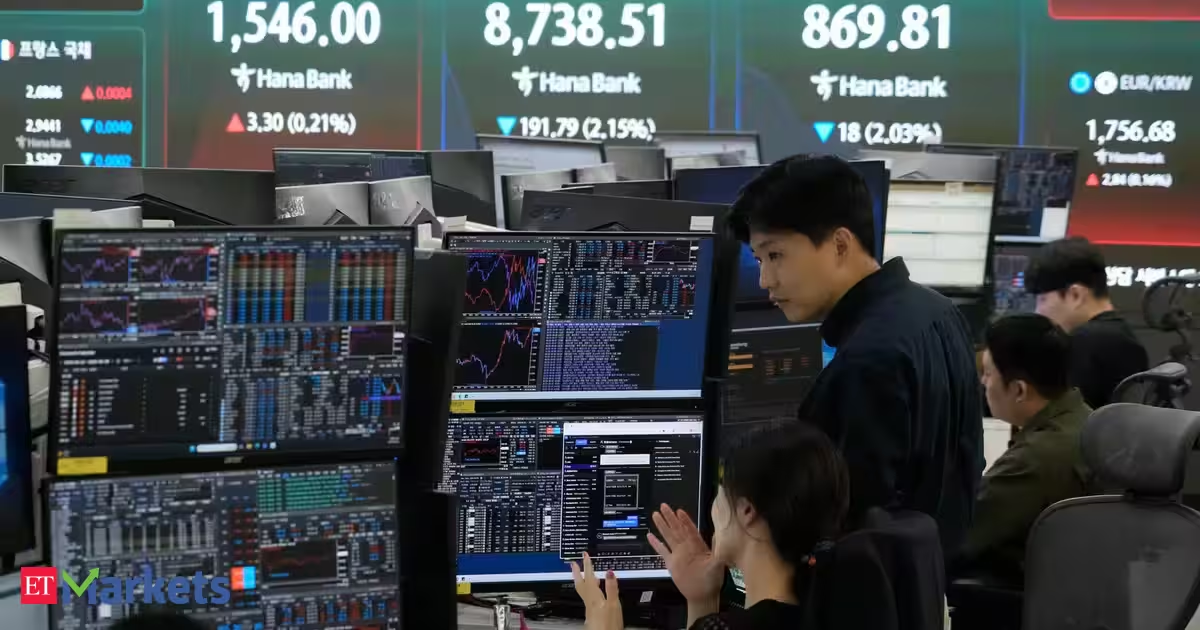
Contracts for the tech-heavy Nasdaq 100 Index climbed 1.2%, while those for the S&P 500 Index added 0.6% after Nvidia signaled strong sales growth in 2028. The company’s shares rallied 4.2% in extended trading. The upbeat outlook also lifted other AI stocks, including Marvell Technology Inc. and Sandisk Corp., in after-hours trading.
The optimism helped lift MSCI’s Asia Pacific stock gauge 0.6%, with South Korea’s Kospi Index — a bellwether for AI investments — leading the gains.
Read more: Lenders may turn to OFCB route to raise more funds abroad
Elsewhere, Brent crude extended its declines, trading around $87.20 a barrel as traders weighed diplomatic progress in the Middle East against rising Russia-Ukraine tensions. Still, caution lingered in bond markets as traders boosted bets on a Federal Reserve interest-rate hike this year after a key US inflation gauge remained above the Fed’s target.
Short-dated Treasuries underperformed in the US session and the dollar rose, with money markets fully pricing an increase by December.
Nvidia’s outlook offered fresh evidence that spending on AI infrastructure remains robust, easing concerns that the investment boom is losing steam. The upbeat forecast comes as investors increasingly scrutinize whether heavy AI spending can sustain earnings growth after a volatile stretch for technology stocks.“Nvidia shares are rising without waiting for analysts to revise their forecasts following the earnings release, suggesting the market is taking a somewhat positive view of the company’s outlook,” said Takashi Ito, a senior strategist at Nomura Securities.
Nvidia expects to grow revenue by approximately 70% in fiscal 2028, Chief Financial Officer Colette Kress said during a post-earnings conference call. Analysts have projected an increase of about 45% for that year, according to data compiled by Bloomberg.

This software company may not be a household name, but it is making its mark in the business travel arena. Recent initial public offering Navan (NAVN) is Tuesday’s IBD 50 Growth Stock To Watch. The travel booking firm raised its revenue outlook in its latest earnings report after a strong quarter. Its booking engine connects with leading artificial intelligence platforms. Navan…
Copyright ©2026 Investor’s Business Daily, LLC. All rights reserved. 87990cbe856818d5eddac44c7b1cdeb8

Sunny Optical H1 2026 slides: Pan-IoT surge drives diversification
 ET Bureau
Growth Equation Power-sector capex offers the firm room to grow, but raw-material price volatility and customer concentration temper outlook
Business
Incorporated in 2005, Lumino Industries is an integrated engineering, procurement, and construction (EPC) company. It manufactures and supplies conductors, power cables, electrical wires, and specialised components to the power transmission and distribution industry. Manufacturing contributed nearly 70% of revenue in FY26, while EPC accounted for the rest. The company operates two manufacturing facilities in Howrah, West Bengal, with a combined capacity of 40,000 MT. The company had a closing order book of ₹3,149.9 crore as of March 31, 2026, comprising ₹1,991.9 crore of EPC orders and ₹1,157.90 crore of manufacturing orders. The government entities accounted for 53% of FY26 revenue, posing concentration risk. It is also exposed to metal prices volatility as it uses aluminium, copper and steel as raw material.
Financials
Revenue grew 20% annually to ₹2,041.1 crore in FY26 from ₹1,407.3 crore in FY24. Operating profit before depreciation and amortisation (Ebitda) increased to ₹238.9 crore from ₹145.1 crore while the Ebitda margin improved to 11.7% from 10.3% during the period. It is within the peer range of 3.5-14%. Net profit rose 36% annually to ₹160 crore in FY26 from ₹86.6 crore in FY24. Return on equity increased to 24.6% in FY26 from 21.5% in FY24 compared with peer range of 1%-15.8%. Total debt rose sharply to ₹384 crore in FY26 from ₹40.9 crore in FY24 amid higher capital expenditure and increasing working-capital requirements. Its working capital cycle widened to 86 days in FY26 from 11 days in FY24.
Read more: Tata Power loses challenge to $490 million arbitration award
Valuation
The company demands a price-earnings (P/E) multiple of 15.6 on post-IPO basis compared with a P/E of 18.9 for KEC International, 57.6 for KEI Industries and 73.1 for Apar Industries.

Rates Spark: Why 4.75% Is A Natural Fit For The 10yr Yield
Wealth managers turn to hybrid SIFs for higher, tax-efficient returns

FBI and DOJ Disrupt Chinese Cyber Group That Hit Fed, NASA, US Senate

Czech duo Muchova and Mensik win US Open mixed doubles title

Weekend Open Thread – Corporette.com

Weekend Open Thread: Brooks Brothers

London Mayor Sadiq Khan handed a peerage by Keir Starmer alongside 15 other Labour figures… just days before the PM leaves No10

Crypto Live Trading| 19 AUG #vinbullindia #livetrading #vinbulllive #live #trading #cryptotrading

Financial Pressures and Child’s Innocence Spark Viral Social Media Moment #shorts

All favorite Altcoins! This is very disturbing! #kryptoinvestorph #cryptocurrency #hardreset
-

 Fashion5 days ago
Weekend Open Thread: Madewell – Corporette.com
-

 Crypto World1 day ago
SpaceX stock could rise 75% to $240, JPMorgan says
-

 Business5 days ago
Musk’s Tesla, SpaceX Confirm $16.8 Billion ‘Terafab’ Chip Plant as World’s Largest Building in Texas
-

 Crypto World5 days ago
anatomy of crypto’s biggest liquidation event since 2021
-

 Crypto World2 days ago
A $30 Billion AI Fund Implodes, Now the SEC Is Investigating Wall Street’s Role
-

 Politics5 days ago
6 months on, Irish renters crushed by effects of government housing bill
-

 Crypto World1 day ago
Did Trump Just Move SpaceX Stock With One Truth Social Post?
-
 NewsBeat5 days ago
The ‘Lucky Dip Gang’ causing carnage for clicks: After five thugs were killed speeding in the wrong direction on a motorway, GUY ADAMS investigates a sick new trend… and why police aren’t even allowed to pursue them
-

 Business4 days ago
Mystery AI Model ‘Ox Alpha’ Draws Developers With Free Access as Chinese Lab Origins Remain Debated
-

 Business2 days ago
Moderna CEO warns China is pouring state money into mRNA technology
-

 Business6 days ago
Five Below: Kids Discount Retailer Reaps Rich Rewards
-

 Business2 days ago
NVIDIA Stock Drops Nearly 2 Percent to $210 on Seventh Losing Day Ahead of Critical AI Earnings
-

 Business6 days ago
UK firms in critical financial distress rise 9% to 53,756
-
 Crypto World5 days ago
Nvidia Stock Suffers Longest Losing Streak Since 2022: Will Q2 Earnings End It?
-

 Sports4 days ago
Deshaun Watson fires back at Browns fans after being booed: ‘It’s a disrespectful thing’
-

 Crypto World7 days ago
Optimism-funded team's deciding vote shifts $49 million in OP tokens away from users
-
 Crypto World4 days ago
Google Gemini AI Predicts Ethereum Could Become the Trade Retail Misses in 2026
-

 Tech5 days ago
Unitree’s New Superman Robot Claims to Outjump and Outrun Every Human, Usain Bolt Included
-

 Business7 days ago
PayPal and Venmo now accepted for tuition at several universities
-

 Tech5 days ago
Faster chip in a familiar form factor
You must be logged in to post a comment Login