






Chamber warns of ‘no concrete measure to navigate the impact of a possible oil price shock or other turmoil’

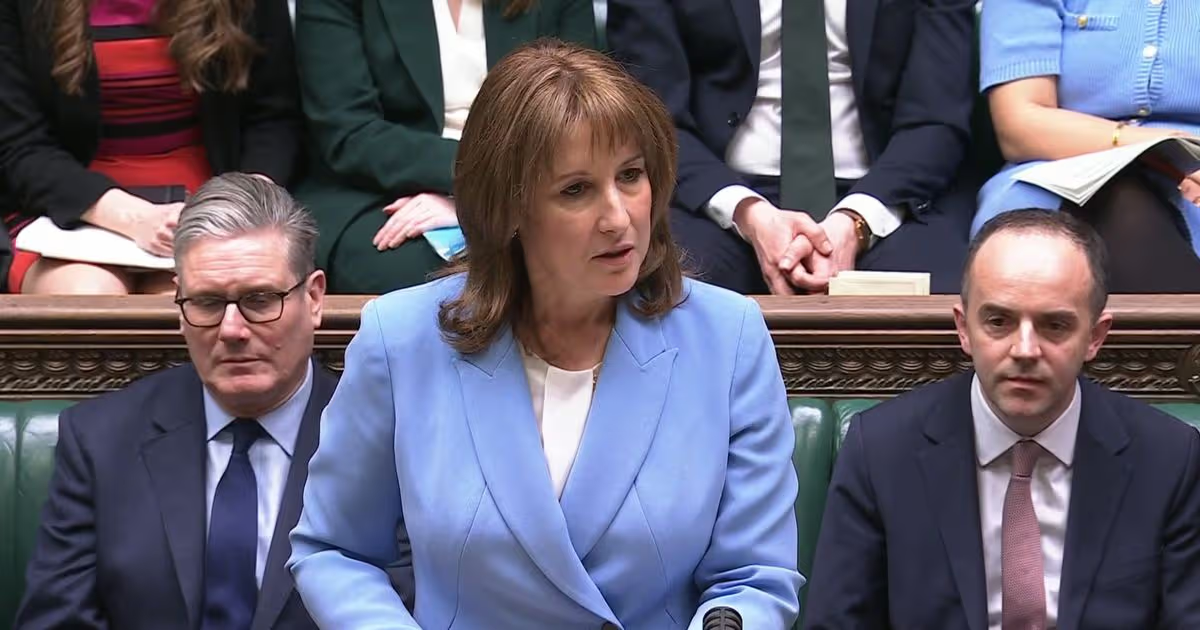
Chancellor of the Exchequer Rachel Reeves delivers her spring statement in the House of Commons(Image: House of Commons/UK Parliament/PA)
North West business leaders have warned the ongoing Middle East crisis means the economic picture remains uncertain despite Rachel Reeves’ confident message in her spring statement.
The Chancellor told the House of Commons that the UK would see weaker economic growth and higher unemployment than previously expected, but said the Labour government had the right plan and that the country must “stay the course”. And she said that plan was “more necessary than ever before in a world of uncertainty” with the Iran conflict threatening economic stability.
Subrahmaniam Krishnan-Harihara, director of business policy and research at Greater Manchester Chamber of Commerce, said: “In a brisk and politically charged 20-minute speech to the Commons this afternoon, Chancellor Rachel Reeves claimed that recent economic data was a vindication of her Autumn Budget. Whilst she acknowledged the situation in the Middle East and the potential for economic disruption, there was no concrete measure to navigate the impact of a possible oil price shock or other turmoil.
“The Chancellor led with the latest publication from the Office for Budget Responsibility (OBR), which forecast inflation to fall this year leading to a softening in interest rates and reduced borrowing. The Chancellor claimed that the recent increase in consumer spending was evidence of a rise in living standards and resilience in the economy – all attained through Labour’s ‘right plan’ for stability, investment and reform.
“Another aspect to the speech was the impact public sector spending pledges could achieve. These include the freeze in rail fares, extended fuel duty cuts, defence spending and scrapping the two-child benefit limit. Yet the speech’s critical shortfall lies in its lack of fresh stimulus. Growth for 2026 was downgraded to 1.1% while unemployment is set to peak later this year before falling to 4.1% by 2030.
“GDP per capita, which recently saw a decline, is also forecast to rise 5.6% over the parliament. As has often been the case with forecasts, near-term growth has been downgraded while touting progress in later years. GDP growth is expected to be 1.6% in 2027-28 and 1.5% in 2029-30. Likewise, borrowing is expected to fall by 2029/30 when the Chancellor also expects to have additional headroom against stability rules and attain savings in debt interest payments.
“Nonetheless, the speech indicated calmness – the Shadow Chancellor called it complacency – and not wanting to commit to any specific policy measures although the Chancellor did repeat her ‘in the next few weeks’ line for additional announcements. There was passing mention of improving global ties, AI innovation and regional growth all without any substantiation.
“Overall, the Chancellor reinforced Labour’s narrative of progress, but the speech’s heavy partisanship and deferred optimism reveal critical vulnerabilities. With no shields against energy price shocks, forecasts could falter and put to test the steady and stable image she wants to project and the UK’s economic resilience.”

Subrahmaniam Krishnan-Harihara, deputy director of research at Greater Manchester Chamber of Commerce, left, with Rosie Korcz of Davis Blank Furniss(Image: Greater Manchester Chamber of Commerce)
Robert White, chief executive officer at North West law firm Brabners, said: “Business confidence is building across the North and today’s Spring Forecast helped to reinforce that momentum. The Chancellor kept her promise of no major policy announcements, which is welcome after November’s Budget and the turbulence that followed. In an increasingly uncertain world, consistency and discipline in fiscal messaging matter just as much as policy itself – because stability is what gives businesses the confidence to take the next step.
“The Chancellor’s growth speech planned for later in March is a valuable opportunity to clearly articulate the government’s long-term economic vision and reinforce its commitment to empowering regional leaders with genuine authority and long-term funding to drive sustainable growth. Nearly 600 businesses in our True North network stand ready to work alongside decision-makers to help turn that ambition into delivery. The appetite to invest is there – what businesses need now is the framework and certainty to unlock it.”
Dr Maria Rana, lecturer in economics and finance at the University of Salford, said: “As tensions escalate in the Middle East and oil prices rise, Rachel Reeves told Parliament that Labour’s economic strategy remains the right course for the country. She argued that households are expected to be around £1,000 better off per year under the government’s plans, stating: ‘This Government has the right economic plan for our country, a plan that is even more important in a world that in the last few days has become yet more uncertain.’
“The UK’s independent fiscal watchdog, the Office for Budget Responsibility (OBR), now forecasts that economic growth of 1.1% in 2026, down slightly from the 1.4% projected in November. While the medium-term outlook has improved modestly – with growth in 2027 and 2028 revised up from 1.5% to 1.6% – the near-term picture remains subdued. Unemployment is expected to peak at 5.3% this year before gradually falling to 4.1% by 2030, and inflation is projected to return to the 2% target this year, potentially opening the door to further interest rate cuts.
“However, these forecasts do not account for the potential impact of higher energy prices driven by the conflict in the Middle East. If pressures continue to intensify, the outlook could quickly deteriorate, affecting not only the UK but the global economy.

Robert White, CEO of law firm Brabners(Image: Brabners)
“At the same time, the UK continues to face heightened scrutiny in the post-Brexit landscape, with several structural challenges still unresolved. It is similar to attempting to complete a puzzle with a crucial piece missing at its centre: however carefully the remaining pieces are arranged, the overall picture cannot fully come together.
“Overall, the message is one of cautious optimism – but one that remains highly vulnerable to geopolitical shocks and unresolved structural weaknesses.”
Daniel Burton, founder & CEO of Manchester-based Wondrwall and manufacturer of Battery PowrPlan, said the Chancellor would need to do more to calm the volatile energy market.
He said: “Despite the Ofgem Price Cap decreasing by 7%, UK households will remain vulnerable due to the ongoing geopolitical conflicts. Although being considered a more muted event, the Spring Budget offers no solutions for the currently volatile energy market.
“Short-term changes offer limited protection and reassurance for homeowners, with potential energy price surges, inflation and escalation of interest rates creating a domino effect, directly affecting the cost of living. Now more than ever do we need to move towards a system which prioritises future-proofing the home, utilising technology which protects against unpredictable global markets and affordability.”
READ MORE: Spring Statement 2026: Budget watchdog downgrades growth forecast for 2026 as Rachel Reeves defends Government’s planREAD MORE: Exporters pivot away from America and look to Europe and Asia as Chancellor urged to support UK growth
Roger Philips, head of tax at North West accountants PM+M, said: “Today’s Spring Statement was, to some degree, due to be a relative non-event and that’s exactly what the Chancellor would have been hoping for in the days and weeks leading up to it. However, her statement landed against a far more uncertain global backdrop than many, including the Chancellor herself, will have anticipated when the OBR forecasts were first compiled. A self-congratulatory tone was adopted throughout, particularly with regards falling inflation and borrowing costs – both of which government policy do not have any direct impact on.
“Despite some improvement in the near-term fiscal picture, the Chancellor’s room for manoeuvre remains limited and today was not about changes in fiscal policy. Today was about checking all was on track, creating some stability and having a period of calm leading up to the only Budget of the year, in the autumn. Had there been changes, this would have been an indicator of deeper-rooted problems.
“The OBR numbers suggest that the UK remains broadly within its fiscal guardrails, helped by January’s record budget surplus and a presently manageable inflation position, albeit a downgrade in growth in the short term at least. This is something on which the Chancellor’s fiscal policy depends so will not make welcome reading for her. In more stable times, and downgrade in growth aside, this would have provided Rachel Reeves with a degree of reassurance that her fiscal policy was working. However, the escalating crisis in the Middle East has quickly shifted the tone and therefore the numbers should be taken with a large pinch of salt.

Chancellor of the Exchequer Rachel Reeves delivers her spring statement to MPs in the House of Commons(Image: House of Commons/UK Parliament/PA Wire)
“What does all of this mean for business? In this environment, proactive forward planning remains critical. Whilst the UK’s fiscal position appears stable for now, external factors, such as the impact of the escalating problems in the Middle East, underline how quickly that outlook can shift. Businesses and individuals alike should continue to stress-test assumptions, manage their cash flow carefully, and remain agile to enable them to weather the storm.”
Sean Keyes, CEO at civil engineering firm Sutcliffe, said he wanted to see more support for SMEs to help tackle the skills crisis in construction.
He said: “Chancellor Reeves has spoken repeatedly about the need to kickstart economic growth and deliver the homes this country desperately needs. We agree with her on both counts. Whilst the political will to build is arguably stronger than it has been in a generation, however, the infrastructure needed to turn that ambition into bricks and mortar is under serious strain.”
He said the Government’s target to build 1.5m new homes was welcome, but that the country would struggle to deliver it with planning departments under strain and a shrinking workforce.
He added: “Chancellor Reeves has made growth her defining mission. Growth requires builders. And right now, we do not have enough of them.
“We are doing our part. Sutcliffe has committed to training 40 new engineers over the next decade, investing in apprenticeships and graduate programmes that create genuine pathways into the profession. But individual firms cannot solve a systemic problem alone. We need the Chancellor to match industry commitment with meaningful investment in skills infrastructure — and to ensure that financial barriers, including the cost of four-year engineering degrees which can now reach £89,000, do not continue to lock talented people out of the profession.
“However, a scheme of targeted government funding for SMEs to help move young people out of NEET and into employment and training is needed. For many smaller businesses, the real cost of taking on and developing an unskilled 21-year-old is simply prohibitive.”