“It’s a distortion of real pressures. When I’m analysing trends around men…they are wanting to lean into what being a man means. In many cases strength, loyalty, protection. Those are not bad values. Those are being exploited, weaponised, and redirected in order to either sell a product or sell an idea.”
Marianna Spring and Matt Shea speak to Kristina Wilfore, Director at Reset Tech, about their new report into the so-called ‘Male Grievance Industry’, which Kristina says is capitalising on the loneliness, economic anxiety, and identity of men. She argues it’s a growing business on social media which defrauds men by targeting them with content that distorts the real pressures they face.
She also reveals new data about looksmaxxing, the extreme cosmetic social media trend, which shows how just 216 accounts drove 14.6 billion views on this type of content within the last two years.
Advertisement
Thank you to the Top Comment team for its help in making this programme.
The Interview brings you conversations with people shaping our world, from all over the world. The best interviews from the BBC, including episodes with Hunter Biden, son of former US President Joe Biden, head of the World Meteorological Organisation Celeste Saulo, and independent Russian journalist Dmitry Muratov. You can listen on the BBC World Service on Mondays, Wednesdays and Fridays at 0800 GMT. Or you can listen to The Interview as a podcast, out three times a week on BBC Sounds or wherever you get your podcasts.
Presenter: Marianna Spring and Matt Shea
Producer: Cordelia Hemming
Editor: Damon Rose
Get in touch with us on email TheInterview@bbc.co.uk and use the hashtag #TheInterviewBBC on social media.
Advertisement
(Image: Kristina Wilfore. Credit: Photo by Rachel Hofer)
The billionaire Sports Direct and Frasers Group founder has written to the Prime Minister accusing him of failing to tackle the cost of living crisis
Felix Armstrong www.cityam.com
11:13, 28 Aug 2026Updated 11:23, 28 Aug 2026
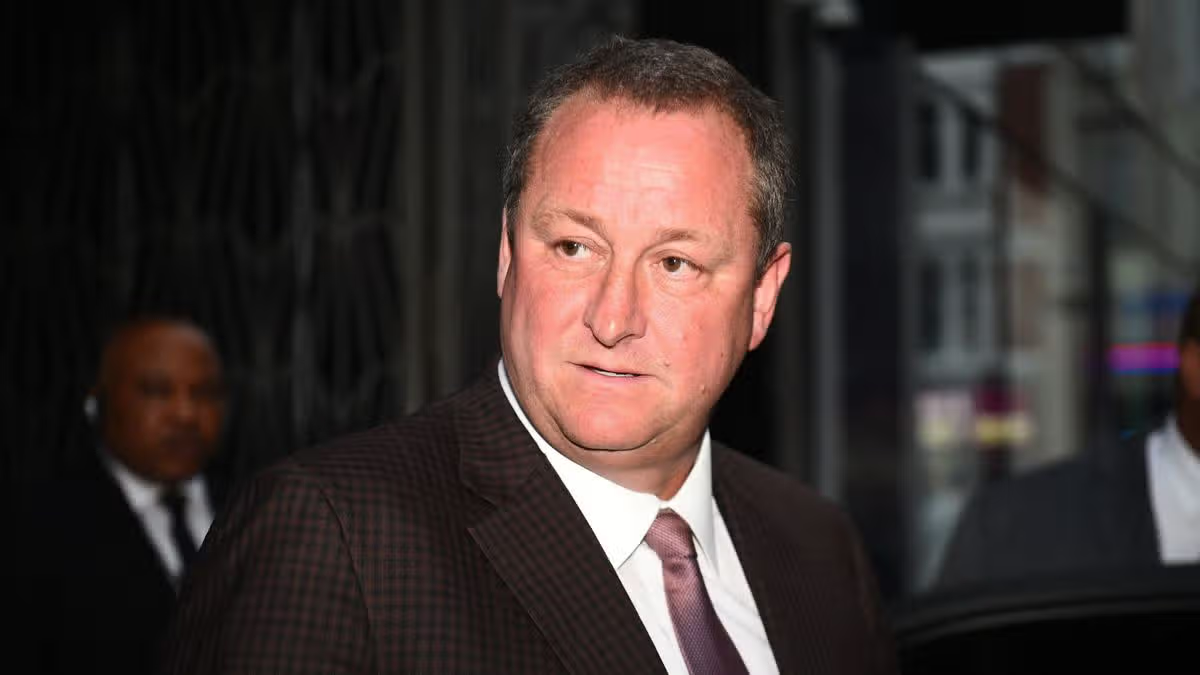
Frasers Group is led by Sports Direct CEO Mike Ashley (Image: PA)
Retail magnate Mike Ashley has lambasted Andy Burnham’s plans to breathe new life into Britain’s high streets, branding them “populist” and “too little too late”.
Advertisement
The billionaire founder of Sports Direct and Frasers Group has penned a letter to the Prime Minister, accusing him of failing to address the cost of living crisis with what he describes as “delusional” policies.
The factors driving the UK’s soaring cost of living “have not been assisted by recent government policies and are not going to be helped by your recent populist proposals,” he said, in a letter seen by City AM.
Ashley accused Burnham of chasing headlines rather than delivering meaningful solutions for hard-pressed households and businesses, taking particular aim at the Prime Minister’s “disastrous” stance on business rates.
Burnham has committed to reviewing the way business rates are calculated for pubs and hotels, and has previously backed a levy on warehouses to fund tax relief for high street retailers, as reported by City AM.
Advertisement
Retailers have long cautioned that a warehouse tax could drive up costs for consumers and Ashley, who leads the Derbyshire-based Frasers group, told Burnham the measure would be “delusional”.
“Rather than address the real underlying issues of how the country’s financial affairs are managed, and supporting growth and entrepreneurialism in business, it is easier for you to pick topics which provide good media soundbites and the old salve of yet more regulation – which is not what the country needs to become competitive,” he wrote. “Shortsighted or populist reactions to underlying business challenges are not the answer. You have the chance to make a difference or get it horribly wrong.”
The retail billionaire ridiculed Burnham’s commitment to deliver “everyday fixes” on the cost of living, which have included a £2 bus fare cap and the removal of VAT on household electricity bills.
“This is a certainly a time for pragmatism and brave solutions but applying that to the underlying issues – not jumping on “everyday fixes” or band wagons that only address part of the problem,” he wrote.
Advertisement
Ashley’s comments arrive as businesses increasingly push back against Burnham’s cost-of-living promises while their own overheads continue to climb.
In an open letter, the City veterans called on the government to rule out new taxes on founders, including levies on dividends, capital gains and business assets.
On Wednesday, Burnham told the Financial Times that he will address the “challenging” cost of doing business as he seeks to dispel concerns that October’s Budget will usher in another punishing tax assault on British enterprises. In his letter to Burnham, Ashley also took aim at the Prime Minister’s commitment to tackle what he describes as “fake” discounts.
Advertisement
Aldi chief executive Giles Hurley has thrown his weight behind this initiative, accusing rival supermarkets of misleading customers with loyalty pricing schemes.
Ashley said: “The driving down of prices through discounting is what helps the consumer by giving them better value and helps with their cost of living. Driving down prices through discounting against an RRP can’t be what you really mean when you talk about “rip off Britain”.
Before expanding into luxury fashion through Frasers Group’s takeover of Harvey Nichols and building a stake in Hugo Boss, Ashley built his reputation by offering affordable sportswear at Sports Direct.
Yatharth Hospital shares surged to a fresh 52-week high of Rs 1,024.85 apiece on the NSE. India’s second-largest hospital chain is looking to consolidate amid a buyout spree by large private equity groups, people familiar with the matter told The Economic Times.
The existing promoters may retain a sliver of ownership, but final negotiations are still underway, the report said, adding that there is no guarantee that the talks will lead to a transaction. Yatharth, however, denied it is in any sale discussions.
Headquartered in Noida and Greater Noida, Yatharth has about nine hospitals with a total bed capacity of over 2,800. The company is targeting a total capacity of over 5,000 beds in the next three years through new facilities and expansion. Its footprint also covers Jhansi-Orchha in Madhya Pradesh and Faridabad in Haryana.
Advertisement
Advent has been a big backer of Indian pharma companies but has, so far, not made an investment in the hospitals sector other than a 2012 investment in Care Hospitals. Aster DM Quality Care, meanwhile, was formed by a mega merger of Moopen family-founded Aster DM Healthcare and Quality Care India, unifying four healthcare brands — Aster DM, CARE Hospitals, Evercare and KIMSHEALTH. It also saw two of the biggest PE groups, TPG and Blackstone, join forces to create the country’s second-largest healthcare chain.
Yatharth Hospital shares jumped more than 18% in one week and 21% in one month, with the stock overall jumping around 50% in 2026 so far. The shares of the company have overall jumped 43% in three years.In the longer term, Yatharth Hospital shares have delivered multibagger returns of more than 167% in three years. The company currently has a market capitalisation of around Rs 9,676 crore.
For the first quarter ended June, Yatharth reported a 51% year-on-year increase in consolidated revenue to Rs 392.70 crore. Average revenue per occupied bed was at Rs 34,758, up 7% from a year ago. Whole-time director Yatharth Tyagi recently told analysts on an earnings call that the hospital chain grew at 37% in FY26 and is set to “easily surpass that growth” this year.
(Disclaimer: Recommendations, suggestions, views and opinions given by the experts are their own. These do not represent the views of The Economic Times)
The innovative chip maker is looking to grow its global business
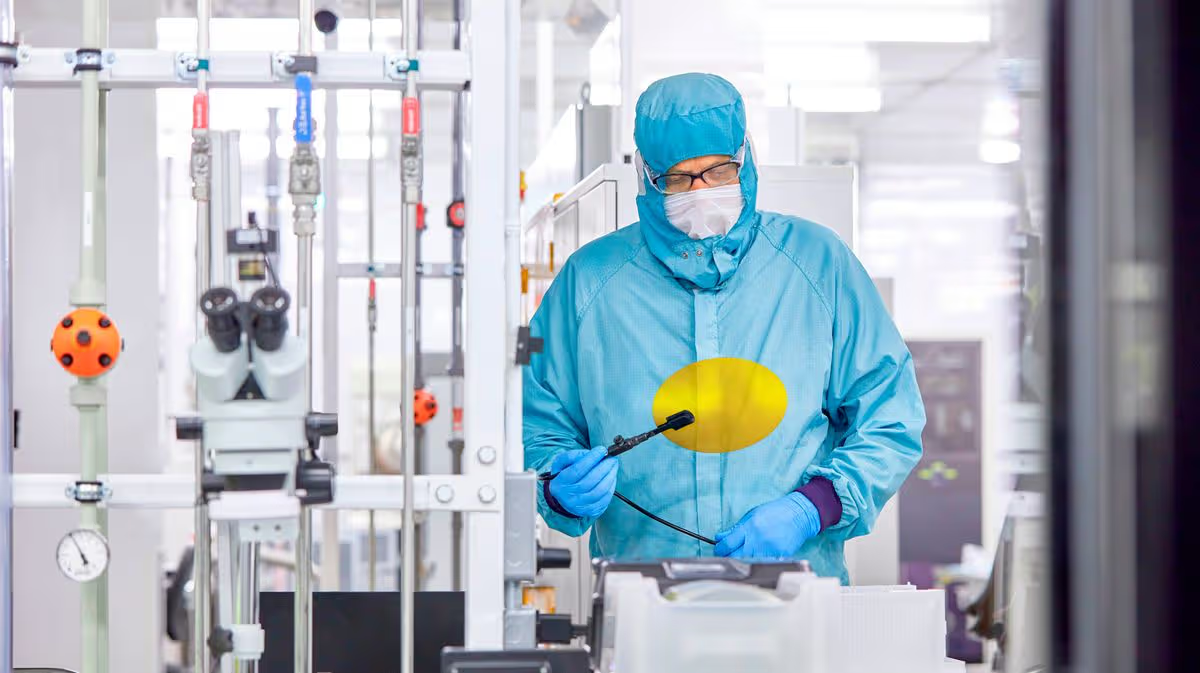
A worker at Pragmatic Semiconductor’s existing NETPark facility.(Image: Supplied by Brands 2 Life PR)
North East-made microchips that are thinner than a human hair are being marketed in China, the company behind them has revealed.
Pragmatic Semiconductor, which opened its multi million-pound factory site in County Durham in 2024, has launched a new Chinese brand with which it hopes to attract customers in that country. The firm has been exhibiting at the International Internet of Things Exhibition (IOTE) in the country’s southern city of Shenzhen.
It says the launch of the new ‘Pragmatic 湃’ identity demonstrates the significance of the Chinese market – and signals its intention to serve regional customers there. China is considered one of the world’s largest semiconductor markets given its technology-driven strengths in areas such as artificial intelligence and electric vehicles.
Pragmatic’s pioneering flexible semiconductor technology is touted as holding major potential for a range of uses including in packaging, healthcare and consumer electronics, among other ideas. Its ultra-thin semiconductors are physically flexible and can be placed where other counterparts cannot.
Advertisement
The chips offer an alternative to silicon-based alternatives that are energy-intensive to make. And they can be embedded into almost anything, bringing connectivity and intelligence to everyday objects.
James Davey, senior vice president, sales, business development and product management at Pragmatic Semiconductor, said: “Connected products are a critical tool for brand trust, product authentication and protection, and consumer engagement. We are pleased to showcase our customer and partner innovations which demonstrate how flexible semiconductor technology can help brands expand market opportunities and connect the physical and digital worlds.
“With our award-winning NFC product portfolio, expanding partner ecosystem, and new Chinese brand, we are deepening our commitment to customers in China while continuing to scale our global business.”
Pragmatic’s push into China comes as the firm is searching for new equity funding, following its successful £179m series D raise. JP Morgan has been appointed to lead the effort which is intended to ramp up production in County Durham.
Advertisement
In the meantime, the firm has secured £36m of bridge financing from existing investors to keep working. Accounts published earlier this summer, and covering 2025, show Pragmatic saw revenues fall to £901,000, down from £1.69m the year before, and incurred operating losses of £65.1m, up from £55.8m.
Bosses flagged delays to the company’s plan but have pointed to the depth and complexity in their ambition to bring a new, disruptive technology to market. Meanwhile, at Pragmatic Park, a second high-volume production line has been installed to triple the site’s capacity.
Pragmatic’s time at the Shenzhen exhibition was boosted with an award win. It was handed the Radio Frequency Identification (RFID) Product Gold Prize at IOTE 2026’s Innovative Product Awards for its near-field communication product portfolio which includes Pragmatic’s FlexIC, flexible integrated circuit technology.
1. Thailand tightens the gold–baht link — but may go further
New development: Bank of Thailand Governor Vitai Ratanakorn says restrictions on gold trading are working and could be tightened further. The current online-gold trading limit is THB50 million per person per day, with the possibility of reducing it to THB30 million or less. The 60-day correlation between gold and the baht has fallen from as high as 0.85 last year to 0.30 in April. Physical gold withdrawals above 2 kg have also fallen about 70% after reporting requirements were introduced.
Market indicator: The baht was around 32.93/USD, down 0.23% Friday morning.
Why it matters: This is becoming a structural FX-policy issue, not simply a gold-market regulation. A persistently strong baht threatens Thai exporters and tourism competitiveness, so the BOT appears increasingly willing to intervene indirectly through the gold channel.
2. Thai stocks enter Friday cautiously after SET closes at 1,600.70
New development: Thai brokers expect a sideways SET market Friday as investors await Federal Reserve Chair Kevin Warsh’s Jackson Hole speech. Kasikorn Securities puts immediate technical support at 1,590 and resistance at 1,610. The SET closed Thursday at 1,600.70, down 0.08%, with trading value of THB65.27 billion.
Key catalyst: Better-than-expected Thai exports are supporting electronics, rubber and pet-food stocks, while global technology strength is providing another positive factor for Thai electronics names.
Why it matters: The combination of improving export momentum and a still-low domestic policy rate creates a potentially supportive environment for Thai equities, but today’s Fed signal could dominate local fundamentals.
3. Toyota investment competition exposes an ASEAN weakness
New development: Indonesia and Thailand are competing aggressively for Toyota production investment. Jakarta has offered Toyota extensive incentives and regulatory concessions, questioning why Thailand remains ASEAN’s automotive manufacturing hub despite Indonesia’s much larger domestic market of nearly 290 million people.
Indicator: Thailand’s advantage remains its established automotive ecosystem and export infrastructure, while Indonesia is trying to leverage market scale and stronger incentives.
Why it matters: This is more than a Toyota story. It highlights the continuing tension between ASEAN economic integration and national competition for FDI. For Thailand, maintaining its automotive hub status will depend increasingly on EV supply chains, incentives, logistics and local manufacturing depth.
New development: A Reuters poll expects China’s official manufacturing PMI to rise slightly from 49.2 in July to 49.6 in August, but remain below the 50 threshold separating contraction from expansion. The official figure is due Monday.
Other indicators: China’s Q2 growth slowed to 4.3%, below Beijing’s 4.5–5% annual target range. July industrial output and retail sales also slowed, while new yuan loans recorded a record contraction. Beijing has opened an 800 billion yuan ($119 billion) policy-financing facility for local-government projects.
Why it matters: China’s weak domestic demand remains a major regional risk. For Thailand and ASEAN, the key offset is China’s continued strength in high-tech manufacturing and exports linked to the global AI investment boom.
5. South Korea remains Asia’s semiconductor bellwether
New development: South Korean exports are expected to rise 62.6% year-on-year in August, according to a Reuters poll, extending the export-growth streak to 15 consecutive months. July exports rose 63%. Imports are forecast to increase 24.7%, producing an estimated $30.74 billion trade surplus.
Driver: Semiconductor demand, particularly AI-related memory chips produced by Samsung Electronics and SK Hynix, remains the key engine.
Why it matters: Korea is an important leading indicator for Asia’s technology cycle. Sustained semiconductor exports suggest that the AI investment boom continues to support Asian manufacturing even while China’s domestic economy weakens. Thailand’s electronics-export story is therefore worth watching closely.
“AWS Certified AI Practitioner Early Adopter”I am a DevOps Engineer for a major, wholly owned subsidiary of a large-cap Fortune 500. I have been the primary driver of Anthropic-based tooling in our company’s division, and have successfully pushed for the division-wide integration of tools like Claude Code via AWS Bedrock. I am currently spearheading the implementation of AI-infrastructure in our division.I am a true subject-matter expert on the actual buildout, deployment, and maintenance of AI tools and applications. I have increasingly deep knowledge on the science behind generative AI systems as a result of first-hand experience with machine learning algorithms, model training, and model deployment.I contribute to Seeking Alpha as an outlet to share my AI and machine learning insights through an investment-focused lens.Closely associated with LL InsightsPer TipRanks (6/26/25) – 2 Year Timeframe#716 out of 31,463 Financial Bloggers #1,222 out of 41,143 experts
Analyst’s Disclosure: I/we have no stock, option or similar derivative position in any of the companies mentioned, and no plans to initiate any such positions within the next 72 hours. I wrote this article myself, and it expresses my own opinions. I am not receiving compensation for it (other than from Seeking Alpha). I have no business relationship with any company whose stock is mentioned in this article.
Seeking Alpha’s Disclosure: Past performance is no guarantee of future results. No recommendation or advice is being given as to whether any investment is suitable for a particular investor. Any views or opinions expressed above may not reflect those of Seeking Alpha as a whole. Seeking Alpha is not a licensed securities dealer, broker or US investment adviser or investment bank. Our analysts are third party authors that include both professional investors and individual investors who may not be licensed or certified by any institute or regulatory body.
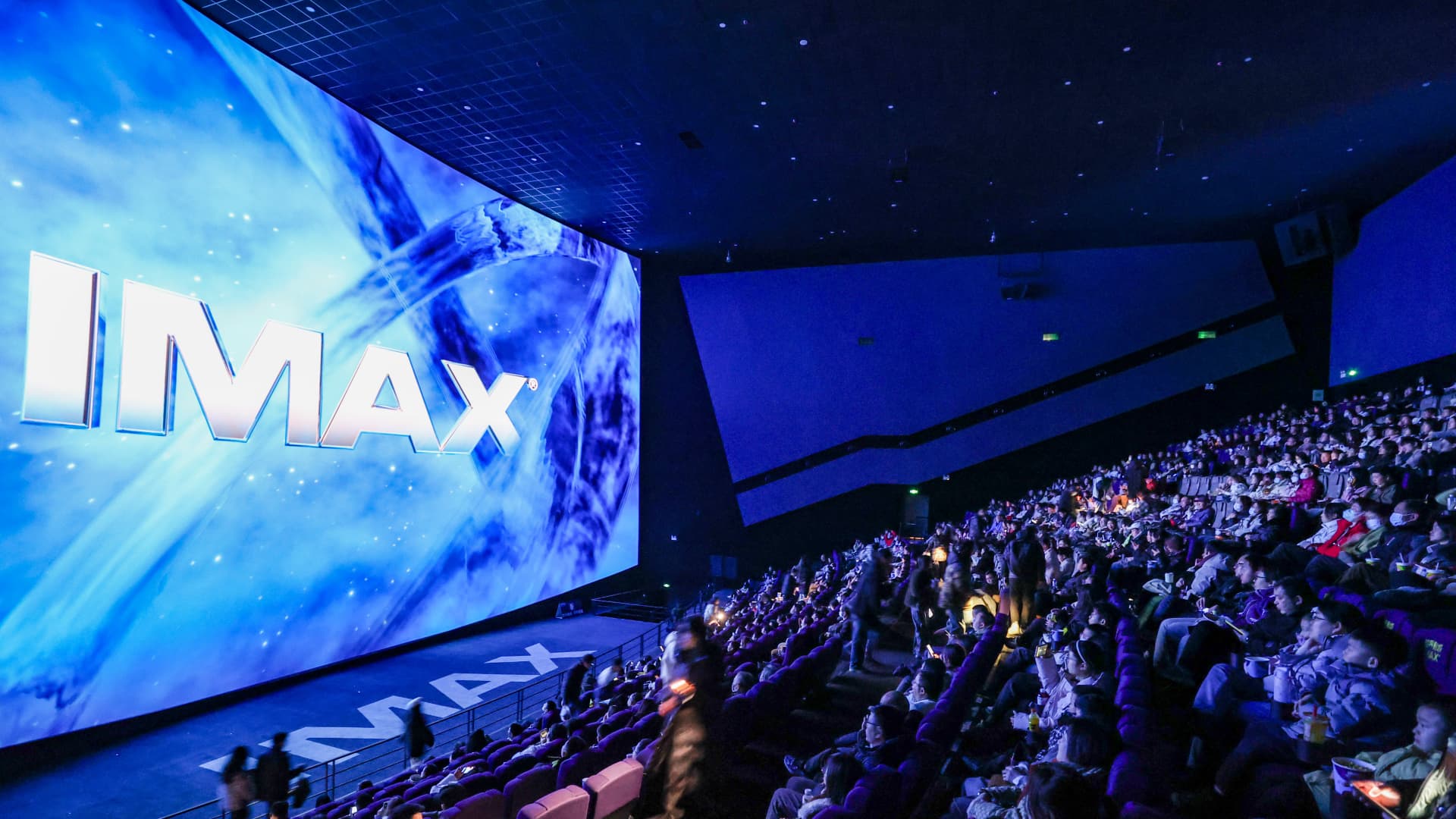
Moviegoers watch the film “Ne Zha 2” at an Imax GT Cinema on in Guiyang, China, Feb. 23, 2025.
China News Service | China News Service | Getty Images
In December, Imax CEO Rich Gelfond opened the door to a sale. Almost nine months later, the company’s stock has hit an all-time high, its box office is breaking records and the stage is set to carry its momentum through the end of 2026.
Advertisement
Yet, no major suitors have appeared.
Imax held preliminary talks with potential buyers earlier this year, but as of May hadn’t fielded any official pitches, CNBC reported at the time. Imax hasn’t hired new bankers and doesn’t have a formalized pitch book, according to a person familiar with the company, who spoke on the condition of anonymity to discuss confidential matters.
But it’s a busy time for dealmaking in the media space. Paramount Skydance is in the midst of a contested merger with Warner Bros. Discovery worth $110 billion, Fox agreed to acquire Roku in a deal worth $22 billion, and Comcast continues its corporate restructuring with the upcoming spinoff of NBCUniversal, which many in the industry say will give both resulting companies more flexibility to do deals.
With a nearly $3 billion market cap, Imax is a relatively inexpensive asset in the entertainment landscape. And it’s been on a hot streak in the wake of the pandemic as moviegoers have traded up for higher-priced premium large format cinema experiences.
Advertisement
The company’s momentum has been further fueled by strong box office sales from films like Universal and Christopher Nolan’s “The Odyssey.” Over the weekend, global Imax ticket sales for the film surpassed $400 million, the first film to exceed the benchmark in the company’s history. This haul represents nearly 30% of total global sales for “The Odyssey” — despite the fact that Imax screens represent less than 1% of movie screens worldwide.
And then there’s the strong pre-sales for the December release of Warner Bros. and Denis Villeneuve’s “Dune: Part Three,” which has already sold out specialized screenings into January.
Wall Street analysts foresee Imax setting a new global box office record in 2026, hot off the heels of the record $1.28 billion the company posted last year. Imax’s 2025 ticket sales were more than 40% higher than 2024 and 13% higher than its previous record, set in 2019.
“The brand value of Imax has never been higher,” Eric Handler, managing director and senior research analyst at Roth, told CNBC. “They have done a really good job of situating themselves right in the center of the eco-structure for Hollywood. So, it’s been a masterful, long-time-coming situation.”
Advertisement
Contributing to the momentum is Imax’s premium ticket prices, which, despite being higher than for other screenings, have not deterred audiences.
So far in 2026, the average adult Imax ticket cost $20.57 in the U.S., according to data from EntTelligence. That’s more than 60% higher than the average standard ticket, at $12.75 each, and nearly 18% higher than rival premium large format offerings, which average around $17.46 apiece.
The company’s slate of “filmed for Imax” content is also accelerating and expected to grow materially through 2028. It’s diversifying beyond the Hollywood landscape with partnerships in China, Japan and South Korea to screen local-language content.
The company is also actively expanding. Around 160 to 175 Imax systems are expected to be installed in 2026, with contracts to build hundreds more already in place, the company told CNBC last year.
Advertisement
The result, then, is less a question of what’s for sale and more a question of who would buy.
The TCL Chinese Theatre during opening weekend for “The Odyssey” in Imax in Hollywood, California, July 18, 2026.
Aaronp/Bauer-Griffin | Gc Images | Getty Images
The most — and least — likely suitors
Handler noted that a potential buyer would need to balance studio relationships and cinema partnerships, as Imax has for years. The company installs its special format screens in existing theaters and negotiates release windows for top-billed films.
Advertisement
Major studios, including Disney, Universal, Paramount and Warner Bros., would have an immediate conflict of interest if they acquired Imax, Wall Street analysts told CNBC.
Imax is “studio agnostic, and so they charge every studio the same,” said Eric Wold, executive director of equity research at Texas Capital Securities. “If some studio were to purchase them, I think the other studios would always feel that they’re kind of second in line for the key release slots in the holidays and summer, and so it may not be received well.”
Even in the scenario where a deal of that nature passed muster with Hollywood and regulators, a single studio would be hard-pressed to fill a 52-week theatrical calendar with only its own films. Premium large format, or PLF, is intended for blockbuster feature films, which moviegoers are willing to pay a higher price to attend. A smaller-budget film with less spectacle might not draw the same crowds for the same price on that kind of screen.
Not to mention, few studios have purchased cinemas even after the Department of Justice rescinded the 1948 Paramount Consent Decrees, which previously disallowed studios from owning movie theater chains. Those restrictions formally sunset in 2022, but so far only Sony has done a major deal for cinemas, acquiring all 35 Alamo Drafthouse locations in 2024.
Advertisement
Beyond movie studios, analysts have highlighted potential suitors in entertainment and tech: for example, Netflix, Apple, Amazon or Sony.
Netflix long vowed to build growth rather than buy it, but more recently it’s gotten a taste for M&A. The company entered into an agreement with Warner Bros. Discovery to buy its studio and streaming businesses before being outbid by Paramount Skydance.
The streamer doesn’t rely on theatrical releases as part of its main programing strategy, therefore its conflict of interest if it were to acquire Imax would be smaller than for traditional Hollywood studios. Additionally, owning Imax would provide any filmmaker that signed on to work with Netflix the opportunity for premium theatrical runs.
Advertisement
Of course, Netflix historically has had limited interest in the traditional theatrical model. While the company does release some films in cinemas, it’s typically done so for short runs or for eligibility for Academy Awards contention.
As for Apple, Amazon and Sony, all three companies have strong technology businesses in addition to theatrical and streaming content, which may align nicely with Imax’s tech-heavy business. While Sony does not have its own streaming platform, it partners with Netflix to distribute new content. Meanwhile, Apple has AppleTV and Amazon has Amazon Prime.
Taking on a cinema tech firm like Imax could offer each company a new avenue for distribution.
There’s also the possibility that Imax could draw interest from a company or investor that wants to buy into Hollywood and the broader entertainment universe. Imax has a global presence and connections to most major studios as well as cinema partners worldwide.
Advertisement
Analysts also noted that a private equity buyer would eliminate any potential conflict concerns and could be most interested to ride the stock’s momentum.
Imax Corp. CEO Richard Gelfond attends the New York premiere of ‘A Beautiful Planet’ at AMC Loews Lincoln Square in New York, April 16, 2016.
Jamie McCarthy | Getty Images
‘Perfectly fine as a standalone company’
Shares of Imax hit an all-time high this week of $54.79. The stock is up almost 80% in the past 12 months.
Advertisement
That surge could be among the reasons it’s still going it alone, according to Alicia Reese, senior vice president of equity research at Wedbush.
“It’s a lot more expensive than it has been for a long time,” Reese said.
When Gelfond first floated the idea of a sale last year, the stock was trading at around $36 per share and had a market cap of about $1.95 billion. The price tag is now a billion dollars higher.
“Maybe those tech companies or potentially [private equity] who had considered it or had been kicking the tires would wait a little while and see what happens to the share price,” Reese said. “There’s a large probability that it’s just going to continue to gain share and gain global growth and remain at these elevated valuation levels for some time, as the growth isn’t likely to reverse.”
Advertisement
Several Wall Street analysts see further stock growth on the horizon, with price targets from some firms as high as $65 a share. On Monday, Drew Crum of B. Riley Securities raised his price target on the stock to $61, up from $52.
“Taken together, we continue to forecast record financials in 2026, with share gains, higher margins, and healthy cash flow generation, as reflected in our above-consensus estimates,” he wrote.
Potential suitors would also naturally be looking at what the future holds for the entertainment business at large. The North American box office is still chasing the pre-pandemic levels of 2019, and despite a blockbuster summer, ticket sales are still lagging.
Wedbush’s Reese noted that Imax is grouped in with the theatrical exhibition space, which is traditionally a slow-growth, dividend-paying business. These types of companies will likely get back to paying those dividends once they can sustain “some very low single-digit growth,” she said.
Advertisement
And because Imax is not actively seeking a sale, simply entertaining offers, its executives can afford to be choosey.
“I think the main point is that Imax is perfectly fine as a standalone company,” Reese said. “And so they’re not desperate in any way, shape or form. So, they’re not going to go for just any bid. They want a bid that’s a nice premium to where the shares are currently trading. And so it’d be hard to come to a deal, I think, right now.”
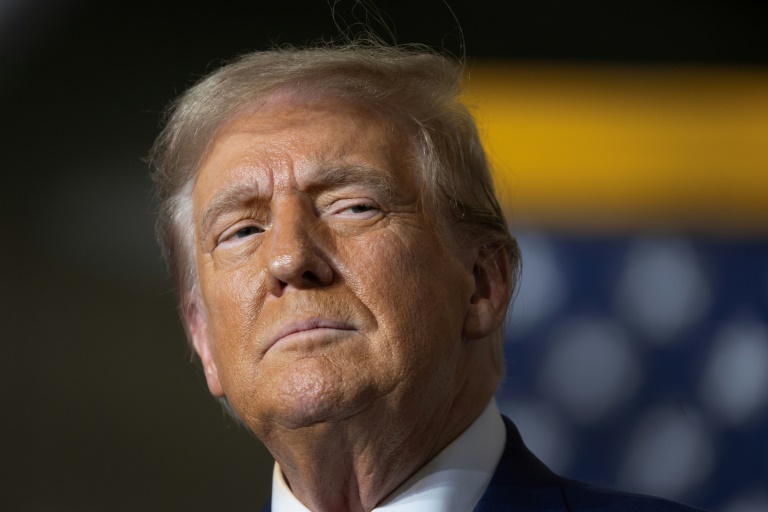
WASHINGTON — President Donald Trump signed an executive order Thursday directing the federal government to rename Lake Ontario “Lake America,” the latest escalation in a deepening trade dispute with Canada that has strained relations between the two longtime allies.
Trump signed the order in the Oval Office, flanked by large display boards depicting maps of the Great Lakes, including one labeled “Making the Great Lakes Even Greater” with “Lake America” printed over the body of water that forms part of the border between New York and Ontario, Canada. The president said the change would take effect immediately.
“‘Lake of America’ was something I’ve been thinking about for a long time,” Trump said, according to multiple outlets present in the Oval Office. He went on to suggest the renaming could extend further. “We have a gulf and we have a lake. Now, all we need is an ocean. So, maybe we’ll have to change the name of the Atlantic, and/or the Pacific. Maybe we’ll change them both.”
The order directs the Interior Department to update federal geographic databases and mapping systems to reflect the new name. According to the text of the order, the designation is justified in part because “the deepest parts of the Lake’s waters” and most of its volume lie within U.S. territory. The order describes Lake Ontario as “a tremendous asset to the United States and part of our Nation’s heritage.”
Advertisement
Asked by a reporter what message he intended to send to Canada with the move, Trump initially said, “No message.” He then pivoted to criticism of the country’s trade practices. “Canada has been ripping us off for a long time on trade, very sadly,” he said. He added that Canada “wants to be treated like a state, but they’re not a state,” and accused Canadian officials of treating the United States “very badly,” calling them “nasty people.”
Trump’s order follows a similar move early in his second term, when he signed an executive order renaming the Gulf of Mexico the “Gulf of America” on his first day back in office. That change drew objections from Mexican officials, who said they would continue using the traditional name, and prompted some digital mapping services to display different names depending on a user’s location.
Legal experts have noted that a U.S. president has authority to determine how federal agencies refer to geographic features for official purposes, but cannot compel other countries or international bodies to adopt the new terminology. Lake Ontario is bordered by both the United States and Canada, and the Canadian government has given no indication it intends to recognize the renaming.
Canadian Prime Minister Mark Carney responded to the order on social media shortly after it was signed, pointing out that the lake’s existing name predates both nations. He wrote that the name Lake Ontario derives from the Wendat word “Ontari’io,” which he said means “the lake is beautiful, the lake is big,” and noted the name is more than 400 years old, predating the Confederation of Canada and the U.S. Declaration of Independence. Carney added pointedly that “America is changing,” listing trade relationships, foreign policy, national monuments and “hydronyms” among the shifts.
Advertisement
The order comes amid a rapid deterioration in U.S.-Canada relations following the breakdown of recent trade talks, which has led both countries to impose new retaliatory tariffs on each other’s goods. Trump has repeatedly threatened in social media posts over the past several days that he would move to rename the lake, following through on those threats Thursday.
The renaming is the latest flashpoint in a broader pattern of geographic and symbolic gestures Trump has used to underscore his positions on trade and sovereignty. His order on the Gulf of Mexico last year set a precedent that some allies and critics alike said signaled a willingness to use federal naming authority as a tool of political messaging.
Reaction to the Lake Ontario order has extended beyond Washington and Ottawa. In a separate but related development, Illinois Gov. J.B. Pritzker mockingly proposed renaming Lake Michigan “Lake Illinois” and joked about annexing Green Bay, a jab widely seen as needling Trump over his geographic rebranding efforts and his broader clashes with Pritzker over federal immigration enforcement and other policy disputes.
The White House did not immediately indicate whether Trump intends to pursue additional geographic renamings, though his own remarks Thursday suggested oceans could be next under consideration. Canadian officials have not announced any formal response beyond Carney’s public comments, and it remains unclear whether the dispute over the lake’s name will factor into ongoing trade negotiations between the two countries.
Shares of Indian IT companies surged sharply on Friday, with heavyweights including LTIMindtree, TCS, HCLTech and Infosys leading market gains.
The sharp rally pushed the Nifty IT index more than 3% higher. LTIMindtree shares jumped around 5%, while HCLTech and TCS gained around 4% each. Coforge, Tech Mahindra, Persistent Systems, Infosys and OFSS rose around 3% each, while Wipro and Mphasis gained 2%.
The surge in IT stocks came after their Wall Street peers rallied following Nvidia’s strong earnings. Nvidia shares jumped 9% after the chipmaker reported second-quarter revenue of $96.2 billion, up 106% from a year earlier and ahead of Wall Street estimates. The company also forecast revenue of about $108 billion for the current quarter, above analyst expectations.
“The results reassured investors on the durability of the global AI boom, sending technology stocks higher,” Reuters quoted Devarsh Vakil, head of prime research at HDFC Securities, as saying.
Advertisement
Investors are now awaiting US Federal Reserve Chair Kevin Warsh’s comments on inflation, due later in the day at the Jackson Hole Symposium.
IT stocks on Dalal Street have seen sharp upswings and downswings recently. Earlier this year, the sector witnessed a sharp sell-off after breakthroughs by AI startups fuelled concerns about potential disruption to the traditional IT services business model. Later, a sharp sell-off in global tech leaders proved to be a blessing in disguise for Indian IT stocks, which remained resilient amid the global tech rout.HSBC said India can serve as an “anti-AI” diversifier as sharp swings in technology-exposed markets encourage foreign investors to broaden their portfolios. HSBC strategists Prerna Garg, Herald van der Linde and Yogesh Aggarwal said in a report that AI-rotation outflows from India have “largely played out”.
While AI jitters continue to keep IT investors on edge, CLSA downgraded several heavyweight stocks and revised their target prices, although it remains bullish on several mid-tier IT vendors. In a recent note, CLSA highlighted that Q1 earnings were a mixed bag for Indian IT companies and their global peers. Basic Excel maths suggests that AI volumes could supersede deflation by FY30, taking US dollar revenue growth from low to mid-single digits, the international brokerage said.
Given the long gestation period and limited potential upside, CLSA downgraded its rating on Tata Consultancy Services (TCS), Infosys and Tech Mahindra to ‘Hold’, while Wipro and Mphasis were downgraded to ‘Underperform’ due to structural concerns.
(Disclaimer: Recommendations, suggestions, views and opinions given by the experts are their own. These do not represent the views of The Economic Times.)
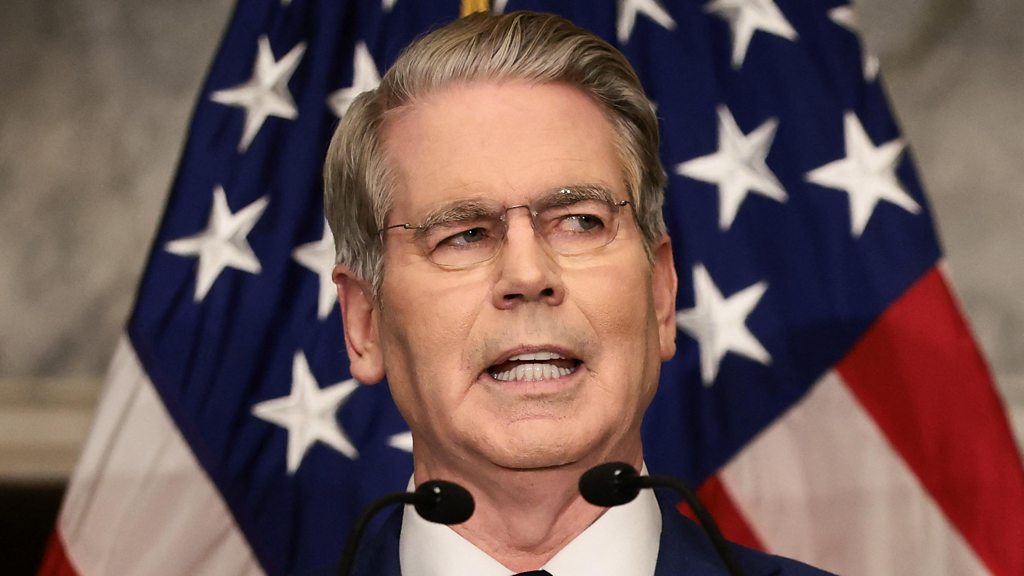
There have been a lot of sanctions programmes against Iran. But this week US Treasury Secretary Scott Bessent announced Operation Economic Outcast, which promises to go further than ever before. It will punish not just Iran but any country helping Iran – including China.
It is the Trump administration’s latest attempt to end the war. Will it work?
We speak to Vali Nasr, professor of international affairs and Middle East studies at Johns Hopkins University, and ask whether in trying to end one war, President Trump risks starting a global trade conflict.
Advertisement
(Photo: US Treasury Secretary Scott Bessent speaks during a press conference to outline further sanctions against Iran, at the Treasury Department in Washington, DC, 24 August, 2026. He has short, mousy-grey hair and is wearing glasses, with the American flag behind him. Credit: Evelyn Hockstein/Reuters)
























































You must be logged in to post a comment Login