
Business
TikTok told to change 'addictive design' by EU or face massive fines





Freelance Financial Writer | Investments | Markets | Personal Finance | RetirementI create written content used in various formats including articles, blogs, emails, and social media for financial advisors and investment firms in a cost-efficient way. My passion is putting a narrative to financial data. Working with teams that include senior editors, investment strategists, marketing managers, data analysts, and executives, I contribute ideas to help make content relevant, accessible, and measurable. Having expertise in thematic investing, market events, client education, and compelling investment outlooks, I relate to everyday investors in a pithy way. I enjoy analyzing stock market sectors, ETFs, economic data, and broad market conditions, then producing snackable content for various audiences. Macro drivers of asset classes such as stocks, bonds, commodities, currencies, and crypto excite me. My thing is communicating finance with an educational and creative style. I also believe in producing evidence-based narratives using empirical data to drive home points. Charts are one of the many tools I leverage to tell a story in a simple but engaging way. I focus on SEO and specific style guides when appropriate.
Analyst’s Disclosure: I/we have no stock, option or similar derivative position in any of the companies mentioned, and no plans to initiate any such positions within the next 72 hours. I wrote this article myself, and it expresses my own opinions. I am not receiving compensation for it (other than from Seeking Alpha). I have no business relationship with any company whose stock is mentioned in this article.
Seeking Alpha’s Disclosure: Past performance is no guarantee of future results. No recommendation or advice is being given as to whether any investment is suitable for a particular investor. Any views or opinions expressed above may not reflect those of Seeking Alpha as a whole. Seeking Alpha is not a licensed securities dealer, broker or US investment adviser or investment bank. Our analysts are third party authors that include both professional investors and individual investors who may not be licensed or certified by any institute or regulatory body.

ismagilov/iStock via Getty Images

• The fund posted returns of 4.51% (Institutional shares) and 4.45% (Investor A shares, without sales charge) for the fourth quarter of 2025.
• The largest contributor to relative performance was security selection in the financials, consumer

Bankers and analysts said that despite the Reserve Bank of India’s aggressive intervention through open market operation (OMO) purchases-₹1.77 lakh crore in March alone and ₹4.57 lakh crore over the entire fourth quarter-banks are unlikely to escape the quarter unscathed. MTM losses on government securities portfolios are expected to weigh on earnings.
“For me, 6.95% was the worst-case scenario, which was breached on Friday, and I don’t think many banks will have a positive book,” said Alok Singh, treasury head at CSB Bank. “Most banks would have bought bonds between the 6.30% and 6.70% levels this fiscal year, and after Friday’s close these portfolios are off the curve by about 30 basis points, which is negative from a book-running perspective.”
 Agencies
Rising yields dent bond portfolios, weighing on treasury income despite RBI’s OMO support
Rising sovereign bond yields are expected to cause significant mark-to-market losses for banks in the March quarter. Despite RBI’s open market operation purchases, escalating geopolitical tensions and inflation concerns have pushed 10-year government bond yields to a 12-month high, impacting bank portfolios.
The RBI stepped up intervention in early March, frequently purchasing bonds on-screen during the final hour of trading-a move widely seen as an attempt to cap the rise in yields. On several occasions, yields eased by 3-6 basis points in the last half hour of trade, even as broader market sentiment weakened amid geopolitical risks.
The strain on banks’ treasury books is not new. Banks had witnessed moderation in treasury income in the December quarter after peaking in the June quarter due to swings in the yields. Even when yields traded in the 6.47%-6.57% range between October and December 2025, banks faced MTM pressure.

In the December quarter the the net trading and MTM income for HDFC Bank fell to ₹9 billion versus ₹24 billion in the September quarter and ₹101 billion in the June quarter.
The new year brought little relief, with yields crossing 6.60% in January before accelerating further in March. “The surge in government bond yields is likely to hit banks’ treasury earnings in the March quarter despite RBI OMO support,” said Prakash Agarwal, partner at Gefion Capital, adding that inflation worries stemming from higher oil prices, West Asia tensions and rising global yields continue to push yields higher. However, some bankers are hopeful of limited near-term relief. “I expect MTM losses due to hardening yields, but there could be some respite on Monday,” said Gopal Tripathi, head of treasury at Jana Small Finance Bank.

DHARMESH SHAH
HEAD OF TECHNICAL RESEARCH, ICICI SECURITIES
Where is Nifty headed?
For a meaningful pullback to materialise, Nifty must reclaim its short-term moving average (23,800) and establish a ‘higher high–higher low’ pattern on weekly chart in the upcoming truncated week. Failure to do so means the possibility of a prolonged correction cannot be ruled out, wherein critical long-term support is placed in 21,900–21,700 zone.
Our support is based on the following observations: a) Past 25 years’ data suggest that there have been eight occasions where bull market corrections were arrested, with an average decline of 17%. b) Since 2003, on multiple occasions, Nifty has respected the long-term 200-week EMA (barring 2008 and 2020), currently placed at 21,930. c) The April 2025 panic low is placed at 21,743. d) Whenever 85% of Nifty 500 universe trades below their 50- and 200-SMAs, and the net daily advance-decline suggests that only 30 stocks are in positive territory, it signals capitulation extremes. Post these extremes, the index has delivered a median rally of 23% in the subsequent 6–12 months.
Trading Strategies: Option Strategy for April
Buy 1 lot of 23,800 CE @ 322
Buy 1 lot of 21,800 PE @ 379
Sell 2 lots of 24,100 CE @ 230
Sell 2 lots of 21,500 PE @ 311
Total inflow is 381 points (Rs 24,765 per lot), which is the minimum profit if the index stays between 21,800 and 23,800. The maximum profit is 650 points (Rs 42,000 per lot) if the index closes at 24,100 or 21,500.
The breakeven range is 20,800 on the downside and 24,800 on the upside. As long as Nifty trades within this range, the strategy remains profitable, with gains between Rs 24,765 and Rs 42,000 per lot. The approximate margin required is Rs 2,20,000.
AgenciesTOP PICKS FOR THE WEEK
Bharti Airtel: Buy at Rs 1,790–1,845, Stop Loss at Rs 1,684, Target: Rs 2,032
Stock has rebounded from its key 20-month EMA, which has held as support in past corrections. After an ~18% fall over four months, it is showing a familiar correction pattern, offering a favourable risk-reward buying opportunity.
DLF: Sell at Rs 523–535, Stop Loss at Rs 546, Target: Rs 502.
Stock has been trading below all its key moving averages, indicating a negative short-term bias. Structurally, the stock has witnessed a multi-month support breakdown, with a lower high–lower low structure on the weekly time frame.
RAHUL SHARMA
HEAD – TECHNICAL & DERIVATIVE RESEARCH, JM FINANCIAL SERVICES
Where is Nifty headed?
Nifty formed back-to-back doji candles on weekly charts, indicating indecision. Friday’s sell-off came on higher-than-average volumes, with FII shorts in the index at their highest level (2.79 lakh short) since the war began. India VIX has risen to sub-27 levels, suggesting continued gap openings. The daily trend remains down, with significant short additions seen on Friday in Nifty, Bank Nifty, and Midcap Nifty futures. Immediate support is at 22,471, below which the index could test 22,000. Resistance is placed at 22,900 and 23,200.
Trading Strategies: Look to add Nifty ATM puts of next week’s expiry on a bounce back around 23,000 for downside targets of 22,470 and lower. Investors can look to add Nifty ETFs in the range of 21,700–22,000 if the correction extends this week.
TOP STOCKS FOR THE WEEK
Reliance Industries: Sell at CMP Rs 1,348, Stop Loss at Rs 1,380, Target: Rs 1,310/1,280
A bearish breakdown was seen on daily charts on Friday, along with a rise in volumes.
Bharti Airtel: Buy at CMP Rs 1,843, Stop Loss at Rs 1,795, Target: Rs 1,900/1,950
A bullish divergence was seen on daily charts relative to Nifty in the last two weeks, along with a rise in volumes on Friday.
DHUPESH DHAMEJA
DERIVATIVES ANALYST, SAMCO SECURITIES
Where is Nifty headed?
The index remains in a lower high–lower low formation, with rebounds being sold into and the short-term trend firmly bearish. Nifty faced rejection near its 10-DEMA and has breached the 22,950–23,000 support zone, now acting as resistance. Weak momentum (RSI below 40) and elevated India VIX near 26.8 point to continued volatility and downside risk.
As long as Nifty stays below 23,000, the bias remains negative with targets of 22,500 and 22,200. A sustained move above 23,000– 23,100 could trigger short covering towards 23,400–23,500.
Trading Strategies: Adopt a sell-on-rise approach near 22,900–23,000 with a stoploss above 23,100, aiming for 22,600–22,500 on the downside. At the same time, options traders can deploy a Bear Call Spread (sell 22,500 CE and buy 25,800 CE of the 07 April 2026 expiry) to benefit from overhead resistance and limited risk exposure.
TOP STOCKS FOR THE WEEK
Ather Energy: Buy at CMP Rs 796, Stop Loss at Rs 748, Target: Rs 880
Ather Energy is showing strong bullish momentum after breaking above its previous all-time high zone of Rs 780–790 and hitting fresh highs, signalling trend continuation. The stock continues to form a higher high–higher low structure, indicating sustained buying interest.
Emcure Pharma: Buy at CMP Rs 1,652, Stop Loss at Rs 1,540, Target: Rs 1,840
Stock shows a strong bullish continuation after breaking above the Rs 1,580 resistance, a key supply zone. It continues to form a higher high–higher low structure, indicating a strengthening trend and accumulation. The breakout is backed by improving participation, signalling demand-driven price action and reinforcing the uptrend.
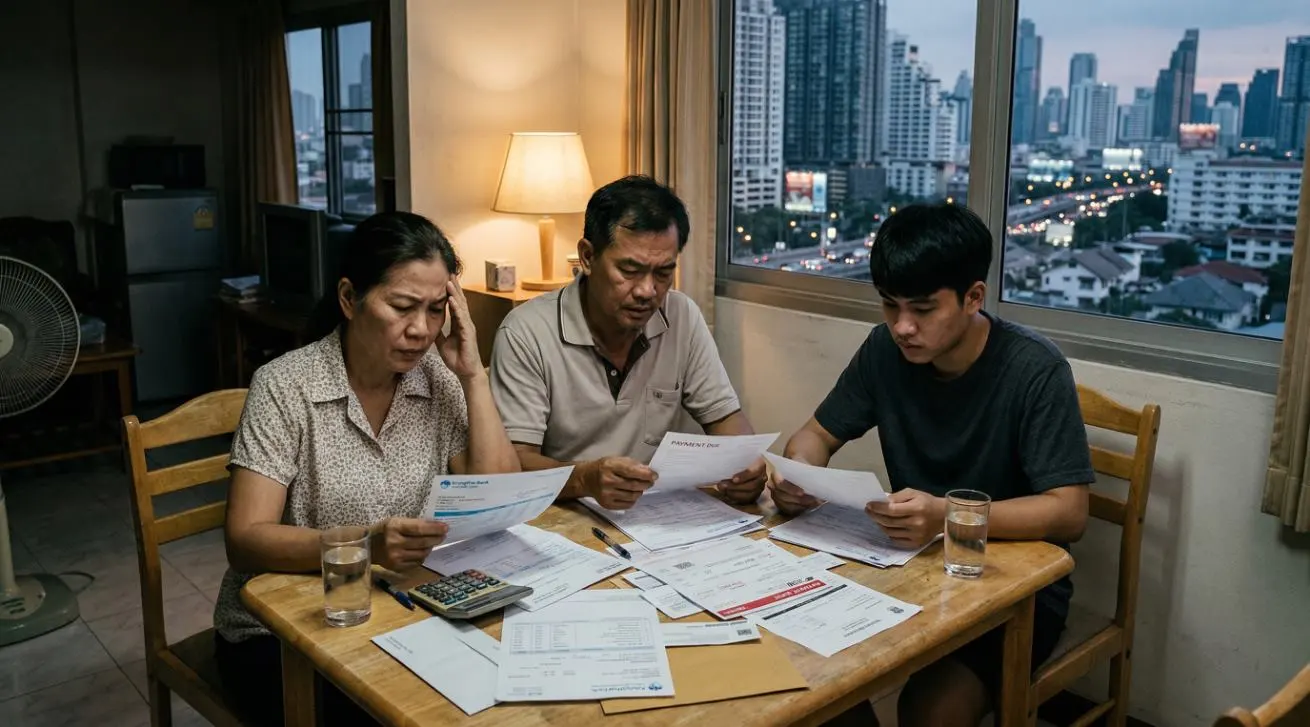
Across mainland Southeast Asia, the region’s economic story is increasingly being shaped not by exports, industrial growth, or foreign investment, but by households taking on debt simply to meet everyday needs.
Key takeaways
- Household debt is rising across Southeast Asia as families increasingly borrow to cover everyday living costs rather than build wealth.
- Cambodia stands at the center of the crisis, where rapid credit growth, weak wages, and heavy microfinance borrowing have deepened household vulnerability.
- Analysts warn that if debt pressures continue unchecked, the crisis could spread beyond families and begin to threaten wider economic and financial stability
Analysts say what was once presented as financial inclusion is now becoming a source of financial vulnerability, as easy credit, weak wage growth, and limited public services leave millions of families under growing strain.
Cambodia has become one of the clearest examples of this shift. The country’s private debt to GDP ratio rose from 24.2% in 2010 to 134.5% in 2023, marking one of the fastest debt expansions in the region. That rise is now colliding with a weaker property sector, border disruptions with Thailand, and fresh US trade restrictions, intensifying pressure on already indebted households.
According to Cambodia’s Credit Bureau, the average outstanding personal loan per borrower stood at around $6,500 in December 2025, despite the garment sector’s minimum wage being only $208 per month. The figures highlight how sharply household borrowing has outpaced income growth in one of the region’s most vulnerable economies.
Borrowing for Daily Survival
The problem extends beyond Cambodia. Thailand’s household debt reached 86.8% of GDP in 2025, placing it among the most indebted economies in Asia. Myanmar is also dealing with chronic household debt, while Malaysia’s household debt stood at 84.3% of GDP by mid 2025.
The composition of debt varies across the region, with Malaysia’s borrowing concentrated in housing and vehicle loans, while Thailand carries a heavier share of personal consumption debt.
Experts say a growing number of households are borrowing not to invest or build wealth, but simply to cover food, healthcare and other basic expenses. In Thailand, 64% of non-performing loan accounts were linked to credit cards and personal loans, while many borrowers were spending more than half of their monthly income on debt repayments.
Rising living costs, combined with external shocks such as tariff threats and regional instability, have made that burden even harder to manage.
Antonios Roumpakis of Hong Kong Metropolitan University said Cambodia and Myanmar have been especially exposed because their growth models are more vulnerable to regional tensions and US tariffs. He also pointed to deeper structural problems, including oversupplied credit, weak financial regulation, and poor lending decisions, as key drivers of the crisis.
Microfinance, Poverty, and Wider Financial Risk
Microfinance has become a central issue in the debate over rising debt. Milford Bateman of Royal Holloway, University of London, said the boom in household debt across much of the Global South, particularly in Cambodia, can be directly linked to the commercialization of microcredit institutions that were once not-for-profit. Human Rights Watch reported that Cambodia’s 3.8 million households held more than 3.1 million microloans worth over $18 billion.
For many families, borrowing is increasingly tied to emergencies rather than opportunity. A health financing study found that 28% of people in Cambodia had borrowed money to pay for healthcare, while a 2025 UN study found that 23% of urban households in Myanmar were borrowing for medical costs. Analysts warn that such debt can trap families in long term poverty, often forcing them to sell assets or seek dangerous forms of work to survive.
The risks are also spreading into the broader economy. In Cambodia, the return of large numbers of migrant workers from Thailand has worsened household vulnerability, while falling remittances have removed an important financial buffer for many families.
In Thailand, heavy debt levels have been blamed for weak consumption, prompting repeated stimulus efforts by the government. Economists warn that if household debt continues to deteriorate, it could evolve from a social crisis into a wider banking problem.
Cambodia’s central bank has already approved the creation of asset management institutions to purchase non-performing loans, a sign of increasing urgency rather than long-term reform confidence. Analysts say the region’s debt crisis will not be solved by credit markets alone.
Stronger banking oversight, tighter regulation of microfinance, and broader access to healthcare, education, and housing will be essential if households are to avoid borrowing beyond their limits.
Other People are Reading

Sai Parenteral’s IPO subscription status
The mainboard issue that closed on Friday, was subscribed 1.05 times over a three-day bidding period. It received over 78.80 lakh share bids against 75,22,486 equity shares available for booking.
The demand was mainly driven by non-institutional investors’ (NII) who subscribed the issue 2.36 times. Qualified Institutional Buyers (QIBs) subscribed the IPO 1.71 times their quota, while Retail Individual Investors (RIIs) hardly showed any interest, subscribing just 12% shares of the available quota.
Here’s how you can check the status on BSE:
Step 1: Visit the BSE ‘Status Application Check’ page https://www.bseindia.com/investors/appli_check.aspx
Step 2: Select Issue Type: Equity/Debt
Step 3: Put PAN/Application No. and enter checkbox ‘I’m not a robot’.Step 4: Submit ‘Search’
Its stock is expected to get listed on April 2.
About Sai Parenteral’s IPO
The company has set the price band at Rs 372– 392 per share and retail investors can make applications for a minimum of 1 lot which comprises 38 equity shares amounting to Rs 14,896.
The IPO’s fresh issue aggregates up to Rs 285 crores while the OFS aggregates up to Rs 123.79 crores which includes anchor investor portion of 31,28,485 equity shares.
The company raised Rs 122.63 crore on Monday through five anchor investors.
It has reserved 50% of the issue for qualified institutional buyers (QIBs), up to 35% for retail investors and 15% for non-institutional investors (NIIs).
Sai Parenteral’s IPO GMP
Shares of Sai Parenteral’s were not commanding any grey market premium (GMP) ahead of the opening of the issue. This implies a flat listing. The GMP is only an indicative price and could change as the issue progresses.
Sai Parenteral’s IPO net proceeds
The gross proceeds from the issue will be to the tune of Rs 285 crore. The company will utilise Rs 110.8 crore towards capacity expansion and upgradation of manufacturing facilities, Rs 18 crore for establishment of a new R&D Centre, Rs 14 crore towards repayment of borrowings, and Rs 33 crore for its working capital requirements.
About Sai Parenteral’s
Sai Parenteral’s (SPL) is a diversified pharmaceutical formulations company engaged in the business of branded generic formulations and Contract Development and Manufacturing Organisation (CDMO) products & services for the domestic and international markets. The company’s portfolio includes formulation products, covering both high-value and high-volume categories across therapeutic areas like cardiovascular, neuropsychiatry, anti-diabetic, etc., with offerings across dosage forms such as injectables, tablets, capsules, liquid orals and ointments.
Sai Parenteral’s Financials
The company’s revenue from operations in H1FY26 stood at Rs 303 crore while its profit after tax (PAT) stood at Rs 2 crore. For FY25, revenue stood at Rs 495 crore versus Rs 154 crore in FY24 and Rs 97 crore in FY23. The PAT stood at Rs 20 crore in FY25 versus Rs 8 crore in FY24 and Rs 4 crore in FY23.
Sai Parenteral’s IPO lead managers
The Book Running Lead Managers (BRLMs) is Arihant Capital Markets Ltd while the registrar to the issue is Bigshare Services Pvt Ltd.
(Disclaimer: The recommendations, suggestions, views, and opinions given by the experts are their own. These do not represent the views of The Economic Times.)

The City regulator will outline how millions of people can claim compensation for mis-sold car finance.

Check out what’s clicking on FoxBusiness.com.
Investigators reportedly found cocaine and fentanyl hidden inside Barbie doll packaging that had been sold to multiple unsuspecting customers in Missouri last weekend.
The incident occurred on March 21 after discount retailer Cargo Largo reported finding a “suspicious powder substance” in the packaging of the dolls, the Independence Police Department (IPD) reported.
Officials determined that five compromised units were sold but were able to recover all the affected items within hours of launching an investigation.
“At approximately 10:18 am this morning, IPD was contacted by Cargo Largo Security regarding a suspicious powder substance located in the packaging of a Barbie Doll,” officials said.
OVER 190,000 ‘LETHAL’ DOSES OF COCAINE SEIZED IN VALENTINE’S DAY WEEK BUST AT SOUTHERN BORDER

A worker carries Barbie dolls to put them on the shelves at a toy store. (Carlos Garcia Rawlins/File Photo/Reuters / Reuters)
The retailer added in a statement that while initial tests indicated the presence of fentanyl, additional tests confirmed that the substance was cocaine with trace amounts of fentanyl.
No injuries were reported and police noted that the Barbie Dolls themselves were not compromised.
AUTISTIC BARBIE JOINS MATTEL DIVERSITY AND INCLUSION LINE

A box of Barbie dolls doing gymnastics in a section of a toy store on Nov. 15, 2025. (Nicolas Guyonnet/Hans Lucas/AFP via Getty Images / Getty Images)
The substance was discovered taped inside the back packaging of the dolls, IPD said.
The retailer added that they identified the source and shared all relevant information with the authorities.

A small bag of fentanyl on display on Wednesday, September 16, 2015, in London, Ohio. (Ty Wright for The Washington Post via Getty Images / Getty Images)
Following the discovery, Cargo Largo allowed investigators and multiple K9 units to conduct a thorough sweep of the store and warehouse.
No additional risks were found, the retailer said.
GET FOX BUSINESS ON THE GO BY CLICKING HERE
| Ticker | Security | Last | Change | Change % |
|---|---|---|---|---|
| MAT | MATTEL INC. | 14.30 | -0.32 | -2.19% |
Police added there is no reason to believe any compromised units were sent to other locations.
“Moving forward, we will schedule regular inspections of both facilities to maintain a safe environment,” the retailer said.
FOX Business reached out to IPD, Cargo Largo and Mattel for more information.

State and territory leaders are meeting on Monday to thrash out ideas to curb the ongoing fuel crisis as the Middle East conflict rages on.

Late Friday, the Reserve Bank of India announced new rules capping the open positions banks can hold in the onshore currency market at $100 million at the end of each trading day. The change, effective April 10, forces lenders to shrink their books, limiting their ability to run large one-sided bets against the rupee.
The urgency reflects deep concern about the rupee, which has slid to successive record lows following the Iran war. That is pushing the RBI to shift away from relying mainly on spot and forward market interventions — tools that have already contributed to a more than $30 billion drawdown in foreign-exchange reserves in the first three weeks of March, according to people familiar with the matter, to more direct measures targeting financial institutions.
“The move signals clear discomfort with rupee weakness and reflects a shift from direct intervention to controlling market positioning, offering near-term stability but limited influence on longer-term fundamentals,” said Kunal Sodhani, head of treasury at Shinhan Bank in Mumbai.
Lenders are seeking to delay the deadline to comply, warning that such a rapid unwind may trigger large losses, and urging that the rule apply only to new bets, people familiar with the matter told Bloomberg News.
BloombergPressure on the rupee has mounted since the Iran war broke out a month ago. The currency has fallen more than 4% over that period to 94.82 as of Friday, and is Asia’s worst performer this year. Uncertainty over the duration of the conflict has prompted global funds to pull more than $11 billion from Indian equities, while index-eligible bonds have seen record outflows of $1.6 billion in March.
Part of the challenge for policymakers is where that pressure is coming from. While the rupee trades in Mumbai, price signals are increasingly determined overseas in hubs like Singapore, London and New York, through derivatives that let investors take positions without access to domestic markets.That makes traditional intervention less effective. Large positions can build outside India’s regulatory reach and feed back to domestic markets via arbitrage, forcing the RBI to respond by selling dollars, draining reserves while doing little to curb the underlying build-up.
By capping how much risk banks can carry, authorities are trying to make it harder for those positions to accumulate in the first place — echoing steps taken in 2011, when the RBI tightened banks’ net open position limits.
“This is a period of extreme stress for the rupee because of an unprecedented energy shock,” said R. Gurumurthy, a former RBI regional director who previously oversaw dollar-rupee interventions. “If you look at past instances where the rupee has faced such rapid depreciation in such a short time, the RBI has always stepped in with exceptional steps.”
BloombergThe growth in offshore trading has long unsettled the RBI. When London overtook Mumbai as the top center for rupee trading in 2019, officials warned that offshore rupee trading was being driven by “speculators and arbitrageurs.”
Most of this activity is in non-deliverable forwards — contracts commonly used in emerging markets, especially for currencies that are not freely traded — allowing investors to hedge or bet on future values without physically exchanging the rupee.
The market’s rapid expansion has coincided with a persistent slide in the rupee, even as India remains one of the fastest-growing major economies, expanding at more than 7% annually in recent years. Capital markets have also grown, drawing about $16 billion from foreign investors into Indian bonds since their inclusion in JPMorgan Chase & Co.’s flagship index in June 2024.
Yet the rupee has weakened more than 25% since 2019, underscoring the disconnect between strong domestic fundamentals and currency performance.
The offshore market “exhibits exaggerated movements,” said G. Mahalingam, a former RBI executive director who was part of a 2019 task force set up to examine overseas rupee trading. “It takes the lead and the domestic market follows.”
Root Problems
Intervention alone has struggled to close that gap. The RBI was a net seller of $51.7 billion of dollars last year, the most on record, and has continued to step in during bouts of volatility, including at the onset of the Iran conflict.
The impact has been limited, highlighting the constraints of direct intervention when it runs up against broader macro forces like a strong dollar and shifting global risk sentiment. Other emerging-market currencies like the Philippine peso and South Korean won have also tumbled after the Middle East conflict broke out.
“Trying to stem currency depreciation by putting the squeeze on offshore markets rarely has the intended effect of staving off speculative pressures,” said Eswar Shanker Prasad, senior professor of trade policy at Cornell University. “The root problems underlying a currency’s falling value need to be addressed.”
With intervention proving costly, the central bank has widened its approach. Besides the limits on open positions, it has also proposed stricter reporting rules requiring overseas affiliates of lenders to disclose rupee-linked trades to a clearing house supervised by the RBI, in a bid to better understand who is driving offshore activity and why.
The plan has met resistance. Global banks said it could breach client confidentiality, conflict with data and reporting rules in other jurisdictions and require major changes to their systems, data formats and legal agreements.
“Some banks may need time to set up their reporting mechanisms, which could result in a temporary, limited decline in liquidity,” said Rajeev De Mello, global macro portfolio manager at Gama Asset Management.

VPL: Why The Pullback In Asia Pacific Stocks Is A Buying Opportunity (NYSEARCA:VPL)

NHL roundup: Flyers beat Stars in OT as East playoff race tightens up

Floods, a landslide and thunderstorms in Afghanistan leave 17 people dead

Smart energy pays enters the US market, targeting scalable financial infrastructure

Why Israel is blocking foreign journalists from entering

Bitcoin: We’re Entering The Most Dangerous Phase

This Machine Turns Paper into Money! #moneytips #gadgetsshorts #artshorts

Marjorie Taylor Greene Declares MAGA is Dead #mtg #maga #breakingnews #viralnews

Wei Yi speaks about his dream team, financial support and more for the Candidates 2026
-
 NewsBeat5 days ago
Manchester United reach agreement with Casemiro over contract clause amid transfer speculation
-

 News Videos4 days ago
Parliament publishes latest register of MPs’ financial interests
-

 Sports7 days ago
Gary Kirsten Accuses Pakistan Cricket Board Of ‘Interference’, Mohsin Naqvi Responds
-

 Sports7 days ago
Remo Stars and Kano Pillars Strengthen Survival Hopes in NPFL
-

 NewsBeat2 days ago
The Story hosts event on Durham’s historic registers
-

 News Videos7 days ago
Ch 9 Financial Management Part 1 | Detailed One Shot | Class 12 Business Studies Boards 2026
-

 Business3 days ago
Instagram, YouTube Found Responsible for Teen’s Mental Health Struggle in Historic Ruling
-
 NewsBeat5 days ago
Tesco is selling new Cadbury Dairy Milk bar and people can’t wait to try it
-
 Entertainment7 days ago
Cynthia Bailey Dishes on ‘RHOA’ Season 17, Discusses Kandi
-

 Tech6 days ago
Samsung will soon let you control smart home devices from your car’s dashboard
-

 Sports7 days ago
2026 Kentucky Derby horses, odds, futures, preview, date: Expert who hit 12 Derby-Oaks Doubles enters picks
-
 Entertainment1 day ago
Lana Del Rey Celebrates Her Husband’s 51st Birthday In New Post
-

 Business6 days ago
More women enter wealth management, but few in advisory roles: study
-
 NewsBeat6 days ago
Colombian military plane with 110 soldiers onboard crashes following takeoff
-

 Fashion5 days ago
Does It Matter What You Wear When You’re Laid Off and Looking?
-

 Fashion7 days ago
Fringe Bags for the Season
-

 Business6 days ago
Late-paying firms face multimillion-pound fines under new crackdown
-

 NewsBeat5 days ago
Entrepreneurs Forum survey reveals optimism in North East
-

 Politics6 days ago
How Media Platforms Balance Performance and Accessibility in Image Delivery
-

 Sports5 days ago
Fantasy Baseball Week 1 Preview: Top sleeper hitters for both five- and 12-day period led by Munetaka Murakami
You must be logged in to post a comment Login