

Business
Trump made more than $1bn from crypto in first year back in office

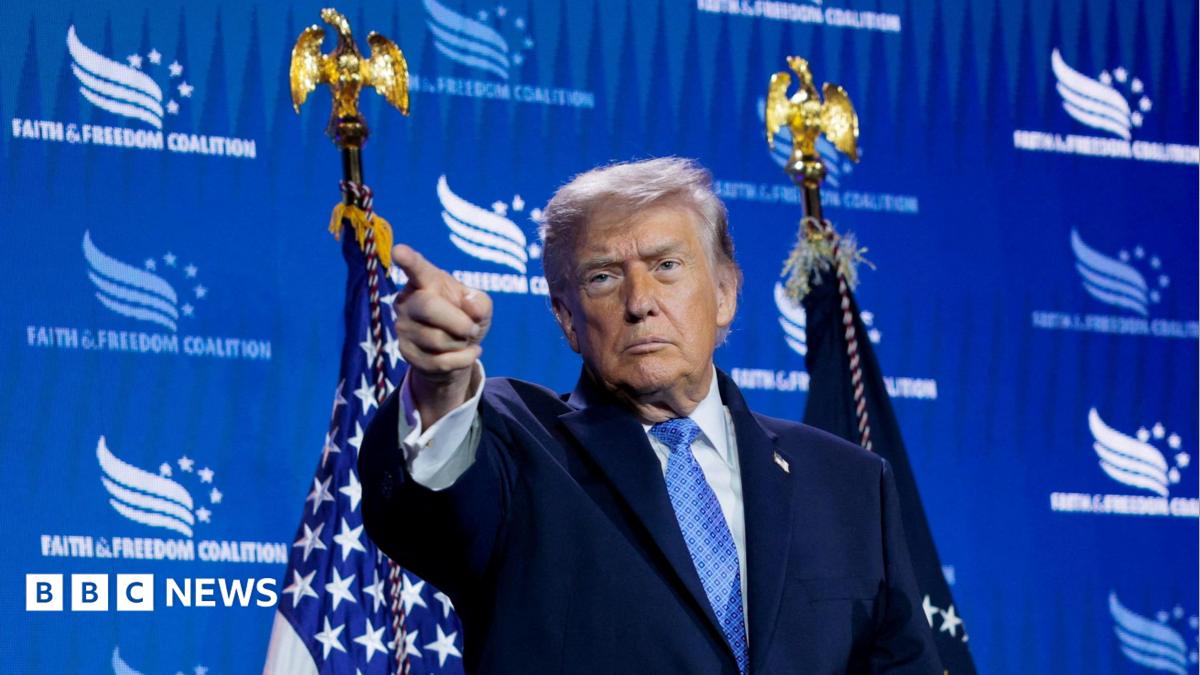
US President Donald Trump made more than $1bn (£750m) last year from business dealings in cryptocurrency, according to his mandatory financial report for 2025.
In a 927-page disclosure, he reported $635m in royalties from a Trump meme coin that has plunged in value since he launched it three days before taking office.
He also reported over $500m in income from World Liberty Financial, a cryptocurrency firm founded by his own sons and the children of his special envoy, Steve Witkoff.
He earned millions more from real estate, Trump-themed Bibles, watches and other items. But the White House denied he was profiting from the presidency.
Much of the income was from transactions with World Liberty Financial, a venture from which Trump and family members receive 75% of the company’s proceeds.
It represents a significant increase in moneymaking compared with Trump’s 2024 financial disclosure, when he disclosed over $600m in income.
But White House deputy press secretary Anna Kelly rejected any suggestion of ethical concerns and said Trump had proudly made the US “the crypto capital of the world”.
“Neither the President nor his family has ever engaged – or will ever engage – in conflicts of interest,” she said in a statement.
She added: “All actions by President Trump and his administration are taken in the best interest of the American people – and any so-called ‘reporters’ pushing otherwise are recycling the same, tired, false narrative that Democrats and the legacy media have been pushing for a decade.”


Netflix’s third installment in its popular Enola Holmes franchise arrived Tuesday with Millie Bobby Brown reprising her role as Sherlock Holmes’ younger sister in a sunnier, darker and more action-heavy chapter set against the backdrop of Malta, drawing a divided critical reception that praised Brown’s performance while questioning whether the series has begun to show signs of franchise fatigue.
“Enola Holmes 3,” rated PG-13 and running one hour and 45 minutes, begins on wedding day. Enola is about to marry Lord Tewkesbury, played again by Louis Partridge, in a ceremony set on the sun-drenched Mediterranean island. Before she can reach the altar, news arrives that her brother Sherlock, played by Henry Cavill, has been kidnapped, and Tewkesbury’s mother is taken shortly afterward. The wedding is indefinitely postponed, the mystery takes over, and Enola races through Malta with Dr. Watson, played by Himesh Patel, to find the kidnappers before the situation turns fatal.
The film is directed by Philip Barantini, best known for the critically acclaimed Netflix series “Adolescence,” who takes over the franchise from Harry Bradbeer, who helmed the first two entries. The screenplay was again written by Jack Thorne, who adapted Nancy Springer’s YA book series for all three films. The ensemble cast also includes Helena Bonham Carter as Enola’s bomb-throwing revolutionary mother Eudoria, Sharon Duncan-Brewster as the villainous Moriarty and Susan Wokoma as Enola’s mentor Edith.
The film includes a clue left by Sherlock before his abduction that becomes central to the plot.
“A Holmes does not disappear without leaving clues for a Holmes,” Enola observes in the film.
The shift to Malta gives the film its most visually distinctive look of the trilogy, trading London’s gloomy Victorian streets and fog for sparkling Mediterranean light and colorful architecture. Several critics noted the change of scenery as one of the film’s stronger decisions, lending the story a fresh visual energy that helps distinguish this installment from its predecessors.
Among the more enthusiastic reviews, Tom’s Guide described the third film as “easily” the reviewer’s favorite in the franchise, citing the emotional depth added to the story through Enola’s ambivalence about marriage and the fear of losing herself in the role of Victorian aristocratic wife alongside her fear of failing to save her brother. RogerEbert.com praised Brown as “ideally cast” and highlighted the film’s action sequences, puzzles and romance as dynamic and engaging elements, adding that “when she speaks directly to us, it feels good to be part of her story.”
MovieWeb similarly called the villain “deliciously fiendish” and praised the film’s ambition in raising the franchise’s stakes.
Critical reviews at the other end of the spectrum identified a set of recurring concerns about pacing, mystery quality and tonal inconsistency. Collider called the film “mostly forgettable,” arguing that while Brown continues to charm in the lead role, the mystery itself is lazy, largely predictable and telegraphed from early in the running time, a particular problem for a series built explicitly on the detective genre’s tradition of genuine puzzle-solving. IndieWire noted that while Barantini brings a more grown-up touch to the material, the choice doesn’t always mesh comfortably with the franchise’s characteristic exuberance, creating a film that feels caught between its desire to mature alongside its audience and its obligation to retain the playful energy that distinguished the original.
Gulf News offered perhaps the most pointed mixed assessment, describing the film as resembling banana bread: “Fine, but nothing to make a fuss about.” The review flagged the feminist and colonial commentary as clumsily integrated into the plot, suggested the villain lacked the nuance appropriate for a Holmes story and criticized a pattern in which Enola’s detective work increasingly gives way to action sequences.
Variety noted that while Enola’s fourth-wall breaks and deductive moments remain charming, some of the real-world social commentary about the suffrage movement and workers’ rights that made the earlier films feel particularly vital is largely absent here, replaced by plot threads about Maltese independence fighters and Dr. Watson’s military past that feel like afterthoughts.
Hollywood Reporter, in perhaps the most concisely worded verdict across the critical coverage, offered what it called a “bottom line” that the film was “elementary but enjoyable,” a play on Sherlock Holmes’ most famous phrase that captures the middling but watchable quality many critics identified.
Brown is again a producer on the film alongside Robert Brown, Michael Dreyer and Jack Thorne. The executive producer roster includes Joshua Grode and Jake Bongiovi. Director of photography Matthew Lewis shot the film on location in Malta and in studio, with production design by Gary Williamson and costumes by Consolata Boyle rounding out the period aesthetic.
The first Enola Holmes film, released in 2020 during the height of the pandemic, was watched by approximately 76 million households in its first four weeks on the platform, making it one of Netflix’s more successful original film launches and establishing Brown as a reliable franchise anchor for the streaming service alongside her work on “Stranger Things.” The sequel followed in 2022 with a broadly positive reception and solid viewership, setting up the third installment as the next test of whether the series can sustain long-term audience engagement.
Whether the franchise continues beyond this third film remains unclear. Some critics specifically called for a fourth entry if the creative team can sharpen the mystery writing, while others suggested the franchise has run its natural course and that Enola might be better served retiring gracefully rather than continuing in diminished form.
For now, “Enola Holmes 3” is available to stream exclusively on Netflix beginning Tuesday, July 1.

Travelzoo: Its Upward Travel Is Quite Enough For Its Valuation And Technicals

The Australian share market has managed to avoid a third straight day of losses thanks to a bounce from the banking sector.
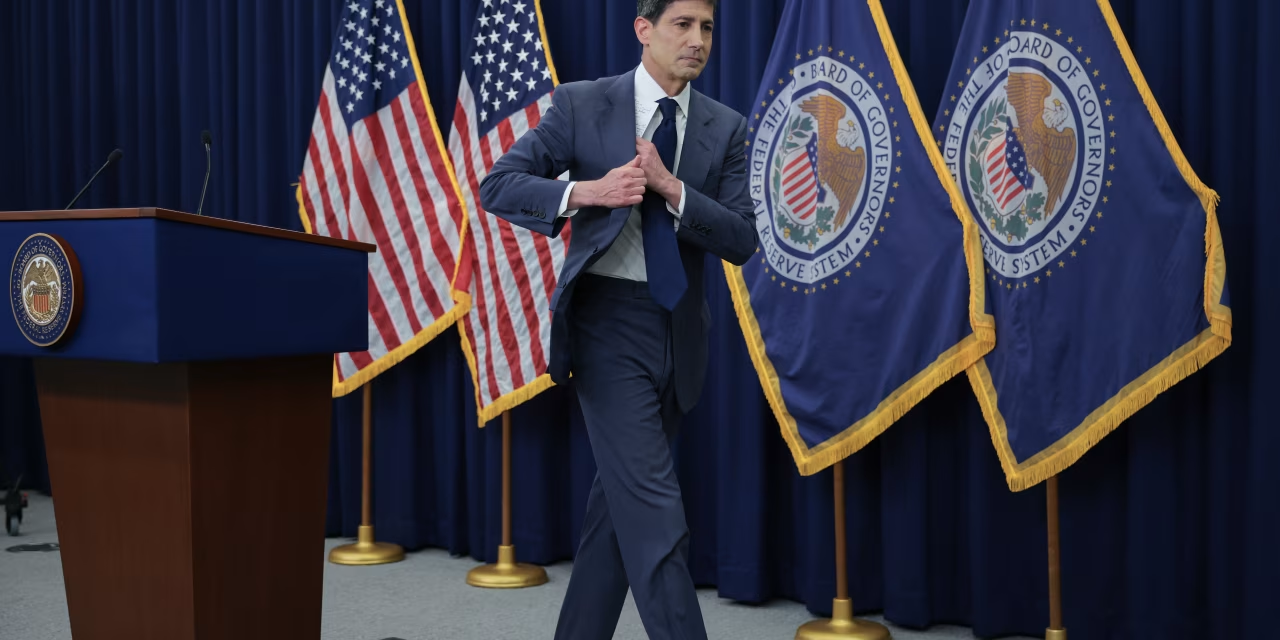
Federal Reserve Chairman Kevin Warsh is talking less than some of his predecessors, making some investors nervous about the prospect of a quieter Fed. At his first Fed meeting as chairman, Warsh shortened the central bank’s policy statement and declined to provide an interest-rate forecast. His approach is prompting some investors to say that added uncertainty could lead to a more volatile market. Read more:

- A Bain & Company report drawing on surveys of 600 doctors and 6,300 consumers across Asia-Pacific finds the region’s healthcare systems under simultaneous pressure from physician burnout and rising consumer expectations. One in five doctors are considering leaving their jobs, while 84% of patients demand greater convenience and 95% want a single point of contact for their care.
- AI adoption is widely supported by both patients and clinicians but organisational readiness remains limited, with one in three doctors saying their institution is unprepared to deploy it at scale. Bain identifies an 18-month window for providers and insurers to act, emphasising clinician engagement and coordinated care models as prerequisites for sustainable change.
A wave of physician burnout is colliding with a surge in consumer demand across Asia-Pacific’s healthcare systems, according to a major new report from global consultancy Bain & Company, which warns that the region’s providers, insurers and pharmacies have roughly 18 months to adapt before losing ground to faster-moving competitors.
Key takeaways
- One in five Asia-Pacific doctors are considering leaving their jobs, driven by heavy workloads and lack of recognition rather than pay, threatening the region’s already thin physician supply.
- Patients are behaving like consumers, with 84% demanding more convenience, 95% wanting a single point of contact for their care, and nearly 60% shifting to alternative settings like telehealth, retail clinics and home-based visits.
- Appetite for AI in healthcare is high among both patients and doctors, but one in three physicians say their organisation isn’t ready to deploy it at scale, leaving an 18-month window for providers and insurers to adapt before losing ground.
The report, Bain’s fourth biennial study of frontline healthcare trends in the region, draws on surveys of 600 doctors in Australia and the Philippines and 6,300 consumers across nine countries, conducted in December 2025. Its authors describe a system caught between two forces moving in opposite directions: patients who increasingly behave like demanding consumers, and a clinical workforce that is stretched to its limit.
A Widening Gap Between Supply and Demand
The tension, researchers argue, stems from a structural mismatch. Asia-Pacific is home to roughly 60% of the world’s population and carries an outsized share of global disease burden, yet the region accounts for only about 22% of worldwide healthcare spending. Physician density remains thin, excluding China, the report puts the average at under one doctor per 1,000 people, far below the World Health Organization’s recommended minimum of 2.5.
Against that backdrop, long wait times have topped the list of consumer complaints for four consecutive Bain surveys, a pattern the report says holds true regardless of whether a country’s system is public or private, wealthy or developing. High out-of-pocket costs compound the problem: fewer than 70% of patients with chronic conditions reported keeping up with regular check-ups, with cost cited as the main deterrent.
Physicians on the Edge
Doctors, meanwhile, are signalling they’ve had enough. Roughly 20% of physicians surveyed said they are actively weighing a move to a different organisation, and about 30% believe recruitment and retention have worsened since 2023. The report attributes this primarily to heavy workloads and a lack of professional recognition rather than pay. Doctors in both mature markets like Australia and emerging ones like the Philippines ranked career development and access to modern tools above compensation as priorities, yet only about 30% said they were satisfied on either front.
The stakes of ignoring this trend are high, the report suggests: physicians who feel engaged in strategic decisions at their organisations reported workplace advocacy scores up to 36 points higher than colleagues who don’t, a gap researchers linked to broader outcomes in patient care and safety.
Patients Are Acting Like Consumers
On the demand side, the report documents a marked shift toward consumer-style healthcare behaviour. The vast majority of respondents, 84%, said they now expect more convenience from the healthcare system than they did two years ago, and 71% want doctors to be reachable through messaging apps or email rather than waiting for scheduled visits. Nearly 70% said they had used AI tools to help interpret a diagnosis or treatment plan.
Preventive care usage has also jumped, with 60% of consumers reporting regular check-ups and screenings in 2025, up from 47% two years earlier, a trend led by China, where 76% of respondents said they get routine screenings.
Spending patterns reflect the same shift: consumers reported increasing what they spend across every category of health and wellness, with nutrition supplements, fitness, and oral healthcare showing the sharpest gains.
Care Is Moving Outside the Hospital
Consumers are also voting with their feet when it comes to where they receive treatment. Close to 60% now use alternative care settings such as walk-in clinics, home-based visits, telehealth or wearable devices, a significant jump from intent levels measured in 2019. The preferred format varies widely by market: retail clinics dominate in Malaysia and Australia, home-based care leads in India and Vietnam, and telehealth is the top choice in China and Singapore, where usage has climbed to 61% of consumers, up 37 percentage points since 2019.
By contrast, telehealth adoption in India has fallen sharply, dropping to just 10% penetration as the market’s largely cash-based payment structure limits insurer-driven incentives to use virtual care.
Surgeons surveyed said they would like to perform far more procedures in ambulatory surgical settings than they currently do, citing patient preference and better access to modern equipment as key drivers.
Fragmentation Frustrates Patients and Doctors Alike
A recurring theme in the report is fragmentation. Half of consumers said they were referred to multiple providers before receiving an accurate diagnosis, and more than 40% received conflicting advice from different clinicians. For patients managing chronic illness, more than half said they had to see multiple doctors just to get their needs met.
Clinicians feel the strain from the other side: roughly one in three doctors reported significant inefficiency at their organisation, and about 40% said they regularly perform repetitive administrative tasks that could be automated.
The result, according to Bain, is overwhelming demand for simplification. 95% of consumers said they want a single point of contact to manage their care, up sharply from 70% in 2019. Yet access to primary care physicians, who are seen by most consumers as the natural candidate for that role, remains inconsistent; roughly a quarter of the region’s population has no primary care doctor at all, with gaps particularly pronounced in Malaysia, Hong Kong, Indonesia and China.
AI: Wanted, But Not Fully Trusted or Ready
Artificial intelligence emerges in the report as both the most promising fix and the area of greatest organisational weakness. Nearly three-quarters of Asia-Pacific consumers said they’re comfortable with at least one AI healthcare application, a notably higher comfort level than researchers found among American consumers in a parallel study. Support is strongest for AI that assists clinicians, such as automated documentation or decision support, rather than AI that replaces human interaction entirely, though more than 35% of respondents said they’d accept AI-only call centres or diagnostic tools.
Doctors broadly share this cautious optimism, hoping AI will ease administrative burdens while worrying it could erode the doctor-patient relationship, a concern the report says mirrors sentiment in the US and UK.
But readiness lags behind appetite. About one in three doctors said their organisation isn’t prepared to deploy AI at scale, citing unclear strategy, inadequate training and insufficient involvement from clinical staff. Even basic digital infrastructure such as workforce management systems and revenue cycle tools remains underused, the report found, even in a relatively advanced market like Australia.
Some organisations are further along. The report cites Apollo Hospitals’ clinical decision-support platform, which covers 1,300 conditions and is maintained by more than 500 in-house clinicians, and Singapore General Hospital’s AI-driven perioperative chatbot, which researchers say has saved an estimated 660 doctor hours a year across 25,000 patients. Ping An Good Doctor, meanwhile, reportedly uses AI agents to handle up to 4 million consultation requests daily, cutting per-doctor service costs by roughly half.
Five Priorities for Industry Leaders
Bain’s authors, partners Vikram Kapur, Alex Boulton, Lucy d’Arville and Dhruv Sukhrani, along with practice senior manager Monica Pinto Basto, lay out five strategic priorities for healthcare leaders in the region: building a trusted single point of coordination for patients; redesigning care journeys around the interactions that matter most to patient loyalty, particularly billing; adopting value-based care models tied to outcomes rather than volume; treating AI deployment as a full business transformation rather than a bolt-on feature; and prioritising clinician engagement as a precondition for successful change.
The report singles out billing and coverage disputes as the single biggest driver of dissatisfied patients across the region, and warns insurers in particular that failing to modernise these interactions risks accelerating the shift toward other players such as providers, retailers, and digital platforms, who are moving to claim the “trusted coordinator” role in patients’ healthcare journeys.
The Bottom Line
Bain’s overarching message is that structural pressure on Asia-Pacific’s healthcare systems will not ease on its own, and that AI, while promising, cannot substitute for organisational change. “Technology-driven advantages cannot scale without the workforce,” the report concludes, arguing that organisations willing to invest in clinician trust and involve doctors as partners in AI-driven transformation stand to gain the most, both from a more engaged workforce and from patients who, once satisfied, tend to stay loyal and spend more.
Other People are Reading
Business
June auto sales data: Commercial vehicle turns consensus player; brokerages list stocks to buy

Motilal Oswal Financial Services, in its note, highlighted that retail demand momentum remained healthy for passenger vehicles and tractors in June, while two-wheelers saw a revival after a tepid performance in May. Commercial vehicle retail, on the other hand, was relatively soft due to the ongoing geopolitical conditions. However, wholesale sales for the month came in strong, beating our estimates across the board.
“The three listed players posted a healthy 31.3% YoY growth in June 2026, primarily over a low base of last year. TMCV continued to outperform its peers and drive industry growth, posting around 35% YoY growth in CV sales to nearly 41k units, ahead of our estimate of 34k units,” it said.
“Overall, most segments posted healthy double-digit growth in wholesales,” it said, noting that Mahindra & Mahindra (M&M) and Tata Motors PV outperformed in the PV segment, while Hyundai Motor India underperformed and Maruti Suzuki India grew in line with industry growth.
Motilal Oswal’s top auto picks
CV retails remained relatively subdued, though the top three CV OEMs posted strong 31% YoY growth in dispatches, mainly due to the inventory push in the system, Motilal said, adding that tractor demand remained steady (+13.5% YoY for the two listed players) despite ongoing concerns. “Overall, given the stable demand momentum and easing input cost pressure, we expect renewed investor interest in the sector in the coming quarters,” it said.
The domestic brokerage named Maruti Suzuki India, TVS Motor Company and Mahindra & Mahindra (M&M) as its top OEM picks. Among auto ancillaries, its top picks are Motherson Sumi Wiring India, Samvardhana Motherson International and Endurance.

Also read: Major automakers record strong June sales on steady domestic demand, rising exports
Emkay’s top auto picks
Analysts at Emkay Global also highlighted that auto pack delivered strong performance in June 2026, with growth momentum rebounding across segments and players (also reflected in Vahan retail volumes). In two-wheeler dispatches, Eicher Motors outpaced Hero MotoCorp, while the two-wheeler industry retail momentum returned to 21% YoY with robust growth across the pack.
Passenger vehicles also saw strong growth across OEMs, barring Hyundai, whose June volumes were hit by the fire incident at a key supplier’s facility, Emkay noted. Tata Motors Passenger Vehicles led the strong growth among PVs.Amid a strong rebound in underlying demand, Emkay favours two-wheelers or CV OEMs over PVs, due to a similar demand trajectory, albeit with better pricing flexibility amid commodity pressures and a limited new model launch pipeline in FY27 (historically a key growth driver for PVs). In two-wheelers, it favours TVS Motor Company and Ather Energy on a structural basis, and Bajaj Auto, as it offers a better risk-reward.
“We prefer to play the CV upcycle with Tata Motors CV,” it further said, adding that in ancillaries, it favours Shriram Pistons, Craftsman Automation, JK Tyre and Pricol.
Also read: Domestic car sales surge in June on tax cuts, lower interest rates & strong demand
ICICI Securities’ top auto picks
ICICI Securities also noted that June 2026 wholesale volumes remained robust and broadly ahead of its estimates. “GST cut-fuelled demand momentum, coupled with a favourable base, continues to underpin the auto sector’s growth. Within 2Ws, scooters and premium motorcycles drove overall segment growth. PV wholesales expanded in double digits, led by strong traction across domestic PCs/UVs and low channel inventory. In CVs, growth was broad-based across MHCVs and LCVs (ahead of our estimates).
The tractor segment’s growth trajectory remained robust (ahead of our estimates). Demand sustainability amid the recent vehicle/fuel price hike(s), along with the potential impact of a below-average monsoon (especially on the tractor segment), remains a monitorable,” it said.
Its preferred auto picks are Hyundai Motor India, Maruti Suzuki India and Bajaj Auto.
Also read: Growth engine revving as GST, auto sales rise despite global roadblocks
(Disclaimer: Recommendations, suggestions, views and opinions given by the experts are their own. These do not represent the views of The Economic Times)

US House committee says South Korea discriminated against Coupang

Shareholders of Qoria Limited, the ASX-listed school cybersecurity software company founded in Perth, have backed a US firm’s billion-dollar takeover of the company.

IHS Markit (Nasdaq: INFO) is a world leader in critical information, analytics and solutions for the major industries and markets that drive economies worldwide. The company delivers next-generation information, analytics and solutions to customers in business, finance and government, improving their operational efficiency and providing deep insights that lead to well-informed, confident decisions. IHS Markit has more than 50,000 key business and government customers, including 80 percent of the Fortune Global 500 and the world’s leading financial institutions. Headquartered in London, IHS Markit is committed to sustainable, profitable growth.

According to the company’s regulatory filing, total two-wheeler sales surged 27% to 15.64 lakh units in Q1 FY2026-27 from 12.32 lakh units in the corresponding quarter last year. Three-wheeler sales jumped 48% to 0.67 lakh units, while the overall international business grew 33% to 4.68 lakh units, highlighting strong momentum in export markets.
June sales deliver strong growth
TVS Motor Company reported a 47% year-on-year increase in total sales for June 2026, with volumes rising to 590,003 units from 402,001 units in the same month last year.
Total two-wheeler sales climbed 47% to 565,417 units, compared with 385,698 units a year earlier. Domestic two-wheeler sales also grew 46% to 411,014 units from 281,012 units. Motorcycle sales rose 42% year-on-year to 267,096 units, while scooter sales surged 53% to 247,950 units.
The company’s electric two-wheeler segment recorded a sharp jump in sales, nearly tripling to 48,537 units from 14,400 units in June 2025. The sharp rise in EV volumes and sustained export growth contributed to the company’s strong monthly performance.
TVS Motor’s international business posted a 47% increase in sales to 172,355 units from 117,145 units a year ago. Overseas two-wheeler sales rose 48% to 154,403 units, compared with 104,686 units in the corresponding period last year.
Three-wheeler sales increased 51% year-on-year to 24,586 units from 16,303 units in June 2025.
Stock Performance and Technical Outlook
TVS Motor has delivered solid long-term returns, with the stock gaining around 21% over the past year and an impressive 163% over the last three years. The company currently commands a market capitalization of Rs 1.66 lakh crore, while its 52-week high stands at Rs 3,970.
From a technical perspective, the stock’s 14-day Relative Strength Index (RSI) stands at 51.6, indicating neutral momentum, as an RSI below 30 is considered oversold while above 70 is viewed as overbought.
Also read: From deep correction to fresh peaks: 10 stocks soar from 52-week lows to new highs in just three months
The stock is also trading above five of its eight key simple moving averages (SMAs), suggesting that the broader trend remains constructive despite near-term volatility.
(Disclaimer: Recommendations, suggestions, views and opinions given by the experts are their own. These do not represent the views of Economic Times)

Why everyone is going for pops of butter yellow in their homes this season

Millie Bobby Brown’s Enola Holmes Returns in Netflix’s Third Film With a Kidnapping

Metaplanet adds 2,823 BTC while Bitcoin income revenue drops 41%

No Jackpot Winner as $257 Million Prize Rolls Over to $269 Million Monday Draw

Renter of Home in Anne Heche Crash Denies Settlement With Son

Weekend Open Thread: Staud – Corporette.com

Having a quick financial backup like InstaMoney really helps when any unexpected expense shows up

NSF FINANCE SECY. ALLEGEDLY INVOLVED IN PRYSM LOUNGE VANDALISM OVER FINANCIAL ASSISTANCE DEMAND

I Just Longed Bitcoin & 6 Altcoins (FULL SET UPS)
-
 Fashion6 days ago
Weekend Open Thread: Staud – Corporette.com
-

 Politics6 days ago
The House | Manchesterism won’t survive the painful trade-offs unless it gets citizens on board
-

 Crypto World2 days ago
Strategy authorizes up to $1.25B in Bitcoin sales under new capital plan
-

 Politics6 days ago
Potential 2028er World Cup attendee leaderboard
-

 Business6 days ago
Asia stock markets slide as tech shares slump
-

 News Videos4 days ago
MAJOR BITCOIN & MARKET UPDATE!!!! (MUST WATCH ASAP!!!)
-

 Tech7 days ago
A Look At A Gaggle Of Transputer Boards
-
 Crypto World7 days ago
Dell (DELL) Shares Tumble Over 5% Following Analyst Downgrade to Hold
-

 Crypto World5 days ago
Coinbase, Circle Deepen Crypto Stock Losses Despite Resilient S&P 500
-

 Business2 days ago
Australia treasurer says alleged access of prime minister’s bank data ’incredibly concerning’
-

 Crypto World5 days ago
Kraken's xStocks Opens Bending Spoons IPO Registration to EEA Retail
-

 Sports5 days ago
FIH Pro League: India defeat Pakistan 7-1, register biggest win of campaign | Other Sports News
-

 Crypto World6 days ago
Bitcoin Sparks $600M Hourly Liquidations With $65,000 Set To Become Resistance
-

 Tech2 days ago
Anonymous researcher drops 0-day ‘exploitarium’ repo
-

 Tech4 days ago
Bluekit phishing kit adopts browser-in-the-middle for login theft
-

 Tech5 days ago
Russian hackers now target Signal backup recovery keys
-
 Crypto World6 days ago
Hyperliquid Named on Singapore MAS Investor Alert Register
-

 Crypto World6 days ago
RTX holders must register wallets before token distribution begins
-

 Sports19 hours ago
Broncos roster: OL Ben Powers (No. 74) entering final year of contract
-
 Business3 days ago
The AI boom won’t burst all at once. It will pop in ‘rolling bubbles’: Macquarie
You must be logged in to post a comment Login