



Connect with us

Business

Turns Out, The Labor Market Is Okay Despite All Moaning And Groaning About The Economy Or Whatever

Published

on

Turns Out, The Labor Market Is Okay Despite All Moaning And Groaning About The Economy Or Whatever

Turns Out, The Labor Market Is Okay Despite All Moaning And Groaning About The Economy Or Whatever

Continue Reading
Click to comment

You must be logged in to post a comment Login

Leave a Reply

Business

Magnitude 3.2 Earthquake Rattles Compton Area In Los Angeles County, Hundreds Report Feeling It Sunday

Published

on

Magnitude 3.2 Earthquake Rattles Compton Area In Los Angeles County,

LOS ANGELES COUNTY, Calif. — A preliminary magnitude 3.2 earthquake struck near Compton in Los Angeles County just after midnight Sunday, according to the U.S. Geological Survey, marking the latest in a series of small tremors to hit Southern California in recent weeks.

The quake struck at 12:13 a.m. Sunday, with its epicenter located approximately 2 miles south-southeast of Compton and about 6.1 miles north of Long Beach, according to the USGS. The tremor occurred at a depth of roughly 8 miles, a relatively shallow depth that can contribute to shaking being felt more widely at the surface even for a modest-magnitude event.

As of early Sunday, 623 people had submitted reports through the USGS’s “Did You Feel It?” online form, indicating they had experienced weak shaking from the quake. Residents reporting the tremor came from a range of communities across the region, including La Habra, Seal Beach, Los Angeles, Bell and La Mirada, reflecting how far the shaking was perceptible even though the earthquake itself registered as relatively minor on the magnitude scale.

Advertisement

Sunday’s quake follows a similar magnitude 3.2 earthquake recorded near Ontario, in neighboring San Bernardino County, on Sept. 2, part of a broader pattern of low-level seismic activity that has continued across the greater Los Angeles basin in recent weeks. A separate magnitude 3.4 quake was also recorded near Ontario, about 12.5 miles east of Riverside, earlier in the same period.

The Compton area, along with the broader Los Angeles basin, sits atop a network of active fault systems that make the region one of the most seismically monitored areas in the country. According to seismic data compiled over more than five decades of record-keeping, the Compton area experiences an average of roughly 2,400 earthquakes of all magnitudes each year, though the vast majority of those events are too small to be felt by residents. Earthquakes of magnitude 3 or higher occur in the area at a rate of roughly 19 per year on average, while quakes reaching magnitude 5 or greater occur closer to once every two years, based on historical data.

Beneath the Compton area lies the Compton blind thrust fault, a concealed fault system that does not reach the surface but has been identified by seismologists as capable of producing significantly larger earthquakes than the one recorded early Sunday. Research conducted through the Southern California Earthquake Center has found geological evidence that the Compton thrust fault has generated at least six large-magnitude earthquakes, estimated between magnitude 7.0 and 7.4, over the past 14,000 years. Because the fault lies directly beneath the densely populated Los Angeles metropolitan area, researchers have identified it as posing one of the more significant deterministic seismic risks in the United States, even though large ruptures on the fault occur only rarely on a human timescale.

Southern California’s broader seismic activity has drawn increased attention from researchers in recent years. Geophysicist Dr. Lucy Jones, a prominent seismologist who has studied the region extensively, has previously noted that certain stretches of heightened earthquake activity reflect an ongoing, connected process occurring along the region’s fault systems, rather than a series of entirely unrelated, isolated events. Southern California has, at various points over the past several years, experienced stretches of earthquake activity exceeding typical historical averages, prompting seismologists to closely monitor whether individual clusters of smaller quakes might be connected to broader stress patterns building along the region’s numerous fault lines.

Advertisement

Sunday’s earthquake was far too small to cause damage, and no injuries or damage were reported in connection with the tremor. Earthquakes in the magnitude 3 range are generally felt only as brief, mild shaking by people located relatively close to the epicenter, and such quakes rarely, if ever, cause structural damage to buildings or infrastructure under normal circumstances.

The USGS continues to encourage residents who experience earthquakes, even minor ones, to submit reports through its “Did You Feel It?” system, which helps the agency gather real-time data on the geographic extent and intensity of shaking associated with individual seismic events. That crowdsourced reporting data, combined with the agency’s network of seismic monitoring stations, allows researchers to build a more complete picture of how a given earthquake was experienced across different communities, information that can prove valuable for both immediate response purposes and longer-term seismic hazard research.

Southern California residents are routinely reminded by emergency management officials to maintain basic earthquake preparedness measures regardless of how minor recent seismic activity may have been, given the region’s well-documented exposure to the risk of a significantly larger earthquake at some point in the future. Recommended preparedness steps commonly cited by state and local emergency agencies include securing an emergency supply kit with food, water and basic medical supplies, developing a family communication and evacuation plan, and securing heavy furniture and other objects within the home that could pose a hazard if they were to fall during stronger shaking.

Sunday’s tremor adds to a broader recent pattern of minor seismic activity affecting the greater Los Angeles region, following the earlier September quakes near Ontario. While none of these recent events has approached a magnitude capable of causing significant damage, seismologists have continued to monitor the broader pattern of activity across Southern California’s interconnected fault systems, given the region’s history of both frequent minor tremors and, less commonly, more significant and potentially damaging earthquakes tied to the same underlying geological structures.

Advertisement

The USGS has not indicated any specific connection between Sunday’s Compton-area quake and the earlier Ontario-area tremors recorded in the preceding days, and officials have not issued any elevated warning regarding the likelihood of further seismic activity in the immediate aftermath of Sunday’s event. As is standard practice following any earthquake in the region, residents are advised to continue monitoring official USGS updates and local emergency management communications for any further developments.

Continue Reading

Business

Lam Research Legal Chief Sold $1.5 Million as AI Chip Demand Booms. Is the Signal Bearish?

Published

on

Lam Research Legal Chief Sold $1.5 Million as AI Chip Demand Booms. Is the Signal Bearish?

Lam Research chief legal officer Ava Harter sold 5,000 shares at $302.46 on August 31, generating about $1.51 million and leaving her with 42,462 shares. The filing says the sale followed a Rule 10b5-1 plan adopted on April 28. On August 6, CEO Timothy Archer exercised 30,000 options at $30.033 and sold 30,000 shares at $300 under a plan adopted on February 24. Lam Research Corporation (NASDAQ:LRCX) has benefited from an AI-driven semiconductor equipment cycle, making the sales relevant even though they do not, by themselves, predict a peak.

Lam Research Legal Chief Sold $1.5 Million as AI Chip Demand Booms. Is the Signal Bearish?

Wichy/Shutterstock.com

The opportunity begins with the physical requirements of advanced chips. More AI accelerators and high-bandwidth memory require complex deposition, etch, and packaging steps, areas where Lam’s equipment is deeply embedded in customer road maps. Once a tool is qualified for a manufacturing process, switching can be costly and risky. Industry spending on AI infrastructure also extends beyond one product generation because data centers refresh hardware repeatedly.

Preset trading plans weaken the case for reading either sale as a fresh reaction to operating conditions. Neither Form 4 establishes that the trades responded to weakening orders. Still, investors should not ignore cycle risk. Semiconductor equipment demand can change quickly when customers overbuild capacity. China restrictions, customer concentration, and a premium valuation add pressure. A strong AI cycle can be real while the stock discounts too much of it.

Hedge funds became considerably more numerous in the latest quarter. Insider Monkey tracked 139 funds holding Lam Research Corporation (NASDAQ:LRCX) at the end of Q2, up from 123 in Q1. Arrowstreet Capital reported 12,269,198 shares as of June 30, while Coatue Management reported 9,441,603. The rising holder count shows broader participation, and the manager figures provide scale without revealing either firm’s current view.

Advertisement

Short interest remains modest. The August 14 settlement showed 28.42 million shares short, or 2.28% of float, up 5.4% from 26.96 million on July 31, with 3.3 days to cover. Reported short positions increased, though the total remains too small to make a squeeze central to the thesis.

Harter’s sale is best treated as a valuation prompt. It does not invalidate Lam’s exposure to AI chip manufacturing, yet it arrives after substantial optimism entered the shares. Future returns depend on order durability, memory spending, China revenue, and margins. If those stay strong, the sale will look routine; if they weaken together, it may appear better timed in hindsight. Deferred revenue and customer-capital budgets should provide earlier evidence than insider activity about where the equipment cycle is heading.

Advertisement
Continue Reading

Business

SSR Mining: The Cash Is In, And Shares Are Still Cheap

Published

on

SSR Mining: The Cash Is In, And Shares Are Still Cheap

SSR Mining: The Cash Is In, And Shares Are Still Cheap

Continue Reading

Business

Boeing Needs To Come Down From Orbit (NYSE:BA)

Published

on

Boeing Needs To Come Down From Orbit (NYSE:BA)

This article was written by

Daniel is an avid and active professional investor.
He runs Crude Value Insights, a value-oriented newsletter aimed at analyzing the cash flows and assessing the value of companies in the oil and gas space. His primary focus is on finding businesses that are trading at a significant discount to their intrinsic value by employing a combination of Benjamin Graham’s investment philosophy and a contrarian approach to the market and the securities therein. Learn more.

Analyst’s Disclosure: I/we have no stock, option or similar derivative position in any of the companies mentioned, and no plans to initiate any such positions within the next 72 hours. I wrote this article myself, and it expresses my own opinions. I am not receiving compensation for it (other than from Seeking Alpha). I have no business relationship with any company whose stock is mentioned in this article.

Seeking Alpha’s Disclosure: Past performance is no guarantee of future results. No recommendation or advice is being given as to whether any investment is suitable for a particular investor. Any views or opinions expressed above may not reflect those of Seeking Alpha as a whole. Seeking Alpha is not a licensed securities dealer, broker or US investment adviser or investment bank. Our analysts are third party authors that include both professional investors and individual investors who may not be licensed or certified by any institute or regulatory body.

Advertisement
Continue Reading

Business

U.S.-Iran tanker war escalates as Hormuz disruption deepens

Published

on


U.S.-Iran tanker war escalates as Hormuz disruption deepens

Continue Reading

Business

Robotics manufacturer Tharsus continues to invest as challenging year knocks profits

Published

on

Business Live

Despite difficult trading conditions the business invested in its core engineering and manufacturing capabilities

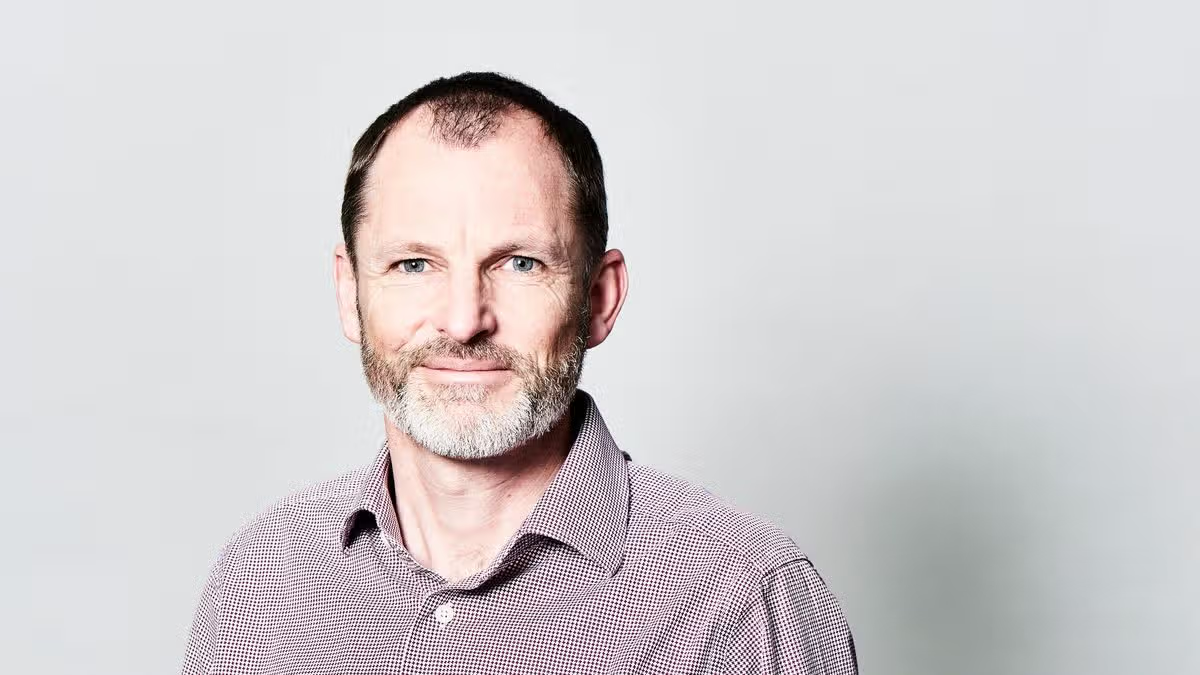
Brian Palmer, CEO of Tharsus

Brian Palmer, founder of Tharsus(Image: Recognition PR)

Northumberland robotics manufacturer Tharsus has continued to invest despite seeing revenue and profits fall in testing times.

Tharsus Group – the holding company of a group of engineering-led businesses including Tharsus and Universal Wolf – manufactures its products from three Blyth factories, employing more than 200 staff. While Tharsus provides a full product design, manufacture and aftermarket service to customers developing advanced machines and automation systems, Universal Wolf is a specialist provider of complex metal fabrication and engineered assemblies.

Tharsus also develops logistics automation products under its VersaTile platform. The business – a former Company of the Year at the North East Business Awards – worked with online grocer Ocado on its warehouse automation project for 10 years, during which time it manufactured thousands of robots to pick groceries for delivery. That contract came to an end in its 2023 financial year.

The group has now published accounts for its 2025 financial year in which it fell to a loss in a challenging year, with lower than anticipated revenue driven by delays and “non-progression of certain customer programmes”. Revenues fell from £24.5m to £18.6m, while Ebitda fell from profit of £800,000 to a loss of £1.5m.

Advertisement
Tharsus CEO Brian Palmer (right) welcomes news of the Ocado deal extension

Tharsus CEO Brian Palmer (right) at the Blyth business(Image: Tharsus)

The 2024 pre-tax profit of £400,000 was also converted to a loss of £1.99m. The overall loss for the year was £1.5m, down from profit of £371,975. Employee numbers also dropped slightly, from an average of 233 to 218.

A report within the accounts, by founder Brian Palmer highlighted its challenges as well as its investments.

It said: “During the year, management focus was directed toward stabilising the group following a period of reduced revenue, while ensuring that the underlying capabilities required to support future growth were retained. Actions were taken at subsidiary level to control costs, manage working capital and protect liquidity.

“Tharsus Limited experienced a challenging year, with lower than anticipated revenue driven by delays and non-progression of certain customer programmes. Restructuring activity was undertaken during the year to reduce costs and protect liquidity.

Advertisement

“Despite the difficult trading conditions, the business continued to invest in its core engineering and manufacturing capabilities and in the development of its VersaTile product platform.

“Universal Wolf Limited also experienced a softer trading year compared with the prior period, reflecting reduced demand from a number of established customers. The business maintained operational discipline and developed its core skills and capability, positioning it to support improved performance as customer programmes mature.”

Tharsus said the group continued to invest in the development of its VersaTile logistics automation platform – systems developed by the group under its own intellectual property – during the year.

It added: “A successful trial of the Grid system was completed during the year at a major grocer’s site, providing additional validation of the system’s performance in a chilled distribution environment. The business is in discussions with several major UK grocers, third party logistics providers and integrators about the commercial applications of VersaTile.”

Advertisement

Following publication of the accounts, the group told BusinessLive that Tharsus, Universal Wolf and VersaTile Automation has felt the impact of increased National Insurance costs, high interest rates and geopolitical uncertainty. These factors have made customers and their funders more cautious regarding innovation expenditure, resulting in the reduced total revenue and overall loss.

CEO and founder Mr Palmer added: “2025 was an important year of transition for Tharsus Group. While market conditions remained difficult in some areas, the business made clear progress in improving its commercial focus and positioning the Group for sustainable growth. We remain confident in the future opportunity for Tharsus Group, underpinned by the quality of our people, our engineering capability and the strength of the customer relationships we are building.

“I am grateful to all our Tharsus, Universal Wolf and VersaTile colleagues for their effort and resilience throughout 2025. Personally, I believe that there is no-one better placed to deal with the challenges of developing and commercialising new technology hardware in the UK than Tharsus Group.”

Advertisement
Continue Reading

Business

Credo's Selloff Is Missing The Bigger AI Opportunity

Published

on

Hammond Power Solutions: Capacity Has Arrived Just As AI Power Demand Accelerates

Credo's Selloff Is Missing The Bigger AI Opportunity

Continue Reading

Business

Germany’s far-right AfD seeks landmark state victory as Saxony-Anhalt votes

Published

on


Germany’s far-right AfD seeks landmark state victory as Saxony-Anhalt votes

Continue Reading

Business

New College Durham launches new training and skills facility

Published

on

Business Live

‘We want New College Durham to become a genuine hub for skills, collaboration and opportunity across the North East’

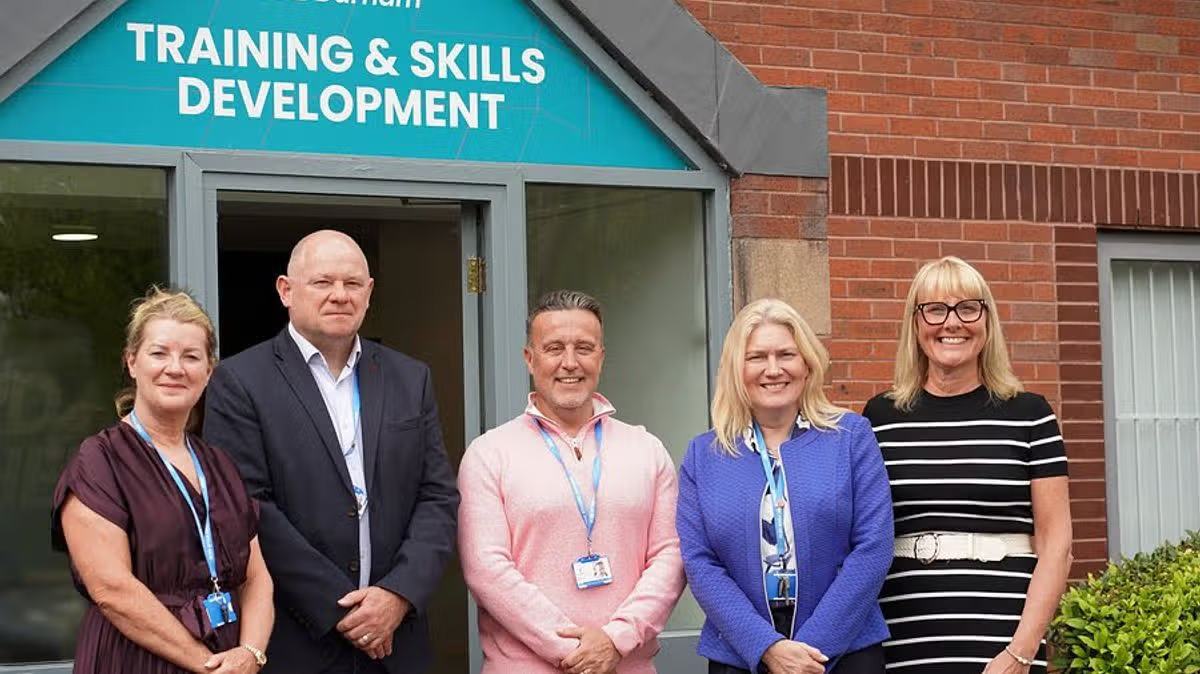
(L-R) Alison Maynard, Andrew Broadbent, Paul Bradley, Colleen Peters  and Lisa Waller at New College Durham's new Training and Skills Development facility

(L-R) Alison Maynard, Andrew Broadbent, Paul Bradley, Colleen Peters and Lisa Waller at New College Durham’s new Training and Skills Development facility(Image: New College Durham)

Leaders of a North East further and higher education college have heralded the launch of a new training facility as a hub for skills, collaboration and opportunity across the region. New College Durham (NCD) has opened the Training and Skills Development facility as a dynamic hub for employers, learners and industry partners.

Its new facilities have been devised to make it easier for businesses of all sizes to access high-quality adult skills training and workforce development opportunities. The hub brings skills, employers and talent under one roof amid moves to help businesses respond to changing industry demands, tackle skills gaps and build the workforce they need to grow and thrive.

Andy Broadbent, principal and chief executive, said: “By creating this dedicated hub and enhancing our current Training and Skills Development offer, we are further reinforcing our commitment to putting students and employers at the centre of everything we do. We understand that every business is different, which is why our team takes the time to appreciate and understand individual challenges before creating training solutions that deliver real results.

“Whether supporting a small business to develop its workforce or helping a larger organisation secure funding for significant training programmes, we’re here to make the process as straightforward and beneficial as possible”

Advertisement

NCD works in partnership with key stakeholders, including the North East Mayoral Strategic Authority, Tees Valley Combined Authority, Jobcentre Plus, and local authorities across the North East.

Its team works with employers to identify skills gaps, understand emerging workforce needs, and develop training programmes that support recruitment, retention, and employee development.

They deliver solutions including apprenticeships, accredited professional qualifications, short courses, leadership development, and technical skills training.

During the recent academic year (2024/25), NCD’s Training and Skills Development Team succeeded in securing £14m in funding, supported 7,000 learners, and worked alongside a wide range of sector-specialist partners to deliver targeted training that strengthens businesses and communities across the region.

Advertisement

Colleen Peters, vice principal business development, productivity and apprenticeships, added: “Businesses are the driving force of our regional economy, and investing in people, skills and talent has never been more important. Our new dedicated training and workshop space brings employers, learners and partners together in one dynamic environment, creating a place where ideas can be shared, skills developed and solutions shaped around the real needs of industry.

“This is far more than a new home for our Training and Skills Development Team. It represents our ambition to work differently with employers, creating stronger connections between education and industry and making it easier for businesses to access the expertise, training and talent they need to grow.

“We want New College Durham to become a genuine hub for skills, collaboration and opportunity across the North East, a place where partnerships are built, businesses are supported to thrive, and adults gain the skills that can transform their futures.”

Advertisement
Continue Reading

Business

Self-Driving’s Next Task: Potholes

Published

on

Self-Driving’s Next Task: Potholes

Self-Driving’s Next Task: Potholes

Continue Reading

Trending

Copyright © 2025