Connect with us
DAPA Banner
DAPA Coin
DAPA
COIN PAYMENT ASSET
PRIVACY · BLOCKDAG · HOMOMORPHIC ENCRYPTION · RUST
ElGamal Encrypted MINE DAPA
🚫 GENESIS SOLD OUT
DAPAPAY COMING

Business

United soars into premium travel

Published

on

United soars into premium travel

United Airlines is making a decisive bet on the future of air travel based on premium seats, champagne flutes and loyalty. 

United Airlines chief executive Scott Kirby recently revealed a sweeping cabin overhaul following which nearly half the seats on some long-haul aircraft will be dedicated to higher-yield passengers: a striking shift that underscores how sharply the economics of flying are changing.

At the centre of the strategy is a reimagined Boeing 787-9 configured with up to 99 premium seats: far beyond what United has historically offered, and a clear signal that the airline sees its future not in filling planes, but in filling them profitably.

The world’s largest airline, United Airlines is a partner airline with Virgin Australia and operates from Melbourne, Sydney and Brisbane, with Virgin code-sharing on its flights.

Advertisement

United will add more than 250 aircraft over the next two years to further modernise its fleet, introduce new aircraft variants, create a new experience for transcontinental travellers, and roll out new onboard products for every customer: reinforcing its position as a leading premium airline.

In a major move, United is bringing widebody-style experiences to its new narrowbody aircraft: the new ‘Coastliner’ Airbus A321 and A321XLR (the same model that Qantas is adding to its fleet).

These are United’s first narrowbodies with the new elevated interior. They feature an all-aisleaccess lie-flat seat suite dubbed ‘United Polaris’ (business class), which is available on international routes.

United has 100 of these new aircraft coming into its fleet to replace 40 older, less-efficient Boeing 757s.

Advertisement

The Coastliner will have a specially designed livery and fly exclusively between United’s US west coast hubs in San Francisco and Los Angeles, and Newark-New York in the east. It will introduce the United Polaris cabin experience to domestic travellers.

United’s A321XLR gives travellers access to 32 premium seats – 16 more than the 757 it replaces – and will start flying later this year.

United’s new 787-9 with the elevated interior will fly internationally, starting on April 22.

Advertisement

These aircraft include the airline’s new United Polaris studio: lie-flat, all-aisle-access seats that are 25 per cent larger than standard United Polaris seats. They include privacy doors, an ottoman for companions on some seats, exclusive meal service with wine pairings and caviar, new amenity kits with retail-size offerings, wireless charging, Bluetooth connectivity, and a 27-inch 4K OLED seatback screen (the largest among US airlines).

The announcement expands on the ambitious ‘United next’ growth strategy announced in 2021. Since that time, United has: added 22 Boeing 787 Dreamliners, 237 Boeing 737 MAX aircraft and 67 Airbus A321neos; completed 70 per cent of its plan to retrofit its mainline narrowbody fleet; replaced more than 100 regional jets with larger mainline aircraft; increased premium seats per North American departure by 40 per cent; and hired more than 60,000 people.

“For more than a decade, we’ve invested billions of dollars in our product, service and technology as part of our plan to be the best brand-loyal airline in the world, and the result is that more and more customers are choosing to fly with us every day,” Mr Kirby said at the announcement.

“Today we accelerate our plans and elevate our offerings to the next level, creating an even more consistent premium onboard experience for every customer and delivering value across every cabin of service.”

Advertisement

The airline’s executive vice-president and chief commercial officer, Andrew Nocella, said the upgrades provided more choice for passengers.

“These new planes and products not only complement our fleet and network plans, but they also give our customers more premium amenity and seat choices, whether they bought a basic economy ticket to fly from Chicago to Fort Wayne or are flying Polaris between San Francisco and Singapore,” he said.

“United is setting the pace and innovating for our customers at a scope and scale unheard of in aviation history. And we’re not taking our foot off the gas.”

In another example of its push into premium products, the airline has announced that it has licensed Air New Zealand’s Skycouch, which it will market as the United Relax Row.

Advertisement

The concept turns a set of three economy seats into a couch or bed, creating a far more comfortable option for customers travelling in the economy cabin on long-haul flights.

United is the first North American airline to offer the seating option and holds North American exclusivity on the design.

The new dedicated row of three seats is outfitted with individually adjustable leg rests that fold up at a 90-degree angle to create room to sleep, stretch out or watch a movie.

The United Relax Row is ideal for families travelling with small children, solo travellers, and couples who want a little extra comfort.

Advertisement

Passengers travelling in United Relax Row will receive additional amenities for their flight, including a custom-fitted mattress pad, a specially sized plush blanket, two additional pillows, as well as a plush toy and children’s travel kit for families.

United expects its Relax Row to launch in 2027 and plans to offer it on more than 200 Boeing 787 and 777 widebody aircraft by 2030.

The seats will be located between economy and premium plus seating, and United will offer up to 12 Relax Row sections on each aircraft.

United has 1,075 aircraft in its mainline fleet and 623 on order.

Advertisement

The airline is also investing in future aircraft concepts. These include options to purchase 100 eVTOL (electric vertical take-off and landing) aircraft from Archer Aviation and 200 from Eve Air Mobility, a division of Embraer.

The airline has also committed to purchasing 100 ES-30 electric turboprop regional aircraft from Heart Aerospace, with options for up to 50 more.

At the other end of the market, it has committed to purchasing 15 Boom Overture 60-passenger supersonic aircraft, with options for up to 35 more.

However, its most ambitious move is a bold step towards reshaping the future of air travel, with a major investment in JetZero’s blended wing body (BWB) aircraft.

Advertisement

This next-generation design promises not only dramatic fuel efficiency gains but also a transformative flying experience for passengers.

The agreement includes the potential to order up to 100 of JetZero’s BWB aircraft, with an option for another 100, contingent on key development milestones, including the successful flight of a full-scale demonstrator (expected in 2027).

If the technology delivers as envisioned, it could mark one of the most significant advances in commercial aviation in decades.

Unlike traditional aircraft, JetZero’s blended wing body design fuses the fuselage and wings into a single aerodynamic form. This innovation allows the aircraft to generate lift across its entire wingspan while significantly reducing drag, potentially slashing fuel burn by up to 50 per cent per passenger mile compared to similarly sized jets.

Advertisement

For United, the potential payoff is enormous: lower carbon emissions, reduced operating costs, and a leap forward in customer comfort.

The JetZero Z4 aircraft, designed to seat 250 passengers, runs on conventional jet fuel but will be capable of using sustainable aviation fuel blends.

The US Air Force has also recognised JetZero’s promise, awarding the company a $US235 million contract in 2023 to accelerate development of its full-scale demonstrator.

 

Advertisement

Continue Reading
Click to comment

You must be logged in to post a comment Login

Leave a Reply

Business

How FRE Nicotine Pouches landed landmark sponsorship deal with UFC and more

Published

on

How FRE Nicotine Pouches landed landmark sponsorship deal with UFC and more

In between the thrill of the bouts on fight night, you may notice a new partner listed on the canvas of a UFC octagon: FRE Nicotine Pouches. 

In a first-of-its-kind collaboration, FRE became the “official nicotine pouch partner” of UFC and the rest of TKO Group Holdings, Inc. (TKO) affiliated properties, including Zuffa Boxing, PBR (Professional Bull Riding), and UFC BJJ, as well as IMG-owned World’s Strongest Man and Formula Drift. 

Advertisement

FRE has been quietly building a sports portfolio that reaches those performance-obsessed audiences across the country, but the announcement of the partnership with TKO last month was a landmark title sponsorship. 

CLICK HERE FOR MORE SPORTS COVERAGE ON FOXBUSINESS.COM

UFC fight with FRE Nicotine Pouches branding

TKO Group Holdings, Inc. and FRE Pouches, a consumer product from Turning Point Brands, partnered to become UFC’s “official nicotine pouch.” (FRE Nicotine Pouches / Fox News)

UFC became the first major U.S. sports property to have an “official nicotine pouch” partner, making this a deal that changes the landscape of a category that will have an estimated $50 billion market by 2033. 

Summer Frein, chief revenue officer at Turning Point Brands, the branded consumer products company that markets and distributes products, including alternative smoking accessories, spoke with Fox Business about how FRE wanted to get into sports. And TKO’s properties, especially UFC, made too much sense.  

Advertisement

“Obviously, first and foremost, we wanted to pick something that aligns with our brand, and our tagline is ‘Own Your Edge.’ When you think about people who own their edge, sports immediately come to mind. And when you think about TKO — I said this to someone last week — where the hell do you own your edge more than knocking someone out in an octagon,” Frein said in a recent interview. 

UFC, BUD LIGHT TEAM UP TO MAKE ALREADY HIGHLY ANTICIPATED SUMMER OF FIGHTS THAT MUCH BETTER: ‘A FAN DELIGHT’

“The consumers who are at the events overlap with our consumer base very directly, both from an adult nicotine consumer perspective, but just the characteristics of them. What they believe in, what they embody (has) a lot of overlap with us as well in terms of being competitive, performance-driven and that sort of thing.”

The UFC has an audience that is over 90% adults, 21 years or older, making it an ideal platform for responsible marketing of adult consumer products like nicotine pouches. But, from an athlete’s perspective, research into how nicotine could enhance sports performance has been abundant. 

Advertisement

Smokeless tobacco has been widely used by athletes to enhance performance, with nicotine serving as a central nervous system stimulant among other anatomic effects. And while nicotine had a bad reputation due to its correlation with tobacco-based products like cigarettes, the stimulant wasn’t the cause of toxic health consequences. Of course, it remains an addictive chemical.

The growth of the global nicotine pouch market reached roughly $4.3 billion in 2025, and it’s only going to surge from there. FRE has moved fast to establish itself before it fully matures, and a deal like this with TKO proves that. 

FRE Nicotine Pouches partnership with TKO

FRE Nicotine Pouches became the “official nicotine pouch” of different TKO Group Holdings, Inc. properties, including UFC and Zuffa Boxing. (FRE Nicotine Pouches / Fox News)

“We started off with PBR last year. We rolled into some NASCAR and ARCA Series racing, and all of those foundational elements gave us the confidence that we were heading in the right direction. Sports made a lot of sense for us,” Frein added. 

“I think [TKO was] also looking for partners and consumers that had overlap, so we were building upon each other there. The consumers expect that. You have seen UFC consumers and fans at events. They ride for that brand. So, if they partner with brands that don’t make sense, I don’t think those fans will be quiet about that. I think our brand made a lot of sense for that reason, too.”

Advertisement

Frein pointed out how FRE sets itself apart for its consumers with its variety of flavors, and, more importantly, nicotine strengths. FRE pouches go from three milligrams up to 15, a strength not many competitors have in their product. No matter where a consumer may be on a nicotine pouch journey, FRE prides itself on that variety to help provide consumers with how they wish to have the product. 

“Consumers told us they use nicotine and use these pouches, in particular, in their life for a variety of reasons. One is to transition off of products they don’t want to use anymore, different nicotine products they don’t want to use anymore. They feel like this is a better option for them – more discreet, less judgment, that sort of thing. Then, we hear them say what you’re saying. They use it for moments of their day that they find to be helpful to them,” Frein explained. 

FRE has also listened to its customers when it comes to the pouch itself. The pouches feature a pre-primed moisture technology pouch that Frein says consumers “prefer.” Their variety also goes into the pouch count, offering 20-count tins or 100-count “Mega Packs.”

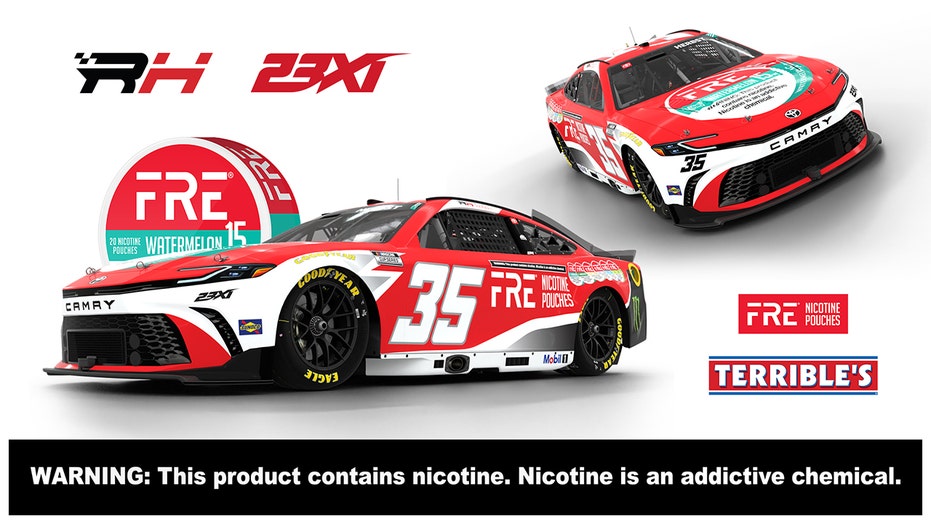
And as Frein mentioned, FRE’s push into sports goes beyond its work with TKO. It recently partnered with 23XI Racing, Michael Jordan’s auto racing company, and driver Riley Herbst for select NASCAR Cup Series races. It also signed as the “official nicotine sponsor” for Taylor Reimer Racing across four ARCA Menards Series events in 2026. 

Advertisement
FRE branding on NASCAR with 23XI Racing

FRE Nicotine Pouches branding on a 23XI Racing NASCAR vehicle for the NASCAR Cup Series. (FRE Nicotine Pouches / Fox News)

CLICK HERE FOR MORE SPORTS COVERAGE ON FOXBUSINESS.COM

As tobacco-less nicotine products have been reframed from a legacy habit to a deliberate, performance-based choice, FRE has made a calculated bet on sports, and partnering with TKO makes the future exciting from a business perspective.  

“I think what the partnership with TKO and NASCAR and Taylor Reimer in the ARCA Series has done for us is open people’s minds,” Frein said. 

“Open doors, given us credibility as a brand and as an industry that we can make it work. We’re going to have a seat at the table. We’re going to market effectively and responsibly, frankly. So, I imagine that, just given the prior piece of the conversations around athletes and them thinking differently and having this a part of their lives, it will open doors to other avenues.”

Advertisement

Follow Fox News Digital’s sports coverage on X and subscribe to the Fox News Sports Huddle newsletter.

Continue Reading

Business

Which Legacy Tech Stock Is the Smarter Buy for Investors in 2026?

Published

on

IBM has launched the world's first quantum computing service in the cloud, giving anyone access to its cutting-edge technology.

NEW YORK — As investors weigh opportunities in the technology sector midway through 2026, Intel Corp. and International Business Machines Corp. present contrasting profiles that highlight different paths to potential returns in an AI-driven market.

Intel shares have delivered strong gains year-to-date, trading near $114.68 after a significant recovery fueled by AI optimism and foundry progress. IBM, meanwhile, hovers around $297-$325, offering stability through its hybrid cloud and software businesses alongside emerging quantum computing initiatives.

Analysts and comparison tools generally favor IBM for long-term reliability, while Intel appeals to those seeking higher-risk, higher-reward exposure to semiconductor manufacturing and AI infrastructure.

Intel’s Turnaround Story

Advertisement

Intel has shown remarkable resilience in 2026 after years of challenges. The company reported improved first-quarter results and made strides with its 18A manufacturing process node, attracting partnerships and external foundry interest. Shares have surged on optimism around Panther Lake and Nova Lake processors, as well as Gaudi AI accelerators gaining traction.

However, the foundry business continues to report operating losses, and Intel faces intense competition from TSMC, Samsung and AMD. Analyst consensus for Intel remains a Hold, with an average price target around $83-$100, suggesting limited near-term upside from current levels despite recent momentum.

The company’s success hinges on executing its roadmap, improving yields and securing major external customers for its foundry services. A $5 billion investment from NVIDIA and collaborations with Google provide validation, but execution risks remain high.

IBM’s Steady Transformation

Advertisement

IBM presents a more mature investment case centered on hybrid cloud, enterprise AI and quantum computing. The company has demonstrated consistent revenue growth, with software and consulting segments benefiting from AI demand. Free cash flow remains robust, supporting dividends and strategic investments.

Analysts assign IBM a Buy rating with price targets clustering near $292-$299, though recent rallies have pushed shares higher. Barclays initiated coverage with an overweight rating and $350 target, citing stable growth and quantum optionality.

IBM’s $10 billion-plus commitment to quantum computing over five years, combined with government support, positions it for long-term leadership in that emerging field. Its Red Hat acquisition continues delivering synergies in hybrid cloud solutions.

Key Comparison Factors

Advertisement

Valuation and Financials: IBM trades at a premium on forward earnings but offers greater stability and a reliable dividend. Intel appears cheaper on some metrics but carries higher volatility due to manufacturing challenges and cyclical semiconductor exposure.

Growth Drivers: Intel bets heavily on AI chip demand and foundry leadership, with potential for significant market share recovery. IBM focuses on enterprise software modernization, hybrid cloud adoption and quantum advantages, providing more predictable revenue streams.

Risk Profile: Intel faces execution risks around process technology and competition. IBM contends with slower growth in legacy segments but benefits from diversified operations and strong cash generation.

Analyst Sentiment: Most tools and comparisons rate IBM as the stronger long-term buy. Intel earns more mixed views, with some analysts highlighting valuation concerns despite recent operational wins.

Advertisement

Broader Market Context

Both companies operate in an environment shaped by massive AI infrastructure spending. Hyperscalers continue expanding data centers, creating opportunities for chips, software and services. However, macroeconomic factors including interest rates, geopolitical tensions and potential slowdowns in tech capital expenditure could impact both stocks.

Intel’s recovery aligns with a broader semiconductor rebound, while IBM benefits from enterprise digital transformation trends. Quantum computing remains a speculative but potentially transformative area for IBM.

Investment Considerations for 2026

Advertisement

For conservative investors seeking stability and dividends, IBM offers a compelling profile with proven cash flow and strategic positioning in hybrid cloud and quantum. Those comfortable with higher volatility and semiconductor cyclicality may prefer Intel for its potential upside if foundry and AI chip ambitions materialize.

Diversification remains key. Many portfolios include exposure to both companies or broader tech ETFs to balance risks. Long-term horizons favor companies with strong balance sheets and clear technology roadmaps.

Neither stock represents a guaranteed winner. Intel’s path requires flawless execution on manufacturing goals, while IBM must continue demonstrating growth in software and AI services amid rapid industry evolution.

Outlook and Risks

Advertisement

The remainder of 2026 will test both companies. Intel must deliver on processor launches and foundry customer wins. IBM needs to sustain momentum in cloud and quantum while managing any legacy business headwinds.

Potential risks include intensified competition, supply chain disruptions, regulatory scrutiny on AI and broader market corrections. Positive catalysts could emerge from major contract wins, technological breakthroughs or favorable macroeconomic shifts.

Ultimately, the choice depends on individual risk tolerance, investment horizon and portfolio allocation. IBM appears favored for steady, lower-volatility returns, while Intel offers asymmetric upside potential for those bullish on its recovery narrative.

As always, investors should conduct thorough due diligence and consider consulting financial advisors before making decisions. Market conditions can change rapidly, and past performance does not guarantee future results.

Advertisement
Continue Reading

Business

US proposes tariffs of 10% or 12.5% on goods from 60 economies over forced labor failures

Published

on

US proposes tariffs of 10% or 12.5% on goods from 60 economies over forced labor failures


US proposes tariffs of 10% or 12.5% on goods from 60 economies over forced labor failures

Continue Reading

Business

DeepSeek slated to draw $7 billion in maiden fundraising, sources say

Published

on

DeepSeek slated to draw $7 billion in maiden fundraising, sources say


DeepSeek slated to draw $7 billion in maiden fundraising, sources say

Continue Reading

Business

Puffin and bumblebee among 18 creatures shortlisted to feature on banknotes

Published

on

Puffin and bumblebee among 18 creatures shortlisted to feature on banknotes

The Bank of England is asking the public which animals should appear on future banknotes.

Continue Reading

Business

Asia stocks rise past US-Iran jitters; Nikkei hits record high on stimulus cheer

Published

on


Asia stocks rise past US-Iran jitters; Nikkei hits record high on stimulus cheer

Continue Reading

Business

Relay Therapeutics Shares Surge 20% on ASCO Momentum for Zovegalisib Breast Cancer Program

Published

on

Legend Biotech Shares Surge 20% on Promising ASCO Data for

NEW YORK — Relay Therapeutics Inc. shares climbed more than 20% in morning trading Tuesday, reaching $17.12 as investors responded to ongoing buzz around the company’s precision oncology pipeline at the American Society of Clinical Oncology annual meeting in Chicago.

The clinical-stage biotechnology company, focused on small molecule therapies for cancer and genetic diseases, has seen renewed interest in its lead candidate zovegalisib (RLY-2608), a mutant-selective PI3Kα inhibitor. The stock’s sharp move comes amid broader sector enthusiasm for oncology advancements showcased at the May 29-June 2 gathering.

Zovegalisib continues to generate attention following earlier data readouts demonstrating clinically meaningful progression-free survival in PIK3CA-mutated, HR+/HER2- metastatic breast cancer. The program holds FDA Breakthrough Therapy designation, signaling regulatory recognition of its potential.

Clinical Progress on Zovegalisib

Advertisement

Updated interim results from the Phase 1/2 ReDiscover trial previously showed a median progression-free survival of 11.0 months in second-line patients treated with zovegalisib plus fulvestrant. Objective response rates reached 39% overall in patients with measurable disease, with consistent efficacy observed across kinase and non-kinase PIK3CA mutations.

These findings, initially highlighted at prior scientific meetings, underscore zovegalisib’s differentiated profile compared to non-selective PI3K inhibitors, which have faced challenges with toxicity such as hyperglycemia. The ongoing Phase 3 ReDiscover-2 trial evaluates the combination in CDK4/6-experienced patients.

At ASCO 2026, Relay’s presence contributes to the narrative of advancing targeted therapies in areas with significant unmet need. Approximately 40% of HR+/HER2- advanced breast cancer patients harbor PIK3CA mutations, often facing limited options after CDK4/6 inhibitor progression.

Pipeline Expansion and Additional Data

Advertisement

Beyond breast cancer, Relay has advanced zovegalisib into PIK3CA-driven vascular anomalies. Initial Phase 2 ReInspire trial results presented earlier highlighted encouraging safety and efficacy signals in this rare disease setting.

The company’s Dynamo platform, which integrates computational and experimental approaches to target protein motion, underpins its discovery efforts. This technology aims to address previously intractable targets through allosteric modulation.

Relay also maintains a broader pipeline, including earlier-stage programs in oncology and genetic diseases, though zovegalisib remains the primary value driver.

Financial Position Strengthened

Advertisement

Relay reported $642.1 million in cash, cash equivalents and investments as of March 31, 2026, up from $554.5 million at year-end 2025. The increase followed net proceeds from at-the-market offerings. A subsequent May public offering added approximately $296.8 million in net proceeds.

Management has stated that current resources provide runway into 2029, supporting continued clinical execution. First-quarter 2026 revenue was $3.0 million, primarily from a licensing agreement, with a net loss of $73.3 million.

Analyst and Market Sentiment

Wall Street maintains a generally positive stance on Relay, with consensus price targets around $21-$23. Ratings lean toward buy, reflecting optimism around zovegalisib’s potential in a large addressable market.

Advertisement

The stock’s recent volatility aligns with typical biotech patterns tied to clinical catalysts. Tuesday’s volume spike reflects heightened investor interest amid ASCO presentations across the oncology sector.

Challenges and Competitive Landscape

The PI3Kα space remains competitive, with other agents like capivasertib approved in similar settings. Relay’s mutant-selective approach seeks to offer improved tolerability while maintaining efficacy, a key differentiator if Phase 3 data confirm earlier signals.

Risks include clinical execution, regulatory outcomes, manufacturing scalability and broader biotech funding dynamics. Any data readouts showing efficacy compression or unexpected toxicities could pressure the stock.

Advertisement

Broader Industry Context

ASCO 2026 has featured multiple advances in targeted therapies and combination approaches for lung cancer, sarcoma and other malignancies. Positive momentum across oncology names has supported sector sentiment despite macroeconomic uncertainties.

Relay’s strategy positions it at the intersection of precision medicine and computational drug design. Success with zovegalisib could validate the platform and open opportunities for additional programs.

Investment Considerations

Advertisement

At current levels near $17, Relay trades with elevated expectations for its lead asset. The company’s cash position provides flexibility for business development or accelerated development timelines. However, as a pre-commercial entity, it carries typical biotech risks including binary clinical outcomes.

Financial advisors recommend careful position sizing given volatility. Diversification across the sector and attention to upcoming milestones, including potential conference updates and Phase 3 progress, remain important.

Management will participate in upcoming investor conferences, including the Jefferies Global Healthcare Conference on June 3 and Goldman Sachs on June 8, providing further opportunities to discuss strategy.

Outlook

Advertisement

Relay Therapeutics enters the second half of 2026 with key data catalysts and a strengthened balance sheet. Whether Tuesday’s gains hold will depend on sustained positive sentiment from ASCO, execution on the zovegalisib program and broader market conditions.

The company’s focus on transforming drug discovery through motion-based insights offers a compelling long-term narrative. As clinical programs mature, Relay could emerge as a significant player in precision oncology if it delivers on its pipeline promise.

Continue Reading

Business

Aehr Test Systems Stock Soars 17% Amid Surging AI Demand and Conference Spotlight

Published

on

Aehr Test Systems

FREMONT, Calif. — Shares of Aehr Test Systems Inc. jumped more than 16% in morning trading Tuesday, climbing to $109.36 as investors continued to reward the semiconductor test equipment maker’s strong positioning in the artificial intelligence and data center infrastructure markets.

The stock opened higher and extended gains on elevated volume, reflecting ongoing enthusiasm for companies tied to AI chip production and reliability testing. Aehr’s FOX and Sonoma systems, used for wafer-level and packaged-part burn-in, have become critical tools for hyperscale customers validating high-power AI processors.

As of 10:32 a.m. EDT, Aehr shares had risen $15.74, or 16.81%, on the Nasdaq. The move pushed the company’s market capitalization above $3 billion, continuing a remarkable run that has seen the stock more than quadruple year-to-date.

Record Orders Fuel Optimism

Advertisement

The latest surge builds on momentum from April, when Aehr announced a record $41 million production order from its lead hyperscale AI customer for package-level burn-in of custom AI processor ASICs. That deal helped drive second-half fiscal 2026 bookings above $92 million, surpassing the company’s raised guidance range of $60 million to $80 million.

Deliveries from the order are scheduled to begin in fiscal 2027, which starts later this month. The transaction underscored Aehr’s deepening relationships with major cloud providers racing to expand AI capabilities.

In its fiscal third quarter ended February 2026, Aehr reported $37.2 million in bookings, achieving a book-to-bill ratio exceeding 3.5 times. While revenue came in at $10.3 million and the company posted a net loss, executives highlighted strong demand for both wafer-level and packaged-part solutions tied to AI and data center applications.

CEO Gayn Erickson noted the momentum in AI processor qualification and production burn-in. The company has also secured new customers in silicon photonics for data center optical interconnects, expanding its addressable market.

Advertisement

Conference Appearance Adds Visibility

Aehr’s leadership is scheduled to present at the William Blair 46th Annual Growth Stock Conference in Chicago on Tuesday afternoon. President and CEO Gayn Erickson and CFO Chris Siu are expected to discuss the company’s growth strategy and meet with institutional investors.

Such investor events often catalyze trading activity for small-cap technology names, particularly those with compelling secular tailwinds like AI infrastructure. Analysts have generally maintained bullish outlooks despite quarterly revenue variability, citing Aehr’s differentiated technology and expanding backlog.

Market Context and Challenges

Advertisement

Aehr operates in a niche but increasingly vital segment of the semiconductor supply chain. Its burn-in systems help manufacturers identify defects and ensure reliability before chips enter high-stakes AI data centers, where downtime carries enormous costs.

The company’s fiscal 2026 has been marked by volatility. Shares soared more than 144% in April alone following the record order and earlier silicon photonics wins. However, the company also completed a $60 million at-the-market equity offering, which some investors viewed as prudent capital raising to support growth but others saw as dilutive.

Insider selling has occurred at elevated prices, consistent with executives locking in gains after substantial appreciation. Still, institutional interest remains robust as AI spending forecasts continue climbing.

Broader semiconductor equipment peers have shown mixed performance, but names directly linked to AI accelerators and advanced packaging have commanded premiums. Aehr’s 52-week range spans from roughly $9.45 to $112, illustrating both the opportunity and volatility inherent in the sector.

Advertisement

Outlook and Strategic Position

Aehr has guided for fiscal 2026 revenue on the high end of $45 million to $50 million, with a return to non-GAAP profitability expected in the fourth quarter. Management sees multi-year growth driven by AI processor test and burn-in demand.

The company’s effective backlog, including post-quarter bookings, reached record levels, providing visibility into fiscal 2027. Follow-on orders for Sonoma ultra-high-power systems from existing AI customers further validate the platform’s adoption.

Analysts have raised price targets in recent months. Lake Street increased its target to $56 from $50, while Craig-Hallum upgraded the stock to Buy with a $68 target, citing improving business momentum.

Advertisement

Risks Remain

Despite the upside, challenges persist. Revenue has fluctuated due to the timing of large system shipments, and the company continues to invest in growth amid a competitive landscape. Macroeconomic uncertainty, potential slowdowns in AI capital expenditure, or shifts in customer spending could impact results.

Aehr’s small size relative to larger equipment giants also means thinner liquidity and higher beta to market swings. The stock’s rapid appreciation has raised valuation questions, though supporters argue the AI opportunity justifies current multiples given the backlog and technology edge.

Broader AI Infrastructure Theme

Advertisement

Aehr’s performance reflects the massive investment flowing into AI data centers. Hyperscalers and semiconductor designers are prioritizing rigorous testing to ensure chips meet demanding performance and reliability standards for large language models and inference workloads.

Silicon photonics, where Aehr recently added a major networking customer, represents another growth vector as data centers seek higher-bandwidth, lower-power optical connections.

As fiscal 2027 begins, Aehr appears well-positioned to capitalize on these trends. Tuesday’s trading suggests investors are betting the recent order momentum will translate into accelerating revenue and earnings in coming quarters.

Market participants will watch the William Blair presentation for any incremental color on customer pipeline, new product developments, or updated fiscal guidance. With the semiconductor test market evolving rapidly alongside AI advancements, Aehr’s specialized solutions could remain in high demand.

Advertisement
Continue Reading

Business

Unexpected green energy ‘hotspots’ emerge in North as industry supports 225,000 jobs

Published

on

Business Live

Areas in Yorkshire and Cheshire are identified as green energy hotspots, as well as existing locations in the North East and Humber

Young technician standing on metal platform installing heavy solar photo voltaic panel on blue sky background. Stand-alone solar panel system installation, efficiency and professionalism concept.

The drive to net zero is supporting 225,000 jobs in the North and adding more than £20bn to the economy, a new report says – with some unexpected ‘hotspots’ of activity being identified.

The annual report on the green economy from CBI Economics says the North East has the highest proportion of firms in England involved in the net zero economy, while the green sector in the Humber contributes the highest percentage of its GDP anywhere in England.

Advertisement

But it has also identified West and North Yorkshire, and the area around Cheshire, Warrington and North Wales as ‘hotspots’, both of which have green sectors worth more than £1bn. The Yorkshire area is highlighted for a range of energy projects, while Cheshire is benefiting from hydrogen projects around Ellesmere Port and Middlewich.

The report, which was commissioned by the independent Energy and Climate Intelligence Unit, says that renewable jobs are better paid than others, with an average salary of £43,142. But it warns that a breakdown in political consensus on net zero – with parties like Reform and the Conservatives signalling they would reverse or slow down current investments in green technology – risks putting the sector’s growth in jeopardy.

Louise Hellem, CBI chief economist, said: “This report makes clear the sustained scale of the opportunity in the UK’s net zero economy. It shows that clean power and decarbonisation are no longer future ambitions; they are already a significant and growing part of the UK’s industrial base. At a time when the UK must strengthen energy security and drive growth, the net zero economy is becoming central to the country’s competitiveness.”

Peter Chalkley, director of the Energy and Climate Intelligence Unit, said: “Reaching net zero emissions is scientifically the only way to bring the climate back into balance and stop climate change but it’s now become a major part of the UK economy. Thousands of small businesses across the UK are the unsung heroes of this net zero economy, installing solar panels, manufacturing parts for electric cars and in doing so creating greater energy independence for the UK, shielding us from the oil and gas price crises of recent times.”

Advertisement

The report has been backed by Darren Davidson, the Newcastle-born UK vice president for Siemens Energy. He said: “We welcome the findings of this report because they underline something those of us in the industry can already see clearly: the energy transition is not only essential for the UK’s future, it’s already creating skilled jobs, driving investment and revitalising communities right across the country.

“In my view, there has never been a more exciting time to work in the energy sector. We are transforming how Britain powers homes, businesses and industry, and that means creating long-term opportunities for people with the skills, ambition and commitment to build a cleaner, more secure energy system.”

Continue Reading

Business

Blue Route the best option to addressing M4 congestion

Published

on

Business Live

The Blue Route had the support of environmental groups including Friends of the Earth Cymru

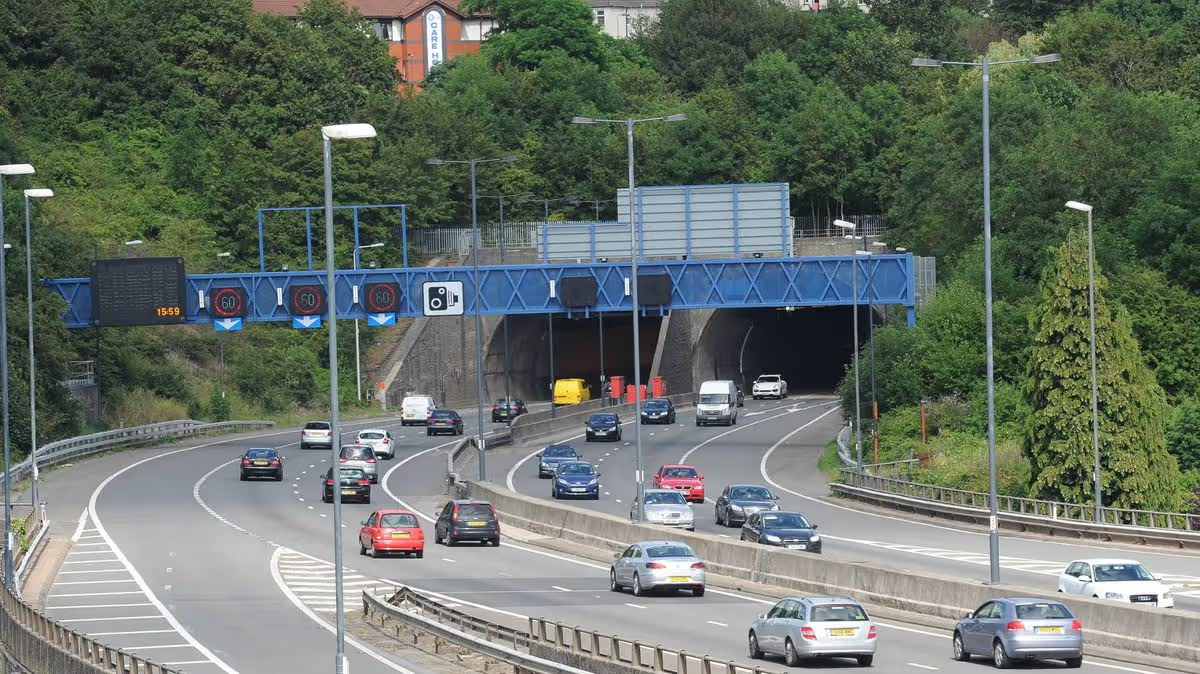
The Brynglas Tunnel

Brynglas Tunnels(Image: South Wales Echo)

Traffic congestion at the Brynglas Tunnels on the M4 near Newport has raised its head again. In 2021 Welsh Government set up the Transport Commission on congestion in south-east Wales chaired by Lord Burns with a team of well-respected Transport professionals. It recommended a public-transport-led series of solutions though some road-based options could be considered.

Rhun ap Iorweth the new First Minister has been drawn to say he will examine a roads-based means of relieving that congestion including the ‘Blue Route’.

Advertisement

This columnist wrote the Blue Route report published by the Institute of Welsh Affairs and the Chartered Institute of Logistics and Transport in 2013 as an alternative road solution when it was clear that Welsh Government’s ‘Black Route’ option – a new six lane motorway across parts of the Gwent levels – was unacceptable on cost and environmental grounds.

The Black Route is currently estimated at £2.5bn (£936m in 2013) compared with the Blue Route at £1bn (£380m in 2013). Also, congestion is mainly at peak working-day periods largely the result of work and school travel. This provides an opportunity for public transport to be the solution with possibly a Brynglas Tunnel by-pass if that is found necessary.

The Blue Route had the support of environmental groups including Friends of the Earth Cymru as it used the existing A48/ A4810 road footprint. It upgrades the A48 Newport Southern Distributor Road from the M4 (J28) to Queen’s Meadow and the A4810 running parallel to, and south of, the Llanwern steelworks site; now a major housing development with a ‘Burns Report’ railway station. It would rejoin the M4 (at J23A Magor Services).

This would be less disruptive than option C in the then government’s plan which built on the footprint of the A48 (at J28) to the M4 (J24) – the already congested Coldra interchange and passing a large established housing area at Ringland.

Advertisement

The Blue Route was expected to divert 15% of traffic from the M4 – sufficient to reduce congestion in the peak periods concerned through constructing overbridges at the intersections to achieve free flowing traffic. This could be built incrementally prioritising the most congested junctions thus spreading the cost over several years.

There is an argument that a new motorway would form a grand entry into Wales. However it will not solve the congestion problem. Research has shown that added capacity on a route will lead to extra traffic and create environmental damage along that route and the adjacent land alongside it. That may not only destroy habitats and green spaces but also homes and gardens.

It is not easy to persuade car users onto public transport but that has to be the policy direction for over congested roads in south-east Wales. The Burns report delivery unit in Welsh Government has worked up plans for the stations in the Burns plan together with adequate park and ride facilities and ride-on bus connections. The new tram-trains serving north of Cardiff commuters from later this year will show how effective such high-quality improvements can be.

As owners of the rail infrastructure in Wales (excluding Core Valley Lines north of Cardiff) it is the responsibility of the UK Department for Transport to fund track and station enhancements, as well as maintenance through Network Rail. This has so far not been forthcoming for the ‘Burns’ stations; and only small funding percentages in Valley Lines electrification and Cardiff Central reformation costs. Yet again showing how reasonable is the ‘ask’ from Welsh Government for responsibility for rail infrastructure and Barnett consequential funding from HM Treasury.

Advertisement

The development of more bus lanes and bus roads will make journey times by bus more attractive than the car. Prior to the introduction of trams in Dublin, the dual-carriageway road between south Dublin and the city centre in peak periods had one lane for buses only. Introduced in the 1980s, I saw its success for myself; because the journey time to / from the city centre by bus was less than in the over-crowded car lane.

However, the First Minister in looking for road solutions, might find one nearer home. The Menai Straits currently has two road crossings between Ynys Mon (his home territory) and the mainland. One of these designed by Thomas Telford (1826) can take limited traffic and a third crossing from the A55 is urgently required. Perhaps north Wales’ A55 expressway has a better case for road construction than the already highly transport-invested south east Wales.

Professor Stuart Cole CBE is Emeritus Professor of Transport (Economics and Policy), University of South Wales.

Advertisement
Continue Reading

Trending

Copyright © 2025