
Business
Veteran Stars Chase Top Scorer Glory at World Cup


As the 2026 FIFA World Cup advances into knockout stages, the race for the Golden Boot has intensified, with Lionel Messi, Cristiano Ronaldo and Harry Kane among the notable contenders seeking to etch their names further into tournament history as top scorers.
Messi and Kylian Mbappé currently lead the scoring charts with seven goals each, while Harry Kane sits on five. Ronaldo has contributed fewer goals so far but remains a perennial threat due to his positioning and finishing prowess. The expanded 48-team format and deeper knockout rounds offer multiple opportunities for prolific scorers to make late surges.
Messi’s pursuit carries particular significance as many expect this to be his final World Cup appearance. The Argentine captain has already demonstrated his enduring quality with a hat-trick in the group stage, showcasing the vision and clinical edge that defined his career. At nearly 39 years old, his ability to influence matches through creativity and opportunistic finishing keeps him at the forefront of Golden Boot discussions.
Ronaldo, Portugal’s all-time leading scorer, continues defying age expectations. Though his goal tally trails the leaders, the five-time Ballon d’Or winner’s physical conditioning and penalty-taking reliability position him for potential surges in single-elimination play. His experience in high-stakes environments provides an intangible edge, even as younger forwards command attention.
Harry Kane enters the conversation as England’s primary goal threat and a consistent performer across major tournaments. The Tottenham and Bayern Munich striker’s aerial ability, link-up play and penalty expertise make him a reliable source of goals. Kane’s recent club form and leadership qualities bolster arguments for his candidacy.
Current betting markets reflect the competitiveness, with Messi and Mbappé as co-favorites, Kane further back and Ronaldo at longer odds. These assessments account for goals scored to date, team progression prospects and individual form.
The Golden Boot award has historically rewarded consistency across multiple matches. Past winners like Kylian Mbappé in 2022 and others have capitalized on favorable team paths and personal momentum. In 2026, the tournament’s structure may favor attackers from teams advancing deep into the bracket.
Messi benefits from Argentina’s strong squad depth and tactical setup that creates scoring opportunities. His intelligence in finding space and converting half-chances remains unmatched. Even without explosive pace, his positioning and composure under pressure enhance his prospects.
Ronaldo’s Portugal side features creative suppliers capable of delivering quality balls into dangerous areas. While his role has evolved toward poaching and set-piece specialization, moments of brilliance can quickly elevate his tally. Ronaldo’s mental fortitude and history of delivering in crucial moments sustain his relevance.
Kane’s England team relies heavily on his contributions, both as scorer and creator. His ability to hold up play and involve teammates creates additional threats. As England’s all-time international top scorer, Kane possesses the pedigree to excel when opportunities arise in knockout fixtures.
Challenges for all three include defensive scrutiny from opponents, potential fatigue from a demanding schedule and the emergence of younger talents like Mbappé, Erling Haaland and others. The expanded format increases the number of matches but also the risk of early exits for some contenders.
Injury management and squad rotation will influence availability. Each player’s physical condition as the tournament progresses could prove decisive. Historical data shows that Golden Boot winners often benefit from teams reaching at least the semifinals.
Broader context includes evolving tactics emphasizing high pressing and quick transitions, which can create or limit scoring chances. Set-piece proficiency, particularly penalties and corners, remains a significant factor given the frequency of such opportunities.
Fan interest in this particular race stems from the narrative weight attached to Messi and Ronaldo’s careers. Their long-standing rivalry adds intrigue, while Kane represents a younger generation of elite finishers seeking major tournament validation.
Media coverage and social platforms amplify every goal and near-miss, heightening scrutiny. Analysts debate fitness levels, tactical roles and supporting casts when projecting final tallies.
Coaches play crucial roles in maximizing goal output. Team strategies balancing attack and defense, player selection and substitution timing affect individual tallies. Managers prioritizing collective success may occasionally limit personal scoring opportunities.
Statistical models incorporate current form, historical World Cup performances and team strength. While predictive, they cannot account for the tournament’s inherent unpredictability and moments of individual brilliance.
The Golden Boot carries prestige beyond individual recognition, often correlating with team success. Top scorers frequently hail from semifinalists or finalists, benefiting from additional matches.
For Messi, adding the award would cap a legendary career with another milestone. Ronaldo seeks to extend his record of international achievements. Kane aims to cement his status among England’s greatest.
Regardless of the outcome, their participation enriches the tournament. Younger players observe and learn from their professionalism and dedication.
As knockout rounds unfold, each match offers chances to alter the standings. Consistent scoring combined with team progression will likely determine the winner.
The 2026 Golden Boot race exemplifies football’s blend of individual excellence and collective endeavor. Messi, Ronaldo and Kane embody different eras and styles, yet share the pursuit of excellence under pressure.
Their stories captivate global audiences, reminding fans why the World Cup remains sport’s premier spectacle. Whatever the final tally, their contributions will be remembered long after the trophy is awarded.

US lawmaker Kaptur injured in car crash, her office says

Eleven penny stocks delivered multibagger returns of up to 198% over the past six months. Screened using a market capitalisation below Rs 1,000 crore, a share price under Rs 20, and a minimum latest trading volume of 5 lakh shares, these low-priced stocks stood out for their strong price momentum despite the high risks typically associated with the segment.
“If the current pace of FCNR(B) inflows, as reflected in the central bank data, continues, we may well see three-digit US dollar billion mobilisation, significantly exceeding the initial estimates of $50-60 billion,” said VRC Reddy, head of treasury, Karur Vysya Bank. “The momentum so far has been a pleasant surprise.”
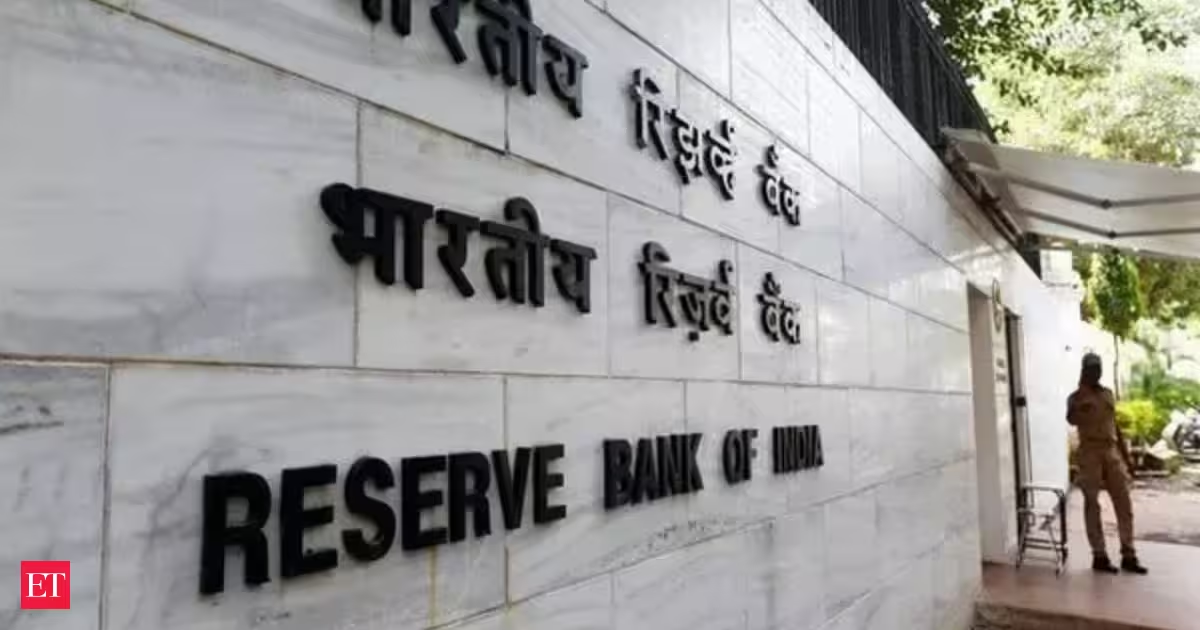
The Reserve Bank of India (RBI) Saturday said the special programmes between them had mobilised $40.81 billion in foreign exchange inflows up to July 31. Of this, FCNR(B) deposits accounted for $36.72 billion, despite the current programme having been operational only since June 8. The strong response has prompted economists to raise their estimates of the eventual mobilisation under the scheme.
“The cumulative inflows across FCNR(B), ECB and OFCB could reach $90 billion or even higher. Collections so far have been much stronger than expected,” said Gaura Sengupta, chief economist, IDFC First Bank.

She has consequently revised FY27 balance of payments surplus forecasts to $40 billion from $25 billion earlier.

The dedicated facilities, announced by the RBI on June 5 and operationalised on June 8, provide concessional foreign exchange swaps to banks to encourage capital inflows, support the balance of payments, cushion the rupee and contain imported inflation. The FCNR(B) window remains open until September 30, while the ECB and OFCB windows will remain available until December 31.
Robust Flows
“We continue to see up to $75 billion being raised under these concessional schemes, helping fund the current account gap, with a possible balance of payments surplus of nearly $35 billion in FY27,” said Madhavi Arora, chief economist at Emkay Global Financial Services.
Madan Sabnavis, chief economist, Bank of Baroda, estimates the overall mobilisation around $70 billion. “We believe around $70 billion can come through the total window, with $50-60 billion from FCNR(B) alone and another $10 billion from ECB and OFCB, though those flows are likely to pick up only after September,” he said.
Business
Dividends & stock splits: Maruti Suzuki, ICICI Bank among nearly 100 stocks turning ex-date this week. Do you own?

Interested investors need to hold shares of these companies in their demat accounts on the record date to be eligible for the respective corporate actions. The list remains tentative, as more companies may announce record dates for dividends, bonus issues and stock splits during the week.
Here is a day-wise list of corporate actions to watch out for this week.
August 3 (Monday)
Around 12 companies have fixed August 3 (Monday) as the record date for their respective dividends. The most notable name among them is ICICI Bank. The heavyweight private lender has fixed Monday as the record date for its final dividend of Rs 12 per share.
IT player Coforge also has fixed Monday as the record date for its interim dividend of Rs 4 per share, while Emkay Global Financial Services will turn ex-record date for a final dividend of Rs 1.5 per share.
Other stocks that will turn ex-record date on this day include Bannari Amman Spinning Mills (Rs 0.25 per share), Ganesh Infraworld (Rs 0.1 per share), Kakatiya Cement Sugar & Industries (Rs 3 per share), Kanpur Plastipack (Rs 1.2 per share), Khazanchi Jewellers (Rs 0.5 per share), Lakshmi Engineering and Warehousing (Rs 10 per share), Prima Plastics (Rs 2 per share), Sai Silks (Rs 1.5 per share) and Transrail Lightning (Rs 3 per share).August 4 (Tuesday)
Bosch accounts for the highest dividend payout among the stocks turning ex-record date for dividends on Tuesday. The company will pay a dividend of Rs 270 per share to its eligible shareholders.
CONCOR will pay an interim dividend of Rs 1.6 per share, while Alembic Pharma and Balkrishna Industries will pay dividends worth Rs 2.4 per share and Rs 4 per share, respectively. Other stocks turning ex-record date on Tuesday include Andhra Paper (Rs 0.5 per share), CE Info Systems (Rs 3.5 per share), Eveready Industries (Rs 2.5 per share), Greenply Industries (Rs 0.5 per share), Hirect (Rs 1.4 per share), Mysore Petro Chemicals (Rs 2 per share), PCBL Chemical (Rs 4.5 per share), Sonam (Rs 0.3 per share), TCPL Packaging (Rs 25 per share) and The Grob Tea Company (Rs 2 per share).
August 5 (Wednesday)
Disa India accounts for the highest dividend payout among the stocks turning ex-record date for dividends on Wednesday, with a final dividend of Rs 200 per share.
Bayer CropScience and Automotive Axles will pay final dividends of Rs 60 per share and Rs 32 per share, respectively, while Goodyear India will pay a final dividend of Rs 26.5 per share. Gandhi Special Tubes will pay a final dividend of Rs 15 per share, Matrimony.Com will pay Rs 5 per share, Munjal Showa will pay Rs 4.5 per share, Berger Paints India will pay Rs 4 per share, Fermenta Biotech will pay Rs 3.75 per share, and Sika Interplant Systems will pay Rs 3.5 per share.
Other companies turning ex-record date for final dividends on Wednesday include Brigade Enterprises (Rs 2 per share), Indef Manufacturing (Rs 2 per share), Somany Ceramics (Rs 2 per share), Anuh Pharma (Rs 1.5 per share), Indag Rubber (Rs 1.5 per share), Shreyans Industries (Rs 1.5 per share), Mukesh Babu Financial Services (Rs 1.2 per share), TD Power Systems (Rs 1.1 per share), ADF Foods (Rs 0.6 per share), and Oriental Aromatics (Rs 0.5 per share).
In addition, Ajanta Pharma, IRB Infrastructure Developers, and Vedanta Aluminium Metal will turn ex-record date for their respective dividends, while Tembo Global Industries will turn ex-record date for a stock split from Rs 10 to Rs 1 per share.
August 6 (Thursday)
Lumax Industries accounts for the highest dividend payout among the stocks turning ex-record date for dividends on Thursday, with a final dividend of Rs 55 per share.
Rane Holdings will pay a final dividend of Rs 47 per share, while Linde India will pay a combined dividend payout comprising a final dividend of Rs 4 per share and a special dividend of Rs 8 per share. Tasty Bite Eatables will pay a final dividend of Rs 10 per share, Lumax Auto Technologies will pay Rs 5.5 per share, Praj Industries will pay Rs 3.6 per share, and Hercules Investments will pay Rs 2.5 per share.
Other companies turning ex-record date for final dividends on Thursday include Bharat Gears (Rs 1 per share), Investment & Precision Castings (Rs 1 per share), Mindteck (India) (Rs 1 per share), and Bemco Hydraulics (Rs 0.1 per share).
August 7 (Friday)
Maruti Suzuki India accounts for the highest dividend payout among the stocks turning ex-record date for dividends on Friday, with a final dividend of Rs 140 per share.
Chennai Petroleum Corporation will pay a final dividend of Rs 54 per share, while Avanti Feeds, Grasim Industries, Jasch Gauging Technologies, PI Industries, United Breweries, and Venus Remedies will pay dividends of Rs 10 per share each. Sharda Cropchem will pay a final dividend of Rs 9 per share, Ipca Laboratories will pay Rs 6 per share, KEC International and Nava will pay Rs 5.5 per share each, BDH Industries will pay Rs 5 per share, and Lodha Developers will pay Rs 4.25 per share.
Bhagwati Autocast will pay a final dividend of Rs 3.5 per share, while Mukand, Netweb Technologies India, and Quess Corp will pay Rs 3 per share each. Shyam Metalics And Energy will pay Rs 2.7 per share, and Aarvi Encon and Wonderla Holidays will pay Rs 2 per share each.
Arvind Fashions will pay a final dividend of Rs 1.6 per share, while Rubicon Research, Sahyadri Industries, Shri Dinesh Mills, Tube Investments of India, and Varroc Engineering will pay Rs 1.5 per share each. Cholamandalam Financial Holdings will pay Rs 1.3 per share, Aditya Birla Lifestyle Brands and BN Rathi Securities will pay Rs 0.5 per share each, Steelcast will pay an interim dividend of Rs 0.45 per share, Westlife Foodworld will pay an interim dividend of Rs 0.4 per share, and IDFC First Bank, Manba Finance, and Sagility will pay Rs 0.25 per share, Rs 0.25 per share, and Rs 0.1 per share, respectively.
In addition, JOJO Ltd. will turn ex-record date for a stock split from Rs 10 to Rs 5 per share.
Also read | Odyssey of stock market: What investors can learn from the Greek epic hero’s journey back home?
(Disclaimer: Recommendations, suggestions, views and opinions given by the experts are their own. These do not represent the views of The Economic Times)
Business
AI may hurt IT today, but it could create the sector’s next growth engine: Baroda BNP Paribas MF
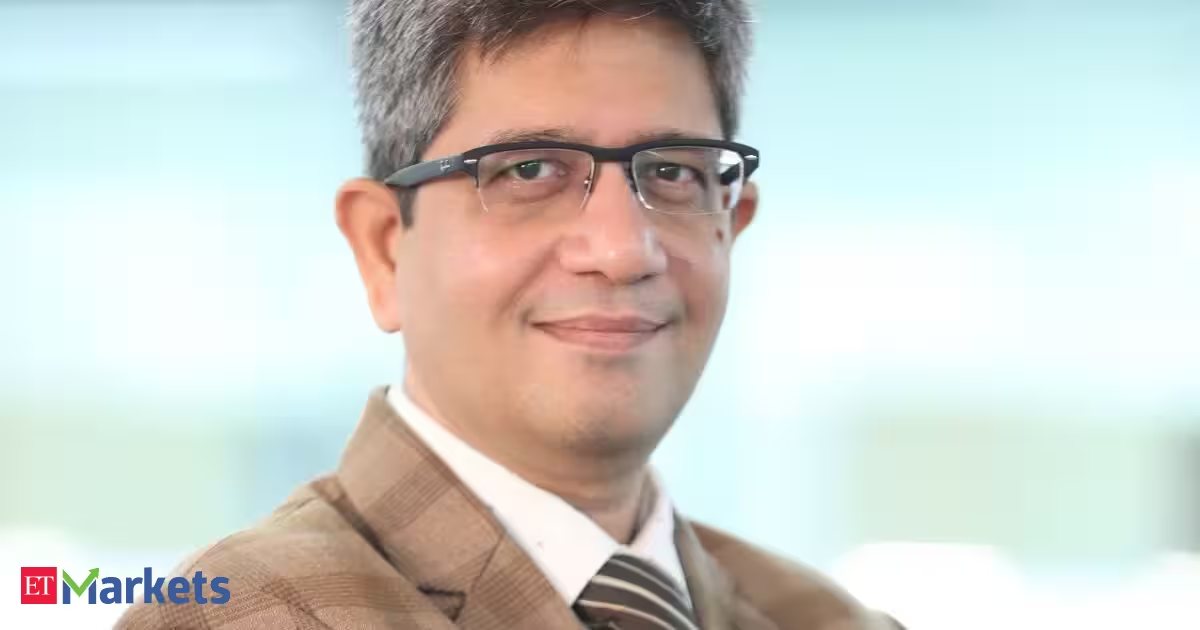
The fund house believes the recent correction in IT stocks reflects concerns over tariffs, AI-led disruption and weak near-term earnings guidance, but says the long-term opportunity lies in the industry’s transition from pilot AI projects to large-scale enterprise deployments. Korde sees emerging demand for data engineering, cybersecurity, cloud integration, specialised semiconductor infrastructure and AI-enabled hardware as potential growth drivers, even if traditional revenue streams come under pressure.
“While the existing revenue pools may get impacted, every disruption provides an opportunity as well, as has been witnessed in the past,” he said in an interview with ETMarkets.
Edited excerpts from a chat:
The government’s policy thrust is firmly behind manufacturing, yet you are more bullish on services. What is the market underestimating about the services opportunity?
While there has been a visible thrust on the manufacturing sector through various measures such as introduction of Production Linked Incentives (PLI) and promoting Make in India, it is also quite noticeable that the service sector has not been ignored. Various policies such as national Tourism Policy 2015, National Education Policy 2016, National Health Policy 2017, and initiatives like the National Mission on Pilgrimage Rejuvenation and Spiritual, Heritage Augmentation Drive (PRASAD) to name just a few, have helped drive growth in the services sector as well. Interestingly, The Gross Value Added by the Services sector has averaged 7.1%* year on year growth in the past 20 years, higher than both Industry and Agriculture average growth rate.
Which segments within services—financials, IT, healthcare, telecom, travel or digital businesses—offer the strongest earnings visibility over the next three to five years?The services sector offers multiple sectoral opportunities to invest in: Financial Services, Information Technology, Consumer Services, Power, Healthcare, Telecommunication, Oil & Gas, Telecommunication, Services, and Media & Publication. A lot of companies within these sectors have been growing at a fair clip in the past 5 years. We project good growth visibility in Financial Services (on low credit penetration and financialization of savings), Healthcare (aging demographics, expanding middle class, lifestyle diseases and wellness focus, and potential to see increase in medical value tourism), and Consumer Services (rapid digital acceleration boosting growth in e-commerce and quick commerce driving volumes across audience).
Indian IT services face uncertainty from AI-led disruption. Do you see AI as a threat to existing revenue pools or as the sector’s next growth driver?
The IT Sector has corrected by 23% over the last 1 year led by concerns around uncertainty led by tariffs and AI dominance. Even the growth guidance for FY27 remains weak, though the sector is a beneficiary of the weaker local currency. So, while the impact on stock prices has been immediate, there hasn’t been adequate clarity on how the opportunities might manifest. However, there can be potential prospects as the move from pilot AI projects to scaled enterprise deployments occur, which may be in the form of massive data engineering, new cybersecurity frameworks, or cloud integration & architectures and specialized semiconductors (GPUs, NPUs, TPUs), edge-AI devices, and data center infrastructure on the hardware side. To sum up, while the existing revenue pools may get impacted, every disruption provides an opportunity as well, as has been witnessed in the past.
Financial services represent a significant part of the listed services universe. Where do you currently see the best risk-reward—banks, NBFCs, insurers, asset managers or capital-market businesses?
Within the Financial Services space, we have a preference for Mid cap banks, NBFCs and platform companies in that order.
From a broader market perspective, do you expect returns over the next year to be driven by earnings growth, valuation expansion or sector rotation?
Generally, the markets do well when there is confidence in the earnings growth trajectory. IMF projects India’s GDP growth at ~6.4% for FY27* and identifies India as the fastest-growing major global economy, bolstered by resilient domestic consumption, robust services activity, and reduced external tariffs. This is higher than their projected growth rate of 3.9% for emerging markets and developing economies and 3.1% for the World. In this scenario, earnings growth, especially if the war scenario tapers off, can be a good growth driver for the markets. Of course, if this war extends further, or in case of additional hostilities elsewhere, corporate earnings are vulnerable to the tune of 300-500bps, in which case instead of earnings growth, sector rotation can be the driver.
Midcap valuations remain elevated despite uneven earnings delivery. Where do you still find a favorable risk-reward, and which segments appear priced for perfection?
While Midcap valuations may appear expensive in isolation, the current valuation is at a 6% discount to the past 8 year average PE multiple of the index. Similarly, even the large cap Nifty 100 index is trading at a lower valuation (by~8%) to its past 8 year average. At the same time, the small cap index is trading at a premium to its historical valuation. Hence risk reward broadly appears to be favourable in valuation terms for both mid cap and large cap segments.
Which sectors currently offer the strongest overlap between the midcap and value frameworks, and will return over the next three years be driven primarily by earnings growth, valuation rerating or successful corporate turnarounds?
To answer the latter part of the question, as mentioned earlier, earnings growth for India should be a key driver for returns. Successful corporate turnarounds are unique and company specific events, so they cannot be classified as a category driver, while valuation rerating is often derived as a function or outcome of improved earnings growth trajectory.
In the context of Indian markets, the mid cap framework is largely growth oriented, but following the Growth at Reasonable Prices (GARP) philosophy helps in identifying some themes closer to the value philosophy. We see Financial Services and IT offering good overlap between these frameworks due to stock correction, discounted valuation as compared to historical averages, overall good management quality, and healthy cash flow generation.
If you must start an SIP of Rs 10,000 as an investor with moderate risk appetite at this stage, how would it be spread out across various fund categories? Consider a long-term horizon of 10 years.
While it is difficult to be generic when individual investor risk return profile and tenure are different, and a planner with a holistic view of the client can be a better judge on these aspects, we believe a broad core portfolio from a longer term perspective would appear as spread 20% in hybrid (BAF), 20% each in the large / mid / small categories and the balance 20% in a thematic (value / services / consumption).

In a written reply in the Rajya Sabha, minister of state for external affairs Kirti Vardhan Singh said on Friday that three rounds of CEPA negotiations have been held so far, with the latest round taking place in Ottawa from July 6-10. “Progress has been made across multiple negotiating tracks, with both sides working towards concluding the process by late 2026,” he said. PM Narendra Modi plans to visit Canada later this year to give further momentum to bilateral ties, which have improved under the current dispensation in Ottawa. The MEA said the proposed India-Canada CEPA aims to establish a free trade area by eliminating or reducing tariffs and other trade restrictions. The agreement is also intended to progressively liberalise trade in goods and services, promote a more transparent, predictable and facilitative trade and investment regime, and strengthen economic cooperation and people-to-people ties.
Canada represents a market of 41.65 million people, as of 2025, and $2.34 trillion in terms of GDP in terms of purchasing power parity.
The India-Canada CEPA holds significant potential to unlock and expand bilateral trade, which stood at $8.66 billion in 2024-25, comprising exports worth $4.22 billion from India and imports of $4.44 billion, according to an official.
Business
Govt’s urban reset: Centre divides ministry of Housing and Urban Affairs into two specialised verticals

The administrative revamp follows the government’s decision last Thursday to split the ministry into two specialised verticals: Department of Capital Development (Rajdhani Vikas Vibhag) and the Department of Urban Development (Shehari Vikas Vibhag). The division is designed to enable dedicated focus on distinct aspects of urban planning while streamlining service delivery, execution, and policy interventions.
The administrative reshuffle moved at breakneck speed. Within 24 hours of the Gazette notification, secretary Srinivas Katikithala (a 1989-batch IAS officer of Gujarat cadre) handed over charge of the newly-created department of capital development to D Thara, a 1995-batch IAS officer from the same cadre. Simultaneously, the Centre posted Satendra Singh (a 1995-batch Jharkhand cadre IAS officer) as secretary to lead the Department of Urban Development. The overhaul extends deep into the operational leadership of Centre’s core urban schemes.
Crucial personnel shifts include Kuldeep Narayan, who was directing the flagship housing scheme Pradhan Mantri Awas Yojana (Urban), moving to Niti Aayog. Roopa Mishra, who spearheaded the Swachh Bharat Mission (Urban), has also been reassigned. New directors are slated to assume charge within the next fortnight to ensure seamless administrative continuity. At the heart of this structural realignment is a targeted policy focus on the national capital. The Centre has set its sights on resolving Delhi’s long-standing, complex urban challenges through a bifurcated strategy. With a BJP government in power in Delhi, the ministry bifurcation will also help in better implementation of infrastructure projects, including the ambitious Central Vista project.
Business
US Senator Moreno says Ohio’s Miller should not serve in Congress, citing abuse allegations

US Senator Moreno says Ohio’s Miller should not serve in Congress, citing abuse allegations


Stone Fox Capital is an RIA from Oklahoma. Mark Holder is a CPA with degrees in Accounting and Finance. He is also Series 65 licensed and has 30 years of investing experience, including 15 years as a portfolio manager. Mark leads the investing group Out Fox The Street where he shares stock picks and deep research to help readers uncover potential multibaggers while managing portfolio risk via diversification. Features include various model portfolios, stock picks with identifiable catalysts, daily updates, real-time alerts, and access to community chat and direct chat with Mark for questions. Learn more.
Analyst’s Disclosure: I/we have a beneficial long position in the shares of SOFI either through stock ownership, options, or other derivatives. I wrote this article myself, and it expresses my own opinions. I am not receiving compensation for it (other than from Seeking Alpha). I have no business relationship with any company whose stock is mentioned in this article.
The information contained herein is for informational purposes only. Nothing in this article should be taken as a solicitation to purchase or sell securities. Before buying or selling any stock, you should do your own research and reach your own conclusion or consult a financial advisor. Investing includes risks, including loss of principal.
Seeking Alpha’s Disclosure: Past performance is no guarantee of future results. No recommendation or advice is being given as to whether any investment is suitable for a particular investor. Any views or opinions expressed above may not reflect those of Seeking Alpha as a whole. Seeking Alpha is not a licensed securities dealer, broker or US investment adviser or investment bank. Our analysts are third party authors that include both professional investors and individual investors who may not be licensed or certified by any institute or regulatory body.
Business
10 New Galaxy AI Features Samsung Has Built Into Its New Galaxy Z Fold 8 Foldable Phone Ahead of Launch
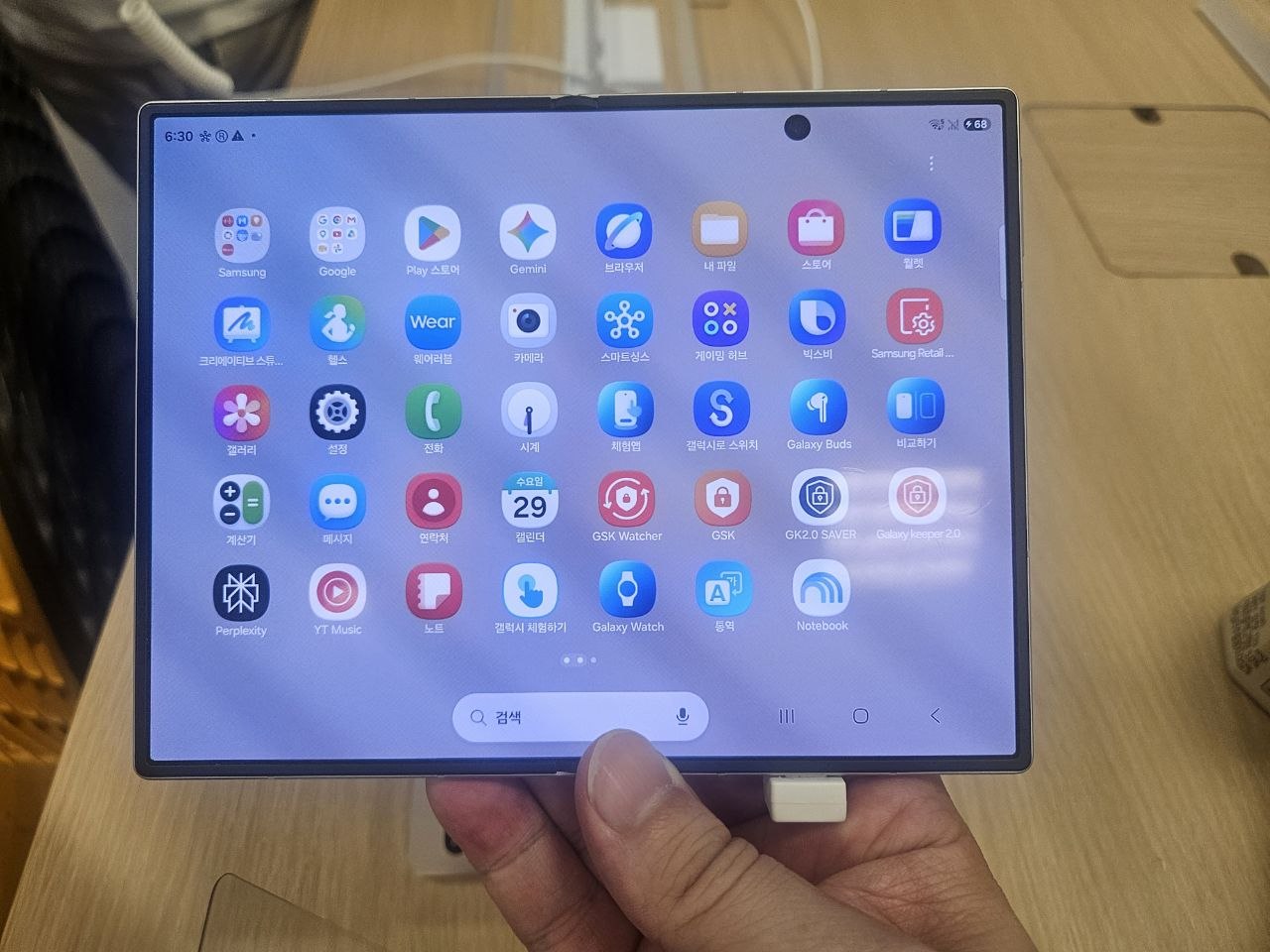
Samsung unveiled its Galaxy Z Fold 8 during a Galaxy Unpacked event in London on July 22, positioning the foldable phone as its most AI-integrated device to date ahead of its general availability date of August 5. Here are 10 new artificial intelligence features Samsung has built into the device.
1. My FanCam. This video-editing feature allows users to select a subject within a video and have Galaxy AI automatically track and follow that person throughout the clip. Users open the AI icon during editing, press the My FanCam button, and tap on the specific subject they want the software to detect and follow, a feature Samsung has positioned as particularly useful for concert footage, sports events or any recording involving multiple moving subjects.
2. Call Brief. This feature automatically summarizes phone calls, giving users a condensed overview of a conversation’s key points without requiring them to review a full transcript or recording, a tool designed to help users quickly recall important details from calls without needing to take detailed notes during the conversation itself.
3. Enhanced Now Nudges and Now Brief cards. Samsung has expanded its proactive, context-aware notification system with enhanced Now Nudges, which surface timely, personalized suggestions based on a user’s habits and daily patterns, alongside customizable Now Brief cards that summarize relevant information for a user’s day. As of July 2026, Now Nudge supports 16 languages, including Korean, English, French, Spanish, Italian, German, Polish, Portuguese, Japanese, Chinese, Thai, Vietnamese, Hindi, Arabic, Indonesian and Russian.
4. Photo Assist. Boosted by Galaxy AI, Photo Assist lets users move, resize or remove objects within a photo, or fill in background areas left behind after an object has been removed, streamlining photo touch-ups without requiring separate editing software. The tool also includes a Create section that allows users to make personalized edits using written text prompts, and lets users compare original and edited versions of a photo side by side to more easily track changes. Photo Assist currently supports 41 languages.
5. Gemini Intelligence integration. The Galaxy Z Fold 8 runs on One UI 9 and integrates Google’s Gemini Intelligence, an agentic AI assistant designed to handle more complex, multistep tasks across apps rather than responding only to single, isolated commands. TM Roh, CEO, president and head of Samsung’s Device eXperience Division, framed the broader push toward agentic AI as central to the device’s design philosophy. “As AI becomes more agentic, mobile devices will become the most personal entry point to experiences that understand and adapt to each user,” Roh said during the Galaxy Unpacked event. “By setting a new standard for foldables, we are once again advancing the premium mobile experience and opening the next era of intelligence to more people.”
6. Gemini Notebook. Formerly known as NotebookLM, Gemini Notebook is now built directly into the new foldables, taking advantage of the Fold 8’s larger inner display to let users drag photos, documents and recordings into a shared, side-by-side workspace rather than switching between multiple separate apps to organize research or notes.
7. Circle to Search. This feature lets users circle, highlight or tap on anything visible on their screen, whether within an app, a photo or a webpage, to instantly search for more information about it without needing to leave the app they are currently using or manually describe what they are looking at in a separate search query.
8. Live Translate. Building on Samsung’s existing real-time translation tools, Live Translate provides on-the-fly translation for conversations and calls, allowing users communicating across different languages to understand each other in real time through the phone’s built-in AI processing.
9. Samsung Health AI tools, including Energy Score and AI Health Coach. The device’s AI capabilities extend into Samsung Health, where Energy Score uses sleep, heart rate and activity data collected from a paired Galaxy Watch to generate a daily energy rating along with personalized recommendations. A companion AI Health Coach feature offers customized fitness and nutrition suggestions based on a user’s logged health data and stated personal goals.
10. On-device, privacy-focused AI processing. Rather than routing all AI tasks through external servers, Samsung has emphasized that sensitive data, including calls, voice recordings and notes, is processed directly on the device by default and does not leave the phone, a design choice the company has detailed in its published AI privacy policy. The Galaxy Z Fold 8’s Snapdragon 8 Elite Gen 5 for Galaxy processor includes a dedicated neural processing unit specifically built to handle this kind of on-device AI workload efficiently.
Samsung has said all of the Galaxy AI features included on the Galaxy Z Fold 8 will remain available at no additional cost, though the company has left open the possibility that future premium features or third-party AI model integrations could eventually introduce subscription-based pricing tiers.
The Galaxy Z Fold 8 itself features a 7.6-inch inner display, a 5.5-inch cover screen, and a redesigned hinge intended to reduce the visibility of the display crease that has historically been a point of criticism for book-style foldable phones. The device weighs 201 grams, which Samsung describes as its lightest foldable to date, and includes a 4,800mAh battery rated for up to 26 hours of continuous playback. The phone is available in 256GB, 512GB and 1TB storage configurations, with pricing starting at $1,899 in the United States for the base 256GB model. Samsung is also offering up to seven years of software updates for the device, extending the phone’s expected AI feature support well beyond the typical software lifespan of earlier smartphone generations.

Ariana Grande quits West End role as she plans to step back from the spotlight amid ‘ongoing public scrutiny’ over her appearance
US lawmaker Kaptur injured in car crash, her office says
Teleprompter Operator Accused in Kalshi Betting Case Is No Longer a Federal Employee


![Macias - MONEY [Official Music Video]](https://wordupnews.com/wp-content/uploads/2026/02/1770256831_maxresdefault-80x80.jpg)

-
 Sports7 days ago
Commonwealth Games boxing: Jadumani Singh seals dominant 5-0 win over Pakistan’s Sumama Rehman to enter quarter-finals | Commonwealth Games News
-

 Business4 days ago
Why Trees Belong on the Risk Register
-

 Fashion2 days ago
Weekend Open Thread: Wit & Wisdom
-

 Tech7 days ago
Intel is reversing course and bringing hyper-threading back to its server chips
-

 Politics2 days ago
Meta enters AI-training agreement with far-right ‘propaganda rag’ Newsmax
-

 Politics6 days ago
Luke Littler dismantles Gerwyn Price to retain title in Blackpool
-

 Crypto World1 day ago
MicroStrategy Post-Earnings CLARITY Act Push Could Add New Catalyst for Its Stock
-

 Politics5 days ago
The Part of the Electric Transition Nobody Wants to Discuss
-
 Entertainment5 days ago
‘Stargate’ Creator’s New Sci-Fi Series Returns for Season 3 Tomorrow
-

 News Videos7 days ago
BITCOIN JUST ENTERED THIS CRITICAL ZONE…
-

 Business5 days ago
Major shareholder moves on Canyon
-

 News Videos3 days ago
Bitcoin Enters the 3rd Stage of the Bear Market
-

 Crypto World2 days ago
XRP Ledger v3.3.0 brings five institutional features
-

 Crypto World5 days ago
Kraken Enables Retail Access to Jersey Mike’s IPO via Tokenized Shares
-

 Tech6 days ago
New macOS Sequoia & Sonoma security updates for older Macs
-

 Politics3 days ago
Luke Littler’s dominance sparks GOAT debate
-

 News Videos5 days ago
Claude: Build Financial Dashboards in Minutes (2026)
-

 Sports3 days ago
Seema Kaliramna Wins Discus Throw Bronze, Takes India’s CWG Medals Tally To 17
-

 Business5 days ago
Johnson & Johnson agrees to $5.5B settlement over talc cancer claims
-

 Crypto World10 hours ago
Crypto PAC spending tops $2M in Michigan House race
You must be logged in to post a comment Login