AUSTIN, Texas — Elon Musk, the billionaire entrepreneur behind Tesla, SpaceX and xAI, has sparked intense debate with a bold prediction that artificial intelligence will usher in an era of “universal high income” funded by direct government payments, ultimately triggering deflation rather than inflation as productivity explodes. In a video clip widely shared Friday on X, Musk described a future where AI-driven output of goods and services grows faster than the money supply, making everyday items cheaper even as cash is distributed to citizens.
“We’ll have universal high income. We’re basically just issuing money to people, and just because the output of Business Services will so far exceed the money supply, that effectively you have deflation, because deflation is just the ratio of the outputs of goods and services to… pic.twitter.com/iePErYDKK0
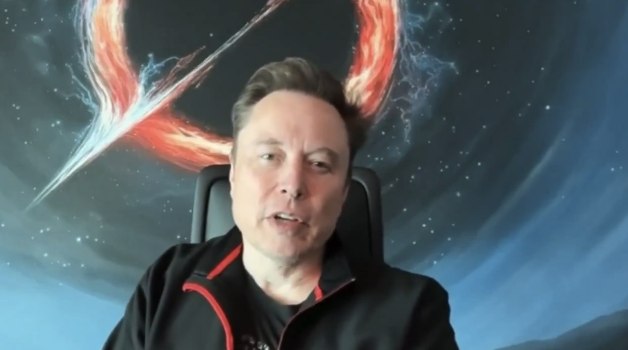
The remarks, captured during what appears to be a recent interview, quickly went viral. Posted by popular X account DogeDesigner, the 59-second clip had amassed more than 600,000 views within hours. Musk sits in a black Tesla-branded jacket against a cosmic backdrop, gesturing emphatically as he outlines his vision. “We’ll have universal high income,” he states. “We’re basically just issuing money to people, and just because the output of goods and services will so far exceed the money supply, that effectively you have deflation, because deflation is just the ratio of the outputs of goods and services to the money supply.” He adds that he predicts the growth rate of goods and services will outpace money creation, leading to falling prices.
Musk’s comments represent an evolution of his long-standing views on universal basic income, which he has supported for years as a buffer against AI-induced job displacement. This time, however, he escalates the concept to “universal high income,” suggesting payments substantial enough to maintain living standards without traditional employment. The deflationary twist hinges on AI’s ability to supercharge production across sectors — from manufacturing and agriculture to services and energy — creating abundance that dilutes the purchasing power pressure typically associated with printing money.
Advertisement
Economists have long debated the mechanics of such a scenario. Traditional theory warns that flooding an economy with new currency risks inflation, as more dollars chase the same goods. Musk flips the script, arguing AI will flood the economy with goods instead. If factories run with minimal human labor, farms harvest autonomously and software handles complex tasks, the supply curve shifts dramatically rightward. Prices for housing, food, transportation and healthcare could plummet, he contends, even as governments issue larger stipends.
The idea aligns with Musk’s broader optimism about AI. Through xAI, his latest venture, he has positioned himself as a proponent of safe, truth-seeking artificial intelligence that accelerates scientific discovery. Tesla’s Optimus humanoid robots and autonomous vehicle fleets are already prototypes of the labor-replacing technology he envisions. SpaceX’s Starship program and Neuralink’s brain interfaces further illustrate his belief that humanity is on the cusp of a post-scarcity world where work becomes optional.
Yet the proposal has drawn swift criticism and questions. Replies to the viral post reflect a spectrum of reactions. Some users expressed fear that unconditional payments would erode work ethic and foster dependency, citing historical experiments like the “mouse utopia” studies where abundant resources led to social collapse. Others worried about real-estate prices: if everyone receives high income, demand for limited assets like land could skyrocket, offsetting deflation in other areas. “Universal high income sounds fantastic right up until you realize a basic starter home will probably cost 400 trillion dollars,” one commenter wrote.
Skeptics also challenged the mechanics of implementation. “Printing money has never created deflation,” another user replied. “Control has.” Economists note that real-world distribution matters: who decides payment amounts, eligibility and funding sources? Without corresponding productivity gains across all sectors — including those with natural scarcity like prime real estate or rare materials — localized inflation could still emerge. Critics point to past stimulus checks during the COVID-19 pandemic, which contributed to price spikes despite supply-chain issues.
Advertisement
Supporters, however, see Musk’s forecast as forward-thinking policy guidance. In an era when AI is already automating white-collar jobs in coding, legal analysis and customer service, universal high income could serve as a humane transition mechanism. It echoes proposals from figures like Andrew Yang, who advocated universal basic income during his 2020 presidential run, but Musk’s version envisions higher amounts sustained by exponential growth rather than tax redistribution alone.
The timing of Musk’s comments adds weight. As of April 2026, AI investment is surging globally. Major technology firms report breakthroughs in multimodal models capable of reasoning, creating and optimizing at superhuman speeds. Governments from Washington to Beijing are racing to regulate and harness the technology, with debates centering on job displacement versus abundance. Musk himself has warned repeatedly about AI risks, urging caution even as he invests heavily. In the clip, he acknowledges the future holds “a range of possible outcomes” and urges vigilance, estimating an 80 percent chance the trajectory proves “great.”
Policy implications could be profound. If Musk’s deflationary abundance materializes, central banks might need to rethink monetary policy. Interest rates, quantitative easing and inflation targets were designed for scarcity-driven economies. A world of falling prices could reward savers but discourage spending and investment if consumers wait for even lower costs. Governments might issue high-income payments through digital currencies or direct deposits, funded partly by taxes on AI-driven corporate profits.
Musk’s companies stand to benefit enormously from the shift he describes. Tesla’s full self-driving technology and robotaxis could generate trillions in value while displacing millions of driving jobs — precisely the scenario universal high income would address. xAI’s Grok models aim to accelerate discovery in physics, biology and materials science, potentially unlocking the productivity gains Musk predicts. The entrepreneur has long argued that humanity must become multi-planetary to ensure long-term survival, viewing AI as both a tool and a potential existential risk.
Advertisement
Public reaction on social media highlights deep societal divisions. Optimists celebrated the vision of leisure time for creativity, family and exploration. “More time for me to make AI videos,” one user quipped. Pessimists warned of moral hazard: “If everyone is rich then no one is.” Some invoked philosophical concerns, arguing that struggle gives life meaning and that removing it risks societal decay. Others questioned practicality: “How is it possible? And why would we even need money in society at that point?”
Financial markets showed no immediate reaction Friday, with Tesla shares trading steadily amid broader tech sector volatility. Analysts note Musk’s statements often move markets when tied to product announcements but serve more as philosophical provocations here. Still, the clip’s rapid spread — boosted by high-engagement accounts — underscores X’s role as a real-time barometer of tech thought leadership.
The discussion revives older debates about technological unemployment. Since the Industrial Revolution, automation has displaced workers while creating new opportunities. AI differs in scale and speed, potentially affecting cognitive as well as physical labor. Studies from organizations like the World Economic Forum project massive job churn by 2030, with reskilling programs struggling to keep pace. Universal high income, in Musk’s framing, acts as a bridge rather than a permanent welfare state.
Implementation hurdles remain vast. Funding such a program at scale would require unprecedented fiscal resources or novel revenue streams, such as value-added taxes on AI output or international agreements. Political feasibility depends on public trust in government distribution mechanisms — a challenge in polarized times. Pilot programs worldwide, from Finland to Kenya, have tested smaller-scale basic income with mixed results on employment, health and entrepreneurship.
Advertisement
Musk’s track record lends credibility to his forecast even as it invites scrutiny. He has repeatedly delivered on seemingly impossible timelines, from reusable rockets to mass-market electric vehicles. Critics argue his optimism sometimes overlooks transitional pain: millions could face unemployment before abundance arrives. “The transition will take 10-plus years and will be immensely painful for people displaced by AI,” one observer noted in replies.
As the video continues circulating, it joins a growing chorus of tech leaders addressing AI’s societal contract. OpenAI’s Sam Altman has experimented with universal basic income pilots, while others advocate for “AI dividends” from productivity gains. Musk’s contribution stands out for its deflationary optimism — a counter-narrative to doomsday predictions of hyperinflation or mass poverty.
For now, the entrepreneur’s words serve as both provocation and roadmap. Whether universal high income becomes policy or remains theoretical will depend on how quickly AI delivers the abundance Musk anticipates. In the meantime, the clip has reignited global conversation about humanity’s relationship with work, money and technology in an age of intelligent machines.
Friday’s viral moment underscores a central tension: technology that could free humanity from drudgery also demands new economic and ethical frameworks. Musk’s vision, delivered with characteristic candor, challenges policymakers, economists and citizens to prepare for a future where scarcity may give way to plenty — and where the very definition of economic value may transform.
Britain’s bond market delivered its sharpest rebuke yet to Sir Keir Starmer’s premiership on Tuesday, with 30-year gilt yields climbing to their highest level this century as the prime minister stared down a growing chorus of Labour MPs demanding he step aside.
The sell-off, which dragged sterling and equities lower in lockstep, wiped out the relief rally that followed Starmer’s defiant intervention last week. Tuesday’s cabinet meeting, at which the prime minister once again refused to countenance resignation, did little to settle nerves. Investors are now openly pricing in the prospect of a leftward lurch in Labour policy, with the attendant risks of looser fiscal rules, higher gilt issuance and a further squeeze on the cost of capital for British business.
For the country’s 5.5 million small and medium-sized enterprises, the implications are far from academic. Higher long-dated gilt yields feed directly into the swap rates that underpin commercial lending, business mortgages and asset finance, raising the prospect of yet another leg up in the borrowing costs faced by Britain’s corporate backbone at a time when many are still nursing the legacy of post-pandemic debt.
The 30-year gilt yield rose 13 basis points to 5.81 per cent, the highest since May 1998. The benchmark 10-year yield gained 10 basis points to 5.1 per cent, within a whisker of breaching the post-2008 peak it set earlier this month. Bond prices move inversely to yields.
“A new Labour leader may face pressure to ease the fiscal rules and raise gilt issuance,” warned Jim Reid, analyst at Deutsche Bank, capturing the City’s central concern that any successor would lean towards higher spending and heavier taxation of the very businesses the Treasury is counting on to drive growth.
Advertisement
Sterling’s slide alongside government bonds will draw uncomfortable parallels with the dark days of Liz Truss’s mini-budget. When a currency weakens in concert with rising borrowing costs, it is the trading pattern of an emerging market that has lost the confidence of foreign capital, not that of a G7 economy. The pound fell 0.64 per cent against the dollar to a two-week low of $1.352, and shed 0.21 per cent against the euro to €1.152, its weakest since mid-April.
Some of the pressure is undeniably imported. Bunds, OATs and BTPs all sold off as President Trump declared the Iran ceasefire was “on life support”, sending Brent crude up 2.8 per cent to $107.17 a barrel and reigniting inflation fears across advanced economies. The Strait of Hormuz, through which a fifth of global oil and gas once flowed, remains largely shut. Germany’s Dax bore the brunt of the European sell-off, falling more than 1 per cent. But gilts underperformed by a substantial margin, marking out Westminster’s political turmoil as a uniquely British risk premium.
Mohit Kumar, chief European economist at Jefferies, urged clients to short sterling, arguing any change in the composition of government “would likely be left-leaning”. Anthony Willis, senior economist at Columbia Threadneedle Investments, cautioned that the bond market was unlikely to settle “until greater clarity emerges”.
Equities followed suit. The FTSE 100 surrendered 0.3 per cent having opened the week with a 0.4 per cent gain, while the more domestically focused FTSE 250 dropped 211 points, or 0.9 per cent, extending its losing streak to a second day. Mid-cap stocks, dominated by UK-facing businesses, are the clearest read on how the City judges Britain’s economic prospects.
Advertisement
The grim verdict from Andrew Goodwin, chief UK economist at Oxford Economics, is that there is little prospect of meaningful relief. He expects 10-year borrowing costs to remain stuck above 5 per cent for the remainder of the year, regardless of who occupies Number 10. “Markets clearly perceive the UK has a bigger inflation problem and that tighter monetary policy will be needed to limit second-round effects from the energy shock, while political uncertainty has added to pressures at the long end,” he said.
Even were Starmer to dig in, Goodwin argued, the bond market would have little to celebrate, with the prime minister’s “attempts to regain popularity, or, more likely, from a successor implementing more costly left-wing economic policies” weighing on sentiment. “If Starmer sets out a timetable to stand down, the uncertainty premium will persist.”
For owner-managers already navigating a punishing cost base, a softening consumer and the fallout from this spring’s National Insurance changes, the message from the bond vigilantes is unambiguous: brace for borrowing to stay dear, and for political risk to remain firmly on the balance sheet.
Jamie Young
Jamie is Senior Reporter at Business Matters, bringing over a decade of experience in UK SME business reporting.
Jamie holds a degree in Business Administration and regularly participates in industry conferences and workshops.
When not reporting on the latest business developments, Jamie is passionate about mentoring up-and-coming journalists and entrepreneurs to inspire the next generation of business leaders.
Novo Nordisk CEO Mike Doustdar details the company’s Amazon partnership, benefits of Ozempic beyond weight loss and more on ‘The Claman Countdown.’
Amazon is rolling out 30-minute delivery across dozens of U.S. cities, marking its fastest shipping option yet as the retail giant continues to accelerate its push into ultra-fast fulfillment.
The new service, called Amazon Now, will deliver thousands of items — including groceries, household essentials and electronics — to customers’ doors in about 30 minutes.
Advertisement
The offering is now available in Seattle, Philadelphia, Dallas-Fort Worth and Atlanta, and is expanding to additional markets such as Austin, Denver, Houston, Minneapolis, Orlando, Oklahoma City and Phoenix.
“Amazon Now is for when you need or want the convenience of getting your Amazon order delivered in 30 minutes or less,” Udit Madan, senior vice president of Amazon Worldwide Operations, said in a statement. “With thousands of items available for ultra-fast delivery, you can get everything from groceries for dinner, to AirPods before a flight, to household essentials like laundry detergent or toothpaste delivered right to your door.
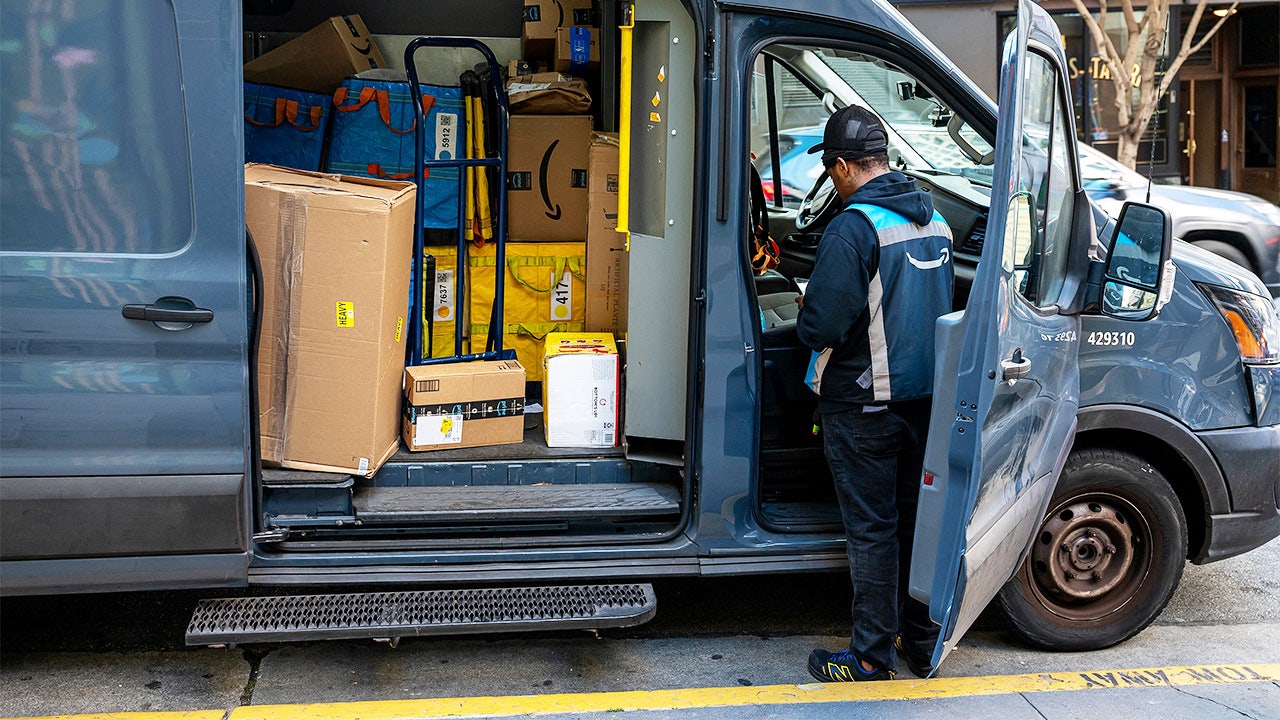
A worker near packages in an Amazon delivery vehicle in San Francisco on Monday, Feb. 2, 2026. (David Paul Morris/Bloomberg via Getty Images / Getty Images)
“Amazon Now complements Amazon’s existing fast-delivery offerings, including 1-hour and 3-hour delivery on more than 90,000 products and Same-Day Delivery on millions of items,” Madan added.
Advertisement
Amazon said the new service relies on a network of smaller fulfillment sites located closer to customers, allowing for faster delivery times and shorter travel distances for drivers.
Prime members will pay $3.99 per order for the service, while non-members will pay $13.99. Additional fees will apply for smaller orders, including $1.99 for Prime members and $3.99 for non-Prime members for orders under $15.
Amazon’s new MK30 Prime Air drone is displayed during Amazon’s “Delivering the Future” event at the company’s BFI1 Fulfillment Center, Robotics Research and Development Hub in Sumner, Washington on October 18, 2023. (Jason Redmond/AFP via Getty Images / Getty Images)
“Amazon Now uses a network of smaller locations designed for efficient order fulfillment, strategically placed close to where customers live and work,” Amazon said. “This approach prioritizes the safety of employees picking and packing orders, reduces the distance delivery partners need to travel, and enables faster delivery times for customers.”
Advertisement
Amazon plans to expand the service to tens of millions of customers by the end of 2026.
Amazon is investing $4 billion to expand Prime delivery services to rural America. (Amazon / Fox News)
The rollout comes as Amazon continues to invest heavily in speeding up deliveries, reporting that U.S. Prime members received more than 8 billion items the same or next day in 2025 — a more than 30% increase from the previous year.
The new offering adds to Amazon’s broader delivery network, which includes Prime Air drone delivery, offering sub-60-minute service in select U.S. locations, as well as one-hour, three-hour and same-day delivery options across thousands of cities and towns.
Advertisement
Amazon said 2025 marked its third consecutive year of record-fast delivery speeds, with more than 13 billion items arriving the same or next day globally. In the U.S., Prime members received over 8 billion of those shipments — up more than 30% year over year — with groceries and everyday essentials making up about half.
The company said Prime members have access to free shipping on more than 300 million items, and saved an average of $550 on fast delivery last year — nearly four times the cost of a membership.
Mr Moulton and GM&C Life Sciences Fund join £4.3m funding round
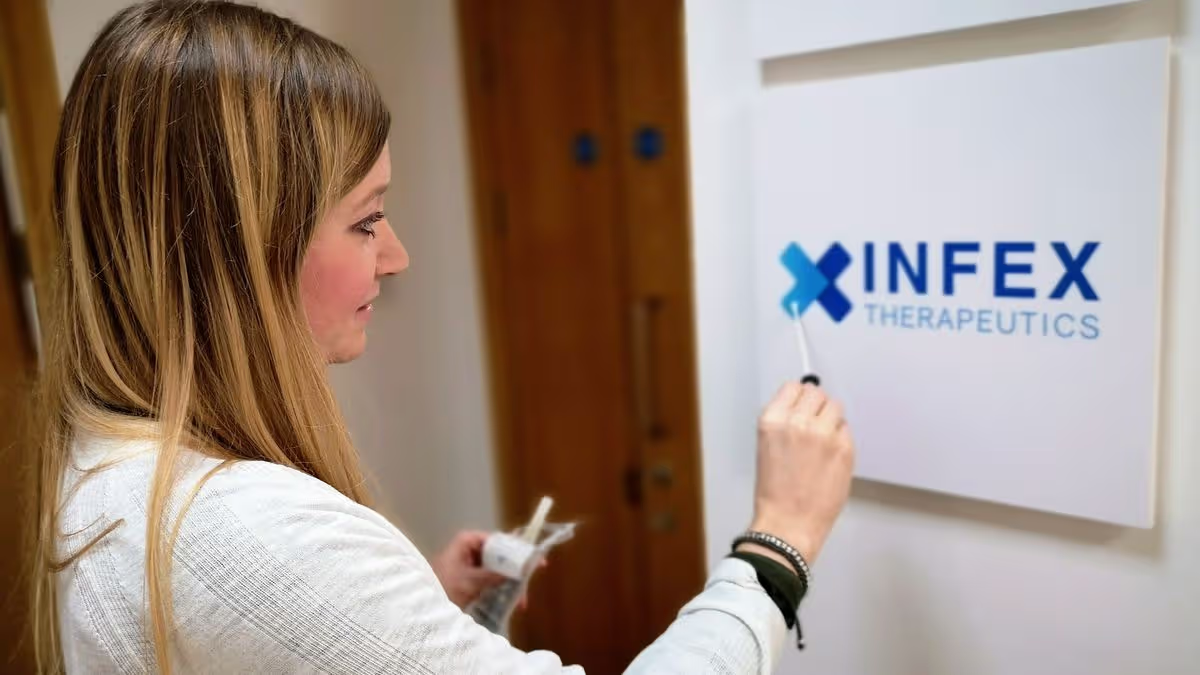
Infex Therapeutics has secured £4.3m in funding(Image: Infex Therapeutics)
Venture capitalist Jon Moulton has backed a biotech firm that’s looking to tackle the “critical global threat” of infections that are resistant to antibiotics.
Infex Therapeutics, of Alderley Edge, has secured £4.3m in a funding round led by Mr Moulton alongside the GM&C Life Sciences Fund, managed by Catapult Ventures, and existing high net worth investors.
The company will use the funding to develop its pipeline of new anti-infectives targeting antimicrobial resistance (AMR) and other “critical-priority infectious diseases”.
Dr Peter Jackson, CEO of Infex Therapeutics, said: “We are delighted to secure this investment led by Jon Moulton, with support from the Greater Manchester and Cheshire Lifescience Investment Fund and our existing investors.
Advertisement
“This funding represents strong validation of our progress in developing novel anti-infectives to address the critical global threat of antimicrobial resistance.”
Jon Moulton, founder of Better Capital and now chair of Infex Therapeutics, said: “We have supported Infex from the beginning and continue to be impressed by the company’s scientific progress and strategic execution.”
He highlighted Infex’s lead programme RESP-X, which is being trialled as a therapy for non-cystic fibrosis bronchiectasis (NCFB) patients.
And he said: ”This additional investment reflects our strong conviction in both the team and its innovative approach to tackling antimicrobial resistance.
Advertisement
Nick Wright, CEO of Catapult Ventures which manages the GM&C Life Sciences Fund, said: “Infex Therapeutics has made excellent scientific progress since we first invested several years ago. The company has clearly established itself as a world leader in the AMR and related space and the data it is generating is very compelling.”
Gatestone Institute senior fellow Gordon Chang joins ‘Mornings with Maria’ to break down President Donald Trump’s Beijing trip, Iran tensions, and rising concerns over China’s economy and surveillance-linked EVs.
President Donald Trump is slated to visit China this week, and according to a White House official, business figures including Elon Musk, Apple CEO Tim Cook and more than a dozen others will travel to China with the U.S. delegation.
Blackrock CEO Larry Fink, Boeing CEO Kelly Ortberg, and Goldman Sachs CEO David Solomon are some of the other figures listed.
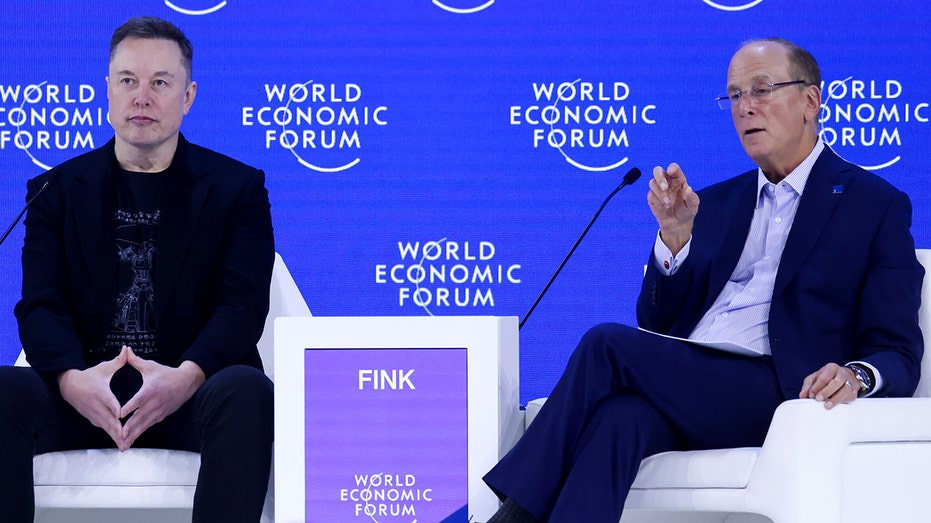
Elon Musk, chief executive officer of Tesla Inc., left, and Larry Fink, chief executive officer of BlackRock Inc., during the World Economic Forum (WEF) in Davos, Switzerland, on Thursday, Jan. 22, 2026. (Krisztian Bocsi/Bloomberg via Getty Images / Getty Images)
Others on the list provided by the White House official include Blackstone Chairman, CEO and co-founder Stephen Schwarzman, Cargill Board Chair and CEO Brian Sikes, Citi Board Chair and CEO Jane Fraser, Coherent CEO Jim Anderson, GE Aerospace chairman and CEO H. Lawrence Culp, Jr., Illumina CEO Jacob Thaysen, Mastercard CEO Michael Miebach, Meta President and Vice Chairman Dina Powell McCormick, Micron Chairman, President and CEO Sanjay Mehrotra, Qualcomm President and CEO Cristiano Amon and Visa CEO Ryan McInerney.
“I am very much looking forward to my trip to China, an amazing Country, with a Leader, President Xi, respected by all,” Trump declared in a Monday Truth Social post.
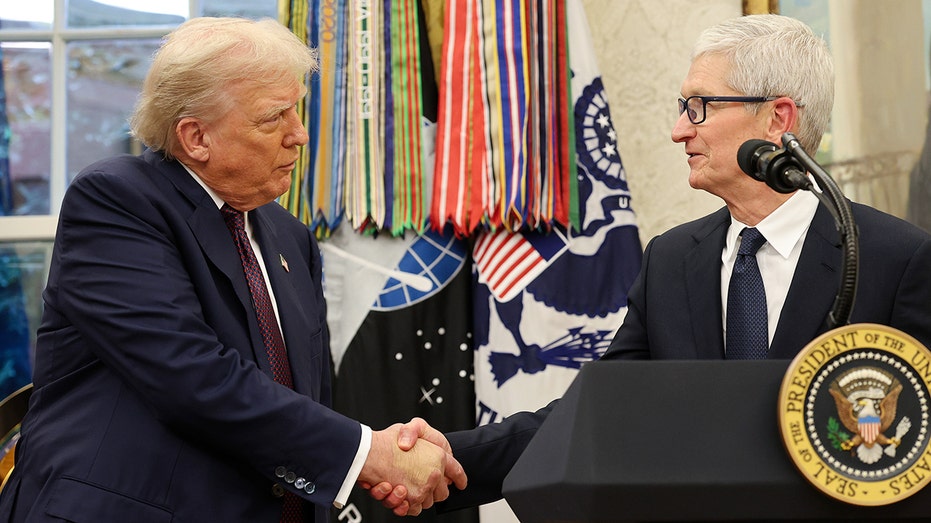
Apple CEO Tim Cook (R) shakes hands with U.S. President Donald Trump during an event in the Oval Office of the White House on Aug. 6, 2025 in Washington, D.C. (Win McNamee/Getty Images / Getty Images)
“Great things will happen for both Countries!” he added.
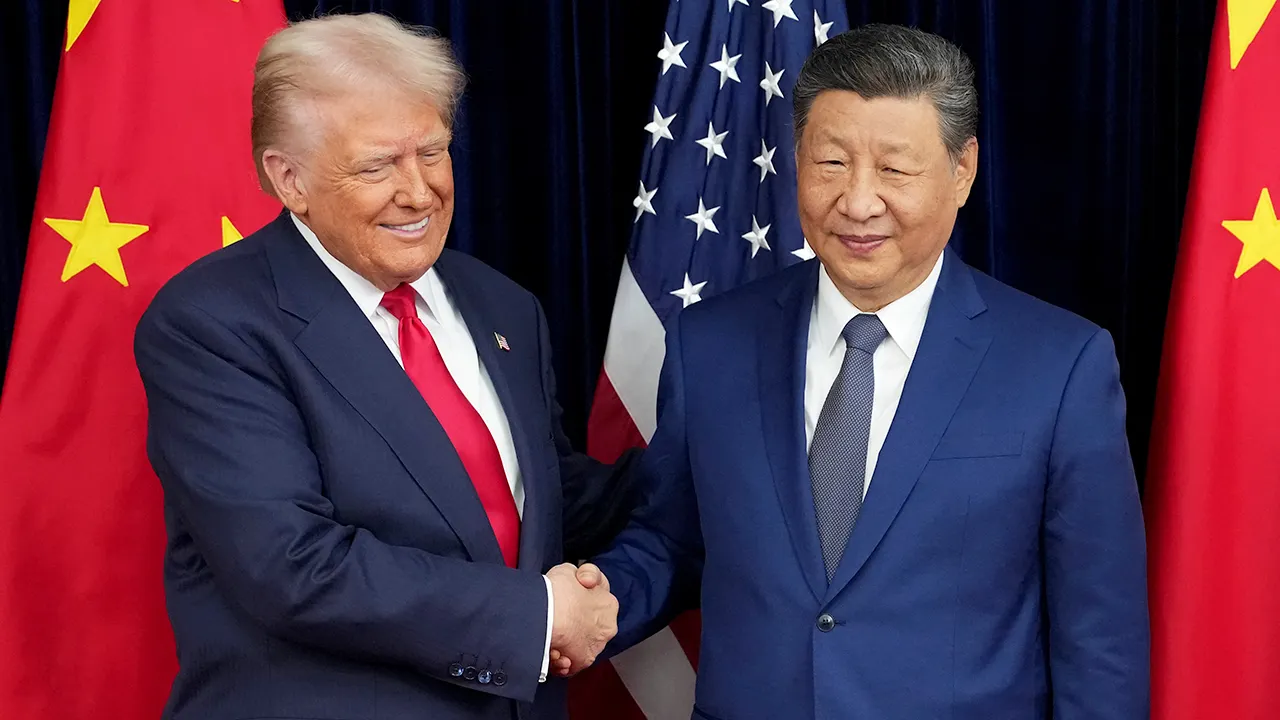
President Donald Trump met with Chinese President Xi Jinping in October in South Korea, according to Reuters.
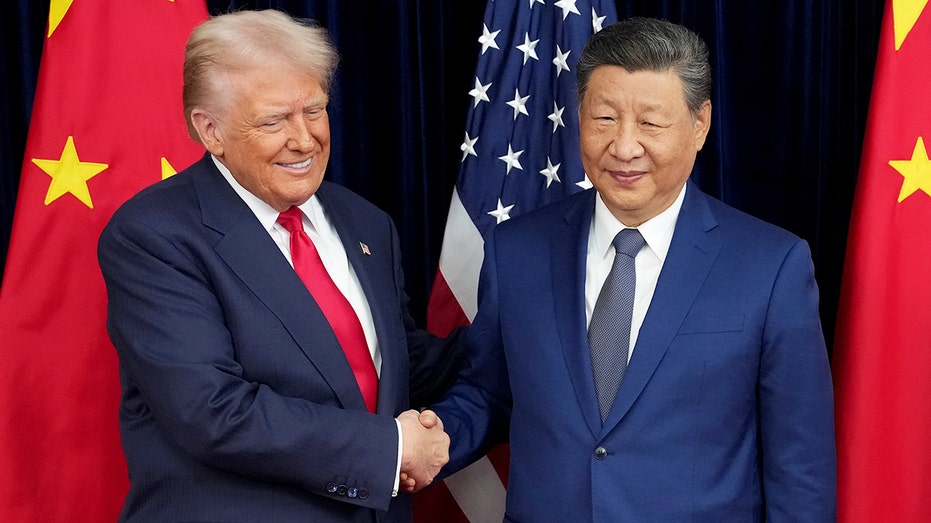
U.S. President Donald Trump greets Chinese President Xi Jinping ahead of a bilateral meeting at Gimhae Air Base on Oct. 30, 2025 in Busan, South Korea. (Andrew Harnik/Getty Images / Getty Images)



























































You must be logged in to post a comment Login