
Business
(VIDEO) Two RAF Pilots Eject With Minor Injuries After Hawk T2 Crashes Near Valley on Anglesey

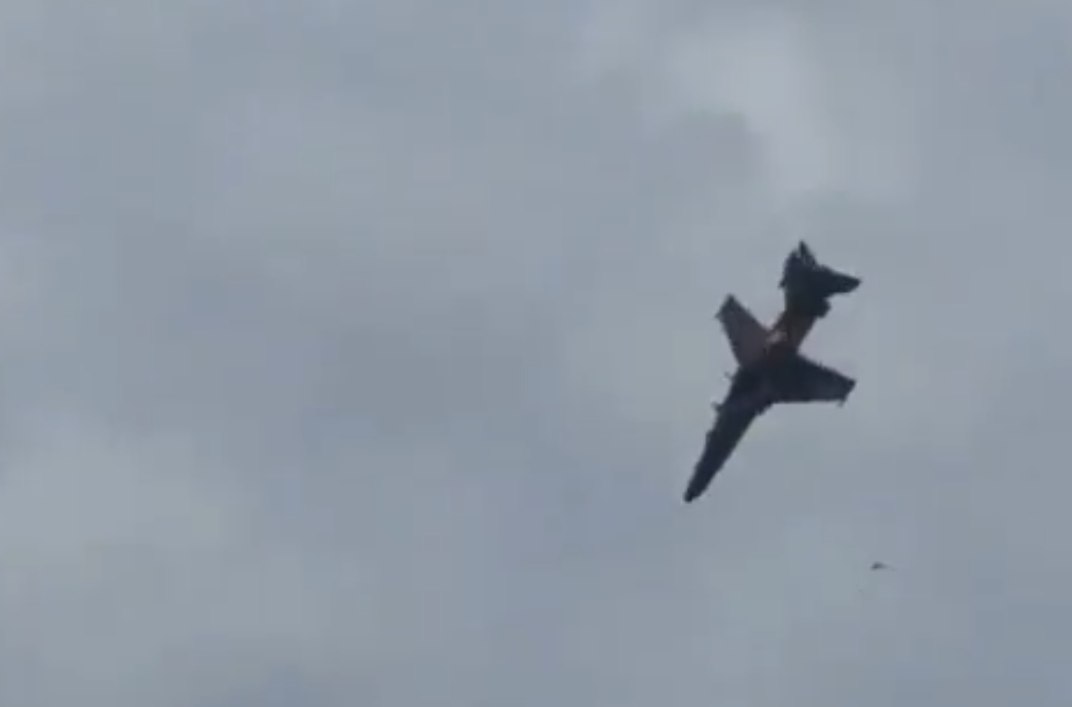
ANGLESEY, Wales — Two Royal Air Force pilots ejected from a Hawk T2 training jet that crashed shortly after takeoff from RAF Valley on Wednesday, police and the air force said.
North Wales Police said the crew of the T2 Hawk were being treated for what were thought to be minor injuries after the aircraft came down in the Pencarnisiog area of Anglesey. The force said there were no reports of wider damage or other injuries and asked the public to stay away. Helicopters from the Coastguard and the Wales Air Ambulance were sent to the scene near the base. BBC Wales reported the pilots were taken to Birmingham for treatment, where two air ambulances later landed at Queen Elizabeth Hospital, home of the Royal Centre for Defence Medicine.
A Royal Air Force spokesperson said: “An incident involving an RAF T2 Hawk aircraft, flying out of RAF Valley, occurred near Anglesey. An investigation is underway and we will not comment further at this time.”
Video circulated on social media, including a clip posted by Breaking911, showed a training jet in trouble after leaving the runway. Eyewitnesses described fire on takeoff, two bangs consistent with ejection seats, and orange parachutes.
Pete Bennett told North Wales Live he watched the aircraft leave the ground. “I knew straight away that it was in trouble – right on take-off there was an orange flame and as it accelerated it was basically on fire,” he said. “As it gained altitude the flame disappeared but it was clearly in trouble. It climbed at an aggressive pitch… It pitched twice violently in the air and then there were two clear loud bangs. The pilots ejected and both parachutes opened.”
In a longer account carried by The Aviationist, Bennett said the jet “rolled to starboard and then slowly descended and crashed maybe a mile, hopefully in a field. There was a huge wall of fire and black smoke. The aircrew came down around half way between the runway and where the plane crashed, which I’m guessing was around a mile inland from RAF Valley.”
A North Wales Police spokesman said: “Local officers are currently in attendance to reports of an incident involving an RAF training aircraft in the Pencarnisiog area of Anglesey, alongside colleagues from the Royal Air Force, North Wales Fire and Rescue Services, Welsh Ambulance Service University Health Trust and Helimed. Two pilots are being treated for what are thought to be minor injuries and at this stage there are no reports of any wider damage or injuries. Please avoid the area until further notice.”
BBC Wales quoted Defence Secretary Wes Streeting on X: “An investigation is under way. My thoughts are first and foremost with the pilots. We will provide further updates in due course.”
RAF Valley, on the west coast of Anglesey, is the home of No. 4 Flying Training School and the Hawk T2 fleet used to train fast-jet pilots before they move to types such as the Typhoon and F-35. The Prince of Wales was based there as a search-and-rescue pilot from 2010 to 2013. The Hawk T2 is a two-seat advanced trainer built by BAE Systems.
Police and the RAF have not named the crew or said whether they were instructors, students or a mixed pair. Liverpool Echo cited The Telegraph as reporting the jet was believed to have been flown by trainee crew. Official statements did not confirm that.
Cause was not announced. Investigators typically examine engines, flight data, maintenance records and the takeoff path. Witnesses described flame on the roll and a violent pitch before ejection. Those observations are not findings.
The wreckage burned in a field. Images showed a smoke column. Aviation outlets said a Jupiter HT1 helicopter from Valley was airborne after the crash, consistent with search-and-rescue practice at the station. Fire crews worked the site. Police kept roads clear.
Hawk T2 ejections are uncommon enough that they trigger a formal inquiry. The seats did what they are designed to do: get two people out before the airframe hit. Police described the injuries as thought to be minor. Transfer to Birmingham puts them at the military medicine center used for service personnel.
RAF Valley sits close to villages and the coast. A crash a mile inland still puts metal and fire near homes. Officers said no one on the ground was reported hurt. That is the first public measure of how the afternoon ended, not a final accident report.
The air force limited its comment to the type, the base and the fact of an investigation. Until that inquiry reports, the public record is a Hawk T2 out of Valley, two parachutes, a field fire, and two pilots under care.

WA is moving to regulate student housing projects through the planning system.

The dollar briefly hit a seven-week high against a basket of currencies before paring gains as oil prices see-sawed.
Crude prices turned lower after Japan’s Kyodo News said Iran offered to reopen the Strait of Hormuz within seven days if the U.S. takes steps toward easing military pressure.
An earlier rise in oil prices, which reflected continuing shipping risks, had lifted the dollar due to the U.S.’s position as a net oil exporter and the currency’s safe-haven role.

Mortgage rates hit highest level since 2024, demand falls
Marion Campbell, Sonic Drive-In’s vice president of integrated marketing and communications, on the fast-food chain’s beverage and fall flavor strategies.
McDonald’s on Wednesday announced new details as part of its long-term growth strategy, which will include a focus on upgrading restaurants and staff training, at an investor day at the corporate headquarters in Chicago.
The fast-food giant announced its NEXT growth and productivity strategy in June and outlined plans to implement changes throughout its system.
McDonald’s said that to speed up the modernization of restaurants, deployment of technology and other operational improvements, it plans to provide about $8.5 billion in NEXT partnering support for franchisees through 2036, with roughly $5 billion provided through 2030.
The NEXT support for franchisees will include a combination of capital support and rent relief.
MCDONALD’S SAYS US SALES SLOWED AFTER VALUE DEAL PUSH FELL SHORT
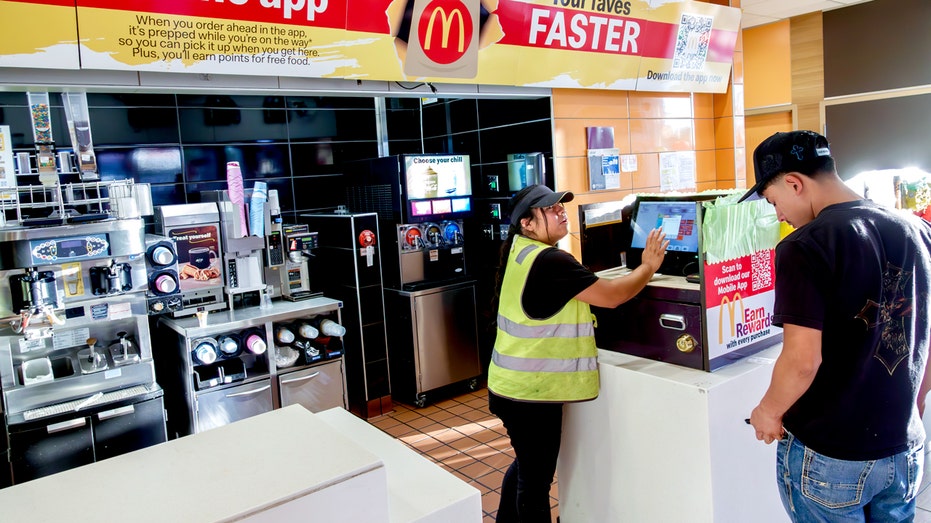
McDonald’s detailed its plans to modernize restaurants and support franchisees. (Jeffrey Greenberg/Universal Images Group via Getty Images)
The support comes with a target of about 250 basis points of gross restaurant-level efficiency improvements amounting to about $100,000 in annual cash flow benefits for the average restaurant, with the company saying the majority of that would benefit the restaurant’s bottom line over time.
McDonald’s announcement noted that the restaurant component of the plan aims to boost growth and productivity through simplified operations, elevated execution, modernized restaurant design and deploying generative AI-enabled ArchIQ at scale.
MCDONALD’S SHAKES UP FALL COFFEE LINEUP AS PUMPKIN SPICE SEASON HEATS UP
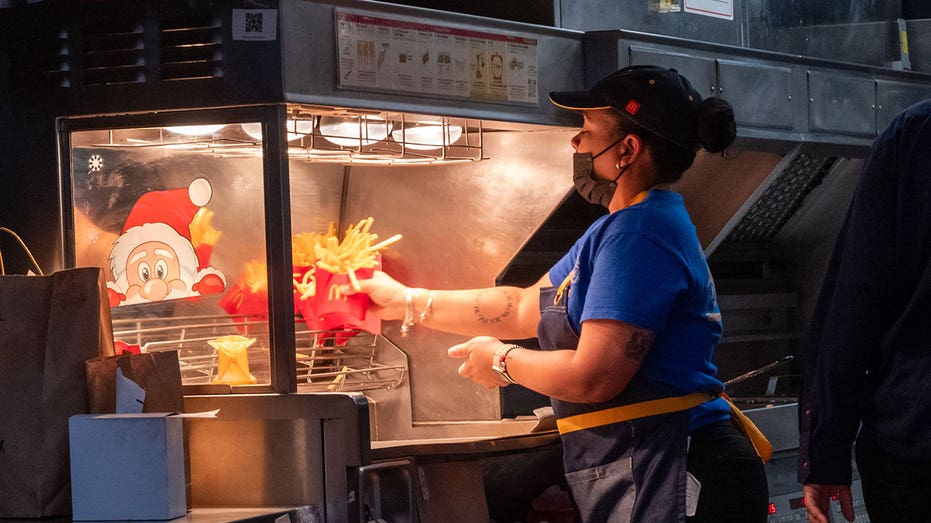
McDonald’s also announced a new customer service initiative to drive repeat visits and improve consistency. (Spencer Platt/Getty Images)
The company also announced a multiyear training program called “Make it Golden” that will begin on Founder’s Day, Oct. 5, which aims to improve customer service to create more consistency for patrons and increase repeat visits.
“McDonald’s has the unmatched scale, customer insights, brand loyalty, and operational capabilities to not only adapt to the next wave of change in our industry, but to turn it into an advantage,” said McDonald’s CEO Chris Kempczinski. “That’s what McDonald’s > NEXT is about: to be the first choice for more customers, more often – while making our restaurants stronger and easier to run.”
MCDONALD’S SERVING UP NEW KIND OF ENERGY BOOST ON MENUS NATIONWIDE
| Ticker | Security | Last | Change | Change % |
|---|---|---|---|---|
| MCD | MCDONALD’S CORP. | 236.78 | -13.59 | -5.43% |
“We are confident that executing across the key components of NEXT will unlock stronger restaurant economics, generate attractive returns for the Company, our franchisees and shareholders, and increase capacity to keep investing in growth,” Kempczinski added.
McDonald’s announcement also included new market share targets, calling for 1.5 percentage points of growth in both chicken and beverages by 2030, while also maintaining the company’s leadership in beef market share.
GET FOX BUSINESS ON THE GO BY CLICKING HERE
Sales growth from unit expansion is also targeted to contribute nearly 2.5% to system-wide sales growth in 2027, moderating to about 2% by 2030.

Trinseo adjourns annual and extraordinary shareholder meetings due to lack of quorum

The UK economy will grow by 1.1 per cent this year, according to new forecasts from the Organisation for Economic Co-operation and Development (OECD), up from the 0.9 per cent it projected in June.
The Paris-based organisation said in its interim outlook, published today, that output had held up better than expected in the face of the US-Iran war. It pointed to “solid domestic demand growth in the second quarter” of the year.
The OECD said household spending could get a further boost from government measures to cut taxes on energy bills and cap bus fares.
The 1.1 per cent estimate is the joint second highest in the G7, behind the United States on 2.2 per cent and level with Germany, which has begun to recover from three years of industrial stagnation.
Slower growth and lower inflation
The OECD expects UK growth to slow to 1 per cent in 2027, down from the 1.1 per cent it forecast in June. When it last published forecasts, the organisation had cut its UK growth projection to below 1 per cent for this year.
It also lowered its inflation projection for this year from an average of 3.7 per cent to 3.1 per cent. For next year it expects inflation of 2.6 per cent, higher than the 2.4 per cent it forecast in the summer.
UK GDP figures and measures of private sector activity and household sentiment have improved in recent months, despite global oil prices rising to between $90 and $100 a barrel since August. Economists have warned that higher oil and gas prices will add to inflation and cost-of-living pressures, and that spending and activity are likely to be squeezed during the winter months.
The OECD said British consumers were among those “dedicating a higher proportion of their spending towards fuel, amid very rapid growth in gasoline and diesel prices since the onset of the conflict”.
Emma Reynolds, chief secretary to the Treasury, said: “Despite unprecedented pressures and conflict in both the Middle East and in Europe, the UK economy is showing strong resilience. We had the fastest growth in the G7 in the first half of the year and we are starting the big, long-term changes needed to create good jobs and growth in every postcode.”
The OECD said it expects no change this year to UK interest rates, which stand at 3.75 per cent.
Last week the Bank of England held Bank Rate at 3.75 per cent and warned it could tighten policy for the first time in three years before the end of 2026, should consumer prices breach 4 per cent. Governor Andrew Bailey said a rate rise was likely if the Iran war went on. Annual inflation is currently running at 3.1 per cent.
The OECD said the picture for the UK and world economy was “heavily dependent on whether a durable resolution to the Middle East conflict is achieved”.
“Energy prices have recently risen again amidst intensified disruptions to production and exports in the Gulf economies. Elevated refining margins due to production bottlenecks are placing additional upward pressure on consumer prices and business costs. Prices for some agricultural commodities have also risen markedly in recent months, partly due to the impact of extreme weather on supply,” the interim report said.
The organisation raised its global growth projection from 2.8 per cent to 2.9 per cent. It said “sizeable oil inventories, additional supply from outside the Gulf economies and discretionary government support measures all helped to cushion the impact on the global economy”.
Its biggest downgrade was to Canada, where projected growth fell from 1.2 per cent to 0.9 per cent after the US imposed new tariffs on its neighbour.
France was also downgraded, to 0.4 per cent, the lowest in the G7. The OECD’s forecast comes as the EU’s second-largest economy faces pressure to reduce its rising budget deficit before presidential elections next year.

“Risks to achieving our inflation target have increased, while risks to the labour market have receded,” Barr said in prepared remarks for a Chicago Fed housing affordability conference.
He noted that US economic growth remains strong and the labour market solid, but inflation is still above the Fed’s 2% goal and not clearly headed lower. “In my base case, further policy adjustments are likely needed to ensure inflation comes down to target in a timely fashion,” he said.
For live updates on US Markets, click here
In a unanimous decision last week, Fed policymakers raised the central bank’s policy rate to a range of 3.75%-4.00%. Sixteen of 18 officials signalled that at least one more hike would likely be needed before year-end, according to a Reuters report.

Barr’s remarks suggest he sees the case for at least two further increases, though he did not specify a timeline.
His willingness to be specific about the rate path stands in contrast to Fed Chairman Kevin Warsh, who has declined to offer any forward guidance on the matter.”In my view, given changes to the economy, we were out of position, and we made an adjustment in the right direction,” Barr added, referring to last week’s quarter-point hike. “We want to support sustainable, durable growth in support of maximum employment, and price stability is crucial to that.”
Barr’s comments on monetary policy were brief, with most of his speech devoted to housing affordability, a problem he said has been compounded by a shortage of supply and elevated mortgage rates. The average rate on a 30-year fixed-rate mortgage in the US rose to 7.12% last week, its highest level in more than two years, the Mortgage Bankers Association said on Wednesday.
(Disclaimer: This article is based on inputs from agencies. These do not represent the views of The Economic Times)

McDonald’s is predicting that flat traffic and higher inflation will continue to weigh on the restaurant industry, CEO Chris Kempczinski said Wednesday.
“One of the things I’ve talked to our team about is we need to stop talking about that being a difficult environment, and just say that is the environment,” Kempczinski said on CNBC’s “Squawk on the Street.” “Because I think, as we look out forward, we’re not expecting things to change.”
For years, Kempczinski has been warning investors and analysts about the “challenging environment” faced by McDonald’s and the broader industry. The burger chain reported U.S. same-store sales growth of just 0.8% in its most recent quarter as traffic to its domestic restaurants fell.
Diners have been eating out less frequently, pushing back against higher menu prices as they face increased costs on everything from gas to groceries. From August 2025 to July 2026, industry operators surveyed by the National Restaurant Association reported a net decline in customer traffic in every month but one.
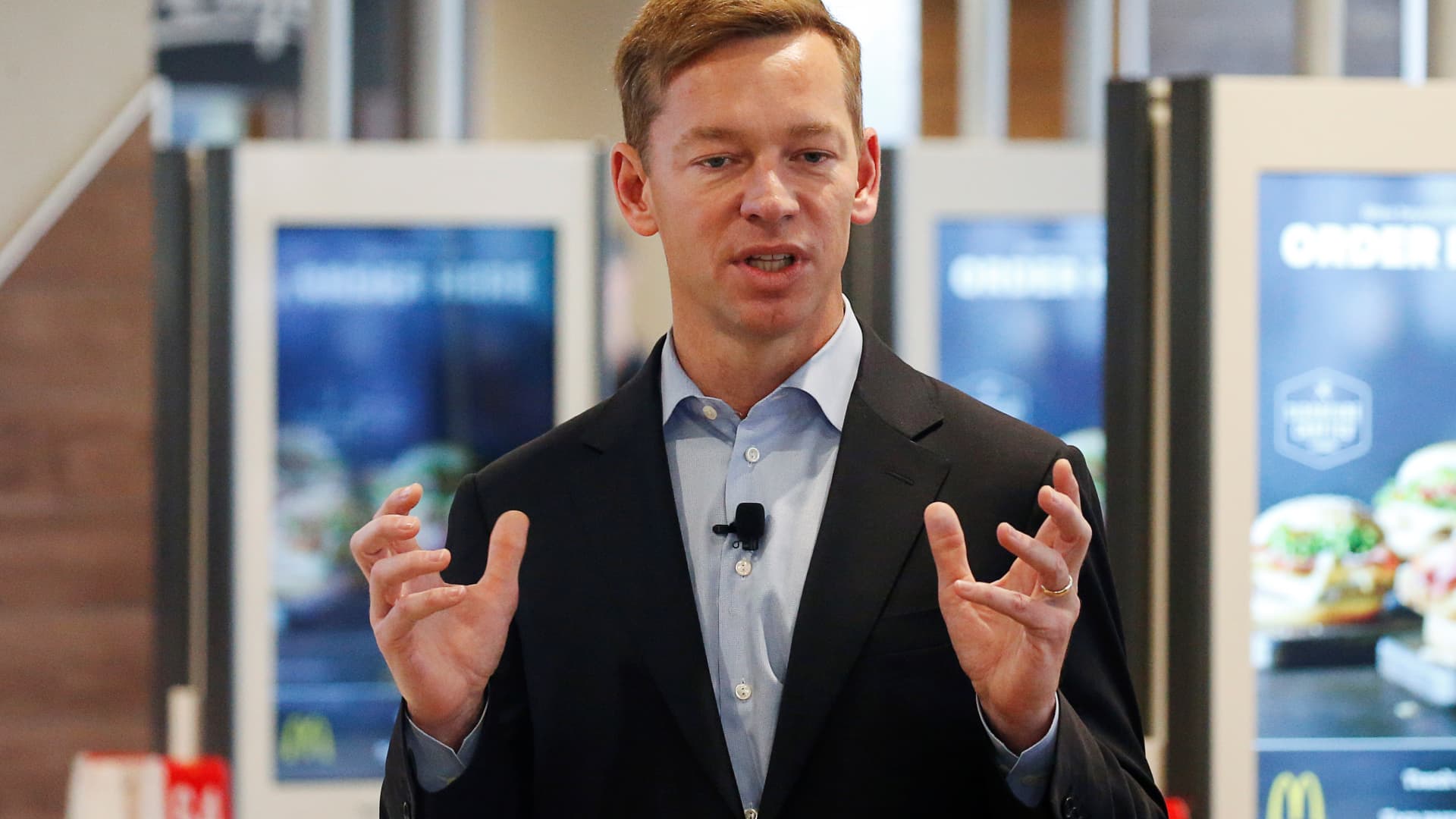
Chris Kempczinski, McDonald’s, speaks during a press conference in New York, November 17, 2016.
Shannon Stapleton | Reuters
To attract customers, McDonald’s and its rivals have leaned into discounts. But diners aren’t the only ones facing higher costs.
Restaurant operators — like McDonald’s and its franchisees — have seen beef prices soar. Kempczinski said that beef costs have nearly doubled over the last five years in the company’s biggest markets. Other expenses, like labor and construction, have also ticked higher, putting more pressure on margins.
“Across the board, we’re seeing that inflation is sticky,” Kempczinski said. “It’s sticky, not just in the U.S., but around the world.”
Faced with tougher operating conditions, McDonald’s is focusing on stealing diners from its rivals.
“The biggest thing that you need to do in an environment like this is you have to be able to earn share,” Kempczinski said. “You have to be able to actually grab growth from your competitors.”
While he said McDonald’s will likely have to consider price increases, he added the chain will have to be careful not to drive diners away. He reiterated that the company believes it erred by raising prices too quickly in the years after the Covid pandemic.
Kempczinski and other McDonald’s executives will share more details about the company’s plans to gain market share during its investor day on Wednesday.

The majority of companies raising equity for the first time are now based outside London, according to research from Beauhurst Insights and the law firm Penningtons Manches Cooper, with the capital’s share of first-time deals falling to 44.6 per cent in the first half of 2026.
London’s share of all first-time equity deals had already dropped to 49.1 per cent in 2025, the researchers said. The last time more first-time fundraisings were completed outside the capital than inside it was in 2022, according to Beauhurst.
Companies using artificial intelligence captured 58.6 per cent of the value of all first-time deals in the six months to June, the study found. That compares with 32.9 per cent in 2025 and 17 per cent in 2024.
The 2,730 start-ups that sold shares for the first time in 2025 raised a total of £4.4bn, an increase of 11.7 per cent, according to the report.
However, 30 per cent more companies secured external capital for the first time, and the researchers said investors had committed less money per company and at lower valuations. Pre-investment valuations fell by 20.3 per cent to £1.5m last year, and the average has since slipped to £1.45m.
The average deal size fell from £2m to £1.7m. The median deal stood at £290,000, a gap the researchers attributed to the effect of several very large first-time fundraisings.
Henry Whorwood, managing director at Beauhurst Insights, said the increased volume of first-time equity raises reversed a long-term decline. He attributed that decline to venture capital firms increasingly needing to support their existing portfolio companies with more capital.
Mr Whorwood said the rise of AI had driven the reversal, with a wave of companies seeking to exploit the technology.
London leads on AI rounds
Although the capital’s overall share has fallen, London completed more AI first rounds than the rest of the UK combined, at 392 against 268, the research found.
London’s 60 per cent share of AI fundraising rounds was 11 percentage points ahead of its share of the market as a whole. The researchers said this reflected the concentration of investors and support services for technology companies in the capital.
Separate Barclays and Beauhurst figures published in July showed that UK equity investment rose to £14.4bn in the first half of 2026, with London accounting for the bulk of the money raised.
Outside London, first-time fundraising in the West Midlands nearly doubled in 2025, according to the report. Northern Ireland recorded a rise of 73 per cent and Scotland 60 per cent. London-based deal volumes rose by 27 per cent.
Largest first-time rounds
The report pointed to several very large first-time fundraisings. Isomorphic Labs, the London-based, Google-backed start-up that uses AI for drug discovery, raised £464m in March 2025.
Edinburgh-based Fidra Energy, which has developed a battery energy storage system, secured £445m from its owner, the US institutional investor EIG, alongside the UK’s National Wealth Fund.
In the first half of this year, the £814m of first-time equity raised by Ineffable Intelligence represented 39 per cent of the value of all first-time deals, according to the research.
The London-headquartered AI company was founded in late 2025 by David Silver, a computer science professor at University College London and a former senior AI specialist at Google’s DeepMind labs in London. The British Business Bank was among the backers of the Ineffable Intelligence round.
Separate Tracxn data published in July found that investors were writing fewer, larger cheques in the first half across UK tech.

Jamie Young
Jamie Young is Senior Reporter at Business Matters, covering SME finance, employment law and Westminster policy since 2016. He has reported on every Budget and Autumn Statement since 2018, helped make sense of the ‘covid era’ and the bounce-back loan scheme from launch through the fraud investigations, and broke the magazine’s coverage of the 2024 late-payment reforms. He joined Business Matters straight from completing his BA in Administration from Exeter University and is NCTJ-qualified. Reach him at jyoung@cbmeg.co.uk

Groupe Beneteau H1 2026 slides: profitability turns as US exit cuts losses

‘Like we did in the Asia Cup’: Pakistan to put India ‘under pressure’ in Asian Games, says Mike Hesson | Cricket News

These popular TP-Link home security cameras could be hacked to spy on you while you sleep, experts warn

What’s The Verity Meme All About And Why Are Kids Saying It?




-

 Fashion5 days ago
Weekend Open Thread: Talbots – Corporette.com
-

 Tech3 days ago
Researchers escape OpenAI Codex sandbox to run commands on host
-

 Crypto World5 days ago
Circle launches Arc Studio AI agent for building onchain apps
-
 NewsBeat5 days ago
Trump says US has reached an agreement to take permanent control of Greenland’s security
-

 Crypto World3 days ago
Who Needs CLARITY Anyway? ARB Could See 70X Increase: Hodler’s Digest
-

 Crypto World5 days ago
Trading Bitcoin on Robinhood? Why 2% Spread Has Traders Worried
-

 Crypto World6 days ago
Mortgage and refinance interest rates today, Thursday, September 17, 2026
-

 Crypto World5 days ago
Bitcoin price breaks channel as RSI climbs to 63
-

 Crypto World7 days ago
US Charges Robinhood Engineers Over Crypto Listing Trades
-

 Crypto World19 hours ago
Goldman Sachs and Deutsche Bank Agree: The S&P 500 Rally Isn't Over
-

 Tech2 days ago
Google’s $899 Googlebook is a bet that you’ll buy a new laptop for Gemini
-

 Business3 days ago
Analog Devices (ADI) Bets $1.35 Billion on Chips that Let Machines Think for Themselves
-

 Crypto World3 days ago
Coinbase, Robinhood, Circle Seen as Tokenized-Stock Winners
-

 Crypto World5 days ago
World Money launches in 150+ countries with Stripe
-

 Crypto World5 days ago
Silver prices recover quickly, hitting weekly high today
-

 Tech6 days ago
GPT-6 Astra Reached the Nether in Minecraft, Lost Its Stash to a Creeper, and Farmed Potatoes for Hours
-

 Tech4 days ago
Trump suggests rebranding AI with a new name, says he’s also creating an AI Force
-
 NewsBeat5 days ago
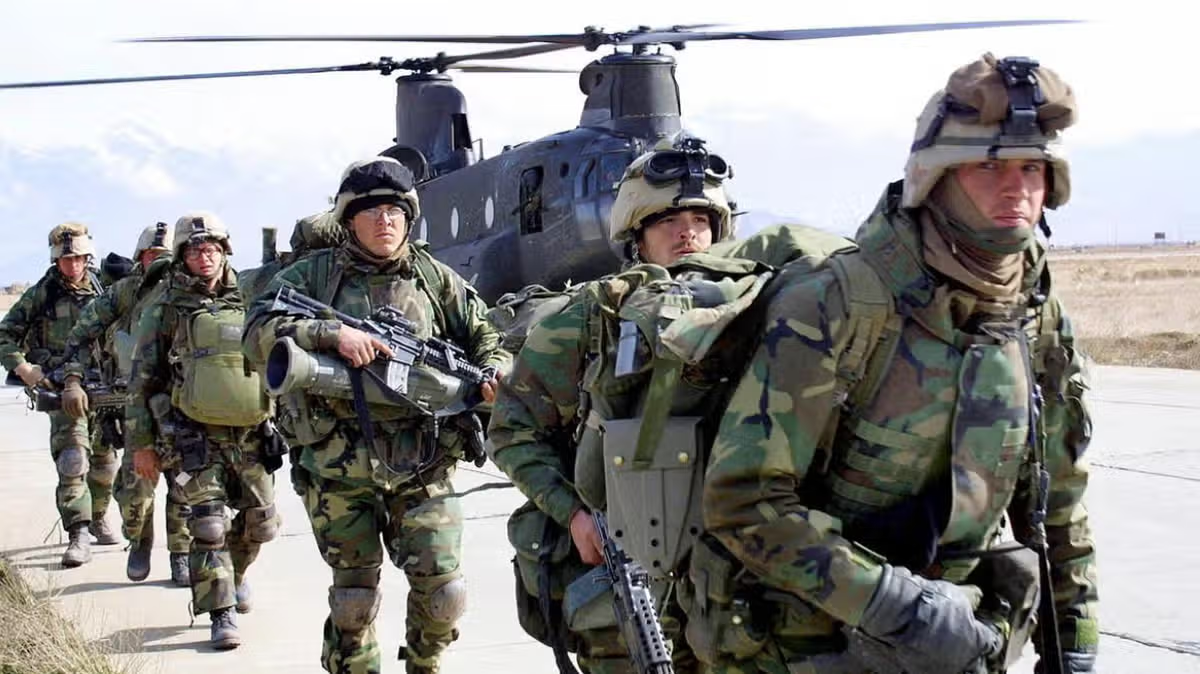
US was ‘on brink of war’ with China over false AI report of nukes moving in Middle East
-

 Entertainment7 days ago
Grey’s Anatomy Showrunner Teases Changes After Cast Exits
-
 Crypto World2 days ago
Bitcoin price holds above $81K as key catalysts line up
You must be logged in to post a comment Login