
Business
Warner Bros weighs reopening sale talks with Paramount, Bloomberg News reports





Corporate profit pre-announcements have shown a “major deterioration” for the last quarter of 2025, a Morgan Stanley analysis shows. The latest economic indicators underscore weak consumer demand as some government stimulus programs are scaled back, according to Nomura Holdings. These factors are fuelling concern the nine-day holiday will fail to deliver its typical boost to earnings as the economic uncertainty continues to erode consumer spending.
“Sentiment on Chinese stocks is going through a weak patch,” said Vey-Sern Ling, managing director at Union Bancaire Privee in Singapore. That’s “partly because investors are unwilling to take risks before the long holidays, and also because of a lack of new catalysts, seemingly heightened regulatory scrutiny recently, and continued intense competition.”
The MSCI China Index has risen just 0.8% this year, while the MSCI All World Index has gained 2.8%. The contrast is starker within Asia: South Korea’s key gauge has surged 31% and Taiwan’s has jumped 16%.
China’s earnings season is already shaping up as a disappointment.

 Bloomberg
 Fourth-quarter pre-announcements from more than 2,000 mainland-listed A-share companies show negative alerts outnumber positive ones by 14.8%, versus a net negative 4.8% in the second quarter, according to Morgan Stanley. Smaller firms fared worst – particularly in real estate and consumer-focused sectors-strategists including Chloe Liu and Laura Wang wrote in a note this month.
Slowing economic growth is a key drag on profits. China’s growth cooled to 4.5% last quarter, from a year earlier, the weakest pace since the country reopened from Covid lockdowns in late 2022. Producer prices fell 1.4% in January from a year ago, extending a deflationary streak that began in late 2022, while purchasing managers’ indexes signaled an unexpected slowdown.“The significant miss in both manufacturing and non-manufacturing PMIs suggests insufficient underlying demand,” Lu Ting, chief China economist at Nomura in Hong Kong, said this month. “Consumption is facing clear headwinds from the scaled-back trade-in stimulus program this year.”
BloombergEconomic data may take a back seat in the coming weeks as the statistics bureau typically combines January and February figures to smooth out distortions caused by the irregular timing of the Lunar New Year holiday. Major policy announcements are also unlikely before the National People’s Congress in March.
Increased regulatory intervention is adding to market caution. Authorities last month tightened margin financing rules in an effort to curb speculative trading and reduce the risk of future boom-and-bust cycles.
Diverging Growth
At the same time, earnings are diverging sharply across industries, complicating stock selection.
Metal miners are benefiting from surging prices, while companies in the artificial intelligence supply chain and firms supported by the government’s campaigns to rein in a price war are also gaining favor, according to a report from China Merchants Securities Co.
Miner CMOC Group Ltd. said last month its preliminary net income jumped about 50% for the full year, while software maker Iflytek Co. reported a gain of between 40% and 70% for the same period. In contrast, shares of electric-vehicle makers BYD Co. and Great Wall Motor Co. both slumped following lackluster January sales numbers.
Overall A-share earnings are expected to have grown about 6.5% year-on-year for 2025, compared with a drop of 3% for 2024, according to China International Capital Corp. China Merchants Securities also predicts single-digit growth.
The profit increase is “largely attributable to policy support and cyclical factors, rather than signaling a fundamental or structural shift in market conditions,” said Shen Meng, a director at Beijing-based investment bank Chanson & Co.

RUCHIT JAIN
VICE PRESIDENT, MOTILAL OSWAL FINANCIAL SERVICES
Where is Nifty headed this week?
The pullback move last week witnessed selling pressure around the psychological mark of 26,000, making it a key short-term resistance zone. Nifty has ended below its 20-DEMA of 25,630.1, led primarily by weakness in IT stocks. Market breadth has also deteriorated in the last couple of sessions, indicating selling in broader markets as well. Technically, this indicates a rangebound-to-negative bias trend for Nifty in the immediate term. Strong support is placed in the range of 25,200–25,100, while resistance remains firm at 26,000.
Trading Strategies: As Nifty has already seen a correction from resistance and is still away from its support, the risk-reward for directional positions appears unfavourable. Traders may consider adopting a wait-and-watch approach. Any dip towards the 25,200–25,100 support band could offer opportunities for contra trades, as the risk-reward dynamics would turn more attractive near those levels.
AgenciesTOP STOCK PICKs
Bajaj Finance: BUY CMP Rs 1,030 | Stop loss: Rs 980 | Target Rs 1,120
The Bajaj Finance stock has resumed its positive trend post the recent corrective phase.
Torrent Pharma: BUY | CMP Rs 4,070 | Stop loss: Rs 3,980 | target: Rs 4,250
The stock has been an outperformer within the pharma sector, and is on the verge of a consolidation breakout.
TANMAY SHAH
RESEARCH HEAD, SIHL
Where is Nifty headed this week?
Technical indicators point to emerging downside pressure, suggesting that the recent rally lacks strong follow-through buying. At present, the index is finding support near its 20-day simple moving average (SMA) around 25,468, which is acting as an immediate cushion. On the shortterm timeframe, momentum oscillators indicate an oversold condition, raising the possibility of a technical bounce towards the 25,700 zone in the coming sessions. On the downside, the 200- day moving average at 25,292 represents a critical medium-term support. A decisive close below this level could weaken sentiment further and open the door for a decline towards the 25,100 area, where a previous gap is placed.
Trading Strategy: For the February 24 Nifty weekly expiry, traders may consider deploying an Iron Condor strategy in line with the current rangebound market conditions. This would involve selling 24,800 Put and buying 24,600 Put, along with selling 26,050 Call and buying 26,250 Call, to maintain a defined risk profile. The strategy is aimed at benefiting from time decay and is best suited if Nifty continues to trade within the 24,800–26,050 band until expiry.
TOP STOCK PICKS
Tata Motors Passenger Vehicles: BUY | CMP: Rs 380 | Stop loss Rs 369 | Target: Rs 395–399
After an extended correction, the stock is now trading above its key moving averages, and is showing relative strength. In this setup, a buy can be considered with an upside target of Rs 395–399, keeping a closing stop loss at Rs 369.
Dr. Reddy’s Laboratories: BUY | CMP: Rs 1,268 | Stop loss: Rs 1,244 | Target: Rs 1,295–1,320.
Stock is trading comfortably above its 200-day SMA and is nearing a breakout from its channel formation, supported by healthy volumes. Given this constructive setup, one may initiate long positions, with targets at Rs 1,295 and Rs 1,320, while keeping a closing stop loss at Rs 1,244.
SUDEEP SHAH
HEAD – TECHNICAL AND DERIVATIVES RESEARCH, SBI SECURITIES
Where is Nifty headed this week?
Nifty enters the week on a weak footing after failing to sustain above the 26,000 mark and witnessing sharp profit booking near 26,009. The 550-point decline in the final two sessions signals clear supply at higher levels. Technically, the structure has deteriorated, as the index has slipped below its 20-day, 50-day and 100-day EMAs, with the shorter averages now sloping downward—a bearish shift in trend bias. Momentum also remains subdued, with the daily RSI slipping below its short-term average and failing to reclaim the 60 zone during the recent pullback. The pattern suggests a lower-high formation in the near term, indicating rallies may face resistance. Immediate support is placed at 25,350–25,300. A decisive break below 25,300 could extend the correction towards 25,100 and possibly 24,900. On the upside, the 25,700–25,750 zone remains a strong resistance band. Unless this hurdle is convincingly crossed, the broader bias stays cautious to negative for the week.
Trading Strategies: Amid a cautious outlook, traders should refrain from over-leveraged bets, while investors should favour a buy-on-decline approach in quality names with strong technical setups. We expect the Nifty to consolidate between 25,100 and 25,800, while Bank Nifty may consolidate between 59,600 and 60,800 levels.
TOP STOCK PICKS
L&T: BUY CMP: Rs 4,173 | Stop loss: Rs 4,030 | Target: Rs 4,380–4,430
The stock continues to trade near its 52-week high, with the price remaining above key long-term moving averages (50 and 200 DMA), signalling structural strength in the broader trend. Short-term technical structure is also in sync with long-term charts and is displaying superior relative strength.
Pricol: BUY CMP: Rs 633 | Stop loss: Rs 608 | Target: Rs 665–690.
Chart shows bullish positioning, with most moving averages—across short, medium and long periods— sloping upward and price trading above them, indicating an underlying uptrend.


UK labour reforms to cut hiring by one in three employers, survey shows


UK property asking prices hold steady after post-budget jump, Rightmove says

That fear is breathing new life into the market for credit derivatives, where banks, investors and others can protect themselves against borrowers larding on too much debt and becoming less able to pay their obligations. Credit derivatives tied to single companies didn’t exist on many high-grade Big Tech issuers a year ago, and are now some of the most actively traded US contracts in the market outside of financial sector, according to Depository Trust & Clearing Corp.
While contracts on Oracle have been active for months, in recent weeks, trading on Meta Platforms and Alphabet has become much more active. Contracts tied to about $895 million of Alphabet debt are outstanding, after netting out opposite trades, while around $687 million is tied to Meta debt. With AI investments expected to cost more than $3 trillion, much of which will be funded with debt, hedging demand can only grow, according to investors. Some of the richest tech companies are rapidly turning into some of the most indebted.
“This hyperscaler thing is just so ginormous and there’s so much more to come that it really begs the question of ‘do you want to really be nakedly exposed?’,” said Gregory Peters, co-chief investment officer at PGIM Fixed Income. Credit derivatives indexes, which offer broad default protection against a group of index members, aren’t enough, he said.
BloombergSix dealers quoted Alphabet CDS at the end of 2025 compared with one last July, while the number of Amazon.com Inc. CDS dealers rose to five, from three, DTCC data show.
Some providers even offer baskets of hyperscalers’ CDS, mirroring baskets of cash bonds that are rapidly being developed. Activity among hyperscalers really picked up in the fall when news around the debt requirements of these companies became front and center. A Wall Street dealer said his trading desk is able to regularly quote markets of $20 million to $50 million for a lot of these names, which didn’t even trade a year ago.
For now, hyperscalers are having little trouble financing their plans in the debt market. Alphabet’s $32 billion debt sale in three currencies this week drew orders for many times more that amount within 24 hours. The technology company successfully sold 100-year bonds, an astonishing move in an industry where businesses can rapidly become obsolete.Morgan Stanley expects borrowing by the massive tech companies known as hyperscalers to reach $400 billion this year, up from $165 billion in 2025. Alphabet said its capital expenditures will reach as much as $185 billion this year to finance its AI build-out. That kind of exuberance is what has some investors worried. London hedge fund Altana Wealth last year bought protection against Oracle defaulting on its debt. The cost was about 50 basis points a year for five years, or $5000 a year to protect $1 million of exposure. The cost has since risen to around 160 basis points.
BANK USERS
Banks that underwrite hyperscaler debt have been significant buyers of single-name CDS lately. Deals to develop data centers or other projects are so big and happening so fast underwriters are often looking to hedge their own balance sheets until they can distribute all of the loans tied to them.
“Expected distribution periods of three months could grow to nine to 12 months,” said Matt McQueen, head of credit, securitized products and muni banking at Bank of America Corp., referring to loans on projects. “As a result, you’re likely to see banks hedge some of that distribution risk in the CDS market.”
Wall Street dealers are rushing to meet the demand for protection.
“Appetite for newer basket hedges can be expected to grow,” said Paul Mutter, formerly the head of US fixed income and global head of fixed income sales at Toronto-Dominion Bank. “More active trading of private credit will create additional demand for targeted hedges.”
Some hedge funds see banks’ and investors’ demand for protection as an opportunity to profit. Andrew Weinberg, a portfolio manager at Saba Capital Management, described many CDS buyers as “captive flow” clients — bank lending desks or credit valuation adjustments teams for example.
Leverage remains low at most of the big tech companies, while bond spreads are only slightly tighter than the corporate index average, which is why so many hedge funds, including his, are willing to sell protection, according to Weinberg.
“If there’s a tail risk scenario, where will these credits go? In a lot of scenarios, the big companies with strong balance sheets and trillion dollar market caps will outperform the general credit backdrop,” he said.
But for some traders, the frenzy of bond selling has all the hallmarks of complacency and mispriced risk.
“The sheer amount of potential debt suggests that these companies’ credit risk profiles could come under some pressure,” said Rory Sandilands, a portfolio manager at Aegon Ltd., who says he has more CDS trades on his book than a year ago.

Edited excerpts from a chat:
How does the Groww BSE Hospitals ETF differentiate itself from existing healthcare or pharma-focused passive products, and what specific gap in investor portfolios are you aiming to address through a pure-play hospitals strategy?
Today, pharma-focused passive funds are heavy on the listed pharmaceutical companies, as they should be; even the healthcare-focused products in India are only able to provide exposure to a broad mix of healthcare companies, including pharma, hospitals, and others. The Groww BSE Hospitals ETF, in contrast, offers targeted exposure to the hospitals segment, which accounts for nearly three-fourths of India’s healthcare industry. An important point to note is that pharma companies often have substantial global exposure and can be influenced by external factors, while hospitals are largely domestic businesses and therefore more closely aligned with India’s structural healthcare demand trends.
By focusing on hospital service providers, this ETF seeks to address a portfolio gap for investors looking for a pure-play opportunity in healthcare delivery, one of the fastest-growing and rapidly transforming segments in the healthcare ecosystem.
Given that hospitals account for nearly three-fourths of India’s healthcare market and are seeing improving financial metrics, what gives you confidence that this structural growth story can sustain over the next market cycle?
While healthcare as a whole benefits from structural tailwinds, the hospital segment has distinct drivers that reinforce its long-term growth trajectory. Rising health insurance penetration, increasing affordability, higher incidence of lifestyle diseases, medical tourism, and a gradually ageing population are all expanding the market for organised hospital players.
At the same time, the sector is witnessing sustained capacity expansion through rising capex, alongside improving occupancy levels and operating efficiencies. Given the long gestation periods and high entry barriers, established players are well-positioned to benefit from this incremental demand. India today has relatively low beds-per-capita and doctor density levels compared to global counterparts, which indicate significant headroom for potential expansion in the coming years.
With gold and silver seeing renewed investor interest amid global uncertainties, are you noticing a meaningful shift in retail asset allocation away from equities, or is this more of a tactical diversification trend?
Indians have traditionally allocated to precious metals, so the recent rise in flows to gold and silver ETFs should not be viewed as a shift away from equities. Rather, it reflects the ongoing financialisation of savings, where exposure that may earlier have been taken through physical gold or silver is now moving into regulated financial instruments.
We view this as a structural evolution in how allocations are expressed, rather than a short-term tactical shift driven purely by market uncertainty.
January saw gold ETFs getting more inflows than total equity inflows. Is this a sign of euphoria building in the market for bullion?
It’s not unusual to see flows into an asset class pick up during periods of strong performance. However, describing this as euphoria may be overstating the case. While some portion of flows could be momentum-driven, gold ETF inflows were rising even before the recent rally.
The category’s AUM has grown over 13 times between March 2019 and March 2025, indicating that the trend is structural and long-term in nature, rather than purely sentiment-driven.
How should investors think about allocating between equities and precious metals at this juncture, especially given elevated valuations in certain equity pockets and strong momentum in gold and silver?
We believe that asset allocation decisions should be guided by long-term strategic frameworks rather than short-term valuation or momentum signals, and that both equities and precious metals should be a part of a diversified portfolio. Equities remain central to wealth creation over time, while precious metals can provide diversification benefits, particularly during periods of uncertainty.
While equities typically form a larger allocation given their link to long-term economic growth, the exact mix should reflect an investor’s risk tolerance, time horizon and financial goals.
For someone investing in a gold ETF, for example, how should one decide which is the best product to buy? Many investors look at returns and expense ratios. What are the parameters one should look at before selecting an ETF from a particular fund house?
While returns and expense ratios are important, investors should also closely evaluate tracking error, which reflects how efficiently the ETF mirrors underlying gold prices. Lower tracking error indicates better replication, while higher tracking error may imply greater deviation from the underlying gold prices, leading to inconsistent performance relative to the commodity it seeks to track.
In addition, liquidity, in the form of trading volumes and bid–ask spreads, is also a parameter to consider before selecting an ETF.
Many investors also get confused between gold ETFs and gold mutual funds. For someone who already has a demat account and is looking to invest for the long term, does it make more sense to buy an ETF rather than an MF?
Both Gold ETFs and Gold Mutual Funds serve a similar purpose, providing exposure to gold in a regulated, financial format and over the long run, the difference in returns is likely to be marginal. The choice need not materially alter long-term outcomes.
The key distinction lies in structure and convenience: Gold ETFs require a demat account and are traded on the exchange like stocks, while Gold Mutual Funds can be bought and redeemed directly with the AMC without a demat, offering greater ease of access for certain investors.

Non-banking finance companies (NBFC) can now factor in DLGs when setting aside buffers for potential loan losses, provided the guarantee forms an integral part of the loan arrangement, the RBI said last week. The regulator also said lenders must update their loss estimates each time the guarantee is invoked, as the protection available reduces with every use.
For NBFCs, this change reduces provisioning pressure, improves profitability, and frees up balance-sheet capacity for fresh lending. For fintechs, meanwhile, it would encourage greater loan origination. The revised framework takes effect immediately.
“This is a significant relief for NBFCs like us that are engaged in digital lending partnerships with Fintech Lending Service Providers (LSPs),” said Ravi Narayanan, MD & CEO, SMFG India Credit. “This regulatory clarity will support the industry in safely scaling digital lending, enabling NBFC-fintech partnerships to expand access to under-penetrated retail customer segments,” he added.
The move marks a reversal from the central bank’s May 2025 directive. Back then, the regulator had instructed NBFCs to exclude DLGs offered by fintech lending service providers when calculating the loss buffers required for stressed or risky loans. The earlier stance, mandatory from March 31, 2025, had led lenders to build full provisions on these portfolios, raising credit costs and dampening the appeal of fintech-originated loans.
The Provisioning Poser
The earlier rules had forced several NBFCs to take sizable additional provisions in the March quarter, ET had reported on May 27 last year. SMFG India Credit reported a 44% fall in FY25 profit after booking Rs 115 crore in extra DLG-related buffers, while Credit Saison India’s profit dropped 22% following ₹178 crore in additional provisioning.Northern Arc Capital also reported an impact of ₹80 crore and had provided ₹63 crore on its books as of March 31, 2025. The RBI had mandated NBFCs to make provisions across the March, June and September quarters of 2025.
“This amendment shall result in reversal of additional provisions carried thus far by the entities and free up the capital. This will be favourable for lending partners in such loan arrangements and support overall credit expansion. It is also timely considering that the revised co-lending guidelines are effective from January this year,” said AM Karthik, co-group head, financial services, Icra Ratings.
DLGs – usually capped at 5% and often backed by fixed deposits provided by digital lending partners – had been widely used in digital lending and co-lending structures. The 2025 rules had effectively neutralised their benefit, leading to a pullback in origination volumes for fintechs and higher credit costs for NBFCs.
With the latest amendment, the RBI aims to harmonise the treatment of DLGs across digital lending, co-lending and credit-risk transfer guidelines, while ensuring lenders do not overstate the protection offered by such guarantees.


Australia’s Qube agrees to $8.3 billion buyout offer from Macquarie-consortium

Verizon CEO Hans Vestberg unpacks how tariffs will impact the business on ‘The Claman Countdown.’
Verizon has added on a step for customers wanting to unlock their fully paid-off devices by introducing a new waiting period in certain cases.
Under Verizon’s current device-unlocking policy, customers who pay off their payment agreement balance online or in the My Verizon app have to wait 35 days before their phone will be unlocked.
The same delay applies if a Verizon Gift Card is used to buy a smartphone or customers pay off the remaining balance.
The delay also applies to postpaid customers who pay off a device installment plan online or in the app.
NEW IPHONE SCAM TRICKS OWNERS INTO GIVING PHONES AWAY

Verizon’s new unlock policy creates 35-day delays for paid-off devices. (iStock / iStock)
Customers who complete their installment agreements with scheduled monthly payments will continue to have their devices unlocked automatically after the final payment, according to the policy.
Customers may be able to avoid the 35-day delay by paying off the remaining balance in person, but only at a Verizon corporate store using what the company describes as a secure payment method.
These include cash, an EMV chip-enabled credit card or a contactless option like Apple Pay or Google Pay.
Payments made online, in the app, by phone, at authorized retailers or through other non-secure methods may also trigger the 35-day waiting period.
HAGERTY ASKS FCC TO SANCTION VERIZON OVER DISCLOSURE OF SENATE PHONE DATA

Verizon customers can avoid 35-day device unlock delays by paying off phones in-store with cash, chip cards, or contactless payments like Apple Pay instead of online methods. (Photo Illustration by Igor Golovniov/SOPA Images/LightRocket via Getty Images / Getty Images)
A Verizon spokesperson said customers who meet the requirements for a faster unlock will usually receive it within 24 hours and added that the 35-day window is to allow time for fraud prevention, according to Ars Technica.
The policy change came after the Federal Communications Commission (FCC) eliminated Verizon’s longstanding requirement to automatically unlock devices 60 days after activation.
The change, for example, would limit customers’ ability to quickly unlock a phone before international travel to use a local SIM card abroad.
NEW IPHONE SCAM TRICKS OWNERS INTO GIVING PHONES AWAY

Prepaid devices bought from Verizon stay locked for 365 days of paid, active service. (Kena Betancur/VIEWpress / Getty Images)
It could also make it complicated for customers hoping to sell a paid-off device immediately or switch carriers without interruption and find corporate stores.
GET FOX BUSINESS ON THE GO BY CLICKING HERE
For prepaid customers, devices bought from Verizon stay locked for 365 days of paid, active service.
After that period, Verizon says it will automatically remove the lock, unless the device has been reported stolen or flagged for fraud.
FOX Business has reached out to Verizon for comment.

Baron is an asset management firm focused on delivering growth equity investment solutions. Founded in 1982, Baron has become known for its long-term, fundamental, active approach to growth investing. Baron was founded as an equity research firm, and research has remained at the core of its business. Note: This account is not managed or monitored by Baron Capital, and any messages sent via Seeking Alpha will not receive a response. For inquiries or communication, please use Baron Capital’s official channels.

Tributes paid to nurse killed in crash on way to work
Global Markets | China’s stock bull run falters with earnings set to underwhelm

Jack Black and Paul Rudd’s $133 Million Blockbuster Is Dominating Streaming


-

 Sports4 days ago
Big Tech enters cricket ecosystem as ICC partners Google ahead of T20 WC | T20 World Cup 2026
-

 NewsBeat6 days ago
Mia Brookes misses out on Winter Olympics medal in snowboard big air
-

 Tech5 days ago
SpaceX’s mighty Starship rocket enters final testing for 12th flight
-

 Sports7 days ago
Benjamin Karl strips clothes celebrating snowboard gold medal at Olympics
-

 Tech22 hours ago
Luxman Enters Its Second Century with the D-100 SACD Player and L-100 Integrated Amplifier
-

 Video3 days ago
The Final Warning: XRP Is Entering The Chaos Zone
-
![Heathrow has said passenger numbers were 60% lower in November than before the coronavirus pandemic and there were “high cancellations” among business travellers concerned about being trapped overseas for Christmas as Omicron spreads. The UK’s largest airport said the government’s travel restrictions had dealt a fresh blow to travel confidence and predicted it was likely to take several years for passenger numbers to return to pre-pandemic levels. This week ministers said passengers arriving in the UK would have to take a pre-departure Covid test, as well as a post-flight test, because of fears about the spread of the new variant. “[The] high level of cancellations by business travellers concerned about being trapped overseas because of pre-departure testing shows the potential harm to the economy of travel restrictions,” the airport said in an update. Heathrow said the drop in traveller confidence owing to the new travel restrictions had negated the benefit of reopening the all-important corridor to North America for business and holiday travel last month. Eleven African countries have been added to the government’s red list, requiring travellers to quarantine before reuniting with families. “By allowing Brits to isolate at home, ministers can make sure they are reunited with their loved ones this Christmas,” said John Holland-Kaye, the chief executive of Heathrow. “It would send a strong signal that restrictions on travel will be removed as soon as safely possible to give passengers the confidence to book for 2022, opening up thousands of new jobs for local people at Heathrow. Let’s reunite families for Christmas.” Heathrow said that if the government could safely signal that restrictions would be lifted soon, then employers at Heathrow would have the confidence to hire thousands of staff in anticipation of a boost in business next summer. The airport is expecting a slow start to 2022, finishing next year with about 45 million passengers – just over half of pre-pandemic levels. This week Tui, Europe’s largest package holiday operator, said it expected bookings for next summer to bounce back to 2019 levels. However, Heathrow said on Friday not to expect the aviation industry to recover for several years. “We do not expect that international travel will recover to 2019 levels until at least all travel restrictions (including testing) are removed from all the markets that we serve, at both ends of the route, and there is no risk of new restrictions, such as quarantine, being imposed,” the airport said.](https://wordupnews.com/wp-content/uploads/2026/02/shutterstock_1100012546-scaled-400x240.jpg)
![Heathrow has said passenger numbers were 60% lower in November than before the coronavirus pandemic and there were “high cancellations” among business travellers concerned about being trapped overseas for Christmas as Omicron spreads. The UK’s largest airport said the government’s travel restrictions had dealt a fresh blow to travel confidence and predicted it was likely to take several years for passenger numbers to return to pre-pandemic levels. This week ministers said passengers arriving in the UK would have to take a pre-departure Covid test, as well as a post-flight test, because of fears about the spread of the new variant. “[The] high level of cancellations by business travellers concerned about being trapped overseas because of pre-departure testing shows the potential harm to the economy of travel restrictions,” the airport said in an update. Heathrow said the drop in traveller confidence owing to the new travel restrictions had negated the benefit of reopening the all-important corridor to North America for business and holiday travel last month. Eleven African countries have been added to the government’s red list, requiring travellers to quarantine before reuniting with families. “By allowing Brits to isolate at home, ministers can make sure they are reunited with their loved ones this Christmas,” said John Holland-Kaye, the chief executive of Heathrow. “It would send a strong signal that restrictions on travel will be removed as soon as safely possible to give passengers the confidence to book for 2022, opening up thousands of new jobs for local people at Heathrow. Let’s reunite families for Christmas.” Heathrow said that if the government could safely signal that restrictions would be lifted soon, then employers at Heathrow would have the confidence to hire thousands of staff in anticipation of a boost in business next summer. The airport is expecting a slow start to 2022, finishing next year with about 45 million passengers – just over half of pre-pandemic levels. This week Tui, Europe’s largest package holiday operator, said it expected bookings for next summer to bounce back to 2019 levels. However, Heathrow said on Friday not to expect the aviation industry to recover for several years. “We do not expect that international travel will recover to 2019 levels until at least all travel restrictions (including testing) are removed from all the markets that we serve, at both ends of the route, and there is no risk of new restrictions, such as quarantine, being imposed,” the airport said.](https://wordupnews.com/wp-content/uploads/2026/02/shutterstock_1100012546-scaled-80x80.jpg) Business7 days ago
Business7 days agoWeight-loss jabs threaten Greggs’ growth, analysts warn
-
 NewsBeat7 days ago
Residents say city high street with ‘boarded up’ shops ‘could be better’
-

 Crypto World2 days ago
Bhutan’s Bitcoin sales enter third straight week with $6.7M BTC offload
-
 Crypto World4 days ago
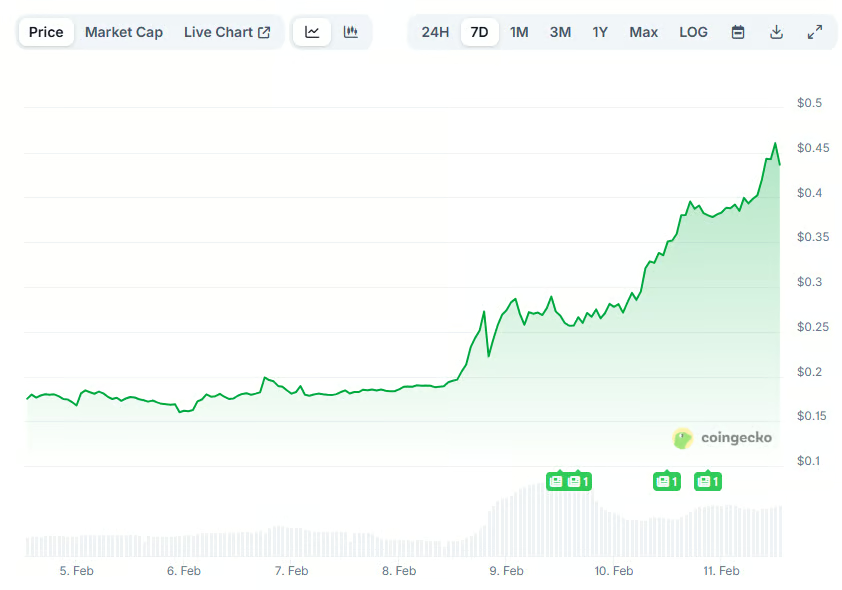
Pippin (PIPPIN) Enters Crypto’s Top 100 Club After Soaring 30% in a Day: More Room for Growth?
-
 Crypto World6 days ago
U.S. BTC ETFs register back-to-back inflows for first time in a month
-

 Video4 days ago
Prepare: We Are Entering Phase 3 Of The Investing Cycle
-

 Crypto World5 days ago
Blockchain.com wins UK registration nearly four years after abandoning FCA process
-
Sports6 days ago
Kirk Cousins Officially Enters the Vikings’ Offseason Puzzle
-
 Crypto World6 days ago
Ethereum Enters Capitulation Zone as MVRV Turns Negative: Bottom Near?
-
 NewsBeat8 hours ago
The strange Cambridgeshire cemetery that forbade church rectors from entering
-

 Crypto World5 days ago
Crypto Speculation Era Ending As Institutions Enter Market
-

 Business4 days ago
Barbeques Galore Enters Voluntary Administration
-
 Crypto World3 days ago
Ethereum Price Struggles Below $2,000 Despite Entering Buy Zone
-

 Politics5 days ago
Why was a dog-humping paedo treated like a saint?