When HOLT Architects began reimagining Lavery Library at St. John Fisher University, the assignment was not to refresh a dated academic building. It was to redefine what that building meant to campus life.
Constructed in 1975, the Lavery Library represents the characteristics of that period. As it was mostly concrete and constructed to keep the books stored (and not experience the students) there was an inward look at how the building was constructed which led it to having an internal nickname as a “book fort.” Students would enter the building to get their books and leave; The services were during their stay and spread throughout the building and days. Very little natural light was allowed inside. No circulation was promoted between the major campus areas.
The next 50 years of leadership from the university asked a completely different question: What type of project will allow the students to have the support to perform at their highest level? From this question we were able to change the idea of working on the library to the creation of a Student Success Center and demonstrate access to the services; visibility for all incoming students; the inclusion of all students.
Repositioning a Campus Landmark
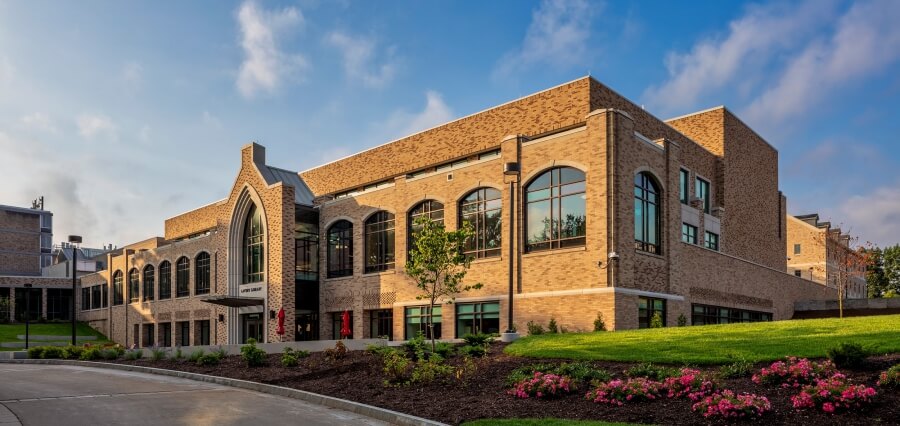
The renovation of Lavery transforms the structure’s role in relation to the campus fabric as it now connects key areas of campus rather than serve as a barrier. HOLT Architects incorporated two primary entrances: one facing LeChase Commons and an elevated entrance facing the South Quad to work as throughways rather than dead ends.
The new universally accessible exterior route replaces previously risky 20-foot staircases with a direct link between Upper Quad and Commons, creating a fully accessible connection for the first-time creating dignified, equitable access to the entire property.
Internally, the renovation optimises vertical circulation through a strong social staircase with an intuitive orientation throughout the building, creating continuous movement throughout the various levels. Rather than appearing as a series of disconnected spaces, the renovation creates an open, clear connection to what a student will see on their way to what they want.
Adaptive Reuse as Strategy, Not Compromise
Rather than demolish the 1975 structure, HOLT embraced adaptive reuse. The building’s robust concrete frame was preserved, conserving significant embodied carbon and minimizing construction waste. The decision reflects a growing recognition within higher education design: sustainability is often most effective when it begins with what already exists.
Preserving the structure required strategic intervention. Mechanical chases that once occupied the perimeter walls were relocated inward, freeing the building’s edges for glazing and daylight. High-performance envelope upgrades and new glazing systems enhance energy efficiency while transforming the interior experience.
This approach allowed the design team to respect the building’s permanence while redefining its purpose. The heavy concrete frame remains, but its character has shifted. Transparency replaces opacity. Light replaces enclosure. The architecture acknowledges its past without being constrained by it.
The project serves as an example of how to incorporate modern solutions and designs with existing historical elements through adaptive reuse. This project shows that preservation and innovation can co-exist, and adaptive reuse can now be seen as an innovative approach instead of just looking back at the past.
From Repository to Academic Hub
The most visible transformation is programmatic. Lavery no longer functions primarily as a repository for books. Through the consolidation and right-sizing of collections, prime perimeter zones were freed for student use. Seating increased by approximately 20 percent without expanding the building’s footprint.
That increase is not simply quantitative. The renovation diversifies how students can inhabit the building. Open collaboration areas coexist with enclosed group rooms. Technology-rich classrooms sit alongside a dedicated silent reading room. Lounge seating, carrels, group tables, and social stair seating support different learning modes, durations, and comfort levels.
The design combines both “we” areas for collaboration and “me” areas for study – providing areas for engaging in group conversation or areas that allow for quieter concentration. Individual students can select the environments that align with their energy levels and work styles throughout their day. The spaces are meant to accommodate different methods of studying, so there isn’t just one way to be successful academically within this building.
Daylight is central to this shift. Once scarce, it now defines the interior character. New entrances and expanded glazing draw light deep into the floor plates. Transparent tutoring rooms and visible circulation paths allow students to see activity and support in motion. The building communicates openness before a word is spoken.
A Concierge Model for Student Success
At the heart of the renovation is a concierge-style Student Success Desk. Advising, tutoring, accessibility services, career planning, and research support are co-located in a single, highly visible hub. Services that were once fragmented or hidden are now centralized and daylit.
An organizational move to a new space has both logistical and psychological implications. When academic support is provided at a distance (e.g., in offsite offices), there may be a perception of stigma associated with accessing that support. When academic support is provided centrally on campus in light-filled spaces and in close proximity to day-to-day activity throughout the campus, academic support is readily accepted as the norm.
Librarians are repositioned as teaching partners, with offices distributed throughout the building rather than isolated behind closed doors. Their presence reinforces the idea that research, advising, and mentorship are integrated aspects of student life, not ancillary services.
University leadership has described the project as the physical embodiment of Fisher’s supportive culture. The architecture expresses that culture in concrete terms. Students encounter support not as a destination they must seek out, but as an ever-present resource woven into their path.
Removing Physical and Psychological Barriers
The renovation addresses inclusivity at multiple scales. The new accessible campus connection eliminates a long-standing physical obstacle. Interior circulation is intuitive, with clear sightlines and vertical links that reduce confusion.
Transparency does additional work. Glass-walled tutoring rooms and visible service points remove the ambiguity that often discourages students from asking for help. When support is visible, it signals availability. When students can see peers engaging with services, help-seeking becomes normalized.
Even the redistribution of space reflects this philosophy. Perimeter daylight zones are prioritized for student occupancy, while deeper interior areas house support functions. The message is subtle but clear: students come first.
Native landscaping and stormwater strategies extend the ethos of care beyond the building envelope. Sustainability and equity operate as parallel commitments rather than competing priorities.
Architectural Thought Leadership in Practice
HOLT Architects has built a reputation across New York State for integrating high-design aesthetics with functional and sustainable solutions. At Lavery, that reputation translates into a project that is as strategic as it is spatial.
The firm resisted the temptation to treat the building as obsolete. Instead, it recognized the latent value in the existing structure and amplified it. Adaptive reuse preserved embodied carbon. Envelope upgrades improved performance. Reorganization unlocked space for students. The design demonstrates that thoughtful intervention can extend a building’s relevance by decades.
The project’s impact has been recognized with the Jeffrey J. Zogg Build New York Award from the Associated General Contractors of New York State. The award underscores not only construction excellence but also the broader civic value of the transformation.
Of course, there is also an increasing recognition of the nature of the space being occupied on a daily basis. Lavery is now operating as a civic commons, or an academic hearth, where the community, connection, and learning all come together. Students walk through Lavery on their way to their respective quads. Students also hang out on the social stair and meet with advisors in the glass-fronted offices; they also study in daylight that previously did not exist.
A Model for the Next Generation of Campus Libraries
Higher education institutions across the country are grappling with similar questions. What is the role of a library in an era of digital resources? How can campus buildings embody commitments to accessibility and inclusion? How can sustainability goals align with budget realities?
The Lavery renovation offers one answer. Rather than abandoning the library typology, it expands it. The building retains its intellectual core while integrating academic and career support into a unified framework. It shifts from storage to service, from isolation to integration.
By preserving the concrete frame, HOLT Architects demonstrated that sustainability begins with stewardship. By opening the façade and reorienting circulation, the firm reinforced that architecture shapes behavior. By centralizing student services, the design team affirmed that physical space influences institutional culture.
What was once described as a “book fort” is now a forum for learning and connection. The transformation is architectural, operational, and symbolic.
For St. John Fisher University, Lavery stands as a commitment made visible. For HOLT Architects, it represents a model of adaptive reuse that balances preservation, sustainability, and forward-thinking design. And for the students who move through its light-filled spaces each day, it serves a simpler purpose: a place where success is supported, accessible, and expected.





















































You must be logged in to post a comment Login