


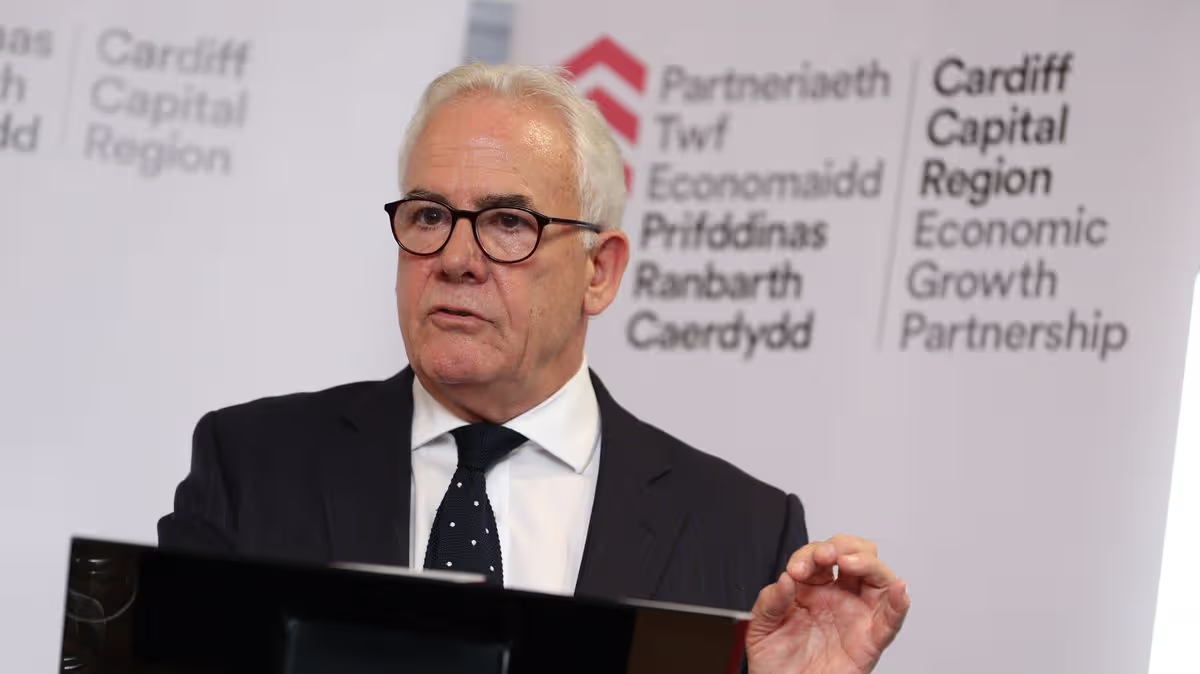
Frank Holmes says Wales can no longer afford to think small or continue to operate with a fragmented strategy.

Frank Holmes.
Capital is a restless, pragmatic force. It does not invest on sentiment, nor does it anchor itself to history.
It flows predictably towards environments where the regulatory, financial and physical frameworks make long term risk viable.
Ultimately, this reality dictates a harsh truth: a nation’s standard of living is entirely bound to its competitiveness, namely its fundamental ability to unlock domestic potential and attract global capital.
For Wales to claim its place in this global arena, we must build a cohesive economic architecture, and this demands a fundamental reorientation of Welsh economic policy.
We can no longer afford to think small, nor can we continue to operate with a fragmented strategy.
To secure a prosperous future, we must learn to think and act as an ambidextrous nation by mastering two distinct capabilities at once.
With one hand the nation must optimise, modernise and defend its industrial strengths With its other hand, Wales must boldly explore, fund and create the high-value, intellectual-property-led industries of the future.
Welsh economic policy is currently too one-handed; to avoid stagnation, we must quickly learn to use both.
This ambidextrous shift is not an academic preference; it is an urgent structural necessity. Modern economic growth is increasingly defined by a sweeping global transition away from physical capital and towards intangible assets, specifically patents, algorithms, software and brand equity.
These intangible assets operate under a different set of economic rules, where capital alone cannot solve the problem, especially when early stage small and medium sized enterprises (SMEs) remain so highly vulnerable.
Globally, SMEs represent the bedrock of economic activity, yet they are significantly less productive than large, established firms. The mortality rate is brutal: approximately 20% of these enterprises close within their first year, and more than 55% fail to survive beyond their fifth.
Helping these companies scale requires a dedicated infrastructure that makes intangible assets State bankable for the very first time by introducing specific market making instruments, and removing the baseline risk that currently prevents commercial lenders and investors from financing pure ideas.
Simultaneously, we must intentionally connect these early-stage companies with venture capital accelerators providing immediate access to investor ready bootcamps, sector specific experts and seasoned entrepreneurial mentors.
Wales possesses world class universities and genuine regional depth, but their potential is currently outweighed by archaic spin out commercialsation rules, startups and scaleups missing venture grade ambition, a lack of competitive funding and a lack of realistic understanding of what global scale truly requires.
An ambidextrous nation does not allow its startup ecosystem to exist in isolation from its industrial base. Inward investment must be strategically anchored within our existing regional sectors of strength: advanced manufacturing, particularly our world class compound semiconductor cluster, the creative industries, life sciences and fintech.
Highly competitive industrial clusters rely on deep, collaborative partnerships where large market integrators directly raise the operational standards of local SME suppliers. By actively transferring knowledge, coordinating long term demand planning and building management capabilities, anchor firms help smaller partners improve efficiency and access entirely new markets.
This creates a resilient, win win economic fabric. The steady, muscle bound scale of the global anchor supports and shields the quick, agile innovation of the local SME. This integration provides the crucial fuel for scaling, effectively preventing the dangerous customer concentration and dependency that so often cripples an SME before it is strong enough to expand operationally and geographically.
To accelerate this integration, the state must step forward as an active market maker. This means co financing collective branding programmes to position regional SME clusters in global markets, and, Nordic-level integration, leveraging strategic public procurement as a primary growth driver.
Rather than deploying passive subsidies, the public sector can use its massive purchasing power to offer commercial contracts for necessary services. This establishes the critical, first customer relationships that transform pre-revenue SMEs into mature, venture backed entities.
Since high value, IP led economies rely so heavily on geographic clustering, they are uniquely fragile and often highly dependent on human capital.
liveability as two sides of the same coin.
Direct response to shifting market demands is paramount. At the same time, we must treat community liveability as a core strategic asset. High performing schools, affordable modern housing, reliable public transport and excellent healthcare are not secondary luxuries; they are the primary determinants of whether high value talent chooses to relocate and remain in Wales.
You only have to look at Ireland, which despite is enviable economic success, an acute shortage of affordable housing in the Dublin area is driving its talent overseas.
Moving beyond narrow material metrics, economic data consistently reveals that robust economic growth fosters trust in government, and shared prosperity boosts social cohesion. When liveability factors underperform, the consequences are stark: underperforming schools, crumbling public services and communities left in managed decline. To prevent this brain drain, our institutional framework must be firmly embedded in statute. This ensures a durable, stable and legally grounded environment that makes long-term capital commitment and talent retention rational across unpredictable political cycles
Finally, exploiting modern technologies and productivity multipliers, such as artificial intelligence, advanced robotics and automated manufacturing require a resilient digital and energy infrastructure whilst high value technology clusters cannot operate without a constant, energy supply to power modern data centres, automated supply chains and high-speed digital connectivity.
In our midst is the biggest natural gift, the second highest tidal range in the world capable of generating multi-Gigawatts of clean, predictable, affordable energy, whilst delivering unprecedented sovereign national wealth.
Upgrading our physical energy grid to power the digital, IP led economy is the ultimate act of national ambidexterity. To maximise the economic return on these investments, our institutions and government must execute their infrastructure strategies with absolute rigour ruthlessly removing bureaucratic barriers and guaranteeing resilience to unexpected market headwinds.
The lesson across all economic history is clear: competitiveness, innovation and long term survival are not passive occurrences. They do not happen by accident, and they cannot be sustained through wishful thinking or political rhetoric. They are the direct result of deliberate, structurally sound choices.
Ecosystems that thrive are those that systematically bridge the productivity gap between large and small enterprises, construct lean, fast moving validation vehicles to capture emerging opportunities, and back every single strategic decision with an uncompromising commitment to timely and to- budget delivery.
Economic growth is not everything for everyone, but the evidence indicates it is very close to being so. Historically, it has created remarkable progress and elevated living standards across the globe.
Our current societal challenges indicate that we do not have too much economic growth, but that we have had far too little.
By executing an ambidextrous strategy with absolute operational and flawless execution, Wales can secure its prosperity, protect its communities and command its economic future.
- Frank Holmes is partner with Gambit Corporate Finance and chairs the investment board of the Cardiff Capital Region.



















































You must be logged in to post a comment Login