Connect with us

Business

What the Growing Uber and Lyft Driver Movement Means for Riders

Published

on

Uber

A wave of state laws allowing Uber and Lyft drivers to unionize is spreading across the country, marking one of the most significant shifts in labor rights for gig workers since ride-hailing apps first launched more than a decade ago.

Massachusetts became the first state to open the door to rideshare unionization in 2024, when voters approved a ballot measure creating a framework that lets drivers organize and bargain collectively while remaining classified as independent contractors rather than employees. California followed in January, giving an estimated 800,000 rideshare drivers in the state the right to form a union. Illinois became the third state to pass such legislation on June 1, extending similar rights to the state’s roughly 100,000 Uber and Lyft drivers.

A historic certification in Massachusetts

The movement reached a major milestone this spring when Massachusetts drivers organized what labor advocates are calling one of the most significant labor wins for independent workers in decades. The certification, made possible under the state’s 2024 framework, could ultimately represent nearly 70,000 drivers statewide through the newly formed App Drivers Union.

Advertisement

For drivers who backed the effort, the moment carried deep personal significance. Jean Fredo, who has driven for Uber for more than seven years, said he hopes the union will bring better pay, stronger protections against sudden deactivations and greater overall stability for drivers. “With the union, it will not feel like we’re working for nothing,” Fredo said, speaking through a translator.

Fellow driver Alfred Potter, who took part in organizing efforts, described the years-long push toward unionization as “still no more than a dream” for much of the process, reflecting how long the effort took to reach certification after the 2024 ballot measure passed.

California drivers see a similar path

In California, the nation’s second state to grant rideshare drivers union rights, organizing is still in its early stages, with the earliest possible vote on unionization set for May. Sangar Khan, who drives for Uber and Lyft out of the Bay Area, said he believes unionization could benefit drivers financially. “I think the union is good for drivers, and maybe they pay more,” Khan said, describing frustration with what he sees as a large gap between what riders pay for trips and what drivers ultimately take home.

Advertisement

Uber and Lyft did not agree to interviews on the California law, though Uber has previously said its support for expanding union rights in the state was tied to separate legislation that reduced the company’s insurance costs by lowering requirements for underinsured drivers.

A pattern with deep roots

The current wave of state-level unionization laws traces back to Seattle, which in 2015 became the first city in the country to pass an ordinance allowing rideshare drivers to organize, a move city officials framed at the time as an effort to protect workers and balance bargaining power between drivers and ride-hailing companies. Uber and Lyft challenged that ordinance in court, arguing that federal labor law prohibited cities from regulating collective bargaining and that allowing drivers to collectively negotiate rates could violate federal antitrust law.

More than a decade later, the legal and political landscape has shifted considerably, with state legislatures and voters, rather than individual cities, now driving the expansion of union rights for gig workers, sidestepping some of the legal challenges that stalled earlier municipal efforts.

Advertisement

Critics warn of rising costs

Not everyone views the trend favorably. Critics, including some free-market policy researchers, argue that sector-wide labor rules risk increasing costs for both drivers and riders alike, warning that expanded bargaining rights could push ride-hailing companies to raise fares to offset higher labor costs, similar to price increases seen following minimum wage mandates in the food delivery industry.

Opponents of mandatory unionization have also raised concerns about drivers who prefer to remain fully independent, arguing that collective bargaining agreements could bind drivers to terms they did not personally support and potentially reduce the flexibility that has long been a defining feature of gig work. Some critics have specifically warned that the expansion of gig worker unionization moves the industry incrementally closer to traditional employment classification, even as most current laws are structured to preserve independent contractor status.

Automation adds urgency

Advertisement

The push toward unionization is also unfolding against the backdrop of rapid advances in autonomous vehicle technology, which some labor organizers view as an additional reason to secure stronger protections for drivers now, before self-driving technology potentially reshapes the ride-hailing industry. Advocates argue that unionized drivers will be better positioned to negotiate protections, or transition support, if autonomous vehicles begin displacing significant numbers of human drivers in the coming years.

With Massachusetts, California and Illinois now serving as models for rideshare unionization, labor organizers say they expect additional states to consider similar legislation in the coming years, particularly as ride-hailing companies continue to expand their footprint across the country. Whether the trend ultimately benefits drivers through improved pay and job security, or raises costs for riders and limits flexibility for the independent contractors who make up the rideshare workforce, remains a central point of disagreement between labor advocates and industry-aligned critics.

For now, the expansion of union rights for gig workers marks one of the most closely watched labor developments in the ride-hailing industry since it first emerged more than a decade ago, with millions of drivers across the country now positioned to weigh in on whether collective bargaining becomes a permanent fixture of gig work.

Advertisement
Continue Reading
Click to comment

You must be logged in to post a comment Login

Leave a Reply

Business

The Asseco Investment Illustrates Exactly Why We Own Topicus

Published

on

Warden Capital Q2 2026 Letter

The Asseco Investment Illustrates Exactly Why We Own Topicus

Continue Reading

Business

Former Cardiff Rugby chief executive lands new role at the home of golf

Published

on

Business Live

Richard Holland has been appointed St Andrews Link Trust chief executive

Richard Holland at St Andrews.(Image: 2026 © Recounter Media Limited)

Former Cardiff Rugby chief executive Richard Holland has landed a new job with St Andrews Link Trust.

Advertisement

Mr Holland will become the chief executive for the trust, which operates the famous Old Course in Scotland, from the start of September – having left Welsh rugby after the Arms Park side were taken over by the Welsh Rugby Union last year.

He will succeed Neil Coulson following his departure earlier this year.

His role will include oversight of an organisation with more than 450 staff and the responsibility for managing eight courses at the Home of Golf, including the historic Old Course where golf has been played for more than 600 years.

Mr Holland spent 14 years at the Arms Park, with Cardiff being temporarily placed into administration by their directors in April 2025 before being acquired by the WRU. The governing body still continues to own the capital club.

Advertisement

Prior to working at Cardiff, Holland has held a number of leadership roles – including executive director of Chepstow and Hereford racecourses, and vice-president of corporate relations and sales at the Celtic Manor in Wales.

Mr Holland said: “I’m honoured to be appointed to lead the Home of Golf into its next chapter. St Andrews Links has an extraordinary history, and I’m excited to play a part in ensuring we continue to respect what has gone before, while shaping an exciting future as golf grows in popularity and inspires people around the world, and right here in St Andrews.

“My first few weeks will be spent meeting and listening to people in the town and beyond as my family and I settle into our new home.

“I’m looking forward to getting to know the team at the Trust, our partners and the local community as we continue to celebrate everything that makes the Home of Golf unique, create accessible pathways into the sport and deliver world-class experiences ensuring that we continue to work constructively to support golf locally, around Fife and further afield.”

Advertisement

The Old Course is set to host the 155th Open next year, marking a record 31st time the famous course will host the tournament.

“We are delighted to have appointed Richard Holland,” said Sandra Tuddenham, chair of trustees at St Andrews Links Trust. “He is a highly experienced chief executive with a long track record of leading heritage-rich, publicly scrutinised sporting and hospitality organisations.

“His appointment comes at an exciting time for St Andrews Links as preparations to host The 155th Open next year gather pace, and we are confident that he will build on the Trust’s proud legacy while shaping a sustainable future for the Home of Golf.”

Advertisement
Continue Reading

Business

Daikin Q1 sales rise 17%, meets expectations

Published

on


Daikin Q1 sales rise 17%, meets expectations

Continue Reading

Business

The DoubleLine Income Solutions Fund: A 12% Yield Backed By Risky Credit

Published

on

The DoubleLine Income Solutions Fund: A 12% Yield Backed By Risky Credit

The DoubleLine Income Solutions Fund: A 12% Yield Backed By Risky Credit

Continue Reading

Business

Xtrackers II announces dividends for 27 ETF share classes

Published

on


Xtrackers II announces dividends for 27 ETF share classes

Continue Reading

Business

Nextpower: The Market Is Still Pricing A Tracker Vendor, Not A Power Platform

Published

on

TAN: Why Solar Is Less Shiny Today (Rating Downgrade)

Nextpower: The Market Is Still Pricing A Tracker Vendor, Not A Power Platform

Continue Reading

Business

ASEAN’s Neutrality Is Failing the South China Sea Test

Published

on

How China is quietly replacing Japan as Thailand's dominant industrial partner
  • ASEAN’s traditional non-aligned approach, which has preserved regional peace for decades, faces mounting strain as China’s sustained pressure in the South China Sea exposes the limits of consensus-based diplomacy. Two decades of negotiations over a legally binding Code of Conduct have produced no agreement, illustrating how neutrality can enable gradual territorial encroachment rather than prevent it.
  • The bloc’s structural reliance on consensus allows members with close ties to China to block unified responses, creating an institution capable of swift diplomacy with Russia yet unable to defend its own waters in binding terms. Genuine regional security may require ASEAN to move beyond diplomatic silence and assert firmer positions when sovereignty is directly threatened.

ASEAN faces its toughest test balancing neutrality amid global disorder, particularly in the South China Sea. While its consensus-based diplomacy has maintained regional peace, China’s territorial pressure exposes critical weaknesses. Staying friendly with everyone fails when one party quietly encroaches, making silence increasingly insufficient.

Key Points

  • ASEAN, chaired by the Philippines this year, faces mounting global pressures, balancing trade, energy, and food security while maintaining friendly ties with all major powers, including Russia and China, through its traditional non-aligned “ASEAN way” approach.
  • The South China Sea remains ASEAN’s greatest challenge, where two decades of negotiations with China over a legally binding Code of Conduct have stalled, exposing how consensus-based decision-making becomes a weakness when members have conflicting ties.
  • While ASEAN’s neutrality has successfully prevented interstate war, its reluctance to confront assertive actors like China risks enabling gradual territorial encroachment, suggesting the bloc must find courage to move beyond diplomatic silence when regional sovereignty is genuinely threatened.

ASEAN’s Balancing Act in a Divided World

A Tested Approach | Strengths of Neutrality

In 2025, the Philippines chairs ASEAN during one of its most demanding periods, as global disorder strains a region deeply dependent on trade and stability. From crisis management at the Cebu summit to maintaining friendly ties with Russia despite Western pressure, ASEAN demonstrates its defining characteristic: refusing to choose sides. This strategic neutrality has historically served the region well. By keeping ties open with all major powers, ASEAN secures energy, food, and security through multiple relationships rather than dependence on a single hegemon. Decades without interstate war stand as evidence that this approach delivers results.


When Neutrality Becomes a Liability

The South China Sea Challenge | Institutional Limitations

However, ASEAN’s greatest strength becomes its most dangerous weakness when one party at the table is not merely talking but actively taking. Nowhere is this clearer than in the South China Sea. After over twenty years of negotiations, ASEAN and China have yet to agree on whether a Code of Conduct would even be legally binding. The Philippines, the most directly pressured member, exemplifies this dilemma — President Marcos Jr. advocates for binding rules yet expresses little confidence in achieving them. Staying neutral toward a party applying sustained pressure ultimately allows that pressure to continue unchallenged.


The Courage ASEAN Must Find

Consensus as Constraint | A Call for Decisive Action

Advertisement

ASEAN’s consensus-based decision-making, while ensuring inclusivity, creates a structural paralysis precisely when firmness is most needed. Members with close ties to China effectively prevent any unified, assertive response to territorial encroachments. The result is a body capable of reaching agreements with Russia within days yet unable to produce a single binding sentence defending its own waters in years. China’s gradual territorial gains — never large enough to trigger war, yet sufficient to redraw boundaries — expose this vulnerability. Genuine regional security ultimately requires not just skillful diplomacy, but the institutional courage to firmly reject actions that threaten the foundations of the regional order itself.

Source : ASEAN has to stand up to Beijing’s ambitions – Taipei Times

Advertisement
Continue Reading

Business

Elon Musk Faces Tough Investor Scrutiny as SpaceX Shares Plunge 50% Ahead of First Public Earnings Call

Published

on

Tesla CEO Elon Musk speaks at an event in Hawthorne, California April 30, 2015.

NEW YORK — Elon Musk faces investors Tuesday for the first time since taking SpaceX public, a closely watched call coming after the rocket company’s shares have lost roughly half their value since peaking in June, raising questions about whether Musk oversold the company’s near-term prospects.

SpaceX is scheduled to release its second-quarter 2026 financial results after markets close Tuesday, followed by a live audio-only webcast at 4:30 p.m. Eastern time, marking the company’s first earnings report and shareholder call since going public. The event comes just two days ahead of a major insider lock-up expiration that could add further pressure to the stock.

A dramatic reversal since the IPO

SpaceX priced its initial public offering at $135 per share on June 11, raising $85.7 billion in what became the largest IPO in history. Shares began trading on the Nasdaq the following day and climbed as high as $225.64 by June 16, before beginning a steady decline that has continued for much of the summer. The stock has since fallen more than 45% from that peak, with some measures putting the drop closer to 50%, leaving shares trading in the range of $113 to $123 in recent sessions.

Advertisement

The decline has erased hundreds of billions of dollars in market value and fueled concerns among analysts that investors, caught up in the excitement surrounding one of the most anticipated public offerings in Wall Street history, may have pushed the stock’s valuation well beyond what SpaceX’s underlying financial performance could support.

Mounting losses

Much of the scrutiny facing Musk on Tuesday centers on SpaceX’s financials, which have shown a pattern of widening losses even as the company’s revenue continues to grow. SpaceX posted a net loss of roughly $4.9 billion for all of 2025. That figure was nearly matched in just the first quarter of 2026 alone, when the company reported a net loss of $4.28 billion on revenue of $4.69 billion. Combined first-half losses for 2026 are expected to exceed the company’s entire loss total from the prior year.

Wall Street analysts surveyed by FactSet are projecting a second-quarter net loss of approximately $1.9 billion, or 23 cents per share. While some analysts believe SpaceX’s financial results could improve later in the year, the company currently trades at roughly 49 times its expected revenue, a valuation multiple that leaves little room for disappointment and places enormous weight on Tuesday’s numbers.

Advertisement

What investors want to hear

Analysts expect management to address three core business segments during the call: Space, which includes SpaceX’s launch operations and the long-delayed Starship rocket program; Connectivity, centered on the company’s Starlink satellite internet service; and a newer artificial intelligence infrastructure push that includes a proposed orbital data center project.

Starlink remains one of the few bright spots in SpaceX’s business. As of March 31, the service had grown to 10.3 million subscribers across 164 countries, more than double the 5.0 million subscribers it had a year earlier. The service generated $11.4 billion in revenue in 2025, and investors will be watching for updated subscriber figures as one of the clearest indicators of the company’s underlying growth trajectory.

Investors are also expected to press Musk on the progress of Starship, the massive rocket system central to NASA’s plans to return astronauts to the moon, following a series of recent setbacks, including an aborted test and an imperfect booster recovery during the vehicle’s most recent flight. Questions about a possible future business tie-up between SpaceX and Tesla, as well as SpaceX’s expanding role in artificial intelligence infrastructure through partnerships with hyperscale computing providers, are also likely to come up, though Musk has historically avoided detailed comments on such topics during earnings calls, citing securities regulations.

Advertisement

A lock-up expiration adds urgency

Compounding the pressure on SpaceX shares is an insider lock-up expiration set for Thursday, Aug. 6, just two days after the earnings call. The expiration will allow a significant portion of insider-held shares, an unconditional tranche representing roughly 20% of total shares, or more than 900 million shares, to become eligible for trading for the first time since the IPO.

A separate, larger tranche tied to the stock trading above $175.50 for five of 10 consecutive sessions has not been triggered, since shares have remained well below that threshold since mid-June. Musk’s own controlling stake, along with shares held by key executives, remains restricted under a separate one-year lock-up that runs until June 2027.

Analysts widely view Tuesday’s earnings report as the company’s best opportunity to stabilize investor sentiment before the lock-up expiration potentially floods the market with new sellers. A strong report could help offset some of the anticipated selling pressure; a disappointing one could accelerate it.

Advertisement

A test of the Musk premium

Unlike other trillion-dollar technology companies, SpaceX’s roughly $1.4 trillion market capitalization is not currently supported by traditional financial metrics such as profitability or free cash flow. Much of the investment case for the company rests instead on confidence in Musk’s track record and his stated ambitions, including plans to build data centers in space and eventually establish a human presence on Mars.

That dynamic has drawn comparisons to Tesla, where Musk faced a similarly rocky earnings call two weeks earlier that sent shares of the electric automaker falling further amid concerns over rising costs and negative free cash flow. With both of Musk’s flagship companies under pressure simultaneously, Tuesday’s SpaceX report is being closely watched as a broader referendum on investor confidence in Musk’s ability to deliver on ambitious, capital-intensive projects across multiple companies at once.

Whether SpaceX’s first earnings report as a public company can reverse the stock’s slide, or simply confirm investors’ concerns about an overheated valuation, is likely to become clear within hours of Tuesday’s release. With the lock-up expiration looming just two days later, analysts say the company has a narrow window to reassure shareholders before a new wave of insider selling tests the stock’s ability to find a floor.

Advertisement
Continue Reading

Business

NANR: A Proven Inflation Hedge

Published

on

Commodities: Oil Slumps As The U.S. And Iran Pause Strikes

NANR: A Proven Inflation Hedge

Continue Reading

Business

Wiltshire brewer Wadworth first to trade on Asset Match’s new PISCES platform

Published

on

Business Live

Market would allow existing shareholders to sell part of their vested equity to buyers

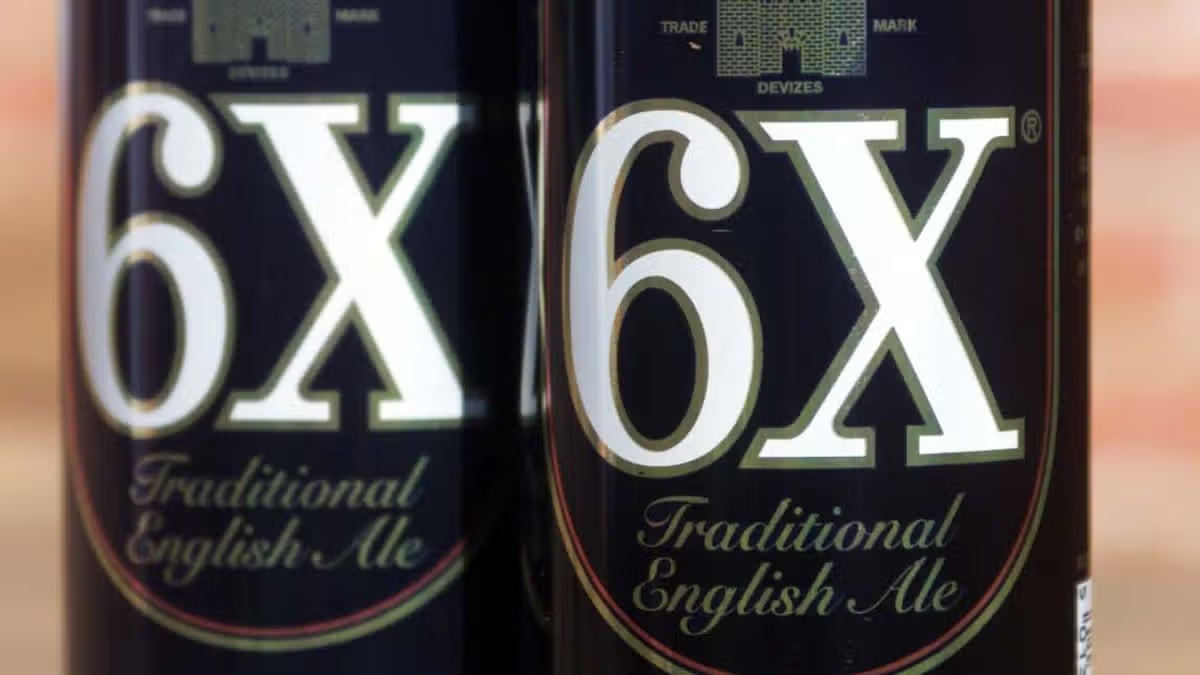
Wadworth's famous 6X beer

Wadworth’s famous 6X beer

A British brewery has drawn up plans to become the first company to join Asset Match’s new private markets platform as it continues to look to attract unlisted firms.

The online private stock market has welcomed Wiltshire-based brewer and pub operator Wadworth to its Private Intermittent Securities and Capital Exchange System (Pisces), enabling existing shareholders to offload a portion of their equity stake to prospective buyers.

Participants will be able to access company reports and auction details on August 4. Buyers and shareholders can submit orders during Wadworth’s first trading window of 11 August to 30 September, as reported by City AM.

Established in 1875, Wadworth has traded its A ordinary shares, a class of company equity which typically carries voting rights, on the Asset Match platform since February 2023.

Advertisement

The brewer, renowned for its range of traditional ales such as 6X, has traded more than 300,000 shares to date.

Ben Weaver, business development director at Asset Match, said the PISCES auction “represents the first opportunity” for a broader pool of investors to acquire shares in Wadworth.

Weaver said: “We believe there is strong investor appetite for established private companies with recognised brands, tangible assets and long-term growth potential.

“We expect Wadworth inaugural PISCES auction to attract significant interest.”

Advertisement

Simon Townsend, chairman of Wadworth, said the transaction would “broaden awareness of the company” among investors. Gaining traction.

Asset Match received its Pisces approval from the Financial Conduct Authority in April, and the flotation of Wadworth represents the first real test of whether the exchange can deliver liquidity to shareholders.

The platform must now persuade other firms seeking to unlock value without a full listing to choose their service over rivals JP Jenkins, Vestd and London Stock Exchange Group.

London’s platform welcomed fintech Moneybox last month, confirming a £45m employee share sale, alongside autonomous driving company Wayve in a substantial £63m employee share sale.

Advertisement

JP Jenkins has similarly onboarded just one company under its framework to date, completing the transaction of digital board game developer QPLAY in March. Vestd is yet to attract a single company to list on its framework.

Continue Reading

Trending

Copyright © 2025