Connect with us

Business

What UK SMEs Get Wrong About Their First Office

Published

on

What UK SMEs Get Wrong About Their First Office

However, the first office selection process is always made on the basis of cost, convenience of location, or even size of the office. Expensive mistakes are normally discovered much later on in the process.

Based on experience of working with myHQ Spaces and dealing with thousands of office enquiries, there is always the same set of common errors that are made. It is not about selecting the wrong kind of office space. It is about jumping too soon, comparing incomplete pricing, and making decisions on assumptions about the way the business will operate in two or three years’ time.

Mistake 1 — Treating the Quoted Rate as the Cost

The work area offered at £300 per desk monthly does not have to be £300. The VAT is generally levied at the current standard rate of 20% in the UK for all products and services, which implies that the £300 work area cost will amount to £360 inclusive of VAT. This will mean that for a team of five individuals, the cost will be £1,800 monthly or £21,600 annually.

Free newsletters
Advertisement

The stories that matter to UK business, straight to your inbox.

Advertisement

The real issue is whether the figure presented gives you an indication of what is actually included. Room usage could be capped at a certain monthly allowance, with extra hours billed on a separate basis. Other services such as printing, storage, visitor access, out-of-hours access, car parking, etc., could fall outside the stated price. Some organizations quote the price inclusive of VAT, while others quote the price exclusive of VAT.

Mistake 2 — Committing to a Lease Before the Headcount is Settled

It may be wise to go for a traditional commercial lease in case the need for space is quite predictable; however, if you have an uncertain number of employees, it might not be worth pursuing. According to business.gov.uk, company leases usually last 10 to 15 years, although shorter leases have become quite common. It also mentions that break clauses can be negotiated, depending on the terms of the lease agreement.

The commitment goes beyond just paying the rent. There are other commitments involved, like fit-out charges, maintenance, and dilapidations if the property comes back to the landlord in bad shape. This implies that a business will pay rent for office space which it does not need anymore and also the cost to bring the property back into shape. Flexspace can thus be termed as an insurance premium. It involves paying more for each desk, but in doing so, one avoids betting on something that has not even happened yet.

Mistake 3 — Choosing Location by Prestige Instead of Hiring Pool

A premium business address may be impressive for websites and business cards, but it may not be a convenient place for your employees. The office should be in a place that can easily be reached by people through a manageable commute, especially where the expectation is that the staff will attend often. Business.gov.uk identifies proximity to the employees, customers, and transport links as important considerations for business premises.

Advertisement

Such logic does not apply only to London. An enterprise from Bristol could be interested in a centrally-located office, but discover that an office in a less central position will be better because it will be closer to where their primary customers reside. It can happen in Manchester, Birmingham, Leeds or Glasgow. Should an affordable office cost employees an additional 40 minutes of travel time, then the saving on rent becomes meaningless.

Mistake 4 — Taking Space Before It is Needed

The existence of an office might indicate that the company has matured to the next level, but this should not be the factor that determines when the commitment should take place. Should a majority of the staff work off-site, having an office rented five days a week might result in a lot of capacity going to waste. Day passes, membership options, and conference room facilities might serve as other solutions until it becomes clear how much office space is needed.

An alternative approach would be to first create the company, test the market, hire the staff, and then measure the working system that has developed. The reverse approach is very common; get into a big office and hope the people will follow. This gets the order of demand and costs backward. Should the process of hiring take longer than anticipated, then the company is saddled with an office expense without the required number of staff.

Mistake 5 — Not Comparing Like With Like

Two different office quotes may share the exact headline rate but actually signify two entirely different costs. One may consist of meeting room credits, Internet connection, receptionist service, and some utilities, whereas others may not. The deposit amount, set-up fee, notice period, and other such factors may also influence the cost of the agreement.

Advertisement

It is important to first ask all providers the same questions before making a comparison. Questions include: What is included in the price per month? What is excluded from the pricing? What is the deposit amount? What is the notice period? Are the meeting rooms included and, if yes, for how many hours? All of this information should be presented in a straightforward cost comparison on a monthly and annual basis. The goal is not to look for the lowest price per desk.

The Practical Sequence

Making the first decision in regard to the office is much simpler once you make the distinction between the headline price and the real commitment. You need to calculate the total cost including VAT and extras, and align the term of the lease agreement with your level of confidence regarding future staffing. The location should be chosen based on where your team could reasonably do its work, and not simply by looking at prestige factors. In any case, take the permanent space only if you really need it operationally.

https://www.business.gov.uk/invest-in-uk/expand-your-business-in-the-uk/guide/detailed-guides/find-the-right-location-and-premises/

Advertisement

Continue Reading
Click to comment

You must be logged in to post a comment Login

Leave a Reply

Business

Virtus SGA International Growth Portfolio Q2 2026 Portfolio Activity

Published

on

Whale's Insight: A Macro-Driven Market With No Safe Haven, And No End To Volatility

Virtus Investment Partners provides investment management products and services to individuals and institutions. We operate a multi-manager asset management business, comprising a number of individual affiliated managers, each with a distinct investment style, autonomous investment process and individual brand. We clearly understand the responsibility we have to our clients and we are committed to their success as investors.
For important disclaimers, go to https://www.virtus.com/social-media-guidelines. Note: This account is not managed or monitored by Virtus, and any messages sent via Seeking Alpha will not receive a response. For inquiries or communication, please use the firm’s official channels.

Continue Reading

Business

Old El Paso debuts broth, new soups

Published

on

Old El Paso debuts broth, new soups

MINNEAPOLIS — General Mills is expanding its Old El Paso portfolio with new soups and the debut of broth varieties.

The gluten-free broth is available in a 32-oz format, with birria style beef and chicken tinga style varieties.

“There’s nothing better than a warm, flavorful meal as we head into fall, and we’re seeing consumers look for more ways to bring the Tex-Mex flavors they love to meals beyond taco night,” said Ben Bienert, business unit director for Old El Paso at General Mills. “That inspired us to think about how Old El Paso could show up in even more cooking occasions. Our new versatile broths make it easy to bring bold Tex-Mex flavor to busy weeknight dinners, a lunch staple or as the starting point for something completely new.”

The canned soups include chipotle steak burrito style and cheesy beef taco style soup varieties.

Advertisement

The portfolio expansions are available in retailers nationwide. 

Continue Reading

Business

Ultraviolette adds Intel CEO as adviser, raises $85 million

Published

on


Ultraviolette adds Intel CEO as adviser, raises $85 million

Continue Reading

Business

Newcastle carbon reduction company SmartCarbon bought in private equity deal

Published

on

Business Live

The deal for the Gosforth company aims to support its growth and help develop its technology

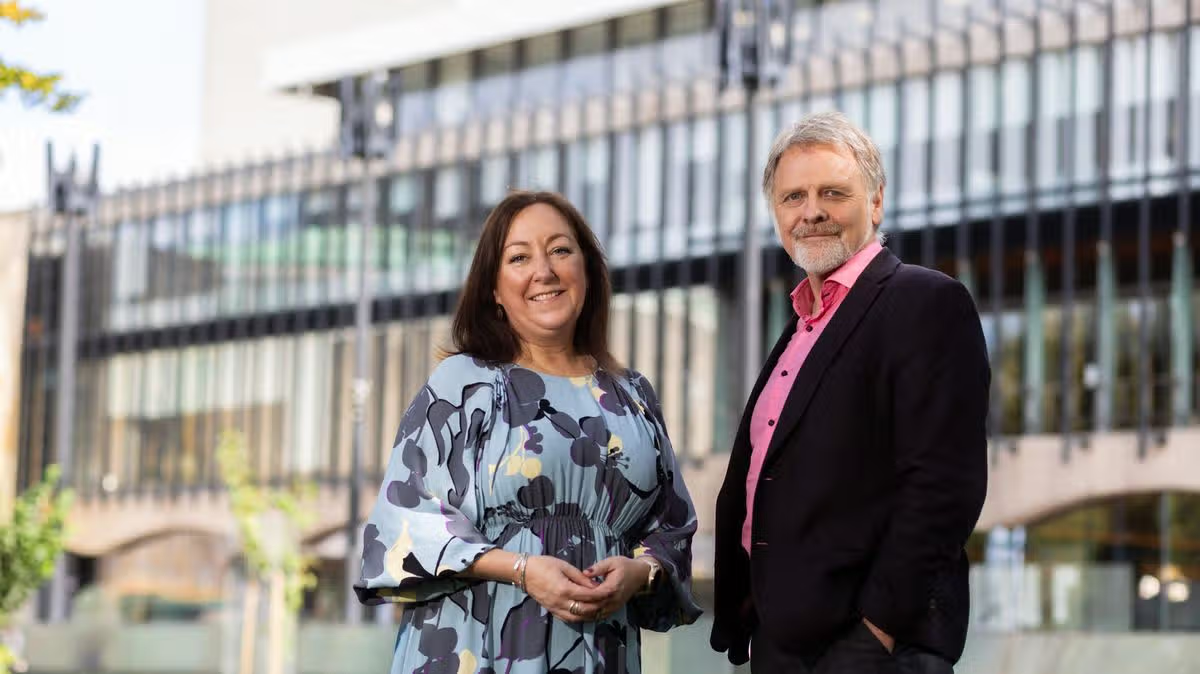
Anna-Lisa Mills and Lee Jackson, from CarbonSmart

Anna-Lisa Mills and Lee Jackson, from CarbonSmart(Image: CarbonSmart)

Newcastle-based carbon reporting and reduction specialist SmartCarbon has been acquired by private equity firm TVI Group in a deal that aims to support the company’s growth.

The Gosforth firm, which was founded in 2016, has grown from a specialist carbon reporting platform working with several businesses in the North East into a national organisation serving both public and private sector organisations. Clients include such as Greggs, Durham University, Thirteen Group and UCL Hospitals London.

As well as helping organisations to measure and reduce carbon emissions, it has a partnership with Northumbria University to deliver carbon footprint training and other course for organisations working towards long-term carbon reduction.

The new investment from Berkshire-based TVI Group will support the development of SmartCarbon’s carbon calculator and reporting platform, integrating automation and AI capabilities that area designed to reduce the administrative burden associated with carbon accounting.

Advertisement

SmartCarbon managing director Lee Jackson, said: “We’re delighted by the TVI acquisition as this brings not only great experience in technological innovation but also a shared commitment to Smart Carbon’s longstanding values and purpose of driving progress in driving carbon reduction in business. Through this new investment, SmartCarbon will be able to execute plans for the development of our carbon accounting platform, enhance our customer experience and, fundamentally, make it easier for businesses to build emissions reporting and carbon reduction planning into their operations.

“Crucially, SmartCarbon will continue to deliver a combination of technology and environmental expertise. Our highly qualified consultancy team remains committed to providing the practical and insightful support that our clients have relied on over the years.”

The company’s founder and principal consultant, Anna-Lisa Mills, will remain with the business within its consultancy team. She said: “When SmartCarbon was founded, the ambition was to give organisations the tools and the knowledge needed to take genuine action on carbon emissions. I’m incredibly proud of how far the business has come since 2016 and I’m excited to remain part of SmartCarbon’s journey as we build on those foundations as a TVI Group business.”

The deal sees Ian Whittaker join SmartCarbon as chairman. He has more than 20 years of sales, marketing and general management experience in the UK and Europe with IT company Hewlett Packard and, as a CEO and board member of a start-up software technology business that listed on the London Stock Exchange and was subsequently sold in 2024.

Advertisement

He said: “I am excited and delighted to join the SmartCarbon team and look forward to building and growing further the fantastic business the team have established.”

Continue Reading

Business

At Close of Business podcast September 23 2026

Published

on

At Close of Business podcast September 23 2026

Tom Zaunmayr speaks to Justin Fris about how WA’s small business sector is navigating a series of challenges. 

Plus: City council sacks CEO Michelle Reynolds; ACCC blocks IAG-RAC deal, again; $130m Scarborough project approved. 

Advertisement

Continue Reading

Business

How Workplace Grime Quietly Drains Billions From Business Bottom Lines

Published

on

How Workplace Grime Quietly Drains Billions From Business Bottom Lines

Almost none will mention the item that research suggests is silently taxing their payroll every single day — the physical cleanliness of their workplace.

The numbers are not small. As a company that cleans commercial spaces across one of the most competitive business environments on earth, we at Green Hands Cleaning Services Corp in New York City have watched businesses treat cleaning as a grudge purchase — the first line item cut when budgets tighten. The research says that instinct is spectacularly expensive. Here’s the evidence, and why the humble cleaning contract may be one of the most underrated productivity investments in business.

Your Desk Has 400 Times More Bacteria Than a Toilet Seat

Let’s start with the finding that made headlines around the world and still shocks every executive who hears it. Research led by Dr. Charles Gerba, a microbiologist at the University of Arizona, found that the average office desk harbours roughly 400 times more bacteria than the average toilet seat — around 10 million bacteria on a typical work surface.

Free newsletters
Advertisement

The stories that matter to UK business, straight to your inbox.

Advertisement

The reason is behavioural, not mysterious. Toilets get disinfected regularly because they’re perceived as dirty. Desks don’t, because they’re perceived as clean. Meanwhile, Gerba’s research found that the areas where employees rest their hands and eat lunch are bacterial hotspots: the average office phone carried around 25,000 bacteria per square inch, keyboards roughly 3,300, and computer mice about 1,600. The office kitchen fared even worse — communal sponges, fridge handles, and coffee pot handles ranked among the most contaminated objects in the entire building.

And contamination doesn’t stay put. A University of Arizona tracer study placed a harmless virus surrogate on a single office door handle at the start of a workday. Within four hours, the virus was detectable on more than half of all commonly touched surfaces in the office — and on the hands of roughly half the employees. One handle. Four hours. Half the workforce.

Now consider that 80% of common infections are transmitted by touch, according to widely cited public health research, and the business implications start coming into focus.

The £14 Billion Question: Sickness Absence Is a Cleanliness Problem

For UK readers, the macro numbers are sobering. The Office for National Statistics reported that UK workers lost approximately 185.6 million working days to sickness absence in 2022 — the highest on record — with minor illnesses such as coughs and colds consistently the single largest cause. Estimates of the total cost of sickness absence to the UK economy run into the tens of billions of pounds annually, and that’s before counting presenteeism: employees who turn up ill and work at a fraction of capacity, which research by Deloitte and others suggests costs employers considerably more than absence itself.

Advertisement

Here’s where cleaning stops being janitorial and starts being financial. A frequently cited workplace hygiene study found that implementing a targeted disinfection programme for high-touch office surfaces reduced surface contamination dramatically — and related research on workplace hygiene interventions has associated proper cleaning protocols with reductions in employee absenteeism of up to 30–40% for illness-related absence. When flu season alone costs businesses billions in lost output, a professional cleaning regime targeting phones, keyboards, door handles, and kitchen surfaces isn’t overhead. It’s insurance with a measurable payout.

The pandemic taught every business this lesson at gunpoint. The follow-up lesson — that the economics of workplace hygiene were compelling before COVID and remain compelling after it — has been forgotten remarkably quickly. It’s a core reason demand for structured commercial programmes like https://www.greenhandscleaningservices.com/services/office-cleaning-new-york-city has remained well above pre-2020 levels even as pandemic-era anxiety has faded: the firms that measured the absence data kept the contracts.

Clean Workplaces Don’t Just Prevent Sickness — They Manufacture Productivity

The second body of evidence is, if anything, more commercially interesting than the first: cleanliness doesn’t merely stop losses. It actively improves output.

The clutter tax on cognition. Princeton University neuroscientists demonstrated in The Journal of Neuroscience that visual clutter competes for the brain’s processing capacity, measurably degrading focus and performance. Your employees’ brains are running background processes on every stack of paper and dusty surface in their field of vision.

Advertisement

The air they breathe is a performance variable. A landmark Harvard T.H. Chan School of Public Health study (the COGfx study) found that workers in well-ventilated offices with low levels of indoor pollutants showed cognitive scores 61% higher than in conventional office conditions — rising to 101% higher in optimised environments. Dust-laden carpets, clogged vents, and grimy surfaces are direct contributors to the indoor air quality problem, and the US EPA estimates indoor air is typically two to five times more polluted than outdoor air. Given that office workers spend roughly 90% of their time indoors, the air inside your office is arguably a line on your P&L.

Employees notice — and judge. A survey by Staples found that 94% of workers reported feeling more productive in a clean workspace, and 77% said they produce higher quality work in a cleaner environment. Separate research found a majority of employees judge their employer by the state of the workplace — with dirty toilets and grubby kitchens repeatedly cited in surveys as factors that damage morale and even influence decisions to stay or leave. In a tight labour market, that’s a retention issue wearing a mop’s disguise.

Clients judge faster than employees do. Multiple commercial surveys have found that around 95% of customers say exterior and interior cleanliness influences their perception of a business, and a significant share say they would not return to a business with dirty facilities — with unclean toilets being the most cited deal-breaker. First impressions form in seconds; grime forms them for you.

The Hybrid-Work Trap: Why Offices Are Getting Dirtier, Not Cleaner

Here’s a counterintuitive development from the post-pandemic workplace that business owners should understand: hybrid working has made office hygiene worse, not better.

Advertisement

The logic seems backwards — fewer people should mean less mess. But three forces work in the opposite direction:

  1. Hot-desking multiplies exposure. When desks were assigned, each keyboard hosted one person’s microbes. Desk-sharing means every surface is now a rotating exchange point for the whole workforce. Studies of shared-desk environments have found significantly higher contamination on hot desks than on assigned ones.
  2. Cleaning contracts were cut to match headcount, not usage. Many firms reduced cleaning frequency proportionally to attendance — but a desk used by three different people across a week needs more attention than one used by a single occupant, not less.
  3. Intermittent occupancy creates its own problems. Water sitting in unused taps and appliances, dust accumulating in low-traffic zones, and kitchens used heavily on peak days but cleaned on schedules designed for even usage.

The businesses handling this well have shifted from fixed-schedule cleaning to usage-based programmes — deeper cleans aligned to peak occupancy days, disinfection of shared workstations between users, and periodic intensive cleans that reset the whole environment. It’s the model behind flexible offerings such as Green Hands’ custom cleaning plans, and it’s rapidly becoming the standard sophisticated tenants demand rather than a premium option.

What New York’s Hyper-Competitive Market Teaches Every Business

Operating in New York City is a stress test for any theory about commercial cleanliness, and a few lessons from our market translate directly to businesses anywhere — London, Manchester, or Leeds:

Lesson 1: The businesses that measure it, keep it. Our longest-standing commercial clients are the ones who tracked something — sick days, client feedback, Glassdoor mentions of the office environment — before and after establishing a proper cleaning programme. Cleaning survives budget reviews when it has a KPI attached. When it’s a vague “facilities” line, it gets cut, and the costs reappear elsewhere, unlabelled.

Lesson 2: Frequency beats intensity. A monthly blitz clean is far less effective than lighter, more frequent attention to high-touch points. Microbial recolonisation of surfaces happens within hours, not weeks. The University of Arizona door-handle study proved contamination spreads building-wide in half a working day — your cleaning cadence needs to respect that timeline.

Advertisement

Lesson 3: The kitchen and the toilets are your brand. Employees forgive a scuffed floor. Surveys show they do not forgive a dirty kitchen or washroom — and neither do visiting clients. If budget forces prioritisation, prioritise where humans eat and where they’d rather not think about.

Lesson 4: Deep cleans are infrastructure, not indulgence. Carpets, vents, blinds, upholstery, and the zones behind and beneath furniture are where the Harvard air-quality findings live. Quarterly or biannual deep cleaning — the kind detailed at https://www.greenhandscleaningservices.com/services/deep-cleaning-service-new-york-city — is what keeps the daily cleaning meaningful, in the same way servicing a boiler keeps the radiators worth bleeding.

Lesson 5: Insurance and vetting are non-negotiable. Whoever cleans your premises has out-of-hours access to your offices, your equipment, and potentially your data environment. Insured, bonded, background-checked teams aren’t a luxury tier — they’re baseline commercial risk management.

Running the Numbers for Your Own Business

Sceptical? Good — run your own maths. Here’s the back-of-envelope model we suggest to every commercial prospect:

Advertisement
  • Take your average fully-loaded daily cost per employee (salary, NI/benefits, overheads).
  • Multiply by your annual sick days per employee (UK average: roughly 5.7 days per worker, per ONS).
  • Assume a professional hygiene programme trims illness-related absence by a conservative 20% (well below the reductions reported in workplace hygiene studies).
  • Add a modest 2–5% productivity uplift from the environment effects documented by Harvard, Princeton, and the Staples survey data.

For a 30-person business with a £45,000 average fully-loaded cost, even the conservative version of that calculation typically lands between £25,000 and £60,000 in annual recovered value — against a cleaning programme costing a fraction of that. The ROI conversation ends quickly.

Then add the unquantifiables: the client who noticed the immaculate meeting room, the candidate who accepted the offer partly because the office “felt looked after,” the review that mentioned your premises. Cleanliness compounds.

The Bottom Line

Business leaders spend fortunes on productivity software, engagement consultants, and wellbeing programmes — while the physical environment their people inhabit eight hours a day carries 10 million bacteria per desk, air that measurably dulls cognition, and clutter that taxes every brain in the building.

The research verdict is unambiguous: workplace cleanliness is not a facilities expense. It is a performance input with one of the clearest, most measurable returns available to any business — a rare investment that simultaneously cuts costs (absence), raises output (productivity), protects revenue (client perception), and supports retention (morale).

The dirtiest secret in business isn’t hiding in the accounts. It’s sitting on the desk.

Advertisement

About Green Hands Cleaning Services Corp

Green Hands Cleaning Services Corp is a professional commercial and residential cleaning company headquartered in East Elmhurst, Queens, serving businesses and homes throughout New York City, including Manhattan, Brooklyn, and Queens. The company provides office cleaning, commercial cleaning, janitorial services, disinfection services, and deep cleaning for workplaces of every size, alongside a full range of residential services including apartment cleaning, move-in/move-out cleaning, and recurring maid service. Fully insured and bonded, with vetted professional teams, custom cleaning plans, transparent pricing, and flexible scheduling — including same-day and after-hours service — Green Hands partners with businesses that understand a clean workplace is a competitive advantage, not a cost centre.

Green Hands Cleaning Services Corp
22-16 79th St, East Elmhurst, NY 11370, United States greenhandscleaningservices.com
+1 212-812-9418

 

Advertisement

Continue Reading

Business

Don't Sell This Nasdaq Rally

Published

on

Cairn Terrier dog walking against gradient background

Don't Sell This Nasdaq Rally

Continue Reading

Business

Cineplex explores strategic alternatives as new CEO Bill Walker takes the helm

Published

on


Cineplex explores strategic alternatives as new CEO Bill Walker takes the helm

Continue Reading

Business

Intel Stock: The Future Has Arguably Never Looked This Bright (NASDAQ:INTC)

Published

on

Intel: Getting Better, But Not Quite There Yet

This article was written by

JR Research is an opportunistic investor. I was recognized by TipRanks as a Top Analyst, and also by Seeking Alpha as a “Top Analyst To Follow” for Technology, Software, and Internet, as well as for Growth and GARP. I identify attractive risk/reward opportunities supported by robust price action to potentially generate alpha well above the S&P 500. My picks have consistently demonstrated market outperformance over time. My approach combines timely and sharp price action analysis with fundamentals as my foundation. I also tend to avoid overhyped and overvalued stocks while capitalizing on battered stocks with significant upside recovery possibilities. I run the investing group Ultimate Growth Investing which specializes in identifying high-potential opportunities across various sectors. My main ideas revolve around stocks with strong growth potential, and also well-beaten contrarian plays. I designed the group for investors seeking to capitalize on growth stocks with solid fundamentals, robust buying momentum, and appealing turnaround plays to generate alpha consistently. Learn more

Analyst’s Disclosure: I/we have a beneficial long position in the shares of META, AMZN, TSM either through stock ownership, options, or other derivatives. I wrote this article myself, and it expresses my own opinions. I am not receiving compensation for it (other than from Seeking Alpha). I have no business relationship with any company whose stock is mentioned in this article.

Seeking Alpha’s Disclosure: Past performance is no guarantee of future results. No recommendation or advice is being given as to whether any investment is suitable for a particular investor. Any views or opinions expressed above may not reflect those of Seeking Alpha as a whole. Seeking Alpha is not a licensed securities dealer, broker or US investment adviser or investment bank. Our analysts are third party authors that include both professional investors and individual investors who may not be licensed or certified by any institute or regulatory body.

Advertisement
Continue Reading

Business

Renishaw plc (RNSHF) Q4 2026 Earnings Call Transcript

Published

on

OneWater Marine Inc. (ONEW) Q1 2026 Earnings Call Transcript

William Lee
CEO & Director

Right. I have the thumbs up from the back. So, we’re good to go. So, welcome, everyone, to our full year results presentation for 2026. I am going to go through on strategy and outlook after John, our Chief Financial Officer, has given an update on the financial results for the year. Clearly, it’s been an excellent year for us. And I just wanted to go through some of the highlights though, before handing over to John. So great progress, revenue and profit growth in all areas. Now clearly, the headline driver and star there has been the investment triggered by AI going into semicon investment.

For me, most pleasing though is the progress that we’ve made in our portfolio of emerging businesses, and we’ll touch more on that later. We remain very well positioned in a range of attractive markets. And I really think we’re making the most of that opportunity with our innovation-led strategy, important new products that we’ve released that are really going well and more coming through. And again, I will touch more on this later.

We are investing. We have been investing in capacity. This is targeted to meet the needs and the demands that we are seeing. We are doing this very cognizant of the fact that we operate in cyclical industries, particularly that semiconductor one, of making sure that we invest in

Advertisement
Continue Reading

Trending

Copyright © 2025