Getting access to trading capital without risking your own money is the promise every prop firm makes. The reality is more complicated. With thousands of firms operating globally and the majority of traders failing to reach payout stages, picking the wrong firm means wasted fees and frustration.
This ranking breaks down 5 prop trading firms for the UK traders based on what actually matters: fees, profit splits, drawdown rules, payout reliability, and platform options
5 Prop Firms for the beginners Ranked
Selecting the right prop firm requires looking beyond marketing claims. We assessed each firm that operates in the UK across six core areas that directly impact a trader’s success and experience.
- Challenge Fees and Refunds. We compared upfront costs and whether firms return fees after the first payout.
- Profit Split Structures. Higher splits mean more money in your pocket, but we also checked for hidden conditions.
- Drawdown Rules. Daily and maximum loss limits determine how much room you have to trade.
- Payout Frequency and Reliability. Consistent, timely payouts separate legitimate firms from problematic ones.
- Platform Availability. Access to familiar platforms like MetaTrader, cTrader, or TradingView matters for execution.
- Reputation. We reviewed verified user feedback on TrustPilot and trading communities for patterns in complaints or praise.
1. OneFunded
OneFunded
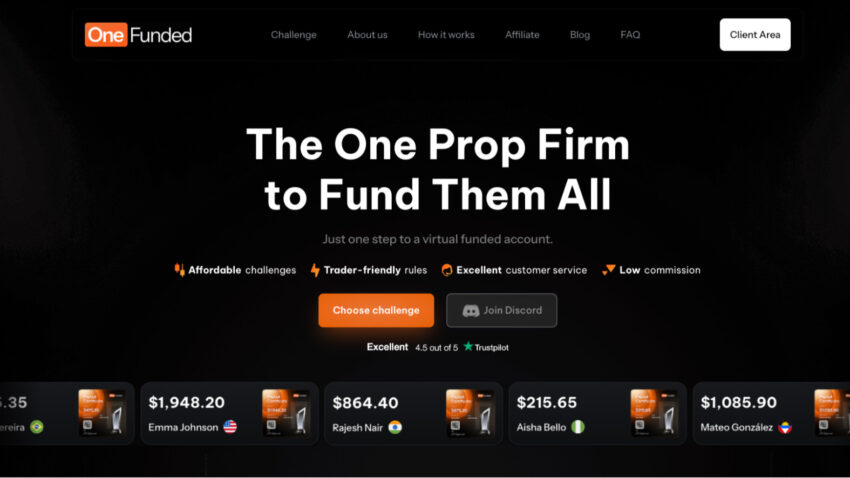
launched in 2024 under CEO Anastasiia Kaplunenko. Kaplunenko is a fintech professional who built the firm around a specific frustration: hidden rules, delayed payouts, and opaque evaluation conditions that made trading harder than it needed to be. The firm operates globally through OneFunded Capital Ltd., registered in Saint Lucia. Its UK operations are handled by Brynex Tech Limited in London.
Challenges and evaluation processes
You can choose among four challenge tracks on OneFunded, including Value, Core, Flex, and Flash. Each program is built around a different risk profile, but one rule applies to all four: no time limits of any kind.
| Challenge Type |
One-Off Fee |
Account Sizes |
Profit Target |
Max Daily Drawdown |
Max Total Drawdown |
Min Trading Days |
| Value (2-Step) |
$16-$137 |
$2K-$50K |
6%/6% |
4% |
8% |
4 per phase |
| Core (2-Step) |
$45-$650 |
$5K-$200K |
8%/5% |
5% |
10% |
3 per phase |
| Flex (2-Step) |
$54-$780 |
$5K-$200K |
7%/4% |
4% |
10% |
3 per phase |
| Flash (1-Step) |
$29-$715 |
$2K-$200K |
10% |
4% |
6% |
5 total |
The Value track starts at $16 for a $2,000 account. And for the Flex track, it is worth noting that it is the only track that carries no consistency rule during evaluation. This ensures that traders have more freedom in how their profits are distributed across days.
Spreads, fees, and payouts
Challenge fees translate to between $16 and $780. This means even the largest Flex account is accessible without a significant upfront commitment.
- Profit split: 80% to the trader as standard; upgradable to 90% via paid addon
- Spreads and commission: Viewable directly on the platform in demo mode before purchasing a challenge.
- Payout schedule: 14-day cycle; weekly payouts available via a paid addon. Minimum payout is $100 with 24 hour processing time.
- Payout methods: Crypto, bank transfer, and Rise.
- Fee refund: The challenge fee is refunded alongside your first payout
What you can trade and at what size
OneFunded provides access to 250+ instruments, including 55+ forex pairs, 150+ American and European stock CFDs, 15+ global indices and metals, and 15+ cryptocurrencies.
| Asset Class |
Leverage |
| Forex |
1:100 |
| Commodities and Indices |
1:30 |
| Cryptocurrencies |
1:2 |
Trading software and tools
OneFunded supports three platforms, each available on web, desktop, iOS, and Android:
- TradeLocker: Integrated with TradingView for charting. It is accessible globally, including the UK and suited to manual traders
- cTrader: Available to the UK traders and offers advanced order execution and full market depth.
- MT5: Available to the UK traders and supports automated trading through EAs and provides the widest analytical toolkit of the three platforms.
Rules every trader must follow
- Algorithmic trading: EAs are permitted but require pre-approval. Prohibited practices include latency arbitrage, reverse arbitrage, tick scalping, gap billing, data freezing, and the use of delayed or external data feeds.
- News trading: Permitted across all four tracks and in funded accounts. However, a 5-minute window applies around scheduled high-impact events.
- Weekend and overnight trading: Positions may be held overnight and over weekends but swap fees may apply.
- Consistency rule: Applies to Value (40% cap on best-day profit), Core (50%), and Flash (50%) during evaluation. The Flex track has no consistency rule although in the funded phase, a 30% cap applies across all tracks.
Reputation and trader experience
OneFunded holds a Trustpilot rating of 4.4/5 from 205 reviews. It has 64% five-star and 23% four-star ratings. Reviewers most consistently highlight the absence of time limits, fast crypto payouts, transparent rules, and responsive support.
The firm previously operated as Prop365 before rebranding, and several reviews reference continuity of service through that transition. Negative reviews focus mainly on a small number of consistency rule disqualifications and occasional KYC delays, both of which the firm addresses directly on Trustpilot. It has replied to 88% of negative reviews, typically within 48 hours.
The firm’s community is active on Discord, X, Facebook, and Instagram. And support is reachable via email at support@onefunded.com, chat, and through the contact page on the website.
Our assessment
OneFunded checks all the important boxes when looking for a prop firm that accepts UK traders. The entry fee is one of the lowest on this list, all four challenge tracks run on unlimited time, and payouts below $1,000 are processed in crypto by default, which is the most practical route for traders receiving foreign earnings. The rules are written plainly, the Flex track removes the consistency rule entirely, and the challenge fee comes back with the first payout.
It suits beginner traders who trade part-time, are making their first funded account attempt, or want a low-cost, low-pressure environment to build a consistent track record before moving to larger account sizes.
2. FTMO
FTMO has been operating from Prague, Czech Republic, since 2015. This is the longest-established firm in this guide and one of the most recognized names in funded trading globally. The firm runs two challenge tracks on unlimited timeframes and offers a free trial for traders to test the platform.
Challenges and evaluation processes
FTMO offers two paths to a funded account, both with no time limit on the evaluation.
| Challenge Type |
Fee from |
Account Sizes |
Target |
Max Daily Loss |
Max Loss |
Min Trading Days |
Avg. Reward |
Fee Refund |
| 2-Step |
€89 |
$10K-$200K |
10%/5% |
5% |
10% |
4 per phase |
Up to €12,234 |
Yes (100%) |
| 1-Step |
€79 |
$10K-$200K |
10% |
3% |
10% |
– |
90% profit split |
No |
Spreads, fees, and payouts
- Profit split: 80% standard on both tracks; 90% via the Scaling Plan once certain account growth milestones are reached.
- Spreads: Tight; major pairs like EURUSD regularly trade near 0.1 pips on MetaTrader during active sessions.
- Commission: All standard forex pairs carry a commission of $5 per lot per side ($10 round-trip).
- Payout schedule: Bi-weekly; average processing time of approximately 8 hours from request to completion.
- Payout methods: Bank wire, Skrill, crypto, and Visa Direct (up to $20,000)
- Scaling ceiling: Up to $2M through the Scaling Plan
What you can trade and at what size
FTMO covers forex, indices, commodities, metals, and cryptocurrencies across all accounts.
- Forex: Major, minor, and exotic pairs; leverage up to 1:100
- Indices: Global indices including US30, US100, US500, and EU equivalents; leverage up to 1:20
- Commodities and metals: Gold, silver, oil; leverage up to 1:10
- Cryptocurrencies: Bitcoin, Ethereum, and others; leverage up to 1:2
Trading software and tools
FTMO supports MetaTrader 4 and 5, and cTrader. All three platforms are available for both the 1-Step and 2-Step FTMO Challenges as well as funded FTMO Accounts, and can be selected directly in the challenge configurator.
Every FTMO account includes a built-in toolkit, which includes FTMO Academy, Psychology Course, Account MetriX performance tracker, Equity Simulator, Trading Journal, Economic Calendar, and News Indicator.
Rules every trader must follow
- Algorithmic trading: EAs are permitted on all accounts. The only restriction is a cap of 2,000 server requests per day per account.
- News trading: Unrestricted during both evaluation phases.
- Overnight and weekend holding: Permitted during evaluation on both tracks. On a funded Standard account, positions must be closed before the weekend market rollover.
- Gap trading: Prohibited.
Reputation and trader experience
FTMO holds a Trustpilot rating of 4.8/5 from 41,020 reviews. This is the highest review volume of any firm in this guide, and the most statistically reliable reputation signal as a result. Reviewers highlight transparent rules, fast payout processing, and responsive multilingual support. Negative reviews are rare and mostly relate to account closures for rule violations, which FTMO addresses publicly on Trustpilot.
The firm’s community spans Discord (116K+ members), YouTube (417K+ subscribers), Instagram (551K followers), X (139K followers), and Facebook (272K followers). Support is available 24/7 via live chat, WhatsApp, email at support@ftmo.com, and phone, in 20 languages.
Our assessment
FTMO’s strength is its track record and the tools it bundles with every account. A decade of consistent operation, over $500 million paid in rewards globally, and more than 41,000 Trustpilot reviews give it a credibility floor that newer firms cannot match. That matters if you are committing meaningful capital to a challenge fee.
That said, this firm suits experienced traders who prioritize a long operational history, built-in analytical tooling, and platform flexibility above all else.
3. RebelsFunding
RebelsFunding was founded in 2023 by Marek Soska and is headquartered in Bratislava, Slovakia. The founding team has been trading financial markets since 2008 and launched a trading education business in 2015 before creating RebelsFunding. The firm says on its website that it has distributed over $3 million in rewards to more than 30,000 traders globally. RebelsFunding offers the widest range of program tiers on this list.
Challenges and evaluation processes
| Program |
Phases |
Fee |
Account Sizes |
Profit Target |
Daily Drawdown |
Max Drawdown |
Fee Refund |
| Copper |
4 |
From €9 |
$1K-$320K |
5% per phase |
5% |
10% |
200% |
| Bronze |
3 |
From €37 |
$5K-$160K |
5% per phase |
5% |
10% |
150% |
| Silver |
2 |
From €45 |
$5K-$80K |
8%/5% |
5% |
10% |
100% |
| Gold |
1 |
From €68 |
$5K-$40K |
10% |
None during eval; 4% on funded |
6% |
– |
| Diamond |
10-level |
From €156 |
$5K-$20K initial; scales to $530K |
10% per level |
None |
6% |
100% after Level 0 |
Spreads, fees, and payouts
- Profit split: 75-90% across all programs; the starting rate and scaling conditions vary by tier.
- Spreads: The average spread on major forex pairs sits at around 0.9 pips, while top shares average between 0.5 and 1.0 pips. Across the full instrument range, spreads start from as low as 0.3 pips.
- Commission: RebelsFunding charges a flat $2 per $100,000 traded across all asset classes.
- Payout schedule: Your first withdrawal becomes available 14 calendar days after placing your first trade on the funded account. All further withdrawals can be submitted every 14 days.
- Payout methods: Bank wire transfer, crypto, PayPal, Wise, Revolut, Venmo (only for US-based traders), physical checks, and Credit/Debit Cards.
- Scaling: Account grows up to 200% of the initial value on Copper, Bronze, and Silver upon meeting profitability milestones; Diamond scales to $530K through 10 levels.
What you can trade and at what size
RebelsFunding covers the following asset classes:
- Forex: 40 pairs with 28 swap-free pairs
- Metals: 4 instruments, with 4 swap-free
- Energies: 2 instruments (WTI Oil and Natural Gas)
- Cryptocurrencies: 7 instruments including Bitcoin and Ethereum
- Equities: 10 individual stocks
- Indices: 8 instruments including NASDAQ and S&P 500
The minimum lot size across all instruments is 0.01 lots, and RebelsFunding requires consistent position sizing. And leverage is tiered; see the table below:
| Asset Class |
Evaluation Leverage |
RCF (Funded) Leverage |
| Forex – Majors |
1:200 |
1:100 |
| Forex – Crosses |
1:150 |
1:50 |
| Forex – Exotics |
1:100 |
1:25 |
| Metals |
1:25 |
1:15 |
| Indices |
1:25 |
1:15 |
| Energies |
1:5 |
1:5 |
| Equities |
1:2.5 |
1:2.5 |
| Cryptocurrencies |
1:2.5 |
1:2.5 |
Trading software and tools
RebelsFunding uses a single proprietary platform, RF-Trader, built on TradingView charts and connected directly to liquidity providers. It is available on web, desktop, iOS, and Android. The platform has a built-in lot size and dollar-risk calculator, which several reviewers specifically cite as useful for real-time position sizing. It also includes an AI Trader tool in the Client Zone that analyses your trading history and identifies strengths and weaknesses.
Rules every trader must follow
- Algorithmic trading: EAs are permitted across all programs
- News trading: Permitted across all programs; no restriction window stated
- Weekend trading: Positions can be held over weekends, but the firm cautions against it on cross pairs and less liquid instruments. And crypto trading is not available over weekends.
- Scalping: Permitted
- Overnight holding: Permitted on all programs
Reputation and trader experience
RebelsFunding holds a Trustpilot rating of 4.4/5 from 2,292 reviews, with 69% five-star and 15% four-star ratings. The firm replies to 96% of negative reviews, typically within 48 hours. Reviewers highlight affordable entry fees, fast payout processing, straightforward rules, and responsive support. The most recurring criticism across recent reviews is platform performance, specifically, slow load times on the RF-Trader app during peak market hours and periodic connectivity drops.
Our assessment
RebelsFunding’s fee refund model is a standout feature. Also, the range of five program tiers makes it one of the few firms on this list where a complete beginner and an experienced trader can both find a structurally appropriate starting point.
The firm suits traders who are confident in their pass rate and want the lowest net challenge cost over time. That is, the more programs you pass, the more of your fees come back.
4. CTI
City Traders Imperium has been funding traders since 2018 and operates from Dubai, UAE. It is the only firm in this guide that pays a monthly salary to its highest-performing funded traders. The firm offers four routes to funding and with a maximum allocation of $4 million.
Challenges and evaluation processes
All four programs run on unlimited time, and each carries a balance-based drawdown. This means losses are calculated against the account balance, not a floating equity high-water mark like many others. This gives traders more room to recover from open position drawdowns without breaching the limit.
| Program |
Entry Fee |
Account Sizes |
Profit Target |
Max Daily Loss |
Max Drawdown |
Min Profitable Days |
| 1-Step |
From $27 |
$2.5K-$100K |
8% |
– |
5% |
3 |
| 2-Step |
From $34 |
$2.5K-$100K |
10%/5% |
5% per phase |
10% per phase |
3 per phase |
| 3-Step (Pay-per-level) |
From $1 (Level 1 only) |
$2.5K-$100K |
3%/5%/7% |
2% per step |
4% per step |
3 per step |
| Instant Funding |
From $62 |
$2.5K-$80K (doubles on passing) |
10% to scale |
None |
6% |
None |
| Instant Funding Pro |
From $263 |
$5K-$80K |
10% to scale |
None |
6% |
None |
CTI also operates a VIP program that activates automatically as funded traders demonstrate consistent performance. This table provides the details:
| VIP Tier |
Profit Share |
Payout Frequency |
Additional Benefits |
| Bronze |
90% |
Weekly |
30% discount on all future purchases, VIP support, free 1-on-1 coaching |
| Silver |
100% |
Any time, on demand |
Free CTI merchandise, all Bronze benefits |
| Gold |
100% |
Any time, on demand |
Potential 1-year monthly salary, institutional trading conditions, custom funding terms, team membership |
Spreads, fees, and payouts
- Profit split: starts at 50% for Instant Funding (Level 1), 80% on evaluation programs from the first funded payout, and scales to 100% at Silver and Gold VIP tiers.
- Spreads: From 0.3 pips on EUR/USD
- Commission: $5 per lot round-turn on forex
- Payout schedule: Your first withdrawal becomes available after a minimum of 5 trading days on your funded account. In the VIP tier, payouts are weekly at Bronze, and any time on demand at Silver and Gold.
- Payout methods: Payouts are processed into a Personal Wallet inside the CTI dashboard and withdrawals are via bank wire transfer, cryptocurrency (USDT/TRX), Credit/Debit Card, PayPal.
- Scaling ceiling: $4 million through the VIP program
What you can trade and at what size
- Forex: 28 currency pairs; leverage 1:30 on evaluation accounts, 1:10 on Instant Funding
- Commodities: Gold, silver, and crude oil; leverage 1:10
- Indices: 13 global indices including US30 and DE40; leverage 1:10
- Cryptocurrencies: 6 assets including BTC/USD and ETH/USD; leverage 1:2
Trading software and tools
CTI supports MT5 and Match-Trader, both available across all platforms. In addition, traders get access to Account Metrix, Account Analysis, a Trading Journal, Risk Calculators, an Economic Calendar, and CTI Academy at no extra cost.
Rules every trader must follow
- Stop loss: Mandatory on every trade
- Copy trading: Prohibited across all programs and account types
- Gambling behavior: Prohibited
- News trading: Permitted across all programs without restriction
- Weekend and overnight holding: Permitted on all programs
Reputation and trader experience
CTI holds a Trustpilot rating of 4.3/5 from 1,683 reviews. 84% of the reviews are five-star and 9% four-star. The firm replies to 97% of negative reviews and typically within one week.
Positive reviews cite fast payouts (several reviewers report same-day processing), responsive multilingual support, and an easy-to-navigate dashboard. The recurring criticism is payout denials following what CTI characterizes as gambling behavior or stop-loss violations.
Our assessment
CTI’s strongest differentiator is the VIP program structure as a whole. The 3-Step pay-per-level program also removes one of the biggest barriers in prop trading, which is the psychological cost of paying a large upfront fee and failing early.
This firm suits disciplined traders who prefer manual processes and operate with defined risk parameters. These traders also want a clear, built-in progression toward higher payouts and better conditions without paying extra for each upgrade.
5. ThinkCapital
ThinkCapital is backed by ThinkMarkets, a broker regulated across multiple jurisdictions. The broker provides an infrastructure credibility that standalone prop firms cannot offer. Its rails support spreads, execution, and platform stability.
Challenges and evaluation processes
| Program |
Phases |
Entry Fee (from) |
Account Sizes |
Phase 1 Target |
Phase 2 Target |
Phase 3 Target |
Daily Loss |
Max Loss |
| Lightning |
1 |
$59 |
$5K-$100K |
10% |
— |
— |
3% (balance) |
6% trailing |
| Dual Step Intraday |
2 |
$59 |
$5K-$100K |
9% |
5% |
— |
4% (equity) |
7% fixed |
| Dual Step Swing |
2 |
$82 |
$5K-$100K |
9% |
5% |
— |
4% (balance) |
7% fixed |
| Nexus |
3 |
$39 |
$5K-$100K |
7% |
6% |
5% |
4% (balance) |
8% fixed |
All programs scale to $1 million on MT5 accounts and $1.5 million on ThinkTrader accounts. Every 10% return in a rolling three-month period triggers a 20% account size boost.
Spreads, fees, and payouts
- Profit split: 80% standard across all programs; upgradeable to 90% via addon or through the scaling plan
- Spreads: Traders are commission-free but with wider spreads on ThinkTrader. For MT5 accounts, raw spreads from 0.0 pips with commission.
- Commission: $4 per lot per side on MT5; zero on ThinkTrader
- Payout schedule: Bi-weekly standard; weekly payouts available via addon
- Payout methods: Crypto, RiseWorks, and Broker Profit Transfer
What you can trade and at what size
- Forex: 49 pairs; leverage dynamic up to 1:100 on Dual Step and Nexus; 1:30 on Lightning
- Indices: NAS100, GER40, and others; leverage up to 1:15
- Commodities: Gold, silver, and oil; leverage up to 1:30
- Cryptocurrencies: BTC/USD, ETH/USD, and others; leverage 1:2
Trading software and tools
ThinkCapital supports ThinkTrader and MT5, both accessible to beginner traders. The former is a proprietary platform with full TradingView integration. This means you can chart and execute trades directly from TradingView charts without switching windows, and without paying any commission. Also, all accounts come with access to a free trial before any paid commitment.
Rules every trader must follow
- News trading: A news trading addon is available for the Lightning and Nexus programs to remove this restriction on funded accounts. Dual Step Swing permits news trading by default
- Expert advisors: They are banned by default. Automated systems require purchasing the EA addon.
- Weekend holding: Permitted on Nexus and Dual Step Swing, and Lightning funded accounts; not permitted on Dual Step Intraday.
- No account rolling: Deliberately failing a challenge to restart is flagged and banned
- Gambling behavior: Accounts exhibiting reckless position sizing, described as oversized risk relative to account balance, are subject to a warning and potential reset.
Reputation and trader experience
The average rating for ThinkCapital on Trustpilot is 4.0/5 from 604 reviews. Of these, 75% are five-star and 15% are one-star ratings. Positive reviews cite fast and helpful live support, TradingView integration on ThinkTrader, tight gold spreads, and the credibility of ThinkMarkets’ regulated backing. On the other hand, some negative reviews describe accounts being terminated for “multiple profiles” following giveaway wins or near-payout milestones, with no specific evidence provided by the firm’s risk team. ThinkCapital’s responses to these reviews cite undisclosed risk team findings but do not address the individual claims in detail.
Our assessment
ThinkCapital is one of the two broker-backed firms in this list, and this is a major upside. Other advantages include TradingView integration on a commission-free platform, and low entry fees across three structured programs. This makes the firm ideal for traders who want the reliability of a regulated-broker-backed infrastructure at a budget entry point.
How the Eight Firms Compare
| Firm |
Max Capital |
Default Split |
Challenge Tracks |
Min Entry Fee |
Time Limit |
Crypto Payout |
Trustpilot |
| OneFunded |
$200,000 |
80% |
4 |
$16 |
None |
Yes |
4.4 |
| FTMO |
$2M |
80% |
2 |
€79 |
None |
Yes |
4.8 |
| RebelsFunding |
$530,000 |
75-90% |
5 tiers |
€9 |
None |
Yes |
4.4 |
| CTI |
$4M |
80% |
4 + VIP |
$1 |
None |
Yes |
4.3 |
| ThinkCapital |
$1.5M |
80% |
3 |
$39 |
None |
Yes |
4.0 |
*BrightFunded’s Trustpilot rating has been removed by Trustpilot due to a breach of its guidelines.
Conclusion
The right prop firm for a beginner trader is not the most popular one globally. It may also not be the one that advertises the juiciest profit share. Instead, the firm you should choose is one that works given your payout options, the cost in INR terms, how the evaluation is structured, and how clearly the rules are written. Those four filters eliminate a lot of options quickly.
That said, we have learned that no evaluation deadline, crypto payouts that bypass the friction of international bank transfers, entry fees that do not require a large capital commitment to get started, and rules written plainly enough are the most important hoops a firm must jump through. And by this point in the guide, you have already seen which firm fits this description.























































You must be logged in to post a comment Login