
Business
Why Experiences Are The Best Reward For Entrepreneurs


There’s a particular moment that many successful entrepreneurs recognise, even if they don’t always name it. The dream watch is added to the collection and the beautiful car sits in the garage.
The holiday home is completed and ready for use. But somewhere between the acquisition and the ownership, the satisfaction proved more fleeting than anticipated.
The spending behaviour of successful entrepreneurs suggests that the relationship between success and reward is undergoing a shift. Assets, while tangible and enticing with ROI, have a ceiling on the pleasure they deliver. Travel experiences, on the other hand, offer a deeper sense of satisfaction.
The Hedonic Treadmill, and How to Step Off It
Behavioural economists have a name for the pattern: hedonic adaptation. The principle is straightforward. However much pleasure a new possession delivers at the point of acquisition, that pleasure diminishes rapidly as the object becomes part of the familiar background of daily life. Over time, the watch becomes a watch. The special car becomes just a car.
Experiences work differently. Rather than blending into the background, they exist as moments in time, with a beginning and an end. And then they exist in memory, where they are processed, retold, and valued in ways that physical objects rarely are. Research has repeatedly demonstrated that experiential purchases generate more lasting satisfaction than material ones, across income levels. Among high earners, the effect is more pronounced still.
So, for entrepreneurs who have already acquired the obvious things, where does reward actually come from?
The Experience Economy, Upgraded
The answer is in the category of experiences that sit at the outer edge of what money can access, not because of their price point alone, but because of their genuine scarcity and the quality of what they demand from you.
A table at a two-Michelin-star restaurant is excellent. A private tour of a museum after hours is memorable. But neither requires anything of the person having it. The highest-performing experiences in the reward category share a different quality: they are active, immersive and genuinely uncommon. They produce a story that is personal and impossible to replicate.
Supercar driving tours have emerged, somewhat quietly, as one of the defining experiences in this category. The concept revolves around curated, fully managed driving journeys through some of the world’s most spectacular landscapes. Genuinely exhilarating, operationally seamless, and available to almost no one who hasn’t specifically sought it out.
What Supercar Touring Actually Involves
There’s a misconception that a supercar tour is a track day with better scenery. It isn’t.
The top operators in this space build journeys of multiple days across handpicked routes through the Dolomites, the Basque Country, the Swiss Alps, or across US destinations from Napa Wine Country to the canyon roads of Utah. Then there’s the vehicles: Ferrari, Lamborghini, McLaren, Porsche, Bentley. The accommodation at each overnight stop is boutique and destination-quality. The dining is exceptional. The group is small — typically a handful of vehicles — and every logistical wrinkle is handled seamlessly before departure.
There are numerous operators in the supercar tour space, offering different levels of curation, variety and expertise. HunterMoss is one of the space’s most established operators, having run luxury driving holidays across Europe for over a decade, and more recently, expanding into destinations across the US. Their experiences span everything from multi-day European Alpine loops to shorter US getaways built around the country’s most compelling driving regions.
Why This Resonates With Entrepreneurs Specifically
The entrepreneur who books a supercar tour is not, in most cases, doing so simply because they like fast cars. They’re doing so because of the particular quality of the experience it delivers, and that quality maps closely onto the psychological profile of someone who has built and run a business.
It demands active engagement. You cannot be passive in a supercar on an Alpine pass. The experience requires your undivided attention, your judgment, and a level of presence that most leisure travel doesn’t ask for. For people who find genuine relaxation in being fully switched on, who might return from a beach holiday feeling somewhat flat, this is the difference.
It is genuinely uncommon. Not in a manufactured exclusivity sense, but in the simple sense that very few people do this, because very few people know it exists at this level of curation. The stories it produces are not ones your peer group has already heard.
A Practical Note
For entrepreneurs considering this category for the first time, a few things are worth knowing.
The market is not homogeneous. There is a significant difference between a self-organised sports car rental and a fully curated driving tour with professional guidance, professionally and personally vetted accommodation, and the operational depth to handle whatever changes on the day. Curation quality varies considerably between operators.
The ideal entry point is a focused tour in a destination you already have some draw to. European Alpine routes (Switzerland, the Dolomites, Bavaria) offer the most concentrated combination of driving quality and scenery. US tours in Napa or Utah are the natural choice for those based or travelling in North America.
And it’s worth booking well ahead. The most in-demand tours are booked out typically over 12 months in advance because the group sizes are genuinely small by design.
The Return on Investment
Of course, there is a cost to this category of experience. It is not a budget purchase.
But the question that high performers increasingly ask is not what something costs in absolute terms, but what it returns in satisfaction and in memory. Measured against those metrics, a supercar tour through a stunning destination compares favourably to most things that cost considerably more and deliver considerably less.


AlexSecret/iStock via Getty Images
Technology rallied 5.24% on Thursday for its best day since April 9, 2025, when the sector surged 14.15% after the Tariff Tantrum. Tech had fallen 5.41% over the prior four trading days, and the rebound recovered more than 90% of that decline. By comparison, the

Kip Meintzer
Head of Global Investor Relations
Greetings, and welcome to the Check Point Software’s 2026 Second Quarter Financial Results Video Conference. I’m Kip E. Meintzer, Global Head of Investor Relations. And joining me today are Chief Executive Officer, Nadav Zafrir; and our Chief Financial Officer, Roei Golan.
Before we begin, I’d like to remind everyone that this conference is being recorded and will be available for replay on our website at checkpoint.com. [Operator Instructions] During the presentation, Check Point’s representatives may make forward-looking statements.
Forward-looking statements can relate to future events or future financial and/or operating performance. These statements involve risks and uncertainties that could cause actual results to differ materially from those projected in the forward-looking statements. Any forward-looking statements made only as of the date hereof, Check Point Software undertakes no obligation to update publicly any forward-looking statements except where required by law.
In our press release, which has been posted on our website, we present GAAP and non-GAAP results, along with the reconciliation of such results, as well as

The e-commerce and cloud titan posted its strongest cloud growth in over four years, indicating a fresh wave of demand that justifies its 10% increase in planned capital spending for 2026 to $220 billion.
Amazon’s results come as a resounding sign to Wall Street that some of Big Tech’s AI investments are already generating measurable returns.
If gains hold, the stock could add more than $340 billion in market value on the back of a 37% jump in second-quarter cloud revenue. Earlier this week, Microsoft surged more than 15% after its cloud unit beat estimates with a 43% revenue jump.
However, there’s a growing divide in investors’ tolerance for the ever-increasing AI spend by Big Tech, set to exceed $730 billion this year.

“The market is no longer questioning whether AI demand is real. The new dividing line is whether unprecedented spending is producing visible, near-term revenue and margin expansion,” said Bill Birmingham, managing director at REX Financial.
“The market penalizes spending when monetization is delayed, indirect or difficult to measure.” Meta and Google-parent Alphabet both slumped 7%, despite strong growth in revenues, after the companies raised their capital spending forecasts while free cash flows cratered.
“Amazon is earning the right to keep spending. Where others are asking investors to trust that the payoff will come, Amazon showed it this quarter,” said Thomas Monteiro, senior analyst at Investing.com.
“As long as AWS keeps accelerating and margins hold, the market looks willing to fund the build-out, even with free cash flow in the red.”
Amazon’s free cash flow swung sharply negative in the quarter, with the company burning $7.6 billion on a trailing 12-month basis, versus $18.2 billion in positive free cash flow a year earlier.
Still, CEO Andy Jassy reassured investors that Amazon is only pouring money into serving demand that already exists. He said a majority of available Amazon cloud capacity for 2027 and some capacity for 2028 had already been reserved by customers.
Chris Ballard, managing partner at Check Capital, said Amazon’s approach to spending was “methodical and responsible.”
“This level of capital deployment is all very new, so Amazon showing immediate results is a really good sign.”
At least 15 brokerages raised their price targets on the stock following results.
Amazon trades at a price-to-earnings ratio of 24.67, compared with Microsoft’s 22.94 and Alphabet’s 19.35.
Business
Aluminium signals recovery after correction; supply risks and energy concerns may drive the next leg higher

The recent rebound has been supported by tightening global inventories, concerns over energy availability in key producing regions, geopolitical tensions in the Middle East, and expectations of robust demand from the power, transportation, renewable energy, and electric vehicle sectors. Additionally, China’s production constraints and growing global emphasis on electrification continue to reinforce the long-term bullish outlook for aluminium, a metal increasingly regarded as one of the most strategic industrial commodities alongside copper.
Factors Currently Supporting Aluminium Prices
Several factors have tilted market sentiment in favour of aluminium. The foremost among them is the growing expectation of a tighter global supply balance. There are estimation that the global aluminium market has moved from surplus conditions seen in previous years towards a marginal deficit as demand growth continues to outpace supply expansion. Electrification trends, including electric vehicles, solar installations, battery infrastructure, and grid modernization projects, are generating sustained demand growth across major economies. At the same time, aluminium smelting remains one of the most energy-intensive industrial activities, making production vulnerable to fluctuations in power costs and energy availability. China’s production restrictions and limited capacity additions elsewhere have further strengthened market fundamentals.
Impact of US-Iran Tensions
The recent escalation in tensions involving the US and Iran has emerged as a significant driver for aluminium prices. While Iran is not among the world’s largest aluminium exporters, any conflict affecting the Persian Gulf region raises concerns about the continuity of raw material shipments and finished metal exports. The Strait of Hormuz remains one of the world’s most critical maritime chokepoints. Disruptions to shipping routes can delay alumina supplies and increase freight and insurance costs, thereby affecting aluminium production economics.
Furthermore, gulf producers including Bahrain, Qatar and the UAE are major aluminium suppliers to international markets. Any prolonged geopolitical instability in the region could trigger a renewed supply squeeze and exert upward pressure on prices.
Global Supply-Demand Scenario
The global aluminium market is witnessing a gradual transition from comfortable supply conditions to tightening availability. China remains the world’s largest producer, accounting for nearly 60% of global output. Demand continues to be driven by transportation, construction, packaging, electrical infrastructure and renewable energy sectors. The rapid expansion of electric vehicle manufacturing and investments in power transmission infrastructure have emerged as the primary demand drivers. With inventories remaining relatively tight and new capacity additions lagging demand growth, the market is becoming increasingly sensitive to any supply disruptions.
China’s Dominant Role in the Market
China remains the single most important variable for aluminium prices. The country produces approximately 58-60% of global aluminium output and is also its largest consumer. However, Beijing’s production cap of around 45 million tonnes has prevented unrestricted expansion of smelting capacity. Environmental regulations, carbon-emission targets and energy consumption limits have restricted production growth in several provinces.
Despite weakness in the property sector, demand from automobiles, solar energy, power grids and energy storage projects has remained robust. As long as Chinese production growth remains constrained while domestic demand continues to expand, global aluminium prices are likely to remain well supported.
India’s Position and Deficit Concerns
India is among the world’s leading aluminium producers, with companies such as Hindalco and Vedanta playing important roles in the global market. While the country is not expected to face a severe aluminium shortage in the near term, domestic demand is rising rapidly. If global prices continue to rise and imports become costlier because of logistics disruptions, Indian consumers may face higher procurement costs. This could eventually increase production costs across various sectors. Although a sharp physical deficit is unlikely immediately, tighter market conditions could translate into higher prices for aluminium-intensive goods.
Price Outlook for the Rest of the Year
Looking ahead, the outlook remains constructive. The combination of geopolitical uncertainty, energy market volatility, constrained Chinese supply growth, and structurally rising demand from electrification trends continues to favour higher prices. For MCX aluminium, while intermittent corrections cannot be ruled out, the broader trend remains positive as long as supply-side risks persist. If Middle East tensions escalate further or energy prices witness another sharp spike, aluminium could witness a stronger-than-expected rally in the second half of the year. Conversely, a significant increase in Chinese production or a slowdown in global industrial demand may cap gains.
(The author is Head of Commodity Research, Geojit Investments Limited)

Why did the Japanese yen collapse in 2026?

Form 144 Meta Platforms For: 1 August

Ra capital management, 10% owner, acquires $455,725 Artiva stock
The drop, if sustained, would mark the stock’s worst day since the pandemic-driven selloff in March 2020. It would erase nearly $500 billion from Apple’s market capitalization and return the crown of the world’s most valuable company to AI chip giant Nvidia, days after reclaiming it.
Tim Cook, widely hailed as a supply-chain genius, called the shortages “very significant” and said Apple had limited options to address them, speaking on his final earnings call as CEO before handing the reins to John Ternus in September and becoming executive chairman.
“If even at Apple’s scale they are saying they are out all supply chain flexibility, it’s really bad for everyone,” said Ben Bajarin, CEO of tech consultant Creative Strategies.
Big Tech has been scooping up advanced chip-making capacity and memory chips to power its AI data centers, sparking shortages and price increases that are expected to shrink both the personal computer and smartphone markets this year.
Apple had cushioned some of the blow from surging memory costs by drawing on stockpiled inventory, but Cook said that the buffer was fading and shortages of processors were keeping it from meeting strong demand for iPhones and Macs.
Its forecast on Thursday for revenue growth of between 9% and 11% in the current quarter fell short of Wall Street’s roughly 12% estimate, and softer growth in its services business also overshadowed otherwise strong June-quarter results.
SERVICES WEAKNESS WORRIES INVESTORS
The services weakness worried investors as it came during a stretch of strong iPhone sales, which typically feed the business that takes a cut of App Store purchases and includes everything from Apple Music to Apple TV.
That slowdown could deepen if iPhone sales take a hit from a price increase that many analysts expect during the launch of the new lineup, which typically happens in September.
“Apple’s leverage over the supply chain appears to be in question and it’s not clear that AI is serving as any measurable tailwind to products or services, with its future monetization impact still uncertain,” Morgan Stanley analysts said.
“In fact, one could argue App Store softness might even be a result of AI re-prioritizing customer time.”
Still, some analysts said that the iPhone has weathered price hikes before without denting demand significantly and that a recent U.S. leasing deal with Klarna that offers monthly plans for Apple’s devices could soften the blow.
At least four brokerages cut their targets for the company’s stock price, while three raised. That moved the median view to $330, which is $3 lower than the last closing price, according to LSEG data. The stock has risen 22.7% this year as of Thursday’s close.
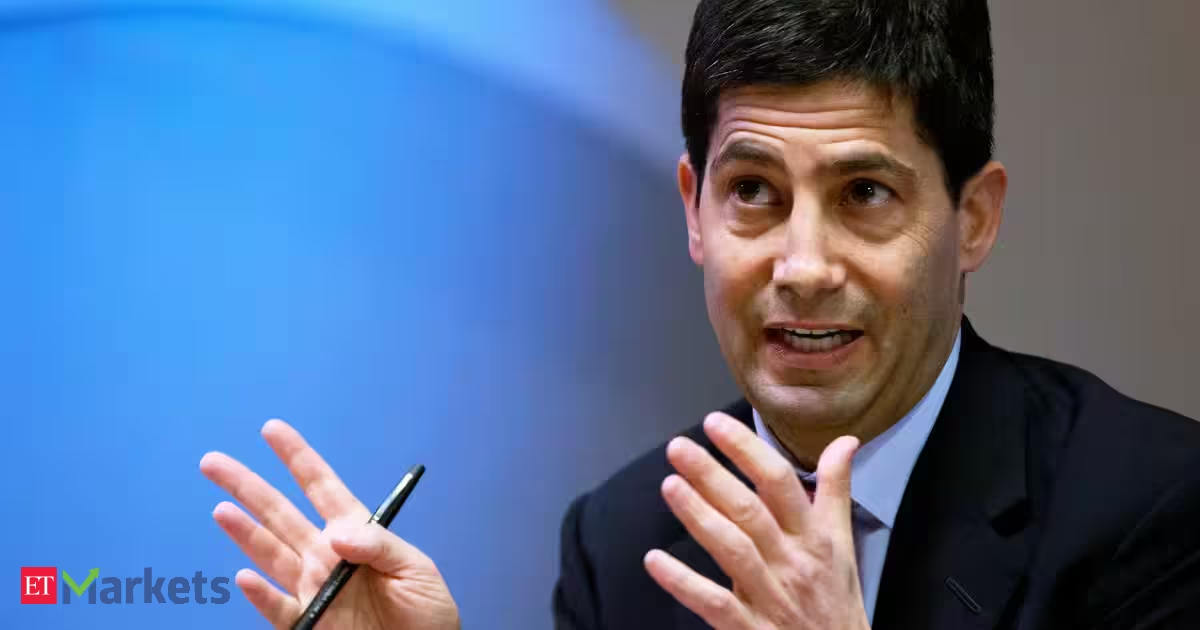
Complicating matters was Warsh’s hint that he may try to switch up the Fed’s yardstick for successfully containing inflation, for years defined as a 2% year-over-year rise in the Personal Consumption Expenditures Price Index. “That’s our number, we’re sticking with it,” Warsh said in a press conference after the end of a two-day policy meeting, before adding, “Who knows, come after next January, what we might say about strategy. I suspect the task forces might have something to add.”
Warsh handpicked 15 outside experts in May to deliver recommendations by the end of 2026 on the Fed’s conduct of monetary policy, including its inflation framework. Warsh said on Wednesday he will check in with them in the next couple of weeks and may share any thoughts that are “ready for prime time” at the Fed’s global central bankers’ conference in Jackson Hole, Wyoming. Past Fed chiefs have used that late-August meeting to prefigure what the central bank may do at its meetings in September. Warsh has so far stuck to his promise to provide no guidance on the Fed’s likely rate path. The combination of Warsh’s repeated assertions of the need to tame inflation with no action to move it toward the 2% target and a hint that the goalposts themselves may change helped send 30-year Treasury yields above 5.2% on Wednesday, a 19-year high. They extended their rise on Thursday.
“That’s almost seen in that building as the markets voting ‘no confidence’ on the Fed and the Fed’s willingness and capacity to bring inflation down,” said Nathan Sheets, the global chief economist at Citigroup. “He highlighted a problem and gave no strategy for solving it other than, ‘I’m a hawk, trust me,’ and the markets wanted more than that,” said Sheets, who worked at the Fed for 18 years. “I think part of it is if you lean too far into future hikes, then he’s disappointing the White House. And it is a balancing act between Warsh the hawk, which he is, and trying to stay on sides relative to 1600 Pennsylvania Avenue.” Sheets said Warsh will need to make a choice by September.
THE BREWING STORM
Warsh’s colleagues are already calling for action. Three of the Fed’s 12 voting policymakers dissented on Wednesday against the decision to leave the central bank’s benchmark interest rate on hold in the 3.50%-3.75% range. On Friday they and any others at the table are free to have their say, and analysts expect a deluge of commentary, given what Sheets called the “absolute red flag” of rising long-term bond rates. “While Warsh may try to constrain the Fed’s official communications and substitute ‘talk’ for action while waiting for ‘task forces’ to return a verdict, the regional Fed presidents, and perhaps members of the Board (of Governors), are willing to discuss their views in the open and will be doing so over the next few days and weeks,” said Thierry Wizman, global FX & rates strategist at Macquarie Group. “We expect them to do a lot of damage control, and to highlight how they, if not Warsh, are ready to tighten policy.” Before the Fed’s meeting this week, some policymakers including two of those who dissented on Wednesday – Dallas Fed President Lorie Logan and Cleveland Fed President Beth Hammack – had signaled their discomfort with leaving rates unchanged despite rising inflation. Others who voted with Warsh on Wednesday to keep rates on hold, including Fed Governors Christopher Waller and Lisa Cook, have said they too may call for rate hikes if they don’t see improvement in inflation soon. The U.S. Bureau of Economic Analysis reported on Thursday that PCE inflation eased in June to 3.7% from 4.1% in May, and underlying core inflation rose 3.3% last month after advancing 3.4% in May. The slight improvement had been widely anticipated after the release of other inflation data earlier this month, and policymakers have said they are worried about renewed upward price pressures due to the ongoing Middle East conflict and surging investment in technology related to artificial intelligence. Business spending on equipment increased at a 15.2% pace in the second quarter, the BEA said in a separate report on Thursday, marking a second straight quarter of double-digit growth. Trump so far has refrained from attacking Warsh for not delivering lower rates, blaming the new Fed chief’s fellow board members instead. “Board members have put Warsh on notice they intend to push for a hike in September if inflation does not meaningfully ease over the summer,” Tim Duy, chief U.S. economist at SGH Macro Advisors, wrote in a note. “If Warsh is indeed a dove in hawk’s clothing, he will not have as much support on the board to hold rates steady again in the face of persistently high inflation.”
BlackRock, a 10% owner, sells $3.1m in York Space Systems stock

Galaxy could be most comfortable on counter vs. FC Dallas

How to watch Chelsea FC vs Tottenham: TV channel and live stream for pre-season friendly today

The Tech Tide Turns | Seeking Alpha


-
 Sports5 days ago
Commonwealth Games boxing: Jadumani Singh seals dominant 5-0 win over Pakistan’s Sumama Rehman to enter quarter-finals | Commonwealth Games News
-

 Business2 days ago
Why Trees Belong on the Risk Register
-

 Fashion12 hours ago
Weekend Open Thread: Wit & Wisdom
-

 Tech5 days ago
Intel is reversing course and bringing hyper-threading back to its server chips
-

 Politics8 hours ago
Meta enters AI-training agreement with far-right ‘propaganda rag’ Newsmax
-

 Crypto World6 days ago
Ripple bought a bank in pieces. The $4 billion audit
-

 Politics5 days ago
Luke Littler dismantles Gerwyn Price to retain title in Blackpool
-

 Politics4 days ago
The Part of the Electric Transition Nobody Wants to Discuss
-

 News Videos5 days ago
BITCOIN JUST ENTERED THIS CRITICAL ZONE…
-

 Crypto World6 days ago
XRP Ledger adds $2.6B as RWA inflows rank second
-
 Entertainment3 days ago
‘Stargate’ Creator’s New Sci-Fi Series Returns for Season 3 Tomorrow
-

 Business3 days ago
Major shareholder moves on Canyon
-

 Politics6 days ago
Spain sweeps the board at 2026 World Cup with individual awards
-

 News Videos2 days ago
Bitcoin Enters the 3rd Stage of the Bear Market
-

 Entertainment6 days ago
Sara Gilson Killed By Husband After Viral “Pedophile” TikTok Video
-

 Crypto World3 days ago
Kraken Enables Retail Access to Jersey Mike’s IPO via Tokenized Shares
-

 Tech4 days ago
New macOS Sequoia & Sonoma security updates for older Macs
-

 News Videos3 days ago
Claude: Build Financial Dashboards in Minutes (2026)
-

 Politics2 days ago
Luke Littler’s dominance sparks GOAT debate
-

 Crypto World6 days ago
Upbit expands KRW market with two major DeFi token listings
You must be logged in to post a comment Login