
Business
Will Bitcoin Reach $100,000 Again in 2026? Analysts Remain Divided as Price Surges Toward $78,000 This Month


Bitcoin’s dramatic price swings throughout 2026 have left forecasters sharply divided over whether the cryptocurrency will reclaim the $100,000 threshold before the year ends, with predictions ranging from continued sub-$50,000 declines to bullish targets well above $150,000, even as a powerful rally this week has renewed hope among bulls.
The cryptocurrency has surged nearly 22% over the past five trading days, climbing above $77,000 as of Friday, according to multiple market trackers, its highest level since early June. That rally has been driven by a combination of U.S. Treasury moves to expand long-term bond buybacks, renewed optimism around pending crypto legislation known as the CLARITY Act, and a wave of short-position liquidations across derivatives markets. Even with that advance, bitcoin remains well below its October 2025 all-time high of $126,000, a peak from which the cryptocurrency has fallen more than 50% at various points this year, briefly touching a 21-month low near $58,000, according to CoinGecko.
That volatility underscores just how uncertain the path to $100,000 remains, even among analysts who believe it is achievable. Standard Chartered has forecast bitcoin reaching $100,000 by year-end, according to KuCoin, while other institutions have offered considerably more bullish targets: Arthur Hayes of Maelstrom projected $125,000, Ripple CEO Brad Garlinghouse forecast $180,000, and JPMorgan analysts set a target of $170,000, based on the premise that bitcoin’s role in institutional portfolios could increasingly resemble that of gold. Fundstrat’s Tom Lee projected a range of $150,000 to $200,000, while Strategy Executive Chairman Michael Saylor has continued articulating a far longer-term thesis in which bitcoin eventually absorbs significant value from gold, real estate and other traditional stores of value, potentially reaching multimillion-dollar valuations over a longer time horizon.
Not every forecaster has shared that optimism. Crypto market analyst Aralez, publishing detailed monthly price projections in early June, argued bitcoin remained in a persistent bear market that had not yet reached its final bottom. According to Memeburn’s breakdown of his forecast, Aralez projected bitcoin would complete a bearish move toward $60,000 in June, before falling further to around $53,000 in July. He anticipated a short-lived relief rally into the $65,000 to $68,000 range by August, one he cautioned could prove to be a “bull trap” rather than a genuine recovery, with his model pointing to a final capitulation low near $46,000 in October before a broader Q4 recovery that he projected could ultimately push bitcoin back toward $100,000 by year-end.
Other on-chain analysts have offered similarly cautious near-term outlooks. According to Memeburn, on-chain analyst Ali Martinez predicted a bear market bottom around October 2026, in the range of $37,500 to $38,000, a considerably lower floor than some of the more optimistic institutional forecasts circulating earlier in the year.
Prediction markets have offered a more skeptical read on bitcoin’s odds of reaching six figures again this year. According to a Motley Fool analysis citing the Polymarket platform, bitcoin had only a 17% chance of reclaiming the $100,000 level in 2026 as of that assessment, compared with a 35% chance of falling below $40,000, a 15% chance of dropping below $30,000, and a 7% chance of crashing below $20,000. Those odds reflected a period earlier this year when bitcoin was down nearly 30%, a stretch the Motley Fool described as “one of the most disappointing” years for bitcoin investors in the cryptocurrency’s history at that point, even as the outlet’s own analyst maintained a contrarian view that a recovery to $100,000 remained achievable given bitcoin’s historically cyclical trading patterns.
CNBC’s survey of institutional forecasts published in January offered a broader sense of how widely predictions have varied even among professional analysts. Bernstein’s Gautam Chhugani argued that 2026 could prove to be a strong year for bitcoin, supported by potential interest rate cuts and a more accommodating regulatory environment for cryptocurrency, while cautioning that “heightened volatility is likely amid ongoing macroeconomic and geopolitical uncertainties.” CNBC noted that Chhugani’s track record on prior-year forecasts had been mixed; his December 2024 prediction that bitcoin could fall to around $80,000 in 2025 proved accurate, while his separate forecast that bitcoin could trade between $180,000 and $190,000 that same year did not materialize.
At the more extreme end of the forecasting spectrum, some crypto industry figures have projected valuations far beyond $100,000. Blockstream co-founder Adam Back and JAN3 CEO Samson Mow have both suggested bitcoin could eventually reach $1 million, according to KuCoin, forecasts that represent a small but vocal segment of long-term bitcoin maximalists whose price targets extend well beyond the more conventional institutional projections offered by firms such as JPMorgan and Standard Chartered.
Underlying much of the disagreement among forecasters is genuine uncertainty over several key macroeconomic variables that could significantly influence bitcoin’s trajectory over the remainder of the year, including the pace and scale of Federal Reserve interest rate decisions, whether Congress advances the stalled CLARITY Act establishing clearer regulatory boundaries for digital assets, and how broader geopolitical developments, including the ongoing conflict between the United States and Iran, continue to influence investor appetite for risk assets more generally.
The scale of bitcoin’s volatility this year has itself become a central theme of coverage on the topic. CoinGecko’s analysis noted that a widely cited $143,000 price target circulating earlier in the year “once looked compelling on its own terms,” but that the intervening months instead saw bitcoin fall more than 50% from its October 2025 peak before beginning to recover, illustrating that “whatever target an analyst is calling for, the path there is unlikely to be a straight line.”
Given the current rally’s strength, bitcoin’s proximity to $78,000 puts it roughly 22% below the $100,000 threshold as of this week, a gap that would require sustained additional gains, rather than a single dramatic move, to close before the end of the year. Whether the current rally proves durable or gives way to renewed volatility, as several analysts have cautioned could happen, remains the central question shaping bitcoin’s prospects of reclaiming six-figure territory in 2026. As with any highly volatile asset, none of the price targets discussed here should be treated as guaranteed outcomes, and anyone considering an investment decision based on bitcoin’s price trajectory should weigh the significant disagreement among professional forecasters alongside their own research and risk tolerance.


Mexican governor, indicted by US on cartel charges, requests leave again amid backlash

Recent initial public offering Hinge Health (HNGE) is the IPO Stock Of The Week as it continues to rebound from a key support level, while new entries are within striking distance. The healthcare stock also sits on Investor’s Business Daily’s IPO Leaders screen. The San Francisco-based company offers online physical therapy and pain care for muscles and joints. It’s also…
Copyright ©2026 Investor’s Business Daily, LLC. All rights reserved. 87990cbe856818d5eddac44c7b1cdeb8

A half-dozen copper mining stocks broke out from bases Friday as prices for the red metal hold firm and are likely to stay elevated due to pressures on both supply and demand, analysts say. Copper prices are trading near record highs and various sources of copper are strained worldwide. Copper production in Chile and Peru — two of the largest…
Copyright ©2026 Investor’s Business Daily, LLC. All rights reserved. 87990cbe856818d5eddac44c7b1cdeb8
Business
TSMC Completes 1.6nm A16 Chip Process, Widening Technology Gap With Rival Samsung Electronics Ahead of Q4
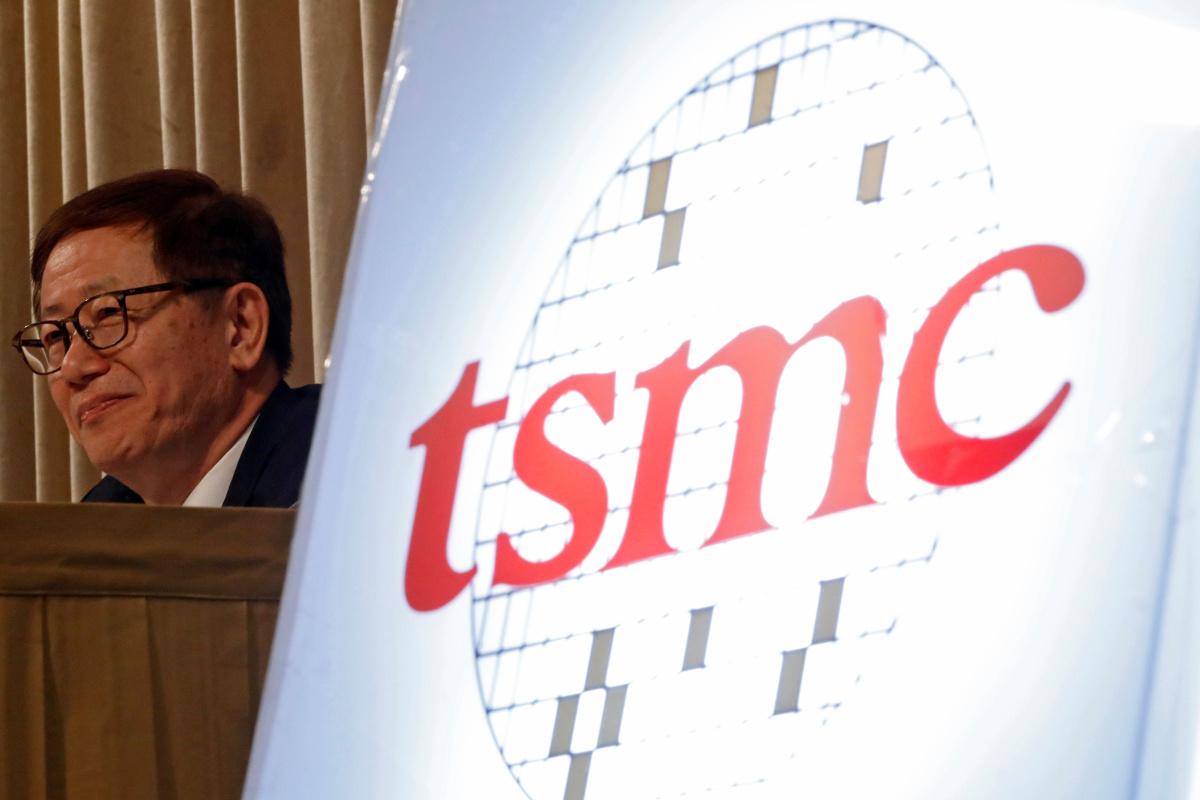
Taiwan Semiconductor Manufacturing Co. has completed development and verification of its next-generation 1.6-nanometer-class chip manufacturing process, positioning the world’s largest contract chipmaker to widen its technological lead over rival Samsung Electronics as both companies race to power the next generation of artificial intelligence hardware.
According to a report from Liberty Times, cited by ChosunBiz on Aug. 20, TSMC has finished development and validation of its angstrom-class A16 process and expects to begin mass production during the fourth quarter of 2026. The timeline aligns with TSMC’s own previously published guidance, which had pointed to volume production of the A16 node sometime in the second half of 2026, making the newly reported Q4 target a more specific milestone rather than a departure from the company’s existing roadmap.
The A16 process is being marketed as the first angstrom-class CMOS platform to feature what TSMC calls Super Power Rail technology, according to BigGo Finance. That design relocates a chip’s power delivery network to the backside of the wafer, a shift that frees up front-side routing space typically consumed by competing power and signal wiring, allowing the chip to better handle the dense computational demands of high-performance computing applications.
Compared with TSMC’s enhanced 2-nanometer N2P process, the A16 node delivers meaningful performance and efficiency gains. According to multiple outlets including Android Authority and Deal N Tech, the new process offers an 8% to 10% increase in computing speed at the same power level, or alternatively a 15% to 20% reduction in power consumption at the same computing speed, alongside an 8% to 10% increase in overall chip density. The News International’s coverage noted the same performance range, describing the A16 chips as delivering either faster computing speed or lower power draw depending on how a customer chooses to configure the tradeoff for a given application.
Notably, TSMC’s A16 process is not initially targeted at consumer smartphones. According to Android Central, the new chips are designed primarily for AI and high-performance computing applications as their main initial market, meaning the technology is unlikely to appear in phone chips in the near term. That timeline stands in contrast to the 2-nanometer chips already expected from major smartphone chipmakers including Apple, Qualcomm and MediaTek later this year, all of which remain a full node behind TSMC’s newly completed A16 process in terms of raw transistor density.
The successful completion of A16 development carries significant competitive implications given Samsung’s own recently revised chip manufacturing timeline. According to BigGo Finance, Samsung Electronics had originally announced in 2022 that it planned to begin mass production of its own 1.4-nanometer process in 2027, but the company recently revised that roadmap at the SAFE Forum 2026, pushing its 1.4-nanometer mass production target back to 2029. That revision leaves Samsung roughly one year behind TSMC’s own 1.4-nanometer A14 process, which the Taiwanese chipmaker is targeting for mass production in 2028.
Industry analysts cited by BigGo Finance suggested that Samsung’s delayed 1.4-nanometer timeline reflects a deliberate strategic choice by the company to prioritize yield improvement and capacity expansion on its existing 2-nanometer process rather than racing ahead toward more advanced nodes. With AI chip production continuing to transition from 3-nanometer to 2-nanometer manufacturing, analysts noted that focusing on optimizing and scaling up 2-nanometer output represents a more realistic near-term strategy for Samsung to secure high-value chip orders, even as TSMC continues pushing further ahead on its broader technology roadmap.
TSMC’s advancement in backside power delivery technology also places it in direct competition with Intel, which was the first chipmaker in the industry to commercialize a similar approach. According to BigGo Finance, Intel introduced its own version of backside power delivery, branded PowerVia, in its Panther Lake processor lineup, though that implementation required significant pin count adjustments, metal pitch relaxation and cell architecture redesign during development. The News International’s coverage similarly noted that while Intel has already deployed backside power delivery commercially, TSMC’s overall manufacturing scale and broader customer portfolio remain significant competitive advantages that continue to favor the Taiwanese company within the advanced chip foundry market.
Looking further ahead, TSMC’s successful A16 development is viewed by industry observers as a positive signal for the company’s subsequent A14, or 1.4-nanometer, process, which remains on track for mass production in 2028, according to BigGo Finance. Some reports have also indicated that TSMC is separately pursuing an eventual 1-nanometer manufacturing node, alongside plans to construct new “Giga Fab” manufacturing facilities in Taiwan to support that longer-term roadmap, according to earlier reporting from TweakTown. Samsung has responded to that longer-term competitive pressure by launching development of its own next-generation 1-nanometer process, which the company has internally referred to as its “dream semiconductor process,” targeting mass production by 2029, according to the same report.
Beyond the direct competitive dynamic with Samsung, TSMC’s advancement toward increasingly smaller chip manufacturing nodes also comes as IBM has separately demonstrated a sub-nanometer chip architecture that goes beyond even TSMC’s most advanced current roadmap. According to Android Authority, IBM has estimated it will take approximately five years before that more advanced sub-nanometer design becomes ready for actual production, suggesting TSMC’s newly completed A16 process and its subsequent 1.4-nanometer and eventual 1-nanometer plans remain focused on delivering the most immediately commercially viable advances within the current generation of the ongoing global chip manufacturing race.
With TSMC targeting A16 mass production for the fourth quarter of this year and Samsung continuing to focus its near-term resources on optimizing its existing 2-nanometer process rather than accelerating its own more advanced node timeline, the gap between the two chipmakers’ most cutting-edge manufacturing capabilities appears likely to persist, at least in the near term, as both companies continue competing for the lucrative and rapidly expanding market for chips powering artificial intelligence infrastructure and high-performance computing applications worldwide.
Chipotle and Yum! Look Like Bargains After Food-Safety Selloff
How High Can Treasury Yields Rise Before Tanking the Stock Market?

Bessent’s Surprise Interventions Are Leaving Bond Investors Bracing for More Change
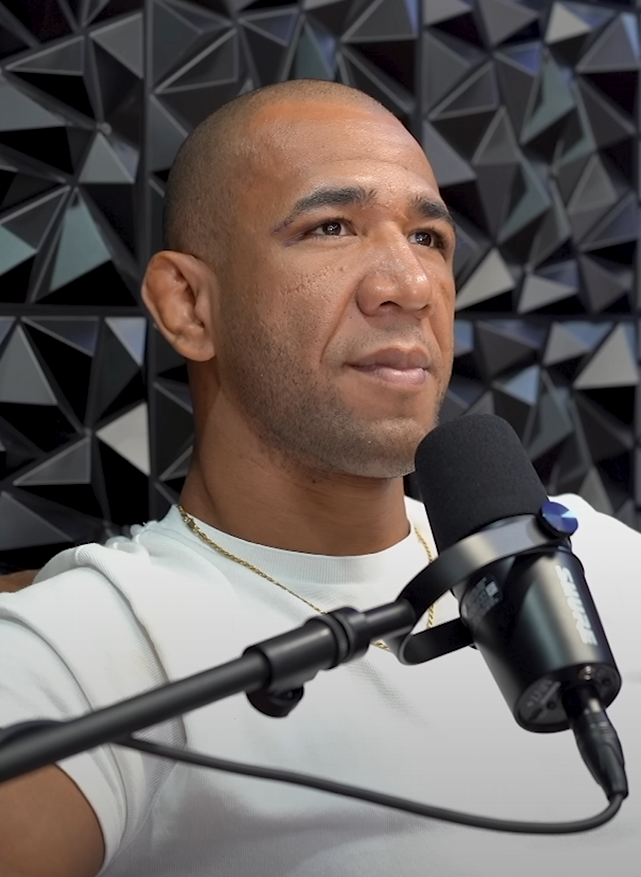
The UFC returns to Sacramento, California, for the first time in more than seven years Saturday, staging a middleweight showdown between Anthony Hernandez and Gregory Rodrigues at Golden 1 Center, with the full card streaming live on Paramount+.
How to Watch
The event streams exclusively on Paramount+ in the United States, with no cable television broadcast required. The card is split into two segments: the preliminary fights begin at 5 p.m. ET (2 p.m. PT), followed by the main card at 8 p.m. ET (5 p.m. PT). Fans can access the broadcast through the Paramount+ app on smart TVs, streaming devices, mobile phones, tablets or via a web browser, with both the prelims and main card included as part of a standard Paramount+ subscription rather than requiring a separate pay-per-view purchase, consistent with the UFC’s current broadcast partnership structure for its Fight Night events.
The Main Event
Headlining Saturday’s card is a five-round middleweight bout between Anthony “Fluffy” Hernandez, a Northern California native fighting close to home, and Brazilian power puncher Gregory “Robocop” Rodrigues. According to UFC.com, Hernandez enters the fight looking to rebound after having his eight-fight winning streak snapped by current UFC middleweight champion Sean Strickland in his most recent outing, roughly six months ago. Hernandez carries a professional record of 15-3 into the bout, while Rodrigues, a hard-hitting Brazilian standout, enters at 19-6.
UFC.com’s fight-by-fight preview, published by writer E. Spencer Kyte, framed Saturday’s event as a homecoming moment for both the promotion and its headliner. “One week after returning to Philadelphia for the first time in a number of years, UFC continues its tour of old haunts with a trip to Golden 1 Center in Sacramento for a Fight Night event headlined by a critical middleweight matchup between local NorCal standout Anthony ‘Fluffy’ Hernandez and Brazilian powerhouse Gregory ‘Robocop’ Rodrigues,” Kyte wrote, adding that Saturday marks the UFC’s first event in California’s capital city in more than seven years.
Co-Main Event and Featured Bouts
The co-main event pits heavyweights against one another, with Moldova’s Serghei Spivac looking to halt Vitor Petrino’s three-fight winning streak, a run the Brazilian has put together since moving up from light heavyweight last year, according to Sports Illustrated’s coverage of the card. Elsewhere on the main card, Reinier de Ridder and Roman Dolidze, both moving up from the middleweight division, meet in a light heavyweight contest, while unbeaten prospect Mason Jones looks to continue his perfect start to his second UFC run against MarQuel Mederos. Flyweight prospect Carli Judice also features on the main card, facing Jeisla Chaves.
The full main card, according to FIGHTMAG, includes: Anthony Hernandez (15-3) vs. Gregory Rodrigues (19-6) at middleweight; Serghei Spivac (18-6) vs. Vitor Petrino (14-2) at heavyweight; Reinier de Ridder (21-4) vs. Roman Dolidze (15-5) at light heavyweight; MarQuel Mederos (11-1-1) vs. Mason Jones (18-2) at lightweight; and Carli Judice (6-2) vs. Jeisla Chaves (8-0) at flyweight.
The preliminary card features a mix of established veterans and rising prospects. According to FIGHTMAG, the prelims include Anthony Wint (7-0) against Terrance Chatman (5-1) at heavyweight, along with Jamall Emmers (22-8) facing Lerryan Douglas (14-5) at featherweight, and Kennedy Nzechukwu (14-6-1) taking on Shamil Gaziev (14-3) at heavyweight. Wint, in particular, enters the fight with significant momentum, having advanced to 7-0 with six finishes, including a standout performance on Dana White’s Contender Series, according to UFC.com’s preview.
Weigh-In Results
Both headliners made weight without complications at Friday’s official weigh-ins, held at Golden 1 Center, according to imagery and reporting from the event. Hernandez and Rodrigues faced off during the ceremonial weigh-in, setting the stage for Saturday night’s five-round main event.
Betting and Additional Coverage
For fans interested in wagering on the card, betting lines are available through major sportsbooks, with MMAmania.com specifically highlighting its own weekend betting picks tied to the event. Live results, play-by-play updates and post-fight coverage are expected to be available through multiple MMA-focused outlets throughout the night, including ESPN’s dedicated UFC fight center and Sports Illustrated’s live results tracker, for fans who are unable to watch the Paramount+ stream in real time but still want to follow the card’s outcomes as they happen.
Why This Event Matters
Saturday’s card carries particular significance both for Hernandez, fighting in front of a hometown crowd expected to pack Golden 1 Center, and for the broader middleweight division, where a win for either Hernandez or Rodrigues could position the victor for a more prominent spot in the divisional rankings heading into the fall. UFC.com’s preview emphasized the anticipated atmosphere surrounding the event, noting that Saturday’s return to Sacramento is expected to draw a passionate crowd eager to see the promotion back in the city after such an extended absence.
For those attending in person, tickets remain available through Ticketmaster, though availability has been reported as limited in the days leading up to the event, according to UFC.com’s own promotional materials encouraging fans to secure seats before the card. For everyone else, Saturday’s complete UFC Fight Night: Hernandez vs. Rodrigues card, from the 5 p.m. ET prelims through the conclusion of the main event, will stream live and in full on Paramount+, giving fight fans nationwide a single, straightforward way to follow the action as the UFC makes its long-awaited return to California’s capital city.
Business
(VIDEO) Where to Watch Livestream MLS’s Inter Miami vs. Toronto FC Tonight: Is Messi Playing Today?

Inter Miami hosts Toronto FC on Saturday, Aug. 22, in a pivotal MLS Eastern Conference matchup, with Lionel Messi confirmed to play despite a heated confrontation earlier in the week that had briefly put his availability in question.
How to Watch
The match kicks off at 7:30 p.m. ET at Chase Stadium in Fort Lauderdale, Florida, also referred to as Nu Stadium. In the United States, Apple TV holds exclusive streaming rights to every Major League Soccer match, including this one, through its MLS Season Pass subscription service. There is no free, legal broadcast option available in the U.S. for this game, since Apple’s exclusive rights deal with the league means all MLS matches, including marquee fixtures involving Messi, are only accessible through a paid MLS Season Pass subscription on the Apple TV app, available on smart TVs, streaming devices, phones, tablets and web browsers.
Is Messi Playing Tonight?
Yes. Lionel Messi is confirmed to start for Inter Miami against Toronto FC, after avoiding a suspension from Major League Soccer over an altercation with Philadelphia Union midfielder Quinn Sullivan during Miami’s 2-2 draw with Philadelphia on Aug. 19. According to Athlon Sports, MLS reviewed the incident and issued Messi an undisclosed fine rather than a suspension, clearing him to feature at Nu Stadium. Messi’s projected starting spot alongside Luis Suárez confirms he will lead Miami’s attack as the club looks to end a difficult recent stretch.
Messi’s recent form has carried significant emotional weight. According to Bolavip, Messi scored against Philadelphia in that midweek draw, marking his first goal since the death of his father, Jorge Messi, and helping end a three-game losing streak for Inter Miami. The goal moved Messi to 13 MLS goals on the season, putting him one behind the league’s current Golden Boot leader.
The Bigger Picture
Inter Miami enters Saturday’s match sitting second in the Eastern Conference with 39 points, but the club’s recent form has raised questions about its overall cohesion heading into the stretch run of the regular season. According to Goal.com, Miami has suffered three defeats in its last four matches across all competitions, including a Leagues Cup group-stage exit and a lopsided 4-1 loss to Nashville SC, adding pressure on head coach Javier Mascherano’s side to find more consistent results.
Toronto FC, by contrast, arrives in Florida after a dramatic result of its own. The club fought back from a man disadvantage, after defender Walker Zimmerman was sent off, to secure a 3-3 draw against Charlotte FC on Aug. 19, with goals from Daniel Sallói and Niklas Dorsch among the scorers. That result left Toronto with 21 points from 20 matches, sitting 11th in the Eastern Conference standings but still fighting to improve its position before the regular season concludes.
Projected Lineups
According to World Soccer Talk, Inter Miami’s projected starting XI features goalkeeper Rocco Ríos Novo behind a back line of Sergio Reguilón, Maximiliano Falcón, Jordi Alba’s replacement at fullback, and other defensive options, with Rodrigo De Paul, Casemiro and Tomás Ávilés or a similar midfield trio supporting Messi and Suárez up top. Toronto FC is expected to line up with goalkeeper Sean Gavran behind a back line adjusted for Zimmerman’s absence due to suspension, with Djordje Mihailovic serving as the primary creative engine supporting striker Sallói in attack.
Mihailovic, an established U.S. international, has been the focal point of Toronto’s attacking play throughout the season, known for his tactical intelligence, precise passing and set-piece delivery. His ability to break down stubborn defenses from central areas makes him one of the key threats Miami’s backline will need to account for.
Inter Miami will also be missing key contributors due to absences beyond Messi’s situation. According to Athlon Sports, midfielder Yannick Bright is suspended, while Micael and Mateo Silvetti are expected to miss the match through injury, further testing the depth of Mascherano’s squad as the club looks to snap its recent slide.
Head-to-Head History
The two clubs have met several times in recent seasons, with Inter Miami holding a clear edge in the series. According to Goal.com, Miami defeated Toronto 4-2 in their most recent MLS meeting on May 9, 2026, at BMO Field. Prior to that, the two sides played to a 1-1 draw at the same venue in September 2025 and another 1-1 draw in Miami in April 2025. Across their last five meetings in all competitions, Inter Miami holds three wins to Toronto’s none, with two draws, and the two sides have combined for 17 goals across those matches.
What’s at Stake
With the MLS playoff race intensifying as the regular season enters its final stretch, both clubs have significant incentive to secure a positive result Saturday. For Inter Miami, snapping its recent run of poor form and reasserting its position near the top of the Eastern Conference remains the priority, particularly with Messi back among the goals and looking to build further momentum following a personally difficult stretch tied to his father’s death. For Toronto FC, currently sitting outside the playoff picture in 11th place, points against a direct conference rival like Miami carry outsized importance in the club’s push to climb the standings before the season concludes.
Fans looking to follow Saturday’s match without an Apple TV MLS Season Pass subscription can typically find updates through official MLS social media channels, live blog coverage from outlets covering the match, or delayed match highlights posted after the final whistle, though live, real-time viewing of the match itself in the United States requires the paid Apple TV subscription service given the league’s exclusive broadcasting agreement.
Business
AI Data Center Protests Spread Across 42 States as Power Costs and Water Use Fuel Backlash Nationwide

A grassroots movement opposing the rapid expansion of artificial intelligence data centers has grown into a nationwide political force, with 142 coordinated protests held across 42 states in July marking what organizers describe as the first nationally synchronized day of action against the infrastructure buildout, as concerns over electricity costs, water scarcity and limited local job creation increasingly shape state and local policy.
The July 18 demonstrations, organized by the advocacy group HumansFirst, represented the largest single-day mobilization yet against AI data center construction, according to Reuters. Texas hosted the most protest events of any state, with 18 rallies, while Georgia, a key battleground state, saw 11. HumansFirst co-founder Amy Kremer, a former Tea Party movement leader, has framed the fight as nonpartisan, drawing supporters from across the political spectrum even as she has criticized Republicans for what she describes as giving the technology industry a “free pass,” according to Reuters. Notably, Kremer and some organizers said they do not support blanket moratorium policies of the kind adopted in New York, preferring instead more targeted demands including greater transparency in the development process, protection of local environmental resources, creation of well-paying union jobs, and stronger accountability mechanisms for developers who fail to deliver on their promises.
The scale of the resistance has translated into significant, quantifiable delays for the industry. According to Data Center Watch, cumulative blocked or delayed AI infrastructure projects have reached roughly $286 billion since 2025, with more than $130 billion in projects blocked in just the first quarter of 2026 alone, according to Tom’s Hardware. More than 69 jurisdictions have already enacted data center bans or moratoriums as of mid-2026, with Seattle, home to the headquarters of both Microsoft and Amazon, imposing a one-year ban on new large data centers that directly affects five proposed projects from those two companies.
New York became the first state to enact a formal, statewide permitting freeze. Gov. Kathy Hochul signed an executive order on July 14 imposing a one-year moratorium on environmental permitting for new hyperscale data centers drawing 50 megawatts or more of power, according to CNBC’s reporting cited by TFTC. That order followed the state legislature’s earlier passage of the Responsible Data Center Development Act, which similarly proposed a one-year moratorium on new permits for large data centers alongside separate utility rate classes and mandatory impact studies. Chicago Mayor Brandon Johnson followed with his own executive order on Aug. 11, introducing a strengthened review process and formally requesting that the city council consider a temporary moratorium on new data center approvals, according to Jaekyung Ilbo’s reporting.
Electricity costs have emerged as one of the central drivers of public opposition. Wholesale power costs on PJM Interconnection, the largest electricity grid operator in the United States, rose 76% year over year in the first quarter of 2026 to $136.53 per megawatt-hour, according to Jaekyung Ilbo. Capacity market prices, which reflect the cost utilities pay to ensure sufficient future power supply, surged from roughly $28.92 per megawatt-day to approximately $329, with independent market monitors attributing a significant portion of that increase to rising data center electricity demand. That trend has fueled concerns that ordinary ratepayers could continue absorbing higher electricity bills as a direct consequence of nearby AI infrastructure development.
Water usage has similarly become a flashpoint, particularly in drought-prone regions of the western and southern United States. The large volumes of water required to cool servers inside data centers have prompted concerns in some communities about reduced water pressure and potential water shortages, with residents in several areas arguing that data center operations are directly competing with residential water needs. While some critics have also raised concerns about increased greenhouse gas emissions tied to expanded natural gas power generation built to serve data center demand, analysts have cautioned that the precise scale of that emissions impact requires further verification.
Limited local job creation has added a further layer to the backlash. Despite the enormous capital investment involved in constructing large-scale data centers, the number of permanent, full-time jobs such facilities typically generate has repeatedly been characterized as modest relative to the scale of investment, fueling a broader public perception that these facilities consume substantial local resources while providing comparatively limited direct benefit to surrounding communities.
Public opinion polling has reflected the depth of this opposition. A June 2026 Reuters/Ipsos poll found that only about one-third of Americans approve of the current pace of data center construction, with just 14% saying they would support a data center being built in their own community, according to Memeburn. A separate Gallup poll conducted in March found neighborhood-level opposition to new data centers running at roughly 70%, a figure higher than public opposition to nuclear power plants.
The backlash has also drawn attention from federal lawmakers. Democratic Rep. Alexandria Ocasio-Cortez of New York and independent Sen. Bernie Sanders of Vermont introduced the AI Data Center Moratorium Act of 2026 in March, a bill that would impose an immediate federal moratorium on new AI data centers until stronger national safeguards are established. Ocasio-Cortez framed the legislation in stark terms at the time of its introduction. “We have seen ICE partner with AI companies to surveil Americans, social media users employ AI bots to create sexually explicit deepfakes of women and children, and data center construction inflate electric bills in communities across the country,” Ocasio-Cortez said. “Congress has a moral obligation to stand with the American people and stop the expansion of these data centers until we have a framework to adequately address the existential harm AI poses to our society. We must choose humanity over profit.” The bill is considered unlikely to advance in either chamber of Congress, though its introduction reflects the broader intensity of concern building around the issue among progressive lawmakers.
As regulatory pressure intensifies across developed markets, some technology companies have begun shifting their site-selection strategies toward regions with comparatively lighter regulatory environments. Following restrictions on new data center construction in Singapore, Ireland and the Netherlands, some companies have reportedly begun exploring relocation toward parts of Southeast Asia where oversight remains less developed, according to Jaekyung Ilbo’s analysis. With the U.S. midterm elections approaching, the newspaper’s report suggested that data center policy could increasingly become a defining issue in competitive races across battleground states including Kansas, Wisconsin and Michigan, as both the pace of AI infrastructure construction and the strength of local regulatory responses continue to evolve heading into the fall.

6 playoff bubble players to watch at the BMW Championship Sunday
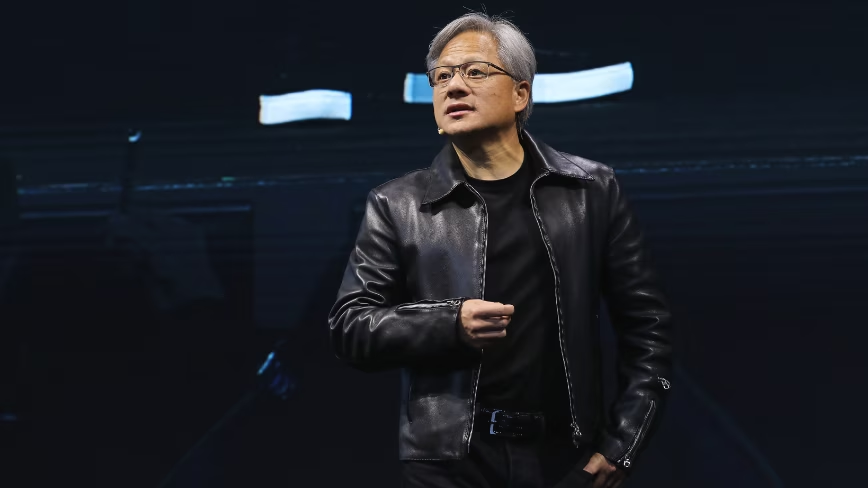
Nvidia AI server prices are rising more than 15% from early next year
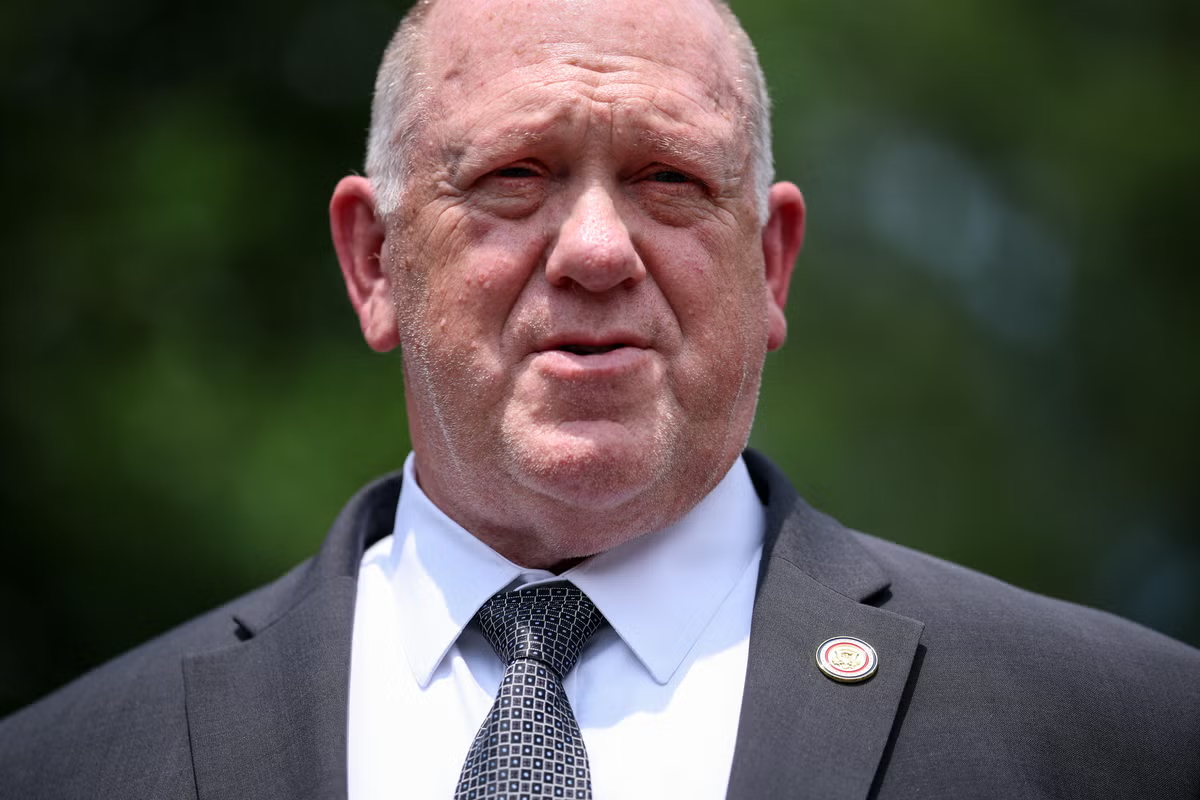
Trump’s border czar Tom Homan says he’s ‘an equal opportunity deporter’ as he denies ICE racial profiling claims




![UNBELIEVABLE: Rotation Of Large Scale Capital Into Bitcoin & Crypto! [Trust It?]](https://wordupnews.com/wp-content/uploads/2026/08/1787446668_maxresdefault-80x80.jpg)

-

 Fashion1 day ago
Weekend Open Thread: Madewell – Corporette.com
-

 Business5 days ago
SMA Solar Technology AG (SMTGY) Q2 2026 Earnings Call Transcript
-

 Tech5 days ago
Qwen3.8-27B runs frontier-class coding agents and reasoning locally, no cloud API required
-

 Politics14 hours ago
6 months on, Irish renters crushed by effects of government housing bill
-

 Crypto World5 days ago
OCC Greenlights Trump Family Crypto Firm for Trust Charter
-

 Crypto World5 days ago
NAVI Prime launches institutional lending framework on Sui
-

 News Videos3 days ago
Don’t Leave Your Financial Future To Chance | August 19, 2026
-

 Crypto World6 days ago
Data of 54K Wallet Users Leaked, Clarity Odds Just 10%: Hodler’s Digest, Aug. 16
-
 NewsBeat17 hours ago
The ‘Lucky Dip Gang’ causing carnage for clicks: After five thugs were killed speeding in the wrong direction on a motorway, GUY ADAMS investigates a sick new trend… and why police aren’t even allowed to pursue them
-

 Politics6 days ago
Britain is facing a housing disaster
-

 Tech7 days ago
What are the rumors about the AirPods Pro 4?
-

 Business5 days ago
Stock Market Today: Tech Futures Slide As Treasury Yields Jump; Nvidia, Micron, Sandisk Sell Off
-

 Business6 days ago
Rebel Creamery files Chapter 11 with $23.8M Van Leeuwen judgment on appeal
-
 Crypto World5 days ago
Dow’s 3-Year Winning Run Isn’t a Crash Signal, Still 49% Odds of Double-Digit Gains
-

 Tech6 days ago
Straight Up the Cliff, Yunnan’s New Fuyao Ladder Turns a Three-Hour Climb Into a 50-Second Ride for Students
-
 Tech6 days ago
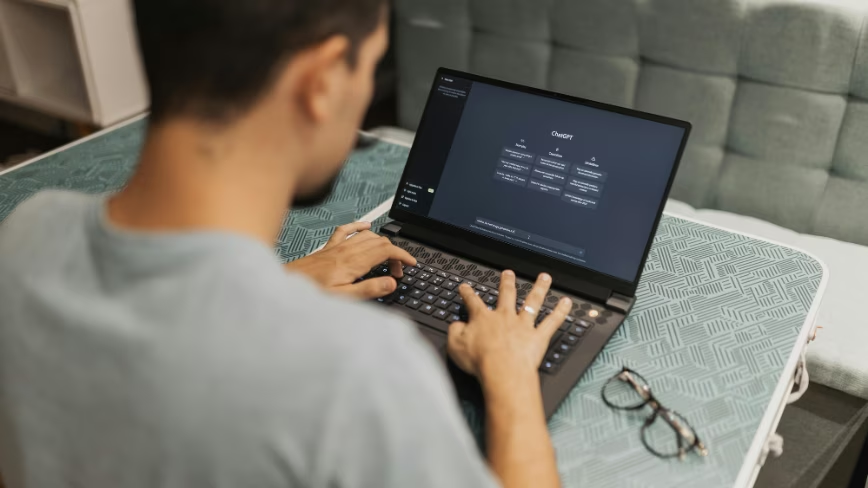
OpenAI’s new ChatGPT feature logs your keystrokes and stores them in plain text
-

 Tech6 days ago
DeepSeek’s top-ranked V4 Flash stumbles on real agent tasks as its prices surge
-
 Tech5 days ago
Nvidia discloses $21B stake in SpaceX
-

 Tech4 days ago
GLM-5.3 hits the API at $1.4/$4.4 per million tokens
-

 Business2 days ago
Five Below: Kids Discount Retailer Reaps Rich Rewards
You must be logged in to post a comment Login