Connect with us
DAPA Banner
DAPA Coin
DAPA
COIN PAYMENT ASSET
PRIVACY · BLOCKDAG · HOMOMORPHIC ENCRYPTION · RUST
ElGamal Encrypted MINE DAPA
🚫 GENESIS SOLD OUT
DAPAPAY COMING

Business

Work on Devon tungsten mine project set to ‘ramp up’ ahead of 2027 opening

Published

on

Business Live

Tungsten West is looking to restart production at Hemerdon near Plymouth

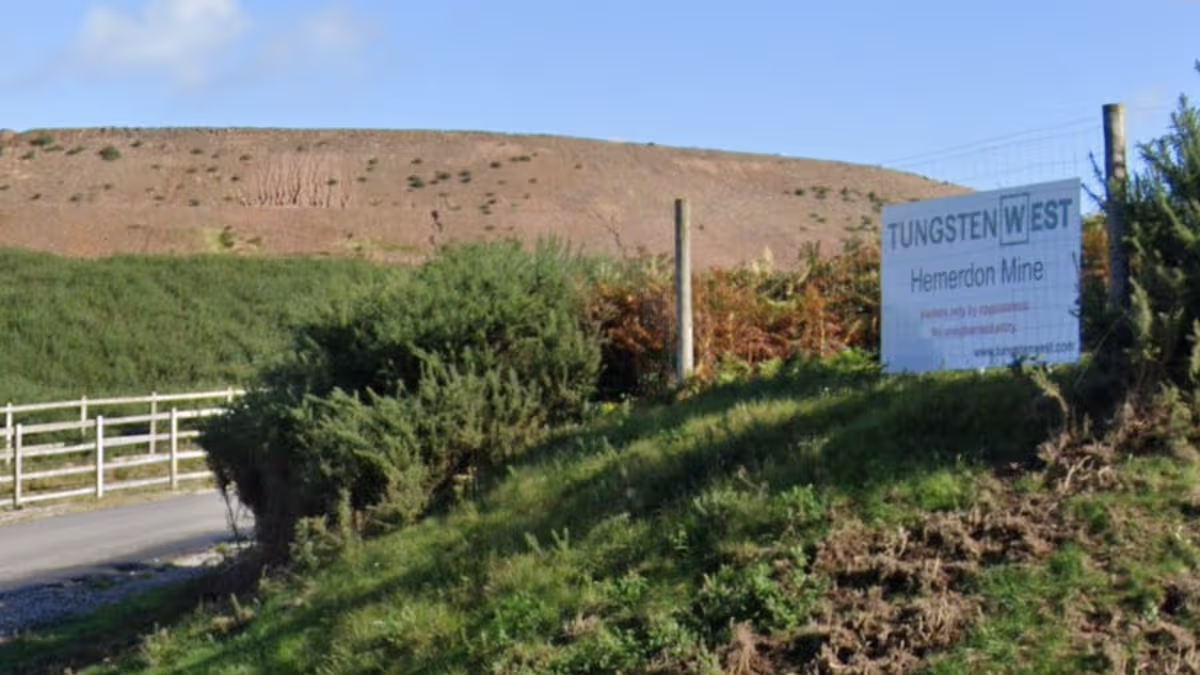
The entrance to Tungsten West's Hemerdon Mine, in Plymouth

The entrance to Tungsten West’s Hemerdon Mine, in Plymouth(Image: Google)

A company looking to revive a mine in Devon that holds a rare critical metal says it is preparing to “ramp up” work at the site in the coming weeks. AIM-listed Tungsten West is working to restart production at the Hemerdon tungsten and tin mine near Plymouth – one of the largest tungsten resources in the world.

Tungsten West acquired the site through a receivership process in 2019 following the collapse of previous operator Wolf Minerals and is hoping to open the site for production in spring next year.

Advertisement

It is understood Hemerdon could produce up to 20 per cent of the global supply of primary tungsten outside of China once operational. Tungsten is used by many manufacturing companies, including in the automotive and defence sectors.

Ahead of the project commission, Tungsten West said on Wednesday it had started an “enhanced programme” of stakeholder engagement, including with the local community and regulators.

Jeff Court, chief executive of Tungsten West, said: “We are making rapid progress on the restart of Hemerdon with the first phase of recommissioning starting this month.

“This marks another significant milestone towards full project commissioning in Q1 2027, and I would like to thank the team, our partners, stakeholders and shareholders for the hard work that has been undertaken to date to reach this step.”

Advertisement

Tungsten West has already hired 100 people to work at Hemerdon and is targeting total recruitment of 350 by early 2027. The project is also expected to be completed within budget, the company added.

In February, Tungsten West raised more than £41m in a share sale, raising funds from new institutional investors and existing shareholders to finance the Devon project.

Mr Court said at the time the funds were the “cornerstone” for the restart of operations at Hemerdon.

“We are extremely pleased that the market has shown such strong support for the company”, he said. “We welcome new shareholders and the increased investment from our pre-existing shareholders, who both strongly believe in the vision we have for the company.”

Advertisement
Continue Reading
Click to comment

You must be logged in to post a comment Login

Leave a Reply

Business

Severn Trent avoids fine for ‘serious’ wastewater failures

Published

on

Swingers

Ofwat has been investigating how wastewater and sewage networks are managed across the industry.

Severn Trent was the eighth case it had completed in its industry-wide wastewater investigation, which has resulted in fines and enforcement packages worth more than £300m, including a £104.5m fine for Thames Water.

But Ofwat said that unlike the previous seven cases, Severn Trent “proactively identified problems in its own network” and “began putting them right” before the enforcement case was opened.

“Ofwat has formally accepted an enforceable package of undertakings from Severn Trent Water to ensure the company returns to compliance,” a spokesperson said.

Advertisement

Severn Trent which covers most of the West Midlands including Staffordshire, Shropshire, Warwickshire and Worcestershire, and parts of the East Midlands, including Derbyshire, Leicestershire and Nottinghamshire, said its work in spills reduction continued.

James Jesic, the company’s chief executive, added: “We accept Ofwat’s findings relating to issues that we proactively identified and began addressing these before the enforcement case was opened.

“Our investment programme in spills reduction continues across our region at pace with the strength of our whole organisation and supply chain behind it.”

Advertisement
Continue Reading

Business

Airbus trims jet industry demand forecast after Iran war, tariffs

Published

on


Airbus trims jet industry demand forecast after Iran war, tariffs

Continue Reading

Business

SPMO: The Leaner Way To Own The S&P 500

Published

on

SPMO: The Leaner Way To Own The S&P 500

SPMO: The Leaner Way To Own The S&P 500

Continue Reading

Business

Steak restaurant group Pasture in international expansion

Published

on

Business Live

Its expansion is being backed with a new £4.5m funding line from Barclays Bank

Photo shows Sam in his restaurant with butcher in the background

Founder of Pasture Sam Elliott(Image: Faydit Photography)

Pasture Restaurant Group has confirmed plans for its first overseas venue..

The group, which operates five steak restaurants across Cardiff, Bristol and Birmingham, has secured a £4.5m refinancing package from Barclays to support the next stage of its growth.

Advertisement

As well as its first overseas venture, in Barcelona, Spain, the funding will enable Pasture to invest further in its existing venues.

Founded in Bristol in 2018 by chef Owner Sam Elliott, its first Cardiff restaurant opened in 2020 and was recently recognised among the world’s top 50 steak restaurants. Since launching it has diversified its offering to include Nightshade speakeasy bar & Parallel restaurant in Cardiff.

The group has also invested its own farm and vineyard which supplies wine and produce for the restaurants, a butcher’s shop, and an online store.

The new Barcelona restaurant is expected to open early next year.

Advertisement

Mr Elliott said“When I founded Pasture Restaurant Group, the goal was simple: to combine great cooking with outstanding local produce.

“Eight years on, it’s incredibly rewarding to see customers continue to connect with that vision, and we’re excited to be entering the next phase of growth with plans to open our first international restaurant in Barcelona.

“Barclays has been a supportive partner throughout our journey, always understanding our ambitions and financial requirements. Everyone at Pasture is looking forward to what comes next.”

Greer Hooper, head of South Wales corporate banking at Barclays, said: “Barclays are delighted to strengthen our ongoing relationship with Pasture Restaurant Group, a dynamic and high regarded hospitality business with a strong regional presence.

Advertisement

“In less than a decade, the group has established itself across key locations including Cardiff, Bristol and Birmingham, building a reputation for quality and consistency. Their continued growth is a clear demonstration of their proposition and their ability to succeed in a highly competitive and evolving sector.”

Continue Reading

Business

23andMe data breach victims to receive $47m payout

Published

on

23andMe data breach victims to receive $47m payout

Victims of the 2023 data breach at genetics testing firm 23andMe are to share a $46.75m (£35m) payout, after a California bankruptcy court ruled that the company’s new owner must compensate as many as 6.9 million people whose personal information was exposed.

The ruling, handed down on Tuesday, draws a line under one of the most damaging data breaches in consumer technology, and offers UK business owners a stark illustration of how a single security failure can help bring down a company once valued at $6bn.

Chrome Holding, which operates as the TTAM Research Institute, took control of 23andMe last year following the firm’s bankruptcy. It is run by 23andMe co-founder Anne Wojcicki, who won the company’s assets at a bankruptcy auction with a bid of $305m.

Under the ruling, the settlement will first be paid to Kroll Restructuring, which represents the victims, within five business days of Tuesday’s decision. Kroll will then distribute the funds. The appointment of firms such as Kroll is typical in corporate bankruptcy proceedings.

Business Matters has contacted the legal team representing the victims to ask how many people will receive the payout. Representatives of Chrome Holding and 23andMe have also been contacted for comment.

Advertisement

The road to Tuesday’s ruling began with a hack that, on paper, looked contained. 23andMe filed for bankruptcy early last year, roughly 18 months after hackers gained access to around 14,000 user accounts, a small fraction of its total user base.

The damage did not stop there. Because the platform connects users to their genetic relatives, the hackers were able to access the profiles of those users’ family members, giving them reach into millions of profiles hosted by the company.

And this was no ordinary customer database. 23andMe offered “comprehensive” genetic profiles of people who submitted their DNA, including markers relating to their health and family history, meaning some of the stolen information was highly personal and impossible to change once exposed.

The fallout landed on both sides of the Atlantic. In the UK, the Information Commissioner’s Office fined the company £2.31m, finding that 23andMe had failed to put adequate measures in place to secure sensitive user data before the incident.

Advertisement

In May, California’s Attorney General Rob Bonta sued the company following an investigation that found 23andMe “failed to take basic steps to protect users’ data”. Bonta also claimed the firm “lied to consumers about the severity of its 2023 data breach”.

For smaller firms tempted to file this under big-company problems, the direction of travel from regulators should give pause. The 23andMe penalty sits alongside the ICO’s £14m fine for outsourcer Capita over its own 2023 cyber-attack, evidence that the watchdog is increasingly willing to punish security failures with meaningful sums.

23andMe, for its part, continues to trade, selling DNA testing kits online under its new ownership. Founded in 2006 and floated in 2021, the company was once valued at $6bn but has never turned a profit.

For entrepreneurs, the lesson is uncomfortable but plain. Customer data is a liability as well as an asset, and as this week’s ruling shows, the bill for mishandling it can outlive the business itself.

Advertisement

Amy Ingham

Amy is a newly qualified journalist specialising in business journalism at Business Matters with responsibility for news content for what is now the UK’s largest print and online source of current business news.

Advertisement
Continue Reading

Business

Alinta signs Scarborough gas deal with LNG Japan

Published

on

Alinta signs Scarborough gas deal with LNG Japan

Alinta Energy has struck an agreement to buy 30 petajoules of gas from a Japanese consortium that owns a stake in Woodside’s Scarborough project.

Continue Reading

Business

GenusPlus denies Telstra outage involvement

Published

on

GenusPlus denies Telstra outage involvement

Contractor GenusPlus said media reporting which appeared to imply the company’s own infrastructure was contributing to Telstra’s nationwide outages was incorrect.

Continue Reading

Business

Part-time hiring hits three-year high in UK

Published

on

Part-time hiring hits three-year high in UK

Businesses are taking on part-time staff at the fastest pace in three years, as owners look to meet rising demand for workers without shouldering the long-term costs of permanent hires.

The part-time hiring index published by KPMG and the Recruitment and Employment Confederation (REC) rose to a three-year high of 52.7 in June, up from 52.2 in May and comfortably above the 50-point mark that separates growth from contraction.

For SME owners, the logic is familiar. Stronger economic activity is creating a need for extra hands, but after two years of rising employer National Insurance, minimum wage increases and new employment rights, few are willing to lock in fixed payroll costs that would be hard to unwind if growth stumbles again. It is a strategy smaller firms have reached for before when the outlook turned uncertain.

Neil Carberry, chief executive of the REC, said: “After a long recruitment winter, these figures show truly hopeful signs. Temporary and contract work once again leads the way, as firms react to demand without yet feeling confident enough to commit to larger-scale permanent hiring.”

There were clearer signs within the data that the labour market is picking up steam after tax rises and minimum wage increases knocked hiring appetite across the SME economy.

Advertisement

The permanent hiring index jumped to 49.1 in June from 44.1 in May. That still marks contraction, and the measure has now been below the 50 threshold for 45 consecutive months, but the pace of decline is the slowest in some time.

Lisa Fernihough, advisory vice-chair at KPMG UK, said: “Although permanent placements are still falling, the pace of decline is easing and back to a rate we were seeing before the Iran conflict put a pause on active recruitment for many companies.”

The backdrop remains tough. Figures from the Office for National Statistics show unemployment reached 4.9 per cent in the three months to April, up from 4.6 per cent a year earlier, while the number of vacancies has fallen to a five-year low of 707,000. As Business Matters reported in May, long-term unemployment has climbed to a decade high, with small employers warning that successive cost increases are choking off new hires.

Candidate supply, at least, remains plentiful. The index measuring full-time jobseekers dipped to 60.2 in June from 62.4, while temporary candidate availability fell to 59.3 from 61.8. Both remain well into growth territory, meaning firms that do hire face a deeper talent pool than at any point in recent years.

Advertisement

For owners budgeting the year ahead, separate figures from research company IDR suggest wage pressure has plateaued. Workers received an average pay rise of 3.5 per cent in the three months to May, the fifth consecutive such reading. Nearly half of settlements landed between 3 per cent and 3.99 per cent, just over a third exceeded 4 per cent, and one in ten workers secured more than 5 per cent.

That stall in pay growth matters beyond the payroll run. Economists view the labour market as a crucial factor in whether the Bank of England raises interest rates this year. While the US-Iran war has put upward pressure on inflation, continued weakness in the jobs market could persuade rate-setters to leave borrowing costs at 3.75 per cent for the rest of the year, welcome news for any small firm carrying variable-rate debt.

For now, the message from the data is one of cautious optimism: demand for staff is returning, but Britain’s employers are hiring with one hand on the exit.


Amy Ingham

Amy is a newly qualified journalist specialising in business journalism at Business Matters with responsibility for news content for what is now the UK’s largest print and online source of current business news.

Advertisement

Continue Reading

Business

New occupier sought for former BAE Systems Brough fighter jet factory

Published

on

Business Live

The 230,000 sq ft of newly vacant space at the Humber Enterprise Park, on the outskirts of Hull, is being marketed by Knight Frank

The factory closed in 2020, though BAE retains a presence at the site.

The former BAE Systems factory is now available to businesses.(Image: Knight Frank LLP)

Fresh attempts are being made to secure a tenant for the former BAE fighter jet manufacturing facility at Brough. Property consultants Knight Frank have been instructed by the site’s proprietors, Citivale and Westcore, to promote the 230,000 sq ft of recently vacated premises at the Humber Enterprise Park, situated on Hull’s outskirts.

The practice has been commissioned to collaborate with Hull-based PHH Commercial at the 79-acre location on the Humber’s banks. Accommodation now offered at the park encompasses the 167,486 sqft, single-storey steel-framed warehouse and industrial building which previously accommodated manufacturing of components for the Hawk jet, the aircraft flown by the Red Arrows.

It has lately served as a storage and logistics centre having undergone several modest extensions to provide supplementary offices and supporting staff amenities. There is also a 63,026 sqft unit that delivers extra warehouse and production capacity and enjoys a protected yard and parking provision.

BAE retains an operation at the Brough location, though manufacturing there ceased in 2020, concluding more than a century of aircraft construction there. The plant had been employed to modernise RAF Phantom jets during the 1970s and 80s before Harrier jump jets and subsequently Hawks were constructed there.

Advertisement

Humber Enterprise Park was established in 2014, and the two facilities now available have lately received a multimillion-pound renovation. Other park tenants include Cablescan, Dearing Plastics, Morson Praxis, Europa Crown, Purex, and Cranswick PLC, reports Hull Live.

Iain McPhail, partner in Knight Frank’s industrial property team, commented: “This is a significant appointment for us, and we are delighted to be marketing two high-quality warehouse and manufacturing buildings at one of the region’s most successful employment parks.

“We have two units available on the estate, one of 167,486 sqft which has just been refurbished and the other of 63,026 sqft, whereby the refurbishment program is due to commence imminently. The combination of the size and spec of these units, the reputation of the Humber Enterprise Park and its location, close to the M62, M18 and the Humber ports, makes them extremely attractive propositions for occupiers.”

Paul Brustad, Citivale’s asset manager at Humber Enterprise Park, stated: “With Knight Frank’s coverage in the industrial and logistics sector throughout Yorkshire, as well as their national presence, we are pleased to appoint them as letting agents on our Humber Enterprise Park scheme. With these two units currently available, the regional market knowledge and expertise of Knight Frank will be welcomed to compliment that of our other joint letting agents PPH Commercial.”

Advertisement

Like this story? For more news from the commercial property scene around the regions, visit our dedicated section here for the latest news and analysis within the sector.

Continue Reading

Business

UK tech funding hits $15.3bn in H1 2026 as deals shrink

Published

on

UK tech funding hits $15.3bn in H1 2026 as deals shrink

UK tech companies raised $15.3bn in the first half of 2026, an 84 per cent leap on the $8.3bn recorded in the second half of 2025 and enough to hold Britain’s place as the world’s third-largest tech funding market, behind only the United States and China. But the headline number hides a less comfortable truth for the average founder: the money went to fewer companies.

New figures from data intelligence platform Tracxn show total funding rounds actually fell to 490 from 543 over the same period. Investors are writing fewer, far larger cheques, and the biggest of them are landing on a handful of AI businesses.

Half-year mega rounds of $1bn or more jumped to four, up from just one in each of the two previous halves. Isomorphic Labs’ $2.1bn Series B, a $2.0bn Series C for data centre builder Nscale, which had already raised £750m last September to build Britain’s biggest AI facility, and a $1.2bn Series D for self-driving firm Wayve, fresh from winning British Business Bank backing in its robotaxi push, together accounted for roughly a third of everything raised.

There is genuine encouragement for smaller firms in the detail. Seed funding rose 128 per cent to $1.8bn, with Fuel Ventures, Y Combinator and SFC Capital the most active backers at that stage. Early stage funding grew 50 per cent to $6.9bn and late stage rose 120 per cent to $6.6bn, suggesting capital is flowing at every rung of the ladder, just to fewer names on each one.

The sector map tells founders where the appetite lies. Enterprise applications remained the largest sector at $8.7bn, up 63 per cent, but enterprise infrastructure more than doubled to $4.2bn as investors piled into the compute, cloud and data centre capacity behind AI. Life sciences funding surged 228 per cent to $3.2bn. It is a continuation of the momentum that made 2025 a record year for UK AI investment, and it confirms that investors now treat AI’s physical infrastructure as an investable category in its own right.

Advertisement

The exit picture is more sobering. Just two companies, General Oceans and Metatek, went public in the half, down from seven, and acquisitions fell 20 per cent to 167. Value concentrated at the top here too: BVNK’s $1.8bn sale to Mastercard, eBay’s $1.2bn purchase of Depop and Genius Sports’ $1.2bn acquisition of Legend together outweighed the remaining 164 deals combined. For owners eyeing a trade sale, the message is that buyers are still active but choosier, and the average wait is lengthening, with time from first funding to acquisition stretching to 15.5 years from 12.7.

Geography remains the ecosystem’s stubbornest feature. London took 86 per cent of all UK tech funding, $13.1bn of the total, up from 79 per cent, with Cambridge a distant second at 4 per cent. Reading and Norwich both saw funding multiply several times over, to $369m and $130m respectively, but each on the back of a single large round.

For SME founders, the takeaway is double-edged. There has rarely been more capital available at seed, and the route from first cheque to IPO has shortened to 4.2 years from 6.8 for those who make it. But the market rewards scale, AI credentials and, for now, a London postcode. Those raising outside that profile should expect a market that is booming in aggregate and demanding in person.


Jamie Young

Jamie Young

Jamie is Senior Reporter at Business Matters, bringing over a decade of experience in UK SME business reporting.
Jamie holds a degree in Business Administration and regularly participates in industry conferences and workshops.

When not reporting on the latest business developments, Jamie is passionate about mentoring up-and-coming journalists and entrepreneurs to inspire the next generation of business leaders.

Advertisement

Continue Reading

Trending

Copyright © 2025