
Crypto
Harvard’s endowment jumps 27% in fiscal 2026, lifted by SpaceX as top holding


Harvard University’s endowment grew 27.1% in fiscal year 2026, its strongest return in five years, the school said in its annual financial report released on Thursday.
The endowment, which beat the S&P 500’s 22.3% total return in the same period by 4.8 percentage points, now totals nearly $68 billion. The outperformance came amid actions by the Trump administration to penalize the school and withhold funding from the university.
“While markets can easily take back what they give, that return will strengthen the endowment’s capacity to support the University over time,” Harvard’s chief financial officer Ritu Kalra and treasurer Timothy Barakett wrote in the 49-page annual report. “The University deliberately smooths distributions so that operating support does not rise and fall with the markets. Strong investment returns therefore support Harvard’s work gradually, through future distributions.”
The returns marked the best year for the endowment, managed by the Harvard Management Company, since 2021. Harvard’s fiscal year ends on June 30.
In its second-quarter 13F filing with the Securities and Exchange Commission, Harvard unveiled a $2.2 billion stake in Elon Musk’s SpaceX rocket and satellite company. It marked the endowment’s largest single holding by value, trailed by Taiwan Semiconductor Manufacturing Company at just under $350 million.
Harvard’s financial picture, though, is undermined by moves by the federal government. Federally-sponsored research revenue declined 19.5% to $509 million in fiscal 2026.
And starting in the current fiscal year, “endowment resources will face an additional constraint, with the federal excise tax on Harvard’s net investment income rising nearly six-fold, from 1.4% to 8%,” Kalra and Barakett wrote. “We estimate the higher rate will cost roughly $300 million a year.”
“[I]n a year of returns like this one,” the federal excise tax “would be several times larger,” they noted.
President Alan Garber acknowledged such headwinds, but said in the report that Harvard can still succeed.
“Together, we have the opportunity to set the University on a path to excellence that none of us can imagine today,” he said. “Notwithstanding the challenges and uncertainty, this is a thrilling time to be part of a great American institution devoted to Veritas.”


The UK’s new cryptocurrency regulatory regime is coming. The FCA published its final crypto rulebook on 30 June 2026, and the countdown to full enforcement has begun. Here’s what retail traders and crypto platform users need to know right now.
The Timeline: Three Key Dates
The FCA’s authorisation gateway opened 30 September 2026 and will close 28 February 2027. Any crypto platform operating in the UK — whether it’s a UK-based exchange, a foreign platform serving UK customers, or a custody service — must apply for full FCA authorisation within this window or face being shut out of the UK market.
The full regime comes into force on 25 October 2027. After that date, platforms without FCA authorisation will be unable to operate legally in the UK. This is not a gentle transition: it is a hard cutoff.
Which Platforms Are Affected?
The new framework covers crypto trading platforms (exchanges), custodians, stablecoin issuers and staking intermediaries. If you trade crypto on a platform serving the UK — whether you live here or the platform is overseas — that platform must be authorised. Platforms already registered under existing anti-money laundering (AML) rules will not be automatically converted to the new authorisation and must apply separately.
This is important: old registrations do not carry over. A platform that passed AML checks two years ago does not automatically pass the new, stricter regime.
What Has Already Happened: The Rejection Rate
Over 85% of firms that applied under the existing AML registration process were rejected or withdrew their applications. This gives a clear signal: the new authorisation bar is much higher, and not every platform will clear it.
New Protections for Traders
When the regime goes live, FCA-authorised platforms will be required to offer meaningful consumer safeguards that have not previously existed in the UK crypto market:
These rules do not eliminate crypto’s volatility or risk. Crypto remains a high-risk investment and the new rules do not guarantee against losses. But they bring the UK’s regulatory framework closer to traditional financial services.
What You Should Do Now
Three concrete steps for UK retail traders:
1. Check your platform’s status. Visit the FCA’s Firm Checker at fca.org.uk/consumers/check-if-firm-fca-authorised to see whether your current trading platform is registered or has applied for authorisation. If it is not on the register and has not announced an application, assume risk.
2. Prepare for platform migration. If your current platform is not seeking authorisation, you will need to move your holdings before October 2027. This takes time and can incur withdrawal fees. Start the process before the rush begins.
3. Review your tax position. From the 2026/27 tax year, crypto platforms are required to collect and report transaction data to HMRC under the Crypto-Asset Reporting Framework (CARF). If you have not previously declared crypto gains to the taxman, now is the time to get ahead of it with a tax adviser.
What Happens to Platforms That Don’t Apply?
Crypto exchanges and custody services operating without FCA authorisation after 25 October 2027 will be breaking UK law. Penalties for non-compliance include unlimited fines for businesses and up to 2 years’ imprisonment for those involved. In practice, this means:
— UK banks will close payment corridors to unauthorised platforms
— Platforms will lose access to UK customer money
— Users will have no regulatory recourse if funds are lost or stolen
The Bigger Picture
The FCA’s new regime is broadly aligned with the EU’s MiCA regulation, which came into force on 1 July 2026, but the UK framework allows more flexibility on stablecoin reserves and explicitly preserves access to global liquidity through overseas trading venues. This positions the UK as commercially pragmatic while still raising governance standards.
For retail traders, the takeaway is straightforward: by October 2027, you should be trading only on FCA-authorised platforms. The 12-month countdown has started. Use the time to verify your platform’s status, plan your migration if needed, and get your tax house in order.
Main picture: Photo by Davor Puljić on Unsplash

A guide to the proposed swap definition, the adopted casino-wager exclusion and the court split over state gambling laws—and why each has a different legal effect…. Read the full story at The Defiant
Source link

ARLINGTON, Va. — The CEO of Kalshi, the company at the center of a high-profile legal battle over the future of prediction markets in the U.S., said the clash won’t ultimately decide whether the rapidly growing industry is overseen by states or a federal agency, but whether it’s overseen by the feds here or is forced overseas.
“We feel pretty good about where we stand overall,” Kalshi CEO Tarek Mansour said Wednesday at the DC Fintech Week event near Washington.
Mansour rejected arguments that sports betting — the explosively growing element of the event-contracts space — doesn’t have significant economic consequences that justify the trades’ status as federally regulated financial contracts.
“The notion that sports does not have economic consequence is ludicrous,” he said.
A growing list of states have challenged Kalshi and other prediction markets firms in court, accusing them of engaging in illegal sports wagering that belongs under the authority of state gambling regulators. But Kalshi and the federal regulator of its exchange, the Commodity Futures Trading Commission, have countered in courts that the federal agency is the appropriate sole watchdog of prediction markets.
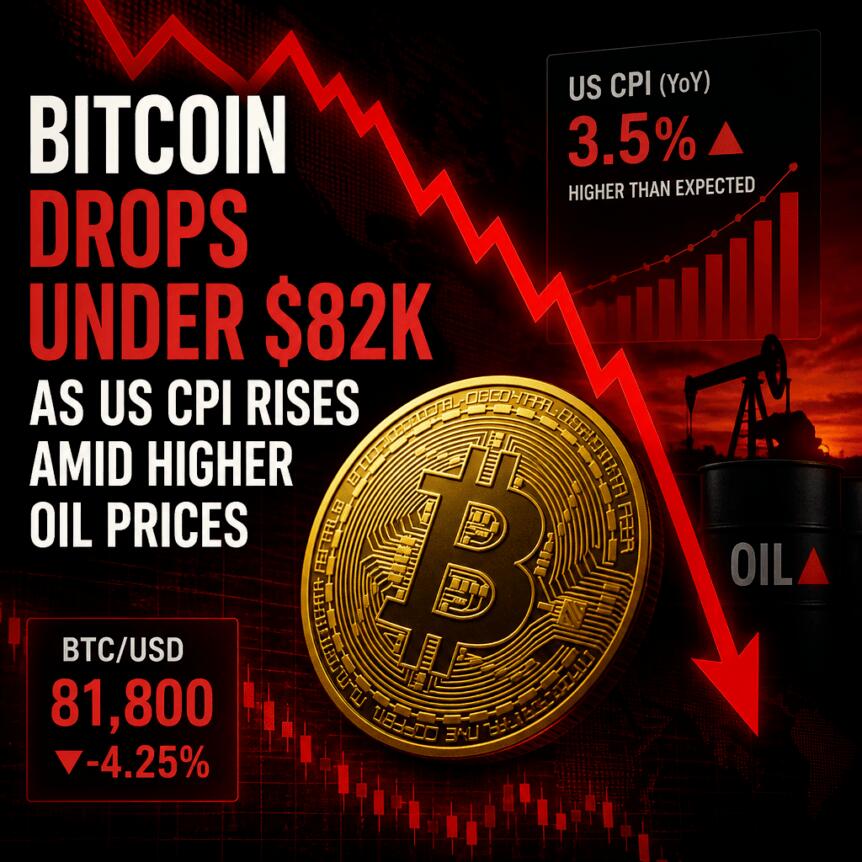
Bitcoin slipped below the psychologically important $82,000 level in the hours after the US Bureau of Labor Statistics released September Consumer Price Index (CPI) data, with the move closely tied to a hotter-than-expected inflation print and the market’s read-through to interest-rate expectations.
At around $81,926 on Bitstamp, BTC’s decline followed a CPI year-over-year rate of 3.7%—slightly above the 3.6% consensus—while fuel costs and broader energy-related components drove much of the surprise. The report also pushed up US Treasury yields and dragged gold lower, underscoring how macro repricing is still dictating near-term crypto price action.
Key takeaways
- Bitcoin fell to roughly $81,926 on Bitstamp after September CPI came in at 3.7% YoY versus 3.6% expected.
- Fuel and gasoline prices were the dominant factor, with gasoline up 9.1% YoY according to the BLS release.
- US bond yields jumped and gold declined to about $4,079 per ounce, signaling a broader risk-sensitive macro reaction.
- CME Group’s FedWatch Tool showed markets shifting toward the odds of a 25-basis-point move at the Fed’s late-October meeting.
Hotter US CPI tightens the macro grip on Bitcoin
TradingView data, as cited in coverage of the move, showed not only crypto but also gold and stock-index futures turning lower after CPI hit the tape. The CPI report confirmed a 3.7% year-over-year increase for September, which was 0.1 percentage points above the majority expectation, according to Bureau of Labor Statistics data.
The composition of the inflation gain mattered: fuel-price increases tied to global supply pressures—linked in the report discussion to the Middle East conflict and an oil-supply strain—were described as especially conspicuous.
The BLS release highlighted that gasoline was up 9.1% year-on-year, accounting for more than half of the “all items” monthly increase, while the energy index rose 5.2% over the month following a 2.1% increase in August. These details, from the BLS official CPI release, are important for investors because they suggest the inflation pressure is not only “core-like,” but also concentrated in inputs closely tied to global energy markets.
Core CPI also edges higher, limiting relief for rate-sensitive assets
Even beyond energy, the report did not provide broad cooling. Core CPI—defined as CPI excluding energy and food—came in at 2.6% year-on-year, also 0.1 percentage points higher than what markets expected.
Carson Group’s Sonu Varghese, commenting in an interview on CNBC, argued that investors should have anticipated elevated readings. He pointed to potential follow-through from higher diesel prices as well as demand-side effects tied to the “AI boom,” framing the “surprise” as increasingly difficult to justify given where the economy appears to be headed.
For crypto traders, the key takeaway is that even if the headline number is partially energy-influenced, the core component being firmer reduces the probability that markets can quickly pivot back to a softer Fed path purely on disinflation hopes.
Fed pricing shifts: higher yields and lower gold follow CPI
Market-rate expectations moved quickly after the CPI print. According to CME Group’s FedWatch Tool, the majority of participants adjusted toward a 25-basis-point rate hike at the Fed’s upcoming meeting on Oct. 28. The odds for that outcome rose to 53.7% from 22.1% the prior day, the tool’s data showed, while expectations for December reflected similarly hawkish probability levels, with a second 25-basis-point move standing at around 50%.
Theresa Sheehan of Econoday offered additional context, suggesting that—paired with softness in September payrolls—the FOMC may be inclined to hold rates at its late-October meeting while maintaining a bias toward hiking in December.
In commodities and rates, the CPI reaction followed a consistent macro playbook. Gold, which is often sensitive to real yields and the direction of monetary policy expectations, fell to approximately $4,079 per ounce. US bond yields rose as well, with the 10-year yield reaching 5.329%—described as roughly three basis points shy of new 24-year highs, based on the coverage’s referenced charting of market moves.
Economist Robin Brooks captured the sentiment in a blog post cited in the reporting, arguing that the CPI result was “the last thing global bond markets needed,” especially after earlier indications that a bond sell-off might be settling.
Where Bitcoin goes next: a defined zone and the next inflation catalyst
Despite the broader risk-off tone, Bitcoin’s immediate technical framing remained centered on a specific range. The article discussion noted BTC continuing to trade around a key area between $82,500 and $83,400, with analysts awaiting confirmation on whether that band could hold as support or instead give way.
That matters because macro-driven selloffs can quickly become self-reinforcing if a commonly watched level breaks. Conversely, if the range holds while yields stabilize, BTC often regains traction as traders refocus on crypto-specific flows rather than purely on duration and rate expectations.
Looking ahead, the next scheduled US data point in the chain of inflation signals is the Producer Price Index (PPI), due Friday, which was highlighted in prior Cointelegraph reporting referenced in the article. With CPI already shifting Fed pricing, traders are likely to watch whether PPI confirms another round of inflation pressure or—just as importantly—whether it points to easing input costs that could later feed into retail price trends.
For now, the main uncertainty is whether the CPI move proves to be a brief repricing tied to energy alone, or a more persistent inflation narrative that keeps yields elevated. Either way, Bitcoin appears to be reacting as a macro asset in the near term—so monitoring rate expectations and the next inflation prints may be as important as watching order-book dynamics.

Join Our Telegram channel to stay up to date on breaking news coverage
TD Cowen warns CFTC crypto rules may not survive past the 2028 election
The Commodity Futures Trading Commission’s new framework for leveraged crypto trading may not be finalized before the 2028 presidential election, and TD Cowen analysts say that timing puts the whole effort at risk.
Jaret Seiberg, a managing director at TD Cowen’s Washington Research Group, laid out the warning in a note dated October 12, 2026. “Time is running out,” he wrote. In his view, the agency at best delivers a formal proposal in late Q1 2027 or early Q2 2027, and finalizing the rule could stretch into early 2028. A rule finished that close to an election can be rewritten or scrapped by the next administration and a new slate of commissioners, the analysts argued, because agency rules lack the durability of a law passed by Congress.
The warning lands on a rulemaking that began on October 5, 2026, when the CFTC issued an advance notice of proposed rulemaking, a non-binding request for public input ahead of any formal rule. The notice asks for comment on a federal framework for retail crypto transactions involving leverage, margin or financing, an area the agency has never regulated through a dedicated federal lane.
Why the deadline matters
The CFTC moved after the Clarity Act, the market structure bill that would have handed the agency authority over spot crypto trading, stalled in the Senate in September 2026. Chairman Michael Selig has described the agency’s approach as a temporary solution meant to provide oversight while legislative efforts stay stuck, a framing TD Cowen reads as a concession that rulemaking alone cannot settle the industry’s regulatory status.
The analysts see no clean way out of the timing squeeze. Rushing the rule to beat the election raises the risk a judge blocks it on procedural grounds, Seiberg wrote, and even a careful process invites legal challenges that could run past 2028. In TD Cowen’s assessment, only legislation gives the framework a stable footing.
The comment period, set to run 60 days once the notice appears in the Federal Register, has not yet started. No publication date has been announced.
Join Our Telegram channel to stay up to date on breaking news coverage

Rival prediction markets Kalshi and Polymarket will reportedly be excluded from the Federal Trade Commission’s (FTC) probe into deceptive practices in the $167 million online sports gambling industry.
The two crypto-linked firms aren’t a focus of the FTC probe, which will instead set its sights on sportsbooks like DraftKings and FanDuel.
It will likely look into misleading advertisements, as well as the rate of suicides, hospitalizations, and bankruptcies caused by the industry.
Sources familiar with the matter told The Washington Sun that the industry evaluation “is in its early stages,” and that it’s conducted by political and career staffers.
New York alleges prediction markets cause problem gambling
Polymarket, which utilises blockchain technology, and Kalshi, which offers crypto perpetuals, are already under the scope of an insider trading probe overseen by Republican House Oversight Committee member James Comer.
The state of New York has also sued Kalshi and Polymarket this year, accusing them both of running an illegal gambling operation that’s encouraging problem gambling among people under the age of 21.
Last month’s Polymarket suit highlighted a study from the National Institutes of Health and American Psychological Association that linked pathological gambling to mental health disorders, suicidal behaviors and substance abuse.
Prediction markets say they aren’t offering gambling
Neither Kalshi nor Polymarket want to be considered gambling, and hope to be regulated federally under the Commodity Futures Trading Commission instead of individual states.
Kalshi CEO Tarek Mansour recently argued that prediction markets aren’t gambling because it is an open financial market that matches buyers and sellers.
Read more: American Indian tribes want Kalshi and Polymarket off their land
Last year, Polymarket CEO Shayne Coplan called DraftKings and FanDuel a sportsbooks “duopoly” that acts against winning bettors.
He said that Polymarket offers derivatives and shouldn’t be regulated like sportsbooks that offer gambling.
President Donald Trump’s son Donald Trump Jr. holds advisory roles in both firms. He holds $300,000 worth of Kalshi shares, and his investment firm 1789 Capital has invested $500 million in Polymarket.
Got a tip? Send us an email securely via Protos Leaks. For more informed news and investigations, follow us on X, Bluesky, and Google News, or subscribe to our YouTube channel.

BEIJING — U.S. credit card giant Visa announced Tuesday it had received approval from the People’s Bank of China for setting up a bank card clearing business in the country.
The news comes as the U.S. and Chinese presidents plan for their third meeting this year.
“This marks an important milestone toward the company serving China’s domestic payments market,” Visa said in a statement.
“For more than 40 years, Visa has been an active contributor to China’s dynamic payments landscape,” Visa CEO Ryan McInerney said. “We look forward to taking the necessary steps in the process, pursuant to the PBOC’s regulations, to begin operating domestically in China.”
McInerney joined U.S. President Donald Trump’s business delegation to Beijing in May and subsequently became chair of the U.S.-China Business Council in June. The Visa CEO also led a trip to Beijing in early September.
“The timing is notable,” said George Chen, partner and chair of digital practice, The Asia Group.
“Beijing chose to approve visa’s license just ahead of the APEC Leaders’ Meeting in Shenzhen next month, where Xi [Jinping] and Trump are expected to meet again,” he said. “The move suggests that Beijing is keen to demonstrate tangible progress for American businesses before Trump’s next visit to China.”
Trump told Fox News after his Beijing trip in May that he brought up Visa’s request to gain China market access. After the summit in September, China said it would approve applications from all foreign financial institutions to operate in the country.
Entering a closed market
Mainland China has kept a tight grip on its financial sector, favoring domestic players and restricting cross-border capital flows.
Visa previously said it had applied with the PBOC in May 2020 to operate a bank card clearing institution.
The company has worked with Chinese banks for dual-branded cards, for which China’s UnionPay processes transactions domestically and Visa processes overseas payments. In January, Visa said the mainland China-issued cards could be linked to Apple Pay for use overseas.
Rival Mastercard‘s joint venture in China said it started processing payments in 2024 after getting the PBOC’s approval to begin bank card clearing preparations in February 2020.
American Express was the first, receiving its processing license in June 2020 after getting the PBOC nod back in 2018.
Mobile pay dominates daily consumer transactions in China, primarily facilitated by Tencent’s WeChat and Alibaba-affiliate Ant’s Alipay.
Bitcoin’s price nosedived once again on Tuesday morning, but this time it marked a higher low and rebounded quickly toward $84,000.
Most larger-cap alts have experienced more substantial declines, including ZEC, ADA, and NEAR. SOL is below $110, ETH is down by over 1%, while XRP lost the $1.40 level.
BTC Goes Wild
Bitcoin’s troubles began at the start of the previous business week when it was rejected at $87,000 for the fourth or fifth time in the past half a month. At first, it held at $85,500 before bears took complete control and pushed it down to $83,500; the final move came last Thursday, when the cryptocurrency slumped to $80,400.
After losing nearly $7,000 in days, the asset was bound for a bounce-off, which took place by Friday evening and during the weekend. Bitcoin spent the next few days trading sideways between $82,000 and $83,000 before it tried to break out on Monday. However, it was stopped at $84,000 once again.
More volatility ensued on Tuesday morning as BTC dumped to $80,850 (on Bitstamp) and then rebounded just as quickly to $84,000. Similar violent fluctuations harm over-leveraged traders, and the total value of liquidated positions on a daily scale skyrocketed to over $800 million.
As of press time, BTC remains about $500 away from the $84,000 mark. Its market capitalization stands still at $1.670 trillion on CMC, while its dominance over the alts is up to 59.7%.

Alts See Red
Ethereum dipped to $2,400 earlier this morning, before rebounding to over $2,500. However, it’s still 1.2% down on the day. BNB is down to $745, while XRP has slipped further away from the coveted $1.40 level. SOL is below $110, HYPE has slumped by 5%, and so has ADA. Cardano’s token is below $0.24 as of now.
ZEC has dropped by over 6% to $1,226, while NEAR has plummeted by 10% to under $5.20. HBAR, ONDO, ENA, AVAX, PUMP, and WLD are also deep in the red. STX and BTW are among the few exceptions in the green today.
The total crypto market cap is down by over $20 billion on a 24-hour scale to $2.810 trillion on CMC.

The post ZEC and NEAR Plummet Hard, BTC Recovers From Rollercoaster Ride: Market Watch appeared first on CryptoPotato.


- KuCoin 5.0 integrates AI, trading tools, and wealth management services.
- KuCoin introduces a unified account for eligible spot, margin, and futures traders.
- The upgrade adds accessibility features and expands AI Assistant 5.x.
KuCoin has unveiled KuCoin 5.0, a comprehensive platform upgrade that integrates artificial intelligence (AI), trading tools, wealth management services, and accessibility features as the cryptocurrency exchange seeks to improve the user experience.
Announced on October 9, 2026, the upgrade covers six areas: compliance, technology, assets, experience, AI, and wealth management.
The company said the changes are intended to create a more unified and efficient platform, building on its global brand initiative, “Trust, Built-in,” and its “Trust First. Trade Next.” proposition.
The upgrade includes a redesigned interface, an expanded AI assistant, and new ways for users to manage funds across trading and wealth management services.
KuCoin 5.0 introduces redesigned interface and unified trading account
KuCoin 5.0 includes an updated Profile Center 2.0, featuring a card-based layout designed to make account information and frequently used functions easier to access.
The exchange has also upgraded its sub-account system to simplify account creation, strengthen security controls, and improve management.
Enhanced K-line charts offer additional tools and real-time data, with settings synchronised across devices.
The platform has introduced a colour vision accessibility mode to make charts and other visual information easier to distinguish for users with different colour vision needs.
KuCoin estimates that approximately 360 million people worldwide experience some degree of difficulty distinguishing colours.
The upgrade also retains Lite and Pro experiences to accommodate users with different levels of familiarity and trading requirements.
For eligible users at VIP1 level and above, KuCoin has introduced the Unified Trading Account (UTA). The feature brings spot, margin, and futures trading into a shared framework for funds, margin, and risk management.
According to the company, this arrangement reduces the need to transfer funds between separate accounts and allows for more efficient capital use across eligible products.
AI assistant expands across platform services
KuCoin 5.0 includes an upgrade to AI Assistant 5.x, creating a unified entry point for conversations, questions, and task completion across the platform.
The assistant covers market insights, Earn services, trading, customer support and campaigns.
It uses page context and user actions to better understand users’ requirements, recommend relevant services and help them complete tasks.
The company said the AI integration is intended to extend across the user journey rather than operate as a standalone feature.
Wealth management tools connect earning and trading
The upgrade also links earning and trading activities through wealth management products and benefits for VIP users, Earn access through sub-accounts and support for selected wealth assets within the UTA framework.
Main accounts and sub-accounts can participate in Earn while managing funds separately.
Meanwhile, KCUSD can be used as margin within the Unified Trading Account, reducing the need to move funds repeatedly between earning and trading activities.
KuCoin said these changes are supported by continued development of its compliance, technology and asset foundations.
“Trust should be something users can experience in every interaction—not only in how their assets are protected, but in how clearly, reliably and efficiently the platform works,” said BC Wong, CEO of KuCoin.
Wong added that KuCoin 5.0 translates the company’s long-term commitment to trust into its product, providing users with greater confidence and control while laying the groundwork for the next stage of digital finance.
The company said the upgrade establishes a foundation for further platform development by connecting trading, asset management, and intelligent services within a more integrated experience.

Omar has accused Trump of having a “weird” obsession with her
Trump has long targeted Omar and her birthplace Somalia during his anti-immigration speeches and remarks.
Last December, while delivering an address in Pennsylvania, Trump referenced Omar during an ant-immigration tirade, claiming she does “nothing but b-tch” and arguing she comes from a county considered to be “the worst” in the world. “We ought to get her the hell out,” the President said, pausing as members of the crowd chanted “send her back.”
Omar responded by saying Trump’s “obsession” with her is “beyond weird.”
“Since he has no economic policies to tout, he’s resorting to regurgitating bigoted lies instead,” said Omar via social media, reacting to a clip of the President’s speech. “He continues to be a national embarrassment.”
In January, Omar was approached by a man with a syringe during a Town Hall meeting in Minneapolis. The man sprayed her with a substance before being restrained by on-site security. Lab analysis later determined the liquid contained acetic acid and identified it as a mixture of water and apple cider vinegar. Last month, a 56-year-old man named Anthony James Kazmierczak was sentenced to 14 months in prison for the assault.

CAF Insiders Dismiss Claims of Declining Confidence in Motsepe’s Leadership
Porsche Just Revealed The Mission S, And It’s So Much More Than Just A New Concept Car

LARRY KUDLOW: Don’t count the GOP out yet


-

 Fashion5 days ago
Weekend Open Thread: Quince – Corporette.com
-

 Business & Hustles5 days ago
PwC: Supply-Chain Diversification, AI and Energy Transition Open New Growth Paths for Thailand
-

 Sports7 days ago
Multiple Power Four programs face College Sports Commission investigations over alleged NIL cap evasion
-

 Crypto4 days ago
XRP Ledger Defends Emergency Patch Amid Criticism
-

 Crypto3 days ago
Rep. Omar Says She Will ‘Not Be Silenced’ After Federal Agents Raid Her Home
-
 Crypto6 days ago
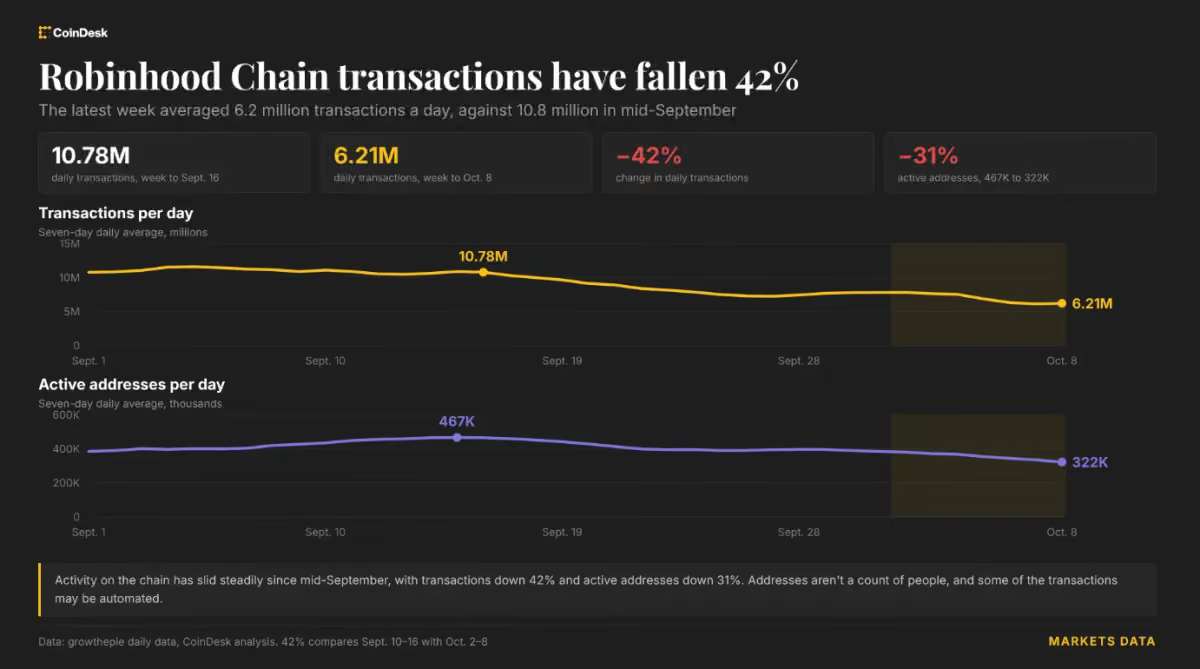
Robinhood Chain slowdown spreads from fees to trading as transactions fall 40%
-

 Sports6 days ago
College Football Week 6 Bets: Three Picks for Saturday’s Biggest Games
-

 Sports4 days ago
Duke receives encouraging update regarding top prospect from class of 2028
-

 Crypto3 days ago
KuCoin unveils 5.0 upgrade with AI tools and unified trading account – CoinJournal
-

 Crypto4 days ago
Saylor Signals Next Bitcoin Buying Plan After September STRC Buybacks
-

 Tech & AI7 days ago
ICE Emails Discuss Using Palantir-Supported Tool to Investigate Voter Fraud
-

 Sports6 days ago
Morocco and Senegal await AFCON final verdict after arbitration hearing – Sports
-

 Crypto6 days ago
Mashinsky Accepts Lifetime Industry Ban and Up to $35 Million in Conditional Payments | The Defiant
-

 Sports6 days ago
Saudi oil crisis affects Neom project, 2034 World Cup plans
-

 Sports3 days ago
Work on Trump’s D.C. muni enrages judge: ‘You did your absolute worst’ | News
-

 Crypto5 days ago
October 11 Crash: What Wiped Out 1.65M Traders
-
Crypto3 days ago
ZEC and NEAR Plummet Hard, BTC Recovers From Rollercoaster Ride: Market Watch
-

 Crypto5 days ago
Justin Sun says Tron post-quantum plan on testnet
-
 Sports3 days ago
Tax evasion to Portugal fallout: Controversies that rocked Ronaldo’s career | Football News
-

 Crypto4 days ago
Ledger halts CryptoBilis after $86M wallet drain
You must be logged in to post a comment Login