
Crypto World
2 Major Ripple (XRP) News From The Past 24 Hours: Details


Less than two months after announcing a major partnership with the Kansas Jayhawks, the company behind XRP has doubled down on its US sports endeavors by collaborating with the Florida Gators.
Almost immediately after the news was announced, both parties shared a video showing that XRP’s logo was painted on the sports team’s ground.
$XRP and @FloridaGators.
Soon. https://t.co/AI7wKEy3xw— Ripple (@Ripple) September 4, 2026

Further details on the partnership indicate that the team will generate $5 million annually by placing the logos in the Swamp.
“Florida has a long history of embracing innovation and technology to enhance the experience of our fans and advance our programs,” athletic director Scott Stricklin said in a statement. “This partnership brings together two organizations that think boldly about the future, and we look forward to introducing XRP to our fans.”
The first game to host XRP’s logo will be played tonight at the Ben Hill Griffin Stadium, as the Florida Gators will face the Florida Atlantic Owls.
Recall that Ripple made a similar partnership with the Kansas Jayhawks, who represent the University of Kansas, and their teams have won 15 national championships, including 12 NCAA Division I titles. This one was more personal for Ripple’s CEO, who was raised in the state and holds a Bachelor of Arts in Economics from the University of Kansas.
The second news was shared by one of the most popular XRP Army members, BankXRP, on X. The user noted that Ripple will be the headline sponsor of Stable Launch – Stablecon USA’s startup competition.
The company’s Whittney Levitt will join the judging panel of the event, in which the winning startup gets a $200,000 investment.
The post 2 Major Ripple (XRP) News From The Past 24 Hours: Details appeared first on CryptoPotato.


As Amy Dockser Marcus writes for The Information, we’ve been here before. In 2000, on the heels of the first sequencing of human DNA, Francis Collins, then-director of the Human Genome Project, predicted that “in another 20, 25 years we should be able to prevent or cure most cases of cancer, of diabetes, of heart disease, of multiple sclerosis, of asthma.” And yet, here we are, 26 years later, facing a growing epidemic of chronic diseases.
Daphne Koller, CEO of the AI-driven drug development company insitro, calls it the “magic wand” assumption. “Hundreds of years into modern medicine,” she writes, “our understanding of most human disease, and much of healthy physiology, is best captured by the parable of the blind men and the elephant; in this case, a really huge elephant.”
The current debate about whether AI can cure all diseases is more than a tempest in a GPTeapot. It points to a larger problem: we are too often focused solely on improving the machines, and too rarely focused on investing energy and resources in improving humans.


Robinhood Chain has recorded less than 1% of its analyzed transactions through a contract clearly linked to Robinhood Wallet users, according to ARK Invest research director Lorenzo Valente.
Summary
- Less than 1% of analyzed transactions passed through the confirmed Robinhood Wallet swap route.
- Valente estimated Robinhood-linked activity could reach about 5% after including unidentified contracts.
- GMGN and OKX accounted for much of the remaining activity identified in the analysis.
- Robinhood Chain remains open to outside wallets, trading terminals and EVM-compatible applications.
According to Lorenzo Valente’s analysis, contract-level data indicates that most trading on Robinhood Chain comes from existing on-chain traders rather than new cryptocurrency users entering through Robinhood.
Valente, ARK Invest’s director of research for digital assets, examined which smart contracts generated transactions on the network. His review sought to separate activity that could be linked directly to Robinhood products from trades routed through outside wallets and applications.
Robinhood Wallet sends swaps through the 0x Settler contract, making that route the clearest source of transactions from the company’s wallet users, according to Valente. Transactions involving the contract represented less than 1% of the activity included in his analysis.
Allowing for contracts that could not be identified raised the possible Robinhood-linked share to about 5%, he estimated. Valente described the estimate as generous because some of the unidentified activity could also have come from outside trading services.
Robinhood Chain activity comes mainly from external platforms
Most of the identifiable volume outside the 0x Settler route came through GMGN and OKX, Valente said. Both platforms give traders access to on-chain assets without requiring them to use Robinhood Wallet as their main entry point.
GMGN functions as a trading terminal for users seeking newly issued tokens and other speculative assets across several blockchains. OKX also offers a Web3 wallet and decentralized exchange tools that can connect to Ethereum Virtual Machine networks.
Comparing the transaction patterns across chains, Valente said the activity on Robinhood Chain resembled the behavior already seen from users of the same services elsewhere. He described the network as attracting the “same degens” to a new blockchain, rather than showing clear evidence that Robinhood had introduced a separate group of users to on-chain markets.
Valente framed the observation as his reading of the contract data, not a customer count supplied by Robinhood. Wallets can also interact through aggregators, custom contracts, or routes that make their original source difficult to identify, limiting how precisely public blockchain data can assign transactions to individual platforms.
The findings concern transaction origins rather than the number of people using each wallet. One address may belong to a single user, a trading bot, an application, or a service that combines transactions for several customers.
An open network complicates Robinhood user counts
Robinhood Chain operates as a permissionless Ethereum Layer 2 built with Arbitrum technology. EVM-compatible wallets and applications can connect without holding a Robinhood brokerage account, while developers can deploy contracts without restricting access to the company’s customers.
Such access means the network’s total transactions, fees, and decentralized exchange volume cannot automatically be treated as Robinhood customer activity. A trade made through GMGN or OKX still appears on Robinhood Chain, even when the trader never enters through Robinhood’s wallet interface.
The distinction matters because the network has generated large trading and revenue figures since its July 1 mainnet launch. Crypto.news previously reported that three leading applications produced about 93% of measured application revenue during one 24-hour period.
GMGN led that snapshot with approximately $1.11 million, followed by the Pons token-launch platform with about $1.03 million and Uniswap with roughly $327,707. The concentration supported the view that a small group of crypto-native services drove much of the network’s early fee activity.
On Sept. 2, Robinhood Chain generated $4.01 million in chain revenue from $4.45 million in total fees, according to DeFiLlama data cited in a separate report. Its cumulative decentralized exchange volume had also crossed $47 billion in under two months, while GMGN and Pons accounted for much of the memecoin trading.
Robinhood has covered transaction costs during the network’s first 90 days, with the gas subsidy scheduled to run through the end of September. The free gas program has allowed traders and applications to execute transactions without paying the usual network fee themselves.
Tokenized stocks form a smaller but growing market
Robinhood introduced the chain partly as infrastructure for tokenized stocks, real-world assets, and decentralized finance. Trading activity, however, has also spread into memecoins and newly issued tokens that are not central to the brokerage’s stock-token strategy.
Uniswap processed $1 billion in cumulative tokenized-stock volume on Robinhood Chain by Aug. 21. The total covered swaps involved several stock-linked tokens rather than assets deposited on the network or trading in a single product.
Stock tokens remain unavailable to investors in the United States. Robinhood has offered the products across more than 120 countries, according to its August earnings call, allowing eligible overseas customers to gain price exposure to U.S. stocks through blockchain-based instruments.
For American readers, Robinhood Markets remains the direct listed exposure to the company’s blockchain strategy through its Nasdaq-traded HOOD shares. On-chain transactions generated by outside services should not be treated as equivalent to new U.S. brokerage accounts, cryptocurrency customers, or revenue reported in Robinhood’s financial statements.
Robinhood reported 28.4 million funded customers at the end of the second quarter, up 1.9 million, or 7%, from a year earlier. Its investment accounts increased 9% to 29.9 million, while total platform assets reached $369 billion, according to the company’s second-quarter results.
Robinhood’s customer base remains a separate metric
Supporters of the network have pointed to Robinhood’s existing customer base as a possible route for bringing more people on-chain. BitMine Chairman Tom Lee said in August that access to millions of funded accounts could make Robinhood Chain an important source of new Ethereum users.
Early network data has not yet established that connection, according to Valente’s contract review. Confirmed Robinhood Wallet routing represented only a small part of the transactions he examined, while trading terminals used by experienced crypto participants accounted for most of the activity he could identify.
Robinhood said during its second-quarter earnings call that it served more than 1 million accounts outside the United States. The company also reported quarterly revenue of $1.3 billion, up 32% from a year earlier, and said it added nearly 1 million funded customers during the quarter.
Robinhood Chain has set a daily fee record of $6.04 million, lifting its seven-day annualized revenue rate to approximately $1.1 billion as memecoin trading and token launches drive network activity.
Summary
- Robinhood Chain generated $6.04 million in fees and retained $5.44 million in daily revenue.
- Seven-day revenue reached $20.33 million, equal to an annualized rate of roughly $1.06 billion.
- GMGN and Pons have become two of the largest application-level revenue sources on the network.
- Robinhood Chain recorded $1.71 billion in decentralized exchange volume over the latest 24 hours.
Robinhood Chain daily fees reach $6.04 million
DefiLlama data showed Robinhood Chain collecting $6.04 million in transaction fees over the latest 24-hour period, exceeding the previous level of about $4.6 million and setting a record for the network.
After deducting Ethereum settlement expenses and Robinhood Chain’s fee-sharing obligations to the Arbitrum ecosystem, the network retained approximately $5.44 million as chain revenue. Fees refer to the total amount users paid, while revenue measures the portion kept by the network after associated costs and allocations.
Robinhood Chain generated $20.33 million in revenue during the latest seven-day period, according to the same dashboard. Maintaining that rate for a full year would produce approximately $1.06 billion, commonly rounded to $1.1 billion.
Annualized figures are projections based on a short measurement period rather than revenue already earned. A few days of unusually active trading can raise the estimate quickly, while a decline in transactions would pull it lower.
The latest record extends a rapid increase from Sept. 2, when the chain collected $4.45 million in fees and retained $4.01 million. Its revenue therefore rose by approximately 36% between the two readings, although both figures came from rolling 24-hour windows.
As crypto.news previously reported, Robinhood Chain’s early rise included approximately $3.6 million in transaction fees during July, its first month after the public mainnet launch. The latest one-day total has now exceeded the amount recorded across that entire month.
Memecoin platforms account for much of the activity
Applications built around memecoin trading and token issuance have supplied a large share of the chain’s recent fee income. GMGN generated approximately $2.9 million in revenue across its supported networks over the latest 24 hours, while its seven-day total reached $13.84 million, DefiLlama data showed.
GMGN provides token-monitoring, wallet-tracking, and trade-execution tools rather than issuing tokens itself. The platform charges users when they trade through its interface, allowing higher volume to feed directly into its fee totals.
Robinhood Chain has recently become GMGN’s largest revenue source. Data cited in an August report showed that the network contributed $11.67 million of the platform’s approximately $19.81 million in monthly revenue at the time, ahead of BNB Chain and Solana.
Pons has added another major source of activity. The Robinhood Chain launchpad allows users to issue and trade tokens, charging launch fees and collecting part of the swap fees generated during trading.
Over the latest 24-hour measurement period, Pons retained approximately $1.24 million in protocol revenue. Its seven-day and 30-day revenue totals stood at $5.95 million and $9.04 million, respectively.
Fee volume on Pons has been much larger than the amount retained by the protocol. A recent network breakdown found that users paid $5.95 million through Pons in one 24-hour period, while approximately $1.11 million counted as protocol revenue.
Under the platform’s model, part of the trading fees goes to token creators rather than remaining with Pons. Separating gross fees from retained revenue is therefore necessary when comparing Pons with Robinhood Chain or other protocols.
GMGN, Pons, and Uniswap accounted for approximately 93% of Robinhood Chain application revenue in a recent DefiLlama snapshot. GMGN contributed around $1.11 million, Pons generated roughly $1.03 million, and Uniswap supplied about $327,707 during that measured period.
Concentration among a small group of applications leaves the chain’s daily results sensitive to changes in memecoin volume. Rolling dashboard totals can also change throughout the day as older transactions leave the 24-hour window and new transactions enter it.
DEX volume climbs above $1.7 billion
Alongside the fee record, decentralized exchanges on Robinhood Chain processed approximately $1.71 billion in trading volume over 24 hours. Seven-day DEX volume reached $9.95 billion after increasing 105% from the preceding comparable period.
Pons has supplied a large portion of that trading. On Aug. 30, the launchpad processed about $445 million of the chain’s $874.8 million in DEX volume, meaning one application accounted for slightly more than half of the daily total.
Trading has not been limited to conventional memecoins. Launchpads on the network have also created markets that pair user-issued tokens with assets linked to publicly traded companies, combining speculative token activity with Robinhood’s tokenized-equity offering.
Uniswap serves as a main liquidity venue for those markets. In August, tokenized stock trading involving Robinhood Chain exceeded $1 billion in cumulative volume through Uniswap.
The total represented swap volume involving stock tokens, not the value of tokenized equities held on the network. Markets have included tokens tracking companies such as Nvidia, Apple, and Alphabet.
Robinhood Chain’s total value locked stood at approximately $1.17 billion in native protocols at the latest reading, while its bridged value reached about $3.03 billion. Stablecoins on the chain carried a market capitalization of approximately $951.8 million after rising 26.6% over seven days.
U.S. investors gain exposure through Robinhood stock
Robinhood launched the network on July 1 as an Ethereum Layer 2 built with Arbitrum Orbit technology. ETH serves as its gas token, while transactions are ultimately settled on Ethereum.
The chain does not have an official native token. Community-issued assets trading on it, including PONS, are not Robinhood securities and do not give holders ownership in Robinhood Markets.
For American investors, the most direct regulated exposure to the company remains Robinhood Markets stock, which trades on Nasdaq under the HOOD ticker. Network revenue could affect the company’s financial results if Robinhood records the retained fees as corporate income, but annualized blockchain estimates are not equivalent to revenue reported in Robinhood’s audited financial statements.
Robinhood’s Stock Tokens are available in more than 120 countries but remain unavailable to U.S. residents. The products provide economic exposure to referenced equities rather than legal ownership of the underlying shares, according to an earlier chain review.
Under the Arbitrum Expansion Program, 10% of Robinhood Chain’s net revenue goes to the Arbitrum ecosystem. Eight percentage points flow to the Arbitrum DAO treasury, while two percentage points support a developer guild. Applying the arrangement to the latest $5.44 million daily revenue figure would allocate approximately $544,000 before any later adjustments recorded by the participating parties.

Perhaps more than other diseases, the desire for privacy is particularly strong for dementia, which is still viewed by many as a mental health disorder rather than a neurologic disease like Parkinson’s disease or ALS.
My patients and families typically limit the disclosure of the diagnosis on a need-to-know basis, and many choose to hide it till the end. Doctors, clinics, and hospitals are complicit with this secrecy, with only around 50% of people with dementia having their diagnosis documented in their medical records.
Since dementia tends to begin later in one’s life, many simply fade into retirement and anonymity, which inevitably leads to social isolation and misleading others of their whereabouts. Interestingly, the shame associated with dementia is not typically shared by people afflicted with other neurological disorders such as multiple sclerosis, stroke, or ALS.
When singer Celine Dion was diagnosed with the rare, progressive neurologic condition called stiff-person syndrome, she came forward with a message to her fans, putting an end to speculation about the mystery illness that caused her to cancel a series of performances. In her documentary, she bravely allowed a glimpse of the painful muscle spasm she experiences daily. Through her foundation, Dion personally donated millions of dollars towards research into the rare disease that afflicts fewer than 5,000 people in the United States.


U.S. spot Bitcoin and Ethereum exchange-traded funds attracted a combined $1.20 billion during the trading week ending Sept. 4, with Bitcoin products accounting for more than 80% of the total.
Summary
- Spot Bitcoin ETFs recorded $986.7 million in weekly net inflows.
- Ethereum ETFs added $215.3 million, down sharply from the previous week.
- BlackRock’s Bitcoin funds attracted $691.5 million across the five sessions.
- The largest combined inflows arrived on Sept. 3 as crypto prices rebounded.
Bitcoin ETF inflows approach $1 billion
According to data from Farside Investors, U.S. spot Bitcoin ETFs recorded $986.7 million in net inflows between Aug. 31 and Sept. 4. The weekly intake increased about 6.7% from the $924.5 million added during the previous five trading sessions.
The funds opened the week with $216.7 million in net inflows on Aug. 31 before recording $236.5 million in withdrawals on Sept. 1. Demand returned over the following three sessions, producing inflows of $101.1 million, $730.8 million, and $174.6 million.
Sept. 3 accounted for roughly 74% of the entire weekly total. BlackRock’s spot Bitcoin products attracted $454 million that day, while ARK Invest and 21Shares’ ARKB added $137.7 million. Fidelity’s FBTC and Grayscale’s Bitcoin Mini Trust recorded $74.4 million and $48.8 million, respectively.
BlackRock’s products led the full week with about $691.5 million in net inflows. ARKB followed with $137.7 million, while Fidelity’s fund added $94.8 million.
Bitwise’s BITB received $41.7 million during the period. VanEck’s HODL posted approximately $33 million in net withdrawals, while Grayscale’s converted GBTC fund recorded a modest $18.6 million inflow.
The five-day result brought cumulative net inflows across the U.S. spot Bitcoin ETF market to approximately $55.69 billion, according to Farside’s data.
Ethereum ETF demand slows from the previous week
U.S. spot Ethereum ETFs recorded $215.3 million in net inflows over the same period, Farside data showed. Although the funds remained net positive, weekly inflows fell by around 73.6% from $815.7 million during the previous week.
Ethereum products started the period with an $87.6 million inflow on Aug. 31 and added another $8.6 million on Sept. 1. The group then recorded $48.2 million in net outflows on Sept. 2 before attracting $141.4 million on Sept. 3 and $25.9 million on Sept. 4.
BlackRock’s ETHA brought in $136.4 million during the week, while its staked Ethereum product ETHB added $81.8 million. The two BlackRock funds therefore received a combined $218.2 million, slightly more than the category’s total net inflow after withdrawals from competing products were included.
Fidelity’s FETH ended the week with only $4.7 million in net inflows. The fund attracted $65.1 million on Sept. 3 but lost $48.3 million the following session.
Grayscale’s higher-fee ETHE recorded $37 million in weekly net outflows. Grayscale’s lower-cost Ethereum Mini Trust partly offset those withdrawals with $17.1 million in inflows.
Cumulative net inflows into U.S. spot Ethereum ETFs reached approximately $13.19 billion by the end of the week.
Crypto ETF inflows diverge from wider U.S. funds
The $1.20 billion combined inflow into Bitcoin and Ethereum ETFs came during a cautious period for conventional U.S. investment funds.
Investors withdrew $11.12 billion from U.S. equity funds during the week ending Sept. 2, according to LSEG Lipper data reported by Reuters. Large-cap funds accounted for $7.52 billion of those withdrawals, while money market funds attracted $48.76 billion.
Reuters tied the broader caution to rising bond yields, higher oil prices and tensions in the Middle East. Those factors weighed on risk assets earlier in the week, but sentiment improved on Sept. 3 after Federal Reserve Governor Christopher Waller said he could support keeping interest rates unchanged if inflation continued to ease.
The shift coincided with the largest daily crypto ETF inflows of the week. Bitcoin and Ethereum funds collectively attracted about $872.2 million on Sept. 3, while Bitcoin climbed above $81,000 and Ethereum moved back toward $2,500.
The subsequent reversal showed that ETF inflows did not remove short-term macro risks. Bitcoin was trading near $79,664 at the time of writing, down about 1.8% over the latest session, while Ethereum traded around $2,458 after a 2.8% decline.
U.S. data keeps rate expectations in focus
The next test for ETF demand could come from changing expectations for U.S. interest rates. The Bureau of Labor Statistics reported that nonfarm payrolls increased by 162,000 in August, while the unemployment rate remained at 4.1%.
The stronger labor data reduced some of the optimism created by Waller’s comments because a resilient economy could give the Federal Reserve more room to keep borrowing costs elevated.
Investors will now focus on the Sept. 11 U.S. consumer price index report and the Federal Reserve’s Sept. 16 policy decision. Further evidence of persistent inflation could pressure crypto prices and ETF demand, while softer inflation would support the case for stable or lower interest rates.
Despite those risks, the weekly figures showed that U.S. investors remained net buyers of both major crypto ETF categories. Bitcoin products maintained their momentum from the previous week, while Ethereum funds stayed positive even as their weekly intake slowed.
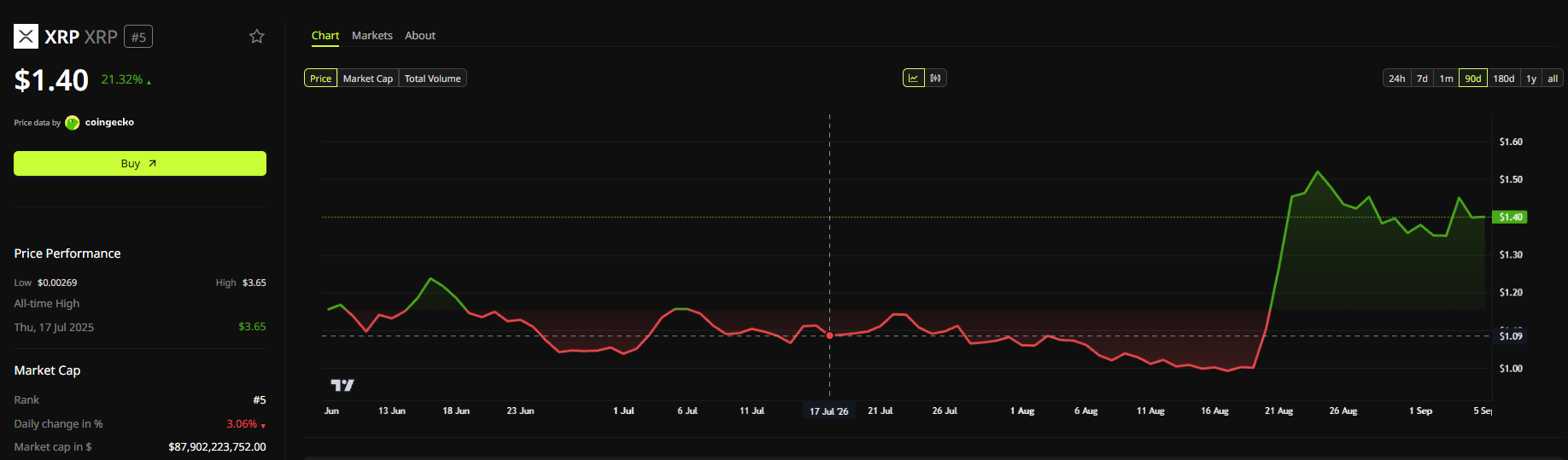
Ripple CEO Brad Garlinghouse has seized on the Dutch central bank’s $11 billion gold move. He says global finance still shifts value the way it did in the 1940s.
De Nederlandsche Bank sent roughly 86 tonnes of gold to London between March and August. The metal came from New York and Ottawa.
Ripple CEO Says the Gold Move Proves Crypto’s Case
The Dutch central bank sold about 59 tonnes in New York. It then bought the same quantity back in London. Nearly 70% of the transfer was therefore a paper exercise.
Only 27 tonnes actually crossed the Atlantic. New York now holds 18.5% of Dutch reserves, down from 31.3%. London’s share climbed to 32.1%. DNB holds 612.4 tonnes in total, worth 72.2 billion euros at the end of 2025.
Garlinghouse contrasted that friction with crypto’s past decade. He said the sector grew from a $1.5 billion experiment into a $2.7 trillion asset class.
He also revisited Germany’s 2013 repatriation. The Bundesbank needed four years to bring home 674 tonnes worth roughly $36 billion.
Old Rails Still Carry the World’s Money
DNB Governor Olaf Sleijpen framed the relocation as crisis preparation, not distrust of Washington. London handles far more physical gold trade than Ottawa.
“With this relocation, we have improved the tradability of our gold reserves. We expect that we will never need to use them, but we do need to strengthen our resilience and preparedness.”
Sleijpen, DNB
The mechanics still support Garlinghouse’s complaint. Banks settle value through correspondent queues, while stablecoins clear payments instantly. SWIFT switched on its own blockchain ledger in July, yet final settlement runs on older rails.
Garlinghouse made a similar point after the Mastercard deal in June. XRP trades near $1.40, down 3,65% on the day but up 21% over three months.

The Bank for International Settlements, owned by central banks, tested the XRP Ledger this month. Its prototype anchored official statistics in three to five seconds. Verification took one to two.
So can crypto do better? On speed, those numbers say yes. On trust, not yet. Central banks want vaults, insurance and legal finality.
Sleijpen’s decision to move gold to London was driven by the necessity of crisis-era tradability, a form of structural security that digital assets are still working to replicate.
The post Ripple CEO Slams $11 Billion Gold Move: Can Crypto Do Better? appeared first on BeInCrypto.


Poland’s Sejm has fallen 25 votes short of overriding President Karol Nawrocki’s third veto of a crypto regulation bill, with 241 lawmakers supporting the measure against the 266 required.
Summary
- The Sejm voted 241–198 to override Nawrocki’s veto, while three lawmakers abstained.
- Passing the bill again required a three-fifths majority, or 266 of the 442 lawmakers present.
- The legislation would have placed Poland’s crypto market under the supervision of the KNF.
- Donald Tusk cited testimony from the Zondacrypto investigation while urging lawmakers to support the bill.
Polish Radio reported on Sept. 4 that Poland’s lower house failed to pass the crypto bill again after President Karol Nawrocki refused to sign it for the third time.
Poland crypto bill falls 25 votes short
Of the 442 lawmakers present, 241 voted to override the president, 198 opposed the motion, and three abstained. Polish law required support from three-fifths of lawmakers voting with at least half of the Sejm’s 460 members present, setting the threshold at 266 votes.
An override would have required Nawrocki to sign the legislation. With the motion defeated, the latest version cannot advance through the legislative process.
The bill would have designated the Polish Financial Supervision Authority, known as the KNF, as the country’s crypto regulator. Its provisions were designed to support Poland’s implementation of the European Union’s Markets in Crypto-Assets Regulation, or MiCA.
Nawrocki has said he supports rules for the sector but considers the government’s version too restrictive. When he rejected the legislation on June 11, the president said lawmakers had addressed only one of the 16 changes proposed by his office.
“Bad law does not become good law simply because it is passed a hundred times,” Nawrocki said in a video statement announcing the third veto.
According to the president, the bill could place excessive burdens on Polish crypto companies and encourage some businesses to operate from other jurisdictions. He has also accused the governing coalition of repeatedly returning legislation that failed to resolve objections raised during previous rounds.
Nawrocki submitted a separate proposal that his office described as offering stronger safeguards against fraud and financial crime without imposing the same costs on legitimate companies. The president said Parliament had not supported his version.
Three vetoes have prolonged Poland’s MiCA dispute
The latest defeat follows two previous attempts by Prime Minister Donald Tusk’s government to pass a domestic crypto framework.
As crypto.news previously reported, Nawrocki rejected the first Crypto-Asset Market Act on Dec. 1, 2025. His objections included the regulator’s proposed authority to block crypto-related websites and the costs that companies could face under the law.
The Sejm tried to overturn that decision four days later. Lawmakers backed the override by 243 votes to 192 but failed to reach the required three-fifths majority.
After Parliament passed another version, Nawrocki issued his second veto on Feb. 12, arguing that it was almost identical to the original legislation. A second override attempt failed on April 17, when lawmakers voted 243–191 in favor and three abstained.
By May, the Sejm was considering competing proposals from the government, the president’s office, Poland 2050, and the Confederation party. The packages differed over the KNF’s enforcement powers and the financial penalties available to the regulator, according to earlier coverage of the bills.
The government-backed legislation passed the Sejm on May 15 against the backdrop of an investigation into Zondacrypto. The measure included licensing and reporting duties for crypto service providers, KNF supervision, and criminal liability for certain violations connected with token issuance and crypto services.
MiCA already applies across the EU, but national authorities still handle licensing, supervision and enforcement within the bloc’s common framework. The regulation covers crypto service providers, exchanges, custodians and certain token issuers, while allowing authorized companies to use passporting rules to operate across member states.
The EU’s transition period ended on July 1, leaving firms that lacked authorization facing service restrictions or an orderly wind-down. An ESMA register cited in June showed that 244 crypto service provider licenses had been issued shortly before the deadline, while Germany and France accounted for more than one-third of them.
Zondacrypto allegations shape the political fight
Before the Sept. 4 vote, Tusk urged lawmakers to override Nawrocki’s veto and referred to an investigation involving the defunct Zondacrypto exchange.
Polish Radio reported that Tusk read parts of witness testimony that implicated former Justice Minister Zbigniew Ziobro. According to the testimony presented by the prime minister, Ziobro had allegedly promised to stop the Zondacrypto case if he returned to power.
The statement alleged that PLN 2 million, worth about €463,000, was intended as “compensation” for Ziobro and would pass through a foundation established by his brother. Of that amount, PLN 500,000, or roughly €116,000, was allegedly assigned to Ziobro’s personal expenses.
Tusk said the testimony identified Ziobro’s wife, Patrycja Kotecka, as playing the main role in the alleged arrangement. The account forms part of an investigation, and the claims cited in Parliament have not been presented as court findings.
During the parliamentary debate, Tusk accused members of the opposition Law and Justice party, or PiS, of supporting people involved in questionable crypto dealings.
“You are disgracing yourselves,” Tusk told the lawmakers.
The political dispute surrounding the exchange had already surfaced during the second veto vote in April. At the time, Tusk alleged that Zondacrypto had received funds connected to Russian organized crime and had supported political and social events associated with right-wing groups in Poland. The allegations and the exchange’s political connections were detailed in an April report on Zondacrypto.
Nawrocki has rejected claims connecting him to the company. In April, he said he had never met Zondacrypto chief executive Przemysław Kral or company representatives and had no information showing that the exchange supported his presidential campaign.
U.S. crypto rules take a different route
For U.S. readers, Poland’s vote does not change access to American exchanges, crypto funds or other U.S.-regulated investment products. The Polish measure concerns domestic enforcement of an EU regulatory framework and the powers available to the KNF.
Washington has been developing its own system through federal agencies and Congress rather than adopting an EU-style single licensing regime. On Aug. 18, the U.S. Securities and Exchange Commission proposed Regulation Crypto Assets, a framework for certain investment contracts involving digital assets.
The proposal includes one exemption for offerings of up to $5 million over four years and another permitting qualifying issuers to raise as much as $75 million in a 12-month period. It also contains disclosure duties and a conditional safe harbor addressing when a crypto asset would no longer be treated as part of an investment contract.
SEC Chair Paul Atkins said the proposal was designed to give crypto companies clearer fundraising routes under federal securities laws while maintaining investor protections. The agency opened a 60-day public comment period following the publication of the proposal.
Unlike Poland’s bill, the SEC proposal focuses on securities offerings and does not create a national operating license equivalent to MiCA authorization. U.S. crypto businesses may also fall under CFTC rules, state money-transmitter requirements, and other federal or state laws, depending on their products and activities.
Separately, Poland has formally requested Ziobro’s extradition from the United States, where Polish Radio said the former minister has lived since May after losing refugee status in Hungary. The request covers 19 of the 26 alleged offenses he faces in a separate investigation concerning conduct during his time in office.
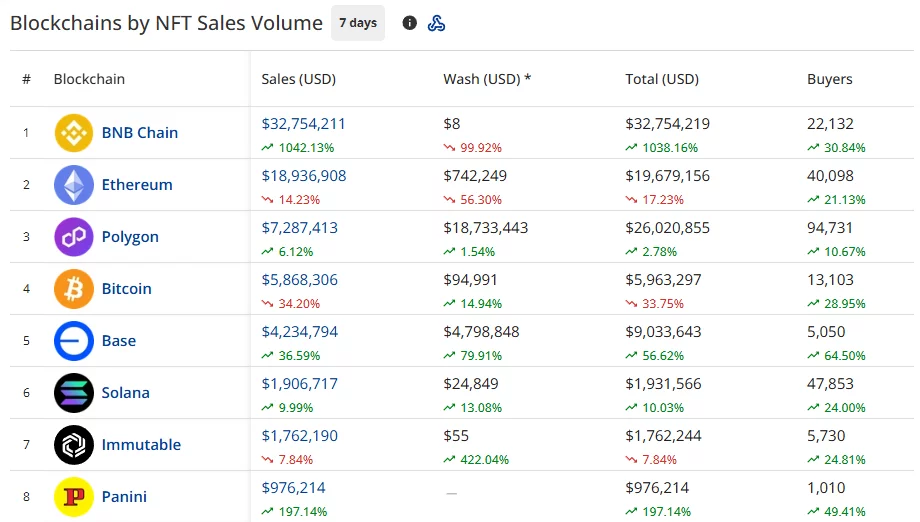
NFT sales rose 55.6% to approximately $75.54 million over the past seven days, with BNB Chain overtaking Ethereum after recording more than $32.75 million in sales.
Summary
- NFT sales increased 55.6% to $75.54 million, while transactions fell 14.77% to 650,332.
- Buyer addresses rose 20.38% to 273,655, and seller addresses increased 18.09% to 291,266.
- Ethereum sales fell 14.23% to $18.94 million despite an increase in buyer addresses.
- BNB Chain sales surged 1,042% to $32.75 million, making it the top-ranked network.
- Courtyard led collections with $6.32 million, while a BRC-20 NFT sold for 10 BTC.
According to data from CryptoSlam, captured on Sept. 5 with the seven-day view selected, NFT sales increased from approximately $48.55 million during the preceding period.
Buyer addresses climbed 20.38% to 273,655, while seller addresses increased 18.09% to 291,266. However, total transactions fell 14.77% to 650,332, meaning the increase in sales value occurred alongside fewer recorded transfers.
The average value per transaction rose to approximately $116, compared with about $64 in the prior period. CryptoSlam records blockchain addresses rather than verified individual buyers or sellers, so the address totals should not be treated as confirmed user counts.
NFT activity increased as the broader cryptocurrency market remained volatile. Bitcoin traded near $79,694, while Ethereum changed hands around $2,458 at the time of writing. The total cryptocurrency market capitalization stood at approximately $2.78 trillion.
The concurrent movements do not establish that cryptocurrency prices caused the rise in NFT sales. BNB Chain’s unusually large weekly increase also means the global comparison requires network-level context.
BNB Chain leads NFT sales with $32.75 million
BNB Chain moved into first place with approximately $32.75 million in organic NFT sales, an increase of 1,042% from the previous seven-day period. Buyer addresses on the network rose 30.84% to 22,132.
CryptoSlam recorded only $8 in wash-trading volume for BNB Chain, leaving its combined total close to $32.75 million. The scale and speed of the increase make the network the main contributor to the global weekly gain, although the collection rankings did not show one BNB Chain project accounting for most of the amount.
Ethereum ranked second with $18.94 million in organic sales, down 14.23%. Wash trading declined 56.30% to approximately $742,249, putting the network’s combined total at $19.68 million. Ethereum buyer addresses increased by 21.13% to 40,098 despite the decline in sales value.
Polygon followed with $7.29 million in organic sales, up 6.12%. The blockchain also recorded $18.73 million in wash trading, taking its combined volume to $26.02 million. Polygon’s 94,731 buyer addresses represented the largest total among the leading chains and increased by 10.67%.
Bitcoin ranked fourth with $5.87 million, down 34.20% from the previous period. Buyer addresses nevertheless rose 28.95% to 13,103. The network also generated approximately $94,991 in wash volume, producing a combined total of $5.96 million.
Base placed fifth after sales increased 36.59% to $4.23 million. Its wash-trading volume reached $4.80 million, exceeding organic sales and lifting combined volume to $9.03 million. Buyer addresses jumped 64.50% to 5,050.
Solana completed the leading six with $1.91 million in organic sales, up 9.99%. The network recorded 47,853 buyer addresses, an increase of 24%, and about $24,849 in wash activity.
Courtyard tops weekly NFT collection sales
Polygon-based Courtyard remained the leading NFT collection with $6.32 million in sales, up 7.50%. The platform recorded 97,050 transactions, a 1.01% increase, while buyer addresses fell 7.63% to 17,766.
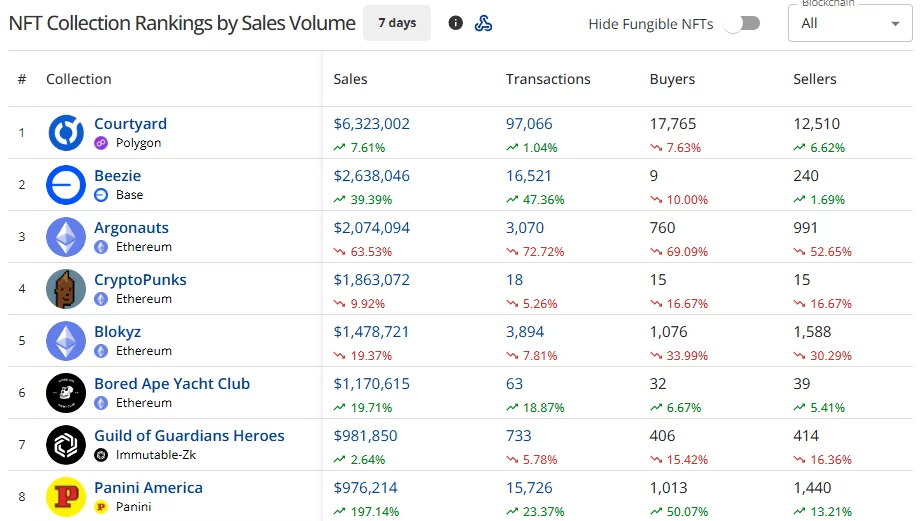
Courtyard’s sales represented approximately 8.4% of global NFT volume. Its high transaction count separates the collection’s activity from projects where weekly sales were concentrated among a small number of wallets or transfers.
Base-based Beezie ranked second with $2.64 million, up 39.39%. Transactions increased 47.36% to 16,521, but CryptoSlam recorded only nine buyer addresses and 240 seller addresses. The low buyer count means the sales figure was highly concentrated rather than spread across a broad group of addresses.
Ethereum’s Argonauts placed third with $2.07 million despite sales falling 63.54%. Transactions declined by 72.74% to 3,068, while buyer and seller addresses also fell by more than 50%.
CryptoPunks followed with $1.86 million, down 9.92% from the prior week. The collection produced 18 transactions involving 15 buyer addresses and 15 seller addresses.
Blokyz generated $1.48 million, a decline of 19.56%, from 3,889 transactions. Bored Ape Yacht Club ranked sixth with $1.17 million, up 19.71%, while its transaction count increased 18.87% to 63.
Guild of Guardians Heroes completed the leading seven with $981,850 in sales, up 2.64%. Its transactions fell 5.78% to 733, while buyer addresses declined 15.42%.
BRC-20 NFT leads high-value NFT sales
Bitcoin-based $REWD BRC-20 NFT #68f822daa8f482226a42a15319b5fe66a… recorded the largest sale, changing hands for 10 BTC, worth approximately $796,863, nine hours before the snapshot.
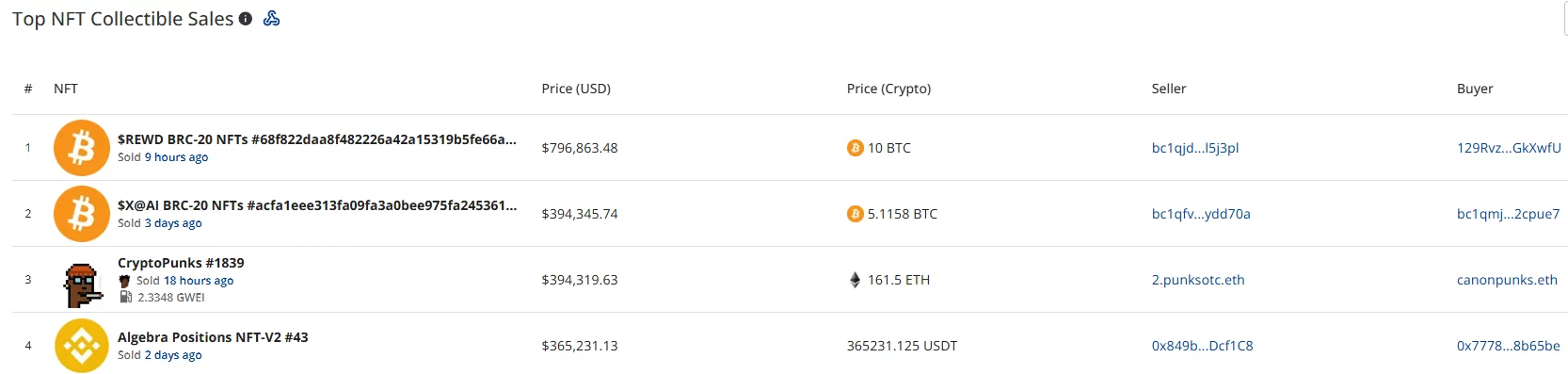
Another Bitcoin-based asset from the $X@AI BRC-20 NFT collection ranked second. It sold for 5.1158 BTC, valued at approximately $394,346, three days earlier.
CryptoPunks #1839 placed third after selling for 161.5 ETH, or approximately $394,320, around 18 hours before the data capture.
Algebra Positions NFT-V2 #43 recorded the fourth-largest sale at 365,231.125 USDT, worth approximately $365,231, two days earlier. Algebra position NFTs represent decentralized exchange liquidity positions rather than conventional digital collectibles.
CryptoSlam classified both BRC-20 transactions and the Algebra position transfer as NFT sales, though their economic structures differ from those of profile-picture and digital-art NFTs.
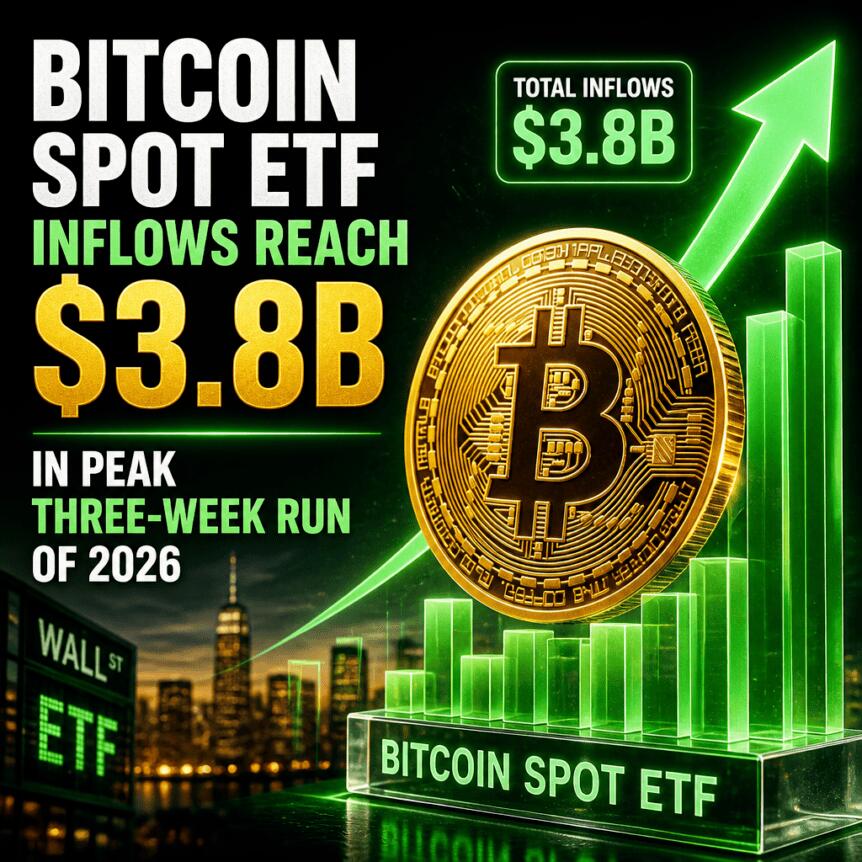
US-listed spot Bitcoin exchange-traded funds (ETFs) extended a late-summer demand surge, logging their strongest three-week stretch of 2026. The rebound coincided with Bitcoin trading around the $80,000 level, with weekly inflows accelerating into the week ending Friday.
SoSoValue data shows the funds pulled in $986.9 million during the week ending Friday. That pushed cumulative net inflows over the past three weeks to $3.8 billion. Total net assets across the suite were $101.3 billion on Friday, after rising to $103.3 billion the prior day. Since inception, cumulative net inflows reached $55.6 billion.
Key takeaways
- US spot Bitcoin ETFs attracted $986.9 million in the week ending Friday, lifting three-week net inflows to $3.8 billion.
- Friday’s total net inflow was $174.6 million, down from a much larger Thursday surge of nearly $731 million.
- BlackRock’s IBIT led demand with $117.4 million on Friday, about 67% of that day’s inflows, per Farside Investors.
- Bitcoin ETF momentum is improving versus the prior week, but year-to-date flows remain about $1 billion negative, reflecting lingering uncertainty from earlier 2026 outflows.
- While Bitcoin inflows strengthened, spot Ether and XRP ETF flows fell sharply on a weekly basis.
Three-week rebound highlights a demand shift
The latest inflow sequence represents a significant improvement from earlier in 2026, when spot Bitcoin ETFs experienced heavy outflows. The contrast matters for market participants tracking whether institutional demand is broadening or simply reacting to short-term price moves.
According to SoSoValue, the three-week net inflow total of $3.8 billion is far more consistent than the earlier part of the year. Still, the broader picture remains mixed: year-to-date net flows are reported to be roughly $1 billion negative. That implies the ETF complex is recovering, but not fully reversing the cumulative drain from prior months.
Net asset values also underline the pace of the recovery. Total net assets across the US-listed spot Bitcoin ETFs stood at $101.3 billion on Friday, following a brief bump to $103.3 billion on Thursday.
Friday inflows cool after Thursday’s spike
Demand didn’t maintain Thursday’s intensity. US spot Bitcoin ETFs recorded $174.6 million in net inflows on Friday, according to the reporting in the week’s flow recap. That figure was a sharp drop from the nearly $731 million recorded a day earlier, as referenced by earlier market coverage linked in the source.
Within the broader total, BlackRock’s iShares Bitcoin Trust (IBIT) remained the dominant driver. Farside Investors data cited in the source shows IBIT received $117.4 million on Friday, contributing about 67% of the day’s net inflows.
Elsewhere, Fidelity’s Wise Origin Bitcoin Fund (FBTC) was the only other fund to post net inflows, attracting $57.2 million. All other US spot Bitcoin ETFs recorded no net flows for the day, highlighting how concentrated inflow activity can be even in a strong overall period.
Price action also provides context for the flow pattern. Bitcoin slid from around $81,200 to briefly under $79,000 on Friday. At the time of publication, Bitcoin traded at $79,716, up about 2.6% over the prior seven days, based on CoinGecko data included in the source.
Rotation away from Ether and XRP ETFs
The rebound in Bitcoin ETF inflows came alongside a noticeable weakening in other crypto-asset ETF demand. Compared with the previous week, Bitcoin ETF inflows were up by about 7%, while flows into US spot Ether and XRP ETFs fell by roughly 74% and 83%, respectively, based on SoSoValue figures.
SoSoValue shows spot Ether ETF inflows dropped to $218.4 million from $824.4 million a week earlier. For XRP, inflows declined to $19 million from $110.5 million over the same comparison period.
Despite the weekly pullback, both Ether and XRP ETF products remain net positive for the year. SoSoValue data cited in the source indicates US spot Ether ETFs have recorded about $863 million in net inflows year-to-date, while XRP ETFs have attracted roughly $515 million.
This divergence is a useful signal for investors: even when institutional allocation preferences shift, it often happens unevenly across asset classes rather than uniformly. For traders and allocators, the key is whether the Bitcoin-specific demand trend continues long enough to further erode earlier negative year-to-date positioning.
What to watch next as flows become the focus
With Bitcoin ETF inflows showing resilience after earlier outflows, the next question is whether the complex can sustain inflow momentum beyond this three-week window—especially given Friday’s cooling versus Thursday’s outsized day. Investors should watch for whether IBIT and FBTC continue to concentrate the bulk of inflows, and whether Ether and XRP ETFs remain under pressure or stabilize after their recent weekly declines.
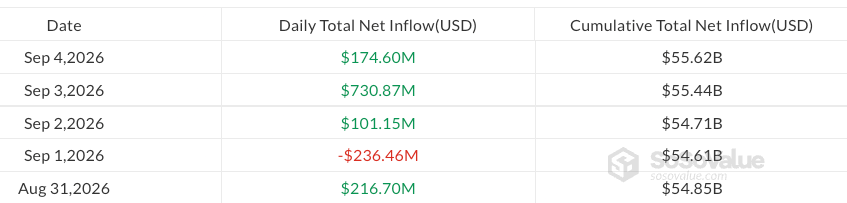
US-listed spot Bitcoin exchange-traded funds (ETFs) have recorded their strongest three-week inflow stretch of 2026 as Bitcoin traded around $80,000.
The funds attracted $986.9 million in the week ending Friday, bringing net inflows over the past three weeks to $3.8 billion, according to SoSoValue data.
Total net assets across the funds stood at $101.3 billion on Friday after briefly rising to $103.3 billion a day earlier, while cumulative net inflows reached $55.6 billion.
ETF demand marks a sharp turnaround from heavy outflows earlier in 2026, though year-to-date net flows remain roughly $1 billion negative.
Bitcoin ETF inflows cool after Thursday surge
US spot Bitcoin ETFs attracted $174.6 million in net inflows on Friday, down sharply from the nearly $731 million recorded a day earlier.
BlackRock’s iShares Bitcoin Trust (IBIT), the largest spot Bitcoin ETF by assets, drew $117.4 million on Friday, accounting for about 67% of the day’s total net inflows, according to Farside Investors data.
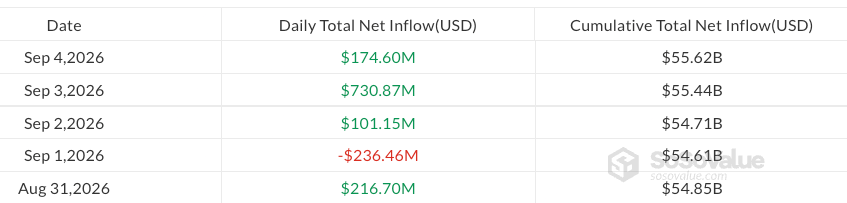
Daily spot Bitcoin ETF flows from Monday through Friday. Source: SoSoValue
Fidelity’s Wise Origin Bitcoin Fund (FBTC) was the only other fund to record net inflows, attracting $57.2 million, while all other US spot Bitcoin ETFs recorded no net flows for the day.
Related: Surprise nonfarm payrolls print sends Bitcoin back below 80K
The slowdown came as Bitcoin fell from around $81,200 to briefly below $79,000 on Friday. Bitcoin traded at $79,716 at the time of publication, still up about 2.6% over the past seven days, according to CoinGecko.
Bitcoin ETF demand strengthens as Ether, XRP flows fade
Compared with the previous week, Bitcoin ETF inflows increased about 7%, while inflows into US spot Ether and XRP ETFs fell about 74% and 83%, respectively.
Spot Ether ETF inflows dropped to $218.4 million from $824.4 million, while XRP ETF inflows declined to $19 million from $110.5 million, according to SoSoValue.
Despite weaker inflows, Ether and XRP ETFs remain in positive territory for the year. US spot Ether ETFs have recorded about $863 million in net inflows year-to-date, while XRP ETFs have attracted roughly $515 million.
Magazine: BTC will hit $1M by 2030… but Arthur Hayes is buying ETH instead

We Need a Cure for AI Health Hype

7 PS2 Games That Are Perfect From Start to Finish

Crypto’s BIGGEST Supercycle Starts NOW!?





-
 Crypto World21 hours ago
Bitcoin price stalls near $82K as key resistance holds
-

 Politics21 hours ago
Best Gaming Laptops, CPUs, TVs, And Keyboards To Upgrade Your Set Up For GTA VI
-

 Tech22 hours ago
The Birds Outside, Drawn For You Automatically
-

 Crypto World1 day ago
IMF Says El Salvador’s Post-Review Bitcoin Purchases Used No Public Funds
-
 Crypto World21 hours ago
U.S. added stronger than expected 162,000 jobs in August as labor market bounced back
-

 Sports1 day ago
Alexandre Pato consortium’s Northampton Town investment approved
-

 Sports20 hours ago
Golden Eaglets Drawn in Group B for 2026 WAFU B U17 Championship
-

 Sports1 day ago
Commanders’ Chig Okonkwo is a top breakout fantasy football candidate
-
 Crypto World20 hours ago
XRP price breaks falling channel as bulls target $1.53
-

 Politics1 day ago
A new European chapter for Gibraltar
-

 Politics23 hours ago
The House | Bin the lectures, bring gossip and be ready to banter: how the new PM should prepare for his Trump encounter
-

 Politics20 hours ago
How To Avoid Winter Colds: 4 Everyday Habits That Spread Germs, Says Pharmacist
-

 Crypto World20 hours ago
From warning to listing: UK’s largest retail investment platform opens access to crypto ETNs
-

 Tech22 hours ago
A Worthy Android Ereader, With Some Tradeoffs
-

 Crypto World21 hours ago
FinCEN flags $12.7B tied to Southeast Asia crypto investment scams
-

 Crypto World20 hours ago
Trezor Data Breach Impacts 67,000 More US Customers
-

 Politics1 day ago
33 Cosy Autumn Home Decor Ideas: Blankets, Pumpkin Decorations, And Candles
-

 Sports1 day ago
Seven wickets in 21 balls: Sri Lanka’s Chamari Athapaththu scripts history with record-breaking spell
-

 Tech21 hours ago
How To Edit Claude’s Memory
-

 Tech20 hours ago
beyerdynamic AVENTHO Y Debuts at IFA 2026 and Makes Wireless Headphones Less Disposable
You must be logged in to post a comment Login