My family could never have imagined that eight months later, she would be among the 32 people killed in her classroom on April 16, 2007, coming home in a mortuary van.
In the years since, mass violence has become a recurring nightmare in American life. Yet every August, millions of parents still make that same drive, entrusting their children to colleges and universities across the country. No parent should have to make that journey wondering whether their child will come home safely.
We have learned a great deal since 2007. We know more about recognizing warning signs, responding to mental health crises, and building stronger safety protocols on campus. We know more about what proactive prevention requires. The problem is that knowing what works and consistently doing it are two different things.
As another academic year begins, we cannot rely on prayers or goodwill to keep our students safe. While most colleges and universities spend phenomenal budgets emphasizing sports, campus events, and academics, parents need to ask the most important question: how safe is my child? We need sustained, measurable, and accountable action from lawmakers, university leaders, and citizens.
Lizzie Post still remembers the time she walked into a party and an acquaintance greeted her with exciting news: “You had a baby!”
“I’m going to the bar,” Post replied.
Post, co-president of the Emily Post Institute and Emily Post’s great-great-granddaughter, knew the woman meant well. She had apparently heard that something momentous had happened—it hadn’t—and cycled through three incorrect milestones trying to identify it. Fortunately, she eventually stopped guessing: a relief for everyone involved.
Life is full of faux pas, but even when you’re the one making it, you can dig your way out of social quicksand most of the time. Here’s what psychologists and etiquette experts suggest saying, plus when to stop talking.
Advertisement
Your immediate reaction after saying something you regret might be to turn fire-truck red. Then comes the urge to reach for the very thing that got you into trouble in the first place: more words. People often try to explain, defend, or excuse their misfired remark, says Karina Schumann, a social psychologist and associate professor at the University of Pittsburgh who studies apologies and conflict resolution. The instinct is self-protective: They’re frantically trying to repair their image in the other person’s eyes.
“What actual repair looks like is to shift the attention to the other person,” Schumann says. “Put aside this very strong need that you have to repair your self-image, and instead think: ‘If I were on the receiving end of this, what would I need to hear?’”
Pause, acknowledge the impact of what you said, and take responsibility. She suggests phrasing it like this: “I’m sorry. I shouldn’t have assumed.” Or: “I can see that my joke was insensitive. I apologize.”
Then take a breath. More words will still be available later, should the situation require them.
Advertisement
Match the apology to the offense
A minor blunder and a painful faux pas shouldn’t trigger matching productions of remorse. Forget an acquaintance’s name? A quick “I’m sorry—please remind me” may be enough. Ask when someone is due when she isn’t pregnant, or make a joke that accidentally lands on a painful subject? That calls for a direct acknowledgment of the harm, without trying to laugh it off, and perhaps a longer conversation if the other person wants one.
The person responsible isn’t always the best judge of what it will take to repair the situation. Schumann points to a phenomenon researchers call the “magnitude gap”: People who cause harm tend to view it as less severe and less damaging to the relationship than the people on the receiving end do. The offender may think, I apologized; this should be over. The other person may still be wondering how the offender could fail to understand how much it hurt.
Don’t turn an apology into an autobiography
Advertisement
An apology doesn’t require an origin story, a director’s commentary, or a guided tour of everything happening inside the offender’s head.
“Blame is like a hot potato,” says Jennifer Thomas, a psychologist and co-author ofThe 5 Apology Languages: The Secret to Healthy Relationships. Defensive responses—including “I was only joking,” “I didn’t mean it that way,” and “Why did you take it so personally?”—toss it back to the injured person. They minimize the harm, gloss over the offender’s intentions, or suggest the other person is simply too sensitive.
An explanation can sometimes make what happened easier to understand, Schumann says, but it has to provide context without weakening responsibility. Lead with: “I shouldn’t have done that. There’s no excuse for it.” Then ask whether an explanation would be helpful.
A digital faux pas calls for the same restraint. If you send a text to the wrong person with information you wouldn’t have divulged to them otherwise, Post suggests writing: “I’m so sorry. Clearly that text wasn’t meant for you—and I probably shouldn’t have been sending it anyway.” Then leave it at that.
Advertisement
Resist the apology encore
For a minor, accidental blunder—maybe you stuck your toe in your mouth instead of your whole foot—one sincere apology is generally enough. “The more you apologize, the more it’s about you,” Post says. That means no apology cookies, no anguished message the following morning, and no campaign to extract an official declaration that everything is fine.
Serious harm is different. Schumann cautions against treating every apology as a “one-shot thing,” as though finding the perfect words should settle the matter. The other person may need a longer conversation, an effort to make amends, or simply more time.
“The timing of any forgiveness should stay wholly in the hands of the person who was hurt,” Thomas says. An apology offers them a choice, not a deadline.
Advertisement
What if you don’t realize you made a faux pas until hours or days later? It’s usually better to address it than hope the other person forgot, therapist Elika Dadsetan-Foley says. Try: “I’ve been thinking about what I said yesterday. I realize it may have been insulting, and I’m sorry I didn’t recognize that in the moment.”
The next time you meet, act normal
The next time you run into the neighbor you assumed was sick but who had merely gone makeup-free, or the acquaintance who received a text that was definitely not meant for them, offer a friendly greeting. Avoiding the person can make one uncomfortable exchange feel like a permanent rupture; bringing it up again can give a dying embarrassment fresh oxygen.
Keep the story to yourself, rather than retelling it as evidence of what a hopeless fool you are. “You may think that’s you throwing yourself under the bus, but you’re dragging the other person with you,” Post says. Your self-deprecation may get a laugh, but it also makes the other person’s embarrassment public.
Advertisement
Fortunately, most faux pas don’t require a lifelong of self-flagellation. If you’ve apologized sincerely and the other person seems ready to move on, follow their lead. “We all get stuff wrong from time to time,” Post says. Sometimes recovering gracefully means making amends. Other times, it means saying sorry—and letting everyone get on with the party.
Ripple said the $275 million raised will support its expansion into traditional financial services such as prime brokerage and multi-asset clearing, citing strong demand from institutions.
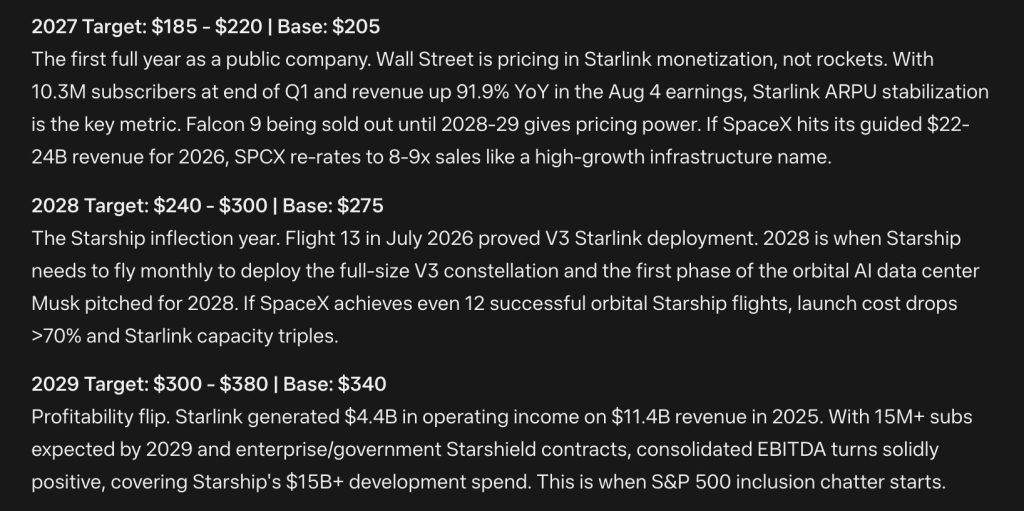
Wall Street has stopped valuing this company of rockets, Meta AI, however, predicts the market prices of Starlink monetization, and the price prediction ladders from $205 in 2027 to $410 by 2031.
The 2027 case rests on subscriber economics. Starlink ended Q1 with 10.3M subscribers and revenue up 91.9% year over year in the August 4 earnings.
ARPU stabilization is the metric that matters there. Falcon 9 is being sold out until 2028 and 2029, with supplies pricing power alongside it.
Source: Meta AI SpaceX Price Prediction
If SpaceX hits guided revenue of $22B to $24B for 2026, Meta AI expects SpaceX to re-rate to 8x or 9x sales. The 2028 target of $275 depends on Starship.
Flight 13 in July 2026 proved the V3 Starlink deployment. Monthly flights would deploy the full-size V3 constellation and the first phase of the orbital AI data center.
Advertisement
Twelve successful orbital flights would cut launch costs by more than 70% and triple Starlink capacity. By 2029, the base case reaches $340 as profitability flips, with 15M subscribers expected and Starshield contracts covering Starship’s $15B development spend.
The 2030 target of $385 turns on the AI narrative, converting a $3.2B loss-making division into orbital compute revenue. The bear case is grounded, where Starship failures or FAA delays keep the $4.9B net loss lingering and push SPCX toward $95 to $110.
Source: Meta AI
SPCX Price Prediction: Meta AI Predicts Satellites Matter More Than Rockets Now
The 2-hour chart shows a stock that has round-tripped. SPCX spiked above $225 in mid-June before selling off hard.
Advertisement
Late June and July delivered a sustained decline. Price fell from $170 toward $107 by the end of July.
August reversed that entirely. Buyers drove a sharp recovery from $107 back above $150 within two weeks.
Recent sessions have cooled. Price now consolidates in the low $140s after that run.
The close reads $143.31, up 0.27% and $0.39. The session range covered $141.92 to $143.72, with post-market at $143.12.
Advertisement
Support sits at $135, then $125 and $110. Resistance appears at $150, then $160 and $170.
RSI reads 55.62 with its signal line above at 58.94. The oscillator trails by more than 3 points, showing the August rally losing intensity.
Both lines sit above the midline. Momentum remains positive but is fading rather than building.
Meta AI’s 2027 base case needs a 43% move. The next earnings print and Starship cadence are what turn that ladder into something the market underwrites.
SpaceX Has a Long List of Catalysts. Kalshi Lets Traders Focus on What Happens Next.
The SpaceX thesis now depends less on distant promises and more on a sequence of events the market can actually watch: subscriber growth, earnings, Starship launches, regulatory approvals, and deployment milestones.
That is exactly the kind of event-driven thinking Kalshi is built around.
Advertisement
Rather than taking a position in an asset and absorbing every variable that comes with it, Kalshi lets users trade directly on real-world outcomes across markets, economics, politics, technology, and other major events.
The question becomes simpler: what do you think happens next, and what probability is the market assigning to it?
For a company like SpaceX, where one successful launch or delayed approval can change the valuation narrative quickly, separating the event from the stock reaction can offer traders a different way to express conviction.
Eligible new users who join Kalshi through CryptoNews can also receive $25 through our referral link.
South Korea’s won hit its strongest level against the dollar in more than 10 months on Wednesday. The currency strengthened past the 1,400 mark, a level last seen in late September 2025.
A booming semiconductor industry is helping drive the currency’s recovery, even as the same sector comes under heavy selling pressure in South Korean equities.
Chip Dollars Reach the Currency Market
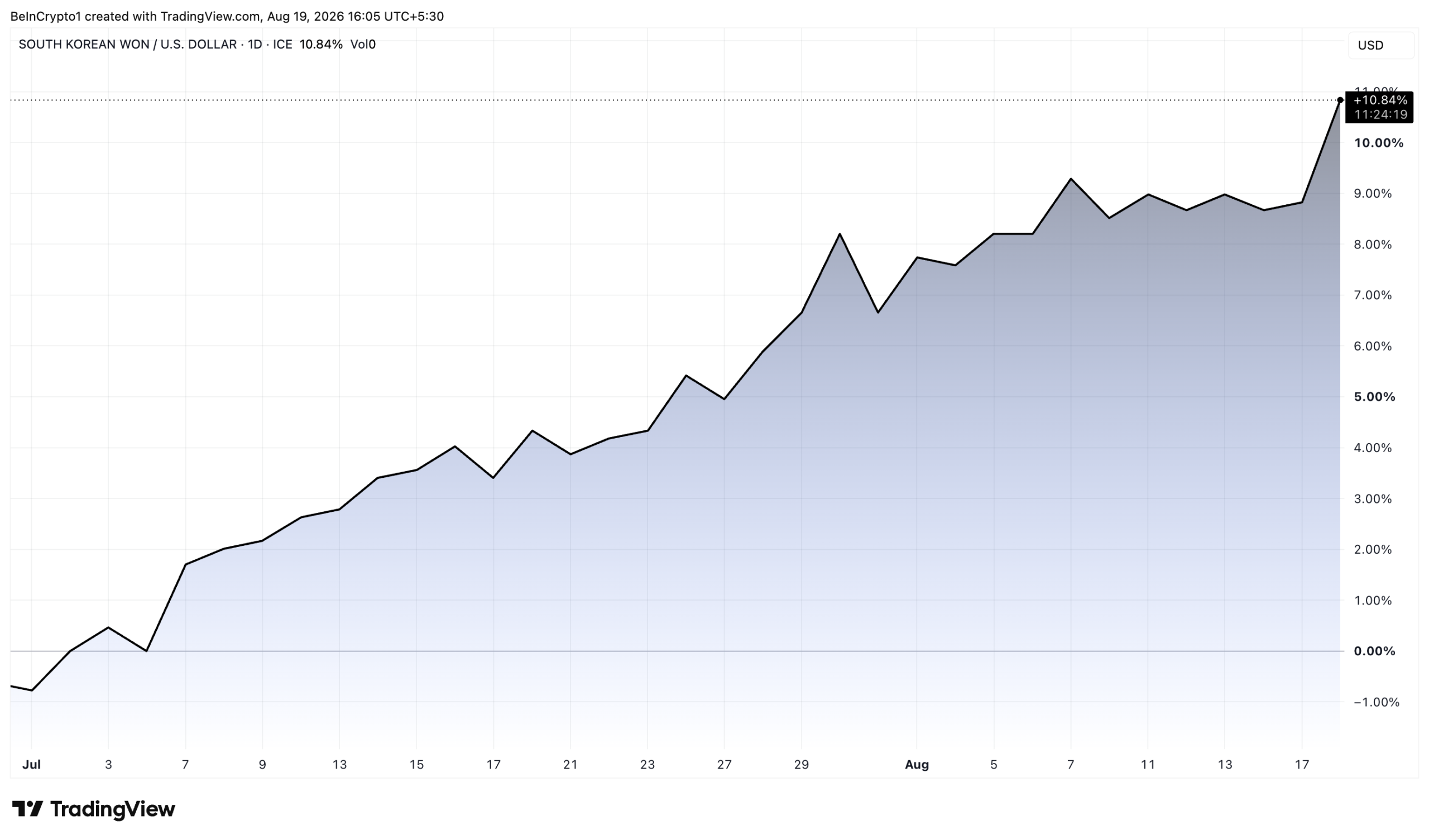
The won has gained 10.8% since early July. The currency traded as weak as 1,557.9 per dollar on July 2 before strengthening to 1,396.6 at press time.
Export earnings explain the move. Korea shipped $98.89 billion of goods in July, up 63% from a year earlier. Semiconductor exports rose 179% to $41 billion.
Those dollars are now reaching the domestic market. SK Hynix raised $26.5 billion through a US depositary receipt listing. The firm said that it will use the funds from the listing to fund projects in the country.
Chip Stocks Pull the Other Way
The picture is markedly different in South Korea’s stock market. The same AI-driven semiconductor boom that is boosting export earnings has also left chip stocks vulnerable to sharp swings in investor sentiment.
The selling pressure continued on Wednesday, prompting the Korea Exchange to activate a sell-side trading curb. At press time, the KOSPI stood at 6,490.63, down 5.52%.
Chipmakers led the decline. Samsung Electronics fell 7.64% to 248,000 won, while SK Hynix dropped 9.09% to 1,511,000 won. Together, the two companies account for roughly half of the KOSPI’s weight.
The sell-off followed a sharp overnight decline in US semiconductor stocks. SK Hynix’s depositary receipts fell 9.2% in New York, while Micron Technology declined 7.02%.
The divergence highlights an unusual dynamic in South Korea’s markets. The semiconductor boom is supporting the won through stronger export earnings and dollar inflows, while concerns over the global technology sector are weighing heavily on the country’s chip-heavy stock market.
HTX, a leading global cryptocurrency exchange, recently announced the successful conclusion of Phase 2 for its popular TradFi Trade to Earn campaign. The second phase delivered significant growth in trading volume, user engagement, and platform incentives, demonstrating the ability of the Trade to Earn model to drive trading activity among TradFi futures traders and further highlighting the market potential of this innovative trading incentive model.
Nearly 59,000 USDT Returned to Users as Volume Posts a Steep Growth Curve
Designed specifically for TradFi traders, HTX’s TradFi Trade to Earn ties active futures trading directly to fee rebates and bonus incentives, helping users cut costs and trade more efficiently.
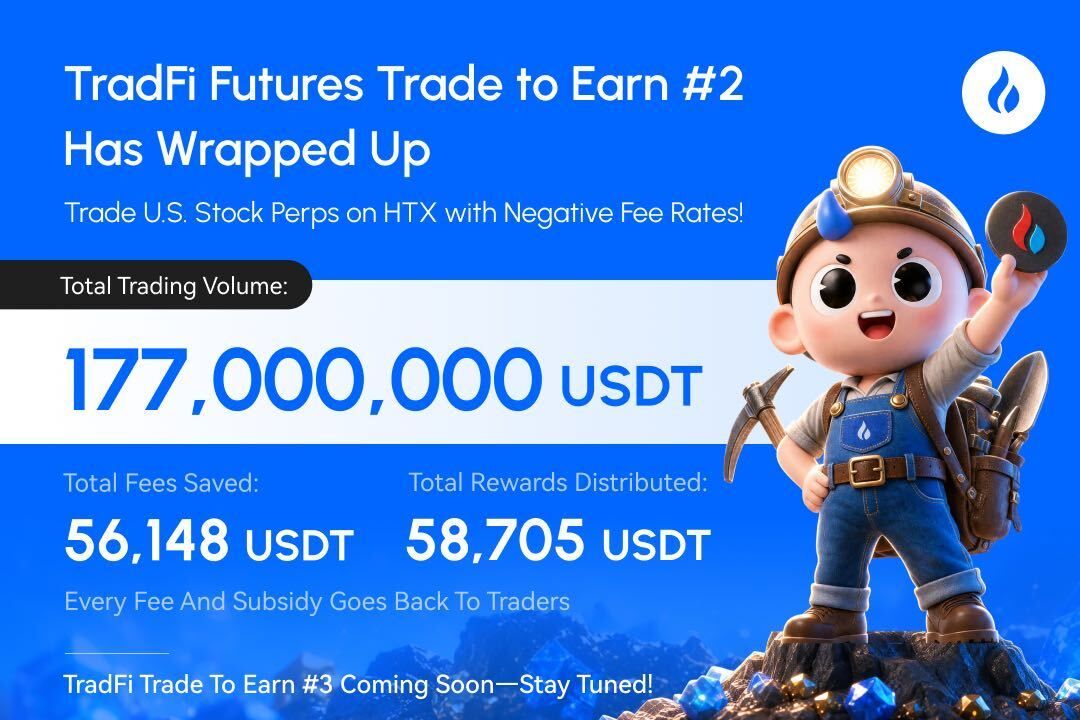
During Phase 2, cumulative trading volume for TradFi futures on HTX surpassed 177 million USDT, nearly triple the volume recorded in Phase 1, representing a 179% increase. The rapid growth in volume reflects rising user engagement with TradFi futures.
Alongside the volume surge, platform reward distributions grew. HTX distributed nearly 59,000 USDT in total rewards during Phase 2, including more than 56,000 USDT dedicated to trading fee rebates. Compared with the first phase, total fee rebates and cumulative rewards distributed both grew by over 150%, reflecting the platform’s growing commitment to providing greater incentives.
Advertisement
For TradFi futures traders, fees are a meaningful part of their trading costs. Particularly in high-frequency trading and fast-moving markets, increased trading frequency often means higher trading costs. HTX’s TradFi Trade to Earn turns a portion of these trading costs into user incentives through fee rebates and rewards, lowering the barrier to participation while further enhancing capital efficiency for traders.
From Cutting Costs to Adding Returns: A New Stage for TradFi Trade to Earn
Moving from lowering the cost of trading to increasing traders’ overall returns, TradFi Trade to Earn is becoming a key incentive tool within the HTX futures ecosystem.
As markets continue to evolve, traders are placing greater emphasis on liquidity, trading costs, and capital efficiency. In response to changing trading needs, HTX continues to expand its TradFi offerings and refine its incentive mechanism, providing traders with a flexible and efficient way to participate in these markets through a broad selection of assets and compelling user benefits.
HTX now offers more than 170 TradFi assets, spanning precious metals, commodities, indices, and U.S. equities to meet a wide range of trading needs.
Advertisement
Notably, Phase 3 of HTX TradFi Trade to Earn is set to launch soon.
Building on the continued growth in trading volume across the first two phases, the upcoming event will carry forward the core “trading + incentives” model, offering users another round of fee rebates and rewards. As the range of TradFi assets continues to expand, users gain access to an increasingly diverse range of trading opportunities, further broadening the potential of the TradFi Trade to Earn model.
About HTX
Founded in 2013, HTX has evolved from a virtual asset exchange into a comprehensive ecosystem of blockchain businesses that span digital asset trading, financial derivatives, research, investments, incubation, and other businesses.
As a world-leading gateway to Web3, HTX harbors global capabilities that enable it to provide users with safe and reliable services. Adhering to the growth strategy of “Global Expansion, Thriving Ecosystem, Wealth Effect, Security & Compliance,” HTX is dedicated to providing quality services and values to virtual asset enthusiasts worldwide.
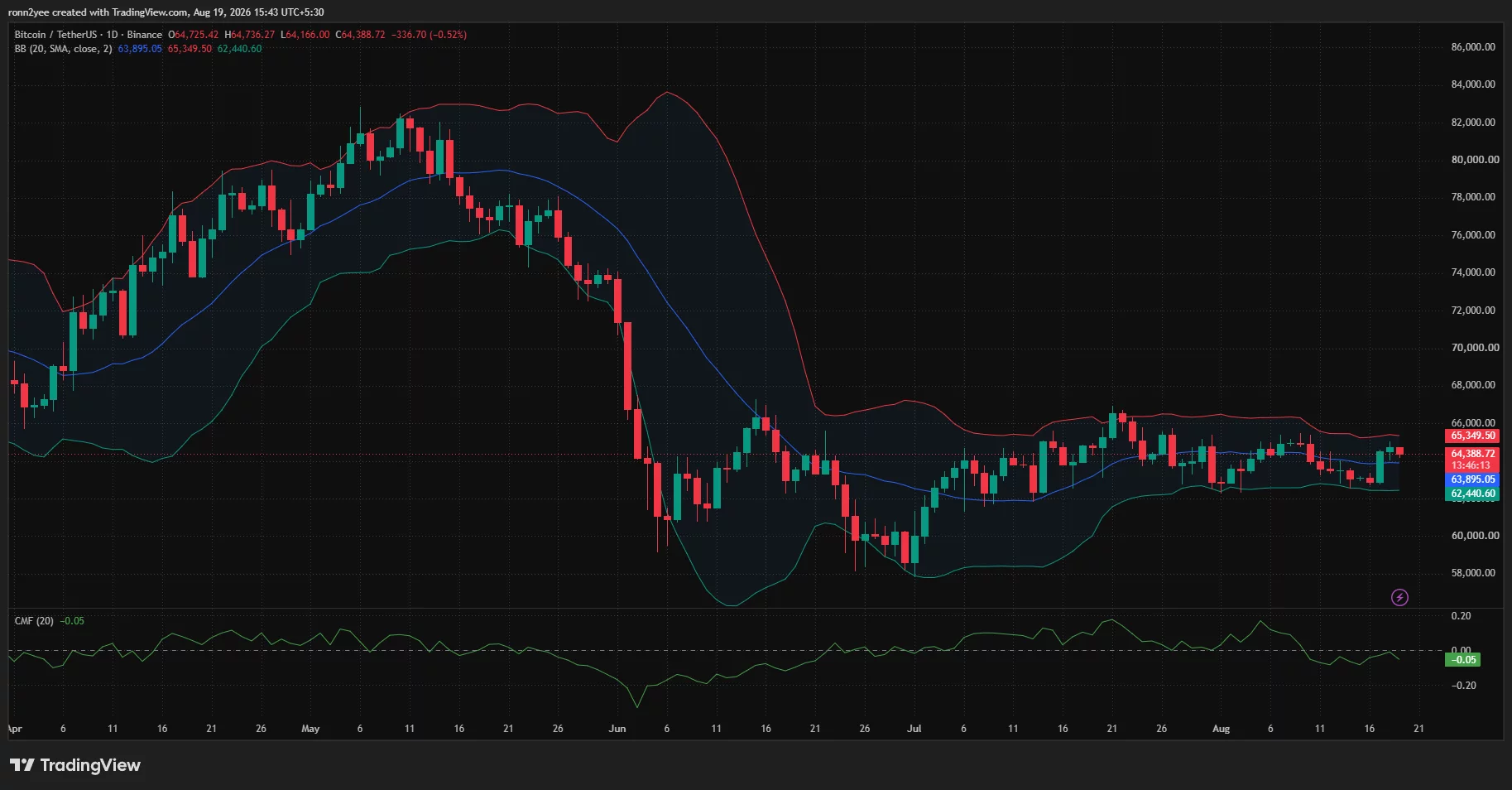
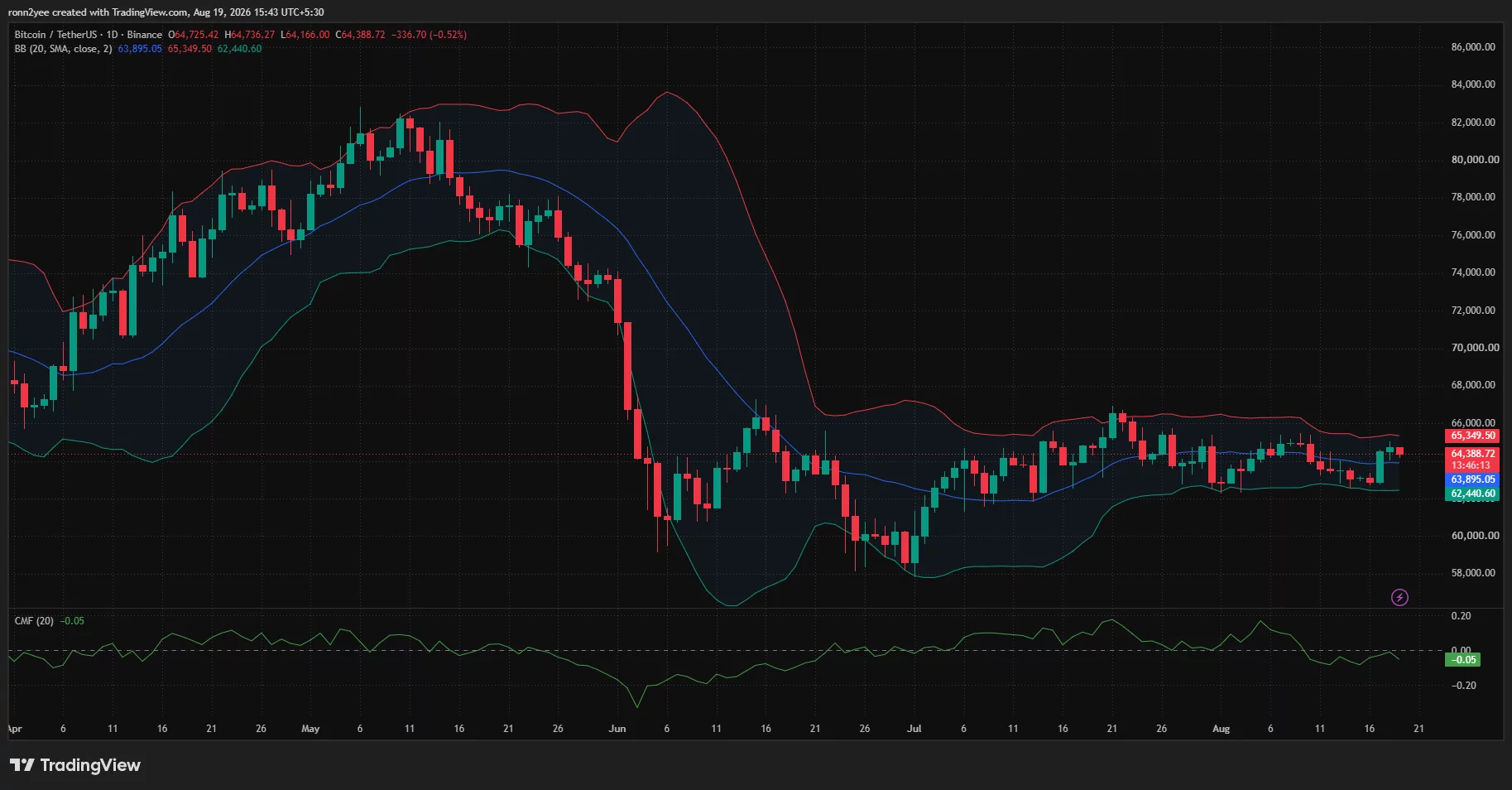
Bitcoin price pulled back to about $64,300 on Aug. 19 after failing to hold above $65,000, as weak spot demand, rising bond yields, and resistance near $65,400 limited the rebound.
Summary
Bitcoin price retreated to $64,300 after briefly approaching $65,000 during the latest recovery.
Bollinger Bands place resistance at $65,350 and near-term support around $63,900.
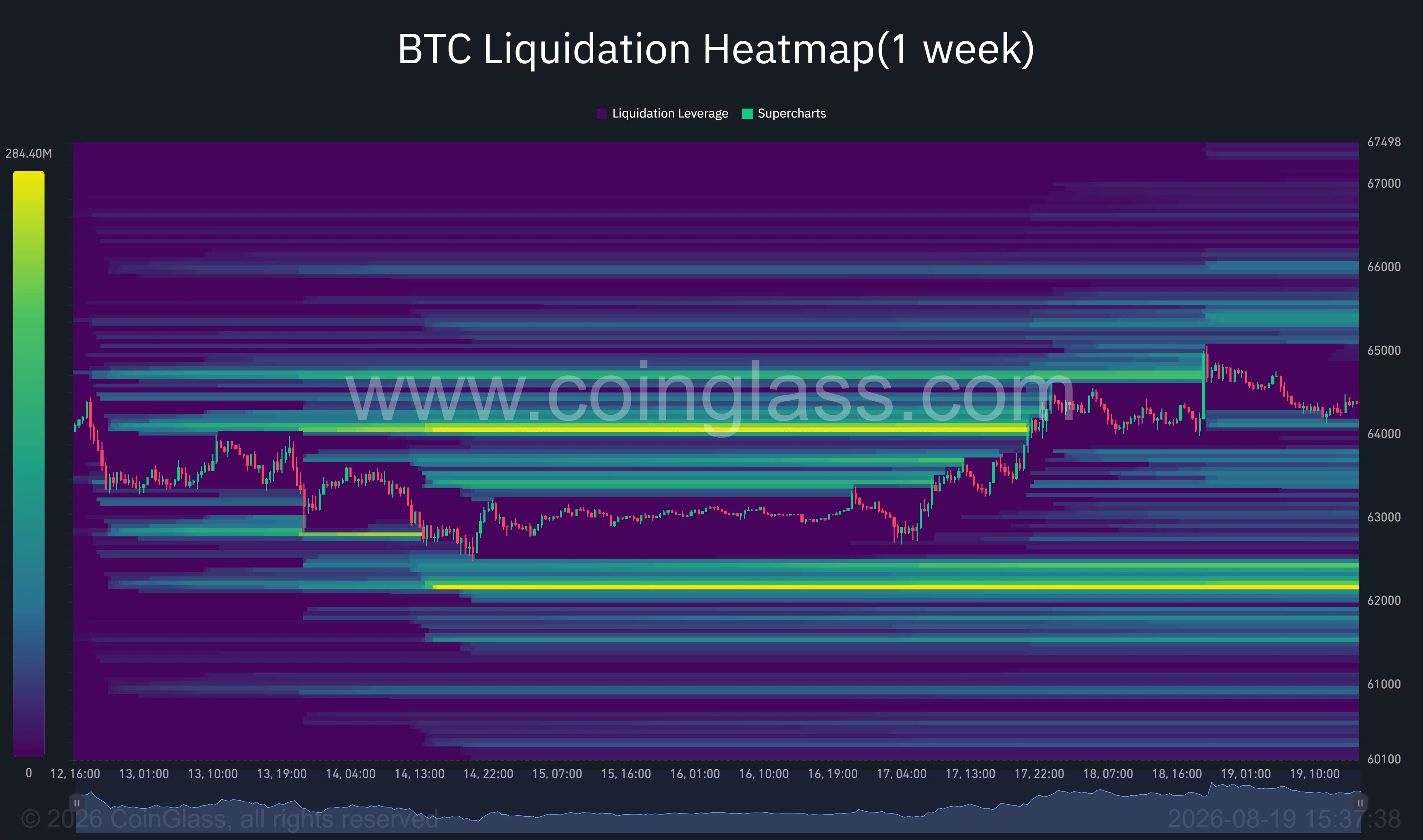
CoinGlass data shows liquidation clusters near $65,400, $66,000, and $62,200.
Traders are awaiting the Federal Reserve’s July meeting minutes for interest-rate signals.
Bitcoin price stalls below $65,000
According to data from crypto.news, Bitcoin (BTC) price was trading at about $64,390 on Binance on Wednesday afternoon in Asia, down roughly 0.5% on the daily candle. The price had reached an intraday high of $64,736 before sellers pushed it lower.
The retreat followed a rebound from the $62,700 area earlier in the week. Bitcoin moved through $64,000 and approached $65,000 on Aug. 18, but the rally did not attract enough buying pressure to clear the upper end of its recent range.
Advertisement
Trader Lennaert Snyder said Bitcoin had again been rejected from the high of its compression range. He identified $65,400 as the level keeping the asset inside the range and said a loss of the $64,000 previous-day low could send the price back toward the lower boundary.
Snyder said he was maintaining a short position opened near $65,000 but planned to move it to breakeven if possible. His downside scenario depends on Bitcoin losing $64,000, while another defense of the $62,500 range low would leave the market increasingly compressed.
Bitcoin has traded mostly between $62,500 and $65,400 since late July, aside from brief moves outside the range. Repeated reversals have reduced the value of entries near the middle, where neither buyers nor sellers have established control.
Advertisement
Low trading volume limits the Bitcoin rebound
Thin spot activity remains one of the main obstacles to a sustained breakout. Analyst Gerla said Binance spot volume had declined for years, even as Bitcoin continued to hold around $64,000.
$BTC volume is drying up… and that’s exactly what I want to see.
Binance spot volume has been declining for years while price holds $64K. Most traders see this as bearish.
Gerla interpreted the decline as possible seller exhaustion rather than an immediate bearish signal. However, lower volume also means that the recovery has received limited confirmation from buyers.
Binance data published earlier in August showed how activity has shifted toward leveraged products. Bitcoin futures volume on the exchange reached about $57.82 billion in one session, compared with $6.08 billion in spot volume.
The resulting futures-to-spot ratio reached 7.82, according to CryptoQuant data. Futures therefore accounted for almost eight times as much activity as spot trading, leaving short-term price moves more exposed to leveraged positioning and liquidation-driven volatility.
Advertisement
Institutional demand has also weakened. U.S. spot Bitcoin exchange-traded funds recorded about $385.2 million in net withdrawals during the week through Aug. 14. The outflows followed $853.5 million in inflows in the previous five trading sessions.
Lower ETF demand and weak exchange volume have reduced the buying pressure available near resistance. Both measures would need to improve for a breakout above $65,400 to receive stronger market confirmation.
Bitcoin charts identify $65,350 as resistance
The daily chart shows Bitcoin trading just above the middle Bollinger Band at $63,895. The upper band stands at $65,350, closely matching the resistance that stopped the latest recovery.
Bitcoin price daily chart — Aug. 19 | Source: crypto.news
A daily close above $65,350 would place Bitcoin outside the upper edge of its recent volatility range. Such a move could open a path toward $66,000, followed by the late-July swing area near $67,000.
The lower Bollinger Band sits at $62,440, creating a broader support zone between $62,400 and $62,700. A daily close below that area would weaken the range structure and expose $61,000, followed by the June and July lows near $58,000.
Advertisement
Chaikin Money Flow was at minus 0.05 on the daily chart. The reading indicates that capital flows remain slightly negative and offers little evidence of sustained accumulation despite Bitcoin’s rebound.
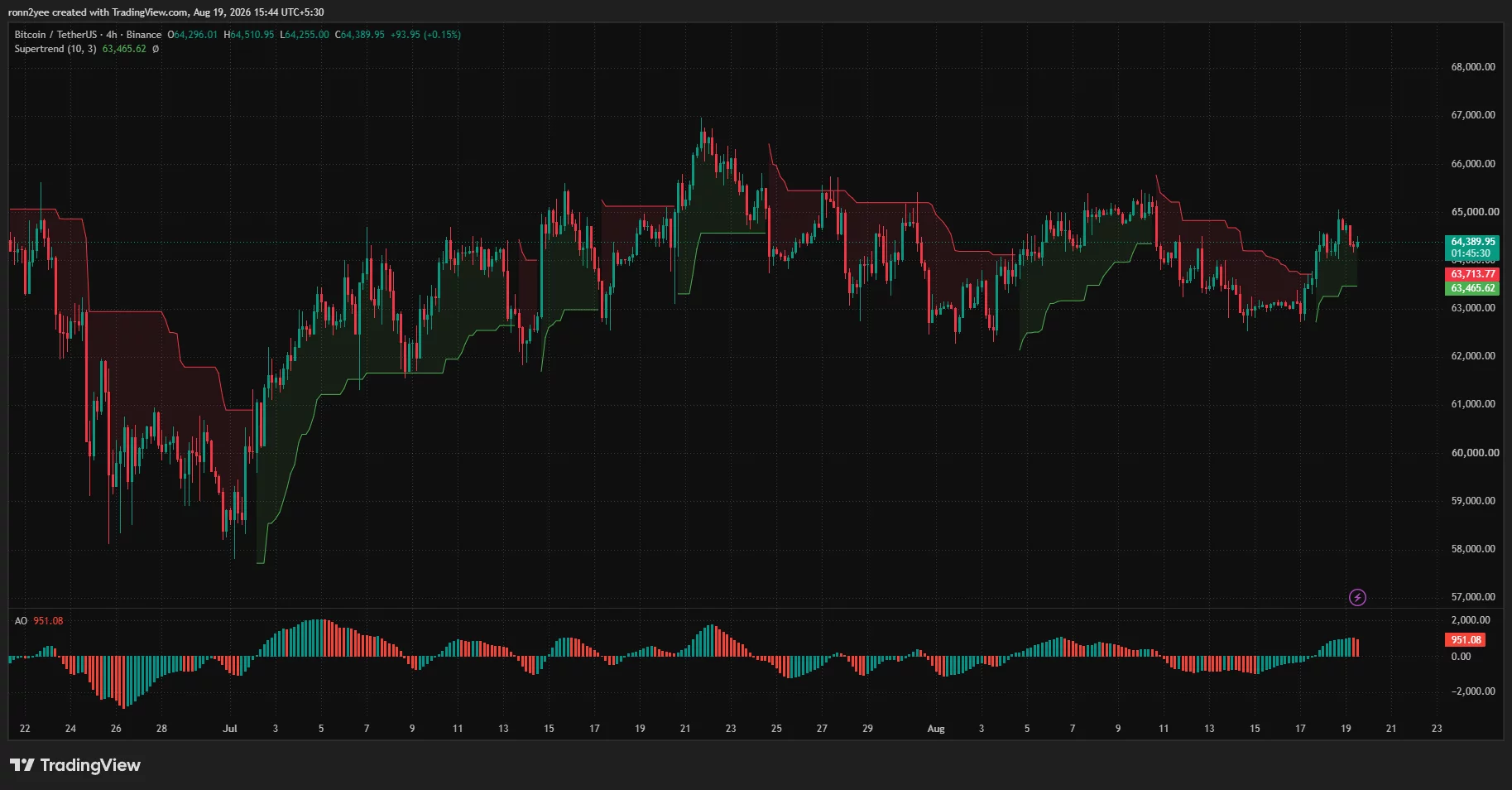
The 4-hour chart presents a firmer short-term setup. Bitcoin remains above the Supertrend support at $63,466, while the Awesome Oscillator is positive at 951.
Bitcoin price 4-hour chart — Aug. 19 | Source: crypto.news
Recent red bars on the Awesome Oscillator show that bullish momentum is slowing after the advance from $62,700. Buyers would need to defend the $63,450–$64,000 region to preserve the short-term recovery.
Liquidation levels could determine the next move
CoinGlass’ one-week liquidation heatmap shows several concentrations of leveraged positions surrounding Bitcoin’s current price.
Bitcoin liquidation heatmap | Source: CoinGlass
The closest overhead liquidity appears between approximately $65,300 and $65,600, with another cluster around $66,000. A move through $65,400 could trigger short liquidations and accelerate the price toward the second cluster.
The strongest nearby downside concentration sits around $62,200. Additional liquidity is visible between $63,400 and $64,000, making that region a possible target if Bitcoin loses its current 4-hour support.
Advertisement
Liquidation heatmaps identify areas where leveraged positions may be closed, but they do not determine which price level will be reached first. Bitcoin’s position between large clusters on both sides supports Snyder’s view that the market remains compressed.
Fed minutes remain the next US market catalyst
Bitcoin’s retreat also followed a broader pullback in U.S. risk assets. LSEG data cited by Barron’s placed BTC near $64,306 as rising global bond yields and Middle East tensions weighed on markets.
Treasury yields eased on Wednesday after the previous session’s global bond selloff, with the U.S. 10-year yield around 4.686%. Brent crude remained above $91 as renewed U.S.-Iran tensions maintained concerns about energy-driven inflation.
U.S. investors are now waiting for minutes from the Federal Reserve’s July meeting. The release could provide more information on how officials view inflation and the path of interest rates.
Advertisement
A softer policy signal, improving ETF flows, and a close above $65,400 would strengthen Bitcoin’s breakout case. Renewed pressure on bonds and a loss of $64,000 would instead shift attention toward $62,500 and the large liquidation cluster near $62,200.
Disclosure: This article does not represent investment advice. The content and materials featured on this page are for educational purposes only.
SpaceX is trading below its $135 IPO price. Marathon Digital is down 34% year to date. Coinbase has outperformed both. The math on which tech bet delivers risk adjusted returns has not been done until now.
Summary
SpaceX stock (SPCX) trades at approximately $131 as of mid August, 3% below its $135 IPO price from June 2026, after peaking at $225.64 and declining 48% from that high, giving early investors a negative return two months into the listing.
Coinbase (COIN) has returned roughly 18% year to date through August 2026, outperforming SpaceX, Marathon Digital, Riot Platforms, and every other publicly traded crypto company, driven by exchange volume and stablecoin custody revenue rather than bitcoin price appreciation alone.
Marathon Digital (MARA) and Riot Platforms (RIOT) have declined 34% and 29% respectively in 2026, tracking bitcoin’s flat to negative price action while absorbing rising energy costs and post halving margin compression.
A dollar invested in bitcoin on January 1, 2026 would have returned approximately 4% by mid August, while a dollar invested in MARA would have lost 34 cents, meaning the underlying asset outperformed the company that mines it by 38 percentage points.
ARK Invest has deployed over $475 million into SpaceX stock since the IPO despite the price decline, while simultaneously reducing its COIN position, creating a measurable bet that SpaceX will outperform crypto equities over the next 12 months.
The largest IPO in history arrived in June 2026 and immediately became the most traded stock in the world. SpaceX priced at $135, opened above $190, touched $225.64 within two weeks, and then fell 48% to a post IPO low of $119.79 before stabilizing near $131. Two months after listing, buyers at the IPO price are underwater. Buyers at the peak have lost nearly half their position.
During the same period, the crypto industry’s publicly traded companies followed their own trajectory. Coinbase gained 18% year to date. Marathon Digital lost 34%. Riot Platforms lost 29%. MicroStrategy, which rebranded to Strategy and now holds over 500,000 bitcoin on its balance sheet, moved roughly in line with bitcoin itself. The performances diverge sharply enough to raise a question that retail investors have been asking without receiving a rigorous answer: which of these bets actually pays?
Advertisement
The question matters because SpaceX and crypto stocks are competing for the same capital. They attract the same cohort of retail investors who seek asymmetric returns in technology. They trade on the same platforms. They appear in the same ARK Invest portfolios. And they share a common vulnerability: both are priced on narratives that have not yet been validated by sustained cash flow, which means the math on returns, volatility, and risk adjusted performance determines which narrative deserves the premium.
The SpaceX return that was not
SpaceX reported $7.8 billion in second quarter revenue, exceeding Wall Street estimates. The company completed a $60 billion stock based acquisition of Anysphere, the company behind the Cursor coding platform, adding an AI business to its rocket and satellite operations. Starlink, its satellite internet division, crossed 5 million subscribers. By every operational metric, SpaceX is performing.
The stock is not. At $131, SPCX sits 3% below its IPO price. The gap between operational strength and stock weakness has a specific cause: the 911.5 million insider shares that became eligible for sale in early August. The lockup expiration created a supply overhang that the market has not yet absorbed.
Cathie Wood’s ARK Invest responded by buying more. The firm has deployed over $475 million into SPCX since the IPO, purchasing through the decline and adding $52.1 million in a single week in mid July. Raymond James set an $800 price target, the highest on Wall Street, implying a 510% return from current levels.
Advertisement
But the return that matters for comparison purposes is the one investors have actually received: negative 3% over two months for IPO buyers, negative 42% for buyers at the $225 peak, and negative 11% for the median entry price across the first month of trading. The SpaceX IPO has been, for most participants, a losing trade.
The crypto stock scorecard
The publicly traded crypto sector offers a wider range of outcomes than SpaceX, and the dispersion reveals which business models are working and which are not.
Coinbase (COIN): Up approximately 18% year to date. The exchange benefits from trading volume that scales with market volatility rather than market direction. Stablecoin custody revenue, institutional prime brokerage fees, and the Base L2 network’s transaction revenue have diversified the company beyond pure exchange commissions. COIN is the only major crypto stock that has consistently outperformed bitcoin in 2026.
Marathon Digital (MARA): Down 34% year to date. The largest publicly traded bitcoin miner by hash rate has been squeezed by the April 2024 halving, which cut block rewards from 6.25 to 3.125 BTC. Energy costs in Texas, where Marathon operates its largest facilities, have risen 12% year over year. The company mines bitcoin at an all in cost of approximately $43,000 per coin, leaving thin margins at current prices near $58,000.
Advertisement
Riot Platforms (RIOT): Down 29% year to date. Similar dynamics to Marathon, with the additional pressure of a protracted proxy fight that diverted management attention through the first half of the year. Riot’s Corsicana facility in Texas is the largest single mining site in the world by capacity, but capacity does not equal profitability when the bitcoin price is flat and energy costs are rising.
Strategy (formerly MicroStrategy, MSTR): Roughly flat year to date, tracking bitcoin. The company holds over 500,000 BTC on its balance sheet, making it a leveraged proxy for bitcoin price. Its stock trades at a persistent premium to net asset value, which is a bet that the company will continue acquiring bitcoin at favorable terms. The premium has compressed from over 100% in late 2024 to roughly 40% in August 2026.
CleanSpark (CLSK): Down 22% year to date. The company has focused on acquiring distressed mining facilities at discount prices, building hash rate more cheaply than Marathon or Riot. The strategy is sound on paper, but the stock has not rewarded it because the market is pricing all miners on the same metric: bitcoin price minus energy cost, and both variables are working against the sector.
The arithmetic nobody performed
Here is the comparison that matters and that no coverage has assembled in one place. Consider a hypothetical investor with $10,000 on January 1, 2026, choosing among five options: buy bitcoin directly, buy COIN, buy MARA, buy RIOT, or wait for the SpaceX IPO and buy at the $135 listing price.
Advertisement
Bitcoin directly: $10,000 becomes approximately $10,400. A 4% return with no management fee, no dilution risk, and no operational leverage. The holder owns the asset and bears only price risk.
COIN: $10,000 becomes approximately $11,800. An 18% return, reflecting Coinbase’s diversified revenue and its position as the primary institutional on ramp for U.S. crypto markets.
MARA: $10,000 becomes approximately $6,600. A 34% loss, despite Marathon mining a total of approximately 6,700 bitcoin in the first half of 2026. The company produced the asset but destroyed shareholder value relative to simply holding it.
RIOT: $10,000 becomes approximately $7,100. A 29% loss, with similar dynamics to Marathon.
Advertisement
SpaceX (from IPO): $10,000 becomes approximately $9,700. A 3% loss over two months, with a maximum drawdown of 48% from the peak.
The result is stark. The best performing option is a crypto company that does not mine, hold, or produce bitcoin. The worst performing options are companies whose entire business model is producing bitcoin. And the underlying asset itself outperformed three of the four equities tied to it, despite returning only 4%.
This pattern has repeated in every bitcoin cycle since mining stocks became publicly traded. Miners underperform bitcoin during flat or declining markets because their costs are fixed in dollars while their revenue is fixed in bitcoin. When bitcoin rises sharply, miners outperform because of operational leverage. But the periods of underperformance are longer and deeper than the periods of outperformance, which means a buy and hold investor in mining stocks has historically been better served by holding bitcoin directly.
Advertisement
What SpaceX and crypto stocks have in common
The comparison is not arbitrary. SpaceX and crypto stocks share structural characteristics that make them substitutes in retail portfolios.
Both are narrative driven. SpaceX is priced on the Starlink subscriber trajectory, the Starship program’s success rate, and Elon Musk’s ability to execute on a vision that includes Mars colonization. Crypto stocks are priced on bitcoin’s next cycle, Ethereum’s fee revenue, and the assumption that regulatory clarity will unlock institutional capital. In both cases, current cash flows do not justify current valuations. The premium is a bet on a future that has not arrived.
Both attract the same investor cohort. Retail trading platforms report that SpaceX and crypto stocks are among their most traded instruments. ARK Invest, which is the largest institutional holder of both COIN and SPCX, treats them as part of the same “disruptive innovation” thesis. The capital that flows into SpaceX on IPO day is capital that does not flow into COIN or MARA that week.
Both are accessible through synthetic instruments on crypto rails. Hyperliquid’s SPCX perpetual future tracked the IPO tick for tick, hosting a $14 million leveraged short that no brokerage would have offered. The existence of equity perps on crypto venues means that the distinction between “stock” and “crypto” is blurring for the traders who move the most volume.
Advertisement
And both are vulnerable to the same macro risk. With the CLARITY Act’s passage odds falling to 10% and regulatory certainty fading, the political tailwind that crypto stocks relied on is weakening. Higher interest rates compress the valuation multiples of unprofitable or marginally profitable growth companies. SpaceX’s AI spending hit $15.8 billion in the second quarter, raising questions about burn rate. Mining companies face rising energy costs that erode already thin margins. If the Fed holds rates higher for longer, both sectors suffer.
Where they diverge
The differences matter as much as the similarities.
SpaceX generates real revenue from real customers. Starlink’s 5 million subscribers pay monthly fees. Government launch contracts provide predictable income. The Cursor acquisition adds AI revenue. SpaceX’s revenue base is diversified across industries that have nothing to do with each other. This is not true of any crypto stock: every publicly traded crypto company derives the majority of its revenue from a single source (bitcoin mining, exchange volume, or token holdings).
SpaceX has a capital structure problem that crypto stocks do not. The 911.5 million insider shares that unlocked in August represent roughly 30% of the company’s outstanding stock. This supply overhang will take months to absorb. Crypto stocks have their own dilution issues (MARA has repeatedly issued shares to fund mining equipment purchases), but none faces a single lockup expiration of this magnitude.
Advertisement
Crypto stocks offer direct exposure to an asset class that SpaceX does not touch. A bet on COIN is partly a bet on bitcoin, partly a bet on Ethereum, partly a bet on stablecoin adoption, and partly a bet on DeFi volume. A bet on SpaceX is a bet on rockets, satellites, and AI. The correlation between these bets is low, which means they serve different portfolio functions even if they attract the same investors.
The ARK Invest signal
ARK Invest’s portfolio moves provide a measurable signal about how at least one major institutional investor is weighing these bets. Cathie Wood has bought SpaceX aggressively through the decline while reducing her COIN position during its rally. The trades imply a view that SpaceX is cheaper relative to its growth potential than Coinbase is.
The logic is not unreasonable. At $131, SpaceX trades at roughly 17 times trailing revenue, compared to Coinbase at approximately 12 times trailing revenue. But SpaceX’s revenue is growing faster (estimated 40% year over year versus Coinbase’s 25%), and its addressable market (global internet access, government launch, AI infrastructure) is arguably larger than Coinbase’s (U.S. crypto trading and custody).
NEW: Hyperliquid sees SpaceX pre-IPO perpetuals drop 45% in minutes from ~$2,280 to $1,280, liquidating over $1.5M in longs pic.twitter.com/g48TN8iCfg
The counterargument is that SpaceX’s valuation was set by a controlled IPO process in which demand was artificially constrained, while Coinbase’s valuation has been set by three years of public market price discovery. The IPO price may simply have been too high, and the current decline is a correction to fair value rather than a buying opportunity.
ARK’s bet will be judged over 12 to 36 months, not two. But the size of the position ($475 million and growing) means that ARK’s performance in 2027 will be materially affected by whether SpaceX recovers from its post IPO decline. If it does, the SpaceX bet will look prescient. If it does not, the opportunity cost of not holding COIN or bitcoin directly will be significant.
What to watch
SpaceX insider selling volume. The 911.5 million unlocked shares represent the largest near term risk to the stock. Watch weekly SEC filings for the pace and size of insider sales. If selling decelerates before September, the supply overhang is being absorbed.
Bitcoin mining profitability after the halving. Marathon and Riot report all in mining costs quarterly. If costs exceed $50,000 per bitcoin and the price stays below $60,000, expect further share price declines and potential consolidation in the mining sector.
Advertisement
Coinbase revenue diversification. Base L2 transaction revenue, stablecoin custody fees, and international exchange volume are the metrics that determine whether COIN continues to outperform. Watch the Q3 earnings report in November.
Equity perps volume on Hyperliquid. If synthetic stock trading on crypto venues grows, it creates a feedback loop: more crypto native capital flows into stock exposure, potentially reducing demand for crypto stocks as a proxy for traditional market access.
ARK Invest rebalancing. Any reduction of the SpaceX position or increase in COIN would signal a shift in Wood’s relative conviction and would move both stocks given ARK’s position size.
Advertisement
Why compare SpaceX stock to crypto stocks?
SpaceX and crypto stocks compete for the same pool of retail capital seeking asymmetric returns in technology. They trade on the same platforms, appear in the same institutional portfolios, and share structural characteristics including narrative driven valuations and sensitivity to interest rate changes.
Has SpaceX stock been a good investment since its IPO?
No, as of mid August 2026. SPCX trades at approximately $131, below its $135 IPO price, after peaking at $225.64 and declining 48%. Most retail buyers who purchased in the first month of trading are underwater.
Which crypto stock has performed best in 2026?
Coinbase (COIN) has returned approximately 18% year to date, outperforming every other major publicly traded crypto company. The outperformance reflects diversified revenue from exchange commissions, stablecoin custody, institutional services, and the Base L2 network.
Why do bitcoin mining stocks underperform bitcoin?
Mining stocks have fixed dollar costs (energy, equipment, labor) and revenue denominated in bitcoin. When bitcoin’s price is flat or declining, miners face margin compression that does not affect holders of the underlying asset. This structural mismatch causes mining stocks to underperform bitcoin during sideways and bearish markets.
Advertisement
Can you buy SpaceX stock on crypto platforms?
Not directly, but Hyperliquid and other decentralized venues offer perpetual futures contracts that track SpaceX’s stock price. These synthetic instruments provide leveraged exposure without equity ownership, dividends, or voting rights.
How much has ARK Invest put into SpaceX?
ARK Invest has deployed over $475 million into SpaceX stock since the June 2026 IPO, purchasing through the price decline. The firm has simultaneously reduced its Coinbase position, signaling a relative preference for SpaceX’s growth potential.
Is it better to hold bitcoin or bitcoin mining stocks?
Historically, holding bitcoin directly has outperformed holding mining stocks on a buy and hold basis. In 2026, bitcoin returned approximately 4% while Marathon Digital lost 34% and Riot Platforms lost 29%. Mining stocks offer leveraged upside during strong bull markets but deeper drawdowns during flat or bearish periods.
What is the biggest risk to SpaceX stock right now?
The 911.5 million insider shares that became eligible for sale in August 2026. This supply overhang represents roughly 30% of outstanding shares and could suppress the stock price for months as insiders gradually sell their positions. This is educational analysis, not investment advice.
Advertisement
Disclaimer: This article is for informational purposes only and does not constitute financial, legal, or investment advice. Stock and cryptocurrency investments carry significant risk. Always conduct your own research before making investment decisions. Information is accurate as of August 19, 2026.
“The U.S. side should abandon the Cold War mentality and foster an open, fair and non-discriminatory environment for educational, scientific and people-to-people exchanges between China and the United States,” it added.
Here’s what to know about the raft of policies aimed at curbing institutional ties to China.
Order targets primarily Chinese institutions
The foreign institutions the U.S. seeks to blacklist were identified by the Pentagon last month. Eighty-eight of the 130 institutions are in mainland China, while the remaining institutions are in Russia and Iran. The list has been updated annually since an earlier version was first released in 2023. It was established under Section 1286 of the 2019 National Defense Authorization Act, which was enacted during President Donald Trump’s first term.
Advertisement
While some Chinese universities on the list have more explicit ties to the military, others are prominent civilian institutions with extensive international research partnerships. These include Fudan University and Shanghai Jiao Tong University. The updated list also added a number of other Chinese institutions with varying links to China’s defense and security establishment, including Shandong University, Hangzhou Dianzi University, Shenyang Aerospace University, and the University of International Relations.
Target earnings easily beast fiscal second-quarter earnings views early Wednesday, while revenue, same-store sales and guidance also were strong. But TGT stock tumbled in premarket trade. TJX Cos. (TJX) earnings are also due before the markets open. Among other retail earnings, Walmart (WMT) and Ross Stores (ROST) follow on Thursday. Target Earnings Target earnings doubled to $4.11 a share, crushing…
Japanese BTC treasury company Metaplanet has disclosed a deal that will put a man Bloombergdescribes as “Tokyo’s King of Death Spiral Financing” on both sides of the takeover.
Metaplanet wants to take control of Nasdaq gaming company Super League Enterprise in a $135 million deal.
Once the takeover is complete, Evo Fund, a Cayman islands fund launched by Princeton graduate and former Barings trader Michael Lerch, will pick up warrants for up to 10 million Super League shares.
It also financed Metaplanet’s BTC buying in Tokyo, putting Lerch on both sides of the deal.
Advertisement
Moreover, Evo’s fund bought into Super League in September 2025 via a “$10 million strategic equity investment.”
That infusion helped Super League, which will change its name to Superplanet once the deal passes shareholder approval, regain compliance with Nasdaq’s equity rules.
Japanese business press has nicknamed Lerch the “mysterious alchemist” for how his fund’s warrants dilute companies.
Advertisement
Indeed, Evo is Japan’s largest buyer of floating-strike equity warrants. Bloomberg describes Lerch as synonymous with the death spiral financing trading strategy.
Specifically, his warrants often price using a moving, rather than static, strike price. As a result, rights built into clauses of Lerch’s contracts allow Evo to exercise convertability into stock at a lower price as shares fall.
Each exercise dilutes existing holders even more as the price declines.
For scale, consider that Evo’s 2025 warrant transactions in Japan exceeded ¥1 trillion, or roughly $6.3 billion. That captured more than 80% of the country’s floating-warrant market.
Advertisement
On the Super League side, Evo is now a named counterparty. Lerch’s fund will probably receive warrants under the filing that hands Metaplanet control.
Super League’s disclosure lists two subscription agreements dated the same day.
Metaplanet’s Florida subsidiary, Metaplanet Holdings, subscribes for 44,859,400 common shares at $3 each. It also gets 100 shares of convertible preferred stock and four 10-year warrants covering up to 381 million shares.
Evo’s agreement grants two two-year warrants for up to 10 million shares, at fixed prices of $3 and $5.55. That is, and somewhat uncharacteristic for the “Tokyo’s King of Death Spiral Financing,” not a floating strike on this deal.
Advertisement
Sadakazu Osaki, a researcher at Japan’s Nomura Research Institute, warned that floating-strike warrants like Evo’s are “the last financing resort for underperforming companies.”
Metaplanet has used exactly that instrument, at enormous scale, to fund its BTC purchases.
Got a tip? Send us an email securely via Protos Leaks. For more informed news and investigations, follow us on X, Bluesky, and Google News, or subscribe to our YouTube channel.


















































You must be logged in to post a comment Login