
Crypto World
200,000 Fake AI Victims Used to Lure and Expose Online Scammers


AI scam-baiting has moved from novelty to infrastructure. Australian company Apate says it has deployed nearly 200,000 AI “persona” characters worldwide that impersonate gullible targets—keeping fraudsters busy while simultaneously collecting intelligence for banks and telecom operators.
In a recent six-week window ending in 2025, Apate reported that its bots engaged in 600,000 scam calls for Australian telco TPG, which the company frames as more than 500 days of wasted criminal time—equivalent to savings of roughly $13 million. Beyond disruption, Apate’s system is designed to surface actionable details that can help defenders identify where stolen funds are moving and how scam networks operate.
Key takeaways
- Apate says it runs close to 200,000 AI personas that can interact with scammers via phone-style conversations and messaging channels.
- In the six weeks to late 2025, Apate reported 600,000 scam calls engaged for TPG, translating into hundreds of days of scammers’ time lost.
- The company’s anti-scam value proposition is not only delay—it also centers on extracting intelligence such as new cryptocurrency wallet addresses.
- Apate’s research suggests a growing share of scam communications already involve AI, but it argues defenders can still have an advantage.
- The approach mirrors broader industry efforts, including UK telco O2’s “AI Granny” campaign, but Apate positions its scale and data extraction as the differentiator.
AI targets built to waste scammer time
Apate founder Dali Kaafar describes the system as a way to automate what human scam baiters have long attempted manually: stringing fraudsters along to consume their effort, not the public’s. In Kaafar’s telling, the idea emerged after he personally received a scam call while on a family picnic in Sydney in November 2021. He spent 44 minutes engaging the caller by roleplaying as a naive victim.
What began as a private diversion evolved into a research-led project. While working as a professor at Macquarie University, Kaafar discussed the concept with doctoral students focused on AI and security, proposing a system that could both engage scammers at scale and capture useful information from those interactions.
In a matter of months, the project secured funding from the Office of National Intelligence for research work before spinning out into Apate in 2023. Kaafar says the company now works with major banks in Australia and with other financial institutions in the UK, South Africa, and parts of Southeast Asia.
Nearly 200,000 personas and “realistic” conversation behavior
Apate launched with 120 distinct personas and later expanded to 197,000. Kaafar attributes realism to detailed characterization, including identifiable vocal tics, accents, and small behavioral cues. He says the company spent considerable time refining how the bots sound and respond so that conversations feel natural to targets—and convincing enough for scammers who may be skeptical.
According to Kaafar, the underlying AI models were trained on “hundreds and hundreds” of recorded conversations between human scam baiters and scammers. This training is aimed at enabling counter-strategies during calls and chats, rather than simply running automated scripts.
Apate also uses the same engagement loop as a measurement tool. Kaafar says one internal performance metric tracks the frequency of profanity directed at the bots by frustrated scammers—an anecdote that underscores how the company is optimizing for sustained engagement rather than quick hang-ups.
The company deploys the bots through channels including WhatsApp and Telegram, where scammers often try to move fast from initial contact toward payment instructions. Kaafar also frames the strategy around a key behavioral truth: even if “you can’t scam an honest man” is not literally correct, fraudsters remain motivated by greed, and that motivation can still be exploited by delaying or steering their workflows.
From disruption to defense: extracting crypto and operational intelligence
Apate describes its anti-scam data goal as forward-looking intelligence for banks and telecom operators. In its crypto-focused work, Kaafar says Apate partners with “one of the leaders in blockchain analysis” and is interested in identifying wallet addresses and methods used by scam rings.
Kaafar claims that, during bot engagements across multiple conversations, Apate can extract new crypto wallet addresses “by the hundreds and by the thousands.” The implied rationale is that defenders need to identify the next place where money will land before funds are transferred—so monitoring and incident response can be applied ahead of damage.
He compares scam operations to corporate organizations, suggesting that call centers and related workflows are structured enough to support a repeatable data advantage. In this framing, the most important output from a bot interaction is not merely evidence that fraud occurred, but the details that help analysts understand which accounts, wallets, and compounding “money collection” points matter next.
As an example, Apate says that in July its bots uncovered a marketplace involving brokers soliciting verified bank accounts in India, with commissions reportedly paid in USDT based on proceeds from scams passing through those accounts.
An arms race where defenders may still have an edge
Apate’s broader warning is that scammers are increasingly using AI too. The company cites that scams can scale cheaply because fraud is already a large business. Kaafar says Apate’s research estimates that about 20% to 30% of scam text conversations already employ AI, reflecting how quickly fraudsters can adopt tools to accelerate communications.
Still, Kaafar argues that anti-scam bot systems have a strategic advantage in a defender-vs-attacker AI setting. Drawing on game theory concepts, he suggests that defensive bots are built to extract information, while scam bots are trying to push the other side toward an action—meaning the defender can more easily learn from the attacker’s model and behavior.
Kaafar also takes a longer view: even if scammers become more sophisticated, the same sophistication may increase the amount of exploitable data left behind in the interaction. He describes that dynamic as “good news” in the fight against scams.
The point is not that AI eliminates fraud risk, but that well-designed engagement systems can convert fraud attempts into intelligence streams—turning what would otherwise be wasted time for victims into a resource for investigators and monitoring teams.
As AI scam methods evolve, readers should watch whether bot-based intelligence extraction becomes standard among financial institutions and telecom providers—and, crucially, how quickly defenders can operationalize the wallet and account details that these systems surface ahead of transfers.


Franklin Templeton is preparing to put tokenized assets inside its conventional mutual funds and ETFs, Bloomberg reported on Thursday, eight days after SEC staff cleared the firm to hold its $721 million blockchain-based money market fund in those portfolios.
Franklin characterizes relief as the first US regulatory clearance for digitally native products inside conventional funds.
“It is not a rule, regulation, or statement of the Commission, and the Commission has neither approved nor disapproved its content,” the Division of Investment Management wrote on August 12, adding that it “has no legal force or effect.”
Staff set aside paragraphs (b), (e), and (f) of Rule 17f-2 under the Investment Company Act of 1940, the provisions built around vault custody of share certificates.
The Franklin OnChain U.S. Government Money Fund (FOBXX) reported net assets of $720,928,224 on July 31 and a 3.50% seven-day net yield. Franklin Templeton Investor Services will open a separate wallet on Stellar for each investment fund.
Twelve Conditions Attached
Staff attached twelve conditions. Each fund’s board of trustees must approve the arrangement and review it at least annually.
FTIS has to retain the power to correct errors, freeze or migrate wallet records and restore the official ownership record, and if it ever stops acting as transfer agent it must hand the successor administrative control over the smart contracts.
Independent public accountants must verify each fund’s holdings at least three times a fiscal year, two without prior notice. Moreover, funds may use the shares for cash balances and securities lending collateral. CryptoPotato reported in December that BENJI served as collateral in a SemiLiquid credit pilot, staying encumbered across the loan lifecycle.
Relief Rests on a 1992 Letter
Staff granted the position by analogy to a September 24, 1992 letter to Franklin Investors Securities Trust, which covered a master-feeder arrangement where an affiliated transfer agent held fund shares in book-entry form. Franklin argued a Stellar wallet raises the same question, since FTIS still maintains the official ownership record and keeps unilateral control over it.
The letter names 23 investment managers, among them Putnam, Western Asset, ClearBridge, BrandywineGLOBAL, Royce and Clarion Partners. CryptoPotato has covered Franklin’s agreement to buy 250 Digital, the firm spun out of CoinFund, as its digital asset arm passed 50 staff.
On August 18, the SEC proposed the Regulation Crypto Assets with $5 million and $75 million offering paths, a proposed rule carrying a 60-day comment period. Franklin’s request was signed by Navid J. Tofigh, Senior Associate General Counsel, and answered by Taylor Evenson, Senior Counsel.
The post Franklin Templeton Wins SEC Staff Relief for Its $721M Onchain Fund appeared first on CryptoPotato.
Eric Trump denied that anyone was launching a new Trump-linked coin on Saturday, calling contrary claims fraudulent as TRUMP and MELANIA posted double-digit gains over 24 hours. “What a joke… This is absolutely not true,” Trump wrote on his Blue-checkmarked X account. “No one is launching any kind… Read the full story at The Defiant

This week, Binance founder Changpeng Zhao (CZ) finally revealed why he chose to face US prosecutors during his AML violation case despite holding UAE citizenship that could have kept him from the grasp of US law enforcement.
His account offered a rare explanation of his thinking before a four-month prison sentence and the end of his leadership at Binance.
CZ Says Running From the Case Was Never an Option
Zhao talked about the matter in a fireside chat with Anthony Scaramucci on August 19 at the Wyoming Blockchain Symposium in Jackson Hole, stating that he had become a citizen of the United Arab Emirates approximately six months before the Binance case became public and that the country has no extradition treaty with the USA.
He could have stayed in the Middle East and avoided US courts altogether, but he said that option didn’t feel honorable to him.
“Actually, I was granted citizenship of the UAE, but I didn’t want to leverage that,” Zhao explained. “That’s just the wrong thing to do.”
According to him, resolving the case one way or the other was better for himself, Binance, BNB holders, and the wider crypto industry.
“When the US government is going after you, you don’t dodge it,” declared the former Binance CEO. “You shouldn’t be hiding or running away from it.”
But on the other hand, Zhao had quite different expectations about the punishment he would face. He told Scaramucci that he never expected to get imprisoned since his case had no fraud, just one Bank Secrecy Act violation.
CZ also compared his sentence with that of former BitMEX executive Arthur Hayes, who received six months of home confinement after pleading guilty to one count of violating the Bank Secrecy Act by failing to establish adequate AML and KYC at his exchange.
Zhao, meanwhile, got four months in federal prison for fundamentally the same personal offense. And while that was still a much shorter jail term than the three years the Justice Department had recommended, it was certainly more than the no-prison-time his legal team had asked for.
“I think I’m still the single only person that went to jail for a single violation of a Banking Secrecy Act,” he remarked.
A Case That Ended With Prison, Then a Pardon
In the interview, CZ also reflected on Binance’s position at the time of the case. He pointed to its status as the world’s largest crypto platform while stressing that it was neither US-based nor China-based.
“We’re not US-based, we’re not China-based, but look Chinese, so kind of an easy target,” he said. “I don’t blame them. It is what it is.”
The 48-year-old stepped down from his position at the helm of Binance after the exchange agreed to a $4.3 billion settlement with US authorities.
He himself also paid a $50 million personal penalty before heading to the Federal Correctional Institution (FCI) Lompoc II in Santa Barbara, California, to serve out his sentence, leaving the facility near the end of September, 2024.
A year after that, President Donald Trump gave him a full and unconditional pardon.
The post CZ Reveals Why He Didn’t Use UAE Citizenship to Avoid US Charges appeared first on CryptoPotato.
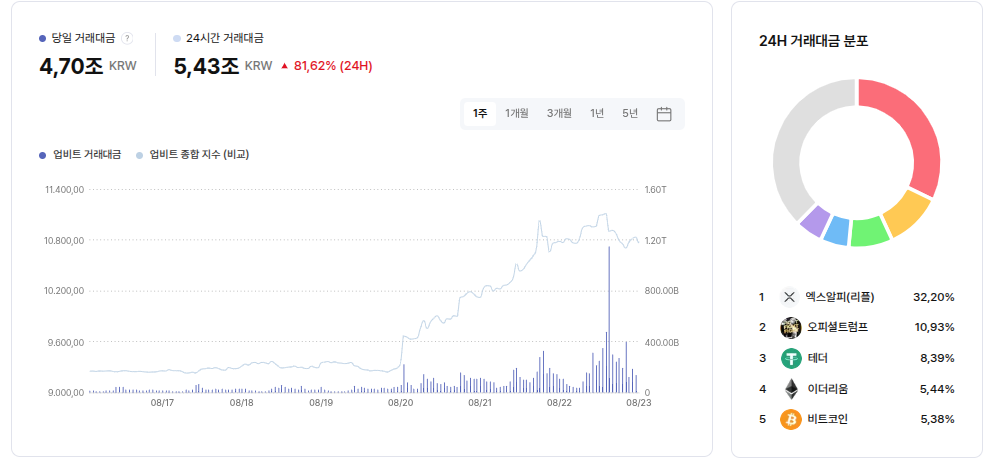
South Korea’s Upbit recorded 1.15 trillion won, roughly $830 million, in trading volume within a single hour on Saturday, with XRP and TRUMP dominating the surge.
The spike extends a rebound that began the previous day, when Upbit’s daily volume already jumped 273%.

What Drove Upbit’s Record Hourly Volume
XRP led the charge by a wide margin. The token accounted for 32.20% of Upbit’s 24-hour trading volume, ranking first among all traded assets, according to Upbit Datalab.
TRUMP ranked second on the exchange, contributing 10.93% of total volume. USDT followed in third place with 8.39%, while Ethereum and Bitcoin rounded out the top five at 5.44% and 5.40%, respectively.
Upbit’s total 24-hour trading volume reached approximately $3.81 billion, while rival exchanges Bithumb and Coinone recorded $1.954 billion and $172 million, respectively.
Saturday’s spike was not an isolated event. On August 21, Upbit’s daily volume had already jumped 273% to roughly $1.84 billion, marking the exchange’s highest daily volume since mid-March.
Follow us on X to get the latest news as it happens.
XRP topped that session too, contributing $418.9 million and ranking ahead of Bitcoin, USDT, and ETH. Bithumb recorded a similar increase that day, with volume climbing 132.9% to about $934.9 million.
Why the Rebound Follows Months of Weaker Activity
That earlier rebound followed months of weaker trading, as South Korean investors favored domestic equities while the KOSPI climbed to record highs on AI-driven semiconductor demand. Upbit and Bithumb both reported declines in operating revenue of nearly 50% during the first half of 2026.
XRP traded near $1.44 at the time of writing, according to BeInCrypto data, up 2.1% over the past 24 hours despite an intraday flash crash and up nearly 50% over the past week. The token’s rally followed Ripple’s backing of a major XRP Ledger amendment, alongside strong ETF inflows.
That gain remains positive despite a brutal 37% flash crash earlier in the day, which briefly pushed XRP as low as $1.36 before it recovered, liquidating hundreds of millions in leveraged positions along the way.
TRUMP held its gains more cleanly. The token traded near $2.34, up 26% in 24 hours and more than 66% over the past week. Its all-time low of $1.37 came just nine days ago, on August 13.
Subscribe to our YouTube channel to watch leaders and journalists provide expert insights.

Speculation around a Robinhood Chain launch has fueled renewed interest in the token, alongside a broader recovery across Solana-based meme assets. Whether this two-day streak marks a lasting rotation back into crypto or another short-lived wave, as seen repeatedly this year, remains an open question for South Korean traders.
The post $830 Million in an Hour: XRP and TRUMP Drive New Record in South Korea appeared first on BeInCrypto.
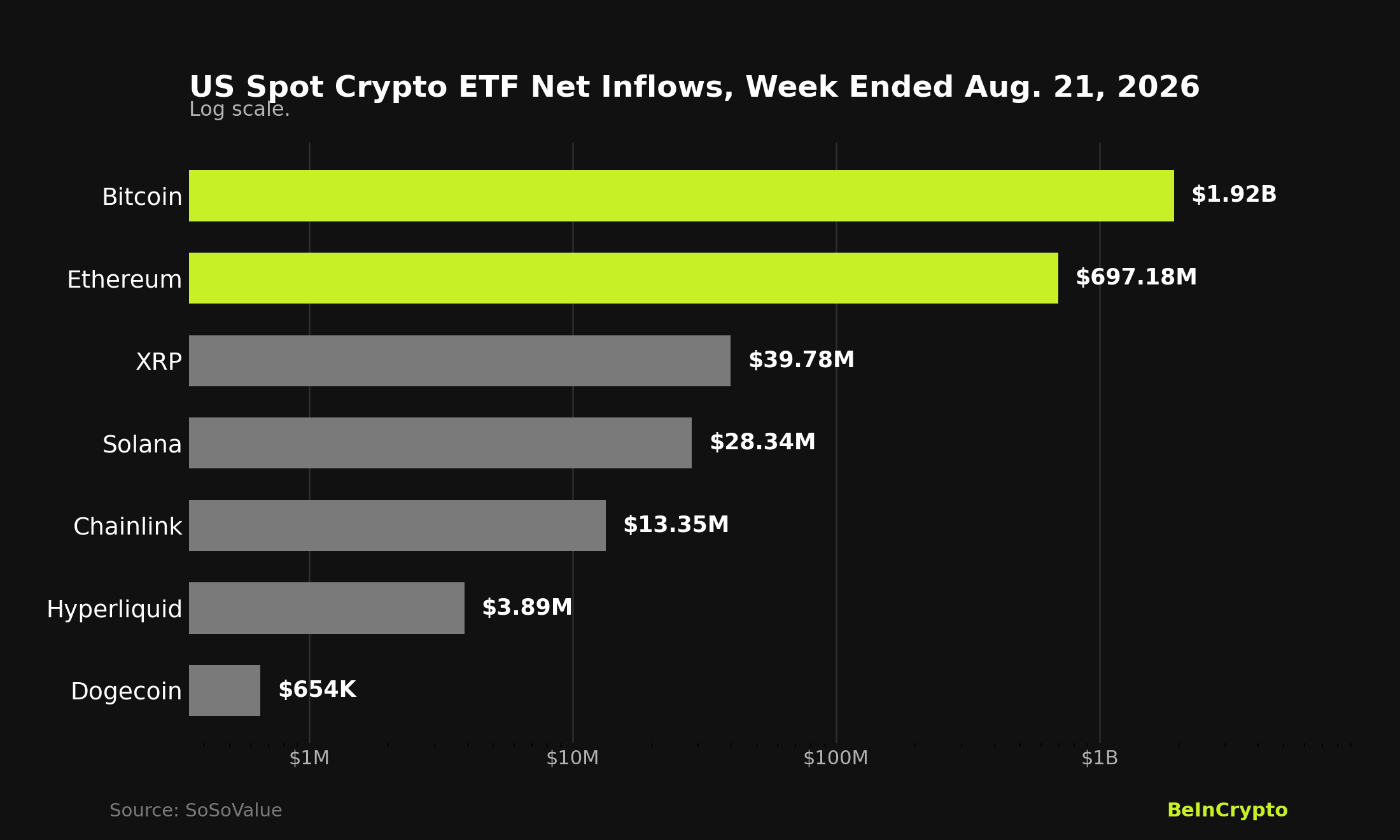
US-listed Bitcoin (BTC) and Ethereum (ETH) exchange-traded funds each recorded their largest week since October 2025, drawing a combined $2.6 billion in the seven days ended August 21.
Bitcoin products captured $1.92 billion of that sum. Ethereum funds added $697.18 million, reversing a $391.96 million combined outflow the previous week.
Bitcoin and Ethereum ETFs Hit Biggest Weekly Inflow in 10 Months
According to SoSoValue, Bitcoin funds recorded five consecutive days of net inflows from August 17 to August 21. The run included a $606 million single-day haul on August 20.
Trading activity climbed alongside the money. Weekly volume in BTC funds reached $22.15 billion, roughly triple the prior week’s total.
The week interrupts a long retreat. Cumulative net inflows into Bitcoin ETFs peaked at $62.77 billion in October 2025 and have since fallen to $53.71 billion.
Ethereum funds followed a similar path. Their largest daily intake since October landed on August 20 at $220.77 million. Total assets, however, remain 53% below the August 2025 high.
The annual picture stays negative for both. BTC funds have shed $2.91 billion in 2026 and ETH products $177.93 million, leaving each on track for its first losing year since launch.
Follow us on X to get the latest news as it happens
Assets Grew 9 Times More Than New Money
The flow figures understate what actually moved. Combined assets across both products rose by about $23 billion last week, compared with $2.6 billion in creations.
Stripping out flows, the implied gain in the underlying holdings reached 22.9% for Bitcoin and 29.2% for Ethereum. Three sessions from August 19 to August 21 produced most of it.
Revaluation, therefore, did the heavy lifting. Bitcoin traded near $77,125 at press time, while Ethereum changed hands at $2,423.
Altcoin Funds Extend the Run
Other major US altcoin spot ETFs also posted net inflows over the same week. XRP (XRP) ETFs led with $39.78 million and set a record for weekly trading volume at $271.74 million.

Solana (SOL) products followed with $28.34 million, marking an eighth consecutive week of inflows. Chainlink (LINK) funds drew $13.35 million, their second-largest week since launching in December. Assets closed at a record $171.59 million.
Hyperliquid (HYPE) products added $3.89 million and also finished at record assets of $360.39 million. Dogecoin (DOGE) funds trailed the group with $654,416.
Subscribe to our YouTube channel to watch leaders and journalists provide expert insights
The post Bitcoin and Ethereum ETFs Score Biggest Week Since October with $2.3 Billion appeared first on BeInCrypto.
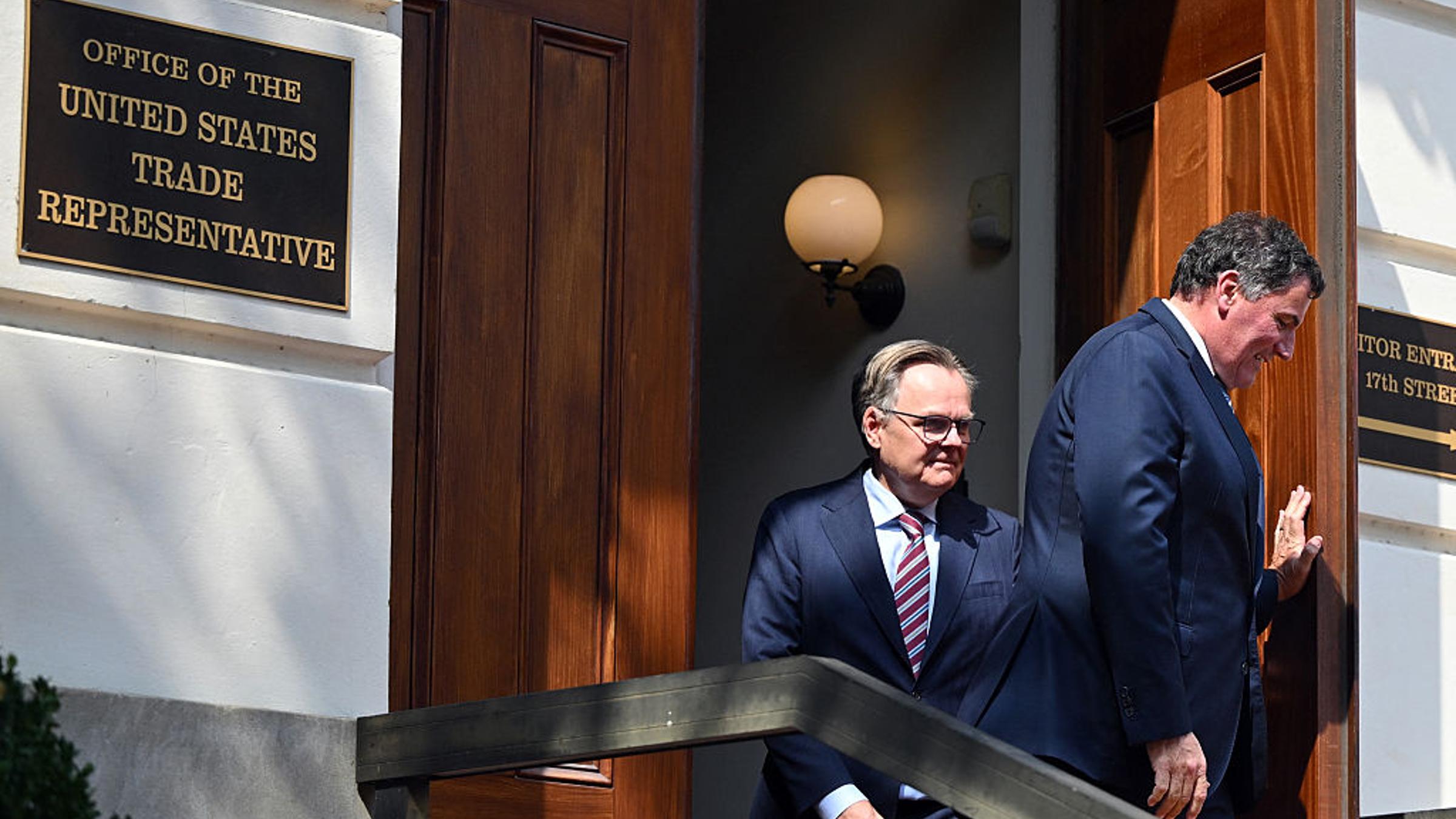
“New demands and walk backs of other commitments by Canada have upended the careful balance reached in the past days,” Greer said. “This is a missed opportunity for Canada to partner with the United States.”
Carney vowed that the tariffs would not go unanswered. Speaking at a news conference Saturday, he announced dollar-for-dollar tariffs on U.S. goods.
“We cannot accept what they have offered, and we will not give what they have asked,” he said.
The retaliatory tariffs will touch U.S. sectors including steel, dairy, appliances, agricultural equipment, pulp and paper, and electronics, and they will go into effect Sept. 8.
The growing rift between the U.S. and Canada
Polling conducted before the talks collapsed suggests that most Canadians supported taking a hard line in negotiations with the U.S.
An Angus Reid Institute poll from July found that 65% of Canadians say that their government should approach the U.S. either cautiously, as a potential threat, or as an enemy.

Coinkite, the company behind Coldcard, has shipped a firmware update that will not generate a new wallet seed until the owner supplies randomness by hand.
That means at least 50 dice rolls, 128 coin flips, or 65 timed key presses, three weeks after a defect in its random number generator opened customer funds to attackers.
Coldcard’s two device lines run separate firmware tracks, so the release carries two numbers, 5.6.1 for the Mk4 and Mk5, and 1.5.1Q for the Q, the larger model with a keyboard and QR scanning.
Boot Check Targets the Defect
Coinkite stated that the input is added on top of device randomness from the STM32 TRNG and both secure elements.
Coldcard was built to draw seed entropy only from its hardware generator, but Coinkite traced the failure to a build and link error that left the setting meant to disable the software path without effect, sending the random-number call to MicroPython’s Yasmarang PRNG, which entered the seed path in March 2021.
Affected seeds carry about 72 bits of entropy instead of the expected 128 bits after 594.5 BTC was swept from 500 addresses on July 30.
Firmware 5.6.1 now verifies at boot that the random-number call reaches the intended hardware path, halting the device if it fails. Coinkite replaced Yasmarang with a SHA-256 Hash_DRBG, specified in NIST SP 800-90A, and seeds it at startup with a full 256-bit digest from both secure elements, which earlier firmware truncated to 32 bits.
Key mashing follows Peter Todd’s push-button RNG design, hashing keypad press timing at CPU-cycle resolution. The first press sets a reference, and each of the 64 gaps that follow is credited with two bits of entropy.
Old Seeds Still Need Migrating
“Installing this update does not make an existing vulnerable seed safe,” Coinkite wrote, directing anyone whose seed may have been generated on affected firmware between 2021 and July 2026 to create a replacement and move their Bitcoin (BTC). Mk2 and Mk3 fall outside this release, and their minimum fixed version stays at 4.2.0.
A compromised USB host could rewrite a staged transaction after the owner approved it, so the signature covered different outputs. The device now rechecks those bytes before signing and stops with a “Transaction modified” warning.
Coinkite’s new Security Status page lists four independent reviews, among them a real-device test that observed eight hardware RNG reads for a 32-byte seed request and a rebuild matching every byte of the signed firmware.
The company noted that the checks are “not a complete audit of every firmware binary.” As CryptoPotato reported, confirmed losses passed $100 million, with Galaxy Research counting 1,596 BTC from roughly 7,300 addresses, and a suspected fourth wave sweeping nearly 449 BTC on August 3.
The post Coldcard Firmware 5.6.1 Forces User Entropy Into Every New Seed After $100M Exploit appeared first on CryptoPotato.
The Sandbox said it has "identified and fully contained" a vulnerability in the SAND cross-chain bridge that let an attacker mint unbacked SAND on Base and BNB Smart Chain, and that it has switched off bridging to and from both networks, leaving the SAND on those chains isolated and unable to be… Read the full story at The Defiant
Friday ended with both the Nasdaq and the S&P 500 posted their first weekly decline in four weeks. Each kept their year-to-date gains above 12%. And both indexes also undercut the low of their Aug. 4 follow through days. A key difference is that, in addition, the Nasdaq ended Friday’s session below its 21-day exponential moving average, while the S&P…
Copyright ©2026 Investor’s Business Daily, LLC. All rights reserved. 87990cbe856818d5eddac44c7b1cdeb8
Bitcoin has staged an aggressive breakout after weeks of compressed price action, pushing through several important resistance levels in a short period. While the move has materially improved the technical picture, BTC is now approaching another major supply area, making the sustainability of the breakout the key question.
Bitcoin Price Analysis: The Daily Chart
On the daily timeframe, Bitcoin has decisively broken above the long-standing descending trendline and the $66K-$67K resistance zone. The breakout was followed by an exceptionally strong expansion, with price also clearing the intermediate $72K-$74K supply area and reaching roughly $79K before pulling back toward $77K.
This represents a notable shift in market structure. The descending trendline had capped BTC throughout the broader correction, so reclaiming it alongside multiple horizontal resistance zones suggests buyers have regained control, at least in the near term.
However, price is now approaching the major $80K-$83K resistance zone. This area previously marked an important swing high and could attract profit-taking following such a rapid advance. A breakout and daily acceptance above $83K would further strengthen the bullish structure and potentially open the way toward the much larger $94K-$98K supply zone.
Conversely, after such a vertical move, a correction would not necessarily invalidate the breakout. The former $72K-$74K resistance zone is now the first major area to monitor as potential support. Holding this region on a pullback would reinforce the idea that the recent move represents a genuine structural reversal rather than a temporary liquidity-driven spike.
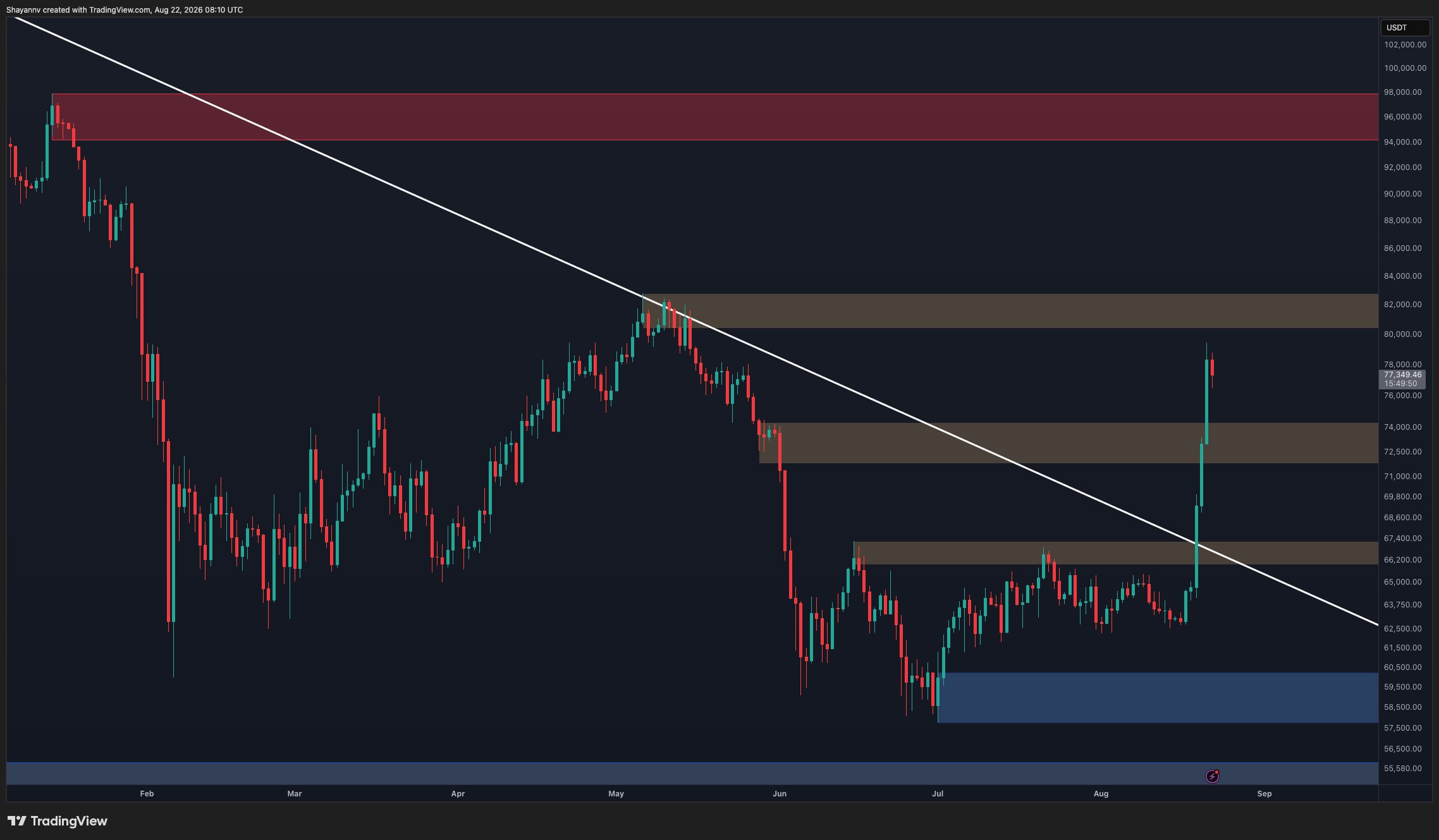
BTC/USDT 4-Hour Chart
The 4-hour chart highlights the strength of the breakout more clearly. Bitcoin escaped the converging trendline structure around $64K-$65K and accelerated almost vertically, eventually reaching approximately $79.5K.
Given the speed of the advance, the market is now extended from its breakout point, increasing the probability of short-term consolidation or a corrective retracement. The $72K-$74K zone is the first significant support area, while the Fibonacci levels shown on the chart provide deeper retracement references at roughly $71.1K, $69.1K, $67.7K, and $66.3K.
The $66K-$67K region is particularly important because it combines the former horizontal resistance area with the broader breakout structure. A deeper correction into this region, followed by strong demand, could still preserve the bullish setup.
For now, the immediate obstacle remains the $79.5K high followed by the $81K-$83K supply zone. A period of consolidation beneath this resistance would be relatively constructive, whereas an immediate rejection followed by a loss of $72K could indicate that the market needs a considerably deeper reset before attempting another leg higher.

On-chain Analysis
The Realized Price UTXO Age Bands chart provides additional context for the breakout by showing the average acquisition prices of different groups of Bitcoin holders.
The most relevant development is that BTC’s surge toward $79K has pushed spot price above the realized-price levels of the shorter-term 1-3 month and 3-6 month cohorts, which sit around $64K and $74K, respectively. This means these groups have broadly moved back into unrealized profit, reducing some of the pressure associated with underwater recent buyers.
At the same time, several older cohorts remain positioned considerably above the current market price. The 18-month to 2-year realized price is around $87K, while the 6-12 month and 12-18 month bands are much higher, near $95K and $105K. These levels could become increasingly relevant if the recovery continues, as BTC would begin approaching the cost bases of holders who remain underwater.
Therefore, the on-chain structure has improved alongside the technical breakout, but the recovery is not yet complete. Holding above the roughly $74K cost basis of the 3-6 month cohort would be particularly constructive, while losing it could indicate that the latest surge has moved ahead of underlying holder support.

The post Bitcoin Price Analysis: BTC’s 25% Rally Faces Its First Serious Threat appeared first on CryptoPotato.

Hannah Einbinder Interview: Hacks Star Talks Gillian Anderson And Political Activism
Motor racing-Milei puts himself in the driver’s seat to bring F1 back to Argentina

Former world champion admits he shouldn’t have fought Shakur Stevenson when he did





-

 Fashion1 day ago
Weekend Open Thread: Madewell – Corporette.com
-

 Business4 days ago
SMA Solar Technology AG (SMTGY) Q2 2026 Earnings Call Transcript
-

 Tech5 days ago
Qwen3.8-27B runs frontier-class coding agents and reasoning locally, no cloud API required
-

 Politics11 hours ago
6 months on, Irish renters crushed by effects of government housing bill
-

 Crypto World5 days ago
OCC Greenlights Trump Family Crypto Firm for Trust Charter
-

 Crypto World5 days ago
NAVI Prime launches institutional lending framework on Sui
-

 News Videos3 days ago
Don’t Leave Your Financial Future To Chance | August 19, 2026
-
 NewsBeat14 hours ago
The ‘Lucky Dip Gang’ causing carnage for clicks: After five thugs were killed speeding in the wrong direction on a motorway, GUY ADAMS investigates a sick new trend… and why police aren’t even allowed to pursue them
-

 Crypto World6 days ago
Data of 54K Wallet Users Leaked, Clarity Odds Just 10%: Hodler’s Digest, Aug. 16
-

 Politics6 days ago
Britain is facing a housing disaster
-

 Tech6 days ago
What are the rumors about the AirPods Pro 4?
-

 Business6 days ago
Rebel Creamery files Chapter 11 with $23.8M Van Leeuwen judgment on appeal
-
 Crypto World5 days ago
Dow’s 3-Year Winning Run Isn’t a Crash Signal, Still 49% Odds of Double-Digit Gains
-

 Business4 days ago
Stock Market Today: Tech Futures Slide As Treasury Yields Jump; Nvidia, Micron, Sandisk Sell Off
-

 Tech7 days ago
Three new Windows flaws can bypass security, gain system privileges, and even install malware remotely
-
 Tech6 days ago
OpenAI’s new ChatGPT feature logs your keystrokes and stores them in plain text
-

 Tech5 days ago
Straight Up the Cliff, Yunnan’s New Fuyao Ladder Turns a Three-Hour Climb Into a 50-Second Ride for Students
-

 Tech6 days ago
DeepSeek’s top-ranked V4 Flash stumbles on real agent tasks as its prices surge
-
 Tech5 days ago
Nvidia discloses $21B stake in SpaceX
-

 Business2 days ago
Five Below: Kids Discount Retailer Reaps Rich Rewards
You must be logged in to post a comment Login