




He found fame as the Californian ‘horse whisperer’ who even charmed the Queen of England.
But when trainer Monty Roberts died three weeks ago aged 91, he left a lasting legacy not only at the Royal stables – where he was a regular visitor for 35 years – but in horsemanship around the world.
The late Queen so admired Roberts’ pioneering techniques for breaking-in horses – using gentle persuasion, not brutality – that the two became unlikely friends.
One of the last films Elizabeth made was a documentary about Roberts’ work, The Cowboy And The Queen.
However, The Mail on Sunday has been told their unique collaboration went further still, and that, together, they helped to establish a pioneering scheme for British military veterans and emergency workers suffering from post-traumatic stress disorder (PTSD).
The result is Warrior Equine, a charity which today uses sessions working with horses to restore the health and sanity of soldiers and police officers, for example.
It turned out that, aside from his work as a trainer, Roberts had already used his horses to help thousands of traumatised US servicemen at his ranch in California and when, in her later years, Her Majesty got to hear of this, she was determined a similar scheme should be established in Britain, reveals historian and royal biographer Hugo Vickers.
‘The Queen wanted this to develop in the United Kingdom and across the world,’ said Vickers, who is updating his latest biography, Queen Elizabeth II: A Personal History.
The late Queen Elizabeth II and horse trainer Monty Roberts (pictured) helped to establish a pioneering scheme for British military veterans and emergency workers suffering from PTSD

The scheme, called Warrior Equine, was formed after Elizabeth was inspired by Roberts’s use of horses to help thousands of traumatised US servicemen (Pictured: Roberts at Windsor Castle, where he stayed with the Queen for the Windsor Horse Show)
Roberts’ first involvement with British soldiers was in 2014, when the American ran a series of brief courses with servicemen through the Help For Heroes charity. It proved such a success that similar events soon followed.
‘At this point, the Queen was taking a private interest,’ said Vickers.
‘The organisers produced a report after each session and it went to Her Majesty. In 2017, she asked Sir Redmond Watt, Major-General of the Household Division, to become involved and he has continued to be massively supportive with access to military personnel.
‘In 2019, the Queen invited the team to the Royal Mews at Windsor Castle to give her a private demonstration. She told Terry Pendry, her groom, that they could use any of her horses, and some veterans who had already completed the course went through their paces.’
Vickers continued: ‘Afterwards there was a tea which was meant to last 15 minutes and in fact lasted over an hour. One person who was there told me that Her Majesty sat at a table of six, including two veterans and a Welsh Guards colonel.
‘There was ‘joy in her face’ when she heard the stories, including one from a man whose life had effectively been saved from the threat of suicide.’
One of those present that day was Ele Milwright, who had organised Roberts’ British clinics and, with the Queen’s backing, established Warrior Equine in 2019.
Today, her charity works with groups including the Household Cavalry, The King’s Troop Royal Horse Artillery, the Army, the Navy and emergency services.

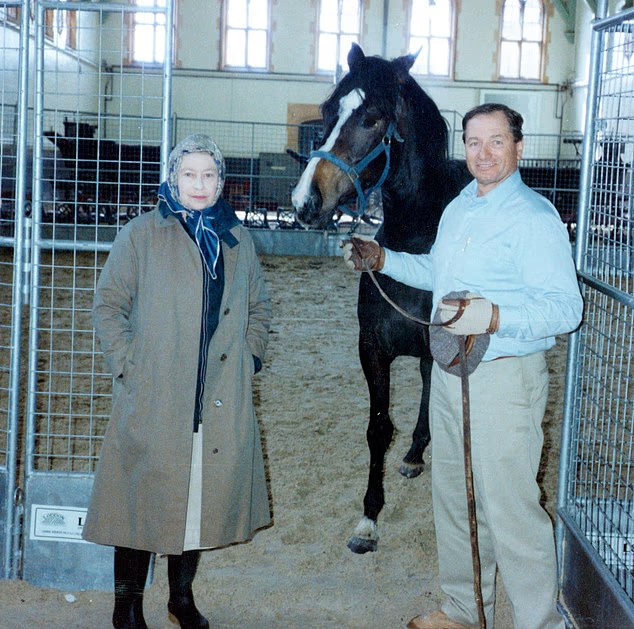
Monty Roberts with one of the Queens horses at Windsor Castle. It is said the late Queen admired Roberts’ pioneering techniques for breaking-in horses, making the pair unlikely friends

Queen Elizabeth II pictured with John Miller, her retired Crown Equerry, in 1982. The Queen initially sent Mr Miller to visit Roberts’s ranch

Monty Roberts pictured with horse Shy Boy in 2005 at his American ranch. He later found fame as the Californian ‘horse whisperer’
‘I know that the Queen very much wanted this to happen,’ Milwright said.
‘Her Majesty wanted us to widen our work beyond what we’d done with Help For Heroes to include serving personnel and workers from the emergency services. She recognised the unique strains and enormous psychological pressures and difficulties they faced in the course of their duty.
‘Having had the privilege of sitting down with the Queen and hearing first-hand her support, I was determined to repay her faith in us. She was very much the catalyst.’
Yet the relationship between the Queen and Monty Roberts nearly got off to a bad start, explained Vickers.
‘The Queen knew her retired Crown Equerry, Sir John Miller, was to visit friends in California, and she sent him to the ranch to see what Roberts was doing. When this moustached figure arrived, Roberts took one look at him and thought he came straight from casting in Hollywood.
‘Roberts was convinced the visit was a practical joke arranged by his neighbours. Miller thought Roberts was a charlatan who was using concealed sugar lumps to tame the horses.
‘The two men gradually became impressed by their respective equestrian knowledge and skills, however.
‘Miller gave the Queen a favourable report, so she invited Roberts to Windsor in April 1989.’
Vickers added: ‘The Queen watched him at work in the Royal Mews – as did the Queen Mother and Prince Philip. Roberts tamed 23 horses in five days, getting one rider into the saddle in 29 minutes.
As Roberts put it: ‘Her Majesty took my work to the world and, with her influence, the world is changing dramatically away from violence in training horses.’
According to Vickers, Terry Pendry, the Queen’s groom, learnt to follow Roberts’ methods and introduced them to the Household Cavalry.
Pendry later said Roberts ‘did more for the animal kingdom than anyone’.











































You must be logged in to post a comment Login