

Crypto World
3 Altcoins That Could Reach New All-Time High This Weekend

Three altcoins enter the weekend trading near record highs (ATH), led by LEO Token, which sits closest to a fresh peak. WhiteBIT Coin and Rain complete a list picked on one rule, proximity to all-time highs.
The selection follows the same criterion as last weekend’s edition. These are the big and mid-cap coins nearest their previous peaks, with Fibonacci levels marking the path higher and the support that would invalidate each setup.
LEO Token Sits Closest to a New Record
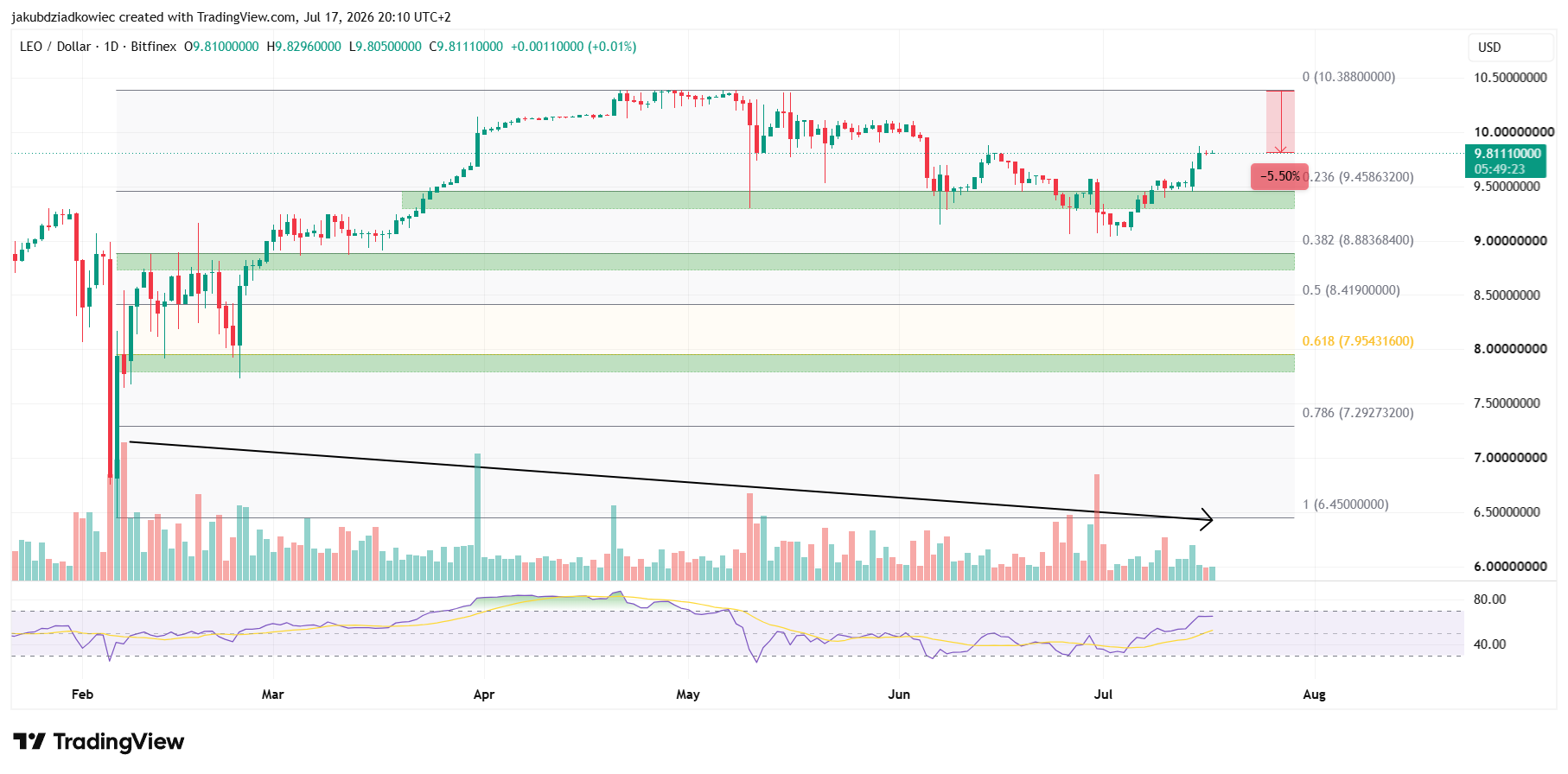
LEO Token (LEO) trades near $9.80, down about 0.2% on the day. That price sits roughly 7% below its record of $10.57, the smallest gap on this list.
On the daily chart, price bounced from the 0.236 Fibonacci retracement near $9.46. It now tests the swing high from June 15, the last hurdle before the record.

A clean break above that level would open the path toward a new peak. The BeInCrypto price forecast also points to bullishness for the token.
If the move stalls, the 0.382 Fibonacci level near $8.88 marks a healthy correction target. Declining volume points to accumulation, while the RSI reads about 65 and continues to rise.
WhiteBIT Coin Targets $64 After Channel Reclaim
WhiteBIT Coin (WBT) tells a more volatile story. The coin trades near $55.66, down about 0.8%, and is roughly 13% below its December record of $64.11.
Price broke down from an ascending channel on May 27, then bottomed on June 5. Since then, buyers have driven two separate bounces off the lows.

The coin now rests at the 0.618 Fibonacci level near $55.93 and faces firm resistance at $58. That level lines up with the lower band of the broken channel.
The RSI sits near a neutral 55, and volume keeps fading. Reclaiming $58 would clear the way toward the December peak, though that record now dates back seven months.
Rain Needs $0.0147 to Rejoin the Race
Rain (RAIN) qualifies on proximity, yet its chart looks the weakest of the three. The token trades near $0.0141, down about 0.5%, and sits roughly 13% below its June 22 record of $0.01614.
Price has just been rejected from resistance near $0.0147. It now drifts toward support at the 0.382 Fibonacci level near $0.01259.

The same token featured previously and still trades below its peak a week later. Momentum has cooled, with the RSI at a neutral 42 and turning south.
Volume has also declined since the early-June impulse, a sign of lower volatility. A firm reclaim of $0.0147 would revive the push toward the record.
What to Watch This Weekend
Each setup now hinges on one level. LEO needs to clear the June 15 swing high, WBT must reclaim $58, and RAIN has to flip $0.0147 back into support.
A break of those levels would confirm each thesis and point toward record territory. Failure would hand the initiative back to sellers heading into next week.
Broader conditions still matter, as Bitcoin works through its own late-cycle phase. A weekend risk-on move would give all three altcoins the tailwind they need.
The post 3 Altcoins That Could Reach New All-Time High This Weekend appeared first on BeInCrypto.


France’s gambling regulator has ordered internet service providers to block access to Polymarket, escalating a wave of restrictions aimed at prediction platforms operating outside local authorizations.
In a Friday press release, the Autorité nationale des jeux (ANJ) said prediction websites fall under illegal gambling rules if they are not authorized, adding that advertising or promoting such sites is a criminal offense punishable by fines of up to 100,000 euros.
Key takeaways
- France’s ANJ has ordered ISPs to block Polymarket, citing lack of authorization and illegal gambling promotion risks.
- The regulator argues Polymarket’s features resemble regulated gambling, but without “protective mechanisms” found in the legal market.
- ANJ also raised concerns about possible outcome manipulation, including allegations involving weather-related contracts.
- Polymarket has already been geoblocked in multiple regions, according to its own documentation.
- Regulatory scrutiny is not limited to Europe: similar legal disputes have played out in the US between state actors and federal authorities.
France moves to block Polymarket
The ANJ’s order targets access to Polymarket through internet service providers, framing the platform as an unauthorized gambling offering. According to the regulator, Polymarket’s operations are not authorized in France, and the advertising of gambling sites without permission constitutes a criminal offense.
The decision comes as prediction markets continue to gain mainstream attention. Polymarket, in particular, has grown rapidly over the last two years, with trading volume reaching billions of dollars, even as regulators worldwide question whether its event contracts are gambling products, unlicensed offerings, or something closer to financial instruments.
France’s action also reinforces a broader pattern of country-by-country enforcement. Polymarket access has been blocked in places including Singapore, Poland, Portugal, Hungary, Ukraine, Brazil, and Indonesia, while at press time Polymarket said it was geoblocked in 36 regions, based on its published API documentation.
ANJ cites “addictive” mechanics and missing safeguards
Beyond the authorization question, the ANJ’s reasoning focuses on how prediction products are experienced by users. The regulator said Polymarket offers “addictive features” that are comparable to those of legally regulated gambling, but it claims those features are “amplified by the absence of the protective mechanisms found in the legal gambling market.”
This distinction matters for investors and users because it goes to how regulators classify the product. When a platform resembles regulated gambling mechanics but lacks corresponding protections—such as consumer safeguards and oversight—authorities are more likely to pursue takedowns, advertising restrictions, and access blocking, even if the platform markets itself as a different kind of market.
Outcome manipulation concerns and investigation status
The ANJ also pointed to the risk of outcome manipulation in certain event contracts. It cited alleged rigging, including a specific example: bets tied to weather outcomes where the regulator said weather sensors may have been hacked.
“Some of the bets offered on this platform appeared to be rigged: for example, bets on the weather revealed that weather sensors may have been hacked.”
In addition, the cybercrime unit of the Paris Public Prosecutor’s Office opened an investigation in May 2026 and, according to the article’s account of the regulator’s findings, identified a lack of identity verification safeguards such as Know Your Customer checks.
For participants, this kind of enforcement pressure highlights a key operational fault line: regulators are not only focused on contract structure, but also on platform controls—especially around participant verification and the reliability of the information used to settle outcomes.
France builds on earlier warnings, while US regulators escalate
This is not France’s first move. Earlier coverage noted that the ANJ shared plans in November 2024 to block Polymarket after the platform allegedly failed to comply with national gambling laws, and the Friday decision follows through with the required ISP-level blocking.
The French action arrives amid an ongoing legal fight over prediction markets in the United States. On June 17, Kentucky sued five prediction market platforms, including Kalshi and Polymarket, alleging they were operating unlicensed sports betting platforms—according to the earlier reporting cited in the article. Additional states have followed suit. Separately, the Commodity Futures Trading Commission (CFTC) has sued New Mexico, arguing that state-level interference encroached on the federal regulator’s exclusive authority over federally regulated event contracts, as reflected in the referenced CFTC dispute.
Taken together, the US and France developments underscore a persistent regulatory tension: prediction markets sit at the intersection of gambling law, securities and commodities frameworks, and consumer protection rules. Even when platforms frame themselves as market infrastructure for forecasting rather than wagering, regulators appear willing to treat them as gambling-like products when participation mechanics and consumer risk resemble traditional betting.
As France implements the ISP blocking order, the next question for readers and market participants is how Polymarket and other affected platforms will adjust compliance, identity verification, and settlement-risk controls—and whether the broader trend shifts from geoblocking to more formal legal resolutions in major jurisdictions.
Ethereum has risen 1.8% to $1,845 after Rep. Bryan Steil raised hopes for a Senate vote on the CLARITY Act next week, while ETF inflows and firm chart support kept traders cautiously bullish.
Summary
- Ethereum rose 1.8% as Bryan Steil raised hopes for a CLARITY Act vote next week.
- Spot Ethereum ETFs recorded $105 million in weekly inflows, their highest since April.
- ETH must defend $1,830 and break $1,854 to target the $1,947 resistance zone.
Steil, who chairs the House Financial Services Subcommittee on Digital Assets, told FOX Business that the bill could reach the Senate floor in the coming week. Passage could place ETH under a digital commodity framework and establish federal rules for its trading and oversight.
During a July 17 hearing, Steil urged lawmakers to complete the legislation as the Senate prepares to consider it. “Let’s pass CLARITY,” he stated in remarks published by the House Financial Services Committee.
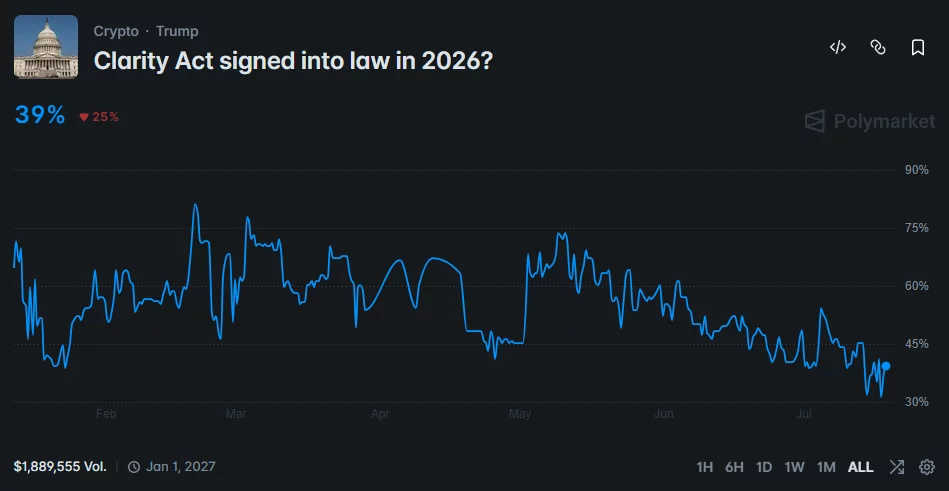
Polymarket traders raised the probability of the bill becoming law in 2026 to 39% from 30% on July 17. However, unresolved disputes over ethics rules and stablecoin yields have kept the odds below 50%.
Institutional flows have also improved. SoSoValue data showed that spot Ethereum ETFs attracted $105 million between July 13 and July 17, their strongest weekly inflow since April.
Ethereum’s decentralized finance activity has grown alongside the ETF demand. DeFiLlama placed the network’s total value locked at about $40.5 billion, up from roughly $36 billion at the start of July. The network also processed $978.9 million in decentralized exchange volume and 2.46 million transactions over the past 24 hours.
Ethereum must clear $1,854 to reopen the path toward $1,947
Ethereum’s daily chart shows a double-bottom structure formed around $1,511, with the neckline near $1,847. ETH briefly climbed to $1,947 before returning to test the neckline, which now overlaps with the 0.786 Fibonacci retracement at $1,853.82.
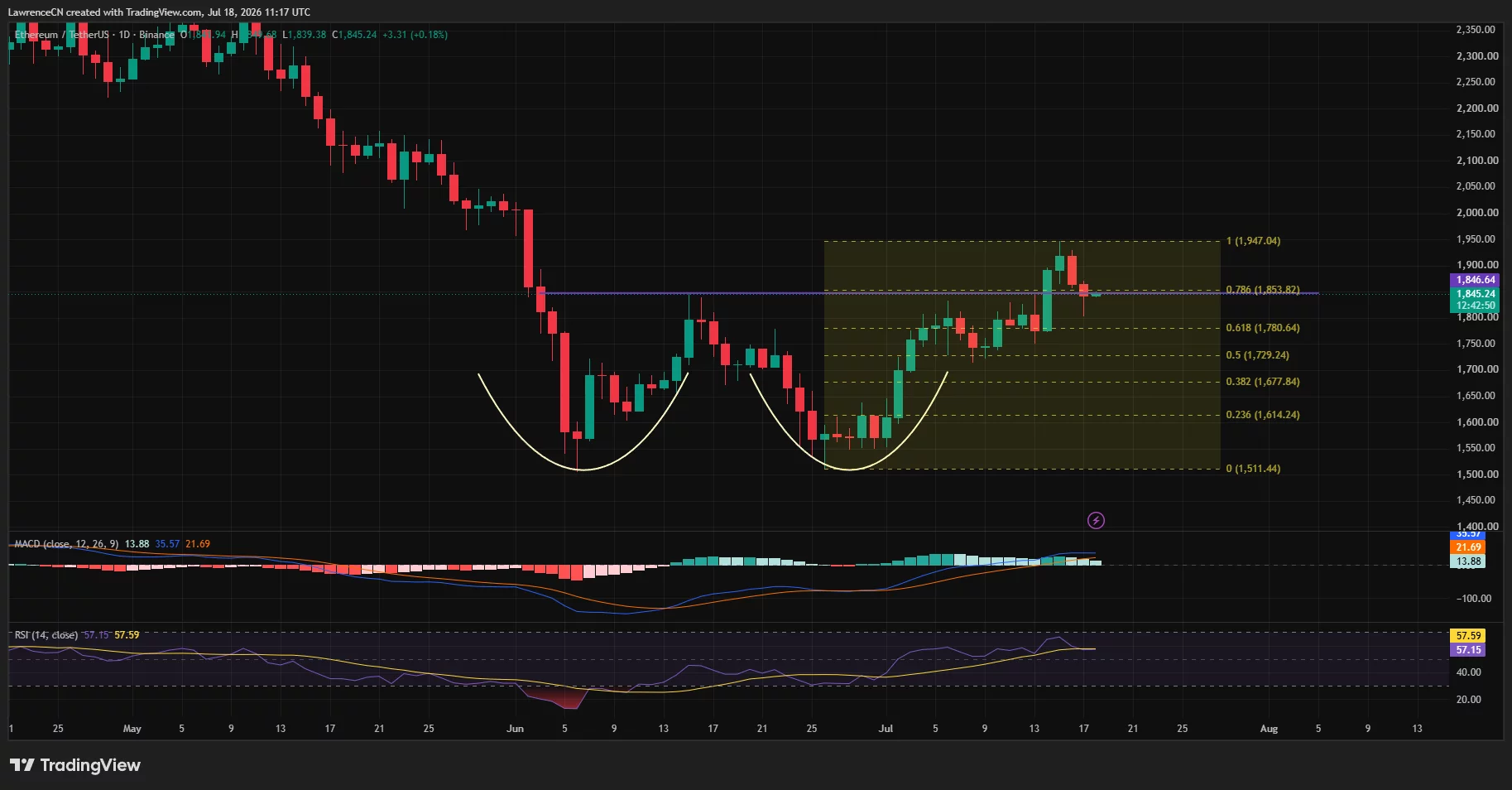
A daily close above $1,854 would place the recent $1,947 high and the 100-day exponential moving average near $1,939 back in play. The double-bottom structure has a measured target near $2,180, while crypto analyst Michaël van de Poppe expects $2,200 to $2,400 if the $1,780 support remains intact.
Daily momentum still favors buyers, although the pace has slowed. The MACD line stands at 35.57, above the 21.69 signal line, while the positive histogram has contracted to 13.88. The relative strength index sits at 57.15, leaving ETH below overbought territory.
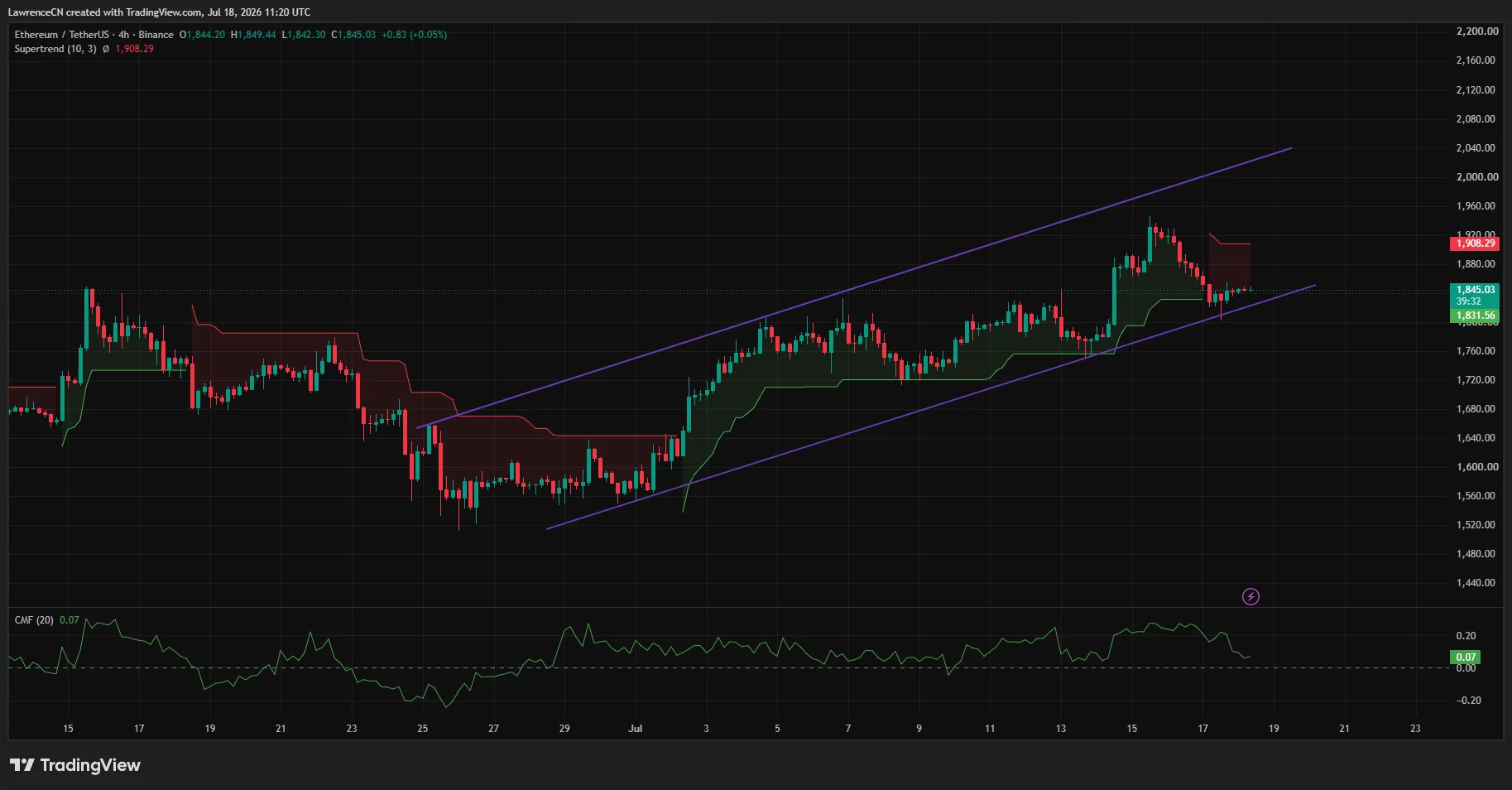
On the 4-hour chart, Ethereum (ETH) remains inside an ascending channel that has guided the recovery since late June. Its lower boundary and the previous Supertrend support meet around $1,830, while the upper boundary extends toward $2,040. Chaikin Money Flow remains positive at 0.07, but the active Supertrend resistance at $1,908 must fall before buyers can retest the July high.
CoinGlass’ 48-hour liquidation heatmap places the nearest dense leverage cluster between $1,860 and $1,870. More positions sit around $1,900, while downside liquidity has accumulated near $1,810 and $1,790.
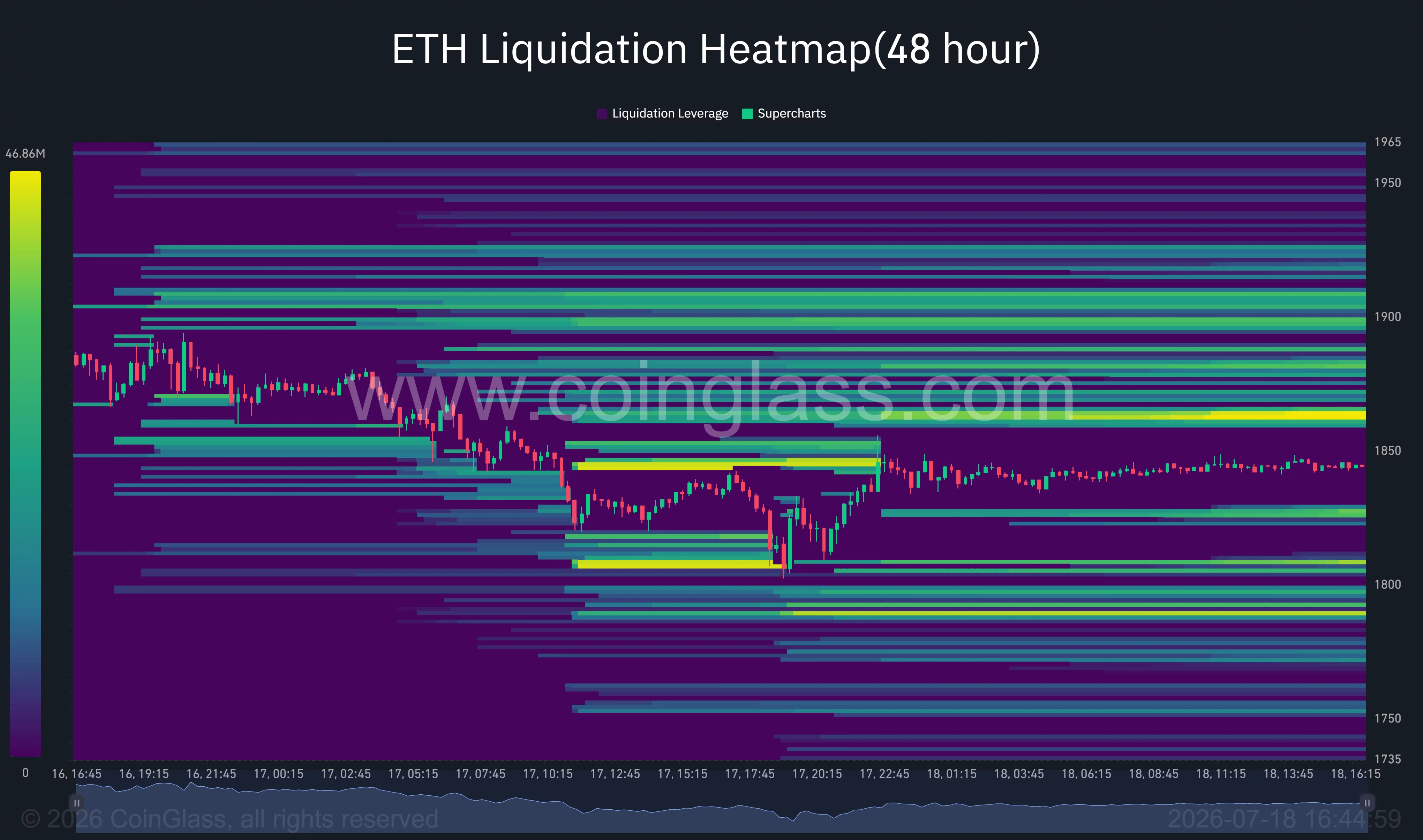
According to analyst Ted Pillows, the $1,820–$1,850 region will decide ETH’s next move.
“If Ethereum holds above it, expect another uptrend towards $1,950–$2,000.”
A break below $1,780 would weaken Ethereum’s recovery
Ethereum would lose its 4-hour channel if sellers force a close below $1,830. Such a move would expose the 50-day EMA near $1,812 and could trigger leveraged long liquidations around $1,810.
A deeper decline below the 61.8% Fibonacci level at $1,780.64 would weaken the double-bottom setup and open the 50% retracement at $1,729.24. Pillows also cited the escalating U.S.-Iran situation as a risk to the $1,820–$1,850 support zone.
Political uncertainty remains another invalidation risk. Failure to resolve the CLARITY Act’s ethics and stablecoin provisions could delay a Senate vote, remove the immediate catalyst behind ETH’s rebound, and place the $1,780 support under renewed pressure.
Disclosure: This article does not represent investment advice. The content and materials featured on this page are for educational purposes only.
F/m Investments’ Washington, D.C., office is just a short drive from the Federal Reserve‘s headquarters. But under the central bank’s new leadership, CEO Alexander Morris has found the distance feeling far greater.
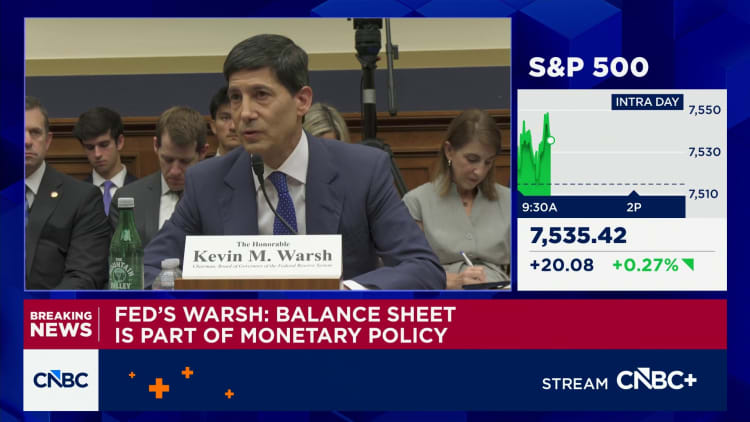
Fed Chairman Kevin Warsh embarked on an overhaul of the central bank’s forward-looking communication since taking the post in May. That move sounded the alarm for market participants like Morris, whose investing theses rely in part on predicting what the Fed will do with interest rates.
“We’ve made a pretty good business out of decoding Fedspeak,” said Morris, referring to the jargon-heavy communication preferred by central bank leaders. “And he just said he was going to go quiet on us.”
This week, Morris’ firm, which manages exchange-traded funds tied to inflation and U.S. Treasurys, released “WarshGPT.” It’s an artificial intelligence-powered tool that parses nearly 1,800 documents and transcripts from Warsh, with the goal of helping users understand how he may analyze issues related to the economy or monetary policy.
F/m Investments is one of many financial institutions readying for an era with less public forecasting from Warsh’s Fed. In some cases, they’re turning to AI models to gain an edge in investing.
“Whether the Fed is providing a lot of information or a little information, investors have to understand what the Fed is likely to do in the future,” said Gary Richardson, a former historian at the central bank who’s now a University of California, Irvine, economics professor. “With limited information, people are going to try to do anything they can to figure out what the Fed is thinking.”
US Federal Reserve Chair Kevin Warsh speaks during his first news conference since taking the helm at the central bank on June 17, 2026 in Washington, DC.
Chen Mengtong | China News Service | Getty Images
Greetings and briefcase sizes
Investors and Fed watchers have wondered if former Chairman Alan Greenspan‘s communication style can serve as a baseline for what to expect under Warsh.
In that era, Richardson said people joked that Greenspan simply saying “good evening” could cause a market decline. Financial media tracked a so-called briefcase indicator, which operated on the theory that Greenspan carrying a bulkier bag meant he accumulated evidence for why borrowing costs should be altered.
Alan Greenspan
Anjali Sundaram | CNBC
Already, Warsh has made expectations clear for a shift in how the Fed publicizes information. One of his task forces aimed at reshaping the Fed’s operations is focused on how the central bank communicates.
June’s Federal Reserve meeting statement — the first such release under Warsh — contained around 130 words, down from figures above 300 words seen in prior publications, a CNBC analysis found. Warsh, who acknowledged the statement was “shorter” and “simpler,” said it purposefully excluded forward guidance.
In his first post-decision press conference as chairman, Warsh allocated 5% of sentences to policy-relevant topics, according to UBS. That number came in at 27% for an average meeting under predecessor Jerome Powell, the bank said.
‘One word can move dollars’
F/m Investments’ WarshGPT chatbot cost less than $1,000 to build with Anthropic‘s Claude model, despite the name being a riff on rival OpenAI‘s ChatGPT. It took roughly two weeks to create from inception to release, a timeframe that included pre-rollout testing by a group that included Fed alumni and newsletter writers.
In addition to Warsh’s communications, the product also taps into economic and political history to ensure its responses have context. But F/m set limits to what WarshGPT can do: The bot doesn’t talk as Warsh and will not offer offer forward statements or forecasts.
F/m isn’t the only large firm reconsidering its strategies and tools for understanding a Warsh-led central bank.
UBS runs an interactive dashboard for clients to track the Fed’s policy tone. It allows users to have an unbiased assessment of Warsh’s commentary during meetings, according to Elena Amoruso, a strategist at the Swiss bank.
Following Warsh’s debut policy meeting as chief last month, Amoruso told clients that Warsh’s policy-relevant comments were “overwhelmingly hawkish.” The central bank leader’s stance was driven by his views on the labor market and growth, she said, in addition to the state of inflation.
“Arguably, this is the most high-value data set … in terms of how much one word can move dollars,” Amoruso told CNBC.
At JPMorgan Asset Management, chief global strategist David Kelly has some backup plans if the Fed stops putting out key releases. If the central bank does away with the “dot plot,” for instance, Kelly said his team will more closely mull over speeches by members of the Federal Open Market Committee — the group tasked with setting interest rates — to get a sense of how they would next vote.
To be sure, Kelly said major changes to Fed communication would likely take several months to announce and implement. He said the final decisions may not be as drastic as some expect.
“Just like the Federal Reserve says it can be patient in adjusting interest rates to the economy, we can be patient in adjusting our resources,” Kelly said.
‘Less clarity’
Still, investors anticipate having less forward guidance from the Fed could result in bigger market swings after policy decisions or members’ public appearances. Some traders see a chance to rake in larger returns in this environment.
“If there’s less communication about the reaction function, I actually think that’s a negative for the economy,” said Steve Friedman, a New York Fed alum who’s now senior macroeconomist at MacKay Shields. However, “less clarity about what the Fed may do can actually be a source of alpha for investors if you have a robust framework for thinking about the economy and monetary policy.”
If Warsh dials back public speaking engagements, Friedman said he would more closely monitor speeches from Fed Governor Christopher Waller. Friedman described Waller as a “bellwether” for the broader committee.
Waller said this week that the Fed shouldn’t be focused on “fighting the last war” with inflation, but that interest rate hikes could still be on the table.
Christopher Waller, governor of the US Federal Reserve, during the Federal Reserve’s Payments Innovation Conference in Washington, DC, US, on Tuesday, Oct. 21, 2025.
Aaron Schwartz | Bloomberg | Getty Images
Retail traders may need to further diversify their portfolios to account for added policy uncertainty under Warsh, according to UC-Irvine’s Richardson. Investment firms looking to get ahead, meanwhile, will be spending big to hire Fed alumni who can help make predictions in a lower-transparency environment, Richardson said.
There are already differing expectations forming for how the Fed will proceed with policy in the coming months.
Fed funds futures traders are pricing in an almost 59% likelihood that the central bank increases interest rates in September, according to CME’s FedWatch tool. On the other hand, Kalshi traders think it’s most likely that the Fed will keep rates unchanged at that meeting.
“For ordinary investors, it’s already really hard for them to figure out what’s going on,” Richardson said. “It’s going to become much harder.”

Kaspersky has uncovered a new malware framework targeting cryptocurrency investors.
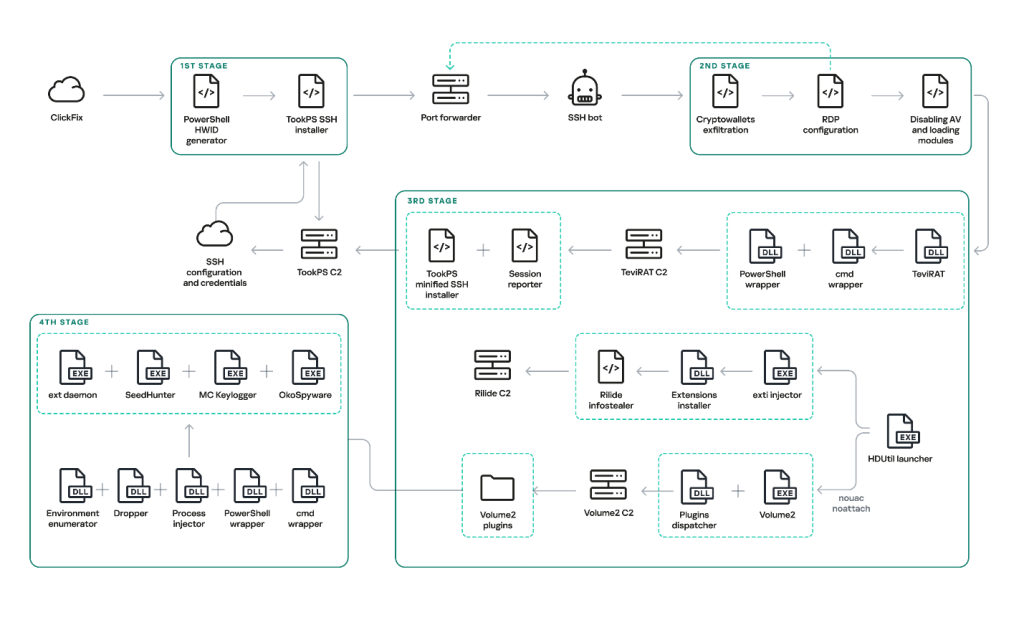
Dubbed “OkoBot,” the malware initiates an infection chain that starts with social engineering tactics such as ClickFix, which tricks users into running malicious commands, or trojanized GitHub apps that deliver a backdoor to infected devices, the cybersecurity company wrote in a Wednesday report.
The malware can harvest crypto wallet files, browser data and user credentials, inject malicious extensions and capture wallet application windows to steal assets. Kaspersky said it identified multiple attacks involving this malware family since January 2026.
Kaspersky added that the malware framework evolved from “TookPS,” a malware campaign first identified in 2025 that distributed a Trojan downloader through fake software websites, and that it opens the door to copycat attacks.
It differs from prior campaigns by orchestrating all 20 malicious payloads via an SSH tunnel, which enables the remote transport of data from infected computers to remote machines controlled by attackers.
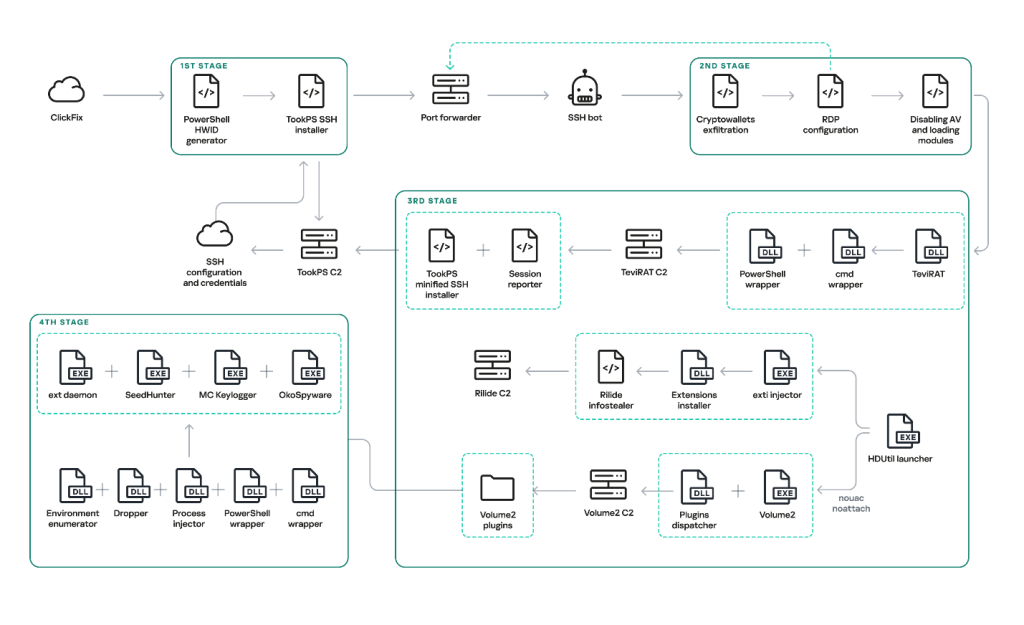
Original OkoBot infection chain. Source: Kaspersky
Fake LinkedIn recruitment campaigns target Web3 developers with malware
Separately, a new malware campaign is seeking to infiltrate the devices of Web3 developers via fake LinkedIn recruitment opportunities, according to SlowMist.
Attackers contact blockchain developers via LinkedIn, posing as Web3 recruiters. They then send fake GitHub repositories to victims, claiming they contained the minimum viable product that needed to be tried before the interview, the blockchain security company said in a Saturday report.
The workflow closely resembles a legitimate technical interview where developers pull code, install dependencies and launch a project, which makes it difficult to notice the attack, according to SlowMist.
Related: UK sentences 2 hackers tied to $115M crypto ransom scheme
The malware aims to deliver a complete “remote access trojan” that infects devices, enabling attackers to steal project keys, cloud credentials, or wallet extension data from these developers.
“This attack is not an isolated case,” wrote SlowMist, adding that recent incidents illustrate that “attackers are increasingly leveraging scenarios such as recruitment, code reviews and project collaborations to trick developers into actively running malicious repositories.”
The report came a day after SlowMist warned of a separate malware campaign targeting macOS users, aiming to steal their credentials and hijack their Telegram sessions to ultimately trick investors into entering their wallet recovery phrases through fake websites.
Magazine: Does Botanix’s failure prove Bitcoiners don’t care about DeFi?
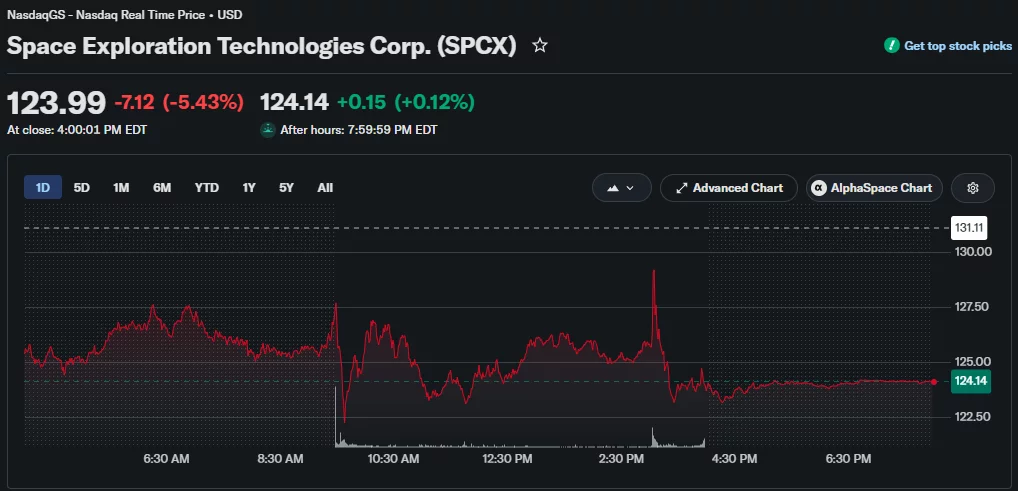
Cathie Wood’s ARK Invest has bought $18.3 million of SpaceX shares after the stock fell 5.43% to a new post-IPO low, according to the firm’s July 17 trading report.
Summary
- ARK Invest bought $18.3 million of SpaceX shares after the stock hit a post-IPO low.
- Four ARK ETFs acquired 147,623 shares as SpaceX closed 8.2% below its IPO price.
- SpaceX delayed Starship Flight 13 after two Raptor engines failed during pre-flight testing.
According to ARK’s daily disclosure, four of its actively managed exchange-traded funds purchased a combined 147,623 SpaceX shares as the stock closed Friday at $123.99. During the session, shares dropped as low as $122.12.
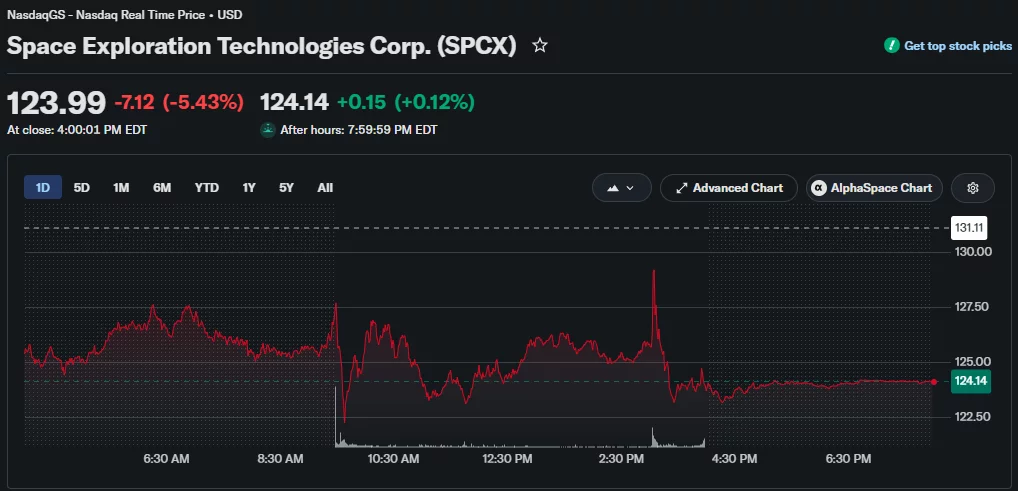
The ARK Innovation ETF made the largest purchase, adding 95,129 shares worth about $11.8 million based on Friday’s closing price. ARK’s Autonomous Technology & Robotics ETF bought 30,464 shares valued at $3.78 million, while its Space Exploration & Innovation ETF added 12,611 shares worth around $1.56 million.
Completing the purchase, the ARK Next Generation Internet ETF acquired another 9,419 SpaceX shares valued at approximately $1.17 million, according to the same disclosure.
ARK adds to its SpaceX position below the IPO price
Friday’s purchase has extended a series of SpaceX investments made by Wood’s firm since the company entered the public market in June.
As crypto.news previously reported, ARK bought roughly $52.1 million of SpaceX shares during the week ending July 10 through the ARKK, ARKQ, ARKW and ARKX funds. Data from Ark Invest Tracker showed that those purchases lifted the firm’s investment since the June IPO above $475 million.
Ark Invest Tracker also reported that ARK acquired about $444 million of SpaceX stock around the company’s June 12 market debut. Its latest purchase came with the shares trading 8.2% below their $135 offer price, based on Friday’s closing value.
While adding to SpaceX, ARK reduced its exposure to Robinhood Markets during the same trading session. The firm’s report showed that ARKW sold 20,089 Robinhood shares and ARKK disposed of another 5,913 shares.
Robinhood ended Friday at $99.96 after losing 5.72% during the session. ARK’s disclosure did not provide a reason for selling the 26,002 shares.
Starship delay adds pressure to SpaceX shares
As crypto.news reported, SpaceX’s latest decline followed the cancellation of Starship Flight 13 shortly before its scheduled launch. According to the report, at least two Raptor engines on the Super Heavy booster failed to ignite during pre-flight testing, prompting the company to stop the mission minutes before liftoff.
Elon Musk later stated that SpaceX would replace the affected engines. The company subsequently rescheduled Flight 13 for July 20 at 6:45 p.m. ET.
Commenting on the stock’s decline, cognitive scientist Gary Marcus linked the latest weakness to rising doubts about Musk’s performance. Marcus expected another record low to be more likely than a sudden and much larger collapse, according to his assessment cited in the report.
Tesla investor Sawyer Merritt offered a different view, arguing that traders had overreacted to a short operational delay. Merritt maintained that postponing the launch by several days did not represent a serious setback for SpaceX.
2026 has been quite interesting and unexpected in terms of investments. Gold and silver started the year strong with massive gains and new all-time highs, while BTC has been mostly trading downward.
While bitcoin’s correction intensified after the January rejection at $95,000, the two largest precious metals tumbled as well. Perhaps a large portion of gold’s losses could be attributed to how investors turned on the largest ETF tracking its performance.
Will GLD Stage a Comeback?
Data provided by the analysts at the Kobeissi Letter indicated that the world’s largest gold-backed ETF, World Gold Council’s GLD, has seen a substantial investor exodus that began in March this year. In the span of just the third month of the year, the financial vehicle lost a whopping $8.5 billion. This became the largest monthly withdrawal in GLD’s 22-year history.
This worrying trend eased to an extent in the following months, but red continued to dominate. Investors pulled out $1.7 billion in April, a more modest $872 million in May, and $3.2 billion in June. The mid-month data for July shows that the withdrawals have dropped to under $50 million, prompting the analysts to speculate whether the gold market is “setting up for a comeback.”
BREAKING: The largest US gold-backed ETF, $GLD, has recorded -$14.4 billion in outflows since March 1st.
This is 50% more than the -$9.6 billion in outflows seen across all Bitcoin ETFs since the October peak.
In March alone, investors withdrew -$8.5 billion from $GLD, the… pic.twitter.com/0Wvwlqxpxi
— The Kobeissi Letter (@KobeissiLetter) July 16, 2026
These net outflows coincided with gold’s price collapse. The bullion peaked at $5,600/oz in late January, but it has lost nearly 30% of its value since then, declining to $4,000/oz as of Friday’s close.
BTC ETFs Bleed Too
With roughly $130 billion in AuM, GLD is more than twice as big as all spot Bitcoin ETFs combined. As such, it’s rather difficult to compare the respective net outflows. Nevertheless, the ongoing narrative is that investors have turned on BTC, which is supported by the recent negative streak that began in May.
In the span of approximately two months, investors pulled out just over $8 billion from all BTC ETFs, pushing the cumulative total net inflows down to $51.22 billion from $59.34 billion. June was the worst month, with over $4.5 billion leaving the funds, which was more than GLD’s exodus.
Perhaps it’s no surprise that the underlying asset’s price performance has been quite painful within this timeframe. BTC was rejected at $83,000 when the withdrawal wave began in mid-May, and plunged to a multi-year low of $57,700 on July 1. Although it has recovered some ground since then, the ETFs’ behavior remains highly uncertain to support a more profound rally.

The post The ETF Battle Between Gold and Bitcoin: Is BTC Really Losing? appeared first on CryptoPotato.

France’s national gambling regulator has ordered internet service providers to block access to Polymarket, arguing that the platform operates like illegal gambling in the country. The Autorité nationale des jeux (ANJ) said Polymarket’s services are not authorized in France and warned that promoting unapproved gambling sites can trigger criminal penalties.
The move underscores how prediction and “event contract” platforms continue to run into regulatory friction across Europe and beyond—particularly over whether these products should be treated as gambling, unlicensed financial instruments, or something else entirely.
Key takeaways
- The ANJ directed French ISPs to block Polymarket, saying its prediction contracts amount to illegal gambling under French law.
- The regulator cited “addictive” mechanics and the absence of protective safeguards common in regulated gambling markets.
- ANJ also pointed to concerns that certain outcomes could be manipulated, including references to hacked weather sensors.
- France joins a growing list of jurisdictions that have restricted Polymarket access.
France orders ISP-level blocks
In a Friday press release, France’s Autorité nationale des jeux (ANJ) said it considers online prediction platforms to be illegal gambling when they are not authorized through the regulated framework. Based on that determination, the regulator ordered internet service providers to block access to Polymarket.
The ANJ stated that Polymarket’s operations are not authorized in France. It also highlighted that advertising gambling services without authorization is a criminal offense, with fines that may reach 100,000 euros (about $114,000), according to the regulator.
For investors, traders, and users, the practical impact is straightforward: even if markets can still be accessed through other means, ISP-level blocking raises friction, reduces discoverability, and increases the likelihood that marketing and distribution channels are disrupted inside the country.
Regulatory concerns: missing safeguards and possible manipulation
Beyond the authorization question, ANJ argued that Polymarket’s user experience resembles regulated gambling offerings, but without the protective mechanisms found in the legal market. The regulator described the platform as having features that can be “addictive,” while emphasizing that France’s authorized gambling environment includes safeguards that are not present on Polymarket.
ANJ further said some event contracts raised manipulation risks. In particular, the regulator referenced cases suggesting bets may have been “rigged,” including weather-related markets where weather sensors allegedly could have been hacked.
“Some of the bets offered on this platform appeared to be rigged: for example, bets on the weather revealed that weather sensors may have been hacked.”
The regulator linked the concerns to findings tied to an investigation by the cybercrime unit of the Paris Public Prosecutor’s Office, which reportedly began in May 2026. ANJ also said investigators identified a lack of identity verification measures, such as Know Your Customer (KYC) checks.
That combination—gamification-style incentives plus weak identity controls plus questions about how external data is validated—has become a recurring theme in regulators’ critique of online prediction products. If identity and data integrity remain unresolved, platforms face higher odds of being treated as gambling rather than as a form of regulated markets activity.
France follows a broader crackdown pattern
France is not alone. According to the article being rewritten, multiple countries have already moved to block or restrict access to Polymarket, including Singapore, Poland, Portugal, Hungary, Ukraine, Brazil, and Indonesia.
At the time of writing, Polymarket indicated it had implemented geoblocking in 36 regions, pointing to the reality that regulatory compliance often arrives as region-by-region access controls. Still, an ISP block order like the one announced by France changes the enforcement posture: instead of relying only on platform-side geofencing, the regulator targets the local internet access layer.
France’s action also fits with its earlier warning signals. The ANJ previously shared plans to block Polymarket in November 2024, citing failures to comply with French gambling rules. The new ISP order therefore represents a formal escalation from planning to execution.
Global pressure from US regulators
Regulatory scrutiny around prediction market platforms is not limited to Europe. In the United States, multiple legal challenges have centered on whether these platforms operate as unlicensed sports betting, and whether states can regulate them without conflicting with federal authority over certain event contracts.
According to earlier coverage referenced in the source material, on June 17 Kentucky sued five prediction market platforms—including Kalshi and Polymarket—arguing they were operating unlicensed sports betting. The same reporting states that at least 17 other states joined similar actions.
The source also notes that the Commodity Futures Trading Commission (CFTC) sued eight states, arguing they interfered with the agency’s exclusive authority over federally regulated event contracts. Taken together, these US developments show a fragmented regulatory landscape where platforms can face lawsuits on both sides of the jurisdiction question: whether they should be classified as gambling/sports betting under state frameworks, or as instruments governed by federal commodities and derivatives rules.
For readers trying to gauge what comes next, the key variable is classification—how regulators decide whether prediction contracts are gambling products requiring licensing, or market instruments subject to a different compliance regime. France’s ANJ decision makes one side of that argument explicit.
As France moves to block Polymarket at the ISP level, market participants should watch for how Polymarket responds in practice—whether it can modify compliance to address authorization, identity verification, and data integrity concerns—and whether other European regulators follow France’s lead with similar enforcement steps.

Ripple Payments Europe joined 14 firms added to the European MiCA register, lifting the total of authorized crypto providers across the bloc to 294.
The update confirms Ripple’s regulated foothold in Europe, though licensing momentum is clearly cooling.
Ripple Payments Secures Its Regulated Foothold in Europe
MiCA is the European Union framework that requires crypto companies to hold a Crypto Asset Service Provider license before offering regulated services. The European Securities and Markets Authority maintains the central register listing every approved firm.
Ripple Payments Europe was added to the list after receiving full authorization from Luxembourg’s financial regulator, the CSSF. The entity now operates as the company’s regulated payments arm across the European Economic Area.

The license unlocks passporting rights covering 30 countries. That mechanism allows a single national approval to cover the entire bloc, replacing the previous patchwork of separate national permissions.
The CASP authorization pairs with Ripple’s existing electronic money institution license in Luxembourg. Together, both permissions allow European banks, fintechs, and corporates to collect, exchange, and pay out through a single integration.
The company holds more than 75 regulatory licenses worldwide, including approval from the UK Financial Conduct Authority secured in January.
What Does the Latest MiCA Update Reveal
The composition of the update tells its own story. The 14 new entries span 10 European countries and include banks, exchanges, payment providers, and Bitcoin-focused platforms.
Portugal’s Bison Bank, Croatia’s state-owned Hrvatska poštanska banka, and Liechtenstein’s Kaiser Partner Privatbank all appeared alongside two German cooperative banks. MiCA authorization clearly extends well beyond crypto-native firms.
The register already includes heavyweight institutions such as BBVA, CaixaBank, Commerzbank, and Standard Chartered Luxembourg. Traditional finance is quietly building regulated crypto capacity across Europe.
The overall pace, however, has slowed noticeably. ESMA added 37 providers on July 3, right after the transitional period closed, compared with just 14 this week.
Markets stayed largely unmoved by the news. XRP trades near $1.07, with a market capitalization above $67 billion, down roughly 3.46% over the past 24 hours, according to BeInCrypto data.

The token sits about 70% below its record high of $3.65. Regulatory progress, once again, has failed to translate into price momentum.
What the License Means for XRP and RLUSD
The authorization matters more than the price for infrastructure. The CASP license allows Ripple to move crypto assets legally within the bloc, while the electronic money institution permission covers the fiat side of each transaction.
That combination is the relevant part for RLUSD, Ripple’s dollar-pegged stablecoin. Under MiCA, stablecoins fall into a separate category, and only credit institutions or electronic money institutions can issue them within Europe.
Holding both permissions in Luxembourg places Ripple in that narrow group. Whether RLUSD eventually launches as a fully regulated European product remains a separate decision, still unannounced.
For XRP, the impact stays largely indirect. The token settles transfers on the XRP Ledger, so wider institutional use of Ripple’s payment rails could increase transactional demand over time.
Subscribe to our YouTube channel to watch leaders and journalists provide expert insights.
The post Ripple Payments Joins MiCA With 14 Firms, Does It Mean Anything For XRP? appeared first on BeInCrypto.


Noxa has halted token launches after generating more than $12 million in fees and helping Robinhood Chain reach $4 billion in cumulative decentralized exchange volume within two weeks.
Summary
- Noxa halted launches after earning $12 million in fees within two weeks.
- CASHCAT plunged over 33% as Robinhood Chain trading volume declined.
- Rival launchpads are competing to capture activity previously controlled by Noxa.
crypto.news reported that the launchpad stopped operating on July 11 after becoming the main platform behind Robinhood Chain’s early memecoin activity. Noxa had supported more than 60,000 token launches and accounted for about 75% of all deployments on the network.
During its peak, Noxa’s daily protocol fees exceeded those of Solana-based Pump.fun for five straight days, according to crypto.news. The rapid activity helped push Robinhood Chain, which launched on July 1, into one of the busiest new venues for speculative tokens.
CASHCAT became Noxa’s most successful launch, reaching a peak market capitalization of $226 million. crypto.news reported that the token helped attract 267,642 unique wallets to Robinhood Chain during its opening weeks.
Noxa initially blamed bot spam and a flood of low-quality tokens when it suspended new launches on July 11. Two days later, its website became unavailable, with the team attributing the outage to a Cloudflare problem.
Rather than restoring its previous business model, Noxa later announced that all continuing trading fees would go to token creators. The decision removed the platform’s share of future revenue, although Noxa did not provide a detailed explanation of its long-term plans.
CASHCAT leads the post-Noxa selloff
CASHCAT fell more than 33% within 24 hours as traders reacted to Noxa’s exit, according to crypto.news. Other Robinhood Chain tokens, including FOX and HOODIE, also declined after previously recording strong weekly gains tied to activity on the launchpad.
Vlad.fun added to the uncertainty when the rival platform went offline several days later. According to its team, an internal integrity issue prompted the shutdown.
Reaction among crypto users remained divided. Some social media users treated Noxa’s decision as a rejection of bot-driven token speculation, while others described the departure as a soft rug.
Trader 0xAvast, who reportedly followed CASHCAT from a market value of around $10,000 to $230 million, dismissed concerns surrounding the collapse as “irrelevant FUD.” However, crypto.news’s data showed Robinhood Chain DEX volume falling after reaching a record $878 million on July 12.
Before Noxa disappeared, crypto.news reported that Robinhood Chain had overtaken Base to rank second by Uniswap deployment volume. The report linked part of that expansion to memecoin launches and Pump.fun integration.
Rival launchpads compete for displaced activity
Despite the drop in trading volume, crypto.news reported that Robinhood Chain’s total value locked has remained close to $200 million. Platforms including flap.sh, trensh.today and bankr have since sought to capture activity previously handled by Noxa, while Pons has also entered the market.
None of those platforms has yet matched Noxa’s token-launch record or produced a memecoin with CASHCAT’s reach.
The memecoin boom has also dwarfed Robinhood Chain’s tokenized real-world asset sector. crypto.news placed the market capitalization of those assets at $12.66 million, while CASHCAT alone had been worth about 12 times that amount at its peak.
Robinhood CEO Vlad Tenev declared that “Robinhood Summer is here” on July 8. Within a week of that post, the chain’s largest launchpad had stopped accepting new token launches, leaving competing platforms to test whether Robinhood Chain can maintain activity without Noxa.

The value of global semiconductor stocks plummeted after the release of the Kimi K3 AI model by Moonshot AI, driving the Philadelphia Semiconductor Index into bear territory. As per Coin Bureau on X, the index slumped by over 20% compared to the high in June, while the benchmark index of Taiwan fell by 6% and the Japanese market was down by 4%. The post also said chip stocks had wiped out around $3.3 trillion from their market value since June 22. Meanwhile, the graph posted alongside the article highlighted a sudden surge in the asset linked to the Kimi K3 release.
Coin Bureau Reports Broad Semiconductor Selloff
Market update for X was given by Coin Bureau after Moonshot AI announced the Kimi K3. In the update, the Philadelphia Semiconductor Index is said to be more than 20% lower than its record level in June, thus qualifying as a bear market.
It was also reported that Taiwan’s benchmark share index fell by more than 6%, while Japanese stocks declined by 4%. Coin Bureau went on to report that the total drop has resulted in a loss of $3.3 trillion worth of market capitalization for global semiconductor shares since June 22. The drop is attributed to the release of the Kimi K3, as per Moonshot AI.
Kimi K3 Launch Draws Attention Across Ai Markets
Moonshot AI announced the launch of the next generation of its open-source artificial intelligence model by naming it Kimi K3. This launch is taking place amid intense competition within the AI development sector where developers keep enhancing their models.
The statement received an immediate reaction from the financial world. Traders kept track of the announcement as the stock prices of chip makers underwent severe selloff. The Coin Bureau article made the connection between the falling semiconductor stock prices and the Kimi K3 release, but other factors remain under consideration in the marketplace.
Chart Shows Rapid Rally Before Profit Taking Emerges
The chart attached to the post showed a continuous rising trend, followed by a breakout that pushed prices even higher to a new level. This happened after a series of highs and lows, reflecting buying pressure.
The candle with the biggest increase was the green candlestick, which took the price almost to the 14,000 level. The red candle that followed was the moment when traders decided to take profit from the big increase. Despite the fact that volatility increased, the price remained above the previous breakout levels.
Markets Watch Ai And Semiconductor Developments
However, semiconductor firms are still closely associated with the development of artificial intelligence infrastructure. The creation of AI models is always significant since it tends to affect market expectations.
Stock prices of semiconductors will keep being watched by investors along with any moves made by Moonshot AI and other companies in the realm of artificial intelligence. This might become clear once more trading sessions take place.

EXCLUSIVE: Man who wrote Sharon Graham’s first Unite manifesto now supports challenger

General Salute’s Winter Challenge bid aided by heavy track upgrade in 2026

Podcast: All-Analog Recording with Jacob Wendt and Kevin Gray


-
 NewsBeat2 days ago
London Mayor Sadiq Khan handed a peerage by Keir Starmer alongside 15 other Labour figures… just days before the PM leaves No10
-

 Fashion18 hours ago
Weekend Open Thread – Corporette.com
-

 Crypto World2 days ago
CFTC blocks Kalshi from unwinding Michigan trades after court order
-

 Politics3 days ago
Young campaigners urge incoming PM to act on outdoor junk food ads
-

 Business2 days ago
Nvidia Stock Slips After Big Tuesday Rally as Huang Confirms Vera Rubin Chip Is Now in Production Today
-

 Politics2 hours ago
The House | The City of London can help the new chancellor deliver growth in every postcode
-
 Entertainment3 days ago
Disney’s Most Ambitious Failed Star Wars Attraction Is Coming to SDCC
-

 Crypto World14 hours ago
Ripple wins EU-wide access as ESMA adds it to MiCA register
-

 Tech4 days ago
Get Your ESP32 Sunny Side Up With This Solar Dev Board
-

 Crypto World2 days ago
Injective Submits SEC Transfer-Agent Registration to Onchain Ownership Records
-

 News Videos4 days ago
XRP BOMBSHELL… XRP OMBOARDED FOR TRANSACTIONS!!!
-

 Business2 days ago
Palantir Shares Rise After Expanded Nvidia Partnership and Fresh Analyst Upgrades Ahead of Earnings Day
-

 NewsBeat24 hours ago
Registration is now open for March for Men with Kev 2026
-

 Tech4 days ago
Dark Secrets Emerge When Jailbreaking LLMs
-
 Sports3 days ago
New Cornerback Enters Vikings Trade Rumor Mill
-

 News Videos1 day ago
Money | Class 12 Economics | CBSE Board Exam 2026-27
-

 Business1 day ago
Banco Bilbao Vizcaya Argentaria, S.A. (BBVA) Discusses Global Macro Environment and Economic Outlook for Core Markets Transcript
-

 NewsBeat7 hours ago
Durham County Council to send out electoral registration emails
-
 Tech5 days ago
Cloudflare Precursor Watches Your Mouse and Keyboard To Decide If You Are Human
-
 Crypto World2 days ago
Claude Fable 5 Slips to Second in AI Coding Leaderboard
You must be logged in to post a comment Login