
Crypto World
3 Cryptocurrencies to Watch Amid the Ongoing Geopolitical Storm

The global geopolitical tension is palpable. Here are a few cryptocurrencies worth watching in this context going in 2026.
There’s no two ways around it – the world in 2026 is one where war is clearly on the table. From the Middle East to Ukraine, geopolitical tensions are escalating globally.
As CryptoPotato reported yesterday, the US, together with Israel, struck against Iran. Retaliation followed, and now each side urges the other to reconsider before responding with even fiercer force.
In the context of significant geopolitical tension, we decided to do a little speculation and see which three cryptocurrencies are worth watching in such a scenario.
Bitcoin
As much as the industry would like to paint Bitcoin as a safe-haven asset, detached from risk-on markets, it has behaved as anything but over the past year.
Still, BTC remains the crypto king – it’s the largest one by means of market capitalization, accounting for 56% of the entire industry. That’s worth watching. Performance-wise, though, the primary cryptocurrency tends to plummet when conflicts arise and recover as tensions ease. That’s what happened last year when the US struck Iran and later claimed that it destroyed their nuclear program; that’s what seems to be happening now as well.
But it’s also worth noting that Bitcoin has been much more volatile than legacy markets, and experts seem to believe the current price action is indicative of a deep crypto winter.
If that’s the case and the conflict in the Middle East is put to bed (one way or another), this could also ease the markets’ evident uncertainty and eventually push the price higher. On the other hand, a prolonged conflict with escalating tensions and the involvement of additional countries such as Russia, China, and the entirety of the Middle East, could spell more uncertainty – something that the US has vowed to avoid by not getting involved in a dragged-out war in the region. Time will tell.
You may also like:
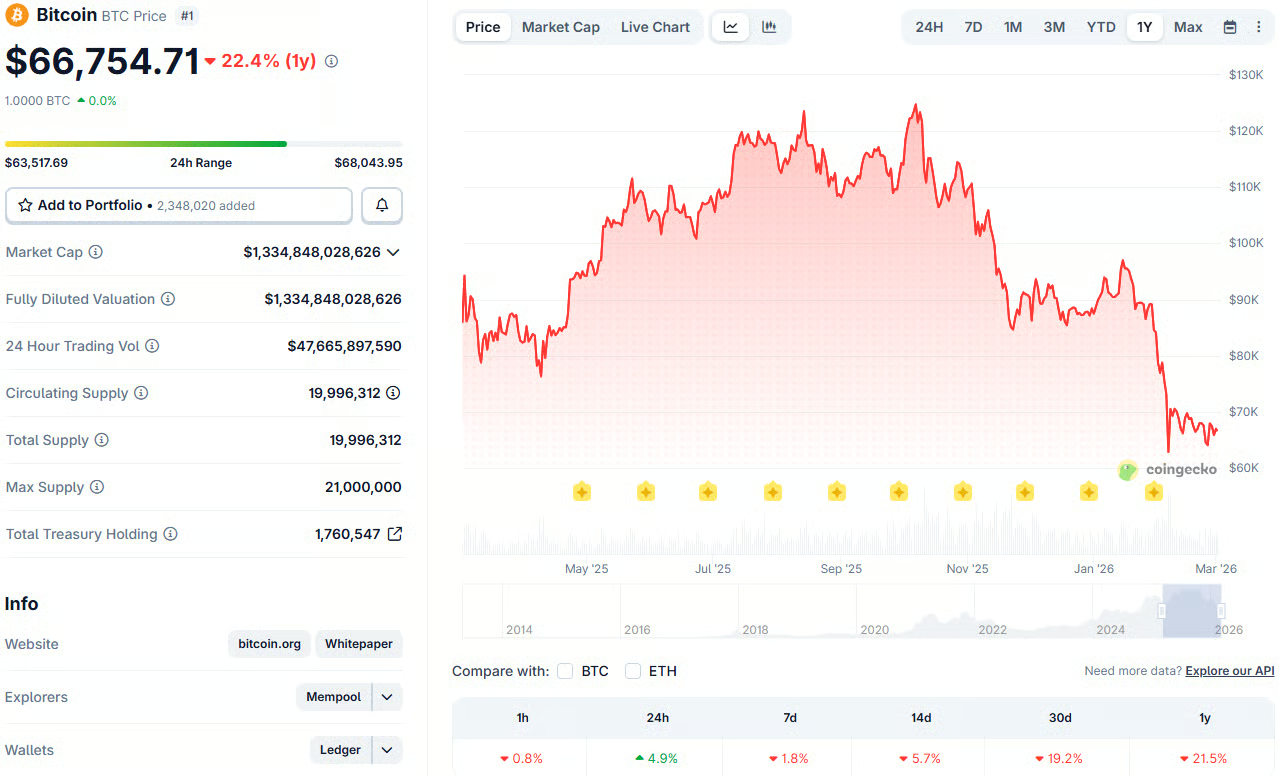
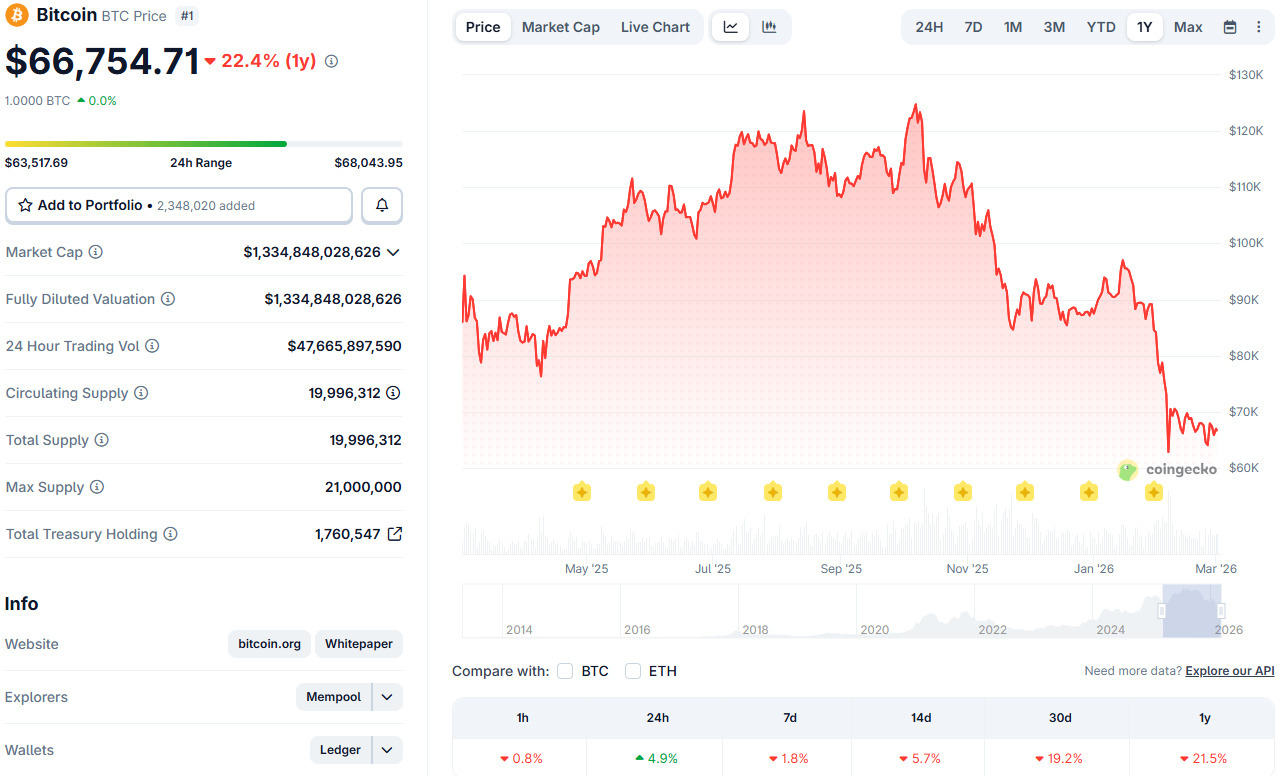
At the time of this writing, BTC trades at around $67,000 – down 2% on the week, up 5% in the past 24 hours, but more importantly, down 47% from its all-time high achieved just five months ago. While clearly in a downtrend, a resolution of ongoing conflicts could serve as a catalyst for recovery.
Tokenized Gold Tokens
Gold has taken center stage in 2025 and, barring one unprecedented drop at the beginning of February 2026, it’s been mostly up for the asset. It’s safe to say it’s living up to its name as a true safe-haven, as investors flock to it during times of geopolitical tensions and economic uncertainty.
Trading above $5,200 per ounce, at the time of this writing, gold prices are up by more than 100% in the last year.
But physical gold isn’t that easy to get, spreads can get significant, and logistics are challenging. That’s where investors might turn to its digital representative, tokens that are fully backed by it.
The two most popular ones, accounting for the bulk of the tokenized gold market, are Paxos’ PAX Gold (PAXG) and Tether’s Tether Gold (XAUT), which carry similar capitalizations.
Both are traded on most popular centralized exchanges with considerable market depth, making them particularly easy to trade with minimal slippage. Of course, you are pretty much trading convenience for security, because you would have to trust that the issuers do, indeed, have enough gold to back them up in case of physical redemption.
But on the other hand, if you are one to speculate, as seems to be a lot of the market nowadays, then having access to a liquid, quick gold wrapper might be an option.
That said, interest in both is evident – their total market capitalizations have soared in the past year.

Privacy-Focused Coins
In 2025, we saw a buying frenzy oriented at privacy coins like Zcash (ZEC) and Monero (XMR). In the context of a high-intensity conflict, which will likely involve heavy sanctions (such as those against Russia, Iran, etc) or increased government surveillance of financial flows, privacy-oriented assets often see a spike in their utility.
Don’t take my word for it.
Despite a crash that took about 55% off its total market capitalization in January, XMR remains up by more than 56% in the past year. ZEC’s case is even more impressive, as it’s up by more than 500% over the same period.
Binance Free $600 (CryptoPotato Exclusive): Use this link to register a new account and receive $600 exclusive welcome offer on Binance (full details).
LIMITED OFFER for CryptoPotato readers at Bybit: Use this link to register and open a $500 FREE position on any coin!

Crypto World
Trump token sees whale accumulation ahead of Mar-a-Lago gala; senators raise questions over event


Large investors are accumulating the TRUMP memecoin ahead of an upcoming gala hosted by President Donald Trump at Mar-a-Lago on April 28, even as the token trades near record lows and the impending event faces political scrutiny.
Data tracked by blockchain sleuth Lookonchain shows notable whale buying through centralized exchanges. One whale, “8DHkza,” withdrew 850,488 $TRUMP tokens (worth approximately $2.4 million) from Bybit over the past two days. Another address, “7EtuAt,” withdrew 105,754 tokens (around $298,000) from Binance 17 hours ago and currently holds 1.13 million tokens, valued at roughly $3.2 million.
Outflows from exchanges are said to represent investor intention to take direct custody of coins and hold the same for long-term. Hence, outflows are taken to indicate accumulation and potentially reduce immediate sell-side liquidity in the market.
The accumulation comes ahead of an invitation-only luncheon reportedly limited to the top 297 TRUMP token holders, with the top 29 receiving exclusive VIP access to Donald Trump.
However, TRUMP continues to trade at record lows near $2.80, down 0.2% on a 24-hour basis and over 1% in seven days. The token came under pressure this week after CoinDesk reported the Trump-linked crypto venture World Liberty Financial’s controversial lending strategy on the Dolomite DeFi platform.
Meanwhile, U.S. lawmakers have stepped up scrutiny of the Mar-a-Lago event. Senators Elizabeth Warren, Adam Schiff, and Richard Blumenthal have sent a letter to Fight Fight Fight LLC, a Delaware-based entity run by Trump associate Bill Zanker, requesting documents and information on whether Trump played a role in planning, promoting, or financially benefiting from the gathering. Fight Fight Fight LLC TRUMP memecoin in partnership with entities affiliated with Donald Trump.
“It is essential that Congress fully understand the extent to which President Trump and his family are profiting off of his cryptocurrency ventures,” the senators said, adding that “Congress must also take steps to prohibit and prevent these egregious conflicts of interest.”
The probe introduces an additional layer of uncertainty for the token, as regulatory and political risks intersect with already weak price action.
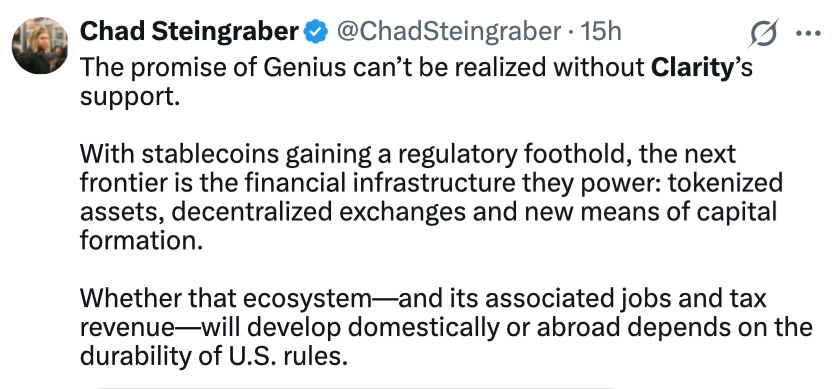
The United States government must pass the CLARITY Act, which aims to provide the crypto industry with clearer regulatory oversight, soon, or risk waiting almost another four years to move the industry forward, according to US Senator Cynthia Lummis.
“This is our last chance to pass the Clarity Act until at least 2030,” Lummis, a well-known crypto advocate, said in an X post on Friday.
“We can’t afford to surrender America’s financial future,” she added. The comments come as crypto industry participants begin to worry that the bill’s chances of passing this year are narrowing, with US midterm elections in November potentially changing congressional priorities and slowing momentum on the highly anticipated crypto legislation.
The former White House AI and crypto czar, David Sacks, also chimed in on Thursday with a similar view to Lummis.
“The time to act is now. Senate Banking, and then the full Senate, should pass market structure. I’m confident that they will. And then President Trump will sign this landmark bill into law,” Sacks said.
Consumers and entrepreneurs both “win” from the CLARITY Act
Many industry participants have argued that the passage of legislation aimed at clarifying which regulators oversee parts of the crypto industry could lead to greater innovation in the US and potentially increase demand for crypto assets among retail investors.

A16z Crypto managing partner Chris Dixon reiterated that view in a post, saying that “when rules are defined, both consumers and entrepreneurs win.”
A wide range of sectors in the crypto industry expect the move to be positive.
Web3 gaming giant Immutable founder Robbie Ferguson said just days before, on April 3, that “the CLARITY Act will make the last decade of growth in gaming look like a joke.”
On Friday, Coinbase CEO Brian Armstrong, who withdrew the crypto exchange’s support for the Digital Asset Market Clarity Act in January, said “it’s time” for the legislation to pass after months of delays.
Meanwhile, Coinbase chief legal officer Paul Grewal said on April 2 that the CLARITY Act could be nearing a markup hearing in the US Senate Banking Committee. However, he noted that progress hinges on resolving disagreements over stablecoin yield.
Related: CFTC unveils innovation task force members in crypto clarity push
Regulators are also voicing their support for the legislation.
US Securities and Exchange Commission (SEC) Chairman Paul Atkins said in a post on the same day that, “It’s time for Congress to future-proof against rogue regulators & advance comprehensive market structure legislation to President Trump’s desk.”
Magazine: Bitcoin quantum-safe without upgrade? CZ’s 2031 crypto vision: Hodler’s Digest, April 5 – 11
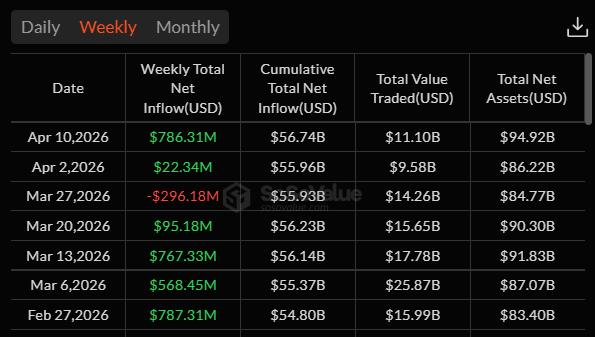
US spot Bitcoin exchange-traded funds (ETFs) posted their strongest weekly inflow since February last week, drawing more than $786 million.
Data from SoSoValue showed that the US-listed funds’ performance last week narrowly trailed the roughly $787.31 million recorded during the last week of February.
BlackRock and Morgan Stanley’s New MSBT Fund Drive Interest
The inflows followed a softer stretch for the products amid broader market volatility and geopolitical tension, which weighed on risk appetite.
SoSoValue data shows that the flow pattern was uneven through the week. The funds opened with a sharp $471.32 million intake on Monday, then slipped into outflows midweek before recovering on Thursday and Friday.
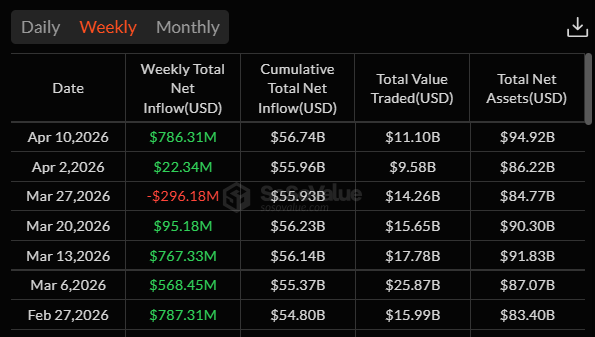
The turnaround left the group with its best weekly result in nearly two months and suggested buyers returned as Bitcoin regained momentum.
BlackRock’s iShares Bitcoin Trust remained the main driver of demand. The fund brought in about $612 million during the week, accounting for almost four-fifths of total net inflows across the category.
The concentration underscored how heavily new institutional allocations continue to favor the largest and most liquid product in the market.
Meanwhile, Morgan Stanley’s newly launched MSBT fund added another point of interest for the market. The fund raised roughly $46 million over its first three trading days, giving investors a fresh entry point as demand across the ETF group picked up again.
Its early flows were modest compared with BlackRock’s scale, but the launch carries broader significance because of Morgan Stanley’s distribution reach. The bank’s network of roughly 16,000 financial advisers oversees trillions of dollars in client assets, giving it access to a channel few Bitcoin ETF issuers can match.
The improvement in fund flows came alongside a strong week for the underlying asset. Bitcoin climbed from around $67,000 to above $70,000 during the period and was trading near $73,411 by the end of the week, a gain of about 9%.
The move marked one of the token’s strongest weekly advances in recent months and helped restore momentum after a period of weaker price action.
The post US Bitcoin ETFs Log Biggest Weekly Inflow Since February appeared first on BeInCrypto.
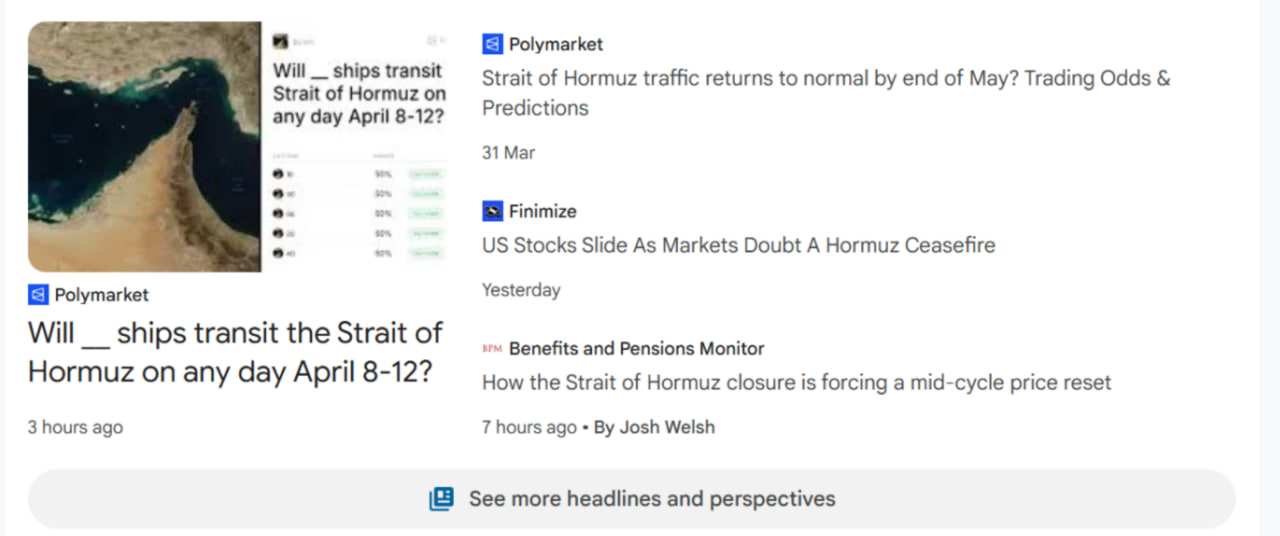
Polymarket betting markets reportedly appeared inside Google News results alongside established news publishers before disappearing.
A Google spokesperson told The Verge that the platform’s appearance in News was an error. “This site briefly appeared in Google News in error, and it is no longer surfacing in News,” spokesperson Ned Adriance reportedly said.
Before removal, Polymarket links were shown directly beneath mainstream outlets when users searched event-driven queries. In one example cited by Futurism, a search for “will ships transit the strait” related to the Strait of Hormuz returned a Polymarket market predicting outcomes on vessel passage alongside reporting from Reuters and The Guardian.

In a Sunday search conducted by Cointelegraph, the same query did not surface any Polymarket results.
Related: Three Polymarket traders made timely bets on US-Iran ceasefire
Polymarket and Kalshi pursue media partnerships
Last year, Google partnered with both Polymarket and rival Kalshi to integrate their data into Google Finance.
In June, Elon Musk’s X also announced a partnership with Polymarket, naming it as its official prediction market partner. The deal aimed to integrate the betting-based forecasting service into the social media platform.
Furthermore, in October, MetaMask said it would integrate Polymarket as part of its push to expand beyond a crypto wallet into a broader “democratized finance” gateway. The same month, World App, the digital wallet and identity platform from Sam Altman’s World project, also added the Polymarket app.
Related: Prediction market users await Artemis II mission splashdown
Small portion of Polymarket traders make a profit
As Cointelegraph reported, only a tiny fraction of Polymarket traders manage to generate consistent high monthly income, according to new data shared by crypto analyst Andrey Sergeenkov. While around 1% of traders have crossed $5,000 in profits in a single month, only 0.015% were able to sustain that level for four consecutive months.
The findings also show that just 0.033% of wallets have exceeded $100,000 in total profits, with some of these likely belonging to professional traders rather than retail users. Despite growing hype around prediction markets as a fast-rising crypto use case, the data suggests most participants struggle to maintain consistent profitability over time.
Magazine: Bitcoin’s ‘biggest bull catalyst’ would be Saylor’s liquidation — Santiment founder


Crypto exchange activity slowed in the first quarter of 2026 after the market cooled from its earlier peak.
Summary
- Crypto exchange trading volume fell sharply in Q1 2026 as market participation weakened after the cycle peak.
- Perpetual futures dominated March activity, with volume reaching four times the level of spot trading.
- Binance held the top position in spot and derivatives despite rising competition from secondary exchanges.
CryptoQuant data showed lower participation across centralized venues, while Binance kept the lead in both spot and derivatives trading.
Centralized exchange trading volume dropped about 48% from the October 2025 peak. The figure fell to $4.3 trillion in March 2026, its lowest level since October 2024.
The pullback showed lower participation from traders and investors after the earlier market run. Activity narrowed toward the biggest exchanges, as users favored liquid venues during periods of price movement.
Perpetual futures remained the main source of trading activity during the quarter. Perpetual volume rose to $3.5 trillion in March, while spot volume stood at $0.8 trillion.
That gap showed how strongly derivatives shaped market structure in Q1. Perpetual volume reached four times spot volume in March, and cumulative perpetual trading hit $4.5 trillion this year.
The rise in derivatives activity also picked up during the relief rally in the third week of March. Binance recorded the largest 24-hour open interest increase for both Bitcoin and Ethereum by mid-March.
Bitcoin open interest on Binance rose by $829 million in 24 hours, while Ethereum open interest increased by $1.6 billion. Across exchanges, Bitcoin and Ethereum perpetual futures open interest climbed to $23 billion and $16 billion.
Binance keeps lead in derivatives trading
Binance led the perpetual futures market with a 40% share and $1.4 trillion in monthly volume. OKX followed with 19%, while Bybit held 13%.
The data showed that most open interest growth flowed to Binance during the March rebound. Other exchanges, including Gate and Bybit, also posted gains, but none matched Binance’s scale.
Binance remained the largest spot trading venue in March. The exchange recorded $248 billion in spot volume and controlled 32% of the market.
That share was down from 37% in October 2025, but Binance still held a lead well ahead of rivals. MEXC and Bybit followed with 9% and 7%, while Gate and Crypto.com posted growth without changing the broader market order.


North Korea’s six-month infiltration campaign at Drift rattled a crypto industry already reeling from billion-dollar exploits.
But as the news settled, a bigger question came into focus: why does North Korea keep coming back to crypto in the first place, and why does its approach look so different from every other state-backed hacking operation on the planet?
The short answer, according to security experts, is that crypto helps give the regime a revenue stream and keep them afloat.
“North Korea doesn’t have the luxury of patience,” said Dave Schwed, chief operating officer at SVRN and the founder of the cybersecurity masters program at Yeshiva University. “They’re under comprehensive international sanctions and they need hard currency to fund weapons programs. The UN and multiple intelligence agencies have confirmed that crypto theft is a primary funding mechanism for their nuclear and ballistic missile development.”
That urgency explains a dynamic that has long puzzled investigators: why North Korean hackers carry out large-scale, traceable heists on public blockchains instead of quietly using crypto to evade sanctions the way other state actors do.
The answer, Schwed argues, is structural. Russia still has an economy: oil, gas, commodity exports, and trading partners willing to use workarounds. It needs crypto as a payment rail, but not for much else. Iran, too, has goods to move — sanctioned oil, proxy financing networks, willing intermediaries across the Middle East. North Korea has almost nothing left to sell.
“Their exports are almost entirely sanctioned. They don’t have a functioning economy that needs a payment rail. They need direct revenue,” Schwed said. “Crypto theft gives them immediate access to liquid value, globally, without needing a counterparty willing to do business with them.”
That distinction — crypto as infrastructure versus crypto as a target — is what separates North Korea not just from Russia, but from Iran as well. While Russia routes money through crypto to work around sanctions, and Iran uses it to fund proxy networks across the Middle East, North Korea is running something closer to a state-sponsored heist operation.
“Their targets are exchanges, wallet providers, DeFi protocols and the individual engineers and founders who have signing authority or infrastructure access,” said Alexander Urbelis, chief information security officer at ENS Labs and a professor of cybersecurity at King’s College London. “The victim is whoever holds the keys or access to the infrastructure that holds the keys.”
Russia and Iran, by comparison, treat crypto as incidental, a means to broader geopolitical ends.
“Russia targets elections, energy infrastructure and government systems. Iran goes after dissidents and regional adversaries,” Urbelis said. “When either of them touches crypto, it’s to move money, not to steal it from the ecosystem.”
That singular focus has pushed North Korean operatives to adopt tactics more commonly associated with intelligence agencies than criminal hackers: months-long relationship building, fabricated identities and supply chain infiltration.
The Drift campaign is only the most recent example.
“You’re not defending against a phishing email from a random scammer,” Urbelis said. “You’re defending against someone who spent six months building a relationship specifically to compromise one person who has the access you need to protect.”
Crypto’s own architecture makes it a uniquely attractive hunting ground. In traditional finance, even successful hacks run into friction in the form of compliance checks, correspondent bank checks, settlement delays and the possibility of reversing fraudulent transfers. When North Korea’s hackers pulled off the Bangladesh Bank robbery in 2016, the heist took days to process and most of the funds were eventually recovered or blocked. In crypto, none of those safeguards exist at the protocol level.
“Once a transaction is signed and confirmed, it’s final,” Urbelis said. The Bybit exploit earlier last year moved $1.5 billion in roughly 30 minutes, a pace and scale that would be nearly impossible in the traditional banking system.
That finality fundamentally changes the security calculus. In banking, a reasonable defense can be built across prevention, detection and response, because there’s always a window to freeze funds or reverse a wire. In crypto, that window barely exists, which means stopping an attack before it happens isn’t just preferable — it’s essentially the only option.
And while banks operate under decades of regulatory guidance and audit requirements, many crypto projects are still improvising — often prioritizing speed and innovation over governance and controls.
That gap creates an environment where even sophisticated teams can be vulnerable, particularly to the kind of long-term infiltration tactics North Korea has been refining.
“This is the hardest operational security problem in crypto right now,” Urbelis said of the challenge of vetting against sophisticated fake identities and third-party intermediaries. “I don’t think the industry has solved it.”
Read more: How North Korea’s 6-month long secret espionage program has crypto community rethinking security
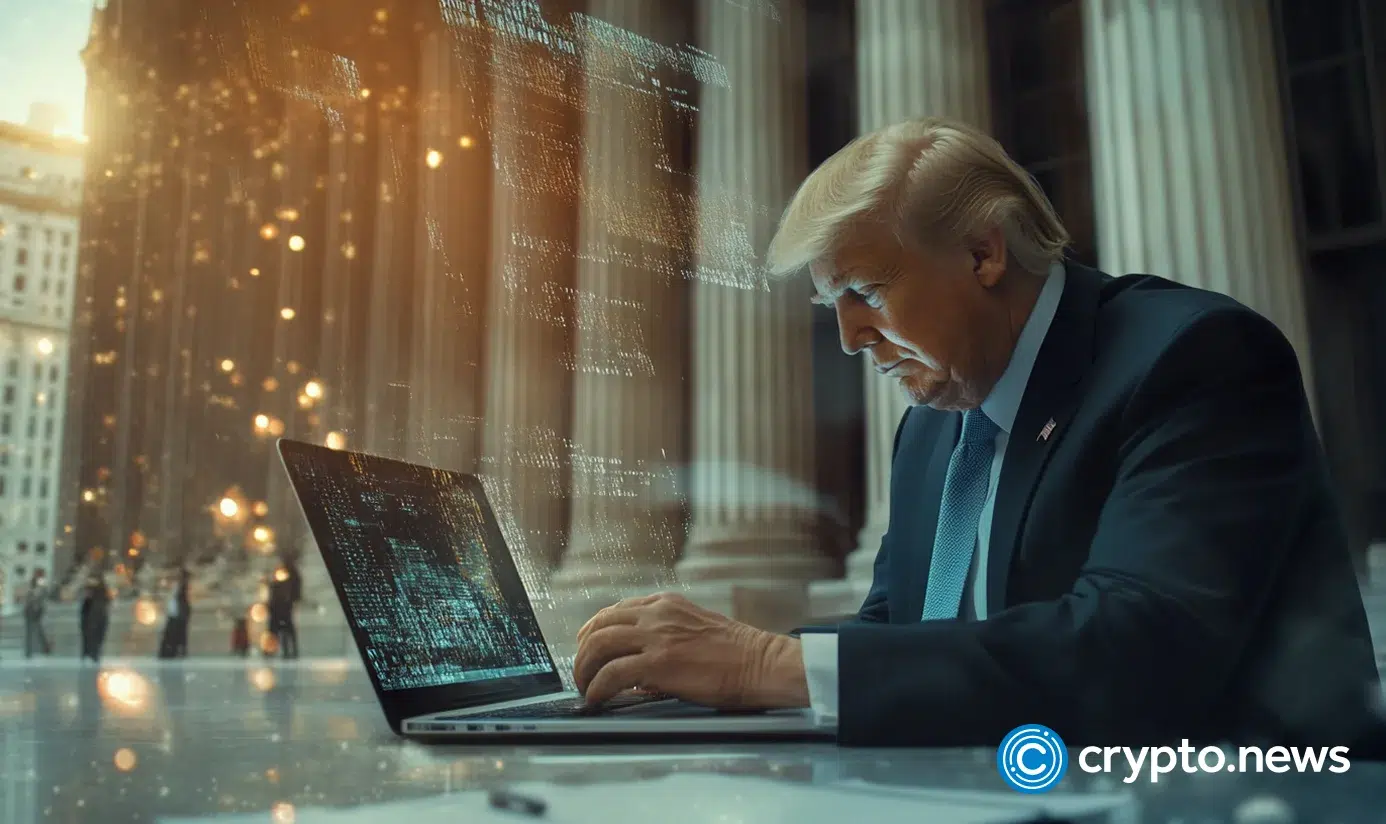
Donald Trump is facing fresh scrutiny as crypto tokens tied to his name and family trade near record lows.
Summary
- TRUMP fell about 90% from its peak as renewed scrutiny hit Trump-linked crypto projects again this week.
- WLFI dropped to a fresh all-time low as criticism of Trump family crypto ties intensified.
- Senators pressed Bill Zanker for details after Trump announced an April 25 gala for token holders.
The pressure has grown after a new gala for token holders raised new questions from Democratic lawmakers.
The Official Trump token, known as TRUMP, fell to an all-time low of about $2.73 in March 2026. It later traded near $2.86, according to CoinGecko data.
The token has dropped about 90% from its January 2025 peak above $73. The decline has kept attention on Trump-backed crypto ventures as traders track whether the project can regain momentum.
World Liberty Financial’s governance token, WLFI, also fell sharply. The token dropped to about $0.07 on Saturday, marking a new all-time low.
WLFI is down nearly 75% from its September 2025 high of about $0.31. The slide has added to pressure on projects linked to Trump and his family.
Criticism grows around Trump crypto ventures
The price declines drew criticism from market observers and legal scholars. Professor Tonya Evans responded to the sell-off with a sharp rebuke of Trump’s role in crypto.
“We thought Sam Bankman-Fried or Gary Gensler were the worst things to happen to the crypto industry, and they were horrible,” Evans said.
She added that “turns out, it was the guy who surrounds himself with sycophants, siphons every bit of value he can for himself, and then expeditiously bankrupts companies and casinos without consequence.”
Her comments came as debate over Trump’s crypto activity returned to the center of public discussion. Critics have focused on whether token-linked events create a financial path to political access.
April gala draws Senate attention
President Trump recently announced another gala for token holders, scheduled for April 25. The event has drawn criticism from Democratic senators who said the plan raises questions about access and fundraising.
Senators Elizabeth Warren, Richard Blumenthal and Adam Schiff sent a letter to Bill Zanker, the memecoin’s creator, seeking details about the event, according to Politico. They said organizers were “dangling access” to Trump while requiring attendees to hold TRUMP tokens, a structure they said could benefit Trump and his family through increased token demand.
Disclosure: This article does not represent investment advice. The content and materials featured on this page are for educational purposes only.
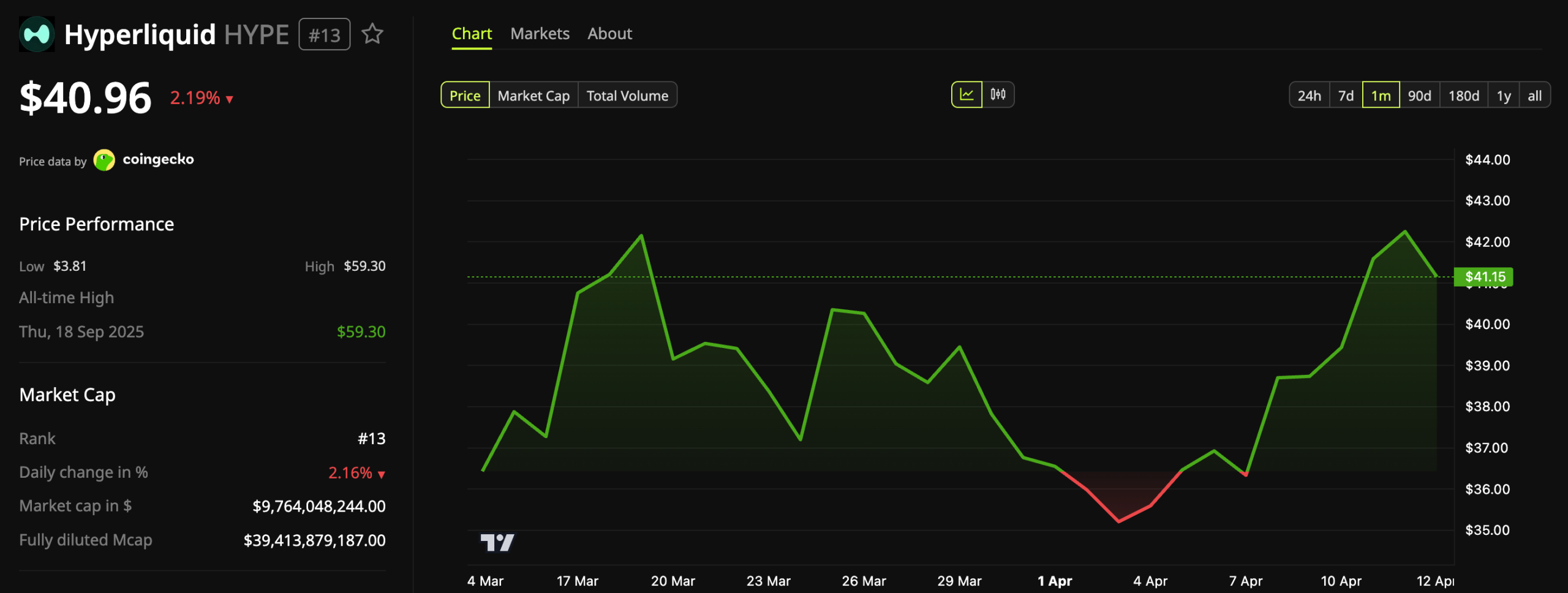
Arthur Hayes, co-founder of BitMEX, has added to his Hyperliquid (HYPE) position, purchasing 26,022 tokens worth approximately $1.1 million.
The buy, flagged by on-chain tracker Lookonchain, marks his first HYPE accumulation in roughly three months, signaling renewed confidence in the token.
Why Arthur Hayes Is Doubling Down on Hyperliquid
With this latest addition, his total holdings now stand at 247,334 HYPE, valued at approximately $10.44 million. The position is sitting on unrealized gains of 27.22%, equivalent to around $2.23 million in profit.
This reflects a strong return on his initial investment despite broader market volatility in the crypto space. The renewed accumulation follows Hayes’s public declaration on April 8.
Follow us on X to get the latest news as it happens
Hayes has maintained a $150 price target for the token by August 2026, roughly a 266% increase from current levels. The executive pointed to Hyperliquid’s revenue model as a key driver.
The platform returns 97% of its trading fees to buy back and burn HYPE from the open market, creating a deflationary loop that ties token value directly to platform usage.
Meanwhile, the acquisition comes as institutional interest in HYPE is also rising. Bitwise filed an amended registration statement with the SEC, adding the ticker BHYP and a 0.67% management fee.
Bloomberg analyst Eric Balchunas said such additions typically signal a fund may launch soon. Last month, Grayscale submitted its own S-1 application to list the Grayscale HYPE ETF on Nasdaq under the ticker GHYP.
A potential ETF approval could open the door to significant institutional capital inflows into HYPE, potentially driving broader adoption and renewed price momentum for the token.
HYPE has been one of the strongest large-cap performers over the past year, gaining roughly 176% according to CoinGecko data. However, it has not escaped broader market pressure.
The token slipped approximately 2% in the past 24 hours to around $40.91 as the US and Iran failed to reach an agreement.
Meanwhile, decentralized exchange activity is contracting across the board. Total DEX spot volume fell 23.9% to $212 billion in March, the lowest monthly figure since October 2024.
Monthly perpetual DEX volumes dropped to $699 billion in March, down from a peak of $1.369 trillion in October 2025, according to DefiLlama data. Hyperliquid still leads the perp segment, but the five-month downtrend raises questions about whether fee-driven buybacks can sustain their pace if trading activity continues to cool.
Whether ETF approvals and sustained whale accumulation can offset that macro softening remains the key question for HYPE holders heading into Q2.
Subscribe to our YouTube channel to watch leaders and journalists provide expert insights
The post Arthur Hayes Buys $1.1 Million in HYPE After 3-Month Break appeared first on BeInCrypto.


Bitcoin gave up its late-week gains on April 12 after the United States and Iran failed to secure a permanent peace agreement.
Summary
- Bitcoin fell sharply after US-Iran peace talks failed to produce a permanent agreement over the weekend.
- Ethereum, XRP, BNB and Solana declined as the wider crypto market turned lower today.
- RAVE rose another 40% and extended gains above 1,000% despite the broader market pullback.
The pullback ended a steady rise that started after both sides announced a two-week ceasefire, and it pushed most major altcoins lower.
Bitcoin started the week with gains after reports said the United States and Iran had opened ceasefire talks. The asset moved from about $67,000 to $70,000 before fresh doubts around the talks brought back volatility.
The price then climbed again after President Donald Trump announced a ceasefire on Tuesday. Bitcoin rose above $72,000 and later moved close to $73,000 as traders responded to easing geopolitical stress and fresh market speculation around the Strait of Hormuz.
Bitcoin kept rising into the weekend as peace talks in Pakistan approached. The asset reached nearly $74,000 late on April 11, extending the recovery that followed the ceasefire news.
That move ended early on April 12. Bitcoin fell by more than $2,000 within minutes after Vice President JD Vance said both sides had failed to reach a lasting agreement. At the time of reporting, Bitcoin traded near $71,500, down 1.5% on the day.
Ethereum, XRP and Solana move lower
Most large-cap altcoins also posted losses after Bitcoin reversed. Ethereum fell about 1% but stayed above $2,200, while XRP slipped to $1.33 after a similar daily decline.
BNB dropped below the $600 level, and Solana lost more than 2%. HYPE, Cardano and Bitcoin Cash each fell by more than 3%, while Polkadot and RAIN posted deeper losses during the broader market pullback.
RaveDAO’s native token moved against the wider market trend and rose another 40% on the day. The token has gained more than 1,000% since last Sunday and has entered the top 100 altcoins by market value.
The total crypto market cap fell by more than $30 billion and dropped to $2.51 trillion. Bitcoin’s market cap stood at about $1.43 trillion, while its market dominance remained above 57%.
Disclosure: This article does not represent investment advice. The content and materials featured on this page are for educational purposes only.
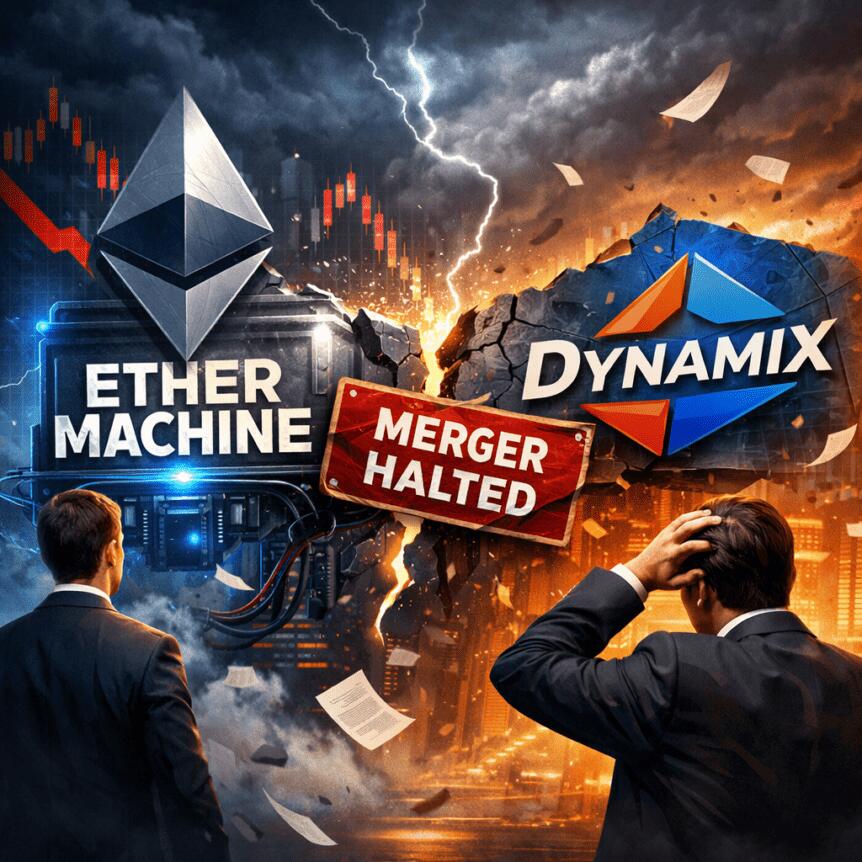
Ether Machine has abruptly halted its planned public debut after announcing a mutual termination of its merger with Dynamix Corporation, a Nasdaq-listed SPAC. The move comes as market conditions deteriorate and investor appetite for complex crypto-finance deals remains tepid.
The companies disclosed the termination in a post on X on Saturday, saying the deal was ended by mutual consent and effective immediately. The arrangement would have seen Ether Machine combine with Dynamix, with The Ether Reserve LLC also involved, to pursue a Nasdaq listing under the ticker ETHM.
In its notice, Ether Machine cited unfavorable market conditions as the reason for calling off the deal. A separate filing with the U.S. Securities and Exchange Commission confirms an unnamed “Payor” — identified in Annex A of the merger agreement but not publicly disclosed — must pay $50 million to Dynamix within 15 days of the termination, signaling a substantial break fee amid the collapse of the transaction.
For readers following the story of Ethereum treasury strategies and SPAC-driven crypto listings, the termination marks a notable shift in a sector that had been trying to scale institutional-grade ether yield through public markets.
Earlier reporting around Ether Machine’s ambitions paints a broader backdrop: the firm, co-founded by former ConsenSys executives Andrew Keys and David Merin, announced last year its plan to launch what it described as the largest yield-bearing Ether fund targeted at institutional investors. The plan entailed listing on Nasdaq under the ETHM ticker and managing a substantial ether treasury.
Ether Machine’s path to the market gained momentum in September with a $654 million private financing round, including 150,000 ETH from Jeffrey Berns, a prominent Ethereum advocate who joined the company’s board. That fundraising was positioned as a runway to deploy a large ETH treasury ahead of a possible Nasdaq debut, but the public listing now appears off the table for the foreseeable future.
The termination also reshapes how market participants assess the feasibility of ambitious treasury strategies tied to public listings. SPAC-backed crypto ventures had offered a route to scale institutional access to yield-generation strategies using large ether holdings, but the deteriorating market environment has already put such plans under strain.
Key takeaways
- Ether Machine and Dynamix terminate their business combination agreement, effective immediately, citing unfavorable market conditions.
- A $50 million payment obligation from an unnamed Payor to Dynamix is due within 15 days of termination, per an SEC filing.
- The deal would have enabled Ether Machine to list on Nasdaq as ETHM and manage a treasury exceeding 400,000 ETH, valued at more than $1.5 billion at launch.
- Dynamix retains a limited window for a new deal, with a deadline of November 22, 2026 to complete another business combination; failure would trigger liquidation and fund returns to shareholders.
Deal dynamics and the optics of crypto SPACs
Ether Machine’s announced vision sought to construct a large, yield-bearing ether treasury designed to appeal to institutional investors seeking crypto exposure with income features. The company positioned the treasury as a strategic asset to be deployed through structured strategies and yield products that could be embedded in a Nasdaq-listed vehicle. The plan also reflected a broader push at the time to bring sophisticated crypto-finance products into traditional capital markets via SPAC mergers and public listings.
With the termination, observers are left to weigh what it means for the broader ecosystem. The immediate cash obligation signals a termination cost that could influence how aggressively similar ventures pursue public-market strategies in uncertain macro conditions. It also raises questions about the speed with which ether-treasury initiatives can transition from private fundraising to public market access, especially when market volatility or liquidity constraints complicate deal execution.
Ethereum treasury activity in context
The news arrives as Ethereum treasury strategies continue to evolve under pressure. Recent reporting highlights a wave of adjustments among major ether-holding funds. Trend Research has unwound a substantial portion of its Ethereum position, selling 651,757 ETH (roughly $1.34 billion at the time) and locking in an estimated $747 million loss. The move underscores the difficulty of sustaining large, public-market-backed ether holdings amid shifting risk appetites and capital costs.
Another notable development in the space is ETHZilla’s transformation into Forum Markets, signaling a broader pivot away from aggressive Ether accumulation toward evolved capital-market playbooks for blockchain treasuries. The shifting branding and strategy reflect a more cautious approach to building sizable ETH troves in an environment of heightened scrutiny and evolving regulatory and liquidity considerations.
Taken together, these dynamics illustrate a market where the allure of large ether treasuries and public-market access competes with practical constraints — volatile crypto markets, policy risk, and the inherent complexity of managing multi-hundred-thousand ETH positions within publicly traded vehicles.
What comes next for Ether treasuries and crypto finance?
As Ether Machine closes its public-listing chapter, investors and builders will be watching whether the market can sustain or rekindle appetite for SPAC-driven crypto ventures. The immediate question is whether Dynamix or Ether Machine will pivot to alternative financing routes or private negotiations, and how quickly a viable path to scale ether-backed yield strategies can reemerge in a climate that remains sensitive to liquidity and regulatory signals.
Meanwhile, the broader trend in Ethereum treasuries suggests ongoing experimentation with how to balance strategic accumulation with risk management, governance rights, and the costs of capital. Market participants may increasingly favor more flexible, privately negotiated structures or on-exchange vehicles that can adapt to rapid shifts in sentiment without exposing investors to outsized termination risk or forced liquidations.
As regulators continue to scrutinize crypto investment vehicles and as institutional tolerance for illiquidity and complexity evolves, observers should monitor whether new partnerships or alternative SPAC arrangements emerge that offer clearer economics or more robust investor protections than those contemplated in high-profile, headline-grabbing bets like ETHM.
What remains uncertain is how quickly the market environment will improve for such ambitious treasury plays and whether Ether Machine or similar entrants will re-enter the public market path with revised terms, different structures, or a fundamentally altered approach to building Ethereum-backed yields for institutions.
Readers should keep an eye on any follow-up disclosures from Dynamix and Ether Machine, including updates on potential new deals, revised capital plans, or shifts in the management and governance of ether treasuries that could signal a broader rethinking of how crypto assets are monetized through public-market vehicles.

Eamonn Holmes’ son issues health update after presenter suffers stroke

Buy or Sell? AI Connectivity Leader Eyes 30-50% Gains Amid Explosive Demand

Netflix’s First Original Hit Just Got Much Harder To Watch 13 Years Later

Why Israel is blocking foreign journalists from entering

Bitcoin: We’re Entering The Most Dangerous Phase

Alan Cumming Brands Baftas Ceremony A ‘Triggering S**tshow’

Achieving financial freedom isn’t permission to abandon your purpose on earth. #worldwide

Moneyview Personal Loan App | How To Apply Money View Loan | Moneyview Personal Loan Telugu 2026

How Small Actions Change Financial Struggles | A Simple Economics Story
-

 Business6 days ago
Three Gulf funds agree to back Paramount’s $81 billion takeover of Warner, WSJ reports
-

 Politics2 days ago
US brings back mandatory military draft registration
-

 Fashion2 days ago
Weekend Open Thread: Veronica Beard
-

 Tech5 days ago
How Long Can You Drive With Expired Registration? What Florida Law Says
-

 Fashion6 days ago
Massimo Dutti Offers Inspiration for Your Summer Mood Board
-
 Sports2 days ago
Man United discover Nico Schlotterbeck transfer fee as defender reaches Dortmund agreement
-

 Fashion5 days ago
Let’s Discuss: DEI in 2026
-

 Crypto World3 days ago
Canary Capital Files SEC Registration for PEPE ETF
-

 Business2 days ago
Tesla Model Y Tops China Auto Sales in March 2026 With 39,827 Registrations, Beating Cheaper EVs and Gas Cars
-

 Crypto World4 days ago
Bitcoin recovers as US and Iran Agree a Ceasefire Deal
-

 Politics2 days ago
Malcolm In The Middle OG Turned Down ‘Buckets Of Money’ To Appear In Reboot
-

 Business2 days ago
OpenAI Halts Stargate UK Data Centre Project Over Energy Costs and Copyright Row
-

 Business19 hours ago
Ireland Fuel Protests Enter Day 5 as Blockades Spark Shortages and Government Prepares Support Package
-

 Tech6 days ago
Italian court says Netflix must refund customers up to $576 over price hikes
-

 Tech6 days ago
Gamer Restores the Original PlayStation Portal From Two Decades Ago
-

 Tech6 days ago
Samsung just gave up on its own Messages app
-

 Tech6 days ago
Haier is betting big that your next TV purchase will be one of these
-

 Tech6 days ago
The Xiaomi 17 Ultra has some impressive add-ons that make snapping photos really fun
-

 Politics2 days ago
LBC Presenter Mocks Trump Over Iran War Failures
-

 Tech6 days ago
Save $130 on the Samsung Galaxy Watch 8 Classic: rotating bezel, sleep coaching, and running coach for $369
You must be logged in to post a comment Login