

Crypto World
3 Meme Coins to Watch During the Final Week of May

Banana For Scale (BANANAS31), Pudgy Penguins (PENGU), and SkyAI (SKYAI) sit at decisive technical levels this week. Each daily chart presents a distinct setup that traders may want to track as meme coin volatility returns.
The wider meme coin sector remains highly active in 2026, with traders treating these tokens as high-beta vehicles relative to Bitcoin. Mixed signals across the three charts point to a sector still searching for clear direction.
Banana For Scale (BANANAS31) Eyes $0.014 Resistance Breakout
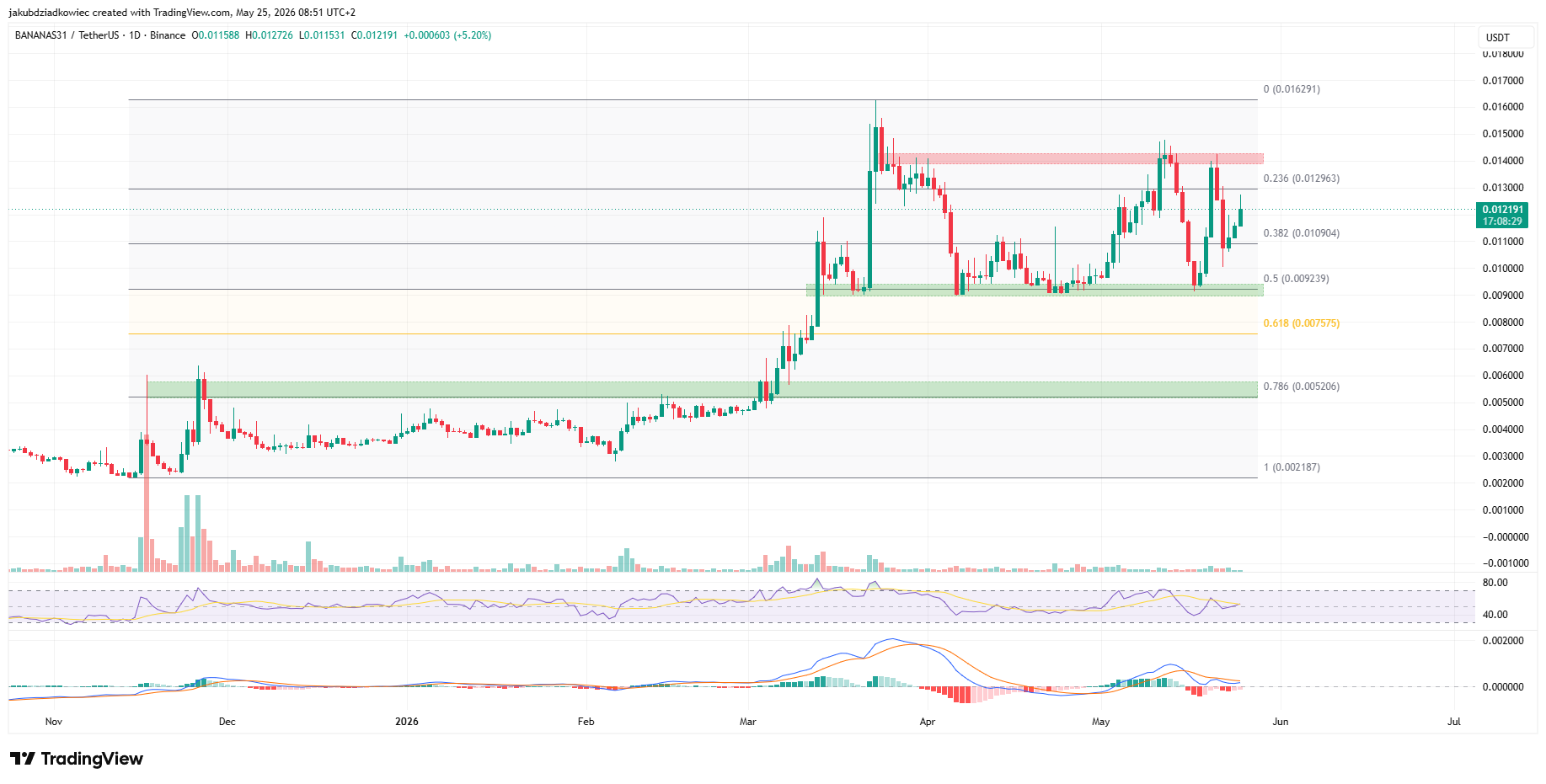
Banana For Scale (BANANAS31) trades around $0.0122 on Monday, up roughly 5% over 24 hours. The daily chart shows price moving inside an ascending channel since early May.
The lower boundary sits at $0.0092, which lines up with the 0.5 Fibonacci retracement. Resistance at $0.014 has been tested three times without a clean break, and another attempt may finally crack the meme coin ceiling.
A close above $0.014 could open a path toward the recent swing high near $0.0163. However, a drop below $0.0092 would expose the next strong support at $0.0052, which coincides with the 0.786 retracement.
The Relative Strength Index (RSI) sits at 52, signaling neutral momentum. Meanwhile, the Moving Average Convergence Divergence (MACD) remains bearish, although the histogram suggests bulls are slowly regaining the upper hand.

Meme Coins to Watch: SkyAI (SKYAI) Validates $0.24 as Key Support
SkyAI (SKYAI) trades around $0.337 on Monday after gaining roughly 3% over the past day. The daily chart shows a sharp decline from the May 6 high near $0.86.
During the selloff, the token lost two important supports. The 0.382 Fibonacci level at $0.56 and the 0.618 level at $0.37 now act as resistance, capping any early recovery attempts from this AI altcoin.
In contrast, buyers have validated the 0.786 retracement at $0.24 as fresh support. That same level previously capped price action as resistance on April 23, adding weight to its role as a pivot.
The RSI prints in neutral territory near 50. However, the MACD is trying to turn bullish, hinting at a possible return of upside momentum if buyers can defend the lower zone.

Pudgy Penguins (PENGU) Tests Ascending Support Line
Pudgy Penguins (PENGU) trades around $0.009 on Monday after a 1.4% pullback over the last 24 hours. The token recently bounced off the 0.382 Fibonacci retracement at $0.0085.
However, PENGU has lost the 0.5 retracement at $0.0095, which now caps the price as resistance. Bulls must reclaim that level to extend the recent rally toward higher targets.
At the same time, price keeps bouncing off the ascending support line that started at the April 5 low. The next target sits just above the 0.618 retracement near $0.011, with the $0.013 zone marking the level beyond.
Like the other two tokens, the RSI prints near 50, pointing to neutral momentum. The MACD is also turning bullish, hinting at improving conditions for buyers in the short term.

Which Meme Coin Offers the Strongest Setup This Week
Among the three, BANANAS31 presents the cleanest bullish structure. The token has tested $0.014 three times, and a break above that level could trigger a sharp move toward the May high. Compared to last week’s setups, BANANAS31 stands out as the most actionable name on the daily timeframe.
SKYAI remains in a confirmed downtrend, although the bullish MACD shift hints at a possible mean reversion. Traders may want to wait for a close above $0.37 before treating the recovery as confirmed.
PENGU sits at a decision point. The token holds the ascending trendline, yet the loss of $0.0095 leaves it exposed. A reclaim of that level would tilt the balance back to the bulls.
For traders ranking these setups by clarity, BANANAS31 leads, PENGU sits in the middle, and SKYAI brings up the rear until the downtrend breaks.
The post 3 Meme Coins to Watch During the Final Week of May appeared first on BeInCrypto.



A crypto PAC affiliated with Fairshake has poured $5 million into a Texas congressional runoff ahead of Tuesday’s vote.
Summary
- Protect Progress spent $5 million supporting Christian Menefee and $2.8 million opposing Al Green in Tuesday’s Texas 18th District runoff.
- The Kalshi prediction market puts Menefee’s odds at 91% and Paxton’s at 96% in the parallel Texas Senate runoff, where total betting volume exceeded $16 million.
- Green voted against the GENIUS Act and the Clarity Act and holds an F grade from Stand With Crypto, making his seat a direct target for Fairshake’s $193 million 2026 war chest.
Protect Progress, an affiliate of the crypto-backed Fairshake PAC, spent $5 million supporting Democratic challenger Christian Menefee in Tuesday’s Texas 18th District runoff and a further $2.8 million opposing incumbent Al Green, according to Federal Election Commission filings. Fairshake reported $193 million cash on hand heading into 2026.
The Kalshi prediction market gave Menefee a 91% probability of winning, with Polymarket at a similar figure. Total betting volume on the parallel Texas Republican Senate race between Ken Paxton and John Cornyn topped $16 million, with Paxton holding roughly 96% odds following a Trump endorsement.
Why Green’s seat became a priority for Fairshake
Al Green has been among the more vocal crypto critics in Congress. He voted against both the GENIUS Act stablecoin bill and the Clarity Act, and Stand With Crypto awarded him an F grade. “I am an unbought, liberated, unafraid Democrat, unbought by crypto cash,” Green told colleagues on the House floor, accusing Menefee of making a “deal with the devil” by accepting Fairshake support.
Fairshake, backed primarily by Ripple Labs and Coinbase, also secured the endorsement of the Blockchain Leadership Fund, backed by Anchorage Digital and Chainlink Labs, in the Menefee race. Menefee was elected to Congress in a January 2026 special election and quickly became the industry’s preferred candidate over Green.
Crypto.news has covered the Clarity Act’s compressed legislative calendar heading into the 2026 midterms. The Texas result will be read as a signal of how far pro-crypto PAC spending can move congressional seats in contested districts.
Crypto.news has also reported on the US Treasury’s AML rules for stablecoin issuers under the GENIUS Act, the specific legislation Green opposed that made his seat a target. Crypto.news has also tracked the broader legislative push to institutionalise crypto policy that Fairshake’s congressional spending is designed to support.


Stablecoin issuer Tether and the government of Georgia plan to launch a stablecoin called “GELT” that would represent the Georgian lari under the country’s digital asset regulatory framework.
On Monday, Tether said the stablecoin is expected to support cross-border commerce and digital payments in Georgia. The company said GELT’s structure, rollout and regulatory implementation will be announced at a later stage.
The plan builds on Georgia’s recent efforts to develop rules for digital assets and stablecoins, including a framework covering reserve management, redemption rights, issuer oversight and Anti-Money Laundering compliance. In March, the National Bank of Georgia said it had developed rules for the initial offering of “stable virtual assets,” including requirements for full reserve backing, offering documents and external auditor verification.
Georgian Prime Minister Irakli Kobakhidze said the partnership with Tether would help lay the foundations for a more connected and transparent financial world. National Bank of Georgia President Natia Turnava said the central bank welcomes the collaboration as part of its strategy to advance digital financial infrastructure.
The announcement did not say who would legally issue GELT, where reserves would be held, or whether holders would have direct redemption rights. The company also did not provide a definite launch timeline.
Tether acknowledged Cointelegraph’s request for comment. Cointelegraph reached out to the National Bank of Georgia for more information, but did not receive a response by publication.
Georgia released stablecoin rules in March
On March 6, the National Bank of Georgia released rules covering stablecoin issuance. The framework said a stablecoin offering in Georgia cannot be provided without prior written consent from the National Bank.
It applies to virtual asset service providers, or VASPs, registered with the central bank, while companies that are not registered as VASPs must obtain registration before conducting a stablecoin offering or providing related services. The central bank said stablecoins in circulation must be fully backed by reserve assets that meet liquidity and credit quality requirements.
Related: Tether buys SoftBank’s stake in Bitcoin company Twenty One Capital
The rules also require issuers to prepare documents related to the initial issuance and submit them for external auditor verification, according to the central bank. The regulator said the framework intends to improve consumer protection, risk management and alignment with international standards.
GELT to join Tether’s non-dollar stablecoin lineup
The GELT stablecoin would join Tether’s smaller lineup of currency-specific stablecoin products beyond its flagship USDT. Tether has previously launched tokens pegged to the Mexican peso and offshore Chinese yuan and has also announced plans for a United Arab Emirates dirham-pegged stablecoin.
Tether’s Mexican peso-pegged MXNT launched in 2022 with initial support on Ethereum, Tron and Polygon. Its offshore Chinese yuan-pegged CNHT was created in 2019 and later expanded to Tron, while the planned UAE dirham token was announced in 2024 with backing from liquid UAE-based reserves.
The company has also developed market-specific stablecoin products. In January 2026, Tether launched USAT as a US-regulated dollar stablecoin aimed at the American market.
Tether has also wound down some of its earlier non-USDT stablecoins. The company stopped minting its euro-pegged EURT and said redemptions ended in November 2025, while its offshore Chinese yuan-pegged CNHT is set to become non-redeemable in February 2027.
Magazine: ETH bears growling, Tom Lee’s buying, XRP to ‘explode’: Market Moves

Strategy shifted its capital allocation this week by pausing Bitcoin purchases and focusing on debt repurchases. The company directed resources toward retiring convertible notes instead of expanding its digital asset holdings.
Strategy Prioritizes Convertible Debt Repurchase
Strategy paused its Bitcoin accumulation program and allocated capital toward repurchasing convertible senior notes due in 2029. The company announced plans to retire nearly $1.5 billion in face value debt and expects to complete the transaction for about $1.38 billion in cash.
The company intends to fund the repurchase through existing cash reserves and proceeds from stock sales. It also outlined the possibility of using Bitcoin-related resources if necessary, though current holdings indicate no direct reduction in its Bitcoin treasury.
The debt repurchase follows recent fundraising efforts through STRC perpetual preferred shares and MSTR stock sales. Consequently, Strategy previously acquired 24,869 Bitcoin for approximately $2.01 billion. The latest move marks a temporary shift from accumulation toward balance sheet management.
Bitcoin Holdings Remain at Record Levels
Despite the pause in purchases, Strategy continues to hold 843,738 Bitcoin on its balance sheet, carrying a market value of about $65.25 billion based on recent prices. The company acquired the assets for roughly $63.88 billion.
The figures suggest that Strategy remains in a profitable position on its Bitcoin investment. The current treasury size reinforces its status as the largest corporate Bitcoin holder and underscores its long-term commitment to digital assets.
Background factors support that view: the company has raised billions through multiple financing methods and has consistently used equity, debt, and preferred share offerings to fund acquisitions. The latest debt action therefore reflects capital management rather than a strategic retreat from Bitcoin.
Debt Reduction Supports Capital Structure Goals
The debt repurchase reduces future dilution risks tied to convertible notes, meaning fewer potential shares could enter circulation if conversions occur later. The move may also increase Bitcoin exposure on a per-share basis for existing shareholders.
Retiring debt below face value strengthens the company’s financial position by lowering outstanding liabilities and improving balance sheet flexibility. The reduction in leverage may also support future fundraising when market conditions improve.
Strategy has relied on capital markets to expand its Bitcoin treasury over recent years, so maintaining financial flexibility remains important for future acquisitions. The company can potentially access new debt, equity, or preferred share financing after completing the repurchase.
The announcement arrived during a challenging period for MSTR stock performance: shares declined more than 5% over the previous week and erased earlier gains, and the stock closed 3.01% lower at $159.89 on Friday. Recent filings also showed stock sales by Chief Financial Officer Andrew Kang and director Jarrod Patten. However, Strategy’s Bitcoin holdings remain unchanged despite concerns surrounding the debt transaction. The company’s latest actions indicate a focus on strengthening its capital structure while preserving capacity for future Bitcoin purchases.

Key Highlights
- Coinhouse obtains MiCA authorization from French regulators for EU-wide crypto operations.
- Paris-based platform receives EU passporting privileges well before France’s 2026 compliance cutoff.
- Coinhouse transitions from national PSAN registration to comprehensive PSCA authorization.
- MiCA approval provides Coinhouse with competitive advantages in Europe’s regulated digital asset sector.
- Authorization enables Coinhouse to deliver custody, transfer, advisory, and brokerage solutions throughout Europe.
Coinhouse has obtained MiCA authorization from France’s financial regulator AMF, granting the Paris-based platform expanded operational capacity throughout the European Union. The regulatory approval encompasses brokerage services, digital asset custody, transfer operations, investment advisory, and portfolio management activities. This achievement positions Coinhouse well ahead of France’s mandatory July 2026 licensing requirement.
Coinhouse Achieves Complete PSCA Authorization
Coinhouse has been granted Crypto Asset Service Provider certification under France’s MiCA framework. This new authorization supersedes the company’s previous PSAN designation, which operated under France’s domestic cryptocurrency regulatory system. The upgrade establishes a more robust legal foundation for international activities.
The MiCA authorization enables Coinhouse to deliver multiple regulated cryptocurrency services throughout EU jurisdictions. Available services encompass purchasing, selling, exchange operations, safekeeping, administrative functions, and digital asset transfers. Furthermore, the authorization includes investment consultation and portfolio management capabilities.
Coinhouse originated in 2014 under the name La Maison du Bitcoin. The platform subsequently became among France’s initial registered Digital Asset Service Providers. The MiCA authorization now elevates the company from domestic registration to European Union-wide authorization.
MiCA Authorization Facilitates European Growth Strategy
The MiCA authorization provides Coinhouse with passporting capabilities throughout every EU Member State. Consequently, the platform can scale operations without pursuing individual national registrations across different markets. This framework establishes a more streamlined pathway for compliant expansion.
Coinhouse currently operates in French-speaking territories including Belgium and Luxembourg. Nevertheless, the fresh authorization facilitates wider accessibility to retail customers, corporate entities, and institutional investors. The platform can now distribute its offerings across Europe under unified regulatory standards.
The MiCA authorization simultaneously bolsters Coinhouse’s competitive standing against less agile rivals. Numerous French PSAN entities still require authorization before the domestic system expires. Accordingly, Coinhouse secures both regulatory stability and marketplace advantages.
France Advances Toward MiCA Transition Date
France plans to discontinue its domestic PSAN system on July 1, 2026. Beyond that date, cryptocurrency service platforms require PSCA authorization to maintain legal operations. The MiCA authorization consequently becomes mandatory for businesses serving French customers.
The AMF has cautioned that unauthorized providers must cease operations following the transition deadline. Organizations that operate without proper authorization may encounter legal consequences and monetary penalties. Therefore, obtaining early authorization provides Coinhouse with uninterrupted operations before the deadline.
The MiCA authorization additionally demonstrates Europe’s transition toward unified cryptocurrency regulation. MiCA seeks to standardize digital asset supervision and eliminate fragmented national frameworks. For Coinhouse, the authorization transforms regulatory compliance into an opportunity for European expansion.


Dubai, UAE — The emergence of autonomous trading as a practical capability is reshaping how capital is deployed in crypto markets. CoinQuant, the Dubai-based AI trading platform, is responding by upgrading from a no-code trading tool to a unified trading intelligence architecture that serves both human traders and autonomous AI agents. The move signals a broader shift in the market: as agents move from prototype experiments to live execution, a rigorous infrastructure for validation, risk management, and data processing becomes essential.
CoinQuant says more than 15,000 users have engaged with its platform since launch. Founder and CEO Maan Ftouni emphasizes that autonomous trading is no longer purely theoretical, but the next phase requires a defensible operating framework. “Autonomous trading is happening,” Ftouni notes, “but the next phase requires structured validation, disciplined risk management, and intelligence infrastructure. That is what CoinQuant delivers.”
Structured validation bridges intent and capital
As AI agents increasingly connect directly to exchanges and wallets, they often rely on raw APIs without the benefit of backtesting, risk analysis, or validated data pipelines. CoinQuant introduces a structured intelligence layer that sits between trading intent and live capital deployment. In practice, no strategy — whether crafted by a human or generated by an AI agent — goes live without validation. The workflow embeds backtesting, risk metrics, and parameter optimization so capital is deployed only after a systematic evaluation.
The approach aims to address a core gap in agent-enabled trading: the absence of a disciplined governance framework that can scale across dozens or hundreds of strategies. By enforcing validation steps at every stage, CoinQuant seeks to align automated execution with proven performance under varying market conditions. This emphasis on reliability is particularly critical as agents increasingly operate at high frequency and scale, where unvalidated trades can quickly translate into meaningful losses if not properly constrained.
From no-code to a unified intelligence engine
At the center of CoinQuant’s evolution is a unified intelligence system that blends institutional-grade backtesting, curated market data, optimization — powered by AI — and the firm’s Domain Expert capability. The platform sources data from providers such as Kaiko and Financial Modeling Prep to ensure that traders and agents work from structured, high-quality datasets. On the human side, the interface is designed for natural-language interaction, allowing users to describe, test, optimize, and deploy strategies without writing code. For AI agents, connectivity comes through programmatic APIs and MCP integrations to access data and validate strategies at scale.
According to the company, the goal is simple but ambitious: the same engine that underpins a first backtest for a human user should be able to validate hundreds of strategies for autonomous systems in parallel. “The interface is surface-level. The intelligence engine beneath it is the product,” Ftouni explains. The architecture thus positions CoinQuant as a dual-use platform that can support traditional traders and AI-driven agents within a single, coherent framework.
Two growth vectors driving adoption
CoinQuant frames its expansion as a natural extension of its existing business model. With a growing user base of over 15,000 traders, the platform has demonstrated demand for structured trading intelligence that can guide both manual strategies and autonomous validation workflows. The anonymized, aggregated intelligence layer that emerges as more strategies are built and tested contributes to a proprietary dataset mapping trading intent to logic, validation metrics, and performance outcomes across multiple market regimes. This data backbone is intended to improve decision-making for all users, while protecting individual strategies through anonymization.
Ftouni reiterates that the intelligence engine is designed to power both human and AI-driven validation pipelines. “The same engine that powers a trader’s first backtest can validate hundreds of strategies for autonomous systems in parallel,” he says. This parallel validation capability is what enables CoinQuant to scale its operations without sacrificing rigor, a critical balance as the ecosystem moves toward greater automation and institutional-grade workflows.
Automation on the horizon and a new funding phase
Looking ahead, CoinQuant is preparing to launch an automated strategy execution layer on HyperLiquid, which will become the company’s second major revenue stream. The automation layer is designed to translate validated backtests into live deployments within the same intelligence framework, creating a seamless spectrum from concept to execution. For traders and developers, this integration promises a more efficient path from testing to real-market activity, while for the platform, it represents a significant expansion of the value proposition.
Concurrently, CoinQuant has outlined a plan to raise a $3 million Seed round to accelerate product development, scale infrastructure, and support global growth. The company is also developing HYDRA, a hierarchical multi-agent architecture intended for advanced research, risk modeling, and strategy optimization. Taken together, the initiatives reflect a concerted push to formalize the role of AI and automation in professional trading workflows while building out a robust, scalable backbone that can accommodate increasing volumes and more complex agent configurations.
With more than 15,000 users validating demand for structured trading intelligence, CoinQuant aims to become the intelligence backbone of algorithmic trading in an era where agent-driven activity is becoming mainstream. The combination of a mature validation framework, access to institutional-grade data, and an expanding set of automation capabilities positions the Dubai-based platform as a notable entrant in the field of AI-assisted market making and systematic trading.
What to watch next for traders and investors
As CoinQuant scales its architecture, the key indicators investors will likely focus on are the robustness of the validation pipeline under diverse market conditions, the performance of live deployments enabled by the HyperLiquid integration, and the efficacy of HYDRA in multi-agent coordination and risk modeling. The quality and granularity of the anonymized intelligence dataset will also be a closely watched metric, given its potential to improve cross-strategy validation and inform safer, more scalable automation.
In the near term, the market will also be watching how the automation layer affects execution quality, latency, and capital efficiency when strategies move from backtests to live trading. If CoinQuant can demonstrate consistent, risk-adjusted performance at scale, it could accelerate adoption of agent-driven trading across a broader segment of the crypto ecosystem — from individual traders to professional funds seeking programmable, governance-backed automation.
Readers should keep an eye on how HYDRA develops and how the HyperLiquid integration performs once live deployments begin. The coming months will reveal whether CoinQuant’s unified approach can sustain rigorous validation while delivering the practical automation capabilities that increasingly define the frontier of quantitative crypto trading.


SHIB futures netflow plunged 306% as outflows exceeded inflows, according to CoinGlass derivatives data.
Summary
- CoinGlass data shows SHIB futures netflow dropped 306%, with outflows exceeding inflows as derivatives traders reduced exposure to the meme token.
- Open interest in SHIB futures stands at $61.2 million, while approximately $42,485 in SHIB positions were liquidated in the latest 24-hour session.
- SHIB was trading near $0.00000575 at time of writing, down approximately 54% over the past 12 months and 3.7% over the past week.
CoinGlass tracked SHIB futures netflow dropping 306%, with the total value of SHIB leaving derivatives exchange wallets outpacing inflows. The metric tracks movement of tokens in and out of derivatives platform wallets and is used as an indicator of how traders are positioning in the perpetual futures market.
The 306% negative netflow signals that derivatives traders are actively reducing exposure rather than opening new leveraged positions. Open interest stands at $61.2 million, with $42,485 in SHIB futures positions liquidated in the latest 24-hour session.
What the derivatives data tells us about SHIB trader sentiment
Negative futures netflow does not necessarily indicate an impending price crash, but it does reflect a reduction in the number of traders willing to hold derivative exposure to SHIB at current prices.
SHIB was trading near $0.00000575 at time of writing, down approximately 54% over the past 12 months from a peak near $0.000012. The token broke below key support near $0.0000054 this week according to technical analysis on CoinMarketCap, raising concern about a possible retest of March 2026 lows.
Crypto.news has reported on over 3 billion SHIB tokens hitting exchanges in a single session earlier this month, adding sell-side pressure as broader crypto market liquidations accelerated.
The pattern of negative futures flow alongside exchange inflows suggests holders are repositioning rather than accumulating. Crypto.news has also covered how declining SHIB futures open interest and funding rate pressure had already signalled weak conviction among derivatives traders in February 2026.
The Shiba Inu (SHIB) price page tracks live movements as the futures data raises questions about SHIB’s near-term direction heading into the US Memorial Day holiday weekend.


Onchain analytics firm Bubblemaps says a Hyperliquid whale linked to former BitForex CEO Garrett Jin and the infamous 10 10 short trade would have been up more than $70 million if he had never traded Ethereum, but is instead sitting on roughly $128 million in net losses after catastrophic ETH longs erased huge prior gains.
Summary
- Bubblemaps estimates the trader is down $128 million overall despite earlier nine figure wins
- The whale reportedly made about $100 million shorting BTC in the October 10, 2025 flash crash
- Subsequent outsized ETH longs on Hyperliquid led to more than $200 million in realized losses
- A linked wallet has now rotated into Hyperliquid again, buying $10 million of HYPE and shorting $38 million of ZEC
In a new onchain breakdown shared on X, Bubblemaps reconstructs the PnL of the wallet cluster it associates with Garrett Jin, arguing that if the trader had simply held BTC and avoided the ETH leverage spiral, his net profit would stand north of $70 million; instead, the account is now “down $128M overall” after a brutal series of Ether trades.
The cluster has been in the spotlight since the so called 10/10 crash on October 10, 2025, when a Hyperliquid whale built massive short exposure into Bitcoin and Ethereum shortly before President Donald Trump announced 100 percent tariffs on Chinese imports, triggering a violent risk off move.
How did a 10 10 legend flip from +$70M to –$128M?
Binance Square’s retrospective on the “10 11 flash crash” notes that the whale held more than 100,000 BTC equivalent and was behind a $735 million BTC short on Hyperliquid, with Arkham Intelligence later estimating between $190 million and $200 million in profit on those shorts across BTC and ETH as prices cratered.
Yahoo Finance separately described the same trader as the “Hyperliquid whale who made nearly $200M on the Oct. 10 crash,” and reported that blockchain sleuths linked the address to Garrett Jin, though Jin denied owning the wallet while acknowledging that he knew the person behind it.
From there, the trade morphs into a case study in overconfidence.
Binance coverage of a March 2025 liquidation recounts how an address on Hyperliquid opened a more than $200 million long position on ETH using 50x leverage, staking about $4.3 million in USDC to control 113,000 ETH before being liquidated in a move that left the protocol itself with a roughly $4 million loss due to insurance fund slippage.
Panoptic’s market intelligence notes and other whale tracking reports suggest that similar oversized ETH longs followed, taking the wallet’s aggregate realized loss on ETH north of $200 million as repeated attempts to time reversals ran into continued volatility and margin calls.
Against that backdrop, Bubblemaps’ claim that the trader swung from a hypothetical +$70 million to –$128 million net is entirely plausible: the original 10 10 BTC short win was massive, but the later ETH leverage series appears to have more than erased it.
What is the 10 10 whale doing now on Hyperliquid?
Despite the drawdown, the same cluster is back on Hyperliquid with a familiar mix of high conviction bets.
Bubblemaps says a connected address has recently deposited several million dollars of collateral to the perpetuals exchange, bought approximately $10 million worth of HYPE, the platform’s native token, and opened a $38 million short position on privacy coin Zcash (ZEC).
That dovetails with other recent whale tracking reports.
Bitcoin.com News described how a trader dubbed “Evaded” accrued about $7.5 million in profit in under four days from leveraged longs on ZEC and HYPE on Hyperliquid, then rolled into a $38.63 million ETH long using 25x leverage, a position that would be automatically liquidated on a roughly 4 percent adverse move.
Whale Alert and PANews have documented the same address pattern closing profitable HYPE, ZEC and ETH longs for about $4.6 million in gains, then opening a 990 BTC short worth nearly $75 million on Hyperliquid as BTC came under pressure from ETF outflows and derivatives liquidations.
While those reports focus on a pseudonymous trader called Evaded, Bubblemaps’ new thread argues that at least one of these high frequency, high notional Hyperliquid whales can be tied through address clustering and historical flows back to the 10 10 short and the entity it links to Garrett Jin.
The picture that emerges is of a trader who oscillates between periods of spectacular success and ruinous overreach, with the core pattern unchanged: concentrated directional bets on BTC and ETH around macro events, and now similarly aggressive positioning in platform tokens like HYPE and high beta names such as ZEC.
Why this whale matters for markets
On an absolute scale, a net PnL of –$128 million is a rounding error in a multi trillion dollar crypto market, but the 10 10 whale saga is a vivid illustration of how even elite operators with accurate reads on one regime can blow up when they assume the same playbook will work forever.
It also underscores how much of the Hyperliquid and perps venue narrative is driven by a handful of very large accounts whose wins and losses can distort funding rates, liquidity and sentiment for the rest of the market in the short term, especially when they pivot from being the bid to being the offer on assets like BTC, ETH, HYPE or ZEC.
For traders watching flows, Bubblemaps’ work adds another lens: rather than treating each new whale as an isolated story, it invites you to look at the entire career arc of a wallet cluster, and to ask whether you are front running a disciplined asymmetric player or shadowing a gambler who just torched nearly nine figures trying to replay last cycle’s script.


Chris Larsen’s XRP wallets have resumed on-chain activity ahead of Tuesday’s Texas primary runoff.
Summary
- Ripple co-founder Chris Larsen’s associated XRP wallets have shown renewed activity, coming ahead of Tuesday’s Texas Democratic primary runoff election.
- Larsen is estimated to hold approximately 2.58 billion XRP across eight wallets tracked on XRPScan, making his holdings one of the largest known individual XRP positions.
- XRP was trading near $1.35 at time of writing, with today’s activity following $109 million in Larsen-linked wallet transfers to exchanges recorded in January 2025.
Ripple co-founder Chris Larsen’s associated wallets have resumed on-chain activity, according to blockchain data, ahead of Tuesday’s Texas Democratic primary runoff. The reactivation draws immediate attention given Larsen’s history of significant XRP transfers at notable market and political junctures.
Larsen serves as executive chairman of Ripple Labs. His estimated 2.58 billion XRP holdings across eight wallets tracked on XRPScan represent one of the largest known individual positions in any single cryptocurrency, worth approximately $3.5 billion at current prices near $1.35.
🚨 @Ripple co-founder Chris Larsen’s $XRP wallets are active again.
On-chain trackers spotted fresh wallet #movements after months of inactivity, reviving speculation across the $XRP community. 👀
📊 @cryptoquant_com data estimates Larsen is sitting on over $764M in unrealized… pic.twitter.com/kyKupOSdzZ
— CoinGape (@CoinGapeMedia) May 25, 2026
Why Larsen’s wallet activity draws attention from the XRP community
In January 2025, wallets that had been idle for six to seven years reactivated and sent more than $109 million in XRP to exchanges including Coinbase, Bitstamp, and Bybit. In July 2025, on-chain researcher ZachXBT reported an additional $140 million in XRP transfers from Larsen-linked addresses coinciding with XRP trading near an all-time high above $3.40.
“Since July 17, 2025, an address linked to Ripple co-founder Chris Larsen transferred out 50M XRP ($175M) to four addresses. ~$140M ended up at exchanges/services,” ZachXBT wrote on X in July 2025. Larsen had not commented publicly on today’s activity at time of writing.
Whether the current movement precedes exchange transfers or represents internal wallet management is not confirmed from on-chain data available at time of publication. Crypto.news has covered Ripple CEO Brad Garlinghouse’s legislative activity in 2026 as the Clarity Act moves through Congress.
Crypto.news has also reported on why the Clarity Act’s progress is particularly consequential for XRP, context that gives any Larsen wallet movement added political timing significance ahead of Tuesday’s runoff.
TLDR
- XRP whale transactions worth over $1 million dropped by 57% in nine days.
- The XRP price declined from $1.54 on May 14 to around $1.35.
- The token recorded five consecutive intraday losses for the first time in two months.
- Large transactions fell from 157 trades to just 67 during the period.
- Analyst Ali Martinez linked the drop in whale activity to weakening market participation.
XRP whale activity has dropped sharply over the past nine days as large transactions declined across the network. Data shows trades worth at least $1 million fell by 57% while the XRP price also weakened. The slowdown points to reduced participation from large holders during a period of falling prices.
XRP Whale Activity Drops as Price Records 5 Straight Losses
XRP fell to $1.35 after declining from $1.54 recorded on May 14. The token posted five consecutive intraday losses between May 15 and May 19. The decline marked the first time in over two months that XRP recorded such a streak. The price dropped about 8% during this five-day period. Market analyst Ali Martinez highlighted a drop in large transactions during the same timeframe.
According to the data, whale transactions fell from 157 trades to just 67. These trades each represented transfers worth at least $1 million. This equals a 57% decline in large transaction activity within nine days. The reduction aligned closely with XRP’s downward price movement.
Martinez stated that large investors reduced participation as prices weakened. He added that this drop reflected lower confidence among major holders. The slowdown in trading activity occurred while XRP traded below $1.40. Selling pressure remained steady throughout the period.
Compression Phase Forms as Whales Quietly Accumulate XRP
Martinez described the current market state as a compression phase. He said whales appear to be waiting as the price stabilizes within a tighter range. He noted that such conditions often reduce short-term volatility. They also help establish clear support and resistance levels. Despite fewer large trades, some wallets continued accumulating XRP. Data shows selective buying among mid-sized holders during the dip.
Wallets holding between 1 million and 10 million XRP increased their balance. Holdings rose from 3.72 billion XRP to 3.79 billion XRP. This group added about 70 million XRP over the observed period. Smaller whale wallets also increased their holdings slightly.
Addresses holding between 100,000 and 1 million XRP added around 20 million XRP. Their total rose from 6.31 billion XRP to 6.33 billion XRP. Martinez said the accumulation remains limited in impact on price movement. The broader market still reflects reduced activity from larger participants.
He also pointed to a tightening Bollinger Band on the three-day chart. He said it marks the lowest volatility level seen in over a year. Martinez identified $1.50 and $1.29 as key levels to monitor. He called this range a “no-trade zone” in his analysis.
He stated that a close above $1.50 could push XRP toward $1.80. A move below $1.29 could weaken the outlook and test $1.00 support. At the time of writing, XRP continues trading near $1.35 while whale activity remains subdued.
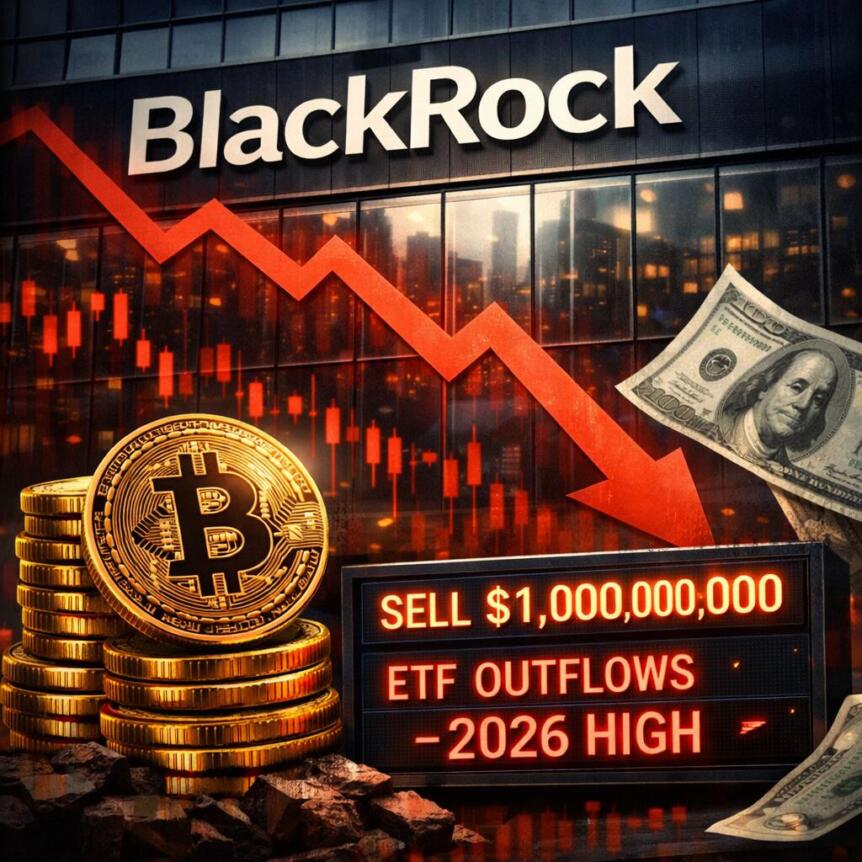
BlackRock recorded its largest Bitcoin ETF outflow of 2026 after steady withdrawals throughout the past week. The asset manager sold more than $1 billion worth of Bitcoin, while the broader ETF market also posted heavy losses. Meanwhile, Bitcoin remained under pressure despite a modest recovery near the start of the week.
BlackRock Leads Weekly Bitcoin ETF Outflows
BlackRock reported continuous Bitcoin sales during every trading day last week. Consequently, the total value of those sales reached approximately $1.01 billion by week’s end. The figure marked the firm’s largest weekly Bitcoin ETF outflow since November 2025.
Data from crypto analytics platform Arkham showed BlackRock accounted for most of the sector’s withdrawals. Moreover, the broader Bitcoin ETF market experienced significant selling activity across multiple funds. Market participants reduced exposure as volatility increased across digital assets.
Bitcoin faced persistent downward pressure during the same period. As a result, ETF demand weakened despite BlackRock maintaining its leading market position. The latest withdrawals reflected a notable shift from stronger inflows seen earlier this year.
The outflow trend emerged as cryptocurrency prices struggled to sustain momentum. Furthermore, several major digital assets traded in negative territory throughout much of the week. The market environment contributed to reduced demand for spot Bitcoin ETFs.
Institutional activity played a major role in the week’s market performance. Consequently, large-scale fund withdrawals added pressure to Bitcoin and related investment products. The combined ETF outflow reached approximately $1.26 billion during the reporting period.
BlackRock represented the largest share of those withdrawals. Moreover, the fund manager continued to dominate overall Bitcoin ETF holdings despite recent selling activity. The latest figures highlighted the scale of the market’s recent shift.
Bitcoin Holds Above Key Levels Despite Selling Pressure
Bitcoin traded at $77,443 at the time of reporting. However, the cryptocurrency remained well below levels seen during stronger periods earlier this month. The price still managed a modest gain of 0.45% from recent lows.
The asset began the month with positive momentum across major exchanges. However, sentiment weakened as volatility returned to the broader cryptocurrency market. Selling pressure increased as prices struggled to maintain upward movement.
Several market indicators pointed to growing uncertainty across digital assets. Consequently, traders adjusted positions while risk appetite declined. Bitcoin faced resistance as buyers attempted to stabilize recent losses.
The recent ETF withdrawals added another challenge for the market. Moreover, reduced institutional demand coincided with weaker price performance across major cryptocurrencies. The combination created additional pressure on Bitcoin’s short-term outlook.
Market forecasts remained divided regarding Bitcoin’s next move. Some analysts expected consolidation near current levels, while others projected further declines. Meanwhile, resistance levels continued to limit stronger recovery attempts.
Bitcoin maintained support above key price zones despite the recent weakness. However, continued selling activity could influence future market direction. The cryptocurrency remained sensitive to both institutional flows and broader market sentiment.
Market Context Highlights Changing Institutional Activity
Spot Bitcoin ETFs played a significant role in Bitcoin’s performance throughout the past year. Consequently, inflows and outflows often influenced short-term market sentiment and trading activity. Large fund movements frequently attracted attention across financial markets.
BlackRock emerged as the dominant participant in the Bitcoin ETF sector after its launch. Moreover, the firm’s products consistently attracted substantial capital compared with competitors. That position made recent withdrawals particularly notable.
The latest outflows followed months of stronger institutional participation. However, changing market conditions encouraged a more defensive approach among large market participants. As a result, Bitcoin ETFs experienced one of their weakest weeks of 2026.
The broader cryptocurrency market continues to navigate heightened volatility. Meanwhile, Bitcoin remains the primary benchmark for digital asset performance. Future ETF flow data will likely remain an important factor for market direction.

“You saved my life” Taxi driver thanks passenger after cab chat led to cancer find

CD rates on the rise could soon bring more on retail deposits

Crypto PAC pours $5M into Texas runoff on May 26


-

 Crypto World4 days ago
Blockchain.com files with SEC for U.S. IPO
-

 Fashion3 days ago
Holiday Weekend Open Thread – Corporette.com
-

 Business3 days ago
Dell Technologies DELL Stock Surges 15% on AI Server Momentum and Analyst Upgrades in 2026
-

 Crypto World4 days ago
Bitcoin Accumulation Weakens as BTC Realized Losses Hit $600M
-

 Crypto World3 days ago
Space X IPO Is ‘Bad News’ for Tech Stocks: But What About Bitcoin?
-

 Politics3 days ago
Makerfield: a tale of two social-media histories
-

 Crypto World3 days ago
Robinhood crypto COO Tanya Denisova exits
-

 Crypto World4 days ago
MicroStrategy’s Saylor Says Miners No Longer Set Bitcoin Price, Another Force Has Taken Over
-

 Business1 day ago
NYT Strands Answers May 24 2026 Revealed for Puzzle No. 812 Theme Summer Essentials
-
 Tech3 days ago
A 0.12% parameter add-on gives AI agents the working memory RAG can’t
-

 Crypto World3 days ago
AI infrastructure race heats up as IREN pitches full-stack strategy, WhiteFiber lands $160M deal
-

 Tech4 days ago
WhatsApp ads could make Irish debut after discussions with DPC
-

 Tech4 days ago
You Can Now Add ChatGPT To PowerPoint
-

 Business4 days ago
Trump Invests $1M-$5M in Kura Sushi USA Chain With 27 California Locations
-
 NewsBeat4 days ago
Charity run by Reform leader Malcolm Offord accused of ‘law breaking’ over Scottish registration
-

 Sports4 days ago
2026 CJ Cup Byron Nelson leaderboard: Brooks Koepka finds putting stroke in Round 1
-

 Crypto World5 days ago
Exa Labs raises $250 million in funding led by a16z
-
Business4 days ago
Goldman Sachs reinstates Ageas stock coverage with neutral rating
-

 Crypto World4 days ago
Trump Media’s Bitcoin Stash Shrinks Again as 2,650 BTC Lands on Crypto.com
-
 Crypto World3 days ago
Verus Bridge Hacker Returns $8.5M ETH, Keeps $2.8M as Bounty
You must be logged in to post a comment Login