
Crypto World
3 Reasons Why September Could Be Bullish for Ethereum (ETH)

August has been the best month for the second-largest cryptocurrency so far this year, and now bulls have set their attention on September, expecting additional gains in the next four weeks.
Check out what suggests that a further green wave could indeed be in the cards.
The Positive Factors
As of this writing, ETH trades at around $2,380 (per CoinGecko), representing a 28% monthly pump. Its strong performance comes on the back of a broader market resurgence witnessed during the second half of August. Recall that BTC briefly jumped past $81,000; one can explore the exact catalysts in our detailed article here.
For its part, ETH temporarily climbed above $2,550, while growing institutional demand suggests the local peak may be surpassed this month. SoSoValue’s data shows that spot ETH ETFs have closed 12 consecutive green days, attracting over $1.5 billion in capital within that period. The last time the funds recorded such a sustained run was in July 2025.

Next on the list is the amount of ETH stored on cryptocurrency exchanges. Just a few days ago, the figure dropped to around 14.9 million coins, the lowest since the summer of 2016. Currently, it stands at around 14.99 million, which is quite close to the depicted bottom. Such a development signals that investors have abandoned centralized platforms in favor of self-custody, thereby reducing immediate selling pressure.

Last but not least, we will outline the whale activity. X user CW claimed that large investors have continued accumulating in the current price range, while Arkham recently revealed that some mysterious market participants have bought more than $100 million in ETH.
Speaking of whales, one should observe BitMine’s actions. The company scooped up an additional 53,501 ETH over the past week, increasing its total stash to 5,901,112 coins, or very close to its goal of owning 5% of the entire Ethereum supply. What’s more interesting is that this was the 65th consecutive week in which BitMine acquired ETH.
Something for the Bears
Contrary to the aforementioned bullish signals, the seasonal character of Ethereum hints that bears may regain control in the following weeks.
September is traditionally a weak period for the cryptocurrency, with its price ending in the red 7 out of 11 times. What makes the current setup even more concerning is that August finished positive, and throughout the asset’s entire historical record, there hasn’t been a year in which both August and September closed with gains. We have yet to see whether 2026 will finally break the negative trend.

Separately, if you want to know about the market state, the recent Iran-US tension, and other hot crypto news, please check our video below.
The post 3 Reasons Why September Could Be Bullish for Ethereum (ETH) appeared first on CryptoPotato.

Solana’s plan to double its annual disinflation rate has drawn criticism from SOL Strategies CEO Michael Hubbard, who has argued that the network’s current inflation of about 4% to 4.5% does not justify an accelerated reduction.
Summary
- SGP-0002 passed with 67% support, narrowly clearing Solana’s two-thirds threshold.
- Hubbard said the inflation change was rushed and unlikely to produce a measurable effect on SOL’s price.
- SOL Strategies’ CEO said SGP-0003 passed under the voting rules communicated before ballots opened.
- The Nasdaq-listed infrastructure company operates Solana validators, staking services and a SOL treasury.
Solana inflation cut has come too early, Hubbard says
Michael Hubbard, CEO of Solana infrastructure and treasury company SOL Strategies, told crypto.news that the inflation change was premature and had been pushed through before its effects on network participants were fully understood.
SGP-0002, known as Double Disinflation, would increase the rate at which Solana’s inflation falls each year from 15% to 30%. The proposal retained the network’s existing terminal inflation rate of 1.5% but shortened the estimated time needed to reach it from 5.7 years to about 2.8 years.
According to Solana’s final governance tally, SGP-0002 received 176.29 million SOL in support, equal to 67% of participating stake. Another 66.19 million SOL opposed the proposal, while 20.63 million SOL abstained. Participation reached 60.7% of the eligible stake.
The result exceeded the published 66.67% approval requirement by roughly one-third of a percentage point. As previously reported, the proposal could remove an estimated 18.9 million SOL from projected issuance over six years, equivalent to about 2.6% of the supply expected under the existing schedule.
Hubbard said inflation of about 4% to 4.5% was “not that extreme” and rejected the view that issuance was the main force holding back SOL’s market performance. In his assessment, calling inflation the problem offers an overly simple explanation for the token’s price movements.
Staking rewards also remain inside the Solana economy, Hubbard noted, because SOL issued to stakers is commonly restaked rather than sold immediately. Based on that structure, he said cutting issuance would not produce an immediate or easily measured change in SOL’s price.
Galaxy Research raised a related concern before the vote, warning that lower staking rewards could make validator operations less attractive if increased fee income or SOL price appreciation failed to offset the lost revenue. The firm also said frequent changes to established economic parameters could make financial planning more difficult for validators and other businesses.
Hubbard’s company has direct exposure to the issue. SOL Strategies operates Solana validators, provides staking services, and manages a SOL treasury. Its earnings can therefore be affected by staking rewards, validator revenue, and changes in the value of SOL.
SGP-0003 vote has opened a dispute over abstentions
Alongside his concerns about inflation, Hubbard questioned how Solana officials interpreted the result of SGP-0003, the Resource and Inclusion Fee proposal.
The official final tally gave SGP-0003 53.9% support, with 18.92% voting against it and 27.18% abstaining. Under the formula displayed in Solana’s current governance documents, abstentions count toward both quorum and the denominator used to calculate approval, leaving the proposal below the required two-thirds level.
Hubbard argued that the calculation method communicated when voting began treated abstentions differently. Under that interpretation, abstentions helped meet quorum but were excluded when calculating the share of decisive votes cast in favor or against.
Excluding abstentions, SGP-0003 secured approximately 74% of the stake that selected either option, enough to exceed the two-thirds requirement. Hubbard therefore considers the proposal approved under the rules participants were originally given, even though he believes rejection may produce a better practical result.
Solana Compass stated before the ballot that SGP-0003 needed 66.67% of the combined “for” and “against” stake and that abstentions would not affect the outcome. An Aug. 9 report on the tokenomics debate also described the calculation as excluding abstentions from decisive stake.
The Solana Constitution currently says the opposite. Article IV states that the approval denominator consists of “For + Against + Abstain,” while the repository’s voting policy repeats that abstaining stake counts as participation without contributing to the “for” tally.
According to Hubbard, applying a different calculation after voting started moved the goalposts for validators and delegators. He said procedural integrity required using the rules presented when the ballot opened, regardless of whether the resulting proposal was good policy.
Resource fees could add costs for Solana applications
SGP-0003 supported a redesign of Solana’s transaction charges through SIMD-0553. Solana currently charges a base fee of 5,000 lamports per signature, with half burned and half paid to the block-producing validator.
Under SIMD-0553, transactions would instead carry a 2,500-lamport inclusion fee paid to the block producer and a separate fee based on the computing resources requested. The protocol would burn the resource-based portion in full.
Using network activity from May 2026, the proposal’s authors estimated that daily SOL burns could rise from about 648 SOL to between 1,500 and 1,800 SOL during the first stage. Later stages could increase the estimated range to between 3,750 and 4,500 SOL and eventually between 7,500 and 9,000 SOL.
Hubbard said the model would introduce unnecessary transaction complexity. Resource-heavy applications, trading routers, and order-book operators could face higher costs because fees would depend on how much computing capacity their transactions request.
SOL Strategies’ CEO also raised concerns about the financial interests of the proposal’s supporters. SIMD-0553 was written by Cavey of Temporal, a research and development company that says it built HumidiFi, one of Solana’s dominant proprietary automated market makers.
Hubbard alleged that the proposed fee structure could benefit the associated propAMM while imposing higher costs on direct competitors. No independent transaction-level study cited in his statement established the size of any competitive advantage, making the conflict claim Hubbard’s assessment rather than a confirmed effect of the proposal.
Before the vote, a simulation hosted by Sandwiched.me examined the expected cost for routers, applications, and propAMMs at different resource-fee rates. The dashboard showed that the effect varied according to transaction design, requested compute limits, and whether applications optimized their resource use.
Solana’s earlier inflation vote also divided validators
Debate over issuance did not begin with SGP-0002. In March 2025, Solana validators considered SIMD-0228, which proposed replacing the fixed inflation schedule with a rate that responded to staking participation.
Under the model, inflation would fall when a large share of SOL was staked and rise when participation dropped enough to create security concerns. The proposal received 61.39% support but failed to clear the required two-thirds threshold.
Ahead of that ballot, earlier coverage reported that Solana’s annual inflation stood near 4.6% and was already set to decline by 15% each year until reaching 1.5%. Critics warned that a sharp reduction could weaken smaller validators by lowering rewards while fixed hardware and voting expenses remained.
Hubbard’s position differs from supporting the existing inflation level permanently. He said neither SGP-0002 nor SGP-0003 was critical to Solana’s future and described the timing and process as more concerning than the long-term policy goals.
For U.S. investors, the proposals also affect exposure held through SOL Strategies shares. The Canadian company trades on Nasdaq under the ticker STKE and on the Canadian Securities Exchange under HODL, giving American shareholders indirect exposure to Solana validator income, staking activity and the company’s SOL holdings.
According to the company, Hubbard became its full-time CEO in 2026 after serving as interim chief executive from October 2025. SOL Strategies’ Nasdaq listing began under STKE in September 2025, replacing its previous OTCQB trading arrangement.
SGP-0002 has provided a governance mandate rather than an automatic change to issuance. SIMD-0550 still requires validator-client implementation, consistent inflation calculations across clients, and activation through a mainnet feature gate at an epoch boundary. Rewards earned before activation would remain unchanged, while the faster disinflation schedule would apply beginning with the following epoch.

New Jersey’s top legal and gaming enforcement officials have asked the US Supreme Court to step into a fast-growing dispute over prediction markets—specifically whether state regulators can enforce gambling rules when a platform argues it is operating under a federal framework.
Attorney General Jennifer Davenport and Mary Jo Flaherty, interim director of the New Jersey Division of Gaming Enforcement, filed a petition for a writ of certiorari on Wednesday, seeking the Supreme Court’s review of New Jersey’s enforcement action against Kalshi. The case centers on whether federal law preempts states from regulating sports bets conducted within their jurisdictions, even when the platform says its markets are registered with the Commodity Futures Trading Commission (CFTC).
Key takeaways
- New Jersey has petitioned the US Supreme Court to decide the scope of federal preemption over state regulation of sports betting on prediction-market platforms.
- The dispute is tied to whether CFTC-registered prediction markets fall under the Commodity Exchange Act and are treated as “swaps,” as argued by Kalshi.
- New Jersey’s filing points to civil actions reportedly brought by gaming regulators in at least 20 states to resolve similar jurisdictional questions.
- New Jersey warns that a Kalshi win could make many sports-betting arrangements illegal if they are offered outside CFTC-registered trading venues.
- Kalshi says it disagrees with the appeal, arguing that prediction markets cannot function under a patchwork of state regulators.
Why New Jersey wants the Supreme Court involved
In its petition, New Jersey argues that the Supreme Court is needed to resolve a jurisdictional conflict that has left prediction market operators and regulators in uncertainty. Davenport said prediction-market companies claim they offer legal sports betting across all 50 states, but that they “refuse to follow the gambling laws of any State.” She framed the dispute as Congress not creating a blanket exemption from state law for sports-betting activities.
New Jersey’s petition asks the justices to address a specific question about the 2010 Dodd-Frank Wall Street Reform and Consumer Protection Act: whether that law preempts states from regulating sports bets occurring within their jurisdictions when those bets are offered on markets registered with the CFTC.
The legal battleground: CFTC registration and “swaps”
The Supreme Court request follows an April opinion from the US Court of Appeals for the Third Circuit. According to reporting on that decision, the appellate court ruled 2-1 against New Jersey’s gaming authorities, rejecting Kalshi’s argument that it had a “reasonable chance of success” in asserting that the CFTC’s Commodity Exchange Act preempted state law.
The Third Circuit’s ruling addressed—at least for the purpose of the lower court dispute—whether Kalshi could rely on federal preemption stemming from the CFTC framework. A central part of New Jersey’s appeal is a challenge to the agency-level argument that sports bets issued through prediction-market platforms should be treated as “swaps” within the CFTC’s jurisdiction.
In New Jersey’s characterization, the key point is that federal law does not displace state sports-gambling enforcement—even where the markets are registered with the CFTC. Cointelegraph reported that it reached out to the CFTC for comment on the petition but did not receive an immediate response.
What a Kalshi victory could mean for state enforcement
New Jersey’s filing argues that the stakes extend beyond one company. The Attorney General’s announcement suggests that if Kalshi were to prevail on preemption grounds, federal prohibitions on trading “swaps” outside CFTC-registered markets could be read to make certain sports-betting activities illegal even in states where the activity would otherwise be permitted.
The logic, as presented by New Jersey, is straightforward but consequential: if CFTC preemption is broad enough to block state gambling enforcement, then sports bets structured as “swaps” would be required to comply with federal venue restrictions. That could leave market participants with fewer lawful pathways—depending on how the platform structures its offerings and where and how trading occurs.
Kalshi, however, rejected the approach. In a statement to Cointelegraph, spokesperson Dani Lever said the company disagreed with New Jersey’s decision to seek Supreme Court review, arguing that it cannot be “regulated by 50 different regulators.” Lever added that the company remains confident in the lower courts’ rulings and said nothing in New Jersey’s filing changes its position.
Why this case matters for the broader prediction-market sector
Whether the Supreme Court will take the case is uncertain. Observers have noted that the justices could consider the underlying preemption question in similar prediction-market disputes—whether those involve New Jersey, Nevada, or future enforcement actions against other platforms. But the timing and which specific dispute the court chooses remain open.
That uncertainty is itself part of the problem for the industry. For platforms, the outcome determines whether their compliance strategy is primarily federal—tied to CFTC registration and the Commodity Exchange Act—or whether states can continue to impose their own betting and licensing regimes even when platforms believe their offerings fit within federal categories.
For investors and users, the practical implication is clear: legal risk can vary sharply by jurisdiction, and the structure of a platform’s market and trading mechanics may be treated differently depending on where enforcement occurs. A Supreme Court ruling could reduce that uncertainty—or, depending on how the court rules, potentially increase it by narrowing the range of activities that states may regulate.
As the case heads toward a likely Supreme Court decision or continued appellate litigation, the most important thing to watch is whether the Court grants review and, if so, how it frames the Dodd-Frank preemption question around CFTC “swaps.” Until then, prediction markets remain in a legal gray zone where federal registration arguments and state gambling enforcement can collide in unpredictable ways.

Analyst Ali Martinez says the $15 Dogecoin target he has been tracking since the token’s early days is dead, now that DOGE has broken below the long-term rising channel the whole thesis was built on.
The call undoes months of bullish setups other analysts pointed to through August, from whale accumulation to a technical buy signal that had suggested a rally back toward that same structure.
The Channel That Defined the $15 Case Just Broke
The channel in question is a rising parallel one that Martinez says has defined Dogecoin’s price action since inception. Every time the price touched its lower boundary, it marked what he calls a generational buying opportunity, pointing to gains of 9,221% in 2017 and 30,694% in 2020.
When DOGE returned to that support in February 2026, the setup pointed to the possibility of another historic run, with $15 as the projected target. Now that DOGE has broken below the boundary, Martinez says the move has removed “the technical foundation behind the $15 thesis.”
The OG meme coin was trading around $0.0806 at the time of writing, down about 6.6% for the week and 3% on the day, sitting just below the $0.0813 level several analysts had flagged earlier this month as the line to hold.
Against Bitcoin, the token is almost flat, down about half a percent, so this isn’t a case of DOGE lagging some broader market pullback so much as losing a level tied to its own chart. It also remains 89% below its all-time high of $0.7316, set in May 2021.
How the Bullish Case Built Up Through August
The bullish case has been building for weeks. On August 15, Martinez pointed to a monthly TD Sequential buy signal alongside an inverted hammer and a developing doji candle, a combination he compared to a setup from August 2022 that preceded a 145% monthly rally.
He also flagged whale wallets adding more than 430 million DOGE that week. As CryptoPotato reported, the meme coin had slumped below $0.07 days earlier, its lowest level in almost three years, with active addresses climbing from 38,000 in July to 44,000, and other analysts, including Crypto Patel, marking the $0.07 to $0.10 range as a long-term accumulation zone.
By late August, DOGE had rallied 30% in a week to near $0.09, clearing that $0.0813 level the market was watching. More aggressive traders went further still, with MikybullCrypto calling for $3 and Vuori Trading predicting $10, a target that would require Dogecoin’s market cap to top $1.5 trillion.
That rally has since faded, with DOGE back under the same resistance it broke through weeks earlier.
The post Analyst Says $15 Dogecoin Target Is Dead After Long-Term Channel Break appeared first on CryptoPotato.

Many, many genes—more than were identified in this study—are probably involved, influencing a variety of pathways in the brain, Nivard says. “That must be the case, given how diffuse we find those genetic effects to be.”
“It’s a wonderful paper,” says Tena Vukasović Hlupić, a psychologist at the University of Zagreb who was not an author on the new study. “It’s finally empirical evidence that there is not one gene for whatever personality trait.”
What’s next for genetics and personality research?
Understanding the genetic variants playing into each trait may help psychologists and neuroscientists further explore the basic neurobiology of personality. “There’s this endless debate on whether our body and our experiences shape our personality, or whether personality shapes our experience. I’m super excited to go and use these results to dig into those kinds of questions,” says Nivard.
This information also raises the possibility of using such variants as a way to screen for problems down the road, says Hlupić. The variants themselves are only a small part of what might give people a predisposition to a certain mental-health condition, for instance, but if they can be used as an indicator of risk, and early interventions can help, they might be useful tools beyond basic research.
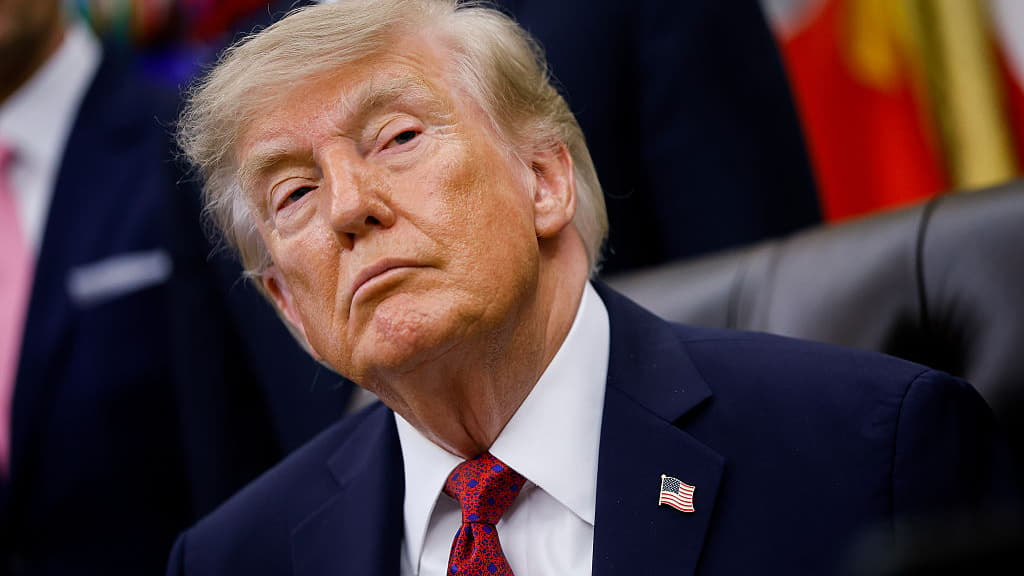
The U.S. military said it struck air defense sites, radar systems, maritime assets and facilities, mine laying capabilities, and communications sites linked to the Islamic Revolutionary Guard Corps (IRGC).
Iran’s Foreign Ministry on Wednesday released a statement insisting the U.S. had attacked civilian areas and service infrastructure in the provinces of Khuzestan, Sistan and Baluchestan, Hormozgan, and Kerman. It said a wedding ceremony in Kuhestak, Sirik County, had been struck, resulting in fatalities and injuries.
In a statement to TIME, CENTCOM spokesperson Navy Captain Tim Hawkins said: “We are aware of reports, which originated from Iranian state media. The U.S. military never targets civilians, unlike the IRGC.”
The IRGC said it had launched retaliatory strikes on U.S. bases in Jordan, Kuwait, and Bahrain, alongside an additional U.S. facility in Iraq, overnight Tuesday.
The renewed hostilities and threats come after a roughly month-long pause in active hostilities between the two countries. On Sunday, the U.S. military struck two Iranian launchers on Larak Island it said were preparing to fire rockets carrying naval mines into the Strait.


Recreational cannabis use is now legal in 24 U.S. states. After Illinois legalized it, in 2020, James Swartz started to keep an eye out for any changes in public health that might stem from more widespread marijuana use. A professor of social work at the University of Chicago, he still remembers when he and his colleagues learned about the rise of a distressing condition that seemed linked to chronic marijuana usage. “We started seeing more and more clinical reports and case studies in the literature about this syndrome,” he says. “So we were curious: Is that happening here?”
They found that indeed, cannabinoid hyperemesis syndrome (CHS)—which can include a symptom colloquially called “scromiting,” a portmanteau of “screaming” and “vomiting”—seemed to be on the rise in emergency departments nationwide. In 2025, the condition even got its own ICD 10 code, allowing doctors to enter it more specifically into medical records. The condition is still poorly understood, and recently, physicians publishing in JAMA wrote a primer on the disorder.
What is cannabinoid hyperemesis syndrome (CHS)?
An important backdrop to the rise of CHS is a condition called cyclic vomiting syndrome, or CVS, says Dr. Thangam Venkatesan, a professor at the Ohio State University who is an expert on CVS and an author of the new paper. “It has episodes of nausea, vomiting, belly pain, headache, and this affects both children and adults,” she says. During episodes, people vomit or retch four or five times an hour, and episodes can last several days, before abating for weeks or months. Understanding and avoiding triggers is key to treating the disorder.
CHS was first described in 2004 in Australia, when doctors carefully followed patients with cyclical vomiting who were habitual cannabis users. It presents similarly to CVS and usually occurs after people have been using marijuana for some time, sometimes as a treatment for other disorders, and involves abdominal pain and vomiting that recedes after people stop cannabis use. The pain can be so intense for some people that they may scream while they vomit. (About the “scromiting” label: Venkatesan doesn’t use it and calls it “a fairly derogatory term.”)
During episodes, people can seek relief by taking very hot baths and showers, though it’s not clear why this helps, says Venkatesan—nor is this coping method unique to CHS. “Close to half the patients with cyclic vomiting who have never used cannabis also exhibit the hot shower bathing behavior,” she says. “This is very peculiar.”
Why is cannabinoid hyperemesis syndrome on the rise?
It’s possible that some of the increase in documented cases comes from more ER doctors recognizing what they’re seeing as a cohesive syndrome, says Venkatesan. But the rise seems to coincide with a sharp increase in the potency of the forms of cannabis now available and an increase in cannabis use generally. Concentrations of THC, the primary psychoactive compound in marijauna, used to be around 1-3% in dried plants, and now they may be higher than 15%—and as high as 95%.
“It’s a completely different product, even in medical dispensaries,” than before legalization, Venkatesan says. She notes that people may not be aware of the potential for syndromes like CHS when they start using cannabis, and the picture is complicated by the fact that many heavy users do not experience these symptoms, she says.
What should people know about cannabinoid hyperemesis syndrome?
Although most people with CHS tend to be young adults, there are patients of all ages. The main risk factors are prolonged use of cannabis with high concentrations of THC.
“You really increase your chances of this with frequent use of high-potency products for an extended period of time,” says Swartz. “So I would say, be careful of the products that you’re using, be mindful of the potency and the frequency with which you’re using. It’s not a fun condition to have.”
The rise of legalized cannabis has also been accompanied by an increase in schizophrenia cases, research has found; one study in Ontario found that cases associated with cannabis-use disorder nearly tripled in recent years. Even before legalization, there was a known link between psychosis and prior cannabis use in young people, suggesting that in some, there may be a genetic predisposition to schizophrenia that is exacerbated by cannabis. Daily use of high-potency cannabis is associated with a nearly five-fold increase in schizophrenia risk, another study found.
Do people with CHS also have psychiatric conditions? Studies found that mental-health conditions and CHS do tend to co-occur, says Swartz. But whether that’s because people are self-medicating with cannabis and thus predisposing themselves to CHS, or whether CHS and mental-health conditions occur together for other reasons isn’t clear.
Quitting cannabis isn’t always an easy process, Swartz says, even with a motivation as strong as resolving CHS. “It’s more complicated than, ‘Hey, just stop,’” he says. “The question is: ‘Why are you using?’ And let’s think of some other way you can address that, other than cannabis.”


After multiple appeals courts ruled differently about whether states can crack down on prediction markets’ sports products, New Jersey asked SCOTUS to step in.


OpenSea has added Solana NFT trading to OS2, giving users access to collections such as Mad Lads and Claynosaurz through its multichain marketplace.
Summary
- OpenSea now allows users to browse, buy, sell, and bid on supported Solana NFT collections.
- The Aug. 31 release extends OS2’s existing Solana services beyond fungible-token trading.
- Mad Lads, Claynosaurz, Collector Crypt, and Phygitals were available during the initial rollout.
- OS2 now competes more directly with Solana-focused marketplaces such as Magic Eden and Tensor.
OpenSea brings Solana NFT trading to OS2
OpenSea said in an Aug. 31 announcement that collectors can now browse, purchase, sell, and place bids on supported Solana NFTs through OS2. The launch includes Mad Lads, Claynosaurz, Collector Crypt, and Phygitals, among other collections built on the network.
Within the same interface, collectors can manage Solana NFTs without changing wallets or visiting a separate marketplace, according to the company. Creators using Solana can also list their work for OpenSea users who may already trade assets issued on other blockchains.
Solana token trading was already available through OS2 before the latest release. Adding NFT functions fills a gap in the platform’s support for the network, as users can now trade both fungible and non-fungible Solana assets through one account.
Released publicly in May 2025 after a testing period, OS2 initially offered token trading across 19 chains. The rebuilt platform also introduced cross-chain features, marketplace aggregation and support for tokens alongside the NFT products associated with OpenSea’s original business.
By Aug. 27, OpenSea said its market data covered more than 25 networks. Four days before the Solana NFT announcement, the company connected its market data to Perplexity Computer, allowing the AI service to answer questions about tokens, collectibles and onchain trading activity.
OpenSea co-founder and CEO Devin Finzer described the data used by AI agents as “open, live, and verifiable” when announcing the Perplexity integration. The service can identify heavily traded assets and collections by drawing from current OpenSea activity rather than relying only on token price feeds.
Solana support adds competition for NFT marketplaces
For Solana collectors, OpenSea’s release adds another place to trade collections that have largely depended on marketplaces with an established presence on the network. Magic Eden began as a Solana-focused platform before adding support for other ecosystems, while Tensor has built products around professional Solana NFT traders.
OpenSea’s entry creates more overlap among the marketplaces, though the company did not provide trading-volume targets, user projections or market-share estimates for its Solana product. Its announcement focused on access to collections and the ability to use existing wallets across supported networks.
The release also restores a service that OpenSea had tested several years earlier. In April 2022, the marketplace introduced Solana NFT support in beta, making Solana its first supported non-Ethereum Virtual Machine network. The new OS2 implementation brings Solana collections back into the platform more than four years after that initial test.
Competition now extends beyond individual NFT listings because the largest marketplaces have added networks, wallets, and token products to retain users. OpenSea has followed that model through OS2, combining its NFT marketplace with fungible-token trading and products that can pull liquidity from several chains.
Its July 2025 acquisition of Rally Wallet added a mobile-first wallet business focused on NFTs and tokens. OpenSea planned to place Rally’s technology within its product range, while Rally co-founder Chris Maddern joined the company as chief technology officer.
OS2 had launched two months before the Rally transaction with real-time liquidity aggregation and cross-chain functions. The wallet purchase gave OpenSea another route to develop mobile trading without separating token activity from NFT portfolio management.
OpenSea continues adding products beyond NFTs
While restoring Solana NFT trading, OpenSea has continued developing services outside its original collectibles market. In June, product executive Zack Brenner asked users about early access to perpetual futures and later indicated that Hyperliquid could supply the infrastructure.
The planned perpetual futures product would place OpenSea closer to crypto platforms that combine spot tokens, derivatives, and rewards. However, the company had not announced a release date or provided final product terms at the time of the report.
Product releases have moved ahead while OpenSea’s SEA token remains delayed. The company introduced SEA in February 2025 and initially expected to release it around March 30, 2026, with proposed uses including governance, reduced trading fees and staking linked to NFT collections.
In March, Finzer postponed the SEA launch and cited difficult market conditions. OpenSea did not provide a replacement date, while users who joined parts of its Waves rewards campaign received an option to recover certain platform fees by giving up associated Treasure Chest rewards.
The token was intended to support OpenSea’s plan for an application covering NFTs, fungible assets and other forms of crypto trading. Solana NFT support advances the product side of that plan without changing the unresolved schedule for SEA.
US regulatory questions remain relevant to OpenSea
For US users, access to Solana NFTs comes after the Securities and Exchange Commission ended an investigation into OpenSea without filing charges. The agency had issued a Wells notice in August 2024, indicating that its staff could recommend enforcement action based on the view that some NFTs traded through the marketplace might qualify as securities.
OpenSea said in February 2025 that the SEC had closed the investigation. Finzer called the decision a victory for NFT creators and argued that treating NFTs as securities would misinterpret existing law.
No enforcement case followed the Wells notice, but the closure did not create a general exemption for every NFT or marketplace operating in the United States. The legal status of an individual digital collectible can still depend on how it is issued, marketed, and sold under US securities law.
In April 2025, crypto.news previously reported that OpenSea had asked the SEC to clarify that NFT marketplaces should not be treated as securities exchanges or brokers. The company’s legal team argued that platforms such as OpenSea do not execute transactions, hold customer assets, or act as intermediaries in the same way as traditional securities firms.
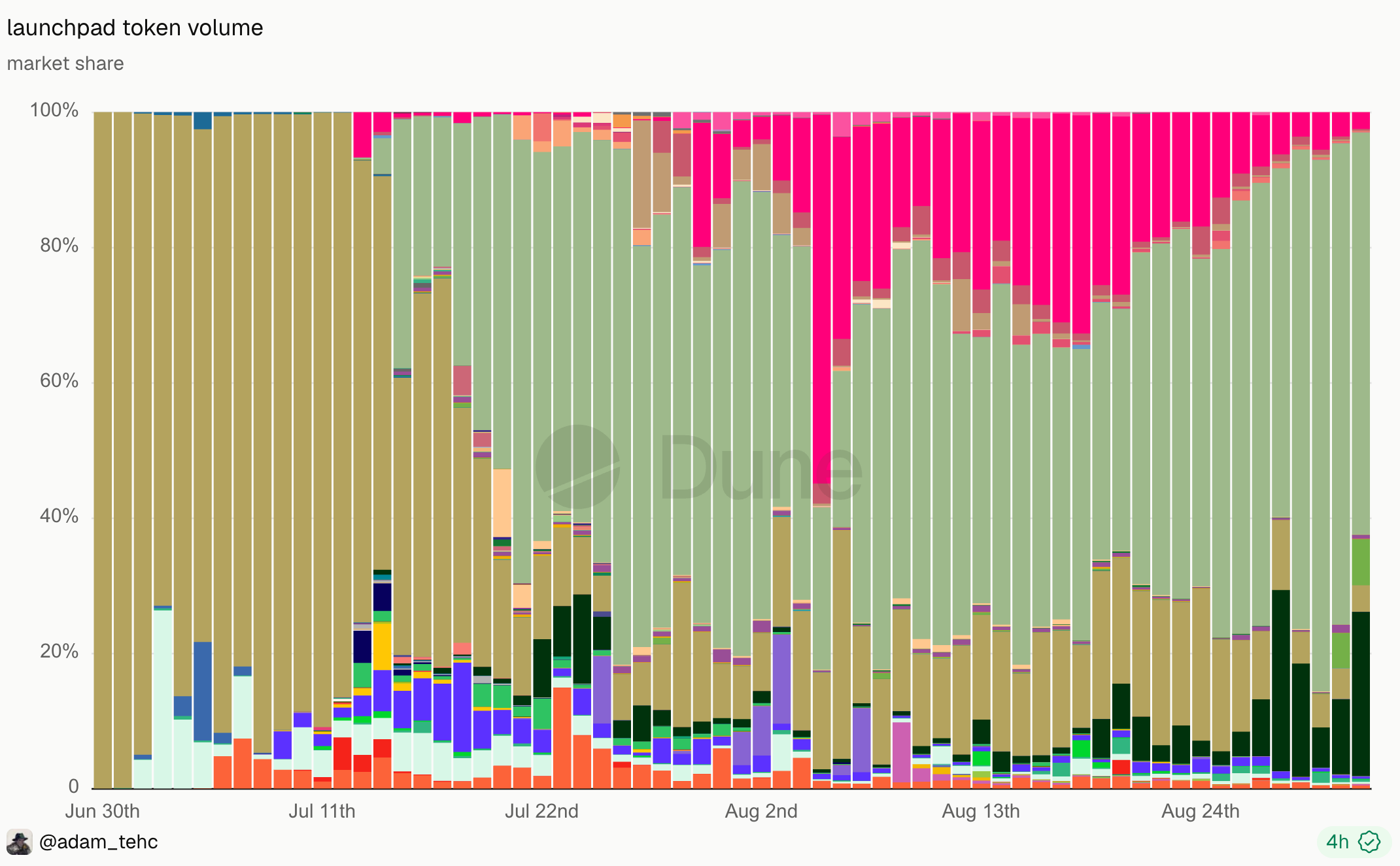
Robinhood built a chain for tokenized stocks. Meme coin traders took it over, and a launchpad called Pons says it has cleared $4.54 billion in volume in under 2 months.
Pons now runs most token launches on the network. Its own token reached a record high on September 1 and leads the chain by market value.
How Pons Took Over Robinhood Chain Launches
The $4.54 billion figure came from Pons’ post on X. The launchpad handled $370.2 million in volume on September 1, according to a Dune dashboard. Launchpads on the network processed $623.1 million combined that day.
That gave Pons 59% of all launch activity on the chain. Rival platform long.xyz placed second with $151.4 million. The lead is not new.
Pons overtook Noxa in mid-July and has held the largest share of daily launchpad volume nearly every day since. Only pools. trade has briefly passed it, in early August.

Token creation is more concentrated still. Launchpads minted 27,802 tokens on August 31, and Pons produced 17,909 of them. The platform counted 106,488 active wallets on September 1.
Fee generation has followed. Bubblemaps put Pons at $4.73 million in fees over 24 hours, citing DefiLlama. That total beat Hyperliquid, Polymarket, and Fomo combined, which reached $4.65 million.
It also topped the combined network fees of Robinhood Chain, BNB Smart Chain, and Solana at $3.46 million. Bubblemaps counted only base network fees for the chains.
Follow us on X to get the latest news as it happens
PONS Token Sets Record High
The volume story has a price story attached. PONS traded at $0.42436 early Wednesday, down 9.82% on the day. Its market capitalization stands at $301.9 million, ranking it 134th.
The token reached a record $0.49328 on September 1. It has gained 1,297.8% over the past month.

Dune data ranks PONS above AI and Cash Cat (CASHCAT) by market value. The token’s lead extends beyond that. PONS was also the most traded asset on the chain over the past 24 hours.
PONS drew $62.46 million in volume over 24 hours across 110,827 trades and 9,063 unique wallets.
Subscribe to our YouTube channel to watch leaders and journalists provide expert insights
The post Pons Earned More Fees in 24 Hours Than Hyperliquid, Polymarket, and Fomo Combined appeared first on BeInCrypto.
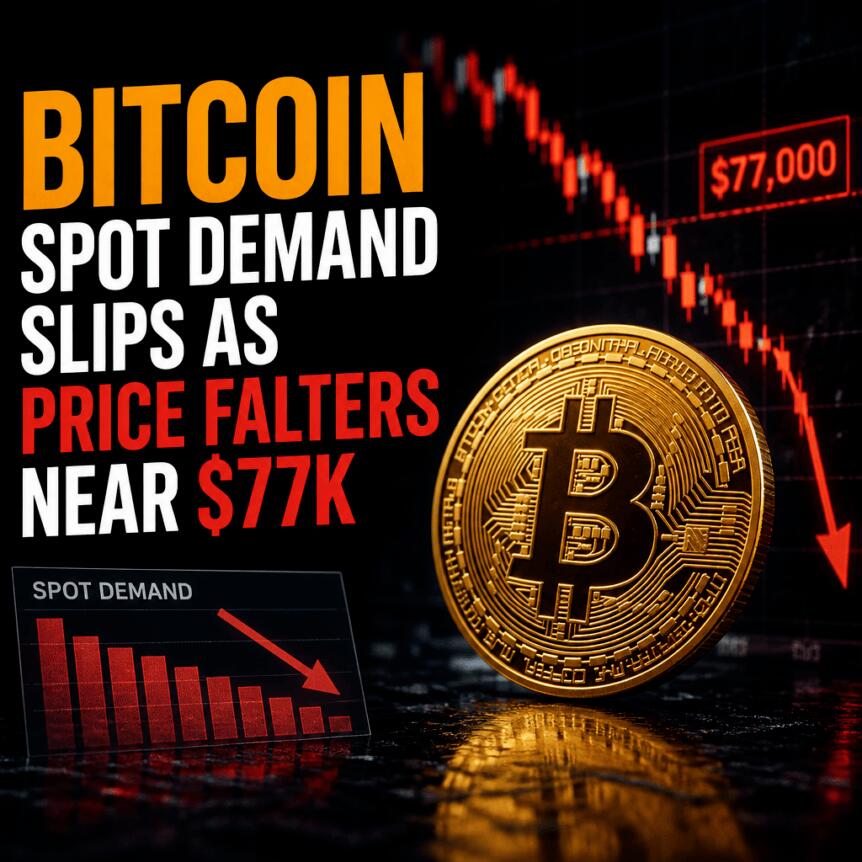
Bitcoin slipped lower in early Wednesday European trading, posting local lows near $76,400 before recovering to around $77,000, according to CoinGecko. The retreat came as broader risk assets weakened in Asia and as the US fixed-income backdrop remained fragile.
CryptoQuant data suggests the selloff wasn’t solely a momentum move—Bitcoin’s “apparent demand” indicator turned negative again following outflows from US spot Bitcoin exchange-traded funds (ETFs) reported the day prior.
Key takeaways
- Bitcoin sold off to roughly $76,400 before reclaiming the $77,000 area, but remains capped by a previously reported resistance cluster.
- According to CryptoQuant, Bitcoin’s apparent demand has flipped negative again after a short improvement during the August rally.
- US spot Bitcoin ETF flows showed $236 million in net outflows the previous day, aligning with the softer on-chain demand read.
- A sharp drop in USD/JPY to about 158.5 reignited speculation about another yen intervention, with no official confirmation at the time of writing.
- Asian equities fell broadly—South Korea’s KOSPI -4.0% and Japan’s Nikkei 225 -2.9%—with tech and chip names among the biggest drags.
CryptoQuant: apparent demand turns negative again
The latest leg down in BTC followed US spot Bitcoin ETF outflows of $236 million reported for the prior day. In parallel, CryptoQuant data indicates Bitcoin’s apparent demand measure has moved back into negative territory after a brief reprieve during the August rally.
The “apparent demand” concept is designed to infer whether market participants are actively absorbing newly created supply and previously dormant coins. It draws inspiration from commodity-market-style issuance versus inventory changes and attempts to capture the gap between newly mined issuance and changes in inactive supply.
In this framework, positive readings are generally interpreted as older coins waking up and the market absorbing both existing supply and new issuance—often viewed as a sign of active spot demand. Negative readings imply that coins are aging into dormancy faster than miners are creating new ones, which is typically treated as weaker spot demand conditions.
While BTC had regained the $77,000 level by the time of writing, it was still described as pinned under a nearby resistance cluster that Cointelegraph previously highlighted. The immediate question for traders is whether the bounce can break through that overhead supply or whether renewed negative demand readings will keep BTC confined.
Macro pressure: yields, USD/JPY, and possible yen intervention
Outside crypto, a broader risk-off mood was building. Earlier in the week, Cointelegraph reported on a global bond selloff that was weighing on markets; on Wednesday, the pressure appeared to ease slightly as the US 10-year yield briefly dipped below 4.8%.
However, FX markets added another layer of uncertainty. Commentators pointed to “inorganic” price movement in the USD/JPY pair around 13:00 UTC, interpreting it as a possible sign of another central bank action. USD/JPY fell to about 158.5, pulling away from the psychologically important 160 level that market participants widely expect the Bank of Japan (BOJ) to defend. At the time of writing, no official statement had confirmed whether intervention occurred.
This matters for crypto indirectly: rapid shifts in USD/JPY often reflect changing expectations for global liquidity and interest-rate differentials—conditions that can influence both risk appetite and the availability of capital for higher-beta assets like cryptocurrencies.
Asian equities slide, tech and chips lead the losses
Equities in Asia traded sharply lower, with multiple factors likely contributing, including rising oil prices and renewed profit-taking in parts of the AI complex. South Korea’s KOSPI led the decline, dropping 4.0% to close at 6,562.72. Among the largest detractors were chipmakers SK Hynix and Samsung Electronics, which fell about 4% and 4.7%, respectively.
Japan’s Nikkei 225 slid 2.9% to 64,325.64, with technology heavyweights contributing to the weakness. SoftBank Group—which has been an investor in OpenAI—was among the names weighed by the broader risk-off tape. The Taiwan index also declined, with the TAIEX down roughly 1.7%.
Earlier coverage from Cointelegraph had already raised concerns about the US side of the AI trade, including signs that credit stress was building via rising credit spreads for hyperscalers. While Wednesday’s equity weakness wasn’t explicitly attributed to any single catalyst in the source, the connection to credit sensitivity is a key reason investors often watch these developments alongside crypto—because a broad deleveraging cycle tends to pressure leveraged positions across markets.
What to watch next: demand signals and the macro backdrop
Bitcoin’s near-term direction may hinge on whether apparent demand continues to recover from the negative reading highlighted by CryptoQuant, or whether the market slips back into a pattern of dormant-supply growth. At the same time, watch USD/JPY for clearer confirmation around intervention expectations and monitor whether US yields stabilize—both can quickly change risk sentiment across crypto and traditional markets.

Modding Platform Nexus Mods Now Owns SteamDB

What Profession Should These Types Of People Do? #shorts #job #money #lawyer #funny

Maine’s high court rules father can restrict daughter’s church attendance





-

 Fashion5 days ago
Weekend Open Thread: Maeve – Corporette.com
-

 Crypto World6 days ago
Bitcoin’s 22% rally now needs real demand to outlast Treasury liquidity boost
-

 Business6 days ago
Apple Confirms September 9 Keynote and Reveals Its Full Pre-Order Schedule
-

 Crypto World7 days ago
Elon Musk Grok Bot Promise: We Will Make You Whole if AI Loses Your Money
-

 Business6 days ago
Salesforce Stock Soars 19% as Blowout Earnings and Agentforce AI Growth Silence Software Skeptics
-

 Business5 days ago
Onto Innovation Stock: AI’s Next Bottleneck Is Yield (NYSE:ONTO)
-

 Crypto World7 days ago
NVIDIA revenue hits $96.2B as AI demand doubles
-

 Crypto World5 days ago
Bitcoin price tests $82K resistance as Brandt stays long
-
 Tech4 days ago
Hugging Face built a $4.5 billion empire on free AI models. Now Nvidia is buying it for $12.9 billion
-

 Crypto World7 days ago
Nvidia Q2 Earnings Reveal $96.2 Billion Beat, So Why Is NVDA Falling?
-

 Business5 days ago
iPhone 18 Pro Pre-Orders Could Shift to Saturday as Apple Reportedly Avoids September 11 Anniversary
-

 Tech7 days ago
Claude Cowork gets its own browser that doesn’t touch your tabs, bookmarks, or saved passwords
-

 Crypto World6 days ago
Truflation calls for Fed rate cut after PCE forecast
-

 Crypto World7 days ago
GENIUS Act missed its deadline as OCC writes rules anyway
-

 Tech5 days ago
PaperCut releases second emergency patch for exploited flaws
-

 News Videos3 days ago
Charlie Munger on Robinhood: No one should believe that Robinhood’s trades are free
-

 Tech7 days ago
Apple’s iPhone 18 Pro event is on September 9
-

 Tech6 days ago
The fix for the AI agent that hijacked a company’s DNS: it can propose the change, but it can’t approve it
-
 Entertainment5 days ago
‘Adults’ Creators Break Down Season 2’s Most Shocking Moments and Tease a Potential Season 3
-

 Tech4 days ago
Tamagotchi Ring Takes the 30-Year Digital Pet and Places it on Your Finger
You must be logged in to post a comment Login