

Crypto World
3 Token Unlocks to Watch in the Third Week of May 2026

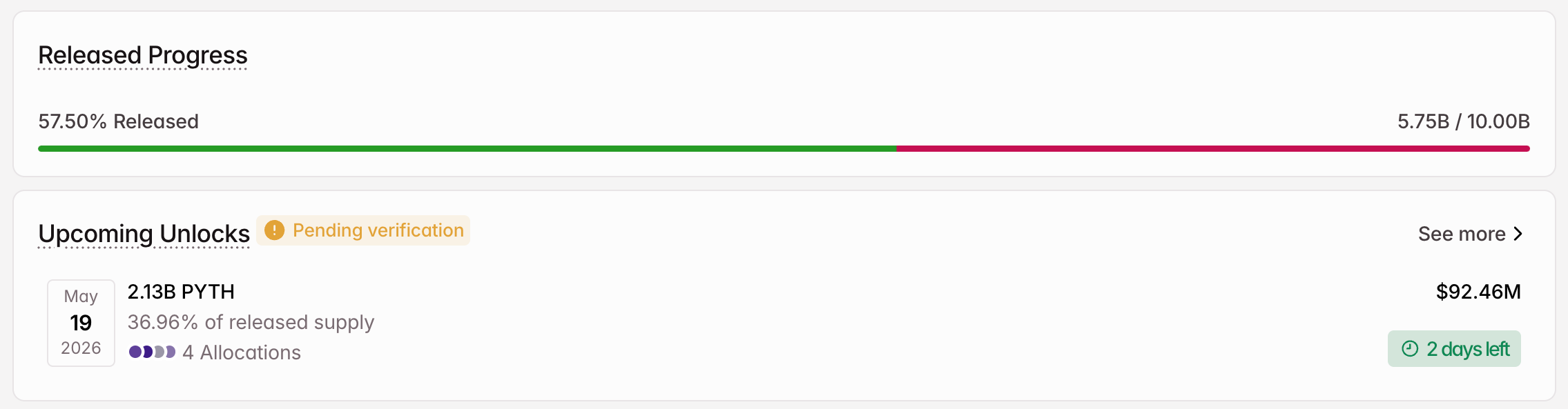
The crypto market will welcome tokens worth more than $770 million in the third week of May 2026. Major projects, including Pyth Network (PYTH), LayerZero (ZRO), and KAITO (KAITO), will release significant new token supplies.
These unlocks could introduce market volatility and influence short-term price movements. So, here’s a breakdown of what to watch.
1. Pyth Network (PYTH)
- Unlock Date: May 19
- Number of Tokens to be Unlocked: 2.13 billion PYTH
- Released Supply: 5.75 billion PYTH
- Total Supply: 10 billion PYTH
Pyth Network is a decentralized oracle protocol that delivers real-time financial market data directly to blockchain applications. It sources price feeds from over 120 first-party publishers, including major exchanges, market makers, and trading firms, covering crypto, equities, FX, and commodities.
On May 19, the team will release 2.13 billion tokens, worth approximately $92.46 million. The altcoins account for 36.96% of the current released supply.

The network will split the supply four ways. Pyth Network will allocate 1.13 billion tokens to ecosystem growth and 537.5 million tokens to publisher rewards.
In addition, the team will keep 250 million tokens for private sales. Lastly, Pyth will direct 212.5 million tokens toward protocol development.
2. LayerZero (ZRO)
- Unlock Date: May 20
- Number of Tokens to be Unlocked: 25.71 million ZRO
- Released Supply: 507.08 million ZRO
- Total Supply: 1 billion ZRO
LayerZero is an interoperability protocol that connects different blockchains. Its primary goal is to facilitate seamless cross-chain communication. Thus, it enables decentralized applications (dApps) to interact across multiple blockchains without relying on traditional bridging models.
The team will unlock 25.71 million tokens on May 20, representing 5.07% of the released supply. Moreover, the supply is worth approximately $32.65 million.

LayerZero will award 13.42 million altcoins to strategic partners. Core contributors will get 10.63 million ZRO. Lastly, 1.67 million ZRO are for tokens repurchased by the team.
3. Kaito (KAITO)
- Unlock Date: May 20
- Number of Tokens to be Unlocked: 17.6 million KAITO
- Released Supply: 374.28 million KAITO
- Total Supply: 1 billion KAITO
Kaito is an artificial intelligence (AI)-powered Web3 information platform that aggregates and analyzes cryptocurrency market data from diverse sources like social media, governance forums, news, and more. The KAITO token serves as a medium of exchange, governance tool, and incentive mechanism within the platform.
On May 20, the team will unlock 17.6 million tokens, representing 4.7% of the current released supply. The supply is worth approximately $8.58 million.

The foundation will receive 1.19 million tokens. Core contributions will get 6.94 million tokens. Furthermore, early backers will receive 2.31 million KAITO. Finally, the team will direct 7.16 million KAITO for ecosystem and network growth.
In addition to these, other prominent unlocks investors can look out for in the third week of May include MBG by Multibank Group (MBG), YZY (YZY), Soon (SOON), and more, which will contribute to the overall market-wide releases.
The post 3 Token Unlocks to Watch in the Third Week of May 2026 appeared first on BeInCrypto.

Bitcoin sentiment is sliding to a level Lyn Alden describes as the weakest she has personally seen, as the latest market phase has become more corporate- and leverage-influenced rather than driven by fresh spot demand. In an interview with Natalie Brunell on Tuesday, Alden argued that Bitcoin’s long-term case cannot depend on outside saviors—it must be able to “survive on its own merits.”
The comments also arrive as Strategy, Michael Saylor’s flagship corporate Bitcoin vehicle and the largest public holder, disclosed another round of selling. Strategy’s Monday weekly 8-K filing said it sold 3,588 BTC, a disclosure that has intensified scrutiny of how corporate structures and yield-style products interact with Bitcoin’s volatility.
Key takeaways
- Lyn Alden said current Bitcoin sentiment is at the lowest point she has seen, and she expects a year that is “flat to up” rather than “flat to down.”
- Alden emphasized Bitcoin must stand on core fundamentals—liquidity, permissionless transfer, and value storage—rather than new external catalysts.
- While Alden sees a role for Strategy’s STRC preferred stock, she cautioned that BTC-linked products can encourage leverage.
- On protocol change proposals, Alden urged caution and criticized the “existential issue” framing used to push faster rule modifications.
Why Alden thinks this cycle feels different
Alden contrasted the present mood with the 2022 bear market, when Bitcoin fell as low as the mid–$16,000 range but investor enthusiasm remained comparatively steadier. In her view, the current drawdown has come alongside a fading of narratives and a market cycle that has leaned more heavily on corporate balance sheets and institutional-style structures.
She also flagged investor disappointment as a contributor to sentiment deterioration. Even so, Alden laid out a tempered base case: she does not expect Bitcoin to print a new all-time high within the year, while also acknowledging the asset’s historic volatility leaves room for a sharp upside move.
Her “hope” scenario is not a fast recovery to new highs, but the prevention of further sustained declines—what she described as a “lack of new bottoms in place.” Technically, she suggested the broader path could look more sideways to upward rather than trending lower, though she did not frame that as a guarantee.
Strategy’s sale and the debate over leverage
Corporate adoption has been one of Bitcoin’s dominant themes in recent cycles, and Strategy has been central to that story. However, Alden said Strategy’s STRC preferred stock has increasingly become part of the market’s trading and positioning toolkit—especially for investors who want exposure to the company’s Bitcoin strategy without holding BTC directly or taking on the full volatility profile.
At the same time, she warned that the presence of higher-yielding BTC-linked products can unintentionally pull more leverage into the system. That dynamic matters because the more investors rely on layered exposure structures, the more sensitive performance can become when market conditions tighten—even if the underlying asset remains unchanged.
Her remarks land amid ongoing discussion about Strategy’s capital structure and the perceived risks tied to Bitcoin-backed preferred stock products. Alden characterized recent actions by Strategy to rebuild reserve coverage and add safeguards as reasonable reactions to market stress, but she also stressed that the long-term behavior of such products still ultimately depends on Bitcoin’s price action.
In practical terms, Alden’s framing suggests investors should distinguish between a product’s access benefits and the risk it may add to portfolio behavior during drawdowns. For traders, that translates into being more precise about the source of exposure—spot versus structured yield versus leverage—and how each tends to react when sentiment breaks.
BIP-110 and Alden’s stance on faster protocol changes
Alden also addressed Bitcoin Improvement Proposal 110 (BIP-110), a proposal aimed at reducing network spam by restricting data-heavy transactions, including those used for storing images. Her position was notably cautious: she said she is generally wary of efforts to change Bitcoin’s rules quickly, arguing that some proposals could increase network complexity or alter existing safeguards.
Rather than rejecting technical scrutiny outright, Alden said she would evaluate the arguments for and against protocol changes. Still, she criticized how some proposals are presented publicly, especially when they are framed as an “existential issue” for Bitcoin. In her view, that kind of language exaggerates the stakes and can amount to “incorrect marketing.”
The takeaway from her comments is not simply that all rule changes are bad, but that the way proposals are communicated can affect how investors and users interpret urgency—particularly during periods when sentiment is already fragile.
What to watch next
With sentiment at a cycle-low level in Alden’s assessment and Strategy’s selling now firmly in focus, traders and long-term holders will likely watch whether Bitcoin stabilizes without additional “new bottoms,” and whether BTC-linked structured products become a source of fragility—or a stabilizing bridge—during the next leg of market direction.
Bitcoin is facing its weakest sentiment cycle yet, according to Lyn Alden, a Bitcoin-focused macroeconomist who said the asset must stand on its own as Strategy disclosed a $216 million Bitcoin sale earlier this week.
“I don’t think there’s anything coming to save Bitcoin,” Alden said in a Tuesday interview with journalist and Bitcoin educator Natalie Brunell, saying the asset’s long-term success must come from its own fundamentals rather than external catalysts.
“The asset just has to survive on its own merits,” Alden said, pointing to Bitcoin’s underlying properties as a liquid, permissionless way to store and send value, instead of relying on a new source of demand.
Her comments come as institutional adoption and corporate treasury strategies have become features of Bitcoin’s latest market cycle. On Monday, Strategy’s weekly 8-K filing disclosed that it sold 3,588 BTC.
Bitcoin sentiment falls to a cycle low
Alden said the current downturn feels different from the 2022 bear market, when Bitcoin dropped to as low as $16,000 but enthusiasm among Bitcoin investors remained relatively strong.
“This is the lowest sentiment that I’ve personally seen on Bitcoin,” Alden said, pointing to a combination of fading narratives, a more corporate-driven market cycle and disappointment among investors.
Alden said her base case is that Bitcoin will not reach a new all-time high this year, though she acknowledged that the asset’s volatility leaves room for a sharp move higher.
“The base case that I would hope to see is just a lack of new bottoms in place” and a technical picture that points “flat to up rather than flat to down,” Alden said.
STRC found demand, but leverage remains a risk
Michael Saylor’s Strategy, the world’s largest corporate Bitcoin holder, has come under increased scrutiny during the downturn as investors reassess the risks around its Bitcoin-backed capital structure and preferred stock products.
Alden said Strategy’s STRC preferred stock has a role for investors who want exposure to the company’s Bitcoin strategy without holding the asset directly or taking on Bitcoin’s full volatility.
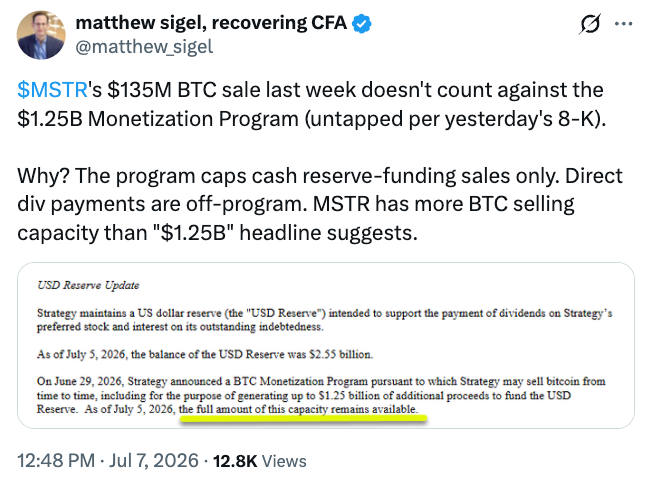
Source: Matthew Sigel
She noted that STRC has become the biggest preferred security in the market, but warned that higher-yielding BTC-linked products can encourage investors to take on additional leverage.
Related: Strategy’s Bitcoin sale may give BTC a ‘durable bottom,’ Grayscale says
She added that Strategy’s recent steps to rebuild its reserve coverage and introduce additional safeguards were reasonable responses to the market stress, though the long-term performance of the product still depends on Bitcoin’s price action.
Alden pushes back on urgency around Bitcoin changes
Alden also discussed Bitcoin Improvement Proposal 110 (BIP-110), which aims to reduce network spam by limiting data-heavy transactions, including those used to store images.
Alden said she is generally cautious about efforts to change Bitcoin’s rules quickly, warning that some proposals could make the network more complex or affect its existing safeguards.
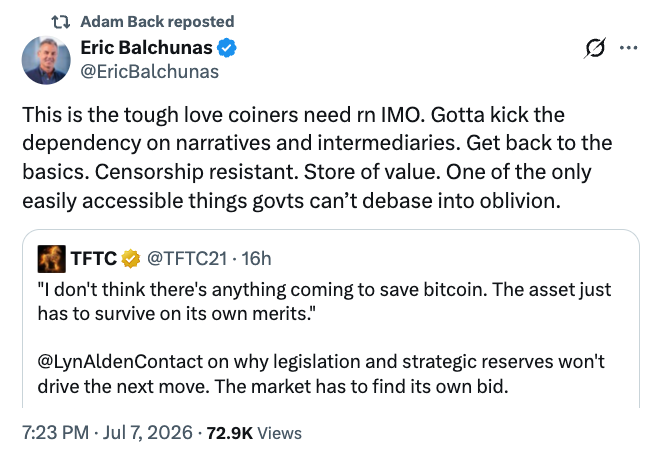
Source: Eric Balchunas
She said she would analyze the technical arguments for and against protocol changes, but criticized the way some proposals are presented to the public. Alden argued that framing a protocol change as an “existential issue” for Bitcoin exaggerates the stakes, calling that approach “incorrect marketing.”
Magazine: Has Bitcoin bottomed for this cycle? Analysts say ‘not yet’

Futures for the Dow Jones Industrial Average and other major stock indexes traded sharply lower Wednesday after President Donald Trump said the U.S.-Iran ceasefire was “over.” Memory stocks Micron Technology (MU) and Sandisk (SNDK) were early losers on the stock market today, threatening to extend their sell-offs amid recent weakness in artificial intelligence stocks. Ahead of Wednesday’s opening bell, Dow…
Copyright ©2026 Investor’s Business Daily, LLC. All rights reserved. 87990cbe856818d5eddac44c7b1cdeb8

Australian crypto exchange Swyftx says it has received an Australian Financial Services License (AFSL), giving it regulatory permission to offer certain crypto-linked products to retail customers and to provide non-cash payment services to businesses and individuals. The move is also tied to Swyftx’s stated shift away from a “spot-only” model, with management pointing to upcoming changes in Australia’s card payment surcharge rules.
According to Swyftx, the license allows it to support derivative offerings—such as crypto options and futures—for retail users, alongside authorization for non-cash payment facilities. The AFSL does not, however, cover spot crypto trading.
Key takeaways
- Swyftx has obtained an AFSL from Australia’s market regulator, enabling retail derivatives and non-cash payment services.
- The company says it does not intend to remain a pure spot exchange, citing room in crypto payments after credit-card surcharge reforms.
- From Oct. 1, Australian merchants are set to face new restrictions on Visa and Mastercard debit/credit surcharges, potentially pushing demand toward alternative payment rails.
- AFSL compliance obligations are expected to become central for most crypto firms, with legislation setting an April 9, 2027 deadline.
Swyftx’s AFSL enables derivatives and payment-facility services
Swyftx announced on Wednesday that it has been granted its AFSL, positioning it among a growing group of crypto companies already operating under Australia’s broader financial-services framework. The license places Swyftx in the same regulatory category as exchanges previously licensed for comparable activities, including Coinbase, BTC Markets and Crypto.com.
In an interview with Cointelegraph, Swyftx interim co-CEO Andrea Yuen said the firm does not plan to remain “a pure crypto spot exchange.” Instead, Swyftx is aiming to broaden its product set and pursue opportunities in payments—particularly in areas it believes could benefit from local regulatory and cost changes affecting card payments.
Operationally, the AFSL matters because it expands what Swyftx can offer within the Australian market. As the company described, the license supports two major directions: derivative products for retail customers (for example, options or futures) and non-cash payment facility authorization, which could allow Swyftx to serve both business and retail clients with payment services.
At the same time, Swyftx’s AFSL does not cover spot crypto trading. That distinction is important for users and investors: the licensing step is not simply a blanket endorsement of all crypto activities, but a permission tied to specific regulated functions.
Why card surcharge changes are driving a push toward crypto payments
A core part of Swyftx’s strategy is directly linked to expected changes to how merchants can recover card payment costs. From Oct. 1, Australian businesses will be banned from adding surcharges to Visa and Mastercard debit and credit card payments. For many merchants, that removes a common mechanism used to pass card transaction costs to customers.
In that environment, Swyftx says it sees potential for alternative payment rails—specifically crypto and stablecoins. Yuen told Cointelegraph that crypto payments and stablecoins could provide merchants with an opportunity to lower transaction costs they may otherwise have to absorb.
The logic is straightforward: when a payment network’s pricing can’t be “passed through” via surcharges, businesses may look for ways to reduce net payment expenses. Stablecoins and regulated crypto payment flows are often discussed as one possible alternative, but the practical impact will depend on merchant adoption, integration pathways, and how regulators supervise payment-related activity.
For the market, Swyftx’s license could also help it participate in payments-based competition rather than relying only on trading volumes. If merchants do move search for cheaper rails following Oct. 1, exchanges with the right authorization may find new distribution channels—especially where stablecoin settlement can be paired with compliant payment tooling.
AFSL deadline pressure builds as ASIC extends a licensing grace window
Beyond Swyftx’s immediate products, the AFSL is tied to a wider regulatory timetable for the Australian crypto sector. Legislation passed in April requires most crypto firms to obtain an AFSL from April 9, 2027, according to earlier coverage by Cointelegraph (https://cointelegraph.com/news/australia-pass-bill-mandate-crypto-exchange-license).
Until now, many crypto exchanges were required primarily to maintain anti-money laundering (AML) and know-your-customer (KYC) controls rather than full financial-services licensing duties. With the AFSL framework, firms are expected to follow compliance standards comparable to other regulated financial institutions.
Yuen described the shift as “an enormous responsibility to be a regulated financial service,” underscoring that obtaining the license is not simply a marketing milestone—it comes with ongoing obligations.
At the regulator level, ASIC has also been working to manage the transition. The Australian Securities and Investments Commission recently extended its grace period for crypto businesses to apply for an AFSL until Sept. 30. ASIC said it has received around 30 license applications from crypto businesses since October last year (ASIC statement: https://www.asic.gov.au/about-asic/news-centre/news-items/asic-extends-no-action-position-for-digital-asset-businesses-to-30-september-2026/).
Only a limited number of crypto exchanges have so far obtained AFSLs, including Coinbase, BTC Markets, Crypto.com and KuCoin, based on prior Cointelegraph reporting (https://cointelegraph.com/news/ripple-eyes-australian-financial-license-through-acquisition).
For investors, traders, and builders, this is a key inflection point: licensing progress can influence which firms can expand into derivatives retail distribution and regulated payment services, while laggards may be constrained by timelines and regulatory uncertainty as April 2027 approaches.
Australian retail adoption remains resilient as licensing expands
While regulatory licensing advances, local interest in crypto assets continues to be reflected in consumer surveys. A survey cited by Swyftx’s update from Independent Reserve suggested that 33% of Australians now own cryptocurrency, up from 31% in 2025.
Independent Reserve CEO Adrian Przelozny said younger Australians are increasingly confronting economic pressures that make traditional wealth-building options—particularly home ownership—feel less attainable. He argued that, as a result, many are exploring alternative assets, with cryptocurrency viewed as one option that has historically delivered stronger returns than traditional portfolios.
The same survey indicated that Bitcoin remains the dominant digital asset among respondents, with 71% reporting they hold it.
Taken together, rising participation and accelerating licensing could create a broader market environment: more consumers may seek regulated access, while exchanges that secure AFSL permissions may be better placed to deepen product offerings and payment-related services.
Looking ahead, readers should watch how Swyftx and other newly licensed firms translate AFSL capabilities into real payment integrations and derivative offerings, and whether merchant adoption follows the Oct. 1 surcharge rule change as expected. The regulatory transition toward 2027 will also be a determining factor in how quickly Australia’s crypto market can diversify beyond spot trading.

AngelList, the venture capital platform hosting more than 50,000 funds and 800,000 accredited investors, is terminating its partnership with Rail – the B2B payments platform operated by Ripple – effective July 31, 2026, removing all crypto payment options from the platform in the process. The decision is a direct setback for Ripple’s enterprise payment ambitions, less than a year after it paid $200 million to acquire Rail.

AngelList confirmed the move in a formal notice, stating that USDC, USDT, DAI, and ETH will become completely unavailable after the July 31 deadline. Users have been directed to switch to ACH and wire transfers for any upcoming investments to avoid processing delays. Existing investments, account access, and portfolio data are unaffected.
No explanation was given for the decision beyond the wind-down notice itself.
Discover: The Best Crypto to Diversify Your Portfolio
What Rail Was Built to Do
Ripple acquired Toronto-based Rail in August 2025 for $200 million as part of a broader $2.45 billion M&A push. Rail’s core proposition was enabling enterprise businesses to process stablecoin payments – including USDC and USDT – across multiple fiat currencies without requiring dedicated crypto wallets or exchange integrations. For a platform like AngelList, it was a clean on-ramp for accredited investors to deploy capital using digital assets.

Don’t Miss Out on Our $1,000 USDT Airdrop on ByBit
The pitch was straightforward: reduce friction for crypto adoption in institutional workflows without asking enterprises to overhaul their backend infrastructure. AngelList’s exit suggests that the pitch didn’t hold up against the platform’s operational priorities.
What makes the timing notable is the broader context around Ripple. The company secured a key European regulatory license in early July 2026, and Clearstream – the European post-trade giant – added XRP and other tokens to its custody offering just days before AngelList’s announcement. Ripple’s institutional footprint is expanding in some directions while contracting in others, and AngelList’s retreat underscores that crypto adoption in enterprise payment stacks remains uneven regardless of headline momentum.
Discover: The Best Token Presales
What This Signals for Ripple Enterprise Strategy
The AngelList exit doesn’t impair Ripple’s balance sheet, but it does damage the Rail narrative. A $200 million acquisition is easier to justify when flagship enterprise clients stay on the platform; losing a name-brand partner like AngelList – a firm synonymous with the startup and venture ecosystem – invites questions about how deep Rail’s enterprise traction actually runs.
The broader XRP market picture has been constructive in 2026, with ETF inflows and volume metrics tracking positively. But asset price momentum and enterprise product adoption are separate variables, and AngelList’s move is a reminder that conventional fiat rails – ACH and wire transfers – still win on simplicity and compliance predictability for many institutional operators, even ones deeply embedded in the tech ecosystem.
The stablecoin market has faced its own headwinds in 2026, and broader uncertainty around stablecoin settlement infrastructure may be a contributing factor in AngelList’s calculus, even if the company hasn’t said so explicitly.
The operational clock is running. AngelList users currently routing investments through crypto payment options, USDC included, have until July 31 to transition. After that date, the platform reverts entirely to traditional financial infrastructure with no stated timeline for reintroducing crypto payment support.
Watch for whether Ripple responds with a replacement enterprise client announcement to blunt the reputational impact, and whether Rail’s remaining partnerships hold as AngelList’s exit gets priced into how the industry assesses Ripple’s enterprise payment ambitions heading into late 2026.
Don’t Miss Out on Our $1,000 USDT Airdrop on ByBit
The post Ripple’s $200M Rail Acquisition Loses AngelList as Crypto Payments Get Cut appeared first on Cryptonews.

Key Highlights
- The electric vehicle manufacturer executed a public offering of 75 million shares priced at $15.50 each, generating approximately $1.2 billion in gross capital.
- Shares plummeted more than 18% during Tuesday’s session, followed by an additional ~4% decline in Wednesday’s pre-market trading amid shareholder dilution concerns.
- Second-quarter revenue projections range between $1.55B and $1.65B, surpassing Wall Street’s consensus estimate of approximately $1.45B.
- The automaker increased its 2026 annual delivery guidance to 65,000–70,000 units from the previous 62,000–67,000 range.
- Multiple Wall Street firms, including JPMorgan and Mizuho, recently downgraded the stock to Sell, highlighting capital expenditure concerns and EV subsidy elimination risks.
Shares of Rivian (RIVN) experienced a dramatic decline exceeding 18% during Tuesday’s trading session following the company’s announcement of a 75 million-share public offering priced at $15.50 per share, generating roughly $1.2 billion in gross capital. The selloff continued into Wednesday’s pre-market hours, with shares falling an additional 4.7%.
The pricing of the equity raise came in below recent trading levels, and the substantial influx of new shares severely dampened investor sentiment. Investment banks underwriting the deal also secured a 30-day option to purchase up to 11.25 million additional shares. The transaction is scheduled to finalize on Thursday, July 9.
Rivian indicated the capital raised will support general corporate activities, with a designated portion allocated to satisfy requirements under its loan facility with the U.S. Department of Energy.
The timing of the offering came after shares had rallied on stronger-than-anticipated second-quarter delivery performance. The company delivered 12,194 vehicles during the period, exceeding both internal projections and JPMorgan’s estimate of 11,000 units.
Concurrent with the capital raise announcement, Rivian disclosed preliminary Q2 revenue guidance of $1.55 billion to $1.65 billion, meaningfully above the Wall Street consensus forecast of around $1.45 billion.
The electric vehicle maker also elevated its full-year 2026 delivery outlook to a range of 65,000–70,000 vehicles, representing an increase from its previous guidance of 62,000–67,000 units.
Analyst Community Remains Skeptical
Notwithstanding the encouraging operational metrics, the analyst community maintains a cautious stance. Three separate firms issued Sell recommendations on RIVN shares in recent trading sessions.
JPMorgan analyst Rajat Gupta maintained his Sell rating, highlighting the company’s substantial capital expenditure requirements as a primary risk factor, despite the delivery beat.
Mizuho analyst Vijay Rakesh similarly retained his Sell recommendation, forecasting that battery-electric vehicle sales could remain flat on a year-over-year basis. His pessimistic outlook stems from the termination of federal EV subsidies in the United States.
Jefferies adopted a somewhat more balanced perspective, upgrading its price target to $17 from $16 while maintaining a Hold rating. The firm observed that the equity offering followed a significant stock price appreciation triggered by the Q2 delivery data.
Layoffs Compound Investor Concerns
Earlier this week, news of workforce reductions added further pressure on the stock. Reports indicate that Rivian eliminated hundreds of positions, primarily concentrated in service and customer-facing operations — representing less than 2% of total headcount.
The company continues to operate at a loss and is banking on its more competitively priced R2 SUV to accelerate sales volume. The R2 model debuted in March, with customer orders commencing last month.
Broader market conditions provided no relief. The Nasdaq Composite declined 1.2% on Tuesday amid semiconductor sector weakness, while the S&P 500 retreated 0.5%.
Among 17 analysts providing coverage over the past three months, the consensus recommendation stands at Hold, comprising eight Buy ratings, five Hold ratings, and four Sell ratings. The mean price target of $18.24 suggests approximately 11% potential upside from present trading levels.

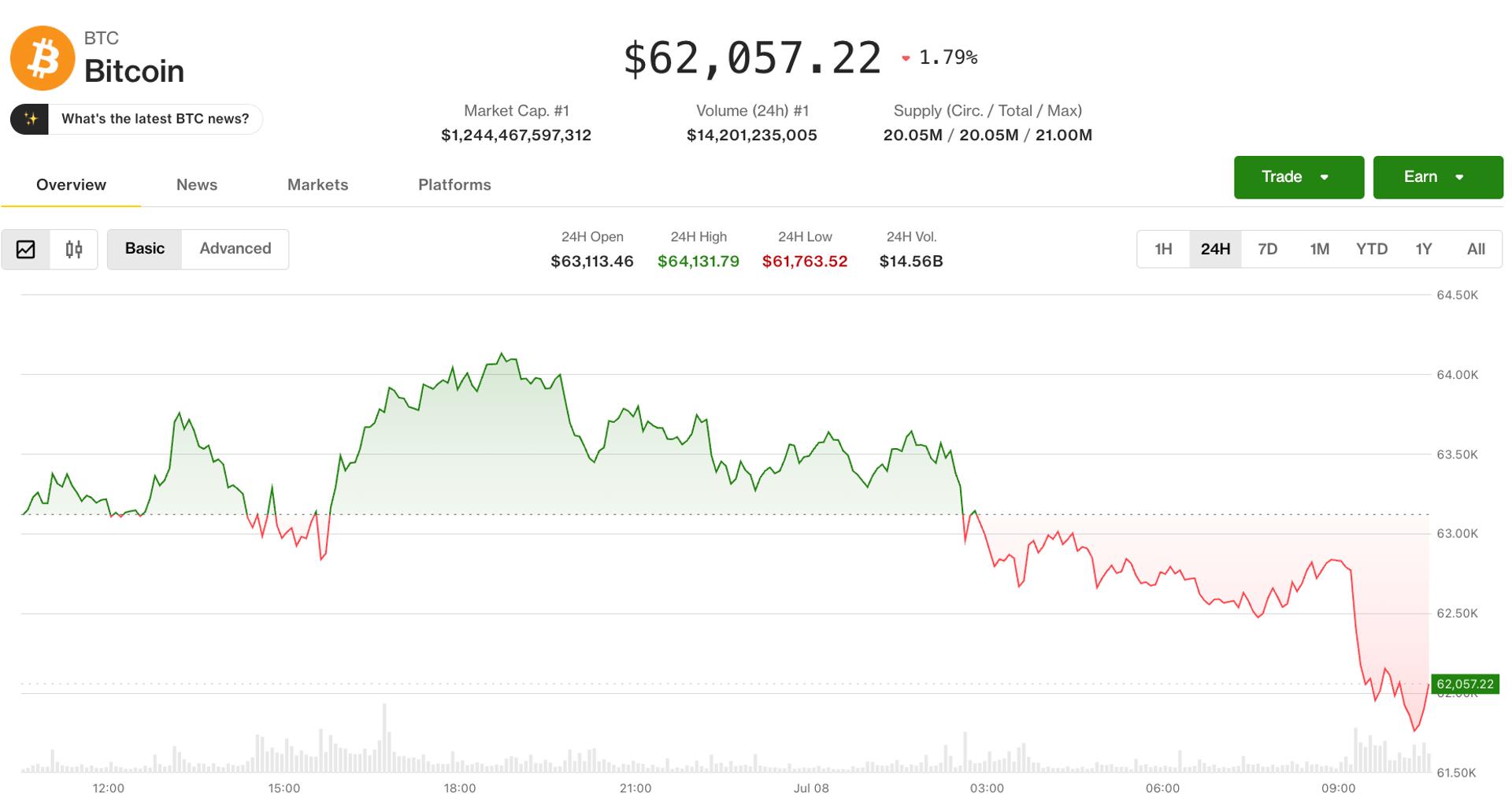
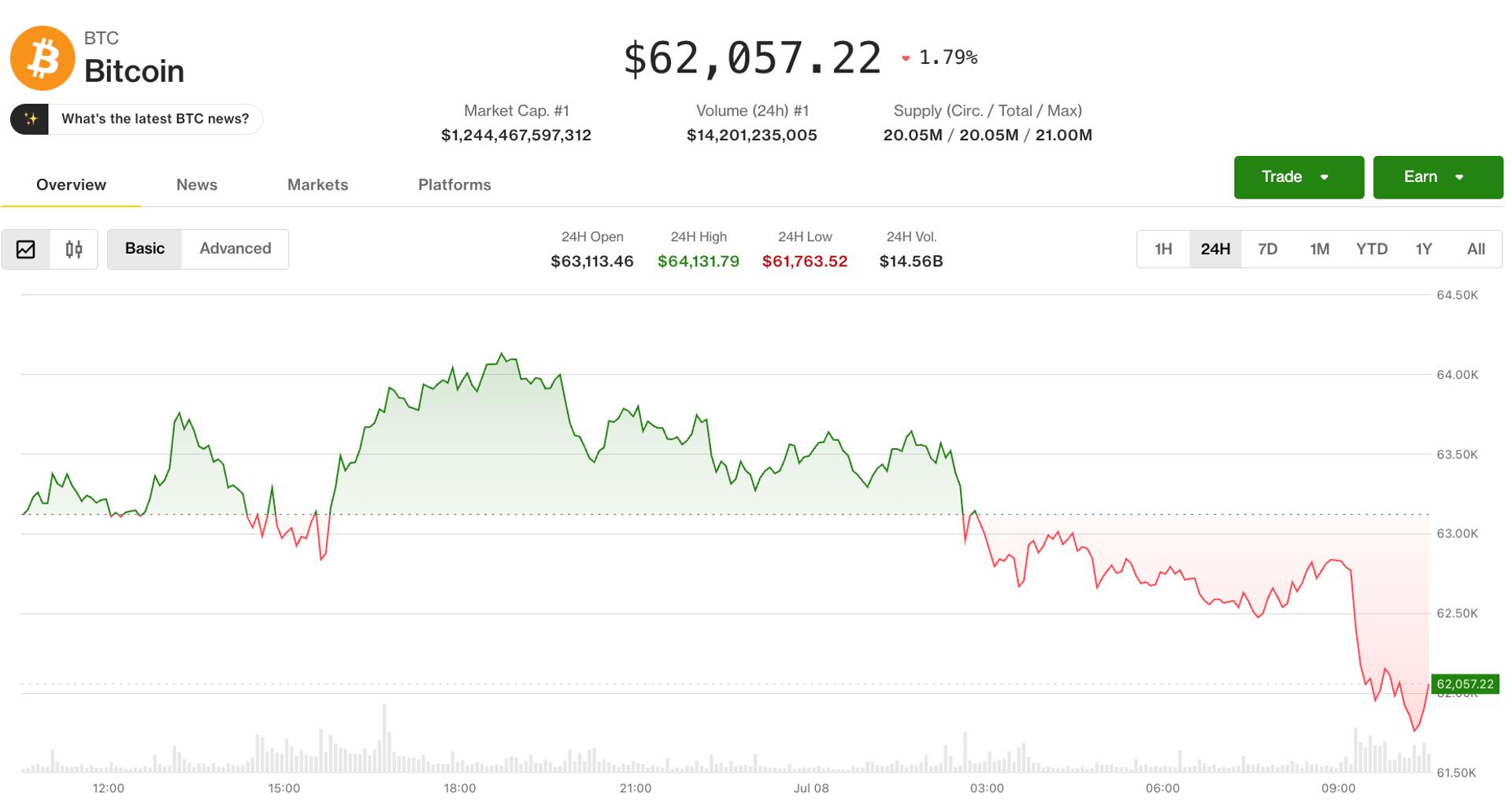
Crypto markets fell Wednesday after fresh airstrikes in Iran spurred a risk-off mood among investors. The CoinDesk 20 Index dropped 2.9% since midnight UTC, with all but one token declining.
Addressing NATO leaders, U.S. President Donald Trump declared the ceasefire “over” and said negotiating with Iran is a “waste of time,” though talks continue, according to news reports.
The U.S. Central Command said it hit more than 60 Islamic Revolutionary Guard Corps small boats to prevent them disrupting international shipping and Iran retaliated with attacks on Kuwait and Bahrain.
The Dollar Index (DXY) rose as the reignited tensions are likely to stoke inflation concerns. Bitcoin and ether (ETH), the two largest cryptocurrencies, fell more than 2%.
There were sharper losses across the more illiquid altcoin sector as JUP, ETHFI and PUMP all losing more than 5%.
U.S. equities also took a hit. Nasdaq 100 index futures and S&P 500 index futures tumbled as much as 1.5%.
Derivatives positioning
- Despite bitcoin’s slide to $62,000, it’s still up 6% this month and there is some good news on the derivatives front: Traders don’t look to be shorting the rally. Open interest (OI) in futures has dropped to 730K BTC from over 740K BTC a day ago.
- Ether is not faring so well. Open interest has held steady at around 13.95 million tokens despite the spot-price drop triggering liquidations of bets worth $90 million. BTC 24-hour liquidations tally just over $100 million.
- The sell-off in Canton Network’s CC token has accelerated, with the token’s price slipping to its lowest level since January just as futures open interest rises to a two-week high. This combination points to the possibility of traders shorting the decline, especially since funding rates remain deeply negative, close to -20%.
- Broadly speaking, the bear grip has tightened across major cryptocurrencies, including BTC and ETH, as indicated by their negative 24-hour OI-adjusted cumulative volume delta. A negative reading indicates that price action is being driven by traders placing market orders rather than passive limit orders.
- The latest decline in BTC and ETH seems to have spurred hedging demand for options, as their respective 30-day implied volatility indexes, BVIV and EVIV, are up for the second straight day.
- Options skew on Deribit confirms that. The one-week skew has jumped to nearly 20% in favor of puts from 16% a day ago. Puts offer protection against a price slide in the underlying asset, in this case, BTC. The same is true for ether.
- However, 24-hour volume figures show the highest activity in BTC call options at the $80,000 strike price.
Token talk
- The altcoin market is reeling, with $350 million worth of the $450 million in liquidations being attributed to altcoin trading pairs, according to CoinGlass.
- Solana (SOL) has now completely retraced a rally that began on July 2, trading back at $77 after challenging $84 on Monday.
- One token bucking the bearish sentiment is MORPHO. The DeFi token is up by 4% since midnight as total value locked (TVL) on the protocol hit a record high 4 million ETH this week, according to DefiLlama.
- A beacon of hope for the altcoin market is that several tokens are now dipping back into “oversold” territory, with the average relative strength index (RSI) dropping to 40/100 from 47/100 on Tuesday.
Whale wallets holding between 100,000 and 100 million ADA have collectively shed 190 million tokens since July 1, per Santiment Supply Distribution data, pushing Cardano to $0.172 on July 8 and extending its losing streak to four consecutive days. The question the on-chain data forces onto the table is not whether selling pressure exists – it clearly does – but whether the distribution cycle is approaching exhaustion or still has room to run toward the Fibonacci cycle low at $0.138.
Whale Offloading Defines the Near-Term Setup
The Santiment data identifies three distinct cohorts driving the current distribution: wallets holding 100K–1M ADA, 1M–10M ADA, and 10M–100M ADA have all resumed offloading following last week’s brief recovery. The 190 million tokens dumped over seven days represents a continuation of a multi-week whale offloading pattern rather than an isolated event – a prior wave in early June saw roughly 260 million ADA exit those same cohorts, according to Mitrade’s analysis from June 12.

That historical context matters for calibrating severity. The June episode coincided with a long-to-short ratio of 0.68 on CoinGlass – meaningfully more bearish than the current 0.79 reading. The current setup is directionally consistent with that of the prior cycle but not yet at peak pessimism by that metric alone.
For a broader context on how ADA’s recent price action fits into the wider Cardano narrative, the Cardano price analysis tracking whale activity from this same period offers additional color on the distribution dynamics at play.
Derivatives Signal Reinforces the Bearish Case
Derivatives data from CoinGlass corroborates what the on-chain data suggests. The funding rate for ADA has flipped negative, printing at -0.0060% on an OI-weighted basis – a condition where shorts are paying longs, reflecting the market’s collective bet that price moves lower from here. That is a meaningful structural shift from neutral.
The long-to-short ratio sitting at 0.79 – near a one-month low and below the neutral 1.0 threshold – confirms the same directional bias. More traders are positioned short than long, and the negative funding rate means those shorts are not being squeezed out; they are being paid to hold. That combination removes one of the most common catalysts for a short-term bounce.
Technical Levels: The Chart Is Working Against the Bulls
ADA’s technical structure is uniformly bearish. The 50-day EMA at $0.185, the 100-day EMA at $0.216, and the 200-day EMA at $0.289 all sit above the current ADA price and are acting as overhead supply. The most recent bounce was capped by the 32.82% Fibonacci retracement at $0.195, confirming that sellers are active at each recovery attempt.

Immediate resistance clusters at $0.173 – the 23.6% Fibonacci retracement – which ADA is currently testing from below. Above that, the 50-day EMA at $0.185 and the 38.2% retracement at $0.195 form the next meaningful supply zone, followed by a wider band at $0.213–$0.217 where the 50% retracement level, 100-day EMA, and a broken descending trendline converge.
On the downside, initial support sits at the psychological floor of $0.150. A clean break below that level opens the path to the Fibonacci cycle low at $0.138 – the primary price forecast target for the bearish scenario. Per FXStreet’s technical analysis, ADA needs to reclaim and hold above the $0.173 area to ease immediate downside pressure.
There are two signals that partially complicate the bearish read. The MACD has turned positive and the RSI is hovering near 50, suggesting momentum is not yet fully exhausted. That reading is worth noting, but both indicators need to be weighed against the fact that ADA remains below every key EMA on the chart – a MACD cross means less when the broader trend structure is this degraded.
Forward Scenarios: The Decision Point Is $0.150
The bearish path is the more technically supported of the two at present. If whale offloading continues and the $0.173 resistance holds, ADA tests $0.150 within the current weekly range. A failure at that psychological support – particularly if accompanied by further deterioration in the funding rate or the long-to-short ratio – sets up a move toward the $0.138 Fibonacci cycle low. That level represents the key structural test; if it fails, downside risk extends materially further.
The bull case requires a specific sequence: whale distribution exhausts, the cohorts tracked by Santiment flip from selling to accumulation, and ADA reclaims $0.173 on meaningful volume. From there, the 50-day EMA at $0.185 and the $0.195 resistance zone become the relevant targets. That scenario is not impossible – prior cycles have seen these same whale cohorts pivot from offloading to accumulation at depressed levels – but the derivatives data does not yet signal that rotation is underway.
The structural setup for Cardano mirrors the broader dynamic affecting much of the altcoin market, where technically complex assets are being weighed down by macro-driven risk-off positioning; the Bitcoin technical outlook for 2026 provides useful context for understanding the macro headwinds compressing ADA’s recovery potential. Until on-chain data shows whale behavior shifting decisively, the $0.138 target remains the more credible near-term outcome.
Don’t Miss: The Hottest Meme Coin Opportunities Silently Climbing the Crypto Ranks in July
The post Cardano Whales Are Planning a Big Move: Will ADA Sink or Swim? appeared first on Cryptonews.

In traditional finance, stock buybacks have long been used by companies to reward shareholders and signal confidence in their business. Today, the same concept has found a new home in decentralized finance (DeFi) and cryptocurrency through token buybacks.
From decentralized exchanges to lending protocols and Layer-2 networks, an increasing number of crypto projects are allocating protocol revenue to purchase their native tokens from the open market. While token buybacks often generate excitement among investors, their true economic value extends far beyond simply pushing prices higher.
Understanding why token buybacks exist—and when they actually create value—is essential for anyone investing in digital assets.
What Is a Token Buyback?
A token buyback occurs when a blockchain protocol or crypto project uses treasury funds or protocol-generated revenue to purchase its own token from the open market.
Those purchased tokens are typically:
- Burned permanently
- Locked in treasury reserves
- Distributed as staking rewards
- Used for ecosystem incentives
- Held for future governance initiatives
Unlike token emissions, which increase supply, buybacks reduce circulating supply or absorb selling pressure.
In simple terms:
Instead of creating new tokens, the protocol becomes a buyer of its own asset.
The Basic Economics of Buybacks
Every market is driven by one simple principle:
Supply and demand.
When a project consistently purchases its own token, it increases market demand.
If supply remains constant—or decreases through token burns—the token becomes scarcer.
This can create upward price pressure, assuming demand from other market participants remains healthy.
However, buybacks alone do not guarantee appreciation.
The key question is:
Where does the money for the buyback come from?
Revenue-Backed Buybacks vs Artificial Buybacks
Not all buyback programs are created equally.
Healthy Buybacks
The strongest buyback models are funded through:
- Trading fees
- Lending interest
- Protocol revenue
- Network fees
- Real business income
Examples include DEXs that use a percentage of swap fees to repurchase tokens.
Here, buybacks represent genuine economic activity.
The protocol earns money first, then redistributes value to token holders.
Weak Buybacks
Some projects instead fund buybacks using:
- Treasury reserves
- Venture capital funding
- Newly issued tokens
- Inflationary emissions
These buybacks may temporarily support the price but are not sustainable.
Eventually, the capital runs out.
Without continuous revenue generation, buybacks become little more than marketing.
Why Investors Like Buybacks
Token holders generally view buybacks positively because they create several benefits.
1. Reduced Selling Pressure
When the protocol becomes a consistent buyer, it offsets some natural selling activity from traders.
2. Scarcity
If repurchased tokens are burned, the circulating supply gradually decreases.
Scarce assets often become more valuable over time if demand remains stable.
3. Alignment With Protocol Success
Revenue-funded buybacks directly connect protocol usage with token value.
- More users →
- More revenue →
- More buybacks →
- Potentially stronger token demand.
This creates a positive feedback loop.
4. Long-Term Confidence
Buybacks signal that the team believes their token is undervalued and worth accumulating.
This can improve investor sentiment.
The Flywheel Effect
Many successful crypto protocols attempt to build a buyback flywheel.
The cycle looks like this:
When this cycle remains healthy, the protocol compounds value over time.
The buyback itself isn’t the source of growth.
Rather, it is the result of sustainable protocol adoption.
Buybacks vs Token Burns
These concepts are often confused.
Token Buyback
- Purchases tokens from the market.
Token Burn
- Permanently destroys tokens.
Many protocols combine both.
The project buys tokens first, then burns them.
This removes the supply permanently.
Other projects keep repurchasing tokens inside treasury reserves instead.
Each approach serves different strategic goals.
Potential Risks
Despite their benefits, buybacks are not magic.
Several risks exist.
Revenue Declines
If protocol activity falls, buybacks naturally shrink.
Demand disappears.
Market Manipulation Concerns
Some projects announce buybacks purely to generate hype without having meaningful revenue.
Price spikes may be temporary.
Opportunity Cost
Every dollar spent on buybacks cannot be invested elsewhere.
Projects must decide whether buying tokens creates more value than:
- Expanding development
- Hiring engineers
- Funding ecosystem grants
- Marketing
- Security improvements
Sometimes investing in growth creates greater long-term returns.
Unsustainable Tokenomics
If inflation greatly exceeds buyback volume, supply continues increasing despite repurchases.
In this case, buybacks have little net effect.
Real-World Examples
Many prominent crypto ecosystems have adopted buyback mechanisms as part of their tokenomics, though each implements them differently.
Examples include:
- BNB Chain uses a recurring burn mechanism funded by network activity.
- Hyperliquid is directing a share of protocol revenue toward buying back its token.
- Jupiter is allocating part of the protocol fees to token repurchases.
- MakerDAO (now governed under the Sky Ecosystem framework) is using surplus protocol revenue to support token value through governance-approved mechanisms.
While the mechanics differ, the underlying principle is the same: connect protocol success to tokenholder value.
Why Buybacks Matter More in DeFi
Traditional companies distribute profits through dividends.
Most decentralized protocols cannot simply issue dividends because of regulatory, legal, and governance considerations.
Instead, buybacks offer a blockchain-native alternative.
Rather than paying cash directly, the protocol strengthens the token economy itself.
In this sense, a token becomes a claim on the network’s economic activity—not through ownership in the traditional corporate sense, but through incentives embedded in the protocol’s design.
Looking Ahead
As DeFi matures, token buybacks are likely to become more sophisticated. Instead of relying on manual decisions, future protocols may execute buybacks automatically using smart contracts tied to on-chain revenue, making capital allocation more transparent and predictable.
We are also likely to see projects combine buybacks with other mechanisms such as staking, token burns, governance incentives, and revenue sharing to create stronger long-term token economies. The focus will increasingly shift from short-term price support to sustainable value creation backed by real economic activity.
Final Thoughts
Token buybacks are far more than a marketing strategy or a tool for boosting short-term prices. At their best, they represent a direct link between a protocol’s real-world usage and the value of its native token.
However, the effectiveness of any buyback program ultimately depends on one critical factor: sustainable revenue generation. A protocol that consistently earns income from active users can reinvest those earnings into its ecosystem, creating a healthier economic cycle for token holders. Without that foundation, even the largest buyback announcements may offer only temporary excitement.
For investors, the most important question isn’t whether a project has a buyback program—it’s whether that buyback is powered by genuine economic value. In the long run, projects that generate real revenue and allocate capital wisely are far more likely to build resilient token economies than those relying on hype alone.

ESMA, the EU’s market regulator, is starting a dedicated supervisory process aimed at how crypto custody providers manage operational risks. The move is designed to feed into the wider rollout of the EU’s Markets in Crypto-Assets (MiCA) framework, which has been entering its enforcement phase as regulators move beyond initial transition deadlines.
According to an ESMA announcement on Wednesday, the regulator is launching a Common Supervisory Action (CSA) that will specifically examine the digital operational resilience frameworks of crypto-asset service providers (CASPs), with custody services at the center of the review.
Key takeaways
- ESMA’s Common Supervisory Action will focus on operational resilience for custody activities, including how firms manage keys and stored crypto-asset custody.
- National competent authorities will run risk-based reviews of authorized CASPs across the EU from now through the first half of 2027.
- Supervisors are expected to assess governance, transaction controls, incident detection and response, and reliance on external service providers.
- ESMA plans to compile the national findings into a final report for its Board of Supervisors after the exercise ends in the second half of 2027.
Why ESMA is targeting custody resilience now
The timing matters. ESMA’s announcement comes shortly after the end of MiCA’s transition phase on July 1, which has shifted attention toward how firms will demonstrate compliance under the new EU rulebook. As regulators move from transitional arrangements to ongoing supervision, custody has become a particularly important area due to its direct role in safeguarding assets and the high operational and technological risks involved.
In its statement, ESMA said the CSA will assess the maturity of CASPs’ digital operational resilience frameworks as they relate specifically to custody activities. The regulator highlighted that reviews will include key and storage management—core components of most custody operations—along with other operational risk domains.
For market participants, this type of supervisory focus can be more than a compliance formality. Custody providers often sit between trading platforms, wallets, and end-users, meaning operational failures can propagate quickly across connected services. By evaluating resilience frameworks rather than only looking at formal authorization status, ESMA is signaling that the quality of operational controls will be a central supervisory concern.
How the Common Supervisory Action will work
ESMA said the supervisory action will be implemented by national competent authorities across the EU. Rather than performing a uniform check of all relevant firms, supervisors will conduct reviews using a risk-based sample of authorized CASPs.
The exercise is scheduled to run from now until the first half of 2027. During that window, regulators will examine how companies handle custody-related operational risks in practice. ESMA indicated that the reviews are expected to cover areas including:
- Key and storage management arrangements tied to custody operations
- Governance structures supporting resilience and operational control
- Transaction controls used to manage and safeguard custody processes
- Incident detection and response capabilities
- Dependencies on external service providers
This scope suggests a focus on both preventative controls and recovery readiness. In digital operational resilience frameworks, incident detection, escalation, and response planning are especially important because many custody threats are operational in nature—ranging from system outages and misconfigurations to disruptions affecting critical dependencies.
From national findings to an ESMA-level report
After national authorities complete their assessments, ESMA will consolidate results into a final report. The filing is intended for submission to ESMA’s Board of Supervisors after the exercise concludes in the second half of 2027.
While the CSA is being delivered through national regulators, the consolidation into an ESMA-level output matters for the industry. It helps create a more coordinated EU-wide view of whether operational resilience expectations are being met consistently across member states, and it may influence how supervisors follow up where weaknesses are identified.
Custody providers adapting to MiCA’s new phase
ESMA’s custody review also arrives as parts of the market continue to adjust to MiCA’s requirements. The source noted that some custody providers have begun supporting crypto platforms adapting to the evolving EU regulatory environment.
Earlier coverage cited in the material points to activity from BitGo: last month, the company launched a Europe-focused crypto-as-a-service platform intended to help platforms maintain access to the market while working through MiCA-related compliance requirements. While ESMA’s CSA is not framed as a response to any single firm or incident, it reflects the broader supervisory direction—ensuring that custody services meet operational resilience expectations under the MiCA framework.
For operators and users, the underlying message is straightforward: as MiCA transitions into full supervision, regulators will increasingly look at the operational substance of compliance, especially in areas that directly manage private keys, storage infrastructure, and the systems used to detect and respond to incidents.
As the CSA progresses, firms should expect follow-up scrutiny around governance, controls, and resilience testing—particularly where custody depends on external vendors or complex operational workflows. The key open question for the market is how consistently national authorities will apply the same supervisory expectations, and what themes will emerge once ESMA consolidates the findings later in 2027.

Taylor Swift Wedding Claims Shut Down By VIP Guest

Bitcoin Doesn’t Need a Savior as Strategy Cuts $216M BTC

‘I’ve lost three loved ones recently and this is one way I’m dealing with grief and pain’


-

 Fashion5 days ago
Weekend Open Thread: High Hopes
-
 NewsBeat3 days ago
Taylor Swift and Travis Kelce wedding staffer hilariously struggles to keep her cool while checking in megastars
-

 Fashion2 days ago
Open Thread: What Great Books Have You Read Recently?
-

 Politics5 days ago
The House | “Reframing the debate from a binary discussion of winners and losers”: Yuan Yang reviews ‘We Are Not Machines’
-

 Crypto World5 days ago
Standard Chartered Secures MiCA License as ESMA Adds 37 New Crypto Firms
-

 Sports7 days ago
Broncos roster: OL Ben Powers (No. 74) entering final year of contract
-

 Business2 days ago
AXT Shares Jump Nearly 14% as Semiconductor Materials Maker Rebounds on AI-Linked Indium Phosphide Demand
-
 Tech1 day ago
Anthropic’s new “J-lens” reveals a silent workspace inside Claude that mirrors a leading theory of consciousness
-

 Crypto World6 days ago
Binance stock trading tops $1B in first month after launch
-

 News Videos1 day ago
Whats Hidden Inside This Cash Register? #treasure #reselling #money
-

 Crypto World6 days ago
Alibaba-affiliate Ant Group enters the humanoid robot market with 12 deals
-

 Crypto World3 days ago
South Africa proposes crypto tax guidance under existing rules
-
 Crypto World2 days ago
SK hynix (000660.KS) Stock Dips as $28B Nasdaq ADR Offering Drives AI Memory Expansion
-

 News Videos2 days ago
Best Time to Enter Small Caps Right Now? Another Bull Run? | Financially Free
-

 Tech3 days ago
Lenovo laptops are now shipping with YMTC SSDs, a sign of Chinese NAND entering the mainstream
-

 Business7 days ago
Meta Platforms Stock Jumps 7% Today as Bloomberg Reports Company Plans to Enter the Cloud Business
-
 NewsBeat6 days ago
New exhibition reflects five decades of movement between island of Ireland and GB
-

 Business5 days ago
What a 10 Percent Drop Means for Buyers, Sellers and Renters
-

 Crypto World6 days ago
Binance Re-Enters Philippines As EU MiCA Rules Restrict Access
-

 News Videos2 days ago
Avoid entering in FOMO #bitcoin #cryptocurrency #trading #scalping
You must be logged in to post a comment Login