

Crypto World
4 Important Binance Announcements Concerning Tron (TRX), Zcash (ZEC), and Other Alts: Details


The world’s largest cryptocurrency exchange will temporarily suspend certain services later this month.
Additionally, it will delist numerous trading pairs “to protect users and maintain a high-quality trading market.”
The Upcoming Disruptions
Binance will perform a wallet maintenance for the Tron Network on July 23, and to support the process, it will briefly pause TRX deposits and withdrawals. The operation is expected to take about one hour, following which everything should resume normally. In addition, the exchange will support an upcoming Zcash hard fork and, as a result, temporarily suspend ZEC deposits and withdrawals.
“The network upgrade and hard fork will take place at block height 3,428,143, or approximately 2026-07-28 13:00 (UTC),” the disclosure reads.
In both cases, token trading will not be impacted, while Binance promised to handle all technical requirements involving users.
Such efforts are quite common and usually cause no serious implications for clients. Less than a month ago, Binance briefly halted deposits and withdrawals on the Bitcoin (BTC) network to perform similar wallet maintenance.
Prior to that, it took similar actions to support improvements across various ecosystems, including Ethereum (ETH), Cardano (ADA), and more. There haven’t been reports or complaints of major issues, and everything was restored promptly.
The Other Updates
Binance is known for closely monitoring all services and digital assets listed on its platform to ensure they meet industry standards, such as team commitment, development activity, trading volume, liquidity, network stability, and more. Based on its latest review, it decided to remove the spot trading pairs: ACX/USDC, ALGO/BTC, CVC/USDC, LPT/USDC, ONG/BTC, RVN/USDC, and XRP/BNB. The actual delisting is scheduled for July 24.
Meanwhile, the same action will apply to several pairs from the Margin section on July 24. Those include the cross margin pairs CYBER/USDC, DOLO/USDC, PIXEL/USDC, and STEEM/USDC, as well as the isolated margin pairs DOLO/USDC, PIXEL/USDC, and STEEM/USDC.
The announcements have not triggered a negative price impact for the involved cryptocurrencies. However, it is a completely different story when Binance terminates all services with a certain digital asset. Last month, it delisted Alchemix (ALCX), Ardor (ARDR), NFPrompt Token (NFP), and Marlin (POND), causing double-digit collapses for the affected ones. A very similar thing was observed at the start of June when it said goodbye to Contentos (COS), Dar Open Network (D), Highstreet (HIGH), and MOBOX (MBOX).
The post 4 Important Binance Announcements Concerning Tron (TRX), Zcash (ZEC), and Other Alts: Details appeared first on CryptoPotato.

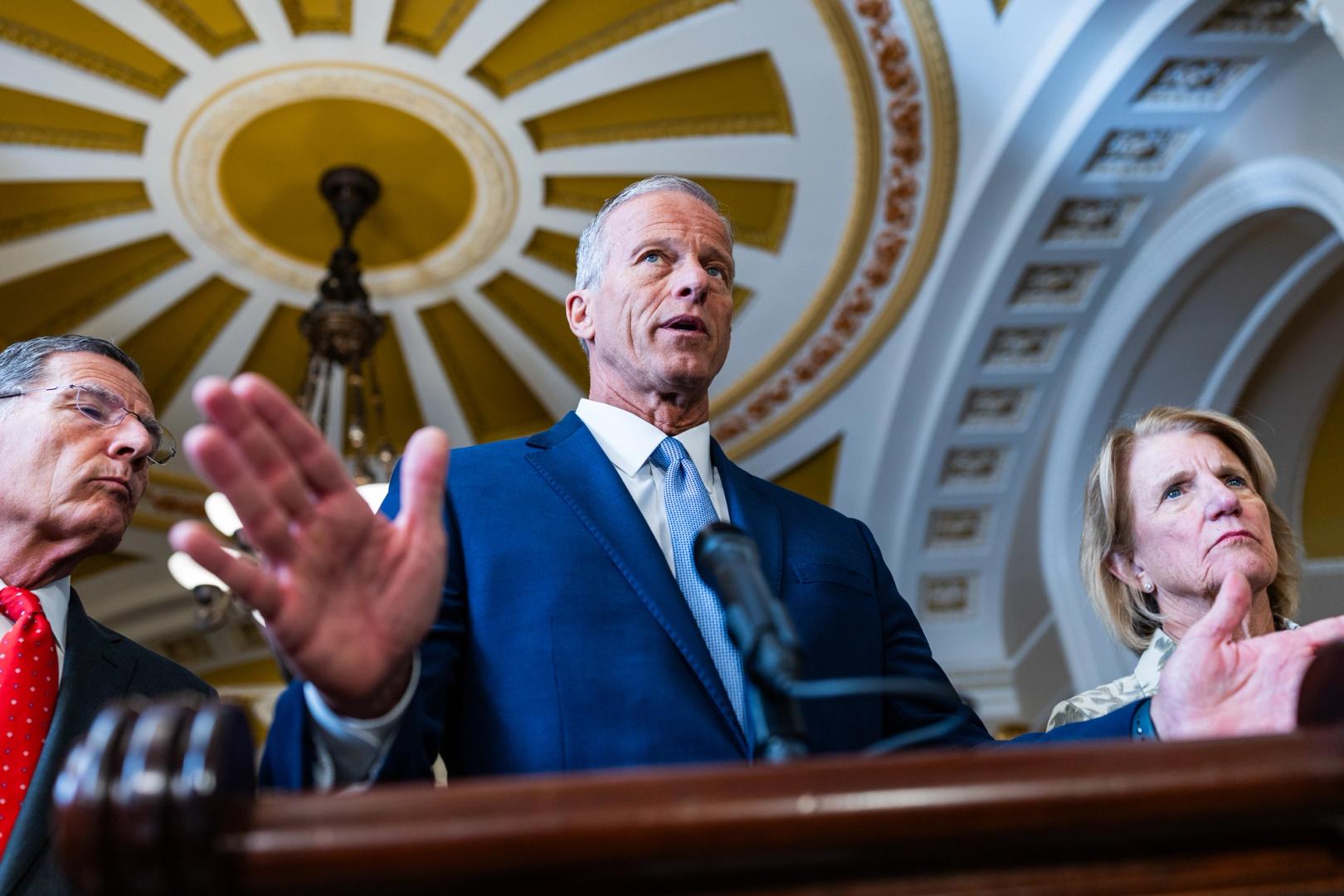

The crypto industry had held out optimism that the Senate could finish the wide-ranging Clarity Act in the next couple of weeks. Dragging it into the later months of the year sharply reduces its odds for passage in 2026.
Clarity — even more than last year’s Guiding and Establishing National Innovation for U.S. Stablecoins (GENIUS) Act — is the crypto industry first priority in crypto policy, with the hope it finally secures a permanent legal foundation for U.S. crypto activity.
The Senate’s floor process is a multi-stage affair that can take a few days or even longer to advance legislation past the 60-vote threshold needed in that chamber. At this stage, the crypto bill is hardly guaranteed to muster even a majority, as some Republican senators have also raised concerns with its treatment of stablecoin yield and the language of the government-ethics provision.
Senator Cynthia Lummis, a Wyoming Republican who has been a lead Clarity Act negotiator, told CoinDesk in a Wednesday interview that the most contentious sections are still open for revision that she said could bring Democrats to support it.
Republicans and industry insiders had hoped that getting the bill to the Senate floor might sharpen its urgency and help drive deals among the lawmakers to iron out the final disagreements. That could still happen if Thune can find some floor time before recess.


Bitcoin has fallen below $65,000 after U.S. President Donald Trump threatened a “massive attack” on Iran, with the cryptocurrency losing about 1.5% on Thursday.
Summary
- Bitcoin fell below $65,000 after Trump threatened a massive military attack against Iran.
- Houthi strikes on Saudi oil tankers pushed Brent crude above $100 per barrel.
- Binance Research expects macroeconomic pressure to restrain Bitcoin through the third quarter.
According to data from crypto.news, Bitcoin (BTC) was trading at $64,885 on July 23, extending its retreat after an attempt to recover earlier in the week. The price later touched about $64,831 as traders responded to another escalation in the Iran war and a sharp rise in crude oil prices.
Speaking to Axios on Thursday, Trump confirmed that he was considering restarting large-scale military operations against Iran. His comments came after Iranian forces struck U.S. targets in the region and Iran-backed Houthi fighters attacked Saudi oil tankers in the Red Sea.
“I am considering a massive attack. Bigger than ever before. I am close to making a decision. We are all set for it.”
Despite the warning, Trump gave no deadline for deciding whether to launch another operation. Two U.S. officials told Axios that the White House had not made a final decision or issued new military orders.
War risks have renewed pressure on Bitcoin
Discussing possible support from Israel, Trump told Axios that the country “would join in two minutes if I ask them to.” He maintained that Washington did not need assistance to conduct the operation, while acknowledging that Israeli involvement could carry “consequences” through Iranian retaliation.
Trump also claimed that Iranian officials wanted negotiations but were not prepared to accept an agreement. Two regional sources familiar with the mediation process told Axios that Iran’s leadership had rejected the latest proposal submitted through intermediaries.
“They haven’t received enough pain yet,” Trump said while questioning Tehran’s approach to the negotiations.
Military activity has intensified during the past 12 days as Washington has tried to stop Iranian attacks on commercial vessels in the Strait of Hormuz. According to Axios, Iran has continued its regional operations despite repeated U.S. strikes, leaving the two countries without a clear path toward a ceasefire.
Bitcoin’s decline followed a familiar risk-off response to the conflict. Earlier in July, the cryptocurrency dropped more than 3% to around $61,691 after Trump declared that a tentative Iran ceasefire was over.
Binance Research analysts told Barron’s that macroeconomic pressure could limit Bitcoin’s performance through the third quarter. The analysts noted that BTC ended the first half of 2026 near $59,500, about 53% below its record high of more than $120,000 reached in October 2025.
According to Binance Research, the decline places Bitcoin within a possible historical bottoming period heading into the fourth quarter, although the firm stressed that the signal had not been confirmed. BTC’s inability to hold $65,000 on Thursday has kept attention on whether sellers can push the price back toward its July lows.
Surging oil prices have added an inflation threat
Energy markets faced fresh pressure after Yemen’s Iran-aligned Houthis claimed attacks on two Saudi oil tankers, Encelia and Layla, in the Red Sea. The group said it used ballistic missiles, cruise missiles and drones because the vessels had violated its naval blockade on Saudi Arabia.
Saudi state news agency SPA confirmed that an attack caused a fire on Encelia’s bow, although all crew members were safe.
Ship-tracking data reviewed showed that five tankers changed course after the Houthis warned vessels to avoid Saudi ports. Two of those tankers indicated the Suez Canal as their new destination, while the Houthis separately claimed they had forced about 10 ships to turn back.
Those attacks have placed the Bab el-Mandeb Strait, a key route connecting the Red Sea and Gulf of Aden, at the center of the conflict. Reuters reported that the passage provides Saudi Arabia with an alternative export route while traffic through the Strait of Hormuz remains heavily disrupted.
Brent crude futures climbed 7% to $100.66 per barrel on Thursday, crossing $100 for the first time since late May, according to Reuters. West Texas Intermediate rose 6.3% to $92.28, while Brent’s monthly gain approached 40%.
UBS analyst Giovanni Staunovo estimated that Gulf oil-loading activity had dropped to 2.5 million barrels per day over the previous seven days, compared with a 30-day average of 6 million. Staunovo also estimated that Iranian oil loadings may have fallen to zero from between 1.5 million and 2 million barrels per day at the start of July.
Goldman Sachs warned that Brent could exceed $120 during the fourth quarter if disruption in the Strait of Hormuz persists and spreads further across the Bab el-Mandeb Strait and Suez Canal. Higher energy costs could complicate the U.S. inflation outlook, while Binance Research expects macro pressure to keep Bitcoin’s recovery limited through the third quarter.
Changpeng Zhao (CZ) missed one of crypto’s biggest markets. The Binance founder now admits he misjudged the stablecoin market for years.
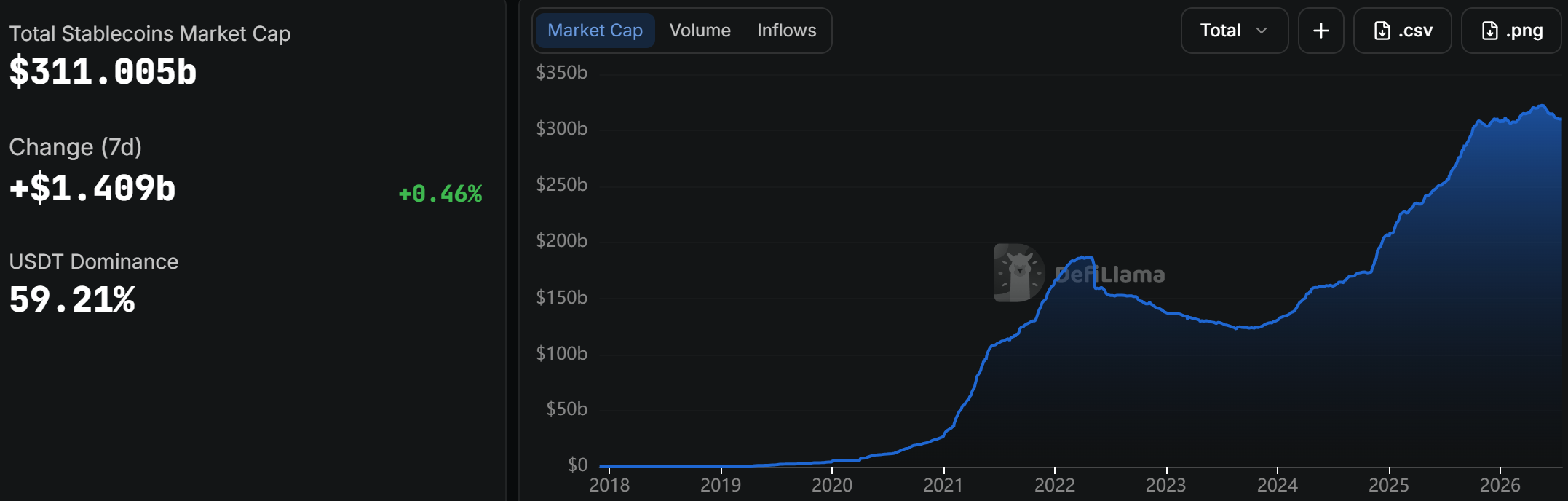
He told the Talking Tokens Podcast that he wrote them off. Today those tokens are worth more than $311 billion.
CZ Says He Missed the Stablecoin Boom
Zhao spoke on the Talking Tokens podcast. He looked back at the calls he got wrong. Leaving Binance gave CZ time to study the market again.
Stablecoins are crypto tokens tied to the US dollar. Each one aims to stay worth about a dollar. Traders use them to move money fast, day or night.
He is blunt about what he got wrong.
“when I was running Binance, I actually kind of missed stablecoins. I didn’t think stablecoins will get that big, but they actually have.”
Follow us on X to get the latest news as it happens
A Temporary Patch Job That Became a Giant
Changpeng Zhao saw stablecoins as a quick workaround. He thought they only moved money between exchanges. He was wrong.
“I thought that was a temporary patch job technology just to bridge some transactions between crypto exchanges, but then got big…”
Stablecoins were tiny when Binance launched in 2017. Now the market tops $311 billion. Tether (USDT) leads with about $184 billion.

That is nearly 60% of the sector. It makes Tether the third-biggest crypto, behind only Bitcoin (BTC) and Ethereum (ETH). Circle’s USDC ranks second, with about $77 billion.
That is a huge market to miss.
The technology he doubted is now US law. The US passed the GENIUS Act in July 2025. It set the first national rules for stablecoins.
Weeks earlier, Circle listed on the New York Stock Exchange. Its shares jumped more than 160% on day one.
Why CZ Now Watches the Stablecoin Market He Missed
Changpeng Zhao does not want to miss the next big thing. He says leaving the CEO job gave him room to learn. Now he studies new areas he once ignored.
“when I’m forced to step back, I kind of look at the industry more as a whole.”
He blames how busy he was at Binance.
“as the CEO of Binance, when I was running it, I was so busy that I couldn’t even learn new things in crypto that well.”
The lesson stuck. Zhao says early doubts can cost a lot. Stablecoins are his proof.
The post Changpeng Zhao Ignored This One Market, Now It Is Worth Over $311 Billion appeared first on BeInCrypto.
Key points:
- Funds queue ~$150M of HYPE for unstaking, $116M from Multicoin
- HYPE falls 8% to ~$58; withdrawals dwarf thin spot market
- Sale intent unclear — Jain denies selling, Selini exit tied to HIP-3 shutdown
Hyperliquid’s HYPE token slid to around $58 on Wednesday in the face of large unstaking events initiated by crypto funds. Data obtained from hedge fund and analytics platform Block Liquidity shows Multicoin Capital holding a combined $138.78 million in staked HYPE, of which roughly 83% — about $116 million — sits in pending withdrawal.
That’s as Selini Capital and Galaxy Digital have queued HYPE tokens worth $4.4 million and $29.4 million, respectively, for withdrawal. In addition, a Multicoin-linked wallet also deposited roughly 167,000 HYPE, worth $11.2 million, to Coinbase, possibly to be sold.
As of publication, the price had recovered some of its decline, last trading hands at $59.19, according to CoinGecko data. Trading volume in the past 24 hours was more than $415.4 million.
Withdrawal queue dwarfs daily spot turnover
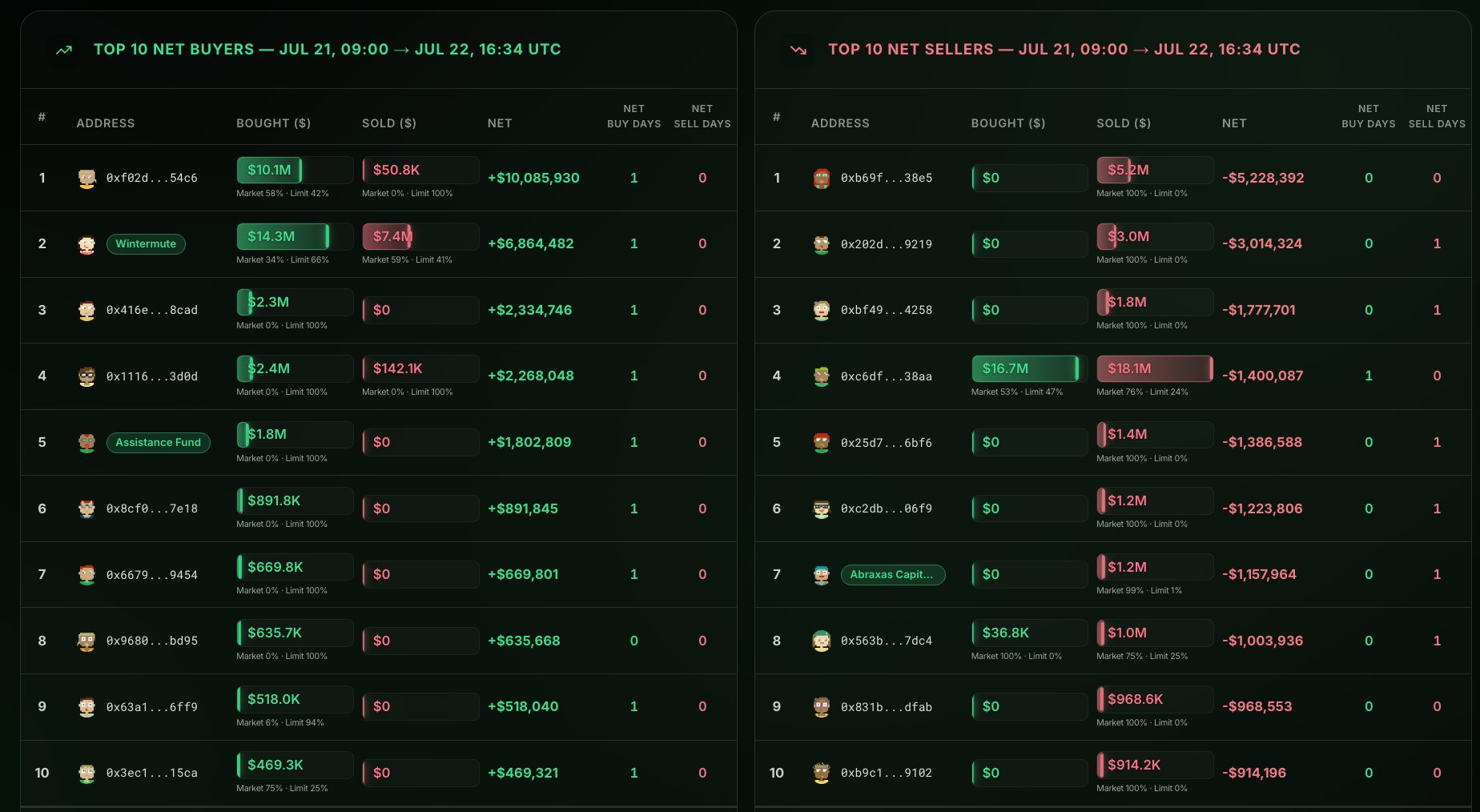
These bulk unlocks will be processed in five to seven days and will result in a nearly $150 million overhang in HYPE’s liquid supply. While perpetuals for the tokens trade around $400 million daily, the spot market for HYPE is significantly smaller. Block Liquidity’s flow tracker recorded just $72.8 million in HYPE spot volume across the roughly 28 hours to Wednesday morning, with 1,463 unique buyers against 982 sellers. Wintermute was the largest net buyer at over $9 million, while the top net seller offloaded $5.2 million.
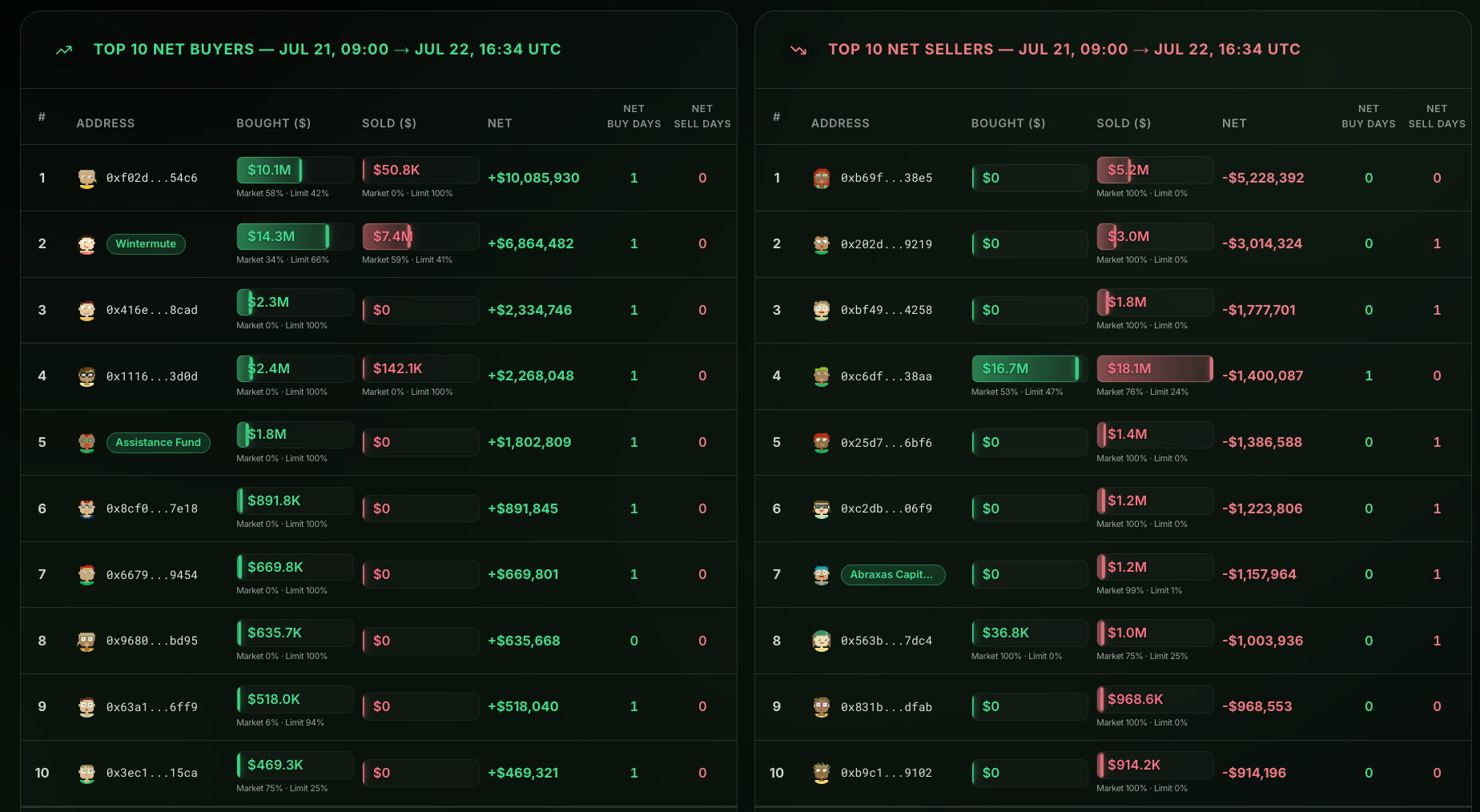
Top buyers and sellers during HYPE’s plummet to as low as $57.39.
Source: Blockliquidity.xyz
A withdrawal queue nearly double the daily spot turnover helps explain the recent apprehension in the market. HYPE has fallen about 11% over the past week. However, whether the unlocked tokens are about to be sold into the market is far from clear.
The unstaking by Selini Capital appears to be linked to the shutdown of the HIP-3 CASH perpetuals markets run by DreamCash. Like many recent HIP-3 deployments, DreamCash’s USDt (USDT)-based markets struggled to attract liquidity, especially as USDC (USDC) became more deeply entrenched in the Hyperliquid ecosystem.
Recent: Bitcoin analysis eyes ‘serious volume’ after Binance sees 9K BTC daily outflow
Launching a builder-deployed perpetuals marked under HIP-3 requires staking 500,000 HYPE as a slashable security bond, which can be refunded when the market goes defunct. Selini Capital may decide to sell this HYPE allocation through an OTC desk.
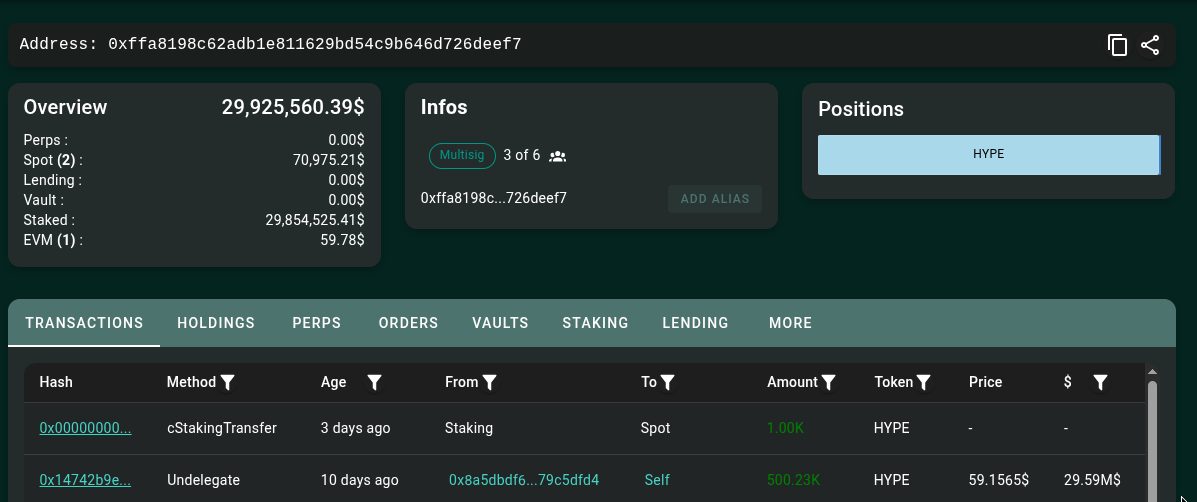
Wallet associated with Selini Capital invoking StakingTransfer Method.
Source: HypurrScan.io
Sale or HIP-3 war chest?
While Selini’s recent HYPE unlock represents the shutdown of a HIP-3 market, Multicoin’s HYPE may at least partially be headed for a new deployment. Last week, the firm made its first Hyperliquid ecosystem venture bet by leading a $1.75 million seed round into Trasia. The latter is an Asia-focused, noncustodial trading platform that plans to launch perpetuals for Asian equities.
Managing partner Tushar Jain said on X that Trasia is targeting “net new users” unfamiliar with Hyperliquid. He claimed in an X post later on Wednesday night that the unstaked HYPE was not intended for selling. The market will watch where funds will flow on the July 28 unlock. Although absorption by new HIP-3 deployments or mere asset reallocation remains the base case, HYPE has not yet recovered to its recent highs.
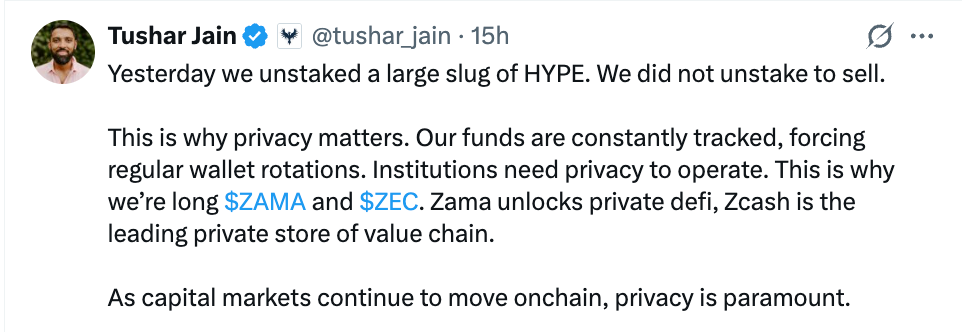
Multicoin Capital managing partner Tushar Jain issues clarification.
Source: X.com
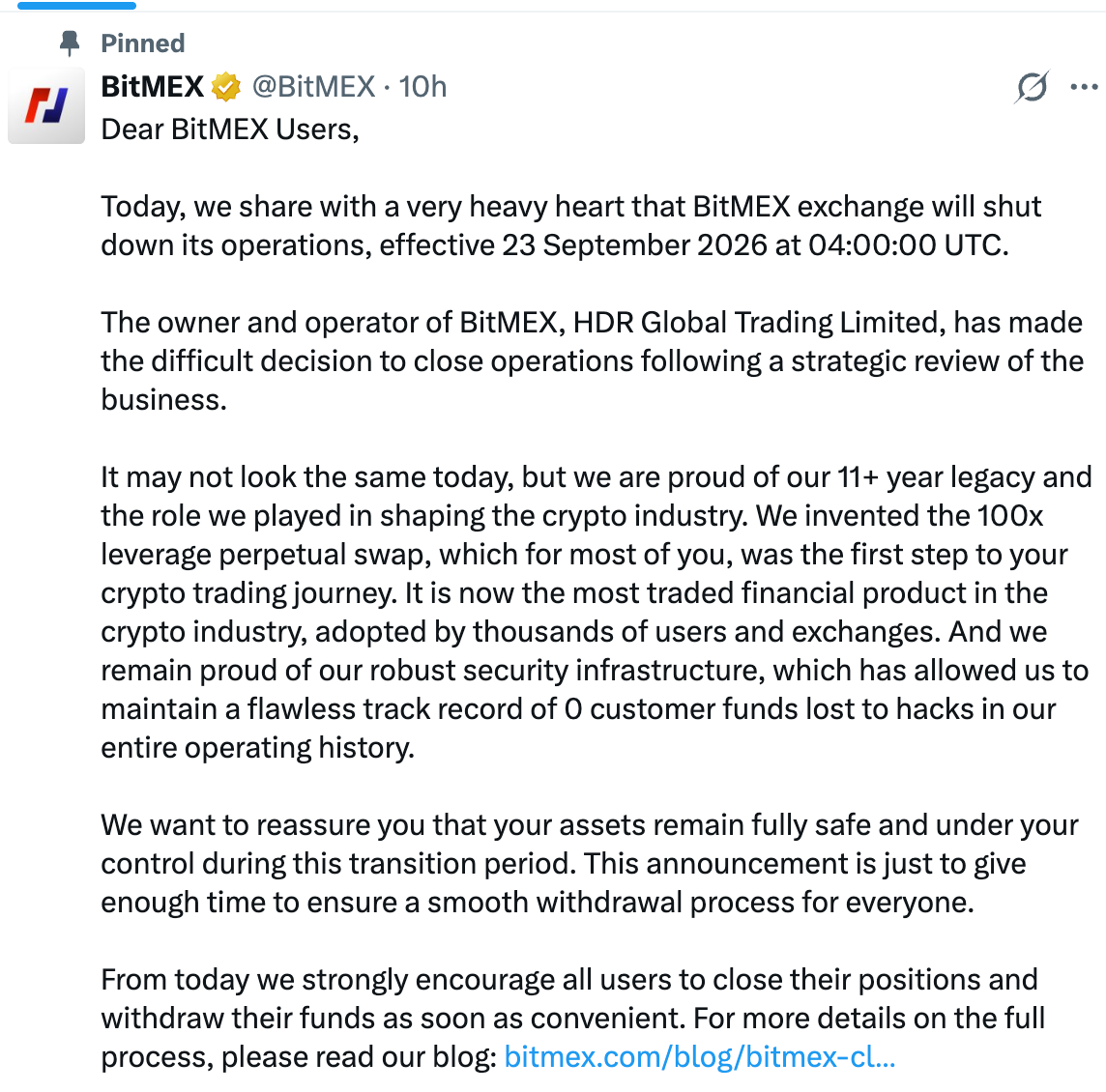
The closure of crypto derivatives exchange BitMEX is prompting fresh questions about whether the industry is entering a new phase of consolidation, as analysts point to market-share concentration and rising regulatory costs squeezing smaller platforms.
While BitMEX helped pioneer perpetual swaps that became a cornerstone of digital asset derivatives trading, its daily Bitcoin futures volume began declining around May 2021 and never recovered to its 2020 daily peak of between $1 billion and $5 billion, according to data from CryptoQuant.
Restructuring adviser Roshan Dharia told Cointelegraph the exchange’s demise reflects structural pressures facing mid-sized centralized exchanges, where liquidity has increasingly concentrated among the industry’s largest players and regulatory compliance costs continue to rise. He said:
The top five platforms now control an estimated 80% of global spot volume, leaving mid-tier and regional exchanges with shrinking margins and no viable path to scale… The headwinds are structural, not cyclical.
Source: BitMEX
Related: BitMEX pitches ‘canary fund’ alternative to Bitcoin quantum coin freeze
The fall of BitMEX
BitMEX, the crypto derivatives exchange founded in 2014 by Arthur Hayes, Ben Delo and Samuel Reed, announced on Thursday that it will shut down. Trading is scheduled to end on Sept. 23 following a strategic review by parent company HDR Global Trading.
The shutdown announcement also triggered a sharp sell-off in BitMEX’s utility token, BMEX, which plunged more than 90% after the exchange revealed plans to wind down operations.
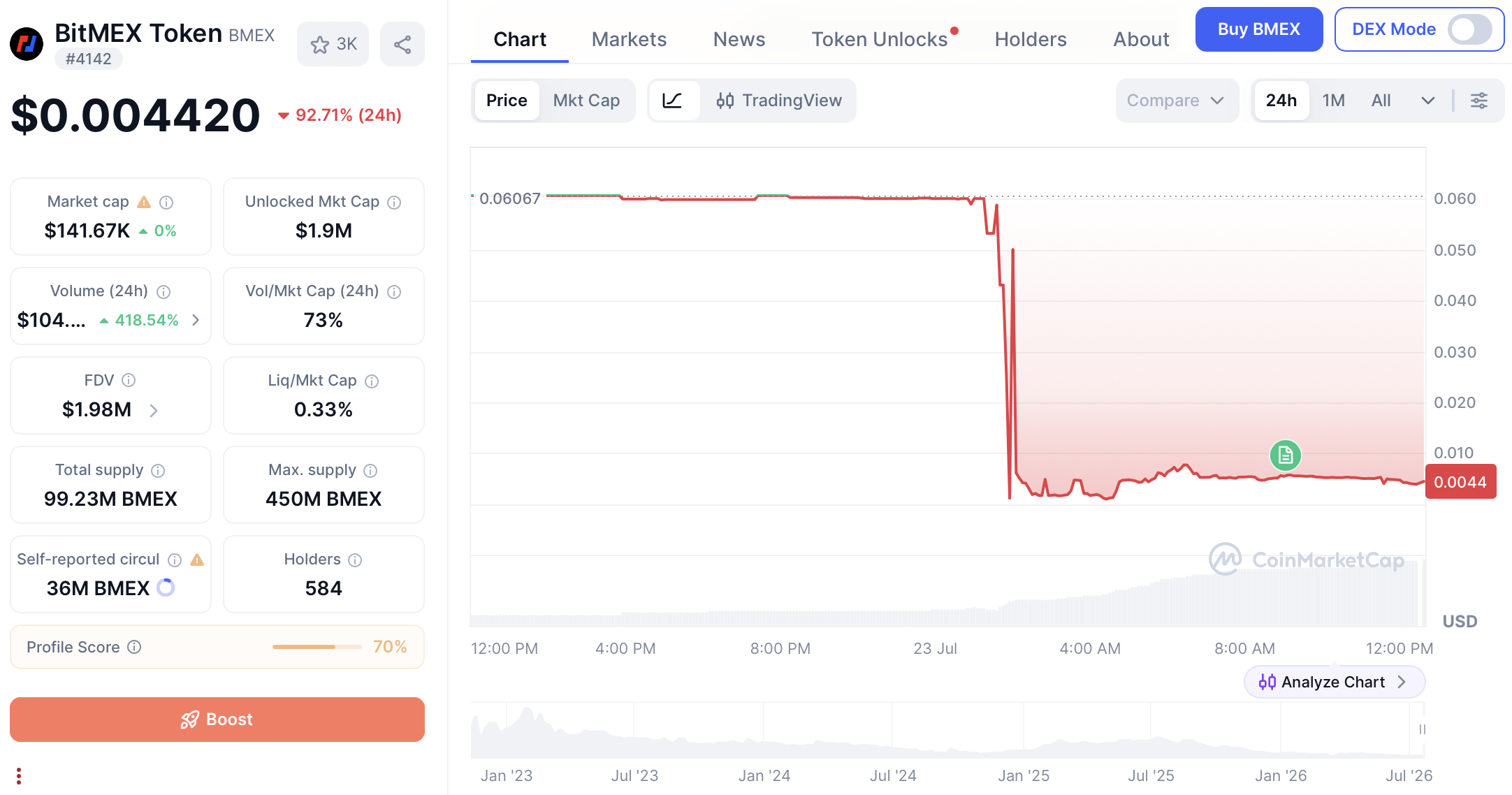
BMEX token drops over 90%. Source: CoinMarketCap.
The announcement came after years of declining market share. CoinGecko ranked BitMEX ninth among derivatives exchanges in August 2023 with a 0.9% share of trading volume. By 2025, it no longer appeared among the firm’s top 10 perpetual exchanges, even as annual perpetual trading volume across those platforms climbed 47.4% to a record $86.2 trillion.
Related: Arthur Hayes dumps WLD days after Maelstrom’s AI IPO pitch
The rise of regulated competitors
BitMEX rose to prominence by offering offshore perpetual derivatives years before similar products became available through regulated venues. Today, those same products are increasingly offered through licensed exchanges in jurisdictions including the United States and the United Kingdom.
In the US, Coinbase launched perpetual-style futures through a Commodity Futures Trading Commission-regulated exchange in May after receiving no-action relief from the regulator. The CFTC also approved Bitcoin perpetual futures for Kalshi. In June, Kraken followed with CFTC-regulated perpetual futures for eligible US traders through its recently acquired Bitnomial exchange.
The trend has also extended beyond the United States. This month, Coinbase secured a UK investment services license allowing it to expand its derivatives business ahead of the country’s new crypto regulatory regime.
Magazine: Here’s why the CLARITY Act’s ethics deal may be so hard to reach
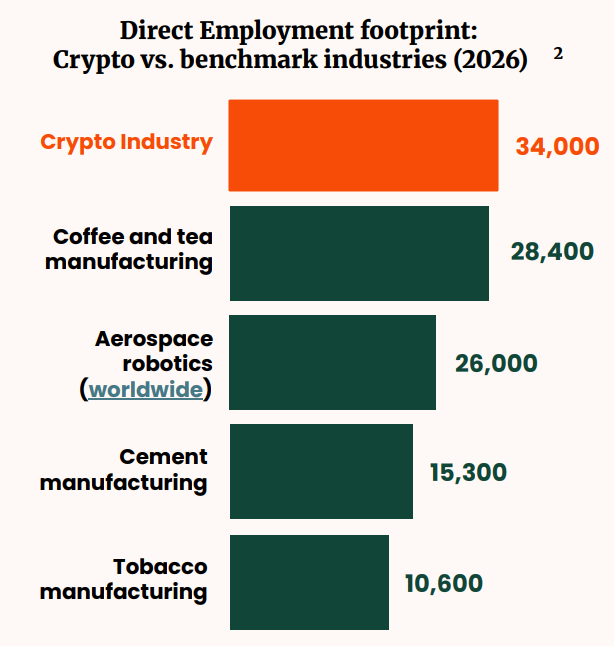
Research from the National Cryptocurrency Association (NCA), an organization backed by Ripple Labs, broke down the economic impact of the entire crypto industry on the United States, estimating that salaries, worker spending and output will have contributed $55 billion this year.
According to a report released Wednesday by the Pragmatic Policy Group on behalf of the NCA, the total economic contribution was based on direct, indirect and induced employment. Of the sectors to benefit from crypto’s economic contributions, the NCA said that investments in securities and commodity contracts were among the highest at $9.7 billion, while housing and real estate were a combined $4.8 billion.
The research found that about 34,000 people in the US were directly employed by crypto companies, accounting for just a fraction of the 232,000 jobs supported by the industry across the entire economy. This would mean crypto companies directly employ more Americans than the coffee and tea manufacturing and aerospace industries, according to data from the US Bureau of Labor Statistics.
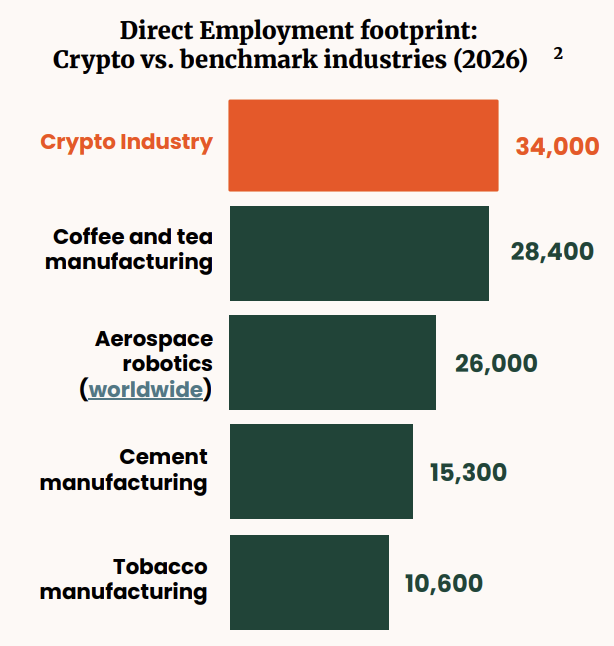
The crypto industry’s growing employment footprint in the US. Source: NCA
Related: Goldman Sachs CEO backs ‘not perfect’ CLARITY Act as vote expected soon
Among the individual US states, Texas, Washington, North Carolina, California and New York employed the most people involved in the industry, but Colorado was a “growing blockchain hub” based on friendly regulatory policies, according to the economic report. The NCA added that North Dakota was “becoming an energy-integrated digital infrastructure hub” due to the state’s tax laws favoring crypto mining and favorable flare gas policies.
The NCA launched in March 2025 as a non-profit organization focused on consumer crypto education, with $50 million in backing from Ripple. Stuart Alderoty, Ripple’s chief legal officer, heads the group.
The industry experienced multiple shutdowns in 2026
Several projects tied to digital assets announced they would be shuttering operations this year for various reasons, including difficulty with scaling and market conditions.
Entropy, a crypto start-up based in New York, said in January that it would shut down after four years in operation. Dmail, a decentralized email platform based in Singapore, began ceasing operations in May, citing expenses on bandwidth, storage and computing. Decentralized autonomous organization governance platform Tally and Balancer Labs also shuttered in March.
Magazine: Will the US get CLARITY this week? Bitcoin’s new $80K target: Hodler’s Digest, July 19

Robinhood CEO Vlad Tenev’s X account has been hacked to promote a fake company-linked memecoin that briefly reached a market capitalization of about $10 million.
Summary
- Hackers used Vlad Tenev’s X account to promote the fake Vladhood memecoin.
- Vladhood briefly reached a $10 million market cap before Robinhood confirmed the breach.
- The attack follows similar memecoin scams targeting CZ, BNB Chain and Yi He.
Robinhood confirmed the breach through its official X account, telling users that Tenev’s profile had been compromised and that the company was working with X to restore access. The brokerage added that the unauthorized post had been removed.
Posted at about 17:24 UTC on July 23, the message introduced Vladhood under the ticker VLAD and described it as the “official Robinhood Chain mascot.” The hackers also claimed that Robinhood would list the token on its trading app.

Seeking to connect the token with Robinhood’s business plans, the deleted post claimed Vladhood would bring attention to Robinhood Chain during the third and fourth quarters. Neither Robinhood’s main X account nor the company’s crypto account published a matching announcement.
The post included a contract address beginning with 0x92d, directing Tenev’s followers to a token deployed only minutes earlier through a contract named PonsLaunchFactory. Robinhood Chain’s block explorer subsequently attached a “potential scam” warning to the asset after recording more than 1,800 transactions.
Vladhood surges before Robinhood confirms the hack
Trading activity accelerated soon after the contract appeared on Tenev’s profile, pushing Vladhood’s market capitalization to roughly $10 million at its peak. The token later fell below $5 million after Robinhood confirmed the breach and the promotional message disappeared.
Onchain data shows that wallets identified as insiders realized more than $1 million in profits during the rapid price increase. At press time, the wallet owners had not been identified, and there was no evidence linking them directly to the compromise of Tenev’s account.
Despite Robinhood’s warning, Vladhood continued trading after the post was deleted, showing how onchain tokens can remain available even when the social-media promotion behind them has been discredited. Robinhood had not announced any plan to list Vladhood or recognize it as the chain’s mascot at the time of reporting.
The episode follows a method that Binance co-founder and former CEO Changpeng Zhao warned traders about in October 2025. With memecoin activity increasing at the time, Zhao wrote that hackers were targeting social-media profiles because such accounts often had weaker safeguards than crypto platforms.
“With the rise of meme coins, hackers are targeting social media accounts (as they usually have lower security measures) to post CAs [contract addresses].”
Zhao also cautioned users that official accounts did not endorse particular memecoins, urging traders to treat sudden contract-address posts with suspicion. His warning followed the compromise of BNB Chain’s X account, which attackers used to promote a fake BNB-themed token presented as part of an airdrop.
A similar scheme targeted Binance co-CEO Yi He in December 2025. Hackers seized an unused WeChat account connected to her old phone number and used it to promote MUBARA, also known as Mubarakah, shortly after she joined Richard Teng in Binance’s dual leadership structure.
Notably, posts from Yi He’s compromised profile encouraged contacts to buy the token, creating enough demand for a coordinated pump-and-dump. Zhao confirmed the breach and urged traders to ignore the messages, while reported onchain estimates placed the attackers’ profit at about $55,000.
Robinhood Chain keeps attracting speculative trading
Tenev’s account was compromised as Robinhood Chain recorded a sharp increase in activity following its July 1 mainnet launch. Built as an Ethereum layer-2 network using Arbitrum technology, the chain was introduced to support tokenized assets, decentralized finance and round-the-clock trading.
Memecoins, however, supplied much of its early decentralized exchange activity. Entropy Advisors estimated that Robinhood Chain had processed about $9 billion in cumulative DEX volume by July 23, with high-risk memecoin trading responsible for much of that amount.
CashCat became one of the network’s first major tokens, reaching a market capitalization of about $150 million during the chain’s opening weeks. Fortune reported that Robinhood Chain’s daily trading volume rose from slightly above $200,000 on July 1 to more than $500 million nine days later, driven largely by speculative tokens rather than real-world assets.
Although Robinhood designed the network around tokenized finance, Tenev previously acknowledged its early memecoin activity. Fortune quoted him as saying that while the company was building Robinhood Chain for real-world assets, the network also “works great for memes.”
Revenue has risen alongside the trading surge. DeFiLlama data showed that Robinhood Chain generated about $1.1 million in revenue over seven days and $2.11 million since launch, placing it among the highest-earning chains during the measured period.
DeFiLlama also recorded hundreds of millions of dollars in bridged value and substantial daily DEX volume on the network. Those figures explain why a false endorsement tied to Tenev and Robinhood Chain could attract traders within minutes, while Robinhood’s confirmation established that Vladhood had no authorized connection to the company.
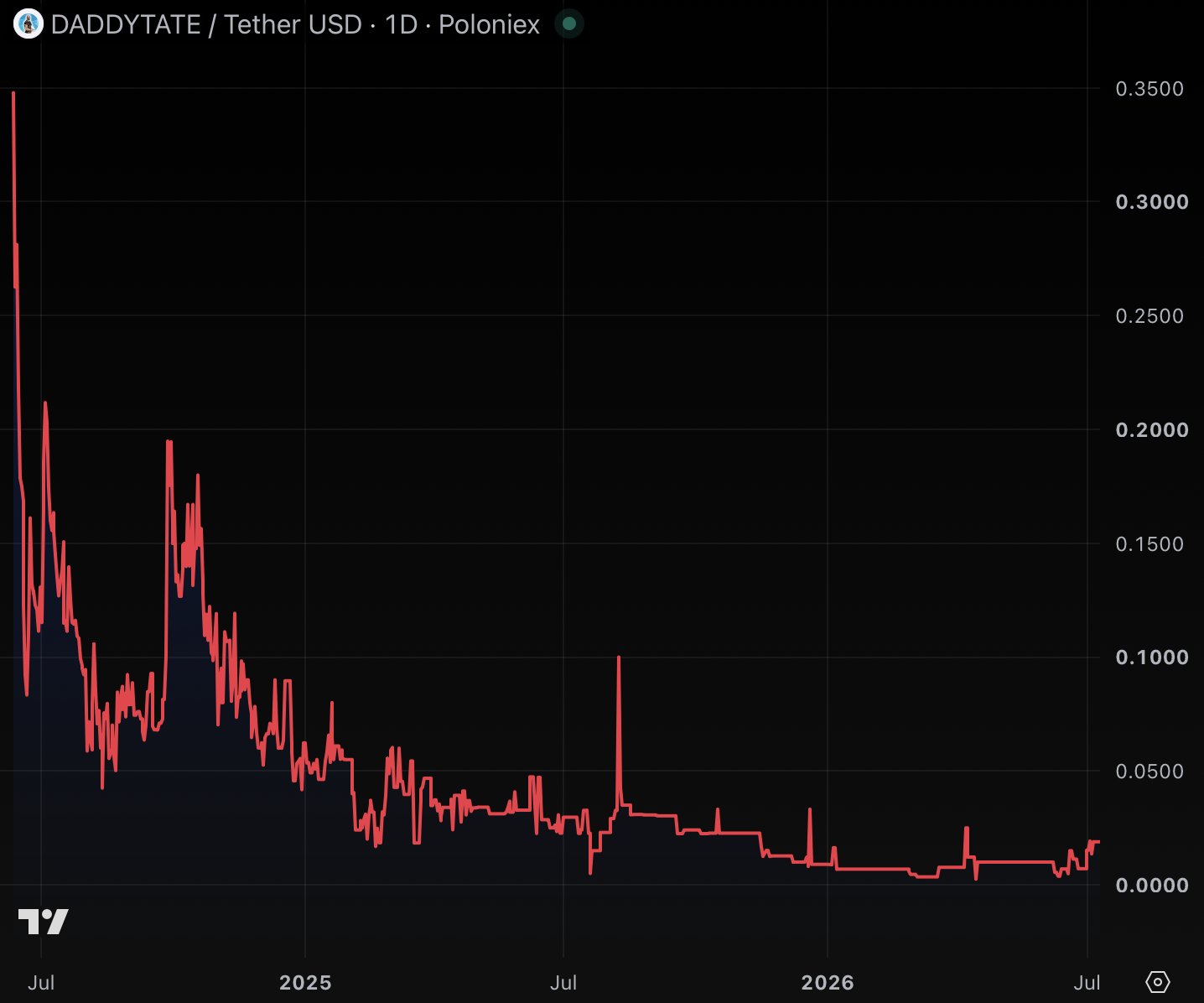
Andrew Tate’s DADDY memecoin has shed half its value and is currently trading 97% below its 2024 peak — a plunge that’s coincided with Tate’s latest arrest and his incarceration in Miami’s Federal Detention Center.
US Marshals arrested Tate, 39, and his brother Tristan, 38, on Saturday on a sealed warrant pursuant to UK extradition proceedings outside Miami’s James L. Knight Center. The pair were en route to a boxing event that Andrew was slated to co-host.
It is not the pair’s first time in government detention and they continue to use these experiences to attract media attention.
Indeed, Tate spent some time on Thursday tweeting about jail life, including being housed next door to an alleged cannibal who “screams through the night.”
Whether personally or through a proxy with internet access, Andrew posted to X, “I am being held in SHU,” referring to the Special Housing Unit at the Federal Detention Center of Miami, a US Bureau of Prisons facility.
He inaccurately claimed that it’s “the highest level of security which exists” and continued to embellish his tale, “No commissary. No visits. No contact with the outside world.”
This “no-contact” experience includes over three million impressions on a single post and a dozen posts or retweets over the past 48 hours, not to mention exposure from his other social media channels and countless media stories about the incident.
UK seeks criminal proceedings against Andrew Tate
Britain’s Crown Prosecution Service has authorized 38 further charges against the Tate brothers, involving four more alleged victims and bringing the total to seven.
Andrew personally faces seven fresh counts of rape, trafficking, and assault, and charges over child sex-abuse images and extreme pornography.
Tristan faces two rape counts, one sexual assault count, and three trafficking counts.
Malcolm McHaffie, head of the CPS special crime division, spoke on the matter, saying, “We have decided to prosecute Andrew and Tristan Tate for further offences including rape, arranging or facilitating trafficking for sexual exploitation and offences relating to indecent images of a child.”
The brothers appeared before Judge Lauren Louis on Monday, with another hearing set for Monday, July 27.
For now, they remain at the Federal Detention Center in downtown Miami.
Justice Department filings this week asked the court to keep the pair secured throughout extradition proceedings, alleging that both brothers strangled women unconscious before raping them.
Their lawyer, Joseph McBride, told reporters, “This feels political.”
Read more: Andrew Tate liquidated again amid fresh trafficking charges
DADDY the Tate brothers’ memecoin wreckage
Tate adopted DADDY, a Solana memecoin, as his personal token in June 2024. On Thursday afternoon it traded around $0.008, 97% below its all-time high of $0.29.
Its market capitalization now hovers below $5 million. The token shed more than a quarter of its value in the two days after the arrest, and is down 50% over the past seven days.
None of this should surprise anyone. Bubblemaps found that DADDY’s deployer sent 40% of the entire token supply straight into Tate’s own wallet.
The Tate brothers endorsed more than 10 Solana memecoins during 2024’s celebrity token frenzy, and most soon collapsed by around 99%.
TOPG, another Tate-themed and possibly unauthorized memecoin, now trades 99.8% below its June 2024 peak on less than $200 of daily volume. Another, Tate Terminal, sits more than 99% below its October 2024 high.
Got a tip? Send us an email securely via Protos Leaks. For more informed news and investigations, follow us on X, Bluesky, and Google News, or subscribe to our YouTube channel.
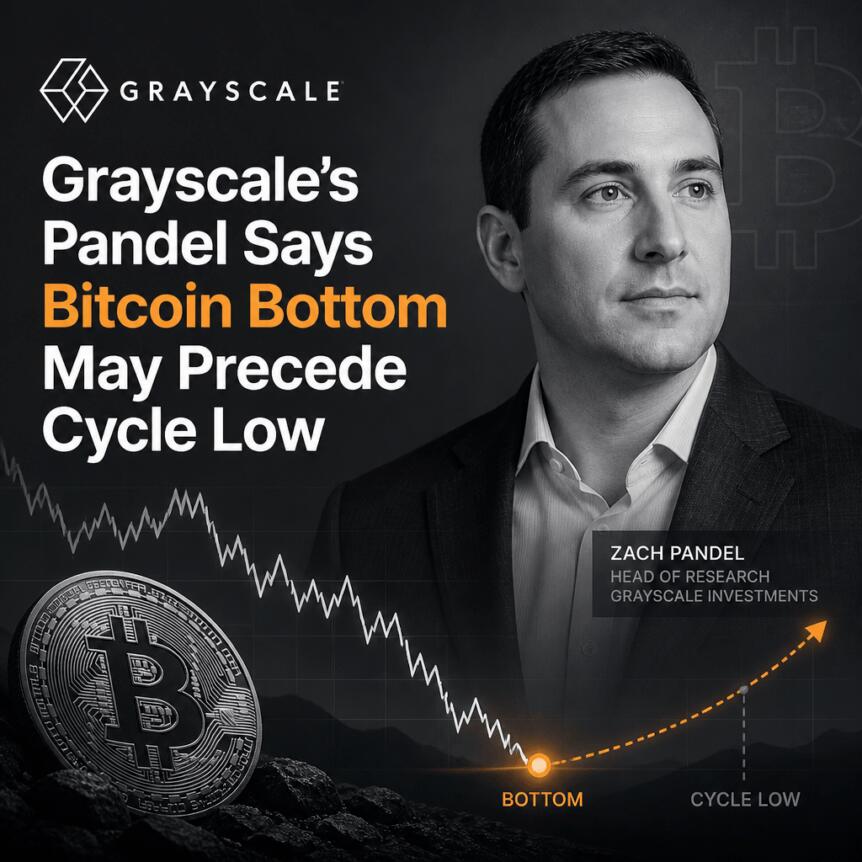
Grayscale is challenging a key assumption many traders use to frame Bitcoin’s price cycle: the idea that bottoms reliably line up with the traditional four-year, halving-driven rhythm. In a Wednesday research note, the firm’s head of research, Zach Pandl, suggested that Bitcoin may have already found a floor—potentially pointing to a cycle low as early as September or October—if upcoming macro conditions remain supportive.
Pandl’s argument centers on Bitcoin’s increasing sensitivity to broader economic variables. Rather than treating the halving cycle as the dominant force, Grayscale says macro factors—especially Federal Reserve policy—may be doing the heavy lifting for price direction right now.
Key takeaways
- Grayscale says Bitcoin’s cycle low could arrive earlier than the historical four-year pattern, with September or October cited as a potential window.
- Zach Pandl argues Bitcoin is increasingly “macro-driven,” implying that rate expectations may determine when price bottoms.
- CME FedWatch data at the time of Grayscale’s note showed markets pricing about a 66% chance the Fed holds rates on July 29, down from 88% a week earlier.
- Despite the macro thesis, Grayscale warns regulation could still cap recovery momentum, particularly if the CLARITY Act fails to pass this year.
- Other analysts still expect a later bottom, including a view that a trough may not appear until October–December 2026.
Why Grayscale thinks the cycle floor may be sooner
Grayscale’s framing departs from the more rigid “four-year cycle” approach. In the firm’s report, Pandl wrote that if the Federal Reserve “forgoes rate hikes” and economic growth remains resilient, Bitcoin “may already have bottomed.” That would imply the cycle low could come earlier than some models anticipate, potentially in September or October.
This matters for investors because it changes how risk is likely to be assessed around typical cycle milestones. If macro conditions are now the primary driver, historical calendar-based expectations may be less reliable—making forward-looking indicators (like real rates and central bank guidance) more important than fixed cycle timing.
The Fed’s meeting and shifting rate odds
A central element of Grayscale’s view is that the Fed remains the most actionable near-term variable for Bitcoin. Pandl said macro factors place Bitcoin in the “driver’s seat,” adding that Bitcoin could “bottom when these macro factors turn around.”
The next scheduled rate decision cited in Grayscale’s discussion is due on July 29. According to CME Group’s FedWatch tool referenced by Grayscale, market participants were pricing in a 66% chance the Fed will hold interest rates unchanged—down from 88% a week earlier. The change highlights how quickly expectations for policy path can evolve, and why Grayscale sees macro shifts as central to the timing of a market bottom.
Grayscale also connected prior Bitcoin bear markets to periods of slowing economic growth alongside rising real interest rates. In that framework, the direction of real rates—more than nominal liquidity narratives—has historically aligned with whether downside pressure persisted or eased.
Regulatory uncertainty remains a drag on upside
Even if macro conditions improve, Grayscale cautioned that policy risk could still limit how far Bitcoin can recover. In a June 26 Grayscale report titled “Two scenarios for the Bitcoin bear market,” Pandl argued that regulatory uncertainty may force continued “deleverage” among certain crypto treasury-related entities.
Specifically, Grayscale suggested that if the CLARITY Act does not pass this year, Strategy and other treasury companies may continue to reduce leverage, a process that could lead Bitcoin to “fall moderately further.”
This point is important because it introduces a potential mismatch: macro might be stabilizing, but balance-sheet pressure within parts of the crypto market could still weigh on prices. For market participants, the takeaway is that “macro-driven” doesn’t automatically mean “macro-only”—regulatory outcomes can influence liquidity and forced selling dynamics even when economic data looks better.
Competing views on how late the bottom could be
Grayscale’s earlier-bottom thesis is not universally shared. Earlier this year, crypto analysts pointed to market structure and long-term investor behavior as signals that a bottom could be approaching sooner rather than later. For example, K33 had argued that Bitcoin’s supply held at a loss could signal cycle timing, noting that historically Bitcoin has tended to bottom weeks after more than half of supply moved underwater. Separately, Swan Bitcoin CEO Cory Klippsten told Cointelegraph in a June interview that record long-term holdings—reaching an all-time high of 14.7 million Bitcoin—could indicate an imminent bottom.
Still, other analysts have suggested that the trough may not arrive until later. Lebit Mining Pool founder Jiang Zhuoer predicted that Bitcoin’s bottom could fall between October and December 2026—roughly six months after Strategy’s Multiple to Net Asset Value (mNAV) indicated its cycle low.
That contrast underscores a broader uncertainty for traders and portfolio managers: different approaches—cycle timing, macro signals, supply-at-loss statistics, or balance-sheet metrics—can point to different windows. The question for readers is not only whether Bitcoin bottoms, but whether the market is responding to the same underlying regime shift that each model assumes.
What to watch next
With the Fed decision on July 29 in focus and regulatory developments still capable of influencing deleveraging pressure, investors should track both macro indicators (especially real-rate expectations) and any signs that the CLARITY Act timeline or related market balance-sheet activity is changing. Grayscale’s thesis hinges on “macro turning around,” but whether that translates into a durable cycle low may depend on policy risk and crypto-specific liquidity conditions as much as on economics.

Robinhood (HOOD) CEO Vlad Tenev’s X account was compromised on Thursday and used to promote a fake memecoin as traders have piled into tokens on the brokerage’s recently-launched blockchain network.
The now-deleted post introduced a token called Vladhood ($VLAD) as the “official Robinhood chain mascot” and falsely claimed it would be listed in the Robinhood app. It included a blockchain wallet address and described the token as part of the company’s focus on Robinhood Chain.
“Does Robinhood love memes? The answer is yes,” the post read.
Robinhood later confirmed the account had been hacked.
“Heads up: Our CEO Vlad Tenev’s X account was compromised and posted a fake promotion for a meme coin,” the company said through its communications account on X. “We’re working with X to restore access and the post has been removed.”

The incident came as Robinhood’s newly launched blockchain has become a hotbed of speculative trading.

Ford integrates Apple Maps into its new electric vehicle platform

Clarity Act expected to miss its window before Congress’ summer break, leadership says

Want to Be On A Dating Reality Show? Here’s What To Know About Casting

Renter of Home in Anne Heche Crash Denies Settlement With Son

No Jackpot Winner as $257 Million Prize Rolls Over to $269 Million Monday Draw

Weekend Open Thread: Staud – Corporette.com

XRP HOLDERS ARE PRE-RICH! – PREPARE TO CASH OUT LARGE SUMS OF MONEY DO THIS FIRST?

CA Foundation QA | Mathematics of Finance -2 | Sep 26 | Sankat Mochan 6.0 | Anurag Chauhan

MONEY – LISA | JUST DANCE 2022 – Fanmade by EloW340
-

 Fashion6 days ago
Weekend Open Thread – Corporette.com
-

 Politics5 days ago
The House | The City of London can help the new chancellor deliver growth in every postcode
-

 Crypto World5 days ago
Ripple Payments Joins MiCA With 14 Firms, Does It Mean Anything For XRP?
-
 Crypto World6 days ago
Two July Windows Left: The CLARITY Act’s Senate Fight and What Failure Means
-

 Politics4 days ago
Democrats look to World Cup watch parties to register thousands of voters
-

 Crypto World6 days ago
Ripple wins EU-wide access as ESMA adds it to MiCA register
-

 Crypto World2 days ago
Grayscale Files For Worldcoin ETF, WLD Registers Sharp Rise
-

 NewsBeat3 days ago
Unregistered fitter used Gas Safe logo on business flyers
-

 Tech3 days ago
Sail Virtually Aboard The “Itanic” With IA-64 Emulator
-

 Crypto World7 days ago
Injective Submits SEC Transfer-Agent Registration to Onchain Ownership Records
-
 Tech3 days ago
Turtle Beach Command Series KB7 review: a nifty screen-equipped gaming keyboard
-

 NewsBeat6 days ago
Registration is now open for March for Men with Kev 2026
-
 Business2 days ago
New Jersey voter registration controversy explained: How 6,600 noncitizens got on the rolls, and what happens next
-
 Crypto World7 days ago
Claude Fable 5 Slips to Second in AI Coding Leaderboard
-

 News Videos7 days ago
Money | Class 12 Economics | CBSE Board Exam 2026-27
-

 Business7 days ago
Banco Bilbao Vizcaya Argentaria, S.A. (BBVA) Discusses Global Macro Environment and Economic Outlook for Core Markets Transcript
-

 Crypto World5 days ago
Kaspersky exposes OkoBot’s 20-module crypto wallet attack
-

 News Videos4 days ago
Big Money Is Entering XRP
-

 Business6 days ago
Airlines warn Sunshine Protection Act could disrupt flight scheduling
-

 NewsBeat6 days ago
Durham County Council to send out electoral registration emails
You must be logged in to post a comment Login