
Crypto World
4 trends to watch this cycle



By Ben Caselin, CMO at VALR
When crypto prices surge, market commentary tends to fixate on green candles and central bank policy.
Yet, looking beyond the immediate rally reveals a deeper structural shift taking place on-chain. Robinhood’s CEO, Vlad Tenev, skilfully drew global attention to this shift with the launch of the Robinhood Chain, joining a broader movement of major platforms bringing mainstream retail equity investors directly onto native on-chain execution.
Macroeconomic stress provides background fuel, but technological innovation provides the spark. Beneath the price action, four key trends are defining this cycle and reshaping how global wealth is owned, accessed, and stored.
Trend 1: The Retail Ownership Supercycle
At a recent White House summit, Vlad Tenev summarised his platform’s mission in a single word: ownership. Broad asset ownership is essential to a free and prosperous society, and the Robinhood Chain is putting that principle into practice.
Consider novel mechanics like The Index. Holding this single token automatically drops fractional tokenised equities directly into a user’s wallet. In a few clicks, crypto-native traders gain organic exposure to traditional stock portfolios, opening up meaningful diversification beyond crypto alone.
Crucially, this movement is propelled by retail culture. Memes like Popcat, Pepe, and Doge previously proved mass-market retail appetite on tier-one exchanges. Today, that energy is driving on-chain execution. On the Robinhood Chain, Cashcat has emerged as the primary runner and unofficial mascot. Meanwhile, Coinbase listing Basecat on Base, alongside community-led initiatives building around Cate on Solana, points to a broader, multi-chain “cat season.”
These community movements act as the primary onboarding engine for crypto and tokenised real-world asset ownership.
Trend 2: CeDeFi and Infrastructure Convergence
While the Robinhood Chain reignited retail attention on-chain, another milestone was taking shape at the infrastructure level. In previous cycles, centralised exchanges focused on building isolated, walled-garden blockchains and proprietary wallets. This cycle marks a fundamental pivot toward Centralised-Decentralised Finance (CeDeFi): direct liquidity integration.
We see this clearly in two parallel moves: Robinhood integrating Lighter, and VALR integrating Hyperliquid.
If Robinhood’s mandate is ownership for everyday retail investors, VALR’s mandate is global access. By directly plugging into Hyperliquid’s high-performance order book, VALR instantly gave over two million users across Africa and emerging markets seamless access to more than 200 liquid markets across crypto, equities, stock indices, commodities, precious metals, and foreign exchange.
Trend 3: The Two-Phase Transformation of Money
This expanding global access lays the foundation for a much larger monetary transition. The evolution of money is unfolding in two distinct phases.
Phase 1 is happening right now through stablecoins. While the distant future of fiat currency looks bleak, stablecoins make storing, transferring, and spending value effortless. They are becoming the pragmatic rails for daily users, global enterprises, and international trade.
However, stablecoins merely digitise fiat; they do not protect against chronic currency debasement. When it becomes obvious to everyone that inflation is indeed not transitory, but long-lasting and ever-worsening, Phase 2 will surely take hold. The transition to sound money will be swift and violent, and stablecoins will provide the off-ramp.
Tokenised gold like XAUt and, fundamentally, Bitcoin are natural destinations for this transfer of capital. We are still early.
Trend 4: Agentic Finance and Human Purpose
Alongside monetary evolution sits the rise of agentic finance. Autonomous AI agents and algorithmic execution will soon handle complex market mechanics, liquidity deployment, and execution strategies.
What AI will do to our economies is still unfolding. Personally, I would rather focus on painting and tending a rose garden, letting the world figure out the question of AI and robots. Optimistically, that is the true promise of technology anyway: outsourcing the mundane to machines so humans can focus on service, kindness, creativity, and contemplation.
Beyond Rotation: The Conviction Cycle
Speculative token-hopping and short-term player-versus-player trading have defined much of recent crypto culture. Yet, set against this culture of endless rotation, a simple phrase is taking root: believe in something.
The platforms, protocols, and participants that endure in this next cycle will not be those chasing fleeting market trends. In addition to ownership and access, this cycle will belong to conviction.
About the author
Ben Caselin is Chief Marketing Officer at VALR.com, Africa’s largest crypto exchange and infrastructure provider by trade volume. Headquartered in Johannesburg, VALR serves over 1900 corporate and institutional clients and more than 1.9 million traders worldwide. Drawing on years of experience in the digital asset space, mostly in Hong Kong, the UAE and now South Africa, Ben focuses primarily on driving the adoption of bitcoin in emerging markets and advocates for an approach to innovation on the basis of spiritual principles.

Disclosure: This content is provided by a third party. Neither crypto.news nor the author of this article endorses any product mentioned on this page. Users should conduct their own research before taking any action related to the company.
XRP has recently seen a significant uptick in market activity, with its 24-hour trading volume reaching approximately $3 billion on Sunday. With a circulating supply of around 62.74 billion tokens and a total supply of roughly 99.98 billion, XRP continues to attract growing investor attention and trading activity.
Summary
- XRP’s 24 hour trading volume reached about $3 billion as market activity increased, while the token traded near $1.36.
- U.S. spot XRP ETFs recorded about $110 million in weekly net inflows through Aug. 30, according to figures cited in the report.
- XRP’s price pulled back despite the higher trading activity, with profit taking, whale portfolio changes and leveraged liquidations cited as possible factors.
- EX DeFi promoted cloud mining contracts as an alternative income source for XRP holders, with advertised daily returns varying by contract size and duration.
Alongside the surge in trading volume, institutional demand for XRP is heating up. US spot XRP ETFs have seen consistent inflows recently; the week ending August 30 recorded a cumulative net inflow of approximately $110 million, the highest weekly figure since 2026, further heightening market interest in XRP’s future performance.
Surprisingly, however, despite the simultaneous rise in trading volume and institutional demand, XRP’s price failed to rally as expected, instead pulling back to around $1.36. This “rising demand, falling price” dynamic has prompted many investors to re-evaluate XRP’s current valuation and future trajectory.
For long-term XRP holders, the question of how to generate passive income, beyond simply waiting for price appreciation, has become a key focus.
Consequently, an increasing number of investors are turning to the EX DeFi cloud mining platform, seeking to boost their returns through cloud mining rather than relying solely on price increases for profit.
Why did the XRP price pull back despite surging demand?
Although market demand for XRP remains strong, the price has retreated, indicating that new buying pressure is not yet sufficient to fully offset selling pressure in the spot market.
Analysts suggest that after XRP’s recent rapid rally, some investors opted to take profits while leveraged long positions were liquidated. These factors likely amplified short-term selling pressure, creating a temporary divergence between the continuous inflow of ETF capital and the spot price of XRP.
Therefore, the current pullback in XRP’s price does not necessarily signal a decline in market demand; rather, it likely reflects the interplay of institutional inflows, portfolio rebalancing by “whales,” short-term profit-taking, and leveraged trading activity. Meanwhile, recent XRP long positions totaling approximately $48 million have further heightened market interest; XRP remains a prominent cryptocurrency attracting significant attention within the 2026 digital asset market.
As the price of XRP fluctuates, EX DeFi cloud mining has emerged as an alternative method for generating passive income.
With increasing volatility in XRP prices, more investors are looking for other ways to earn passive income. EX DeFi offers sustainable energy-based cloud mining solutions, providing investors with a way to participate in the digital asset ecosystem without the need for specialized hardware or complex technical expertise.
Compared to traditional mining, cloud mining reduces the burden on users regarding hardware procurement, power supply, equipment maintenance, and daily operations. The platform manages computing power and operations, while users participate in mining and track their earnings through an automated system.
For investors who hold XRP long-term but wish to explore other avenues for generating returns from digital assets, cloud mining offers a participation model that goes beyond simply waiting for the XRP price to rise.
About EX DeFi
Founded in 2021 and headquartered in the UK, EX DeFi operates in compliance with European regulatory frameworks, including the Markets in Crypto-Assets Regulation (MiCA) and the Markets in Financial Instruments Directive II (MiFID II), while continuously enhancing transparency, operational standards, and user protection mechanisms.
Security and compliance measures include:
Annual financial and security audits conducted by PwC;
Custodial digital asset insurance provided by Lloyd’s of London;
Enterprise-grade security solutions powered by Cloudflare and McAfee®;
Implementation of multi-layer encryption architecture, 24/7 monitoring, and real-time risk management mechanisms.
The platform currently supports a wide range of mainstream crypto assets, including XRP, BTC, ETH, USDT, BNB, ADA, USDC, DOGE, LTC, and SOL.
Even beginners can get started with mining.
Step 1: Register an Account
Step 2: Select a Mining Package
Choose a cloud mining contract that suits your budget, participation timeframe, and specific needs, then launch the mining service with a single click.
Step 3: Start Earning Returns
Once the contract is activated, the system automatically allocates computing power, and earnings are settled automatically. Users can choose to withdraw their earnings or continue participating based on their preferences.
Popular Mining Plans:
BTC (Beginner Trial Contract): Investment $100, Duration: 2 days, Daily Return: $4, Total Profit: $100 + $8
DOGE (Goldshell Mini-Doge Pro): Investment $500, Duration: 6 days, Daily Return: $6.5, Total Profit: $500 + $39
BTC (Canaan-Avalon-A1466): Investment $1,000, Duration: 10 days, Daily Return: $13.4, Total Profit: $1,000 + $134
LTC (Bitmain Antminer L7): Investment $5,000, Duration: 20 days, Daily Return: $73.5, Total Profit: $5,000 + $1,470
BTC (Bitmain S19K-Pro): Investment $10,000, Duration: 30 days, Daily Return: $161, Total Profit: $10,000 + $4,830
Please visit the EX DeFi platform to view more details regarding returns.
Conclusion
While XRP has recently seen a significant increase in trading activity and institutional demand, its price has experienced a pullback. However, given the evolving dynamics of ETF capital flows, “whale” activity, and market sentiment, XRP retains significant value potential for the future.
For long-term XRP investors, beyond monitoring price trends and ETF inflows, there is also the opportunity to participate in digital asset services like EX DeFi cloud mining. Whether you are a novice or an experienced investor, you can leverage XRP to generate stable passive income.
Disclosure: This content is provided by a third party. Neither crypto.news nor the author of this article endorses any product mentioned on this page. Users should conduct their own research before taking any action related to the company.


Eligible assets for the new accounts include listed stocks, bonds, and ETFs, with providers handling tax reporting to simplify investor compliance.
Strive CEO Matt Cole took it to X to announce that the company has accumulated another 1,800 BTC for $143 million at an average price of $79,431 per unit. Thus, the firm’s total holdings have grown to 23,156 BTC.
From a USD perspective, the firm’s cryptocurrency stash is now worth $1.760 billion, given the asset’s price of $78,000 as of press time.
Strive acquired an additional 1,800 BTC for $143M at an average cost of $79,431 per bitcoin, bringing total holdings to ₿23,156.$ASST $SATA pic.twitter.com/6ztKhC4PFF
— Matt Cole (@ColeMacro) August 31, 2026
Strive has accelerated its bitcoin purchases lately, including adding another 1,110 BTC last week, as reported. Cole published a chart yesterday on X highlighting all of the firm’s acquisitions completed in the past year or so, and the graph clearly shows a growing number of buys completed since March this year.
This is the third major crypto acquisition announced by big names today. It all started with Strategy, which, after a two-month pause, finally resumed its bitcoin purchases by splashing $370 million to acquire 4,603 BTC.
Bitmine followed suit. The former BTC miner acquired 53,501 ETH as its entire Ethereum stash surged past 5.9 million. It now owns 4.8% of the asset’s entire circulating supply.
Meanwhile, if you are interested in finding out more about the latest Strategy moves or the overall market state, check out our video below.
The post Strive Keeps Buying Bitcoin: Another 1,800 BTC Push Holdings Past 23K appeared first on CryptoPotato.

California utility stocks tanked after Gov. Gavin Newsom and state legislators reached a deal on bill effectively limiting the liability related to wildfire damages faced by insurers. S&P 500 stocks Edison International (EIX) sold off 10% and PG&E (PCG) plummeted 15%, according to MarketSurge. The two companies were the worst-performing names in the S&P 500 on Monday morning. Meanwhile, Sempra…
Copyright ©2026 Investor’s Business Daily, LLC. All rights reserved. 87990cbe856818d5eddac44c7b1cdeb8

Strategy has resumed Bitcoin purchases after a brief pause, acquiring 4,603 BTC for $370 million, according to a Monday Form 8-K filed with the U.S. Securities and Exchange Commission. The transaction raises the company’s total treasury to 845,050 BTC.
In the filing, Strategy reports an average purchase price of $80,318 per Bitcoin, bringing cumulative acquisitions to $63.3 billion at an average cost of $75,413. The company funded the buy using net proceeds from a 602 million MSTR common stock sale, while also allocating part of those proceeds to corporate cash and share repurchases.
Key takeaways
- Strategy bought 4,603 BTC for about $370 million at an average price of $80,318, lifting treasury holdings to 845,050 BTC.
- The purchase was funded through net proceeds from a 602 million MSTR common stock sale, with additional uses including cash and STRC repurchases.
- The deal marks Strategy’s first corporate Bitcoin acquisition since mid-June, when it purchased 1,587 BTC for roughly $100 million.
- Preferred stock STRC remains central to Strategy’s funding model, and trading below par can constrain the company’s ability to raise capital via STRC sales.
A funded Bitcoin buy adds to Strategy’s 2026 accumulation
The SEC filing details how the 4,603 BTC acquisition was executed and financed. Strategy paid an average of $80,318 per Bitcoin, resulting in a total purchase price of $370 million. After this addition, its Bitcoin holdings stand at 845,050 BTC, reflecting ongoing accumulation rather than a shift to a hedging or diversification strategy.
Strategy also used the financing package to manage near-term corporate balance sheet priorities. The filing says $30 million of the net proceeds was directed to increase Strategy’s USD cash reserve, while $151.8 million went toward repurchasing preferred STRC stock. That split highlights a familiar pattern for the company: continuing BTC accumulation while simultaneously smoothing funding mechanics tied to preferred shares.
Why the STRC discount matters for future treasury moves
STRC—Strategy’s perpetual preferred stock—trades based on expectations for how the company will fund Bitcoin purchases and dividends. On Monday pre-market trading, Yahoo Finance data showed STRC changing hands at $97.33, about a 2.67% discount to its intended $100 par value.
In practice, that discount can affect Strategy’s ability to raise funds efficiently through STRC issuance. The article’s background context notes that trading below par limits how much capital the company can attract via STRC sales. If that continues, investors may watch whether Strategy compensates by adjusting nominal dividend expectations to keep STRC competitive—potentially increasing pressure on its cash flows.
Strategy’s preferred-share structure has been a key part of its “capital framework,” which it outlined in a prior SEC filing dated June 29. Earlier coverage from Cointelegraph described how Strategy’s framework allows Bitcoin sales to fund dividends and increased the annual dividend rate on STRC to 12%. The combination of BTC accumulation, dividend policy, and STRC market pricing is the balance Strategy is currently managing as it scales treasury size.
Signals from Saylor and what changed since mid-June
The new purchase comes after a pause. Strategy’s most recent previously reported corporate Bitcoin acquisition occurred in mid-June, when the company bought 1,587 BTC for roughly $100 million. The Monday filing therefore marks a clear resumption of corporate buying after that earlier tranche.
The timing also aligns with messaging from Strategy’s co-founder and executive chairman, Michael Saylor. Cointelegraph previously reported that Saylor had signaled the company was “back to Bitcoin buying.” On Sunday, he posted “We’re Back” in a widely viewed X post—an approach he has used before major treasury announcements.
While the purchase itself is confirmed by the SEC filing, the sequence of Saylor’s public signaling followed by an official 8-K underscores how investors often treat weekend social posts as potential precursors to larger corporate actions. For traders, the practical takeaway is that corporate treasury updates tied to preferred-stock financing may reintroduce event-driven volatility around MSTR and STRC even when spot market conditions are unchanged.
Market reaction and the next things investors should monitor
In pre-market trading on Monday, Nasdaq-traded MSTR was up less than 1%, after falling more than 7% on Friday, as reflected in the reporting context provided alongside the announcement. STRC, meanwhile, rose modestly in pre-market activity, up 0.44% to $97.33.
Looking ahead, investors should watch whether STRC continues to trade near its par value or remains discounted—because that can influence the company’s ability to fund future Bitcoin purchases using its preferred-share mechanism. The company’s next filings will also matter: Strategy has already shown it can adjust capital allocation across BTC purchases, cash reserves, and preferred-share repurchases, depending on where funding channels are most effective.
For now, the confirmed addition of 4,603 BTC provides another data point that Strategy’s treasury strategy is still actively tilted toward accumulation—while its financing structure, particularly STRC pricing versus par, remains a critical variable for how quickly it can scale further.
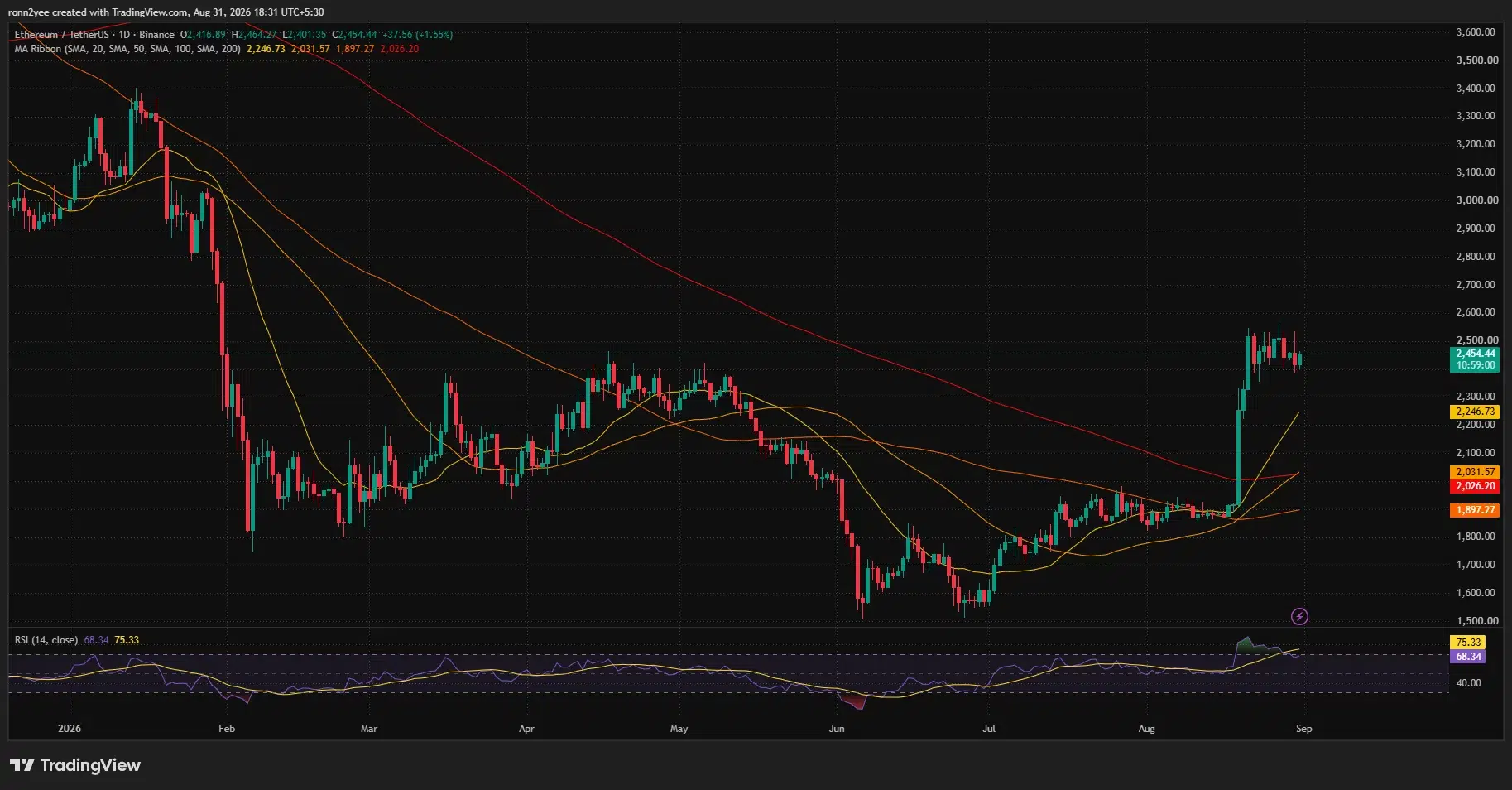
Ethereum price traded near $2,455 on Aug. 31 after buyers again failed to hold the price above $2,500, leaving ETH confined between major resistance and support near $2,400.
Summary
- Ethereum price slipped about 1% from its Aug. 25 opening price despite retaining a 28% monthly gain.
- The daily RSI cooled to 68.34 after moving above 70 during the August rally.
- Liquidation clusters sit near $2,545–$2,575, while leveraged positions also gather around $2,390–$2,410.
- A break above $2,550 could expose $2,650, but losing $2,400 would weaken the recovery.
Ethereum price action today
According to data from crypto.news, Ethereum (ETH) price opened the week at $2,481.78 before reaching an intraday high of $2,564.27 on Aug. 27. Sellers rejected the move, and ETH traded near $2,455 at the time of writing on Aug. 31.
The pullback placed the token about 1% below its weekly opening level. However, ETH remained up roughly 28% over 30 days after recovering from below $1,900 earlier in August.
The daily chart shows that the recovery accelerated around Aug. 19, when ETH broke above a group of long-term moving averages near $1,900–$2,050. The price then climbed more than 30% in several sessions before entering consolidation.
ETH has since traded mainly between approximately $2,390 and $2,550. Repeated upper wicks near the top of the range show that buyers have tested the resistance several times without securing a sustained daily close above it.
The latest daily candle recovered from a low near $2,401, suggesting that buyers are still defending the lower end of the range. However, the price must reclaim $2,500 before it can challenge the Aug. 27 high again.
Momentum cools after the August rally
Ethereum’s daily relative strength index stood at 68.34, down from levels above 70. The reading remains close to overbought territory but shows that momentum has eased as the price struggles below $2,550.
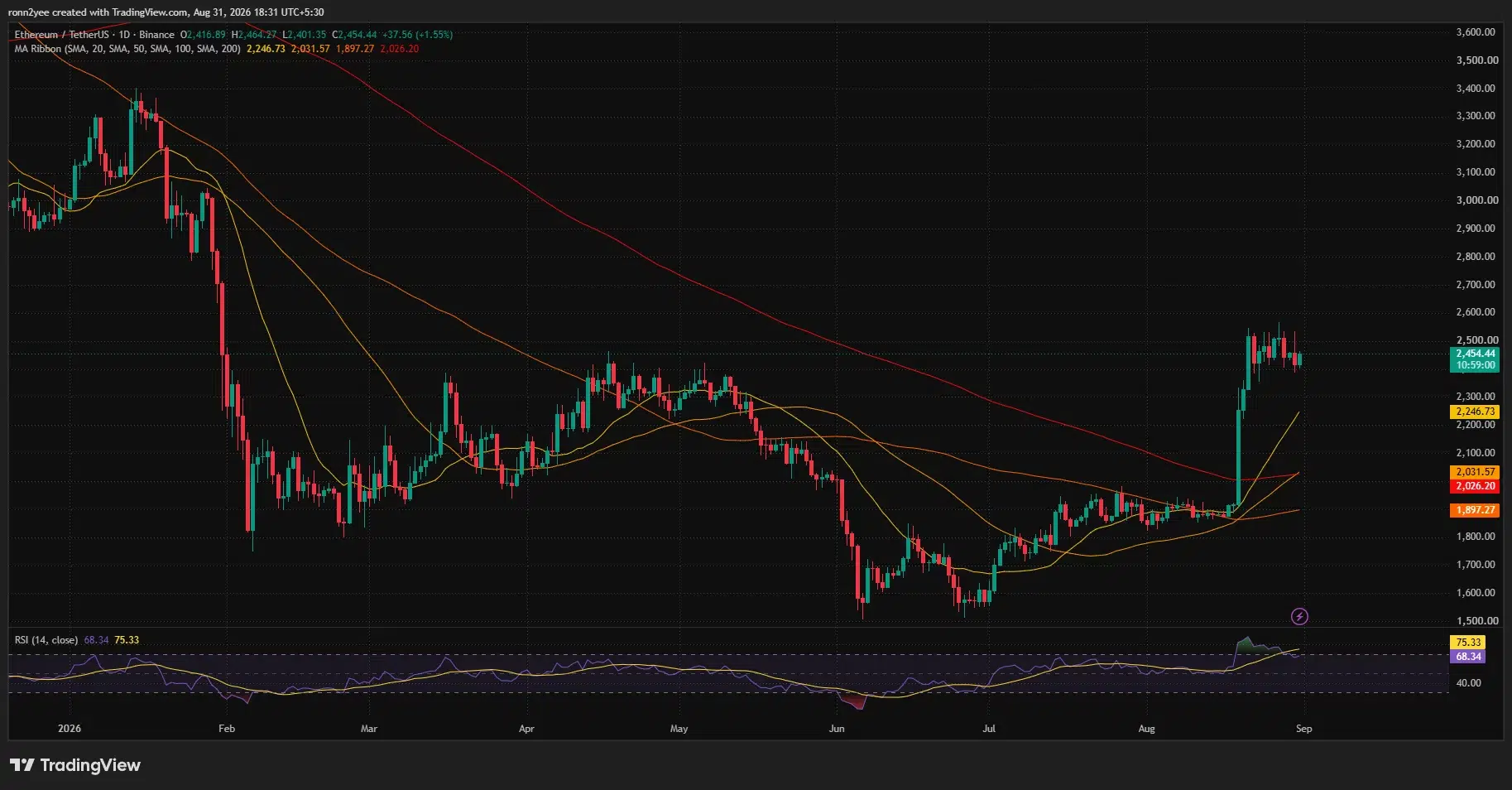
The RSI’s moving average was higher at 75.33. An RSI move below its average after an overbought reading can accompany consolidation or a deeper pullback, although it does not determine the next price direction by itself.
ETH continues to trade above all five moving averages shown on the daily chart. The 20-day simple moving average sits at $2,246.73, making it the first major dynamic support if the current range breaks down.
The 50-day and 200-day averages stand at $2,031.57 and $2,026.20, respectively. Contrary to the earlier death-cross concern, the latest chart shows the 50-day average slightly above the 200-day line. The narrow gap means the longer-term trend has improved, but the signal has little room to absorb a sharp reversal.
The 100-day moving average sits near $1,897.27. ETH’s position well above that level reflects the strength of the August recovery, although the distance between price and its moving averages also leaves room for mean reversion.
Ethereum faces liquidity near $2,550
The 4-hour chart places ETH inside a horizontal range extending from around $2,390 to $2,550. Price has tested both sides since Aug. 21 without producing a confirmed breakout.
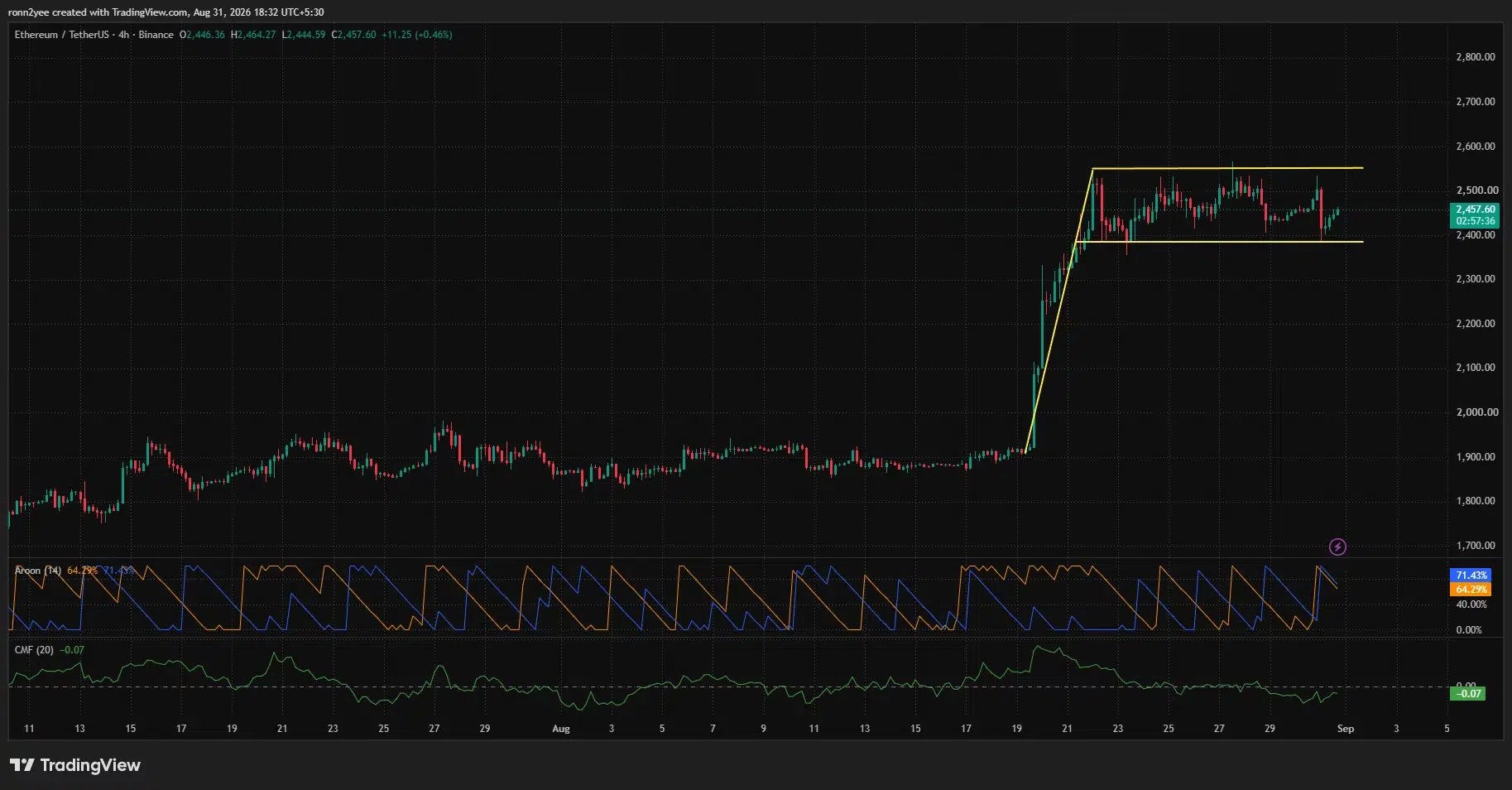
Short-term momentum remains mixed. The Aroon Down reading stood at 71.43%, compared with 64.29% for Aroon Up, showing a slight bearish advantage after the latest rejection. However, both readings remain elevated, which is consistent with volatile price movement inside the range rather than a clear directional trend.
Chaikin Money Flow stood at minus 0.07 on the 4-hour chart. The negative reading points to mild net selling pressure, but its proximity to zero suggests that sellers have not established strong control.
The one-week CoinGlass liquidation heatmap shows a dense concentration of leveraged positions around $2,545–$2,550, followed by another liquidity band near $2,570–$2,580. A move into either area could trigger short liquidations, but the same zones may also attract renewed selling.
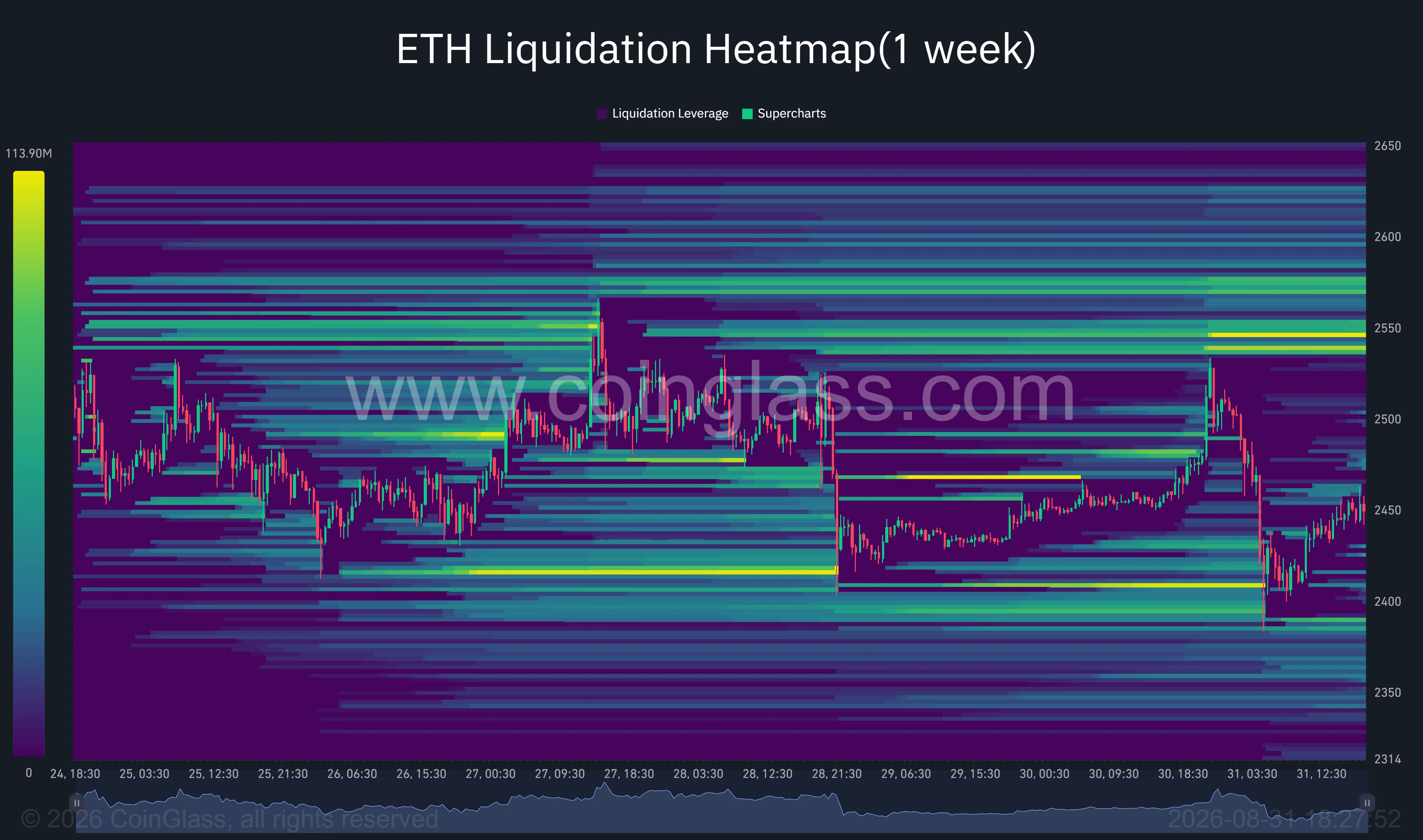
On the downside, visible liquidation concentrations sit near $2,410 and $2,390. A break below $2,400 could therefore force leveraged long positions to close and increase short-term volatility.
Key ETH levels to watch
A daily close above $2,550 would invalidate the upper boundary of the current range and clear the way for a test of the liquidation zone near $2,575. The next wider resistance area sits near $2,650, according to the price structure shared by market analyst Ted Pillows.
Pillows said ETH had tried and failed to break $2,550 again. He expects further range-bound trading and “a small capitulation before reversal,” while his chart identifies approximately $2,250 as the first deeper support.
The immediate downside level remains $2,400. A 4-hour or daily close beneath it would shift attention toward the 20-day moving average near $2,247, which closely matches Pillows’ first support zone.
If that area fails, the 50-day and 200-day moving averages around $2,030 form the next major support cluster. A drop that deep would erase much of the late-August breakout and weaken the current recovery structure.
The bullish setup requires ETH to defend $2,400, reclaim $2,500 and close above $2,550. The bearish setup would gain strength below $2,400, with $2,247 and $2,030 serving as the main lower targets.
US policy remains a market catalyst
Market analyst Michaël van de Poppe said the ETH-to-Bitcoin pair was moving sideways near what he considered a potential entry zone. He expects ETH to outperform Bitcoin in the coming month based on his forecast that the CLARITY Act will receive approval.
However, the legislation had not been enacted as of Aug. 31. An Aug. 5 regulatory filing said the bill passed the House in July 2025 and advanced through the Senate Banking Committee in May 2026, but negotiations remained ongoing, and its prospects were uncertain.
US spot Ethereum ETF flows provide another measure of institutional demand. U.S. spot Ethereum ETFs recorded $815.7 million in net inflows across the five trading days from Aug. 24 to Aug. 28, according to data compiled by Farside Investors. BlackRock’s ETHA led the weekly intake with $567 million, while the ETF group posted its largest daily inflow of the week on Aug. 27 at $225.8 million.
ETH therefore enters September with its monthly recovery intact but short-term momentum fading. The next confirmed move depends on whether buyers can clear $2,550 or sellers can break the support and liquidation zone around $2,400.
Disclosure: This article does not represent investment advice. The content and materials featured on this page are for educational purposes only.

The Cardano Foundation and Brazilian technology firm Blockforce announced some big news. ADA is now live as the public proof layer inside Blockforce’s enterprise supply-chain traceability platform. The system is already running with Brazil’s largest fashion groups and has anchored more than 500,000 supply-chain records.
The structural problem this solves is straightforward. Regulated supply chains need outside parties to confirm a record is genuine without handing over the commercial data behind it. A fully private database gives brands no way to prove anything to an outsider. A fully public ledger proves everything but exposes pricing, supplier identities, and contract terms to anyone watching the chain.
Blockforce’s answer keeps detailed records for each supply-chain step on a permissioned network, visible only to the parties directly involved. Only the cryptographic proof of those records gets anchored to Cardano, where any auditor, regulator, or customer can confirm a record’s integrity without ever touching the underlying data.
Cost is what kept this model stuck at the pilot stage. Anchoring hundreds of thousands of individual records publicly was never economically viable at enterprise transaction volume, which is precisely the scale regulated traceability requires once a program moves past a handful of pilot suppliers.

How Blockforce’s Dual-Ledger Proof Layer Works in This Cardano News
Joint engineering between the two organizations cut the cost per record by 92%, which is the figure both sides point to as the unlock that moved public verification out of proof-of-concept territory and into production at real volume. More than 500,000 records are already anchored under that model.
Supplementary technical material from Blockforce describes the permissioned side of the architecture as running on Hyperledger Fabric, with additional storage components referenced alongside it.

The full architecture, including the uVerify component and the specific batching parameters used to group certificates into Cardano transactions, is laid out in the Cardano Foundation’s Blockforce case study.
Guilherme Pereira, Ecosystem Growth Specialist LATAM at the Cardano Foundation, framed the milestone in infrastructure terms rather than novelty terms:
“The milestone for me is seeing blockchain fit naturally into enterprise infrastructure, delivering the verifiability, traceability, and scale that companies need. Supply chain records are written today and questioned years later, and a public network is what keeps that proof intact for the full product life cycle.”
Trade ADA on Bybit and Get a Chance to Win Our $1,000 USDT Airdrop
Compliance and Traceability Implications
The announcement itself does not certify compliance with any specific regulatory regime by name. It frames the model around giving auditors and regulators independent verification capability, not a compliance stamp.
Broader references to EU sourcing rules circulating in trade coverage should be treated as market context rather than claims made by the Cardano Foundation or Blockforce directly.
Suelen Joner, head of sustainability at Azzas 2154, described the practical goal driving adoption:
“Our goal is to trace 100% of the leather across our brands by 2030. To get there, we built a solution with Blockforce that works with the reality of the chain and uses the data suppliers already produce. Rather than asking them to adopt new systems, we start from that information and turn it into a single auditable record.”
Beyond fashion, the two organizations say expansion is planned into automotive, agribusiness, pharmaceuticals, and cosmetics, using the same dual-ledger structure.
Discover: The Best Token Presales
The post Cardano News: ADA Anchors 500,000 Supply-Chain Records for Public Proof appeared first on Cryptonews.
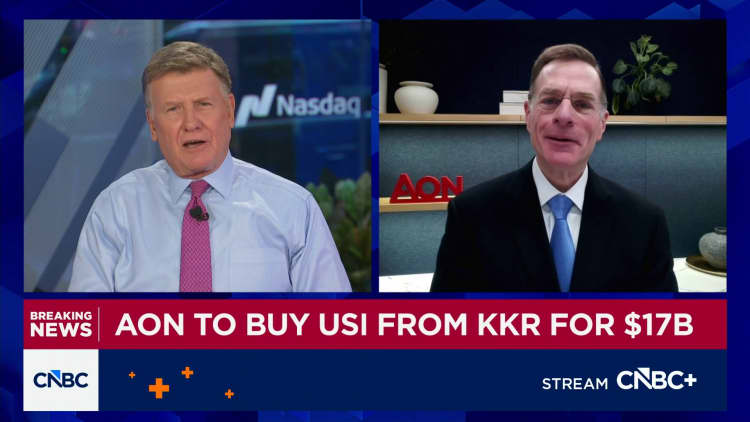

Insurance broker Aon announced on Monday it will purchase rival USI Insurance Services from private equity firm KKR.
The $17 billion deal, which will be funded by Aon with new debt, is anticipated to close in the fourth quarter, subject to regulatory approvals.
CEO Greg Case in an appearance on CNBC’s “Squawk Box” Monday said that the merger will establish the “premier U.S. middle-market platform.”
“This means we’re going to be in a position to bring world class solutions to the underserved U.S. middle market, and … set a new standard of client leadership for the 200,000 middle-market companies in the U.S. and their 48 million employees,” he said.
The acquisition for Aon builds on the company’s purchase of NFP in 2024, another insurance broker focused on the U.S. middle market.
An office building with the Aon logo is seen amid the easing of the coronavirus disease (COVID-19) restrictions in the Central Business District of Sydney, Australia, June 3, 2020.
Loren Elliott | Reuters
USI, according to a press release announcing the deal, is the tenth largest insurance broker in the U.S. The company has more than $3 billion in annual revenue, and more than 10,500 employees.
Once a deal is closed, USI CEO Mike Sicard will transition to Aon’s president and global CEO of middle market.
“Joining Aon represents a truly energizing next chapter for our firm and an opportunity to accelerate our momentum as part of the Aon United platform,” Sicard said in the release. “Our firms share strong, one-firm cultures with a deep commitment to working together to bring the best of our capabilities to clients.”
In a press release, KKR partner Chris Harrington said Aon is the ideal partner to support USI’s next growth chapter.
Shares of Aon slipped about 1% in premarket trading Monday. But despite the initial slide, Case said the opportunity to serve the middle market at the scale the company now can through the acquisition has tremendous value potential for shareholders.
“Maybe the greatest I’ve seen in my 20-year career as CEO,” he said.

The former bitcoin miner continues with its aggressive Ethereum purchases, acquiring more than 53,000 tokens over the past week as its massive treasury now contains 5.9 million ETH, equivalent to 4.9% of the asset’s total supply.
At ETH’s reported price of just over $2,500 (Sunday data), Bitmine’s Ethereum holdings alone are worth nearly $15 billion.
Ramping Up
The purchase announced today is substantially larger than the recent ones, including the one from last week, which was for 32,447 ETH. In the past two weeks alone, the company has acquired almost 86,000 ETH.
The firm now owns 5,901,112 tokens, which represents approximately 4.9% of Ethereum’s circulating supply of 120.7 million. Moreover, it puts Bitmine 98% of the way toward its self-described “Alchemy of 5%” goal of owning 5% of the entire Ethereum supply.
What’s perhaps even more impressive is the highly consistent accumulation strategy. Even as other major crypto buyers, such as Strategy and Metaplanet, paused their acquisitions amid the market uncertainty, Bitmine purchased ETH during each of the past 65 weeks, as Chairman Tom Lee pointed out. Its first buy came with the launch of the Ethereum treasury strategy on June 30, 2025, and the firm hasn’t missed a single week since.
Bitmine remains the largest corporate Ethereum treasury firm and the second-largest crypto treasury entity overall behind Strategy, which resumed its BTC purchases after a two-month hiatus.
Keep Staking
Bitmine has long refrained from simply holding ETH as it continues to stake large amounts. As of the latest announcement shared by the firm, it has staked 5,067,309 tokens, or roughly 86% of its entire stash. In USD terms, the company has staked approximately $12.7 billion at reported ETH prices.
It estimates that its current staking operations could generate around $335 million in annualized revenue, based on its reported seven-day annualized yield of 2.63%.
Separately, Bitmine’s total crypto, cash, marketable securities, and other investments have climbed to $15.6 billion, up from $14.9 billion last week. Aside from the ETH fortune, its treasury contains 211 BTC, $541 million in cash and marketable securities, and investments in Beast Industries and Eighto.
The post BitMine Buys Another 53,501 ETH as Ethereum Stash Blows Past 5.9M appeared first on CryptoPotato.
Crypto World
Bitmine makes largest ether purchase since June as Tom Lee points to crypto's strong Q3


Company Chairman Lee said crypto’s recent outperformance could draw more institutional investors.

Tim Cook & John Ternus are excellent CEOs for Apple

Kemi Badenoch appoints architect of Liz Truss’s mini-Budget to replace Mel Stride as shadow chancellor

Fuel supplier sues distributor for nearly $4M over gas allegedly sold at Trump-promoted Freedom Fuel stations





-

 Crypto World6 days ago
SpaceX stock could rise 75% to $240, JPMorgan says
-

 Fashion3 days ago
Weekend Open Thread: Maeve – Corporette.com
-

 Crypto World4 days ago
Bitcoin’s 22% rally now needs real demand to outlast Treasury liquidity boost
-

 Crypto World5 days ago
Warsh Jackson Hole keynote puts financial innovation first
-

 Crypto World7 days ago
A $30 Billion AI Fund Implodes, Now the SEC Is Investigating Wall Street’s Role
-

 Business4 days ago
Salesforce Stock Soars 19% as Blowout Earnings and Agentforce AI Growth Silence Software Skeptics
-

 Crypto World5 days ago
Did Trump Just Move SpaceX Stock With One Truth Social Post?
-

 Crypto World5 days ago
Elon Musk Grok Bot Promise: We Will Make You Whole if AI Loses Your Money
-

 Business4 days ago
Apple Confirms September 9 Keynote and Reveals Its Full Pre-Order Schedule
-

 Business5 days ago
Walmart takes aim at younger shoppers with new fashion brand
-
 NewsBeat5 days ago
Lindsay Clancy jury braces for closing arguments as judge tells court: ‘You’ve heard all the evidence’ – Live updates
-

 Business2 days ago
Onto Innovation Stock: AI’s Next Bottleneck Is Yield (NYSE:ONTO)
-

 Business6 days ago
Thailand’s Eastern Economic Corridor Capital City (EECiti): Key Developments and Investment Opportunities
-

 Crypto World3 days ago
Bitcoin price tests $82K resistance as Brandt stays long
-

 Crypto World4 days ago
NVIDIA revenue hits $96.2B as AI demand doubles
-

 Business7 days ago
Moderna CEO warns China is pouring state money into mRNA technology
-

 Business7 days ago
NVIDIA Stock Drops Nearly 2 Percent to $210 on Seventh Losing Day Ahead of Critical AI Earnings
-

 Business3 days ago
iPhone 18 Pro Pre-Orders Could Shift to Saturday as Apple Reportedly Avoids September 11 Anniversary
-

 NewsBeat6 days ago
Trump’s trade truce with China faces test with Iran effort
-
 Crypto World5 days ago
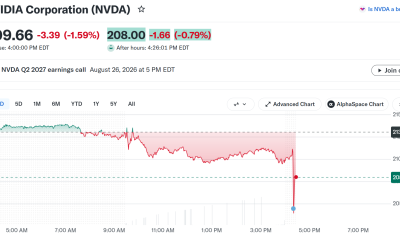
Nvidia Q2 Earnings Reveal $96.2 Billion Beat, So Why Is NVDA Falling?
You must be logged in to post a comment Login