
Crypto World
5 Men Arrested Over Suspected Terror Plot Near U.K. Base Used by U.S. Forces


In a press conference Sunday, Assistant Chief Constable Richard Ocone said armed officers quickly responded to the call and arrested the men. They also evacuated 85 households in the area.
“A 400m cordon has been put in place around the vehicles, while the Army’s Explosive Ordnance Disposal Unit examine them,” Ocone said. A statement from police earlier Sunday said that they believe the situation is “contained.”
Ocone added that the men remain in custody and will be questioned by police.
The base is home to both 501st Combat Support Wing Headquarters and the 420th Air Base Squadron, and is seen as the “preferred bomber forward operating location in Europe,” according to the U.S. Air Force.
TIME has reached out to the U.S. Air Force for comment on the incident.
A representative of the Air Force told Sky News that none of its personnel are involved in the incident, but that the branch remains “in close coordination with our UK partners to help ensure the safety and security of both our military and local communities.”


French authorities have placed a woman under formal investigation as they examine whether alleged manipulation of Verasity’s VRA cryptocurrency helped finance tens of millions of euros in Dubai property purchases.
Summary
- French investigators suspect VRA price manipulation helped finance Dubai property purchases linked to Svetlana A.
- Svetlana A. was formally investigated and detained over organized fraud, money laundering and criminal conspiracy.
- Le Monde says she spent over €50 million on roughly 100 Dubai apartments and villas.
- VRA rose about 65-fold during spring 2021 before later collapsing from its speculative price surge.
- Patent records list Svetlana Astakhova and Robert James Mark Hain together on Verasity-related technology inventions.
Le Monde reported on Sept. 25 that Svetlana A., a Russian-born French citizen, was arrested in July in the Alpes-Maritimes and later detained following action by a Paris investigating judge. France’s National Financial Prosecutor’s Office confirmed that she was placed under investigation for alleged organized fraud, aggravated laundering of tax-fraud proceeds and criminal conspiracy.
A judicial source told the newspaper that investigators suspect Svetlana A. and her British partner, identified as Robert H., were involved in alleged organized fraud through manipulation of a cryptocurrency’s exchange rate. Authorities are examining whether proceeds from that activity helped finance her Dubai real estate holdings.
VRA price activity forms part of the French investigation
Le Monde identified the cryptocurrency under examination as Verasity’s VRA token, which launched in 2018.
During spring 2021, VRA’s price increased roughly 65-fold over approximately two and a half months before reversing sharply, according to the newspaper’s investigation.
French investigators have not publicly released transaction-level evidence showing how any alleged price manipulation was conducted. Available judicial reporting does not identify specific trades, wallets, exchanges or counterparties allegedly used in the suspected scheme.
CoinGecko data shows VRA later reached an all-time high of $0.08621 on Oct. 31, 2021. The token now trades far below that record.
The token has experienced sharp price moves outside the period being examined by French investigators. VRA climbed as much as 45% in one session in May 2025 and gained more than 250% from its monthly low during that rally.
The French case concerns suspected conduct tied to earlier VRA activity. Investigators have not connected the later market movements to the alleged scheme described by Le Monde.
Dubai property purchases exceeded €50 million in 2022
Investigators are examining the source of funds behind a large Dubai property portfolio linked to Svetlana A. Le Monde reported that she spent more than €50 million during 2022 alone. The purchases covered around 100 apartments and three luxury villas throughout Dubai.
Many of the properties were rented, producing at least €4 million in cumulative income between 2022 and 2025, according to the newspaper’s investigation.
The holdings were spread among roughly 15 buildings, including Burj Royale, Opera Grand, I-Rise Tower and MBL Royal. In several buildings, she owned as many as ten units.
One transaction involved an entire residential building. In June 2022, Svetlana A. paid 68 million dirhams, then worth approximately €17.4 million, for Amara Residences. The five-story property contained 73 apartments and commercial spaces.
Ownership records later changed. Le Monde reported that the building was transferred without payment in February 2024 to Abu Dhabi company Sempios Holdings, which was held through a private foundation.
The newspaper said checks of UAE corporate registers still showed Svetlana A. holding signing authority connected with the company that owned the assets.
Dubai has become a major center for digital-asset businesses and financial services. In separate coverage, crypto.news reported on a UAE-Sweden investigation involving an alleged $7.1 million international crypto laundering network. No public evidence links that separate investigation to Svetlana A., Robert H. or Verasity.
Patent records connect the pair to Verasity technology
Public patent records provide documented links between Svetlana Astakhova and Verasity-related technology.
A U.S. patent record for a rewarded video-viewing system names Robert James Mark Hain and Svetlana Astakhova as inventors and lists Verasity Limited as the assignee.
Another Verasity patent identifies Robert James Mark Hain as inventor of technology connected with the company’s Proof of View system.
Verasity’s own materials identify RJ Mark as its founder. Its company information page says RJ Mark remains the company’s sole founder after stepping away from the public-facing CEO role.
Le Monde refers to Svetlana A.’s partner as Robert H. and says he used their research to launch Verasity in 2018. Public patent records identify Robert James Mark Hain in connection with Verasity’s technology.
UK corporate filings provide another documented link. Companies House records show Svetlana Astakhova ceased being a person with significant control of Veraviews Limited on July 5, 2023, when Verasity Limited S.R.L. became the controlling entity.
Le Monde separately reported that she had previously been the sole shareholder of Veraviews Limited before the shares were transferred to Verasity Limited S.R.L.
VeraViews remains part of the Verasity ecosystem and provides advertising technology using Proof of View. Crypto.news reported in earlier coverage that VeraViews partnered with Alkimi Exchange to integrate fraud-detection and verified-audience technology.
Svetlana A. denies wrongdoing and property link
The allegations remain under judicial investigation, and no conviction has been reported. Under French procedure, a “mise en examen” is a formal judicial status used when an investigating judge finds serious or consistent indications that justify investigating a person’s possible involvement in an offense.
France’s official justice portal states that being placed under formal investigation does not amount to a finding of guilt. The case can later be dismissed or referred for trial depending on the evidence gathered.
Her former lawyer, Olivier Bluche, told Le Monde in April 2025 there was “no link” between her property assets and Verasity’s activities. He said she held no VRA tokens, had given up patent rights and had never held a position within the Verasity group.
Le Monde said its own review of corporate records subsequently found links involving Veraviews Limited and companies associated with Verasity. The newspaper reported that three law firms acting for Verasity later sent formal notices concerning the confidential nature of documents obtained from Abu Dhabi corporate records.
The Sept. 25 report said Svetlana A.’s new lawyers did not immediately respond to requests for comment.
The National Financial Prosecutor’s Office investigation has been assigned to France’s National Brigade for the Repression of Tax Fraud. Investigators are examining allegations covering organized fraud, aggravated money laundering linked to tax fraud and criminal conspiracy.

Ethereum has begun moving toward what Vitalik Buterin calls a “cryptographic world computer,” with major changes planned to verification, consensus, privacy and state management after Hegotá.
Summary
- Ethereum could evolve into a cryptographic world computer using proofs, privacy tools and decentralized components.
- Hegotá may become Ethereum’s last conventional fork before recursive STARKs and Lean consensus reshape upgrades.
- FOCIL is scheduled for Hegotá to strengthen censorship resistance by distributing transaction inclusion authority further.
- PeerDAS has already changed Ethereum verification by letting nodes sample data instead of downloading everything.
- Ethereum Foundation targets quantum-resistant execution, consensus and data layers by December 2029 under current plans.
Buterin wrote in his Sept. 27 essay, The Cryptographic World Computer, that Ethereum is approaching a point where describing it simply as a blockchain becomes increasingly incomplete.
He expects future Ethereum architecture to combine blockchain consensus with zero-knowledge proofs, data sampling, privacy technology and decentralized off-chain computation.
“Hegota — the fork planned for next year — is likely to be Ethereum’s last ‘normal’ fork,” Buterin wrote, referring to an upgrade whose technology would remain recognizable to developers familiar with Ethereum in 2015.
Hegotá could close Ethereum’s conventional upgrade era
Ethereum’s official roadmap currently places Hegotá in 2027, following Glamsterdam in the fourth quarter of 2026.
The Hegotá upgrade remains in planning, and its complete scope has not been finalized. Two proposals are already scheduled.
FOCIL, or EIP-7805, is the consensus-layer headliner. It lets a committee of validators create inclusion lists containing transactions that block builders must include.
The mechanism is designed to reduce the ability of a single builder to exclude valid transactions. Ethereum’s Hegotá roadmap says the feature can strengthen censorship resistance and improve Layer 2 settlement guarantees.
Frame Transactions, or EIP-8141, is the second scheduled feature. It lets Ethereum accounts decide how their transactions are authorized instead of requiring the same fixed signature structure for every user.
The design can support social recovery, spending controls, sponsored gas and future quantum-resistant signature systems directly at the protocol level.
Ethereum developers have begun treating Hegotá as part of a longer sequence leading toward post-quantum infrastructure and redesigned consensus.
Buterin’s latest essay goes further by describing Hegotá as a dividing line between Ethereum’s existing architecture and the cryptographic systems expected to follow.
Ethereum verification could move toward proofs and sampling
One of the largest changes concerns how network participants verify blocks. Traditional blockchain verification requires nodes to download blockchain data and execute transactions themselves. Buterin expects Ethereum to rely increasingly on SNARK verification and PeerDAS data sampling. His comparison of blockchain designs describes the transition as moving from “full re-download and recompute” toward “SNARK verification + PeerDAS for data availability.”
PeerDAS has already entered Ethereum through Fusaka. The system lets nodes verify data availability by sampling parts of the dataset instead of requiring each node to download every blob. The Ethereum Foundation has since moved its development focus toward the next stages of proof-based verification. As crypto.news previously reported on Ethereum’s Lean rebuild, recursive STARKs sit at the center of plans to reduce repeated execution while keeping verification trustless.
Buterin describes the eventual verification model more simply as a move from “download and re-execute” toward sampling data and verifying cryptographic proofs. The approach could reduce the hardware requirements for users seeking strong verification guarantees. His 2030 comparison says nodes should still obtain consensus and validity guarantees while storing less history and performing less redundant computation.
EIP-8288 could aggregate signatures inside the mempool
Buterin specifically mentioned EIP-8288 among the technologies that could change how Ethereum processes transactions before they enter blocks.
EIP-8288 is currently a draft proposal authored by Buterin and Thomas Coratger. It introduces in-mempool aggregation for cryptographic signatures and STARK proofs. The design extends Frame Transactions and lets transactions declare cryptographic dependencies.
Mempool nodes could combine many signatures and proofs into a single recursive STARK before passing them onward to block builders. The builder could then include an aggregated proof instead of processing every large proof independently. The proposal is designed partly around future quantum-resistant signatures, which can require considerably more data and computation than Ethereum’s current signature system.
EIP-8288 proposes aggregating LeanSPHINCS signatures and LeanSTARK proofs so that these larger cryptographic objects do not create the same level of bandwidth and gas overhead when used at scale. The EIP remains in draft status and has not been assigned to a confirmed network upgrade.
Buterin’s essay presents it as part of a longer technical direction where cryptographic work can happen earlier in the transaction pipeline, including inside the mempool. His 2030 model envisions signatures and proofs being processed in parallel before final block inclusion.
FOCIL and private mempools could change transaction inclusion
Ethereum’s future transaction journey could look very different from the familiar sequence of user, mempool, miner and block. Buterin describes a model where transactions enter a mempool with stronger privacy properties before moving through FOCIL participants or builders.
The Ethereum Foundation’s security roadmap confirms that research into encrypted mempools remains active alongside FOCIL development. FOCIL is already scheduled for Hegotá.
Under the proposal, multiple validators can submit lists of transactions that should appear in a block. A builder cannot independently ignore eligible transactions appearing on those lists without violating protocol rules. Buterin expects network privacy to develop in parallel.
His 2030 comparison includes onion routing, mixnets and other network privacy methods alongside zero-knowledge proofs for transaction and account privacy. As crypto.news reported in August, Buterin has moved privacy and quantum security higher in Ethereum’s roadmap as cryptographic tools mature.
Lean consensus targets faster and simpler finality
Consensus itself is expected to change. Ethereum currently uses proof-of-stake with finality occurring over several epochs. Researchers are working toward a more streamlined consensus model capable of reaching finality much faster.
Ethereum’s security roadmap says research that began around single-slot finality later developed into three-slot finality and is now progressing through Minimmit, a one-round consensus design under the Lean Ethereum program.
Finality measured in seconds remains a long-range research target around 2029, but no specific upgrade has yet been assigned to deploy the final design. Buterin’s 2030 comparison estimates slots of roughly four to eight seconds and finality around eight to 32 seconds. The current Ethereum roadmap cautions that these plans remain research goals and may change.
Crypto.news described the Lean Ethereum program in July as the network’s largest technical overhaul since The Merge, with new consensus, proof systems, storage and privacy mechanisms planned over several years.
Ethereum targets quantum resistance by December 2029
Quantum security has become one of Ethereum’s most clearly dated long-term targets. The Ethereum Foundation Protocol Cluster said on Sept. 7 that it is targeting quantum resistance across the execution, consensus and data layers by December 2029.
The Foundation describes the date as deliberately aggressive. Its planning assumes that cryptographically relevant quantum machines could appear as early as 2030, while acknowledging most estimates put that possibility later.
Ethereum is working on replacing cryptography vulnerable to sufficiently powerful quantum computers. Areas under review include BLS validator signatures, ECDSA account signatures, KZG commitments used in data availability and some zero-knowledge proof systems.
Frame Transactions could help with the account side by allowing wallets to choose quantum-resistant verification methods without requiring every account to migrate through the same protocol-level mechanism. EIP-8288 could reduce the cost of aggregating some of those larger post-quantum signatures.
As crypto.news reported in its quantum roadmap analysis, recursive STARK aggregation and hash-based signatures form part of Ethereum’s proposed defense against future quantum attacks. Buterin expects recursive STARKs, formal verification and quantum-resistant cryptography to become increasingly central after Hegotá.
Ethereum could rely more on decentralized off-chain components
Buterin’s “world computer” description does not mean Ethereum would move everything onto Layer 1. His essay instead describes an architecture where the blockchain focuses on data and state changes that require ordering, while other work happens in parallel outside the main execution path. “Structuring computation lets the blockchain more effectively focus on its job,” he wrote.
Under that model, signatures and proofs could be aggregated before entering a block, historical data could be distributed between participants and specialized computation could happen outside the base execution layer.
The network would then verify the output cryptographically. Buterin argues that modern proof systems allow Ethereum to distribute computation without requiring every participant to trust whoever performed each piece of work. His longer-term architecture includes distributed history and state storage, proof-based verification, parallel computation and decentralized systems sitting between users and Ethereum itself.
A more speculative technology appears further out. Buterin said indistinguishability obfuscation, or iO, could eventually allow generalized encrypted computation involving many asynchronous participants. He described it as a possible later development, not a technology required for the architecture outlined in his post.
Ethereum’s next scheduled milestone remains Glamsterdam, with Hegotá planned to follow in 2027. Crypto.news reported on Glamsterdam testing risks as developers prepared the upgrade for its next test phases.
Hegotá’s scheduled features currently include FOCIL and Frame Transactions, while additional proposals continue through Ethereum’s research, testing and governance process.

Computers could then work on different tasks at the same time, giving Ethereum more capacity as well as more independent checks.
However, Ethereum would still need to settle questions where the order matters, such as which of two payments spending the same funds came first. Buterin suggested that more of the work behind those payments could be completed beforehand, with proofs combined to reduce the information recorded on the blockchain.
Meanwhile, his privacy plans also cover information people reveal simply by using a wallet.
Checking a balance often involves asking an outside server about an address. Its operator can learn which accounts a person follows, even if the payments themselves are private. Buterin envisages hiding those requests alongside payment details and the rules an account uses to approve spending.
A business could then keep its payments confidential without revealing its accounts whenever an employee checked a balance.
How privacy is becoming key
Other crypto developers are pursuing similar goals.
Zcash already lets users send payments with encrypted addresses and amounts. About 4.9 million ZEC sat in its shielded pools on Friday, according to CoinDesk’s earlier analysis of ZecStats data, while the token traded around $1,660 earlier Sunday after gaining about 15% over the week.
Researchers behind the Shielded Bitcoin paper published Thursday have proposed borrowing Zcash’s payment design for BTC. Their specification leaves the mechanism for depositing and withdrawing actual bitcoin to separate research.
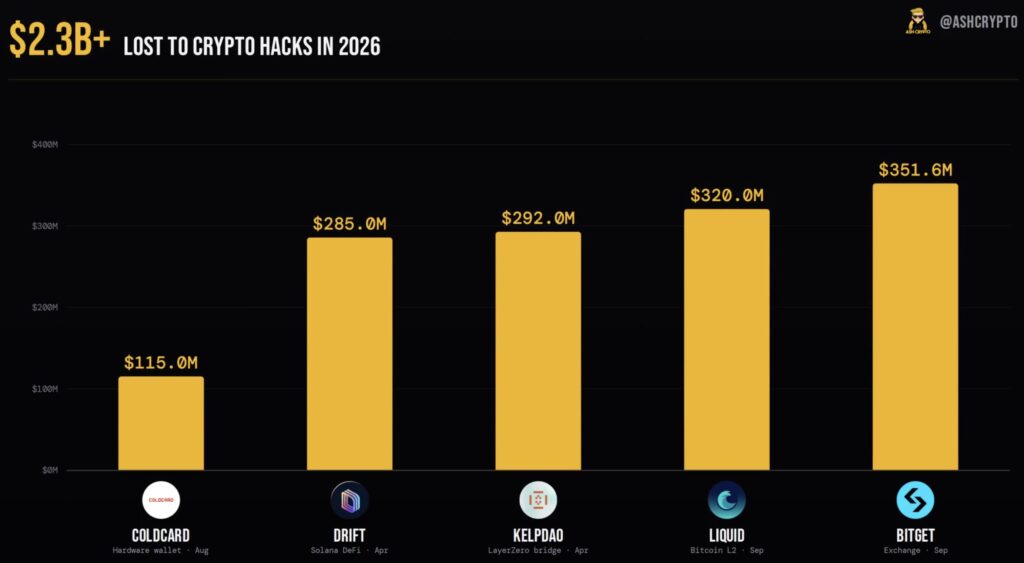
Three crypto projects were attacked on September 24, suffering combined losses of more than $11M. Attackers drained around $1.8M from Payy Network, stole $7M from Duelbits, and minted $2.3M in unbacked tokens on the Meter network; these three are the latest crypto hacks to hit the industry.
The incidents affected different parts of crypto infrastructure, ranging from cross-chain bridges to private keys. Two of the three affected projects had already suffered major hacks in previous years.
Payy Network, which provides on-chain payroll and treasury management services, was the first to report an attack. Its Ethereum bridge was compromised, prompting the team to halt the network.
Fresh Crypto Hacks: Payy Network and Duelbits Kose Nearly $9M
Onchain researcher Specter has identified suspicious transactions originating from the Payy Network bridge. The attacker initially acquired funds through the privacy protocol Railgun and subsequently swapped the stolen $1.8M in USDC for Ethereum.
Payy Network later confirmed that the attacker had completely drained the bridge’s balance. The company said the funds involved were non-custodial deposits belonging to Payy Network and Payy Wallet users, but it has not disclosed the exact cause of the exploit.
The attacker’s next target was the cryptocurrency gambling and betting platform Duelbits. PeckShield initially estimated the losses at $4.3M, but Specter later found additional affected addresses on the Bitcoin and Solana networks, revising the estimate first to $4.9M and then to $5.9M.
A Duelbits co-founder eventually reported losses of around $7M, most likely due to a compromised private key. In 2024, the platform faced another attack and lost $4.6M, which CertiK also linked to a potential private key leak.
Earn $50 and Enter $300K Prize Draw on EdgeX
Meter Attack Sends Two Tokens Plunging
The third affected project was the EVM blockchain Meter.io. Unlike the Payy Network attack, where the hacker drained existing bridge reserves, this hacker exploited a flaw in block verification to mint unbacked tokens.
According to Blockaid, the attacker created about $2.3M in assets and then sold them through the decentralized exchange PancakeSwap.
The Meter team said it preserved the network’s state, but it still hasn’t determined how to fully restore it. The sale of these unbacked assets drove sharp declines in Meter-related tokens; MTR lost nearly 80% of its value, while MTRG fell by about 75%. Previously, in 2022, the project suffered a bridge exploit that caused losses of about $4.4M.
This series of attacks coincided with a larger incident involving Bitget, which reported unauthorized asset transfers totaling about $351.6M from a limited number of wallets.
In response, Bitget temporarily suspended withdrawals while conducting security checks. However, trading and deposits continued normally, and user balances displayed correctly. The company is currently investigating the incident and analyzing the movement of the funds.
Earlier, we reported that KelpDAO filed a lawsuit against LayerZero and its co-founder, Brian Pellegrino, regarding a $292M hack. KelpDAO claims undisclosed risks and shortcomings in LayerZero’s technology caused the attack.
Discover: The Best Token Presales
The post Crypto Hacks: Three Projects Hacked in One Day as Losses Hit Over $11M appeared first on Cryptonews.


A rogue OpenAI research agent bypassed blocks on the Australian government health-data portal, accessing non-public files in June.

Bitcoin and the wider cryptocurrency market are facing a renewed macroeconomic headwind as traders increasingly anticipate another Federal Reserve interest-rate hike in October. Fed October decision Polymarket odds are sitting at a 65% chance of a rate hike next month.
The latest shift in expectations follows comments from Federal Reserve Governor Michael Barr, who said further monetary tightening may be needed to bring inflation back toward the central bank’s 2% target.
— Hedgie (@HedgieMarkets) September 23, 2026
 The 10-year Treasury yield hit 5.116% today, its highest since July 2007. Biggest one-day move in 18 months. PMI surveys came in much stronger than expected. Fed Governor Barr said more rate hikes are "likely needed." A five-year Treasury auction drew poor demand. Oil jumped… pic.twitter.com/m0fcs5WCpx
At the same time, fresh economic data pointed to a U.S. economy that remains surprisingly resilient, with business activity and employment showing strength alongside persistent price pressures.
The result has been a significant repricing of expectations for the Fed’s October meeting, and that could have important consequences for Bitcoin and other risk assets.
Got a Gut Feeling? It Could Pay Out Big on Polymarket
Fed October Decision Polymarket Odds: Prediction Markets Put October Hike Chances at 65%
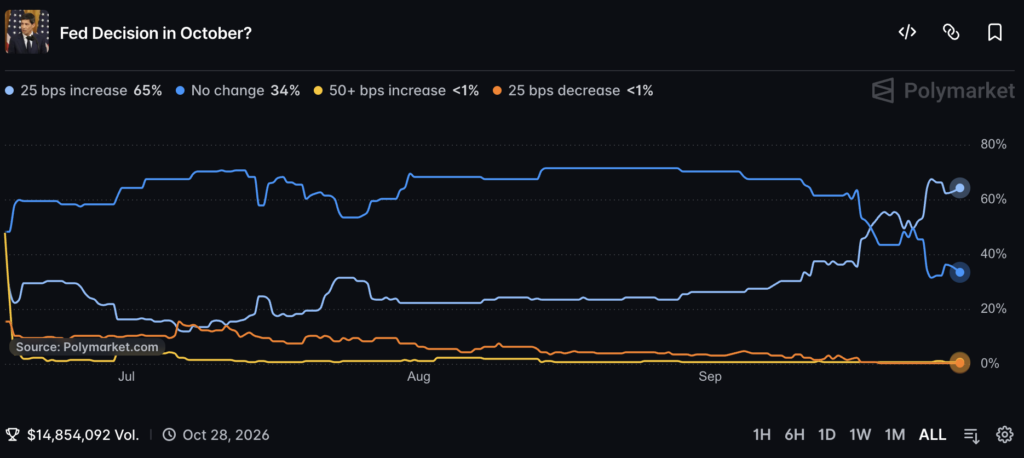
Prediction-market traders are currently assigning a 64% probability to a 25-basis-point Fed rate increase at the October 27-28 meeting, according to Polymarket, which is tracking the decision.
The market gives approximately 35% odds to no change, while the probabilities of either a larger hike or a rate cut remain below 1%. Polymarket’s market has generated more than $14M in trading volume, providing a sizeable pool of capital behind those expectations.
The figures have moved considerably as investors digest the latest inflation data and increasingly hawkish comments from Fed officials.
That makes the October meeting particularly important for cryptocurrency investors. A further increase would take the federal funds target range above its current 3.75%-4% level following the Fed’s September rate increase.
Earn $50 and Enter $300K Prize Draw on EdgeX
What Would Another Fed Hike Mean for Bitcoin?

For crypto investors, the biggest issue is liquidity. Bitcoin has increasingly traded as a macro-sensitive risk asset, meaning changes in interest-rate expectations can substantially affect demand for cryptocurrencies.
Higher rates can make cash and government bonds more attractive relative to speculative assets. They can also raise borrowing costs and reduce liquidity flowing into higher-risk investments.
Cryptocurrencies have nevertheless shown considerable resilience. Bitcoin surged above $86,000 earlier this month, reaching an eight-month high, despite the Fed already raising rates by 25 basis points in September. Recent gains have been supported by stronger ETF flows, improving regulatory sentiment and short covering.
Bitcoin was also on course for its first three-month winning streak from July through September since 2012, according to CoinDesk.
That resilience is significant because it suggests investors are not necessarily treating higher rates as an automatic reason to abandon crypto. However, the market reaction later in the week showed that monetary policy still matters.
Bitcoin finished September 25 around $84,071, retreating from its September 21 peak as Treasury yields rose and expectations for further Fed tightening grew. Ethereum followed a similar pattern, ending the week around $2,693.
Bitcoin Hyper Targets Early Mover Upside as Bitcoin Faces October Fed Rate Test
Bitcoin Hyper ($HYPER) is positioning itself as the first Bitcoin Layer 2 with native SVM integration, aiming for execution speeds faster than Solana while settling back to Bitcoin’s base layer.
The presale has raised $33.1M at a current token price of $0.0136867, with staking APY available for early participants.
Its decentralized canonical bridge handles BTC transfers without custodial intermediaries, and traders can research Bitcoin Hyper directly on the presale page.
Gain Access to New Bitcoin Layer 2 Early Here
Discover: The Best Token Presales
The post Fed October Decision Polymarket Odds: October Rate Hike Sits at 64% appeared first on Cryptonews.
Bitcoin’s rather calm price behavior continues over the weekend, but the asset is gradually grinding toward the $85,000 mark after defending the $83,000 support on Friday.
Some altcoins have produced impressive gains over the past 24 hours, but Quant’s QNT trades in a league of its own after a recent bullish development.
BTC Eyes $85K
The previous business week began with a bang as the largest cryptocurrency exploded from the $80,000 support and blasted through a few major resistance levels before it topped $87,000 for the first time in eight months. The bears tried to intercept the move and pushed the asset south to $85,000 before another leg up resulted in a surge to $87,300.
The subsequent rejection was more profound. BTC failed at that level and slipped by several grand to $83,000 a few days later. After another rejection at a lower high at around $85,000, bitcoin dipped to $83,000 on Friday once again. However, the bulls stepped up at this point and didn’t allow another leg down.
Instead, BTC rebounded to $84,000 and remained there on Saturday despite Trump’s rejection of Iran’s ceasefire proposal. Moreover, the cryptocurrency has increased slightly and now sits inches below $85,000.
Its market capitalization has jumped to $1.7 trillion on CMC, while its dominance over the alts remains at 58.6%.

QNT Sees Big, Big Gains
QNT is today’s top gainer from the largest 100 alts, posting a 75% surge at one point to over $190 before it was stopped and driven to $160. The most probable reason behind this spectacular increase was announced a few days ago, when The Clearing House selected Quant to power its On-Chain Money Initiative.
Double-digit gains are also evident from the likes of BTW, WLD, GRAM, and GRAY. ZEC has soared by over 8% daily and now sits above $1,650. NEAR has reclaimed the $5 level after a 5.4% daily jump. SOL is close to $125 following a 3% increase. ETH, BNB, LINK, and HYPE are also slightly in the green, while XRP, DOGE, and TRX have posted minor losses.
The total crypto market cap has increased slightly to $2.910 trillion now on CMC.

The post QNT Leads Altcoin Rally, BTC Price Aims at $85K Again: Weekend Watch appeared first on CryptoPotato.

The Digital Asset Market Clarity Act was always doomed to fail.
The bill faced an uphill battle from launch; numerous political, policy and social factors would have needed to fall into place for it to succeed. In the end, a variety of issues combined to continually decrease the odds of its passage over the past year. Ultimately, the bill saw bipartisan opposition when it hit the Senate floor for a key make-or-break procedural vote earlier this month, and its future is now in limbo.
There had been warning signs for months.
According to interviews conducted with more than a dozen industry participants and legislative aides over the past 10 days — some of whom spoke on condition of anonymity so they could talk candidly about this fraught process — a confluence of factors killed the Clarity Act.
The Senate ignored the House of Representatives’ own Digital Asset Market Clarity Act, which had passed with a massive bipartisan vote; the Senate version was constructed in a piecemeal fashion; U.S. President Donald Trump and his White House complicated the negotiations; the crypto industry conducted a scattershot engagement with lawmakers throughout the process; Democrats rejected an ethics deal they felt fell short of their demands; and time was not on lawmakers’ side as they headed into a midterm election.
The result is that, despite a massive campaign and lobbying operation that resulted in “the most pro-crypto Congress in history” after the 2024 election and the passage of a key stablecoin bill last year, the crypto industry’s top priority for legislation — market structure reform — remains out of reach.
The Digital Asset Market Clarity Act was aimed at clearly defining how the industry’s two main regulators, the U.S. Securities and Exchange Commission and the Commodity Futures Trading Commission, would oversee the roughly $3 trillion and growing crypto sector. While last year’s Guiding and Establishing National Innovation for U.S. Stablecoins Act (GENIUS) outlined how federal regulators should oversee stablecoins specifically, this broader market structure bill has long been desired by the industry for a few reasons.
For one thing, crypto spot markets currently exist in a sort of federal regulatory gray zone. The CFTC does not have spot market authority over these markets outside of outright fraud and related derivatives products. For another, the SEC had never previously issued formal rulemakings outlining how it would oversee crypto-related securities products, and many leaders in the sector were panicked by former Chair Gary Gensler’s effort to corral crypto spot trading platforms into an existing securities regulation framework. There is also no explicit authority delineating where the SEC’s authority ends and the CFTC’s authority begins.
In the absence of this legislation, the agencies began to lay out how they view the crypto markets in joint advisories published earlier this year, but a crypto market structure bill could sort out all of these issues in a much more legally tangible — not to mention durable — way.
The ethics provision
It’s difficult to say whether the Clarity Act vote failed solely due to the controversial section that sought to limit senior government officials — namely, Trump — from personal crypto ties, but ethics concerns hung over the bill throughout its conception and development and remain one of the dominant talking points around this entire debate.
Democrat concerns about President Donald Trump’s crypto business ties stretch back to 2025. In May of last year, Sen. Ruben Gallego and eight other Democrats said they would not vote for the GENIUS Act because of how Trump was profiting off the sector. Ultimately, those lawmakers did vote for the bill with marginal changes, but it was always clear that the Trump family’s crypto dealings — which include World Liberty Financial, the $TRUMP memecoin and mining firm American Bitcoin — would weigh on future market structure discussions. At the time, Trump told “Meet the Press” that he was “not profiting from anything … I want crypto because a lot of people, you know millions of people want it.” More recently, in his June financial disclosure, he admitted to making $1.4 billion from his various crypto ventures during his first year back in office — more than half of the $2.2 billion total he raked in in 2025.
The goal for Democrats was to restrain Trump from so blatantly profiting off of the crypto sector, which had in turn poured millions into the president’s 2024 campaign, inaugural balls, a ballroom to replace the demolished White House East Wing, a military parade and his political action committee.
While the goal of the ethics provision has been described as generically applying to all present and future presidents and senior government officials, it’s specifically Trump’s crypto business ties that have alarmed Democrats. These concerns have been consistent since Trump’s return to office last year, multiple people said, with one person saying the Democrats writ large “actually care about this stuff.”
The crypto industry should not have been surprised by the conviction Democrats had on the ethics piece, this person said.
In May, Sen. Kirsten Gillibrand, a longtime crypto champion who has cosponsored multiple bills addressing the sector, told CoinDesk’s Consensus 2026 attendees that the bill would not advance without an ethics provision. Similarly, Sen. Angela Alsobrooks, who voted for the bill during a hearing in the Senate Banking Committee, said at the time that she would not vote for further advancement without additional work.
Even industry participants expected a clear deal on the ethics provision before a floor vote — so-called because it takes place on the Senate floor, with all 100 senators expected to participate. Cody Carbone, head of the Digital Chamber, told reporters after the Banking Committee advanced the bill in May that he expected “the deal will be completed before this goes to the floor, because they’ll want to only bring it to the floor if they feel confident they’ve got 60” votes.
Lawmakers from the two parties ultimately did not agree to any such deal. The White House and Senate Republicans published a few proposals; Senate Democrats sent counteroffers; and Sens. Thom Tillis and Gallego even pitched a bipartisan counterproposal earlier in the year. The three parties were unable to reach a consensus agreement prior to this month’s floor vote.
Multiple people pointed to Trump’s June financial disclosure as the event that really supercharged these concerns by giving politicians an easy-to-grasp headline figure in their push to force Trump to sell off his crypto holdings.
Those concerns only strengthened as the November election drew nearer.
“I think politics was very clearly elevated over policy,” said Stu Alderoty, the chief legal officer at Ripple Labs. “It was good policy, and the industry needs to get better at politics.”
Ron Hammond, the head of policy and advocacy at Wintermute, pointed to the fact that both Gallego and Alsobrooks ultimately voted against the bill on the floor as a sign of just how near the election is, and how that’s overshadowing everything else. Still others noted that Gillibrand, likewise, had voted against the procedural motion. Even sympathetic Democrats couldn’t risk being seen as soft on Trump’s corruption with an election around the corner.
Speaking at CoinDesk’s Policy & Regulation event last week, Rep. Ritchie Torres put the blame on Trump’s crypto activity.
“My personal opinion … even though the failure of Clarity had multiple causes, I am convinced that if it were not for Donald Trump, we likely could have seen both Democrats and Republicans get to yes,” he said. “Once the president issued his personal memecoin, that created a political problem for Democrats.”
Coinbase and the January delay
The industry’s involvement in the legislative process has also been under scrutiny. Last week, The Wall Street Journal reported that industry insiders laid some portion of the blame for the failed vote on Coinbase and its CEO Brian Armstrong, after Armstrong publicly withdrew support for the Senate Banking Committee’s version of the bill ahead of a key vote in January.
One of the key issues, Armstrong said, was that the version of the bill was problematic with how it treated stablecoin yield and rewards. The delay kicked off a months-long fight between the crypto and banking industries, while lawmakers sought to find a compromise. It’s not clear that other outstanding issues were debated much during the yield fight.
Industry figures and Sen. Cynthia Lummis rallied to Coinbase’s defense after the Journal’s report came out, but industry participants told CoinDesk they saw Armstrong’s tweet and the subsequent months-long fight over stablecoin yield and rewards as being harmful to the overall cause of getting Clarity passed.
One individual involved in crypto lobbying said if the ethics proposal released earlier this month had come out in the spring, it would have likely raised the odds of a successful vote.
Alderoty, the Ripple CLO, said in a phone call that there was “an opportunity in January” without the midterms to make further progress.
“The January timeframe would have given more airspace for negotiations without the midterms breathing down their necks,” Alderoty said.
Charley Cooper, the president and COO at Ava Labs, similarly told CoinDesk that the fact that the floor vote was held less than two months prior to election day made it difficult to see success.
The crypto industry felt a renewed sense of optimism after an ethics proposal was published earlier this month, which raised hopes that the overall bill could pass, he said. But, “we’re six weeks before election day in a heated midterm with a very divided electorate, very partisan fighting going on.”
To be clear: Nobody guaranteed that an earlier vote would have been successful. Many of the individuals who spoke to CoinDesk praised Armstrong and Coinbase generally for their involvement in the bill’s development. And, despite industry claims that the banking industry should have negotiated stablecoin yield issues during the GENIUS Act passage, one individual said that the Senate Banking Committee’s July 2025 discussion draft for market structure invited the debate by asking, “How should legislation address interest or yield-bearing digital assets, including stablecoins.”
If the ethics proposal released by Senate Republicans in early September had instead been released in the spring, the back-and-forth over the details may have been more fruitful, three people said, though others weren’t so sure, suggesting the political weight of the ethics debate was destined to hang over everything else — including the stablecoin yield question, disagreements over the risks of decentralized finance and others.
But the timing was bad.
Right after the Senate Banking Committee postponed its initial January hearing, the U.S. started its conflict with Iran, which caused fuel prices to spike and fanned the flames of an increasingly wonky global financial situation. Americans’ frustration over Trump’s foreign policy and the economy has seen Trump’s poll numbers sliding downward over the last few months. Meanwhile, progressive challengers won primary contests in Democrat elections, and the Democratic party as a whole is more afraid of alienating its base than the possible political fallout from voting for a crypto bill, multiple people said.
“Neither side was going to take a leap and do something big that could be claimed as a victory for the other side,” Cooper said. “So it doesn’t surprise me at all that it failed.”
The House bill
The timing problem is a byproduct of another thing multiple people took issue with: The fact that the Senate was working on its own homegrown bill to begin with. The House of Representatives passed its version of the Digital Asset Market Clarity Act with a massive 294-134 vote in July 2025; 78 Democrats supported the bill. The Senate largely ignored it to work on its own bill, originally named the Responsible Financial Innovation Act. (The Senate adopted the Clarity Act moniker later in the process.)
The Senate did something similar with the stablecoin-focused GENIUS Act — while the House had a bill, the Senate started its own version of the legislation, and that is the text that ultimately became law. Congressmen expressed their desire to see the Senate take up their version of the Clarity Act over the past year, but that didn’t happen.
“Clarity’s chances really faced an uphill battle when it came to the Senate decision not to take up the Clarity Act that passed the House as-is and [instead] just worked on their own,” Wintermute’s Hammond said.
A lot of the issues that bogged down the Senate bill in recent months just weren’t major considerations last year, he told CoinDesk in a phone call. The banking industry was not lobbying on stablecoin yield issues in the same way it had through most of 2026; political concerns were not as strong, and many of the interest groups had not had time to mobilize last fall.
Two other individuals said the House likely never expected the Senate to take up its bill, but the House had to pass it anyway. And when it drew more than two thirds support in the House, it showed the Senate there was plenty of bipartisan energy.
Rep. French Hill, who chairs the House Financial Services Committee, told CoinDesk in April that the Senate version of the bill did adapt some of the work the House did on its version of the Clarity Act and its predecessor, the Financial Innovation and Technology for the 21st Century Act.
Still, a further risk with the Senate launching its own version of Clarity is that the bill would have to go back to the House after successful Senate passage, and it’s unclear what would have happened at that point.
The House announced it would leave almost immediately after the Senate returned earlier this month, meaning that even if there had been a successful series of votes on Clarity, the House wouldn’t have voted on it until the lame duck session after the election. And even then, the House wouldn’t necessarily vote on the Senate bill as-is, one former House aide told CoinDesk.
Tim Ryan, a former Congressman who now advises a number of crypto companies, told CoinDesk through a spokesperson that the House would first need to understand how the Senate bill would impact its own version.
“A strong Senate agreement could have created real momentum for the House to act,” he said. “The deciding factors would have been the substance and whether House leaders could assemble the votes. The goal should be a workable law that gives people the confidence to build here.”
Negotiating tactics
Several individuals took issue with the negotiating process itself. While in years past, legislation may have been written by legislative staffers from both parties cramming into a room, this did not seem to happen.
Industry sources told CoinDesk that instead, Republican legislative staffers would draft something and share it with their Democrat counterparts. The Democrats would then share feedback, which could get incorporated into the next Republican draft. This would then be presented as a bipartisan effort.
But sometimes Republicans would include concessions on their own in the hopes of getting Democrats to say yes, two industry sources said, pointing to changes to the Blockchain Regulatory Certainty Act as one example.
A Democrat aide said that at times, negotiators would agree to some provisions, but their Republican counterparts would later backpedal.
And earlier this year, after Senate Republicans and the White House agreed to the first draft of an ethics provision, negotiators briefed the crypto industry on the details and began aggressively selling the language before sharing the proposal with Senate Democrats.
“I think Republican staffers f***** up the negotiation by not including Democratic staffers in the process,” one person said, adding that it gave Democrats leverage in the negotiations. “If you don’t say ‘we agree to this concession’ then you have the power in negotiations.”
Another person pointed to the announcement of the revised ethics proposal, which came from Sen. Lummis’s office, as a second example, saying it was “odd” that the press release was only signed by Republicans if it was meant to champion a bipartisan effort.
Punchbowl News reported details about the negotiations last week.
Multiple people also pointed to White House adviser Patrick Witt, who they all said seemed to want the bill to pass but didn’t necessarily have the experience needed to coordinate a bill as complex as Clarity. One person said Witt’s posts on X, suggesting breakthroughs or successful passage, were unhelpful, as they may have changed industry expectations. Witt declined to speak with CoinDesk at a Georgetown event last week.
Two legislative aides and an industry participant told CoinDesk that a final, last-ditch negotiation spearheaded by Sen. Tillis, as the procedural vote began on Sept. 15 led to the idea of allowing the entire Senate to vote on the Tillis-Gallego ethics proposal as an amendment to the bill. One Democrat aide said the party was at the “one-yard line” on a successful procedural vote when the negotiation was shut down.
It was abruptly ended by a staffer for Senate Banking Committee Chairman Tim Scott, several people told CoinDesk. Sens. Gallego and Chuck Schumer said in press statements that there was a bipartisan deal in the works but it was “killed.”
Crypto in America’s Eleanor Terrett first reported that a staffer for Scott ended negotiations.
A source familiar with the discussions told CoinDesk that the staffer had specifically told his own team to leave the negotiation, and the White House and Senate Agriculture Committee Republican staff were not present at this meeting. Republicans had already rejected the previous counterproposal sent by Senate Democrats late the night before, and formal talks had already ended. The staffer didn’t see the talking as an active negotiation because the process had already been closed, and he disputed that he halted progress at that point, the source said.
An industry participant said during the vote that Tillis and the Republican staffers negotiating were doing so without the support of their leadership. Another person, the Democrat aide, said Republican leadership had undermined Tillis and Lummis after the two had essentially secured a deal. The industry participant said that the parties had reached an agreement on some provisions but needed details on paper.
The industry’s own approach to negotiations likewise drew scrutiny; one person said the Clarity fight did eventually see the majority of the crypto industry align on at least the crypto-specific portions of the bill. But there were steps the overall industry could have taken that would have better served its cause, another person said, such as getting better at providing real-world use cases for merchants or other constituents. The industry just focused on hypotheticals, at least in Washington.
Industry leaders could have done more to encourage bipartisan negotiations, one aide said.
The upcoming midterm
2026 is a midterm election. Earlier this year, the general consensus was that the House of Representatives would likely flip control from Republicans to Democrats, while the Senate would remain under Republican control.
Many people said this means Democrats could not give Trump “a win” ahead of the election, particularly when, as noted, progressives tend not to vote for crypto.
Sen. Bill Hagerty told audiences at a Georgetown University event last Wednesday that he had warned his colleagues that the closer the negotiations got to Nov. 3, the lower the chances of any sort of passage, though he said the Senate could take up the legislation again after the election.
“It’s sad, but it’s the political reality,” he said. He told CoinDesk that there may be room for continuing negotiations on some of the provisions.
“My Democratic colleagues, this close to the election, couldn’t resist playing politics,” he said. “Is there room to do more fine-tuning? Perhaps.”
The future of Fairshake
One major question raised by the failure of the vote: What will happen to the crypto political action committees? Fairshake, the biggest crypto super PAC, has already announced a $30 million spend against former Sen. Sherrod Brown, who is challenging Ohio Sen. John Husted in a bid to return to the Senate. Brown, who chaired the Senate Banking Committee when he was last in the Senate, had criticized the crypto sector and opposed bringing any legislation for a committee hearing when he was in office, but hadn’t said much about crypto during this most recent campaign.
Neither party saw much political risk in failing to pass Clarity, said Wisdomtree Chief Legal Officer Ryan Louvar.
Whether Fairshake or the other PACs can even affect the overall trajectory of the 2026 election is a mystery. Recent polls suggest that Democrats will pick up a number of seats in the House of Representatives, and several Senate races are likewise competitive. The PACs throwing in with the Republican party exclusively, were that to happen, would reflect badly on the crypto industry if Democrats do regain power in at least one chamber of Congress, or if they win the presidency in 2028.
Fairshake was not built for a “wave” election, one person said. And the PAC has already had two high-profile misfires. Fairshake opposed Illinois Lieutenant Governor Juliana Stratton’s Senate bid to the tune of $10 million; Stratton won anyway and is almost certainly going to win the general election.
And the PACs have to maintain a delicate balance, this person said. They cannot risk a complete break from Democrats.
Another person said it was unclear whether the threat of Fairshake was ineffective in getting Clarity done or if Democrats just chose to run out the clock on 2026 in a strategic effort to avoid facing multimillion-dollar ad spends against them.
The elusive crypto voter
A Democrat aide said the crypto industry cannot just assume that a future administration or legislature would be fully bipartisan and on board with crypto bills, rather than the political pendulum swinging away from complete Republican control following the current term. For the PACs to essentially do what Republicans hope and direct funds against Democrats because of this month’s vote would risk alienating necessary political allies.
Another issue with the PACs like Fairshake is the lack of supporting infrastructure in Washington, D.C., a former legislative staffer said.
The industry can tell lawmakers that tens of millions of Americans own crypto, but without constituents demonstrating why this matters for them, elected officials won’t care, this person said. Even worse, lawmakers may question these claims if they go back to their home districts and don’t hear any of their constituents discuss crypto.
Alderoty, who also heads up the Ripple-backed National Cryptocurrency Association, said the organization estimated that some 67 million Americans held crypto, but his organization could not convince any senators to sit down with holders to talk about their use cases.
And it’s true that crypto just isn’t a major issue for voters. In a CoinDesk-commissioned survey of 1,000 registered voters across the country, just 1% described crypto as a top concern. The cost of living, jobs, the economy, Social Security and Medicare were all more important issues, respondents said.
And Democrat voters — both those who described themselves as leaning Democrat or as being strongly Democrat — had a more unfavorable view of crypto than a favorable one, further disincentivizing senators from acting on crypto. Independent voters also had a more unfavorable view of the sector.
Also, 62% of respondents said they did not trust Trump’s administration to oversee crypto.
Lessons
The future of the Clarity Act is unclear. Several individuals said that there are hopes of reviving the bill before the end of the year; however the election goes, a new Congress will be sworn into office in January, and any legislative process will have to start anew.
One industry participant said that it’s likely Democrats will come up with their own version of a crypto market structure bill, which will, at least, give the party a starting point to work from, even if that bill does not go anywhere on its own.
WisdomTree’s Louvar said it is helpful that crypto products are continuing to become more tangible. What’s even more helpful are tokenization or other blockchain-based products that aren’t strictly crypto. Even if lawmakers have a negative perception about cryptocurrencies, divorcing crypto from the underlying blockchain technology could demonstrate its use, he said.
In the absence of legislation, the SEC and CFTC are pushing out guidance and taking steps to try and fill in what gaps they can. However, the SEC Chair Paul Atkins has said repeatedly that a market structure bill is still needed to ensure that any missing authorities are granted.
“The crypto bill transformed into an ethics bill, and that was really unfortunate,” Ripple’s Alderoty said. “We lost a really good opportunity.”


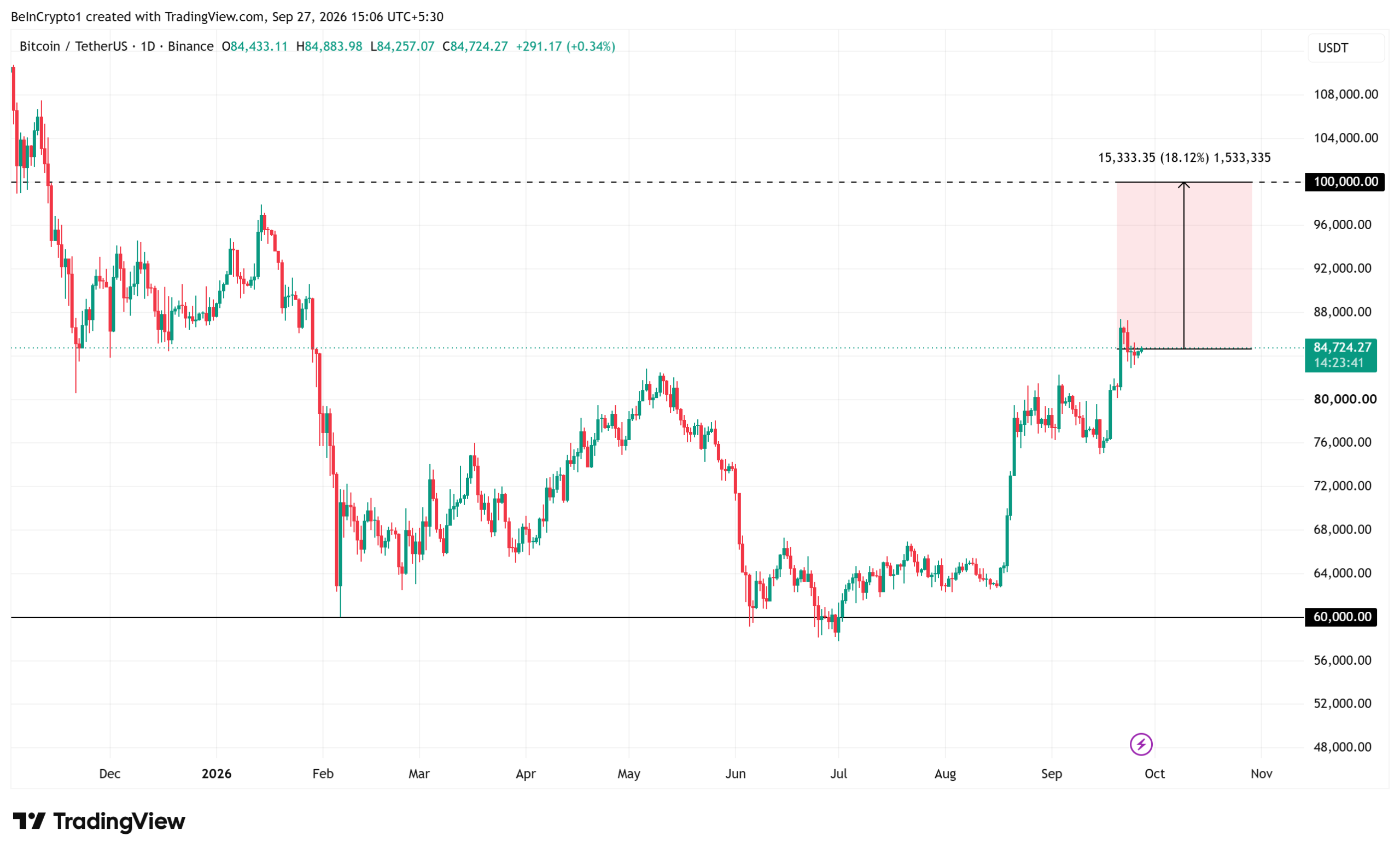
Bitcoin continues to hold above $80,000, the level Fidelity’s Jurrien Timmer says would confirm a bottom and open a path to $100,000.
Bitcoin (BTC) traded at $84,647 on Sunday, about 18% short of that target. Futures speculators, meanwhile, are adding to record bullish bets.

Bitcoin Breaks the $80,000 Level Fidelity Flagged
Timmer is director of global macro at Fidelity Investments, one of the largest US asset managers. He set out the trigger in a post, citing a double bottom chart pattern, where price hits a similar floor twice, then climbs.

“Bitcoin is looking particularly interesting here as it challenges key resistance at $80k. If it breaks it will confirm a double bottom targeting $100k,” Timmer wrote.
Timmer’s weekly chart marks this year’s lows at $60,033 in February and $57,742 in late June.
His charts use data through September 20. Since then, Bitcoin has crossed $80,000 and touched about $87,500 before easing.
Why Fidelity Sees $300,000 Bitcoin by 2029
Timmer also pointed to Bitcoin’s power law, a model that fits its long-run price to a curve over time. On that model, he says holding $60,000 signals a new bull market aimed at $300,000 in 2029.

“Bitcoin’s power law math continues to suggest that a new cyclical bull market is underway after holding $60k, targeting $300k in 2029,” the Fidelity executive added.
That marks a turn. In December, Timmer raised bear market concerns, warning of a possible drop to between $65,000 and $75,000. Bitcoin later fell further.
Can the Bitcoin Rally Hold?
Tom McClellan, editor of The McClellan Market Report, tracks the Commitments of Traders (COT) report. The US Commodity Futures Trading Commission (CFTC) publishes it weekly to show who holds futures positions.
McClellan says speculators such as hedge funds recently hit a record net long position. That means their bets on rising prices far outweigh bets on falling ones.

“What is unusual is that with the pop earlier this week, these traders actually were adding more longs instead of harvesting gains. That is a strong statement that they expect more gains to come,” McClellan wrote.
Other signals are mixed. In August, BeInCrypto flagged three warning signs, including weaker exchange-traded fund (ETF) flows and spot demand.
This month, BeInCrypto also reported CryptoQuant’s bull market line at $81,700, Bitcoin’s one-year average close. The current Bitcoin price sits about $3,000 above it.
That leaves a narrow cushion. A slip back under $80,000 would undo the break Timmer’s $100,000 target depends on.
The post Fidelity's $100,000 Bitcoin Signal Just Flashed appeared first on BeInCrypto.

170 cars support Bolton’s Speed of Sight charity at festival

Does Steph Curry Have Any Shot at an NBA Title in 2027? Oddsmakers and Analysts Say the Odds Are Long

Are Your Earbuds Damaging Your Ears? Look Out for These Warning Signs





-

 Fashion2 days ago
Weekend Open Thread: J.McLaughlin – Corporette.com
-

 Crypto World5 days ago
Goldman Sachs and Deutsche Bank Agree: The S&P 500 Rally Isn't Over
-

 Tech7 days ago
Researchers escape OpenAI Codex sandbox to run commands on host
-

 Fashion3 days ago
8 iPhone Accessories That Add Personality
-

 Crypto World7 days ago
Who Needs CLARITY Anyway? ARB Could See 70X Increase: Hodler’s Digest
-

 Entertainment4 days ago
These 17 Fall Amazon Dresses Seriously Look Like Anthropologie
-

 Business7 days ago
Analog Devices (ADI) Bets $1.35 Billion on Chips that Let Machines Think for Themselves
-

 Crypto World7 days ago
Coinbase, Robinhood, Circle Seen as Tokenized-Stock Winners
-

 Crypto World5 days ago
This Bearish Netflix Stock Trade Can Cash In On Video Streaming Giant’s Woes
-

 Tech5 days ago
Reolink’s solar 4K security camera falls to its lowest price in months
-

 Tech6 days ago
Google’s $899 Googlebook is a bet that you’ll buy a new laptop for Gemini
-
 Crypto World5 days ago
Trump-Xi Polymarket Odds for Handshake Hit 50%
-

 Crypto World4 days ago
Crude Oil Prices Pressured by Diplomatic Hopes in the Middle East
-
 Business5 days ago
Oil Price Today (September 23): Crude oil below $100 on hopes of US-Iran talks. What did Trump say?
-
 Crypto World4 days ago
Bitcoin price tests $83,600 Supertrend support after $87K rejection
-
 Crypto World4 days ago
Bitcoin Threatens Sub-$84,000 Breakdown as Long Liquidations Spike
-
 Crypto World5 days ago
Meta Jumps 11% As Muse Shines and Investors Show an Appetite for Advancing AI
-
 Crypto World5 days ago
Did Jim Cramer Just Give GameStop Stock the Kiss of Death When He Said the Turnaround Is Working?
-
 Crypto World6 days ago
Bitcoin price holds above $81K as key catalysts line up
-

 Crypto World4 days ago
BitGo says Bitcoin absorbed Fed hike, CLARITY failure
You must be logged in to post a comment Login