
Crypto World
8 crypto projects built on real adoption


Disclosure: This article does not represent investment advice. The content and materials featured on this page are for educational purposes only.
This analysis highlights eight crypto projects with working products, measurable adoption, and utility-driven token models as market fundamentals regain focus.
Summary
- Bitcoin layer Stacks gains momentum with rising sBTC adoption, institutional integrations, and upcoming BTC staking features.
- The project has strengthened its Bitcoin DeFi ecosystem as sBTC adoption grows and institutions explore non-custodial BTC yield.
Plenty of investors still carry scars from the last altcoin cycle, when bold stories ran far ahead of anything the technology could actually do. Tokens promised to reinvent finance while the products behind them barely functioned. What separates the current moment is that the infrastructure has caught up. Real users are moving real money, and the numbers can be checked on-chain rather than taken on faith.
This is not a roundup of the largest coins by market value. Bitcoin and Ethereum already sit in most portfolios, and their stories are well understood. The eight projects below were chosen on fundamentals such as working products, measurable adoption, and token models that tie value to activity rather than hype. Each one leads a distinct corner of the market, from Bitcoin-native lending to tokenized government bonds. Here is where the substance is.
1. Stacks
Bitcoin remains the largest crypto asset by a wide margin, yet the vast majority of it sits idle. Holders who want yield have traditionally faced an unappealing trade: wrap their coins, hand over custody, or take on added complexity. Stacks was built to close that gap. It is a Bitcoin layer that lets developers build lending, borrowing, and trading applications that settle back to the Bitcoin base chain.
The traction is real. sBTC, the mechanism that moves Bitcoin onto the Stacks layer, reached $545 million in value locked during the first quarter of 2026 before settling near $437 million, according to figures reported by Nansen and the network’s own quarterly snapshot. Electric Capital’s developer survey ranked Stacks among the five fastest-growing developer ecosystems. Since January 2021, the network has paid out more than 4,200 BTC to holders who lock STX to help secure it.
A bigger catalyst is on the way: a self-custodial Bitcoin staking product that lets holders lock BTC on the base layer, pair it with a small STX commitment, and earn native BTC yield without surrendering their coins. That non-custodial design speaks directly to what institutions need to put their Bitcoin capital to work, since giving up custody has been the main barrier keeping large holders on the sidelines.
STX also carries unusual institutional reach for a mid-cap token. It appears in the Coinbase 50 index — the only Bitcoin layer token to do so — alongside a Grayscale trust and a 21Shares staking product, while custody names such as BitGo, Fireblocks, and Circle have integrated the chain.
Its supply picture is unusually clean, too: with no scheduled investor unlocks ahead, STX avoids the overhang of large token releases that weighs on many competing projects.
2. Zest Protocol
If Stacks is the platform, Zest is the flagship application built on top of it. Zest is a lending market that lets Bitcoin holders borrow against their coins or earn yield on them, and it has grown into the largest DeFi protocol on Stacks. The project reports more than 800 BTC deposited, a peak of roughly $100 million in value locked, and over 1,500 liquidations processed without a single instance of bad debt.
Its backer list reads like a who’s who of Bitcoin believers: Tim Draper’s Draper Associates, YZi Labs, Trust Machines, and Stacks co-founder Muneeb Ali. Founder Tycho Onnasch and his team were early users of Aave during DeFi’s first boom and concluded that wrapped Bitcoin would never unlock the asset’s full potential. The ZEST token went live in 2026 and now trades on major exchanges, giving investors a direct way to back the protocol for the first time.
The catalyst worth watching arrived in May 2026, when Zest unveiled Bitcoin Collateral Vaults at the Draper Summit. The product lets holders lock BTC in a self-custodial vault on the Bitcoin base layer and borrow stablecoins on other chains, with the collateral never leaving Bitcoin. Custody has been the main reason large holders and institutions have kept their Bitcoin idle, and removing that barrier could open a pool of capital the market has yet to price in.
3. Ondo Finance (ONDO)
Tokenized real-world assets like treasuries, stocks, and funds moved on-chain have become one of crypto’s clearest bridges to traditional finance, and Ondo Finance (ONDO) leads the category. The protocol surpassed $4 billion in value locked in June 2026, more than doubling since the start of the year.
Ondo’s products speak to two audiences. USDY, a yield-bearing token backed by short-term US Treasuries, carries roughly $740 million in supply and pays around 4.65% annually, giving holders a return that ordinary stablecoins do not. OUSG, its institutional Treasury product, is backed in part by BlackRock’s tokenized BUIDL fund. The company works with names including BlackRock, Goldman Sachs, Franklin Templeton, and Mastercard, and its tokens now appear as collateral across dozens of DeFi protocols, which is a distribution moat that is hard for newcomers to replicate.
The open question sits with the ONDO token itself. Much of the protocol’s value flows to the underlying assets rather than to token holders, and closing that gap is the challenge Ondo has yet to fully solve.
4. Ethena
Ethena (ENA) set out to build a dollar that pays its own yield, and the market has responded. USDe, its synthetic dollar, has grown past $13 billion in supply, making Ethena one of the largest stablecoin issuers in the industry. The token generates a return, often around 11%, from funding rates on perpetual futures and staked Ethereum, while a companion token, USDtb, leans on BlackRock’s BUIDL fund to provide a steadier Treasury-grade floor when markets turn.
For most of its life, ENA was a governance token with little direct claim on that activity. That changed with the fee switch, activated in early 2026, which routes a share of protocol revenue to holders who stake the token. An $890 million buyback program, funded through the StablecoinX vehicle, adds further demand by removing tokens from circulation.
The counterweight is supply. Ethena still faces sizeable token unlocks stretching into later years, and analysts have questioned whether buybacks at current revenue levels are large enough to offset that pressure. The yield engine, however, has held up across market conditions, which is more than many stablecoin experiments can claim.
5. Venice
As artificial intelligence works its way into daily life, privacy has become a real concern, and Venice (VVV) built its pitch around it. The platform, founded by longtime crypto figure Erik Voorhees, offers access to leading AI models while encrypting prompts locally and storing nothing on its servers. Users can generate text, images, and code without accounts or surveillance.
Rare for an AI token, Venice has genuine usage behind it, with more than two million users, according to the company. Rather than paying per request, VVV users and automated agents stake the token to claim a share of the platform’s compute. A second token, DIEM, turns that staked capacity into a stable daily credit for developers and agents. Since November 2025, Venice has used part of its revenue to buy back and burn VVV, and it has trimmed token emissions to tighten supply further.
The risks are those of any young, narrative-driven asset. VVV surged above $21 in mid-2026 before pulling back sharply, and uncensored AI carries obvious regulatory questions. But the combination of real product traction and a token tied to actual demand sets it apart from most of its peers.
6. Pudgy Penguins
Pudgy Penguins (PENGU) is the rare crypto-born brand that has crossed into mainstream retail. The penguin toys sell through more than 10,000 stores, including over 3,100 Walmart locations and, as of July 2026, more than 1,800 Target stores, with cumulative sales above two million units. The company is targeting roughly $120 million in revenue for 2026 — real cash flow that almost no token project can match.
The cultural footprint runs deeper than the sales figures. Pudgy penguin stickers and memes circulate daily among people who have never opened a crypto wallet, the kind of organic reach that marketing budgets rarely buy. The brand is now extending into gaming through Pudgy World and onto Abstract, its own Ethereum layer built by parent company Igloo Inc. and backed by Founders Fund. Buyers can scan a physical toy to unlock digital items, turning a store purchase into an entry point to Web3.
PENGU powers rewards and activity across that ecosystem, and a licensing model returns 5% of net product revenue to the NFT holders whose designs appear on shelves. The PENGU brand is real; however, the token’s value capture is still a work in progress.
7. Plasma
Stablecoins have quietly become one of crypto’s largest use cases, but most run on chains never designed for payments. Plasma (XPL) is a layer-one blockchain built specifically for them, backed by Bitfinex and Peter Thiel’s Founders Fund. Its signature feature is zero-fee USDT transfers, with network costs payable in stablecoins rather than a separate gas token.
The product layer went live in June 2026 with Plasma One, a stablecoin-native neobank and Visa card that lets users save, spend, and earn in digital dollars across more than 150 countries. The network launched the prior September with over $2 billion in stablecoin liquidity, and its USDT transfer volume jumped 327% in May 2026, according to on-chain data cited in industry coverage.
Plasma’s challenge is visible in its chart. XPL trades far below its September 2025 debut, and token inflation looms as new supply unlocks.
Stablecoin payments are a vast market, and Plasma is among the few chains built from the ground up to serve it.
8. Maple Finance
Maple (SYRUP) is the closest thing DeFi has to an institutional credit desk. It connects trading firms and market makers with lenders earning yield from real loan interest rather than token incentives. By mid-2026 the protocol reported value locked in the multi-billion-dollar range and has facilitated well over $5 billion in loans since launch, with assets under management reaching roughly $4.6 billion in the first half of the year.
The token model was rebuilt to reward that activity. Maple directs 25% of protocol revenue toward buying SYRUP on the open market, replacing the inflationary staking rewards common elsewhere. Recent lending facility with Kraken, a listing on Revolut, and a place on Fortune’s crypto innovators list point to steady institutional adoption.
Credit is never risk-free, and that is Maple’s exposure. Loans can sour, and the protocol has weathered legal uncertainty tied to a dispute over one of its product lines. Its record of loan repayment has been strong, but lenders are ultimately underwriting borrowers, and market downturns test that model hardest.
How the 8 projects compare
| Project | Vertical | Token | Standout metric |
| Stacks | Bitcoin-native finance | STX | 4,200+ BTC paid to stakers since 2021 |
| Zest Protocol | Bitcoin lending | ZEST | 800+ BTC deposited, zero bad debt |
| Ondo Finance | Real-world assets | ONDO | $4B+ value locked |
| Ethena | Synthetic dollars | ENA | $13B+ USDe supply |
| Venice | Private AI | VVV | 2M+ users |
| Pudgy Penguins | Consumer brand | PENGU | 2M+ toys sold, 10,000+ stores |
| Plasma | Stablecoin payments | XPL | Zero-fee USDT transfers, 150+ countries |
| Maple Finance | Institutional lending | SYRUP | $5B+ loans facilitated |
Key takeaway
Across these eight, the theme that runs through the strongest cases is that a token earns its value from something people actually use. Ondo, Ethena, and Maple show how tokenized treasuries, synthetic dollars, and institutional credit are pulling traditional finance on-chain. Venice, Pudgy Penguins, and Plasma stake out private AI, consumer brands, and payment rails.
The two picks that tie the list together sit on Bitcoin. Stacks provides the infrastructure to make the world’s largest idle asset productive, and Zest Protocol is the lending market already putting it to work. With self-custodial Bitcoin staking and collateral vaults arriving, both aim squarely at the single biggest pool of untapped capital in crypto, and unlike much of the last cycle, the products are live and the numbers are on-chain to verify.
Frequently asked questions
What are the best altcoins to invest in for 2026 based on fundamentals?
Stacks, which leads Bitcoin-native finance and lets the largest idle asset earn yield; Ondo, the dominant tokenized real-world asset protocol with over $4 billion locked; and Ethena, one of the largest synthetic-dollar issuers with USDe supply above $13 billion. These are the three names that stand out.
Is it too late to invest in altcoins in 2026?
That depends on which altcoins and on the timeframe. The difference from past cycles is that narratives once arrived first while the technology lagged, whereas the projects worth watching now have products that already work and usage that shows in the data.
What is the best Bitcoin ecosystem token to buy?
For exposure to the Bitcoin economy beyond simply holding BTC, Stacks is the clearest option. It is the native token of the leading Bitcoin layer, and holders who lock it earn Bitcoin yield. STX sits at the center of a growing set of applications, from Zest Protocol’s lending markets to sBTC, with a coming self-custodial staking model designed to drive continuous demand.
Which altcoins have institutional backing in 2026?
Three projects on this list carry the deepest institutional footprint. Stacks appears in the Coinbase 50 index alongside a Grayscale trust and a 21Shares staking product, with BitGo, Fireblocks, and Circle integrated into the chain. Ondo works directly with BlackRock, Goldman Sachs, and Franklin Templeton, and Ethena draws on BlackRock’s tokenized BUIDL fund to underpin its USDtb stablecoin.
Disclosure: This content is provided by a third party. Neither crypto.news nor the author of this article endorses any product mentioned on this page. Users should conduct their own research before taking any action related to the company.

Wall Street just lived through one of its wildest 48 hours of the year. On Wednesday, the Fed held rates steady at 3.50%-3.75%, but three FOMC members broke ranks to demand a hike—an unusually hawkish dissent that sent the Dow plunging over 1,100 points, its worst session since April 2025. Treasury yields spiked, with the 30-year touching levels unseen since 2007, as renewed US-Iran strikes pushed oil higher and reignited inflation fears. The Nasdaq 100 briefly slid into correction territory, down 11% from its June record high.
Then came the reversal. Thursday’s blockbuster earnings from Microsoft, whose Azure cloud business surged, alongside a rebound in beaten-down semiconductor stocks, powered the Nasdaq Composite (US Tech Mini on FXOpen) to a 2.8% gain, snapping a six-day losing streak.
The whiplash captures the market’s core dilemma perfectly: a Fed chair in Kevin Warsh determined to prove his inflation-fighting credentials, a Middle East conflict refusing to fade, and a tech sector whose AI-driven earnings power may be the only thing strong enough to override both.
Technical Analysis of the Nasdaq 100 Chart
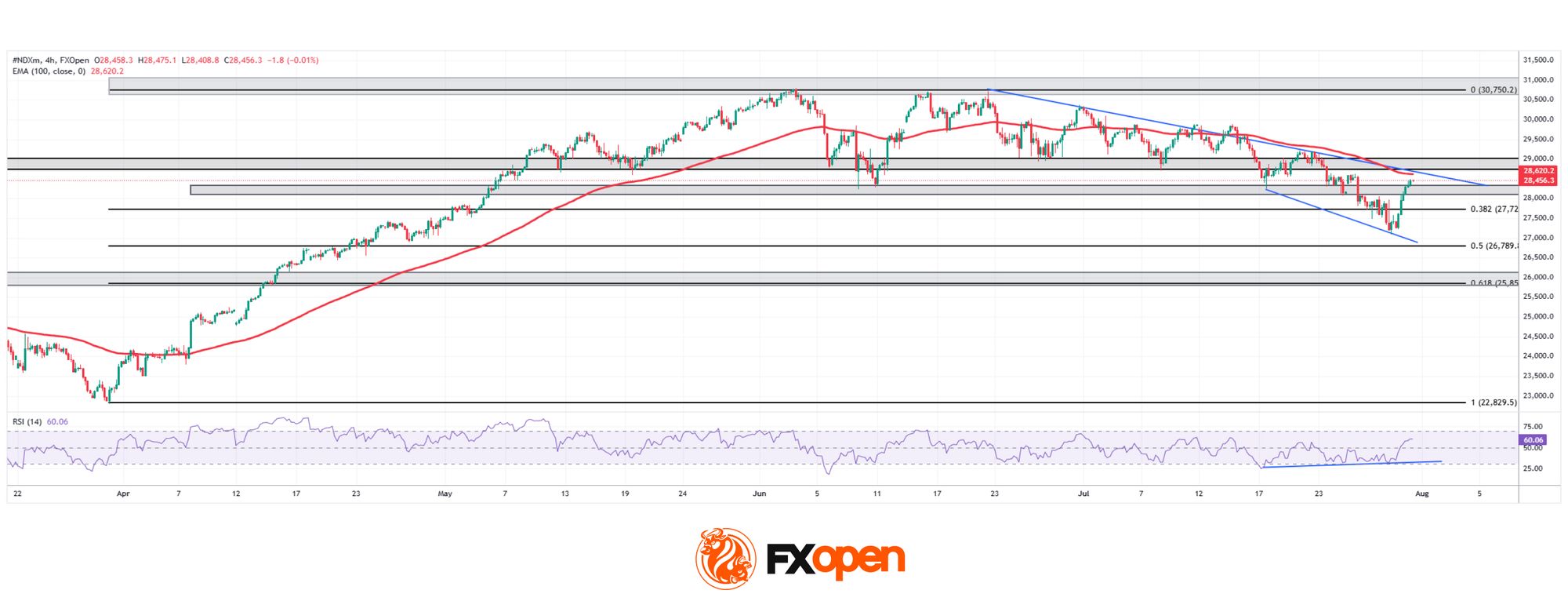
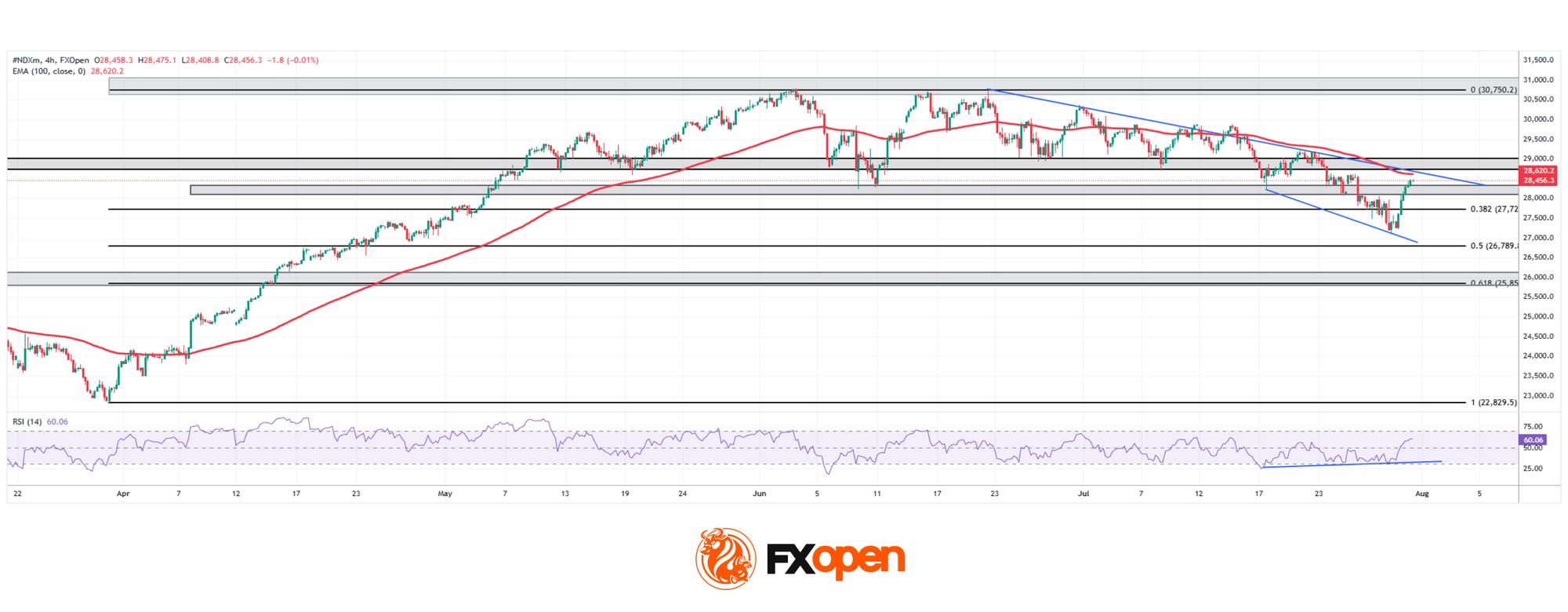
As the chart shows, the Nasdaq 100 (US Tech 100 Mini on FXOpen) is currently testing the descending trendline that has guided its decline from late June’s highs, with price also pressing against the 100-period EMA near 28,620, a confluence that has repeatedly capped rallies over the past several sessions. Adding weight to this setup, the RSI is showing a bullish divergence, printing higher lows even as price carved a fresh low in late July.
Bullish Scenario
Should buyers finally break above both the descending trendline and the 100-period EMA, the divergence would gain real technical credibility, opening the path toward the 28,800-29,000 resistance zone and, beyond that, a retest of the 30,750 highs from June.
Bearish Scenario
Conversely, a rejection at this trendline-EMA confluence would invalidate the bullish divergence for now, sending price back toward the 27,720 area, the 0.382 Fibonacci retracement of the March-June rally. A deeper break would expose the 0.5 and 0.618 retracements near 26,789 and 25,850, levels that previously acted as key support during the spring advance.
With price coiled right beneath a trendline it has yet to conquer, and the RSI quietly hinting at renewed strength underneath, the Nasdaq 100 chart (US Tech 100 Mini on FXOpen) looks ready to answer the question markets have been asking all week: was this correction just noise, or the start of something bigger?
Trade global index CFDs with zero commission and tight spreads (additional fees may apply). Open your FXOpen account now or learn more about trading index CFDs with FXOpen.
This article represents the opinion of the Companies operating under the FXOpen brand only. It is not to be construed as an offer, solicitation, or recommendation with respect to products and services provided by the Companies operating under the FXOpen brand, nor is it to be considered financial advice.
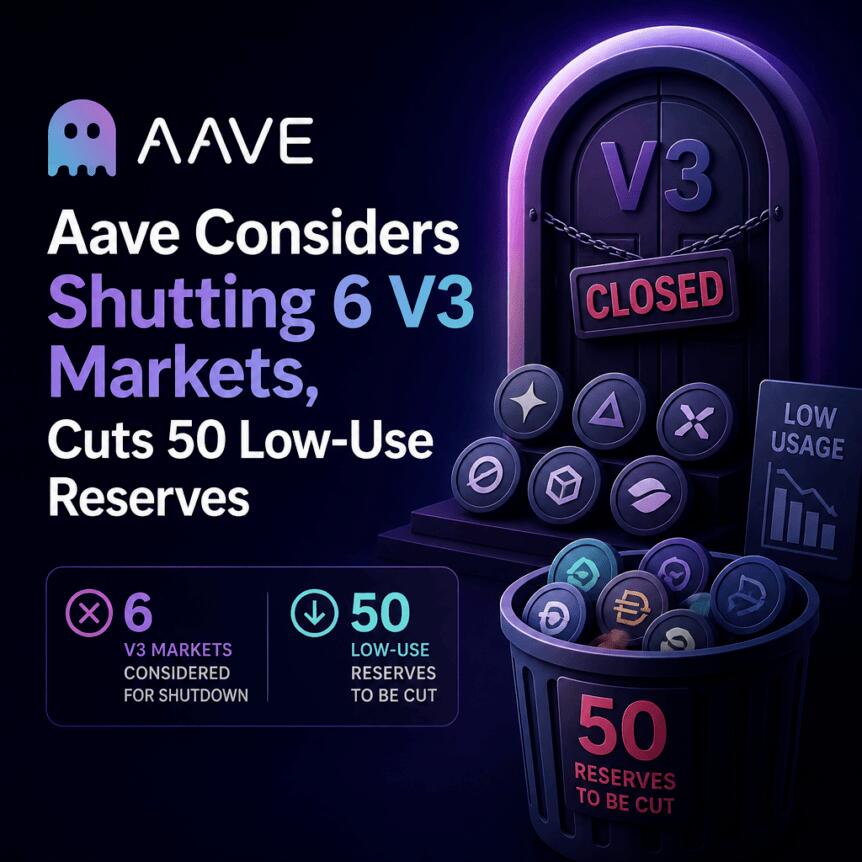
Aave governance is considering a broad cleanup of its V3 lending markets, targeting underused reserves across multiple blockchains and retiring certain matured listings. The proposal, detailed in an ARFC (Aave Request for Comment), outlines offboarding activity on six chains and removing dozens of low-adoption assets, covering $98.1 million in supplied collateral and $15.6 million in outstanding debt, measured as of July 28.
Risk services provider LlamaRisk, working alongside other Aave service providers, recommended deprecating 50 low-use reserves and retiring 21 matured Pendle principal token listings across 11 deployments. The same proposal also calls for retiring all 25 reserves on Sonic, Scroll, zkSync, Metis, Soneium and Aptos.
Key takeaways
- Aave’s ARFC targets low-adoption assets and matured Pendle principal token listings, with balances snapshot at July 28.
- The plan would wind down V3 markets on six blockchains and deprecate 50 low-use reserves across 11 deployments.
- All chain-specific closures proposed here come after earlier freezes and prior governance decisions on certain networks.
- Aave founder Stani Kulechov framed the move as reducing the protocol’s “economic and technical risk surface” under updated frameworks.
- This ARFC is a proposal step, not proof that a final onchain vote has already passed.
Why this proposal is moving forward
ARFCs are a formal governance stage at Aave: they provide detailed recommendations and serve as a precursor to an Aave Improvement Proposal. As such, the publication of this ARFC does not itself confirm that the changes have been approved via an onchain vote or executed by the protocol.
Even so, the scope is notable. The offboarding plan described in the ARFC would restructure Aave’s V3 presence on multiple networks—primarily by removing reserves where usage has been insufficient and by retiring token listings that have reached maturity. In total, the proposal covers $98.1 million in supplied assets and $15.6 million in debt, indicating that the affected V3 markets are meaningful in size even if they are not retaining strong participation.
Aptos exit follows a short-lived V3 rollout
The most time-sensitive portion of the cleanup appears to be the proposed Aptos exit. According to data cited by LlamaRisk, the V3 market launch on Aptos occurred roughly 11 months before this ARFC recommendation.
LlamaRisk attributes weak performance to a sharp liquidity contraction and minimal earning. It reports that available liquidity fell by 94% over six months and that quarterly revenue was below $1,000. Those figures, as referenced in the ARFC summary, set the justification for moving from an active posture to a full deprecation across the network.
The same recommendation also distinguishes between chains that were already inactive in practice and those that were still operating. The ARFC indicates that every reserve on Scroll, zkSync, Metis and Soneium was already frozen. By contrast, Sonic and Aptos were still active at the time of the snapshot, and the ARFC recommends freezing and retiring reserves on those remaining deployments.
How earlier “temp checks” shaped the current cleanup
The proposal builds on prior governance outcomes and implementation steps across Aave’s multichain V3 strategy. Earlier in the process, a “temp check” on Aave’s multichain approach concluded on Dec. 5, 2025. That vote, described in Aave governance materials, recorded 923,400 votes in favor with under 1% voting against, and it covered actions such as increasing reserve factors on underperforming instances, shutting down instances on zkSync, Metis and Soneium, and establishing a $2 million annual revenue floor for new instance deployment.
Additionally, Aave governance processes have already accelerated deprecations on specific chains. In April, Scroll was added to the list of affected protocols through an accelerated procedure. A corresponding governance action described the move as completing Scroll’s deprecation after rapid deterioration in network liquidity and Aave market activity, via a direct-to-AIP proposal filed by LlamaRisk.
Beyond instance closures, Aave’s risk posture has also been formalized in updated internal documentation. The protocol published an updated risk framework on June 9, covering asset risk, bridge and monitoring risks, chain risk, and criteria for winding down reserves or deployments. Separate governance activity later this month indicated de facto adoption of rules under a newer “governance framework v2,” pointing to a more structured approach to deciding when underperforming deployments should be reduced or removed.
Aave founder ties the move to risk-framework changes
Aave founder Stani Kulechov publicly commented that the cleanup is intended to reduce exposure as the protocol applies its new risk approach. In a Thursday post on X, Kulechov said the deprecations would also “reduce Aave’s economic and technical risk surface as part of the new Aave Risk Framework and Technical Asset Listing Framework.”
Source: Stani Kulechov on X
While the current action may look like an exit from certain environments, Kulechov’s framing suggests it is not a retreat from multichain itself. He stated that Aave will continue applying continuous risk assessment for assets across deployments, with the immediate effect being a refocusing on selected chains where usage and performance are stronger.
The comments also arrive amid Aave’s ongoing expansion activities elsewhere. Earlier coverage from Cointelegraph noted that Aave is launching on Avalanche, and the current governance cleanup appears to align with that broader operational theme: expand into targeted environments while methodically trimming underused or deteriorating ones.
What to watch next for Aave V3 users and liquidity providers
If this ARFC advances, the key question will be how quickly the proposed offboarding transitions from governance discussion to formal execution—and whether Aave provides additional updates on how liquidity is expected to migrate as reserves are frozen and retired. Investors and DeFi participants should also watch for signals that the newly adopted risk frameworks keep tightening the threshold for maintaining V3 markets on smaller or less liquid chains.
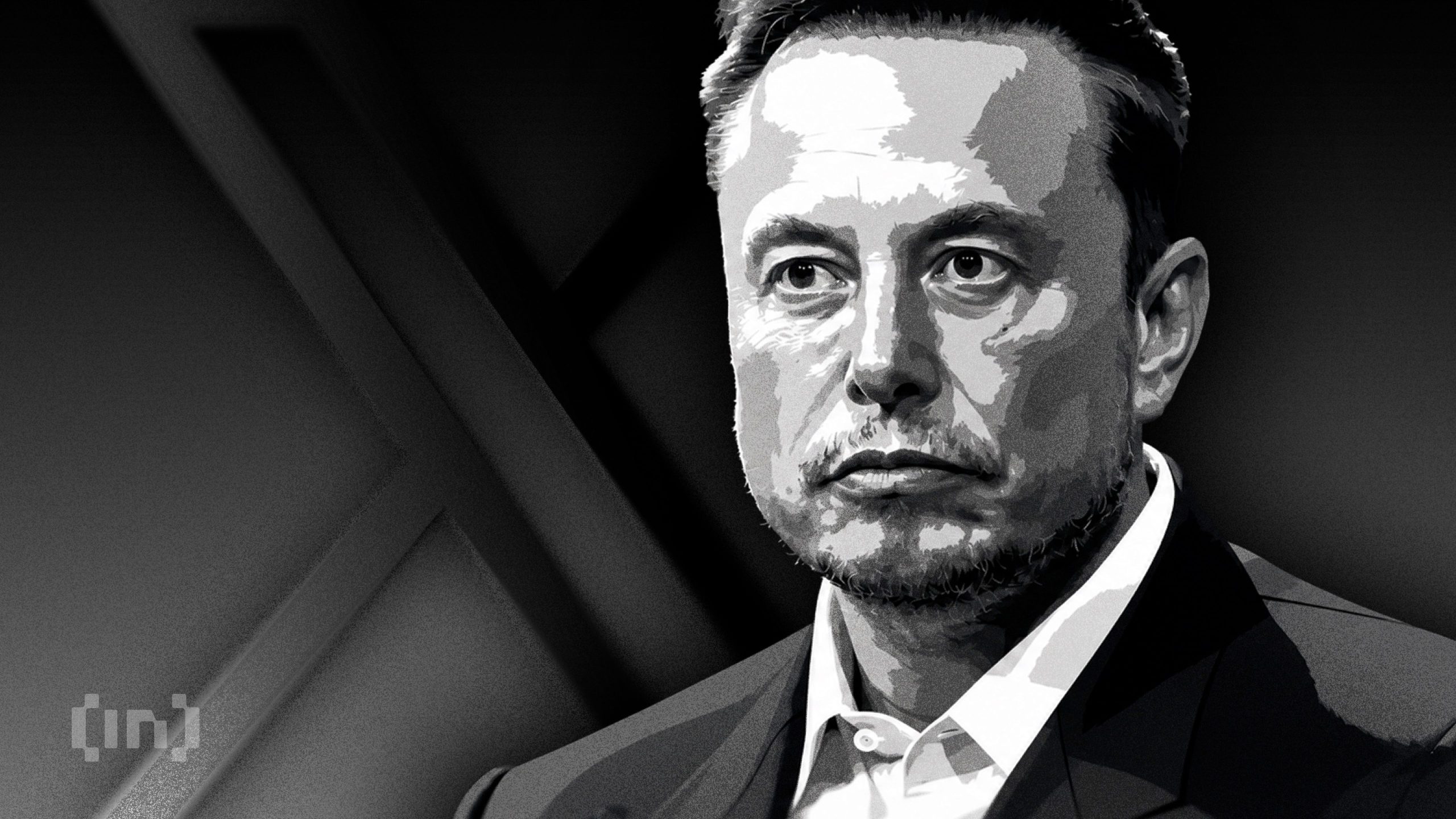

Elon Musk dismissed rumors that Tesla plans to sell its Gigafactory Shanghai plant, calling the claims fake news on Friday.
Musk’s denial followed a Wall Street Journal report on a possible split of Tesla’s China business. That report tied the move to a possible merger between Tesla and SpaceX.
What Musk Is Actually Denying
The rumor began after an X user suggested directly to Musk that Tesla was preparing to offload the plant. Musk’s reply, posted early Friday morning, called the report absurdly fake news and urged people to assume breaking news is false until proven otherwise.
The Journal’s report did not name Gigafactory Shanghai directly. Instead, it said Tesla advisers had weighed a spin-off, a sale, or a closure of the automaker’s Chinese operations, options Musk has not addressed beyond his blanket denial.
Gigafactory Shanghai remains Tesla’s largest plant, with annual capacity above 950,000 vehicles, and it historically accounts for more than half of the company’s global deliveries.
Gigafactory Shanghai exports vehicles across Europe, Canada, and the Asia-Pacific region. However, Musk’s denial landed during a rough stretch for Tesla stock, which suffered its worst week since 2022 after mixed second-quarter results.
Why the SpaceX Merger Talk Persists
The China business rumor did not emerge in isolation. Wolfe Research has already framed a Tesla and SpaceX merger as a core investor thesis, a pairing Musk has never firmly ruled out. That view follows SpaceX’s record initial public offering, which raised $75 billion in June and valued the rocket company at $1.75 trillion.
Musk has separately argued that SpaceX could outvalue Earth itself. That claim underscores how central the rocket company has become to his broader ambitions. Ark Invest’s Cathie Wood disclosed a $529 million rotation from Tesla into SpaceX shares this month, citing similar merger logic.
Musk also has a track record of terse denials moving markets. He used a similar two-word denial to knock down another SpaceX rumor just weeks earlier. That pattern is why commentators like Whole Mars Catalog urged outlets not to delete their posts after a denial. Keeping the original post visible, they argued, helps the public track exactly what Musk is rejecting.
Tesla’s second-quarter earnings showed revenue climbing to $28.24 billion, even as margins narrowed to 16.8%. That gap adds financial pressure that could fuel more reorganization speculation regardless of Musk’s denial. For now, his post stands as the only official word from either company, and investors will likely keep testing that line as merger chatter builds through the rest of 2026.
The post Is Tesla Really Selling Gigafactory Shanghai? Elon Musk Says No appeared first on BeInCrypto.
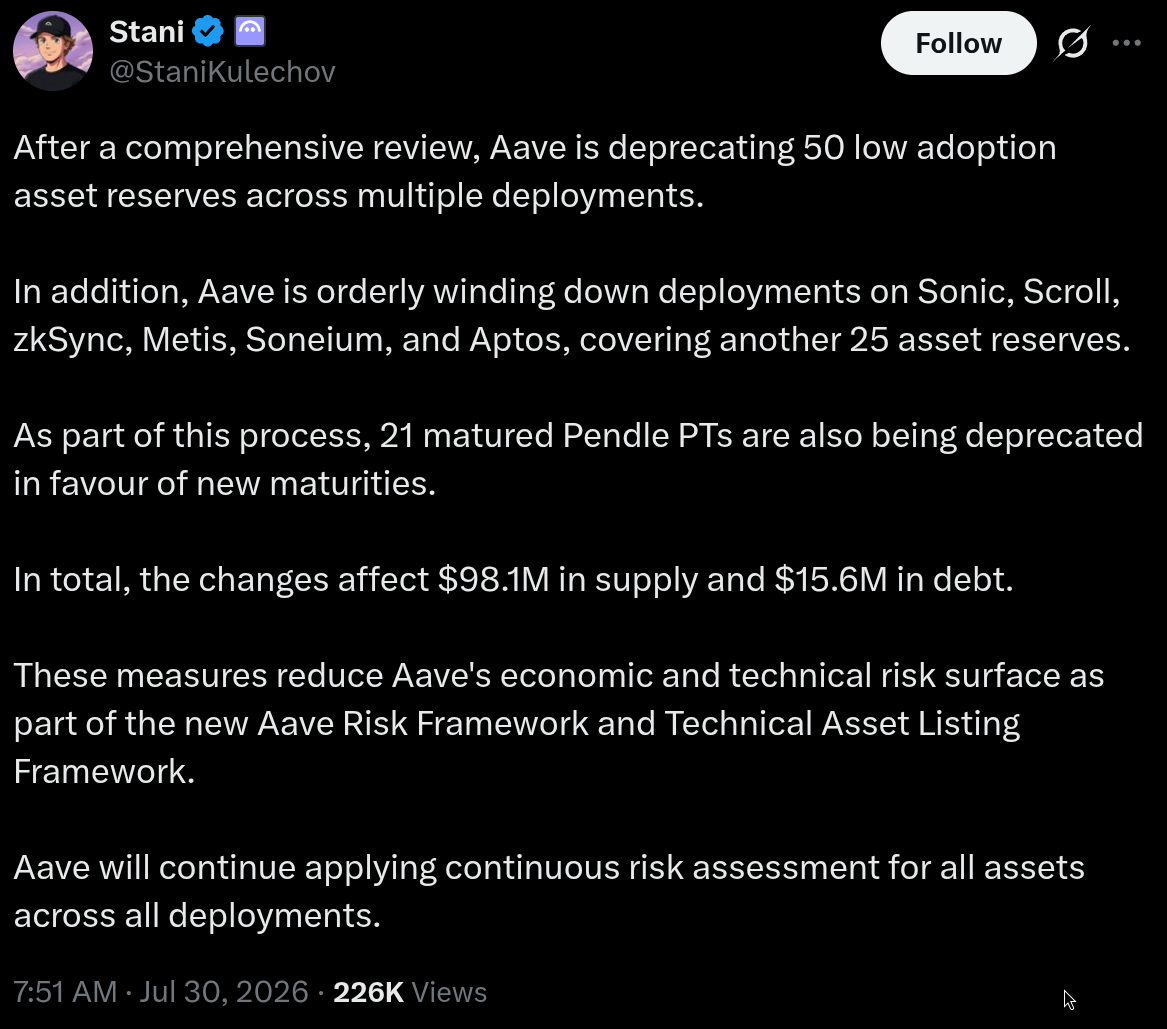
An Aave governance proposal would wind down the lending protocol’s V3 markets on six blockchains and retire dozens of low-use token listings, a cleanup covering $98.1 million in supplied assets and $15.6 million in debt.
Risk service provider LlamaRisk, working with other Aave service providers, recommended offboarding 50 low-use reserves and 21 matured Pendle principal token listings across 11 deployments. It also proposed retiring all 25 reserves on Sonic, Scroll, zkSync, Metis, Soneium and Aptos. The balances were measured on July 28.
An ARFC is a detailed proposal and precursor to an Aave Improvement Proposal; it is not, by itself, proof of a completed final onchain vote or execution.
Aptos exit follows recent launch
The proposed Aptos exit comes just 11 months after Aave launched its V3 market there, with available liquidity down 94% over six months and quarterly revenue below $1,000, according to LlamaRisk.
Every reserve on Scroll, zkSync, Metis and Soneium was already frozen, whereas Sonic and Aptos remained active and are recommended for freezing. The temp check on Aave’s multichain strategy concluded on Dec. 5, 2025, with 923,400 votes in favor and under 1% against increasing the reserve factor on underperforming instances, shutting down the instances on zkSync, Metis and Soneium, and establishing a $2 million annual revenue floor for new instance deployment.
Related: Aave positioned to capture tokenized asset growth in DeFi: Standard Chartered
Scroll was then added to the affected protocols through an accelerated process in April, as LlamaRisk filed a direct-to-AIP proposal to freeze every Scroll reserve and raise selected reserve factors, describing the measure as completing Scroll’s deprecation after a rapid deterioration in network liquidity and Aave market activity. Aave also published an updated risk framework on June 9, covering asset, bridge, monitoring and chain risk and criteria for winding down reserves or deployments, and this month’s announcement indicated de facto adoption of those rules by the protocol.
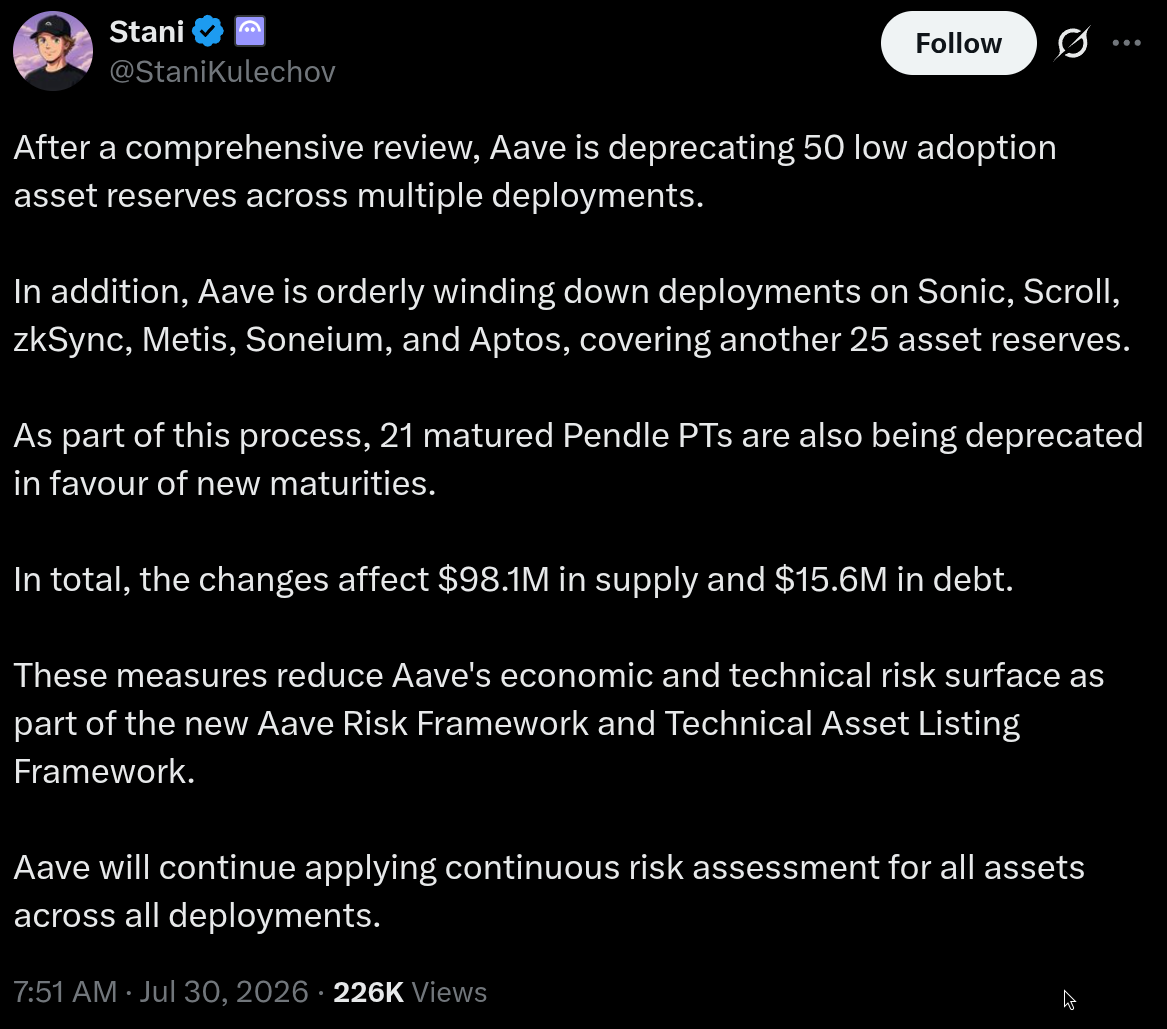
Source: Stani Kulechov
Aave founder Stani Kulechov said in a Thursday post that this will also “reduce Aave’s economic and technical risk surface as part of the new Aave Risk Framework and Technical Asset Listing Framework.”
Related: Aave brings V3 lending and GHO stablecoin to Monad
Still, this is not a reversal of Aave’s multichain expansion strategy, rather a strategic refocusing on select protocols. “Aave will continue applying continuous risk assessment for all assets across all deployments,” Kulechov said. The comments also follow Aave launching on Avalanche earlier this month.
Magazine: The real reason DeFi projects that survived 2022 crash are shutting down now


Bitcoin and Ether options with a combined notional value of about $10.43 billion expired on July 31, placing the $64,000 Bitcoin level at the center of the monthly settlement.
Summary
- 149,000 Bitcoin options worth $9.6 billion expired with max pain concentrated at the $64,000 level.
- 435,000 Ether options worth $830 million expired with a 0.63 put-call ratio and $1,850 max-pain.
- Low implied volatility and uneven inflows kept Bitcoin near $64,000 despite call-heavy monthly positioning overall.
Greeks.live reported that 149,000 Bitcoin options worth $9.6 billion expired with a 0.28 put-call ratio and $64,000 max pain. Another 435,000 Ether options worth $830 million expired with a 0.63 ratio and $1,850 max pain.
Deribit’s monthly options settle at 08:00 UTC on the final Friday of each month. Shortly after settlement, Bitcoin traded near $63,824, while Ether changed hands around $1,891. Neither asset recorded an immediate break from its recent range.
Bitcoin options expiry settled near $64,000 max pain
The Bitcoin expiry represented about 30% of outstanding contracts, according to Greeks.live. Its low 0.28 put-call ratio showed that call open interest greatly exceeded put open interest going into settlement.
A separate PerpFinder snapshot, based on Deribit data at 07:51 UTC, recorded $7.39 billion in call open interest and $2.06 billion in puts. It placed total notional open interest at $9.45 billion, slightly below Greeks.live’s $9.6 billion estimate. The difference likely reflects changing Bitcoin prices and data captured at different times.
Max pain refers to the settlement price at which the largest value of options would expire without value for buyers. It does not guarantee that the spot market will move toward that level or remain there afterward.
Recent activity supports that caution. Research covering two earlier July expiries found that Bitcoin did not settle precisely at the stated max-pain levels and showed little lasting price movement after the contracts expired.
Call-heavy positioning did not confirm a bullish breakout
The low Bitcoin put-call ratio appears bullish at first because calls provide upside exposure. However, many calls were concentrated above the market price, particularly around the $70,000 and $72,000 strikes.
Contracts at those levels could not generate gains at expiry unless Bitcoin rose sharply above its weekly range. Bitcoin instead traded within a 24-hour range of roughly $63,787 to $65,305, keeping the largest upside positions out of the money.
Greeks.live said call gamma exposure was spread across several strikes, while put gamma exposure was more concentrated. Gamma measures how quickly an option’s price sensitivity changes when the underlying asset moves. Concentrated exposure can affect how dealers hedge, but it does not independently forecast market direction.
The firm also said “the conditions for a rally are not in place,” citing limited capital inflows and weak follow-through when U.S. equities rebounded. That is the firm’s market assessment rather than a confirmed future outcome.
Ether options showed stronger downside protection
Ether’s 0.63 put-call ratio showed more demand for puts relative to calls than the Bitcoin market recorded. Greeks.live placed Ether’s max-pain level at $1,850, below the market price shortly after settlement.
PerpFinder’s final pre-expiry snapshot recorded approximately $499.4 million in Ether call open interest and $311.5 million in puts. It calculated total open interest of $810.9 million and a 0.62 ratio, close to the figures provided by Greeks.live.
Ether traded near $1,891 after settlement, within a 24-hour range of about $1,884 to $1,934. The asset therefore remained above both the $1,850 max-pain estimate from Greeks.live and the $1,800 level cited by some earlier market reports.
As previously reported, Ether options carried a 1.26 put-call ratio during the July 10 expiry. The fall to about 0.63 indicates that positioning became less defensive by month-end, although Ether still carried more relative put exposure than Bitcoin.
ETF inflows and $65,000 resistance shape the next move
The expiry arrived as spot Bitcoin ETF demand showed signs of recovery. U.S. funds received $233.1 million on July 30, led by BlackRock’s IBIT with $183.4 million. However, flows had alternated between gains and withdrawals earlier in the week, supporting Greeks.live’s description of uneven capital demand.
Bitcoin also remained below the heavy trading area above $65,000 identified by Greeks.live. The asset briefly reached a 24-hour high above $65,300 but returned below $64,000, showing that buyers had not established the former rally zone as support.
crypto.news reported that the smaller July 10 expiry also produced cautious positioning and limited confidence in a sustained advance. Earlier July 3 coverage placed attention on weak ETF flows and demand for short-term downside protection.
Traders will next monitor whether positions roll into the August 28 monthly expiry. Deribit data showed about $3.15 billion already positioned for that date in Bitcoin options, while the September 25 expiry carried roughly $6.22 billion.
A sustained move above $65,000, stronger spot volume and several consecutive ETF inflow sessions would provide clearer evidence of improving demand. Without those conditions, the July settlement mainly removed a large block of expiring exposure while leaving Bitcoin’s wider trading range unresolved.


Tokyo-listed Quantum Solutions (2338) sold 1,000 ETH for $1.9 million and more than doubled its disposal ceiling to fund an AI data center business.
The move came as another crypto treasury firm, Hyperscale Data (GPUS), monetized about 100 BTC and opened a bitcoin-backed credit line for a Michigan AI data center..
Quantum sold the ETH on July 30 at $1,903 per token, generating $1.903 million after fees, according to a company filing. It expects to recognize a $100,970 loss against the position’s May 31 carrying value of $2,003.97 per ETH, the filing adds.
The sale price was 47% below the $3,595.02 average acquisition cost Quantum reported in June.
The firm sold 904 ETH for $1.61 million on June 16 at an average price of $1,777 per token. The two disposals raised about $3.51 million and reduced its holdings by 29% to 4,764.8 ETH from 6,668.8 ETH.
Quantum’s board raised the cumulative sale limit to 4,375 ETH from 1,875 ETH through Oct. 30, leaving it authorized to sell another 2,471 ETH. Using the full limit would mean disposing of nearly 66% of the holdings it reported in June.


The US Internal Revenue Service (IRS) warned that scammers are mailing counterfeit letters to crypto holders, directing them to a fake “Digital Asset Compliance Portal” built to steal digital assets and personal data.
The agency’s Criminal Investigation unit issued the fraud alert on Thursday. It said the letters carry QR codes that send recipients to a spoofed website.
How the Fake IRS Letters Work
The counterfeit notices tell recipients they must enroll in the portal before a deadline. The IRS stressed that it does not operate any such portal and is not sending the letters.
Once victims scan the QR code, the fraudulent site asks them to enter personal information. The agency urged taxpayers not to scan QR codes from unsolicited letters, emails, or texts. It also told people to hang up on callers demanding payment.
The use of physical mail marks a shift from typical crypto phishing. Coinbase and threat intelligence firm DarkTower flagged the campaign this week.
Their investigation found the letters reference tax years 2017 through 2026. Moreover, the look-alike domain was registered through a Hong Kong registrar and hosted in Romania.
“That phone call is the actual attack… a scammer posing as ‘support’ will try to talk you into handing over the keys to your account…to trick you into moving your funds to a ‘safe’ wallet they control. This is called vishing (voice phishing), and it is one of the most effective account-takeover techniques used against crypto holders today,” Coinbase said.
Follow us on X to get the latest news as it happens
Crypto Scams and Hacks Keep Draining the Sector
The scheme fits a broader pattern of impersonation-driven fraud. Chainalysis estimated in its report that scams and fraud cost victims $17 billion in 2025. Impersonation scams surged 1,400%.
Hacks remain equally persistent. TRM Labs recorded 207 hacks in the first half of 2026, more than double the 83 logged a year earlier.
That marked the firm’s highest six-month count on record. However, total losses fell to roughly $972 million from about $2.3 billion in H1 2025.
Together, the figures suggest attackers are pivoting from code exploits toward human targets. The IRS letters show that pivot now extends beyond inboxes and into physical mailboxes.
Subscribe to our YouTube channel to watch leaders and journalists provide expert insights
The post Did You Get an IRS Crypto Compliance Letter? It Probably Isn’t Real appeared first on BeInCrypto.
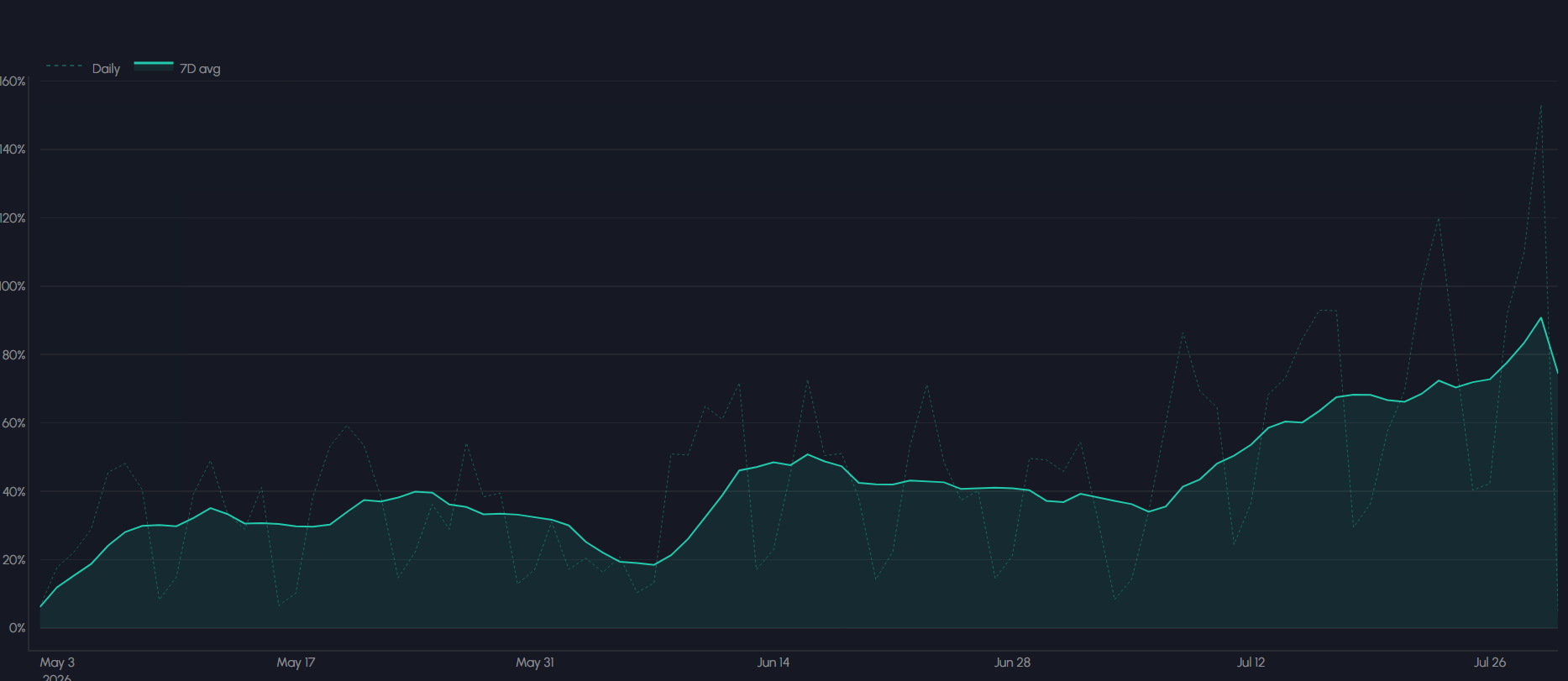
Perpetual futures tied to tokenized stocks and commodities generated nearly as much trading volume as Bitcoin perpetuals on two of the largest venues for the products over the past week, according to Talos.
Combined seven-day volume across tracked real-world asset (RWA) perps reached $61.7 billion, equal to 99.2% of Bitcoin perpetual volume on Hyperliquid and Binance, where most trading activity is concentrated, Talos told Cointelegraph in an email summary citing a data snapshot taken on Thursday.
Tokenized equity contracts accounted for 57.8% of the total, followed by commodities at 28.2%.
The value of onchain RWAs has grown to about $36.8 billion, excluding stablecoins, according to RWA.xyz. Crypto exchanges have also expanded their offerings beyond cryptocurrencies, increasingly listing tokenized stocks and commodities alongside digital assets.
Related: Tokenized RWA market grows 420% since 2025 on regulatory clarity, access
Hyperliquid recorded $25.1 billion in RWA perpetual trading volume during the week of July 13 to July 19, exceeding the combined volume of all other perpetual categories on its platform.
Circle co-founder and CEO Jeremy Allaire said in a July 24 X post that growing RWA trading on Hyperliquid signals crypto markets moving “away from speculating on endogenous digital commodities.”
Growth continues into the new week
Early data for the current week suggests the trend is continuing. RWA perpetual trading volume has already reached $37.2 billion, exceeding Bitcoin perpetual volume by about 9%, according to Talos’ dashboard.
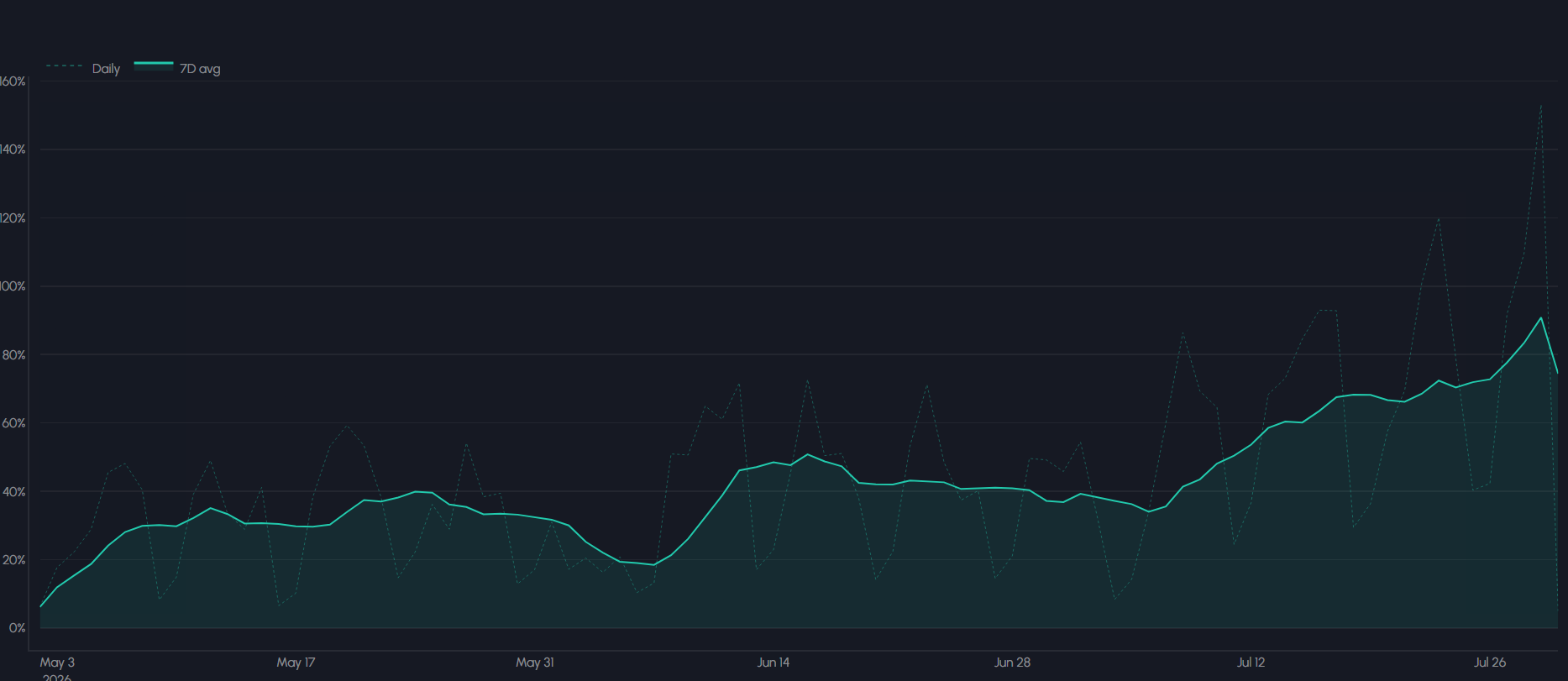
RWA perpetual futures volume as a percentage of Bitcoin perpetual futures volume on Hyperliquid and Binance. Source: Talos
Equity-linked contracts accounted for $22.8 billion of the total, followed by commodities at $9.1 billion and indexes at $4.2 billion. ETFs contributed about $338 million, while foreign exchange, pre-IPO and other RWA contracts made up the remainder.
Earlier in July, Pantera Capital said perpetual futures could become a dominant trading instrument beyond crypto, citing advantages such as 24/7 trading, the absence of contract expiries, simpler position management and continuous price discovery.
Hyperliquid’s growth has drawn attention from traditional finance. Intercontinental Exchange CEO Jeffrey Sprecher, whose company owns the New York Stock Exchange, recently urged regulators to create a “level playing field” for 24/7 onchain perpetual futures, arguing that existing market structures should not prevent the development of blockchain-based trading.
Despite the growth, RWA perpetuals remain a relatively small segment of the broader crypto derivatives market. Talos’ data shows aggregate futures trading volume of about $821.4 billion over the past seven days, with tracked RWA perpetuals accounting for roughly 7.5% of the total.
Magazine: The 100x obsession: Fundamentals grow in importance as crypto matures
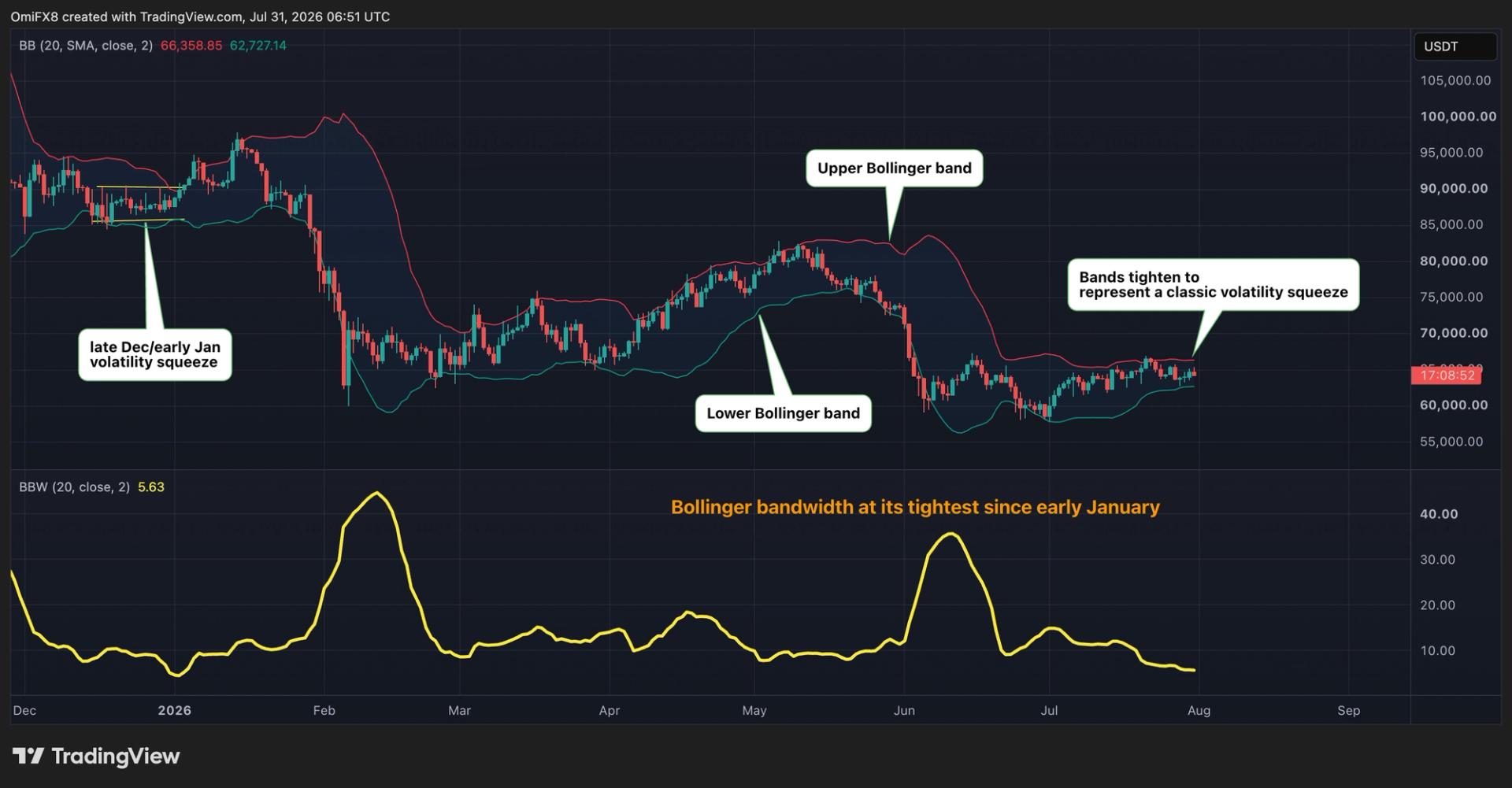
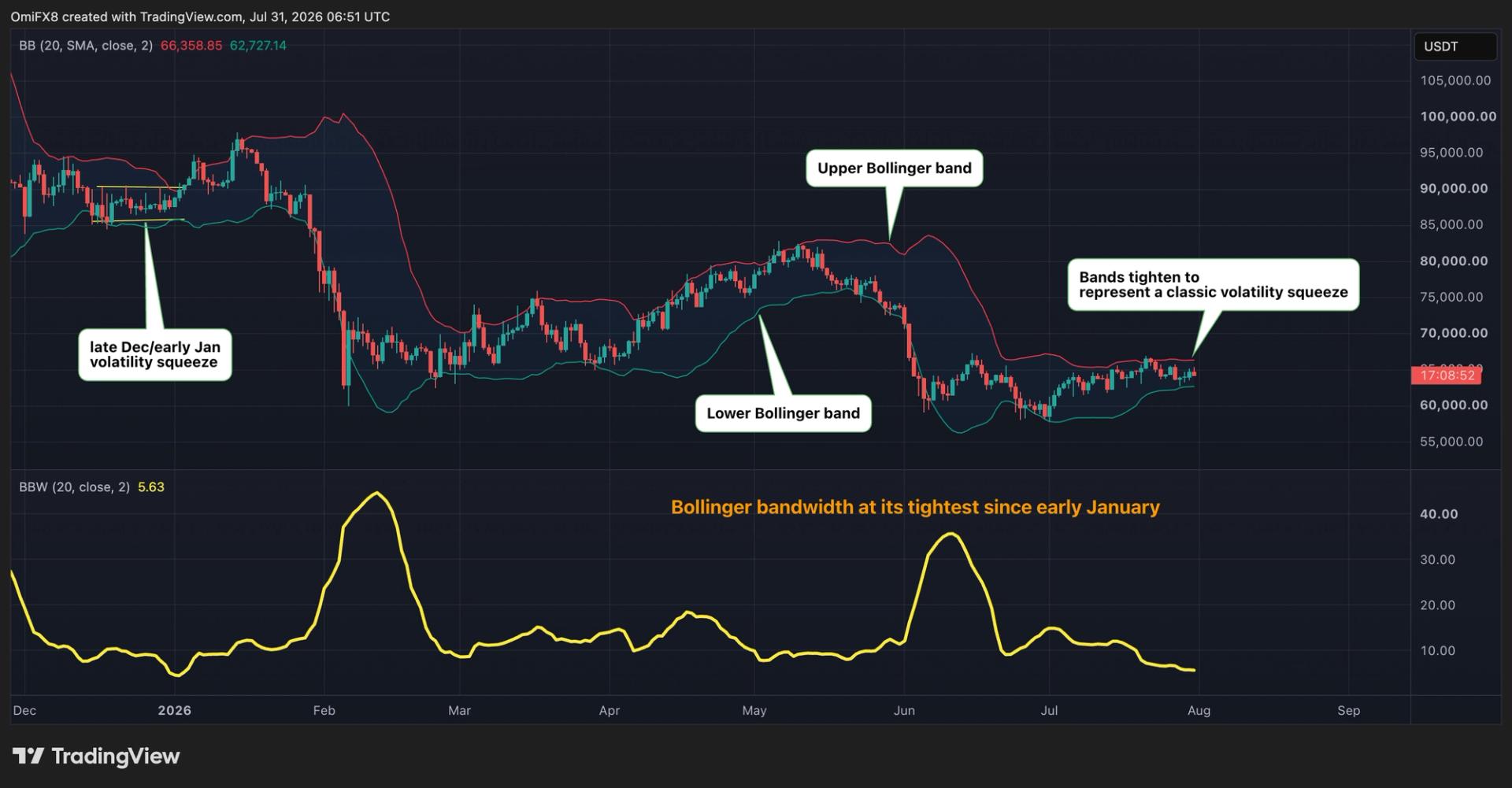
Trading bitcoin these days feels much as it did seven months ago, at the start of the year.
The price of the largest cryptocurrency is stuck in a tight range, with volatility at six-month lows, and traders are struggling to identify a break to bet on. Not surprisingly, transaction volume has slumped and is on track for the lowest since November 2023.
Back in January, the bitcoin price had been stuck in a narrow band, $86,000-$90,000, since the second half of December. Trading volume had dropped to an average of $5.1 billion a day, and has fallen to $2.2 billion this month, according to research from K33.
What happened next is interesting. Volatility picked up in the following weeks, the price rose to nearly $98,000 by mid-January and then slid down to around $60,000 by early February. Trading volume rose.
And that’s precisely the point. Volatility is cyclical: long stretches of quiet price action often precede a sharp move in one direction or the other. Like a coiled spring, the tighter the market compresses, the more forcefully it can unwind.

The largest altcoin by market cap rode the recent minor bullish wave in the cryptocurrency market, surging from just over $1,500 to almost $2,000 to mark a multi-month peak.
However, it stalled there as it couldn’t breach that psychological level. Moreover, the same technical tool that predicted the substantial revival has now flipped bearish.
Is ETH in Trouble?
According to Ali Martinez, the TD Sequential, a metric used to determine the underlying asset’s potential exhaustion moves in either direction, has been quite successful in determining ETH’s trend reversals. Back in early July, when Ether slumped to a multi-year low at around $1,520, it flashed a buy signal. This was followed by a major monthly rally that drove ETH to $1,980 last week.
As mentioned above, though, the asset’s run was halted at that level, and the TD Sequential is hinting at further trouble ahead. Martinez noted earlier today that the indicator has flipped to a sell signal and suggested that investors might consider taking some profits off the table.
Another popular analyst going by the X handle Crypto Lens shared a similar opinion. They noted that Ethereum has stuck between $1,860 and $1,955 for a reason, as the bull trap is “just getting started.” They added that a run to the $2,000 resistance will be followed by the “real capitulation.”
Crypto Lens’ scenario envisions a week or so in consolidation below that level before the final leg down begins and drives the asset south to somewhere between $1,400 and $900. Once it cleanses the weak hands, ETH’s next bull run can begin, and the analyst’s target is a big one – $7,000.
Not Good Against BTC
Crypto Rover also weighed in on the altcoin’s performance but focused on the trading pair against BTC. He outlined a chart that shows ETH has been charting new lower highs and lower lows for the past year. It began with a local peak at 0.04 marked last October, before Ethereum gradually lost a lot of traction that culminated with a drop to $0.025 in June.
It outperformed the market leader in the past month, jumping to 0.03. However, Crypto Rover believes another rejection is coming, which could drag it south to a fresh multi-year low of under 0.0235.
I’m sorry, bulls.$ETH vs $BTC keeps forming lower highs, and the latest rally is already losing momentum.
The same thing happened last time before ETH/BTC fell to a new low. pic.twitter.com/Si09I1gfIN
— Crypto Rover (@cryptorover) July 30, 2026
The post Is ETH’s Rally Over? The Key Indicator That Called Ethereum’s Run Just Flipped Bearish appeared first on CryptoPotato.
Where is Bryan Kohberger today? Everything to know before Netflix’s Idaho murders documentary

BP puts North Sea business up for sale

CRA International: Asking Price To Get In On Demonstrated Growth Is Steep


-

 Fashion7 days ago
Weekend Open Thread: Brooks Brothers
-
 Sports5 days ago
Commonwealth Games boxing: Jadumani Singh seals dominant 5-0 win over Pakistan’s Sumama Rehman to enter quarter-finals | Commonwealth Games News
-

 Business2 days ago
Why Trees Belong on the Risk Register
-

 Tech4 days ago
Intel is reversing course and bringing hyper-threading back to its server chips
-

 Crypto World6 days ago
Ripple bought a bank in pieces. The $4 billion audit
-

 Politics4 days ago
Luke Littler dismantles Gerwyn Price to retain title in Blackpool
-
 Entertainment7 days ago
A New Post-Apocalyptic Gundam Anime Series Blasts Into SDCC
-

 Politics3 days ago
The Part of the Electric Transition Nobody Wants to Discuss
-

 News Videos5 days ago
BITCOIN JUST ENTERED THIS CRITICAL ZONE…
-

 Business2 days ago
Major shareholder moves on Canyon
-

 Crypto World5 days ago
XRP Ledger adds $2.6B as RWA inflows rank second
-

 News Videos22 hours ago
Bitcoin Enters the 3rd Stage of the Bear Market
-

 Politics5 days ago
Spain sweeps the board at 2026 World Cup with individual awards
-
 Entertainment3 days ago
‘Stargate’ Creator’s New Sci-Fi Series Returns for Season 3 Tomorrow
-

 Entertainment5 days ago
Sara Gilson Killed By Husband After Viral “Pedophile” TikTok Video
-

 Crypto World2 days ago
Kraken Enables Retail Access to Jersey Mike’s IPO via Tokenized Shares
-

 Tech6 days ago
Anthropic launches Claude Opus 5, a cheaper AI model for coding, agents and enterprise workflows
-

 News Videos3 days ago
Claude: Build Financial Dashboards in Minutes (2026)
-

 Politics17 hours ago
Luke Littler’s dominance sparks GOAT debate
-

 Tech3 days ago
New macOS Sequoia & Sonoma security updates for older Macs
You must be logged in to post a comment Login