
Crypto World
A Pause on Advanced AI Is Wishful Thinking, But Adobe Stock Is a Buy Anyway

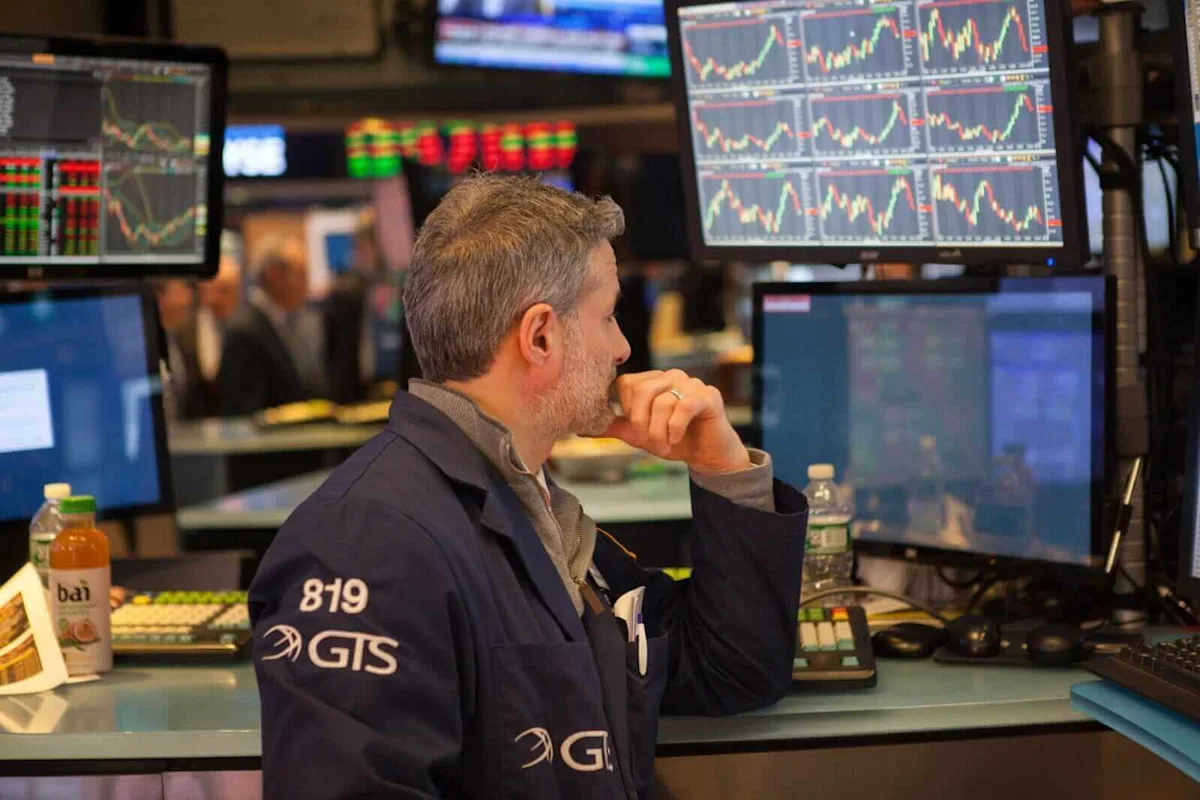
Artificial intelligence (AI) has been the predominant investing theme ever since Nvidia (NVDA) released that monstrous beat in its fiscal first-quarter 2024 earnings report in May 2023. Since then, the market, particularly tech companies, has been divided into two halves. The first are companies that are seen as net AI winners and saw their valuations soar. Nvidia was the flagbearer of this trade until a few months back, and its market cap soared to over $5 trillion. The Jensen Huang-led company became the world’s most valuable company in the process, something not many envisioned — at least not so soon — before AI really took off.
At the other end are companies perceived to be net losers from AI. These include software companies and IT services firms relying on “man-hour” models. Basically, these are companies whose very business model is at risk as AI models automate many tasks.
More News from Barchart
Meanwhile, “AI-pocalypse” fears have eased, and names like Accenture (ACN) and Adobe (ADBE) have rebounded from their 2026 lows. However, Adobe has fallen nearly 15% from the highs hit earlier this month. In my previous article, I noted that it would be prudent to take profits off the table after the sharp rally in ADBE stock. With the stock now coming off those highs, let’s explore why it is a “Buy” now, particularly amid the chatter around pausing advanced AI development.

Advanced AI Pause
To begin with, I believe it is highly unlikely that U.S. companies would pause advanced AI development. First, there is mutual distrust between the various companies building AI, and given how important the technology could become in the years ahead, there would always be suspicions of companies secretly working on advanced models. Moreover, U.S. AI companies are also competing with Chinese companies, which are often accused of copying U.S. technology. Think of it this way: despite various treaties, the U.S. and the former Soviet Union secretly continued to work on nuclear weapons during the Cold War. We now have a new cold war/tech war between the U.S. and China, and neither would want to lag in advanced AI buildout.


Crypto World
Coinbase (COIN), Robinhood (HOOD), Circle (CRCL) stand to gain from SEC’s tokenized-stock push: analysts
There is one hurdle if Coinbase wants to run a trading venue directly under the exemption. Its exchanges use central limit order books, while the SEC framework is built around automated market makers (AMM).
That means, the Goldman report noted, Coinbase would need new infrastructure or could route activity through AMM-based decentralized exchanges, for example to protocols on Base.
Robinhood expected to adjust for U.S. market
Robinhood could also benefit, even though its current offshore stock tokens do not fit the SEC framework.
Those products provide price exposure to U.S. shares through a derivative without conveying the full ownership rights required under the exemption. Goldman analysts said Robinhood would need additional product development to offer a compliant version in the U.S.
It became a flashpoint earlier this month when movie theater operator AMC Entertainment’s CEO criticized Robinhood for offering AMC-linked stock tokens without the company’s approval. The SEC’s new framework gives issuers the right to object before third-party tokenized versions of their shares can begin trading.
Still, Citizens analysts expect Robinhood to move quickly given the traction of its tokenized-equity offering outside the U.S. and its broader push around its Arbitrum-based Robinhood Chain.
Robinhood CEO Vlad Tenev already signaled this week that more shareholder features, including share redemptions and voting rights, will be added to the stock tokens.
Crypto World
Bitcoin survived brutal week of market shocks. Still, analysts are deeply split on what happens next.
For Matt Hougan, CIO at Bitwise Asset Management, the U.S. still has two and a half more years of a pro-crypto regulatory regime, during which the industry can continue to move forward.
Hougan remains bullish on crypto. “I don’t think it will stop investors from considering smaller-cap assets with strong tokenomics and links to real-world assets.”
However, he added, “had the Clarity Act passed the Senate vote, I think crypto would have been the consensus ‘smart money trade’ in Q4, and prices would have ramped back toward all-time highs.”
But because it failed, “I think the road ahead is bumpier,” Hougan said. “I don’t think it’s changed too much from where it was Monday before the vote.”
Hougan said the Clarity Act was and remains irrelevant to bitcoin, so if bitcoin’s price continues to drop, it has more to do with sentiment than fundamentals. “If bitcoin sells off in the short-term due to Clarity Act vibes, I’d consider that an opportunity,” he said.
No bottom yet?
Vineet Budki, managing partner and CEO of Sigma Capital, said bitcoin’s recovery and the long-liquidation flush do not yet establish that the bottom is in.
“I’m not ready to make that call,” Budki said. “I’d rather give it a quarter and let the price action speak before taking a firm directional view.”


Grayscale’s Zcash ETF has scheduled a 3-for-1 forward share split for Sept. 30, with each shareholder receiving three post-split ZCSH shares for every share held before the adjustment.
Summary
- Grayscale plans a three-for-one ZCSH split, with split-adjusted trading scheduled to begin September 30, 2026.
- September 28 shareholders of record will receive two additional ZCSH shares for every share held.
- ZCSH closed at $117.72 on September 18 after rising sharply during the previous two sessions.
- Grayscale said ZCSH surpassed $500 million in assets within two weeks of its August launch.
- Zcash developers target November 5 for NU7 mainnet activation after an October 6 testnet upgrade.
The Sept. 18 filing says investors recorded as shareholders at the close of trading on Sept. 28 will qualify for the split. Two additional shares for each existing share will be distributed after the market closes on Sept. 29, with split-adjusted trading due to begin before NYSE Arca opens on Sept. 30.
Zcash ETF split triples shares without changing investment value
The SEC filing states that the split does not change the total economic value represented by an investor’s holding at the moment of adjustment. The number of shares will triple while the net asset value represented by each share will fall proportionately.
Grayscale said the post-split NAV per share is “expected to be approximately one-third” of its level immediately before the split, according to the fund’s release.
Under that structure, an investor holding 10 ZCSH shares would hold 30 after the split, assuming the position remains unchanged through the relevant dates. Shareholders receive two new shares for each existing share, not three extra shares on top of their original holding.
Neither the ticker nor the security identifier is scheduled to change. The filing says the fund will continue trading on NYSE Arca as ZCSH and retain the same CUSIP number after the split.
Grayscale has not described the forward split as a distribution of new investment returns. Its disclosure presents the event as a change in share structure, with more shares outstanding and a correspondingly lower price and NAV per share.
ZCSH assets grew rapidly after its August listing
Grayscale said ZCSH began trading on NYSE Arca on Aug. 25 after the former Grayscale Zcash Trust was converted into the exchange-traded product. An earlier SEC filing announced the planned listing and name change four days before trading began.
As crypto.news previously reported on the Zcash ETF launch, the conversion gave U.S. brokerage investors exchange-traded exposure to ZEC without requiring them to acquire and custody the cryptocurrency directly.
By Sept. 8, Grayscale reported that the fund’s assets under management had crossed $500 million, less than three weeks after its NYSE Arca debut. The sponsor said cumulative inflows since the exchange listing had surpassed $70 million at that point, excluding a separate affiliated transaction involving Digital Currency Group.
A Sept. 8 SEC disclosure shows DCG International Investments acquired approximately $100 million of ZCSH shares through an authorized participant in exchange for 85,705.32563297 ZEC.
Grayscale disclosed that DCG International is indirectly owned by Digital Currency Group, which is the indirect parent of the fund’s sponsor.
More recent figures reported by The Block put cumulative net inflows above $233 million since the Aug. 25 debut and net assets at roughly $890 million as of Sept. 17.
The same report placed cumulative ZCSH trading volume above $11 billion, citing fund-flow data available before Grayscale announced the split. The figures came from third-party reporting and were not included in Grayscale’s Sept. 18 SEC filing.
ZCSH price rose sharply before the split announcement
Market data from Stock Analysis shows ZCSH closed at $117.72 on Sept. 18, down 1.97% for the session. The fund had gained 16.01% on Sept. 17 after advancing 14.11% one day earlier.
ZCSH traded between $114.33 and $120.73 on Sept. 18, with just over one million shares changing hands. The price performance should not be treated as a direct reaction to the forward split because ZCSH tracks an underlying crypto asset that had already been moving sharply.
ZEC climbed above $1,500 during Sept. 18 trading before giving back part of the move. As crypto.news reported on ZEC’s recent rally, the token had risen sharply from August levels as institutional interest, positioning and network developments drew attention.
Paradigm co-founder Matt Huang disclosed the investment firm’s exposure to ZEC on Sept. 16, according to the same report. Huang described Zcash as a “private complement to Bitcoin,” while supporting continued developer funding.
The disclosure arrived during an existing ZEC rally, so the token’s full price move cannot be attributed to Paradigm’s purchase.
Grayscale’s fund carries its own regulatory distinction. The company states that ZCSH is not an investment company registered under the Investment Company Act of 1940 and therefore does not receive the same regulatory protections that apply to registered ETFs and mutual funds.
Zcash NU7 timetable adds another dated event for ZEC
Zcash development teams have set an Oct. 6 testnet activation target for the NU7 network upgrade, according to the ecosystem timeline.
Developers currently target Nov. 5 for mainnet activation, subject to testing and a final mainnet decision scheduled for Oct. 20.
As crypto.news reported in its NU7 update, the planned upgrade would reduce Zcash’s target block spacing from 75 seconds to 25 seconds.
The current package includes version 4 transaction deactivation and a Network Sustainability Mechanism configuration following recent governance polling.
Crypto.news reported on the Zcash holder vote, where nearly 2.4 million ZEC participated. Approximately 99.9% of participating ZEC supported reducing the block target to 25 seconds, while around 98.9% backed retaining the existing halving schedule.
The timetable still contains several conditions. Developers list Sept. 30 as the code-completion target, Oct. 6 for testnet activation and Oct. 20 for the final mainnet activation decision after reviewing testnet behavior. The Nov. 5 date therefore remains conditional on the technical review.
ZCSH shareholders face three split dates
For ZCSH holders, the SEC filing sets three separate dates. Sept. 28 is the record date, meaning shareholders recorded at the close of market qualify for the extra shares.
Sept. 29 is the payment date when the two additional shares per existing share are scheduled for distribution. Before trading begins on Sept. 30, the split becomes effective and ZCSH is scheduled to start trading on its adjusted share basis.
The SEC filing says NAV per share should be approximately one-third of its pre-split level, with the number of shares increasing proportionately and the ZCSH ticker remaining unchanged.

Anthropic has selected Accenture as its first “embedded evaluator” partner, moving from a broad commitment to independent oversight toward a concrete safety program designed to keep pace with fast-moving AI model development. The move follows an earlier call from Anthropic CEO Dario Amodei for industry-wide measures to slow the “frontier” of AI progress and create room for safeguards.
In a three-step proposal published Sept. 12, Amodei argued that AI systems can accelerate progress through recursive self-improvement—an effect that, if left unchecked, may outgrow humans’ ability to understand and control the technology. He added that safeguards should be implemented alongside development rather than as an afterthought.
Key takeaways
- Anthropic says it will work with Accenture Faculty to evaluate models, conduct red-teaming, and test safeguards as part of its embedded evaluation plan.
- Accenture is expected to provide employee-like access to evaluators, reflecting Amodei’s first step toward stronger, independent oversight.
- Anthropic and Accenture each expect to invest at least $1 billion over the next five years, according to Anthropic’s announcement.
- The project’s mechanics are still being finalized because embedded evaluation is described as a new area.
- Anthropic says it will directly fund Accenture’s work in the near term, citing the lack of an existing system for financing independent evaluation.
From Amodei’s slowdown proposal to a concrete evaluator
Amodei’s Sept. 12 proposal was framed around safety concerns that have intensified alongside rapid model iteration. He highlighted a dynamic where AI capabilities can speed up the creation of subsequent generations of AI, calling it recursive self-improvement. In his view, that process could produce outcomes that develop faster than governance and control mechanisms.
While the proposal generated attention across the AI industry, reactions were mixed. Coincidentally, OpenAI CEO Sam Altman and SpaceX CEO Elon Musk voiced positive responses to Amodei’s approach, according to social posts cited in the original reporting. Nvidia CEO Jensen Huang, however, reportedly argued that regulation of this kind was unnecessary, as noted by a CNBC profile referenced in the source material.
Against that backdrop, Anthropic’s announcement of Accenture as a first embedded evaluator is best understood as an attempt to operationalize part of Amodei’s plan. The key idea is that independent evaluation should have access patterns closer to those of internal teams—so evaluators can test systems under realistic conditions, rather than relying on limited or purely external reviews.
What “embedded evaluation” will cover
Anthropic said Accenture and its AI business unit Faculty will help “evaluate and red-team models, conduct alignment assessments and testing model safeguards.” The company also stated that the program’s implementation details are still being worked out, emphasizing that embedded evaluation is an emerging practice.
That emphasis on development matters for investors and builders because it signals that the framework is not yet standardized. For companies attempting to meet safety expectations, the lack of mature procedures can create uncertainty about what “good” evaluation looks like in practice—especially when evaluation includes alignment checks and safeguard testing.
It also highlights a practical shift: instead of treating safety testing as an isolated stage, the partnership aims to build evaluation capacity that can run alongside model development. The source material also notes that embedded evaluation was already on Anthropic’s internal roadmap, but the Accenture partnership is intended to accelerate execution.
Funding, access, and what comes next
Anthropic’s announcement places financial backing at the center of the plan. Both Anthropic and Accenture expect to invest at least $1 billion each over the next five years, according to the company’s statement. The partnership is also described as non-exclusive, with Anthropic expecting to name additional evaluators in the coming weeks.
The company further said there is currently no established funding mechanism for independent evaluation, and that long-term support may need to come from pooled resources or government sources. Still, given what Anthropic characterized as urgency, it plans to fund Accenture’s work directly in the near term.
For market participants, this structure raises an important question: will independent evaluation become a scalable, ongoing “industry function,” or will it remain dependent on a handful of well-resourced labs and contractors? Anthropic’s plan suggests it intends to push toward the former, but the acknowledgment that an existing funding system is absent indicates the field still has institutional gaps.
Accenture, via statements attributed to its leadership, positioned the work as part of building the next generation of evaluation capability. The announcement cited Accenture’s Faculty as having experience testing and evaluating models for major AI laboratories and developing complex AI systems designed to be safer by construction.
Why this matters beyond AI headlines
Even though the story is focused on AI, the underlying issue—how to build credible oversight faster than capabilities evolve—is broadly relevant to crypto markets as well. Many blockchain and decentralized systems increasingly rely on AI-assisted automation, monitoring, and tooling. When safety and evaluation frameworks are in flux, teams that integrate AI into financial or infrastructure workflows may face additional compliance and risk questions.
Anthropic’s choice to fund and operationalize embedded evaluation also signals a shift in competitive dynamics within the broader tech stack: safety is being treated less like a policy promise and more like an engineering program with measurable activities such as red-teaming, alignment assessments, and safeguard testing. Whether that becomes an industry norm will likely depend on how clearly embedded evaluation methodologies can be standardized and verified over time.
Readers should watch whether Anthropic expands the program beyond Accenture with additional evaluators, and whether the partnership publishes enough detail for outsiders to assess how “employee-like access” is implemented in practice. The largest open uncertainty is methodological: embedded evaluation is new, and the effectiveness of safeguards will depend on how the program is structured as it scales.
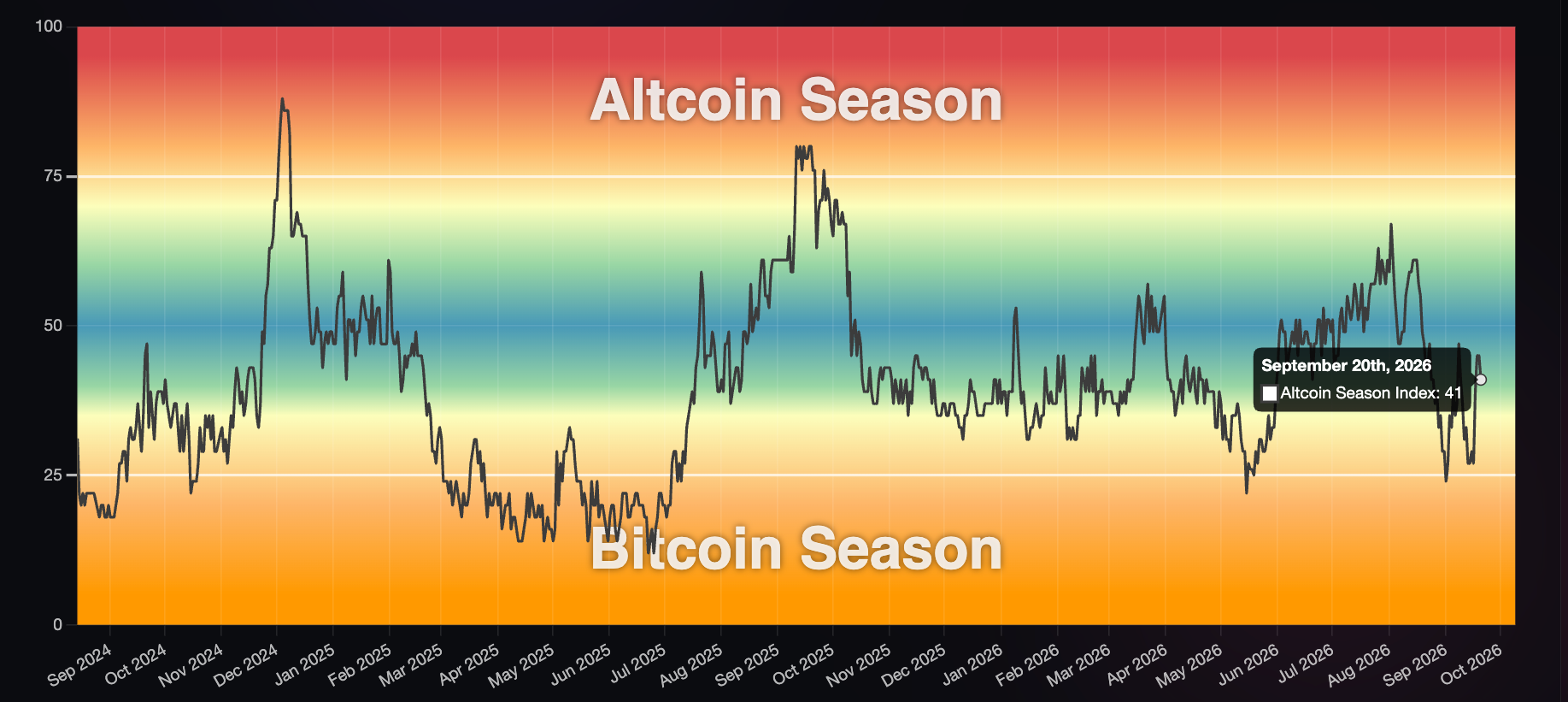
Altcoins have climbed back above a key level on Binance, with 70% now above their 200-day average. A separate gauge of altcoin strength has moved in the opposite direction.
Blockchaincenter’s Altcoin Season Index fell to 41 on September 20. The reading sits 34 points below the level that historically confirms an altcoin season.
Altcoin Market Cap Reclaims $800 Billion
The total cryptocurrency market capitalization has gained 3.7% in September, with several altcoins posting sharp rallies despite macroeconomic and geopolitical shocks.
CryptoQuant analyst Darkfost reported that Total3 moved back above $800 billion. The metric tracks altcoin market capitalization excluding Bitcoin (BTC) and Ethereum (ETH). That level had not been reached in more than 8 months.
The move cleared May’s high on a strong daily close. Furthermore, Binance data showed that 70% of altcoins were trading above their 200-day averages, a level last seen in October 2025.
Those same altcoins spent nearly a year sitting 65% to 85% below that average. Bitcoin, meanwhile, has traded within a range of $75,600 to $82,000.
Ash Crypto pointed to another bullish setup on a chart excluding the top 10 assets.
Follow us on X to get the latest news as it happens
Why the Two Signals Point in Opposite Directions
The improved price structure does not necessarily mean altcoins are outperforming Bitcoin. The Altcoin Season Index measures the percentage of the top 50 altcoins that have outperformed Bitcoin over a 90-day period.
With the index at 41, fewer than half of those assets have beaten BTC over that timeframe. The index peaked near 67 in August. Relative strength has weakened since then.

Bitcoin dominance also supports this view. The metric stood at 59.34% on September 20, up 0.5% over the previous three days.
In other words, altcoins have recovered against the dollar without yet showing broad-based strength against Bitcoin.
One Bitcoin-denominated measure, however, points to a possible shift. The ETH/BTC ratio was near 0.03238 and had recently tested against a downtrend in place since 2021, according to Ash Crypto.
The breakout is still recent, and the ratio remains well below its 2021 peak. It therefore provides an early signal rather than confirmation of a broader altcoin rotation.
Darkfost also cautioned that the market’s improving structure could reverse quickly.
“But be careful, this kind of development can shift quickly, so caution remains warranted,” analyst Darkfost said.
For the Altcoin Season Index to confirm a broader rotation, altcoins would need to continue outperforming Bitcoin across its 90-day measurement period.
Subscribe to our YouTube channel to watch leaders and journalists provide expert insights
The post 70% of Binance Altcoins Recover But Altcoin Season Index Tells Another Story appeared first on BeInCrypto.
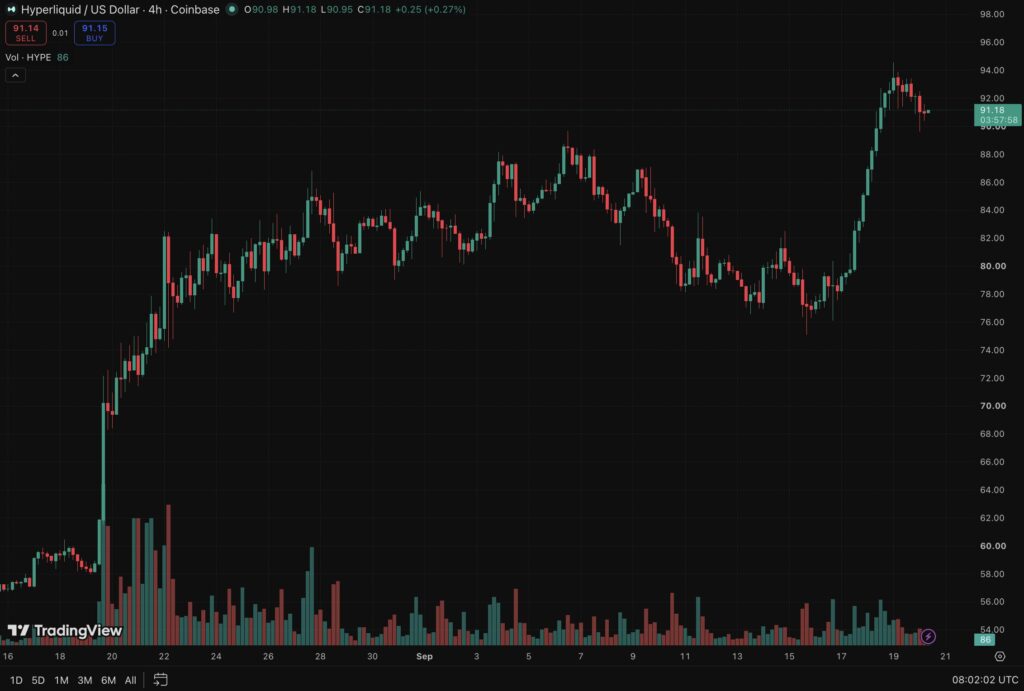
In Hyperliquid news, HYPE is at $91.19, down a modest -1% today, just $3 off the record high it printed earlier this week. Not bad for a token that was under $80 a week ago.
Hyperliquid’s new Manual Borrows feature went live September 18, letting users post HYPE or Bitcoin as collateral to draw USDC and USDT loans directly on HyperCore infrastructure. Total borrowed assets already sit at $269M. HYPE holders can borrow against their tokens at up to 65% LTV with an 82.5% liquidation threshold.
Bitcoin collateral caps at 50% LTV with a 75% threshold. Hyperliquid keeps 10% of interest paid as a liquidation reserve, passing the rest to suppliers, a fairly standard money-market split, but one that instantly deepened HYPE’s on-chain utility.
The launch coincided with a 13%+ single-day rally to a $90.92 all-time high, alongside a +75% jump in trading volume. That kind of volume spike, paired with a new leverage mechanism, tends to attract scrutiny.
Hyperliquid has already faced insider-trading allegations tied to its perpetual futures earlier this year, a reminder that fast-growing derivatives venues draw regulatory eyes as fast as they draw capital.
Hyperliquid News: Can HYPE Price Hit $100 This Week?
HYPE trades around $91, down about -1% over 24 hours after last week’s +15% weekly surge. CoinGecko pegs the all-time high at $94.48, meaning the current price sits about -2.5% below that ceiling, the obvious resistance zone to watch.
Below, $90 acts as the first support layer, the same level HYPE reclaimed during the September 18 breakout; a clean loss of that level would point back toward the high-$80s.
Volume remains elevated following the borrowing-feature launch, which is typically a bullish signal when paired with price holding near highs rather than fading.

Bull case: A retest and break of $94-95 on continued borrowing-driven demand, opening room toward fresh highs of $100 and above.
Base case: Continued consolidation in the $88-93 band while leverage unwinds.
Bear case: A breakdown below $90 support that drags price back toward the low-$80s, invalidating the recent breakout structure.
LiquidChain Targets Early Mover Upside as Hyperliquid Tests Key Levels
With Hyperliquid news of $269M in loans already being live, and HYPE near its all-time high, it is exactly the kind of setup that rewards early holders and frustrates everyone arriving now. At a $20Bn+ market cap, doubling from here requires enormous fresh capital inflow.
That math is why traders increasingly rotate a slice of profits into earlier-stage infrastructure plays still building their liquidity base, the same phase Hyperliquid itself was in years before this rally.
LiquidChain ($LIQUID), a Layer 3 infrastructure project, is positioning itself around a similar liquidity thesis, fusing Bitcoin, Ethereum, and Solana liquidity into a single execution environment rather than forcing developers to fragment across chains.
The presale is priced at $0.014957 with $969,509.91 raised to date. Its Unified Liquidity Layer and Deploy-Once Architecture let developers ship once and reach all three ecosystems, backed by verifiable settlement and single-step execution.
Momentum on the multi-chain infrastructure narrative is already building; Solana’s recent Transaction v1 upgrade tripling data capacity and its 250ms slot-time cut both feed directly into cross-chain throughput plays like this one.
Gain Special Access to Layer 3 Trading Here
Discover: The Best Token Presales
The post Hyperliquid News: HYPE Tests New Highs Following Loans Going Live appeared first on Cryptonews.
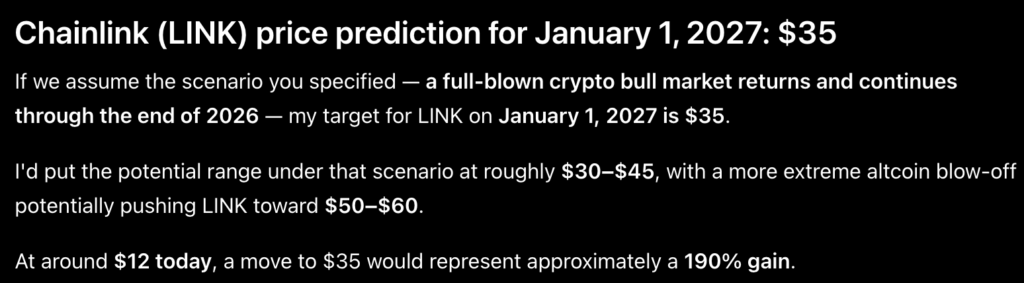
If we assume full bull-market conditions return between now and the end of 2026, the Anthropic Claude AI predicts Chainlink (LINK) will reach $35 by January 1, 2027. Currently, LINK is trading around $12, so a move to $35 would be roughly a threefold rise from current levels.
I believe $35 is a reasonable target because it would place LINK above its 2024 peak while remaining well below its all-time high of approximately $52.70.

LINK has a history of being highly cyclical. During the 2020–2021 bull market, it surged from around $1.77 at the start of 2020 to an all-time high of $52.70 in May 2021. However, it then fell sharply, closing 2022 at about $5.57.
This historical performance matters because LINK has shown that a $20 to $30 range is common during a robust crypto market. The key question now is what will occur if the overall market shifts from its current relatively weak state to a genuine altcoin bull market.
Claude AI Predicts LINK: Technical Analysis Supporting the Chainlink Thesis
WHY IS NOBODY TALKING ABOUT $LINK RIGHT NOW
The pattern is crystal clear:
1. Bear flag breakout
2. Manipulation lower
3. Distribution higher (right now)$LINK is trading in the distribution phase and this pull-back will likely end near 50% of the range.
There are few… pic.twitter.com/KlPukWxRF4— Coinvo Trading (@CoinvoTrading) September 17, 2026
The 2026 chart currently indicates a substantial recovery from a capitulation low. LINK dropped from about $14.40 at the beginning of the year to around $7.00 in June, before rebounding into the $11–$13 range.
Recent data show increases of 13.5% in July and 38.2% in August, with August taking LINK from approximately $8.19 to over $12.50 at one point during the month. This change indicates a significant shift in momentum.
A recent golden cross occurred in the moving averages, with the 50-day average crossing above the 200-day average in late August. Current estimates place the 50-day average at about $9.60 and the 200-day average at about $9.00.
The immediate technical progression to watch is as follows: $12.50 to $14.40, then a run toward $17.50 and $20. $27–31 to $35 completes the move.
The first major hurdle is approximately $12.50–$14.40, where LINK needs to establish itself above this zone. Recent analysis has identified $12.50 as the key breakout level, with $13 as the next target if resistance breaks.
Once LINK surpasses the $17–$18 range, the chart becomes much more interesting, as this area incorporates the swing structure from 2025/2026. The next crucial zone to watch is $27–$31, which includes LINK’s significant highs from 2024–2025.
A clean breakout through this range would indicate that LINK is entering price discovery territory relative to the most recent cycle, making the $35 target plausible.
Does the Historical Price Action Support the $35+ Possibility?
LINK’s past bull-market moves illustrate just how explosive it can become when momentum builds:
2019: ~$0.30 to $3.04
2020: ~$1.77 to $20.11
2023: ~$5.13 to $17.67
2024: ~$9.49 to $30.94
LINK posted its largest annual gain in 2020, up over 500%. In 2023, it achieved approximately 165% annual growth.
While past performance does not guarantee future results, it offers a helpful framework for a bull market scenario: LINK has historically responded strongly when the crypto liquidity cycle turns positive.
For instance, a move from around $11.50 to $35 would be a gain of about 204%. This increase is significant, though not historically extraordinary for LINK during a major crypto expansion.
Make Your Prediction Count With $25 For Free on Kalshi
Bitcoin Hyper Targets Early Mover Upside as LINK Tests Key Levels
For LINK, the upside math of an $8Bn+ market cap moves more slowly than early-stage infrastructure plays, where attention is rotating.
Bitcoin Hyper ($HYPER) is positioning itself as the first Bitcoin Layer 2 with full SVM integration. It boasts smart contract execution built for speed that outpaces Solana itself, while settling back to Bitcoin’s base-layer security.
As of today, the presale has raised more than $33.1M at a current token price of just $0.0136864, with staking rewards live at launch at a huge 35% APY.
The pitch: solve Bitcoin’s slow transactions, high fees, and lack of programmability without abandoning what makes BTC trusted in the first place. A Decentralized Canonical Bridge handles BTC transfers natively.
Gain Access to New Bitcoin Layer 2 Early Here
Discover: The Best Token Presales
The post Anthropic Claude AI Predicts LINK to Blast +300% by 2027 appeared first on Cryptonews.
Crypto World
The S&P 500 Has Returned About 11% Annually Since 1958. Here’s the ETF I’d Trust for the Next 30 Years.

In 1996, these were the S&P 500‘s (SNPINDEX: ^GSPC) largest holdings by market cap:
-
Coca-Cola: $130.6 billion
-
ExxonMobil: $121.7 billion
-
Intel: $107.6 billion
-
Microsoft: $99.4 billion
-
General Electric: $97.4 billion
-
Merck: $86.4 billion
-
International Business Machines: $73.5 billion
-
Procter & Gamble: $72.5 billion
-
Johnson & Johnson: $66.3 billion
-
Walmart: $52.2 billion
30 years later, all of these companies remain well-known names in the current economy. But it’s fair to say that they don’t at all resemble what the index looks like today. Microsoft is the only “Magnificent 7” stock still in the Top 10. Apple was in the midst of a corporate crisis until Steve Jobs eventually returned to the company. Nvidia, Amazon, Meta Platforms, Alphabet, and Tesla weren’t even publicly traded companies (or didn’t exist) back then.
Missed AI’s “Act 1”? Act 2 Could Be 15x Bigger. Most investors think they missed the AI boat because they didn’t buy Nvidia in 2005. But according to our analysts, we’re only at the end of “Act 1″—the R&D phase. “Act 2” is the global rollout. Continue »
Economies evolve over time, sometimes significantly. When investing for the long term, you can try to pick stocks that will survive and thrive. Or you can buy an ETF that tracks the economy and provides broad exposure. That’s why the Vanguard Total Stock Market ETF (NYSEMKT: VTI) is my choice for a core holding for a multidecade portfolio.

VTI doesn’t need to pick the next big winners
Since 1958, the S&P 500 has returned an average of 11% per year. But as demonstrated just now, it’s a rapidly changing group of stocks that is driving those returns over the year.
That’s what makes the Vanguard Total Stock Market ETF so compelling. It doesn’t need to try to identify and pick individual winners. It will increase its exposure to them naturally over time as the market caps of these companies grow.
If you had owned the S&P 500’s top 10 holdings in 1996 and held them for the next 30 years, you probably would have still done fairly well. But you would have missed out on the emerging tech names that grew to dominate the market and economy over that time.
Plus, the Vanguard Total Stock Market ETF owns the smaller companies that often turn into bigger companies down the road. By investing in the S&P 500, you limit yourself to just the large companies that have already established themselves. Adding small-cap and mid-caps to the mix potentially gets you in earlier on the next decade’s leaders.
That’s why I’d own this ETF and have it act as the core of my portfolio over the next several decades. Its diversification, low cost, and ability to change over time make it an ideal long-term holding.
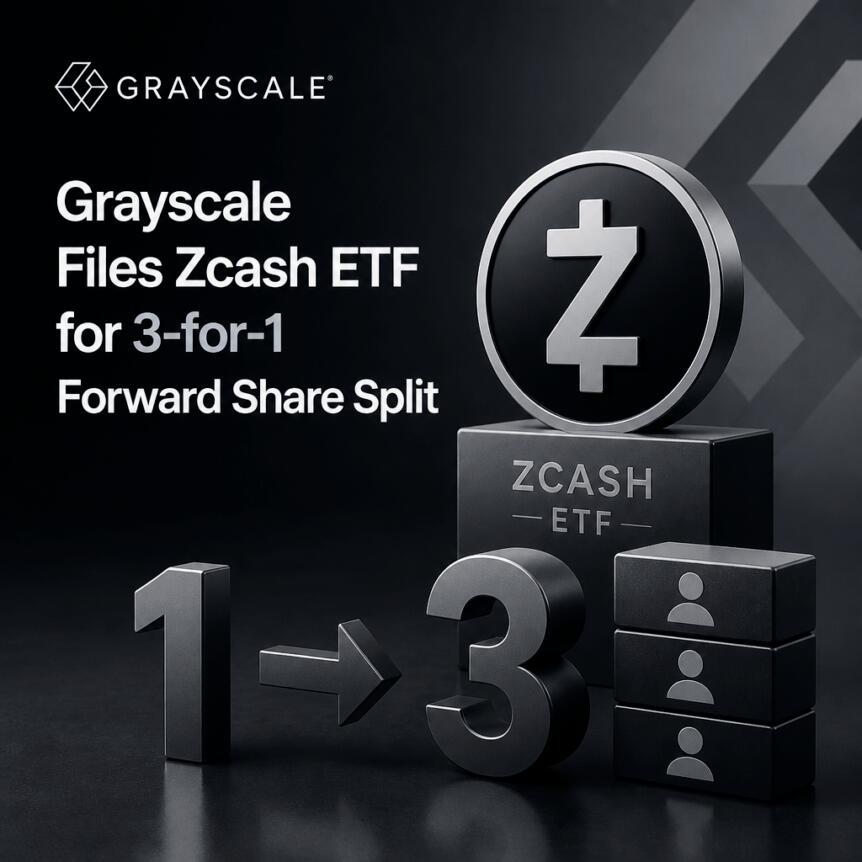
Grayscale’s Zcash ETF is set to undergo a 3-for-1 forward share split, according to a filing submitted with the U.S. Securities and Exchange Commission. The change is scheduled to take effect after the market close on Sept. 28, with shareholders set to receive two additional shares for every share they hold.
In a press release cited in the ETF filing, Grayscale said the forward split is designed to reduce the price per share while increasing the total number of shares outstanding in equal proportion—leaving the value of an investment unchanged in theory.
Key takeaways
- Grayscale’s Zcash ETF (ZCSH) plans a 3-for-1 forward split effective after the Sept. 28 market close.
- Shareholders receive two extra shares per held share; the filing describes the change as proportionate, not value-accretive.
- Grayscale expects the lower per-share price to improve accessibility, referencing that the unit price had become “too high.”
- The move comes as Zcash’s broader market momentum has been strong over the past year, with the token up about 2,800% in that period, according to the ETF materials.
What the 3-for-1 split means for ZCSH holders
The SEC filing describes the mechanism clearly: at the close of trading on Sept. 28, shareholders will receive two additional shares for each share they own. Grayscale’s included explanation—referenced in the filing—frames the result as a straightforward arithmetic adjustment rather than a change in underlying value.
For example, the materials illustrate that an investor holding 10 shares valued at $300 each—totaling $3,000—would own 30 shares priced at $100 each after the split, with the portfolio’s total value remaining the same.
The practical effect for investors is largely operational. Shares typically trade at a lower nominal price after such events, which can influence how the product is perceived and how easily some investors can size positions. However, the split does not inherently alter the ETF’s exposure to its underlying asset.
Why Grayscale is lowering the per-share price
Grayscale said the forward split is expected to “decrease the price per share” of the fund while increasing the share count proportionately. The ETF’s materials connect this to accessibility concerns, noting that Zcash’s token has risen sharply over the past year and that the per-unit price had become considered too high.
According to the filing-related press release, ZEC has increased by about 2,800% over the last year, and that surge helped push the ETF unit price to a level Grayscale deemed less convenient for potential investors. The split is therefore positioned as a way to make the ETF easier to buy and track in everyday terms.
For traders, these changes often matter most around implementation, including how order sizes and price targets are recalibrated. For longer-term investors, the key question is whether sentiment and liquidity improve as the share price becomes more “consumer-friendly,” even though the economics should remain proportionate.
Broader Zcash market momentum and ETF spotlight
While the share split is a structural adjustment inside the ETF wrapper, the timing also lands amid renewed attention on Zcash itself. Cointelegraph previously reported that Zcash had gained about 20% over a 24-hour period after Paradigm co-founder Matt Huang disclosed an unspecified purchase of ZEC.
In that coverage, Huang characterized Zcash as a “private complement to Bitcoin” and discussed the importance of long-term funding for the project, particularly as AI-driven cyber capabilities and quantum computing advance. Earlier coverage also linked Zcash’s performance to the visibility of privacy-focused assets in a market that remains sensitive to both regulation and technological narratives.
The Block reported that ZEC climbed as high as $1,521 early Friday, which would have been viewed as an effective new all-time high for the token before retreating slightly. That context matters for ETF holders and prospective investors: when the underlying asset experiences volatility and headline-driven flows, structural moves like share splits can draw additional attention to the vehicle, even if the split itself is not a market catalyst.
What investors should watch next
The most immediate checkpoint is the Sept. 28 record date tied to the forward split, since the share ratio will take effect after the market close. After that, investors should monitor how ZCSH trades relative to its adjusted share price—especially how liquidity and bid-ask spreads behave around the split window.
More broadly, the sustained relevance of ZCSH will likely track Zcash’s next fundamental and technical developments, alongside market demand for privacy-oriented assets. Even with the per-share price coming down, the underlying question for investors remains unchanged: whether the ETF continues to attract steady inflows as ZEC’s volatility and narrative momentum evolve.
Related references: Grayscale’s SEC filing includes details of the forward split (SEC EDGAR: zcsh-ex99_1.htm), and Cointelegraph previously reported on Zcash’s short-term price action and Matt Huang’s disclosure of a ZEC purchase (Cointelegraph coverage).


Hong Kong has jailed former China Construction Bank (Asia) relationship manager Lam Chun-yin for four years after he admitted accepting more than $470,000 in Tether to authenticate false bank instruments carrying a stated value above $1.6 billion.
Summary
- Hong Kong jailed former CCB Asia manager Lam Chun-yin for four years over USDT bribes.
- Lam accepted more than $470,000 in Tether to authenticate false bank documents totaling $1.6 billion.
- The court ordered HK$3.7 million restitution, matching the cryptocurrency bribes Lam received from conspirators involved.
- ICAC obtained arrest warrants for other people implicated after CCB Asia uncovered the scheme internally.
- A New York court let key White Rock claims against China Construction Bank survive dismissal.
The Independent Commission Against Corruption said on Sept. 18 that District Court Judge Ernest Lin Kam-hung sentenced the 32-year-old after his guilty plea to one count of conspiracy for an agent to accept advantages under Hong Kong’s Prevention of Bribery Ordinance and Crimes Ordinance.
The court ordered Lam to repay approximately HK$3.7 million to CCB (Asia), an amount equal to the bribes identified in the case. ICAC said the judge started from a six-year prison term and reduced it by one-third because Lam pleaded guilty, leaving a four-year sentence after finding no exceptional reason for another reduction.
Hong Kong bribery case centered on false bank guarantees
At the time of the offenses, ICAC said Lam worked in the Consumer Banking Division at CCB (Asia)’s Causeway Bay retail branch, where he served individual customers. The agency said his role did not cover business credit facilities or letters of credit, and the bank had never authorized him to handle such products.
Vesttoo Limited, which has since ceased operations, ran a platform for insurance-related investment transactions. ICAC said investors using the platform had to provide bank-issued standby letters of credit so an issuing bank could ultimately cover relevant losses if an investor failed to meet its obligations.
Yu Po Holdings Limited entered the platform as an investor in early 2022. The anti-graft agency said a criminal group then arranged for Lam to falsely present himself as China Construction Bank’s contact person for standby letters of credit connected with Yu Po.
Between April and June 2022, Lam admitted conspiring with a Vesttoo department head and other associates to receive more than $470,000 worth of Tether. ICAC said he authenticated multiple standby letters of credit that falsely purported to come from China Construction Bank and two collateral letters presented as Yu Po documents endorsed by the bank. The stated value of the instruments exceeded $1.6 billion.
An earlier ICAC charge announcement gave more detail about the document count. In June 2025, prosecutors alleged that Lam had been involved with 88 false standby letters of credit and two false collateral letters. His later guilty plea covered the bribery conspiracy, while a separate conspiracy charge involving false instruments was left on the court file.
CCB Asia uncovered the scheme through an internal review
CCB (Asia) found the problem during an internal investigation and then filed a corruption complaint, according to ICAC. The agency said its inquiry established that neither China Construction Bank nor its related companies had issued any of the standby letters of credit or collateral letters involved in Lam’s case.
During sentencing, Judge Lin described Lam’s criminality as “higher than in other similar cases,” according to ICAC. The judge cited the use of forged bank documents, the potential risk faced by the bank and damage to Hong Kong’s standing as an international financial center.
ICAC said people involved in the scheme had tried to make the bribery harder to detect by routing payments through cryptocurrency. The commission said it had applied for court warrants to arrest other individuals implicated in the case, but its Sept. 18 public statement did not identify the wanted people.
Public ICAC materials reviewed for this report do not disclose wallet addresses or transaction hashes for Lam’s Tether payments. The specific transfers therefore cannot be independently matched to public blockchain transactions from the information released by the agency.
The use of USDT in the case does not mean the payments were untraceable. In related coverage,crypto.news reported that Hong Kong investigators traced 8,127 USDT in a separate trafficking case to an exchange account and then to a bank transfer. The Hong Kong Court of Appeal relied on evidence from that payment trail when it upheld a 56-month prison term in August.
Vesttoo-linked claims continue through U.S. courts
The conduct behind Lam’s Hong Kong case sits within a larger series of disputes tied to Vesttoo’s reinsurance collateral. Vesttoo and affiliated entities filed Chapter 11 cases in Delaware in August 2023 after questions emerged over letters of credit used to support insurance and reinsurance transactions. A Vesttoo liquidating trust remained active in the bankruptcy docket in 2026.
A separate New York case brought by White Rock Insurance, an Aon subsidiary, concerns letters of credit allegedly used in Vesttoo transactions. White Rock alleges its segregated insurance cells released roughly $140 million in premiums after relying on purported collateral associated with China Construction Bank entities. The allegations remain civil claims and are not findings from Lam’s Hong Kong criminal sentence.
On April 21, New York Supreme Court Justice Andrea Masley rejected most of China Construction Bank’s attempt to dismiss White Rock’s amended complaint. The court allowed claims including fraud-related and negligent-supervision theories to continue, while dismissing a separate negligence claim as duplicative.
At the motion-to-dismiss stage, the New York court treated White Rock’s pleaded facts as allegations that still require proof. The order said there were factual questions over whether Lam had actual or apparent authority and whether CCB entities could face liability for his alleged conduct. The court expressly stated that those questions would have to be developed later in the litigation.
Another U.S. case involving Vesttoo collateral reached the Fifth Circuit Court of Appeals in April. Porch.com sued reinsurance broker Gallagher Re over duties connected with a reinsurance arrangement involving Vesttoo, White Rock and collateral expected from China Construction Bank.
The Fifth Circuit affirmed dismissal of some Porch claims but revived one contract claim concerning post-placement administrative services and sent that part of the case back for further proceedings. The appeals court said the scope of services customarily performed by a reinsurance intermediary presented a factual question that should not have been resolved through a motion to dismiss.
ICAC is still seeking other people tied to the case
The Sept. 18 sentencing does not close ICAC’s investigation into every person connected to the false instruments. The agency said it had sought warrants for other implicated individuals after Lam’s case reached sentencing.
ICAC had previously identified Vesttoo employee Udi Ginati and intermediary Wan Cheuk-lun in its June 2025 charging announcement, saying Lam was accused at the time of receiving Tether from Ginati, Wan and others. The same announcement separately charged former Standard Chartered Bank (Hong Kong) senior relationship manager Lee Ka-man with conspiracy to use four false standby letters of credit purportedly issued by Standard Chartered. Those earlier accusations must be distinguished from Lam’s Sept. 18 conviction and sentence.
The anti-graft agency said CCB (Asia) and Standard Chartered Bank Hong Kong cooperated with its investigation when the charges were announced. Its Sept. 18 statement said CCB (Asia) had lodged the corruption complaint after detecting the conduct internally and continued assisting investigators.
Hong Kong authorities have continued dealing with crypto-linked crime in other cases during 2026. Hong Kong police received 255 reports tied to the alleged Fun Coffee crypto investment scheme, with reported losses reaching HK$104 million. Police said the scheme involved USDT-based investment plans and had led to several arrests by August.
Separately, the city has continued expanding its regulated digital-asset framework. crypto.news reported on Sept. 17 that Hong Kong plans to expand regulated stablecoin trading and tokenized-asset infrastructure under its 2026 policy program.
ICAC’s latest public statement in Lam’s case says the commission is pursuing the remaining people implicated through court-issued arrest warrants, while Lam must serve the four-year sentence and repay approximately HK$3.7 million to CCB (Asia).

Fulham vs Manchester United LIVE squad confirmed with triple boost plus how to watch

Recharge Chapter 5-6 | Money and Banking | Class 12 | Boards 2025

Mainoo primed for Man City after United’s winning return to Champions League




-

 Fashion2 days ago
Weekend Open Thread: Talbots – Corporette.com
-

 Tech7 days ago
The Latest Weird Thing to Play Doom Is the Mapped-Out Brain of a Fruit Fly
-
 NewsBeat2 days ago
Trump says US has reached an agreement to take permanent control of Greenland’s security
-

 Crypto World5 days ago
Kraken Lets xStocks Holders Earn Yield Through DeFi
-

 Crypto World6 days ago
Revolut Attackers Warn of Ongoing Daily Customer Data Leaks
-

 Crypto World1 day ago
Circle launches Arc Studio AI agent for building onchain apps
-

 Crypto World4 days ago
What Is the Status of the U.S.-Iran Peace Talks? Here's What Both Sides Are Saying
-

 Crypto World4 days ago
US Charges Robinhood Engineers Over Crypto Listing Trades
-

 Crypto World5 days ago
Robinhood engineers charged over $50K crypto scheme
-

 Crypto World1 day ago
Bitcoin price breaks channel as RSI climbs to 63
-

 Crypto World6 days ago
Elon Musk Drops a Bombshell: Grok 5 Could Be the AGI Breakthrough
-
 Crypto World7 days ago
New Tesla Roadster Uses SpaceX Tech. Will It Impact the Stock Price?
-
 NewsBeat6 days ago
‘Sick conspiracy’: Trump says only guardrails AI needs is ‘a strong and smart (High IQ!) president’ in all-caps rant
-

 Crypto World5 days ago
NVIDIA Analysis: Attempted Rising Wedge Breakout Amid Pressure on the AI Sector
-
Business6 days ago
SK Hynix ADRs Fall More Than 6% as Memory Rally Breaks on Fears of Slower AI Spending
-

 Tech4 days ago
Webb’s IC 348 Mosaic Includes Two-Jupiter Dwarfs, Twin Jets, and a Nursery Still Making Worlds
-
 Crypto World6 days ago
3 Token Unlocks to Watch in the Third Week of September 2026
-

 Crypto World6 days ago
DOJ Seeks to Seize $61M in Iran Oil Funds From Binance Accounts It Vouched For
-
Crypto World6 days ago
Can Circle’s Arc Repeat Robinhood Chain’s Meme Coin Boom?
-
 Crypto World7 days ago
Goldman Sachs backs 25bp Fed hike after CPI
You must be logged in to post a comment Login