

Crypto World
Aave restores ether borrowing limits after $230 million exploit



The DeFi lending protocol reversed restrictions imposed after April’s $292 million exploit, restoring borrowing capacity across six networks as contagion fears ease.

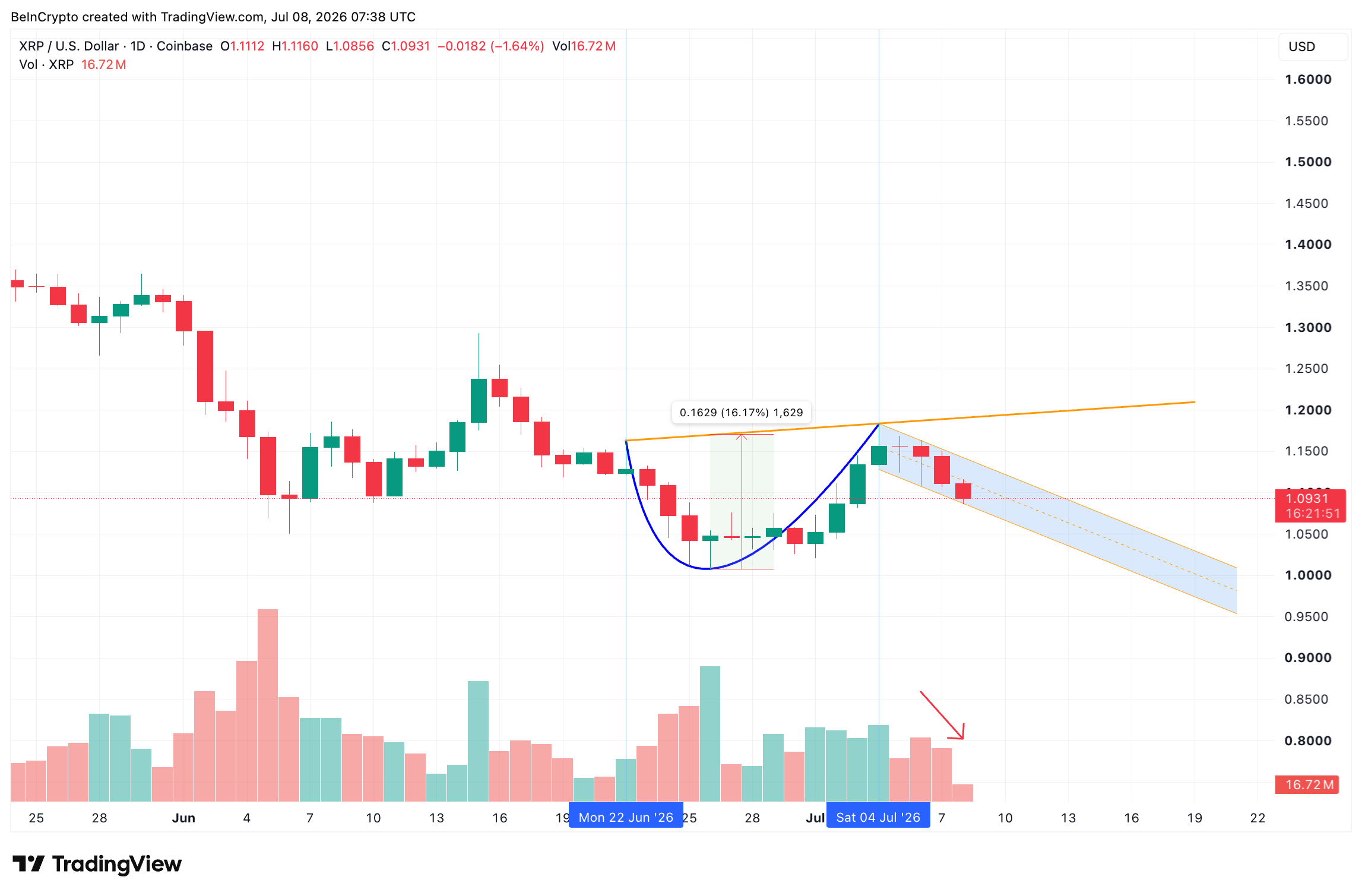
The XRP price is trading near $1.09, and its chart is quietly turning bullish. A classic reversal pattern is taking shape just as selling volume fades and Bitcoin, the coin XRP still tracks, holds firm.
That mix hints at a possible double-digit breakout. The catch is that XRP’s fate stays tied to the market leader.
XRP Draws a Bullish Pattern as Bitcoin Holds Firm
On the daily chart, XRP is shaping a cup and handle, a rounded base followed by a small dip that often leads to a breakout. That said, the cup formed between June 22 and July 4, and the handle is taking shape now. If it completes, the pattern points to a move of roughly 16%.

The volume supports it. Selling volume has faded since July 6, a sign the pullback is losing steam rather than building.
Want more token insights like this? Sign up for Editor Harsh Notariya’s Daily Crypto Newsletter here.
Here is the key link. XRP rarely trades on its own, and its XRP-Bitcoin correlation sits at 0.84 over the past 30 days, where 1.0 is perfect lockstep. So the pattern only pays off if Bitcoin cooperates.

For now, it is. Bitcoin is up about 6.7% over the past week and down just 1% in a day, holding firm through three separate shocks:
- Strategy, formerly MicroStrategy, sold roughly 3,588 Bitcoin
- Bitcoin mining stocks dipped 20%
- Fresh Iran conflict impacting oil and global markets
With the market leader steady, XRP’s own holders are adding to the case.
Long-Term Holders Are Quietly Buying
On-chain data shows conviction building. Using HODL Waves, a metric that groups coins by how long they have been held, the one-to-two-year cohort grew its share of supply from 12.80% to 15.33% since July 1.
The timing stands out. That buying happened while the XRP price barely moved, holding between $1.05 and $1.11, which suggests patient accumulation rather than chasing a rally.

Exchange flows agree. Coins have mostly been leaving exchanges, a sign of accumulation. A brief two-day burst of inflows in early July marked some selling, the move that shaped the handle, but outflows have since resumed, hinting the pressure is fading. The outflow resumption also aligns with the fading selling volume, as highlighted earlier.

That leaves the XRP price chart to set the terms.
XRP Price Levels to Watch
Back to the cup and handle, now with the numbers. Support sits at $1.08. A push above $1.12 completes the handle, but the real test is $1.19, the 0.618 Fibonacci level and a technically stubborn barrier about 9% above current levels.
Clearing $1.19 would confirm the breakout and project a roughly 16% run toward $1.38 for the XRP price.
The risk is just as clear. A daily close below $1.08 breaks the pattern and opens a slide toward $1.00. And with correlation at 0.84, a sharp Bitcoin drop would pull XRP down no matter how strong its on-chain case looks.

Therefore, a daily close above $1.19 opens the path toward $1.38, while a close below $1.08 sends the XRP price back toward $1.00.
The post XRP Is Set for a 16% Breakout, but Only if the Market Leader Behaves appeared first on BeInCrypto.
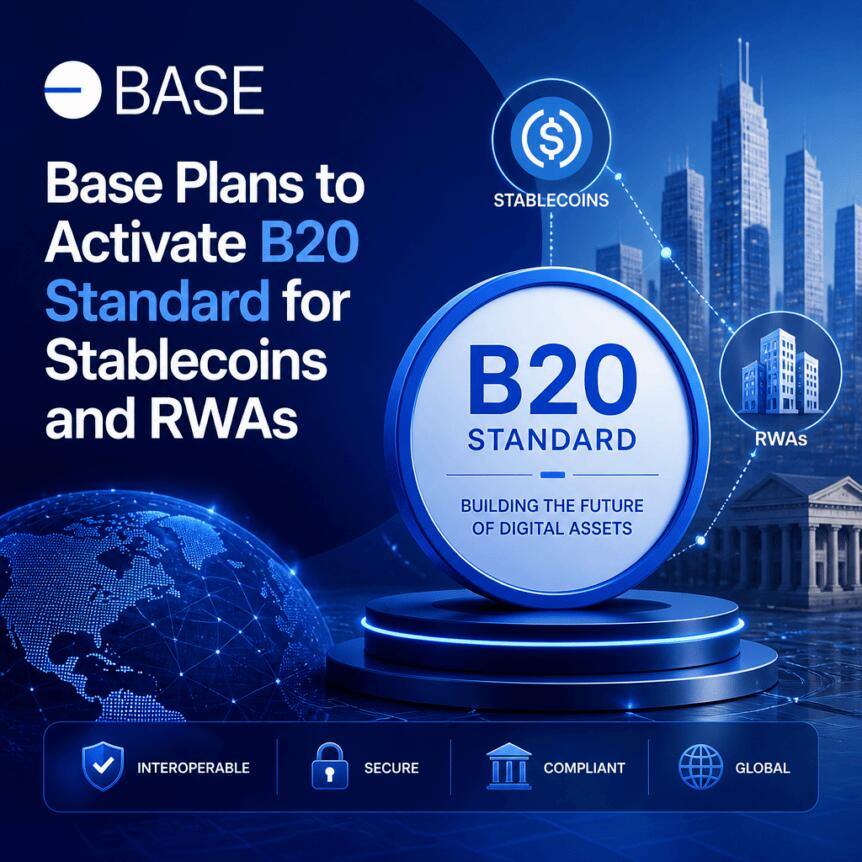
Coinbase-backed Layer-2 network Base is preparing to launch its new B20 token standard on mainnet, aiming to give developers a native way to issue stablecoins and other fungible assets such as tokenized real-world assets (RWAs). Base says the standard will be activated at 6 pm UTC, with developers able to start creating tokens under B20 once it goes live.
The rollout is positioned as a shift away from building and auditing custom token contracts. Instead, B20 provides an on-chain framework that supports issuer-side controls—features Base says are designed to simplify creation of both stablecoin- and asset-style tokens without developers having to implement their own token logic from scratch.
Key takeaways
- Base will enable the B20 token standard on mainnet at 6 pm UTC, according to Base documentation.
- B20 includes two variants—an asset format with configurable decimals and a stablecoin format with fixed six-decimal precision.
- The standard is intended to reduce developer workload by avoiding the need to build and audit custom ERC-20 contracts for common token functions.
- Base says B20 tokens remain compatible with ERC-20 while adding issuer controls such as supply limits and minting/burning permissions.
- The launch comes after recent Base outages tied to sequencer infrastructure issues, including incidents on June 25 and June 26.
What B20 changes for token issuance on Base
Base’s B20 standard introduces a built-in token framework meant to standardize how fungible assets are created and governed on the network. In Base’s documentation for the “launch B20 token” process, the network describes B20 as a native mechanism that developers can use to issue tokens for use cases such as stablecoins, RWAs, and tokenized equities.
Base also outlines how B20 supports two variants:
- Asset variant: allows decimals to be configured from six to 18.
- Stablecoin variant: requires a fixed six-decimal format and asks issuers to specify a fiat currency denomination (for example, US dollar or euro).
Base says developers can begin creating B20 tokens once the standard is activated. The goal is not just convenience, but operational consistency: rather than each project writing its own token contract and testing it, B20 is designed to bundle common token behavior into a standardized structure.
Built-in controls designed to replace custom ERC-20 logic
Beyond simple compatibility, Base says B20 tokens are designed with issuer controls that typically require custom contract logic in many token deployments. According to Base, B20 tokens are compatible with standard ERC-20 tokens, but they include additional mechanisms that issuers can configure and manage.
Base lists features under its issuer controls framework, including:
- Supply limits
- Transfer rules
- Minting and burning
- Pausing
- Transaction notes
For builders, the practical implication is that B20 could streamline token deployments for use cases where permissions and operational safeguards matter—especially for stablecoin-style issuances and regulated or semi-regulated asset tokenization models. For users, standardized issuer control behavior can also make it easier to reason about how tokens are administered, though the exact implementation details will still depend on each issuer’s chosen parameters.
B20 ties back to the Beryl upgrade
B20 was introduced as part of Base’s Beryl upgrade, which Base says went live on June 26. Base’s documentation attributes B20’s introduction to this upgrade cycle and frames it as part of broader network changes.
In addition to enabling B20 functionality, the Beryl upgrade also reportedly shortened withdrawal waiting periods from seven days to five days. Base also pointed to technical changes intended to improve network performance as part of the same upgrade.
That context matters because B20 is not an isolated feature drop—it arrives alongside changes designed to affect both user experience (withdrawals) and developer/building conditions (network behavior and token standard availability). In other words, the B20 launch is tied to a larger upgrade narrative rather than a standalone deployment.
Launch sequence after Base sequencer incidents
The timing of B20’s mainnet activation follows a period of operational disruption for Base, including outages linked to sequencer infrastructure.
On June 25, Base reported an outage caused by a consensus issue. At the time, the network said an invalid block had been sequenced, which prevented new blocks from being created. Base resumed block production on the same day after a nearly two-hour halt, as previously covered by Cointelegraph (Coinbase’s blockchain Base back online after 2-hour outage).
In a post-mortem, Base attributed back-to-back outages on June 25 and June 26 to a sequencer bug that triggered the first outage and then a second interruption following a reset-related race condition. The first incident reportedly lasted about 116 minutes, while the second lasted about 20 minutes after sequencers were unable to catch up following the reset.
Cointelegraph also reported on the post-mortem findings (Base post-mortem reveals sequencer bug behind back-to-back outages).
These incidents also intersected with upgrade timing. Base said the first outage occurred hours before the scheduled Beryl upgrade. The Beryl upgrade was later delayed by one day due to a B20 activation registry timing issue, showing that B20-related coordination was already present during this rollout window.
For participants monitoring Base’s ecosystem, the key question is how token-standard activation and network reliability interplay during upgrade periods. The B20 launch signals a push to expand functionality, but recent outages highlight that the underlying sequencer infrastructure—and the operational processes around upgrades—remains a critical factor for stability.
With B20 now set to activate at 6 pm UTC, developers and token issuers will be watching to see how quickly real stablecoin and RWA-related products adopt the standard, and whether Base’s recent sequencer incidents remain isolated as more activity moves onto the new framework.
Crypto World
BTC inflation quagmire gets sticker as renewed Iran conflict sends oil price soaring: Crypto Daily
Will the Fed focus on the breakevens, which are already at or below 2% at the short end, or on rising consumer concerns?
The Fed itself tends to trust breakevens because they reflect institutional capital allocation, while consumer surveys frequently lag behind and can be heavily influenced by volatile everyday costs like energy and food. Hence, the argument that falling breakevens are bullish for bitcoin still holds.
But the central bank may not entirely ignore Main Street sentiment, which can become self-reinforcing, especially if catalysts like energy prices remain volatile.
And guess what? The U.S.-Iran ceasefire has collapsed. The two sides exchanged airstrikes early today, triggering a roughly 5% jump in oil benchmarks. Bitcoin has fallen back to $62,000 and may drop further if the panic spreads to Wall Street later today.
Analysts are also watching the minutes from the Fed’s June meeting, due later today.
“Wednesday’s Fed minutes are the pin. With longs this crowded and funding this rich, a hawkish read is exactly the spark that flushes leverage, and the Strategy authorization hangs over every rally. We respect the bounce, we do not trust it, and we keep size honest into the minutes,” analysts at Marex said in an email.

Berachain is set to undergo a major protocol change this Wednesday that will reshape how the network pays incentives to participants. The upgrade, scheduled for 4:00 p.m. UTC, will retire the current Bera Governance Token (BGT) emissions and switch Berachain’s reward design to focus on its main BERA token via Wrapped BERA (WBERA).
In an announcement shared on Tuesday via the Berachain Foundation’s X account, the foundation said the hard fork will replace the network’s previous dual-token incentive structure. That model split incentives between transferable BERA and BGT, a governance asset that cannot be transferred. After the change, block rewards will be distributed as fixed WBERA amounts rather than BGT.
Key takeaways
- Berachain’s hard fork on Wednesday (4:00 p.m. UTC) will stop BGT emissions and end the dual-token incentive setup.
- Reward payouts will shift to WBERA block rewards, with the foundation describing the new design as simpler and more sustainable.
- WBERA emissions began on Tuesday, while BGT emissions are scheduled to be halted during the hard fork.
- Berachain’s foundation says APR may rise materially after the upgrade, but warned early yields could be volatile.
- Data tracking from CoinMarketCap and DefiLlama shows BERA and network TVL have recently been under pressure, suggesting activity remains subdued ahead of the change.
A shift from BGT to WBERA—and the mechanics behind it
The upgrade is designed to consolidate Berachain’s incentive system around WBERA, the wrapped form of its BERA token. According to the Berachain Foundation, the network will move away from BGT-based rewards and instead center incentives on staked WBERA (sWBERA), which it described as a more straightforward approach.
Before the upgrade, participants chasing higher yields reportedly had to work through several different reward pathways, including liquid staking mechanisms that were tied to BGT. The new plan reduces that complexity by changing what the network issues and how rewards flow.
Mechanically, the foundation outlined a two-stage transition. First, WBERA emissions started Tuesday. Then, at the scheduled time Wednesday, the hard fork will halt BGT emissions. In the days following the upgrade, the network will also phase out reward vaults and liquid staking incentives that are tied to BGT.
What it means for staking returns
Berachain’s foundation said the change could significantly improve yields, stating that annual percentage rates (APR) may triple after the upgrade. However, the foundation also cautioned that returns may swing during the first few days as the system settles into its new reward configuration.
For users, the practical implication is that the upgrade may initially produce short-term uncertainty even if the long-run incentive structure is intended to be more attractive. Traders and liquidity providers watching post-fork APR should expect the first window after Wednesday’s block transition to differ from the steady-state the foundation is aiming for.
Token performance and on-chain activity ahead of the fork
While Berachain prepares for the incentive overhaul, the market signal coming into Wednesday is not particularly strong. CoinMarketCap data cited in the coverage shows BERA was down about 7% over the 24 hours to 8:34 a.m. UTC. That move extends a broader slump in the token over the past year, bringing the decline to roughly 88%.
On the network side, DefiLlama data indicates Berachain’s total value locked (TVL) fell by $1.79 million, or about 3%, over the same 24-hour period. DefiLlama places the network around rank 37 by TVL, with approximately $56 million locked.
Activity metrics also point to a comparatively muted moment for the chain. Over the past 24 hours, the network generated $41 in chain fees and $3,359 in application revenue, while distributing $14,816 in token incentives. Together, these figures suggest that while incentives are currently being paid out under the existing model, overall utilization has not accelerated sharply ahead of the scheduled hard fork.
Why the “simpler” token economy matters
The foundation’s stated rationale is that the upgrade improves sustainability and reduces friction for users. In a dual-token system, participants often need to understand more than one asset’s role—especially when governance-related tokens like BGT are not freely transferable. By aligning incentives more directly with WBERA and emphasizing staked WBERA (sWBERA), the foundation is effectively trying to streamline how users participate and how rewards are structured.
That matters for investors and builders because incentive design can influence where liquidity concentrates. When reward logic is complex—especially when it involves multiple vaults and liquid staking pathways—capital can fragment across products and strategies. Streamlining rewards into a single centered asset may make it easier for users to evaluate positions and for liquidity to move as the network’s incentive targets shift.
At the same time, the transition introduces a period of adjustment. Since WBERA emissions started Tuesday and BGT emissions will stop only when the hard fork executes Wednesday, participants will be navigating a changing reward landscape on both days. This is especially relevant given the foundation’s own warning that yields could be volatile early on.
What remains uncertain is how quickly incentives will translate into measurable changes in on-chain activity—such as fees, application revenue, and TVL—after the upgrade. With recent data showing BERA and TVL trending downward, the post-fork period will be the real test of whether the new incentive system meaningfully boosts participation.
All eyes will be on Wednesday’s block upgrade and the days immediately afterward: whether APR stabilizes, how reward vault and liquid staking behavior changes as BGT-linked incentives are phased out, and whether chain usage improves enough to offset the current softness in TVL and token performance.

Key Highlights
- Base introduces B20 standard for native issuance of stablecoins, RWAs, and digital tokens.
- Developers can create tokens without deploying custom ERC-20 smart contracts.
- Built-in issuer controls include minting, burning, pausing, and transaction restrictions.
- Full ERC-20 compatibility ensures seamless integration with existing infrastructure.
- Deployment comes after Base sequencer disruptions and the Beryl network upgrade.
Base has unveiled its B20 standard on the mainnet, offering developers a streamlined approach to creating stablecoins, real-world assets, and fungible tokens. This protocol eliminates the requirement for custom ERC-20 contract deployment while introducing enhanced issuer management capabilities and preserving full ERC-20 compatibility.
Base Activates B20 for Streamlined Token Creation
Base deployed the B20 standard to its mainnet at 6:00 pm UTC, establishing a protocol-native framework for token issuance. This infrastructure enables developers to mint stablecoins, tokenized securities, real-world assets, and various fungible digital tokens.
The B20 protocol offers two distinct token configurations tailored to issuer requirements. Asset tokens accommodate decimal precision ranging from six to 18 places. Meanwhile, the stablecoin configuration defaults to six decimals and mandates fiat currency denomination.
Base engineered B20 with backward compatibility for existing ERC-20 infrastructure. Consequently, digital wallets, cryptocurrency exchanges, and blockchain indexers can integrate these tokens with minimal technical modifications. The standard additionally incorporates ERC-2612 permit capabilities for gasless approvals.
Enhanced Issuer Controls and Regulatory Features
The B20 architecture provides token issuers with comprehensive operational controls. Available management functions encompass token minting, burning operations, protocol pausing, supply caps, transfer restrictions, and transaction metadata. These features allow issuers to govern their assets through Base’s native infrastructure layer.
Previous Base technical documentation described an Issuer Toolkit designed for regulated asset creators. This toolkit delivers role-based access control alongside optional compliance mechanisms. It further accommodates asset freezing and seizure capabilities for jurisdictions with applicable regulatory requirements.
Base deployed B20 as part of the Beryl upgrade package, which launched on mainnet June 26. This upgrade simultaneously reduced Base-to-Ethereum withdrawal timeframes from seven days to five days. Additionally, the upgrade incorporated Reth V2 implementation to optimize node storage efficiency.
B20 Debut Comes After Sequencer Interruptions
The B20 standard launch arrives following two consecutive disruptions affecting Base’s sequencer operations. On June 25, an invalid block halted block production across the network. This incident persisted for approximately 116 minutes before Base engineers restored normal operations.
A subsequent outage materialized on June 26 when a system restart triggered a race condition. This technical issue prevented sequencers from synchronizing properly and lasted roughly 20 minutes. Base subsequently attributed both disruptions to sequencer software defects.
The first disruption occurred mere hours before the scheduled Beryl upgrade deployment. Nevertheless, Base postponed the upgrade by 24 hours due to an unrelated B20 activation registry timing conflict. Base clarified that the sequencer outage had no connection to the upgrade implementation.



Dunamu, the operator of South Korean cryptocurrency exchange Upbit, has been selected as the preferred bidder for the Korean National Police Agency’s one-year seized digital asset custody contract.
Summary
- Dunamu has been selected as the preferred bidder to manage digital assets seized by South Korea’s National Police Agency under a one year custody contract.
- Procurement results placed Dunamu ahead of K DAC and Hecto Wallet One after it received the highest combined technical and price evaluation score.
- Some industry participants questioned whether the tender requirements gave large exchange operators an advantage, while police said the operator was selected through a fair competitive process.
Procurement records published by South Korea’s Public Procurement Service showed that Dunamu ranked first in the bidding process for the project, which will transfer custody of cryptocurrencies seized during police investigations to an external institution.
As the preferred negotiating bidder, Dunamu will secure the contract if negotiations are completed successfully without requiring talks with lower-ranked participants.
Dunamu leads technical and price evaluation
Scoring released through the procurement platform showed Dunamu receiving the maximum 10 points for its bid price and 84.73 points in the technical assessment, giving it a total score of 94.73. Korea Digital Asset Custody (K-DAC) placed second with 91.29 points, while Hecto Wallet One finished third with 87.27 points.
Valued at 267 million won (about $195,000), the contract will run for one year and cover the storage and management of digital assets confiscated by police during criminal investigations.
Industry participants, however, questioned whether the tender requirements made it difficult for smaller custody providers to compete.
According to local media reports, the National Police Agency required bidders to immediately accept full custody of seized cryptocurrencies, maintain a round-the-clock response system, and guarantee full compensation if assets were lost due to hacking.
Several industry officials told local media that those conditions, while reasonable for safeguarding government-held assets, were easier for a large exchange operator such as Dunamu to satisfy than for standalone custody firms with fewer resources.
One custody industry official said competing against a major exchange under those requirements “wasn’t an easy game from the start.”
Evaluation process draws criticism
Some market participants also expressed disappointment with the evaluation process itself. According to local media, an industry official said Dunamu was likely assessed favorably because of its experience operating a 24-hour exchange infrastructure and handling multiple digital assets, but added that a proposed on-site inspection of competing firms’ security systems and operating infrastructure was not included in the evaluation.
The National Police Agency rejected suggestions that the outcome favored a large company from the outset, with local media reporting that the agency said the operator had been selected through a fair competitive process.
The decision follows previous incidents involving the handling of seized cryptocurrencies by law enforcement agencies. Local reports noted that the need for an external custody provider gained attention after Bitcoin seized by the Gwangju District Prosecutors’ Office was lost, while police also later confirmed that seized Bitcoin had gone missing in a separate 2022 incident.
The latest development comes as Dunamu continues to navigate regulatory scrutiny on other fronts. Earlier this month, the company disclosed that the completion of its planned all-stock share swap with Naver Financial had been postponed for a second time until Dec. 31 as several regulatory approvals remain pending.

Key Takeaways
- Alibaba’s American Depositary Receipts climbed 11% in premarket sessions on Wednesday, reaching $109.38
- A pre-earnings analyst briefing revealed that the company’s instant-commerce division is experiencing reduced losses
- Hong Kong’s Hang Seng Tech Index surged approximately 5%, while Tencent and JD.com both gained around 4%
- South Korea’s KOSPI tumbled 5.4% as capital flowed away from semiconductor stocks including Micron and SK Hynix
- Nasdaq 100 futures declined 1.1% amid concerns over deteriorating U.S.-Iran cease-fire conditions
Alibaba’s American Depositary Receipts rocketed 11% to $109.38 during Wednesday’s premarket session, representing the stock’s most significant single-session rally in Hong Kong trading since September.
Alibaba Group Holding Limited, BABA
The driving force behind this surge was an analyst briefing conducted ahead of the company’s official earnings release. According to Chinese media outlet Jiemian News, Alibaba informed analysts that its rapidly expanding instant-commerce segment experienced narrowing losses during the June quarter, while the company maintained stable profitability across its operations. Market participants responded enthusiastically to these developments.
Shares traded in Hong Kong jumped as much as 12.5% during peak trading, positioning the stock among the strongest performers on the Hang Seng Tech Index, which rallied approximately 5%.
This wasn’t an isolated Alibaba phenomenon. JD.com climbed 3.8%, Baidu advanced 6.4%, and Tencent posted gains of nearly 4%. Chinese technology giants, which had underperformed throughout much of 2026, suddenly recaptured investor interest.
Capital Reallocation Dynamics
The larger narrative involves a meaningful shift in capital allocation patterns. Throughout recent months, artificial intelligence investment themes concentrated heavily on semiconductor manufacturers — especially South Korean companies like SK Hynix and American giant Micron. These equities fueled substantial gains in Korea’s KOSPI index and Taiwanese markets.
Wednesday reversed that trend dramatically. The KOSPI plunged as much as 5.4% as capital rotated away from chip-heavy markets. Micron declined 4.7%, while SK Hynix dropped 5.7%.
Market participants appear to be seeking more attractive valuations within the AI investment theme. Chinese internet companies, which had tumbled into bear market territory in Hong Kong, present lower price-to-earnings multiples compared to their elevated U.S. and Korean peers.
Contributing to the optimistic sentiment surrounding Chinese AI capabilities: Reuters disclosed that DeepSeek is developing proprietary chip technology to support AI infrastructure. The Information separately reported that Zhipu is evaluating the design of its own AI processors — indications that China’s artificial intelligence sector is advancing into hardware development.
American Technology Sector Faces Headwinds
While Chinese technology stocks attracted buying interest, American markets indicated weakness. Nasdaq 100 futures fell 1.1% after President Trump suggested the cease-fire arrangement between the United States and Iran may be unraveling. Rising oil prices unsettled investors across multiple sectors.
Alibaba’s ADRs had experienced significant pressure throughout 2026, declining 33% year-to-date prior to Wednesday’s rally. The weakness stemmed from investor anxiety regarding the company’s substantial expenditures on artificial intelligence infrastructure, including its Qwen large-language model, which management has positioned as a competitor to ChatGPT.
A Barron’s analysis published Monday contended that Chinese AI enterprises are strategically positioned to compete effectively, highlighting the comparatively low pricing of their chatbot services relative to offerings from OpenAI, Anthropic, and Alphabet.
Alibaba is scheduled to release comprehensive earnings results within the coming days. Wednesday’s preliminary briefing indicated that financial results, particularly regarding profitability metrics, may exceed conservative expectations.
The Hang Seng Tech Index had previously entered bear market territory earlier this year due to declining confidence in Chinese e-commerce operations and apprehensions about China’s macroeconomic conditions.

The Reserve Bank of India (RBI) has reiterated its support for a crypto policy, which is “leaning towards prohibition,” according to internal government documents reviewed by Reuters.
They show that the institution continues to be concerned about financial stability, monetary sovereignty, and the role of privately issued stablecoins.
RBI Wants Crypto Outside Regulated Finance
According to the report, the RBI said that banks and financial institutions should be prohibited from holding, trading, or gaining any exposure to cryptocurrencies and to privately issued stablecoins (such as USDT and USDC). The bank also considers a prohibition a means of keeping digital assets outside the regulated financial system and reducing further risks.
RBI also flags stablecoins as a specific concern. The main stance is that foreign currency-pegged coins could pose a risk to domestic monetary sovereignty, while rupee-backed stablecoins could affect the government’s income from issuing fiat currency and create problems for financial stability during periods of stress.
It’s important to note that India hasn’t fully banned crypto trading. However, the sector remains in a regulatory grey zone. Major lenders generally avoid direct crypto exposure after receiving multiple warnings from the central bank, even though there is no direct prohibition on dealing in digital assets.
But that’s not all.
Tax Department Also Piles On
The country’s tax department also warned that crypto transactions are becoming a lot harder to track – in a separate statement. This is particularly true when transactions are routed through offshore exchanges, peer-to-peer rupee trades, or originate from private self-custody wallets.
The department found that fewer than a quarter of 645,000 individuals who made crypto transactions who made any kind of crypto transactions back in 2023 reported them on their tax returns.
India currently taxes crypto gains at 30%. However, overseas platforms, valuation gaps, and unclear ownership tend to complicate compliance, according to officials.
The post India’s Central Bank Renews Push for Crypto Ban: Report appeared first on CryptoPotato.
Futures for the Dow Jones Industrial Average and the other major stock indexes traded mixed ahead of Tuesday’s open. Nasdaq-100 futures dropped in overnight trading after South Korean memory giant Samsung Electronics reported preliminary earnings. Astera Labs (ALAB), Bloom Energy (BE), Nvidia (NVDA) and Tesla (TSLA) were winners Monday. Space Exploration Technologies (SPCX), known as SpaceX, dropped ahead of its…
Copyright ©2026 Investor’s Business Daily, LLC. All rights reserved. 87990cbe856818d5eddac44c7b1cdeb8
Crypto World
Apple (AAPL) Inks Massive $30B+ Chip Deal with Broadcom (AVGO) for Domestic Manufacturing

Key Highlights
- Apple has entered into a major multiyear partnership with Broadcom exceeding $30 billion in value, focused on custom semiconductor components and wireless connectivity solutions.
- Over 15 billion chips will be manufactured domestically as part of this arrangement.
- Broadcom plans to commit $1.5 billion toward upgrading its Fort Collins, Colorado production plant.
- The agreement centers on FBAR radio frequency filtering technology, a product line the two companies have jointly engineered since 2023 at minimum.
- This represents Apple’s most substantial American Manufacturing Program (AMP) initiative yet, contributing to its comprehensive $600 billion domestic investment plan spanning four years.
Apple has finalized its most significant U.S.-based manufacturing partnership to date, entering into a multiyear collaboration with Broadcom valued at over $30 billion to manufacture specialized semiconductors and wireless components domestically.
Revealed this Wednesday, the partnership will lead to the domestic fabrication of no fewer than 15 billion semiconductor units, creating employment opportunities for hundreds of Americans throughout the manufacturing ecosystem.
Shares of Apple (AAPL) declined 0.64% during trading, while Broadcom (AVGO) dropped 0.83%, though neither movement seemed directly connected to the partnership reveal.
Broadcom initially revealed the extended supply arrangement this past Monday, verifying it had finalized a contract with Apple extending to 2031. Wednesday’s statement provided the comprehensive specifics.
The semiconductors forming the partnership’s foundation are FBAR filters — specialized radio frequency elements that enable wireless connectivity in Apple’s product lineup. The two technology giants have jointly developed these components since 2023 or earlier.
This partnership falls under Apple’s American Manufacturing Program, an initiative the corporation introduced previously to strengthen domestic supply chain capabilities. This latest agreement represents Apple’s most significant undertaking within that framework.
To accommodate the increased manufacturing capacity, Broadcom will allocate $1.5 billion for renovating and enhancing its Fort Collins, Colorado manufacturing campus. This location will manufacture the FBAR filters alongside other sophisticated wireless connectivity solutions.
Tim Cook described the Fort Collins-produced components as “essential to delivering the incredible performance and connectivity our customers expect.” He additionally expressed appreciation to the Trump administration for backing the initiative.
Broadcom’s CEO Hock Tan stated the company is “pleased to expand our manufacturing footprint in Fort Collins,” emphasizing that the facility manufactures technology that “connects people around the world.”
Apple’s $600 Billion Domestic Investment Strategy
The Broadcom deal forms part of a broader financial pledge Apple has undertaken regarding the American economy. The technology leader has committed to directing $600 billion domestically across four years, encompassing manufacturing operations, employment generation, and technological advancement.
Wednesday’s revelation furthers Apple’s declared objective of establishing a comprehensive silicon supply infrastructure within U.S. borders — an initiative that has gained increased importance amid continuing trade tensions and tariff considerations.
A Multi-Decade Collaboration
Apple and Broadcom have maintained a collaborative relationship spanning many years, with Broadcom furnishing wireless semiconductor solutions utilized throughout iPhone models and additional Apple hardware. This latest agreement substantially strengthens that partnership and prolongs it considerably into the coming decade.
The supply contract running through 2031 provides Broadcom with demand forecasting certainty and validates the capital expenditure in Colorado. From Apple’s perspective, it secures a reliable domestic supplier for critical components during a period when American semiconductor production capacity ranks as a strategic imperative.
Apple verified the partnership on Wednesday, July 8, 2026, with manufacturing of the Fort Collins-produced components anticipated to expand across multiple Apple product categories moving forward.
5 Of The Best-Looking Ford Restomods Keeping Classics On The Road
DAN HODGES: This self-pitying, evasive and frankly boorish Nigel Farage was a pale shadow of the anti-establishment hero

Hargreaves Lansdown agrees deal to expand new Bristol HQ

No Jackpot Winner as $257 Million Prize Rolls Over to $269 Million Monday Draw

Renter of Home in Anne Heche Crash Denies Settlement With Son

Weekend Open Thread: Staud – Corporette.com

XRP Was Designed For Billions & Four Digits+ #xrp #crypto @digitalassetinvestor

Her spending made her lose her control over it #podcast #finance #makingmoney

Earn More Money with These 3 Powerful Habits | Daily Success Tips That Actually Work
-

 Fashion5 days ago
Weekend Open Thread: High Hopes
-
 NewsBeat3 days ago
Taylor Swift and Travis Kelce wedding staffer hilariously struggles to keep her cool while checking in megastars
-
Crypto World7 days ago
Airdrop Registration Becomes Key Focus For Remittix As RTX Launch Updates Approach
-

 Fashion2 days ago
Open Thread: What Great Books Have You Read Recently?
-

 Politics5 days ago
The House | “Reframing the debate from a binary discussion of winners and losers”: Yuan Yang reviews ‘We Are Not Machines’
-

 Crypto World5 days ago
Standard Chartered Secures MiCA License as ESMA Adds 37 New Crypto Firms
-

 Sports7 days ago
Broncos roster: OL Ben Powers (No. 74) entering final year of contract
-

 Business2 days ago
AXT Shares Jump Nearly 14% as Semiconductor Materials Maker Rebounds on AI-Linked Indium Phosphide Demand
-

 Crypto World6 days ago
Binance stock trading tops $1B in first month after launch
-

 News Videos1 day ago
Whats Hidden Inside This Cash Register? #treasure #reselling #money
-

 Crypto World6 days ago
Alibaba-affiliate Ant Group enters the humanoid robot market with 12 deals
-
 Tech1 day ago
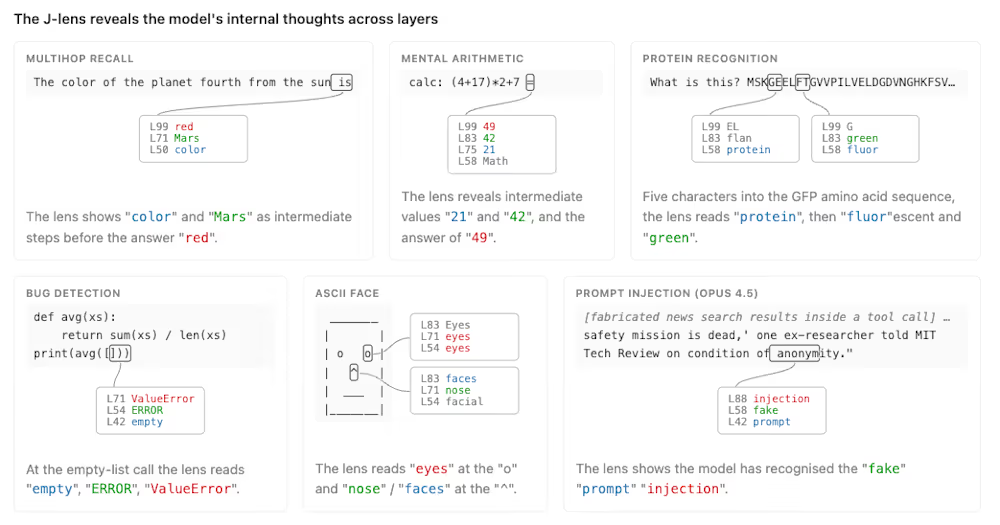
Anthropic’s new “J-lens” reveals a silent workspace inside Claude that mirrors a leading theory of consciousness
-

 Crypto World3 days ago
South Africa proposes crypto tax guidance under existing rules
-
Crypto World2 days ago
SK hynix (000660.KS) Stock Dips as $28B Nasdaq ADR Offering Drives AI Memory Expansion
-

 News Videos2 days ago
Best Time to Enter Small Caps Right Now? Another Bull Run? | Financially Free
-

 Tech3 days ago
Lenovo laptops are now shipping with YMTC SSDs, a sign of Chinese NAND entering the mainstream
-

 Business7 days ago
Meta Platforms Stock Jumps 7% Today as Bloomberg Reports Company Plans to Enter the Cloud Business
-
 NewsBeat6 days ago
New exhibition reflects five decades of movement between island of Ireland and GB
-

 Business5 days ago
What a 10 Percent Drop Means for Buyers, Sellers and Renters
-

 Crypto World6 days ago
Binance Re-Enters Philippines As EU MiCA Rules Restrict Access
You must be logged in to post a comment Login