
Crypto World
Agent Arc: Infrastructure for Autonomous Capital


Markets don’t sleep. Humans do.
That mismatch is no longer sustainable.
Agent Arc is built on a simple thesis: capital should be able to operate autonomously, continuously, and safely—without emotional interference, latency bottlenecks, or opaque decision-making.
This isn’t another “AI trading bot.” It’s infrastructure for autonomous market execution.
What Is Agent Arc?
Agent Arc is both a data layer and an execution infrastructure designed to run autonomous agents in live markets—24/7, constraint-aware, and fully observable.
The system is built around three non-negotiables:
- Continuous operation
- Enforced risk at the system level
- Full legibility into what the agent is doing and why
No black boxes. No discretionary panic clicks.
The Autonomous Execution Layer
At the core of Agent Arc is a high-performance execution engine that operates directly on user-connected exchange accounts using secure, non-custodial APIs.
Agents:
- Monitor markets in real time
- Execute trades autonomously
- Optimize for latency, liquidity, and capital efficiency
- Enforce strict risk limits on every action
Humans define the rules.
Agents execute them without hesitation or fatigue.
This is execution as infrastructure—not suggestion.
Intelligence & Decision Layer
Agent Arc doesn’t rely on static rules or fragile indicators.
Instead, it processes:
- Market structure
- Price action
- Volatility
- Liquidity
- Sentiment and narrative signals
These inputs are fused into a unified market view. Decisions adapt dynamically as regimes shift. Importantly, decisions are treated as execution inputs, not predictions.
Every action is continuously evaluated against exposure, leverage, and risk constraints.
No vibes. No guesswork. Just enforced logic.
Control & Legibility: The Arc Terminal
Autonomous doesn’t mean opaque.
The Arc Terminal provides a natural-language interface where users can:
- Query portfolio state
- Inspect trade rationale
- Understand exposure and positioning
- See market context in real time
The system explains itself while it runs.
Execution never pauses. Understanding never lags.
Risk Is Enforced, Not Optional
Agent Arc doesn’t ask you to “manage risk.”
It enforces it mechanically.
Risk controls include:
- Position sizing
- Leverage caps
- Exposure limits
- Stop conditions
All applied automatically across agents and venues.
This design intentionally removes emotional intervention while still allowing users to adjust constraints whenever they choose. You control the boundaries. The system enforces them without exception.
Modular by Design
Agent Arc is not a monolith.
Agents are modular. New strategies, execution logic, and intelligence layers can be introduced without disrupting the core infrastructure.
The first reference agent running on this architecture is PSYOPS.
PSYOPS: The Execution Core of Agent Arc
PSYOPS isn’t “a strategy.”
It’s the canonical execution and capital allocation agent of the Agent Arc platform.
Agent Arc provides the infrastructure.
PSYOPS is how capital actually moves.
What PSYOPS Is (and Isn’t)
PSYOPS is not:
- A discretionary trading product
- A copy-trade bot
- A black-box signal feed
PSYOPS defines the baseline execution logic, risk posture, and capital behavior of Agent Arc.
All future agents inherit from this framework instead of competing with it—preventing capital fragmentation and allowing execution intelligence to compound system-wide.
Execution Framework: Statistical Arbitrage, Done Properly
PSYOPS is built around a statistical arbitrage framework optimized for autonomous execution.
Key characteristics:
- Dynamic long and short exposure
- Broad asset universe
- Market-unbiased structure
- Focus on relative inefficiencies, not price direction
By maintaining 20 long and 20 short positions, PSYOPS minimizes reliance on market direction while targeting dispersion and mean reversion.
This approach scales with:
- Discipline
- Speed
- Consistency
Which, conveniently, are things machines are very good at.
Context-Aware, Not Discretionary
Statistical arbitrage is the backbone—but PSYOPS isn’t blind.
Sentiment and narrative signals are incorporated as contextual inputs that influence:
- Confidence
- Timing
- Regime interpretation
They do not override the execution framework.
They refine it.
The result: a system that remains market-unbiased while adapting to the reflexive, sentiment-driven nature of crypto markets.
Non-Custodial by Design
PSYOPS never takes custody of funds.
Execution happens directly on your own exchange account via secure APIs.
- Trades settle in your account
- Risk is enforced where capital actually moves
- No withdrawal permissions
- No custody risk
This is accountability at the execution layer.
Why PSYOPS Sits at the Center
PSYOPS is the economic center of gravity within Agent Arc.
Future agents—whether asset-specific, research-driven, or time-horizon-based—will:
- Inherit its execution logic
- Share its risk framework
- Compound improvements across the system
This is how autonomous capital scales without turning into a spaghetti bowl of competing bots.
How to Get Started with PSYOPS
Step 1: Check Access
Connect a wallet that meets the token-gated requirement by staking $PSYOPS.
Supported on BASE and EVM-compatible wallets.
Step 2: Connect Your Exchange
PSYOPS currently supports Binance Futures.
Important (read this twice):
PSYOPS uses the entire available USDT balance in the connected account.
Strongly recommended:
Use a dedicated Binance sub-account.
Steps:
-
Create a Binance sub-account
-
Fund it with your desired USDT allocation
-
Generate API keys (Futures + Read only, no withdrawals)
-
Connect via the Agent Arc dashboard
Step 3: Deploy and Monitor
Click Start PSYOPS.
From there:
Monitor everything in real time:
-
PnL
-
Trades
-
Open positions
-
Historical performance
Trading Architecture Overview
-
Exchange Connectivity: Binance Perpetual Futures (CEX)
-
Signal Generation: Deep neural network trained on price, volatility, and technical data
-
Portfolio Logic: Market-unbiased long/short allocation
-
Risk Management: Dynamic SL/TP, volatility-adjusted parameters
No pauses. No discretion. Just execution.
$PSYOPS Token Utility
$PSYOPS isn’t decorative.
It powers the ecosystem:
A portion of platform fees may be allocated to token sinks or ecosystem incentives—designed to align usage with long-term system health (not profit promises, not yield theater).
Roadmap Snapshot
Phase 1 – Closed Beta
Phase 2 – Expansion
Phase 3 – Open Beta
Phase 4 – Long-Term Core
-
PSYOPS as a stable execution engine
-
Vault and capital routing integrations
-
Execution APIs for other agents and apps
Final Thought
Agent Arc isn’t betting on better predictions.
It’s betting on better execution.
PSYOPS proves that autonomous agents can:
In markets that punish emotion and latency, autonomy isn’t optional anymore.
It’s inevitable.
FOR REFERENCE
Website | X(Twitter) | Telegram | Discord
REQUEST AN ARTICLE


Marc Rowan, chief executive officer of Apollo Global Management LLC, during a Bloomberg Television interview in New York, US, on Tuesday, Dec. 5, 2023.
Jeenah Moon | Bloomberg | Getty Images
Apollo, the asset management giant, told investors in its flagship private credit fund that it will limit withdrawals this quarter to just under half of requests, the latest sign of stress in the asset class.
In a filing with the Securities and Exchange Commission late Monday, Apollo Debt Solutions BDC said that it received redemption requests equal to 11.2% of shares outstanding in the first quarter, far exceeding the 5% quarterly cap the fund allows.
Unlike some other private credit players, Apollo is sticking with the 5% cap, an industry standard that rivals including Blackstone have recently relaxed to satisfy investor demands for their funds.
The vehicle — a non-traded business development company, or BDC — expects to return about $730 million to investors on a prorated basis, meaning redeeming shareholders will receive roughly 45% of the capital they requested. The fund has a net asset value of $15.1 billion, as of Feb. 28.
“Today’s decision reflects our ongoing commitment to long-term value creation for the Fund’s shareholders,” Apollo said. “As long-term stewards of capital, we have a fiduciary duty to act in the best interests of all Fund investors, balancing the interests of shareholders seeking liquidity with those who choose to remain invested.”
Apollo said the fund’s net asset value per share declined 1.2% over the past three months through Feb. 28, but outperformed the U.S. Leveraged Loan Index, which fell 2.2% over the same period.
The withdrawals show that Apollo didn’t avoid the rush of investor redemptions plaguing rivals, driven by concern over private credit loans to software companies. Apollo executives have sought to distance themselves from other players recently, saying the firm typically made loans to larger, more stable companies.
Software is the single biggest sector at 12.3% of loans in the Apollo Debt Solutions BDC, according to the company.


The prediction market is updating insider trading and manipulation rules days after inking an exclusive partnership with Major League Baseball.
Polymarket on Monday announced updated market integrity rules across both its DeFi platform and its CFTC-regulated U.S. exchange, amplifying requirements governing insider trading and market manipulation. The new standards appear in the DeFi platform’s Terms of Use and the Polymarket US Rulebook.
“Markets thrive on clarity,” said Neal Kumar, Polymarket’s chief legal officer, in a release.
Prohibited Behavior
The rules spell out three categories of banned insider trading conduct. First, participants may not trade on any contract if they possess confidential information about the outcome of the underlying event, where using that information would violate a preexisting duty of trust or confidence.
Second, participants may not trade on confidential information passed to them by someone who owed a preexisting duty of trust or confidence to someone else, if they know or have reason to know that the tipper would be prohibited from trading on it themselves.
Third, participants may not trade on any contract if they hold a position of authority or influence sufficient to affect the outcome of the underlying event.
Beyond insider trading, both platforms prohibit all types of fraud and market manipulation — including spoofing, wash trading, and fictitious transactions — as well as self-dealing, front-running, information misuse, attempted manipulation, and disruptive practices.
Enforcement
On the DeFi side, Polymarket maintains a multi-layered monitoring system and partners with surveillance and technology specialists, and all trades are executed on the Polygon blockchain, providing built-in on-chain transparency. When the platform or community flags unusual activity, Polymarket said it may ban wallet addresses or refer the matter to law enforcement.
On Polymarket US, surveillance operates at three levels: partnerships with trade surveillance specialists, a control desk conducting real-time monitoring, and a Regulatory Services Agreement with the National Futures Association to detect rule violations and investigate offenders. Sanctions on the U.S. exchange can include suspension, termination, monetary penalties, or regulatory referrals.
The rule overhaul follows last week’s announcement that MLB named Polymarket its official and exclusive prediction market exchange. The deal centers on an integrity framework that restricts markets deemed to pose manipulation risk, including contracts on individual pitches, manager decisions, and umpire performance. MLB also signed an information-sharing agreement with the CFTC, the first such deal between the derivatives regulator and a professional sports body.
Polymarket received CFTC approval to operate in the U.S. in November 2025, following a $2 billion strategic investment from Intercontinental Exchange. The platform has since begun rolling out its U.S. app, starting with sports markets.
This article was written with the assistance of AI workflows. All our stories are curated, edited and fact-checked by a human.

TLDR:
- TRON DAO has expanded its AI Fund tenfold, growing from $100 million to a full $1 billion commitment.
- The fund targets agent identity systems, stablecoin payment rails, and tokenized equity as core investment areas.
- TRON’s network processes over $21 billion daily and holds $85 billion in USDT, supporting agent-scale payments.
- Tokenized equity is positioned as the ownership layer for AI agents managing economic interests on behalf of users.
TRON DAO has expanded its AI Fund from $100 million to $1 billion. The fund targets early-stage companies building infrastructure for the agentic economy.
It focuses on agent identity systems, stablecoin payment rails, tokenized assets, and developer tooling. This move builds on a thesis formed in 2023, when TRON predicted AI and blockchain would converge.
TRON Doubles Down on AI and Blockchain Convergence
The TRON AI Fund first launched with a clear conviction: AI and blockchain technology would eventually merge. That prediction has gained enough traction to justify a tenfold increase in committed capital.
The fund now positions itself as a strategic vehicle, not just a financial one. Its expanded mandate reflects growing market demand for autonomous financial infrastructure.
Three core theses continue to drive the fund’s investment direction. As TRON stated, “AI agents will become active participants in the global economy, requiring new financial infrastructures that combine identity, payment, and asset ownership fully onchain.”
This makes stablecoins the most practical payment layer for agent-to-agent commerce today. The fund views this as foundational, rather than experimental, infrastructure.
Stablecoins also serve individuals and small teams augmented by AI tools. A single person running AI-powered operations no longer needs a large team behind them.
However, they still need payment systems that are simple, low-cost, and accessible. Traditional banking onboarding and intermediary fees make that difficult to achieve.
TRON noted that “AI-augmented people can run what once required entire teams from a single laptop.” That shift changes the demand for financial tools entirely.
Tokenized equity rounds out the fund’s framework as the ownership layer for this new economy. It is divisible, programmable, and transferable around the clock, supporting autonomous asset management.
TRON’s Network Scale Positions It for Agent-to-Agent Settlement
TRON’s blockchain currently supports over 370 million user accounts across its network. Daily transaction volume on the chain exceeds $21 billion, demonstrating its capacity at scale.
The network also holds more than $85 billion in circulating USDT supply. These numbers place TRON among the largest stablecoin liquidity sources in the blockchain space.
TRON described agent-to-agent payments as systems expected to “rely on infrastructure that is already proven at scale.” Its network meets that standard through its user base, liquidity depth, and transaction throughput.
The fund intends to extend this infrastructure further into settlement and custody for tokenized assets. That expansion aligns with the broader goal of supporting autonomous financial systems.
The fund will also pursue acquisitions alongside traditional investments. Early-stage companies building core agentic tools are the primary target.
Consolidation in this space is expected as the sector matures. TRON sees this as an opportunity to shape the foundational layer of the agentic economy.
As AI agents take on more economic roles, demand for on-chain financial rails will grow steadily. TRON’s expanded fund positions it to meet that demand directly and at scale.

Key takeaways:
-
Bearish Bitcoin futures premiums and low call option odds suggest traders remain skeptical despite BTC’s brief 4% relief rally.
-
High oil prices and cautious Fed policy continue to pressure risk assets, while Bitcoin derivatives metrics signal a lack of conviction.
Bitcoin (BTC) surged 4% within minutes of US President Donald Trump announcing his intention to temporarily de-escalate the conflict in Iran and pursue negotiations. While oil prices immediately tumbled 14% to $85 per WTI barrel and the S&P 500 climbed 3%, Bitcoin derivatives metrics continued to signal skepticism and a lack of confidence in the $68,000 support level.

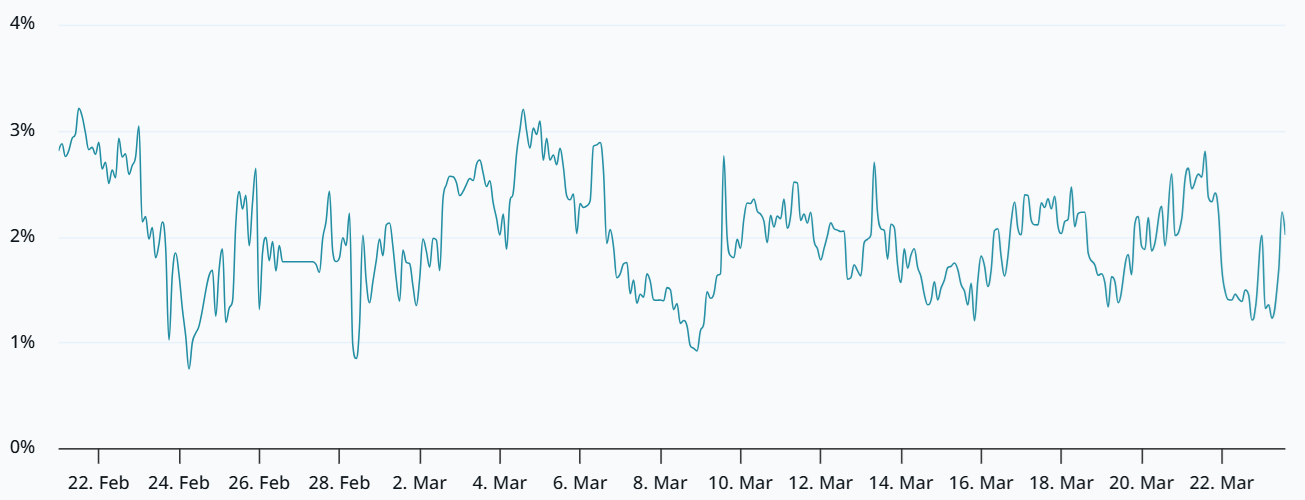
Bitcoin futures traded at a 2% annualized premium relative to regular spot markets on Monday, indicating a lack of demand for bullish leverage. Under neutral conditions, this indicator typically ranges between 4% and 8% to compensate for the longer settlement period. This lack of conviction from bulls has been the norm for the past month, even during a recent rally toward $76,000 on Tuesday.
Short-term gains fail to offset five months of Bitcoin pain
Short-term positive updates regarding the US and Israel-Iran war are unlikely to reverse the pessimism following a five-month price decline. Because the specific causes of Bitcoin’s Oct. 10, 2025, flash crash and its subsequent failure to track traditional markets remain unconfirmed, traders treat any developments with high suspicion.

This major sell-off occurred alongside rising US import tariffs, including a 100% levy on Chinese goods after China restricted rare earth metal exports. However, the unprecedented $19 billion in liquidations caused the most significant damage, resulting in heavy losses for market makers and traders who utilized cross-margin positions.

At the Deribit exchange, the $80,000 Bitcoin call option for April 24 traded at 0.017 BTC ($1,207). With 31 days until expiry and an implied volatility of 48%, the market is pricing in only a 20% chance of Bitcoin reaching $80,000. This low expectation for a 13% monthly gain is rare in cryptocurrency markets, where participants are generally more optimistic.

USD stablecoins traded at a 1.3% premium against the official US dollar to yuan exchange rate on Monday, indicating that there is not a particular imbalance between buying and selling demand in the region. Typically, high demand for cryptocurrency pushes this premium above the 1.5% neutral range, while panic selling causes stablecoins to trade at a discount.
Federal Reserve’s choice to pause rate cuts keeps investors in fixed-income
The data shows that there is modest resilience in Bitcoin derivative markets, especially since BTC retested the $67,500 level on Monday. Gold’s historic 21% price drop over ten days proved that no asset class is safe when traders fear an economic recession and inflationary risks, especially as fuel prices impact logistics and nearly every sector of the US economy.
Related: Bitcoin spot volumes fall to 2023 lows as BTC rallies remain news-led
Monday’s 3% relief bounce in the S&P 500 is unlikely to cause investors to exit fixed-income positions, especially as the Fed gave little indication of continuing its monetary easing policy. High interest rates reduce incentives for consumer financing and create a burden for corporate capital costs.
There is undoubtedly a significant dependence on the duration of the war for risk assets, including Bitcoin. Until oil prices revert back to $75 or lower, odds are traders will act cautiously, but additional catalysts may need to emerge for Bitcoin traders to turn bullish, especially considering the persistent lack of conviction in onchain and derivatives metrics.
This article does not contain investment advice or recommendations. Every investment and trading move involves risk, and readers should conduct their own research when making a decision. While we strive to provide accurate and timely information, Cointelegraph does not guarantee the accuracy, completeness, or reliability of any information in this article. This article may contain forward-looking statements that are subject to risks and uncertainties. Cointelegraph will not be liable for any loss or damage arising from your reliance on this information.


The House Financial Services Committee meets Wednesday to decide the future of Wall Street’s backend. Lawmakers will question executives from Nasdaq, DTCC, and the Blockchain Association on how to move trillions in securities onto blockchain rails.
The hearing marks a critical pivot from “crypto as casino” to “crypto as infrastructure.”
Chair French Hill (AR-02) convenes the session at 10:00 AM ET in the Rayburn House Office Building. The focus is specific: determining if current securities laws are strangling the efficiency of tokenized assets.
The committee is looking for a way to let regulated firms use blockchain records without triggering an SEC enforcement action. The testimony delivered here will shape the bipartisan legislation expected later this spring.
- Legislative Scope: The hearing reviews two draft bills: one mandating a joint SEC-CFTC study on tokenized products, and another allowing regulated firms to maintain blockchain-based records.
- Institutional Weight: Witnesses include top brass from Nasdaq, DTCC, and SIFMA, signaling that traditional finance—not just crypto natives—is driving the pressure for regulatory clarity.
- Market Impact: Successful legislation would greenlight pilot programs for tokenized stocks and bonds, moving Real World Assets (RWAs) from experimental sandboxes to institutional balance sheets.
Tokenization and the Future of Securities: What the Hearing Covers
The hearing has a name: “Tokenization and the Future of Securities: Modernizing Our Capital Markets.”
The witness list means business. Kenneth Bentsen Jr. of SIFMA, Summer Mersinger of the Blockchain Association, Christian Sabella of the DTCC, and John Zecca of Nasdaq. The architects of traditional market plumbing and the builders of new rails, sitting at the same table.
Two draft bills are on the agenda. The Modernizing Markets Through Tokenization Act forces the SEC and CFTC to stop fighting over jurisdiction and conduct a joint study on tokenized derivatives. The Capital Markets Technology Modernization Act goes further, codifying the ability of broker-dealers to use blockchain for record-keeping.
This comes one week after the SEC and CFTC signed a coordination pact. Regulators are aligning just as Congress moves to open the field.
The signal flare for Real World Assets is lit.
Projects have been stuck in pilot phases for one reason: legal settlement finality on a blockchain is still a gray area. Advance the Modernization Act and banks get the legal cover they need to scale tokenized treasuries and bonds. Institutional appetite is already there. Tokenized securities are the logical next step.
Compliance is where it gets messy. The SEC says tokenized assets are securities first, technology second. The industry says applying 1940s paper-based rules to instantaneous ledger settlements makes no sense. That fight is front and center Wednesday.
The stablecoin angle is indirect but impossible to ignore. Tokenized securities need a cash leg for settlement. That means a wholesale CBDC or a regulated stablecoin. Push hard enough on on-chain securities and stablecoin legislation gets dragged along with it.
One bill pulls the other.
What to Watch When the Hearing Opens
Watch Chair French Hill’s line of questioning.
If he pushes witnesses on specific bottlenecks in SEC Rule 15c3-3, the Committee is ready to legislate now. Vague questions about innovation mean they are not.
The interaction between the Blockchain Association’s Summer Mersinger and traditional finance witnesses matters just as much. A united front between Web3 advocates and SIFMA and Nasdaq puts real pressure on the SEC. If they split, with TradFi pushing private permissioned chains while crypto advocates want public mainnets, the regulatory path fractures. The DTCC’s testimony is the wildcard. They control the current settlement layer. If they validate blockchain’s efficiency, the argument is effectively over.
Timeline is everything. A successful hearing sets up a markup by late April. No consensus pushes real change into late 2026, while Singapore and the UK keep moving.
The infrastructure is ready. The banks are ready. Wednesday decides if regulation gets out of the way.
Discover: The best new crypto in the world
The post What to Expect From This Week’s House Committee Hearing on Tokenization appeared first on Cryptonews.

US financial regulators just rewrote the rulebook. On Tuesday, the SEC and CFTC released joint guidelines classifying the vast majority of digital assets as commodities or “digital tools,” stripping the SEC of its previous enforcement-heavy oversight role.
The move immediately fueled conflict-of-interest allegations regarding World Liberty Financial, the DeFi project controlled by the Trump family.
- Token Taxonomy: New SEC-CFTC guidelines classify most crypto assets as commodities, exempting them from securities registration.
- Conflict Concerns: Insiders argue the shift directly benefits World Liberty Financial by reducing disclosure burdens for the Trump family project.
- Legislative Bridge: Chair Paul Atkins frames the rules as a temporary measure while Congress stalls on the Digital Asset Market Clarity Act.
The Mechanics of the ‘Token Taxonomy’ Shift Explained
SEC Chair Paul Atkins calls it a “token taxonomy.” The market calls it a total reversal. Speaking at the Blockchain Summit in DC, Atkins confirmed the regulator is “not the ‘securities and everything commission’ anymore.”
The new joint guidelines with the CFTC explicitly categorize most digital assets—including payment tokens, collectibles, and utility assets—as distinct from securities.
— BSCN (@BSCNews) March 18, 2026
 CRYPTO: SEC OFFICIALLY CLASSIFIES NFTs AS "DIGITAL COLLECTIBLES," NOT SECURITIES
The joint SEC/CFTC interpretive guidance dropped March 17 with a five-category token taxonomy:
Digital commodities (BTC, ETH, SOL, XRP, ADA, LINK + 10 more) Digital collectibles (NFTs,… pic.twitter.com/acXShbdce1
This creates a massive regulatory moat. Under the previous administration, these assets faced existential legal threats for failing to register.
Now, they are officially deemed “digital tools.” Only direct blockchain-based representations of existing securities, such as tokenized stocks and bonds, remain under the strict purview of the SEC. This is the operational rollout of the regulation philosophy Atkins promised: innovation first, enforcement second.
The timing is critical. While the administration pushes for the Digital Asset Market Clarity Act, the legislation remains stalled in Congress due to disputes over stablecoin interest provisions. Atkins is not waiting for the vote.
By issuing these guidelines now, agencies are creating a provisional safe harbor that mimics the Act’s intended structure without requiring legislative approval. The agencies frame this as a “bridge” to provide certainty, but it effectively sidelines the stricter oversight mandates that defined the Gensler era.
Does the New Framework Shield Family Interests?
The policy shift creates an immediate governance paradox. Market insiders note that the primary beneficiary of this deregulated environment is likely World Liberty Financial, the lending protocol launched by the Trump family.
Under the Biden-era interpretation, project insiders faced strict lockup periods and heavy disclosure requirements. The new “digital tool” classification effectively bypasses those hurdles.

Todd Baker, a senior fellow at Columbia Law School, argues the framework is tailored to facilitate “profit-making but socially valueless” trading free from federal oversight.
The contrast with recent history is sharp. Just months prior, the industry was navigating heavy litigation, such as cases where Gemini was sued over its internal governance and strategy shifts.
The new rules likely preclude similar enforcement actions against projects like World Liberty Financial, provided they do not tokenize existing securities.
Critics argue this creates a two-tier system where connected projects gain faster access to liquidity. However, supporters like The Digital Chamber’s Cody Carbone see it as a necessary correction to keep the US competitive.
With other jurisdictions vacillating, South Korea is still debating the total abolition of crypto taxes to prevent capital flight, the US is moving aggressively to cement its status as the global crypto capital. Summer Mersinger of the Blockchain Association framed the coordination as helpful in the “near term,” but the conflict of interest questions remain the headline.
The agencies have built their bridge, but it leads to a political minefield. Rules can be rewritten by the next chair; only legislation provides cement. Until the Clarity Act clears Congress, the market is trading on administrative permission, not law.
Discover: The best new crypto in the world
The post Trump SEC Overhaul Fuels Oversight Debate Over Family Crypto Conflicts appeared first on Cryptonews.


- HBAR rose to above 0.095 as crypto sentiment improved following recent macro‑driven swings.
- The $0.13-$0.15 zone could be a major resistance region for bulls.
- Hedera price must reclaim and hold above $0.10 to confirm a potential trend reversal.
Hedera (HBAR) price jumped more than 5% in 24 hours as cryptocurrency markets flipped green, with bulls eyeing momentum amid optimism that the US-Iran war could end soon.
But as Hedera’s native token targets a breakout above the $0.10 mark, what resistance cluster is likely to derail buyers? The technical chart provides the outlook.
Here’s why HBAR price rose, testing a key level
Hedera’s HBAR rose to intraday highs near $0.095 on Monday as Bitcoin and the broader market reacted to geopolitical developments.
The move followed comments from Donald Trump suggesting easing tensions with Iran, which helped lift sentiment across risk assets.
Bitcoin climbed above $71,000 during the session, while BNB also moved higher toward $650, supporting gains in altcoins.
Despite the initial relief, underlying uncertainty remains. Ongoing tensions linked to the Iran conflict and broader macroeconomic headwinds continue to limit upside across the crypto market.
Adding to the uncertainty, reports cited Iranian state media disputing Trump’s claims, stating that no negotiations are underway and rejecting his remarks.
Against this backdrop, HBAR’s near-term direction remains tied to broader market movements.
A renewed decline in Bitcoin could push the token back below the $0.09 level.
On the other hand, sustained buying above current levels could open the door for further short-term gains, with a key resistance zone likely to define the next move.
Hedera price forecast: can bulls extend rally?
Analysts tracking Hedera highlight $0.10 as a key near-term pivot, with potential upside targets in the $0.13–$0.15 range.
This zone has recently acted as a ceiling for price advances, capping bullish attempts.
A sustained move higher would require HBAR to break above the 50-day exponential moving average near $0.098 and the 100-day EMA around $0.11.
Clearing these levels would bring the token toward a primary resistance area near the 200-day EMA, around $0.13, which has marked recent rejection points.
Previous attempts to push higher have struggled to hold gains beyond the $0.15 level.
At present, HBAR is retesting the middle band of the Bollinger Bands on the daily chart.
The bands are tightening, indicating reduced volatility and suggesting that a breakout may be approaching, although confirmation is still needed.

Hedera HBAR chart by TradingViewFailure to clear this zone could see HBAR revert into a consolidation corridor within a long-term downward channel.
Conditions across the market could then mean an extended sideways action before clarity from macro or fundamentals becomes the next upside catalyst.
Bears may eye $0.07 and $0.06 as major support levels.
TLDR
- Shibizens confirmed that Shibarium completed a major server migration and full chain reindexing in the past 30 days.
- The Shibarium explorer is about 45% synchronized as it rebuilds its database from scratch.
- Displayed explorer data shows fewer blocks, transactions, and wallets due to incomplete indexing.
- Actual on-chain data exceeds 14 million blocks and 1.56 billion transactions.
- The real wallet count stands above 270 million addresses despite lower visible figures.
Shibizens reported a 30-day infrastructure overhaul across Shibarium systems. The update confirms a server migration and a full chain re-indexing process. The team clarified that the changes reflect upgrades rather than network slowdown.
Shibarium Infrastructure Rebuild and Explorer Reindexing
Shibizens stated that Shibarium completed a major server migration during the last 30 days. The team also initiated a full chain re-indexing to strengthen system capacity. They explained that the process rebuilds the explorer database from scratch. As a result, synchronization now stands near 45%. However, the explorer currently shows partial on-chain data. Shibizens stressed that this reflects indexing progress rather than missing blockchain records.
The group addressed visible discrepancies on the Shibarium explorer. Displayed data lists about 2.4 million blocks and 168 million transactions. In contrast, actual records exceed 14 million blocks and 1.56 billion transactions. Wallet data also differs across reports. The explorer shows about five million addresses, while real figures exceed 270 million addresses. Shibizens attributed the gap to incomplete indexing across nodes.
Shibizens stated that only 51% of blocks remain indexed. They cited Shibariumscan and Shibburn data to support the figure. They explained that indexing delays affect visible balances and NFT displays. However, they confirmed that on-chain assets remain intact. “Shibarium is not lagging,” Shibizens said. They added, “It is rebuilding at scale for what’s coming next.”
The team emphasized that token visibility depends on explorer synchronization. Therefore, some wallets may not reflect full holdings. They clarified that blockchain records remain unchanged during migration. They also confirmed that block production continues normally. Current block time averages about five seconds. The network continues processing transactions without interruption.
Layer 3 Focus Expands Across Puppynet and SHIB Ecosystem
Shibizens reported that the development focus now shifts toward Layer 3. The team referenced Shib Alpha and ShibClaw within the roadmap. They indicated that testing efforts now concentrate on advanced scaling layers. Meanwhile, Puppynet continues to operate as Shibarium’s testnet. The team confirmed that AI-driven automated contract activity is increasing. However, block time stability remains steady at five seconds.
Over the weekend, Woofswap confirmed that Shibarium L3 remains under active testing. The participant shared limited details regarding technical specifications. Shibizens also confirmed that a new L3 explorer went live on March 21. The launch supports early testing and monitoring functions. They described the rollout as part of the broader infrastructure buildout.
Puppynet continues recording automated contract interactions across its network. Developers monitor activity patterns and test smart contract deployments. The testnet supports validation before mainnet integration. Shibizens reiterated that infrastructure upgrades support future expansion.

The U.S. Securities and Exchange Commission is advancing its framework to reinterpret how federal securities laws apply to crypto assets, moving two proposed rules to the White House for review. The centerpiece is an interpretive notice that could narrow the jurisdiction of federal securities laws over many digital assets, signaling a potential regulatory shift while the White House weighs the plan.
Regulatory records show the SEC submitted the two proposals to the Office of Management and Budget for review on a recent Friday, with one item explicitly detailing which digital assets the agency might deem securities under federal law. As of Monday, the record listed the package as “pending review” by the White House, a status that could influence both enforcement and regulatory posture depending on the administration’s assessment.
Key takeaways
- The SEC forwarded two proposed rules to the White House Office of Management and Budget, including an interpretive notice on what digital assets could be securities.
- Chair Jay (Paul) Atkins signaled last week that the agency would not treat four asset classes as securities: digital commodities, digital tools, digital collectibles (NFTs), and stablecoins, while offering a cohesive token taxonomy for these types.
- The interpretive framework aims to clarify when a “non-security crypto asset” might qualify as an investment contract, providing regulatory guidance ahead of any potential congressional action.
- The move follows a memorandum of understanding with the CFTC, underscoring growing cross-agency coordination as lawmakers consider a broader market-structure bill for digital assets.
SEC interpretive move and what it could mean for crypto regulation
The SEC’s latest step appears to aim at providing a more coherent framework for determining when a crypto asset falls under securities laws. In a notice released last week, Chair Atkins indicated that digital commodities, digital tools, digital collectibles—including non-fungible tokens—and stablecoins would not be treated as securities under the agency’s purview. The interpretive notice is described as establishing a “coherent token taxonomy” for these asset classes and addressing how a non-security crypto asset may or may not be considered an investment contract under the Howey test.
If finalized, the interpretive rule could serve as a bridge to crypto regulation while Congress debates a more comprehensive market-structure bill to bring clear, unified rules to the sector. The AML-style approach would aim to reduce regulatory ambiguity and potentially recalibrate how exchanges, custodians, and developers operate in the interim. The policy aligns with the agency’s recent collaboration with the CFTC, highlighted by a Memorandum of Understanding signed earlier this month to clarify jurisdictional boundaries and regulatory expectations in the crypto markets.
Regulators and market participants have long sought a stable, forward-looking framework that reduces uncertainty around whether a given token is a security. The SEC’s proposed taxonomy is meant to outline how different digital asset types should be treated, and crucially, when assets may still be subject to investment contract analysis even if they fall outside the securities umbrella. The White House review stage is a critical gate: a positive outcome could accelerate regulatory alignment, while a protracted or revised review could push the timetable for broader legislative action.
Broader policy momentum: White House talks, stablecoins, and the CLARITY Act
Beyond the White House review, the crypto policy landscape continues to evolve at the congressional level. Politico reported on Friday that White House officials and lawmakers had reached an agreement in principle on some aspects of the crypto regime, including stablecoin yield considerations that could shape the market-structure bill’s trajectory in the Senate Banking Committee. However, the committee indefinitely postponed its markup of the bill in January after Coinbase CEO Brian Armstrong expressed public concerns about the legislation as written, underscoring the political sensitivity surrounding crypto regulation.
As of Monday, there had been no public announcement of a new date for the markup. Senate leadership outlined a workflow prioritizing other legislation, such as the SAVE America Act, before returning to bipartisan crypto debate. Senate Republicans and allies have signaled continued interest in a structured approach to digital assets, but the path remains contingent on both legislative negotiation and regulatory clarity from agencies like the SEC and the CFTC.
The ongoing discussions touch on the CLARITY Act, a proposed framework intended to clarify crypto markets and stablecoins under a market-structure agenda. The interagency dynamics—between the SEC’s jurisdictional interpretations, the CFTC’s role in cash and derivative markets, and congressional arbitration—will shape how quickly a final, enforceable regime can take effect, and what form it will take for issuers, exchanges, and users alike.
Investors and builders should watch two interlinked developments: the White House’s decision on the SEC’s interpretive rules and the progress (or stall) of the market-structure bill in Congress. While a regulatory pathway for many digital assets could reduce policy risk, it could also introduce new compliance obligations, particularly for entities operating in the cross-border or custody-heavy segments of the market. The tension between advancing a broad framework and accommodating industry concerns is likely to persist as lawmakers seek to balance investor protection with innovation.
As the regulatory clock ticks, participants should monitor the White House’s review timeline, the final content of the interpretive notice, and any updates to the market-structure bill’s language—especially provisions around stablecoins and collateral use. The next few weeks could reveal whether the administration’s review will accelerate clarity or reveal remaining ambiguities that require legislative refinement.
What remains uncertain is how quickly the White House completes its review and whether Congress will greenlight a comprehensive framework on digital assets in the near term. For market participants, the key question is whether the unfolding process will reduce regulatory surprise or introduce new interpretive wrinkles that alter how tokens are categorized and traded.
Readers should keep an eye on updates from RegInfo.gov and official agency notices, as well as any new statements from Senators and regulatory staff about the CLARITY Act and related crypto amendments. The evolving stance from the White House and Congress will continue to shape the baseline for crypto regulatory risk, guiding how exchanges structure listings, how issuers approach token design, and how traders price risk in a landscape that remains in flux.
Investors and industry watchers should stay tuned to forthcoming White House feedback on the SEC’s proposals, the pace of the Senate Banking Committee’s work, and further clarity on how the CFTC and SEC will coordinate enforcement and policy in the months ahead.
US Senators Adam Schiff and John Curtis are expected to introduce a bipartisan bill on Monday that would bar sports betting and “casino-style” contracts from prediction markets regulated by the Commodity Futures Trading Commission (CFTC), according to a Monday Wall Street Journal report.
“Too many young people in Utah are getting exposed to addictive sports betting and casino-style gaming contracts that belong under state control, not under federal regulators,” Senator Curtis, one of the bill’s co-sponsors, told the WSJ.
If introduced as reported, the measure would add to a widening Washington push against certain prediction market contracts. The report adds to the growing regulatory scrutiny over prediction markets, following renewed insider trading concerns sparked by the US-Israeli war with Iran.
On March 10, Schiff introduced the DEATH BETS Act, a bill seeking to prohibit CFTC-regulated prediction markets from listing contracts tied to war, terrorism, assassination and individual death.
Related: Prediction markets boom on Iran bets as Congress eyes ban
Sports markets drive trading volume
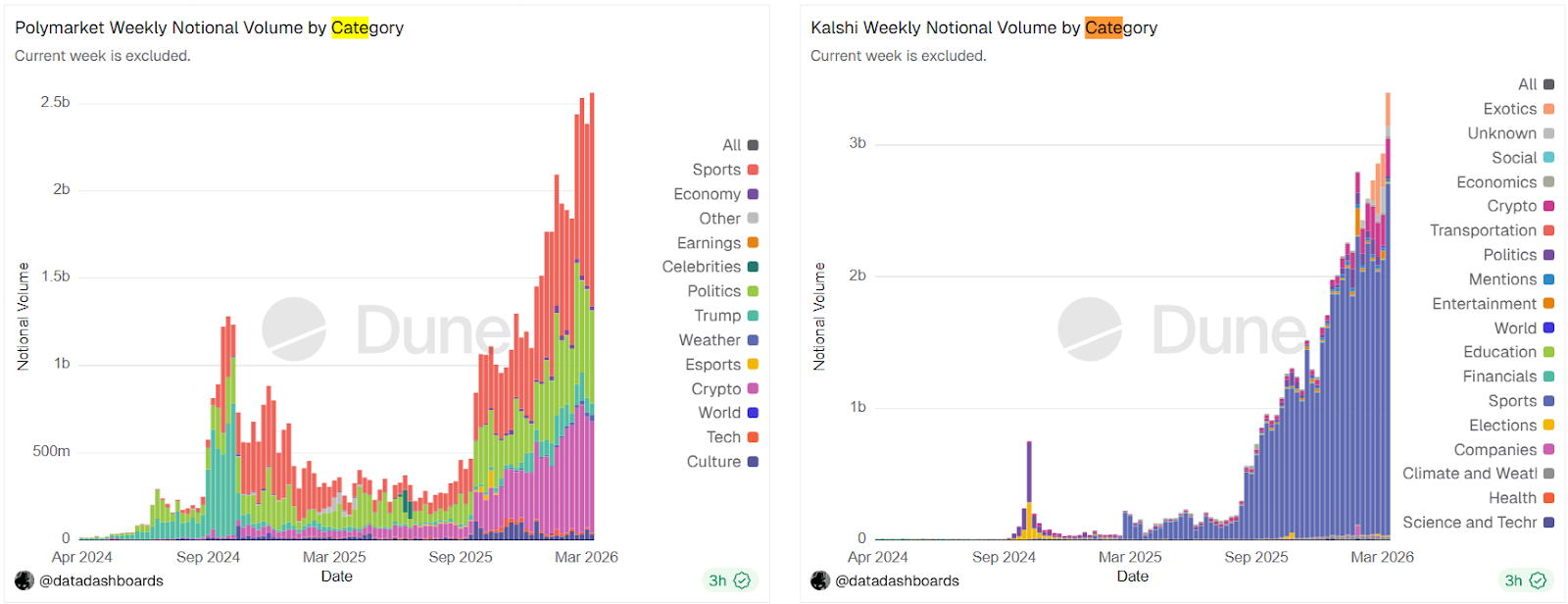
Sports betting is a leading source of trading activity on prediction market platforms. Sports-related contracts accounted for 47.7% of Polymarket’s weekly notional volume and 78.8% for Kalshi last week, according to Dune data.
Sports betting generated $1.2 billion in weekly notional trading volume for Polymarket and $2.6 billion for Kalshi.

State and federal lines blur
The regulatory pressure has also intensified outside Congress. On March 12, the CFTC issued a staff advisory classifying event contracts on prediction markets as a “financial asset class.”
The commodities regulator also submitted an Advanced Notice of Proposed Rulemaking, asking for public feedback on how the Commodity Exchange Act (CEA) would apply to prediction markets. Polymarket and Kalshi are regulated by the CFTC as Designated Contract Markets (DCM).
Related: Kalshi, Polymarket face trading halt in Nevada after court rulings
While CFTC Chair Michael Selig claimed the CFTC had “exclusive jurisdiction” over prediction markets, an Ohio judge tested that claim in a March 9 ruling, saying that Kalshi had failed to show the CEA “would necessarily preempt Ohio’s sports gambling laws,” or that these sports betting contracts would fall under the “exclusive jurisdiction” of the CFTC.
On Friday, a Nevada judge temporarily blocked Kalshi from offering sports, election and entertainment event contracts in the state for 14 days, finding regulators were reasonably likely to succeed in arguing the markets violated Nevada gambling law.
Cointelegraph approached the senators for comment and a copy of the draft bill.
Magazine: Inside a 30,000 phone bot farm stealing crypto airdrops from real users

PicoZ80 Is A Drop-in Replacement For Everyone’s Favorite Zilog CPU

Urgent search launched to find woman last seen 10 days ago who may be in Manchester

VERBUND AG 2025 Q4 – Results – Earnings Call Presentation (OTCMKTS:OEZVY) 2026-03-23


-
 Crypto World3 days ago
NIO (NIO) Stock Plunges 6.5% as Shelf Registration Sparks Dilution Worries
-

 Fashion3 days ago
Weekend Open Thread: Adidas – Corporette.com
-

 Politics3 days ago
Jenni Murray, Long-Serving Woman’s Hour Presenter, Dies Aged 75
-
 Tech6 days ago
Are Split Spacebars the Next Big Gaming Keyboard Trend?
-

 Crypto World2 days ago
Best Crypto to Buy Now: Strategy Just Spent $1.57 Billion on Bitcoin During Fear While Early Investors Quietly Enter Pepeto for 150x Potential
-

 News Videos5 days ago
RBA board divided on rate cut, unusually buoyant share market | Finance Report | ABC NEWS
-

 Crypto World2 days ago
Bitcoin Price News: Bhutan Sells $72 Million in BTC Under Fiscal Pressure, but the Smart Money Entering Pepeto Sees What the Market Does Not
-

 Politics6 days ago
The House | The new register to protect children from their abusers shows Parliament at its best
-

 Tech4 days ago
inKONBINI Lets You Spend Summer Days Behind the Register
-
 Politics6 days ago
Real-time pollution monitoring calls after boy nearly dies
-

 Crypto World5 days ago
Canada’s FINTRAC revokes registrations of 23 crypto MSBs in AML crackdown
-

 Sports11 hours ago
Remo Stars and Kano Pillars Strengthen Survival Hopes in NPFL
-

 News Videos5 days ago
PARLIAMENT OF MALAWI – PAC MEETING WITH REGISTRAR OF FINANCIAL ON AMARYLLIS HOTEL – INQUIRY LIVE
-
 NewsBeat5 days ago
Residents in North Lanarkshire reminded to register to vote in Scottish Parliament Election
-

 Politics4 days ago
Gender equality discussions at UN face pushbacks and US resistance
-

 Business1 day ago
No Winner in March 21 Drawing as Prize Rolls to $133 Million for Next
-

 Business5 days ago
Who Was Alex Pretti? 5 Key Facts About the ICU Nurse Killed by Federal Agents in Minneapolis
-

 Sports10 hours ago
Gary Kirsten Accuses Pakistan Cricket Board Of ‘Interference’, Mohsin Naqvi Responds
-

 Tech1 day ago
Give Your Phone a Huge (and Free) Upgrade by Switching to Another Keyboard
-

 Sports3 days ago
2026 Kentucky Derby horses, odds, futures, preview, date: Expert who nailed 12 Derby-Oaks Doubles enters picks
You must be logged in to post a comment Login