
Crypto World
AI Data Center Backlash Is Being Politically Weaponized: Will Midterms Tip the Scales?



The AI trade’s biggest near-term risk may not be earnings but politics. Alger’s Ankur Crawford warns data center backlash could become a defining midterm issue.
Crawford, executive vice president and portfolio manager at Alger, made the comments on CNBC’s “Closing Bell.”
Data centers become a midterm flashpoint
Crawford said the fight over data centers could become what she called a “kill the AI” moment. She spoke hours before Nvidia (NVDA) posted Q2 results that sparked a 4% stock reversal.
Data centers, the massive facilities powering AI compute, have become an unusual bipartisan target. Ads in Texas, Ohio, Michigan, and Pennsylvania now blame both parties for rising electricity bills tied to their construction.
Crawford argued much of the criticism lacks evidence. She called water and noise complaints “FUD,” industry shorthand for fear, uncertainty, and doubt. Electricity strain is real, she said, but mainly emerges later this decade.
That distinction matters little to voters. Polling cited by Brookings found concerns over electricity rates, water use, and jobs cutting across party lines. Newsweek reported all six Senate toss-up races, per the Cook Political Report, touch the data center debate.
Texas Gov. Greg Abbott illustrates the shift. He once championed a $40 billion Google investment as proof of the state’s AI leadership. This summer, he introduced new water and electricity standards and ordered utility audits of data center permits.
Nvidia’s growth math still hinges on 2029
Crawford tied this political overhang directly to markets. She said Nvidia’s own numbers matter less than the multi-year question of margin structure and compute demand through 2029. Political resistance to new data center capacity threatens the growth assumptions behind that thesis.
She remains bullish. Crawford noted whisper numbers on 2028 earnings put Nvidia’s multiple in the low double digits. She called the stock a “coiled spring” relative to its growth rate.
The bigger unknown, she said, is whether skepticism fades as compute demand becomes tangible to ordinary voters. She pointed to AI-assisted personalized cancer treatment breakthroughs as the kind of visible benefit that could shift public opinion.
Whether that shift happens before or after November remains the open question hanging over the entire AI trade.
The post AI Data Center Backlash Is Being Politically Weaponized: Will Midterms Tip the Scales? appeared first on BeInCrypto.



Six long-dormant Bitcoin wallets have transferred 553.59 BTC worth $40.15 million after remaining inactive for periods ranging from nearly 12 years to more than 15 years.
Summary
- Six wallets moved 553.59 BTC between Aug. 16 and Aug. 26.
- The holdings were worth $40.15 million when the transactions occurred.
- Two addresses carry labels linking them to a New York dormant-wallet lawsuit.
- Only one transfer reached a destination associated with a known crypto company.
Galaxy Research tracked the six movements from wallets dating to 2011, 2012, and 2014, although blockchain records do not reveal who controlled most of the addresses or why the owners transferred their holdings.
Five transfers went to addresses without known exchange links, offering no on-chain evidence that the Bitcoin was sold. The final transaction sent 40 BTC to an address labeled Boerse Stuttgart Digital, a German provider of crypto custody and trading infrastructure.
Bitcoin wallets move 553 BTC over 10 days
Beginning on Aug. 16, the first wallet transferred 8.54 BTC in block 962,770 after remaining inactive since June 13, 2011. Galaxy valued the holdings at about $538,000 when they moved, compared with an estimated acquisition price of around $14 per coin.
Using the difference between the historical and transfer prices, the holdings had gained about 461,981%. The figure represents an unrealized return unless the owner sold the coins, which the blockchain transaction does not establish.
Two days later, a wallet last active on Aug. 10, 2012, transferred 212 BTC worth approximately $13.66 million. The address carried the label “Noah Doe #1396 · Salomon Client Dusted,” connecting it to a New York lawsuit involving thousands of dormant Bitcoin addresses.
At an estimated historical price of $12 per BTC, the 212 BTC position had risen by roughly 557,640% when it moved. No public label identified the receiving address as an exchange or trading platform.
Hours after the 212 BTC transaction, another early holder moved 10.74 BTC. The coins had remained in place since June 17, 2011, and were worth about $692,000 at the time of the transfer. Neither side of the transaction had a public identity label.
Dormant-wallet activity resumed on Aug. 22, when two large transfers occurred within about two hours. One address moved 150 BTC worth $11.75 million after sitting inactive since Dec. 26, 2014.
Galaxy labeled the wallet “Noah Doe #1680,” making it the second address in the group connected to the New York case. Based on Bitcoin’s price when the address became inactive, the holdings had appreciated by an estimated 23,701%.
Three 2011 addresses move $10.37 million
Later on Aug. 22, a cluster of three addresses dating to 2011 transferred a combined 132.31 BTC in block 963,519. Galaxy valued the transaction at approximately $10.37 million.
The address beginning “1EG5DvjR” moved Bitcoin valued at $4.45 million, representing a potential gain of about 629,068%. A second address, beginning “1928FWqd,” transferred roughly $404,000 of BTC after its estimated value rose by 625,826%.
A third address, beginning “1EBzWeno,” accounted for $5.51 million of the total. Galaxy calculated that the holdings had appreciated by approximately 807,639%, based on an estimated original Bitcoin price of about $10.
On Aug. 26, the sixth wallet sent 40 BTC in block 964,127 after remaining inactive since May 28, 2012. The transaction occurred at 10:54 UTC and directed the holdings to an address labeled Boerse Stuttgart Digital.
Although the sender remains unidentified, the destination makes the movement different from the other five transfers, which went to addresses without public entity labels. The transfer to a custody provider does not by itself show whether the owner planned to sell, change custodians, or reorganize the holdings.
Galaxy estimated a cost basis near $5 per Bitcoin for the 40 BTC position. At the transfer price, its value had increased by approximately 1,535,911%, the largest percentage gain among the six wallets.
Large movements from old Bitcoin addresses have occurred repeatedly in 2026. On Aug. 20, 28 dormant wallets transferred 1,314.41 BTC worth $94.03 million, including 1,214.42 BTC from addresses created in 2014.
Earlier in July, a separate wallet transferred 5,908 BTC worth about $383 million after more than eight years without activity. The coins went to a new address rather than a publicly labeled exchange wallet.
New York case challenges dormant Bitcoin ownership
Two of the latest six wallets appear in a New York Supreme Court case brought by a pseudonymous plaintiff identified as Noah Doe and two Wyoming entities.
The lawsuit seeks control of 39,069 dormant addresses under Article 7-B of New York’s Personal Property Law, which covers lost property. The targeted addresses reportedly held about 3.7 million BTC when the complaint was filed, including wallets associated with Bitcoin creator Satoshi Nakamoto and the Mt. Gox hacker.
According to filings covered by crypto.news, New York Supreme Court Justice Kathy J. King paused the proceedings in June and blocked the plaintiffs from seeking a default judgment before a scheduled July hearing.
The plaintiffs had sent small “dust” transactions to thousands of addresses with messages intended to notify their controllers about the claim. Galaxy uses the term “Salomon-dusted” for addresses that received the notices, explaining the labels attached to two wallets in the latest group.
Activity from named wallets has affected the case because the complaint said that addresses that moved funds would be removed. In July, the plaintiffs dropped 44 wallets after they became active following the filing.
Galaxy Research head Alex Thorn said the removed addresses held 21,443 BTC when the lawsuit began. They later moved 46,334 BTC and held about 3,097 BTC when he reported the change.
“Every single one had moved coins onchain since the case was filed,” Thorn said on July 8.
M&A attorney Ian R. Cohen and the Digital Chamber have opposed the plaintiffs’ legal position. Their filings argue that a self-custodied Bitcoin address does not become abandoned solely because it has recorded no outgoing transactions for an extended period.
Security concerns may explain some old-wallet activity
Separate concerns about hardware-wallet security have also prompted long-term holders to move Bitcoin, though no public evidence directly connects four of the latest six wallets to a compromised device.
A firmware flaw affecting certain Coldcard devices led attackers to reconstruct weak seed phrases and drain Bitcoin beginning in late July. Galaxy estimated in early August that four attack waves had removed about 1,816 BTC from 5,294 addresses.
Coinkite, Coldcard’s manufacturer, traced the problem to a firmware change introduced in March 2021. The error weakened the randomness used to create seeds on some devices, making affected private keys easier to calculate than intended.
Wallets established in 2011, 2012, or 2014 predate the flawed Coldcard firmware, but their owners could have imported older keys into affected devices at a later date. No on-chain data cited by Galaxy confirms that such a migration occurred.
For US holders, merely moving Bitcoin between addresses under the same person’s control does not create a taxable disposal. The Internal Revenue Service states that a transfer between wallets, accounts, or addresses belonging to the same taxpayer is not a taxable event, although network fees paid with cryptocurrency may involve separate recordkeeping considerations.


Unstoppable Domains has dropped plans to seek ICANN recognition for its own Web3 domain extensions after finding that compliance, application, and auction costs would exceed the sales it expected to recover.
Summary
- Unstoppable Domains did not apply for its Web3 extensions during ICANN’s 2026 round.
- Customers who bought affected blockchain domains will receive refunds, according to founder Matthew Gould.
- ICANN received more than 1,600 primary applications during its 15-week submission period.
- The company remains involved as a service provider for applications including Telegram’s proposed .gram domain.
Unstoppable Domains says ICANN costs became too high
Unstoppable Domains said it did not submit ICANN applications for nine of its Web3 extensions, including .crypto, .wallet and .blockchain, before the 2026 application round closed. The decision ends its plan to add conventional DNS support to the affected blockchain-based domains.
According to the company’s founder, Matthew Gould, the expected cost of compliance, preparing each application, and competing in possible auctions exceeded the amount Unstoppable believed it could recover through domain sales. ICANN may place applicants into contention when two or more parties request the same extension, creating another potential expense beyond the initial application and evaluation process.
The company has notified affected customers by email and plans to refund purchases tied to extensions that it did not take into the 2026 application round. However, Unstoppable has not publicly released a complete list of eligible extensions, the amount covered by each refund, or the process customers must follow to receive their money.
Questions from holders have centered on whether refunds will cover every domain sold with the expectation of eventual ICANN recognition. Some customers said they retained their names because Unstoppable had repeatedly discussed bringing selected extensions into the standard internet system.
Gould responded that the domains will continue to operate as on-chain assets. Owners can still use supported names as readable aliases for cryptocurrency addresses and for other functions inside compatible wallets and decentralized applications, even though the names will not automatically work in conventional browsers through ICANN’s root system.
The decision ends a commitment dating to 2019
Since 2019, Unstoppable Domains has promoted the prospect that extensions such as .crypto and .wallet could eventually connect Web3 naming with the traditional internet. Gaining ICANN approval would have allowed an accepted extension to work through ordinary DNS infrastructure instead of relying mainly on compatible wallets, applications, browser settings or dedicated resolution services.
In June 2024, crypto.news reported that Unstoppable and Blockchain.com were preparing a .blockchain application for the next ICANN round. The companies said at the time that approval could allow .blockchain names to support normal websites and email while retaining Web3 functions.
Another partnership followed in May 2025, when Brave and Unstoppable launched the .brave domain for the browser’s users. Brave said the Polygon-based names could replace long wallet addresses, support decentralized websites, and operate across several blockchain networks. Both companies were also exploring an ICANN application that could bring .brave into the conventional DNS.
Without ICANN recognition, a blockchain domain and a DNS name using the same text can exist in separate naming systems. Standard browsers generally resolve ICANN-approved names by default, while Web3 names depend on supporting software. Owners may therefore retain their on-chain names without gaining the universal browser access previously tied to Unstoppable’s application plans.
For U.S. customers, the immediate effect is commercial rather than a new regulatory restriction. Unstoppable is based in the United States, while ICANN is a California nonprofit public-benefit corporation responsible for coordinating unique internet identifiers. Neither organization has said the refund plan changes the ownership of already-minted blockchain domains.
ICANN received more than 1,600 applications
ICANN opened the 2026 round on April 30 and accepted submissions for 15 weeks before closing the window at 11:59 p.m. UTC on Aug. 12. It was the first opportunity in years for companies, communities and other organizations to request new generic top-level domains.
In an Aug. 13 update, ICANN said it had received more than 1,600 primary applications. More than 1,100 also contained proposed replacement strings that could be considered if the preferred extension is unavailable or cannot proceed.
Most submissions arrived during the final days of the window, according to ICANN. The organization said the final count depended on applicants paying their evaluation fees, which were due either on Aug. 19 or seven days after the relevant invoice was issued, whichever date came later.
After an administrative review, ICANN plans to publish the public portions of the submissions on what it calls Reveal Day. The disclosure will identify the requested extensions, their applicants, and any strings sought by more than one party. Competing requests may then move through objection, evaluation, resolution, or auction procedures under the applicant guidebook.
Unstoppable has not withdrawn from ICANN-related business altogether. Gould said the company will continue participating as a service provider for partner applications, separating that work from the decision not to pursue its own established Web3 extensions.
Telegram and ENS are still pursuing conventional domains
Among the partner projects, Telegram has applied for .gram in the 2026 round, with Unstoppable acting as its registry service provider. Telegram founder Pavel Durov said ICANN approval could allow more than one billion users to register second-level addresses such as a username followed by .gram.
Durov also said Telegram users could build interactive websites linked to the proposed addresses using a single prompt. The company has not disclosed pricing, allocation rules or a launch date, while ICANN approval remains necessary before .gram can enter the standard domain system.
Ethereum Name Service has taken a separate route. Earlier in August, ENS token holders approved a foundation overhaul that created a five-member board and gave the reorganized entity authority to represent the protocol before ICANN and other internet standards bodies.
The ENS Foundation plans to pursue .ens as a conventional top-level domain, which could allow ENS-linked names to interact with browsers, websites and email services through established DNS infrastructure. ENS does not plan to seek .eth because three-letter country-code strings based on the ISO 3166-1 standard are reserved under ICANN’s application rules.
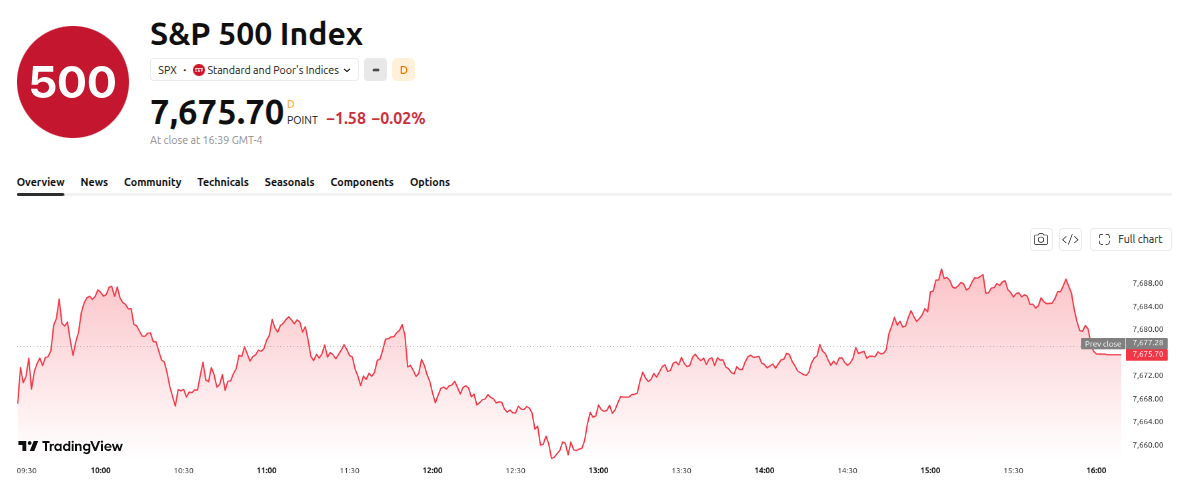
The S&P 500 edged lower despite favorable results from NVIDIA, which comfortably beat the market’s expectations, while core PCE inflation held steady in July.
The cash session had closed nearly flat hours earlier, at 7,675.70 points, ahead of the quarterly report.
The S&P 500’s Cautious Path Into Earnings
NVIDIA carries the single largest weight of any company in the S&P 500, making its quarterly report one of the most consequential single events for the index each year. That outsized influence explains why the benchmark spent Wednesday’s session trading in a tight, hesitant range.

The index had climbed 0.32% on Tuesday to 7,677.28, its third straight winning session, as retreating Treasury yields broadly lifted technology shares.
That momentum stalled on Wednesday, with futures slipping modestly in the hours before the report as investors digested the morning’s inflation data and positioned defensively ahead of the print.
The core personal consumption expenditures price index, the Federal Reserve’s preferred inflation gauge, rose 0.2% month over month and 3.3% year over year in July, exactly in line with economists’ expectations. That reading gave the Fed no fresh reason to tighten policy, though it did little to resolve the broader uncertainty weighing on the index.
Follow us on X to get the latest news as it happens.
The headline figure ran a bit hotter. Total PCE climbed 0.2% monthly and 3.7% annually, both readings 0.1 percentage points above forecasts, leaving the rate-cut debate unresolved just as NVIDIA prepared to report.
The 30-year Treasury yield had touched levels not seen in nearly two decades the previous week, and two days of falling yields had helped technology stocks recover some lost ground. The inflation report alone was not enough to reverse that underlying pressure, leaving the S&P 500 vulnerable to any disappointment from the day’s main event.
NVIDIA Beat Expectations, but the Market Didn’t Celebrate
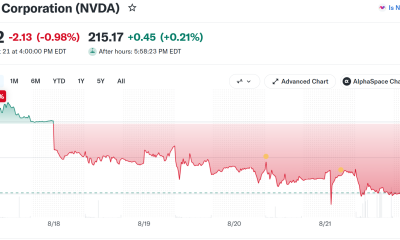
NVIDIA (NVDA) closed the regular session at $209.66, down 1.59% from the previous close, according to TradingView data. In after-hours trading, however, shares jumped to $218.72, up 4.32%, as the market digested a quarter that beat consensus by a wide margin.
NVIDIA reported revenue of $96.2 billion, well above the roughly $92 billion consensus, representing a 106% year-over-year increase. Earnings per share came in at $2.22, comfortably beating the $2.09 estimate and more than doubling the $1.05 posted a year earlier.
Gross margin stood at 75%, though the company guided for a slight dip to 74% next quarter. Hyperscaler revenue more than doubled to $48.7 billion, while the AI cloud, industrial, and enterprise segment added $40.3 billion, up 138%.
Subscribe to our YouTube channel to watch leaders and journalists provide expert insights.
CEO Jensen Huang described demand as accelerating, saying AI has reached its inflection point and that compute now generates real revenue. Despite that optimistic tone, S&P 500 futures reflected some early hesitation, as investors weighed the report against the index’s broader valuation concerns tied to its heavy concentration in AI-linked names.
That reaction is not entirely unusual. NVIDIA has spent several consecutive quarters in which, even after beating Wall Street’s estimates, its shares have struggled to hold gains, as the market demands increasingly ambitious guidance to justify its valuation. The company has posted only modest gains so far in 2026, well below the pace of prior years.
Fed Chair Kevin Warsh’s speech at Jackson Hole on Friday now looms as the next major catalyst for markets.
The post S&P 500 Edges Lower Despite Favorable NVIDIA Results and Stable Core PCE appeared first on BeInCrypto.
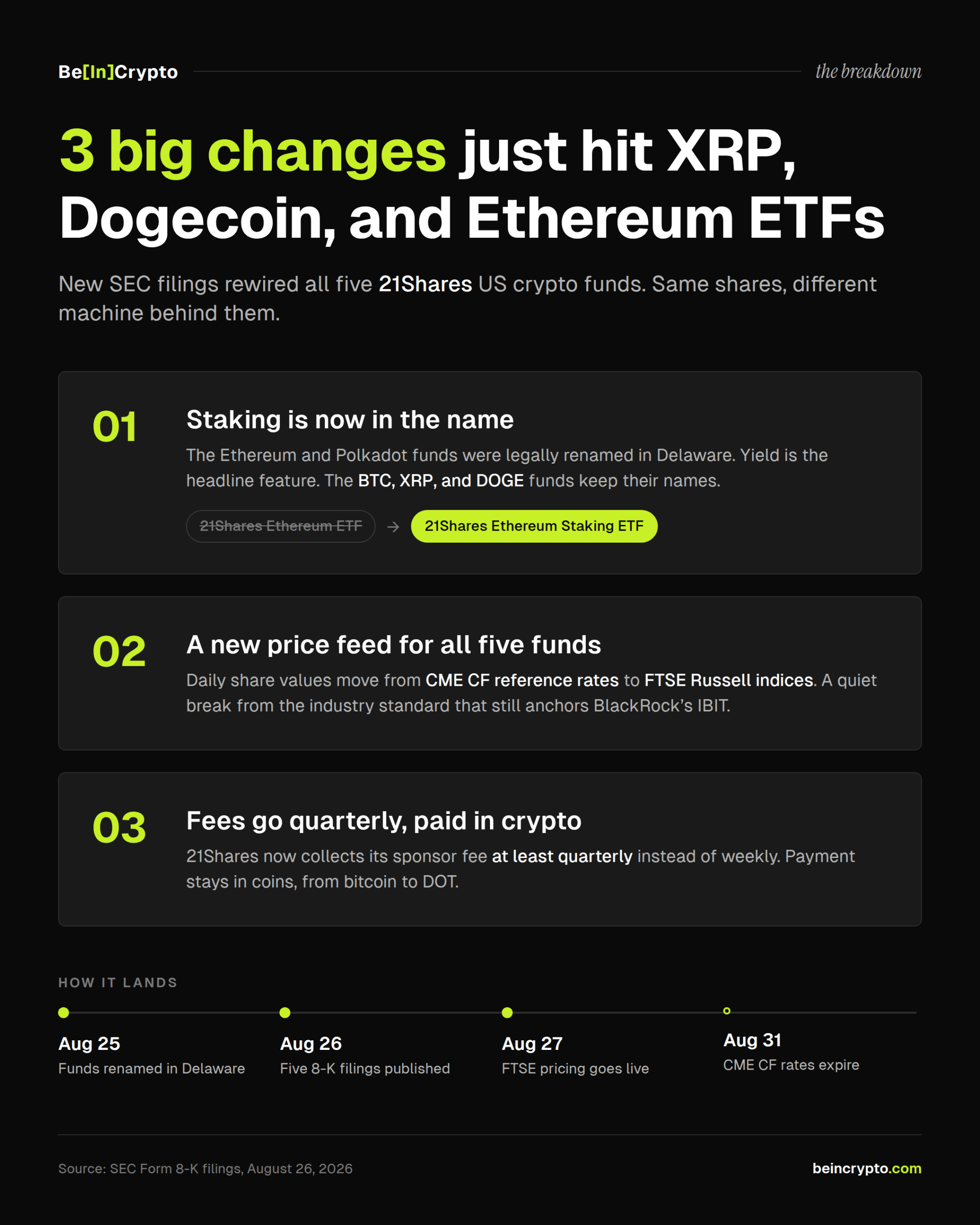
Three changes just hit the 21Shares Ethereum ETF and its four sister funds for Bitcoin, XRP, Dogecoin, and Polkadot. New SEC filings show new fund names, a new pricing source, and a new fee schedule.
Holders keep the same shares. Behind the label, however, the products start working differently on Thursday.

Staking Moves Into the Ethereum ETF’s Name
Start with the names. On August 25, 21Shares renamed two funds in Delaware. The 21Shares Ethereum ETF became the 21Shares Ethereum Staking ETF. The Polkadot (DOT) fund became the 21Shares Polkadot Staking ETF. Five 8-K filings published this week confirmed the changes.
Not every fund got a new name. The Bitcoin (BTC) fund, run with Cathie Wood’s ARK Invest, stays ARKB. The XRP and Dogecoin (DOGE) funds keep their names too.
The Ethereum fund has staked its ether since earlier this year and publishes a reward schedule. So the rename changes the label, not the machine. Yield is now the headline feature, written into the product’s legal name.
That label matters because the yield race is crowding fast. BlackRock launched a separate staked fund, ETHB, on February 18. Its original spot fund, ETHA, still does not stake. Fidelity went further on August 10. It filed to stake FETH’s ether and pay holders quarterly cash. Investors keep 85% of those rewards, while fees take the rest.
Big money has noticed. Intesa Sanpaolo, Italy’s largest bank, cut its Bitcoin fund stake by 94% last quarter and tripled its staked-Ethereum position. Recent flow data tells the same story. Buyers are chasing yield over price.
New FTSE Pricing and Quarterly Fees Land Thursday
The second change is the price feed. From Thursday, August 27, all five funds will value shares using FTSE indices. FTSE Russell is the London Stock Exchange Group arm behind the Russell 2000.
The switch follows 21Shares ending its CF Benchmarks license. Those CME-branded rates expire for the funds on August 31.
That is a quiet break from an industry standard. CF Benchmarks’ rates still anchor IBIT, BlackRock’s giant Bitcoin fund. Even ETHB, BlackRock’s staked fund, prices against a CME CF rate. The benchmark sets each fund’s daily net asset value, so the switch touches every holder’s statement.
The third change is fees. 21Shares will now collect its sponsor fee at least quarterly instead of weekly. Payment stays in coins, from Bitcoin to DOT.
One caution belongs next to the shiny new names. Staked ether can take weeks to exit a crowded withdrawal queue, a gap raised around Morgan Stanley’s Ethereum ETP. Thursday’s flows will show whether yield on the label wins the money.
The post 3 Big Changes Just Hit XRP, Dogecoin, and Ethereum ETFs appeared first on BeInCrypto.


Chainalysis has estimated that potentially taxable onchain crypto activity exceeded $457 billion worldwide in 2025, while transactions within the practical reach of international reporting rules represented only 14% of the total.
Summary
- Potentially taxable onchain crypto activity exceeded $457 billion globally during 2025.
- CARF-covered transactions represented only 14% of the activity identified by Chainalysis.
- The United States led individual countries with an estimated $112.6 billion.
- DeFi, private wallets, income streams, and peer-to-peer payments create reporting gaps.
Chainalysis said in an Aug. 26 crypto tax report that the other 86% included decentralized exchange activity, peer-to-peer transfers, onchain income and crypto payments that fall outside the practical scope of the OECD’s Crypto-Asset Reporting Framework.
The analytics firm examined realized gains, income, and payments across Bitcoin, Ethereum, Solana, Tron, BNB Smart Chain, and Base. Its income category covered mining, staking, lending, and gambling, while the payments estimate included merchant services and transfers that resembled peer-to-peer payments.
Activity recorded inside centralized exchanges was excluded because trades, staking, and lending conducted within their internal systems do not appear on public blockchains. The report also did not cover every blockchain, transaction type, or trading venue, leading Chainalysis to describe the $457 billion estimate as a “lower boundary.”
US crypto activity accounted for $112.6 billion
At $112.6 billion, the United States generated the largest amount of any country. Chainalysis divided the US figure into $64.6 billion in payments, $30.1 billion in gains, and $17.9 billion in income.
North America ranked first among regions with $134.6 billion, placing it ahead of the European Union at $125.1 billion and East Asia at $54.7 billion. Germany followed the US in the country table with $24.1 billion, while China accounted for $21 billion and the United Kingdom recorded $19.4 billion.
India ranked fifth with $19 billion, followed by Brazil at $16.1 billion, Canada at $15.1 billion, and Japan at $13.2 billion. Russia and Thailand generated an estimated $13 billion and $12.5 billion, respectively.
The calculations represent activity that could be taxable under commonly used rules rather than the amount of tax owed or unpaid. Chainalysis noted that local exemptions, tax rates, and classifications differ, meaning authorities would not collect the full value as revenue.
For US taxpayers, selling crypto for dollars, swapping one token for another, and spending digital assets can create taxable disposals under Internal Revenue Service rules. Mining and staking rewards can also count as ordinary income, while buying crypto with dollars or moving assets between wallets controlled by the same person generally does not create a taxable event, according to a recent US crypto tax guide.
US custodial brokers began filing Form 1099-DA for customer disposals made during the 2025 tax year. Gross proceeds are reported first, while cost-basis reporting phases in for covered transactions made in 2026.
According to Chainalysis, the US crypto tax gap was estimated at roughly $50 billion annually in 2022. The report cited congressional projections showing that Form 1099-DA could generate $28 billion in federal revenue over 10 years.
CARF captures activity handled by crypto intermediaries
Developed by the Organisation for Economic Co-operation and Development in 2022, CARF creates a system for participating tax authorities to exchange information about crypto transactions across national borders.
Reporting Crypto-Asset Service Providers, a category that largely covers centralized exchanges and brokers, must collect customer details and submit transaction data to the authorities with which they have a qualifying connection. Some retailers and wallet providers can also fall within the framework.
Data collection started on Jan. 1, 2026, in 48 jurisdictions, including the United Kingdom and members of the European Union. Most participating countries are due to begin exchanging the collected information in 2027, with other jurisdictions following in 2028 or 2029.
Closed order books operated by centralized exchanges offer tax agencies a clearer route to customer records because the platform normally knows who conducted each trade. CARF also covers some blockchain transactions, including certain deposits or withdrawals between a private wallet and an exchange when the transfer relates to a sale.
Even within that structure, CARF-covered events represented just 14% of the potentially taxable onchain activity found in the report. Chainalysis did not argue that the framework should be rewritten, saying its data can still give authorities information about transactions on platforms where most crypto trading occurs.
The EU is also implementing DAC8, which uses a scope similar to CARF while applying connection rules drawn from the Markets in Crypto-Assets framework. Under both systems, tax agencies can receive platform data even when a user conducts transactions outside their country of residence.
DeFi and private wallets leave transaction histories incomplete
CARF’s reliance on reportable service providers leaves much of decentralized finance outside its direct reach. A decentralized exchange may operate through smart contracts without a central custodian that controls customer assets or maintains complete identity records.
Private wallets create another gap because users can hold assets, interact with protocols, and transfer funds without passing through a reporting platform. Foreign services with no qualifying connection to a CARF jurisdiction may also sit outside its requirements.
Cost basis presents a separate problem. When a customer acquires crypto on one platform and later sends it elsewhere for sale, the receiving exchange may know the proceeds but not the original purchase price or holding period.
Historical records can remain missing because CARF does not apply retroactively. Aggregate reports supplied under the framework may also lack the transaction-level detail required to rebuild a complete sequence of wallet activity, according to Chainalysis.
Recordkeeping problems can increase when one investor uses exchanges, self-custody, staking, and liquidity pools. A public blockchain records contract calls and token transfers, but it does not automatically classify an event for tax purposes or establish the owner’s intent.
The same enforcement issue has appeared outside CARF’s first group of participating jurisdictions. South Korea has said its planned 22% crypto tax will cover income from private wallets and exchanges when the regime starts on Jan. 1, 2027, although its National Tax Service acknowledged practical limits in finding every unreported private-wallet transaction.
South Korean officials plan to use CARF and their overseas financial-account reporting system to obtain records from foreign platforms. Tax treatment for staking, lending, airdrops and hard forks remains under review as authorities prepare for the first returns covering 2027 income.
Blockchain records may supplement platform reports
To address missing platform data, Chainalysis said tax agencies can use blockchain analysis to follow transfers between wallet addresses, detect interactions with decentralized or foreign platforms, and identify income from mining, staking, lending, or liquidity provision.
Onchain records may also help reconstruct cost basis when assets pass through several wallets before reaching a reporting exchange. Linking those records to customer information from a regulated platform can give investigators a route from a transaction history to an identified taxpayer.
Such methods have already been used in tax investigations. In May, crypto.news reported that Italian authorities traced more than €1 million, or about $1.1 million, in alleged undeclared Ordinals gains after examining a seized hardware wallet.
Investigators in Foggia and Rome used exchange records and blockchain transaction patterns to follow proceeds from Bitcoin Ordinals and BRC-20 token sales, according to Chainalysis. The firm said the suspect allegedly created the assets, sold them for several times their original cost, and routed the proceeds back to a main Bitcoin wallet.

The U.S. Securities and Exchange Commission (SEC) has taken a procedural step toward rewriting how investment advisers and investment companies handle client custody rules—potentially including clearer guidance for crypto asset custody. The agency’s proposal was submitted on Aug. 25 to the Office of Information and Regulatory Affairs (OIRA), where it will undergo review by the White House Office of Management and Budget before returning to the SEC and, if approved, being opened for public comment.
According to the SEC’s regulatory agenda, the rules are intended to reduce uncertainty over how regulated firms may hold crypto for clients while complying with federal securities requirements tied to the Investment Advisers Act and the Investment Company Act. The SEC has not yet published the full proposal for public view, and OIRA retains the ability to request revisions before the SEC considers whether to advance the draft.
Key takeaways
- The SEC submitted “Amendments to the Custody Rules” to OIRA on Aug. 25, a necessary step before any potential public rulemaking.
- The proposal would address custody practices for investment advisers and funds, including how those entities may custody crypto assets for clients.
- The agency says the intent is to clarify compliance expectations and reduce uncertainty currently affecting institutional crypto custody.
- The broader context includes the SEC’s shift toward rulemaking under current leadership, as the CLARITY market-structure bill faces delays in Congress.
OIRA review marks a new phase for custody-rule changes
Under the U.S. regulatory process, submissions to OIRA are typically part of the administration’s review pipeline, which includes assessing potential economic impacts and other policy considerations. The SEC’s regulatory agenda indicates it is considering either amendments to existing custody rules or new provisions under the Investment Advisers Act and Investment Company Act.
The SEC’s agenda framing highlights compliance clarity as the core objective: institutions have needed more predictable standards for how they can custody digital assets while meeting securities-law obligations. Still, the proposal has not yet been released, so investors and service providers will have to wait to see the exact custody mechanisms and compliance conditions the SEC is considering.
The timeline also matters. Even after the OIRA review, the SEC must decide whether to issue the draft publicly for comment. In the meantime, the drafting remains in a pre-public phase, leaving the precise details—such as how the SEC plans to define permissible custodial arrangements for crypto—unknown.
Why crypto custody rules are now a focal point
Institutional participation in crypto markets has long been tied to custody infrastructure and compliance. Custody is not simply a technical function; it’s also a legal and regulatory question tied to fiduciary duties and the requirement to protect client assets. By exploring custody-rule changes for investment advisers and investment companies, the SEC is effectively aiming to address a practical bottleneck: when custody standards are ambiguous, regulated firms may be more cautious about offering crypto exposure to clients—or they may rely on arrangements that are harder to defend under existing guidance.
The SEC’s stated intent—to clear up uncertainty—suggests that regulators view the current framework as insufficiently clear for modern portfolio practices that increasingly include crypto. However, the proposal is still preliminary, and the fact that it is under review means the agency could adjust its approach after OIRA feedback.
Rulemaking momentum under SEC leadership
Multiple developments point to a broader strategic shift at the SEC. Since Paul Atkins became chair in 2025, the agency has increasingly emphasized formal rulemaking over what it previously treated as “regulation through enforcement.” Atkins pledged to change course by using established rulemaking channels to set industry expectations rather than relying primarily on enforcement actions to define the regulatory boundary.
That strategic shift is also reflected in past enforcement posture. Earlier coverage noted that the SEC dismissed several cases against major crypto companies in 2025, including its lawsuit against Coinbase, as it moved to reshape its approach to digital assets.
While the custody-rule proposal is not itself an enforcement action, it aligns with the same direction: creating clearer standards that regulated firms can plan around. If the SEC ultimately issues the draft for public comment and it advances to final rulemaking, the result could materially affect institutional compliance planning for advisers and investment funds that want to include crypto in client portfolios.
Congressional bill delays keep regulatory uncertainty in focus
The SEC’s custody initiative is unfolding while at least one other major policy effort remains stalled. As Bloomberg reported, the proposed rule is part of the agency’s broader push to advance the Trump administration’s digital asset agenda as the CLARITY market structure bill remains blocked in the Senate.
Earlier reporting from Cointelegraph noted that the CLARITY bill was expected to face a cloture vote after lawmakers return from the August recess in September. With that legislative path uncertain, regulatory clarity on custody and compliance could take on added importance for market participants—even if it comes through the SEC’s rulemaking process rather than Congress.
In other words, while the legislative debate over market structure continues, the SEC is also working on narrower but highly practical rules that govern how investment firms hold assets. For institutions, that distinction can matter: the ability to custody crypto within a clear regulatory framework may be a nearer-term determinant of product development and client offering viability.
What to watch next
Readers should focus on whether the OIRA review prompts changes to the draft and, crucially, whether the SEC eventually releases the custody proposal for public comment. The most important unknown is what specific custody standards the SEC will propose for crypto holdings, since that will determine how institutions adjust compliance processes and custodial arrangements.
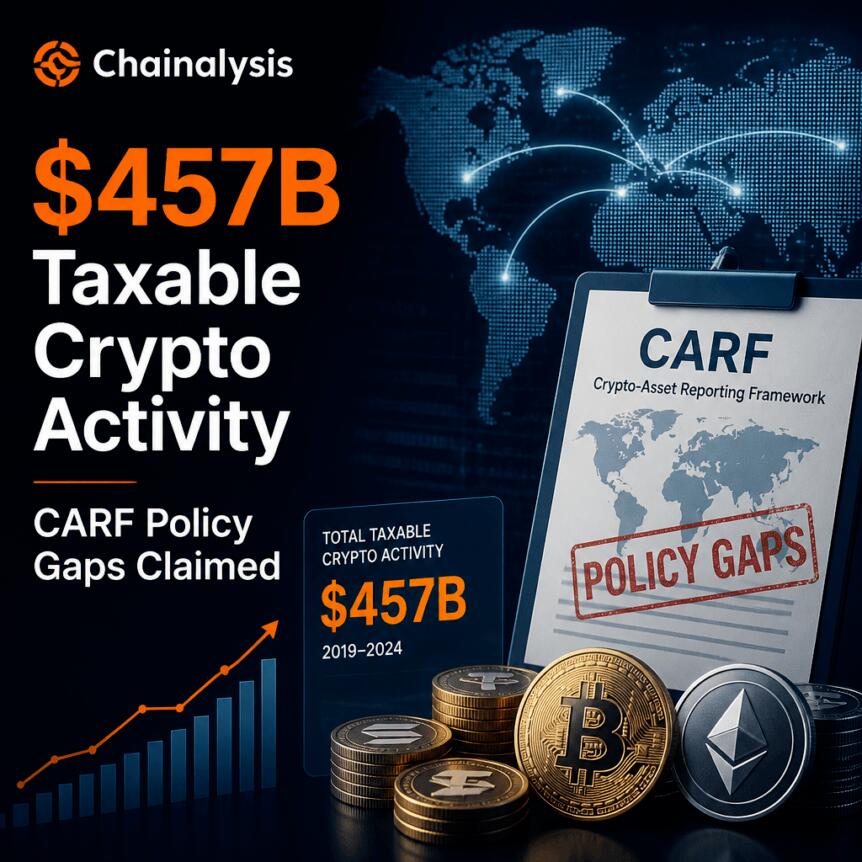
Chainalysis estimates that potentially taxable crypto activity on major public blockchains reached at least $457 billion worldwide in 2025. But the firm argues that current international tax reporting rules will likely capture only a minority of that activity—leaving most onchain activity outside the data flows tax authorities can use.
In Chainalysis’ figures, the United States accounted for an estimated $112.6 billion, while North America led all regions with $134.6 billion. The European Union followed with $125.1 billion. The analysis focuses on realized gains, income from activities such as mining, staking and lending, and crypto-denominated payments across six major blockchains—while excluding activity conducted within centralized exchanges.
Key takeaways
- Chainalysis pegs potentially taxable onchain activity in 2025 at $457 billion globally, but most of it falls outside OECD’s Crypto-Asset Reporting Framework (CARF).
- CARF-covered transactions account for an estimated 14% of the taxable onchain activity Chainalysis identified, with 86% occurring beyond the reporting perimeter.
- The $457 billion estimate includes realized gains and onchain income streams (e.g., staking, lending) and payments, but intentionally leaves out centralized exchange trading activity.
- CARF requires covered providers to collect customer transaction and tax residency information and share it with tax authorities for cross-border exchange.
- Decentralized finance activity may remain largely uncovered because CARF is built around identifiable intermediaries and reporting obligations tied to centralized service providers.
A global onchain tax problem dwarfs what CARF can cover
Chainalysis’ report frames a central mismatch: taxable crypto behavior is heavily onchain and fragmented, while reporting obligations under CARF are structured around intermediaries that can be required to collect and report data.
According to Chainalysis, transactions that fall under CARF account for just 14% of the potentially taxable onchain activity it identified. The remaining 86% includes activity on decentralized exchanges, peer-to-peer transfers, onchain income streams, and crypto-denominated payments—types of activity that may not be routed through centralized, in-scope reporting entities.
This distinction matters for investors and market participants because tax outcomes depend on record availability. Even where taxable events occur on public blockchains, the ability for tax authorities to receive consistent third-party transaction information is limited when reporting requirements don’t extend to the underlying counterparties or decentralized infrastructure.
How CARF is meant to work—and when it starts
CARF was developed by the Organisation for Economic Co-operation and Development (OECD) and announced as a framework for reporting crypto-related customer transaction data to tax authorities. Under CARF, covered crypto service providers collect customer and tax residency information and report transaction data to their domestic authorities, which can then share information across borders.
In practical terms, Chainalysis points to a coverage design that focuses on intermediaries. CARF collection is set to begin on Jan. 1, 2026, in 48 jurisdictions, including the United Kingdom and European Union. For covered platforms, the framework also requires collecting additional customer and tax residency information from that date.
Investors should note that the start date is tied to reporting obligations placed on “covered” providers. The existence of a reporting framework does not automatically mean all onchain activity becomes reportable—coverage depends on whether transactions are processed through entities that fall within CARF’s defined perimeter.
Why DeFi may stay largely outside the reporting perimeter
A key reason for CARF’s limited coverage, Chainalysis suggests, is that CARF is oriented toward crypto intermediaries that facilitate transactions as a business. Colby Mangels, a former OECD adviser who worked on CARF, told Cointelegraph in January that the framework was designed around intermediaries that can be regulated and required to report.
That structure creates friction for decentralized finance. Much DeFi activity may involve no centralized operator in the traditional sense, and potentially no custodial relationship that triggers reporting obligations in the way CARF expects. As a result, decentralized exchanges, peer-to-peer transfers, and various onchain income mechanisms can remain outside direct reporting.
Still, the regulatory landscape is not static. Mangels said tax authorities are watching how anti-money laundering rules evolve, including efforts to determine when DeFi platforms—or their operators—could be treated as regulated crypto service providers. If and when that happens, the boundary between “covered” intermediaries and “uncovered” decentralized activity may shift.
What to watch next as reporting expands
Chainalysis’ estimates highlight an uncomfortable reality: even with CARF rolling out across dozens of jurisdictions, a large portion of taxable onchain activity may remain invisible to tax authorities unless reporting requirements extend to additional kinds of entities or data-generating processes. What matters next is how regulators decide whether and when decentralized platforms—or people operating them—become subject to the same reporting duties as centralized intermediaries.
Readers should watch the implementation details in CARF jurisdictions after the Jan. 1, 2026 rollout begins, as well as any regulatory movement that clarifies how DeFi participants fit into the “crypto service provider” concept. Those determinations will largely determine whether the 14% coverage figure can rise—or whether the reporting gap persists.


Elon Musk backed a bold Grok Bot promise on Wednesday. If the AI agent loses money while running an investor’s bank account, xAI will make the user whole, he says.
One investor is taking him up on it. Yet the numbers tell a different story. It starts with a $100 liability cap sitting in xAI’s own terms.
Inside the Grok Bot Bank Account Experiment
Teslaconomics, a Tesla and xAI investor, asked a simple question on Wednesday. Had anyone connected Grok Bot to a bank account? In a post on X (Twitter), he said the agent could track spending, pay bills, and catch strange charges.
He even wondered whether he still needed a personal banker. His partner reportedly told him an outright no. She fears what an AI with that much access could do.
However, Elon Musk is confident, and even guaranteed reimbursement should the Grok bot mess up.
Follow us on X to get the latest news as it happens
Grok Bot launched in beta on August 11. According to xAI, each agent runs day and night on its own cloud computer. It signs into websites like a human and keeps working while its owner sleeps.
The experiment also fits Musk’s bigger money push. X Money went live with peer-to-peer payments in June.
A $100 Liability Cap Sits Behind the Grok Bot Promise
While Musk’s pledge sounds like insurance, his company’s paperwork says otherwise. xAI’s consumer terms offer outputs and agentic actions on an as-is basis.
Those terms cap most claims at the fees a user paid, or $100, whichever is greater. Bot access comes with a $30 monthly SuperGrok plan, so a year of fees totals $360. That is pocket change next to a drained checking account.
A reply on X (Twitter) does not rewrite that contract. Unless xAI puts the guarantee in writing, any refund rests on Musk’s goodwill.
US banking rules add a sharper edge. Regulation E, the federal rule covering electronic transfers, protects customers from unauthorized payments. However, a transfer loses that label when the customer handed over account access.
Give a bot your login, and standard fraud protections may not apply.
History gives skeptics more ammunition. In May, hidden instructions inside a malicious NFT tricked an AI into moving money, a technique called prompt injection. The attack drained roughly $150,000 from a Grok-linked Bankr wallet. About 80% of the funds later came back.
Weeks later, a separate breach hit 14 user wallets on the same platform, and Bankr pledged full reimbursement. No verified case of Grok Bot mishandling a real bank account has surfaced so far.
Even so, prompt injection could prove costlier when the target holds live bank logins instead of a crypto wallet.
The Grok bot experiment may therefore double as marketing for a product xAI wants inside daily money management. The first real error will show what Musk’s words are worth.
The answer may be a quiet refund, or a very public test of that $100 cap.
The post Elon Musk Grok Bot Promise: We Will Make You Whole if AI Loses Your Money appeared first on BeInCrypto.


The U.S. government has transferred a small amount of Bitcoin seized from Alameda Research’s Binance.US accounts three years ago, renewing attention on how federal agencies will handle the remaining assets.
Summary
- The transferred Bitcoin came from Alameda-linked accounts seized from Binance.US three years ago.
- Arkham reported the transaction but did not identify it as a sale.
- Earlier Alameda-linked transfers sent nearly $2.9 million in seized crypto through government-controlled wallets.
- Federal rules generally restrict sales of Bitcoin placed in the U.S. Strategic Bitcoin Reserve.
Arkham Intelligence reported the transaction on Aug. 26, describing the amount as small and tracing the Bitcoin to Alameda accounts on Binance.US that U.S. authorities seized three years earlier.
The blockchain analytics firm did not publish the amount in its indexed post or identify the receiving address. Arkham also did not say that officials had sold the Bitcoin, leaving the transaction’s purpose unconfirmed.
“The US Government just moved a small amount of Bitcoin that had been seized from Alameda accounts on Binance US, 3 years ago,” Arkham said.
Arkham then asked whether the government would begin liquidating the remaining Bitcoin connected to Alameda. The question was not tied to an announcement from the Department of Justice, the Treasury Department, or another federal agency.
The Bitcoin transfer does not confirm a sale
Moving Bitcoin between addresses records a change in custody or location on the blockchain, but the transaction alone does not show whether the asset has been sold. A transfer to another government wallet may involve custody, accounting, or security management, while movement to an exchange can make a future sale possible without proving one occurred.
The destination is especially important because federal agencies have regularly used Coinbase Prime to store and manage seized digital assets. Coinbase’s institutional platform offers both custody and trading services, meaning a deposit there can support several purposes.
In July, U.S. government-linked wallets transferred nearly $297 million in seized Bitcoin and Ether to Coinbase Prime. The transaction included about 3,940 BTC and 30,014 ETH tied to separate enforcement cases, according to earlier transaction coverage.
Bitcoin connected to Ryan Farace, an online drug dealer known as “Xanaxman,” and the closed BTC-e exchange formed part of the July transfer. Ether linked to a separate money laundering case also moved to Coinbase Prime.
No public blockchain record can show whether an exchange deposit resulted in an executed trade unless additional evidence reveals a conversion or movement of the sale proceeds. The same limitation applies to the latest Alameda-linked Bitcoin transaction.
Alameda assets have moved several times in 2026
Federal wallets have processed other seized assets tied to Alameda and FTX during 2026, providing a record of how authorities have handled smaller token holdings.
In May, Arkham said the government moved about $1.89 million in Render, Uniswap, The Sandbox, Mask Network, and Axie Infinity tokens to Coinbase Prime. The analytics firm traced the tokens to approximately $13 million in Alameda assets seized from Binance accounts more than three years earlier.
Another transaction followed in June, when government-controlled wallets transferred nearly $984,000 in FTX- and Alameda-linked cryptocurrency. At least $768,000 of the total went to Coinbase Prime, as crypto.news reported at the time.
Arkham said the June assets would go to the FTX estate to help repay creditors. The transaction included Chainlink and several smaller tokens, while the remaining amount moved through addresses connected to the same seized asset group.
Federal wallets had also moved more than $33 million in Alameda-linked cryptocurrency in December 2024. According to an Arkham report, the batch included about $18 million in Ether, $13 million in BUSD, and smaller amounts of Wrapped Bitcoin, Shiba Inu, and Axie Infinity.
Arkham said the 2024 assets moved to a newly created address and noted that no official purpose had been announced. The firm presented creditor distributions, wallet consolidation, and asset management as possible explanations rather than confirmed reasons for the transfers.
U.S. reserve rules limit some Bitcoin sales
President Donald Trump’s March 2025 executive order established the Strategic Bitcoin Reserve and directed the Treasury Department to fund it with Bitcoin finally forfeited through criminal or civil proceedings.
Under the order, Bitcoin deposited into the reserve cannot be sold and must remain a U.S. reserve asset. A recent Bitcoin reserve explainer estimated that the federal government held approximately 198,000 BTC as of mid-2026, although public trackers produce different totals based on the addresses and legal categories they include.
The White House order does not place every seized coin under an absolute ban on disposal. It allows agencies to return assets to verified victims, comply with court orders, support law enforcement operations, and meet requirements under federal forfeiture laws.
Legal status, therefore, determines how a particular holding can be handled. Bitcoin that has been finally forfeited and transferred into the reserve receives different treatment from property still involved in a court case, creditor recovery process, or victim compensation plan.
The White House also created a U.S. Digital Asset Stockpile for forfeited assets other than Bitcoin. Treasury has more room to manage or sell tokens held in the stockpile, while the order gives Bitcoin placed in the reserve a general no-sale policy.
No federal agency has said whether the Bitcoin moved on Aug. 26 had entered the reserve, remained assigned to the FTX recovery process, or fell under one of the order’s exceptions.
FTX creditors remain tied to the seized assets
Alameda Research operated as the trading firm associated with FTX before the exchange collapsed in November 2022. Federal prosecutors later said FTX founder Sam Bankman-Fried used customer deposits to finance Alameda’s operations, investments and loan repayments.
The Justice Department said Bankman-Fried misappropriated billions of dollars deposited by FTX customers and gave Alameda access to the funds. A federal jury convicted him in November 2023 on seven counts, including wire fraud, securities fraud conspiracy, commodities fraud conspiracy, and money laundering conspiracy.
In March 2024, U.S. District Judge Lewis Kaplan sentenced Bankman-Fried to 25 years in prison. The Justice Department said the sentence included forfeiture of more than $11 billion, while prosecutors placed FTX customer losses at more than $8 billion.

Altcoins have taken a leading role in the latest crypto market rally, as trading activity and market capitalization surged alongside Bitcoin’s sharp move higher. This comes after an extended period of low volatility and subdued trading volumes.
According to CryptoQuant analyst Darkfost, investor attention and capital have moved strongly toward altcoins, “potentially signaling a broader resurgence of risk appetite across the market.”
Biggest Dominance Surge in 2 Years
Bitcoin gained nearly 25% over the past week, while altcoins significantly amplified the broader market trend. The total altcoin market capitalization, measured through Total2 and excluding Ethereum, increased by around $135 billion during the same period. Darkfost said that the scale of the move highlights how quickly capital has entered the altcoin segment.
A notable change was also seen in trading activity. On Binance, which represents nearly 40% of altcoin trading volume across exchanges, these tokens accounted for as much as 65% of total volume at their peak. At that point, Bitcoin made up just 21% of volume, while Ethereum accounted for 13.6%.
Darkfost explained that altcoins had not held this much of Binance’s trading volume in two years. The gap between the assets indicates a clear redistribution of liquidity across the market, as these tokens attracted a larger share of trading activity than Bitcoin and Ethereum.
The shift came after several announcements from Trump on August 19, including his call for the US to purchase large amounts of BTC and for Congress to pass the Clarity Act. Darkfost said the announcements helped push liquidity into altcoins.
Impulse Surges to 93%
The strength is also showing up in market breadth. Altcoin Vector said its ‘Altcoin Impulse’ reading jumped to 93%, which suggested that the rally has spread across a large part of the market. However, it considers breadth above 75% overextended, meaning the move could face exhaustion or a reset.
Analyst Matthew Hyland had previously predicted that alts could deliver returns of 10x to 1000x, comparing the June sell-off to the March 2020 market collapse. Hyland had said that June was essentially an altcoin version of the 2020 crash and pointed to Ethereum, Cardano and other tokens as examples that could see outsized gains if the comparison plays out.
He had also said many of these tokens could recover within a few months rather than taking years to regain lost ground.
The post Altcoin Volume Dominance Hits Two-Year High as Traders Pour $135B Into the Market appeared first on CryptoPotato.

13 Luxe-Looking Fall Shoe Styles I Saw on the Gold Coast

Pov: playing minecraft with your bestfriend!

GAIL opposes IGX platform for LNG terminal capacity booking





-

 Fashion5 days ago
Weekend Open Thread: Madewell – Corporette.com
-

 Crypto World1 day ago
SpaceX stock could rise 75% to $240, JPMorgan says
-

 Business4 days ago
Musk’s Tesla, SpaceX Confirm $16.8 Billion ‘Terafab’ Chip Plant as World’s Largest Building in Texas
-

 Crypto World5 days ago
anatomy of crypto’s biggest liquidation event since 2021
-

 Crypto World2 days ago
A $30 Billion AI Fund Implodes, Now the SEC Is Investigating Wall Street’s Role
-

 Politics5 days ago
6 months on, Irish renters crushed by effects of government housing bill
-

 Crypto World21 hours ago
Did Trump Just Move SpaceX Stock With One Truth Social Post?
-
 NewsBeat5 days ago
The ‘Lucky Dip Gang’ causing carnage for clicks: After five thugs were killed speeding in the wrong direction on a motorway, GUY ADAMS investigates a sick new trend… and why police aren’t even allowed to pursue them
-

 Business4 days ago
Mystery AI Model ‘Ox Alpha’ Draws Developers With Free Access as Chinese Lab Origins Remain Debated
-

 News Videos7 days ago
Don’t Leave Your Financial Future To Chance | August 19, 2026
-

 Business6 days ago
Five Below: Kids Discount Retailer Reaps Rich Rewards
-

 Business2 days ago
Moderna CEO warns China is pouring state money into mRNA technology
-

 Business2 days ago
NVIDIA Stock Drops Nearly 2 Percent to $210 on Seventh Losing Day Ahead of Critical AI Earnings
-

 Business5 days ago
UK firms in critical financial distress rise 9% to 53,756
-

 Sports4 days ago
Deshaun Watson fires back at Browns fans after being booed: ‘It’s a disrespectful thing’
-

 Crypto World7 days ago
Optimism-funded team's deciding vote shifts $49 million in OP tokens away from users
-

 Tech7 days ago
OpenAI confirms ChatGPT is down as logins and signups fail
-
 Crypto World4 days ago
Google Gemini AI Predicts Ethereum Could Become the Trade Retail Misses in 2026
-
 Crypto World5 days ago
Nvidia Stock Suffers Longest Losing Streak Since 2022: Will Q2 Earnings End It?
-

 Business7 days ago
PayPal and Venmo now accepted for tuition at several universities
You must be logged in to post a comment Login