
Crypto World
aka.fun Launches on Arc to Turn Meme Trading Into an RWA Distribution Engine



Launching alongside Arc mainnet, aka.fun uses USDC and programmable Uniswap v4 markets to connect crypto-native trading activity with the distribution of tokenized real-world assets.
aka.fun announced its launch on Arc mainnet, introducing a new kind of crypto launchpad built around a simple thesis:
Crypto has liquidity, attention and distribution.
Real-world assets need more of all three.
aka.fun is building the layer between them.
The platform is designed to transform crypto-native trading activity, beginning with meme markets and internet culture into a recurring economic engine capable of generating demand for tokenized real-world assets.
Rather than asking crypto users to leave the markets and communities they already participate in to discover RWAs, aka.fun aims to bring RWAs directly into those markets.
The model creates a simple flywheel:
Culture → Trading → Fees → RWA Demand → Distribution → Utility → More Activity
The greater the activity flowing through markets launched on aka.fun, the greater the potential economic engine behind RWA acquisition and distribution.
Turning Crypto Liquidity Into RWA Distribution
Crypto has proven remarkably effective at generating communities, liquidity and global trading activity at internet speed.
Tokenized real-world assets are growing rapidly onchain, but distribution remains one of the industry’s largest opportunities: connecting those assets with millions of crypto-native users already transacting onchain.
aka.fun is designed to become that distribution layer.
Markets created through the platform can use programmable fee flows to support liquidity, incentives and the acquisition of eligible tokenized real-world assets. Those assets can then be distributed to eligible users through aka.fun’s ecosystem and DN404 mechanics.
Users receiving RWAs can choose how they participate based on the mechanics and eligibility of the underlying asset, including holding or trading them where supported.
For RWA issuers and providers, the model creates an entirely different potential distribution channel: crypto-native market activity itself becomes a source of recurring RWA demand.
Why Memes?
Because attention is infrastructure.
Memes have become one of crypto’s most powerful mechanisms for turning internet culture into communities, liquidity and markets.
aka.fun doesn’t view meme trading and real-world assets as competing narratives.
It views them as two parts of the same economic system.
A meme can generate attention.
Attention can generate trading.
Trading can generate fees.
And programmable markets can transform a portion of that economic activity into demand for real-world assets.
In other words: speculation can become distribution.
Rather than attempting to remove the culture and behavior that make crypto unique, aka.fun is building on top of them.
The AKA Flywheel
At scale, the model is designed to create value across multiple sides of the market.
For users:
Crypto-native activity can unlock exposure to real-world assets and new forms of onchain rewards.
For RWA providers:
aka.fun can become a distribution channel connecting tokenized assets with a much larger crypto-native audience.
For liquidity providers:
Growing market activity creates additional opportunities for liquidity deployment and fee generation.
For creators and token communities:
Markets can incorporate programmable incentives and economic mechanics directly into their trading infrastructure.
For the broader ecosystem:
More activity can mean more liquidity, more transactions, greater RWA demand and deeper integration between onchain culture and onchain finance.
The result is a flywheel in which each participant can contribute to and potentially benefit from increased economic activity.
Built on Arc, Powered by USDC and Uniswap v4
aka.fun launches alongside the public mainnet of Arc’s Layer-1 blockchain designed for stablecoin finance and onchain financial applications.
The platform is built around three core infrastructure layers:
Arc – the financial environment.
USDC – the primary financial rail.
Uniswap v4 – the programmable market engine.
Uniswap v4 Hooks allow markets to incorporate custom logic around swaps, liquidity and fees, giving aka.fun the ability to build economic mechanics directly into the trading layer.
aka.fun sits above that infrastructure as the market and distribution layer, connecting creators, traders, liquidity and ultimately tokenized real-world assets.
AKA DN404: The First Showcase of the Model
Launching alongside the platform is AKA DN404, aka.fun’s native AKARII collection and the first showcase of how the ecosystem can combine crypto-native liquidity, digital ownership and RWA-linked rewards.
AKA DN404 is designed around two participation states.
Liquid
In its Liquid state, AKA combines fungible token liquidity with NFT ownership, allowing users to participate through ERC-20 markets as well as NFT marketplaces such as OpenSea.
This creates opportunities for trading, liquidity and arbitrage between the two market structures.
Committed
Holders can alternatively enter a Committed state by permanently burning the fungible token side while retaining the NFT.
Under the collection’s reward mechanics, this commitment activates eligibility for RWA-related rewards associated with the NFT.
The result is a model that lets users choose their own role:
Trade it.
Provide liquidity.
Arbitrage it.
Collect it.
Or commit it.
Different behaviors, one connected economy.
Building the Distribution Layer Between Crypto and the Real World
The long-term ambition extends far beyond individual launches or a single collection.
aka.fun aims to become a large-scale distribution layer between crypto liquidity and real-world asset providers.
As more markets launch and trading activity grows, the platform’s objective is to create increasingly recurring RWA demand generated directly by crypto-native economic activity.
That creates a potentially powerful feedback loop:
More projects create more markets.
More markets create more trading activity.
More activity creates more fees.
More fees can generate more RWA demand.
More RWA distribution creates greater utility for users.
And greater utility attracts more users, creators and liquidity.
“Crypto doesn’t have an attention problem. It has enormous attention, liquidity and trading activity. At the same time, real-world assets don’t necessarily need another place to exist onchain, they need distribution. Our vision for AKA is to connect those two worlds and turn crypto-native activity into a recurring distribution engine for RWAs.”
That is the flywheel aka.fun is building.
Meme culture on the surface.
Programmable markets underneath.
Real-world value flowing through the engine.
Trade, aka FUN.
About aka.fun
aka.fun is an Arc-native launchpad and programmable market platform built around USDC, Uniswap v4 and tokenized real-world assets.
The platform enables creators to launch crypto-native markets while embedding liquidity, incentives and programmable economic mechanics directly into the trading layer.
Its long-term mission is to build a distribution layer connecting crypto-native liquidity and audiences with the rapidly expanding world of tokenized real-world assets.
The post aka.fun Launches on Arc to Turn Meme Trading Into an RWA Distribution Engine appeared first on BeInCrypto.

James Check, founder and lead analyst at Checkonchain, said Bitcoin may have already established its cycle bottom after undergoing two capitulation events, arguing that shifts in holder behavior indicate the market has absorbed much of its selling pressure.
Bitcoin (BTC) reached a record of just over $126,000 in October 2025 and traded around $77,400 at the time of writing, nearly 39% below its peak. Some traders expect BTC to establish another low in October 2026 based on its historical four-year cycle. In July, analyst Benjamin Cowen said that cycle-duration data and the US midterm-election calendar pointed toward a fourth-quarter bottoming window.
In an interview on Cointelegraph’s Proof of Thesis show, Check described Bitcoin’s February decline toward $60,000 as a “price-pain capitulation,” when investors who bought near the top sold at substantial losses. He identified a second “time-pain capitulation” around $58,000 in June and July, following months of sideways price action that caused holders to question whether Bitcoin would recover.
“What’s the difference between $58,000 and $59,000 or $60,000? Nothing,” Check told Cointelegraph. “It’s the six months that separated them. That’s the actual difference.” His assessment challenges expectations of an October low, suggesting the capitulation signals associated with a bear-market bottom appeared months earlier.
Check said approximately $300 billion in Bitcoin cost basis was concentrated between $58,000 and $70,000, while about 4 million BTC moved from an unrealized loss into profit during the subsequent recovery. He added that long-term holders now control roughly 80% of Bitcoin wealth and are more likely to wait for substantially higher prices than sell after a short-term rebound.
Bitcoin four-year cycle misleads traders
Check said anchoring to the four-year cycle is a mistake because there is no mechanical reason for it to repeat.
“Ask, ‘Well, now what do I do?’ long before your compass breaks,” Check told Cointelegraph. “It’s like a broken clock. It’s right twice a day. Just assume it’s broken and find something better.”
Check said previous cycle dates do not explain why investors capitulate. He said traders should instead examine cost basis, unrealized and realized losses, holder profitability and whether experienced investors are accumulating or distributing their coins.
He said that calendar dates should only provide context after evidence of market exhaustion or capitulation emerges. “Look for the evidence, not the calendar,” Check said.
Related: Bitcoin treasuries buy just 5.9K BTC in three months as paper losses linger
Grayscale researcher also sees $58,000 bottom
Grayscale head of research Zach Pandl reached a similar conclusion in a recent interview on Cointelegraph’s Trade Secrets. “I’m willing to stick my neck out and make a guess that prices bottomed back at $58,000 at the end of June,” Pandl told Cointelegraph.
Pandl said the downturn produced less despair than previous Bitcoin bear markets but followed a bull market that also generated less euphoria, potentially resulting in a more contained decline.
He also pointed to Bitcoin’s ability to withstand adverse developments without continuing to fall. “When price in an asset class, whether it’s crypto or anything else, stops going down on bad news, that’s usually a sign that it’s oversold,” Pandl said.
Onchain evidence remains mixed. HODL Waves data showed that Bitcoin supply held for one to seven days rose only from 1.97% on July 1 to 2.35% on July 5, which analyst Willy Woo interpreted as an unusually muted response from dip-buyers.
However, CryptoQuant data showed that short-term holders had remained partially profitable for 30 consecutive days, the longest such stretch of 2026 and a pattern the analytics firm said has characterized previous Bitcoin market recoveries.
Magazine: Bitcoin treasury firms can outperform BTC… but is the risk worth taking?
Binance founder Changpeng “CZ” Zhao applauded a new BNB Chain launchpad with a single clap emoji on Thursday. The GENIUS token spiked within hours.
Zhao then questioned whether his post caused the move. He said he never checked the chart and pointed to the project’s own product release instead.
CZ Points Away From His Post on the GENIUS Token
Genius Terminal, an onchain trading platform whose token runs on BNB Chain, opened a launchpad called genius.fun on Thursday. Zhao marked the announcement with one clap and nothing else.
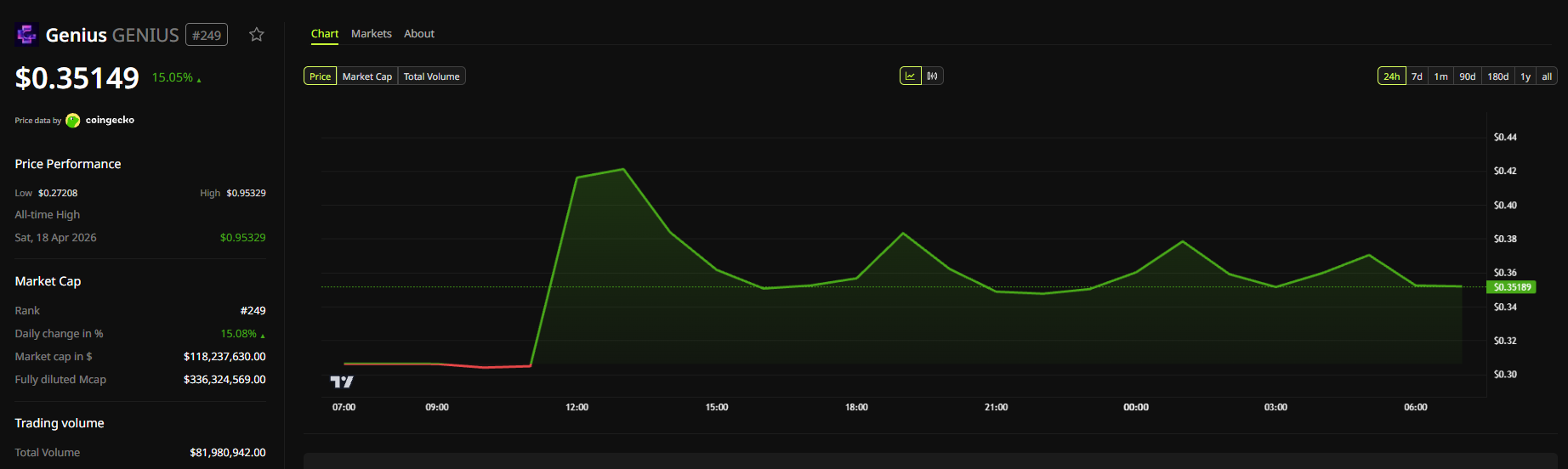
The GENIUS price went near vertical, climbing above $0.42 before drifting back through the day. GENIUS carries a market cap near $118 million, small enough that one post can shift it. The token still trades well below its April high of $0.95.

However, Zhao questioned that link on Friday after one user credited him for the candle. He posts about projects making progress on BNB Chain, he said.
His posts have moved small BNB Chain markets before. One viral message in July handed a single buyer a 357x return on a token named after him.
Traders now watch his account as a market signal, whether or not he intends one.
Inside the New BNB Chain Launchpad
Genius Foundation, the group behind the GENIUS token, opened genius.fun on Thursday. The same team launched an onchain options exchange in June. The launchpad pairs new tokens with tokenized public company shares, known as bStocks, rather than with crypto assets alone.
The team says buyers can send those positions to a foundation that unwraps them into real equity. Holders could then vote in corporate governance. No campaign has taken a stake in any listed company so far.
Established markets dispute that premise. AMC’s chief executive recently called stock tokens fake equity, and stock token voting rights still vary by issuer. BNB Chain nonetheless ranks among the busiest venues for tokenized stock trading.
CZ has argued that initial public offerings will move onchain. Genius.fun tests a blunter version of that idea. Whether any token campaign reaches an actual shareholder vote remains unproven.
The post One Clap From Changpeng Zhao and a BNB Chain Token Went Vertical appeared first on BeInCrypto.


Binance declined to address reports of ECB intervention in its Greek MiCA bid, saying it remains committed to securing authorization in Europe.
Speculation that Canada could one day join the European Union has moved from an internet curiosity to a genuine geopolitical talking point in recent months. As a result, Canada EU odds across prediction market platforms such as Kalshi and Polymarket have begun gaining traction.
The idea picked up momentum as Canada sought to reduce its dependence on the United States amid escalating trade tensions. In April, a Canadian poll found that 58% of respondents thought EU membership was worth exploring, while 25% said joining would be a good idea.
Speculation intensified this week as European Commission President Ursula von der Leyen invited Canada to become the EU’s first “associate member,” aiming for closer cooperation in defense, critical minerals, energy, and AI. Canadian Prime Minister Mark Carney embraced the idea but clarified that Canada seeks a “unique alliance” rather than full EU membership.
This distinction matters, as current EU treaties don’t provide for associate membership and only allow accession by European states. Some EU diplomats have already expressed doubts about the proposal’s viability and member state support.
Canada EU Odds: What do Prediction Markets Say?

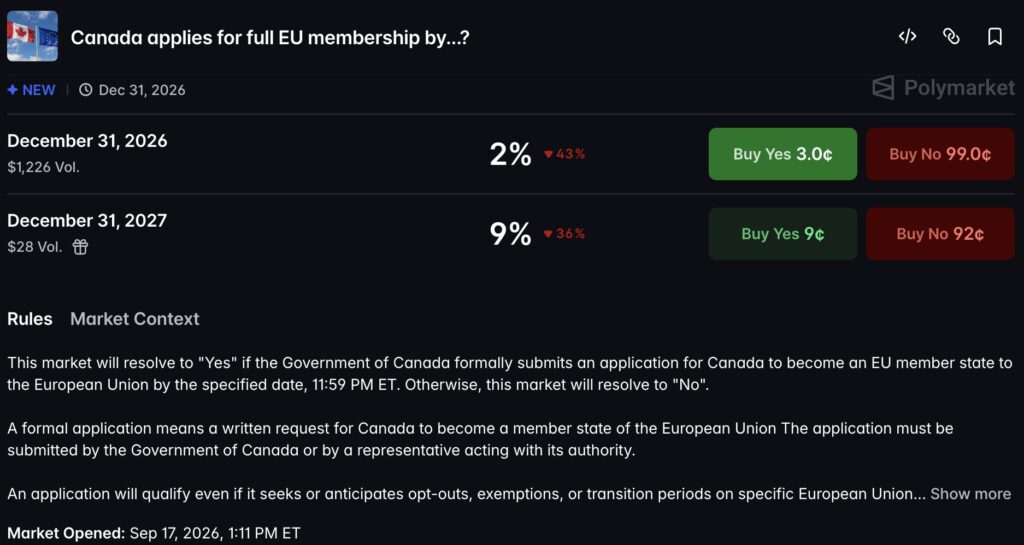
On Polymarket, the market asking whether Canada will be admitted as a full EU member by the end of 2026 or 2027 currently puts the probability at approximately 2% by the end of 2026, and 9% by the end of 2027.
The market opened on September 17 and has generated only around $1,250 in volume so far, so treat the figure cautiously rather than as a well-established consensus.
A separate Polymarket market asks whether Canada will formally apply for full EU membership. Traders currently assign an 8% probability to an application by December 31, 2027, compared with 2% for an application by the end of 2026.
Kalshi, meanwhile, has a broader market asking whether the EU will have a new member before 2030. It currently shows 75.8% of bettors trading yes but just $8,000 in trading volume, and, importantly, does not isolate Canada as the prospective entrant, so it cannot provide a meaningful Canada-specific probability.
The prediction-market picture therefore remains heavily weighted toward closer Canada-EU integration rather than full Canadian EU membership. The new “associate member” proposal could create a pathway for substantially deeper economic, security, and political ties, but converting that into full EU membership would require overcoming significant legal and political obstacles.
For now, the clearest market signal is that Canada joining the EU itself remains a low-probability scenario, while a new form of privileged Canada-EU association is attracting considerably more attention.
Make Your Canada EU Prediction With $25 For Free on Kalshi
Bitcoin Hyper Targets Early Mover Upside as Canada EU Odds Gain Momentum
Bitcoin Hyper is improving network visibility. — Bitcoin Hyper (@BTC_Hyper2) September 15, 2026


Better observability helps the team track performance, understand transaction flows, identify issues earlier, and refine the ecosystem as it grows.
Read the full article  https://t.co/PHfiR1IOFq pic.twitter.com/J6vKOUg1VP
A 1.37% bounce off a $1.54 trillion base is exactly what it sounds like: modest. At this scale, Bitcoin doesn’t double on a rate-hike relief rally; the mathematics simply don’t support it anymore.
This reality is prompting some traders to explore earlier-stage infrastructure projects built on Bitcoin itself, rather than waiting for Bitcoin’s diminishing percentage gains.
Bitcoin Hyper ($HYPER) is positioning itself as the first Bitcoin Layer 2 solution to integrate a Solana Virtual Machine (SVM). It aims to exceed Solana’s throughput while anchoring security back to Bitcoin’s base chain.
Currently, the presale token trades at $0.0136864, with $33,144,078.90 raised so far, an amount that has increased alongside capital rotations driven by rate hikes into Bitcoin-adjacent opportunities.
Bitcoin Hyper proposes addressing Bitcoin’s slow settlement times and limited programmability by using low-latency Layer 2 processing. It also offers a decentralized canonical bridge for BTC transfers, along with staking rewards at a high annual percentage yield (APY).
Gain Access to New Bitcoin Layer 2 Early Here Earn $50 and Enter $300K Prize Draw on EdgeX
The post Canada EU Odds: Prediction Markets Start Taking Bets, What Are They Saying? appeared first on Cryptonews.
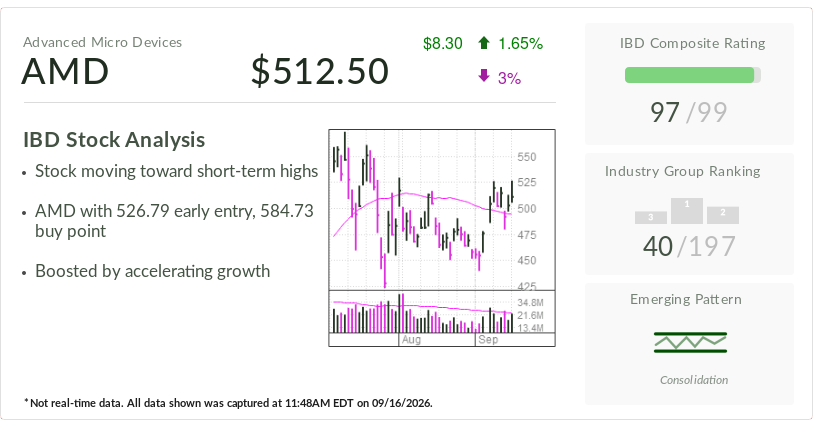
Advanced Micro Devices Advanced Micro Devices AMD $ 512.50 $8.30 1.65% 3% IBD Stock Analysis Stock moving toward short-term highs AMD with 526.79 early entry, 584.73 buy point Boosted by accelerating growth IBD Composite Rating 97/99 Industry Group Ranking 40/197 Emerging Pattern Consolidation Consolidation A sideways pattern that doesn’t fit traditional base definitions. Sometimes will have a handle. * Not…
Copyright ©2026 Investor’s Business Daily, LLC. All rights reserved. 87990cbe856818d5eddac44c7b1cdeb8

Bitcoin price is changing hands near $77,700, up 1.6% on the day, as fresh commentary from JPMorgan reignites the prediction debate over whether BTC can finally close the performance gap with gold. The bank’s analysts see something in the positioning data that most miss, and it could matter more than this week’s price action.
JPMorgan analysts led by Nikolaos Panigirtzoglou argue that Bitcoin investors remain far more defensively hedged against downside risk than their gold ETF counterparts. This, even with both assets having drawn renewed inflows since the Federal Reserve’s July meeting reignited the debasement trade.
HUGE: — Ash Crypto (@AshCrypto) September 17, 2026
 $1 Trillion JPMorgan says Bitcoin could pump hard against gold if investors unwind their Bitcoin ETF hedges.
Right now, BlackRock's IBIT ETF has near-record-high short interest and heavy put options, while gold shorts are below average.
This means any short-covering or… pic.twitter.com/mmrIS5QjiS
Gold ETFs have already clawed back all of their 2026 outflows. Bitcoin ETFs have recovered only about half. On the surface, that reads as gold winning. JPMorgan’s read is different: unwind that excess hedging, and Bitcoin has more structural room to run than the flow data suggests.
That thesis lands during a week where BTC is stuck in a tight consolidation band, leaving traders to decide whether this is accumulation before a breakout or exhaustion before a slide. Recent price-level analysis frames the next move as a battle between buyers defending support and sellers capping every rebound attempt.
Earn $50 and Enter $300K Prize Draw on EdgeX
Bitcoin Price Prediction: Can BTC Break $79K This Week?
BTC is trading in a range between $76,200 and $77,900 over the past 24 hours, with the daily gain of 1.6% doing little to resolve the broader sideways structure that’s defined the last several sessions. Volume remains elevated but hasn’t produced a decisive breakout in either direction. This is a sign that the market is waiting on a catalyst.
Where are the key levels? Resistance sits at $77.8K, directly overhead, with a tougher ceiling at $79K–$80K. Support is layered at $75.2K, then deeper at $72K and $68K if sentiment sours.

The bull case plays out if a clean reclaim of $77.8K triggers a run at $80K, especially if JPMorgan’s hedge-unwind thesis gains traction among institutional desks. The base case is a continued chop inside the $75K–$78K band while the market digests Fed policy language.
However, a slip below $75.2K invalidates near-term strength and puts $72K back in play. Macro conditions tied to Fed policy and Treasury yields remain the swing factor either way.
Trade Bitcoin on Bybit and Get a Chance to Win Our $1,000 USDT Airdrop
Bitcoin Hyper Targets Early Mover Upside as Bitcoin Tests Key Levels
A 1.6% daily pop is fine if the position is already sized. For anyone watching from the sidelines, chasing BTC into resistance near $77.8K with the JPMorgan thesis still unconfirmed as active news is a thin trade. The upside math at a $1.5 trillion-plus market cap simply moves more slowly than early-stage infrastructure plays, which is where attention is rotating.
Bitcoin Hyper ($HYPER) is positioning itself as the first Bitcoin Layer 2 with full SVM integration. It boasts smart contract execution built for speed that outpaces Solana itself, while settling back to Bitcoin’s base-layer security.
Bitcoin Hyper is improving network visibility. — Bitcoin Hyper (@BTC_Hyper2) September 15, 2026
Better observability helps the team track performance, understand transaction flows, identify issues earlier, and refine the ecosystem as it grows.
Read the full article https://t.co/PHfiR1IOFq pic.twitter.com/J6vKOUg1VP
As of today, the presale has raised $33.1 million at a current token price of just $0.0136864, with staking rewards live at launch at a huge 35% APY.
The pitch: solve Bitcoin’s slow transactions, high fees, and lack of programmability without abandoning what makes BTC trusted in the first place. A Decentralized Canonical Bridge handles BTC transfers natively.
Research Bitcoin Hyper before the presale window ends.
Discover: The Best Token Presales
The post Bitcoin Price Prediction: BTC Could Outperform Gold According to JPMorgan appeared first on Cryptonews.
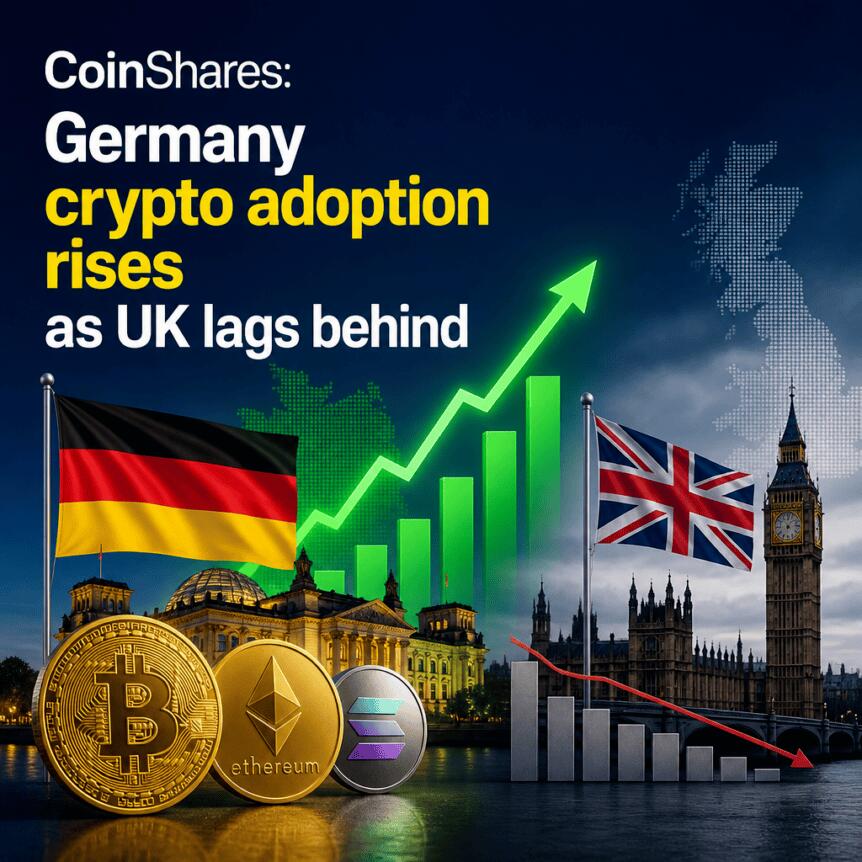
Germany is seeing faster crypto adoption than the UK, with CoinShares researcher Luke Nolan pointing to stronger institutional involvement and younger investors treating digital assets as a more accessible place to deploy inherited wealth. Speaking to Cointelegraph, Nolan said German demand is being driven by a mix of family offices, wealth managers and individual advisors—while the UK remains constrained by regulatory lag.
Behind the headline difference is a clear divide in regulatory momentum: Germany and the wider EU have been working through Markets in Crypto-Assets (MiCA) licensing, while the UK’s crypto market is still “nascent” after the Financial Conduct Authority (FCA) only recently resumed retail access to certain crypto exchange-traded products.
Key takeaways
- CoinShares’ Luke Nolan says Germany’s crypto adoption is advancing quickly, led by advisors and younger investors seeking exposure to inherited wealth.
- Nolan argues the UK is behind largely because FCA retail crypto-product restrictions were lifted less than a year ago, leaving the market still early-stage.
- Germany has 89 licensed crypto-asset service providers, representing 25.5% of firms listed on ESMA’s MiCA register.
- Major German banks are moving toward crypto custody for institutions as regulatory approval milestones approach, including Deutsche Bank’s expected license window.
- The UK FCA is progressing its new authorization framework, with licensing applications opening Sept. 30 and interim transitional arrangements tied to a 2027 timetable.
Why Germany is pulling ahead with younger and advisor-led demand
Nolan described Germany’s adoption trajectory as “very good progress,” emphasizing the role of wealth intermediaries. According to his comments to Cointelegraph, family offices, wealth managers and individual advisors are helping bring crypto into mainstream investment conversations—particularly among younger investors.
A notable behavioral driver, Nolan added, is the growing interest in investing inherited wealth in digital assets. That dynamic matters because it links crypto demand to long-term financial planning rather than short-term speculation, increasing the likelihood of sustained client education and repeat allocations through established advisory channels.
UK market remains “nascent” after FCA timing gaps
In contrast, Nolan said the UK is “still very much behind.” His explanation centered on timing: the FCA lifted its ban on crypto exchange-traded products for retail participants less than a year ago, following a prior ban introduced in January 2021.
That regulatory gap helps explain why the UK digital asset market is described as early-stage. Even as UK regulators move to bring broader crypto activity under formal oversight, investor access and product availability take time to rebuild after restrictive periods—especially for retail-oriented exchange-traded formats.
MiCA licensing momentum: Germany’s weight in the EU register
Germany’s regulatory groundwork under MiCA is also reflected in licensing totals. ESMA’s updated MiCA register shows Germany has 89 licensed crypto-asset service providers, accounting for 25.5% of companies in the register. ESMA’s MiCA-related listings provide the basis for this share of the market within Europe.
Germany has also been positioned as an EU leader by authorization volume. Cointelegraph previously reported that Germany topped the bloc by MiCA authorization in June, reaching 57 authorized crypto companies—underscoring that the country’s pipeline did not merely grow late in the process.
For investors and service providers, licensing concentration can be a signal of both regulatory confidence and operational readiness: firms licensed earlier often have more time to build compliant products, custody workflows and customer onboarding processes.
Big banks in Germany edge closer to institutional crypto custody
The adoption story is not confined to independent advisors. It is also drawing attention from Germany’s largest financial institutions as they prepare for regulated crypto services.
Deutsche Bank revealed on Wednesday that it was awaiting regulatory approval to launch crypto custody solutions for institutional clients in Europe, with a license expected in October. Earlier this year, Cointelegraph reported that Landesbank Baden-Württemberg—described as Germany’s largest federal bank—began offering crypto custody solutions in partnership with Bitpanda for its institutional custody platform (launched in April 2024).
Together, these moves indicate a gradual institutionalization of custody: as banks approach licensing milestones, the market may see improved infrastructure for professional-grade storage, controls and reporting—features that matter to institutional allocators who need compliant operational pathways.
UK regulators advance authorization and enforcement
While Germany presses ahead through MiCA licensing, the UK FCA is working through its own framework for regulating crypto activities. On Wednesday, the FCA issued final guidance describing when crypto activities may require authorization under the UK’s incoming regulatory regime.
According to Cointelegraph’s coverage, licensing applications will open on Sept. 30, with a Feb. 28, 2027 deadline for firms seeking transitional arrangements ahead of the new regime taking effect on Oct. 25, 2027. The timetable suggests the UK is moving toward a structured authorization environment, but it also means firms and users may still be waiting for full operational clarity until the later stages of the schedule.
The FCA also continued enforcement actions. On Thursday, it announced that it had sent a cease-and-desist letter to three London locations suspected of facilitating illegal peer-to-peer crypto trading. Separately, UK Parliament approved regulations bringing digital assets within the FCA’s regulatory remit in February, and the regulator later finalized a package of rules and guidance in June.
For readers watching how Europe’s crypto markets diverge, the key uncertainty is timing: Germany’s progress is being reinforced by MiCA licensing and bank-level infrastructure moves, while the UK’s broader framework is still rolling out. The next thing to track is how quickly FCA authorizations and transitional arrangements translate into new, compliant product availability—especially for institutions and retail channels that have been rebuilding since the end of earlier restrictions.
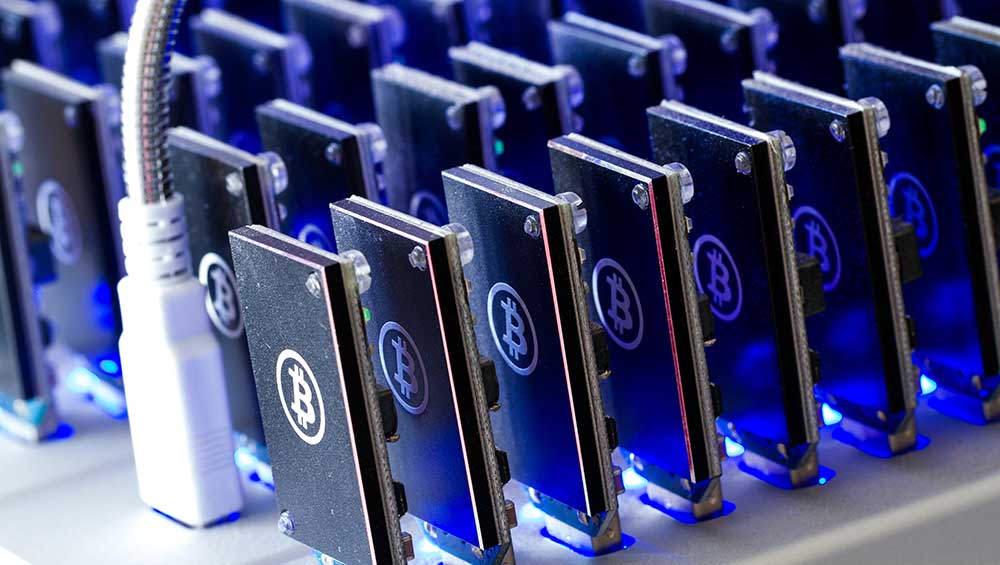
The digital asset industry diverged starkly Wednesday after the Federal Reserve hiked its key interest rate. Bitcoin and cryptocurrency stocks traded lower amid a disappointing start to the week after the Senate on Tuesday failed to advance the Digital Asset Market Clarity Act. Mining stocks and AI infrastructure providers trended higher on reports of bullish energy news for Cipher Digital.…
Copyright ©2026 Investor’s Business Daily, LLC. All rights reserved. 87990cbe856818d5eddac44c7b1cdeb8

Sunbelt Rentals Holdings, Inc. (NYSE:SUNB) reported on September 9 that fiscal first-quarter revenue increased 11.2% to $3.115 billion, including $2.927 billion of rental revenue, up 12.5%. The quarter ended July 31, 2026.
Management raised fiscal 2027 rental-revenue growth guidance to 7% through 10%, while increasing planned net rental-equipment capital expenditures to $2.4 billion through $2.8 billion. Demand supports expansion, but investors need to assess how much cash remains after funding the fleet.

BULL CASE
North America Specialty rental revenue grew 25.3%, giving Sunbelt Rentals Holdings, Inc. (NYSE:SUNB) a strong source of growth beyond general equipment rentals. Specialized services can deepen customer relationships and create opportunities to supply several needs on the same project.
The company estimated that the FIFA World Cup contributed 2.5 percentage points to quarterly rental-revenue growth. Serving complex events demonstrates the commercial value of a broad equipment network. The investment opportunity is to turn that capability into recurring work across industrial, energy and construction customers.
Adjusted EBITDA increased 8.7% to $1.315 billion. This company-defined non-GAAP measure adds taxes, net interest, depreciation, amortization, stock-based compensation and specified restructuring costs to net income. Its margin is adjusted EBITDA divided by revenue.
GAAP operating margin improved to 22.2% from 21.3%, helped by lower depreciation expense relative to revenue. The business is generating higher operating profit as management commits more capital to future rentals.
BEAR CASE
Cash conversion weakened. Operating cash flow declined to $840 million from $868 million, while company-defined non-GAAP free cash flow fell to $70 million from $468 million. Free cash flow deducts rental and non-rental equipment purchases, net of disposal proceeds, from operating cash flow.
That means net equipment spending absorbed approximately 92% of quarterly operating cash flow. Equipment purchases can precede rental income, but the gap places greater importance on deploying new assets quickly and keeping them rented.
The revised outlook increases that obligation. At the guidance midpoints, planned annual net rental-equipment spending rose by $350 million, while expected adjusted EBITDA increased by $70 million. Those revisions show why stronger earnings guidance does not automatically mean more near-term cash available to shareholders.
Adjusted EBITDA margin also declined to 42.2% from 43.2%. Management attributed the decline primarily to faster growth in ancillary revenue, partly offset by improved rental rates. The World Cup contribution also makes recurring demand after the event an important test.


Key takeaways
- The failed CLARITY Act vote and the Federal Reserve’s rate increase have weighed on sentiment.
- XRP futures open interest fell from 2.25 billion to 2.12 billion tokens, signaling softer speculative demand.
- The 50-day and 100-day EMAs provide support between $1.28 and $1.26.
Ripple’s XRP remained under bearish pressure on Friday, trading just above $1.30 as buyers attempted to defend a cluster of short-term moving-average supports.
The token has struggled since rising to $1.50 on Monday. Sentiment weakened after the U.S. Senate failed to advance the CLARITY Act and the Federal Reserve raised its benchmark interest rate by 25 basis points to a range of 3.75% to 4.00%.
Higher interest rates can reduce liquidity and weaken demand for risk assets, including cryptocurrencies. However, the Fed’s decision was widely anticipated, limiting the immediate market reaction.
Ripple highlights XRP’s existing legal clarity
Despite the legislative setback, Ripple maintains that XRP already has a meaningful legal advantage following the company’s lengthy court battle with the Securities and Exchange Commission.
Ripple said the litigation established that XRP is not inherently a security, giving the company and token firmer legal footing even without a comprehensive U.S. digital-asset framework.
The company acknowledged that the CLARITY Act could have offered greater certainty across the broader crypto industry. Still, it argued that XRP remains on “settled ground” compared with many other digital assets.
Derivatives activity has weakened alongside XRP’s fading price recovery. Futures open interest fell to 2.12 billion XRP on Friday from 2.25 billion the day earlier. It has also retreated considerably from the 2.78 billion XRP recorded on August 15.
Falling open interest indicates traders are closing leveraged positions or becoming less willing to establish new ones. If the decline continues, XRP may struggle to attract the speculative demand needed for a sustained move back toward $1.50.
The token nevertheless displayed some resilience following the Fed’s expected rate increase.
XYO co-founder Markus Levin noted that the central bank’s improved growth outlook suggests policymakers do not believe the U.S. economy is approaching a severe downturn.
However, the effects of higher borrowing costs could emerge gradually as financial conditions tighten.
XRP bulls defend the $1.26-$1.28 support zone
XRP remains above the 50-day and 100-day exponential moving averages, which provide support around $1.28 and $1.26, respectively.
The 200-day EMA at approximately $1.36 represents the first major resistance. A decisive break above that level could improve momentum and reopen the path toward $1.50.
Technical indicators currently point to consolidation with a bearish tilt. The Moving Average Convergence Divergence indicator has fallen further below zero, while its expanding negative histogram suggests bullish momentum is weakening.

Meanwhile, the Relative Strength Index stands at 49, slightly below its neutral midpoint.
A daily close below the $1.26-$1.28 support cluster would strengthen the bearish outlook and potentially trigger a deeper correction.
Conversely, holding this zone and reclaiming $1.36 would provide an early sign that buyers are regaining control.

Who Is Drew Lock? 5 Things To Know About Seahawks QB Starting For Sam Darnold

Apple Watch Series 12 reviews: two-day battery life and better health tracking

Financial abuse isn’t always someone taking your money.



-

 Fashion7 days ago
Weekend Open Thread – Corporette.com
-

 Tech5 days ago
The Latest Weird Thing to Play Doom Is the Mapped-Out Brain of a Fruit Fly
-

 Crypto World7 days ago
XAG/USD: Silver’s Short-Term Rally Meets Its Moment of Truth
-

 Crypto World7 days ago
Diesel Tops $6 a Gallon for the First Time as 28 States Set Records
-

 Crypto World3 days ago
Kraken Lets xStocks Holders Earn Yield Through DeFi
-

 Crypto World1 day ago
US Charges Robinhood Engineers Over Crypto Listing Trades
-

 Crypto World6 days ago
Can AI Build a Startup in 72 Hours? Elon Musk's Team Will Livestream the Test
-

 News Videos7 days ago
Facing Financial Fears
-

 Crypto World4 days ago
Elon Musk Drops a Bombshell: Grok 5 Could Be the AGI Breakthrough
-

 Entertainment6 days ago
News Specials, Movies, Shows, More
-

 Business5 days ago
Rivals Sam Altman and Elon Musk Rally Behind Dario Amodei’s Call for a Slowdown in AI Development
-
 NewsBeat4 days ago
‘Sick conspiracy’: Trump says only guardrails AI needs is ‘a strong and smart (High IQ!) president’ in all-caps rant
-
 Crypto World5 days ago
New Tesla Roadster Uses SpaceX Tech. Will It Impact the Stock Price?
-

 Crypto World6 days ago
Robinhood Chain Never Stopped But its Blobs Did Stop Reaching Ethereum For 14 Minutes
-

 Crypto World2 days ago
What Is the Status of the U.S.-Iran Peace Talks? Here's What Both Sides Are Saying
-
 Entertainment6 days ago
New Horror Movie Officially Earns a Rare Stephen King Recommendation
-

 Crypto World3 days ago
DOJ Seeks to Seize $61M in Iran Oil Funds From Binance Accounts It Vouched For
-

 Business6 days ago
Marvell: Most Potent Setup Of The AI Factory Decade
-
 Crypto World4 days ago
3 Token Unlocks to Watch in the Third Week of September 2026
-

 Crypto World6 days ago
Bitcoin ETFs lose $462.7M as Ethereum funds gain $196.9M
You must be logged in to post a comment Login