
Crypto World
Alibaba launches 10,000-card AI cluster as China ramps up tech push



Alibaba and China Telecom are moving ahead with a new data centre project in southern China, powered entirely by the e-commerce giant’s in-house AI chips, as Beijing steps up efforts to build domestic computing infrastructure.
Summary
- Alibaba and China Telecom launched a 10,000-chip AI data centre in Guangdong using Zhenwu semiconductors to support large-scale models.
- The project highlights China’s push for domestic AI infrastructure amid U.S. chip restrictions and rising demand for computing power.
- Alibaba plans to expand the cluster to 100,000 chips as adoption grows across sectors like healthcare and manufacturing.
The facility, unveiled on Tuesday, will be equipped with 10,000 of Alibaba’s Zhenwu semiconductors, designed for both AI training and inference. The system is capable of supporting models with hundreds of billions of parameters, placing it among the most advanced computing setups currently in operation.
Deployed at a data centre in Shaoguan, Guangdong province, the cluster is described as a “fully domestic” project and represents the first Zhenwu-powered system of this scale in the Greater Bay Area. Alibaba said the chips can operate as a unified system, enabling the cluster to function like a single supercomputer with ultra-low latency of around four microseconds.
The rollout highlights how China’s leading technology firms are accelerating development of proprietary AI chips and infrastructure as the country pushes for self-reliance in critical technologies.
In recent years, Washington has tightened restrictions on China’s access to advanced semiconductor technologies, including AI chips produced by Nvidia. The curbs have prompted Chinese firms to speed up the development of local alternatives across both hardware and infrastructure.
Alibaba Group Holding has been advancing its chip ambitions through its T-Head semiconductor unit, while continuing to expand its position in cloud computing. The company now operates across the full AI stack, from chip design to data centre construction and model development, with services delivered through its cloud division.
Cloud computing has remained one of Alibaba’s fastest-growing segments in recent quarters, supported by rising demand for AI workloads. Across China, investment in large-scale data centres using domestic technologies has picked up pace.
A similar project went online last month in Shenzhen, where a 10,000-card cluster built on Huawei’s Ascend 910C chips began operations, signalling a coordinated effort among Chinese firms to scale local computing power.
Unlike their U.S. counterparts, companies such as Meta and Microsoft, which are expected to collectively spend hundreds of billions of dollars on AI infrastructure this year, Chinese players have taken a more targeted approach. Investment has focused on sectors expected to generate measurable returns, including industrial applications and enterprise services.
Scaling AI infrastructure for real-world deployment
The Zhenwu-powered cluster adds to growing evidence that China is shifting from experimentation to large-scale deployment of AI systems. Demand for computing power continues to rise as industries integrate AI into production and services.
According to Charlie Zheng, chief economist at Samoyed Cloud Technology Group Holdings, the rollout of domestic clusters signals a transition from “hardware replacement” to “software collaboration” across China’s AI sector.
He noted that adoption has been fastest in government services and urban governance, where requirements around data sovereignty and system security remain particularly strict.
“The sector’s rigid demand for data sovereignty and security has driven the fastest deployment,” Zheng said.
Alibaba stated that the cluster delivers around 30% higher efficiency in training and inference tasks, while single-card throughput has increased nearly tenfold. The system has already been deployed in areas such as healthcare and advanced manufacturing.
Access to the cluster is being extended to small and medium-sized enterprises through China Telecom’s platform, with usage priced on a per-card or hourly basis.
Looking ahead, Alibaba plans to expand the system to 100,000 chips, a move expected to reduce costs further and improve overall resource utilisation as demand for large-scale AI computing continues to build.


Key Takeaways
- Annual revenue for 2025 declined to $4.37B from $5.15B in the previous year
- Full-year net loss reached $1.3B for 2025
- Quarter-over-quarter home acquisitions surged 46%, signaling operational momentum
- Analysts maintain a Reduce rating with a consensus price target of $4.48
- Company aims for breakeven adjusted net income by late 2026
Opendoor has emerged as a focal point for investors tracking the residential real estate sector. The attention stems not from exceptional performance, but from its ongoing turnaround efforts amid challenging market conditions.
Opendoor Technologies Inc., OPEN
The company’s business model is straightforward. Opendoor acquires properties directly from homeowners, performs minor renovations, and resells them rapidly. Success requires access to cheap capital, predictable home valuations, and healthy transaction volumes. Currently, all three conditions remain elusive.
The 2025 fiscal year delivered $4.37 billion in revenue, representing a decline from the prior year’s $5.15 billion. Total homes sold reached 11,791, while acquisitions totaled just 8,241 properties. Year-end inventory stood at 2,867 homes valued at $925 million, a sharp contraction from 6,417 homes worth $2.16 billion twelve months earlier.
This represents a substantial downsizing. Leadership, however, positions this as strategic repositioning rather than distress.
CEO Kaz Nejatian has branded this transformation “Opendoor 2.0,” emphasizing improved profitability per transaction, accelerated inventory turnover, and enhanced consumer acquisition channels. The stated objective is achieving breakeven adjusted net income on a trailing twelve-month basis by year-end 2026.
Operational Momentum Building
Some encouraging indicators have surfaced. Home acquisitions climbed 46% versus the previous quarter. Weekly purchase agreements increased more than fourfold between late Q3 2025 and the most recent reporting period.
Contribution margins have shown consecutive monthly improvement since September. Management projects exiting Q1 2026 with the strongest contribution margin performance since Q2 2024.
Nonetheless, Opendoor recorded a $1.3 billion net loss for 2025 and a $195 million adjusted net loss. Fourth-quarter adjusted EBITDA registered at -$43 million. Q1 2026 guidance calls for adjusted EBITDA losses in the low-to-mid $30 million range — directionally positive but still unprofitable.
Market Conditions Remain Challenging
Broader economic factors continue presenting obstacles. Mortgage rates hover around 6%, and March pending home sales declined 1.1% year-over-year according to Reuters data. While not completely stagnant, market activity remains insufficient to support transaction-dependent platforms like Opendoor.
Reputational concerns also linger. In 2025, Opendoor settled a securities class action for $39 million related to allegations about its algorithmic pricing system. Though the company admitted no liability, the settlement underscores execution vulnerabilities inherent in automated valuation models.
Analyst sentiment remains cautious. Opendoor holds a Reduce consensus on MarketBeat, derived from 3 sell ratings, 3 hold ratings, and 1 buy rating across 7 tracked analysts. The mean 12-month price target of $4.48 trades below recent market levels.
Bottom Line
Opendoor has demonstrated tangible progress in inventory management and operational discipline. However, the company continues burning cash, remains vulnerable to interest rate fluctuations, and hasn’t validated its model during prolonged housing weakness. OPEN represents less of a traditional real estate investment and more of a leveraged bet on market normalization. The critical metric ahead is whether management delivers on its Q1 2026 EBITDA loss guidance — a test of execution that will determine credibility for the broader turnaround narrative.



The partnership lets holders of tokenized equity and ETFs participate in proxy voting and access other governance features.
Ondo Finance has teamed up with financial infrastructure giant Broadridge Financial Solutions to give holders of tokenized stocks and ETFs the ability to participate in on-chain proxy voting, according to a press release today, April 28.
The partnership enables holders of more than 250 Ondo tokenized stocks and ETFs to vote in shareholder events via a new platform built by Broadridge. Token holders will also gain access to prospectuses, regulatory filings, and other governance materials for the securities underlying their positions, according to the release.
Broadridge has integrated wallet authentication into its ProxyVote platform to allow investors to sign in and submit votes with a verifiable on-chain record, the release explains.
Ondo president Ian De Bode said on X today hat token holders will be able to “connect their wallet and vote on any relevant shareholder event, just like you would when holding stocks in a brokerage account,” adding that “the lines between offchain and onchain investing continue to blur, with Ondo leading the way.”
The integration marks another step in Ondo’s push to make on-chain equities functionally equivalent to their traditional counterparts.
The protocol launched tokenized U.S. stocks on Ethereum last September, and has since added integrations with MetaMask, Trust Wallet, Felix Protocol on Hyperliquid, and others, as The Defiant has previously reported.
Broadridge is itself a dominant force in tokenized real-world assets. Its Distributed Ledger Repo (DLR) platform accounts for 100% of tokenized RWA value on the Canton Network, per RWAxyz data.
Meanwhile, in December, tokenization platform Superstate launched direct on-chain stock issuance for Securities and Exchange Commission-registered public companies. As the The Defiant reported at the time, investors receive the newly issued on-chain shares in their own name, with the same voting rights as traditional stocks.
This article was written with the assistance of AI workflows. All our stories are curated, edited and fact-checked by a human.
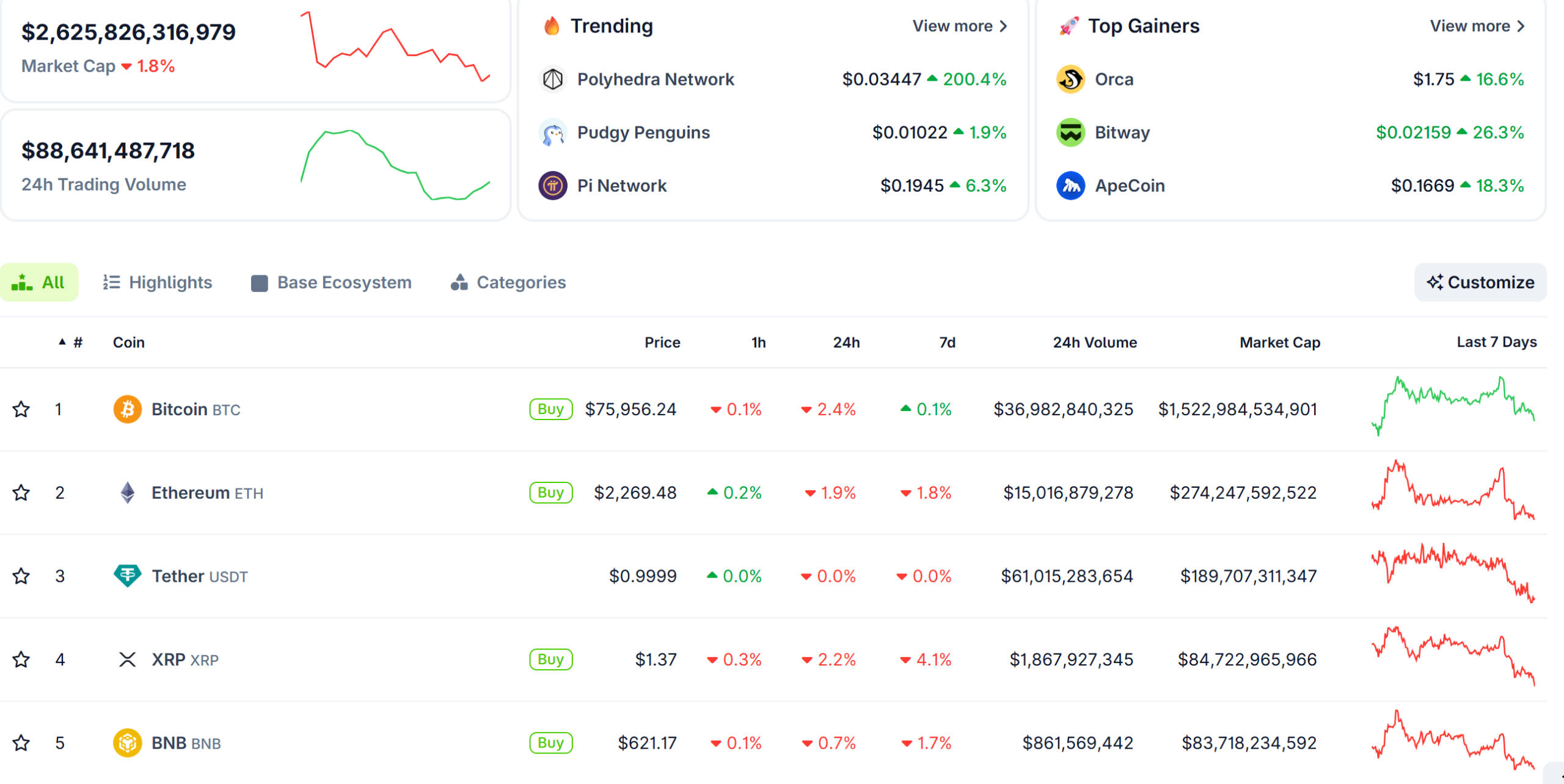
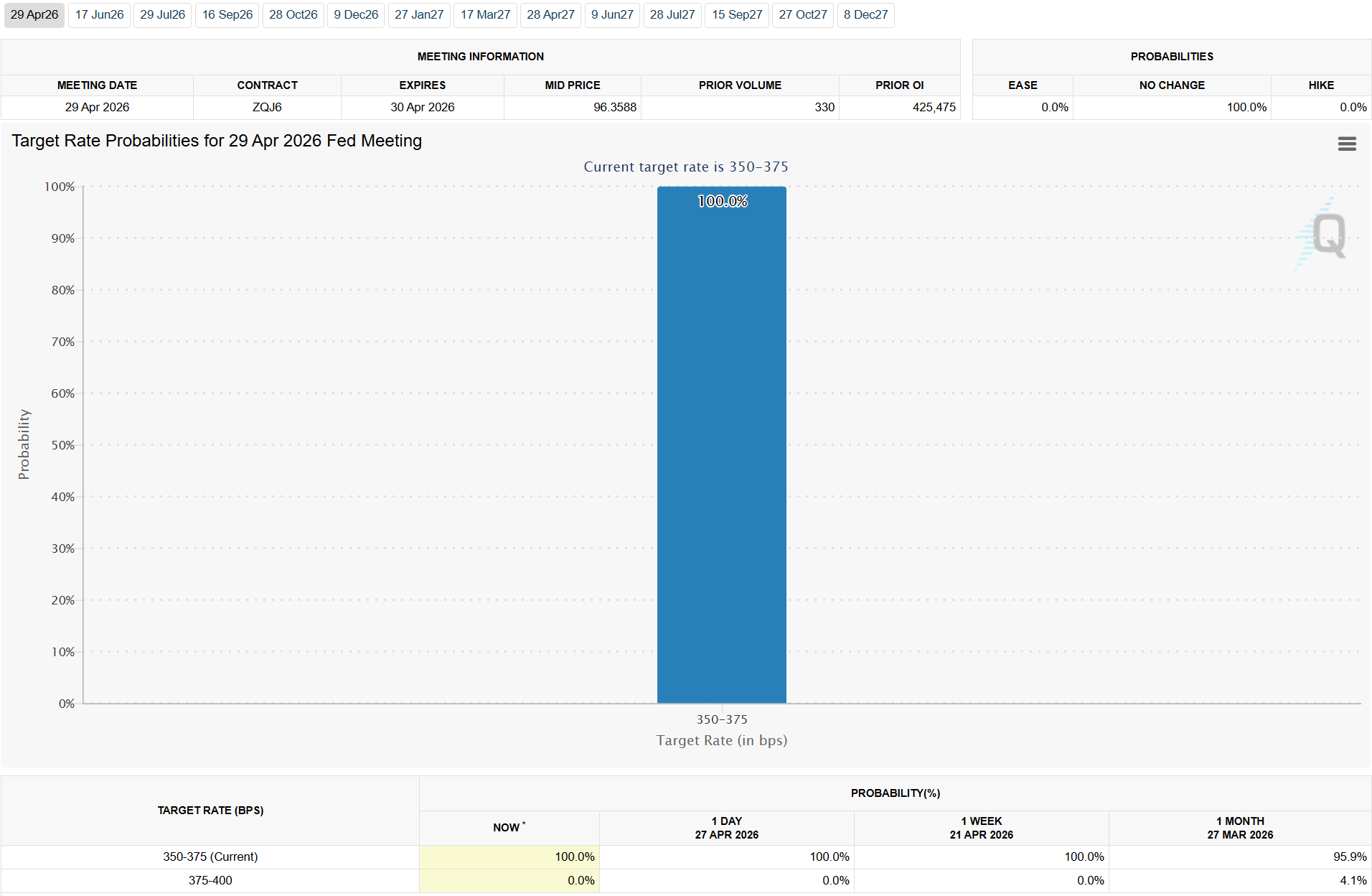
Crypto prices declined Tuesday as traders cut exposure ahead of Federal Reserve Chair Jerome Powell’s final Federal Open Market Committee (FOMC) meeting.
CME Group’s FedWatch tool shows a 100% probability of a hold at 3.50% to 3.75% on April 29, leaving Powell’s press conference as the primary focus for risk assets.
Crypto markets pull back as derisking takes hold
Bitcoin (BTC) fell to levels below $76,000, while the broader market capitalization slid 1.8% to $2.62 trillion, representing losses nearing $40 billion in the last 24 hours.
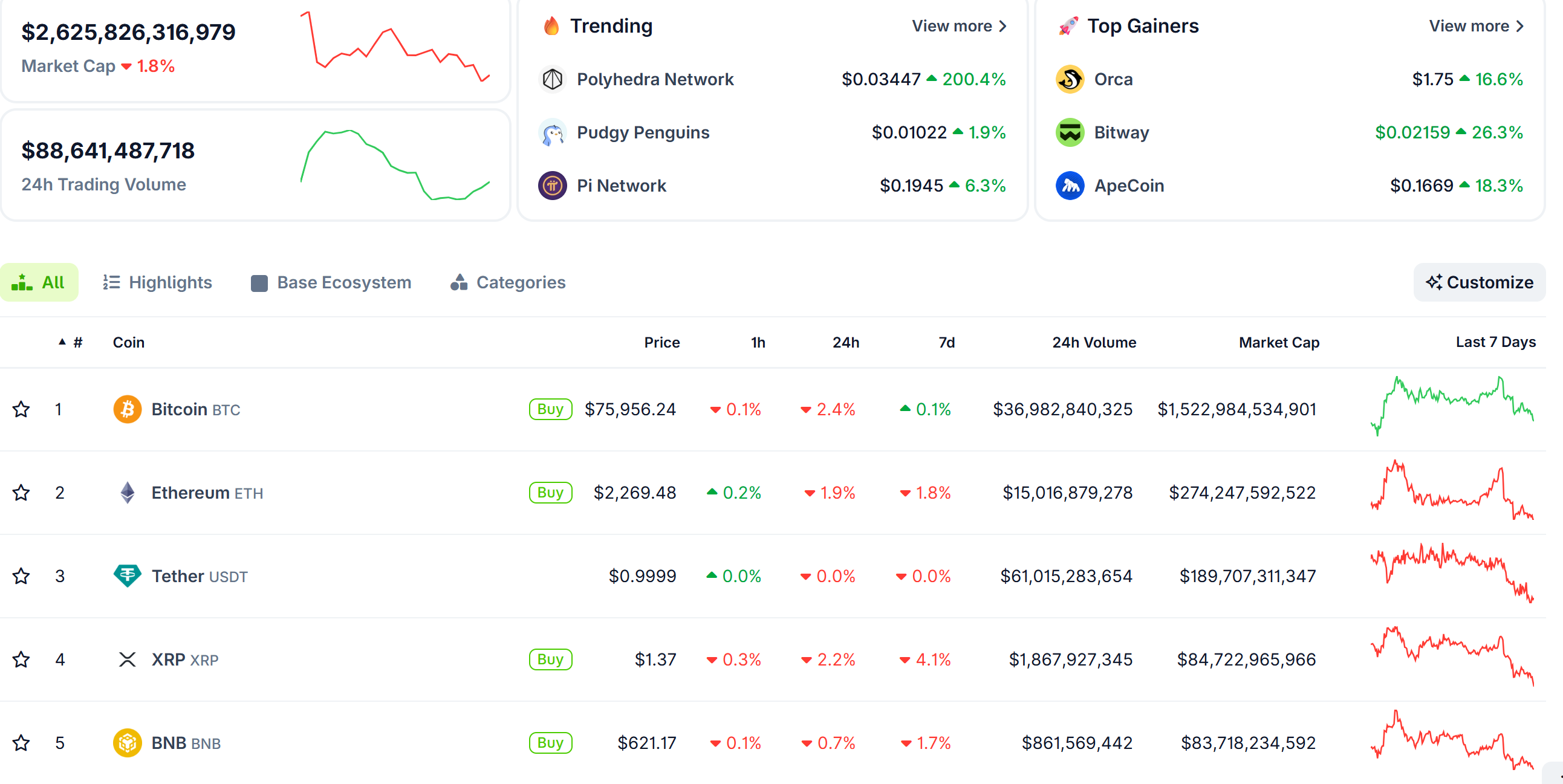
The pullback fits a pattern where Bitcoin and altcoins drift lower in the 24 hours before each Fed decision. Ether (ETH) lost almost 2%, XRP fell 2.2%, and BNB slipped 0.7%, per CoinGecko data.
The retreat tracks reduced positioning in leveraged perpetuals and an uptick in exchange inflows, both common signs of risk reduction before macro events.
“Nearly 10K BTC hit exchanges in a single day while whale inflows made up over 70% of deposits. Tbh thats not random activity thats size moving with intent,” one analyst observed.
Headline inflation near 3.3% to 3.5%, driven by oil pressure from the Iran and Middle East conflict, has weakened the case for near-term cuts and reinforced the hawkish-hold expectation in CME Group’s data.
“Feels like we are doing some derisking ahead of tomorrow. The real move BTC wants to make will happen later this week,” noted one user.
Final Powell Meeting Shifts Focus to Tone
This is widely viewed as Powell’s last appearance as Fed Chair before Kevin Warsh takes over in mid-May. CME data extends the hold forward, with a 100% probability of no change in tomorrow’s FOMC interest rate decision.
“Focus shifts to the FOMC meeting tomorrow. Rates likely unchanged, so eyes will shifts to Powell’s messaging. With inflation pressures tied to energy and global tensions still unresolved, there is a more complex trade-off between price stability and growth,” commented Federico, an executive at Phemex.
Treasury yields ticked higher, with the 10-year near 4.33% to 4.36%, while the dollar held firm on safe-haven flows. Volatility is expected to spike during Powell’s afternoon press conference.
What the next 24 hours could reveal is whether Powell signals openness to later cuts or doubles down on inflation vigilance, a tone that has historically shaped the following month of crypto positioning.
The post Crypto Markets Shed $40 Billion in De-Risking Ahead of Powell’s Final FOMC Decision appeared first on BeInCrypto.

Japan crypto exchange Bitbank has launched a crypto-linked credit card that allows users to pay their bills directly in Bitcoin, the first such product from a licensed Japanese exchange to combine traditional credit functionality with BTC settlement.
The move signals a meaningful shift in how Japan’s regulated crypto sector is approaching retail payment infrastructure.
The card offers 0.5% cashback in cryptocurrency on all spending, layering a rewards incentive on top of the settlement mechanic.
Bitcoin payments integration has never had a cleaner regulatory window in Japan than it does right now, and Bitbank is moving into that window ahead of competitors.
- Settlement currency: Bitcoin, paid directly from user’s Bitbank exchange account
- Cashback rate: 0.5% in cryptocurrency on all card spending
- Card type: Credit card, not prepaid or debit
- Geographic scope: Japan, regulated under FSA licensing framework
- Exchange background: Bitbank FSA-licensed since 2017, operating since 2014
Discover: The best crypto to diversify your portfolio with
How Bitbank’s Bitcoin Crypto Settlement Card Actually Works in Japan
The mechanics are straightforward, but the product structure deserves precision. Users hold a Bitbank credit card, make purchases via standard card rails, and settle the resulting bill in Bitcoin held in their Bitbank exchange account rather than Japanese yen.
The 0.5% cashback reward is paid in cryptocurrency, compounding the user’s crypto exposure with everyday spending.
Bitbank, which received its Financial Services Agency license in 2017 and has operated as one of Japan’s foundational crypto exchanges since 2014, is rolling the product out domestically.

The card targets Japanese retail users who already maintain BTC positions on the exchange and want to bring those holdings into day-to-day financial life without liquidating to fiat first.
This is not a prepaid card or a crypto debit product; it is a credit card with Bitcoin as the settlement currency, a distinction that matters for the payments architecture.
Japan’s 106th credit card company had already launched a crypto Visa prepaid card in September 2024, but Bitbank’s credit-first structure represents a separate and more integrated product category.
Discover: The best pre-launch token sales
The post Japan Bitbank Launches Crypto-Linked Card That Settles Bills in Bitcoin appeared first on Cryptonews.

The recovery effort for rsETH, stalled by the April Kelp bridge incident that released 116,500 rsETH (roughly $293 million at the time) without a corresponding burn on Unichain, is moving into a formal technical phase. The DeFi United coalition, linked to Aave, published a plan to restore rsETH backing by converting committed ETH into rsETH in staged tranches and depositing the tokens into the bridge’s lockbox. This approach aims to resume normal bridge operations once the backing is fully restored. LayerZero and Kelp have also implemented additional security measures ahead of a full return to service, according to Aave.
Parallel to the backing restoration, DeFi United outlined steps to unwind attacker-linked positions across Aave and Compound to reclaim collateral and repair market distortions caused by the exploit. The coalition notes that seven addresses associated with the attacker still hold active rsETH-backed positions on Aave and Compound, representing about 107,000 rsETH of the original 116,500 rsETH released.
The broader context for rsETH recovery continues to unfold as the ecosystem coordinates funding, governance, and technical execution. Earlier coverage highlighted a broader pledge of ETH to restore rsETH backing, and the current plan builds on that momentum with a concrete, vote-dependent process.
The proposed sequence would temporarily adjust the rsETH oracle price to enable controlled liquidations, transfer recovered collateral to a DeFi United multisig, restore the oracle, redeem the rsETH for ETH, and use the resulting funds to clear deficits across affected markets. The recovery plan thus transitions from pledges and public commitments to a coordinated technical process that relies on governance approvals, temporary oracle changes, and execution across several DeFi protocols. While designed to restore rsETH backing, the plan remains contingent on DAO votes, finalized agreements, and the attacker not disrupting the liquidation steps.
Source: Aave
Ethereum backers join the recovery effort
The technical plan follows earlier moves to secure funding and governance support for rsETH restoration. On Monday, Consensys and Ethereum co-founder Joe Lubin joined DeFi United with a commitment of up to 30,000 ETH to back the recovery, while Sharplink, a publicly traded Ethereum treasury company, joined in an advisory role to help structure the plan.
As part of the broader push, Aave Labs had asked the Arbitrum DAO to release 30,765 ETH that had been frozen by the Arbitrum Security Council following the exploit and redirect those funds to DeFi United. The goal is to accelerate the restoration of rsETH backing and stabilize affected markets.
Earlier coverage noted that crypto protocols pledged about 43,000 ETH to the rsETH relief effort, underscoring the ecosystem-wide appetite to address the aftermath of the breach.
As of the latest update, DeFi United’s website shows roughly $302.26 million in total raised or committed toward the rsETH recovery, equivalent to about 132,706.903 ETH. Some commitments remain subject to DAO votes and final execution, reflecting the governance-intensive nature of the plan.
DeFi United secured over $300 million in commitments. Source: DeFi United
The initiative sits at the intersection of cross-chain security, governance, and rapid liquidity management. By moving toward a structured, multi-step restoration rather than relying solely on pledges, the effort aims to reduce the risk of a prolonged imbalance between rsETH and its backing assets while preserving user trust in the affected protocols.
What this means for users and markets
For rsETH holders and the broader DeFi ecosystem, the plan represents a carefully staged attempt to restore collateral behind a pegged asset that saw a rapid distribution of backings during the breach. If successful, the process could set a precedent for how multi-chain bridges and restaking ecosystems manage post-incident recoveries without triggering abrupt slippage or cascading liquidations. The reliance on governance votes underscores the ongoing tension between rapid response and community consent in DeFi crisis management.
Investors and traders will want to watch the timeline for governance approvals, the pace of ETH-to-rsETH conversions, and the execution across Aave, Compound, and the implicated bridge components. The involvement of high-profile supporters—Consensys, Joe Lubin, and Sharplink—adds credibility to the plan, but the execution still hinges on attacker behavior and the stability of oracle adjustments during liquidations.
Next milestones to monitor
Key milestones include finalization of the governance process to authorize the tranche-based ETH-to-rsETH conversions, the operational deployment of the restored backing into the lockbox, and the restoration of oracle feeds to normal levels after backing is re-established. The plan also requires the attacker’s positions to be reliably unwound without triggering further market impairment, an outcome that hinges on coordinated liquidations and cross-protocol cooperation.
Additionally, continued updates on the Arbitrum DAO’s actions and any further commitments from ecosystem participants will shape the speed and reliability of the restoration. The evolving liquidity landscape as new funds are deployed and balances are reset will inform how quickly rsETH markets can regain normal functioning and reduce systemic risk across the DeFi stack involved in the recovery.
Readers should stay attentive to governance votes and official statements from DeFi United, Aave, and partner protocols as the plan progresses. The rsETH restoration is a multi-faceted effort that requires precise coordination across several entities, and the outcome will influence how similar crisis-response playbooks are interpreted in future cross-chain incidents.
Paul Sztorc is not trying to move Satoshi Nakamoto’s bitcoin.
That is the narrow fact getting lost in the backlash around eCash, a proposed Bitcoin fork scheduled for August at block height 964,000. The new chain would copy Bitcoin’s history up to that point, giving BTC holders an equivalent balance on the forked network. Hold 4.19 BTC, get 4.19 eCash.
This would follow the standard fork playbook. Bitcoin Cash did it in 2017, and Bitcoin SV followed later. Both copied Bitcoin’s ledger, changed the rules and in the hopes that the market will care.
eCash is different because of what it plans to do with Satoshi’s copied coins.
The roughly 1.1 million BTC attributed to Bitcoin’s pseudonymous creator Satoshi Nakamoto sits in dormant addresses often linked to the Patoshi pattern, an early mining fingerprint widely believed to trace back to Satoshi though never conclusively proven.
On a normal one-to-one fork, those addresses would receive roughly 1.1 million eCash. Sztorc’s plan would allocate 600,000 eCash to those addresses and redirect the remaining 500,000 eCash to investors who fund the project before launch.
Sztorc, CEO of LayerTwo Labs, pushed back on the theft framing in a Monday X post.
“We do not take any of Satoshi’s BTC,” he wrote. “BTC balances are untouched by eCash. To move BTC, you always need BTC software and the BTC private key. We lack both.”
But Satoshi’s untouched holdings function as Bitcoin’s foundational guarantee, the proof that even the network’s creator never moved his coins because the rules apply to everyone equally. Selling claims on a forked-chain version of those holdings to fund a new project is the part that reads as theft, even when no theft is technically occurring.
That turns the dispute into a property-rights fight, even if the property exists only on a new chain.
“Bitcoin was created to preserve and protect inviolable property rights for everybody on earth,” Beau Turner, CEO of mining firm Abundant Mines, said in an email to CoinDesk. “Any proposal that seeks to evolve or improve it by violating the property rights of the creator of that network is such a serious ethical misstep that it’s hard to believe it would even be considered.”
The timing makes the fight sharper. Bitcoiners have already spent recent weeks arguing over proposals to freeze or restrict old quantum-vulnerable coins, including addresses believed to belong to Satoshi. Those debates put dormant balances, immutability and social intervention back at the center of Bitcoin culture.
That is why the eCash fight is landing in a market already primed to treat any intervention around Satoshi-linked coins as radioactive. Vijay Selvam, author of Principles of Bitcoin, argued that even proposals framed as protective measures risk damaging Bitcoin’s core monetary promise if they create a precedent for treating dormant coins differently.
“Freezing Satoshi’s coins under any circumstances sets a precedent that irreparably damages Bitcoin’s monetary properties,” Selvam wrote on X. “With such a precedent, how can Bitcoiners ever feel confident that their money is safe into the distant future without feeling the need to constantly monitor the news to see if miners are going to rug them?”
Selvam compared the issue to gold’s durability, arguing that bitcoin should offer similar confidence across generations. “If you set a rug-pull precedent for Bitcoin, you’d forever kill its claim to being durable and immutable digital gold,” he wrote. “You’d destroy confidence in its timeless integrity.”
Why propose eCash?
Sztorc has previously spent years pushing Drivechains, a proposal that would let developers add sidechains to Bitcoin through proposals BIP300 and BIP301. The Bitcoin Core community has not agreed to adopted it, and the eCash fork now functions as both an exit plan and pressure tactic.
He has said he would call it off if Bitcoin activates those proposals before August. There is no sign that will happen.
This is why people care even if eCash never becomes economically relevant. Bitcoin forks mostly fail in market terms, but they still test Bitcoin’s social assumptions.
Bitcoin Cash and Bitcoin SV copied the ledger and kept trading, but neither came close to displacing BTC. eCash may end the same way. The difference is that its launch forces a cleaner question than block size ever did: can a fork claim Bitcoin’s moral inheritance while rewriting the most famous untouched balance on the copied chain?
The movement in Meta Platforms shares is being driven by two competing narratives. On one hand, advertising revenue is benefiting from AI-based tools: the Advantage+ platform continues to support strong advertiser demand, and the analyst consensus for Q1 2026 revenue stands at around $55.5 billion—near the upper end of the company’s guidance range of $53.5–56.5 billion. On the other hand, investors remain cautious about planned capital expenditure of $115–135 billion for 2026, which is weighing on free cash flow. The company’s earnings release is scheduled for 29 April after the market close.
Technical Overview
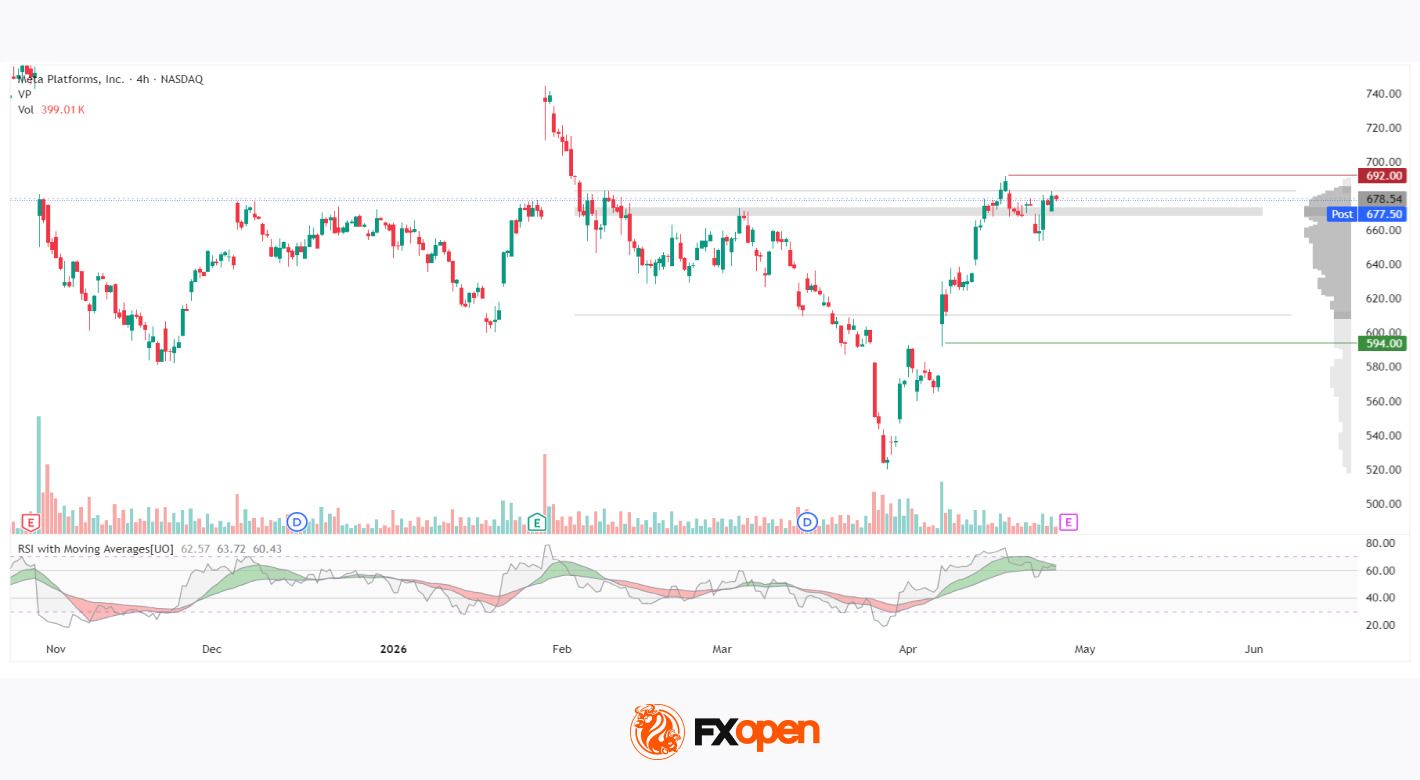
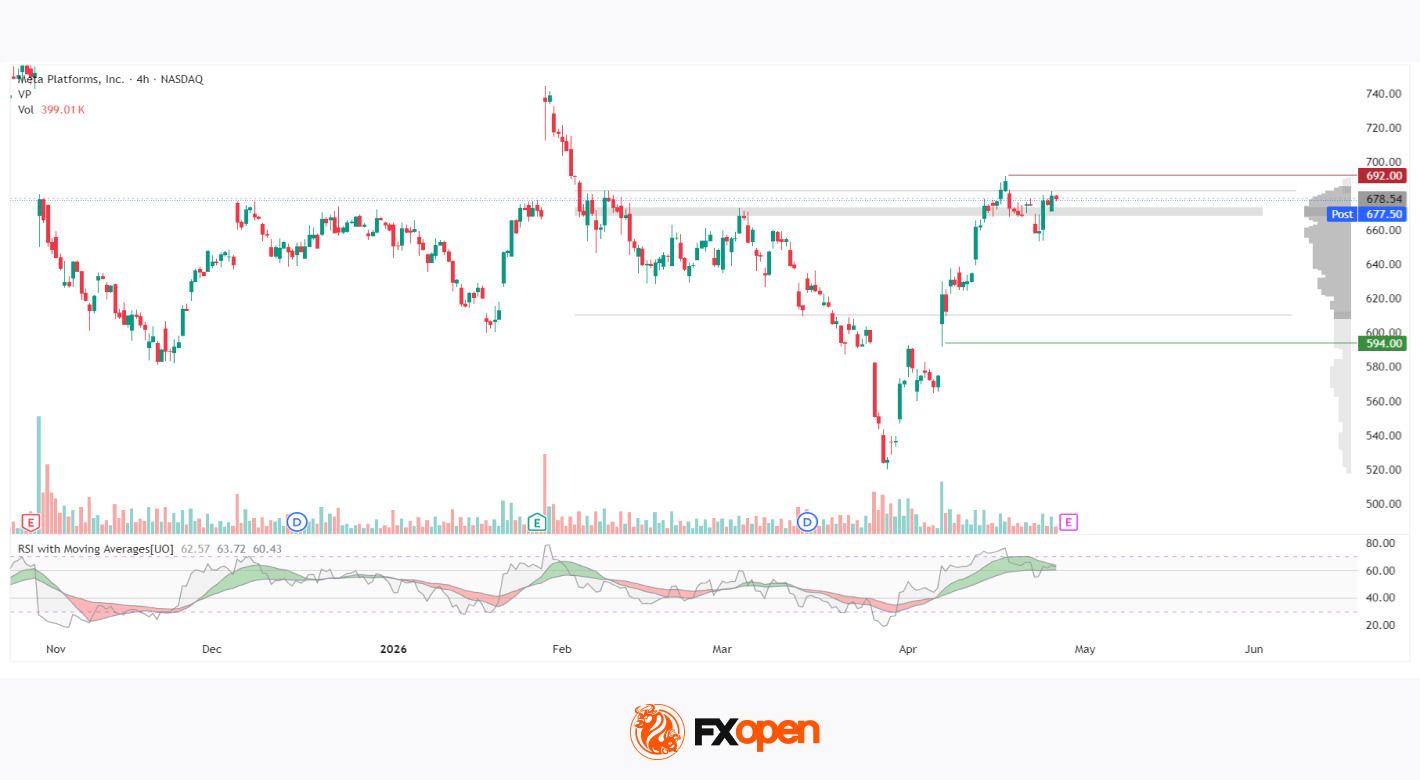
On the 4-hour chart, price action from late January to the end of March showed clear signs of a downtrend, with the stock falling roughly 30% from $744 to $521. The rebound from this low was sharp and symmetrical, forming a clear V-shaped recovery. The return of buyers was accompanied by a notable spike in vertical volume on 8 April, after which the price moved firmly into the market profile range of $610–683.
Within this zone, momentum has slowed. The Point of Control (POC) is concentrated around $668–673. The price is currently trading between this high-volume area and the upper boundary of the profile at $683, where trading activity has been most concentrated over the period. Above current levels, the next key resistance is at $692 — the April high. Support at $594 aligns with a gap formed during the strong upward move on elevated volume. The RSI with moving averages shows readings of 62, 63, and 60. The oscillator sits between two upward-sloping moving averages, indicating that bullish momentum persists, although price action is clearly slowing near the upper edge of the volume range.
Summary
The chart structure reflects a transition from a deep correction to a recovery phase that has now encountered a dense volume barrier. Price behaviour within the $668–683 range will largely depend on the upcoming earnings release and whether the company can meet analysts’ expectations amid rising capital expenditure.
Buy and sell stocks of the world’s biggest publicly-listed companies with CFDs on FXOpen’s trading platform. Open your FXOpen account now or learn more about trading share CFDs with FXOpen.
This article represents the opinion of the Companies operating under the FXOpen brand only. It is not to be construed as an offer, solicitation, or recommendation with respect to products and services provided by the Companies operating under the FXOpen brand, nor is it to be considered financial advice.
Pi Network price rallied over 15% in the past week, outperforming a largely flat crypto market as a wave of network upgrades and event-driven catalysts boosted demand for the token.
Summary
- Pi Network rose about 15% over the past week to around $0.189, outperforming a largely flat crypto market amid upgrade-driven demand.
- The rally was supported by the rollout of Protocol 22.1 and the anticipation of Protocol 23, which is expected to introduce smart contract functionality in May.
- Price is testing the $0.19–$0.20 resistance zone, with a breakout targeting $0.204–$0.22, while failure to hold could see a pullback toward $0.17 support.
According to data from crypto.news, Pi Network (PI) climbed from a weekly low near $0.166 to around $0.189 at press time on April 28, pushing its market cap close to $2 billion and ranking it among the top 50 crypto assets.
The latest move comes as the network successfully rolled out its mandatory Protocol 22.1 mainnet upgrade on Monday. The upgrade is aimed at improving scalability and transaction throughput, a key requirement as the ecosystem prepares to support more complex decentralized applications.
Investor sentiment has also strengthened ahead of the upcoming Protocol 23 upgrade, scheduled for May 11. This next phase is expected to introduce full smart contract functionality, marking a major shift for Pi from a simple peer-to-peer transfer system to a programmable Web3 platform.
At the same time, the project’s visibility has increased following confirmation that it will participate as an official sponsor at Consensus 2026 in Miami, set to take place between May 5 and May 7. The scheduled appearances of co-founders Nicolas Kokkalis and Chengdiao Fan have helped renew retail interest, particularly across social media platforms.
Supply-side dynamics have further supported the rally. On-chain data shows a decline in token unlocks toward the end of April, reducing immediate selling pressure and allowing fresh demand from the upgrade narrative to have a stronger impact on price action.
Pi Network price analysis
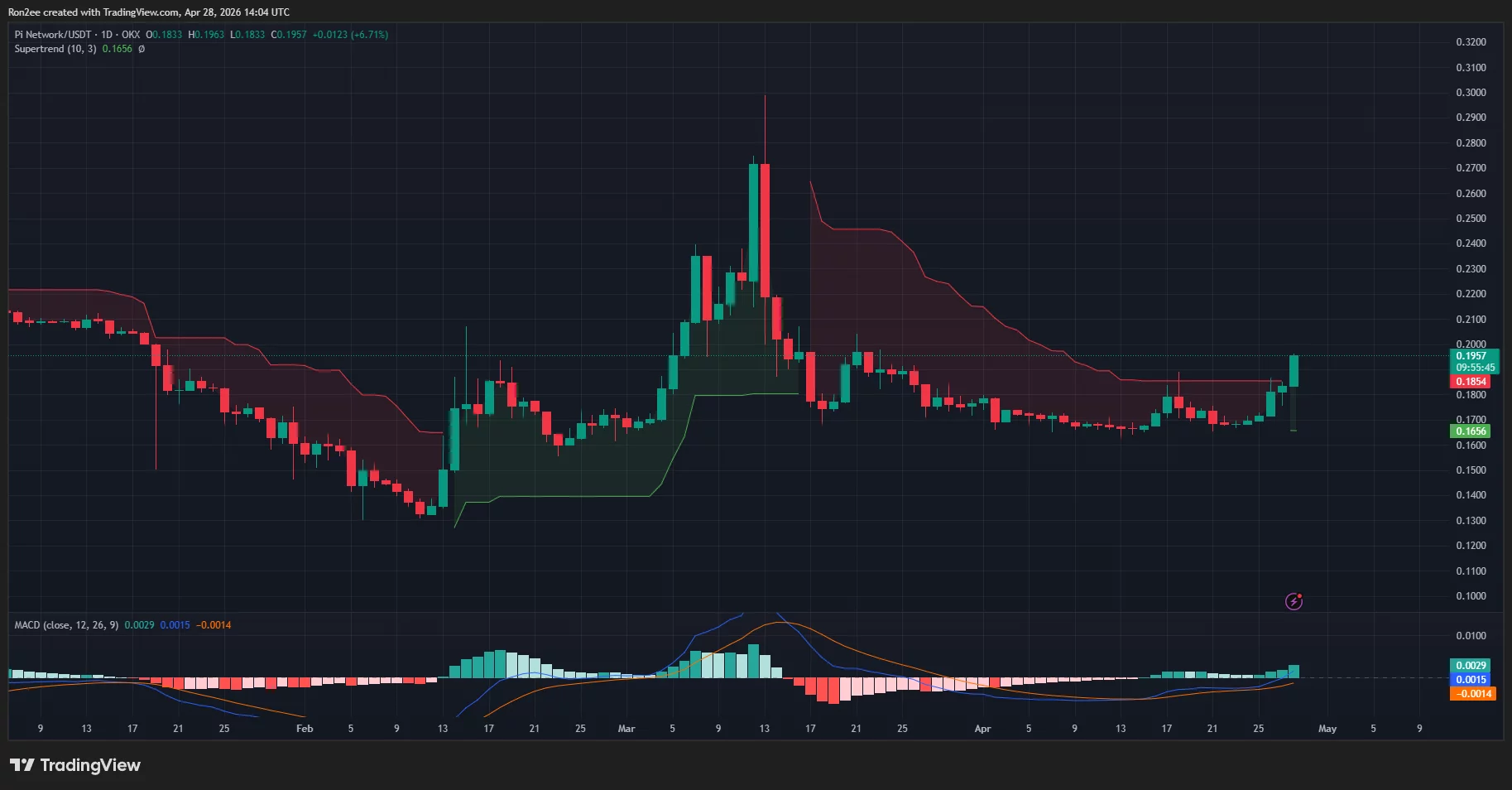
On the daily chart, Pi Network price is attempting to reclaim the $0.19–$0.20 resistance zone after spending most of April consolidating near the $0.16–$0.18 range. The recent breakout attempt follows a period of compression, suggesting that volatility is beginning to expand again.
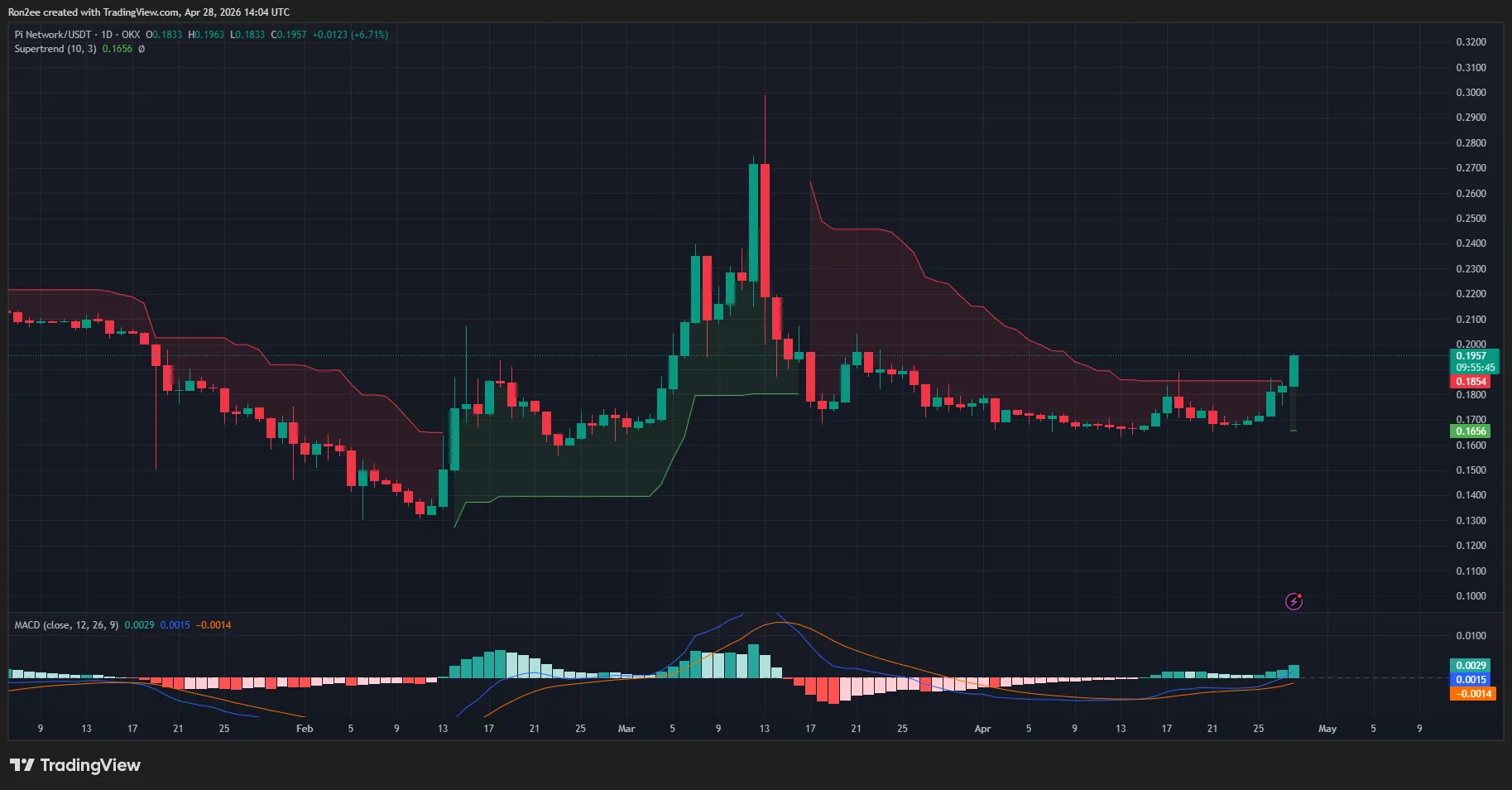
The chart also shows that PI price has flipped back above the Supertrend indicator, which has now turned green. This shift typically signals a short-term trend reversal in favor of buyers and indicates that bullish momentum is building.
Momentum indicators are also starting to align with the price action. The MACD has moved into positive territory, with the signal lines crossing upward and histogram bars turning green, pointing to strengthening upside momentum after weeks of muted activity.
From a pattern perspective, traders are closely watching the formation of a potential double-bottom structure with a neckline around the $0.190 level. A sustained close above this resistance could confirm the breakout and open the door for a move toward $0.2045, with a further extension toward $0.22 if momentum continues into the Protocol 23 launch window.
However, caution remains warranted. Pi Network has previously shown a tendency to follow a “buy the news, sell the event” pattern around major announcements. If the price fails to hold above $0.19, it could slip back toward the $0.17 support zone, with a deeper pullback potentially retesting the $0.165 level.
For now, the short-term bias remains tilted to the upside as long as the token holds above its recent support and the positive news flow continues through early May.


Developers behind a new wallet product say they have found a way to tackle quantum computing risks using a smart contract layer that runs alongside Bitcoin without requiring any change to the network itself.
Postquant Labs unveiled Quip Network’s post-quantum bitcoin wallet Tuesday, the company told CoinDesk in an email. The product runs on Arch Network, a system that lets developers build smart contracts anchored directly to Bitcoin rather than on a separate chain or through wrapped tokens.
Quip uses that infrastructure to add a post-quantum signature scheme called WOTS+, short for Winternitz One-Time Signature, on top of Bitcoin’s existing security. WOTS+ is a tested cryptographic technique that does not rely on the elliptic curve math a quantum computer could break.
By using a “Layer 2” — shorthand for a separate network built on top of Bitcoin that processes transactions and settles back to the main chain—developers can add features without changing Bitcoin’s base layer.
“The Bitcoin community has delayed a fix for years, despite Satoshi himself discussing the quantum problem,” Postquant Labs CEO Colton Dillion said in a statement to CoinDesk. “Developers say any protocol upgrade could take 5 to 10 years, but with Quip’s approach, we provide similar protection immediately.”
Bitcoin’s quantum readiness
The launch arrives in the middle of an active fight over how Bitcoin should respond to quantum risk.
Prominent developer Jameson Lopp and five others proposed BIP-361 two weeks ago, which would phase out quantum-vulnerable addresses on a fixed five-year timeline and freeze coins that fail to migrate, including the roughly 1.1 million bitcoin attributed to pseudonymous creator Satoshi Nakamoto.
Paul Sztorc’s controversial eCash hard fork would copy Bitcoin’s chain and ship seven sidechains including a quantum-resistant one, funded partly by reassigning Satoshi-pattern coins on the new ledger to investors.
Both proposals have drawn pushback from the community.
Quip’s pitch is that neither approach is necessary. The setup requires no soft fork, no consensus change, no community vote. A soft fork is a Bitcoin upgrade that tightens existing rules so older software still works, but it still needs broad miner and node support to activate. Bitcoin’s last major soft fork was Taproot in 2021. The next one, if it happens, could take years.
Technical trade-offs
The three approaches actually disagree on something specific. Lopp’s argument is that Layer 2 protection like Quip’s is insufficient because Bitcoin mainnet public keys still leak the moment a user broadcasts a transaction, giving a future quantum attacker a target.
There are a few caveats, however. The wallet app launches next week rather than today. A third-party audit is underway but not complete. Quip’s quantum-resistant accounts already exist on Ethereum and Solana, but the Bitcoin deployment is new and Arch Network is still relatively early infrastructure.
Postquant Labs CTO Dr. Richard Carback, a long-time collaborator with eCash inventor Dr. David Chaum who now advises the project, said the approach narrows the window for a quantum attack to as little as two blocks, roughly 20 minutes.
(David Chaum’s eCash is the original digital cash protocol from 1983, the academic foundation for ‘blind’ signatures and privacy-preserving electronic money. It predates Bitcoin by 25 years and has nothing to do with Bitcoin or the eCash proposal by Sztorc.)
Sztorc’s argument is that incremental patches are exactly why Bitcoin needs a clean fork with quantum resistance built in from the start. The Layer 2 approach, which now includes Quip and Blockstream’s hash-based signature work on the Liquid Network, argues both other positions overreact to a threat that better infrastructure can handle without changing Bitcoin itself.
Which approach wins depends partly on how fast quantum computers actually arrive. The Bitcoin holders most worried about quantum risk have historically been the same group most resistant to wrapped or smart-contract-anchored products.
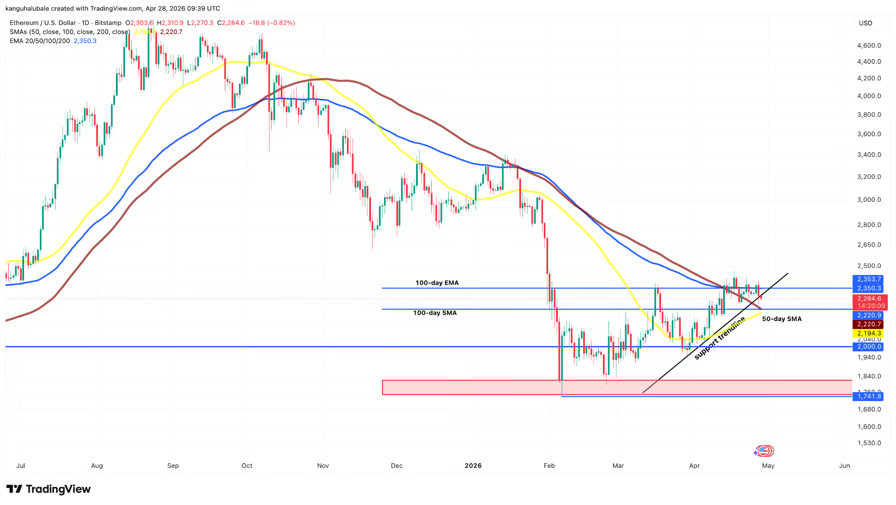
Ether (ETH) analysts have mapped out key ETH price levels to watch over the next few weeks, with a focus on the $2,000 psychological level.
Key takeaways:
- Dropping below the 200-day simple moving average at $2,220 could confirm more downside for Ether.
- ETH faces stiff resistance at $2,400, a level that must be reclaimed by the bulls.
Ether price stuck between two key levels
Data from TradingView showed the ETH/USD pair trading below $2,300, down 5% over the last two days and erasing all gains made over the weekend.
This meant that the price remained wedged between the 100-day exponential moving average at $2,350 and the 100-day simple moving average (SMA) at $2,220, as shown in the chart below.
This suggested that Ether could consolidate within these trend lines for a few more days before a decisive move.
Telegram trading resource Technical Crypto Analyst said that after losing the support trendline at $2,300, “we can probably expect Ethereum to drop, and it might even hit the lower support level in the next few days,” adding:
“A solid breakdown with good volume would confirm this.”
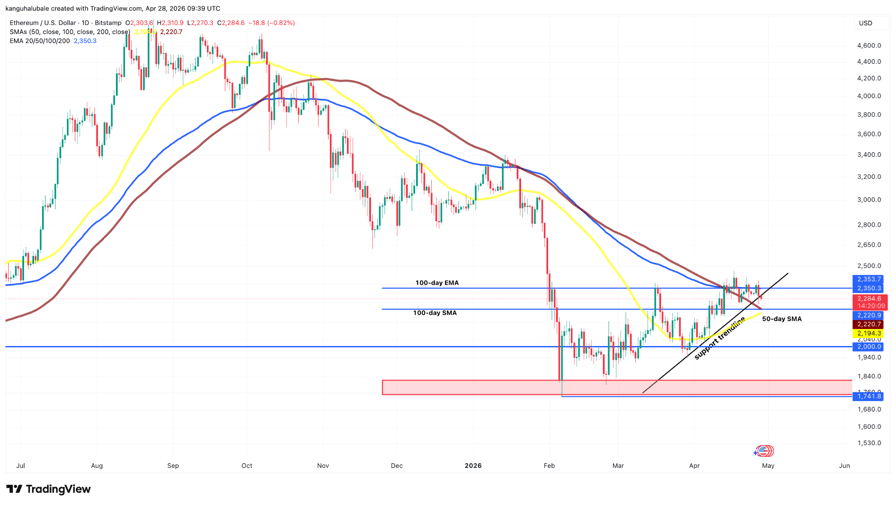
ETH/USD daily chart. Source: Cointelegraph/TradingView
The analyst was referring to two immediate support zones: the $2,200 area, where the 50-day and 100-day SMAs converge, and the psychological level at $2,000.
“ETH has dropped below the $2,300 level,” said fellow analyst Ted Pillows in a Tuesday post on X, adding:
“The next crucial support zone is $2,200 which could be a level for a short-term bounceback.”
A key buy zone to watch below that is the $1,800-$1,750 area, which aligns with the multi-year low reached on Feb. 6.
In a recent post on X, trader Daan Crypto Trades said that the key levels to watch were $2,100 as support and the resistance at $2,800, which ETH price has “respected” well over the past few years.
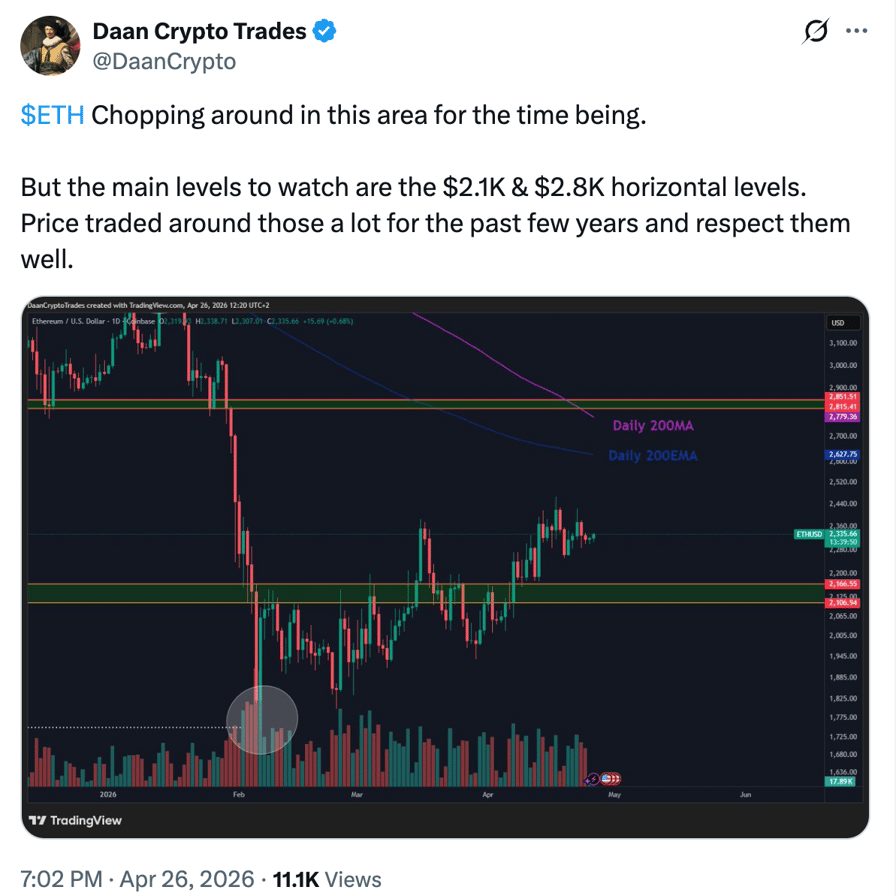
ETH/USD daily chart. Source: X/Daan Crypto Trades
As Cointelegraph reported, a daily close below the moving averages around $2,200 would bring the next line of defense at $2,000 into focus.
Ethereum price must reclaim $2,400 to continue recovery
As Cointelegraph also reported, Ether’s bullish case hinges on flipping the resistance at $2,400 into support, where the realized price currently is.
“This is a very important psychological factor,” CryptoQuant analyst CW8900 said in a recent X post, adding:
“Breaking through that line signifies that whales are transitioning to a profitable position.”
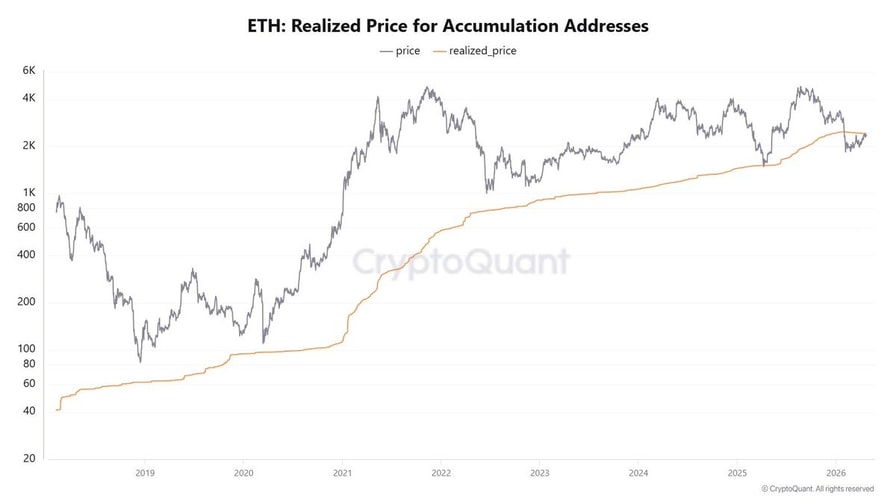
ETH realized price. Source: CryptoQuant
With whales back in a profitable position, it would “provide grounds for their buying power to become stronger,” the analyst added.
Related: Ethereum’s EEZ could pull other blockchains into its orbit
Meanwhile, Ether’s liquidation map reveals that a break above $2,400 would trigger over $1.94 billion in short liquidations across all exchanges.
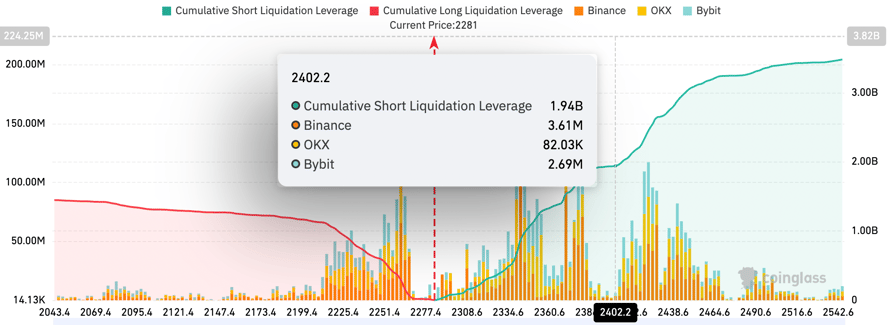
ETH exchange liquidation map. Source: CoinGlass
This means a significant amount of bearish bets risk liquidation on a move higher, opening the way to a sharper upward cascade if the recovery resumes.

Downfall of clueless pals who posed with mountains of weed

Blair institute demands ’emergency handbrake’ on sickness benefits bill
Opendoor (OPEN) Stock Analysis: Can This iBuyer Recover in 2026?

Manchester United reach agreement with Casemiro over contract clause amid transfer speculation

US brings back mandatory military draft registration

Steven Gerrard disagrees with Gary Neville over ‘shock’ Chelsea and Arsenal claim | Football

Raoul Pal Just Exposed the REAL Reason Bitcoin Crashed And It’s NOT What You Think!

Ram Charan Wife Upasana Exclusive Visuals @ Apollo Hospitals at Financial District | hmtv

Cabaret | “Money” Musical Number | Warner Bros. Entertainment
-

 Fashion4 days ago
Weekend Open Thread – Corporette.com
-

 Tech22 hours ago
Register Renaming | Hackaday
-
 Crypto World3 days ago
Hyperliquid $HYPE Rally Builds Momentum as AI Sector Enters Prove-It Phase
-

 Politics6 days ago
Making troops accountable for war crimes threatens US alliance, ex-SAS colonel warns
-

 Politics6 days ago
Disabled people challenge government SEND proposals over segregation concerns
-

 Business5 days ago
Patterson-UTI Energy, Inc. (PTEN) Q1 2026 Earnings Call Transcript
-

 Business6 days ago
Rolls-Royce Voted UK’s Most Iconic Trade Mark as IPO Register Hits 150
-
 Sports2 days ago
IPL 2026: Ruturaj Gaikwad registers slowest fifty of the season, enters all-time unwanted list | Cricket News
-

 Crypto World7 days ago
New York sues Coinbase, Gemini over prediction market offerings
-

 Politics18 hours ago
Drax board avoid their own AGM, accused of greenwashing & environmental racism
-

 Politics6 days ago
Starmer handler McSweeney to be dragged from shadows by Foreign Affairs Committee
-

 Politics6 days ago
Zack Polanski responds to home secretary’s taser threat
-
Politics6 days ago
Wings Over Scotland | How To Get Away With Crimes
-
 Business6 days ago
HCL Tech share price tank over 9% after weak Q4. JPMorgan, HSBC & 3 others cut target price
-

 Crypto World7 days ago
Crypto’s great hope in Senate’s Clarity Act still has a path to survive tight calendar
-

 Politics6 days ago
‘Iran is still a nuclear threat’
-
 Sports6 days ago
Tim Bradley names the current best in the world: “Better than Inoue and Usyk”
-

 NewsBeat2 days ago
LK Bennett closes all stores after entering administration
-

 Crypto World4 days ago
Michael Saylor says BTC winter is over. Market analyst disagrees, says bitcoin was in a pullback
-
 Crypto World7 days ago
Ethereum Price News: ETH Flashes a Bullish Setup No Holder Should Miss While Pepeto Nears Its Binance Listing
You must be logged in to post a comment Login