

Crypto World
Amazon Warning Triggered Anthropic AI Crackdown

The Trump administration’s decision to cut foreign access to Anthropic’s most powerful AI models was reportedly triggered by calls from Amazon CEO Andy Jassy.
According to a report from The Wall Street Journal, Jassy contacted senior government officials on Thursday after Amazon researchers discovered a way to prompt Anthropic’s Fable 5 model into returning information that could be used for cyberattacks.
The call, along with warnings from at least five other firms, led to a frantic shuffle within the White House to gauge the threat and contact Anthropic CEO Dario Amodei, who reportedly pushed back on the administration’s concerns and requests to voluntarily pull the model.
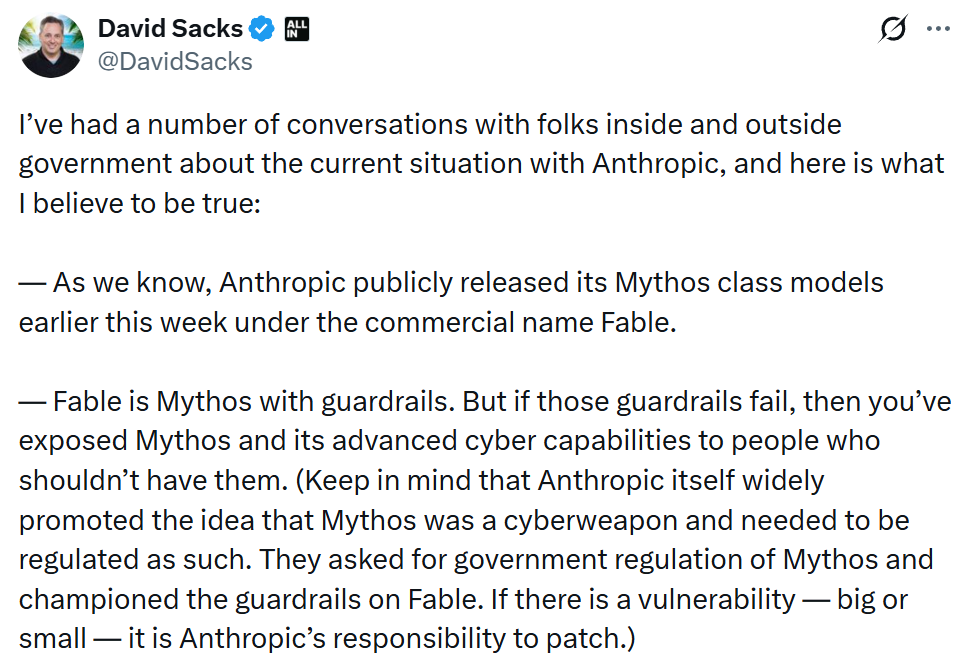
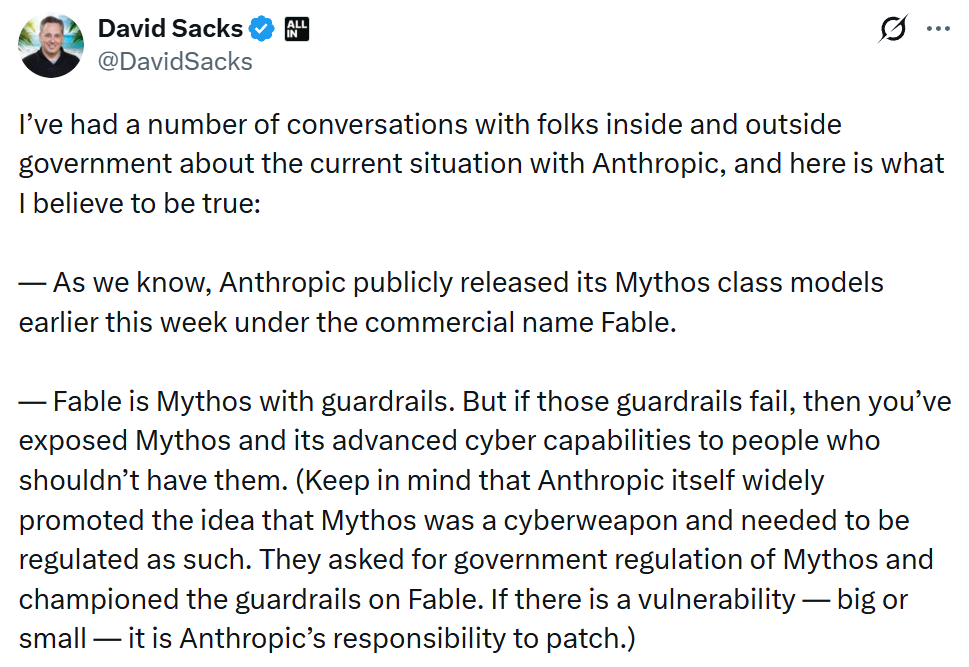
“In reaction, the Admin issued the export control. The Admin did this reluctantly,” said David Sacks, the co-chair of the President’s Council of Advisors on Science and Technology, on Saturday. “It’s been very surprised that Anthropic hasn’t wanted to cooperate with a reasonable safety request (ie fixing the jailbreak issue).”
Source: David Sacks
The episode sheds light on what led to the US directive that forced Anthropic to pull its new model from the public on Friday night. Anthropic Claude is estimated to have around 18,900 monthly active users.
In a blog post on Friday, Anthropic said it believed the US directive was the result of a misunderstanding about the threat posed by a “non-universal jailbreak,” which came from an unnamed report.
Amazon did not confirm if it spoke to government officials about Anthropic’s models.
“As a leading cloud provider that serves a large number of private and public sector customers, it’s not uncommon for governments to seek our counsel on potential security risks,” a spokesperson said. “When they occur, we don’t share the details of these discussions.”
Anthropic said it is working to restore access for its users.
Related: Anthropic suspends access to Fable 5, Mythos 5, citing US directive
“The Admin’s hope now is that Anthropic remediates the safety issue,” Sacks said, which would see the export control lifted, and Fable goes back into general release.
“The Admin wants all of this to happen as soon as possible.”
AI tokens surge after Anthropic crackdown
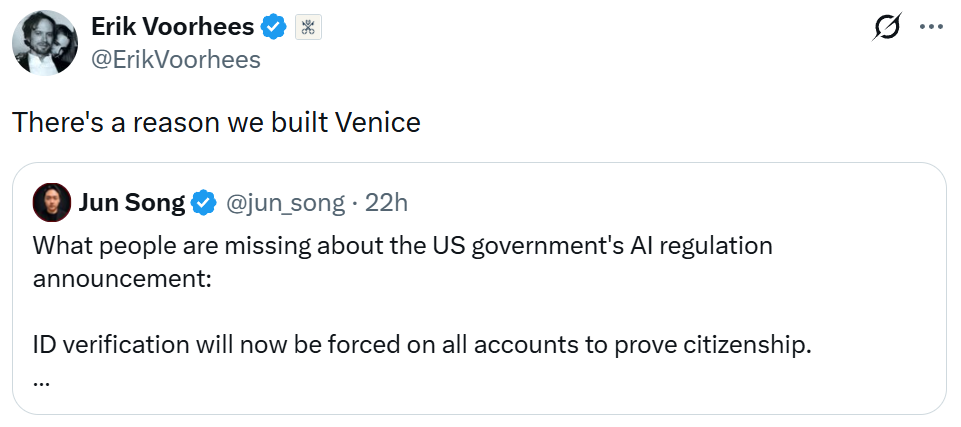
The episode has also demonstrated the US government’s ability to promptly switch off access to US-based AI models on command, leading to a rally in decentralized AI tokens on Friday and Saturday.
The native token of Bittensor, a decentralized AI protocol that lets people build and monetize artificial intelligence models, which some refer to as “the Bitcoin of AI,” surged 23.9% over the past 24 hours.
Venice Token (VVV), the native utility and privacy coin powering Venice AI, a decentralized, uncensored AI platform founded by Erik Voorhees, rose 16%.
Near Protocol, a blockchain project building the infrastructure to support a decentralized AI agent economy, rose 6.2%.
Source: Erik Voorhees
Magazine: Bitcoin, the ‘canary in the coal mine,’ XRP transaction demand falls 91.5%: Market Moves

Crypto World
Pi Network’s PI Finally Shows Some Strength, Bitcoin (BTC) Tapped 10-Day High: Market Watch
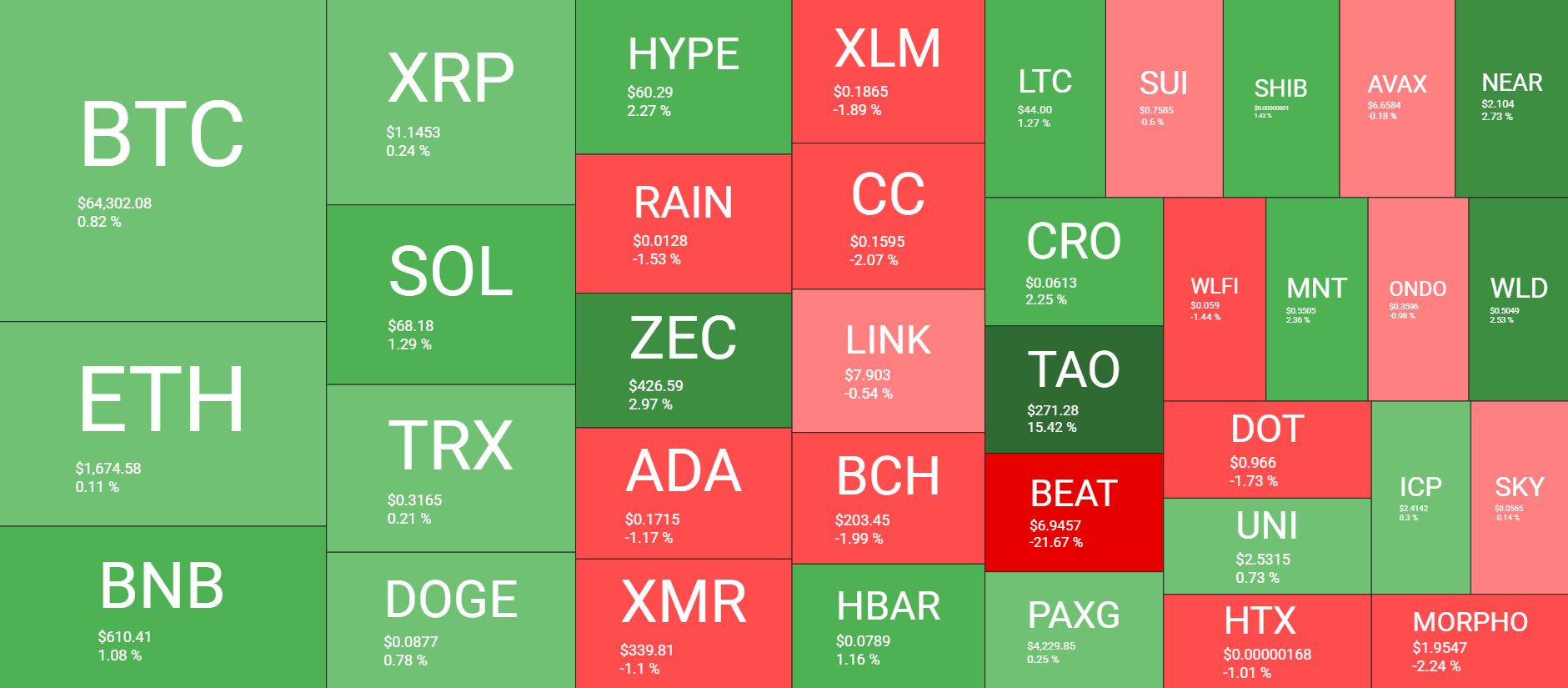
Perhaps driven by some excitement from Trump’s promise for a deal, bitcoin’s price jumped to almost $64,800 over the past several hours for the first time since June 4.
Most larger-cap alts are slightly in the green today, with BNB going up to $610, and SOL nearing $70. TAO has rocketed by over 15%.
BTC Sees 10-Day High
The primary cryptocurrency plummeted at the start of the month, going from over $73,000 to a 19-month low of $59,100 in just four to five days. After losing $14,000 in less than a week, the bulls finally reemerged and didn’t allow another breakdown.
Bitcoin found some support there and quickly reclaimed the $60,000 level. It spent the following week sideways between $61,000 and $64,000 as it bounced toward each boundary following some of the latest developments on the war front between the US, Iran, and all other Middle Eastern countries involved in the conflict.
Most recently, Trump promised yesterday that a permanent deal with Iran is scheduled to be signed today, on June 14. The reaction so far from BTC has been rather muted, as it jumped to $64,800 but has declined by a few hundred dollars. However, the reports from Iran on the matter are the exact opposite, so a deal might not be announced today.
For now, BTC’s market cap has neared $1.3 trillion, while its dominance over the altcoins is up to 56.6%.

PI Shows Resilience
Ethereum continues to sit close to $1,700, Binance Coin has risen to $610, while XRP is close to $1.15. Solana has neared $70, while TRX and DOGE are with minor gains. HYPE has tapped $60 after a 2% increase, and ZEC has added 3% of value to $427.
TAO has rocketed the most from the larger caps, while BEAT has dumped by 20% daily. Humanity (H) has found itself in the top 100 alts by market cap after skyrocketing by well over 90% daily.
Pi Network’s native token has finally shown some signs of revival after its recent calamity. The token plummeted to an all-time low last week of under $0.12, but now sits well above $0.13, trading more than 10% above its bottom.
The total crypto market cap has added another $20 billion daily and is up to $2.280 trillion on CG.
The post Pi Network’s PI Finally Shows Some Strength, Bitcoin (BTC) Tapped 10-Day High: Market Watch appeared first on CryptoPotato.

U.S. President Donald Trump says a deal to end hostilities between the United States and Iran is scheduled to be signed on Sunday, and that immediately afterward the Strait of Hormuz would be “OPEN TO ALL.” The announcement comes despite earlier caution from Iranian officials about the timing, underscoring how closely markets are watching the next steps in a geopolitical standoff that has already roiled energy flows.
Pakistan, which has been mediating the talks, indicated that an agreement could be reached within 24 hours and that preparations are underway for electronic signing following the finalization. Analysts argue that any credible de-escalation—especially one tied to reopened shipping lanes—could feed into improved sentiment for broader risk assets, including Bitcoin and exchange-traded products.
Key takeaways
- Trump claims Sunday will be the signing date and says the Strait of Hormuz would reopen to all immediately afterward.
- Iranian officials have not confirmed the Sunday timeline, with the foreign ministry spokesperson saying it would not be “tomorrow” and could occur “in the coming days.”
- Pakistan’s mediation role suggests a 24-hour window and preparation for electronic signing, followed by technical discussions next week.
- The conflict has already disrupted global energy supply estimates, a development that has contributed to market-wide risk aversion affecting crypto for months.
- Crypto strategists link expectations of a peace breakthrough with potential relief in Bitcoin and ETF-related demand, contrasting with recent ETF outflows.
Trump’s Sunday signing claim meets uncertainty from Tehran
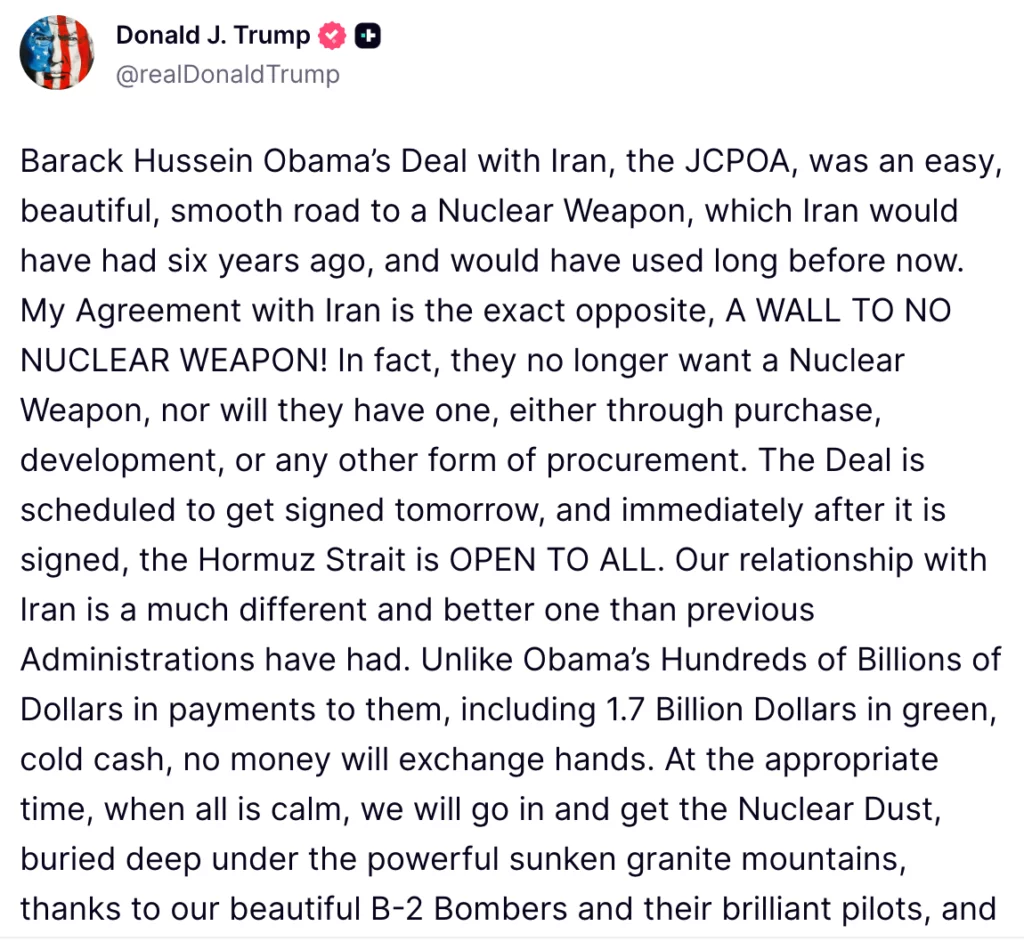
On Saturday, Trump posted on Truth Social that the memorandum of understanding is “scheduled to get signed tomorrow,” adding that “immediately after it is signed, the Hormuz Strait is OPEN TO ALL.” His statement indicates a rapid pivot from ceasefire management toward a broader reopening of one of the world’s most strategically important shipping corridors.
However, the timeline is not uniformly accepted across the negotiations. Iran has not confirmed the Sunday signing. Earlier statements from Iran’s Foreign Ministry spokesperson Esmaeil Baghaei, carried by state media, suggested the memorandum would not be signed on Sunday and instead could happen “in the coming days.” In those remarks, Baghaei indicated that an exact date would need to be clarified, explicitly pushing back against “tomorrow” as the signing day.
For markets, the disagreement itself matters. When a diplomatic timeline is disputed—particularly one that implies potential easing in energy risk—traders often remain cautious, pricing in both the possibility of a quick resolution and the chance of further delay.
Pakistan signals a 24-hour path to agreement
Pakistan’s Prime Minister Shehbaz Sharif also weighed in, saying on X that the region is “closer to a peace deal than ever before.” Sharif stated that finalisation is likely within the next 24 hours and that Pakistan is preparing for electronic signing immediately afterward, followed by technical-level talks next week.
That message is consistent with the mediation posture Pakistan has reportedly taken in the process: offering a near-term cadence for decision-making while keeping the next round of talks in view. Still, with Iran signaling that Sunday might not be accurate, investors have reason to watch whether the signing occurs on schedule—or whether the parties move the date further into the “coming days” window referenced by Baghaei.
Why Hormuz and ceasefire terms matter to crypto sentiment
The anticipated memorandum is expected to extend the ceasefire between the United States and Iran for 60 days and reopen the Strait of Hormuz. While the immediate subject is maritime access and de-escalation, the market impact is broader: disruptions related to the conflict have been widely described as constraining energy supply.
According to the article’s framing, the naval blockade has choked around 20% of the world’s oil and liquefied natural gas supply, contributing to higher global asset prices and a sentiment shock that has pressured crypto markets for months. Even if crypto’s move is not a direct function of shipping lanes alone, the linkage typically works through risk appetite—higher uncertainty can translate into lower willingness to hold volatile assets, while credible de-escalation can do the opposite.
In that sense, a signing date is more than a diplomatic milestone. It serves as an observable signal that the conflict risk premium may begin to unwind, potentially affecting liquidity conditions across financial markets.
Analysts eye relief in Bitcoin and ETF flows after de-escalation
Crypto analyst Michaël van de Poppe said a peace deal between Iran and the U.S. would likely trigger a surge in Bitcoin, along with positive ETF flows. He suggested that liquidity would rotate back toward “risk-on” assets, adding that a portion of that renewed liquidity could flow toward crypto following other major market events.
At the same time, recent Bitcoin fund flow data points to caution. Spot Bitcoin ETFs recorded about $315.84 million in net outflows for the week ended Friday, according to SoSoValue’s ETF tracking. That week’s results also marked the fifth consecutive week of outflows for Bitcoin-linked crypto funds mentioned in the source.
CoinShares head of research James Butterfill previously told Cointelegraph that pressure on digital asset investment products was being driven largely by geopolitics. He linked the uncertainty around the Iran conflict to pressure on interest-rate expectations—an important bridge between macro conditions and investor behavior in risk assets, including crypto.
As of the time of writing, Bitcoin was trading at $64,491 and up 1.5% over the prior 24 hours, according to the provided snapshot.
Taken together, the current setup is a familiar pattern: traders look for catalysts that can shift global risk sentiment, while recent ETF outflows highlight that positioning has been cautious. If the Sunday signing happens as Trump says—and if subsequent steps confirm Hormuz reopening—market narratives could shift quickly. If the signing is delayed again, expectations may reset and the relief bid could stall.
Readers should focus on the key next milestones: whether the memorandum is actually signed on Sunday, whether Iran further clarifies the date, and what follow-through signals emerge regarding Hormuz access. Those specifics will determine whether “de-escalation” becomes a sustained market theme—or remains a headline-driven hope.
U.S. President Donald Trump said a peace deal with Iran could be signed on Sunday, setting up a direct clash with Tehran over the timing of the agreement.
Summary
- Trump said a U.S.-Iran deal could be signed Sunday, but Tehran rejected that exact timeline.
- Hormuz reopening could ease energy pressure and support risk appetite across Bitcoin and crypto markets.
- ETF outflows and Galaxy’s lower BTC floor keep crypto traders cautious despite peace deal hopes.
The claim drew attention across crypto markets because the draft deal is expected to reopen the Strait of Hormuz. Traders are watching whether lower energy stress could send capital back into Bitcoin and other risk assets.
“The Deal is scheduled to get signed tomorrow,” Trump wrote on Truth Social on Saturday. He added that the “Hormuz Strait is OPEN TO ALL” immediately after the signing.
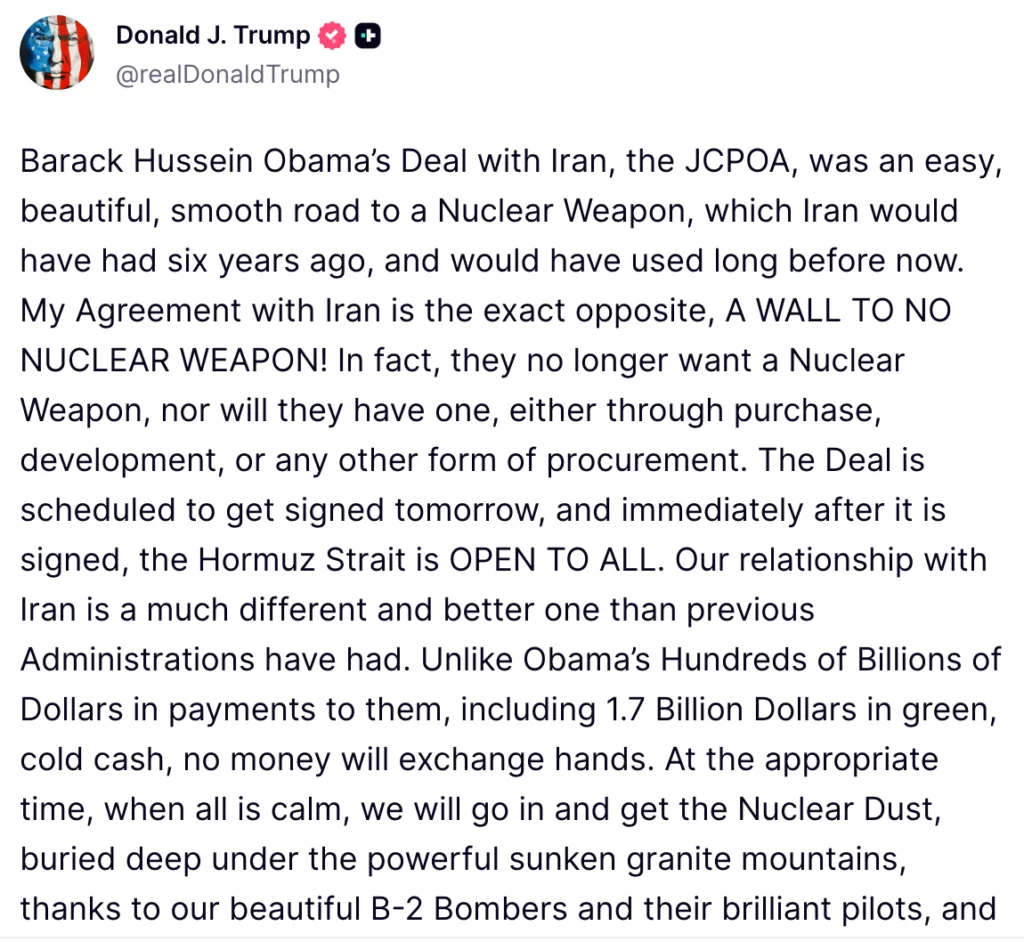
Pakistan also signaled that talks had moved close to a deal. Prime Minister Shehbaz Sharif said the final text had been reached and that an electronic signing could happen within 24 hours.
Tehran disputes the timeline
Iran has not confirmed Trump’s Sunday schedule. Foreign Ministry spokesperson Esmaeil Baghaei told state media that the memorandum would not be signed on Sunday, but could still move forward later.
“We will have to wait and see about the exact date,” Baghaei said, adding that “it will not be tomorrow.” His statement kept uncertainty in place even as mediators pointed to progress.
Hormuz reopening remains central
The Strait of Hormuz is one of the world’s most important energy routes. U.S. Energy Information Administration data showed that about 20% of global petroleum liquids consumption moved through the passage in 2024.
A reopening would matter for oil, LNG, inflation expectations, and risk appetite. Higher energy costs have weighed on global markets for months and have added pressure to crypto during periods of ETF outflows.
Bitcoin traders watch risk demand
Crypto analyst Michaël van de Poppe said a confirmed peace deal could support Bitcoin and other risk assets. “Liquidity will pour back into risk-on assets,” he wrote, adding that crypto could benefit after the SpaceX IPO absorbed attention.
Bitcoin traded near $64,213 on Sunday, after rising about 0.8% over the previous close, per crypto.news market data. Spot Bitcoin ETFs also remained under watch after about $315.84 million in weekly net outflows, according to SoSoValue data
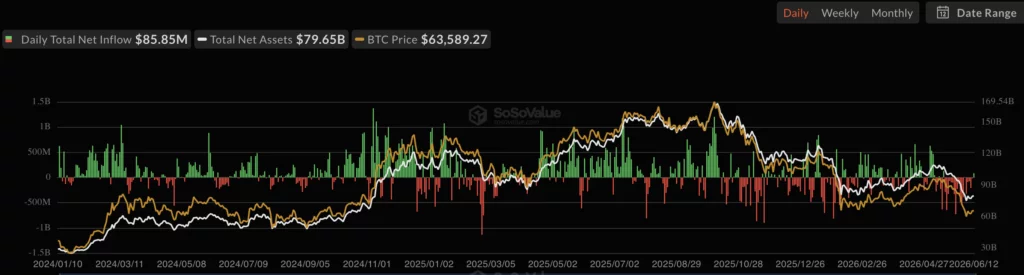
As previously reported by crypto.news, recent market updates tied Bitcoin’s weakness to ETF withdrawals, U.S.-Iran tension, and the competition for capital created by the SpaceX offering. Separate reporting cited Galaxy Research, which said only four of 13 Bitcoin bottom signals had triggered.
Galaxy’s base case placed a possible BTC floor between $40,000 and $46,000 by late 2026. That outlook keeps traders cautious, even as peace deal hopes raise the chance of a short-term relief move.
The next market reaction may depend on whether the U.S., Iran, and Pakistan confirm the same signing timeline. Until then, Bitcoin remains tied to headlines from Hormuz, ETF demand, and wider investor appetite for risk.
A signed deal may ease one source of pressure, but traders still need stronger fund flows before calling a durable recovery. Oil prices and ETF data will be the next checkpoints for short-term crypto positioning.
Disclosure: This article does not represent investment advice. The content and materials featured on this page are for educational purposes only.
The world’s second-largest cryptocurrency by market cap has displayed controversial price moves on micro- and macro-timeframes, as even when it managed to set a new ATH last year, it was barely above the previous one. However, the subsequent crash has driven it south hard, and its market share against BTC has dwindled.
Daan Crypto Trades published an X post today, trying to determine whether it’s finally time to accumulate ETH after the asset’s collapse from last week that pushed it to a 14-month low of $1,500.
Time to Buy?
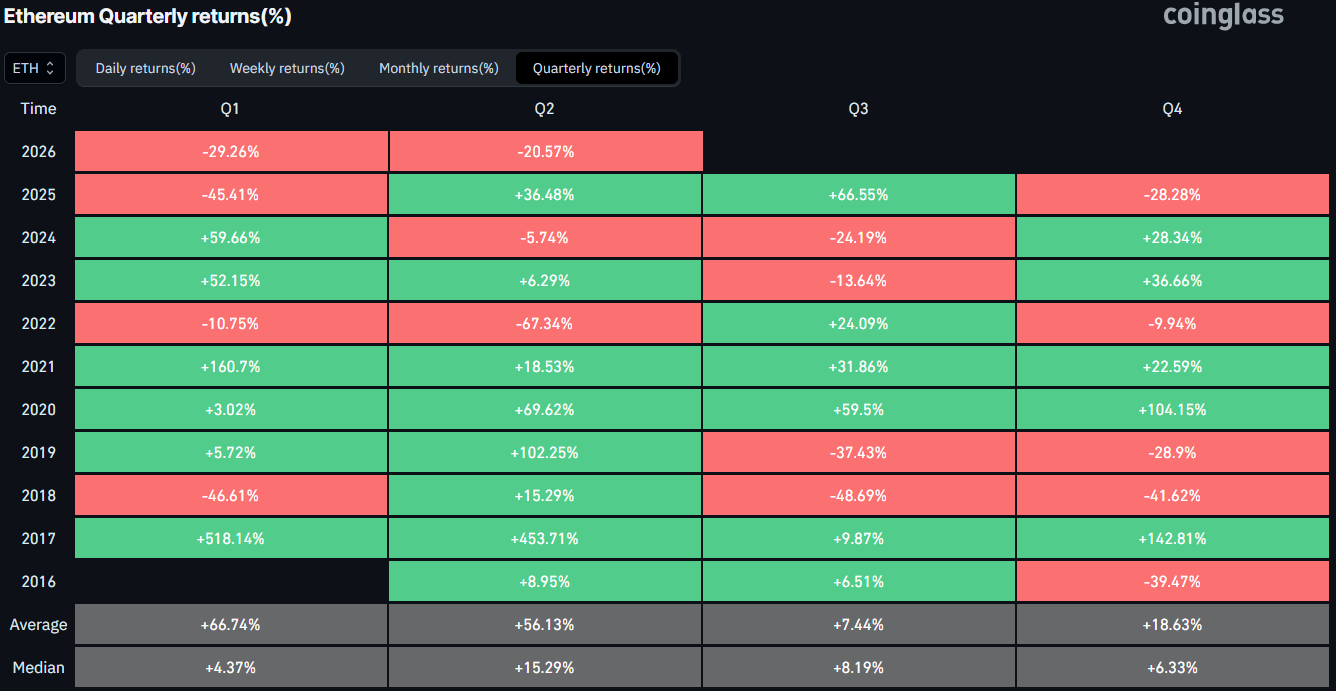
Current data shows that ETH is “on track for its 2nd-worst first half of the year since 2022.” At the time, it dropped by 10.75% in Q1 and a whopping 67% in Q2. So far, it has dumped by 29% in Q1 and 21% in Q2, with a couple of weeks left until the latter ends.
What’s even worse compared to the 2021/2022 performance is that Ethereum is on its way to close three consecutive quarters in the red, and all of the losses are by double digits since Q4 2025 ended with a 28% decline.
Daan noted that it has been “extremely bad 9 months” for the altcoin after it topped following Bitmine’s accumulation craze began. Recall that the Tom Lee-chaired company has accumulated billions worth of ETH, but it’s also billions in the red on its position given the asset’s price correction.
The analyst remains optimistic about Ethereum’s role in tokenization, DeFi, “and all,” and added that the current levels are “finally attractive again for longer-term accumulation (years).”
Nevertheless, he warned that bear markets can go for longer than most people anticipate, and it “never hurts to have some dry powder on the side for unforeseen circumstances.”
Out of Exchanges
Meanwhile, fellow analyst Ali Martinez noted that Ethereum investors have been withdrawing their funds from exchanges en masse lately. Citing data from Glassnode, he said that almost 500,000 ETH, valued at around $800 million at current prices, have been taken out of trading platforms in just a week.
The analyst noted that this could align with the aforementioned strategy for being an “early sign of accumulation.”
Nearly 500,000 Ethereum $ETH, worth roughly $800 million, have been withdrawn from trading platforms over the past week.
This could be an early sign of accumulation. https://t.co/LNkygeYlUV pic.twitter.com/afPADae2pP
— Ali Charts (@alicharts) June 13, 2026
In another post, though, Martinez warned that ETH’s actual price bottom could be more than 50% away from the current levels at around $700.
The post Time to Buy Ethereum as ETH Heads for Another Double-Digit Quarterly Loss? appeared first on CryptoPotato.
Although BTC managed to recover some ground in the past week, June remains deep in the red so far, as its first week was particularly painful for the bulls.
One of the reasons behind the asset’s crash to a 19-month low was that large investors, typically referred to as whales, had decreased their holdings by a whopping amount.
Citing data from Glassnode, popular analyst Ali Martinez highlighted the decrease in whales’ holdings by more than 70,000 BTC in a single month. From a USD perspective, this fortune is worth over $4.5 billion even at current prices.
More than 70,000 Bitcoin $BTC have been distributed by whales over the last month, helping explain the recent downside momentum. https://t.co/22IPTSmSJ5 pic.twitter.com/o7FZ3stHdA
— Ali Charts (@alicharts) June 13, 2026
This intense selling pressure only added fuel to the fire that sent bitcoin tumbling to $59,100 on June 5 for the first time since late 2024. The other possible reasons stem from the massive ETF exodus, Strategy’s sale that led to substantial FUD online, and the broader market weakness due to the US-Iran war uncertainty.
While analysts continue to debate whether bitcoin has already bottomed or if there’s more pain ahead, Ali Martinez recently outlined his dollar-cost average targets in case the cryptocurrency keeps dropping to key support levels.
The first is actually close by, as the 200W SMA is located at $62,800. If it gives in, the next one (300W SMA) is at $55,000, followed by the 400W SMA at $42,500.
For now, bitcoin appears to have found solid support and has even reclaimed the $64,000 level over the past day. More volatility is expected today after Trump promised a deal with Iran, but reports from the Middle Eastern country are less hopeful.
The post Over 70,000 BTC Distributed by Whales Amid Bitcoin’s Price Crash: Data appeared first on CryptoPotato.


India’s crypto tax checks have become stricter after the Income Tax Department issued more than 44,000 notices linked to virtual digital asset filings.
Summary
- India issued over 44,000 VDA notices after matching crypto filings with exchange-reported transaction data.
- Tax officials found Rs 888 crore in hidden VDA income as filing checks became stricter.
- Investors must report each trade, swap, and disposal under Schedule VDA for FY 2025-26.
The department found more than Rs 888 crore, or about $104 million, in undisclosed VDA income, according to The Economic Times. The figures show how tax officials are using exchange data, TDS filings, and investor returns to track mismatches.
India keeps 30% VDA tax in place
India’s core crypto tax rules remain unchanged for FY 2025-26. Gains from virtual digital assets are taxed at a flat 30%, while eligible transfers face a 1% tax deducted at source.
The Income Tax Department says VDA income is taxed without deductions, except the cost of acquisition. Losses from one crypto asset also cannot be used to reduce gains from another asset.
Schedule VDA becomes a key filing test
Investors must use ITR-2 when reporting crypto as capital gains. Those treating crypto trading as business income must use ITR-3. Both forms include Schedule VDA for detailed transaction reporting.
Schedule VDA does not allow investors to report only net gains. Each trade, swap, disposal, and taxable transfer must be entered separately. A crypto-to-crypto swap can also create a taxable event.
Exchange data raises mismatch risks
Budget 2026 added tighter reporting duties for exchanges, custodians, and wallet providers. These entities must send user-level transaction data to the Income Tax Department.
That data allows the department to compare investor filings with exchange records. A mismatch between Schedule VDA, Form 26AS, TDS records, and exchange reports can trigger a notice.
Offshore holdings face closer review
The compliance net may widen further from 2027. India is aligning with the OECD Crypto-Asset Reporting Framework, which supports cross-border sharing of crypto account data.
As previously reported by crypto.news, India has already moved toward tighter digital-asset oversight. Recent rules require platforms to submit user-level transaction data, while overseas crypto holdings may become easier for authorities to trace.
The latest notices show that crypto tax filing in India has moved beyond self-reporting alone. Investors who used multiple exchanges, DeFi platforms, or offshore accounts now face a higher burden to keep full records.
The filing risk is not limited to large traders. Missing staking income, airdrops, wallet transfers, or TDS reconciliation can create questions during review. The department’s message is clear: crypto investors must file accurately before enforcement reaches them.

Three SpaceX tokens lead the trading on Solana after the rocket maker’s June 12 Nasdaq debut. Backpack Securities’ SPCX tops the group, followed by an xStock version and a pre-IPO token.
Jupiter, the largest Solana exchange aggregator, lists more than a dozen tokens under the SpaceX name. The following three are verified, tokenized equity products ranked by Jupiter liquidity and volume.
1. SPCX (Backpack Securities)
Backpack Securities, a regulated US broker-dealer, issues SPCX. The token launched on Solana the same day SpaceX listed on Nasdaq.
Follow us on X to get the latest news as it happens
Each token represents ownership of underlying SpaceX shares. Holders can redeem it for those shares through Backpack’s brokerage platform. Backpack says eligible shares can also convert back into tokens.
It leads the SpaceX token group with $2.5 million in liquidity and about $18.2 million in 24-hour volume. The token carries a market cap of nearly $7.6 million.
Furthermore, holders exceed 5,900. The token trades around the clock on Solana, including outside Nasdaq hours.
2. SPCXx (xStocks)
SPCXx is issued by Backed Finance under its xStocks brand, which already tokenizes a range of public equities. The token tracks the SpaceX share near $166.
Meanwhile, liquidity sits around $236,000 with $927,000 in daily volume. It ranks second among the verified tokens, with over 3,000 holders.
3. SPACEX (PreStocks)
SPACEX issued by PreStocks gives exposure to SpaceX’s pre-IPO valuation via SPV-backed tokens. Liquidity reads about $158,000 with $737,000 in daily volume on Jupiter. When it comes to the number of holders, the token ranks highest with roughly 12,600.
PreStocks says its SpaceX token now converts into a tokenized public-stock equivalent through on-chain trading, split-adjusted for the 5-for-1 split. Holders must complete the swap by midnight UTC on March 12, 2027, or the tokens will expire worthless.
Disclaimer:
This article is for informational purposes only and does not constitute financial, investment, or trading advice. BeInCrypto does not recommend buying, selling, or holding any asset mentioned. Always conduct your own research and verify any token contract before trading.
Subscribe to our YouTube channel to watch leaders and journalists provide expert insights
The post 3 SpaceX Tokens Leading Trading Volume on Solana This Week appeared first on BeInCrypto.
US President Donald Trump says a memorandum of understanding aimed at ending the US–Iran conflict is slated to be signed on Sunday, even though Iranian officials have previously questioned the timing. Trump also claimed that the “Hormuz Strait” would be opened to all immediately after the signing.
The proposed agreement—mediated by Pakistan—would extend a ceasefire and reopen the Strait of Hormuz. While Pakistan’s prime minister said finalization could occur within 24 hours, Iran has not confirmed Sunday as the signing date, leaving traders to weigh the prospect of de-escalation against the risk of further delays.
Key takeaways
- Trump says the US–Iran memorandum is scheduled for Sunday signing and that shipping access through the Strait of Hormuz would follow immediately after.
- Pakistan’s Prime Minister Shehbaz Sharif said the agreement could be finalized within 24 hours, with electronic signing likely shortly afterward.
- Iran has indicated the memorandum would not be signed “tomorrow,” pointing instead to “coming days,” creating near-term timeline uncertainty.
- Analysts expect a peace-related improvement in risk sentiment to benefit crypto—particularly Bitcoin—after months of geopolitics-driven pressure.
- Spot Bitcoin ETF flows have been negative for five straight weeks, with CoinShares research previously linking recent digital asset outflows to geopolitics and interest-rate uncertainty.
Sunday signing claim vs. Iran’s timeline uncertainty
In a Saturday post on Truth Social, Trump said: “The Deal is scheduled to get signed tomorrow,” adding that once signed, “the Hormuz Strait is OPEN TO ALL.” The statement places the signing squarely on Sunday, setting a clear expectation for immediate follow-on steps that could affect shipping and energy markets.
Pakistan, which has been mediating between the US and Iran, also indicated progress. According to remarks attributed to Pakistani leadership on X, an agreement could be reached within 24 hours.
However, Iran has not confirmed Trump’s timeline. An Iranian foreign ministry spokesperson, Esmaeil Baghaei, told state media earlier that the memorandum would not be signed on Sunday and could instead occur “in the coming days.” That clarification matters because it suggests the ceasefire-extension and Strait-of-Hormuz reopenings may depend on a final date agreed by all parties—not just on public statements from Washington and intermediaries.
The deal in question is described as a memorandum of understanding. It is expected to extend the ceasefire between the US and Iran for 60 days and reopen the Strait of Hormuz. Still, until Iran confirms the signing date and details, markets may treat Sunday as a scenario rather than a certainty.
Why the Strait of Hormuz matters for crypto risk appetite
During the conflict, the naval blockade has reportedly choked around 20% of the world’s oil and liquefied natural gas supply, according to the article’s summary. That kind of disruption can spill into macro conditions—raising energy costs, influencing inflation expectations, and amplifying risk premiums across asset classes.
Crypto has not been immune. The same disruption has been linked to a sentiment shock that “pressed crypto markets for months,” reflecting how geopolitical escalation can tighten financial conditions and reduce appetite for volatile assets.
If de-escalation proceeds as envisioned—particularly reopening the Strait of Hormuz—investors may look for improved macro visibility and a broader shift back toward “risk-on” behavior. In practice, that can translate into increased demand for high-beta assets like Bitcoin, especially when market participants believe liquidity constraints may ease.
What analysts are watching for Bitcoin and ETF flows
Crypto analyst Michaël van de Poppe said a peace deal between Iran and the US could trigger a “surge in Bitcoin,” alongside positive ETF flows. His thesis is tied to liquidity returning to risk assets once uncertainty fades.
Van de Poppe’s view also comes alongside ongoing data on Bitcoin ETF performance. According to the referenced SoSoValue tracking, spot Bitcoin exchange-traded funds recorded about $315.84 million in net outflows for the week ended Friday—marking the fifth consecutive week of outflows for Bitcoin-linked crypto funds. Persistent redemptions are important because they can offset spot buying from other parts of the market, dampening upside momentum even if headlines improve.
Separately, CoinShares head of research James Butterfill told Cointelegraph earlier that recent outflows from digital asset investment products were driven primarily by geopolitics. In that account, uncertainty around the Iran conflict was seen as weighing on expectations for interest rates—an interaction that can influence the valuation and risk appetite of crypto assets.
At the time of writing, Bitcoin was trading around $64,491, up roughly 1.5% over 24 hours. While that immediate move suggests some buyers respond to improving headlines, the broader ETF trend indicates the market’s positioning remains cautious.
De-escalation is likely beneficial—but the deal still has execution risk
The clearest tension in the story is the gap between declared signing timing and Iran’s stated uncertainty. Trump’s “tomorrow” claim and Pakistan’s expectation of near-term finalization set a near-term catalyst in motion. Yet Iran’s messaging that the memorandum would not be signed Sunday implies that execution risk remains.
For traders and long-horizon investors, this is more than diplomatic theater. If the signing is delayed, markets that priced a rapid reduction in geopolitical risk could reverse quickly—particularly in a market already contending with ongoing ETF outflows. On the other hand, if the memorandum is signed and implementation steps begin, the energy and macro channel that has weighed on sentiment could start to unwind.
Even in optimistic scenarios, investors will likely track whether reopening steps for the Strait of Hormuz are actually operational, not just announced. That practical follow-through is what determines whether the conflict’s macro impacts—energy disruption and related inflation fears—turn into a relief factor rather than another unresolved headline.
Going forward, the key question is whether Iran ultimately confirms Sunday signing—or whether the memorandum shifts further into “coming days.” Readers should also watch for whether any post-signing commitments translate into measurable changes for shipping and energy-market expectations, since that is where crypto sentiment has been most sensitive so far.


CoinFund founder Jake Brukhman said the Anthropic export-control dispute shows why decentralized AI networks are gaining attention as a possible counterweight to centralized model control.
Summary
- Jake Brukhman said Anthropic’s model shutdown shows how frontier AI can face direct government control.
- Decentralized AI teams are testing distributed GPU training as centralized compute access faces tighter rules.
- Pluralis is exploring tokenized AI model ownership by splitting weights among network participants and operators.
In a June 13 X post, Brukhman said AI models are a centralizing force and a major target for government control. He linked that view to Anthropic’s decision to comply with a U.S. directive that forced it to suspend access to Fable 5 and Mythos 5.
Anthropic said the order required it to block access for foreign nationals, including foreign-national employees, whether inside or outside the United States. The company said it disabled both models for all users to meet the directive, while other Claude models remained available.
Anthropic shutdown highlights distributed GPU training
Brukhman said decentralized networks can act as a counterbalance because AI’s first hard problem is access to large-scale compute. “The answer is simple: there is enough commodity GPU compute in the world to compete on the frontier,” he wrote, adding that new training methods are needed to use it.
He named Gensyn, Prime Intellect, Bagel, Pluralis, Nous Research, Macrocosmos AI, and Covenant as teams working on distributed training. He said their work shows that decentralized training is possible, cheaper, and nearly as efficient as centralized systems, though the sector still faces technical limits.
Pluralis model draws business focus
Brukhman also pointed to the business problem facing open-source AI. He argued that open models can be useful but often lack a revenue model strong enough to support frontier training costs.
He said Pluralis has proposed one answer by splitting model weights among participants. In his view, that structure can support tokenized AI models because no single participant holds the full model, while the network can still provide access to the system.
Broader AI pressure
As previously reported by crypto.news, Anthropic launched Fable 5 only days before the shutdown, presenting it as a Mythos-class model with added safeguards. The same report said some cybersecurity, biology, chemistry, and distillation requests would fall back to Claude Opus 4.8.
Earlier reports also showed the scale of AI infrastructure demand. Blackstone and Apollo were lining up about $36 billion in debt financing for Anthropic’s Google TPU expansion. Separate reporting on open AI infrastructure said concentrated compute access can leave whole regions dependent on a few providers.
Brukhman framed the moment as a choice between centralized AI and public AI on open networks. “This is the moment of truth,” he wrote, asking whether AI will fall under “censorship and unilateral government control” or move toward decentralized systems.
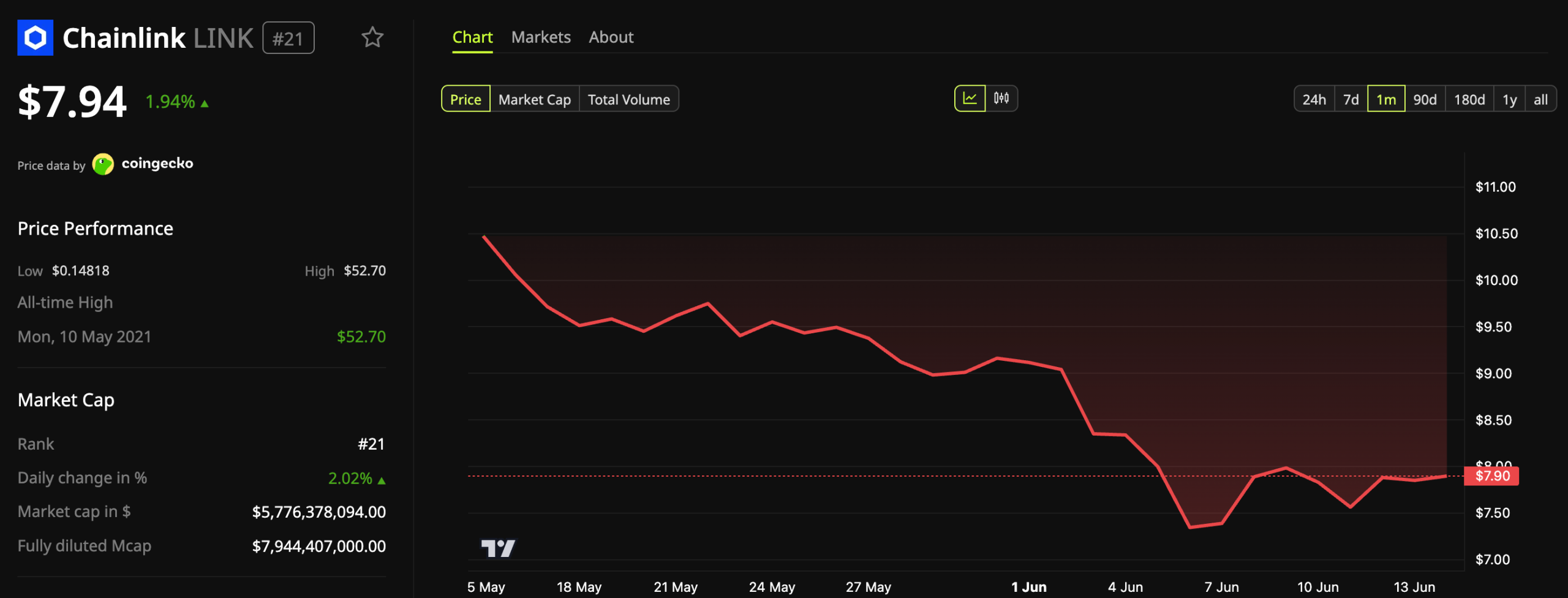
Chainlink (LINK) now powers the betting markets behind the 2026 World Cup. Yet, its token trades near $7.94, close to 90-day lows.
The disconnect highlights a familiar pattern in crypto. Real-world use of Chainlink’s network is rising, while LINK’s price remains tied to sentiment across the wider market.
Chainlink Powers the World Cup’s Betting Rails
Chainlink provides oracle infrastructure that feeds real-world data, such as match results, onto blockchains. Prediction markets use that data to automatically settle bets.
ADI Predictstreet became the tournament’s first official prediction-market partner, and it runs on Chainlink oracles. Myriad, backed by Tom Lee and ConsenSys, settles more than 75 World Cup contracts the same way.
On Polymarket, the World Cup Winner market alone has attracted close to $2.2 billion in bets. The platform also runs fast crypto markets that resolve every 5 or 15 minutes.
Those markets use Chainlink Data Streams and cover hundreds of token pairs. Chainlink says the markets have processed more than $7 billion in a matter of months.
“No mania behind it either: social volume is running at its May average, not above it. The adoption stack isn’t crowd hype,” Santiment said.
Follow us on X to get the latest news as it happens
LINK Price Stays Tied to the Macro
Despite the adoption, LINK trades about 23% below its May highs. The token has followed a broad June risk-off across crypto and other risk assets.
Bitcoin’s weakness has weighed on the wider market, and altcoins like LINK tend to amplify those moves. Lower risk appetite has capped any rebound.

Chainlink’s daily active addresses surged to 5,679 on June 5, marking the busiest day in the quarter. That same day, LINK printed its 90-day low. Higher usage has not raised prices.
“The tournament runs on its rails. The token trades on the macro,” Santiment added.
Analysts Watch for a LINK Bottom
Despite the weakness, Joao Wedson, founder of analytics firm Alphractal, says LINK is “entering the accumulation zone.” He noted that large holders have resumed accumulating. At the same time, the altcoin trades below its realized price, the average cost basis of holders.
“There is another lower level that has acted as a historical price base. A true accumulation phase. BTC may still drop further, but LINK already looks like it is forming a bottom,” Wedson forecasted.
Santiment’s read offers the counterweight. Its data shows the price moving on macro, not adoption, which leaves the bottom unconfirmed for now.
Chainlink’s infrastructure keeps expanding while its token waits on the macro. The coming weeks of the tournament will test whether rising usage eventually pulls LINK off its lows.
Subscribe to our YouTube channel to watch leaders and journalists provide expert insights
The post Chainlink Settles the World Cup but Markets Won’t Settle LINK appeared first on BeInCrypto.

Why Claire Danes ‘Resents’ Body Transformations for Roles

BITCOIN CRASH: I JUST BOUGHT 23 BITCOIN !!!

World Cup diaries: We’ve made history again and we don’t ever want this adventure to end


-

 NewsBeat6 days ago
Alexander Zverev wins the French Open to finally earn a 1st Grand Slam title
-

 Crypto World6 days ago
Anatomy of the June crypto crash: Fed, Iran, Saylor
-

 Crypto World3 days ago
Oppenheimer backs SpaceX as $70 billion retail frenzy builds
-
 NewsBeat7 days ago
Alexander Zverev conquers demons and outlasts Flavio Cobolli to win French Open for first major title
-

 Crypto World3 days ago
Markets Rally as SpaceX IPO Looms Amid Iran Tensions and Inflation Surge
-

 Tech7 days ago
Microsoft unveils seven homegrown AI models in new bid for ‘long term self-sufficiency’
-

 Business6 days ago
High Stakes for Wembanyama as New York Pushes for 3-0 Lead
-

 Tech6 days ago
Notion restores access to Anthropic after service disruption
-

 Sports6 days ago
FIFA WC 2026 Group C: Morocco, Scotland challenge Brazil’s hunt for glory | FIFA World Cup 2022
-
 Crypto World6 days ago
Eli Lilly (LLY) Stock Surges 4% Following Breakthrough Sleep Apnea Trial Results
-

 Crypto World7 days ago
Trump’s AI Ownership Plan Could Benefit Anthropic at OpenAI’s Expense
-
 Sports5 days ago
Bangladesh beat Australia after 20 years in ODIs, register only their second win over six-time world champions | Cricket News
-

 Fashion2 days ago
Weekend Open Thread: Tuckernuck – Corporette.com
-

 Tech1 day ago
NanoClaw integrates JFrog registries to secure AI agent downloads
-

 Crypto World1 day ago
Bitget enters Argentina’s regulated crypto market through PSAV registration
-

 Tech2 days ago
This Week In Security: Microsoft On Microsoft, Register Your Domains, Linux On ARM, And FreeBSD Joins The File Cache Club
-

 Politics3 days ago
Politics Home | Healey Resignation Is “Colossal Failure Of Government”, Says Former Labour Defence Secretary
-

 Sports3 days ago
First Time Since 1971: Australia Register Historic Low In ODI Cricket
-
 Entertainment3 days ago
Donnie Wahlberg & More Heat Up Las Vegas at Circa’s Barry’s Downtown Prime
-

 Entertainment5 days ago
The Ryan Gosling True Crime Thriller On Netflix That Gets Even Stranger, Stream It Now
You must be logged in to post a comment Login