

Crypto World
Amber Group-Backed Perp DEX edgeX to Launch Token on March 31

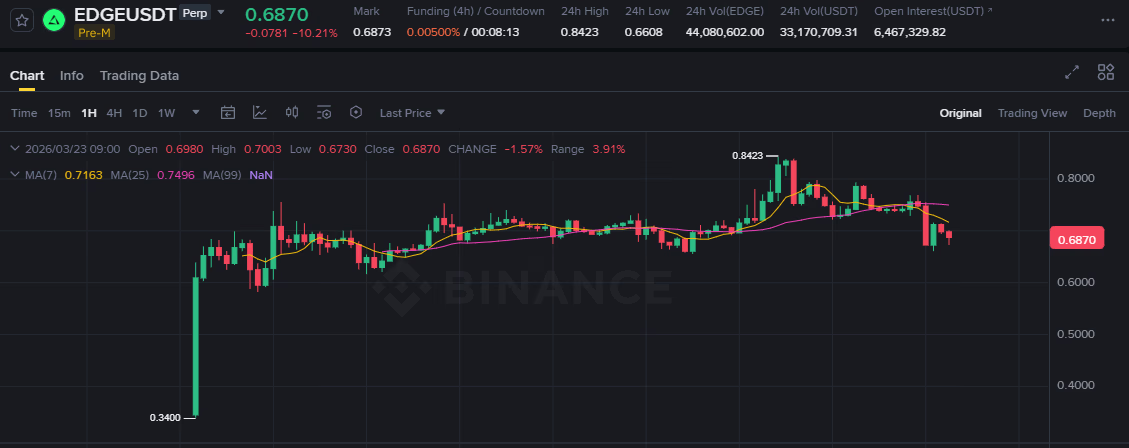
The derivatives platform has already opened airdrop claims and pre-market trading ahead of its long-anticipated token generation event.
Decentralized perpetuals exchange edgeX has confirmed that the token generation event (TGE) and listing for its native EDGE token will take place on March 31.
EDGE has a total supply of 1 billion tokens. At TGE, 25% of the supply will be airdropped, with up to an additional 5% for participants in the Pre-TGE Season points program. The remaining 70% is allocated to Ecosystem & Community, Core Contributors, and Foundation.
The token is already changing hands ahead of the official launch, with pre-market trading opening on Binance on March 19. EDGE is trading around $0.70, implying a fully diluted valuation of roughly $700 million.

The airdrop claim window also opened on March 19, according to an announcement from edgeX.
edgeX, which is incubated by Amber Group, has grown rapidly since launching in November 2024. The exchange processed roughly $4.4 billion in 24-hour trading volume across 176 trading pairs, with nearly $1.1 billion in open interest, according to CoinGecko, making it the third-largest perpetual DEX after Hyperliquid and Aster.
The TGE coincides with the platform’s transition from a single-product perp DEX to what it calls EDGE Chain, a purpose-built Ethereum Layer 2 for high-throughput financial applications.
In February, edgeX received a strategic investment from Circle Ventures alongside native USDC integration.



Coinbase x402 is now native to Amazon Bedrock AgentCore, letting AI agents pay for services in USDC without human input
Summary
- AWS launched Amazon Bedrock AgentCore Payments on May 7, with Coinbase x402 and wallet infrastructure embedded to give AI agents autonomous USDC payment capability.
- Agents settle transactions on Base in roughly 200 milliseconds at less than a fraction of a cent per transaction, with enterprise spending controls and compliance checks built in.
- The x402 protocol has processed more than 169 million payments across 590,000 buyers in its first year, and both AWS and Coinbase are founding members of the x402 Foundation.
Coinbase x402 is now native to Amazon Bedrock AgentCore, letting AI agents pay for services in USDC without human input. AWS announced Amazon Bedrock AgentCore Payments on May 7, describing it as the first time a major cloud provider has built crypto micropayments directly into an agent infrastructure platform.
Stripe is also integrated at preview, with agents able to choose between a Coinbase or Stripe wallet funded in stablecoins or fiat.
The system runs on x402, an open HTTP-native payment protocol that uses the “Payment Required” status code to allow machines to transact over standard web infrastructure.
Settlement happens on Base with USDC in about 200 milliseconds at less than a fraction of a cent per transaction. Agents never access private keys. A single API call handles wallet authentication, transaction signing, and payment execution.
What agents can actually pay for
Developers can connect agents to thousands of x402-enabled services through Coinbase’s MCP integration inside AgentCore Gateway. Supported providers at launch include Exa, Messari, and Browserbase, covering search, real-time data, evaluation runs, and backend setup tasks. Agents pay only for what they use, with no subscriptions or checkout flows.
Brian Foster, Head of Infrastructure Growth at Coinbase, said: “There will soon be more AI agents transacting than humans, and they need money that’s built for the internet — programmable, always on, and global.”
As crypto.news reported, BNB Chain surpassed 150,000 autonomous AI agent deployments in April, a 43,750% increase since January, establishing a parallel infrastructure race for AI agent commerce across blockchains.
Why x402 matters for crypto adoption
The x402 protocol has processed more than 169 million payments across 590,000 buyers and 100,000 sellers in its first year. AWS and Coinbase are both founding members of the x402 Foundation, alongside Cloudflare, which joined in September 2025.
As crypto.news tracked, Coinbase AgentKit has been building toward this integration for months, giving developers pre-built tools to equip AI agents with wallets and transaction capability across multiple blockchains.
Warner Bros. Discovery is already testing AgentCore and said it sees potential for agent-driven transactions covering live sports and major entertainment releases.
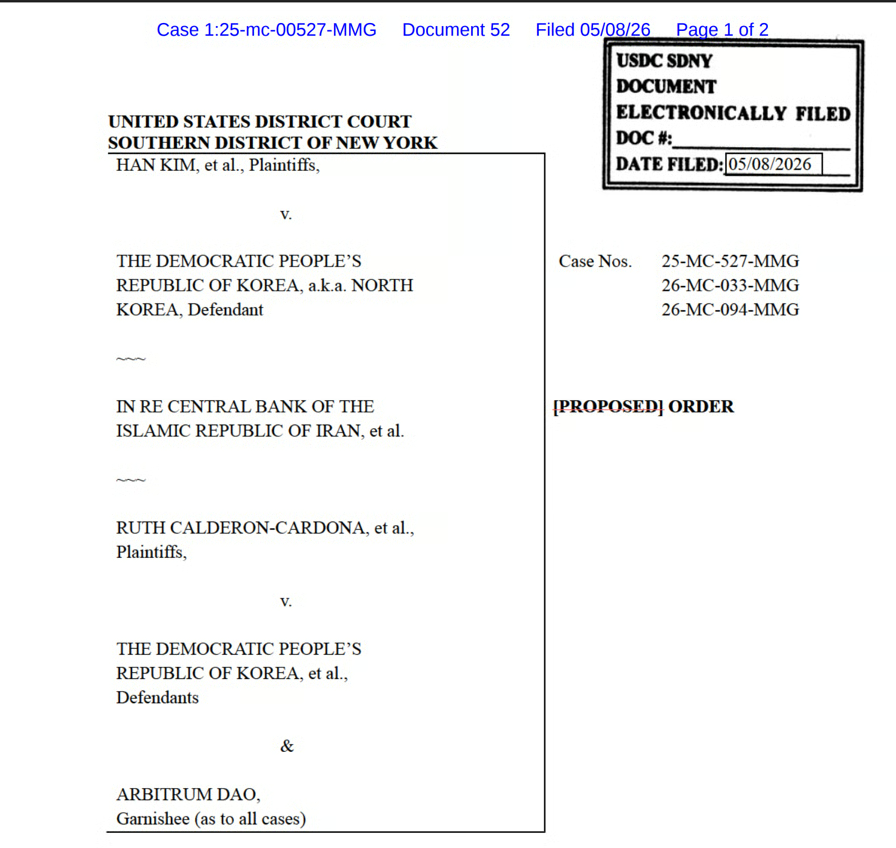
A Manhattan federal judge has allowed Arbitrum DAO to move $71 million in frozen Ether to Aave, clearing the path for the DeFi protocol’s recovery effort following a North Korea-linked exploit.
Judge Margaret Garnett of the Southern District of New York issued the order on Friday, modifying a restraining notice that had locked the assets inside Arbitrum DAO. The modification permits an onchain governance vote to send the funds to a wallet controlled by Aave LLC, and explicitly protects anyone who participates in the transfer from being held in violation of the freeze.
The order still keeps the terrorism victims’ legal claim on the funds, meaning Aave can’t use the funds freely and could be forced to hand them over if the court ultimately rules in the terrorism victims’ favor.

Judge allows Arbitrum to move funds to Aave. Source: Courtlistener
The decision came after Arbitrum delegates showed strong support for the move through an off-chain Snapshot vote as part of Aave’s broader recovery plan following last month’s North Korea-linked rsETH exploit. Any actual transfer still requires a separate binding onchain governance vote.
Related: Arbitrum vote to release $71M in frozen Kelp exploit ETH set to pass
Aave asks court to lift freeze on funds
Last week, Aave filed an emergency motion in a New York court seeking to vacate a restraining notice that had blocked Arbitrum DAO from transferring the funds to victims of the Kelp DAO exploit. The notice was served by Gerstein Harrow LLP, which represents families holding $877 million in unpaid terrorism judgments against North Korea and claims the funds belong to its clients because North Korean hackers stole them during the April 18 hack.
Aave pushed back hard, arguing that a thief doesn’t gain lawful ownership of stolen property and that attributing the hack to North Korea relies on little more than internet speculation. It also warned that if the court upholds the restraining notice, it could deter future DeFi recovery efforts and give bad actors a roadmap to exploit legal uncertainty following hacks.
Gerstein Harrow has previously pursued similar claims. In January, they sued Railgun DAO, alleging the privacy protocol was used to launder proceeds from prior North Korean hacks, including the $1.5 billion Bybit exploit.
Related: Aave deposits fall by $15B as Kelp exploit sparks flight from DeFi lender
Kelp exploit leaves $174 million hole in rsETH backing
The Kelp DAO exploit left rsETH’s backing with a significant shortfall. The hack caused 116,500 rsETH to be released on Ethereum without a corresponding burn on the source side, leaving only 40,373 rsETH in the adapter contract against confirmed backing for 152,577, a gap of roughly 76,127 rsETH, worth around $174.5 million at current prices.
The 30,765 ETH frozen by Arbitrum has been flagged as a meaningful step toward closing that gap, with proponents arguing that even partial restoration of rsETH’s backing would help stabilize conditions for users across Arbitrum and the wider DeFi ecosystem.
Magazine: 53 DeFi projects infiltrated, 50M NEO tokens could be ‘given back’: Asia Express


Upbit will add Pharos to its KRW, BTC, and USDT markets on May 8, giving Korean traders new spot access to PROS.
Summary
- PROS jumped 47.8% to $0.9457 after Upbit and Bithumb expanded Korean market access.
- Pharos trading volume rose 209.6% to $28.7 million as listing momentum boosted activity.
- CoinGecko ranked PROS at #255, with a $127.5 million market cap after the rally.
The exchange notice said trading support was scheduled for 8:30 p.m. Korea time.
Deposits and withdrawals are expected to open within one hour and 30 minutes after the notice. Upbit said users must send PROS through the Pharos network only, as deposits through unsupported networks may take longer to return.
Interestingly, CoinGecko data showed Pharos trading at $0.9457, up 47.8% over 24 hours. The token also gained 45.7% over seven days, placing it above the wider crypto market’s daily move.
Trading activity also increased. CoinGecko placed 24-hour PROS volume at $28.7 million, up 209.6% from the previous day. The token had a market cap of about $127.5 million and ranked #255 on CoinGecko.
The price move also came as Bithumb added Pharos to its Korean won market. That gave PROS another local listing on the same day and expanded access beyond Upbit
Early trading limits will apply
Upbit will apply normal trading controls after the listing opens. Buy orders will be restricted for about five minutes after trading starts. The exchange will also block sell orders priced more than 10% below the previous closing price for a short period.
For around two hours, Upbit will only allow limit orders. These controls are common during new listings, when liquidity is still forming and prices may move quickly.
Meanwhile, Pharos is an EVM-compatible Layer 1 blockchain that uses an asynchronous BFT-based proof-of-stake consensus model. The network also uses parallel processing and aims to support Web3 and real-world asset applications.
Messari describes Pharos as a modular Layer 1 built for real-world assets. Its report says the network targets 30,000 transactions per second and sub-second block times, while combining EVM and WASM under one runtime.
Korean exchange activity stays busy
The PROS listing follows recent Upbit market additions. Related crypto.news coverage said Upbit added B3 to its Korean won market on May 7, giving the Base-linked token direct local access.
Moreover, as crypto.news reported, Upbit listed Dogwifhat on KRW, BTC, and USDT markets on May 6. That report noted that new Upbit listings can draw fast retail attention, but may also bring sharp short-term price moves.
The listing comes as South Korea’s crypto sector faces tighter compliance pressure. Recent crypto.news coverage said local industry groups warned that planned AML changes could raise exchange reporting loads sharply.
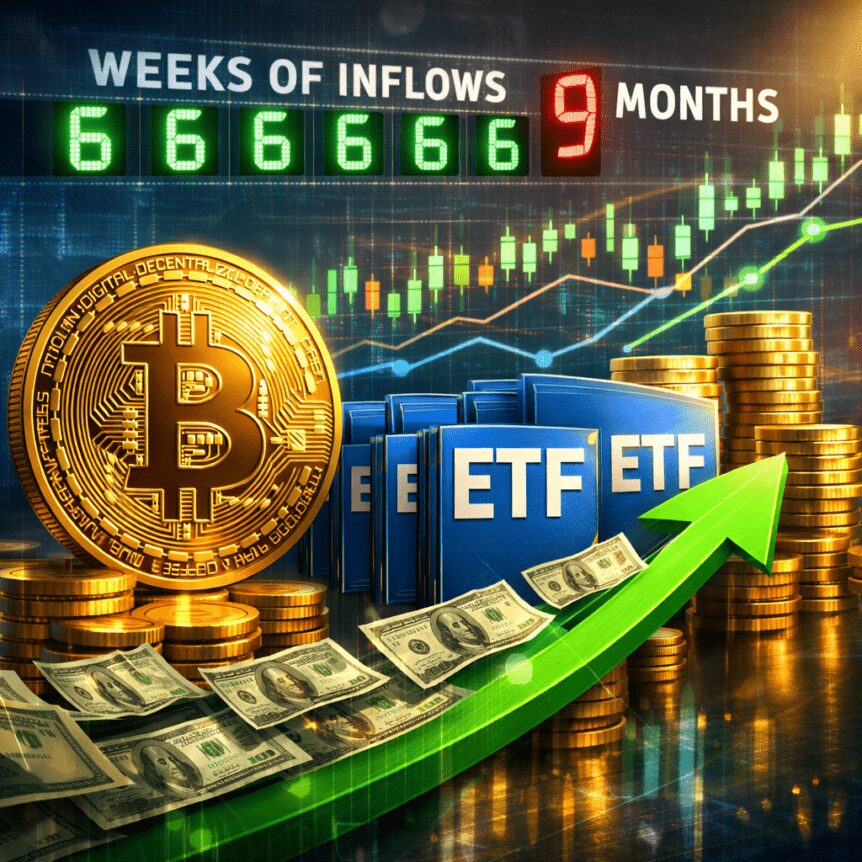
US spot Bitcoin exchange-traded funds (ETFs) extended their run of weekly inflows to a sixth straight week, marking the longest streak of net purchases since August 2025. Data tracked by SoSoValue shows a six-week accumulation totaling about $3.4 billion, underscoring renewed appetite from ETF investors for spot BTC exposure even as intraday price action remains choppy. The week of April 2 through the latest period saw inflows peak in mid-April, with the strongest week recording nearly $1 billion in new money, while the weakest week started with only about $22 million of inflows.
Specifically, the week of April 17 delivered the largest weekly intake at $996.38 million, and the most recent week logged $622.75 million. This six-week ascent stands as the longest such streak in more than nine months; the prior longer run stretched for seven weeks from June 13 to July 18, 2025, totaling roughly $7.57 billion in inflows, including $2.72 billion in the week of July 11 and $2.39 billion the following week.
But the latest cadence was not uniformly uplifting. The week ended with notable outflows—$277.50 million on Thursday and $145.65 million on Friday—before a strong start earlier in the week. Monday and Tuesday delivered $532.21 million and $467.35 million respectively, while Wednesday’s inflows slowed to $46.33 million, illustrating a market tug-of-war as participants weighed macro signals against price action in BTC.
Related: Bitcoin ETFs Extend Rally as Two-Day Inflows Near $1 Billion
Key takeaways
- Six consecutive weeks of net inflows into US spot BTC ETFs, totaling about $3.4 billion from early April through the latest week, according to SoSoValue data.
- The six-week sequence is the longest since August 2025, with the strongest weekly inflow at $996.38 million (week of April 17) and the weakest in the six-week sample at $22.34 million (week of April 2).
- Bitcoin ETF inflows have shown episodic strength despite intermittent late-week outflows, highlighting ongoing demand from institutional and accredited investors seeking direct BTC exposure via regulated vehicles.
- Ether ETFs turned positive for the week ending May 8, posting $70.49 million in net inflows after prior outflows, extending a broader rebound in mid-to-late April.
- The macro backdrop remains a source of ambiguity, with investors awaiting key US data and ongoing geopolitical considerations that influence risk sentiment and liquidity in crypto markets.
Ether ETFs rebound after a stretch of volatility
While Bitcoin-led products dominated headlines with persistent inflows, Ether ETFs also flipped back into positive territory for the week ending May 8, recording net inflows of $70.49 million. This followed a prior period in which Ether inflows flipped to outflows totaling $82.47 million.
The sector had demonstrated notable momentum earlier in April, supported by a three-week run from April 10 to April 24 that produced combined inflows of $617.91 million and peaked at $275.83 million in the week of April 17. That momentum appeared to waver in the week that followed, but the May 8 data point signaled a renewed interest in ether exposure among ETF participants.
From a daily perspective, Ether fluxes within the week showed some volatility: Thursday saw $103.52 million in outflows, a pressure point that nearly erased gains built earlier in the week; Monday and Tuesday brought $61.29 million and $97.57 million in inflows, respectively, while Wednesday posted a modest $11.57 million in inflows. Friday managed a slight recovery of $3.57 million, leaving the week in positive territory.
Magazine: Guide to the top and emerging global crypto hubs — Mid-2026
Context: what the latest inflows imply for the market
Taken together, the data points to a persistent, though nuanced, demand signal for regulated crypto access via ETFs. The Bitcoin inflow trajectory suggests that a broad cohort of investors views spot BTC exposure as a core hedge or diversification tool within a regulated framework, even as daily price moves and systemic liquidity conditions inject volatility into short-term performance figures.
Analysts have noted that the macro environment—especially labor market signals and geopolitical developments—will help determine the pace and durability of ETF inflows in the near term. As traders await key economic releases and policy cues, risk management and liquidity considerations remain central to positioning around BTC and ether ETF products. The broader takeaway is that while inflows are not a straight-line rally, the sustained buying interest in spot BTC ETFs points to growing mainstream acceptance of regulated crypto exposure as part of diversified portfolios.
Related: Cointelegraph coverage of ETF inflows
What traders should watch next
The coming weeks will likely hinge on domestic macro data and the evolving geopolitical backdrop, which jointly influence risk appetite and liquidity for crypto instruments. If the current inflow streak persists, ETF-backed BTC exposure could remain a meaningful driver of demand, particularly as institutions continue to explore regulated access. Conversely, back-end volatility and late-week reversals underscore the importance of disciplined risk management for ETF traders and market makers as they calibrate hedges and liquidity provision around volatile price levels.
Investors should also monitor Ether ETF flows for signs of a broader reset or renewed interest in ether exposure, especially given the mid-April surge and the subsequent rebound observed in early May. As always, the interplay between futures dynamics, spot liquidity, and regulatory developments will shape the path of both BTC and ether ETF products in the near term.
In the meantime, market watchers will want to keep an eye on the next batch of weekly ETF data, as well as daily price action around key support and resistance zones, to assess whether the current inflow pattern translates into more durable demand or remains a series of episodic, data-driven bursts.
Crypto World
FET Reclaims 200-Day Moving Average with Volume as Higher Lows Signal a Structural Shift

TLDR:
- FET closed above its 200-day moving average at $0.2261, trading at $0.2385 for the first time since its downtrend.
- The token collapsed from $0.95 in mid-2024 to $0.10 in September 2025 before forming a base with higher lows.
- Daily volume of 27.95M supported the breakout above the 200-day MA, adding conviction to the price move.
- The next resistance sits near $0.30, while a close back below $0.2261 with volume would invalidate the setup.
FET, the native token of the Artificial Superintelligence Alliance, has closed above its 200-day moving average for the first time since its prolonged downtrend started.
The token is trading at $0.2385, just above the 200-day MA sitting at $0.2261. This move has drawn renewed attention from traders who had been tracking the token’s gradual base-building pattern over several months.
A Downtrend Marked by Capitulation and Quiet Recovery
FET peaked near $0.95 in mid-2024 before entering one of the steepest declines in the AI token sector. The most severe drop came in September 2025, when the price collapsed to $0.10 within weeks.
Volume during that period far exceeded anything seen before it. That flush represented a classic capitulation event, with forced liquidations driving prices to extreme lows.
From that bottom, the token began forming a quiet but consistent pattern of higher lows. Price found support at $0.15, then $0.19, and later $0.21.
Each level held without attracting much public attention. The 200-day moving average was still declining throughout this period, which kept most market participants away from the token.
Analyst account @2xnmore flagged the setup on April 12th, pointing to the 200-day MA as the one level that could change the chart structure entirely.
On May 7th, that same account noted FET sitting directly on the 200-day MA at $0.2263 with volume beginning to return. That observation proved timely.
As of May 9th, FET has closed above the 200-day MA with 27.95 million in daily volume. That volume figure adds weight to the price move.
Without volume support, a close above a key moving average often fails quickly. The current reading changes that narrative somewhat.
What the Chart Requires Next
The 200-day moving average is still sloping downward. That fact matters. A declining long-term average means the macro trend has not officially reversed. One daily close above a falling moving average is a signal worth watching, not a confirmed trend change.
The next test for FET is holding above $0.2261 on any pullback. If the token retests that level and holds, the structure strengthens.
The next resistance area on the daily chart sits near $0.30. A move toward that level, combined with continued volume, would add more weight to the recovery case.
On the other hand, a daily close back below $0.2261 with strong selling volume would remove the current setup entirely. That scenario would push the token back into a range where buyers have limited technical support.
The 200-day moving average has been sloping down since late 2024, which points to a weak long-term trend. That context is important for reading the current price action accurately.
The token has done what the chart required after the April setup. Whether it can sustain that is the question now facing both groups of traders; those who dismissed FET months ago and those who watched the base build quietly beneath a declining average.



Disclosure: This article does not represent investment advice. The content and materials featured on this page are for educational purposes only.
UK FX and crypto markets grow more connected as regulation and macro pressures intensify in 2026.
Summary
- UK FX and crypto markets in 2026 are increasingly linked through interest rates, inflation, and global liquidity conditions.
- Sterling remains policy-driven, while tighter crypto regulation is integrating digital assets into mainstream finance.
- Analysts at TradingPedia highlight how macro trends now shape both GBP and crypto markets.
The UK currency and cryptocurrency markets in 2026 are increasingly shaped by the same macro forces, including interest rates, inflation, and regulatory change. Rather than operating separately, both markets now respond to global liquidity conditions and shifts in investor risk sentiment.
Sterling remains highly sensitive to Bank of England policy expectations, particularly compared to US and euro area interest rates. At the same time, the UK crypto market is moving into a more regulated phase as authorities expand oversight of digital assets and stablecoins.
As a result, FX and crypto are becoming more connected, driven less by domestic factors and more by global financial conditions.
Macro drivers (GDP, Inflation, interest rates, regulation)
The UK macroeconomic backdrop in 2026 is defined by modest growth and continued reliance on monetary policy. GDP expansion remains limited but positive, supported mainly by the services sector and relatively stable employment conditions. This creates a steady but low-growth environment rather than a strong expansion cycle.
Inflation has eased from earlier highs, although it remains uneven. Energy costs and imported price pressures continue to influence expectations, keeping inflation relevant for both consumers and financial markets.
Interest rates remain central to overall financial conditions. They affect borrowing costs, investment decisions, and capital flows, while differences between UK and international rates shape broader market positioning.
At the same time, regulation is becoming a defining feature of the crypto market. UK authorities are extending oversight across exchanges, stablecoins, and custody services, gradually integrating digital assets into a more formal financial framework, a trend also highlighted by experts at TradingPedia.
UK currency market trends
The British pound in 2026 behaves primarily as a policy-driven currency. Its movements are closely tied to expectations around interest rates rather than domestic growth trends.
In practice, this results in a reactive market. Sterling often responds quickly to central bank communication, inflation data, and changes in rate differentials with other major economies. This is particularly visible in key pairs such as GBP/USD and GBP/EUR, where short-term positioning shifts dominate price action.
Inflation still plays a role, but mainly through its influence on policy expectations. Fluctuations in energy and services prices continue to shape the outlook for interest rates, reinforcing the link between macro data and currency movement.
Overall, GBP remains largely range-bound. The market is balancing slow domestic growth with shifting global conditions, limiting the development of strong directional trends.
Links between cryptocurrency and FX markets
The relationship between cryptocurrency and foreign exchange markets in the UK is becoming more noticeable. While the two asset classes still operate differently, they are increasingly influenced by the same macroeconomic forces.
Interest rate expectations and global liquidity conditions now affect both markets in similar ways. When monetary policy tightens, risk appetite typically weakens, which can lead to a stronger US dollar and reduced demand for speculative assets, including cryptocurrencies. Conversely, looser financial conditions tend to support both higher-yielding currencies and digital assets.
There is also a growing overlap in investor behavior. Institutional participants are now active in both FX and crypto markets, often responding to the same macro signals. This has increased the correlation between the two, particularly during periods of market stress or rapid shifts in risk sentiment.
Although crypto still retains elements of independence, especially during sector-specific developments, its integration into the broader financial system is becoming more evident. As a result, movements in digital assets are increasingly aligned with trends seen in traditional currency markets.
Crypto market trends in the UK
The UK cryptocurrency market is undergoing a structural transition. Regulation is expanding as authorities bring exchanges, stablecoins, and custody providers under clearer oversight. This shift is reducing uncertainty while also raising compliance standards across the sector.
Stablecoins and tokenized assets are becoming more prominent, particularly in payments and settlement processes. This reflects a broader move away from purely speculative activity toward more practical financial use cases.
Institutional participation is also increasing. As regulatory clarity improves, larger investors are entering the market more confidently, contributing to a more mature and stable ecosystem.
Conclusion and outlook
Looking ahead, both UK currency and cryptocurrency markets are likely to remain highly responsive to interest rate expectations, inflation trends, and regulatory developments. Sterling is expected to stay range-bound, with movements driven mainly by shifts in central bank policy and global risk sentiment rather than strong domestic growth.
At the same time, the UK crypto market is moving further into a regulated structure, which supports institutional participation but limits speculative excess. As regulation deepens, digital assets are likely to behave less like independent markets and more like components of broader financial conditions.
Overall, 2026 points to a shared theme across both markets: tighter links to macro policy and reduced separation between traditional and digital finance.
Disclosure: This content is provided by a third party. Neither crypto.news nor the author of this article endorses any product mentioned on this page. Users should conduct their own research before taking any action related to the company.
Disclosure: This article does not represent investment advice. The content and materials featured on this page are for educational purposes only.
BlockchainFX and Chainlink attract investor focus as demand grows for top crypto picks in 2026.
Summary
- BlockchainFX gains momentum in 2026 with strong presale growth and multi-asset utility.
- While Chainlink highlights long-term utility, BlockchainFX attracts early-buyer attention.
- With rising presale demand and launch momentum, BlockchainFX is emerging as a closely watched crypto opportunity.
Missed crypto wins still sting because they usually look obvious after the breakout. People see the chart later, check the old entry price, and realize one good move could have changed everything. That is exactly why the phrase top crypto to buy in 2026 is getting so much attention from early buyers hunting for the next real opportunity.
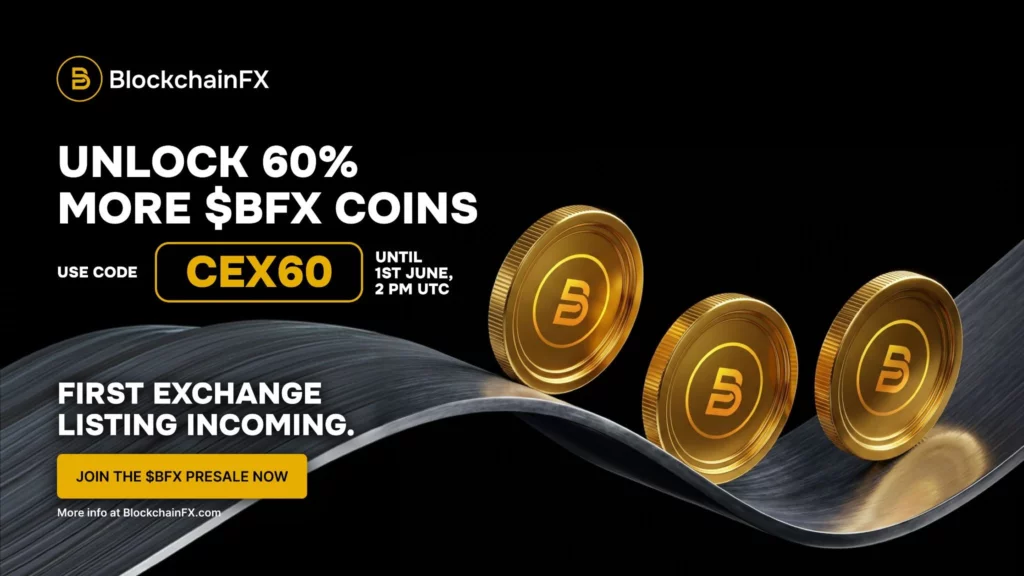
Right now, BlockchainFX (BFX) is grabbing serious attention in crypto price news, while Chainlink (LINK) keeps proving how powerful a strong utility can be over time. Both coins tell a story about timing, momentum, and what can happen when a project catches fire before the wider market fully wakes up.
Why BlockchainFX could be the top crypto to buy in 2026 as its $15m launch trigger gets closer
BlockchainFX stands out because it is not built around one narrow use case. It is a licensed multi-asset Super App that brings crypto, stocks, forex, gold, and ETFs into one web3 platform. That makes the project easy to understand and easy to pitch. For early adopters looking for the top crypto to buy in 2026, this is the kind of setup that feels bigger than a standard token sale. It solves a real problem by putting multiple markets in one place instead of forcing users to jump between apps and platforms.
The sales angle is getting stronger because the numbers already create urgency. BlockchainFX has raised $14.57M+, the current price is $0.035, and the confirmed launch price is $0.05. More than 24,500+ participants have joined, which signals strong demand before exchange trading even begins.
That price gap matters because buyers entering now can see a built-in upside before the token reaches launch. Add in the BFX crypto presale 2026 momentum, daily USDT rewards, 500+ supported assets, and the fact that this crypto presale is nearing its launch trigger, and it becomes clear why BlockchainFX price news is spreading fast.
BlockchainFX bonus code CEX60 sparks fresh price news as the presale pushes toward launch
The biggest news in this section is simple and powerful. BlockchainFX has confirmed that once the presale hits $15M, the launch begins. That means the gap between the current stage and public trading is now very small. This is the kind of update that creates real urgency because people know the lower entry point does not stay around forever. In crypto, late entries often come with regret, and that emotional trigger is exactly why attention around BlockchainFX keeps building.
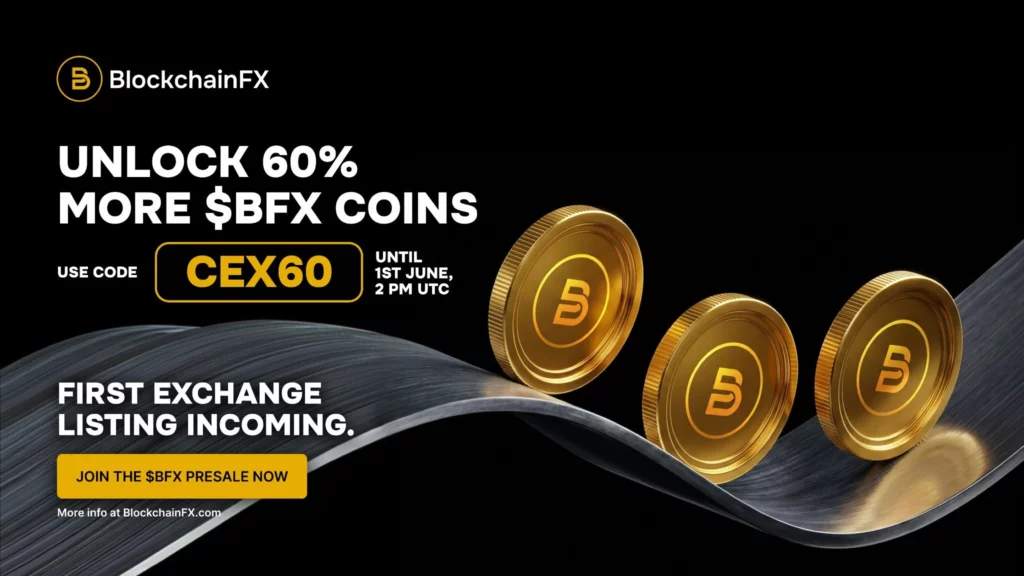
Then comes the part that makes this even more sales-driven. The bonus code CEX60 gives buyers 60% more BFX coins until June 1 at 6 pm Dubai time. That is a strong hook because it can turn an ordinary buy into a much larger position before launch. On top of that, BlockchainFX offers Visa card access for presale participants, trading credits up to $25,000 for top tiers, a 10% referral rewards program, and a revenue-sharing model that sends 70% of trading fees back to the community. This is not just a token story. It is a value stack designed to make early buyers feel like they got in before the crowd.
Chainlink price news proves doubters often miss the biggest wealth runs
Chainlink remains one of the clearest reminders that the market can reward patience in a massive way. Its ICO price was about $0.11, and later it climbed above $50 at peak levels. That kind of move created life-changing returns for people who got in early and held on while others doubted the project. Chainlink price news still gets attention because it carries a lesson the market never stops teaching.
The emotional side of that story matters just as much as the chart. Many people saw Chainlink early, brushed it off, and later watched it make millionaires out of those who acted at the right time. That kind of missed chance stays in the mind for years. The good part is that crypto keeps creating new openings, and that is why many buyers now look at fresh projects with more urgency than before.

Is BlockchainFX the top crypto to buy in 2026?
Chainlink shows what happens when a project with real use breaks out, and BlockchainFX is building a strong case of its own through utility, timing, and traction. Its presale price is still $0.035, its launch price is set at $0.05, and the raise is already at $14.57M+, which puts the project right on the edge of its next major step. That combination is why many market watchers now see BlockchainFX as a serious contender with real upside.
The BlockchainFX presale now has the kind of urgency that gets attention fast. Bonus code CEX60 gives 60% more BFX coins before June 1 at 6 pm Dubai time, and the 10% referral rewards add another reason to act before the crowd gets bigger. For anyone still thinking about old missed winners, BlockchainFX has the emotional pull, the utility, and the presale momentum to feel like a second chance at something much bigger.
For more information, visit the official website, X, and Telegram.
Disclosure: This content is provided by a third party. Neither crypto.news nor the author of this article endorses any product mentioned on this page. Users should conduct their own research before taking any action related to the company.


Crypto‑forensics-led NSW raid seizes 52.3 BTC as AUSTRAC’s 2026 rules tighten the noose on darknet‑linked exchanges and weakly regulated VASPs.
Summary
- New South Wales police seized 52.3 BTC worth about $5.7 million AUD ($4.1 million) in one of Australia’s largest dark web‑linked crypto busts.
- Two men were arrested after a 15‑month Strike Force Andalusia investigation into an alleged darknet marketplace dealing in drugs and weapons.
- The seizure comes as AUSTRAC rolls out tougher AML rules for virtual asset service providers, including mandatory travel rule compliance from July 1, 2026.
New South Wales Police say they have seized 52.3 bitcoin linked to alleged darknet marketplace activity, describing the haul as one of the largest cryptocurrency seizures of its kind in Australia. In an official release, the Cybercrime Squad said detectives executed a search warrant at a home in Ingleburn, southwest Sydney, on May 4, recovering electronic devices that “contained 52.3 bitcoin valued at approximately $5.7 million AUD” at the time of seizure, or roughly $4.1 million USD.
One of Australia’s biggest dark web crypto seizures
The bust capped a 15‑month investigation under Strike Force Andalusia, established in September 2024 to track a substantial bitcoin wallet believed to hold proceeds from darknet market dealings. According to coverage from Dark Web Informer, the trail began with a May 2025 raid in Surfside on the NSW South Coast, where detectives seized around 7.2 grams of cocaine, several devices and about $47,000 in cryptocurrency, ultimately leading them to two men aged 39 and 41 who allegedly controlled a much larger wallet. Yahoo News Australia reports that both men have now been charged over alleged roles in supplying prohibited drugs and moving more than $100,000 in crypto tied to the dark web.
Police allege the funds are connected to an online marketplace facilitating the sale of illicit drugs and weapons, and say forensic work involved extensive wallet tracing and linking on‑chain activity to real‑world identities. The Ingleburn operation, backed by the Public Order and Riot Squad, is being framed internally as a template for future crypto‑forensics‑driven investigations into darknet markets.
AUSTRAC’s tougher crypto rules close in
The seizure comes as Australia’s financial intelligence agency AUSTRAC tightens its anti‑money‑laundering regime around digital assets. In March, AUSTRAC issued updated guidance on “virtual asset designated services,” confirming that exchanges, brokers, custody providers and other VASPs with an Australian link will have full AML/CTF obligations from July 1, 2026, including customer due diligence, reporting, and ongoing transaction monitoring.
Truth Technologies notes that AUSTRAC’s 2026 AML/CTF rule changes introduce new deadlines and expand so‑called “Tranche 2” coverage to lawyers, accountants, real estate and jewellers, while explicitly requiring virtual asset service providers to implement the FATF travel rule for crypto transfers from July 1, 2026. A separate analysis from AMLWatcher highlights that AUSTRAC has also created a public register for VASPs and removed dormant entities, aiming to prevent shell operations being used to launder darknet funds.
For the crypto market, the NSW bust is another data point in a global trend: law enforcement is getting better at tracing bitcoin flows, while regulators simultaneously close the gaps that once let darknet‑linked funds slip through under‑regulated exchanges. As Australia’s new rules bite, offshore platforms serving local users without robust KYC and travel rule controls will find it harder to operate in the grey zone that made cases like Strike Force Andalusia possible in the first place.


Morgan Stanley has launched E*Trade crypto trading at 0.5%, undercutting Coinbase, Schwab, and Robinhood in a pilot set to reach 8.6 million users.
Summary
- Morgan Stanley launched an E*Trade crypto pilot on May 6, charging 50 basis points per trade for Bitcoin, Ether, and Solana via infrastructure partner Zerohash.
- The 0.5% fee undercuts Charles Schwab at 75bps, Fidelity at 1%, and Coinbase retail fees that can exceed 0.5% depending on tier and payment method.
- All 8.6 million E*Trade clients are set to gain access later in 2026, alongside a proprietary digital wallet expected in the second half of the year.
Morgan Stanley has launched ETrade crypto trading at a flat 0.5% fee, below Coinbase and Schwab. The pilot went live on May 6 with Bitcoin, Ether, and Solana available directly inside ETrade brokerage accounts via Zerohash, which handles liquidity, custody, and settlement. Bloomberg reported the pricing, which places Morgan Stanley below every major retail competitor.
Schwab launched its own spot Bitcoin and Ether trading in April at 75 basis points. Fidelity charges roughly 1% per trade. Robinhood is commission-free but carries spreads of 35 to 95 basis points per transaction.
ETF analyst Eric Balchunas said rivals “likely won’t let this stand” and predicted fees across the industry will compress sharply, drawing a parallel to the race to zero expense ratios among Bitcoin ETFs.
What the service includes
Clients receive direct ownership of digital assets rather than fund exposure, which eliminates third-party management fees but carries greater price risk. The pilot does not yet support staking. Zerohash manages all back-end operations, keeping private keys away from users.
As crypto.news tracked, the ETrade crypto rollout is one piece of a broader digital asset push that includes Morgan Stanley’s MSBT Bitcoin ETF, which launched April 8 at a 0.14% expense ratio and hit $103m in inflows within days.
The bank is also building a proprietary digital wallet expected in the second half of 2026, designed to hold crypto alongside tokenized stocks, bonds, and real estate. Morgan Stanley head of wealth management Jed Finn previously described the crypto trading launch as “only the beginning.”
Competitive and market implications
The ETrade launch arrives as crypto.news reported that Morgan Stanley is also pursuing an OCC national trust bank charter for direct crypto custody and staking.
Coinbase generated $3.32bn in consumer transaction revenue in 2025 and launched its own commission-free stock and ETF trading in February to compete with traditional brokerages.
Morgan Stanley’s 16,000 financial advisors oversee $9.3 trillion in client assets, giving ETrade a distribution channel crypto-native platforms cannot match. If the 8.6 million user rollout reaches full scale, it would represent one of the largest retail crypto on-ramps in the US brokerage market.
Crypto World
Micron (MU) Stock Skyrockets 38% in Historic Weekly Rally Fueled by Memory Chip Shortage

TLDR
- MU shares jumped approximately 38% over the past week — marking the strongest weekly performance since late 2008.
- Shares finished Friday’s session at $746.81, climbing more than 15% during that trading day and reaching an intraday record of $712.82.
- The company’s valuation surpassed $840 billion, moving ahead of JPMorgan Chase in market capitalization.
- A worldwide shortage of memory chips has fueled higher pricing and improved profit margins.
- All of Micron’s manufacturing capacity for 2026 has been reserved by customers.
Micron Technology (MU) delivered a performance this week that market observers won’t soon forget.
Shares concluded Friday’s trading at $746.81, posting gains exceeding 15% for the session. Across the entire week, MU climbed nearly 38% — representing its strongest weekly showing since December 2008, when shares were changing hands below $5 during the depths of the Great Recession.
Yes, you read that correctly.
Year-to-date gains now stand at approximately 147%, while the past 30 days alone have delivered returns exceeding 84%. The company’s market capitalization has climbed above $840 billion, positioning it ahead of JPMorgan Chase. While Micron required more than four decades to accumulate its initial $200 billion in market value, it matched that achievement within just seven days.
Friday saw the stock reach an all-time intraday peak of $712.82, according to historical data extending back to 1984.
What’s Driving the Rally
The straightforward explanation: a worldwide scarcity of memory semiconductors.
Appetite for DRAM and NAND — the primary memory chip categories — has intensified dramatically as hyperscale cloud providers invest heavily in artificial intelligence infrastructure. Combined capital expenditures from major cloud companies could eclipse $1 trillion before the close of next year, based on projections from Bank of America and Evercore.
Micron, Samsung, and SK Hynix collectively manufacture over 90% of global DRAM production. This concentrated supply base, paired with accelerating demand, has granted memory producers significant control over pricing.
Every bit of Micron’s production capacity through 2026 has been contracted.
Mizuho analyst Vijay Rakesh observed that Micron “remains well positioned across the memory landscape with leading edge DRAM nodes helping drive cost-downs year-over-year.”
The rally extends beyond Micron alone. AMD climbed 26% during the week, reaching a fresh 52-week high. Intel surged 25% and has more than doubled in value over the past month. Sandisk advanced over 16% on Friday.
Retail Investors Are Paying Attention
Retail trading activity in Micron has intensified notably. Net purchasing reached its highest point in two years during mid-April, based on data from Vanda Research.
“Micron is commanding a much bigger share of retail flow and attention,” said Viraj Patel, strategist at Vanda.
Samsung achieved trillion-dollar valuation status this week. SK Hynix is reportedly receiving investment proposals from international technology companies seeking to finance additional memory production facilities.
During recent quarterly earnings presentations, corporations ranging from Meta Platforms to CoreWeave have cited escalating component expenses as a factor behind elevated spending levels — a direct result of the supply constraints.
Not all observers believe the upward trajectory will persist indefinitely. Carolyn Bell, lead portfolio manager at Stonehage Fleming, characterized it as a cyclical pattern connected to the present stage of data center expansion. Other Wall Street analysts contend that Micron is being reframed as a high-growth AI infrastructure investment rather than a conventional cyclical semiconductor manufacturer.
Micron currently holds the position of 12th largest U.S. company by market capitalization, trailing only Eli Lilly at $900 billion.

Arsenal suffer Champions League final blow with PSG star set to return from injury | Football

TeraWulf: Entering Execution Phase

Amazon lets AI bots pay in USDC via Coinbase x402

Manchester United reach agreement with Casemiro over contract clause amid transfer speculation

US brings back mandatory military draft registration

Steven Gerrard disagrees with Gary Neville over ‘shock’ Chelsea and Arsenal claim | Football


-
 Crypto World1 day ago
HarrisX Poll Found 52% of Registered Voters Support the CLARITY Act
-

 NewsBeat6 days ago
Channel 5 – All Creatures Great and Small series 7 new post
-

 Crypto World2 days ago
Upbit adds B3 Korean won pair as Base token gains Korea access
-

 Tech5 days ago
Image AI models now drive app growth, beating chatbot upgrades
-

 News Videos6 days ago
AP Dhillon – Old Money (Official Audio)
-
 NewsBeat2 days ago
NCP car park operator enters administration putting 340 UK sites at risk of closure
-

 Fashion18 hours ago
Weekend Open Thread: Marianne Dress
-

 Sports6 days ago
Five killed in Texas plane crash identified as Amarillo pickleball players
-
Entertainment7 days ago
New Netflix Movies in May 2026 — My Top 3 Picks to Stream
-
Crypto World7 days ago
Pi Network Mandates Protocol 23 Upgrade for All Mainnet Nodes Before May 15 Deadline
-
Entertainment6 days ago
Anna Nicole Smith’s Daughter Attends 2026 Kentucky Derby
-

 Crypto World6 days ago
Bitcoin mining equities rise in 2026 as BTC lags behind
-

 Entertainment6 days ago
Melissa Joan Hart and More Stars Attend 2026 Kentucky Derby
-
Entertainment6 days ago
Venus Williams’ Best Met Gala Looks Over the Years
-

 Business6 days ago
Luka Doncic Injury Update: Doncic’s Hamstring Recovery Slows Lakers’ Hopes Against Thunder: Can He Run Yet?
-
Entertainment6 days ago
“Storage Wars” star Darrell Sheets' ex-wife breaks silence on his death
-

 Sports6 days ago
Is Man United v Liverpool on TV? Channel, streaming and how to watch Premier League fixture
-

 Business7 days ago
Kuwait International Airport Resumes Operations After Closure as Regional Tensions Ease in 2026
-
 Entertainment7 days ago
Netflix’s 10-Part Miniseries Based on a True Story Is a Perfect Weekend Binge
-
Crypto World7 days ago
Q1 2026 Tech Layoffs AI Wave Hits 81,747 as Firms Shift to AI Infrastructure
You must be logged in to post a comment Login