

Crypto World
MoonPay Unveils Wallet Standard for AI Agents

The Open Wallet Standard aims to fill a gap in the rapidly growing agentic payments stack by giving AI agents a universal, non-custodial way to hold funds and sign transactions across blockchains.
MoonPay on Monday released the Open Wallet Standard (OWS), an MIT-licensed, open-source specification that defines how AI agents interact with crypto wallets, including key storage, transaction signing, and cross-chain account derivation, without ever exposing a private key to the agent process or the large language model driving it.
The standard launched with contributions from over 15 organizations spanning payments, exchanges, and blockchain infrastructure, including PayPal, OKX, Ripple, Tron, TON Foundation, Solana Foundation, Ethereum Foundation, Base, Polygon, Sui, Filecoin Foundation, LayerZero, and Circle.
“The agent economy has payment rails. It didn’t have a wallet standard,” MoonPay CEO Ivan Soto-Wright said in a statement.
The release arrives as the infrastructure for agentic payments is rapidly developing, yet remains fragmented across competing protocols, each assuming agents already have a wallet without specifying how that wallet should work.
As The Defiant reported last week, two protocols are racing to become the foundation of AI payments: x402, backed by Coinbase, and the Machine Payments Protocol (MPP), launched by Stripe and Tempo. Tempo’s payments-focused Layer 1, which went live on mainnet on March 18, shipped with MPP’s “sessions” primitive, allowing agents to set a spending limit upfront and stream micropayments continuously without an on-chain transaction per interaction.
On the same day, Coinbase dropped a significant upgrade to x402, adding support for virtually any ERC-20 token via Uniswap’s Permit2 and new gas sponsorship extensions.
Meanwhile, Visa entered the arena with its own approach. Visa Crypto Labs launched Visa CLI, a command-line interface payment tool targeting AI agent payments, currently in closed beta. And Circle launched Nanopayments on testnet, built on the x402 standard and designed for sub-cent, gas-free USDC transactions for AI agents paying for pay-per-call APIs.
But as MoonPay frames it, all of these systems share a common assumption: the agent already has a wallet. None defines where the wallet lives, how keys are stored, or how one agent discovers a wallet created by another.
In practice, MoonPay says, this means a user running three different AI tools today could have their funds scattered across three separate wallets with no way to access a unified balance.
How It Works
The Open Wallet Standard is structured as seven sub-specifications covering storage, signing, policies, agent access, key isolation, wallet lifecycle, and supported chains. Each module can be adopted independently.
The core design principle is zero key exposure. Keys are encrypted, decrypted only to produce a signature, held in protected memory that cannot be swapped to disk, and wiped immediately after signing. The private key is never accessible to the agent, the LLM context, or any parent application.
A single seed phrase derives accounts across eight chain families — EVM, Solana, Bitcoin, Cosmos, Tron, TON, Spark, Filecoin, and XRP Ledger — with a unified signing interface and CAIP-2 chain identifiers.
There’s also a pre-signing policy engine that evaluates every transaction before any key material is touched. Operators can set spending limits, contract allowlists, chain restrictions, and time-bound authorizations. The standard ships with native SDK bindings for Node.js and Python, a CLI, and an MCP server interface compatible with frameworks including Claude, ChatGPT, and LangChain.
The launch positions OWS not as a competitor to x402 or MPP but as a complementary layer. When x402 returns a payment request, OWS produces the signed authorization. When MPP opens a session and streams micropayments, OWS signs each payment within the agent’s authorized limits.
Whether MoonPay’s open standard gains traction will depend on whether competing agent frameworks adopt a shared wallet layer or continue building proprietary key management.
This article was written with the assistance of AI workflows. All our stories are curated, edited and fact-checked by a human.



Morgan Stanley has launched E*Trade crypto trading at 0.5%, undercutting Coinbase, Schwab, and Robinhood in a pilot set to reach 8.6 million users.
Summary
- Morgan Stanley launched an E*Trade crypto pilot on May 6, charging 50 basis points per trade for Bitcoin, Ether, and Solana via infrastructure partner Zerohash.
- The 0.5% fee undercuts Charles Schwab at 75bps, Fidelity at 1%, and Coinbase retail fees that can exceed 0.5% depending on tier and payment method.
- All 8.6 million E*Trade clients are set to gain access later in 2026, alongside a proprietary digital wallet expected in the second half of the year.
Morgan Stanley has launched ETrade crypto trading at a flat 0.5% fee, below Coinbase and Schwab. The pilot went live on May 6 with Bitcoin, Ether, and Solana available directly inside ETrade brokerage accounts via Zerohash, which handles liquidity, custody, and settlement. Bloomberg reported the pricing, which places Morgan Stanley below every major retail competitor.
Schwab launched its own spot Bitcoin and Ether trading in April at 75 basis points. Fidelity charges roughly 1% per trade. Robinhood is commission-free but carries spreads of 35 to 95 basis points per transaction.
ETF analyst Eric Balchunas said rivals “likely won’t let this stand” and predicted fees across the industry will compress sharply, drawing a parallel to the race to zero expense ratios among Bitcoin ETFs.
What the service includes
Clients receive direct ownership of digital assets rather than fund exposure, which eliminates third-party management fees but carries greater price risk. The pilot does not yet support staking. Zerohash manages all back-end operations, keeping private keys away from users.
As crypto.news tracked, the ETrade crypto rollout is one piece of a broader digital asset push that includes Morgan Stanley’s MSBT Bitcoin ETF, which launched April 8 at a 0.14% expense ratio and hit $103m in inflows within days.
The bank is also building a proprietary digital wallet expected in the second half of 2026, designed to hold crypto alongside tokenized stocks, bonds, and real estate. Morgan Stanley head of wealth management Jed Finn previously described the crypto trading launch as “only the beginning.”
Competitive and market implications
The ETrade launch arrives as crypto.news reported that Morgan Stanley is also pursuing an OCC national trust bank charter for direct crypto custody and staking.
Coinbase generated $3.32bn in consumer transaction revenue in 2025 and launched its own commission-free stock and ETF trading in February to compete with traditional brokerages.
Morgan Stanley’s 16,000 financial advisors oversee $9.3 trillion in client assets, giving ETrade a distribution channel crypto-native platforms cannot match. If the 8.6 million user rollout reaches full scale, it would represent one of the largest retail crypto on-ramps in the US brokerage market.
Crypto World
Micron (MU) Stock Skyrockets 38% in Historic Weekly Rally Fueled by Memory Chip Shortage

TLDR
- MU shares jumped approximately 38% over the past week — marking the strongest weekly performance since late 2008.
- Shares finished Friday’s session at $746.81, climbing more than 15% during that trading day and reaching an intraday record of $712.82.
- The company’s valuation surpassed $840 billion, moving ahead of JPMorgan Chase in market capitalization.
- A worldwide shortage of memory chips has fueled higher pricing and improved profit margins.
- All of Micron’s manufacturing capacity for 2026 has been reserved by customers.
Micron Technology (MU) delivered a performance this week that market observers won’t soon forget.
Shares concluded Friday’s trading at $746.81, posting gains exceeding 15% for the session. Across the entire week, MU climbed nearly 38% — representing its strongest weekly showing since December 2008, when shares were changing hands below $5 during the depths of the Great Recession.
Yes, you read that correctly.
Year-to-date gains now stand at approximately 147%, while the past 30 days alone have delivered returns exceeding 84%. The company’s market capitalization has climbed above $840 billion, positioning it ahead of JPMorgan Chase. While Micron required more than four decades to accumulate its initial $200 billion in market value, it matched that achievement within just seven days.
Friday saw the stock reach an all-time intraday peak of $712.82, according to historical data extending back to 1984.
What’s Driving the Rally
The straightforward explanation: a worldwide scarcity of memory semiconductors.
Appetite for DRAM and NAND — the primary memory chip categories — has intensified dramatically as hyperscale cloud providers invest heavily in artificial intelligence infrastructure. Combined capital expenditures from major cloud companies could eclipse $1 trillion before the close of next year, based on projections from Bank of America and Evercore.
Micron, Samsung, and SK Hynix collectively manufacture over 90% of global DRAM production. This concentrated supply base, paired with accelerating demand, has granted memory producers significant control over pricing.
Every bit of Micron’s production capacity through 2026 has been contracted.
Mizuho analyst Vijay Rakesh observed that Micron “remains well positioned across the memory landscape with leading edge DRAM nodes helping drive cost-downs year-over-year.”
The rally extends beyond Micron alone. AMD climbed 26% during the week, reaching a fresh 52-week high. Intel surged 25% and has more than doubled in value over the past month. Sandisk advanced over 16% on Friday.
Retail Investors Are Paying Attention
Retail trading activity in Micron has intensified notably. Net purchasing reached its highest point in two years during mid-April, based on data from Vanda Research.
“Micron is commanding a much bigger share of retail flow and attention,” said Viraj Patel, strategist at Vanda.
Samsung achieved trillion-dollar valuation status this week. SK Hynix is reportedly receiving investment proposals from international technology companies seeking to finance additional memory production facilities.
During recent quarterly earnings presentations, corporations ranging from Meta Platforms to CoreWeave have cited escalating component expenses as a factor behind elevated spending levels — a direct result of the supply constraints.
Not all observers believe the upward trajectory will persist indefinitely. Carolyn Bell, lead portfolio manager at Stonehage Fleming, characterized it as a cyclical pattern connected to the present stage of data center expansion. Other Wall Street analysts contend that Micron is being reframed as a high-growth AI infrastructure investment rather than a conventional cyclical semiconductor manufacturer.
Micron currently holds the position of 12th largest U.S. company by market capitalization, trailing only Eli Lilly at $900 billion.



Virginia redistricting referendum was struck down 4-3 by the state Supreme Court on May 8, with Democrats immediately filing to appeal to SCOTUS
Summary
- The Virginia Supreme Court ruled 4-3 that Democrats violated procedural requirements when they placed the redistricting amendment on the April ballot.
- The court found that early voting had already begun when the legislature took its first vote in October 2025, incurably tainting the referendum.
- Democrats immediately filed to seek emergency relief from the US Supreme Court, warning the ruling silences the will of voters who approved the measure by 52%.
Virginia redistricting was struck down 4-3 by the state Supreme Court, with Democrats filing to appeal to SCOTUS. The court ruled on May 8 that Democratic lawmakers violated the state constitution’s multistep amendment process when they held the first vote on October 31, 2025, after early voting for that year’s House elections had already begun.
The majority opinion, written by Justice Arthur Kelsey, found the violation “incurably taints” the referendum result and “renders it null and void.” Democrats had spent more than $66 million campaigning for the measure, which passed 52% to 48% in the April 21 special election.
What the ruling means for the midterms
The decision kills a map designed to give Democrats 10 of Virginia’s 11 congressional seats, a gain of four from the current 6-5 Democratic tilt. Without it, Republicans head into November with a decisive redistricting advantage nationally.
Issue One analysis, cited by CNBC, found that redistricting efforts over the past year could give Republicans as many as a 12-seat edge over Democrats absent Virginia’s map. Tennessee, Alabama, and Louisiana have all moved to redraw maps since the Supreme Court’s recent Voting Rights Act ruling. As crypto.news reported, House control in November is also the key variable for the crypto industry’s legislative agenda in 2026.
Rep. Suzan DelBene, chair of the DCCC, said in a statement: “Four unelected judges decided to cast aside the will of the voters.” RNC Chair Joe Gruters countered that “Democrats just learned that when you try to rig elections, you lose.”
What happens next
Virginia Democrats and Attorney General Jay Jones filed the same day to ask the state court to delay enforcing the ruling pending a SCOTUS appeal.
Constitutional law professor Carl Tobias at the University of Richmond warned that SCOTUS is unlikely to give the case full treatment this late in its term with elections approaching. Virginia’s primaries, pushed back to August 14 to account for the referendum, will now proceed under the existing 6-5 map.

TLDR:
- XRP funding rates on Binance have stayed negative for nearly three months, marking a record bearish stretch for the token.
- The Total3 index lost over $544B during the correction but has since recovered roughly $125B from early February repositioning.
- XRP posted a 27% gain while derivatives traders maintained a bearish bias, creating a rare price-sentiment divergence on Binance.
- A similar negative funding rate setup emerged in April 2025 near $1.25, before XRP went on to rally as much as 126% from that level.
XRP funding rates on Binance have remained in negative territory for nearly three months. This comes even as the token posted a 27% gain during the same period.
The altcoin market lost over $544 billion during a broader correction driven by global uncertainty. However, capital repositioning that began in early February has added roughly $125 billion back to the Total3 index. The market dynamic now appears to be shifting.
Altcoin Market Takes the Hardest Hit During Global Correction
The Total3 index tracks the crypto market cap excluding Bitcoin, Ethereum, and stablecoins. During the recent correction, this index shed more than $544 billion in value. Altcoins were the first sector to feel pressure as global market sentiment turned uncertain.
Since early February, however, capital has begun moving back into the altcoin space. The Total3 index has recovered roughly $125 billion over that period. This recovery points to a gradual return of risk appetite among crypto traders and investors.
Despite the recovery, many investors have maintained a bearish stance. A large portion of the market continues to bet against the current upward move. This creates a notable disconnect between price action and trader sentiment.
According to analyst Darkfost, this bearish positioning is especially visible on Binance. Funding rates for XRP have stayed negative for close to three months. This marks the longest and most negative stretch in recent history for the token.
Negative Funding Rates Could Signal a Potential Reversal for XRP
Darkfost aggregated XRP funding rates over a 30-day period to better capture prevailing derivatives sentiment. The data shows a persistent bearish bias even as XRP climbed 27% during the same timeframe. This kind of divergence between price and sentiment is rare and often meaningful.
When a strong bearish consensus forms after a correction of more than 60%, history suggests a reversal may follow.
A similar setup developed in April 2025 when XRP traded around $1.25. A bullish recovery followed, eventually driving a 126% advance from that level.
The pattern shows how crowded short positions can fuel sharp price recoveries. As bearish traders get squeezed, buying pressure tends to accelerate. This dynamic has played out more than once in XRP’s trading history.
At current levels, XRP trades around $1.41 as of writing, still well below its previous cycle highs. The combination of negative funding rates and recovering market cap adds to the case for watching this token closely. Traders familiar with derivatives data will recognize the setup as one worth monitoring.
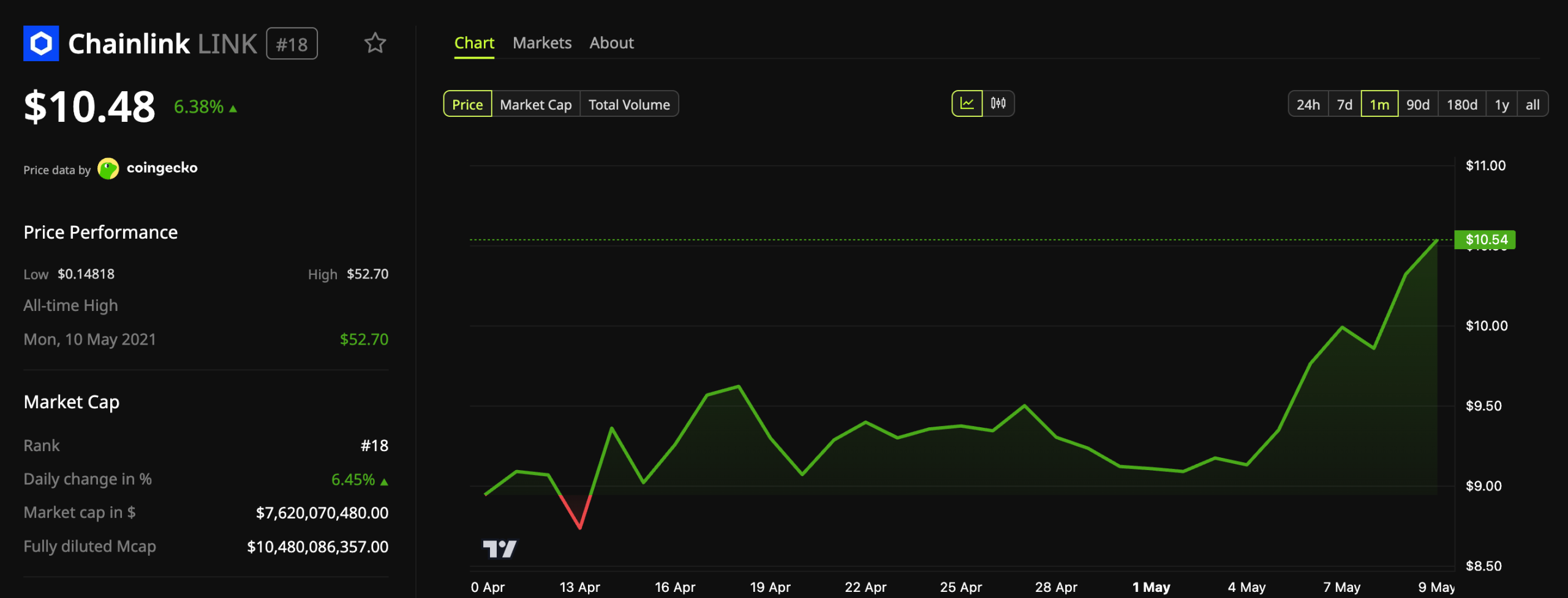
Chainlink (LINK) climbed 15.27% over the past week to an intraday peak of $10.6, marking its highest price in more than three months.
At press time, the altcoin traded at $10.48, up 6.38% over the past 24 hours. The rally coincides with shrinking exchange reserves and a sharp uptick in social media chatter.

Why Is Chainlink Price Up?
According to Santiment, roughly 13.5 million LINK, about 10.5% of exchange-held coins, have been withdrawn over the past five weeks, pointing to accumulation. Social volume has simultaneously surged to a three-month high, suggesting renewed trader attention is converging with shrinking sell-side liquidity.
“Crypto’s 15th largest market cap has had a resurgence in discussions across social media throughout this week, and this has likely contributed to this mini breakout,” the post read.
Whale holdings further corroborate the accumulation trend. Wallets holding between 1 million and 10 million LINK increased their holdings from 265.02 million to 288.04 million LINK over the past 30 days. That marks a 23-million-token increase, or 8.7%.
Wallets with 100,000 to 1 million LINK added another 9.83 million coins. Their stash rose from 163.08 million to 172.91 million tokens during the same period.

Combined, these two cohorts absorbed roughly 32.85 million LINK in one month. Their holdings expanded by 7.7%, reflecting consistent buy-side conviction from larger wallets.
Follow us on X to get the latest news as it happens
LINK Outlook Remains Bullish
Several traders see further upside from the current breakout zone. Trader Quinten Francois flagged the altcoin’s breakout from the multi-year pennant in a post on X.
Trader Clifton highlighted that LINK’s daily chart is forming a descending broadening wedge. He noted measured targets that point to potential gains of 100% to 150% from breakout zones.
“A strong upside breakout from the upper trendline of this wedge, supported by a momentum candle and rising volume, could trigger a powerful bullish rally. Measured targets suggest potential gains of 100-150% from the breakout zone,” the analyst wrote.
Subscribe to our YouTube channel to watch leaders and journalists provide expert insights
The post Chainlink (LINK) Hits 3-Month High: What’s Driving The Rally? appeared first on BeInCrypto.


A US court has found that Meta’s AI ads tools materially developed fraudulent investment content, stripping Section 230 immunity and exposing the platform to securities fraud claims.
Summary
- In Bouck v. Meta, a Northern California federal court denied Section 230 immunity after finding that Meta’s AI ads tools materially shaped fraudulent investment content rather than passively hosting it.
- The ruling opens Meta and other platforms to securities fraud claims under Rule 10b-5, where a platform whose AI assembles ad content could be considered the legal “maker” of the fraudulent statement.
- Alphabet, Snap, TikTok, and X all deploy generative AI in their advertising products and face the same potential exposure under the Ninth Circuit’s material contribution test.
A US court found that Meta’s AI ads helped create fraudulent investment content, removing Section 230 protection from the platform.
Chief Judge Richard Seeborg of the Northern District of California denied a Section 230 dismissal in Bouck v. Meta Platforms, a penny-stock securities class action where plaintiffs alleged that Meta’s generative AI advertising tools had themselves “developed the ultimate content of the fraudulent ads,” making Meta a co-developer rather than a passive host.
The ruling follows a near-identical theory that survived dismissal in Forrest v. Meta, where Judge P. Casey Pitts found that Meta’s ad tools “mix and match” images, videos, text, and audio using generative AI, creating a genuine factual dispute over material contribution to illegal content.
Section 230 of the Communications Decency Act immunizes platforms from liability for third-party content. The line Seeborg drew is technically precise: targeting an audience is protected distribution. Transforming or generating ad content is not. That distinction has now survived at the dismissal stage in two separate cases in the same district.
The Rule 10b-5 question courts have not yet answered
Bloomberg Law legal commentary noted that the Bouck ruling opens a further, unresolved question under securities law. The Supreme Court’s “maker” doctrine in Janus Capital Group v. First Derivative Traders holds that the maker of a fraudulent statement is the entity with ultimate authority over the statement’s content and communication.
If a platform’s generative AI exercises that authority over an assembled investment solicitation, the platform may be the maker of the fraudulent statement under Rule 10b-5, primary securities fraud liability that has no Section 230 analog.
That argument has not yet been fully adjudicated. If it is, platforms whose AI systems assemble investment content could face securities fraud exposure with no Section 230 defense available.
Who else is exposed
The Ninth Circuit’s material contribution framework that survived in Bouck and Forrest applies to any platform whose AI tools actively shape ad content. Alphabet, Snap, TikTok, and X all deploy generative AI in their advertising systems.
As crypto.news reported, AI-driven fraud vectors are accelerating in 2026, with regulators and plaintiffs increasingly targeting the infrastructure layer rather than individual bad actors.
As crypto.news tracked, crypto platforms that use AI to assemble promotional content or investment-related communications could face similar exposure if this legal theory migrates from social media advertising into the digital asset context. Meta has said it will appeal both decisions.
Crypto World
Blockbuster Crypto News: Elon Musk SpaceX Anthropic Deal Fires Up AI Rally and Pepeto Could Be the Last Presale Entry Before Listing
The biggest moves in crypto always start with a headline from outside the market, and the blockbuster crypto news on May 7 was exactly that. Elon Musk dissolved xAI into SpaceX, signed a compute deal with Anthropic worth 220,000 Nvidia GPUs, and set the stage for an IPO that could reach $2 trillion.
When the richest person on the planet bets this hard on AI, the capital that follows touches every connected sector, and blockchain is first in line. But the real question is not which large cap will gain 20% from this wave.
The question is which entry still has a listing event ahead, because that is where the money that changes lives gets made. One project already has $9.86 million in presale capital, a working exchange, and a Binance listing approaching.
Elon Musk Dissolves xAI Into SpaceX and Signs Compute Deal With Anthropic
SpaceX confirmed that Anthropic will use all compute at the Colossus 1 data center in Memphis, gaining 300 megawatts of capacity within a month. Musk announced xAI no longer exists separately and now operates as SpaceXAI.
The company targets a mid-2026 IPO valued up to $2 trillion according to Stocktwits, and this blockbuster crypto news shows AI spending is pushing capital into blockchain at the same pace.
Crypto Has Made More Millionaires Than Any Other Asset Class, and 2026 Is the Next Wave
No other asset class in the last decade has created wealth as fast as crypto. Bitcoin turned $100 into $75 million for early holders. Ethereum turned $1,000 into over $4 million. Shiba Inu turned $8,000 into $9 million in one year according to CNN.
Those are not predictions, those are facts. And every one of those returns came from entering before the crowd showed up. In 2026, the blockbuster crypto news around AI and trillion-dollar IPOs is bringing a fresh flood of capital into digital assets, and the entries that deliver the next millionaire-level returns are the ones priced before a listing event.
Stocks cannot do this. Real estate cannot do this. Only crypto presales at the right moment produce this kind of return.
Pepeto: The Presale Raising Faster Than Any Project in 2026 With AI Contract Scanning
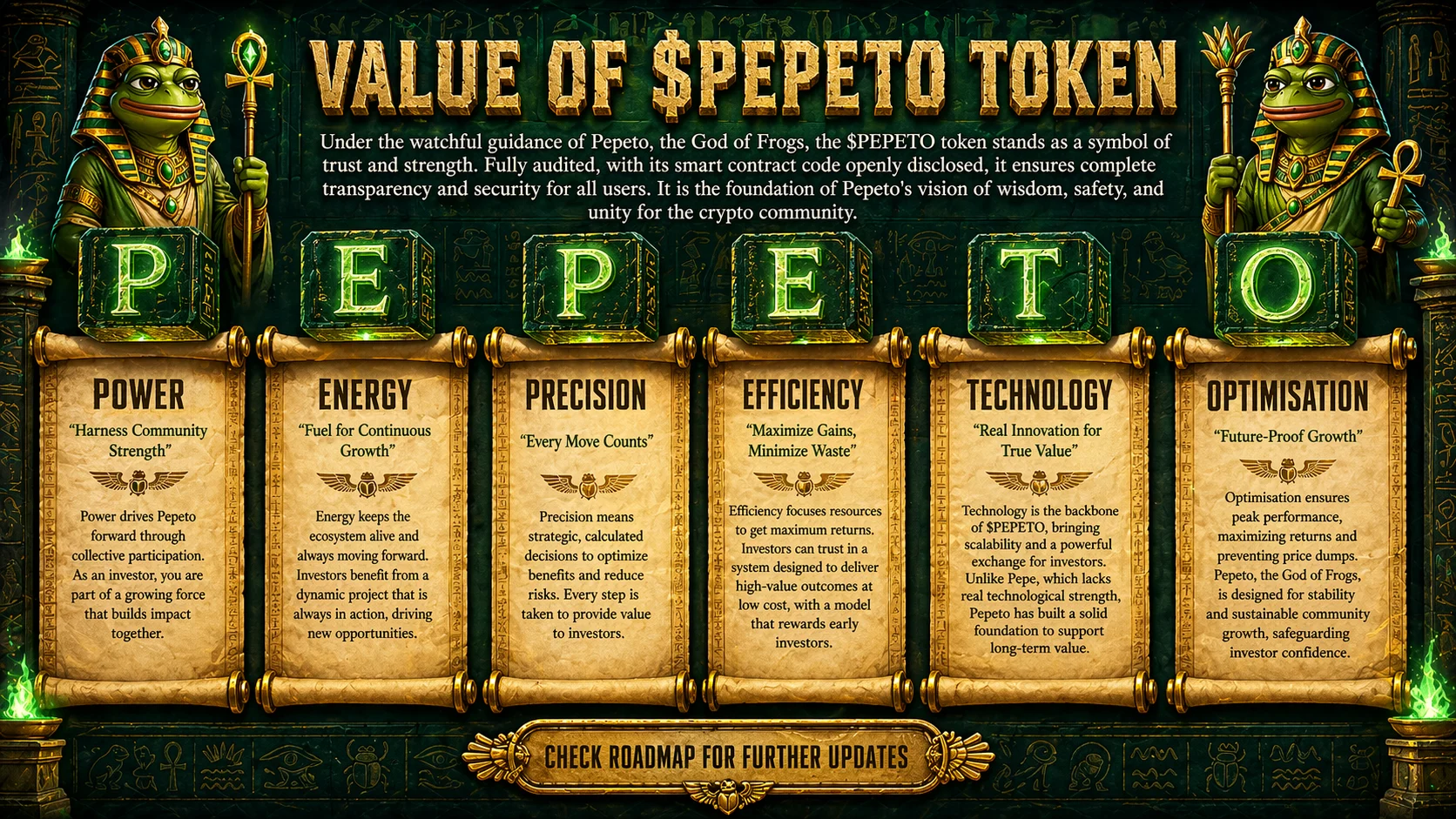
The blockbuster crypto news around Elon Musk and AI is not only about compute power, it is about which projects use AI as a real tool. Pepeto runs a contract scanner powered by AI that checks every token for risks before a buyer puts money in, putting the exchange ahead of platforms where traders depend on outside audit sites.
The exchange handles cross chain swapping across Ethereum, BNB Chain, and Solana with zero fees, so every dollar moved stays as value instead of bleeding into costs.
That zero fee model becomes a growth engine because each swap generates organic demand for the token as users grow. Meme culture draws new users in, and the tools keep them trading because the savings hit every order and the scanner lowers the risk of bad contracts.
SolidProof and Coinsult both audited every contract, a builder from the original Pepe project backs the team, and $9.86 million raised during a correction proves real capital.
Staking at 175% APY pays holders who enter now, and each presale stage sells faster because the price only moves up once a stage closes. The wallets filling this presale today are not guessing. They see the same math that made Shiba Inu buyers millionaires, and they are acting on it.
Conclusion
The blockbuster crypto news of 2026 is writing the next chapter of wealth creation, and Pepeto at $0.0000001869 with $9.86 million raised, dual audits, 175% APY staking, and an AI contract scanner sits at the center of it. Each presale stage fills faster than the last, and the price on Pepeto today will not be there when you come back tomorrow.
The crowd has not arrived yet, and by the time it does the Binance listing will have already repriced the token for everyone who waited. People who watched Shiba Inu turn pennies into fortunes and told themselves they would not miss the next one are looking at that moment right now.
Letting this presale close without entering is how those returns disappear from your hands. Getting in before listing day is how the next wave of crypto millionaires gets built.
Click To Visit Pepeto Website To Enter The Presale

FAQs
How does the Elon Musk SpaceX Anthropic deal connect to blockbuster crypto news for investors?
The SpaceX Anthropic deal sends a $2 trillion signal that AI infrastructure is reshaping capital markets, pushing fresh money into blockchain projects with real AI features. Pepeto runs an AI contract scanner with $9.86 million raised at $0.0000001869 before an expected Binance listing.
What is Pepeto and why are presale holders expecting 100x after listing?
Pepeto is a cross chain exchange with zero fee trading, an AI contract scanner, and 175% APY staking that has raised $9.86 million at $0.0000001869 before an expected Binance listing. The presale to listing repricing compresses months of price discovery into one move, the same math that created millionaires in past meme coin cycles.
Disclaimer: This is a Press Release provided by a third party who is responsible for the content. Please conduct your own research before taking any action based on the content.


The share of profitable Pump.fun traders climbed to 73.28% in April 2026, the fourth consecutive month above 50%. CoinGecko data shows the metric has more than doubled from its low of 30.08% in June 2025.
Profitable wallets had collapsed steadily through 2025 as retail traders absorbed heavy losses on Solana meme coins.
Pump.fun Wallets Stage Historic Profitability Comeback
Pump.fun launched on Solana in January 2024 and quickly became the dominant meme coin launchpad. By late 2024, monthly active wallets had grown into the millions. Most of those traders walked away with realized losses each month.
Profitable traders accounted for less than 50% of active wallets each month from June 2024 through December 2025. The metric hit a low of 30.08% in June 2025. That month, roughly 70% of them booked monthly losses.
Follow us on X to get the latest news as it happens
The trend changed in January 2026. The share of profitable traders climbed from 50.08% that month to 73.28% by April.
“While we cannot conclusively explain this reversal, we hypothesize it reflects a natural exodus of unprofitable traders from the platform. This is supported by the continuous decline in monthly active wallets from its peak of 5.2M in May 2025 to 1.8M in December 2025,” CoinGecko researcher Loke Choon Khei wrote.
Modest Gains Dominate the Comeback
In April 2026, 3.14 million active wallets transacted on Pump.fun. Of those, 2.30 million ended the month profitable. The wins, however, were heavily skewed toward small amounts.
“This study only accounts for Realized PnL; this means that it excludes bagholders who never sold their tokens even if it crashes to zero,” the report added.
About 2.05 million wallets, or 65.14% of the total, recorded gains between $1 and $500. Meanwhile, another 87,127 wallets booked profits between $500 and $1,000. Only 168,795 wallets, or 5.37%, cleared more than $1,000.
Losses followed a similar small-size pattern. About 792,724 wallets lost between $1 and $500, while just 24,538 took realized losses above $1,000.
Subscribe to our YouTube channel to watch leaders and journalists provide expert insights
The post 73% Pump.Fun Traders are in Profit, Best Month Since 2024 appeared first on BeInCrypto.


OpenAI has crossed $25bn in annualized revenue and is actively preparing its OpenAI IPO for as early as the fourth quarter of 2026.
Summary
- OpenAI crossed $25bn in annualized revenue in February 2026, up from $6bn at the end of 2024, driven by ChatGPT subscriptions and enterprise adoption.
- The OpenAI IPO is being prepared with Goldman Sachs, JPMorgan, and Morgan Stanley advising, targeting a potential filing in the second half of 2026.
- OpenAI is not yet profitable and projects annual cash burn reaching $57bn by 2027, making public capital access a financial necessity rather than a choice.
OpenAI has crossed $25bn in annualized revenue and is preparing its OpenAI IPO for as early as late 2026. The milestone was reported by The Information in early March, citing a person familiar with the figures, with Sacra estimating the revenue hit $25bn by the end of February, up from $6bn at the end of 2024. No software company has scaled to this revenue level in a comparable timeframe.
CFO Sarah Friar has told associates the company is targeting a regulatory filing in the second half of 2026, with a potential listing in 2027. Goldman Sachs, JPMorgan, and Morgan Stanley are in discussions about advising the offering.
Friar said separately that the company will allocate a portion of its IPO shares to retail investors, calling it “good hygiene” for a company of its size to act like a public company.
Why the IPO is not optional
OpenAI’s revenue growth is extraordinary but its economics are not. The company generated $13.1bn in revenue in 2025 and spent approximately $22bn to do it. Annual cash burn is projected to reach $57bn by 2027, and the company does not expect to reach breakeven until 2030. The $122bn raised in March gives OpenAI roughly 18 to 24 months of runway before another major capital event is required.
As crypto.news reported, OpenAI is also expanding aggressively into financial services, rolling out tools that connect ChatGPT with institutional data platforms, a move that signals ambitions well beyond consumer subscriptions.
The company’s April 2026 conversion to a public benefit corporation removed the structural barrier to going public that its nonprofit origins had created. Rival Anthropic is simultaneously pursuing its own $50bn raise at a $900bn valuation, creating a potential race to market that could affect OpenAI’s listing window and investor appetite.
Market and crypto implications
Kalshi prediction markets priced the probability of OpenAI announcing an IPO at close to maximum confidence for contracts resolving by early 2026. As crypto.news tracked, on-chain secondary markets are now pricing Anthropic above OpenAI on an implied valuation basis, adding competitive pressure that makes the IPO timeline more urgent.
A $1 trillion listing would be the largest public offering in technology history and would set the benchmark against which every AI company’s private valuation is subsequently judged.


JPMorgan AI spending has been reclassified from discretionary innovation to core infrastructure, placing it alongside data centers and cybersecurity in the bank’s budget.
Summary
- JPMorgan reclassified its $2bn annual AI budget from discretionary innovation to core infrastructure, placing it alongside payment systems and cybersecurity in its $19.8bn tech spend.
- CEO Jamie Dimon says JPMorgan AI deployment has already generated $2bn in operational savings, effectively self-funding the investment across 150,000 employees.
- The bank runs over 500 active AI use cases in production, including fraud detection that has cut anti-money laundering false positives by 95%.
JPMorgan has reclassified JPMorgan AI investment as core infrastructure, treating its $2bn annual budget as non-negotiable as cybersecurity. The world’s largest bank has moved its AI spending out of the discretionary innovation category and placed it alongside data centers, payment systems, and core risk controls inside its $19.8bn total technology budget for 2026.
CEO Jamie Dimon said the investment has already self-funded through $2bn in operational savings across more than 150,000 employees, adding a 10% to 11% productivity gain in engineering, operations, and fraud detection.
The reclassification is not symbolic. When a bank of JPMorgan’s scale treats AI as a non-discretionary cost on par with fraud detection infrastructure, the signal moves downstream to every other financial institution in its competitive set.
CFO Jeremy Barnum confirmed that modernization spending has peaked and the bank’s investment is now shifting toward products, platforms, and AI integration as a baseline operating cost rather than a special project.
What JPMorgan’s AI stack looks like
The bank’s proprietary LLM Suite, named Innovation of the Year at American Banker’s 2025 awards, is now used daily by more than 230,000 employees. It serves as an AI hub that integrates internal customer data, processing workflows, and external information sources through specialized agents.
Over 500 active AI use cases are in production, spanning fraud detection, investment banking deck generation, compliance review, and predictive liquidity management for corporate treasurers.
Fraud detection has seen some of the most measurable results. Anti-money laundering false positives have been cut by 95% using machine learning systems that monitor transactions in near real-time. The bank runs the AI on infrastructure backed by Microsoft Azure and Snowflake, giving it elastic scalability while maintaining the data governance that banking regulators demand.
Crypto and market relevance
JPMorgan is simultaneously pushing into digital assets. As crypto.news reported, the convergence of AI infrastructure investment and digital asset rails is creating a new competitive dynamic in financial services.
The bank has also launched its JPMD deposit token on public blockchain infrastructure, with its proprietary AI now managing JPMD flows and predicting when institutional clients will need liquidity before human traders identify the need.
Dimon has predicted JPMorgan will be a winner amid rising stablecoin threats and economic uncertainty, framing the AI and blockchain combination as the bank’s primary competitive moat.
As crypto.news tracked, OpenAI is rolling out competing financial-services tools targeting the same institutional clients JPMorgan is automating, setting up a direct infrastructure contest between AI-native companies and AI-upgraded incumbents for control of the next layer of financial operations.

FIIs sell over Rs 2 lakh crore worth of Indian equities in 2026. What lies ahead?

Morgan Stanley launches ETrade crypto at 0.5% fee

Reds catcher Tyler Stephenson’s tag blunder costs team in Cubs sweep

Manchester United reach agreement with Casemiro over contract clause amid transfer speculation

US brings back mandatory military draft registration

Steven Gerrard disagrees with Gary Neville over ‘shock’ Chelsea and Arsenal claim | Football


-
 Crypto World1 day ago
HarrisX Poll Found 52% of Registered Voters Support the CLARITY Act
-

 NewsBeat6 days ago
Channel 5 – All Creatures Great and Small series 7 new post
-

 Crypto World2 days ago
Upbit adds B3 Korean won pair as Base token gains Korea access
-

 Tech5 days ago
Image AI models now drive app growth, beating chatbot upgrades
-

 News Videos6 days ago
AP Dhillon – Old Money (Official Audio)
-
 NewsBeat2 days ago
NCP car park operator enters administration putting 340 UK sites at risk of closure
-

 Fashion17 hours ago
Weekend Open Thread: Marianne Dress
-

 Sports6 days ago
Five killed in Texas plane crash identified as Amarillo pickleball players
-
Entertainment7 days ago
New Netflix Movies in May 2026 — My Top 3 Picks to Stream
-
Crypto World7 days ago
Pi Network Mandates Protocol 23 Upgrade for All Mainnet Nodes Before May 15 Deadline
-

 Crypto World6 days ago
Bitcoin mining equities rise in 2026 as BTC lags behind
-

 Entertainment6 days ago
Melissa Joan Hart and More Stars Attend 2026 Kentucky Derby
-
Entertainment6 days ago
Anna Nicole Smith’s Daughter Attends 2026 Kentucky Derby
-
Entertainment6 days ago
Venus Williams’ Best Met Gala Looks Over the Years
-

 Business6 days ago
Luka Doncic Injury Update: Doncic’s Hamstring Recovery Slows Lakers’ Hopes Against Thunder: Can He Run Yet?
-

 Sports6 days ago
Is Man United v Liverpool on TV? Channel, streaming and how to watch Premier League fixture
-

 Business7 days ago
Kuwait International Airport Resumes Operations After Closure as Regional Tensions Ease in 2026
-
 Entertainment6 days ago
Netflix’s 10-Part Miniseries Based on a True Story Is a Perfect Weekend Binge
-
Entertainment6 days ago
“Storage Wars” star Darrell Sheets' ex-wife breaks silence on his death
-
Crypto World7 days ago
Q1 2026 Tech Layoffs AI Wave Hits 81,747 as Firms Shift to AI Infrastructure
You must be logged in to post a comment Login