

Crypto World
Anchorage steps back from USDG as stablecoin alliances decentralize



USDG, still issued by Paxos Singapore and regulated by MAS, will remain in market as one of many institutionally backed dollars as regulators, banks and VCs push toward a fragmented, multi‑issuer “economic OS.”
Summary
- Anchorage Digital, the first federally chartered U.S. crypto bank, is stepping back from leading the Global Dollar (USDG) alliance, saying it wants more neutrality as a stablecoin issuer and custodian.
- CEO Nathan McCauley says about 20 partners are exploring launching stablecoins via Anchorage, so backing USDG too aggressively would misalign incentives as the bank builds a white‑label issuance stack.
Anchorage Digital, the first federally chartered crypto bank in the U.S., is stepping back from a leading role in the Global Dollar (USDG) stablecoin alliance, signaling a shift toward a more neutral, multi‑issuer stablecoin landscape. The alliance — whose members include Robinhood, Kraken, Galaxy Digital, OKX and Visa — was originally framed as a way to build a consortium-backed alternative to single‑issuer dollar tokens, but Anchorage now says it does not want to be seen as the de facto champion of one specific stablecoin as its own issuance and custody business scales.
In comments reported by FinanceFeeds and other outlets, Anchorage co‑founder and CEO Nathan McCauley said the bank will adopt “a higher degree of neutrality” in the stablecoin issuance space, moving away from targeted support for any individual token to better align with its role as a white‑label platform. McCauley noted that roughly 20 potential partners are currently exploring launching stablecoins through Anchorage’s infrastructure, and that the firm needs to “reassess incentive structures and alignment of interests” to avoid conflicts between its own products and those of clients.
USDG itself is not going away. The token is issued by Paxos Digital Singapore and regulated by the Monetary Authority of Singapore, with a current circulating supply around $3 billion, according to figures shared with Coindesk. Paxos — which also operates other regulated dollar tokens — will continue to handle issuance and compliance, while alliance members like Robinhood and Kraken integrate USDG into trading, payments and yield products on their platforms.
What is changing is the balance of power inside the so‑called “stablecoin alliance.” With Anchorage deliberately stepping back from a leadership role, USDG is likely to evolve into one among several institutionally backed dollars rather than the flagship token of a single, highly coordinated consortium. Market participants quoted around the announcement argue that stablecoin issuance is now entering a “parallel development” phase, where multiple institutions and networks roll out their own regulated dollars, often on different chains and under different regimes, instead of converging on one or two dominant consortium coins.
That shift comes as regulators and banks fight over who controls the future of tokenized dollars. In the U.S., the stablecoin yield compromise now before Congress would ban interest‑like rewards on passive balances while still allowing activity‑based incentives, a structure community banks say is necessary to protect deposits but which issuers like Circle and exchanges such as Coinbase argue should not be written so tightly that it kills innovation. At the same time, venture theses from firms like Andreessen Horowitz increasingly describe stablecoins as the base layer of a new “economic operating system,” with multiple issuers, chains and regulatory homes rather than a single monolithic rail.
Anchorage’s recalibration slots neatly into that picture. By positioning itself as a neutral, regulated infrastructure provider that can help dozens of institutions launch their own branded dollars, rather than as the power behind one specific coin like USDG, the bank is betting that the long‑term prize lies in servicing a diversified, multi‑issuer stablecoin ecosystem. For USDG holders, the immediate impact is limited — Paxos still issues the token, MAS still supervises it and alliance members still have skin in the game — but the message to the market is clear: the era of single‑sponsor, single‑network “alliance coins” is giving way to a more fragmented, parallel world where many regulated dollars compete and interoperate, and where the real leverage sits with whoever builds the plumbing they all depend on.



Bitcoin is trading above $80,000, according to CoinDesk market data, after recovering from Friday’s dip, but the rebound still looks more like a market testing resistance than a decisive move higher.
The market structure tells a more complicated story than the price alone, according to market observers.
Beneath bitcoin’s rebound, buyers are becoming more active, and structural support from ETFs remains intact, but much of the recent activity is also being amplified by leveraged futures traders rather than purely spot demand. That makes the recovery more vulnerable to a macro disappointment, particularly with inflation data looming.
Singapore-based market maker Enflux said in a note to CoinDesk that ETF demand and low exchange reserves are helping to build a structural floor for BTC, while Glassnode’s market indicators in its most recent weekly report show buyers becoming more aggressive in both the spot and perpetual markets.
The problem is that the improvement is not clean. Momentum has eased, leverage has risen, and funding is showing more short-side demand, suggesting traders are still hedging against the rally rather than fully embracing it.
That leaves bitcoin in an awkward middle ground. BTC is up 13.4% over the past 30 days and is holding above $81,000, but Friday’s reaction to the stronger-than-expected jobs report — strong numbers mean the Fed is less likely to cut rates — showed how sensitive the market remains to recent buyer cost bases. The headline number beat consensus, yet BTC fell from about $82,000 to $79,743 before recovering over the weekend.
“A headline beat should have cleared $80,700 cleanly, but spot pulled back first,” Enflux wrote. “That level is real overhead, not just a chart marker.”
If risk appetite is returning, why hasn’t BTC broken out more convincingly? Enflux points to an unusual comparison point, arguing that the recovering luxury watch market may offer an early read on how affluent investors are behaving.
Citing Morgan Stanley’s latest secondary watch data, the firm noted that prices rose 1.9% in the first quarter, with gains spreading across 25 of 35 tracked brands as value retention and inventory turnover improved. The broader takeaway is not that crypto money is flowing into watches, but that affluent buyers are re-engaging with risk assets where pricing, scarcity and demand look easier to underwrite after a long correction.
That creates an uncomfortable contrast for bitcoin: if high-end risk appetite is thawing, BTC’s continued struggle to decisively break above key resistance suggests crypto has not yet become the clearest expression of that returning confidence.
Glassnode’s trading data suggests buyers are becoming more aggressive, but not in a way that fully resolves the question of conviction. One key measure is cumulative volume delta, or CVD, which tracks whether traders are more aggressively buying at market prices or selling into bids.
In simple terms, it helps show who is pushing the market. Glassnode said spot CVD, which reflects activity in the underlying bitcoin market, rose 46.4% from $42.4 million to $62.0 million, suggesting buyers are increasingly willing to pay up rather than wait for cheaper entry points.
Perpetual CVD, the same measure applied to crypto futures, jumped from $110.0 million to $410.3 million, showing leveraged traders are also leaning more bullish. That can accelerate gains, but it is a less durable signal than spot demand because futures positions can reverse quickly if sentiment shifts. The caution signals are just as important.
Bitcoin, market observers say, has a stronger floor than it did a month ago, but the next leg higher may depend less on crypto-native enthusiasm than on whether inflation data gives traders enough confidence to stop hedging the rally and start chasing it.


The Senate Banking Committee is set to mark up the sweeping crypto market structure bill on Thursday.
Circle launched a suite of tools designed to let AI agents hold wallets, discover services and make programmable payments using USDC, as companies race to build financial infrastructure for autonomous software systems.
The products, released under Circle’s new “Agent Stack,” include agent-focused wallets, a command-line developer interface, a marketplace for agentic services and a nanopayments protocol for machine-to-machine transactions.
Circle said the nanopayments infrastructure supports gas-free USDC (USDC) transfers as small as $0.000001 and is designed for high-frequency autonomous payment flows between software systems.
The company said the tools are built to allow AI agents to transact autonomously within predefined permissions, spending controls and policy guardrails across supported blockchains and payment networks.
The rollout also includes Circle CLI, a command interface for developers and AI agents building applications on Circle’s platform, and Agent Wallets, which the company said are designed for agents to hold, send and manage funds independently.
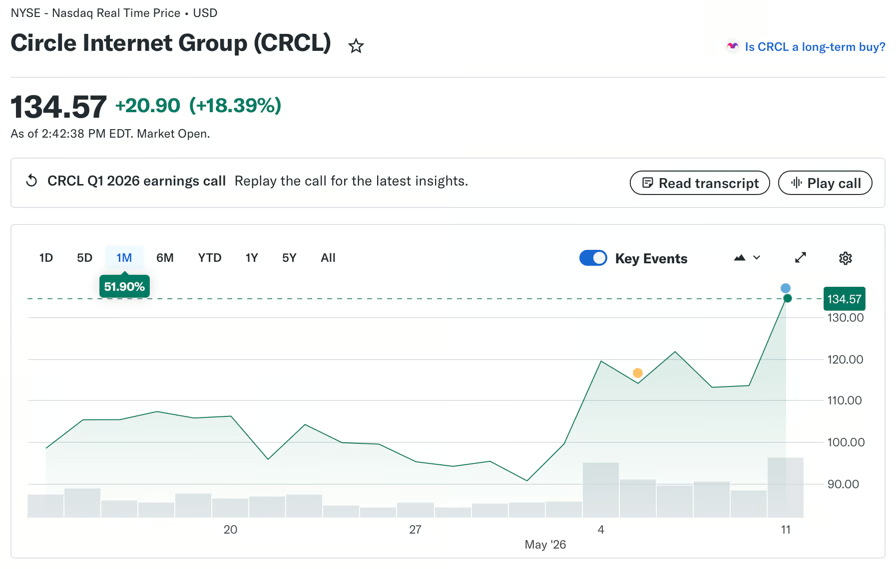
Circle is the issuer of the USDC stablecoin, the second-largest stablecoin by market capitalization with roughly $78 billion in circulation, according to DeFiLlama data. Shares of Circle (CRCL) were up around 18% in midday trading and more than 51% over the past month.

Source: Yahoo Finance
Related: Why stablecoins and SWIFT may have to coexist
Stablecoins emerge as payment rails for AI agents
Circle’s launch comes as crypto companies increasingly position stablecoins and blockchain networks as financial infrastructure for AI agents.
In March, MoonPay released an open-source wallet standard designed to let AI agents manage funds and execute transactions across blockchains through a shared wallet framework with built-in policy controls and encrypted key storage. That same month, BitGo launched an AI-focused developer tool that allows AI agents and assistants to access wallet tools, API resources and technical documentation through natural-language prompts.
Visa also introduced a command-line tool for AI-driven payments without exposing API keys, while Stripe-backed Tempo launched a blockchain and payments protocol designed for stablecoin transactions between autonomous software systems.
Meanwhile, Coinbase said its Ethereum layer-2 network Base was upgrading infrastructure for an “AI agent economy,” with plans focused on stablecoin payments, tokenized assets and developer tools for autonomous software systems.
Last week, Exodus launched XO Cash, a Solana-based stablecoin and developer toolkit designed to let AI agents make payments through agent-linked wallets with configurable spending controls and access to Visa payment rails.
The growing push toward AI-driven automation has already begun to reshape company workforces. Earlier this month, Coinbase said it would cut roughly 14% of its staff, as CEO Brian Armstrong pointed to advances in AI as one of the factors changing how its teams operate.

Source: Brian Armstrong
Magazine: AI-driven hacks could kill DeFi — unless projects act now
Crypto World
SHIB and Pi Move Sideways, BlockDAG Takes the Market Lead With a Live Casino and Utility Stack! Is It the Best Crypto to Buy Now?

The crypto market is moving, but not every coin is moving in the right direction. Shiba Inu price prediction points to weak demand and fading hype, with support sitting precariously near $0.000005 and no clear catalyst to push it higher. Likewise, Pi Network price hovers around $0.18, stuck in a sideways drift and waiting for real fundamentals to emerge. Two speculative plays, two uncertain roads.
Then there’s BlockDAG, which is dominating the best crypto to buy conversations for investors who want utility over promises. With its casino live, a sportsbook incoming, and over $5 million in projected daily volume, this isn’t speculation; it’s momentum backed by proof. Let’s see how all three will fare in the weeks ahead.
SHIB Price Prediction Weakens: Support Nears Breakdown
Shiba Inu price prediction shows SHIB is trading at very low levels with weak demand and low volume. Technical charts suggest a tight squeeze, meaning a big move could come soon. Momentum is slightly positive but not confirmed, as buying interest remains thin, making it risky for short-term traders.
If buyers return, SHIB could rally toward higher resistance, but if sentiment stays weak, it may fall toward support near 0.000005. Lack of whale activity and fading hype increases uncertainty, making direction unpredictable and fast moves more likely than steady trends. Traders should expect sudden volatility rather than slow movement in most scenarios.
Shiba Inu price prediction suggests the token remains highly speculative, with outcomes depending mostly on market sentiment, meaning it could either spike quickly or continue losing value if interest does not return.
Pi Network Price Stuck in Sideways Range
The Pi Network price is currently around $0.18 and moving mostly sideways, showing no strong trend up or down. Market sentiment is cautious because trading is still based on IOU-style activity rather than a fully open blockchain economy.
Forecasts suggest the token may stay in a tight range through 2026 unless major updates increase real usage and demand. Uncertain supply unlocks are also weighing on confidence, keeping investors from pricing in strong long-term growth.

Overall, Pi Network price reflects a waiting phase where the market is looking for clearer fundamentals before a breakout. Until a fully open mainnet, stronger developer adoption, and clearer token distribution rules are confirmed, price action is likely to remain range-bound.
BlockDAG Utility Surges as Casino Goes Live!
BlockDAG is making a compelling case for itself as the best crypto to buy right now, and it’s easy to see why. The project’s casino has officially gone live, marking a turning point toward actual, working utility.
Plus, a full sportsbook is set to unlock soon, which will bring an entirely new category of users and betting volume into the ecosystem. That kind of real-world utility translates directly into on-chain activity, and analysts are already projecting over $5 million in daily volume flowing through the platform.
That figure doesn’t exist in isolation either; incentives, token burns, and buybacks are all built into the system, meaning every dollar of casino activity has a structural effect on BDAG’s demand over time.
Alongside the casino, the BDAGX10 Swap Telegram App is running live, letting users enter hourly events, submit BDAG, earn USDT rewards, and withdraw instantly, a self-sustaining rewards loop that keeps demand constant, independent of casino traffic.
The AfterSale has now closed, and Batch 5 claims open on May 14, giving the community a clear distribution timeline. And here’s the exciting news: for the next 3 days, buyers can secure 160x ROI by purchasing BDAG at just $0.0000005 in the utility presale!
The roadmap ahead makes things even more promising. May brings DEX activation and liquidity pool incentives, deepening the on-chain ecosystem, while June introduces a full Super App complete with lending, oracles, and dApps, significantly widening BlockDAG’s utility footprint. Those looking to earn massive gains have a clear reason to act this week.
Which Is The Best Crypto to Buy Now?
The picture for SHIB and Pi isn’t too optimistic right now. Shiba Inu price prediction leaves traders with more questions than answers, thin volume, no whale activity, and a support level at $0.000005 that could crack under pressure.
The Pi Network is also range-bound and waiting for fundamentals that haven’t arrived yet. For patient holders, that might be fine. For anyone looking to put capital to work today, the math simply doesn’t add up.
BlockDAG, on the other hand, is taking off fast. The live casino is projected to see $5 million in daily volume. Plus, the token burns, buybacks, the BDAGX10 Swap App, and a Super App roadmap all suggest even more utility ahead.
This level of execution is rare for a new project, and that’s what makes it the best crypto to buy for anyone seeking a strong long-term opportunity today.

Presale: https://purchase.blockdag.network
Website: https://blockdag.network
Telegram: https://t.me/blockDAGnetworkOfficial
Discord: https://discord.gg/Q7BxghMVyu
Disclaimer: This is a Press Release provided by a third party who is responsible for the content. Please conduct your own research before taking any action based on the content.

Key takeaways:
- Bitcoin derivatives show limited conviction among pro traders, but ETF flows and Strategy could play a role in the next higher rally.
- Reduced odds of a peace plan between the US and Iran, and high oil prices, could impede Bitcoin’s price discovery.
Bitcoin (BTC) flirted with the $82,000 level on Monday, sparking a brief surge in demand for bullish leverage. Bitcoin has held near $80,000 for over a week, prompting many traders to bet on further upside. However, derivative metrics show that professional players remain skeptical, leaving many to wonder whether $85,000 is actually within reach.

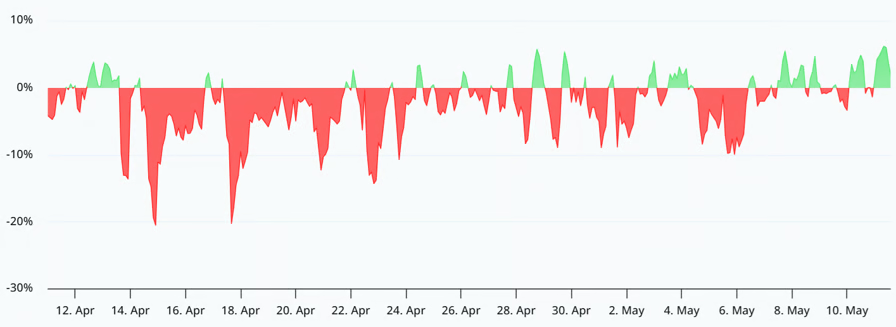
Bitcoin perpetual futures annualized funding rate. Source: Laevitas
The annualized funding rate for Bitcoin perpetual futures briefly jumped to 6% on Monday, touching neutral-to-bullish territory for the first time in over a month. Still, the indicator has mostly stayed negative, signaling more demand for bearish leverage. This lack of confidence among bulls doesn’t necessarily block further gains, but it does highlight a cautious mood among traders.

US-listed Bitcoin spot ETFs daily net flows, USD. Source: SoSoValue
Outflows from US-listed spot Bitcoin ETFs on Thursday and Friday likely fueled this bearish sentiment. Since ETF flows are a go-to proxy for institutional interest, seeing a reversal right as Bitcoin failed to break $82,000 on several attempts is triggering real concern across the market.
Bitcoin miners pivot to AI, BTC price remains stable
The artificial intelligence sector continues to capture investors’ attention, especially after several Bitcoin mining firms pivoted to high-performance computing. Iren (IREN US) announced a massive $34 billion deal with Nvidia on Friday. Additionally, Core Scientific (CORZ US) recently announced plans to expand its campus in Muskogee, Oklahoma.
Bitcoin’s hashrate dropped to its lowest point in eight weeks on April 26, but the indicator showed plenty of resilience throughout May.

Bitcoin 7-day average hashrate, exahashes per second. Source: Blockchain.com
The estimated processing power supporting the Bitcoin network climbed 5% in just two weeks, reaching 970 exahashes per second. While this is still far from the peak of 1,150 exahashes per second, the fear that miners would abandon the network for AI proved irrational.
Even so, bullish momentum hasn’t quite returned for traders, as Bitcoin remains 35% below its all-time high.

Bitcoin 30-day options delta skew (put-call) at Deribit. Source: Laevitas
The Bitcoin options delta skew (put-call) sat at 10% on Monday, unchanged from the previous week. Put (sell) options are trading at a premium, hinting that whales and market makers aren’t comfortable holding downside risk right now. Whether the main issue is the economy or geopolitics, professional traders clearly fear a correction.
Related: Bitcoin stalls as BTC ETF outflows hit $268M–Will new Fed chair restore the rally?
Outside of crypto, Brent crude oil prices jumped above $105 on Monday as the Strait of Hormuz remains partially closed due to the war in Iran. US President Donald Trump called Iran’s latest demands “totally unacceptable,” while Israeli Prime Minister Benjamin Netanyahu argued the conflict won’t end until Iran’s enriched uranium stockpiles are “taken out.”
On the corporate BTC treasury side, Strategy (MSTR US) announced it acquired $43 million in Bitcoin after a one-week break. The buy was funded by selling company shares. So, while the derivatives market still feels a bit bearish, the path to $85,000 is still wide open. Any fresh inflows into Bitcoin spot ETFs this week could easily be the catalyst the market needs.

TLDR
- MARA is expected to report a first-quarter loss on revenue of $184.21 million and earnings per share of $2.34.
- Bitcoin prices fell about 25% during the quarter, which pressured MARA’s digital asset holdings and earnings.
- The company sold 15,133 BTC for about $1.1 billion to strengthen liquidity and repurchase $1.0 billion in convertible notes.
- MARA agreed to acquire Long Ridge Energy from FTAI Infrastructure in a $1.5 billion transaction.
- The company partnered with Starwood to develop data centers targeting one gigawatt of computing capacity
MARA will report first-quarter earnings after the market closes on May 11, and analysts expect a loss on both revenue and earnings. Wall Street forecasts revenue of $184.21 million and a loss per share of $2.34, reflecting the weaker Bitcoin price during the quarter. However, the company continues to advance its infrastructure strategy as it shifts toward artificial intelligence and high-performance computing services.
MARA Prepares for Earnings Release as Bitcoin Weighs on Results
Analysts expect MARA to reflect lower bitcoin prices in its first quarter results, as BTC fell about 25% from $87,000 to $67,000. That decline created mark-to-market losses on the company’s digital asset holdings, which pressured reported earnings. As a result, forecasts point to weaker revenue compared with prior quarters.
In the fourth quarter, MARA reported revenue of $206 million, down 6% from $214 million a year earlier. The company also confirmed plans to diversify operations beyond bitcoin mining. Executives stated that the strategy aims to secure steadier revenue streams tied to data center and computing contracts.
During the first quarter, MARA sold 15,133 BTC valued at about $1.1 billion. The company used $1.0 billion of the proceeds to repurchase convertible notes and improve liquidity. Management said the move supports its long-term infrastructure expansion plans.
MARA Expands AI Infrastructure Through Energy and Data Center Deals
MARA advanced its transition strategy through a $1.5 billion agreement with FTAI Infrastructure. Under the deal, FTAI agreed to sell Long Ridge Energy to MARA, providing long-term power generation capacity. The transaction aims to secure a stable cash flow linked to computing and data center operations.
The company also announced a partnership with Starwood to develop data centers delivering about one gigawatt of computing capacity. MARA said the initiative will support growing demand for high-performance computing workloads. The company continues to allocate capital toward these projects as part of its strategic shift.
Other miners have taken similar steps toward computing services. IREN expanded its transition through a $3.4 billion cloud agreement with NVIDIA. The company also recorded a $140.4 million non-cash impairment tied to the sale of ASIC mining hardware.
HIVE Digital Technologies reported further investment in computing infrastructure. The company committed $3.1 million to install high-speed fiber supporting a planned 50MW computing facility. These developments show ongoing capital deployment across the sector.
MARA shares rose 1% to $13 in pre-market trading ahead of the earnings release. The company will publish its financial results after the closing bell on May 11.
TLDR
- Ronin will migrate from an independent sidechain to an Ethereum layer 2 on May 12.
- The network will execute a hard fork at block 55,577,490 and pause activity for about 10 hours.
- Ronin said all transfers, swaps, and smart contract interactions will stop during the downtime.
- The upgrade will introduce a Proof of Distribution model to reward active contributors.
- The new model will reduce RON token inflation from over 20 percent to below 1%.
Ronin will migrate from an independent sidechain to an Ethereum layer 2 on May 12. The network will execute a hard fork at block 55,577,490 and pause operations for about 10 hours. The team said the move will strengthen security while maintaining throughput and lower token inflation.
Ronin Migration Plan and Network Downtime
Ronin announced the transition in April and confirmed the execution timeline this week. The network said it will begin the upgrade around 15:16 UTC on Tuesday, based on onchain data. The hard fork will halt transfers, swaps, and smart contract activity during the downtime window. Ronin stated on X, “All network transactions will be paused,” and urged users to complete actions before the pause.
The team said all games built on the network will experience temporary disruption. It confirmed that Axie Infinity and Pixels will suspend in-game onchain actions during the upgrade. Ronin explained, “To avoid any inconvenience, please complete all necessary transactions before the downtime begins.” The network will resume operations after completing the technical transition.
Ronin launched four years ago to support Axie Infinity’s need for faster transactions. The company said, “Axie Infinity onboarded millions of gamers to crypto.” It added that Pixels later demonstrated repeated onboarding success. The team now aims to reconnect with Ethereum and integrate more closely with its base layer.
Ronin suffered a $625 million bridge exploit in 2022 while operating as a sidechain. The attack remains the largest DeFi bridge exploit recorded. The new structure will link the network directly to Ethereum as a layer 2. The team said this structure will enhance bridge security and reduce structural risk.
RON Token Economics and OP Stack Integration
The migration will introduce a “Proof of Distribution” model during the downtime. Ronin said the model will reward builders based on active network contribution. The company stated that the change will reduce token inflation from over 20% to below 1%. It described the adjustment as “fundamentally bullish for RON.”
Ronin will redirect 90 million RON tokens from staking rewards to the treasury. The network will also increase marketplace fees to 1.25% from 0.5%. The team confirmed these changes as part of its revised token structure. It aims to reset supply dynamics through lower emissions and updated incentives.
RON trades at about $0.11 with a market capitalization near $89.5 million. The token remains below its 2024 peak level. However, prices rose 30% over the past 30 days following the migration announcement. Onchain data reflects increased activity during the preparation phase.
Ronin will transition to the OP Stack to operate as an Ethereum layer 2. The network said this integration will allow it to inherit Ethereum’s security framework. It will also use EigenDA for data availability to support scalability. The company confirmed that it will begin the migration process on Tuesday at 15:16 UTC.
TLDR
- Ripple secured $200 million in funding from Neuberger Berman to expand its prime brokerage platform.
- The company will use the capital to increase margin capacity across traditional and digital asset markets.
- Ripple rebranded Hidden Road as Ripple Prime after acquiring it for $1.25 billion in 2025.
- Ripple Prime reported that its revenue has tripled year over year since the acquisition.
- Noel Kimmel said the funding will improve capital efficiency and support institutional client growth.
Ripple secured a $200 million funding agreement with Neuberger Berman to expand its prime brokerage services. The company will use the capital to increase margin capacity across traditional and digital asset markets. The deal strengthens Ripple’s institutional platform and supports rising client demand.
Ripple Prime Expands With New Institutional Financing
Ripple confirmed it closed a $200 million funding facility with Neuberger Berman on Monday. The company will use the capital to expand margin offerings across traditional and digital assets. Executives said the agreement strengthens liquidity and operational capacity.
The funding supports the continued growth of Ripple Prime. Ripple rebranded Hidden Road as Ripple Prime after acquiring it in 2025. The firm reported that platform revenue has tripled year over year since the acquisition.
Ripple acquired Hidden Road for $1.25 billion in 2025. The deal ranked among the largest transactions in cryptocurrency industry history. The company later agreed to acquire GTreasury for $1 billion to expand treasury services.
Noel Kimmel, President of Ripple Prime, addressed the funding in a statement. He said, “Dependable access to financing and balance sheet strength are critical to institutional participants.” He added that the facility will increase margin capacity and improve capital efficiency.
Kimmel also said Neuberger Specialty Finance brings expertise in asset-based finance. He stated the firm understands Ripple Prime’s services and operating model. The agreement aims to align financing capacity with institutional client growth.
Peter Sterling, Head of Neuberger Specialty Finance, commented on the transaction. He said Ripple Prime built an innovative brokerage platform combining fintech technology with compliance standards. Sterling emphasized the firm’s operational rigor and agility.
Neuberger Berman manages approximately $570 billion in total assets under management. The investment firm operates across multiple asset classes and global markets. The agreement reflects institutional collaboration in digital asset infrastructure.
Institutional Demand Drives Ripple Prime Growth Strategy
Ripple raised $500 million earlier at a $40 billion valuation. Fortress Investment Group and Citadel Securities backed that funding round. The company used that capital to expand custody, stablecoins, and brokerage services.
Institutional participation in digital assets continues to increase. The U.S. administration under President Donald Trump has supported crypto-friendly regulatory initiatives. Market participants have responded with new digital asset offerings.
State Street Corp. announced a digital asset platform earlier this year. Standard Chartered Plc revealed plans to establish a crypto prime brokerage service. These developments reflect expanding institutional infrastructure.
Ripple positioned Ripple Prime as a multi-asset brokerage platform. The company combines fintech systems with bank-level compliance standards. Executives said the new financing will support client responsiveness and balance sheet growth.
Kimmel stated that the facility enables the company to grow alongside institutional clients. He said it will deliver greater responsiveness and expanded margin access. The funding agreement closed as institutional demand for brokerage services continued to rise.
Key Highlights
-
Seadrill achieves Q1 adjusted EBITDA of $97M while expanding contract pipeline beyond $3.1B.
-
Shares of SDRL advance 3.05% following upgraded 2026 financial projections.
-
Offshore driller secures fresh rig agreements spanning Brazil, Angola, and Gulf of Mexico operations.
-
First-quarter net loss shrinks as improved dayrates strengthen operational performance.
-
Intraday trading shows early volatility despite positive earnings metrics and enhanced outlook.
Seadrill Limited delivered improved first-quarter financial performance while announcing contract wins that pushed its total backlog past the $3.1 billion threshold. Shares of SDRL closed at $49.79, marking a 3.05% increase, though the stock retreated from intraday peaks near $53. The quarterly report highlighted strengthening rig market conditions, upgraded forecasts, and extended revenue certainty through 2026.
Offshore Driller Elevates 2026 Financial Projections
Seadrill recorded operating revenue of $358 million during the first quarter, representing a slight decline from the prior quarter’s $362 million. Despite this modest revenue dip, adjusted EBITDA climbed to $97 million compared with $88 million previously. The offshore driller also expanded its adjusted EBITDA margin, excluding reimbursables, reaching 27.9%.
The company narrowed its quarterly net loss to $7 million from $10 million in the preceding period. Diluted loss per share decreased to 11 cents versus 16 cents previously. Operating expenditures declined to $334 million as certain project preparation activities transitioned into capitalized investments.
Management upgraded its 2026 operating revenue forecast to a range of $1.43 billion to $1.48 billion. Adjusted EBITDA guidance for 2026 was similarly raised to between $370 million and $420 million. The company maintained its capital expenditure and long-term maintenance projection at $200 million to $240 million.
Fresh Agreements Expand Backlog Beyond $3.1 Billion
Seadrill supplemented its contract backlog with over $860 million in new awards following its February fleet update. These contract wins originated from operations in the U.S. Gulf of Mexico, Brazil, and Angola. Consequently, the total contract backlog now exceeds $3.1 billion.
The West Polaris rig obtained a three-year extension with Petrobras in Brazil, scheduled to commence in January 2028. This agreement contributed approximately $480 million to the backlog. Meanwhile, West Neptune and West Vela secured Gulf of Mexico assignments with LLOG, collectively adding $260 million.
In Angola, Sonangol Quenguela extended operations with TotalEnergies for roughly 480 days. This extension maintains rig commitment through July 2028. Additionally, West Carina’s Brazil contract received an extension running into June 2026.
Shares Show Positive Movement Despite Intraday Volatility
SDRL stock appreciated 3.05% to $49.79 following the company‘s first-quarter earnings disclosure. However, trading patterns revealed weakening momentum after an initial surge toward $53. Prices subsequently stabilized toward the lower portion of the session’s range.
Market participants responded to Seadrill’s enhanced EBITDA performance, elevated guidance, and expanded contract pipeline. The intraday retreat suggested profit-taking activity following the opening rally. Nevertheless, SDRL maintained positive territory through the session update.
Seadrill specializes in offshore drilling services, deploying deepwater rigs across key energy markets globally. The company gains when oil producers allocate capital toward long-duration offshore exploration and development initiatives. Recent contract additions provide revenue visibility extending into late 2026, throughout 2027, and into portions of 2028.


US spot Bitcoin ETF products drew $622.75 million last week, their sixth straight week of net inflows.
Summary
- SoSoValue data for the week of May 4 to 8 shows $622.75 million in total net inflows across US spot Bitcoin ETF products.
- BlackRock’s IBIT attracted $596 million during the week, bringing its cumulative total to $66.1 billion.
- The six-week streak has pulled nearly $3.4 billion into US Bitcoin ETF products, the longest run since July 2025.
US spot Bitcoin ETF products drew $622.75 million in net inflows during the week of May 4 to 8, extending the streak to six consecutive weeks of positive flows. SoSoValue tracked the figures on May 11.
BlackRock’s IBIT dominated the period with $596 million in net inflows. Grayscale’s GBTC was the notable exception, posting $62 million in net outflows over the same stretch. IBIT’s cumulative total now stands at $66.1 billion.
Six weeks and what comes next
The current run is the longest inflow streak for US spot Bitcoin ETF products since seven consecutive weeks between June and July 2025. Over the six weeks starting April 2, the funds have together absorbed nearly $3.4 billion in fresh capital.
The strongest week of the run came in mid-April at $996.38 million. Last week’s $622.75 million was the second-highest total of the streak. Bitcoin traded between $80,000 and $82,000 during the period before stabilising near $80,800 by the weekend.
Spot Ethereum ETFs drew $70.49 million over the same week, while spot Solana ETFs took in $39.23 million and spot XRP ETFs attracted $34.21 million.
Institutional positioning and context
The six-week run follows sustained institutional demand that has seen IBIT absorb the overwhelming majority of industry flows throughout 2026. IBIT captured 73% of Bitcoin ETF inflows during the week of January 12 to 16, a pattern that has continued across successive reporting periods.
Quantix Finance CEO Jake Seltzer told analysts this week that “the market is entering a phase where liquidity is becoming more selective rather than purely speculative,” pointing to the inflow data as a sign of structural institutional rotation into Bitcoin.

CSC wins arbitration denying Nebraska NIL deals, but bigger fight looms in court

Double Canvas intrusion confirmed as ShinyHunters resets leak deadline

EBT Final Boss | Financial Audit

Manchester United reach agreement with Casemiro over contract clause amid transfer speculation

US brings back mandatory military draft registration

Steven Gerrard disagrees with Gary Neville over ‘shock’ Chelsea and Arsenal claim | Football


-
 Crypto World4 days ago
HarrisX Poll Found 52% of Registered Voters Support the CLARITY Act
-

 Fashion3 days ago
Weekend Open Thread: Marianne Dress
-

 Crypto World5 days ago
Upbit adds B3 Korean won pair as Base token gains Korea access
-
 NewsBeat5 days ago
NCP car park operator enters administration putting 340 UK sites at risk of closure
-

 Tech2 days ago
Auto Enthusiast Carves Functional Two-Stroke Engine from Solid Metal
-

 Fashion10 hours ago
Coffee Break: Travel Steam Iron
-

 Politics6 hours ago
What to expect when you’re expecting a budget
-

 Politics3 days ago
Politics Home Article | Starmer Enters The Danger Zone
-

 Fashion1 day ago
What to Know Before Buying a Curling Wand or Curling Iron
-
 Business3 days ago
Ignore market noise, India’s long-term story intact, say D-Street bulls Ramesh Damani and Sunil Singhania
-

 Crypto World7 days ago
UAE Free Zone Deploys Blockchain IDs to Verify Registered Firms
-

 Tech21 hours ago
GM Agrees To Pay $12.75 Million To Settle California Lawsuit Over Misuse Of Customers’ Driving Data
-

 Crypto World6 days ago
BlackRock CEO Larry Fink Discusses a New Asset Class
-

 Crypto World5 days ago
Robinhood says Wall Street is building onchain
-

 Entertainment5 days ago
Sarah Paulson Called Out For Met Gala ‘Hypocrisy’
-
 Sports6 days ago
NBA playoff winners and losers: Austin Reaves is not loving Lakers vs. Thunder matchup, but Chet Holmgren is
-

 Tech6 days ago
Apple and Samsung are dominating smartphone sales so thoroughly that only one other company makes the top 10
-

 Entertainment5 days ago
Bold and Beautiful Early Spoilers May 11-15: Steffy Revolted & Liam Overjoyed!
-

 Fashion5 days ago
The Best Work Pants for Women in 2026
-

 Entertainment4 days ago
General Hospital: Ric & Ava Bombshell – Ric’s Massive Secret Exposed!
You must be logged in to post a comment Login