
Crypto World
Andy Konwinski Is One of TIME's 100 Most Influential People in AI





Trump-linked crypto venture company, World Liberty Financial, is preparing to launch a federally chartered national trust bank after the Office of the Comptroller of the Currency granted preliminary conditional approval earlier this month. An entity linked to Sheikh Tahnoon bin Zayed al Nahyan and co-investors reportedly owns 49% of the holding company, the largest stake in that structure.
The proposed bank is intended to issue, redeem, and safeguard USD1, the dollar-backed stablecoin World Liberty launched last year. The venture links World Liberty’s stablecoin business to a proposed federally chartered trust bank.
The OCC’s action is preliminary and conditional rather than a final banking charter. According to the Journal, the approval concerns World Liberty Financial’s plan to launch a federally chartered national trust bank.
The proposed bank’s stated functions are to issue, redeem, and safeguard USD1. The conditional approval does not amount to a final charter.
Discover: The Best Crypto to Diversify Your Portfolio
Trump Crypto Bank and The 49% Stake
Sheikh Tahnoon bin Zayed al Nahyan and co-investors are behind an entity that owns the largest stake, 49%, in World Liberty’s banking holding company, according to people familiar with the matter who spoke to the Journal. The Journal previously reported that Tahnoon backed a $500 million investment in World Liberty Financial last year in exchange for a 49% stake in the company.
The reported holding-company stake places an entity linked to Tahnoon and co-investors in the ownership structure of the proposed bank.

Tahnoon serves as the United Arab Emirates’ national security adviser and is the brother of the country’s president. He oversees a business empire valued at more than $1.3 trillion and funded by his personal fortune and state money, according to the Journal.
An Expanded Business Relationship
The new venture marks an expansion of the business relationship between the Trump-backed crypto company and a foreign government official, according to the Journal. World Liberty Financial is pursuing a proposed bank whose holding company ownership includes an entity linked to Tahnoon and co-investors.

The OCC’s preliminary conditional approval and the reported ownership structure are central elements of the proposed venture. The bank’s planned role is tied to USD1’s issuance, redemption, and safeguarding.
The approval remains preliminary and conditional. World Liberty Financial’s proposed bank has not yet received a final charter. For now, the proposed bank’s stated role is to issue, redeem, and safeguard USD1.
Discover: The Best Token Presales
The post Trump Crypto Empire Faces Scrutiny Over 49% Saudi Linked Stake in New Bank appeared first on Cryptonews.

Visa has teamed up with Dunamu, the parent company of South Korean crypto exchange Upbit, to explore how stablecoins could be used for payments, cross-border remittances and settlement—while also testing how artificial intelligence could enable more automated, commerce-oriented transactions.
In a partnership announcement issued Friday, Dunamu said the two firms will combine Dunamu’s digital asset technology with Visa’s global payments network to develop services for major markets, spanning payment flows, remittance rails, and settlement mechanisms.
Key takeaways
- Visa and Dunamu are collaborating on stablecoin-based payment, remittance, and settlement services.
- The partnership also targets “agentic commerce,” where AI agents may initiate shopping and payment actions on a user’s behalf.
- Dunamu said it is assessing multiple stablecoin projects rather than committing to a single token.
- The teams are considering payment models that could involve Open Standard’s proposed Open USD (OUSD), though the partnership isn’t limited to it.
Why Visa and Dunamu’s stablecoin push matters
Stablecoins have increasingly been positioned as a way to move value more efficiently across borders, particularly for remittances and settlement use cases. Visa’s involvement signals interest from a major legacy payments network in integrating digital-asset rails into broader payment infrastructure, rather than treating stablecoins as a standalone experiment.
For Dunamu, the partnership also represents an opportunity to connect its digital asset capabilities to a global network designed to reach consumers, merchants, and financial institutions at scale. The combination of Dunamu’s expertise and Visa’s established payments footprint is intended to support new business models across payment and settlement workflows.
Open USD is on the table, but not the only option
A key element of the announcement is that Dunamu and Visa are considering stablecoin structures tied to Open Standard’s proposed Open USD (OUSD), a dollar-backed stablecoin initiative unveiled in June.
According to Open Standard, more than 140 companies have signed up to use OUSD, with Open Standard citing Visa, Mastercard, Stripe, Coinbase and BlackRock among the listed participants. However, Dunamu’s Friday statement clarified that OUSD is only one of several stablecoin projects under review for the partnership. The company said it has not prioritized a specific stablecoin for the initiative.
This matters because it suggests the collaboration is still in a discovery and design phase—potentially focused on interoperability, settlement performance, regulatory fit, and integration pathways—rather than an immediate move toward a single token or issuance plan.
Upbit’s operator clarifies OUSD’s role
The partnership also lands amid ongoing scrutiny around who is actually involved in OUSD issuance. In July, Upbit said it was not participating in the issuance of OUSD after Dunamu, Upbit’s operator, was named among the businesses connected to the initiative.
That earlier clarification highlights a distinction that investors and market participants often look for in stablecoin partnerships: engagement on pilots, integrations, or infrastructure planning can differ significantly from taking part in issuance. With Dunamu now describing a broader evaluation of multiple stablecoin options, readers will likely watch for additional detail on whether the firms will narrow down to one model as testing progresses.
Agentic commerce: AI agents making payments
Beyond stablecoins, Dunamu and Visa said they will also explore “agentic commerce.” In this concept, AI agents can locate products and services, then perform purchasing and payments on a user’s behalf.
The announcement indicates the companies will look at how AI could be connected to stablecoin-based payment and settlement infrastructure—effectively combining automated decision-making with digital-asset rails. If executed, this could change how consumers experience online transactions by shifting certain steps of shopping and checkout into automated workflows.
Still, practical outcomes remain unclear. The partnership signals exploration of how AI and stablecoin payments might work together, but it does not outline specific pilots, product designs, or compliance frameworks for agent-driven transactions.
What to watch next
Visa and Dunamu’s collaboration raises expectations around stablecoin adoption at the payment-network level, but the next visible milestones will likely determine whether the partnership becomes a targeted pilot with a defined token and settlement model—or remains a broad feasibility effort across multiple stablecoins and AI-driven commerce scenarios.


CCC token on BSC has suffered an exploit that caused an estimated $117,000 loss after an attacker manipulated the token contract’s sell() function and burned tokens held in its liquidity pool.
Summary
- CCC suffered an estimated $117,000 exploit on BSC after an attacker targeted the token contract’s sell() function.
- TenArmorAlert said the function was used to burn CCC tokens held in the liquidity pool, causing abnormal price movement.
- The security firm has not disclosed the full attack sequence or explained how the attacker was able to trigger the affected function.
- No detailed post mortem, fund recovery plan or compensation proposal had been announced at the time of the alert.
According to blockchain security firm TenArmorAlert, its monitoring system detected suspicious activity involving CCC on BSC on Aug. 28 and traced the incident to the token contract’s sell() function. The firm said the function was used to burn CCC tokens directly from the liquidity provider pair, which was followed by abnormal movement in the token’s price.
TenArmorAlert estimated losses from the attack at roughly $117,000. The firm identified an attack transaction beginning with “0x89d805064” in its security alert but did not provide a full breakdown of the assets removed or the attacker’s final proceeds.
The available information does not identify how the attacker obtained the ability to trigger the affected function, whether access controls were bypassed, or whether another contract interaction was required before the tokens could be burned.
CCC exploit targeted tokens inside the liquidity pool
The reported attack centered on CCC tokens held by the LP pair instead of a direct withdrawal of assets from the pool.
TenArmorAlert said the contract’s sell() function burned CCC from the LP pair. Removing tokens from a trading pair in this manner can alter the token balances used by the pool, though the security firm has not yet published a detailed technical analysis explaining the complete sequence of transactions in the CCC incident.
The firm specifically linked the activity to abnormal CCC price movement after the burn. Independent reports published after the alert carried the same estimated $117,000 loss and sell() function explanation.
No information available at the time of writing showed whether the CCC team had paused the affected contract, changed its permissions, recovered funds, or announced compensation for affected liquidity providers.
Details about the CCC token itself remain limited in the security alert. TenArmorAlert identified the affected network as BSC, commonly known as BNB Smart Chain, but its initial post did not name the decentralized exchange hosting the LP pair.
The mechanics described by TenArmorAlert bear similarities to previous token exploits in which contract functions were manipulated to change the balances of tokens held by liquidity pools.
BNB Chain has seen other contract exploits in recent months
The CCC incident follows several attacks involving token contracts and liquidity infrastructure on BNB Chain this year.
In July, crypto.news previously reported that Swan Treasury lost $625,000 after attackers obtained an off-chain signer key used by its ZhaiquanBuy contract. The compromised key allowed the attackers to generate valid signatures and buy STY tokens at a steep discount before selling them through a STY-USDT liquidity pool.
Blockchain security firm Defimon Alerts found that the Swan Treasury incident involved the contract’s buy() function. The function calculated the amount of STY distributed based on a signed discount value, and the compromised signer allowed the attacker to generate signatures setting that parameter to one. The attacker could then obtain STY for about one-hundredth of its intended price.
Another BNB Chain-based token suffered a sharp price collapse in July after a separate exploit. Balance Coin fell more than 99% after security firms linked two suspicious transactions to an estimated $915,000 attack involving 42DAO.
TenArmor reported in that case that one transaction minted roughly 4.5 million unbacked BLC tokens before they were moved to PancakeSwap V2. The attacker reportedly exchanged the tokens for Binance-pegged USDT and BTCB, while BLC dropped from close to its intended $1 peg to an all-time low of $0.001209.
Liquidity pool attacks have used different contract weaknesses
Other attacks this year have reached liquidity pools through different contract-level weaknesses.
In June, Token of Power suffered a $1.58 million exploit involving its TOP/WETH Balancer V1 pool. Blockaid described the incident as a governance takeover attack, while Cyvers traced the loss to the affected Balancer pool.
The attacker drained 944.2 WETH from the pool, leaving it heavily diluted with TOP tokens. PeckShield later tracked 945.1 ETH sent to Tornado Cash. Security firms had not published a complete technical report on that attack at the time of the June report.
A May attack on DxSale involved another form of contract manipulation on BNB Chain. An attacker allegedly used a hidden contract backdoor to withdraw BNB locked by more than 1,400 liquidity providers, with losses estimated at $7.3 million. PeckShield later tracked about $1.87 million in BNB moving from an attacker-controlled address into two primary wallets before the assets were distributed to several Binance deposit addresses.
An older BNB Chain incident provides a closer technical comparison to the mechanism described in the CCC alert. SafeMoon lost about $8.9 million in March 2023 after an attacker exploited a public burn function that allowed tokens belonging to other addresses to be burned. The vulnerability had been introduced through a project upgrade and was used against the protocol’s liquidity pool.
TenArmorAlert has not said whether the CCC sell() function contained a comparable permission flaw or whether the attack required a different sequence of contract calls. Its Aug. 28 alert only identified the function, the burn of CCC tokens from the LP pair, the resulting abnormal price behavior and the estimated $117,000 loss.
At the time of the alert, no detailed post-mortem, recovery plan or further information about the attacker had been disclosed.
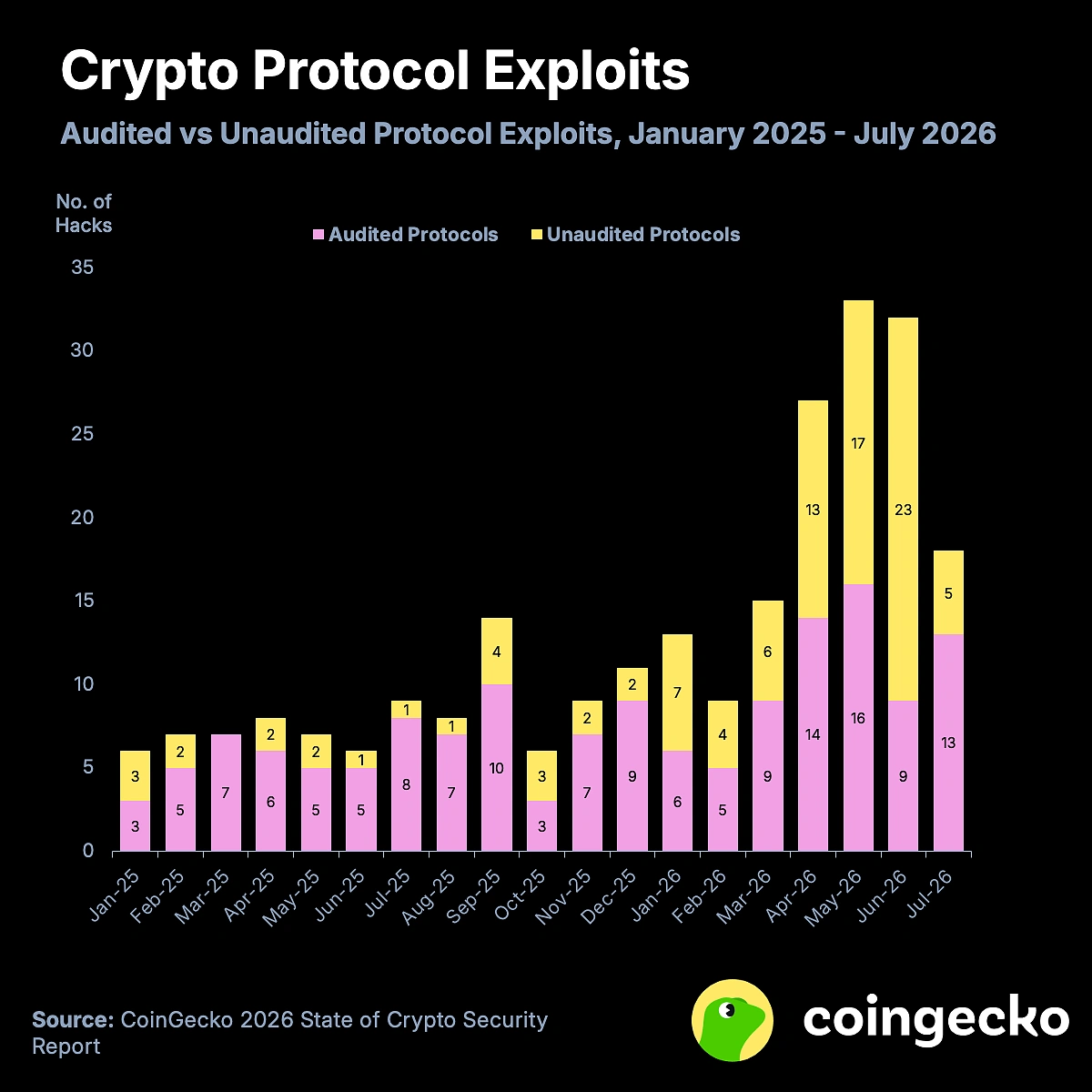
Crypto protocols that completed independent security audits accounted for 88.44% of all funds stolen since January 2025, according to CoinGecko’s 2026 state of crypto security report.
The study tracked 245 incidents and $3.63 billion in losses through July 2026. Independent auditors had cleared 147 of the breached platforms before attackers reached them.
Security Audits Did Not Stop 147 of 245 Crypto Hacks
CoinGecko said that only 11% of exploits involved in-scope smart contract flaws, though those cases still drained $396 million.
Follow us on X to get the latest news as it happens

The damage came from everywhere else. Attackers went after external infrastructure, code shipped after the audit closed, and systemic features that could be manipulated through governance.
Supply chain and infrastructure breaches took more than $1.8 billion, the largest single category in the report. Overall, smart contract exploit-driven losses across decentralized applications (dApps) reached $546 million.
May’s Stake DAO breach showed the limit. An attacker compromised a deployer key rather than exploiting contract logic. On centralized exchanges, stolen private keys remained the most common point of failure.
“Infrastructure and supply chain vulnerabilities have proven to be the most devastating for both CEXes and DEXes,” the report read.
The losses also cluster tightly. The 10 largest attacks alone produced 72.5% of everything taken across the 19-month window.
Cover against those losses is thinning too. Active on-chain insurance fell 20.2% to $130.2 million, and five of nine insurance protocols went inactive or changed direction.
2026 Brings More Hacks and Smaller Losses
Meanwhile, DefiLlama has logged 233 separate incidents so far in 2026, worth roughly $1.31 billion. The same stretch of 2025 saw 92 incidents and $2.37 billion in losses.
Incident volume more than doubled while total losses fell about 45%. Average loss per incident dropped from $25.8 million to $5.6 million. The $1.5 billion Bybit theft inflated the 2025 total.
Three cases carried most of this year’s total. Kelp DAO lost $292 million, and Drift Protocol lost $285 million in April 2026. These two also rank among the top three hacks since 2025, following Bybit
Smaller attacks now arrive pretty frequently, adding to the long list of 2026 crypto breaches. August alone brought an $8.5 million Term Labs governance exploit.
Overall, the pattern raises a scoping question rather than a competence one. Contract reviews remain narrow while deployment keys and governance parameters carry growing value.
Subscribe to our YouTube channel to watch leaders and journalists provide expert insights
The post Audited Protocols Account for 88% of Crypto Hack Losses Since 2025, Report Shows appeared first on BeInCrypto.
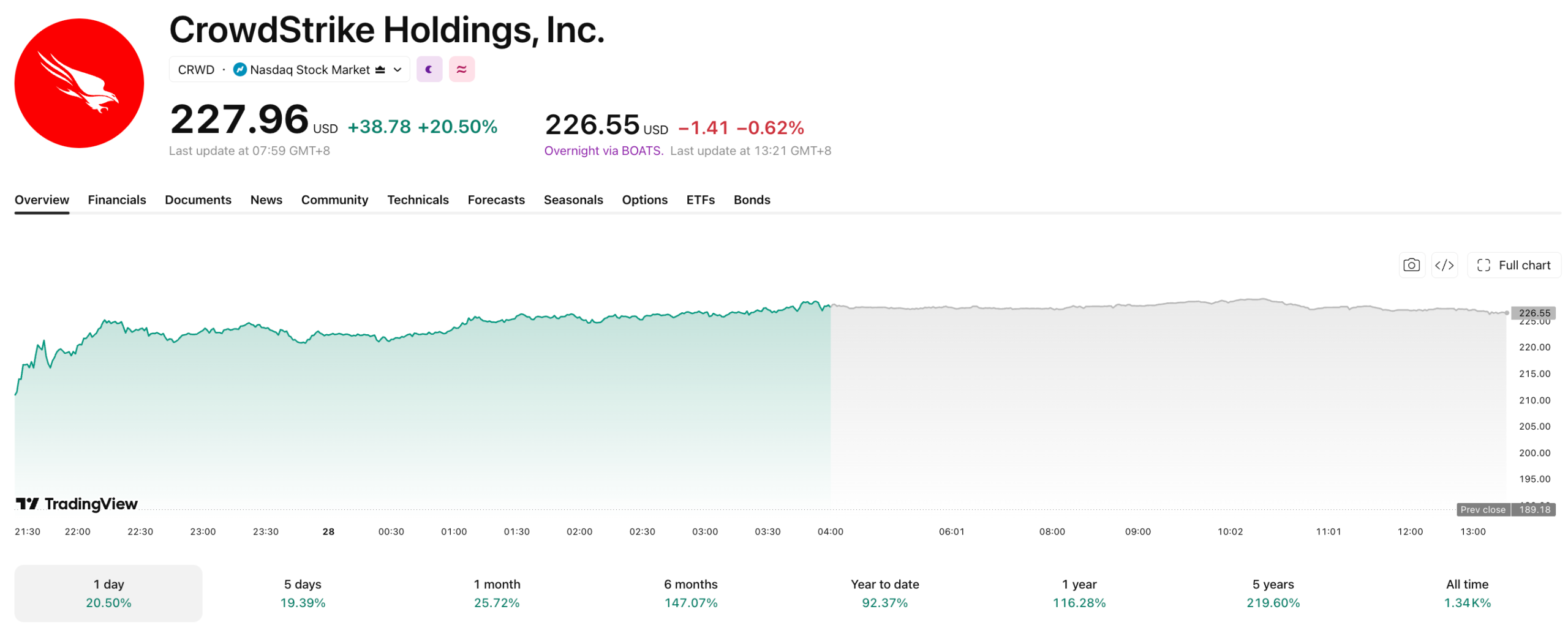
CrowdStrike Holdings (CRWD) stock jumped 20.5% after the cybersecurity firm posted record fiscal second-quarter results, with its CEO tying the surge in demand directly to rising artificial intelligence (AI) driven cyberattacks.
The company beat Wall Street’s revenue and profit targets and raised its full-year guidance following the report.
Record Quarter Driven by AI Threat Demand
CrowdStrike reported $1.47 billion in second-quarter revenue, up 26% year over year and above the $1.44 billion analysts expected. Adjusted earnings came in at $0.31 per share, topping the $0.29 consensus estimate.

Net new annual recurring revenue (ARR), a measure of new subscription commitments added during the quarter, hit a record $332.8 million, up 51% from a year earlier. Total ARR climbed 25% to $5.84 billion.
Founder and CEO George Kurtz tied the results to what he called the “Mythos moment.” This is a reference to Anthropic’s Mythos model launch. Reports say it is capable of exploiting previously unknown software flaws and has pushed AI security up enterprise priority lists.
“The Mythos moment translated into mass-market acceptance that AI adoption needs security, and that’s CrowdStrike. Every enterprise will run on AI, and securing it is the largest market opportunity in our history.”
George Kurtz, CrowdStrike Founder and CEO
On the earnings call, Kurtz described an “arms race” in which AI is simultaneously driving more attacks and more security spending.
CrowdStrike raised its full-year net new ARR growth forecast by 630 basis points to roughly 34% at the midpoint. It also lifted full-year revenue guidance to between $5.99 billion and $6.01 billion.
The results echo CrowdStrike’s own prior research flagging AI-driven threats, and follow Jim Cramer’s stock picks naming cybersecurity as a top 2026 theme.
The results position CrowdStrike as one of several cybersecurity vendors benefiting from mounting enterprise anxiety over AI-enabled threats, a trend likely to shape spending priorities into the next earnings cycle.
The post Rising AI Cyberattacks Fuel Demand for CrowdStrike, Sending Stock Up 20.5% appeared first on BeInCrypto.


Key takeaways
- Cardano slipped to around $0.210 after losing more than 7% this week.
- Whales holding between 10 million and 100 million ADA accumulated 160 million tokens since Sunday.
- ADA’s long-to-short ratio fell to 0.74, indicating that bearish positions dominate the derivatives market.
Cardano is trading at $0.210 on Friday after declining more than 7% since the beginning of the week.
Despite the pullback, on-chain data shows that some large investors are accumulating ADA.
However, conflicting derivatives and on-chain signals suggest traders remain uncertain about whether the cryptocurrency can recover or extend its decline.
Cardano whales accumulate 160 million ADA
Santiment’s Supply Distribution data shows that large Cardano holders have been buying ADA during the latest price correction.
Wallets holding between 10 million and 100 million ADA accumulated approximately 160 million tokens since Sunday. The purchases indicate that some whales continue to view the lower prices as a long-term buying opportunity.
However, the accumulation has yet to generate enough demand to reverse ADA’s short-term decline.
Whale buying during a pullback can support a positive longer-term outlook, but it does not guarantee an immediate recovery—particularly when broader market sentiment remains cautious.
Cardano’s derivatives indicators present a mixed outlook. CoinGlass data shows that ADA’s long-to-short ratio stood at 0.90 on Friday, approaching its lowest level in more than a month.
A ratio below one indicates that more traders hold short positions than long positions, reflecting expectations of further price declines.
The reading suggests that bearish traders continue to dominate the derivatives market despite the recent accumulation by whales.
ADA’s funding rate paints a slightly more optimistic picture. CoinGlass data shows that the token’s open interest-weighted funding rate turned positive on Thursday and reached 0.0013% on Friday.
A positive funding rate means traders holding long positions are paying those with short positions. This typically indicates that bullish positions are becoming more prominent, even though the long-to-short ratio continues to favor sellers.
The divergence between the two indicators highlights the uncertainty surrounding Cardano’s near-term direction.
CryptoQuant’s summary data supports this cautious view. Although the futures market has recorded large whale orders, selling activity remains dominant, while several other indicators are neutral.
Together, the metrics point to indecision rather than a clear bullish or bearish trend.
Cardano holds above key moving averages
ADA traded around $0.210 on Friday after losing more than 7% during the week. Despite the decline, Cardano remains above its 50-day and 100-day Exponential Moving Averages at $0.190 and $0.197, respectively.
Holding above these averages gives ADA a slightly bullish short-term bias, although the token continues to trade below significant overhead resistance.
Momentum indicators are also cooling. The Relative Strength Index has retreated toward the upper-50 region, while the Moving Average Convergence Divergence histogram is contracting.
These readings suggest that the buying momentum behind Cardano’s recent rebound is weakening.
Cardano’s first major resistance sits at $0.213, corresponding with the 50% Fibonacci retracement level of its latest decline.
A close above this level could allow ADA to target the 61.8% Fibonacci retracement at $0.231, followed by horizontal resistance at $0.236.
Beyond those levels, ADA faces a significant supply zone between the $0.245 horizontal resistance and the 200-day EMA at $0.246. A decisive break above this area would strengthen the bullish outlook and potentially clear the way for further gains.
On the downside, immediate support sits near the 38.2% Fibonacci retracement level at $0.195.

This region is reinforced by the 50-day and 100-day EMAs, making it an important support cluster for Cardano bulls. A sustained close below it could expose the 23.6% Fibonacci retracement level at $0.173.
If selling pressure intensifies and ADA loses $0.173, the token could retreat toward its stronger structural support around $0.150.
For now, whale accumulation offers some encouragement, but mixed derivatives data and weakening momentum leave Cardano’s short-term recovery uncertain.
Visa and Dunamu, the parent company of South Korean cryptocurrency exchange Upbit, have formed a strategic partnership to explore stablecoin payments, cross-border remittances and artificial intelligence-powered commerce.
The companies will combine Dunamu’s digital asset technology with Visa’s global payments network to explore payment, remittance and settlement services in major markets, according to a Friday announcement from Dunamu.
“The spread of AI, stablecoins and tokenization is a key trend that will change how finance and commerce operate,” Dunamu CEO Oh Kyung-seok said, adding that the partnership aims to connect digital assets with traditional finance.
Dunamu and Visa are considering business models involving Open Standard’s proposed Open USD (OUSD), a dollar-backed stablecoin unveiled in June. Open Standard said more than 140 companies had signed up to use OUSD, including Visa, Mastercard, Stripe, Coinbase and BlackRock. Dunamu said OUSD is one of several stablecoin projects under review and that it has not prioritized a specific stablecoin for the partnership.
In July, Upbit said it was not participating in the issuance of OUSD after its operator, Dunamu, was named among the businesses involved in the initiative.
The companies will also explore agentic commerce, in which AI agents can search for products and services and make purchases and payments on a user’s behalf. They will examine ways to combine AI with stablecoin payment and settlement infrastructure.
Related: Mirae Asset lays out crypto, stablecoin, tokenization plans for Digital X

The Sandbox says it will directly reimburse eligible holders of bridged SAND after an Aug. 21 exploit that drained Ethereum-based tokens from a bridge vault. The incident, which targeted bridge infrastructure connected to Base and BNB Smart Chain, resulted in the loss of 14.744 SAND—valued at roughly $700,000 at the time—prompting the project to outline a structured repayment plan.
In a post-mortem shared Thursday, The Sandbox confirmed that compensation will be offered on a 1:1 basis for users who held bridged SAND on Base or BNB Smart Chain before the attack. The company says repayments will come from its treasury without minting new tokens, and that affected balances will be distributed through exchanges for a majority of eligible users.
Key takeaways
- The Sandbox will repay eligible holders of bridged SAND from Base and BNB Smart Chain at a 1:1 ratio using Ethereum-based SAND.
- The repayments are scheduled to begin within two weeks, with a claim window that extends for two additional weeks.
- More than 72% of eligible balances are held on centralized exchanges, which will reportedly distribute compensation directly to affected customers.
- According to The Sandbox, about 14.7 million SAND were drained—roughly 0.5% of the token’s 3 billion maximum supply—while the minted unbacked tokens were isolated.
- The compromised bridge contracts will be retired permanently, with future bridges expected to use newly deployed contracts.
Repayment plan for bridged SAND holders
The Sandbox’s reimbursement effort is aimed at users who held SAND that had been bridged onto Base or BNB Smart Chain prior to the Aug. 21 bridge exploit. The company states that claimants will receive an equal amount of Ethereum-based SAND (rather than a token of a different chain), using funds drawn from the project’s treasury. The project also emphasized that it will not mint new tokens to fund repayments.
Based on the company’s explanation, the claims process is expected to open within two weeks and then stay open for another two weeks. That gives eligible users a defined window to verify ownership and submit a claim where needed, while exchange customers may be handled automatically depending on the platform.
Where the losses came from, and what the attacker did
The Sandbox said the attacker exploited a configuration flaw in SAND’s bridge contracts on Base and BNB Chain. In the company’s account, the issue allowed the attacker to gain control over bridge message verification—ultimately enabling minting of unbacked tokens tied to the exploited bridge process.
The project confirmed that roughly 14.744 million SAND were drained from the Ethereum vault connected to the bridge. It also said that the compromised bridge activity led to the creation of more than 339 trillion unbacked SAND on the two targeted networks. However, The Sandbox added that those tokens have been isolated and cannot be bridged or redeemed.
Importantly for holders, The Sandbox stated that SAND on Ethereum and Polygon was not affected by the exploit. That means the core token supply on those networks did not face the same immediate impact as the bridged assets tied to Base and BNB Chain.
Isolation of unbacked tokens and retirement of compromised contracts
Beyond repayment, the company’s post-mortem focuses on containment and prevention. The Sandbox said that the bridge contracts used in the compromised configuration will be permanently retired. Any subsequent bridging between networks would be handled through newly deployed contracts intended to eliminate the exploited verification weakness.
The project’s description suggests that while the attacker succeeded in minting unbacked tokens during the bridge operation, The Sandbox designed—or was able to enforce—limits that prevented those tokens from moving into a redeemable or bridged state. For investors and traders, this distinction matters: it reduces the likelihood of a broader token supply shock across all supported networks, even if the event generated a large quantity of unbacked tokens during the attack.
Exchanges to distribute most compensation
The Sandbox also provided operational details about how compensation will reach users. According to the company, more than 72% of eligible balances are held on centralized exchanges. For those customers, the exchanges are expected to distribute compensation directly.
That approach may lower friction for most affected users by reducing the need for individual claims. Still, the project’s stated plan indicates that a claim process will exist—meaning users without exchange custody (or users not covered by exchange distributions) may need to apply during the opening window.
Token trading and market reaction
At the time of publication, SAND was trading around $0.04, according to CoinGecko, down about 10.4% over the previous seven days. The price drop reflects broader market conditions and how quickly bridge-security headlines can spill into sentiment, even when the project states that Ethereum and Polygon holdings were unaffected.
For market participants, The Sandbox’s commitment to 1:1 reimbursement and the claim timeline may help clarify risks for holders of bridged assets. However, the longer-term confidence impact will likely hinge on how smoothly the claims process runs, and whether monitoring of any remaining bridge-related surfaces finds no further issues.
Readers should watch the start of the claims window and follow how exchanges handle reimbursements for customers holding bridged SAND. Equally important will be The Sandbox’s progress deploying replacement bridge contracts and demonstrating that the retired configurations can’t be re-exploited through new bridge paths or integrations.


The Bank of Russia has added 2,600 crypto wallets linked to suspected illegal financial activity to a system used by banks and law enforcement after more than 1 billion rubles flowed into the addresses during the first half of 2026.
Summary
- Bank of Russia flagged 2,600 crypto wallets linked to suspected illegal financial activity after about 1 billion rubles in crypto flowed into the addresses.
- The wallets were added to a system used by banks and law enforcement agencies for client risk assessments and financial investigations.
- More than 74% of identified pyramid schemes used cryptocurrencies to attract funds, with scams promoting crypto investments, mining and fake data centers.
- F6 separately identified fake Kanye West ticket websites seeking crypto payments from Russian users.
The Bank of Russia said the wallets belonged to companies, projects, individual entrepreneurs and other entities showing signs of illegal activity in the financial market. Banks and law enforcement agencies use the information system for digital compliance, client risk assessments and financial investigations.
During the same six-month period, the regulator identified 2,891 entities with signs of illegal financial activity, down nearly 31% from the first half of 2025. The figure remained close to the level recorded during the second half of last year.
Bank of Russia adds 2,600 crypto wallets to monitoring system
The 2,600 crypto wallets were added to a database that can help financial institutions assess transactions connected to entities flagged by the regulator. More than 1 billion rubles in crypto, based on its ruble equivalent, had been attracted through the identified addresses, according to the central bank.
The regulator sends information on suspected illegal financial activity to law enforcement agencies, Russia’s Federal Antimonopoly Service and other authorized bodies. Banks took restrictive measures against more than 500 payment details used for illegal financial activity during the first half of 2026.
Regulatory action during the period led to more than 330 administrative cases based on material supplied by the central bank, including information collected during previous reporting periods. Authorities took more than 450 other enforcement measures and restricted access to over 11,800 online resources belonging to suspected illegal financial market participants and pyramid schemes.
Crypto remained a common payment method among schemes tracked by the regulator. More than 74% of identified pyramid schemes used cryptocurrencies to attract funds, while the rest relied on foreign payment services or cash. Organizers used more than 940 websites, 120 Telegram channels and over 2,500 social media pages to bring users into their projects during the first six months of the year.
The figure was lower than in 2025, when the Bank of Russia identified more than 4,600 crypto wallets used by organizers of pyramid schemes to receive initial investment payments. Crypto was accepted by 84% of pyramid projects identified last year, up from 77% in 2024.
As crypto.news previously reported, the regulator has linked digital assets to fraudulent investment schemes for several years. In 2024, the central bank warned that scammers were using memecoins, tap-to-earn games and other popular crypto trends to attract victims. Its first-half 2024 data showed more than 3,490 entities with characteristics of pyramid schemes, 43% more than a year earlier.
Crypto remains a common tool in investment scams
Pseudo-investment projects identified this year frequently offered exposure to cryptocurrencies or promised income from crypto mining, according to the Bank of Russia. Some schemes promoted investments in data centers supposedly supplying computing capacity to miners, while others offered digital tokens said to track gold prices.
The regulator identified 929 entities with signs of financial pyramid activity and another 379 suspected of illegally attracting investments during the first half. Combined, the number of pyramid and other pseudo-investment projects fell 44% from the same period in 2025. Most operated online without physical offices and contacted potential clients through social networks, messaging services or phone calls.
Illegal lending moved in the opposite direction. The number of identified illegal lenders doubled from the first half of 2025, reaching 999, compared with 467 a year earlier. The Bank of Russia linked part of the increase to tighter requirements for legal lenders, which limited access to borrowing for customers with high debt burdens.
Among the products promoted outside the formal financial system were so-called crypto loans. Such services offered borrowers loans denominated in Tether’s USDT stablecoin or rubles converted at a specified exchange rate. The regulator said it continued to receive hundreds of complaints about the model while websites associated with such projects were blocked and replaced with duplicate resources.
Russia has been moving to bring more cryptocurrency activity under licensed financial institutions while keeping domestic crypto payments restricted. A law approved this summer created rules for exchanges, brokers, custodians and other intermediaries, with the Bank of Russia responsible for supervising the market. The framework permits regulated crypto activity and certain cross-border uses while maintaining the ban on using cryptocurrency as a domestic payment method.
Ahead of the new framework, the central bank published draft operating rules for cryptocurrency exchanges and digital asset depositories, including capital requirements and official registers for licensed market participants. The rules were prepared ahead of the country’s regulated crypto market rollout scheduled for September.
Russian authorities have been taking enforcement action against crypto businesses suspected of operating outside permitted channels. Back in August, more than 20 people were detained after authorities raided nine crypto exchanges in Moscow. Investigators alleged that the services converted proceeds from scams into cryptocurrency before transferring the assets to handlers in Ukraine.
Scammers turn to fake Kanye West ticket sales
Separate fraud campaigns detected this month have used crypto payments to target Russians seeking tickets for Kanye West concerts.
Cybersecurity company F6 said its Digital Risk Protection analysts found at least 10 websites registered since Aug. 17 across the .ru, .com, .site and .shop domains. The pages used names connected with West, including variations containing “ye,” “yerussia” and “ye-tickets,” while presenting themselves as official ticket or tour websites.
Some of the sites allowed visitors to select apparently available seats before requesting payment in cryptocurrency. Prices ranged from $60 for upper-level seating to $2,100 for a VIP box, according to F6. Other pages requested transfers to a phone number, with advertised ticket prices ranging from 28,000 rubles to 6.2 million rubles.
Several fake pages advertised tickets for concerts in Moscow even though the two announced performances were scheduled for St. Petersburg. Other sites redirected users who clicked the purchase button to illegal online casinos.
F6 found at least seven Telegram bots connected with the ticket campaign. Only one was active when researchers checked on Aug. 21, offering users a mini-app for selecting seats and entering contact details before requesting payment through a phone-number transfer. The company said requiring crypto or phone transfers when no other payment options are available is a sign of possible fraud because recovering money sent through such methods can be difficult.
The campaign follows other attempts to use interest in cryptocurrency to impersonate established Russian financial institutions. The anti-fraud project Moshelovka previously reported schemes that claimed to give Russians access to cryptocurrency trading through the Moscow Exchange.
The real exchange has been expanding its crypto-linked products within Russia’s regulated market. Moscow Exchange introduced indexes tracking Solana, XRP, Tron and BNB in May, adding them to its existing Bitcoin and Ethereum benchmarks. The products were designed for professional investors, while direct cryptocurrency trading remained outside the exchange’s existing offering. Moscow Exchange planned to expand the benchmark list to 10 crypto assets and had discussed futures linked to its crypto indexes.


World Liberty Financial’s proposed US trust bank has drawn a major Abu Dhabi backer, with Sheikh Tahnoon bin Zayed Al Nahyan and co-investors reportedly controlling 49% of the holding company behind the federally chartered venture.
Summary
- Sheikh Tahnoon’s group reportedly backs StringZ Holding, which owns 49% of the holding company behind World Liberty’s proposed US trust bank.
- A Trump family affiliated entity reportedly owns another 38% of WLTC Holdings.
- The OCC granted preliminary conditional approval to World Liberty Trust Company on Aug. 14, with final authorization still required before operations can begin.
- The proposed bank would handle issuance, redemption and custody of World Liberty’s USD1 stablecoin.
- Tahnoon previously backed a $500 million deal for a 49% stake in World Liberty Financial.
The Wall Street Journal reported on Aug. 27, citing people familiar with the matter, that Tahnoon’s group is behind StringZ Holding RSC, which owns 49% of WLTC Holdings, the company formed around World Liberty Trust Company. An entity affiliated with US President Donald Trump’s family owns another 38%, one person familiar with the structure told the newspaper.
The reported ownership comes two weeks after the Office of the Comptroller of the Currency granted World Liberty Trust Company preliminary conditional approval to operate as a national trust bank. The OCC’s Aug. 14 decision lists StringZ among the investors in WLTC Holdings, although the published document does not identify Tahnoon as its backer or disclose the size of its holding.
Under the proposed structure, World Liberty Trust Company would take over issuance and redemption of World Liberty Financial’s USD1 stablecoin, manage the reserves supporting the token and provide digital asset custody services. The company’s January application also proposed institutional custody and conversion services once the bank becomes operational.
World Liberty Financial bank remains subject to final OCC approval
World Liberty Trust Company cannot begin operating under the charter yet.
The OCC’s preliminary approval requires the company to satisfy its pre-opening conditions before the regulator grants final authorization. World Liberty had moved closer to approval by June, when former OCC officials told NOTUS that the Trump-linked company was widely expected to secure the national trust bank charter.
Its application describes WLTC Holdings as the sponsor of a de novo national trust company based in Florida. World Liberty Trust Company would not carry Federal Deposit Insurance Corp. insurance, and its proposed business would focus on trust activities, stablecoin operations and digital asset custody.
The bank would also manage the reserves backing USD1. World Liberty’s application said those reserves would include US dollars held at financial institutions, US government money market funds and cash equivalents, with USD1 designed to maintain a one-to-one value against the dollar.
As part of its approval process, the OCC required three shareholders to sign commitments limiting their ability to influence management or control the bank, according to the Journal. StringZ was among the shareholders subject to those commitments, alongside a Trump family-affiliated entity and another shareholder associated with World Liberty co-founders Zak Folkman and Chase Herro.
StringZ’s commitment was signed by Hamad Khlfan Ali Matar Alshamsi, according to the report. Alshamsi previously served as a director at G42, the Abu Dhabi artificial intelligence company chaired by Tahnoon.
Tahnoon previously backed a 49% World Liberty stake
The reported bank investment follows Tahnoon’s earlier financial ties to World Liberty Financial itself.
A Tahnoon-backed investment vehicle acquired a 49% stake in World Liberty Financial for about $500 million shortly before Trump returned to the White House in January 2025, according to earlier reporting. Crypto.news previously reported that the $500 million investment was made through Aryam Investment 1 and was signed by Eric Trump.
The investment placed Tahnoon-linked capital among World Liberty’s largest shareholders. Another crypto.news report said the transaction was completed four days before Trump’s inauguration and that Trump later said he had no knowledge of the deal, saying his sons and family handled the business.
Tahnoon serves as the UAE’s national security adviser and is the brother of UAE President Sheikh Mohamed bin Zayed Al Nahyan. He also chairs G42, which has become one of Abu Dhabi’s main artificial intelligence companies.
The US government authorized exports of advanced artificial intelligence chips to G42 in November 2025 after Washington and Abu Dhabi had reached an AI cooperation framework earlier that year. The timing of US technology policy toward the UAE and Tahnoon’s investment in World Liberty later became part of questions raised by Democratic lawmakers.
In February, Sens. Elizabeth Warren and Andy Kim sought a national security review of the investment and asked whether the Committee on Foreign Investment in the United States had examined the transaction. Their request also questioned whether foreign investors could obtain influence over World Liberty or access information connected to the company’s financial operations.
The lawmakers’ request followed calls for a CFIUS probe into the reported UAE investment and its ownership terms.
USD1 would move under the proposed trust bank
World Liberty’s banking application places USD1 at the core of the proposed institution.
Launched in 2025, the dollar-pegged token was initially issued with reserves consisting of short-term US Treasuries, cash deposits and other cash equivalents. Its circulation later rose into the billions of dollars as World Liberty expanded distribution and institutional use.
By June 2026, USD1’s circulating supply had reached about $4.4 billion while World Liberty continued pursuing its trust bank charter, according to earlier USD1 coverage.
One of the token’s largest early transactions was tied to Abu Dhabi. MGX, an investment company chaired by Tahnoon, used USD1 for a $2 billion investment into Binance in 2025, bringing the stablecoin into a large institutional transaction shortly after its launch. The deal also drew political attention in Washington because of World Liberty’s links to the Trump family and Tahnoon’s role in the UAE government.
World Liberty’s proposed bank would bring issuance, redemption and reserve management for USD1 inside a federally supervised national trust company if the OCC grants final approval. Its filing also allows the trust company to provide digital asset custody to institutional clients.
Lawmakers have continued examining World Liberty’s foreign ties
World Liberty’s ownership and bank application have remained under congressional scrutiny as regulators consider the trust company’s final authorization.
During the OCC review, Democratic lawmakers questioned Comptroller Jonathan Gould over how the agency would handle a bank application connected to the president’s family. Gould said during a June House Financial Services Committee hearing that the application would be assessed under existing banking law and government ethics requirements, as reported during the charter review.
The Journal reported that OCC officials said career staff handled World Liberty’s application and consulted experienced government ethics officials during the review. A World Liberty spokesperson separately said career OCC staff evaluated the filing against the statutory, regulatory and policy requirements governing bank charter applications.
The OCC’s published Aug. 14 decision confirms that World Liberty Trust Company received preliminary conditional approval and that StringZ is among its investors. Final authorization remains dependent on World Liberty satisfying the regulator’s conditions before opening the trust bank.

BBC Confirms Ann Droid Will Return For Season 2

A Vikings Update that Means Football Wins

Blood Moon partial lunar eclipse: Stunning photos capture August’s full Moon





-

 Fashion7 days ago
Weekend Open Thread: Madewell – Corporette.com
-

 Crypto World2 days ago
SpaceX stock could rise 75% to $240, JPMorgan says
-

 Business6 days ago
Musk’s Tesla, SpaceX Confirm $16.8 Billion ‘Terafab’ Chip Plant as World’s Largest Building in Texas
-

 Crypto World6 days ago
anatomy of crypto’s biggest liquidation event since 2021
-

 Crypto World3 days ago
A $30 Billion AI Fund Implodes, Now the SEC Is Investigating Wall Street’s Role
-

 Politics6 days ago
6 months on, Irish renters crushed by effects of government housing bill
-

 Crypto World2 days ago
Did Trump Just Move SpaceX Stock With One Truth Social Post?
-

 Business5 days ago
Mystery AI Model ‘Ox Alpha’ Draws Developers With Free Access as Chinese Lab Origins Remain Debated
-
 NewsBeat6 days ago
The ‘Lucky Dip Gang’ causing carnage for clicks: After five thugs were killed speeding in the wrong direction on a motorway, GUY ADAMS investigates a sick new trend… and why police aren’t even allowed to pursue them
-

 Crypto World2 days ago
Warsh Jackson Hole keynote puts financial innovation first
-
 Crypto World6 days ago
Nvidia Stock Suffers Longest Losing Streak Since 2022: Will Q2 Earnings End It?
-

 Business4 days ago
Moderna CEO warns China is pouring state money into mRNA technology
-

 Business2 days ago
Walmart takes aim at younger shoppers with new fashion brand
-

 Business3 days ago
NVIDIA Stock Drops Nearly 2 Percent to $210 on Seventh Losing Day Ahead of Critical AI Earnings
-

 Tech6 days ago
Unitree’s New Superman Robot Claims to Outjump and Outrun Every Human, Usain Bolt Included
-

 Business6 days ago
Will Tesla Stock Be Higher or Lower a Year From Now? Here’s What Wall Street Analysts Are Saying
-

 Sports5 days ago
Deshaun Watson fires back at Browns fans after being booed: ‘It’s a disrespectful thing’
-

 Business7 days ago
UK firms in critical financial distress rise 9% to 53,756
-
 Crypto World5 days ago
Google Gemini AI Predicts Ethereum Could Become the Trade Retail Misses in 2026
-

 Tech7 days ago
Faster chip in a familiar form factor
You must be logged in to post a comment Login