

Crypto World
Anthropic Suspends Fable 5 and Mythos 5 After US Government Issues Export Control Directive


TLDR:
- The US government issued an export control directive ordering Anthropic to suspend all Fable 5 and Mythos 5 access globally.
- Anthropic reviewed the jailbreak report and found the capabilities were already available in models like OpenAI’s GPT-5.5.
- The reported jailbreak involved asking Fable 5 to read a codebase and flag software flaws, with no harmful result disclosed.
- Anthropic warned the recall standard, if applied industry-wide, would effectively halt all frontier AI model deployments.
Anthropic has disabled global access to Fable 5 and Mythos 5 following a US government export control directive.
The order, received at 5:21pm ET, cites national security concerns tied to a reported jailbreak method. All other Anthropic models remain available.
The company says it is complying with the directive while disputing the technical basis for the decision.
Government Directive Targets Reported Jailbreak Method
The US government issued the directive without disclosing specific national security details in writing. Officials communicated verbally that they had learned of a method capable of bypassing Fable 5’s safeguards.
Anthropic reviewed a demonstration of this technique and found it exposed only minor, previously known vulnerabilities.
The company reviewed what it believes is the report behind the government’s decision. Anthropic stated that the level of capability displayed “is widely available from other models, including OpenAI’s GPT-5.5, and is used every day by the defenders who keep systems safe.” That review found no Fable-specific uplift in the findings.
The reported jailbreak essentially involved asking the model to read a codebase and identify software flaws. Anthropic confirmed it “has not even received a disclosure of a concerning non-universal potential jailbreak that led to a harmful result.” The potential jailbreaks disclosed were either entirely benign or classified as minor findings.
The directive requires suspending access for all foreign nationals, including Anthropic employees with foreign national status, both inside and outside the United States. The company said compliance meant disabling the models for all customers to avoid any breach of the order.
Anthropic Disputes the Standard Applied to Commercial Models
Anthropic launched Fable 5 with a defense-in-depth strategy, combining narrow jailbreak resistance with real-time monitoring and mandatory 30-day data retention.
The company acknowledged during launch that “perfect jailbreak resistance is not currently possible for any model provider.”
The 30-day data retention policy was a deliberate trade-off. It drew pushback from customers but allowed Anthropic to detect, study, and respond to jailbreak attempts quickly.
Anthropic described this as making jailbreaks “either narrow or very expensive to produce,” keeping risk levels comparable to other deployed models across the industry.
On the government’s authority to act, Anthropic said it “believes the government should have the ability to block unsafe deployments, as part of a statutory process that is transparent, fair, clear, and grounded in technical facts.” The company argued this directive did not meet those standards.
Anthropic warned that applying this recall standard broadly “would essentially halt all new model deployments for all frontier model providers.”
The company committed to releasing additional technical details within 24 hours and confirmed all other models in its lineup continue to operate without restriction.


Oklahoma securities regulators warned investors about a suspected crypto fraud scheme tied to BG Wealth Sharing Ltd and two trading platforms, DSJ Exchange PTY Ltd and HQI Exchange.
Summary
- Oklahoma regulators warned investors to stop sending funds to BG Wealth, DSJ Exchange and HQI.
- The scheme allegedly used fake returns, referral rewards and private messaging apps to recruit investors.
- Authorities warned recovery companies asking upfront fees may be another layer of cryptocurrency fraud attempts.
The Oklahoma Department of Securities said the platforms may be targeting residents in the state.
The department said none of the three entities are registered to operate in Oklahoma. It urged investors to stop sending funds to the platforms immediately and preserve records, including screenshots, account pages and transaction histories.
Fake returns and blocked withdrawals reported
The warning said BG Wealth presented itself as the “world’s largest hedge fund,” according to state regulators. The operation allegedly used multiple web domains, with new sites created after earlier versions were taken down.
Investors were recruited through social media and referral rewards. The department said a self-described “professor” named Stephen Beard sent daily trading signals through private apps, including Bonchat and Telegram. These channels made the operation look active and organized while keeping communication outside normal financial platforms.
Moreover, the alleged scheme promised “zero-risk” returns, according to regulators. Investors were later told to pay extra charges before they could withdraw funds. Those charges were described as taxes, commissions or verification costs.
Regulators said some investors still could not access their funds after paying the added fees. That pattern matches a common crypto fraud method, where victims see fake profits on a platform but cannot withdraw unless they send more money.
Earlier warnings add broader context
The Oklahoma warning follows earlier action by other state regulators. Authorities in Washington, Hawaii and Utah had already issued cease-and-desist orders against BG Wealth and DSJ. Regulators also said BG Wealth and DSJ falsely claimed to be licensed by the U.S. Securities and Exchange Commission.
A related crypto fraud pattern has appeared in other cases involving fake exchanges and private messaging groups. Recent reports also linked BG Wealth to a seized web domain after complaints about blocked withdrawals and alleged losses. Oklahoma officials also warned that recovery companies asking for upfront fees may be another scam aimed at victims who have already lost funds.
Investors who sent money to BG Wealth, DSJ Exchange or HQI Exchange were told to stop immediately and file a complaint with the Oklahoma Department of Securities. The agency also advised affected users to keep all records that could help investigators review the case.

The Bank of England is due to hold its next policy meeting on 18 June. According to a Reuters poll conducted between 5 and 12 June, all 65 economists surveyed expect the Bank Rate to remain unchanged at 3.75%, although around 40% of respondents anticipate at least one rate increase before the end of the year. Domestic data are also weighing on sterling: UK GDP contracted by 0.1% in April, marking the first monthly decline since August last year, while a Bank of England survey showed a notable rise in household inflation expectations amid the conflict in the Middle East. Uncertainty surrounding the monetary policy outlook, coupled with weakening macroeconomic data, is creating a mixed backdrop for the pair.
Technical Picture
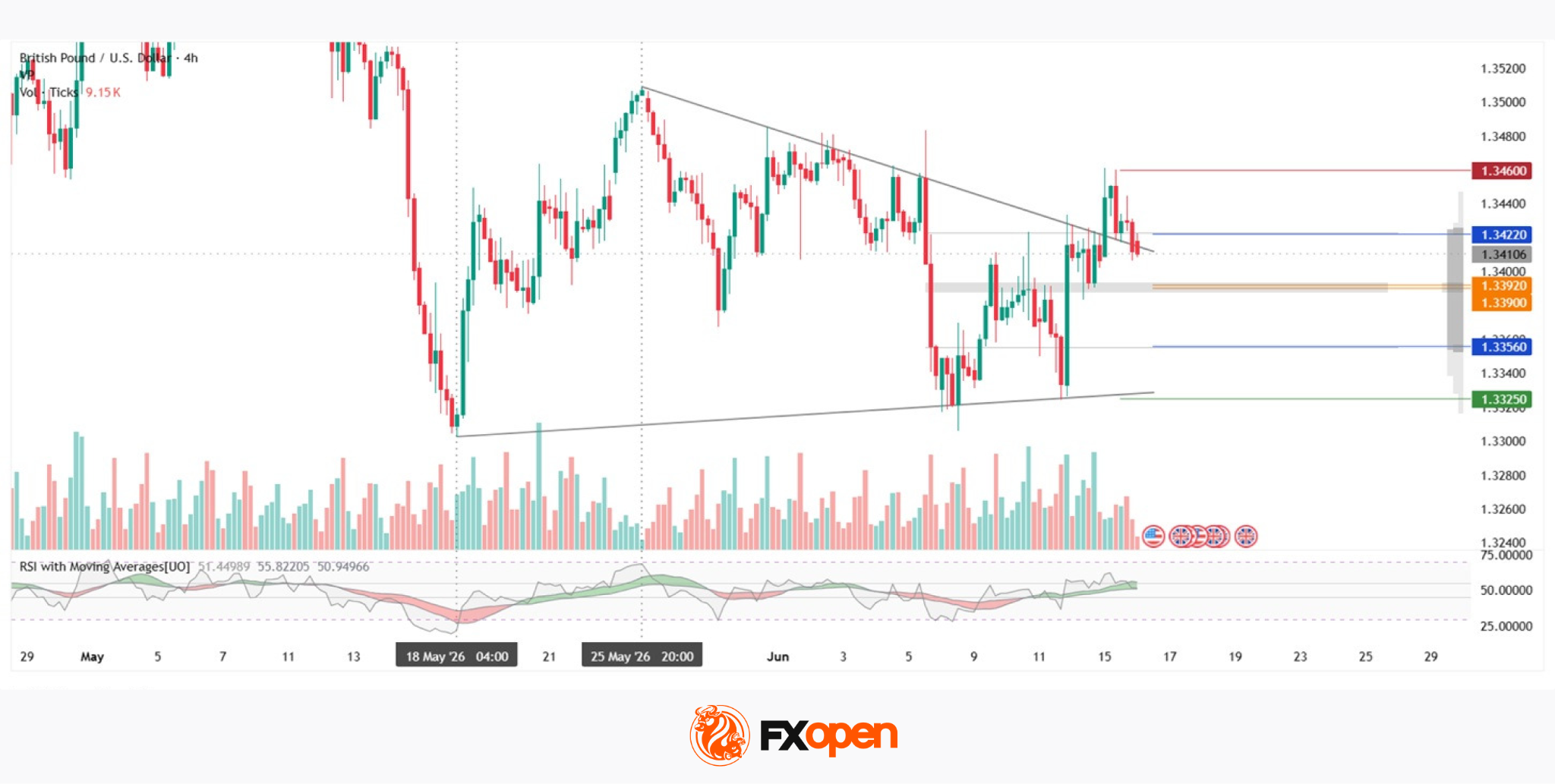
On the four-hour chart, GBP/USD has formed a pattern resembling a descending triangle, with the upper boundary declining steadily while the lower boundary remains broadly horizontal. The pattern developed following the decline that began on 25 May and could be interpreted by market participants as a continuation formation within the broader downtrend that has been in place since the start of the year. At present, the price is attempting to return to the triangle range after briefly moving above the upper boundary and subsequently retreating.
The resistance area around 1.3460 remains relevant if the price fails to establish itself below the upper boundary of the profile at 1.3422 and the Point of Control (POC) zone at 1.3390–1.3392. On the downside, support in the 1.3325 area could become the nearest target in a bearish scenario should the lower boundary of the profile at 1.3356 be breached.
RSI + MAs are currently reading 51, 55 and 50. All three lines are clustered around the neutral zone, providing no clear directional signal.
Key Takeaways
The neutral readings of RSI + MAs, together with the possibility of the price returning to the triangle range following the recent pullback, contribute to an uncertain technical picture. The Bank of England’s decision on 18 June and the accompanying policy guidance are likely to be the key factors shaping the pair’s near-term direction.
Trade over 50 forex markets 24 hours a day with FXOpen. Take advantage of low commissions, deep liquidity, and spreads from 0.0 pips (additional fees may apply). Open your FXOpen account now or learn more about trading forex with FXOpen.
This article represents the opinion of the Companies operating under the FXOpen brand only. It is not to be construed as an offer, solicitation, or recommendation with respect to products and services provided by the Companies operating under the FXOpen brand, nor is it to be considered financial advice.

Key Takeaways
- Solana currently trades at $73.74 following three consecutive sessions of price appreciation and an 11% three-day rally
- Spot Solana ETF products attracted $2.81 million in net inflows on Monday, marking a reversal from the prior week’s outflows
- SOL/BTC pair demonstrates upward momentum, recording its most robust weekly close since the beginning of May
- Tokenized SpaceX stock (SPCX) on Solana generated over $50 million in on-chain trading volume in its initial 24-hour period
- The total value locked in Solana’s real-world asset sector surpassed $3 billion for the first time in history
Solana has delivered three consecutive positive trading sessions, elevating SOL to $73.74 as of Tuesday. This upward movement arrives after a difficult period that left the token trading significantly below its critical moving average indicators.
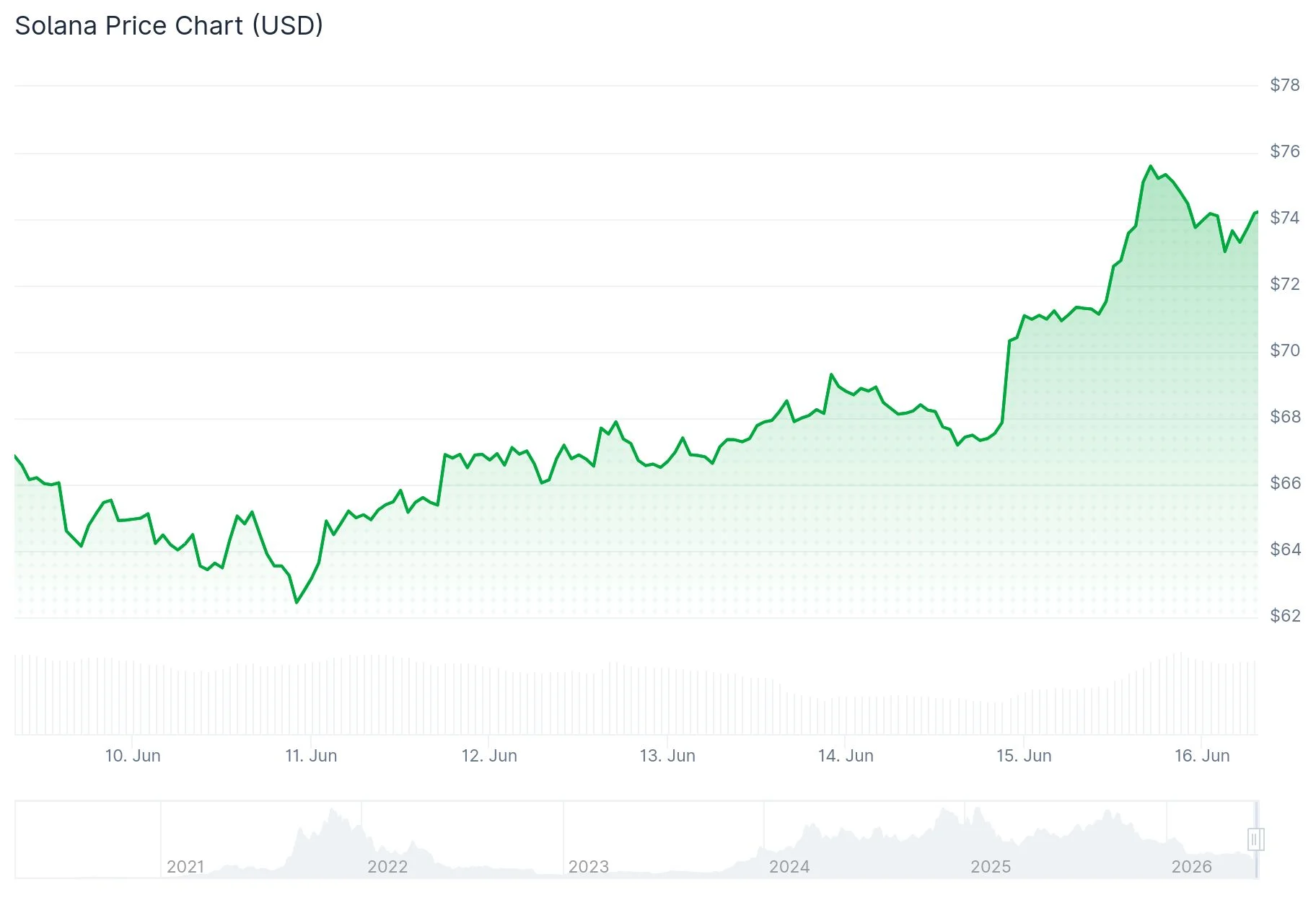
The recent rebound represents approximately 11% growth over a three-day span. However, SOL continues trading below the 50-day EMA positioned at $78.13, the 100-day EMA at $85.11, and the 200-day EMA at $101.67.
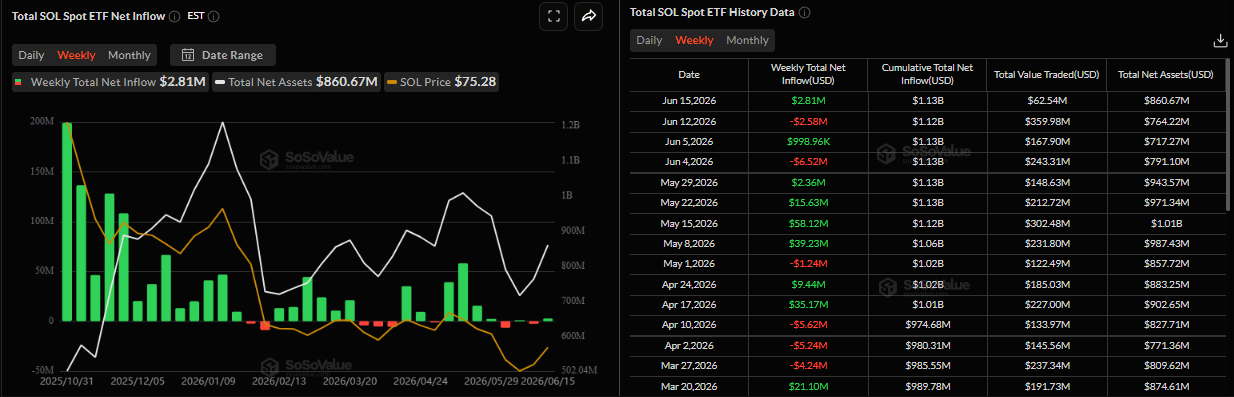
Spot Solana exchange-traded funds captured $2.81 million in net inflows on Monday, based on SoSoValue tracking data. This influx marks a complete turnaround from the previous week’s $2.58 million in net outflows, signaling renewed institutional appetite.
Market analyst Ritika Gupta identified the SOL/BTC ratio as a critical indicator deserving attention. She highlighted that this trading pair achieved its most impressive weekly close since early May, implying Solana could be beginning to outperform Bitcoin as investment capital shifts toward higher-risk assets.
Futures Market Signals Mixed Sentiment
Not every indicator points upward. According to CoinGlass tracking data, SOL’s long-to-short ratio registered 0.96 on Tuesday, falling beneath the neutral 1.0 threshold. This suggests a greater number of traders are betting on price declines rather than increases.
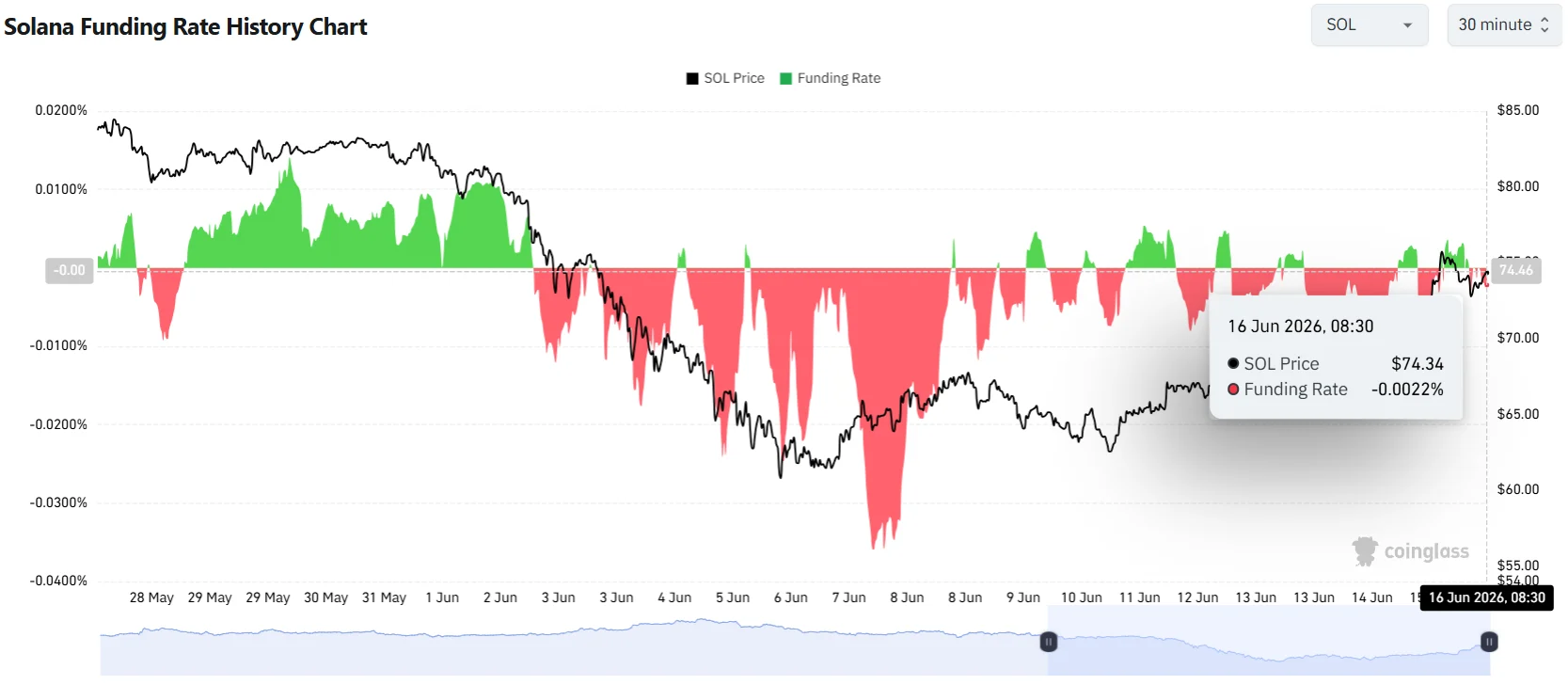
Funding rates have also dipped into negative territory at -0.001%, indicating short position holders are compensating long position holders. This dynamic generally signals bearish expectations within the perpetual futures market.
The Relative Strength Index sits near 49, indicating neutral momentum. While the MACD indicator has shifted positive, market observers characterize the current price action as a corrective bounce rather than the beginning of a sustained uptrend.
Blockchain Metrics Reinforce Price Recovery
On-chain metrics provide additional support for the recent price appreciation. Solana’s real-world asset (RWA) infrastructure achieved a historic milestone, surpassing $3 billion in aggregate value for the first time.
Tokenized SpaceX equity through xStock (SPCX) emerged as the leading tokenized equity instrument on Solana. Launched by Backpack Securities coinciding with SpaceX’s traditional market debut, the token generated more than $50 million in on-chain transaction volume during its first day of trading.
Additionally, Alatau City in Kazakhstan formalized a memorandum of cooperation with the Solana Foundation during the current week.
While the ETH/BTC trading pair approaches its tenth straight weekly decline, SOL/BTC is tracking in the opposite direction. This contrasting performance positions Solana uniquely among major alternative cryptocurrencies.
CryptoQuant aggregate data reveals substantial whale accumulation activity across SOL’s spot and derivatives markets, though additional metrics remain in neutral territory.
The critical support threshold to monitor stands at $60.13. A breakdown below this level would expose the token to additional downside pressure and invalidate the current recovery narrative.

Americans are staring down gas prices under $4 for the first time in nearly two months, after the US and Iran agreed to reopen the Strait of Hormuz. The White House is claiming it as a Trump victory, but analysts say the global oil market still has a long road back to normal.
Gas now looks to be heading under $4 a gallon, but prices had already been falling for three weeks before the June 14 deal. Since May 21, the national average dropped from $4.56 to $4.12 as crude oil settled below $100 a barrel.
The Iran agreement is pushing prices below the $4 mark, but gas remains 28% higher than this time last year, when Americans paid $3.13 a gallon.
Gas Prices Fall as Iran Deal Takes Hold
The agreement covers the Strait of Hormuz, a waterway through which a fifth of the world’s oil typically flows. Brent crude, the international benchmark, fell 5% to $83.13 on Monday, June 15, down roughly 30% from its March 9 peak of $119.50.

A senior White House official said tanker traffic should begin rising immediately, climbing to 50 ships per day shortly, compared with 25 currently. Before the war began, about 130 ships passed through daily.
Trump’s Win, and the Risk He Owns
The US Strategic Petroleum Reserve has fallen to its lowest level since 1983, according to the US Energy Information Administration, leaving the market with almost no buffer for the next shock.
Bob McNally, president of Rapidan Energy and a former energy adviser to the George W Bush White House, warned the market still needs to absorb a “historic 1.5 billion barrel supply loss” that will take “many weeks and months” to work through.
The timeline also complicates the White House’s framing. Prices had already fallen 44 cents over three weeks before Sunday’s deal was announced. The Iran agreement contributed roughly 13 cents of that total drop.
What Cheaper Oil Means for Rates and Crypto
Consumer inflation rose from 2.4% in February to 4.2% in May, its highest level since April 2023. The Federal Reserve, now under new chair Kevin Warsh, meets this week, and analysts expect it to hold rates steady, but the central bank may drop language suggesting a bias toward cutting borrowing costs.
Falling oil prices reduce pressure on the inflation numbers, which could ease the path toward rate cuts later this year. For Bitcoin and broader crypto markets, lower rates and easing inflation are among the clearest reasons investors shift toward riskier assets.
For now, Americans are paying less at the pump. Whether that relief lasts depends on whether a deal signed in Switzerland holds up in the real world.
The post Trump Claims a Gas Price Win, But Oil Reserves at 43-Year Low appeared first on BeInCrypto.

Kevin Warsh opens his first Federal Reserve meeting on June 16, and for crypto traders, the stakes are real. The new Fed Chair is hawkish on inflation, personally divested of all crypto, and committed to saying less than his predecessor.
Warsh took over from Jerome Powell in May, and his financial disclosures showed more than 20 crypto-linked investments, including Solana, Compound, dYdX, and a stake in Bitcoin payments startup Flashnet. Under Federal Reserve ethics rules, he sold all of it before taking the job.
The Dot Plot and Rate Hike Risk
Markets price in a near-certain rate hold at 3.50% to 3.75% for June 17, but the updated Summary of Economic Projections, the dot plot, is the real signal. May CPI came in at 4.2%, with energy prices surging due to the Iran conflict and Strait of Hormuz disruptions accounting for most of the monthly rise.
If the dot plot shows Fed officials penciling in a hike rather than a cut, Bitcoin faces a familiar headwind: tighter liquidity moves traders away from risk assets. Prediction markets currently put the odds of at least one 2026 rate hike at 50%-65%, and the dot plot could reprice it quickly.
Warsh Plans to Talk Less
Warsh has long criticized the Fed’s habit of over-communicating. Charles Schwab’s analysis of his policy stance notes he sees excessive forward guidance as a credibility risk, not a market service. His first post-meeting press conference will likely be shorter, less prescriptive, and less generous with rate-path hints than Powell’s.
Crypto markets move sharply on Fed signals, and when that anchor disappears, volatility tends to follow. The Fed’s standard signal that its next move is more likely a cut than a hike, known as an easing bias, may be the first thing to disappear from the statement, and markets will read its absence as hawkish.
The Pro-Crypto Paradox
Warsh sold all of his digital asset holdings, confirmed by Bloomberg in a certificate of divestiture from the Office of Government Ethics, before taking the job. The crypto-fluent Fed Chair many expected is now constrained by macro orthodoxy and ethics rules.
What actually matters for the industry is whether his worldview, which includes an anti-central bank digital currency (CBDC) position and openness to stablecoin legislation, translates into formal policy. Crypto’s clearest tailwind from Warsh will come not from rate cuts but from stablecoin oversight and approvals for banks to issue tokenized assets.
Warsh’s first press conference on June 17 is the test: if he signals rates higher for longer, crypto will feel it fast.
The post Kevin Warsh Opens First Fed Meeting: What Crypto Traders Must Watch appeared first on BeInCrypto.

On-chain leverage ratio across Decentralized Finance (DeFi) has climbed to levels last seen in 2021, according to Binance Research.
While the metric may suggest elevated risk, the increase was driven largely by a decline in total value locked (TVL) rather than a surge in borrowing demand.
What Pushed DeFi Leverage to 2021 Levels
The on-chain leverage ratio measures the extent of borrowing and leveraged activity relative to the capital locked in DeFi protocols (TVL). It rose to about 38%, driven by TVL compression.
Follow us on X to get the latest news as it happens

The drop in TVL followed a series of major DeFi security incidents in April. BeInCrypto reported that hackers stole about $606 million during the month.
Most of the damage came from attacks targeting Kelp DAO and Drift Protocol, with the Kelp DAO exploit alone resulting in losses of approximately $292 million.
The breaches prompted investors to withdraw capital from DeFi platforms, leading to a sharp contraction in value locked across multiple blockchain ecosystems.
“April’s DeFi exploits triggered ~US$13B in TVL outflows,” the post read.
Consequently, the rise in the on-chain leverage ratio reflected a shrinking pool of collateral rather than a fresh increase in borrowing activity or in traders’ risk-taking.
Despite the broader market pullback, meaningful deleveraging has yet to materialize, Binance Research said.
As leverage remains elevated relative to a shrinking DeFi capital base, the market could remain vulnerable to further liquidations and position unwinds if prices weaken further.
For now, DeFi sits in a fragile balance. Leverage looks elevated even as borrowing activity has not risen proportionally, and the system has yet to reset after the spring outflows.
Subscribe to our YouTube channel to watch leaders and journalists provide expert insights
The post Exploit-Driven TVL Drop Pushes DeFi Leverage Back to 2021 Levels appeared first on BeInCrypto.

The U.S. Government Accountability Office (GAO) has urged the Federal Deposit Insurance Corporation (FDIC) to strengthen coordination with other federal regulators to manage risks associated with blockchain-based financial products. In a letter made public on June 8, GAO recommended that the FDIC develop an ongoing mechanism to help agencies identify, assess, and respond to emerging blockchain-related threats more consistently.
GAO also pressed the FDIC to revisit how it assigns supervisors to institutions, arguing that changes to case manager rotation could improve supervisory independence and reduce the risk that oversight outcomes are compromised. The recommendations arrive as lawmakers and regulators continue to work through the supervisory gaps created by the cross-border and rapidly evolving nature of crypto and stablecoin activities.
Key takeaways
- GAO urged the FDIC to coordinate with other federal agencies through an ongoing mechanism for addressing blockchain risks.
- GAO cited findings from 2023 that regulators lacked a continuous coordination structure while blockchain-related financial services grew significantly.
- GAO recommended rotating FDIC case managers to strengthen supervisory independence.
- GAO linked supervisory questions to the 2023 failures of several crypto-exposed banks, in the aftermath of the FTX collapse.
- Policy developments under the GENIUS Act and proposed broader crypto legislation shape the regulatory context for stablecoin and wider crypto market oversight.
GAO calls for cross-agency coordination on blockchain risk
In its June 8 letter to FDIC Chairman Travis Hill, GAO said it first raised the issue of blockchain risk coordination as a priority matter in May of the prior year. GAO described blockchain technology as an area of concern that it placed on its “High Risk List,” reflecting difficulties regulators face in overseeing blockchain-based financial products and the potential effects on U.S. markets.
GAO’s position is grounded in an earlier assessment it conducted in 2023. The agency found that financial regulators did not have an “ongoing coordination mechanism for addressing blockchain risks,” despite the growing scale of blockchain-related products and services. In practice, GAO argued that without a durable coordination channel, agencies may identify similar risks at different times or respond inconsistently—an issue that becomes more acute when crypto-related activities span multiple regulated entities and regulatory authorities.
GAO maintained that establishing the coordination mechanism it recommended would enable the FDIC and other regulators to collectively identify risks and implement regulatory responses in a timely manner. The emphasis on timeliness is particularly relevant for compliance monitoring: blockchain-linked products can evolve quickly, and regulatory responses often depend on rapid information-sharing across agencies responsible for distinct parts of the financial system.
Stablecoin oversight under GENIUS and the broader legislative push
The FDIC’s role in blockchain-related oversight is closely tied to stablecoins. Under the GENIUS Act passed last year, the FDIC serves as the main regulator for stablecoin issuers that are subsidiaries of banks under FDIC supervision. That framework positions the FDIC as a key gatekeeper for a segment of the crypto market that directly intersects with the banking system.
GAO’s call for coordination therefore has both immediate supervisory implications and longer-term policy relevance. The letter comes as Senate lawmakers consider a bill intended to clarify how federal agencies would regulate the wider crypto market beyond the stablecoin context. As described by Cointelegraph, lawmakers are looking to pass legislation that would outline the regulatory approach across federal bodies—an effort that underscores the current fragmentation problem regulators face when crypto activity cuts across agency mandates.
For institutional stakeholders, the coordination question is not only about enforcement readiness; it also affects compliance design. Firms operating stablecoin-related products, custody services, or other blockchain-based financial offerings may need to map evolving obligations across regulators. A clearer coordination mechanism could reduce the chance of duplicative requests, shifting interpretations, or gaps where risks fall between agencies.
Supervisory independence: GAO urges rotation of case managers
Beyond coordination, GAO recommended a supervisory process change: rotating case managers assigned to banks. GAO said that in 2024 it found the FDIC did not require supervisors to rotate to different banks. According to GAO, a lack of rotation could compromise supervisor independence and interfere with supervision outcomes.
GAO further reasoned that a rotation requirement could mitigate threats to independence. While the specifics of supervisory staffing and governance vary by institution, independence concerns are central to bank oversight. If supervisors become too closely embedded with particular institutions over extended periods, the ability to challenge management assessments and respond objectively to emerging risks may be weakened.
GAO also linked the staffing concern to what it described as unanswered questions raised by bank failures in 2023, particularly whether bank watchdogs took sufficient action to ensure institutions “promptly addressed supervisory concerns.”
Lessons cited from 2023 bank failures tied to crypto exposure
GAO pointed to the collapse of several banks in 2023—Silicon Valley Bank, Silvergate Bank, and Signature Bank—as events that raised questions about the robustness and timeliness of supervisory actions. All three failed in less than a week in March 2023, following the bankruptcy of FTX, which contributed to severe disruption across crypto markets.
From a policy and enforcement standpoint, GAO’s emphasis suggests that supervisors may face heightened risk signals when banks have significant exposure to crypto-linked counterparties, custody arrangements, or related liquidity and asset-liability pressures. GAO’s recommendation to strengthen oversight processes—through both improved interagency coordination and enhanced supervisory independence—aims to address systemic vulnerabilities that can surface during periods of market stress.
At the same time, unresolved questions remain. GAO’s findings do not automatically specify what a “blockchain risk response” should look like in every scenario, nor do they replace the need for agency-specific rulemaking or supervisory guidance. For compliance teams, this means expectations may evolve incrementally as regulators operationalize coordination mechanisms and adjust supervisory staffing practices.
What to watch next
GAO’s letter adds pressure for measurable procedural follow-through at the FDIC, including how coordination with other regulators will be structured and how supervisory staffing will be implemented in practice. The trajectory of broader federal crypto legislation will also influence how these recommendations interact with stablecoin-specific oversight and the wider regulatory landscape.


India has blocked Telegram nationwide until June 22 after the National Testing Agency said cheating rackets allegedly used the platform to defraud candidates ahead of the NEET medical entrance re-examination set for June 21.
The Ministry of Electronics and Information Technology issued the order under Section 69A of the Information Technology Act. That provision lets the union government restrict online access in the interest of national sovereignty and integrity.
Telegram Banned in India Ahead of NEET 2026 Re-Examination
The National Eligibility cum Entrance Test (NEET) carries enormous weight in India. It decides admission to the country’s undergraduate medical and dental seats. About 2.2 million people sat in the original round on May 3.
However, the National Testing Agency (NTA) cancelled that test on May 12. Officials scrapped that round due to an alleged paper leak. A fresh examination was then scheduled for June 21.
Follow us on X to get the latest news as it happens
In addition to the restriction, the government has also ordered Telegram to turn off message editing in India until June 30. The NTA framed both steps as public-order measures, prompted by “organised use of the platform by cheating rackets to defraud candidates.”
“NTA acknowledges that the access restriction issued by MeitY affects lakhs of citizens who use the Telegram platform for legitimate personal, educational, professional, and informational purposes, and sincerely regrets the inconvenience caused to them. The access restriction is, by its express terms, confined to the period ending 22 June 2026 – i.e., the day after the examination,” the statement read.
The government has moved aggressively to keep the June 21 retest on track. Notably, officials have deployed the Indian Air Force to transport the question papers.
Whether the measures hold back exam fraud will become clearer once the June 21 retest concludes. BeInCrypto has reached out to Telegram for comment.
Subscribe to our YouTube channel to watch leaders and journalists provide expert insights
The post India Restricts Telegram Access Until June 22 Ahead of NEET Re-Exam appeared first on BeInCrypto.

The Bank of Japan (BOJ) raised its policy rate by 25 basis points on June 16, moving the target for the uncollateralized overnight call rate to around 1.0%.
Summary
- BOJ raised rates to 1.0%, putting yen liquidity and crypto market exposure back in focus.
- Oil-driven inflation risks pushed Japan’s central bank toward another step away from easy monetary policy.
- BOJ tightening adds pressure to yen carry trades, putting Bitcoin and wider digital assets back in focus.
The new rate takes effect on June 17 after a 7–1 vote by the Policy Board. The move lifted Japanese rates further from the ultra-low levels that shaped local and global markets for years.
“The Bank will encourage the uncollateralized overnight call rate to remain at around 1.0 percent,” the BOJ said in its policy statement.
The central bank also raised the interest rate on the complementary deposit facility to 1.0% and set the basic loan rate at 1.25%. 1.0% marks Japan’s highest policy rate since 1995. Market participants now watch how the move shapes the yen, bonds, and crypto risk appetite in coming sessions.
Inflation risk drives the BOJ decision
The BOJ said Japan’s economy continues to recover at a moderate pace, even as higher crude oil prices weigh on activity. It said strong corporate profits, better jobs data, and income growth still support the economy. The bank also said government steps to reduce the household burden from energy costs will continue to help demand.
The central bank also pointed to rising price pressure. It said price pass-through from higher crude oil costs has moved at a relatively fast pace in business-to-business transactions. It added that this pressure may spread to consumer prices across many items. The BOJ said underlying CPI inflation may move above its 2% price stability target if medium- to long-term inflation expectations keep rising.
Meanwhile, crypto.news reported before the decision that a move to 1.0% could bring renewed attention to global liquidity and the yen carry trade. The carry trade uses cheap yen borrowing to fund higher-yielding assets. Higher Japanese rates can make that trade less attractive and may push investors to reduce exposure to risk assets.
In addition, that matters for Bitcoin and other digital assets because crypto markets trade around the clock and can react quickly when leveraged positions unwind. Bitcoin fell roughly 3% within hours after the BOJ raised rates to 0.75% in January 2026. The report also said Bitcoin would likely face the first wave of selling because of its deeper liquidity, while smaller tokens may see sharper moves.
Japan’s crypto policy remains active
The rate hike comes as Japan continues to reshape its digital asset rules. Crypto.news reported on June 11 that Japan advanced a bill that would cut crypto gains tax to 20%, open a path for crypto ETFs, and treat digital assets more like stocks. That policy track gives Japan a second crypto story beyond monetary tightening.
In May, Japan’s ruling Liberal Democratic Party advanced an AI-blockchain finance plan focused on tokenized deposits, yen stablecoins, and programmable settlement.
These reforms show that Japan is tightening monetary policy while still building clearer digital finance rules. “The Bank will continue to raise the policy interest rate and adjust the degree of monetary accommodation,” the BOJ said, while noting that future moves will depend on economic activity, prices, and financial conditions.


The U.S. Commodity Futures Trading Commission has responded to four common criticisms of perpetual futures contracts, citing more than 100 public comments submitted during a 2025 consultation process as regulators continue expanding oversight of digital asset markets.
Summary
- CFTC Chair Michael Selig said perpetual futures contracts do not require a fixed expiration date under existing U.S. law or regulatory interpretations.
- Selig stated that CFTC regulated perpetual futures face the same leverage limits as other U.S. futures contracts, rejecting claims that they permit 250x leverage.
- More than 100 public comments were submitted during the CFTC’s 2025 consultation on perpetual contracts, while the agency said funding rates help keep prices aligned with spot markets.
According to a post published on X by CFTC Chair Michael Selig, several misconceptions have emerged around perpetual futures contracts and the agency’s recent approvals of such products, including concerns related to contract duration, leverage, public consultation, and funding rates.
Among the issues addressed was the argument that perpetual futures fall outside the legal definition of a futures contract because they do not have a fixed expiration date. Selig said neither the Commodity Exchange Act nor CFTC regulations explicitly define the term “futures contract” in a way that requires a fixed expiration or delivery date.
Instead, he said the criteria used to determine whether an instrument qualifies as a futures contract come from court decisions and commission interpretations, neither of which requires a contract to expire on a predetermined date.
CFTC defends leverage limits and funding mechanism
Attention has also focused on leverage after some critics claimed the agency had approved a product that would allow U.S. traders to access leverage of up to 250x through the recently approved BTCPERP contract.
Addressing those concerns, Selig said extreme leverage has historically been associated with offshore trading venues rather than the perpetual futures structure itself. Perpetual contracts operating under CFTC oversight, he said, remain subject to the same leverage restrictions that apply to other regulated futures products in the United States.
Questions surrounding industry participation were also raised following the approval process. In response, Selig pointed to an April 2025 request for comment covering both perpetual contracts and 24/7 trading, which drew more than 100 responses from market participants, including numerous firms already registered with the commission.
Funding rates, another frequently debated feature of perpetual futures, received separate attention in the statement. According to Selig, critics have argued that the mechanism creates high costs for traders and encourages harmful market behavior.
His explanation was that carrying a position in traditional futures contracts can generate similar annualized costs once traders account for the expenses associated with repeatedly opening and rolling expiring contracts. He added that funding rates help keep perpetual futures aligned with the underlying spot market rather than encouraging misconduct.
The comments arrive as the CFTC continues to take a prominent role in digital asset regulation while Congress debates legislation that could redefine the responsibilities of the CFTC and SEC.
As previously reported by crypto.news, the commission recently appointed former SEC crypto task force adviser Donald Battle as chief data innovation officer. In announcing the hire, the agency highlighted Battle’s experience in blockchain analytics, financial investigations, artificial intelligence, and data science.
Beyond cryptocurrency markets, the commission has remained active in disputes involving prediction markets and event contracts. Court filings cited by the agency show it recently challenged New Mexico officials over efforts to apply state gaming laws to contracts listed on Kalshi, arguing that federally regulated event contracts fall under CFTC jurisdiction.
At the same time, the regulator is collecting public feedback on a proposed framework for sports event contracts, a process that could influence how federal authorities oversee sports-related prediction markets in the future.

No runaway rally likely; markets to trade in broad range: Sameer Dalal

Oklahoma flags BG Wealth, DSJ over suspected crypto fraud

The House | Lord Heseltine: “We Must Not Have Reform Or Restore Anywhere Near The Corridors Of Power”


-

 Business2 days ago
No Jackpot Winner as $257 Million Prize Rolls Over to $269 Million Monday Draw
-

 Crypto World5 days ago
Oppenheimer backs SpaceX as $70 billion retail frenzy builds
-

 Crypto World5 days ago
Markets Rally as SpaceX IPO Looms Amid Iran Tensions and Inflation Surge
-

 Fashion4 days ago
Weekend Open Thread: Tuckernuck – Corporette.com
-
Crypto World1 day ago
Zimbabwe Requires Crypto Businesses to Register Annually Under New FIU Regulations
-

 Entertainment7 days ago
The Ryan Gosling True Crime Thriller On Netflix That Gets Even Stranger, Stream It Now
-

 Tech3 days ago
NanoClaw integrates JFrog registries to secure AI agent downloads
-
 Sports7 days ago
Bangladesh beat Australia after 20 years in ODIs, register only their second win over six-time world champions | Cricket News
-

 Crypto World3 days ago
Bitget enters Argentina’s regulated crypto market through PSAV registration
-

 Tech4 days ago
This Week In Security: Microsoft On Microsoft, Register Your Domains, Linux On ARM, And FreeBSD Joins The File Cache Club
-

 NewsBeat4 days ago
El Nino has formed in the Pacific and could set records, forecasters say
-
 Tech5 days ago
Dutton Ranch star claims they ‘didn’t see any disruption’ on set following Chad Feehan’s exit from Yellowstone spinoff fueled by Taylor Sheridan clash rumors
-

 Politics5 days ago
Politics Home | Healey Resignation Is “Colossal Failure Of Government”, Says Former Labour Defence Secretary
-
 Tech6 days ago
‘This is Seattle’s position on AI’: City Council votes unanimously to pause big new data centers
-

 Business6 days ago
Thailand Ranks Second Worldwide for AI Adoption Growth, Microsoft Reports
-
 Entertainment5 days ago
Donnie Wahlberg & More Heat Up Las Vegas at Circa’s Barry’s Downtown Prime
-
 Tech5 days ago
Opendoor Ends India Operations, Fueling a Bigger Conversation About AI and Outsourcing
-

 Sports5 days ago
First Time Since 1971: Australia Register Historic Low In ODI Cricket
-

 Politics5 days ago
Belfast burns, while Met chief points finger at Iran and Russia
-

 NewsBeat4 days ago
FBI searches office of Ohio voter registration group
You must be logged in to post a comment Login