
Crypto World
Apple faces Aug. 21 Senate deadline over China chips



Apple faces bipartisan pressure to rule out memory chips from two Chinese suppliers as an AI-driven shortage tightens global supply and raises production costs.
Summary
- Six US senators asked Apple to reject memory chips supplied by China’s CXMT and YMTC.
- Apple must provide a formal commitment by Aug. 21, according to the lawmakers’ letter.
- Both suppliers appear on the Pentagon’s Section 1260H list of Chinese military companies.
- AAPL closed 0.56% lower at $338.19 before extending its decline in Thursday trading.
Senators give Apple an Aug. 21 deadline
Six US senators have urged Apple CEO Tim Cook to abandon any plan to source memory chips from ChangXin Memory Technologies, or CXMT, and Yangtze Memory Technologies Co., commonly known as YMTC.
The bipartisan letter was led by Republican Senator Jim Banks of Indiana and Senate Democratic leader Chuck Schumer of New York. Senators Andy Kim, Jeanne Shaheen, Mike Crapo and Pete Ricketts also signed it.
Lawmakers asked Apple to confirm by Aug. 21 that it would not use components made by either supplier, including in devices produced exclusively for the Chinese market. Bloomberg first reported the letter.
“Once a part clears qualification for Apple production, extending it worldwide is a single procurement decision away,” the senators wrote.
The group also asked Apple whether it transferred intellectual property to CXMT or YMTC while evaluating their components. Such transfers could require approval from the US Commerce Department, depending on the technology involved.
Apple had not publicly responded to the letter at the time of writing.
Why US lawmakers oppose CXMT and YMTC
Washington’s concerns center on the suppliers’ alleged links to China’s government and defense industry.
The Pentagon added both companies to its updated Section 1260H list in June. The Defense Department document describes CXMT as affiliated with China’s Ministry of Industry and Information Technology and state-owned asset authorities.
It identifies YMTC as indirectly owned or affiliated with Chinese government and defense agencies. Both companies have denied that they support China’s military.
A Section 1260H designation does not impose the same restrictions as a full trade sanction. However, it limits Pentagon dealings with listed companies and signals possible future procurement or investment restrictions.
YMTC also remains on the Commerce Department’s Entity List, restricting its access to certain US technology, software and chipmaking equipment. CXMT is not currently on that list, although there are reports that a US interagency committee previously approved it for inclusion.
Apple encountered similar opposition in 2022 when it considered using YMTC flash memory in some iPhones. The company dropped those plans after lawmakers raised national security concerns.
AI memory shortage limits Apple’s options
The dispute comes as AI data centers absorb a growing share of global memory production. Samsung, SK Hynix and Micron have directed more capacity toward high-bandwidth memory used in AI accelerators, reducing supplies available for smartphones, computers and other consumer products.
CXMT has become the world’s fourth-largest memory producer, while YMTC has expanded its position in NAND flash storage. The companies are gaining pricing power as buyers compete for limited supply, according to Reuters.
Apple has argued that it needs access to Chinese memory and has sought assurances that CXMT will not be added to the Entity List, Reuters reported, citing people familiar with the discussions.
Blocking both companies would leave Apple more dependent on Samsung, SK Hynix and US-based Micron. That could weaken Apple’s ability to negotiate prices while memory costs remain elevated.
For US investors, the immediate risk is margin pressure. Apple must either absorb higher component costs, pass them to customers through higher product prices, or redesign parts of its supply chain.
Apple stock falls as investors await its response
Apple shares closed at $338.19 on July 29, down 0.56%, after reaching an intraday high of $344.57. The reversal prevented the company from closing above a $5 trillion market value.
AAPL extended the decline during July 30 trading, falling about 1.8% in the morning as investors also prepared for Apple’s quarterly earnings report.
The Aug. 21 response will show whether Apple accepts the senators’ demand or continues evaluating Chinese memory for locally sold devices. Lawmakers also want to know whether Apple sought priority supply from US and South Korean manufacturers, making its answer relevant to the company’s sourcing plans for the 2027 iPhone cycle.
Separately, Apple faces a federal lawsuit from three users who allege that fake apps impersonating Sparrow Wallet appeared on its App Store and caused approximately $1.835 million in Bitcoin losses.



Strategy (MSTR), the world’s largest corporate bitcoin holder, reported Thursday an $8.2 billion second-quarter net loss after the cryptocurrency’s price decline erased billions of dollars from the value of its digital asset holdings.
The quarterly loss was driven almost entirely by an $8.32 billion unrealized markdown on its bitcoin holdings under fair-value accounting.
The company held 843,775 bitcoin as of July 26, up 25% from the start of the year. At current prices, the stash is worth roughly $54.8 billion, compared with an acquisition cost of $63.7 billion.
The report came after a period of growing investor scrutiny on the firm over whether it can sustain an increasingly complex capital structure built around multiple classes of preferred stock, common equity and convertible debt.
The company raised $17.06 billion through at-the-market stock offerings this year, repurchased $1.5 billion of convertible notes at an 8% discount and expanded its U.S. dollar reserve to $3.75 billion, enough to cover more than two years of preferred dividend payments and interest expenses.


Amazon shares surged in after-hours trading on Thursday after the company delivered a blowout second-quarter earnings report, beating Wall Street expectations across revenue, AWS sales, operating income, and earnings per share.
The results reinforced investor confidence that Amazon’s massive AI infrastructure spending is translating into accelerating cloud growth and stronger profitability.
Follow us on X to get the latest news as it happens
Amazon Beats Wall Street Across Key Metrics
Amazon reported Q2 net sales of $200.6 billion, comfortably above analyst estimates of approximately $197 billion. The company also posted operating income of $27.46 billion, exceeding expectations of around $23.6 billion, while operating margin expanded to 13.7%, above the expected 12%.
Perhaps the biggest surprise came from earnings. Amazon reported earnings per share of $5.75, far ahead of the consensus estimate of $1.82, highlighting significantly stronger profitability than analysts anticipated.
The earnings release immediately fueled investor optimism, sending Amazon shares from a regular-session close of $235.50 to roughly $251 in after-hours trading, representing a gain of more than 6.5% after the closing bell.
AWS Growth Shows Amazon’s AI Spending Is Paying Off
The strongest signal from the report came from Amazon Web Services.
AWS generated $42.23 billion in revenue during the quarter, surpassing expectations of roughly $40.57 billion. Cloud revenue grew approximately 37% year-over-year, marking AWS’s fastest expansion in roughly 18 quarters.
For investors, AWS remains Amazon’s most closely watched business because it serves as the company’s primary AI infrastructure engine.
Chief Executive Andy Jassy has repeatedly defended Amazon’s aggressive capital investment strategy, maintaining plans to spend roughly $200 billion during 2026 to expand AI data centers, networking infrastructure, and custom silicon capabilities.
The latest earnings suggest those investments are beginning to translate into accelerating customer demand rather than simply higher expenses.
Investors Reward Amazon’s AI Strategy
Heading into earnings, investors questioned whether Amazon could match the strong cloud performance recently reported by Microsoft while justifying its enormous AI capital expenditures.
Instead, Amazon exceeded expectations across nearly every major operating metric.
The combination of stronger AWS growth, expanding operating margins, and better-than-expected profitability eased concerns that AI spending would pressure near-term earnings. Investors instead viewed the results as evidence that Amazon’s infrastructure investments are already supporting faster revenue growth.
Although some of the earnings benefit included non-operating gains, the company’s underlying operating performance remained well ahead of Wall Street forecasts.
What’s Next for Amazon?
Attention now shifts toward Amazon’s second-half execution as management continues rolling out AI infrastructure and expanding AWS services.
Investors will closely monitor whether AWS can maintain its accelerated growth trajectory while Amazon continues one of the largest capital investment programs in corporate history. Future earnings will also provide a clearer picture of whether AI-driven demand can continue supporting margin expansion and justify the company’s long-term spending plans.
If AWS momentum remains intact, Amazon could further strengthen its position in the increasingly competitive AI cloud market alongside Microsoft and Google.
The report also arrives at a pivotal moment for the AI investment race, with Microsoft and other tech giants raising the bar on cloud performance. Amazon’s latest numbers suggest its AI strategy is beginning to generate tangible financial returns.
The post Amazon AI Bet Pays Off as Q2 Earnings Crush Expectations: How Will Stock React? appeared first on BeInCrypto.

When Liz Gumbinner first noticed a twinge in her right shoulder, she assumed she’d pulled a muscle. It was during the pandemic, when many exercise studios were closed, and Gumbinner, a writer who teaches advertising at Boston University, had been doing a lot of yoga and dance at home.
But the pain, mild at first, gradually became excruciating, shooting down her arm whenever she extended it. “We’re talking worse than labor contractions,” she says.
Pretty soon, Gumbinner couldn’t zip up a dress, turn off a light switch on the wall, or even hold hands with her boyfriend. The only way she could sleep was flat on her back with her arms at her sides. “That’s when I realized it wasn’t a pulled muscle,” she says.
A few months later, she was diagnosed with adhesive capulitis, colloquially known as “frozen shoulder,” a condition in which the shoulder capsule—a fibrous sheath which surrounds the joint—becomes thick and inflamed. It usually develops in three phases: the freezing stage, which can last several months and cause severe pain; the frozen stage, during which the shoulder becomes stiffer and difficult to use, often for up to a year; and the thawing stage, when mobility finally begins to improve.


Hyperscale Data has sold about 100 Bitcoin and secured a BTC-backed credit facility to finance construction of its artificial intelligence data center in Michigan.
Summary
- Hyperscale Data sold about 100 BTC to fund construction and equipment purchases.
- Its Bitcoin-backed credit facility carries a variable rate of approximately 4.5% to 5%.
- A 10-year AI services agreement could generate more than $1.2 billion if fully exercised.
- Hyperscale Data retains about 1,006 BTC, ranking 44th among public corporate holders.
Hyperscale Data converts Bitcoin into AI funding
Hyperscale Data disclosed the Bitcoin sale and financing agreement on Thursday as it accelerated work on its Michigan AI campus.
Proceeds from the sale will fund construction and purchases of critical infrastructure and equipment with long delivery times. The company did not disclose the dollar value of the transaction or the lender behind its Bitcoin-backed credit line.
Its new facility is expected to provide financing at a variable interest rate of roughly 4.5% to 5%. The arrangement allows Hyperscale Data to raise additional capital against its remaining Bitcoin rather than selling a larger share of its holdings immediately.
Bitcoin Treasuries data shows the company retains approximately 1,006 BTC after the sale. That position makes it the 44th-largest publicly traded corporate Bitcoin holder tracked by the platform.
Formerly called Ault Alliance, Hyperscale Data adopted its current name in 2024 as it shifted more attention toward AI infrastructure. However, the company has continued operating its Bitcoin mining business.
Michigan AI contract could exceed $3 billion
Construction at the Michigan campus supports an earlier master services agreement with an unnamed AI infrastructure provider. The initial phase covers approximately 20 megawatts of computing capacity.
The agreement has a 10-year term and includes two optional five-year extensions. Hyperscale Data estimates the contract could produce more than $1.2 billion in revenue if the customer exercises all options attached to the initial capacity.
The customer can also request another 32 MW within the first two years. If that expansion proceeds and remains active throughout both extension periods, Hyperscale Data expects the contract’s total value to exceed $3 billion.
These projections depend on the customer taking the available capacity and exercising its extension rights. Hyperscale Data has not identified the customer or provided a final timeline for completing the full 52 MW buildout.
Bitcoin miners expand into US AI infrastructure
Hyperscale Data’s financing decision adds to a wider shift among U.S.-listed Bitcoin miners seeking revenue from AI computing and data centers.
Hut 8 recently signed a second 15-year lease valued at $9.8 billion for its Beacon Point AI campus in Nueces County, Texas. IREN separately announced $2.8 billion in new multi-year cloud contracts and increased its year-end 2026 annualized revenue target to more than $4 billion.
Mining companies already control power connections, land and data center infrastructure that can be adapted for high-performance computing. AI contracts may offer steadier revenue than Bitcoin mining, where income depends on network difficulty, energy costs and the market price of BTC.
The transition is not without risk. Poolin filed for Chapter 11 protection in the U.S. on July 22 with roughly $173 million in prepetition obligations. The Singapore-based mining company and two U.S. subsidiaries plan to sell their Texas assets through a court-supervised process rather than restore the business.
Hyperscale Data’s Michigan investment gives the trend a direct U.S. infrastructure angle while also showing how corporate Bitcoin reserves can serve as a source of construction capital.
GPUS shares rise after financing announcement
Hyperscale Data shares, traded on NYSE American under the GPUS ticker, gained more than 5% in late-morning trading Thursday, according to Yahoo Finance data.
The market reaction followed the company’s financing update and its projections for the Michigan contract. Investors will now watch construction progress, the AI customer’s expansion decision and any further changes to Hyperscale Data’s Bitcoin holdings.
Using BTC as both a saleable reserve and loan collateral exposes the company to Bitcoin price movements while it funds a capital-intensive data center project. Future disclosures on the facility’s collateral requirements and the campus delivery schedule may provide a clearer view of that risk.

This is what makes the current moment so difficult to read. Transitions do not move neatly through the categories we use to manage the world; pressure crosses them, changing role as it goes, and by the time the official language catches up, people may already have been living with the change for years.
The next transition is forming through that movement. It is not an artificial intelligence story alone, or a climate story alone, or a demographic story alone. Each of those matters, but none explains the whole moment by itself. What matters most is how these forces begin to interact, and how much load they place on systems built around older assumptions. When enough pressure moves at once, the operating and organizing logic of an age begins to lose its fit.
Every age has such a logic. Most people do not experience it as a theory. They experience it as the background of life: how work is organized, how families are supported, how knowledge is trusted, how institutions make decisions, how risk is absorbed, and how people are expected to build a life. For a long time, that background can feel natural. Then the world changes around it, and what once made life manageable begins to show its limits.
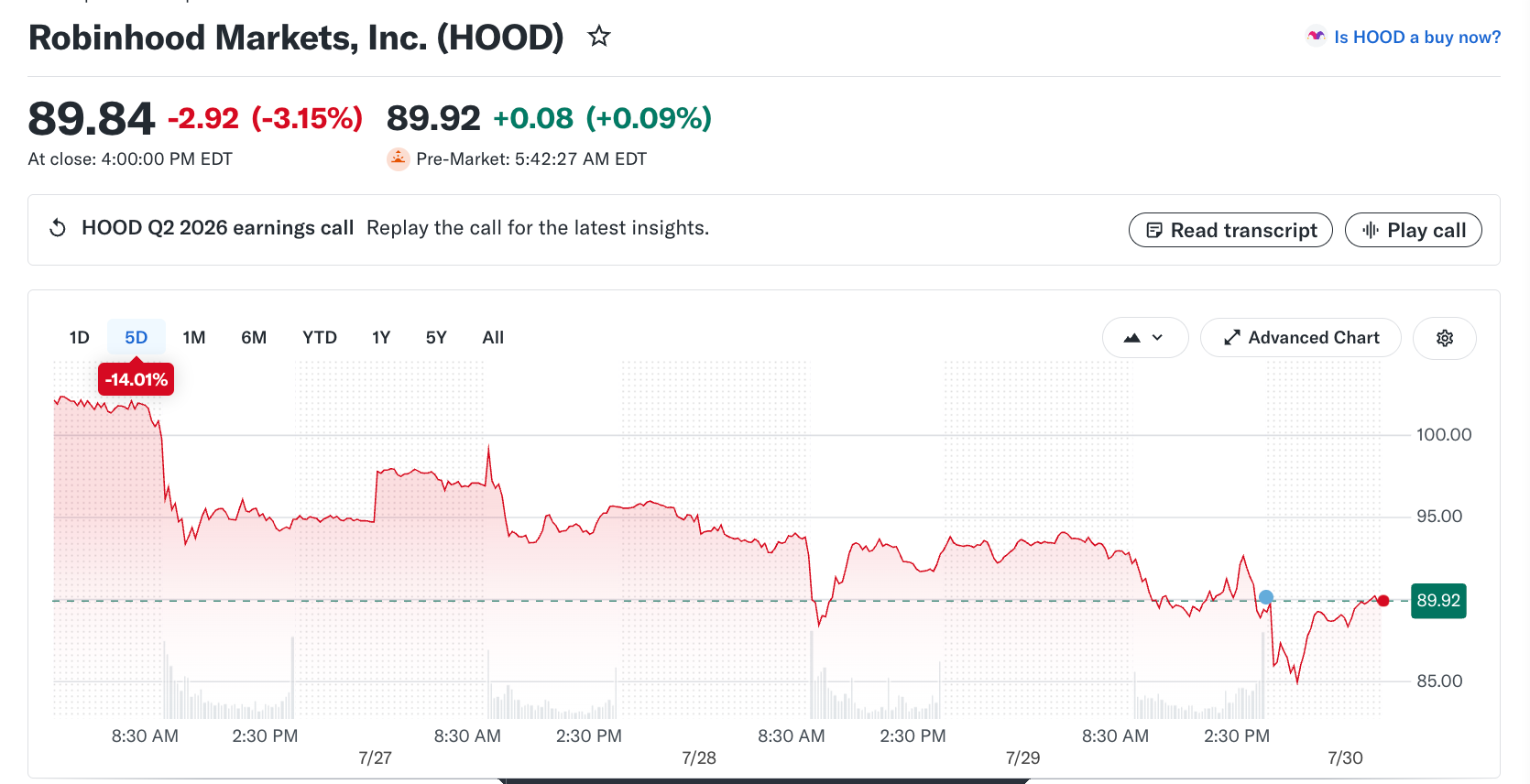
Robinhood (HOOD) stock closed at $89.84 on July 29, down 3.15%, slipping under $90 even after the company posted its best quarter ever.

The drop was not really about the numbers. HOOD has fallen about 14% in five days and roughly 20% this year, so the weakness runs deeper than one earnings report.
HOOD Earnings Beat, but the Market Sold the News
Robinhood reported record revenue of $1.31 billion, up 32% from a year earlier.
Adjusted earnings came in at $0.62 per share, far above the roughly $0.42 that analysts expected.
The mix told the real story. Prediction markets generated $156 million, overtaking both equities at $129 million and crypto at $100 million for the first time.
That shift matters because crypto revenue fell 38% year over year, after an even sharper crypto revenue slide in the prior quarter, yet total revenue still hit a record. However, the year-to-date stock price weakness persisted.

Robinhood now runs 13 businesses above $100 million in annual revenue, far from its meme-broker image. One markets account said Robinhood “proved it’s more than a crypto stock.” And that outlook is now visible in the analysts’ calls.
In the days before the report, the latest analyst calls stayed split but constructive. Barclays and Truist both reiterated buy ratings, with a Barclays Robinhood price target of $122, while JP. Morgan and Morgan Stanley kept hold ratings at $99 and $124.
Want more insights like this? Sign up for Editor Harsh Notariya’s Daily Newsletter here.
Each target still sat near or above the price, so Wall Street was not braced for a collapse. The company also kept buying back stock under a buyback plan it authorized earlier this year.

Part of the profit came from a one-time gain, which invites some caution on earnings quality. Even so, a double beat could not lift the shares.
Options Traders Are Still Hedging for Downside
Robinhood’s options market shows lingering caution. The put-call ratio, which weighs bearish put bets against bullish calls, sits near 0.66 in open interest, a high reading that favors puts.
The volume ratio has climbed toward 0.60 as well. That rise suggests desks kept adding downside hedges around the earnings date rather than betting on a pop.

Hedging shows fear, however, and not always where cash is truly flowing.
Money Flow Improves as Selling Pressure Fades
Deeper data hints the selling may be cooling. Chaikin Money Flow (CMF), a gauge of whether institutional money is buying or selling, reads -0.09 and tried to cross above zero around July 24.
It failed, so institutions are likely still net sellers. Yet, CMF rose between July 27 and July 28 while the price fell, a small bullish divergence. This shows that the big institutional money is bleeding less as compared to the price. However, the CMF needs to move above zero for the HOOD stock to show price-specific positivity.

Volume backs that up. Selling volume has thinned since early July even as the stock dropped, which suggests that even retail sellers are losing steam.
None of this confirms a bottom, though, so the HOOD price chart has to settle the argument.
Robinhood Stock Price Levels That Decide the Next Move
The chart still looks weak. Since June 9, Robinhood has traced a head and shoulders pattern, a topping shape where a high sits between two lower peaks, and it broke down on July 24, days before earnings. The breakdown structure still remains intact, which now explains why the options traders lean bearish.
The breakdown has stalled at $89.87, which also marks the 0.786 Fibonacci retracement. If that floor holds, the roughly 21% target near $76.53 may not fill, especially after a near 10% drop.

A hold above $89.87 and a reclaim of $93.84 would open room back toward the analyst targets. Real strength, however, only returns above $108.45, the right shoulder, which looks distant for now.
For now, $89.87 separates a possible rebound from a deeper slide toward $76.53.
The post Robinhood Sank After a Blowout Quarter: Rebound, or a Slide to $76? appeared first on BeInCrypto.

Telegram founder Pavel Durov said Russian authorities designated him a “terrorist” after he refused government demands for mass surveillance and censorship on the messaging platform, responding publicly a day after Russia announced charges against him.
In a Telegram post on Thursday, Durov also said Russia had barred him from “publishing information on the Internet,” adding that authorities had “got confused about who can ban whom from the Internet.”

Source: Telegram, Pavel Durov
The comments came a day after Russia’s Federal Security Service accused Durov of facilitating terrorist activity, alleging Telegram failed to remove channels used by terrorist groups and Ukrainian intelligence services.
The case builds on a criminal investigation Russia launched in February, when regulators accused Telegram of leaving nearly 155,000 channels, chats and bots online despite claims they violated Russian laws covering extremist content, terrorism, drug trafficking and other illicit activity.
Related: Pavel Durov says Telegram to roll out native Gram crypto wallet
Durov’s legal battles extend beyond Russia
The Russian case adds to Durov’s legal challenges abroad. Durov was arrested in France in August 2024 and remains under judicial investigation over allegations that Telegram facilitated criminal activity by failing to adequately moderate illegal content and respond to law enforcement requests.
Durov has denied wrongdoing, arguing that French authorities failed to follow due process in seeking information from Telegram. His arrest also prompted a TON Community-backed campaign that collected more than 9 million signatures on an open letter urging French authorities to release him.
French authorities initially allowed Durov to temporarily return to Dubai in March 2025 before lifting his travel restrictions entirely later that year.
Telegram is also facing fresh legal pressure in Australia, where regulators this week launched court proceedings alleging the platform failed to remove terrorism-related content.
Durov has cast himself as a defender of free speech and digital privacy. In April, he warned the European Union’s proposed age-verification app could pave the way for broader online surveillance. The same month, he blamed alleged tax data leaks for a wave of crypto-related kidnappings in France and said Telegram would leave the country rather than grant authorities access to users’ private messages.
Magazine: A quantum roadmap would push Bitcoin much higher: Charles Edwards


Tokenized asset specialist Ondo Finance is evaluating a potential acquisition of between $250 million and $500 million, according to a person with knowledge of the matter.
The New York-based company is considering wealthtech targets, among other subsectors, said the person, who spoke on condition of anonymity because the matter is private.
Ondo has not yet appointed any formal advisers, the person said.
Founded in 2021 by former Goldman Sachs executives, Ondo Finance is a tokenization platform that brings traditional financial assets onchain. The company issues tokenized U.S. Treasuries and stocks and has become one of the largest providers of tokenized real-world assets, with more than $3.5 billion across its products.
“As a fast-growing company, Ondo regularly evaluates the market as part of normal business operations. We are not in conversations with any party at this time,” an Ondo representative said in emailed comments to CoinDesk.
Crypto dealmaking has remained strong in 2026 as traditional financial firms and larger digital-asset companies use acquisitions to add licenses, technology and distribution.


FTX begins its fifth creditor distribution on Friday, moving roughly $900 million to holders of allowed claims. The round is the smallest of the five the estate has paid since repayments began.
The shrinking size points to a bankruptcy in its closing phase. The harder problem now is not raising cash but reaching creditors who have never collected.
FTX Fifth Distribution Is the Smallest of Five Rounds
FTX moved more than $5 billion in its second distribution in May 2025, then about $1.6 billion that September. The fourth creditor distribution round came to roughly $2.2 billion in March 2026.
Friday’s payment is under half that. Allowed Class 5A Dotcom customer claims pick up another 9%, reaching 105% cumulatively, while Class 5B U.S. customer claims add 5% to reach the same level. General unsecured and digital asset loan claims each gain 3%, taking both to 103%.
Convenience class holders sit at a 120% cumulative recovery, though FTX cautioned that final percentages may shift slightly on rounding. Those figures count dollars, not coins, and the real value of repayments has trailed what the same assets would fetch today.
A separate $18 million payment goes to preferred equity holders on the same date, lifting that trust’s running total to $95 million.
Some Creditors Still Cannot Be Paid
Claims that are not yet allowed stay marked as disputed. FTX lists three common reasons, including:
- Proofs of claim still under reconciliation
- Jurisdictions still under review, and
- Customers who took partial payments through the Australian proceedings.
The Bahamas track runs on its own terms. Joint official liquidators of FTX Digital Markets set the same June 16 record date and July 31 start, but the distribution rate is still to be confirmed.
Creditors living in jurisdictions the liquidators flag as potentially restricted stay excluded while the legality of paying them is reviewed.
For everyone else, Friday starts a countdown. Holders of allowed claims who have not onboarded with BitGo, Kraken or Payoneer within six months may forfeit the right to be paid at all.
Tax forms carry a separate deadline under the plan with the same consequence. FTX said the class-by-class totals will reach the court docket shortly after July 31.
The post FTX Fifth Distribution Is Its Smallest Yet: Who Still Cannot Get Paid? appeared first on BeInCrypto.


Canadians’ ownership of cryptocurrencies increased to 25% in 2026 from 10% in 2023, new data from the Ontario Securities Commission (OSC) shows.
In the results of a survey released on Tuesday, the OSC found that crypto ownership and awareness among Canadians had increased from that a few years ago. The survey polled 2,360 individuals age 18 and over between December 2025 and January 2026, finding that 59% of the respondents were aware of crypto assets and 25% held them.
“Crypto markets continue to evolve, and Canadians are participating in them more than ever before,” said Naizam Kanji, executive vice president of strategic regulation at the OSC. “By identifying emerging trends and behaviors with our research, we can look around corners, anticipate potential opportunities and risks, and ensure our regulatory approach supports investor protection while fostering fair and efficient markets.”
According to the survey, the results also suggested an increasing awareness of risk, though it was still based on a limited understanding of the industry. About 50% of crypto owners reported checking whether a platform was registered before using it, but many investors “had some misunderstanding around regulation, insurance protections and transaction capabilities.”
Lawmakers in Ottawa have proposed various measures to address different uses of cryptocurrency in the country. In April, the federal government advanced a bill that could ban political donations using crypto, and proposed banning digital asset ATMs, citing concerns about fraud.

Award-winning breastfeeding festival marking 10th anniversary with Belfast celebration

Chipotle CEO says chain making ‘meaningful progress’ on affordability

books $8.2 billion in Q2 loss amid bitcoin (BTC) price decline

Renter of Home in Anne Heche Crash Denies Settlement With Son

No Jackpot Winner as $257 Million Prize Rolls Over to $269 Million Monday Draw

Weekend Open Thread: Staud – Corporette.com

FASE Keuangan 20an ke 40an Yang Jarang Orang Bahas! | SUARA BERKELAS #86

CRYPTO CLARITY ACT DEAD?! ALL XRP HOLDERS! ALL CRYPTO HOLDERS! BREAKING CRYPTO NEWS!

TIPS FINANCIAL FREEDOM #moneymanagement #financialfreedom #keuangan #samasamabelajar
-

 Fashion6 days ago
Weekend Open Thread: Brooks Brothers
-
 Sports4 days ago
Commonwealth Games boxing: Jadumani Singh seals dominant 5-0 win over Pakistan’s Sumama Rehman to enter quarter-finals | Commonwealth Games News
-

 Business1 day ago
Why Trees Belong on the Risk Register
-

 Tech4 days ago
Intel is reversing course and bringing hyper-threading back to its server chips
-

 Crypto World5 days ago
Ripple bought a bank in pieces. The $4 billion audit
-

 Politics3 days ago
Luke Littler dismantles Gerwyn Price to retain title in Blackpool
-
 Entertainment6 days ago
A New Post-Apocalyptic Gundam Anime Series Blasts Into SDCC
-

 Politics2 days ago
The Part of the Electric Transition Nobody Wants to Discuss
-

 News Videos4 days ago
BITCOIN JUST ENTERED THIS CRITICAL ZONE…
-

 Fashion7 days ago
16 Dresses for the High Summer Event
-

 Sports7 days ago
2026 3M Open leaderboard: Scottie Scheffler finds putter in Round 1, sits three back
-

 Business2 days ago
Major shareholder moves on Canyon
-

 Crypto World5 days ago
XRP Ledger adds $2.6B as RWA inflows rank second
-

 News Videos9 hours ago
Bitcoin Enters the 3rd Stage of the Bear Market
-

 Politics4 days ago
Spain sweeps the board at 2026 World Cup with individual awards
-
 Entertainment2 days ago
‘Stargate’ Creator’s New Sci-Fi Series Returns for Season 3 Tomorrow
-

 Tech6 days ago
Anthropic launches Claude Opus 5, a cheaper AI model for coding, agents and enterprise workflows
-

 Crypto World2 days ago
Kraken Enables Retail Access to Jersey Mike’s IPO via Tokenized Shares
-

 Entertainment5 days ago
Sara Gilson Killed By Husband After Viral “Pedophile” TikTok Video
-

 News Videos2 days ago
Claude: Build Financial Dashboards in Minutes (2026)
You must be logged in to post a comment Login