
Crypto World
Apple Stock Slips After Earnings: Can $280 Hold the Line for a New All-Time High?

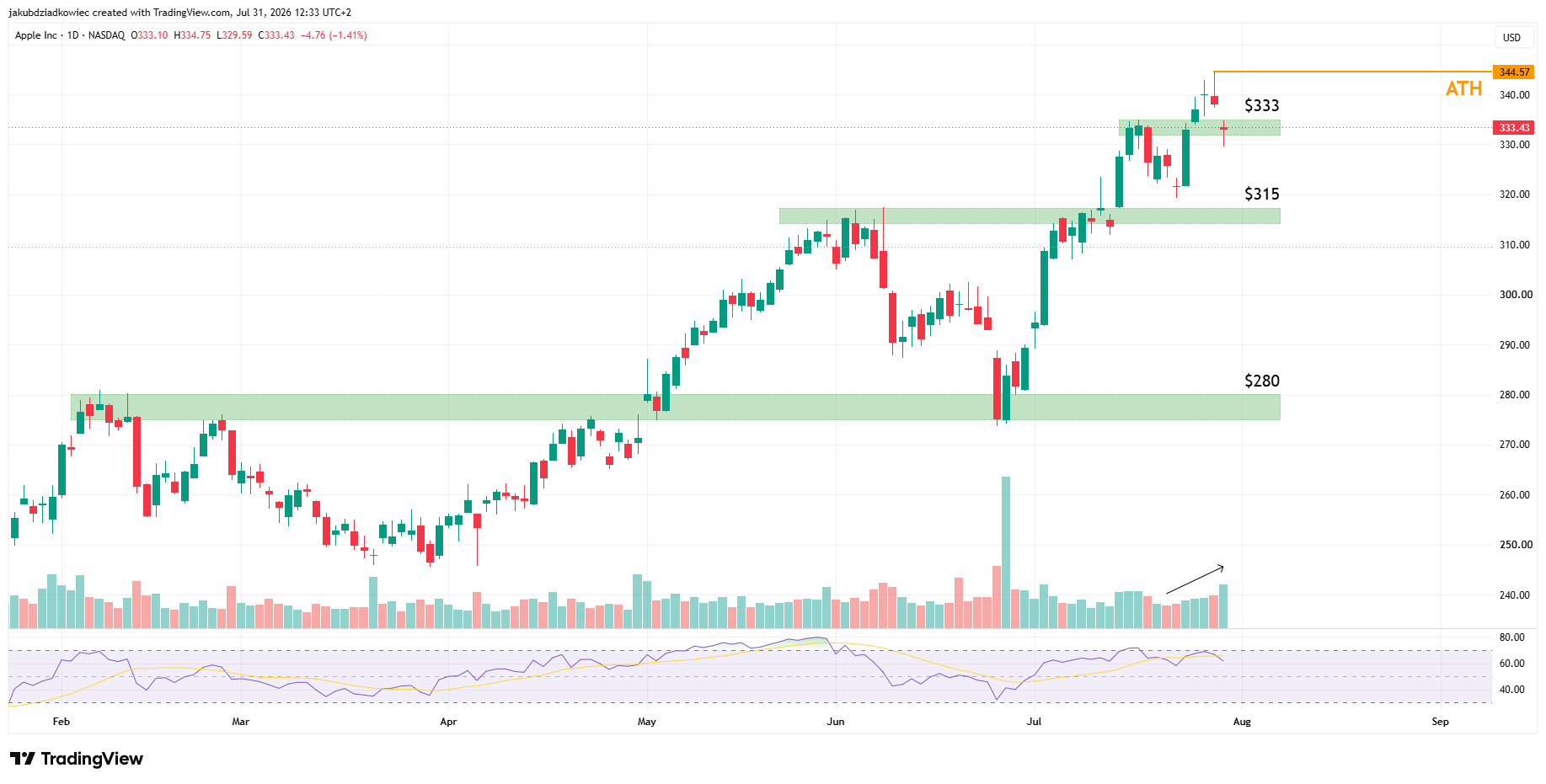
Apple (AAPL) stock opened sharply lower on Friday at $304, down more than 9%. Weak fiscal fourth-quarter guidance overshadowed a record June quarter that beat estimates on revenue and earnings.
Shares closed Thursday at $333.43, down 1.41%, days after Apple briefly touched a $5 trillion valuation.
Record Quarter Meets Cautious Guidance
Apple reported June-quarter revenue of $109.42 billion, above the $108.65 billion consensus. Earnings per share reached $2.02, well above the $1.89 estimate. The full results showed revenue up 16% year over year, a June-quarter record.
iPhone revenue climbed 22% to $54.25 billion, while Mac sales jumped 29% to $10.35 billion. However, Services revenue of $30.74 billion and Greater China sales of $18.82 billion both missed forecasts.
The outlook did the real damage. CFO Kevan Parekh guided September-quarter revenue growth of 9%–11%, below the roughly 12% analysts expected. He cited supply constraints, currency headwinds, and a memory cost squeeze driven by AI demand for DRAM and NAND chips.
The report also marked Tim Cook’s final earnings call as CEO. John Ternus, who takes over on September 1, told analysts Apple sees a major opportunity in AI.
Expanding Volume and RSI at 62 Keep Buyers Interested
Before the guidance shock, the daily chart looked firmly bullish. AAPL corrected only modestly from its $344.57 all-time high, holding a fresh support zone around $333. That area capped price in mid-July before the breakout, a classic resistance-turned-support flip.
Momentum backs that read. The daily Relative Strength Index (RSI) sits near 62, just below firmly bullish territory. Meanwhile, trading volume has expanded in recent sessions, a sign of growing participation. That combination fueled the milestone run to a $5 trillion valuation earlier this week.

If the weakness holds, $280 becomes the immediate battleground. The level rejected price in February and caught the sharp early-July dip.
AAPL Price Prediction Hinges on the $315 Zone
Earnings gap-downs sometimes retrace once the initial selling fades. If buyers reclaim $315 in the coming sessions, the structure of higher highs and higher lows stays intact. A recovery of the $333 zone would then put the $344.57 record back in play, roughly 12% above premarket levels.
Failure to reclaim $315 keeps sellers in control and exposes $280. That would mark the deepest correction since the early-July pullback.
Two catalysts could decide the outcome. Long-term memory supply agreements would ease the margin fears behind the weak guidance. Additionally, the redesigned Siri launch this fall could revive the AI optimism that a July forecast identified as a key driver of the rally.
The next few sessions come down to one question. Either buyers set up an attempt at $315, or the post-earnings gap grows into a broader trend reversal.
The post Apple Stock Slips After Earnings: Can $280 Hold the Line for a New All-Time High? appeared first on BeInCrypto.

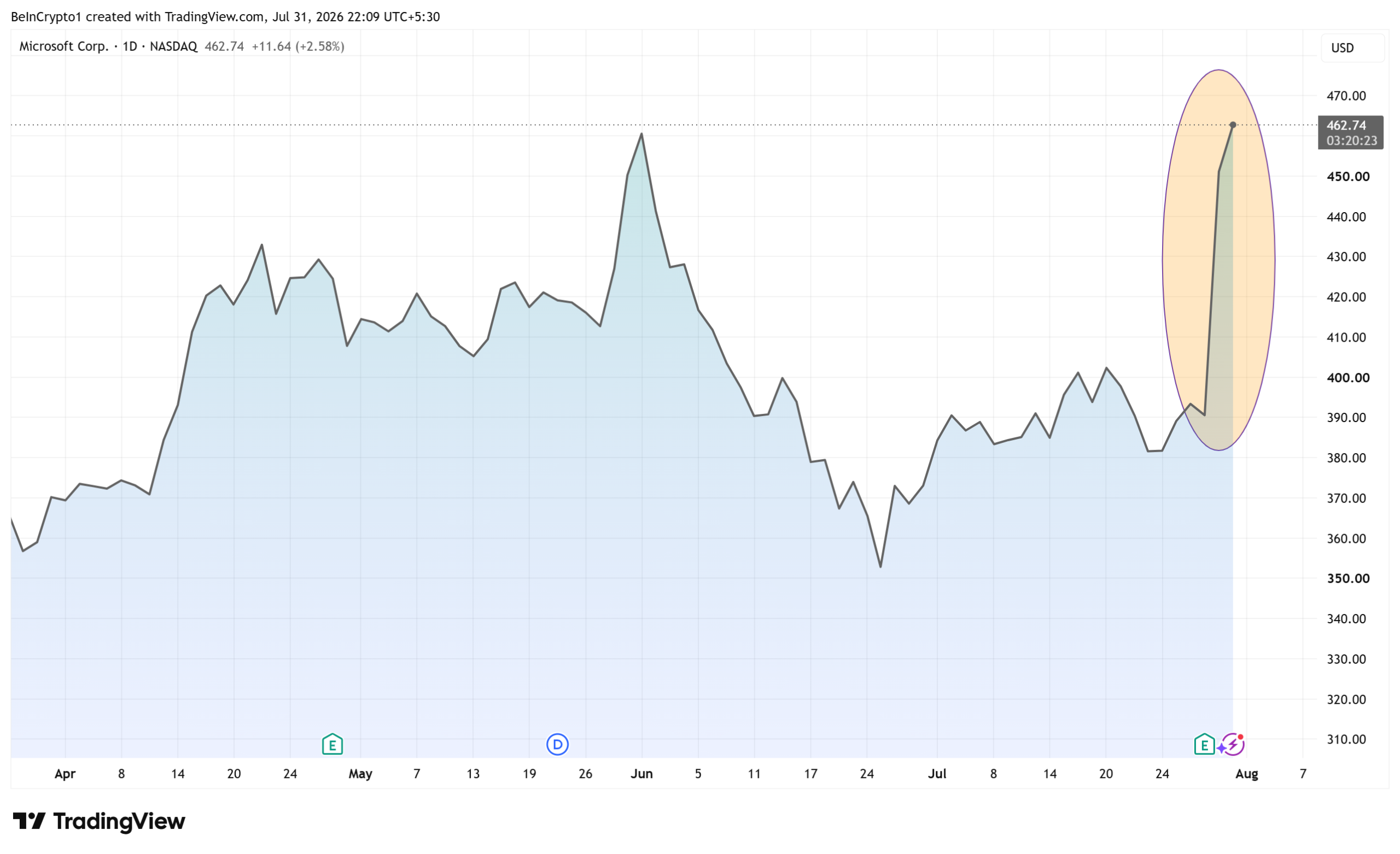
Microsoft investors have 11 days to take control of a fraud lawsuit. It says the company hid trouble inside Copilot, its main artificial intelligence product.
The timing is odd. Microsoft just set a US record for market value gained in a single day. The engine behind that gain was the same product the lawsuit attacks.

What the Lawsuit Says
The case covers anyone who bought Microsoft stock between May 1, 2025 and January 28, 2026.
Investors say Microsoft praised Copilot in public while hiding its flaws. They argue the stock traded far above what it was worth.
The suit sits in a federal court in Washington state. A police and fire pension fund from Michigan is named first.
The alleged flaws are simple ones. Confusing branding. Tools that did not work well together. Customers who tried Copilot and never paid for it.
The Day the Stock Broke
Microsoft reported fiscal second quarter results on January 28. Revenue rose 17% to $81.3 billion. Azure grew 39%.
Investors looked past those numbers. Record capital spending worried them, and Microsoft put Copilot at just over 15 million paid seats.
The complaint puts it harder. It says Azure growth slowed suddenly and the Copilot figure landed well below what analysts had modelled.
The stock fell the next day from $481.63 to $433.50. That is $48.13 gone, or 10%.
Similar suits have followed big tech AI spending letdowns all year.
Then Microsoft Came Roaring Back
On Wednesday, Microsoft posted $90 billion in fiscal fourth quarter revenue. Azure grew 43%. Copilot seats doubled to more than 30 million.
Shares jumped over 16% on Thursday. Microsoft gained roughly $450 billion in value, the biggest one-day rise any US company has ever posted.
“This year, Azure revenue surpassed $100 billion for the first time, and Microsoft 365 Copilot reached over 30 million paid seats, reflecting the confidence customers are placing in us to power their AI transformation,” Nadella said in the earnings release.
Follow us on X to get the latest news as it happens
The stock traded at $462.52 on Friday, up 2.53%. That is still under the $481.63 close before the January fall. The losses are real. So is the comeback, and Microsoft’s lawyers will say so loudly.

So Will Investors Get Money Back?
Most will not, and the few who do will likely wait years for a small cheque. August 11 is not a payday. It is the last day to ask the court to lead the case.
Anyone who bought in that window keeps the right to money later. No sign-up, no lawyer, and no fee.
The notices filling inboxes this week are adverts. Law firms send them after every big stock drop.
Microsoft will now ask a judge to throw the case out. Most suits like this die right there. The ones that survive tend to settle for a small share of the losses claimed, and that takes three years or more.
The rally makes the climb steeper. It is harder to argue investors are still out of pocket when the stock has clawed back most of the fall.
The lesson for traders is short. AI promises now carry legal risk, and that risk sits in the market’s biggest names. That matters while shares still move as one giant AI trade, and it belongs in any list of US stocks to watch in August.
The post Microsoft Copilot Lawsuit Deadline Is August 11: Will Investors Get Money Back? appeared first on BeInCrypto.


Memecoin platform Pump Fun reportedly fired staff members months before their Pump Fun tokens were about to be unlocked, leaving one employee cut off from a potential seven-figure payout.
That’s according to crypto news outlet Sandmark, which obtained recordings and files on the firings.
It reports that Pump Fun was able to grow its employee count to 100 this year. However, recordings of a March meeting revealed the platform’s co-founder Noah Tweedale telling staff that layoffs were needed as Pump Fun “grew too quickly” and couldn’t move “fast and rough.”
Sandmark claims that several employees were terminated in April. Many of those affected reportedly signed a token agreement in mid-June 2025 that would’ve seen a quarter of their Pump Fun tokens unlocked two months later.
According to one X account claiming to campaign on behalf of Pump Fun employees who were laid off before their vesting period unlocked, over 40 staff members have faced the chop in the last two months.
The account’s owner says they were laid off just one day before the vesting period unlocked, and that many of the employees were “treated like cattle.”
They have since restricted the account and deleted one of its posts.
Read more: Crypto firms cut jobs as bear market and AI shift bite
Pump Fun is behind on its regulatory filings
Sandmark also spotted that the business accounts of Pump Fun’s UK parent company, Baton Corporation, are overdue by one month. Indeed, UK Companies House states the accounts dated up to 30 September 2025 are yet to be filed.
It says the penalty for being more than a month overdue is £375 ($505), over three months is £750 ($1,010), and over six months will land Pump Fun with a fine of £1,500 ($2,020).
Of course, this is chump change for a firm that recently hit cumulative revenue of over $1 billion. Its PUMP token, however, is down almost 76% since it’s all-time high last September.
Read more: Coldcard attack: 25 minutes, 500 wallets, $38M in BTC gone
Pump Fun has joined a raft of crypto firms that have fired staff this year. However, the firm’s “grew too quickly” explanation appears to differ from the prevailing narrative across the industry.
When crypto exchange Coinbase announced in May that it would lay off 14% of its workforce, it claimed this was due to market conditions and Coinbase’s desire to incorporate AI.
Gemini also let go of 25% of its staff in February while citing AI changes, while Jack Dorsey’s Block cited AI when it decided to fire 50% (around 4,000 members) of its staff.
Got a tip? Send us an email securely via Protos Leaks. For more informed news and investigations, follow us on X, Bluesky, and Google News, or subscribe to our YouTube channel.


Senate leaders still intend to bring the CLARITY Act to the floor before the August recess, although unresolved negotiations and a crowded calendar leave the timing uncertain.
Summary
- Sen. Cynthia Lummis expects Senate action on the CLARITY Act before the August recess.
- Majority Leader John Thune has reportedly reserved floor time for the crypto market structure bill.
- Revised ethics language would let state authorities enforce restrictions on federal officials’ token activities.
- The Senate must navigate nominations, funding talks and sanctions legislation before leaving Washington.
Lummis says CLARITY Act remains on the agenda
Sen. Cynthia Lummis told crypto journalist Eleanor Terrett that Senate leadership is still seeking to take up the CLARITY Act before lawmakers leave Washington for their August recess.
Lawmakers have “one more week here in Washington,” according to Lummis. She said multiple nominations, discussions over a continuing resolution and votes related to Iran and Russia-Ukraine sanctions were competing for limited floor time.
Despite those demands, Lummis said Senate Majority Leader John Thune had continued to reserve space for the crypto bill.
“Senator Thune has kept a place for the Clarity Act on the agenda before the August recess for many, many weeks now,” Lummis said. “I believe he does intend to go through with it.”
The exact schedule has not been confirmed. Lummis said the Senate could proceed within days but could not say whether action would begin immediately or early next week. Her comments indicate that leadership still intends to test the bill on the floor, rather than guaranteeing a final passage vote.
Revised ethics proposal could unlock Democratic votes
The renewed timeline comes as Senate negotiators seek to resolve an ethics dispute that has prevented a broader bipartisan agreement.
Republican Sen. Thom Tillis and Democratic Sen. Ruben Gallego have reportedly submitted revised language to the White House. Their proposal would allow state authorities to enforce a ban on federal officials issuing or sponsoring digital tokens, instead of placing enforcement solely with the U.S. Attorney General.
Several Democrats had argued that exclusive Justice Department enforcement would provide insufficient independence because the department operates within the executive branch. The counterproposal could address that concern, but it still requires support from the White House and enough senators to advance the broader legislation. Earlier reports state that the Tillis-Gallego compromise would need approval from both sides.
The White House said on July 22 that it had accepted extensive federal ethics restrictions following talks with Republican Sens. Lummis and Bernie Moreno. Officials did not release the final text or explain the proposed enforcement process at the time.
CLARITY Act still faces a 60-vote Senate test
Republicans control 53 Senate seats, meaning the legislation would likely need at least seven Democratic votes to clear the chamber’s 60-vote procedural threshold.
The House passed its version of the CLARITY Act by a 294–134 vote in July 2025, with 78 Democrats supporting it. The proposal seeks to divide oversight of digital assets between the Securities and Exchange Commission and Commodity Futures Trading Commission while establishing rules for exchanges, brokers and token issuers.
Treasury Secretary Scott Bessent increased pressure on senators this week by calling for an immediate vote. He accused Democrats of delaying the legislation and argued that further inaction could weaken U.S. competitiveness in digital assets. Bessent wrote on X that the Senate needed to vote “NOW.”
What happens before the August recess
The immediate test is whether the White House accepts the revised ethics language and whether Thune formally schedules floor proceedings.
Other disputes, including provisions affecting blockchain developers and stablecoin rewards, could still complicate negotiations. Even if the Senate begins considering the bill, amendments and procedural votes may prevent final passage before the recess.
Failure to act within the remaining window would likely push the CLARITY Act into the Senate’s post-recess calendar, narrowing the time available to reconcile it with the House version. For U.S. crypto firms and investors, the outcome will determine whether a federal market structure framework advances this summer or remains unresolved for another legislative period.
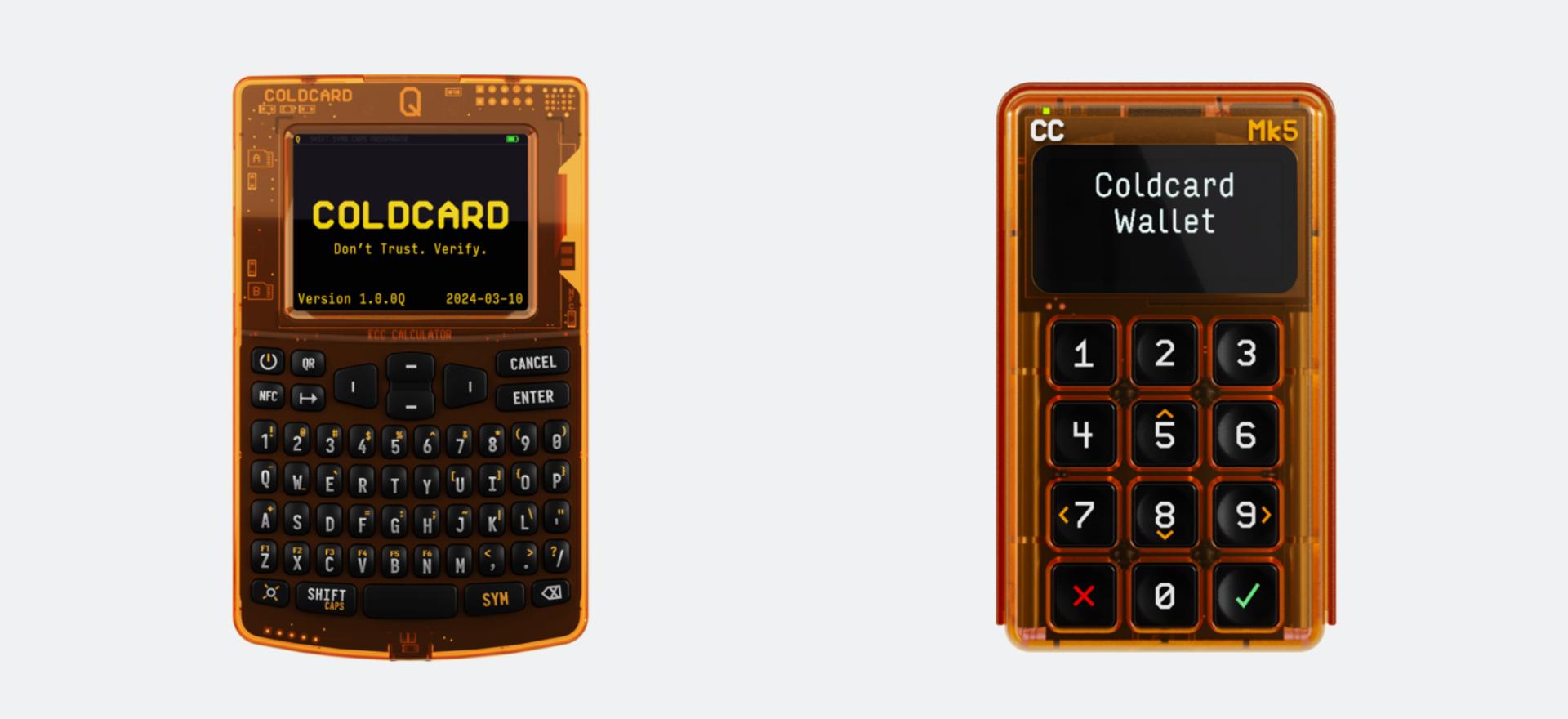
Some prominent bitcoin advocates say the incident is among the most damaging failures of self-custody the industry has experienced.
“This is the worst hit in bitcoin history to the most knowledgeable and ‘properly secured’ bitcoiners,” said Bitcoin commentator Guy Swann. “This isn’t an exchange getting hacked because of hot keys. This is thousands of individuals having their personal private keys recreated out from underneath them.”
Trading one risk for another
For years, bitcoin advocates have argued that holding private keys removes the counterparty risk of centralized exchanges, a lesson reinforced by failures such as FTX. Analysts now argue that users have simply exchanged one set of risks for another.
“The self-custodial hardware space is a disaster at this point and creates more bad rep for the industry than anything else,” said Lorenzo Valente, director of digital asset research at ARK Invest.
“In practice, consumers have traded counterparty risk for software risk, hardware risk, supply-chain risk, phishing risk, backup risk, and the possibility of losing everything through one mistake,” he said. “Frankly, you are better off today holding funds across several publicly-traded exchanges or ETFs.”
The Coldcard flaw illustrates that challenge. Researchers found that certain firmware versions generated wallet seeds using far less randomness than intended, making them susceptible to brute-force attacks.
Beth Hammack, president and chief executive officer of the Federal Reserve Bank of Cleveland, during a research conference at the Federal Reserve Bank of Dallas in Dallas, Texas, US, on Friday, Oct. 31, 2025.
Desiree Rios | Bloomberg | Getty Images
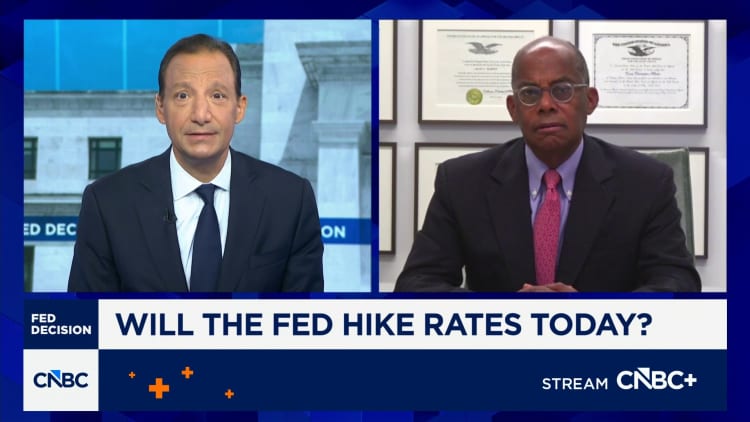
Federal Reserve officials who voted this week against the decision to hold interest rates steady said Friday they favor hiking now as a way to stave off inflation.
“In my view, now is the time for the [Federal Open Market Committee] to act to speed the return of PCE inflation to our 2 percent objective and deliver on our commitment to price stability for the American people,” Cleveland Fed President Beth Hammack said in a statement. “The longer that high inflation persists, the more challenging and costly it can be to bring it back down.”
Similarly, Minneapolis Fed President Neel Kashkari said in a separate statement that he believes small hikes now can prevent the need for larger moves later.
“In my view, a potential series of small policy moves would be better than waiting and eventually concluding that even bolder actions were necessary,” he said.
Kashkari and Hammack joined Dallas Fed President Lorie Logan in dissenting against holding the Fed’s key overnight borrowing rate in a range between 3.5%-3.75%. The other nine voting members of the FOMC voted in favor of keeping the rate steady, where it has been all year following a series of three cuts in the latter part of 2025.

Inflation has held above the Fed’s 2% target for more than five years, spiking again this war following the Iran war and the impact of President Donald Trump’s tariffs.
Logan said the Fed can’t count on an unexpected jolt to the economy to lower inflation and needs to be proactive.
“Labor, consumption and financial market conditions indicate that monetary policy is not restraining the economy,” she said, also in a prepared statement. “Without any policy restraint, inflation will likely continue to trend above target until there’s an unanticipated shock.”
Though price increases eased in June as Middle East tensions briefly eased, energy costs again have risen and generated fears that the Fed will have to tighten.
Though he voted in favor of the hold, Fed Chairman Kevin Warsh said he remains resolute in getting inflation back to target.
“We have begun a new chapter, and we understand that the five-plus years of inflation above target cannot be cured in nine weeks — or by a single month of modest price decreases,” he said.
However, Hammack said she is “not confident it will return to our objective on its own.”
“Supply-side factors, including energy prices, have boosted inflation this year, but I see inflationary pressures coming from the demand side of the economy, as well,” she added.
Hammack said her constituents in the Cleveland area have been describing “pricing pressures as broadening rather than fading, and consumers are expressing despair over persistently higher prices.”
For his part, Kashkari’s comments harken back to both the 1970s period of high inflation and the more recent episodes in which Fed officials initially dismissed the flare-up as “transitory” and brought on up issues related to the Covid pandemic.
“Economic theory argues that monetary policy is the right tool to address demand-driven inflation but faces greater trade-offs when dealing with supply shocks,” he said, adding, “I increasingly believe that monetary policy does have an important role to play in addressing a series of successive supply shocks that might lead to entrenched higher inflation.”
Logan is expected to release a statement explaining her vote later Friday morning.
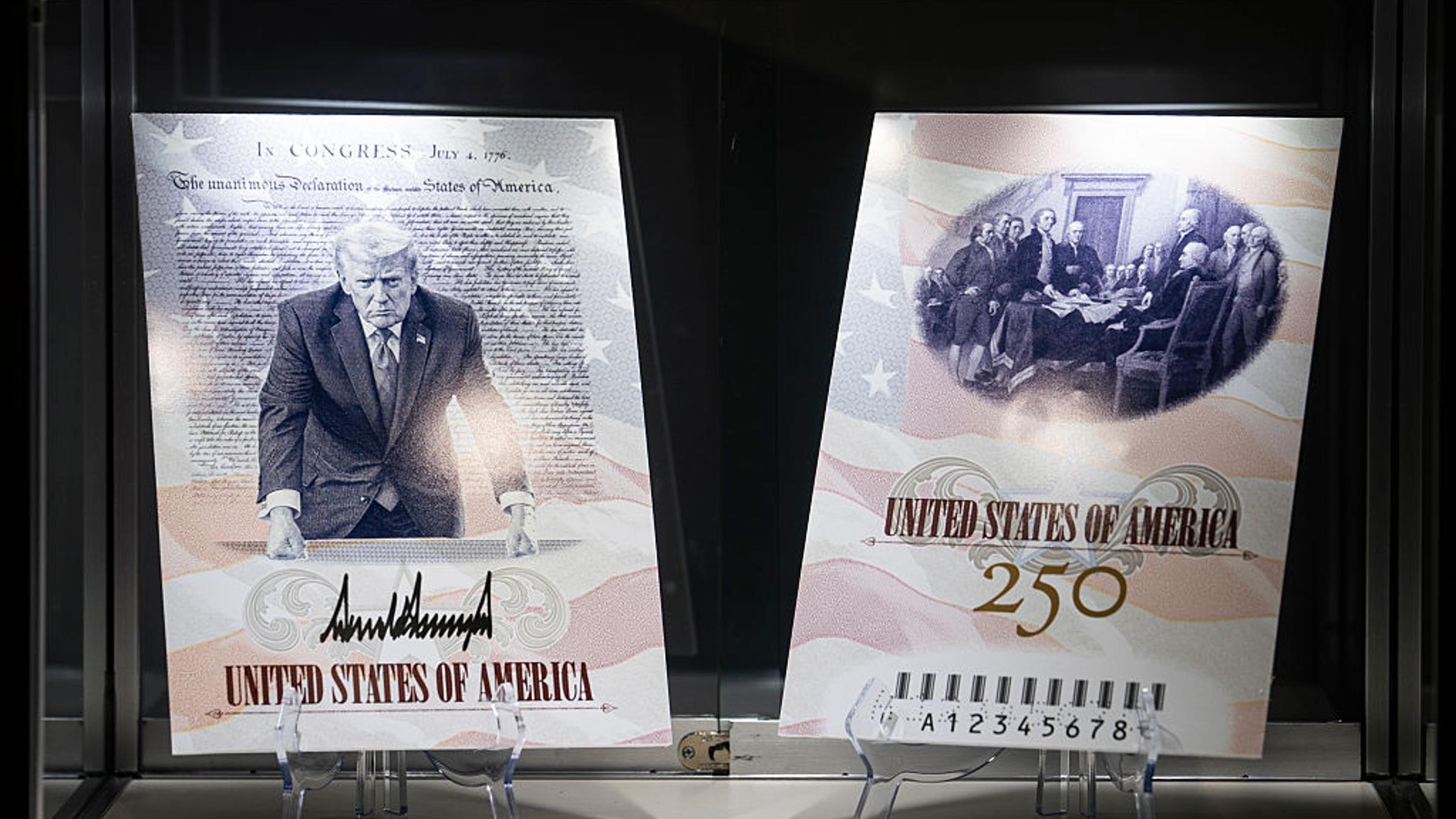
Trump also displayed his name on the Kennedy Center in Washington, D.C.—but last month, six months after it was affixed to the building, it was removed, per a federal judge’s order to restore the cultural center’s original name.
Democrats have overwhelmingly denounced the President’s efforts to affix his name and likeness onto government buildings, programs, and items. Several lawmakers signed an open letter to Trump in February objecting to his plans to shutter the Kennedy Center for two years while it underwent renovations.
“The Kennedy Center is a living memorial to President Kennedy,” Rep. Lizzie Fletcher, a Democrat from Texas, said in a social media post, in which she shared the open letter in February. “President Trump’s announcement that it will also bear his name (in violation of the law establishing it) and that it will be closed for two years (for unidentified repairs) show the narcissism and lawlessness that define this Presidency.”


Much of the adoption, however, benefits established financial institutions rather than token holders, Seiler said. As traditional finance integrates blockchain tech into existing workflows, less value accrues directly to crypto assets than investors expected several years ago.
Founded in 2021, STS Digital is a Bermuda-regulated crypto options market maker that provides 24/7 liquidity and pricing for institutional clients trading digital asset derivatives. The firm specializes in over-the-counter (OTC) trading.
AI, regulation add to crypto headwinds
Another barrier to growth is artificial intelligence. Investor enthusiasm for AI has diverted both attention and capital away from crypto, Seiler said.
High-profile developments around companies such as OpenAI, Anthropic and the SpaceX (SPCX) IPO have made AI the market’s dominant growth narrative, according to Seiler.
He also pointed to delays in U.S. market structure legislation, including the Clarity Act, as another factor weighing on sentiment.
Regulatory certainty would help to accelerate traditional finance’s shift toward 24/7 trading and settlement, while creating a more constructive backdrop for digital assets, he says.
Options selling caps volatility
Seiler also said the rapid growth of the institutional crypto options market is suppressing bitcoin’s price volatility.
Bitcoin’s implied volatility has remained unusually subdued in recent months, with the BVIV Index, a measure of expected 30-day volatility derived from bitcoin options, falling into the mid-30% range in recent months, among its lowest levels of the current cycle, before beginning to edge higher in July.

Champpixs | Istock | Getty Images
The stock market looked unusually tranquil. Beneath the surface, one of Wall Street’s fastest-growing funds devoted to artificial intelligence investments was unraveling.
In a matter of weeks, Leopold Aschenbrenner’s Situational Awareness went from managing roughly $45 billion to being forced into a sweeping reduction of its listed-stock positions as a historic momentum reversal triggered losses on both sides of its portfolio and set off margin calls and compulsory sales.
Situational Awareness had built concentrated positions in one of Wall Street’s most popular trades: owning companies expected to supply the chips, data centers, power and other infrastructure behind the AI boom while betting against software firms viewed as vulnerable to the technology’s disruption.
Its long positions were concentrated among some of the market’s biggest AI beneficiaries. Public filings showed large stakes in Nebius, Bloom Energy, Sandisk, CoreWeave, SharonAI and IREN as of March 31. By Wednesday’s close, those shares had fallen between by 50% and 78% from recent peaks.
At the same time, software stocks like Adobe that had been used as the short leg of the trade rallied. That meant the fund wasn’t protected by its hedges. Instead, the longs and shorts lost money simultaneously.
“People get over leveraged in this market, and they get seduced by the big returns that some of these companies can deliver,” said Bob Lang, founder and chief strategist at Explosive Options. “If you’re not managing your risk properly, this is the sort of thing that’s going to happen to you.”
As the value of the portfolio fell, the fund’s equity cushion shrank and its prime brokers demanded additional collateral. Raising cash required selling more holdings, adding further pressure to sliding stocks and generating additional losses. What might otherwise have been a painful drawdown became a deleveraging spiral. Ken Griffin’s Citadel hedge fund reached a deal to buy the fund’s publicly traded assets.
“Running somebody out the door like this is as old as time,” Lang said. “I’ve seen it happen a lot in oil markets … there’s a lot of things that are happening underneath the surface that we really don’t know about.”
Momentum crash
The episode offers a stark example of how a hedge fund can sustain devastating losses even when major stock indexes appear relatively calm. The S&P 500 remained near record levels as the damage unfolded, masking one of the most violent reversals in market leadership in decades.
“There is no other way to put it, we just witnessed the largest/ fastest momentum crash in modern history,” Jonathan Krinsky, chief market technician at BTIG, said in a note. “And it wasn’t particularly close.”
Morgan Stanley’s sector-neutral Momentum Index tumbled 17.4% in just four trading days, its worst such decline on record, according to BTIG. The drop surpassed the momentum reversals that followed the dot-com bust, the pandemic shock and the 2022 inflation-driven bear market.
The iShares MSCI USA Momentum Factor ETF posted its best month ever as recently as April, and is now on pace for its worst month, illustrating how quickly one of the year’s strongest strategies turned into one of its weakest.

iShares MSCI USA Momentum Factor ETF year to date
Clearing event?
AI infrastructure stocks rebounded sharply Thursday as investors increasingly interpreted the previous several weeks of volatility as the product of a technical dislocation rather than a deterioration in the industry’s fundamentals.
With one of the market’s largest forced sellers stepping back, traders rushed into many of the same chipmakers, power companies and data-center plays that had been at the center of the selloff. The tech-heavy Nasdaq Composite jumped for a second day Friday, on track for a weekly gain of 0.9% after suffering steep losses the last two weeks.
Nasdaq Composite 5 days
Still, not everyone believes the forced unwind marks the end of the AI selloff.
Among the most prominent skeptics is Michael Burry of “The Big Short” fame. Burry has been one of Wall Street’s most vocal critics of the AI boom, arguing that much of the industry’s demand is being sustained by financing arrangements rather than end customers.
Rather than viewing Thursday’s rebound as a turning point, Burry used the rally to add to bearish positions in Micron, the VanEck Semiconductor ETF and Nvidia put options, according to a Thursday Substack post.
“The knee jerk reaction to the Paired Momentum unwind yesterday has been to put it back on today,” Burry wrote. “This was a historic reversal, even more so than what happened 26 years ago,” when the dot-com bubble began to burst in 2000.
Burry said oversold and overbought conditions made a short-term bounce unsurprising, but he questioned whether the trade still had staying power.
“The legs,” Burry wrote, already “they look tired.”
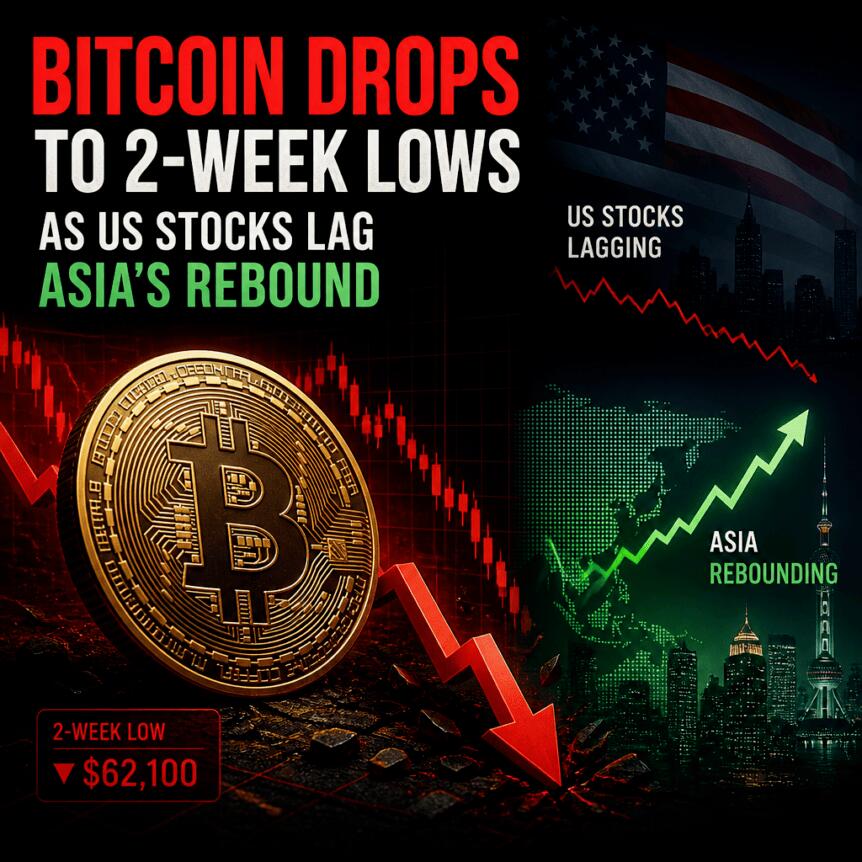
Bitcoin slipped Friday and tested its weakest levels in more than two weeks as market participants pushed risk assets toward the end of the monthly trading window. According to TradingView data, BTC/USD dropped about 3.5% to trade near $62,369 on Bitstamp, a price zone last seen on July 14.
While crypto did not seem to receive the same tailwind as parts of Asia’s equity rebound, the day’s macro cross-currents were hard to ignore. QCP Capital pointed to the outsized role of semiconductor and AI-related exposures in driving swings across regional markets—an environment that appears to be feeding back into crypto liquidity and positioning.
Key takeaways
- BTC/USD fell roughly 3.5% to around $62,369 on Bitstamp, the lowest level in over two weeks.
- US stocks weakened around the monthly close, contrasting with Asia’s rally—especially South Korea’s KOSPI.
- QCP Capital linked crypto activity to the relationship between equity positioning, regional tech sentiment, and crypto liquidity.
- Analysts at CoinGlass showed July ended with strong gains, but at least one trader warns August could bring a rollover similar to 2022.
- Rekt Capital highlighted the 50-month EMA around $65,820 as ongoing resistance after failed breakouts since mid-June.
BTC drifts lower as US equities soften into month-end
TradingView indicated BTC/USD lost ground during Friday’s session, moving toward $62,000 amid broader pressure into the monthly close. The move came despite a rebound elsewhere earlier in the day, when parts of Asia stabilized after a semiconductor-led sell-off.
According to the same macro framing cited by QCP Capital, semiconductor stocks drove both the decline and subsequent recovery because major indices remain heavily weighted to the global AI and memory-chip cycle. That concentration helps explain why an equity catalyst can quickly translate into shifts in sentiment—and potentially liquidity—across correlated markets, including crypto.
QCP Capital added that crypto trading activity increased around the KOSPI’s sharp swings, describing it as evidence of a growing relationship between crypto liquidity, regional equity positioning, and broader technology-sector sentiment. The firm’s argument is less about a single day’s price and more about how the plumbing of liquidity may be changing alongside technology-driven equity narratives.
Asia rebounds while the US turns cautious
US stocks traded red at the open before leveling out, which diverged from the earlier rebound seen in Asia. South Korea’s KOSPI index finished the day up 17.9%, its largest single-day gain on record, according to figures referenced in the market commentary.
The day’s backdrop also included currency and rate dynamics. The commentary noted that both Japan and Korea reportedly engaged in currency interventions on Thursday, while Japan’s central bank kept benchmark interest rates at 1.0% after the US Federal Reserve decided to hold steady earlier in the week, following the US PCE inflation update.
For crypto traders, the practical takeaway is that “risk-on” can appear in pockets while “risk management” remains active in other major venues. When that happens, BTC can still underperform even as some regional equities bounce—particularly when liquidity flows are being reallocated quickly between markets.
July strength sets up a test for August
Even with Friday’s pullback, BTC’s monthly performance has looked constructive. CoinGlass data referenced in the article showed BTC/USD was up 8.5% for the month as of the end of the monthly candle, its strongest July showing since 2022.
That improvement mattered because earlier positioning had already shifted toward the idea of a relief bounce extending into August. The comparison traders were drawing was specifically to the 2022 bear-market structure: a rally that ultimately transitioned into a subsequent move toward a next longer-term bottom.
Rekt Capital—one of the analysts cited for that 2022 mapping—forecast that any bullish attempt might not hold immediately. In an X post on Friday, he wrote that price could try to “maintain these highs in the early stages of August,” but that history suggests a rollover similar to what occurred in 2022.
Technical resistance remains in focus near the 50-month EMA
Rekt Capital also pointed to a technical level that has limited follow-through. He reiterated that Bitcoin’s 50-month exponential moving average (EMA), currently around $65,820, has continued to act as resistance. In his view, that has been visible through two failed breakouts since mid-June.
For investors and traders, the implication is straightforward: even when BTC can put together a strong July, the next phase depends on whether it can clear longer-term trend resistance rather than merely bounce within an existing range. Levels like the 50-month EMA tend to attract both systematic and discretionary attention because they represent a longer horizon for trend definition.
That context also helps reconcile the mixed picture on Friday. BTC weakening toward the low-$60,000 area may be consistent with traders taking profits or reducing exposure as the market transitions from a month-end catalyst period into a new monthly cycle—especially if macro uncertainty and equity volatility persist.
Going forward, readers should watch whether BTC can reclaim and hold above the mid-$60,000 resistance area highlighted by the 50-month EMA and whether August follows through on the “rollover” scenario traders cite from 2022—or instead breaks the pattern and sustains higher levels despite the month-start shift.
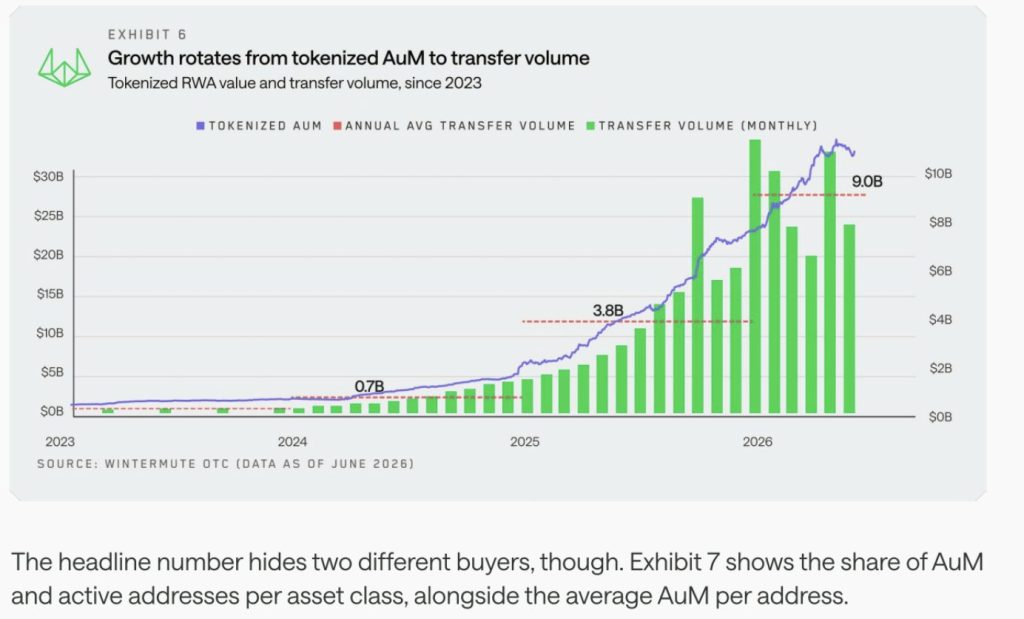
Wintermute reported that institutional investors accounted for a record 72% of spot OTC trading volume on its desk in the first half of 2026, up from roughly 61% in the second half of 2024, a structural shift that the firm says makes broad-based altcoin rallies significantly less likely going forward.
The implication is direct: the capital formation mechanism that historically sent profits cascading from Bitcoin into ETH and then down the altcoin long tail is no longer functioning the same way, and retail traders still positioning for an indiscriminate altseason may be running an outdated playbook.
Discover: Everyone’s Got a Take. Get Free $25 to Actually Trade Yours
Wintermute: Capital Is Concentrating, Not Dispersing
Wintermute’s analysis frames the shift as fundamentally about mandate-driven versus speculation-driven capital. Institutional participants operate under defined risk limits and hold positions over longer periods, which means their flow concentrates in assets with demonstrated liquidity, regulatory clarity, and identifiable fundamentals, not in tokens riding narrative momentum.
The report noted that realized volatility has declined from roughly 70% in earlier market cycles to around 45% in the current one, a direct consequence of institutional order flow replacing retail-driven speculation as the marginal price setter.
Lower volatility compresses the explosive upside that defined 2021-style altseasons, but it also reduces the severity of the unwind.
For traders, the operational takeaway is that OTC block flow, executed away from public order books, is increasingly where price direction gets established. Retail participants reacting to exchange order book moves may consistently find themselves a step behind positioning that was set in bilateral institutional trades.
This dynamic is visible in the institutional infrastructure buildout accelerating across major crypto venues.
Discover: Your Market Calls Are Worth Something. Start With Free $25 on Kalshi
RWA Tokenization as the Institutional On-Ramp
The tokenized real-world asset market reached $31 billion in H1 2026, representing roughly a 50% increase over the prior period, according to Wintermute’s data.
Average monthly transfer volume more than doubled to $9 billion, which signals operational adoption rather than speculative positioning, institutions are moving these assets, not just accumulating them.

The primary instruments attracting institutional capital are U.S. Treasuries, money market funds, and private credit, yield-bearing products where blockchain infrastructure delivers settlement efficiency and programmatic compliance without changing the underlying risk-return profile. This is not institutions chasing crypto-native yield; it is traditional finance running familiar instruments on new rails.
Wintermute also noted that altcoin options notional volume on its OTC desk increased approximately 3.4 times from the second half of 2025 to the first half of 2026, driven by yield-seeking strategies rather than outright directional bets.
Contracts for difference are being deployed across a wider range of tokens for hedging and basket strategies. The derivatives expansion reinforces the same thesis: institutional participants want structured exposure, not raw token speculation. The pattern mirrors broader institutional demand for collateral-grade crypto assets with defined utility.
Discover: Get Paid to Be Right, $25 to Start on Kalshi
The post Wintermute Data Shows Institutional Flow Is Killing Broad Altcoin Rallies appeared first on Cryptonews.

Betfred to close 132 shops and cut 600 jobs citing UK gambling tax hikes

Microsoft Copilot Lawsuit Deadline Is August 11: Will Investors Get Money Back?

From Collagen To A Coffee Machines: Best Shopping Writer-Tested Tested Products In July


-
 Sports5 days ago
Commonwealth Games boxing: Jadumani Singh seals dominant 5-0 win over Pakistan’s Sumama Rehman to enter quarter-finals | Commonwealth Games News
-

 Business2 days ago
Why Trees Belong on the Risk Register
-

 Tech5 days ago
Intel is reversing course and bringing hyper-threading back to its server chips
-

 Crypto World6 days ago
Ripple bought a bank in pieces. The $4 billion audit
-

 Politics4 days ago
Luke Littler dismantles Gerwyn Price to retain title in Blackpool
-

 Politics3 days ago
The Part of the Electric Transition Nobody Wants to Discuss
-

 News Videos5 days ago
BITCOIN JUST ENTERED THIS CRITICAL ZONE…
-
 Entertainment3 days ago
‘Stargate’ Creator’s New Sci-Fi Series Returns for Season 3 Tomorrow
-

 Business3 days ago
Major shareholder moves on Canyon
-

 Crypto World5 days ago
XRP Ledger adds $2.6B as RWA inflows rank second
-

 News Videos1 day ago
Bitcoin Enters the 3rd Stage of the Bear Market
-

 Politics5 days ago
Spain sweeps the board at 2026 World Cup with individual awards
-

 Entertainment6 days ago
Sara Gilson Killed By Husband After Viral “Pedophile” TikTok Video
-

 Crypto World3 days ago
Kraken Enables Retail Access to Jersey Mike’s IPO via Tokenized Shares
-

 Tech7 days ago
Anthropic launches Claude Opus 5, a cheaper AI model for coding, agents and enterprise workflows
-

 Tech4 days ago
New macOS Sequoia & Sonoma security updates for older Macs
-

 News Videos3 days ago
Claude: Build Financial Dashboards in Minutes (2026)
-

 Politics1 day ago
Luke Littler’s dominance sparks GOAT debate
-

 Sports17 hours ago
Seema Kaliramna Wins Discus Throw Bronze, Takes India’s CWG Medals Tally To 17
-

 Crypto World6 days ago
Upbit expands KRW market with two major DeFi token listings
You must be logged in to post a comment Login