

Crypto World
Archer Aviation (ACHR) Stock Gains 5% Despite Mixed Q4 Earnings Report


Key Highlights
- ACHR advanced approximately 5% during Tuesday’s session to reach $5.185, up from the previous day’s close of $4.94, with trading volume hitting ~33.5 million shares.
- The company fell short of Q4 projections for both earnings per share (($0.26) actual vs. ($0.17) forecast) and quarterly revenue ($0.30M actual vs. $1.4M forecast).
- Institutional investors now control more than 50% of shares, including Vanguard Index Funds’ 5.86% position and ARK’s holdings of roughly 35 million shares.
- Wall Street consensus remains at “Moderate Buy” with a mean price objective of $12.00; TipRanks shows an average projection of $13.20.
- Archer concluded 2025 holding approximately $2 billion in liquid assets and received FAA approval for its eVTOL compliance methodology, maintaining its late 2026 passenger service launch schedule.
Archer Aviation ($ACHR) shares have declined approximately 30% since the beginning of 2026, but Tuesday brought a modest recovery as the stock advanced roughly 5% intraday to $5.185, briefly hitting $5.23 during the session. Monday’s closing price stood at $4.94.
Trading activity reached approximately 33.5 million shares, representing about 7% less than the typical daily volume of roughly 35.9 million. The security’s 50-day simple moving average stands at $6.83, while the 200-day average rests at $8.41, indicating that both short-term and long-term technical indicators remain significantly above present trading levels.
The company’s latest quarterly financial results, published on March 2, presented challenges for shareholders. Archer reported a per-share loss of ($0.26), falling short of the analyst consensus forecast of ($0.17) by nine cents. Quarterly revenue totaled just $0.30 million, substantially below the anticipated $1.40 million. However, revenue demonstrated a remarkable 29,900% year-over-year increase from an essentially negligible base.
Despite the earnings shortfall, the company maintains a robust financial position. Archer finished 2025 holding approximately $2 billion in cash reserves, carrying a minimal debt-to-equity ratio of just 0.05, and showing a current ratio of 19.89. This financial runway provides management with flexibility to pursue commercial objectives without immediate capital constraints.
Regarding regulatory progress, the FAA has approved Archer’s eVTOL compliance methodology, preserving the company’s schedule for initial commercial passenger operations. Management continues to target a service debut by late 2026. This upcoming milestone represents a cornerstone of the investment thesis for bullish investors.
Wall Street Perspectives Vary, With Bullish Bias
Analyst opinion remains divided but leans optimistic. Five analysts assign a Buy rating, two recommend Hold, and one maintains a Sell rating. The mean price objective among analysts reaches $12.00, indicating significant appreciation potential from present levels. TipRanks, incorporating more current analyst updates, displays a Strong Buy consensus with a $13.20 mean target — suggesting possible upside of approximately 148% from the $5.185 level.
Needham reduced its price objective from $10.00 to $9.00 in early March while maintaining a Buy recommendation. Goldman Sachs launched coverage with a Neutral stance and an $11.00 target in December. Weiss Ratings continues to hold a Sell rating.
Insider transactions have skewed toward stock sales recently. During the past 90 days, company insiders disposed of approximately 380,750 shares worth roughly $2.6 million. CTO Thomas Muniz sold 9,580 shares on March 13 at $6.27 per share, while insider Tosha Perkins sold 10,949 shares at the identical price on the same date.
Large Investors Accumulate Shares
Notwithstanding the stock’s recent decline, major investors have expanded their holdings. Institutional and hedge fund ownership currently represents approximately 59% of outstanding shares. ARK Investment Management controls approximately 35.2 million shares following an addition of roughly 3.9 million shares during Q4. BNP Paribas expanded its stake by 423% in Q4, elevating its total position to approximately 5.1 million shares.
Vanguard Index Funds maintains a 5.86% ownership stake, positioning them as the top institutional shareholder. CEO Adam Goldstein holds approximately 4.89% of outstanding shares.
Among exchange-traded funds, the SPDR S&P Aerospace & Defense ETF ($XAR) maintains a 2.94% position, with the ARK Innovation ETF ($ARKK) holding 2.58%.
The company’s market capitalization stands at $3.86 billion with a beta of 3.10, demonstrating the stock’s tendency toward heightened volatility compared to broader market movements.




The S&P 500’s longest weekly winning streak since 2023 and Brent crude settling near $92 on U.S.-Iran ceasefire hopes have failed to pull bitcoin and ether (ETH) higher, with the two largest cryptocurrencies finishing the week down nearly 3% as cooling spot bitcoin ETF inflows reinforced the pullback.
The S&P 500 posted its ninth consecutive weekly gain on Friday, the longest such run since 2023 and a streak matched only a handful of times in the past four decades, putting the index up almost 20% from its March lows.
Brent crude settled around $92 a barrel and Treasuries climbed on the week, trimming some of their war-driven losses.
The macro tailwind has come on hopes the U.S. and Iran will sign off on a 60-day ceasefire extension. President Donald Trump said Friday he was ready to make a “final determination” on a preliminary agreement but restated his demand that any deal require Iran to abandon its nuclear program, surrender its enriched uranium and open the Strait of Hormuz.
Crypto did not move with the tape. Bitcoin slipped 2.6% over the past seven days to $73,445, ether 2.5% to $2,011, solana (SOL) 2.2% to $82.42 and TRON’s TRX 5.6%, its worst weekly drop in the top 10, according to CoinDesk data.
finished roughly flat. The slide came alongside softer spot bitcoin ETF inflows, which was flagged this week as adding to the downward pressure even as macro conditions improved.
The exception was the smaller side of the leaderboard. Hyperliquid’s HYPE token ripped 19.4% on the week to $65 as sentiment for the asset continues to grow. Intercontinental Exchange chief Jeffrey Sprecher praised the decentralized perpetuals venue at a Bernstein conference and calling it “bigger than NASDAQ.” BNB closed up 1.9% and XRP eked out a 0.7% weekly gain.
The Iran deal still needs Trump’s signature, and the red lines he restated on Friday sit well beyond what Iran has indicated it would accept publicly. The macro rally is one bad headline from reversing.
Crypto World
Bitcoin’s biggest quantum risk may not be wallet keys. An early investor fears something bigger


A venture capitalist who has spent a decade backing deep-tech and quantum hardware startups says the bitcoin industry is fixated on the wrong half of the quantum problem, the wallet keys instead of the encrypted messages already moving between exchanges, bridges and custodians today.
“The financial system’s most dangerous vulnerability isn’t stored data, it’s the data
moving between institutions right now,” Andrew Gault, CEO of networking firm ZeroTier, told CoinDesk in a recent chat.
“Every interbank message, every payment authentication record, and every digital signature traveling across a network today is being collected by sophisticated adversaries who don’t need to read it yet,” he noted.
“CISOs and security teams have been trained to protect data at rest. What nobody wants to say out loud is that the adversary’s strategy has changed. They’re patient, they have storage, and they’re building a library of today’s encrypted traffic to decrypt the moment quantum capability crosses the threshold,” he added.
Gault is CEO of networking firm ZeroTier and a founding partner of 7percent Ventures, a London- and San Francisco-based deep-tech firm whose portfolio includes British quantum-computing startup Universal Quantum.
The Google Quantum AI research that rattled bitcoin in March showed a sufficiently powerful quantum computer could derive a bitcoin private key from an exposed public key in about nine minutes, came from outside his portfolio.
The conversation since that paper has centered on the roughly 6.9 million BTC sitting in addresses with exposed public keys and Bitcoin’s missing post-quantum migration plan.
But Gault says the more urgent exposure is the data already being collected off the open internet for decryption later, regardless of whether a working quantum computer exists yet.
Google’s own security engineers have moved the same direction. In a March post, the company set 2029 as its target for completing a post-quantum cryptography migration, citing progress on quantum hardware, error correction and factoring resource estimates.
The post, written by Google vice president of security engineering Heather Adkins and senior cryptography engineer Sophie Schmieg, said the company has reprioritized its internal threat model to focus on authentication services and digital signatures, the same wire-level signing infrastructure Gault has been pointing at.
“The threat to encryption is relevant today with store-now-decrypt-later attacks,” the post said.
The strategy driving that urgency is known in cryptography circles as “harvest now, decrypt later.” It assumes adversaries don’t need to read encrypted traffic today, only store it cheaply until a sufficiently powerful quantum computer arrives.
Citi modeled the bank-system version of the scenario in February, estimating a quantum-enabled attack on a single top-five U.S. bank’s access to the Fedwire Funds Service payment system could trigger a $2 trillion to $3.3 trillion cascade across the U.S. economy, equal to a 10% to 17% decline in real GDP.
The Global Risk Institute, cited in the same Citi report, puts the probability of a cryptographically relevant quantum computer arriving by 2034 at between 19% and 34%.
For crypto, the wire-level surface is broader than the wallet one. Cross-chain bridge proofs, exchange API authentication packets, signed transactions broadcast and archived in public mempools, and the back-channel signing traffic between cold storage and trading desks all sit on the same vulnerability spectrum as the bank-grade encryption Citi was modeling.
CoinShares argued in a February report that the wallet-key fear is overstated, estimating only about 10,200 BTC are concentrated enough to move markets if stolen.
Gault’s worry is a different one. “The particularly uncomfortable reality for financial institutions is that the authentication records being harvested aren’t just sensitive,” he said. “It’s the proof layer that determines who owns what, who authorized which transaction, and who bears legal liability.”
Ethereum (ETH) has launched a coordinated post-quantum migration, but Bitcoin has not done the same. Major crypto exchanges and custodians, where most of the signing traffic lives, have not publicly committed to one either.

TLDR:
- FBI crypto seizure crackdown marks one of the largest crypto forfeitures in US history.
- Authorities tied 127,000 bitcoin seizure to Prince Holding Group CEO Chen Zhi fraud network.
- Operation Blackout dismantled scam compounds across Asia and freed nearly 2,000 trafficked workers.
- IC3 reported 72,000 crypto fraud complaints in 2025 with losses exceeding $7.5 billion total.
The FBI has seized roughly $8 billion in cryptocurrency in a sweeping international crackdown on scam compounds.
Authorities also arrested hundreds of suspects tied to coordinated fraud and money laundering networks. The operation stretched across Asia, the Middle East, and parts of Africa, targeting organized criminal infrastructure.
Officials linked the case to one of the largest crypto forfeitures in U.S. enforcement history.
FBI Crypto Seizure Crackdown Targets $8B Scam Compound Networks
The FBI crypto seizure crackdown centered on more than 127,000 bitcoin tied to Chen Zhi, according to Fox News reporting. The assets pushed total recovered crypto to over $8 billion at the time of seizure.
Valuations may have exceeded $15 billion during earlier market peaks. Officials described the action as a historic asset recovery milestone.
Chen Zhi leads Cambodia-based Prince Holding Group, which authorities accuse of running large-scale fraud operations. Federal charges include wire fraud and conspiracy to launder money.
Investigators allege the network operated guarded compounds targeting global online scam victims. Law enforcement continues expanding related financial probes.
Authorities also linked the Democratic Karen Benevolent Army to scam compound activity in Myanmar. The armed group operates in conflict regions and faces U.S. sanctions for prior fraud involvement.
Officials classify it as a transnational criminal organization tied to cyber-enabled theft. Investigators flagged its links to broader Chinese organized crime networks.
The seizure forms part of a wider enforcement push against coordinated crypto-enabled fraud systems. Agencies said these networks combine digital scams with forced labor operations.
Multiple jurisdictions supported asset tracing and crypto wallet identification efforts. The scale of recovered funds highlights the industrial nature of the fraud economy.
Operation Blackout Exposes Global Crypto Fraud and Trafficking Pipelines
Operation Blackout coordinated multiple enforcement actions, including Zephyr Exodus, Sand Dollar, and Haochen. These operations targeted scam compounds operating across Asia and the Middle East.
Authorities seized additional crypto assets and dismantled recruitment pipelines used by criminal groups. Officials said the campaign disrupted cross-border fraud infrastructure.
The FBI reported freeing nearly 2,000 trafficked workers during coordinated raids on scam facilities. Victims were often recruited under false job promises and then forced into scam operations.
The Internet Crime Complaint Center recorded about 72,000 fraud complaints in 2025. Reported losses exceeded $7.5 billion, with officials warning of underreporting.
Investigators partnered with Starlink to track terminals used in scam compound communications. The cooperation led to the suspension of more than 7,000 terminals in Myanmar.
Authorities said criminal groups used satellite links to evade traditional monitoring systems. The disruption weakened multiple active fraud hubs across the region.
Operation Level Up focused on victim identification and fraud prevention across crypto investment schemes. The FBI notified about 8,935 victims who were unknowingly exposed to scams.
Officials estimated the intervention prevented roughly $562 million in losses. The program aims to reduce exposure to high-volume crypto fraud networks.
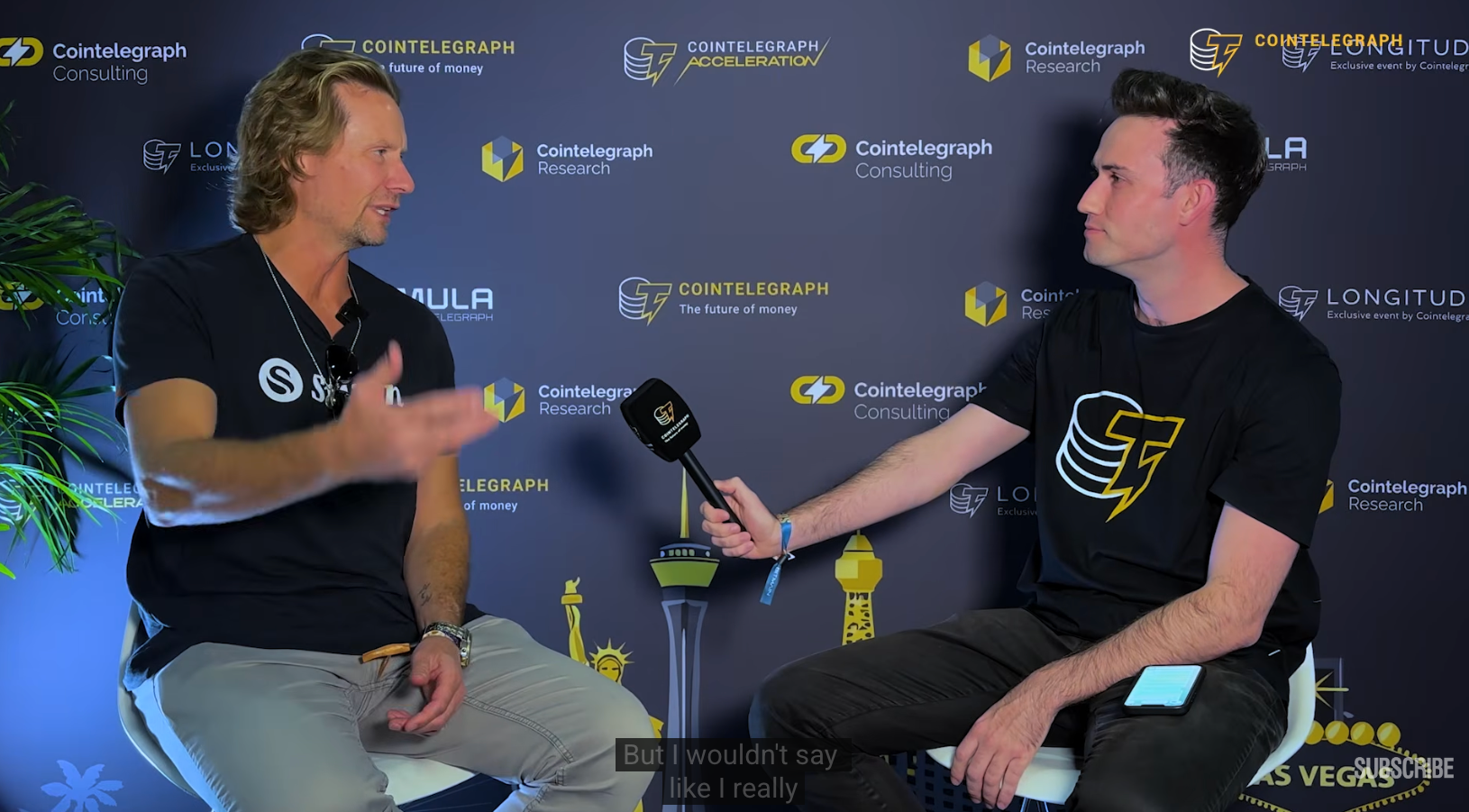
Despite the growing institutional presence in crypto, retail sentiment is just as important as it was when Wall Street was largely on the sidelines, according to Swan Bitcoin CEO Cory Klippsten.
“It still does. You have to remember it’s not like BlackRock owns the Bitcoin and Fidelity owns the Bitcoin. It’s a bunch of retail accounts mostly that actually buy that,” Klippsten said during an interview with Cointelegraph published to YouTube on Tuesday.
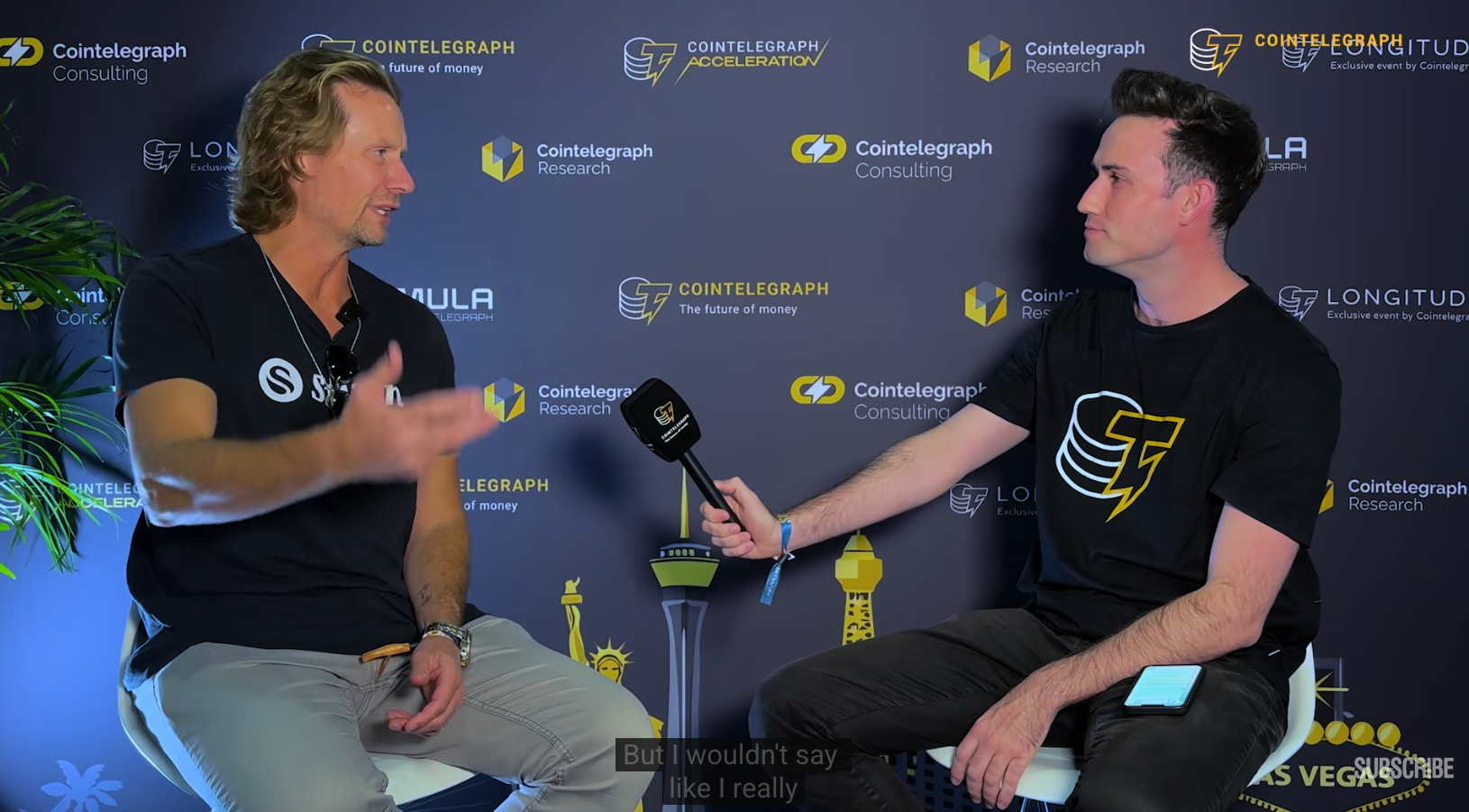
Cory Klippsten spoke to Cointelegraph at BitcoinVegas 2026. Source: Cointelegraph
“You know they’re buying it in a wrapper. But they still have to take real supply and custody it. And it comes out of the supply. So, you know, it’s still it is real demand in ETFs,” Klippsten said, adding:
“There are some paper products and futures and things like that that are weird and take a little while to kind of work through the system. There is something to the idea that there is more supply in certain ways. But at the end of the day, if you want real on-chain Bitcoin, the fact that you can get it is what makes Bitcoin unique.”
US-based spot Bitcoin ETFs have posted a combined $2.90 billion in net outflows since May 15, according to Farside data, while Bitcoin has slid approximately 9.5% over the same period. At the time of publication, Bitcoin is trading at $73,630, according to CoinMarketCap.
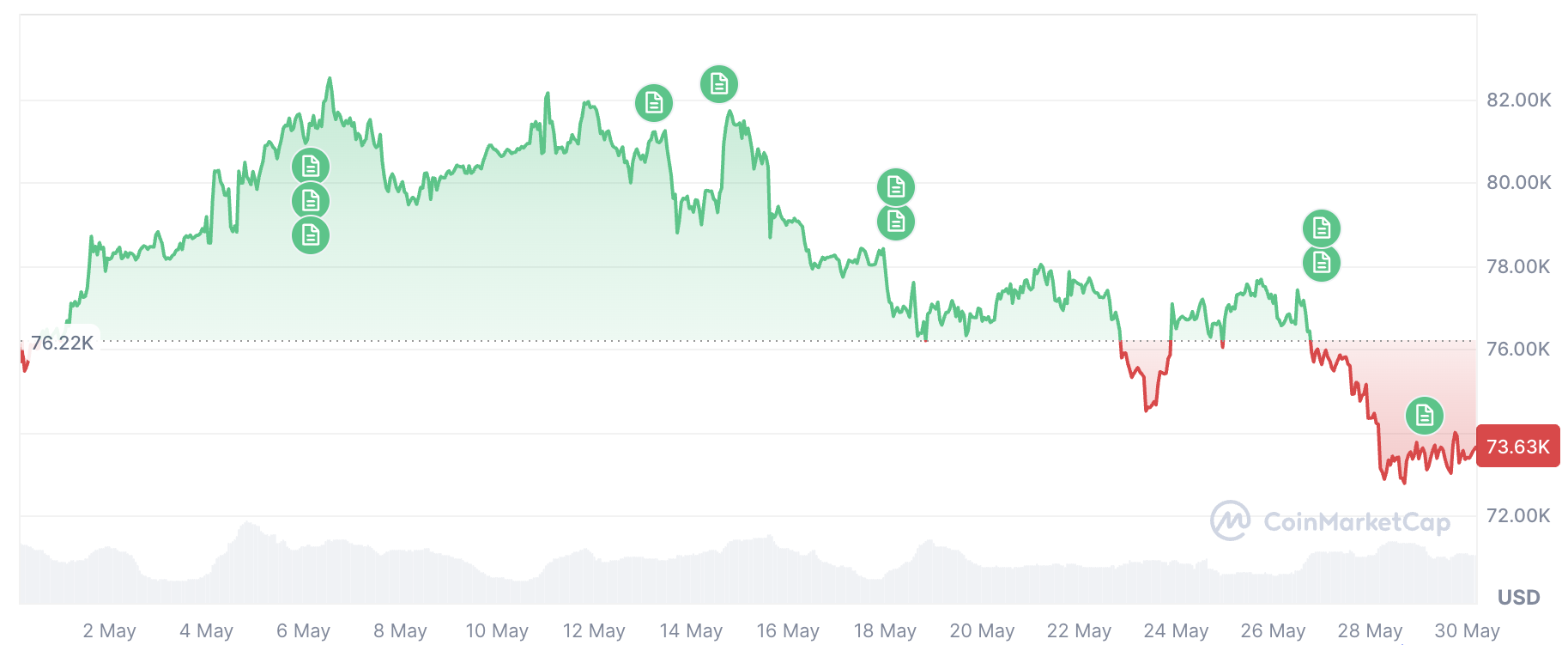
Bitcoin is down 2.87% over the past 30 days. (CoinMarketCap)
Meanwhile, sentiment toward the crypto market has been volatile in 2026. The Crypto Fear & Greed Index, which measures overall crypto market sentiment, posted an “Extreme Fear” score of 23 on Friday, signaling that investors are taking a cautious approach to the crypto market.
Bitcoin price outlook for 2026: slim chances
Klippsten said his outlook on Bitcoin hitting a new all-time high in 2026 is now looking slim.
Related: Bitcoin falls out of the global top 10 assets as market cap dips below $1.5T
He said he thought there was around a 50% chance we’d see a new all-time high this year when Bitcoin was still trading around $95,000 earlier this year, but given it has declined around 23% since then, his odds have gone down.
“I thought there was probably like a 50% chance that we’d see a new all-time high this year. And I’d say, given that we’re still in the 70s and, you know, and that we went all the way down to 60, I’d probably handicap that down to like 20 or 25% chance that we get a new [high]” he said.
Magazine: ETH bears growling, Tom Lee’s buying, XRP to ‘explode’: Market Moves
TLDR:
- Cash App Investing selected Apex Clearing after an extensive evaluation to support its next phase of growth.
- Apex’s AscendOS™ platform offers real-time processing, 24×5 trading, and multi-asset class support for users.
- Existing Cash App features like dividend reinvesting and Round Ups remain fully intact under the new partnership.
- The API-first infrastructure gives Cash App the flexibility to roll out new investment products at a faster pace.
Cash App Investing has selected Apex Clearing Corporation as its new clearing provider, marking a key move in its growth strategy. The partnership combines Cash App’s user-focused investing tools with Apex’s AscendOS™ technology platform.
Cash App Investing serves millions of customers through Block, Inc.’s Cash App, which reports more than 59 million monthly transacting actives. The alliance is designed to support continued scaling and product innovation for everyday investors.
A Technology-Driven Alliance Built for Growth
Apex was chosen following an extensive evaluation process by Cash App Investing. The decision reflects a clear need for real-time, scalable infrastructure.
Apex’s AscendOS™ platform is built specifically for modern digital investing environments. It supports high-volume, concurrent user activity without sacrificing compliance or security.
Cash App Investing customers will continue using the familiar Cash App interface throughout the transition. The partnership preserves existing features such as dividend reinvesting and the Round Ups tool.
Apex’s infrastructure adds robust security protocols to the experience. These systems are designed to handle real-time processing at significant scale.
Apex CEO Bill Capuzzi spoke directly to the reliability element of the deal. “Real-time technology, reliability that earns trust, and a partner built to support their momentum,” he said.
He added that Cash App has built something remarkable for everyday investors. In his view, the collaboration positions Cash App to continue scaling its platform and user base.
The technology stack also opens access to multiple asset classes for future product development. This broadens the potential roadmap for Cash App Investing going forward.
Both firms went through an extensive evaluation before finalizing the arrangement. The outcome reflects a shared focus on infrastructure that can grow with user demand.
Expanding Capabilities Through AscendOS™
Logan Kolar, CEO of Cash App Investing, pointed to the API-first design as a decisive factor. “Apex’s real-time infrastructure and API-first approach give us the flexibility to innovate quickly,” he stated.
He added that the platform ensures customers receive the reliability and protection they expect. The alignment in mission—making investing more accessible—drove the strategic fit between both firms.
AscendOS™ brings capabilities that extend well beyond standard clearing functions. The platform supports a variety of account types alongside multiple asset classes.
It also enables 24×5 trading, which is increasingly expected in digital investing environments. These features allow Cash App to expand its offerings without building infrastructure from scratch.
The API-first architecture supports rapid feature development cycles across the board. Cash App can roll out new tools without long delays in the development process.
The system also maintains regulatory compliance throughout that process. Speed and security are built to work together rather than compete.
For everyday investors using Cash App, surface-level changes will remain minimal. The core benefit lies in the infrastructure supporting their accounts behind the scenes.
Improved reliability, faster processing, and a wider future product range are the expected outcomes. The partnership sets the stage for what both companies describe as the next chapter of growth.
TLDR:
- SEC Chair Paul Atkins said he expects the CLARITY Act to pass Congress and become law.
- The bill aims to establish clear rules separating digital commodities from securities.
- Senate Banking Committee approval has moved the CLARITY Act closer to a full vote.
- The framework seeks to keep crypto innovation and investment activity within the United States.
SEC Chair Paul Atkins has expressed confidence that the CLARITY Act will clear Congress and receive President Donald Trump’s signature.
His remarks arrive as crypto market structure legislation gains momentum in Washington, bringing the United States closer to establishing a comprehensive framework for digital assets.
SEC Chair Paul Atkins Sees CLARITY Act Becoming Law
SEC Chair Paul Atkins delivered a strong vote of confidence for the CLARITY Act during a recent interview, signaling growing optimism around crypto legislation in the United States.
According to Atkins, Congress is expected to approve the measure, allowing President Trump to sign it into law and provide a formal legal foundation for digital asset oversight.
Atkins emphasized that regulatory uncertainty has remained one of the largest obstacles facing the crypto industry.
He explained that businesses often struggle to determine which regulations apply to their products, creating unnecessary costs and delays. Without clear rules, many firms have chosen to develop and launch services outside the United States.
The SEC Chair stated that the CLARITY Act would help resolve those concerns by establishing a statutory framework for digital assets.
He noted that regulatory certainty would allow innovators to operate domestically while giving investors greater confidence in the market.
His comments come as the Senate Banking Committee advances the legislation toward a full Senate vote. The bill’s progress marks one of the most important developments for crypto regulation in recent years and reflects increasing support for a structured approach to digital asset oversight.
CLARITY Act Aims to Define Crypto Rules and Strengthen US Leadership
A central objective of the CLARITY Act is to create clear distinctions between digital commodities and securities. The legislation is designed to reduce overlap between the SEC and the Commodity Futures Trading Commission, providing market participants with a more predictable regulatory environment.
Treasury Secretary Scott Bessent has also backed efforts to move the bill forward. Supporters argue that the framework would help prevent conflicting interpretations from federal regulators while encouraging blockchain innovation within the United States.
Atkins maintained that America already holds a leading position in global crypto markets but warned that maintaining that advantage requires clear and consistent regulation. He said previous uncertainty pushed innovation offshore and limited opportunities for domestic growth.
The CLARITY Act aligns with President Trump’s broader goal of making the United States a global center for digital asset development.
While additional legislative hurdles remain, the bill’s recent progress has increased expectations that comprehensive crypto market structure reform could soon become a reality.
For the crypto industry, the coming Senate vote now represents one of the most closely watched developments in Washington as lawmakers move toward establishing long-term rules for the digital asset economy.

Coinbase Financial Markets has begun offering US institutional clients access to global crypto options and perpetual futures through a regulated futures commission merchant, including connectivity to Deribit’s crypto options platform.
Coinbase said the launch follows guidance from the Commodity Futures Trading Commission that allows a regulated futures commission merchant to connect US clients with global crypto derivatives liquidity. The company stressed that Coinbase Financial Markets is the first CFTC-regulated FCM to provide such access.
Deribit, which Coinbase acquired in August 2025 as part of its expansion into crypto derivatives, is the largest crypto options exchange by open interest. CoinGlass data shows Deribit held roughly $31 billion in Bitcoin options open interest on May 27, compared with about $2.7 billion on OKX, $1.8 billion on Binance and $1.2 billion on Bybit.
According to Friday’s announcement, institutional clients can begin onboarding immediately, while broader access, including retail, is expected to follow later.
Key takeaways
- Coinbase becomes the first CFTC-regulated futures commission merchant to connect US institutional clients to global crypto options and perpetual futures liquidity via Deribit.
- Deribit dominates Bitcoin options open interest, with roughly $31 billion in BTC options as of late May, highlighting liquidity concentration on a single platform.
- US derivatives venues are expanding crypto offerings as regulators signal a path to onshore perpetual futures and new regulated products, including CME’s crypto index futures and Bitcoin Volatility futures, while exchanges such as Kraken pursue expansion through Bitnomial.
- The regulatory backdrop features ongoing moves by US agencies toward onshoring certain crypto derivatives, including a September 2025 joint SEC/CFTC statement and accompanying guidance on 24/7 trading and clearing.
US-regulated access deepens crypto derivatives usage
The Coinbase arrangement leverages an onshore path for US institutions seeking exposure to a broader derivatives liquidity pool beyond domestic venues. By connecting US clients to Deribit through a regulated FCM, Coinbase aims to offer regulated access to a dominant offshore options market, aligning with a broader push to reconcile offshore liquidity with US supervision.
Institutional onboarding is available immediately, with a plan to roll out broader access, including retail participation, at a later stage. The move reflects a growing appetite among large traders for regulated pathways to global crypto derivatives, alongside continued regulatory scrutiny of products and venues offering such exposure.
Deribit’s liquidity position reinforces market dynamics
Deribit’s leadership in BTC options open interest underscores a liquidity concentration that has persisted in crypto derivatives. With roughly $31 billion in Bitcoin options open interest as of May 27, it stacks up against peer venues and shapes the depth of liquidity for complex strategies like spreads, hedges, and volatility plays. The data points cited by CoinGlass show OKX at about $2.7 billion, Binance at $1.8 billion, and Bybit at $1.2 billion in BTC options open interest at the same snapshot.
The partnership with Coinbase could bolster Deribit’s role as a preferred onramp for US institutions seeking regulated access to offshore liquidity pools, potentially affecting spreads, dynamic hedging costs, and the availability of sophisticated options structures for large players.
Regulatory momentum and market diversification
The launch arrives amid a broader regulatory discourse about bringing crypto derivatives onshore. In a joint statement published in September 2025, the US Securities and Exchange Commission and the CFTC signaled they would explore ways to bring perpetual futures trading onshore, noting that such contracts have largely remained offshore due to regulatory and jurisdictional constraints. The agencies said they could consider steps to “onshore perpetual contracts” and bring activity currently flowing to foreign platforms back to regulated US markets.
In parallel, US derivatives venues have been expanding their crypto offerings. CME Group has announced plans to launch a crypto index futures contract tracking a basket of seven cryptocurrencies, including Bitcoin, Ether, Solana and XRP. Days later, CME unveiled Bitcoin Volatility futures, a regulated product that will settle to a 30-day measure of expected Bitcoin volatility derived from CME options markets.
Other US players are pursuing similar growth trajectories. Kraken’s parent Payward completed its acquisition of Bitnomial, a CFTC-regulated derivatives platform that earlier this year launched the first US-regulated futures contracts tied to Injective’s INJ token, following a prior launch for Aptos earlier in the year.
Additionally, CFTC staff published guidance on 24/7 trading, clearing and settlement for crypto asset derivatives, arguing that such markets may be particularly well suited to round-the-clock activity.
Investors and practitioners should watch how onboarding evolves for retail participants, how liquidity shifts between onshore and offshore venues, and what regulatory clarifications emerge as US authorities continue to shape the trajectory of crypto derivatives in a regulated framework.


Jeffrey Sprecher, chief executive officer of Intercontinental Exchange (ICE), has said the company wants equal regulatory treatment as it evaluates opportunities in the fast-growing market for onchain perpetual futures.
Summary
- ICE CEO Jeffrey Sprecher said regulators should clarify whether traditional exchanges can offer onchain perpetual futures under the same rules applied to existing platforms.
- CE has held multiple discussions with Hyperliquid as the exchange operator explores opportunities in blockchain-based derivatives markets.
- Growing interest in 24-hour trading of oil and other assets has pushed regulators to consider how perpetual futures should be supervised, according to Sprecher.
Speaking at a Bernstein conference on May 27, Intercontinental Exchange CEO Jeffrey Sprecher said the company has been discussing blockchain-based perpetual futures with regulators while also holding multiple meetings with the Hyperliquid team to better understand the fast-growing sector.
Sprecher’s comments come weeks after Bloomberg reported that ICE and CME Group had spoken with Capitol Hill officials about potential risks tied to Hyperliquid’s markets, particularly those connected to global oil trading.
According to Sprecher, those discussions were not an effort to target Hyperliquid but part of ICE’s effort to determine whether existing regulations would permit similar products.
“What we are saying to the regulators is, ‘Can we do that?’ Why are you prohibiting us from doing this when it’s already happening? And can’t we have a level playing field?” – Jeffrey Sprecher.
Rather than treating onchain platforms as competitors to be challenged, ICE has been engaging directly with them, according to Sprecher. He said the exchange operator has been learning how decentralized perpetual markets function while helping crypto native firms understand traditional derivatives markets.
“We’re not freaked out about it. We’re actually talking to these people and learning about it.”
ICE explores onchain commodities trading
Interest from ICE comes as blockchain-based perpetual futures attract growing volumes from traders looking for uninterrupted access to markets.
Earlier this month, JPMorgan analysts noted that Hyperliquid had seen rising activity from non-crypto participants using its 24-hour markets to trade oil exposure outside traditional exchange hours.
Sprecher said recent geopolitical tensions in the Middle East have drawn additional attention to weekend trading activity because major developments often occur when conventional markets are closed.
At the same time, ICE has been building ties with crypto firms that already operate in the sector. Last week, the company announced plans with OKX to launch oil perpetual contracts linked to ICE Brent Crude and WTI Crude benchmarks.
ICE has also invested in OKX at a $25 billion valuation and secured a seat on the company’s board. ICE has also backed prediction market platform Polymarket, including a $600 million investment announced in March.
Regulators face questions over market structure
Sprecher added that regulators will eventually need to decide how blockchain-based perpetual futures fit within existing financial rules.
According to Sprecher, policymakers could establish a dedicated framework for perpetual futures or classify them under existing swaps regulations such as the Dodd-Frank Act in the U.S. and EMIR rules in Europe.
Hyperliquid Policy Center, a U.S. advocacy group supporting the protocol, has argued that continuous trading improves market efficiency by removing interruptions between traditional trading sessions and allowing price discovery to occur around the clock.
Another area drawing attention involves private market trading on blockchain platforms. Sprecher pointed to the expected June 11 SpaceX IPO as a real-world test of whether prices discovered through onchain markets influence public listings.
According to Sprecher, the expected June 11 public listing of SpaceX could provide insight into whether prices discovered in onchain markets influence traditional IPO valuations.


Bitcoin and Ethereum faced a large monthly options expiry on May 29 as prices stayed below key levels.
Summary
- Bitcoin options worth $6.2 billion expired as BTC traded below the key $75,000 max pain level.
- Ethereum options worth $1.28 billion expired while ETH struggled near $2,000 after recent market weakness.
- Greeks.live said the expiry looked like bearish unwinding, with longs retreating from key resistance zones.
Greeks.live said 84,000 Bitcoin options expired, with a notional value of $6.2 billion. It also said 639,000 Ethereum options expired, with a notional value of $1.28 billion.
The expiry came after Bitcoin fell below $75,000 during the week. Ethereum also traded near the $2,000 zone after losing support.
Bitcoin falls below max pain
Bitcoin’s put-call ratio stood at 0.88, according to Greeks.live. The max pain level was $75,000.
That level sat above the market price during the expiry window. This showed that bulls failed to pull Bitcoin back toward a key settlement level.
Crypto.news had reported that Bitcoin fell toward $73,000 before the expiry. The report also cited ETF outflows as one reason behind market pressure.
The same market setup kept traders focused on the $75,000 level. A move back above it could ease pressure, but Bitcoin failed to reclaim it before expiry.
Ethereum stays under pressure
Ethereum’s options data also showed a large expiry. Greeks.live said ETH had a put-call ratio of 0.81 and a max pain level of $2,200.
Ethereum traded below that level before settlement. This left many bullish positions under pressure as the market moved lower.
The price action also kept attention on the $2,100 level. Greeks.live said traders now watch whether ETH can retake that zone.
Related crypto.news coverage showed Ethereum trading near $2,000 after recent weakness. The move placed ETH near a key psychological level.
Options data shows fragile sentiment
Greeks.live said the market did not show extreme bearish positioning. Bitcoin and Ethereum put-call ratios stayed below 1.
That means puts did not heavily outnumber calls. Still, the latest price action showed that traders had reduced risk.
The firm described the expiry as a form of bearish unwinding. Large positions expired, while long traders failed to reclaim key price levels.
Greeks.live said, “short-term IV is likely to retreat after expiration.” This remains a market forecast and may change if prices move sharply.
June contracts take market focus
Greeks.live said only 20% of options expired this month. After settlement, June options rose to about 40% of open interest.
That shift means the next round of positioning may now guide market direction. Traders will watch whether capital returns after the expiry.
Bitcoin must reclaim $75,000 to improve short-term sentiment. Ethereum also needs to move back above $2,100 to ease pressure.
For now, the market remains cautious. The expiry removed large positions, but it did not restore strong buying demand.


A majority of European crypto users are still using unlicensed exchanges weeks before the EU’s MiCA transition period comes to an end, according to an analysis published by OKX Europe.
Summary
- OKX Europe found that 60% of European crypto users still use exchanges without MiCA authorization ahead of the July 1 deadline.
- About 7.6 million crypto exchange app downloads in Europe over the past year went to platforms that do not hold a MiCA license.
According to an analysis by OKX Europe shared with crypto.news, 7.6 million of the 18.5 million crypto exchange app downloads recorded across Europe between May 2025 and May 2026 went to platforms that do not hold a valid Markets in Crypto-Assets license.
OKX Europe said those downloads accounted for 41% of all exchange app installs tracked during the period.
The study, which cited Sensor Tower download data and licensing records from thecryptoregister.com, found that about 60% of European crypto users continue to use exchanges operating outside the MiCA framework. Thecryptoregister.com compiles licensing information from the European Securities and Markets Authority and national regulators.
July 1 deadline draws closer
With the MiCA transition period set to end on July 1, exchanges that have not secured authorization could face enforcement action if they continue operating in the European Union. Under the framework, crypto firms are required to obtain approval as Crypto-Asset Service Providers to legally offer services across the bloc.
“European crypto users may not know their exchange is operating without a MiCA licence and time before enforcement begins is running out.” – Erald Ghoos, CEO of OKX Europe.
“7.6 million app downloads in Europe last year going to unlicensed platforms is just the tip of the iceberg; many of these exchanges will have users who have been using their platforms and apps for years.”
He urged users to verify the licensing status of their exchange before the transition period expires.
The ESMA MiCA register, which is publicly available through the regulator’s website, allows users to check whether a platform holds a MiCA authorization, operates under a temporary transitional arrangement, or remains unlicensed.
Regulators step up pressure on firms
Growing regulatory pressure has already emerged in some EU member states. In France, the Financial Markets Authority recently warned crypto firms to complete their MiCA licensing applications before June 30 or stop serving local customers.
AMF President Marie-Anne Barbat-Layani recently said it had become “very, very urgent” for firms to finalize their applications before the deadline.
According to the French regulator, companies without approval should prepare orderly wind-down plans that allow customers to recover or transfer their crypto assets.
French authorities have also warned that unauthorized providers could face blacklisting, public warnings, fines, and possible legal action if they continue targeting users after the transition period ends.
At the same time, some regulators, including France’s AMF, have raised concerns about differences in licensing standards among jurisdictions and the risks that could emerge if approvals are granted under weaker supervisory conditions.
MiCA allows firms licensed in one EU country to offer services across all 27 member states through passporting rights.

Tewinbury Farm Hotel launches fitness and wellbeing offering

What Those Dots Under The Icons On Your MacBook Dock Are For

QUANTO devi GUADAGNARE per COMPRARE una FIAT PANDINA? #money #cars #fiat #finance #salary

Steven Gerrard disagrees with Gary Neville over ‘shock’ Chelsea and Arsenal claim | Football

US brings back mandatory military draft registration

Register Renaming | Hackaday
QUANTO devi GUADAGNARE per COMPRARE una FIAT PANDINA? #money #cars #fiat #finance #salary

KEVIN WARSH PAPER ON XRP LIQUIDITY! – MORE DTCC & RIPPLE CONNECTIONS! – BRAD SHERMAN ATTACKS CRYPTO!

He’s so f*cked (I secretly brought in his wife) | Financial Audit
-

 Business5 days ago
NYT Strands Answers May 24 2026 Revealed for Puzzle No. 812 Theme Summer Essentials
-

 Politics5 days ago
Bridgerton Season 5: Cast, Release Date And Everything We Know So Far
-

 NewsBeat3 days ago
Israel says it has killed new Hamas military leader in Gaza City airstrikes
-

 Business3 days ago
Selena Gomez Reportedly Upset Over Benny Blanco’s Comments on Her ‘Terrible’ Diet
-

 Crypto World7 days ago
Robinhood crypto COO Tanya Denisova exits
-
Crypto World3 days ago
Micron Crosses $1 Trillion Market Cap as AI Demand Reshapes Memory Sector
-

 Tech5 days ago
Microsoft’s quiet Claude Code retreat and the real cost of enterprise AI
-

 Business5 days ago
BTS Sells Out Four Las Vegas Shows at Allegiant Stadium for ARIRANG World Tour
-

 Tech1 day ago
Waymo dominates autonomous vehicle registrations as Tesla trails behind
-
Tech3 days ago
The Samsung pay deal is the moment Korean unions changed register
-
 Tech4 days ago
China assigns ID codes to 28,000+ humanoid robots
-

 Tech3 days ago
Millions of AI agents imperiled by critical vulnerability in open source package
-
Crypto World5 days ago
Brian Armstrong Outlines Crypto Vision for the Future Financial System
-

 Tech5 days ago
Westone Audio and Etymotic Acquired by Fidelity Collective in Major IEM Market Move
-
Crypto World3 days ago
SpaceX’s $2 Trillion IPO: Why Tech Giants Nvidia (NVDA), Apple (AAPL), and Microsoft (MSFT) May Face Pressure
-
 Crypto World5 days ago
Nvidia (NVDA) CEO Calls on Super Micro to Strengthen Export Controls Amid Smuggling Probe
-

 Tech3 days ago
NASA taps Blue Origin to deliver lunar rovers for Moon Base initiative
-
 Entertainment4 days ago
‘Breaking Bad’ Star’s Easy-to-Binge 6-Part Crime Series Spin-Off Is Finally Heading to Free Streaming
-

 Crypto World3 days ago
Spain blocks prediction markets Polymarket Kalshi
-
 Entertainment4 days ago
Taylor Swift Fans Label Travis Kelce’s Beer-Chugging A ‘Red Flag
You must be logged in to post a comment Login