
Crypto World
ARK invest uses Kalshi to track market expectations



ARK Invest is adding Kalshi’s prediction market data to its research process as more institutions test whether these markets can help measure expectations in real time.
Summary
- ARK Invest adopts Kalshi data to track real time expectations and guide research decisions
- Prediction markets expand beyond trading as institutions explore signals for risk management and forecasting
- Federal Reserve and academia study prediction markets as tools for real time economic expectations analysis
Meanwhile, the move places prediction market signals alongside ARK’s existing work on market trends, policy events, and company milestones, showing how the data is being used for research and portfolio planning beyond direct trading.
According to the announcement, ARK will use Kalshi data to track real-time expectations and support its market-based research. The firm also plans to study signals tied to trading activity, regulatory approvals, and technology progress as part of that process.
Kalshi said ARK will also use the data in risk management and hedging. Cathie Wood said, “Bringing prediction markets into institutional workflows is a natural next step for innovation in financial research,” while ARK Research Director Nick Grous said these markets offer “some of the purest expressions of risk around key economic and company-specific outcomes.”
In an X post, Wood said on X that ARK has also been working with Kalshi on markets tied to topics the firm follows, including macroeconomic releases and scientific milestones. Kalshi CEO Tarek Mansour said some of those markets are already live, including contracts linked to non-farm payrolls, deficit-to-GDP ratios, and business key performance indicators.
The partnership adds to a wider push to use prediction market data as a decision tool. Kalshi has grown into one of the main regulated platforms in the sector, and firms are testing whether market-based probability signals can complement surveys, analyst models, and event-driven research.
Fed and academic research track the same trend
A Federal Reserve paper published last month said Kalshi’s macro markets can provide a “high-frequency, continuously updated, distributionally rich benchmark” for researchers and policymakers. The paper compared Kalshi data with surveys and market-based forecasts and argued that prediction markets can offer a real-time view of changing expectations.
Academic work has also examined how prediction markets react to political shocks. A recent paper using Polymarket’s 2024 presidential election data studied trading around the Biden-Trump debate, the assassination attempt on Trump, and Biden’s withdrawal from the race, showing how traders adjusted positions as events unfolded.

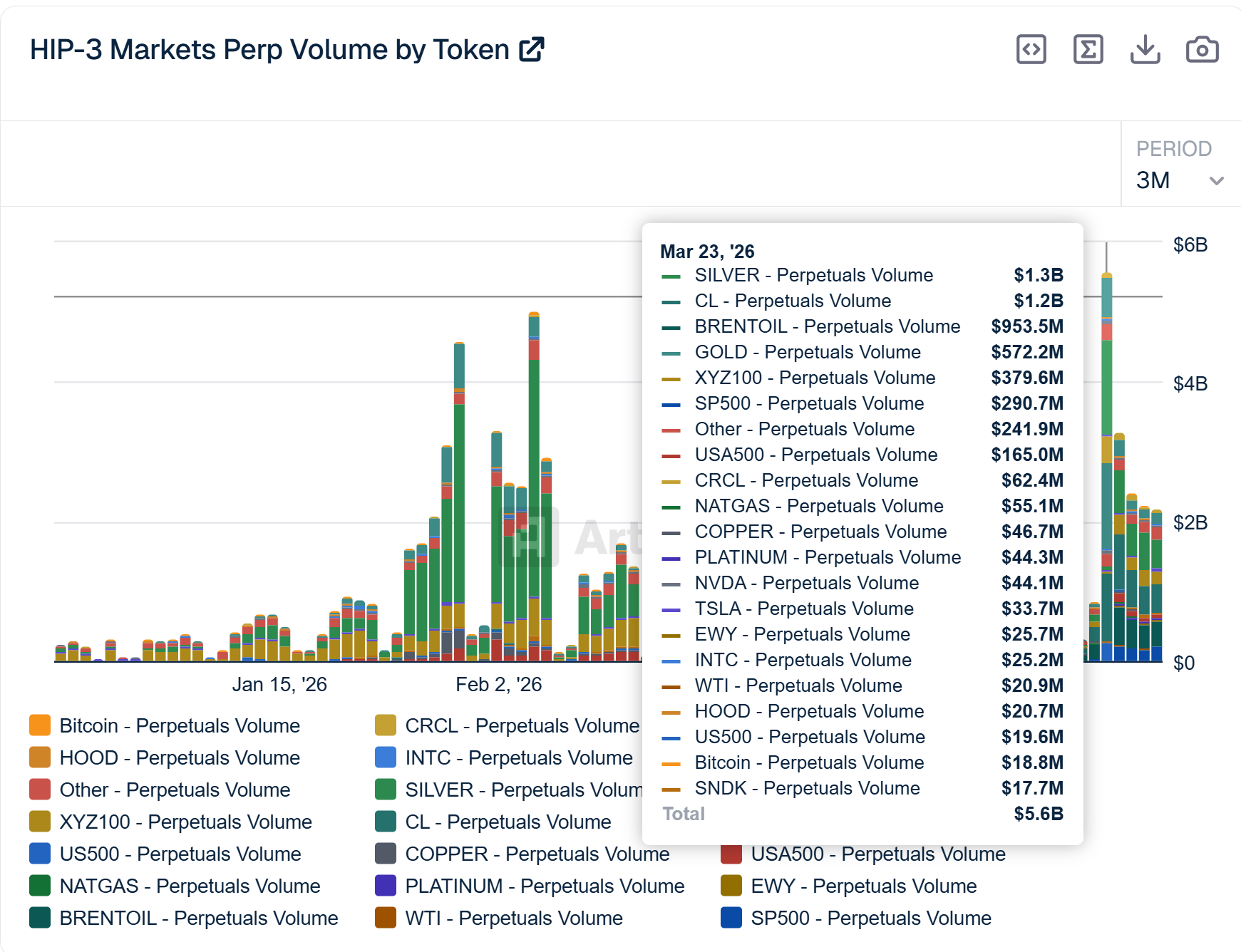
Onchain commodity trading is proving it’s more than a short-term spike, but limited liquidity continues to hold the market back from competing with traditional venues.
Hyperliquid’s HIP-3 market recorded a new all-time high on March 23, with roughly $5.4 billion in perpetual futures volume across commodities and macro assets. Silver led the activity at $1.3 billion, followed by WTI crude oil at $1.2 billion, Brent crude at $940 million and gold at $558 million. Equity indices, including the Nasdaq and S&P 500, also saw notable volumes.

Industry participants say the spike shows growing demand for macro exposure onchain. “Previously, onchain commodity futures were mostly a venue for crypto-native investors, that is no longer the whole story,” said Iggy Ioppe, chief investment officer at Theo. “The real tell is not just the volume, it’s when the volume shows up and who is showing up to trade.”
Ioppe noted that onchain oil futures markets are now processing more than $1 billion in daily volume over weekends, when traditional exchanges are offline. He said the shift is being driven in part by individual traders from traditional finance, who are accessing these markets through personal accounts. “Geopolitics does not stop on Friday afternoon, and markets are starting to adapt to that fact,” he said.
Related: S&P Dow Jones licenses S&P 500 perpetual futures for Hyperliquid
Weekend gap gives onchain markets an edge
The ability to trade around the clock has emerged as a defining advantage for onchain venues. With a roughly 49-hour gap between the close of traditional markets on Friday and their reopening on Sunday, decentralized platforms have become one of the few places where traders can react to macro developments in real time.
That dynamic is starting to influence how prices are formed outside regular trading hours, even if the bulk of liquidity still sits in traditional markets. “For now, onchain is the price discovery layer when the rest of the market is asleep,” Ioppe said. “TradFi is still the depth layer when size matters most.”
On the CME, oil futures alone regularly see between 1 million and 4.5 million contracts traded daily, equivalent to roughly $100 billion to $300 billion in notional volume.

“Traditional venues still dominate when it comes to liquidity, execution quality, and institutional-scale pricing depth,” Sergej Kunz, co-founder of 1inch, said. He noted that deeper liquidity and tighter spreads remain the main barrier. Without them, onchain markets struggle to handle large trades without moving prices, limiting institutional participation.
Additional challenges include pricing reliability, market structure maturity and regulatory clarity, according to Shawn Young, chief analyst at MEXC Research.
Young said commodity tokenization shows “signs of real behavioral changes” but remains in an early phase, with gaps in liquidity and price aggregation still to be addressed.
Related: Perp DEXs become the latest battleground for blockchains
Onchain macro trading expands beyond commodities
Despite certain constraints, activity continues to build. “The broader direction is clear: traders are becoming more comfortable accessing macro-style exposure onchain,” Kunz said.
Gold and oil have led the current wave, but market participants expect similar patterns to emerge in other asset classes as volatility shifts.
Ioppe concluded that trading activity on onchain futures markets is likely to persist as trust builds around weekend pricing. As more traders begin to rely on these markets during off-hours, volume starts to follow. That, in turn, supports growing open interest, reinforcing confidence in the prices being formed. Over time, this creates a self-reinforcing cycle, where higher participation strengthens market credibility and draws in even more flow.
Magazine: Bitcoin’s ‘biggest bull catalyst’ would be Saylor’s liquidation — Santiment founder

Key Takeaways
- Jefferies identifies Coca-Cola’s fairlife protein line as a major catalyst for future growth
- Production capacity for fairlife is projected to jump 25% throughout 2026, unlocking new distribution opportunities
- The fairlife brand may boost North American organic revenue by more than 2% in 2026 alone
- Four out of five Wall Street analysts maintain positive ratings on KO with an $86 average target
- Warren Buffett’s Berkshire Hathaway generates approximately $848 million yearly from KO dividends
Coca-Cola (KO) shares are currently hovering in the mid-$70 range, registering approximately 12% growth year-over-year, despite experiencing a modest 6% decline during the last 30 days.
Jefferies has positioned Coca-Cola among its premier selections within the protein sector, emphasizing fairlife as the primary catalyst. According to the firm, consumers are increasingly gravitating toward accessible, economically viable, protein-dense products — a trend that fairlife capitalizes on effectively.
The investment bank projects that Coca-Cola’s extensive distribution infrastructure will accommodate a 25% surge in fairlife production capacity during the current year. This expanded manufacturing capability should enable deeper penetration into convenience retail locations and food service establishments, channels that represent significant growth opportunities for the brand.
From a financial perspective, Jefferies anticipates fairlife will add upward of 2 percentage points to Coca-Cola‘s North American organic revenue expansion in 2026. This impact is projected to strengthen by an additional percentage point when 2027 arrives.
Collectively, the analyst firm maintains that fairlife positions Coca-Cola to achieve its published organic sales growth target range of 4% to 6% annually.
Broad Analyst Support for KO Stock
Jefferies represents just one voice in a broader chorus of support. According to data compiled through March 24, 2026, approximately 80% of equity analysts tracking Coca-Cola maintain optimistic ratings. The collective price target stands at $86, suggesting potential appreciation exceeding 15% from present trading levels.
Morgan Stanley analyst Dara Mohsenian recently reaffirmed his bullish stance on Coca-Cola with an $87 valuation target. His confidence stems from robust 2026 earnings projections, resilient demand throughout North America, and fairlife’s continued market penetration.
Bank of America Securities similarly maintains a Buy recommendation alongside an $88 price objective.
The stock has retreated approximately 3% to 4% during the most recent trading week. Nevertheless, the prevailing Wall Street sentiment remains largely unchanged.
Berkshire’s Coca-Cola Position Generates Massive Dividend Flow
Warren Buffett’s Berkshire Hathaway has maintained ownership of 400 million Coca-Cola shares since the early 1990s. In 1994, Berkshire received approximately $75 million annually in dividend payments from this holding. Currently, that annual distribution has expanded to roughly $848 million.
Coca-Cola boasts an impressive 64-year streak of consecutive dividend increases, securing its designation as a Dividend King. The stock currently offers a yield approaching 3%, though Berkshire’s yield calculated against its original investment basis now exceeds 60%.
This exceptional dividend history explains why KO continues attracting income-oriented investors, particularly during periods of market turbulence.
Based on assessments from 15 analysts, the consensus rating classifies the stock as a Strong Buy, with a mean price target of $85.07.


Advocates warn that failing to pass the CLARITY Act could leave the door open for a future, less industry-friendly US government to crack down on crypto policies, according to Peter Van Valkenburgh, executive director of Coin Center.
In a Friday post on X, Van Valkenburgh argued that rejecting protections for developers in legislation like the CLARITY Act and the Blockchain Regulatory Certainty Act in favor of “short-term business interests” could lead to a grim future for the industry.
“The point of passing CLARITY is not to trust this administration. It is to bind the next one,” he said, adding that “A world without CLARITY’s statutory protections for developers is a world governed by prosecutorial discretion, political fashion, and fear.”
The CLARITY Act stalled in the Senate after banks, crypto firms, and lawmakers failed to agree on key provisions — including whether to allow stablecoin yields. The bill covers a range of measures, including frameworks for registering crypto intermediaries, regulating digital assets and classifying tokens.
During the previous administration, former SEC Chair Gary Gensler drew heavy criticism from the crypto industry for allegedly crafting policy through enforcement actions and legal settlements with crypto firms rather than formal rulemaking.
Nothing set in stone without legislation
Van Valkenburgh also predicts that, without legislative clarity, a future administration’s Department of Justice could ramp up prosecutions of privacy-tool developers as unlicensed money transmitters, and that existing regulatory interpretive guidance could be revoked.
Related: Crypto investor sentiment will rise once CLARITY Act is passed: Bessent
Since Gensler resigned on Jan. 20, 2025, crypto proponents have noted a regulatory shift by the SEC, including the dismissal of several long-running enforcement actions against crypto firms and friendlier guidance on how the agency will treat crypto.
“If we lose this moment because we thought we’d have a bit more revenue and a bit more latitude under the short-term friendly discretion of the current administration, then we lose our way,” Van Valkenburgh said, urging supporters to press for statutory protections that withstand political change.

BNP Paribas is expanding its investment lineup in France by launching six crypto-linked exchange-traded notes (ETNs) that track the prices of Bitcoin and Ether. The regulated notes will be available to retail clients from Monday through standard securities accounts and Hello bank!, the group’s digital platform, with a potential extension to wealth-management clients outside France in the future.
According to the bank, these ETNs provide a regulated way to gain exposure to crypto price movements without owning the underlying assets. They are described as carrying issuer credit risk (if BNP Paribas were to fail, investors could lose money), but offer no tracking error and certain tax advantages compared with direct crypto ownership. The move underscores BNP Paribas’ broader push into digital assets and its ongoing exploration of blockchain-enabled finance.
Key takeaways
- BNP Paribas launches six crypto-linked ETNs in France, tracking BTC and ETH, accessible via standard securities accounts and Hello bank!.
- ETNs provide regulated crypto price exposure without direct asset ownership, but entail issuer credit risk and potential tax advantages relative to holding crypto directly.
- The rollout aligns with BNP Paribas’ broader digital-asset strategy, including past milestones in tokenization and blockchain collaborations.
- European adoption of crypto-linked ETNs is accelerating, with ING Germany expanding its lineup and the UK reintroducing crypto ETNs to retail investors after regulatory changes.
A regulated path to crypto exposure
The six ETNs are indexed to Bitcoin and Ether, offering investors a way to track the digital assets’ price movements without custodying the coins themselves. BNP Paribas stated the notes will be available from Monday via standard securities accounts and Hello bank!, and the offering is open to individual investors, entrepreneurs, private banking clients and Hello bank! users. The bank indicated the rollout could later extend to wealth-management clients outside France.
BNP Paribas framed the products as a regulated gateway to crypto exposure, contrasting with direct purchases from crypto exchanges. While ETNs carry issuer credit risk—a default by the issuer could impact principal—the notes are described as having no tracking error and certain tax advantages compared with holding crypto directly, according to the issuer’s description.
BNP Paribas’s broader digital-asset push
The launch sits within BNP Paribas’ broader strategy to integrate digital assets into its operations. In 2024, the bank arranged and placed Slovenia’s first digital sovereign bond, marking the European Union’s debut in blockchain-based government debt issuance. The move signaled a continued push into tokenization and blockchain-enabled finance across public and private markets.
BNP Paribas has also deepened its participation in the Canton ecosystem. The bank joined the Canton Foundation, alongside HSBC, to govern the Canton Network—a blockchain-focused initiative aimed at institutional finance and real-world asset tokenization. In parallel, BNP Paribas Asset Management supported Digital Asset’s Canton-driven initiatives and, more recently, launched a tokenized share class of a money-market fund on the Ethereum blockchain to explore fund tokenization using public infrastructure. The bank’s broader activity in tokenization extends from public networks to earlier private blockchain issuances in Luxembourg.
Europe’s growing appetite for crypto ETNs
The appetite for crypto-linked ETNs is broadening across Europe. In Germany, ING began adding new products from Bitwise and VanEck to its investment lineup, expanding access to regulated notes that provide crypto exposure through traditional channels. In the United Kingdom, crypto ETNs re-entered the retail market in October 2025 after the Financial Conduct Authority reversed a ban it had imposed in 2021, signaling a shift toward regulated access for retail investors.
As major banks expand regulated crypto offerings and public-blockchain pilots, observers are watching how these products scale beyond domestic markets and how evolving regulatory guidance shapes investor protections, tax treatment, and product design. The path forward will likely hinge on issuer risk management, cross-border distribution, and the degree to which traditional financial infrastructure can accommodate evolving crypto assets at scale.
Keep an eye on whether BNP Paribas expands the ETN rollout beyond France, how European regulators refine rules around crypto-linked notes, and what these developments imply for wider adoption of regulated crypto access across the region.

Key Highlights
- Johnson & Johnson (JNJ) delivers a 2.17% yield with a conservative 47% payout ratio and an impressive 64-year dividend growth history
- Procter & Gamble (PG) boasts the longest dividend increase streak among the group at 70 consecutive years, offering a 2.96% yield
- Coca-Cola (KO) receives unanimous positive analyst coverage — achieving a Buy rating without any hold or sell recommendations
- Exxon Mobil (XOM) stands as the sole Hold-rated stock with a sell rating, highlighting concerns about its exposure to volatile commodity markets
- Walmart (WMT) features the group’s lowest yield at 0.81% but maintains the most sustainable payout ratio of 36%, offering significant dividend expansion potential
Among the most popular dividend-generating equities available to investors are Johnson & Johnson, Procter & Gamble, Exxon Mobil, Coca-Cola, and Walmart. Each presents a unique value proposition for income-focused portfolios — varying in yield percentages, financial stability, and sector-specific risks. Below is a detailed examination of these five stocks using current MarketBeat analytics.
Johnson & Johnson
Johnson & Johnson provides shareholders with a 2.17% dividend yield while maintaining a payout ratio of 47.06%. With the payout ratio remaining under the 50% threshold, the pharmaceutical and consumer health giant distributes less than half of its earnings to shareholders. The company has consistently increased its dividend for 64 straight years.
According to MarketBeat consensus data, the stock receives a Moderate Buy rating, comprised of 1 strong buy recommendation, 17 buy ratings, and 9 hold ratings. Notably, zero analysts recommend selling. Wall Street views it as a reliable blue-chip investment, though price target analysis indicates modest near-term appreciation potential.
For those prioritizing dividend income, the pairing of a below-50% payout ratio with six decades of uninterrupted growth represents an exceptional combination rarely found in today’s markets.
Procter & Gamble
Procter & Gamble delivers a 2.96% yield to shareholders while operating with a payout ratio of 62.52%. The consumer goods titan has achieved 70 consecutive years of dividend increases — establishing the longest track record among these five companies.
The Procter & Gamble Company, PG
MarketBeat data shows a Moderate Buy consensus supported by 13 buy recommendations and 8 hold ratings. The stock currently has no strong buy or sell ratings assigned by analysts.
The remarkable 70-year dividend growth streak positions it as an ideal holding for investors seeking reliable, long-term income generation. Analysts acknowledge its predictable performance but generally classify it as a stable compounder rather than a high-growth opportunity.
Exxon Mobil
Exxon Mobil currently yields 2.41% with a payout ratio of 61.58% and has delivered 42 consecutive years of dividend growth. As the sole energy sector representative in this analysis, it faces greater volatility tied to oil and natural gas price fluctuations compared to its consumer-focused counterparts.
MarketBeat assigns Exxon a Hold consensus reflecting 9 buy ratings, 9 hold ratings, and 1 sell rating. This represents the most tepid analyst enthusiasm among the five stocks examined.
While the dividend track record spans more than four decades, the inherent cyclicality of energy sector earnings introduces uncertainty that the remaining four companies largely avoid.
Coca-Cola
Coca-Cola offers a 2.80% yield with a payout ratio of 69.74% and 64 years of uninterrupted dividend increases. Its payout ratio matches Procter & Gamble as the highest in this comparison, though it remains within acceptable parameters for dividend sustainability.
The beverage giant enjoys exceptional Wall Street support. MarketBeat data reveals a Buy consensus featuring 1 strong buy and 15 buy ratings. Remarkably, zero analysts assign hold or sell ratings — representing the most unified positive sentiment in this entire group.
This universal analyst backing underscores Coca-Cola’s standing as a straightforward, resilient dividend investment that consistently delivers predictable results to shareholders.
Walmart
Walmart presents the group’s lowest yield at merely 0.81%, yet it simultaneously maintains the lowest payout ratio at 36.13%. The retail behemoth has increased its dividend for 53 consecutive years.
MarketBeat assigns Walmart a Moderate Buy consensus derived from 1 strong buy, 30 buy ratings, and 4 hold ratings — representing one of the broadest positive analyst coverages in this analysis. No sell ratings exist.
The exceptionally low payout ratio provides Walmart with substantially greater flexibility for future dividend growth compared to many established dividend payers. The investment thesis centers less on immediate income generation and more on dividend security and long-term growth trajectory.
Final Thoughts
Johnson & Johnson and Procter & Gamble emerge as the most well-rounded selections, delivering an optimal combination of current yield, disciplined payout management, and extensive dividend growth histories. Coca-Cola captures the most favorable analyst sentiment across Wall Street. Exxon carries elevated risk due to energy sector volatility and remains the only stock receiving a Hold consensus alongside a sell rating. Walmart completes the analysis with the most conservative payout structure, prioritizing dividend sustainability over immediate yield generation.

The World Foundation, the organization supporting the digital identity project Worldcoin (WLD), has completed a $65 million over-the-counter (OTC) token sale.
According to a March 28 statement, World Assets Ltd, a subsidiary of the foundation, executed the block trades with four private counterparties over the past week. The transactions, with initial settlements beginning March 20, were priced at an average of $0.2719 per token.
World Foundation Sold WLD Tokens to Fund Orbs Manufacturing
The foundation stated that the off-ramped capital will be deployed toward core operational expenses. This includes intensive research and development, ecosystem expansion, and the continued manufacturing of its proprietary iris-scanning hardware, known as “Orbs.”
To mitigate immediate secondary-market impact, $25 million of the sold WLD is subject to a six-month lockup. This would restrict those specific tokens from entering circulation until late September.
However, blockchain analytics indicate this major capital raise is not an isolated event.
Data tracked by Lookonchain reveals a sustained pattern of structural divestment by World-affiliated entities. Over the past two years, the project has systematically offloaded WLD tokens through prominent market makers, including Flow Traders and Wintermute, creating a persistent overhang on the market.
This continuous supply expansion comes at a precarious time for the asset. The latest OTC sale coincides with WLD plunging to an all-time low before staging a modest recovery to its current level of approximately $0.27.
Despite this slight rebound, the token remains severely depressed. It is trading more than 97% below its peak of $11.72 reached in March 2024.
Compounding the project’s market struggles is a rapidly deteriorating regulatory environment.
Worldcoin’s core narrative centers on providing a “proof of humanness” network to combat the increasing proliferation of sophisticated AI bots online.
However, this positioning has largely failed to appease cautious regulators. As a result, regulators across the globe have consistently sounded the alarm about the mass collection and storage of biometric data.
Hence, the project continues to navigate severe legal challenges and ongoing privacy investigations in multiple international jurisdictions.
The post Sam Altman’s World Foundation Sells $65 Million in Worldcoin appeared first on BeInCrypto.

Key Takeaways
- A staggering $850 billion evaporated from the market capitalization of the “Magnificent Seven” tech behemoths within one trading week.
- Meta experienced its sharpest weekly decline since October 2025, plummeting over 11% following a major social media platform lawsuit defeat.
- Microsoft headed toward its weakest quarterly performance in 16 years, sliding 6.5% during the five-day period.
- Bitcoin trades around the $65,000 level while the S&P 500 has surrendered more than 7% year-to-date, as market participants now anticipate potential rate increases rather than cuts.
- Among the Magnificent Seven, Apple stood alone with positive weekly returns, bolstered by speculation around expanding Siri’s AI partnerships beyond OpenAI.
The world’s largest technology companies, collectively known as the “Magnificent Seven” megacap stocks, endured a devastating week that eliminated more than $850 billion from their total market capitalization. The massive selloff reverberated throughout financial markets, impacting everything from equities to digital currencies.
Meta suffered an 11% weekly plunge, marking its steepest decline since October 2025. The social media giant’s shares tumbled after a jury verdict determined both Meta and Alphabet, Google’s parent entity, were negligent in safeguarding young users on their respective platforms. Alphabet shares declined nearly 9% during the same period.
Microsoft recorded a 6.5% weekly loss. The software titan is currently tracking toward its poorest quarterly showing since the 2008 financial crisis. Technology software companies have experienced particularly acute selling pressure.
Nvidia and Amazon both experienced approximately 3% weekly declines. Tesla shares retreated nearly 2% over the same timeframe.
What Triggered the Tech Stock Selloff
Bond yields climbed significantly throughout the week as market participants incorporated expectations for elevated inflation levels, partially driven by accelerating oil prices. This shift has completely eliminated forecasts for Federal Reserve interest rate reductions. Financial markets currently assign greater probability to a 2026 rate increase than a rate decrease.
This macroeconomic backdrop proves particularly damaging for growth-oriented equities, which typically depend on accessible capital and future profit projections that diminish in value during rising rate environments.
Chip manufacturers also experienced turbulence mid-week following Alphabet’s publication of new research outlining an algorithm capable of decreasing AI memory requirements. This development hammered memory semiconductor producers including Sandisk and Micron Technology on Thursday. While both companies finished the week with losses, the sector experienced partial recovery Friday.
The S&P 500 has now surrendered over 7% since the beginning of the year. The Nasdaq has entered correction territory. The VIX volatility index, commonly referred to as Wall Street’s fear gauge, surpassed 30 — reaching its highest reading in twelve months.
Cryptocurrency and Traditional Safe Haven Performance
Bitcoin currently hovers around $65,000, significantly beneath its previous peak levels. Gold has similarly retreated approximately $500 from its January all-time high.
The current market landscape has provided investors with limited refuge options. International equity markets are also trailing their domestic counterparts.
Torsten Sløk, chief economist at Apollo, expressed his belief that markets are demonstrating excessive reaction and predicted the current turbulence should persist for approximately four to six weeks before conditions normalize. Keith Lerner, chief investment officer at Truist Wealth, advised clients this week that “measured cash deployment is warranted.”
Apple emerged as the sole positive performer among the Magnificent Seven, concluding the week with modest gains. Reports surfaced suggesting the technology giant plans to expand its Siri voice assistant platform to accommodate AI services beyond its existing OpenAI partnership.
As of the latest market close, the S&P 500 registered 6,368, representing a 1.67% Friday decline.

Key Takeaways
- Analysts project the worldwide unmanned systems market will surge to $250 billion by 2035, compared to $40 billion currently
- Barclays describes this transformation as “Physical AI” — where defense firms increasingly resemble technology enterprises
- Investment firm Needham & Company identified six drone-related equities positioned to capitalize on an “unmanned supercycle”
- Featured firms include AeroVironment, Red Cat, Ondas, Draganfly, Amprius, and Unusual Machines
- Market expansion hinges on artificial intelligence infrastructure investment, power grid capacity, and rare earth element availability
The worldwide unmanned aerial vehicle sector has experienced exponential expansion, doubling its valuation within a five-year window, and financial analysts indicate this represents merely the beginning stages. Recent research from Barclays positions the current market value above $40 billion in 2025, marking a substantial increase from approximately $20 billion recorded in 2020, with forecasts extending to $250 billion within the next decade.
The financial institution characterizes this evolution as “Physical AI” — representing the convergence of artificial intelligence capabilities with unmanned flight platforms. This transition is fundamentally reshaping the operational focus of defense industry participants. Traditional hardware manufacturing is giving way to software development, computational infrastructure, and autonomous decision-making architecture.
Barclays research teams observe that this transformation positions drone manufacturers closer to technology sector enterprises than conventional military contractors. Initial capital expenditures concentrate heavily on AI infrastructure development, while future expansion trajectories depend on data processing facilities, electrical grid capacity, and strategic mineral access.
Individual unmanned platforms may carry price tags below $50,000, yet constructing operational frameworks capable of coordinating autonomous vehicle swarms at meaningful scale demands substantial capital allocation. Analysts identify this infrastructure development as the genuine market opportunity materializing ahead.
Unmanned aerial technology currently ranks as the technology sector’s second-largest expansion catalyst, trailing only self-driving vehicle development.
Equities Under Analyst Scrutiny
Investment banking firm Needham & Company published independent analysis identifying six corporations strategically positioned within what researchers label an accelerating “unmanned supercycle.”
AeroVironment represents among the sector’s most recognized defense drone manufacturers. The corporation produces compact tactical unmanned systems, loitering munition platforms, and autonomous technologies deployed by United States military forces and international partners. Needham anticipates robust demand for battlefield intelligence gathering and precision strike drones will maintain the company’s central market position.
Red Cat concentrates on military-specification unmanned platforms engineered for intelligence collection, surveillance operations, and reconnaissance missions. The enterprise has expanded manufacturing capacity as defense procurement agencies accelerate acquisition programs. Needham identifies significant appreciation potential should major military initiatives transition from evaluation phases into widespread deployment.
Ondas maintains operations spanning both unmanned vehicle technology and wireless communication networks. Its technological platforms support infrastructure surveillance, security applications, and counter-drone operations. Needham highlights escalating worldwide demand for counter-unmanned aerial system capabilities as a primary expansion catalyst.
Draganfly engineers unmanned systems for defense sectors, security operations, and emergency response applications. The company is expanding production facilities while pursuing North American governmental procurement contracts. Needham projects the enterprise could capitalize on accelerating momentum toward domestically-sourced drone suppliers.
Amprius pursues a differentiated strategy. The corporation manufactures advanced lithium-ion battery technologies utilizing silicon anode engineering, delivering superior energy density compared to conventional battery solutions. For unmanned platforms, this translates to extended operational flight durations. As autonomous system deployment accelerates, Needham forecasts sustained demand for next-generation battery technologies.
Unusual Machines operates within the manufacturing supply chain rather than producing complete unmanned systems. The enterprise supplies critical components utilized in drone production. As governmental entities prioritize domestic sourcing requirements in defense procurement programs, Needham believes the corporation stands positioned to benefit across multiple platform categories.
Market Growth Catalysts
Barclays research personnel identify three limiting factors that will influence unmanned system market expansion velocity: artificial intelligence capital investment, electrical power infrastructure, and strategic mineral availability.
Energy demands for AI computational centers are substantial. Specialized component requirements compound these challenges. These variables will determine autonomous drone system scaling timelines throughout the coming decade.
Governmental entities worldwide are expanding defense appropriations while prioritizing autonomous system development. This procurement demand channels directly toward the enterprises Needham highlighted.
Red Cat and AeroVironment occupy the more established market segments, while corporations like Amprius and Unusual Machines represent the enabling infrastructure making large-scale drone deployment operationally feasible.
While Needham’s analysis did not specify individual price objectives in publicly released materials, the firm characterizes the current environment as representing a structural growth inflection point for the unmanned systems industry.

Key Takeaways
- Memory chip stocks tumbled approximately 10% in recent weeks, with Micron and Sandisk each declining more than 10% following Google’s TurboQuant announcement
- Google’s new TurboQuant technology promises to cut AI memory requirements by a factor of six, triggering investor anxiety
- Morgan Stanley characterizes the recent decline as a constructive correction rather than a fundamental concern
- Memory capacity has emerged as the primary constraint for AI infrastructure expansion, surpassing GPU availability
- Morgan Stanley maintains Overweight recommendations on both Micron and Sandisk with $520 and $690 price objectives
Morgan Stanley continues to back memory semiconductor manufacturers following a significant market downturn that shook investor confidence in late March.
The iShares Semiconductor ETF experienced approximately a 10% decline during the past month. Multiple factors contributed to the downturn, including valuation concerns, questions about demand sustainability, and emerging AI innovations.
On March 24, Google introduced a novel compression technology dubbed TurboQuant. The innovation reportedly slashes memory requirements for operating AI models by as much as six times. The announcement triggered widespread investor unease.
Both Micron and Sandisk experienced declines exceeding 10% in the immediate aftermath of the disclosure. Micron finished trading at $357 on March 27, though the stock maintained a 25% gain for the year-to-date period.
Morgan Stanley’s Joseph Moore challenged the negative sentiment in a research communication distributed on March 26.
Moore reaffirmed Overweight recommendations for both Micron and Sandisk. The firm’s price objectives remain unchanged at $520 and $690, respectively.
According to Moore, the selloff represents “a healthy pricing in of durability concerns” instead of indicating a fundamental transformation in market dynamics. The financial institution contends that memory manufacturers’ business strength is “more durable than the market thinks.”
Memory Capacity Emerges as Primary AI Infrastructure Constraint
Throughout the previous two years, Nvidia’s graphics processing units dominated conversations as the critical component driving AI infrastructure investments. While this remains accurate, Morgan Stanley argues that memory has evolved into the primary limiting element.
“Memory is a bottleneck, increasingly the bottleneck, to AI builds,” the research team stated. They observed that clients are now making advance payments for substantial volume commitments, indicating how constrained supply has become.
According to Moore, DRAM excess capacity has been completely absorbed. “Everywhere we look we see indications that it is a true bottleneck,” he noted.
AI’s portion of semiconductor expenditure could reach “well north of 50%,” according to the bank’s analysis. Increasing supply appears unlikely to match that intensity of demand.
Morgan Stanley’s Assessment of TurboQuant’s Impact
Morgan Stanley specifically analyzed Google’s TurboQuant announcement, arguing that market participants misinterpreted its implications.
The compression technology exclusively targets KV Cache memory, not total memory consumption. “They are just talking about KV Cache memory, not memory overall,” the firm clarified.
KV Cache typically resides in high-bandwidth memory, which represents a specialized and constrained category. Morgan Stanley characterized TurboQuant as “normal course productivity improvement,” rather than a demand-destructive breakthrough.
The investment bank doesn’t anticipate gross margins approaching 81% to persist indefinitely. However, it identifies minimal justification for near-term margin compression.
Morgan Stanley additionally highlighted robust prospects for free cash flow production from memory sector companies. The firm determined that “duration is all that matters,” and by that standard, market signals “all appear positive.”
Micron and Sandisk retained their Overweight designations as of March 26, 2026.


A new report about possible US ground action in Iran has added fresh tension to global markets.
Summary
- Washington Post said planners reviewed Iran ground raid options while Bitcoin held near $66,500 Sunday.
- Bitcoin stayed flat through Sunday trading as investors waited for traditional markets to reopen overnight.
- Officials kept diplomacy in focus even as reports outlined possible raids near Iran’s Kharg Island.
Bitcoin stayed near $66,500 on Sunday, but traders are watching whether broader risk assets react more sharply when US markets reopen.
The Washington Post reported that the Pentagon is preparing options for ground operations in Iran that could last for weeks. The planning includes Special Operations forces and conventional infantry, though it remains unclear whether President Donald Trump would approve that step.
The reported options include moves against Kharg Island and other coastal targets near the Strait of Hormuz. The report described the planning as limited raids rather than a full invasion, with US officials weighing how far to push military pressure while the war enters its fifth week.
Even with those reports, public statements from top officials still point to a diplomatic track. On March 26 that Secretary of State Marco Rubio said the war should last “weeks, not months” and that the United States could meet its goals without ground troops, even as contingency plans stay in place.
At the same time, regional diplomacy has not ended. The Associated Press reported that mediators gathered in Pakistan for talks aimed at ending the monthlong war, even as fighting continued and both sides kept pressure on key energy and security routes.
Bitcoin holds steady as traders wait for market reaction
Bitcoin showed a muted reaction over the weekend. It traded at about $66,561 on Sunday, with a narrow intraday range, after earlier war-related swings pushed the asset below $69,000 during the past week.
That price action fits a recent pattern. Earlier this month crypto markets sold off when conflict headlines intensified, while other reports this week showed Bitcoin losing ground as risk appetite weakened.

Man City seemingly know the answer to two contract calls but pivotal double decision looms

Elon Musk’s last co-founder reportedly leaves xAI

#money #haveitoldyoulatelythatiloveyou #millionairemindsetunlimited #motivation #millionaire


-
 NewsBeat4 days ago
Manchester United reach agreement with Casemiro over contract clause amid transfer speculation
-

 News Videos3 days ago
Parliament publishes latest register of MPs’ financial interests
-

 Sports6 days ago
Remo Stars and Kano Pillars Strengthen Survival Hopes in NPFL
-

 Sports6 days ago
Gary Kirsten Accuses Pakistan Cricket Board Of ‘Interference’, Mohsin Naqvi Responds
-

 Business7 days ago
No Winner in March 21 Drawing as Prize Rolls to $133 Million for Next
-

 Tech7 days ago
Give Your Phone a Huge (and Free) Upgrade by Switching to Another Keyboard
-

 Tech7 days ago
AI enters the chat: New Seattle dating app relies on tech to facilitate meaningful human connections
-

 Business3 days ago
Instagram, YouTube Found Responsible for Teen’s Mental Health Struggle in Historic Ruling
-

 News Videos6 days ago
Ch 9 Financial Management Part 1 | Detailed One Shot | Class 12 Business Studies Boards 2026
-

 NewsBeat2 days ago
The Story hosts event on Durham’s historic registers
-
 NewsBeat4 days ago
Tesco is selling new Cadbury Dairy Milk bar and people can’t wait to try it
-

 Sports6 days ago
2026 Kentucky Derby horses, odds, futures, preview, date: Expert who hit 12 Derby-Oaks Doubles enters picks
-
 Entertainment14 hours ago
Lana Del Rey Celebrates Her Husband’s 51st Birthday In New Post
-
 NewsBeat7 days ago
Update on Wisbech river crash as search for teenage boy enters fifth day
-

 Tech6 days ago
Samsung will soon let you control smart home devices from your car’s dashboard
-
 Entertainment6 days ago
Cynthia Bailey Dishes on ‘RHOA’ Season 17, Discusses Kandi
-

 Fashion5 days ago
Does It Matter What You Wear When You’re Laid Off and Looking?
-
 NewsBeat6 days ago
Colombian military plane with 110 soldiers onboard crashes following takeoff
-

 Business5 days ago
More women enter wealth management, but few in advisory roles: study
-

 Sports4 days ago
Fantasy Baseball Week 1 Preview: Top sleeper hitters for both five- and 12-day period led by Munetaka Murakami
You must be logged in to post a comment Login